 Valentina Rojas
One couple who do not arrive at 8:30pm on Valentine's night can cost a restaurant a whole evening's spend from that table, and a deposit rule written in a hurry can turn the loss into a dispute.
Treat Valentine's Day 2027 as a fixed-capacity event: Sunday 14 February, with Saturday 13 February the night before. Fix the sittings and the set-menu price per head, service charge included. Take a deposit or card guarantee at booking, keep it a small share of the price, and state when it is refunded before the guest pays. Send a day-before reminder and keep a waitlist for gaps. The regulator gives no percentage, so no deposit is automatically safe.
The night that only runs once
Picture a 50-seat restaurant on the second Saturday of February. Every table is a table for two. The set menu was written in December, the ingredients were ordered to the number of covers, and the rota was built around two sittings. At 8:30pm the second sitting is due. Four tables are laid for guests who have not come. There is no second Valentine's night to make the money back. A table that sits dark through the second sitting is a sale lost for good.
The public evidence is thin and mostly from vendors, and this guide labels it that way. A reservation-software vendor's blog in 2026 repeats the findings of ResDiary Evo's 2024 Hospitality Industry Report: 76% of venues were affected by no-shows in 2023, with an average of 8% of bookings going unfulfilled, and an estimated average revenue loss per venue of £3,621 across the year. Those are all-year figures, not Valentine's figures, and they are one vendor's research. No official Valentine's-specific no-show statistic was found for this research. The one concrete Valentine's number is an anecdote: in 2019 the Morning Advertiser reported that a brasserie and cocktail lounge lost close to £2,700 in revenue and wasted around £400 worth of food after no-shows, when 36 customers cancelled at the last minute or did not turn up. It is one venue in one year. It shows the scale of what a single night can lose, not an average.
The risk is not only the empty table. Three other things tend to go wrong in the same week. The set menu is priced at a round figure and the service charge is added at the foot of the bill, so the headline price the guest saw is not the price they pay. The deposit policy is written the week before, with an amount that feels sensible and no thought for whether it is fair. The first guest who loses a deposit after a family emergency can turn the policy into a public argument. And the reminders, the waitlist and the cancellation window are all improvised on the night, by phone, with a diary that does not show which tables are really free.
This guide is for a UK independent that wants to settle those questions in November rather than in February.

The calendar: Saturday 13 and Sunday 14 February 2027
Valentine's Day 2027 falls on a Sunday. Saturday 13 February is the night before. That is a planning fact computed from the calendar, and the first decision it forces is which nights carry the Valentine's menu.
| Time | Day | What it usually means for the room |
|---|---|---|
| Saturday 13 February 2027 | Saturday | The night before Valentine's, and the night most couples will treat as the celebration |
| Sunday 14 February 2027 | Sunday | Valentine's Day itself, with Monday work the next morning |
This research found no source on how demand divides between a Saturday and a Sunday Valentine's, so the split is the owner's own booking history. One vendor blog from 2023 suggested calling 13 February "Galantine's", and another from 2024 wrote about a midweek Valentine's Day. Neither gives a figure for a Sunday. The practical test is last year's diary. Look at how early the Valentine's weekend filled, how many bookings were for two, and how many of the cancellations arrived within a day of the booking.
A small kitchen is usually better served by one set menu on both nights, because it halves the number of things that can go wrong.
Decide when the diary closes for new online bookings. A cut-off such as the Thursday before gives the kitchen a final number.
Sittings and table plans for twos
The arithmetic below is for one illustrative 50-seat restaurant. Every input is illustrative, chosen to make the sums easy to follow, and the owner should replace it with the room's own numbers.
The room has 50 seats, laid as 25 tables for two. There are two sittings a night, at 6:00pm and 8:30pm. That gives 25 tables x 2 sittings = 50 bookings and 50 x 2 = 100 covers a night, or 100 bookings and 200 covers across Saturday and Sunday. At a set menu of £65 a head, a full house on food alone is 200 covers x £65 = £13,000 across the two nights, or £6,500 a night. Drinks are ignored here, and so is margin. The figures are revenue.
| Time | What happens | Table state |
|---|---|---|
| 6:00pm | First sitting seated | 25 of 25 tables booked |
| 8:15pm | First sitting finished, a stay of 2 hours 15 minutes | Tables clearing |
| 8:30pm | Second sitting seated after a 15 minute reset | 25 of 25 tables booked |
| 10:45pm | Second sitting finished | Room closes |
The 15 minutes between 8:15pm and 8:30pm is the whole margin. If the first sitting stays for 2 hours 30 minutes, every table in the room is late for the second. The lateness compounds, because there is no slack in a two-sitting night. Hold the stay to what the kitchen can deliver. A set menu served to 25 tables at once is a different kitchen problem from the same menu served over an evening, and the stay in the plan should come from a rehearsal, not from the price.
Three practical rules help a table plan for twos.
Count tables, not seats. A table for four used by a couple wastes two seats, and on Valentine's night it is easy to give a four-top to a pair because the diary showed it free. Decide which tables are for twos, and seat nobody else at them.
Stagger the first sitting. Seating all 25 tables at 6:00pm sends 25 orders to the pass together. Offering 5:45pm and 6:15pm, or splitting the room by zone, spreads the kitchen's load. The slot interval is a setting on a service, and 15, 30 and 60 minutes are the intervals the TableSpark booking engine offers.
For a restaurant on TableSpark, a service is a sitting such as Lunch or Dinner and decides when the engine takes bookings. A service carries Party min and Party max, slot length, guest lead time, book-ahead days and capacity by room or table. A sitting built around two-tops can run with a party range of one to two. On a single date, a Reservation closures and exceptions panel can close new reservations for a date or cap covers, without touching the published hours. Special-date opening hours, which are on every plan, let a changed service window show on the website for 13 and 14 February. The hours and booking rules tutorial walks through both screens.
The Valentine's set menu: what to show, and the price to show
A set menu simplifies a night with 100 bookings. Every table gets the same few courses, the kitchen preps to a count, and the bill is known when the booking is made. Many restaurants add a drinks pairing or a glass on arrival. Each add-on is another line the guest has to understand before they pay.
The price display is where a Valentine's menu most often goes wrong, because the menu is a fixed-price meal with a service charge on top.
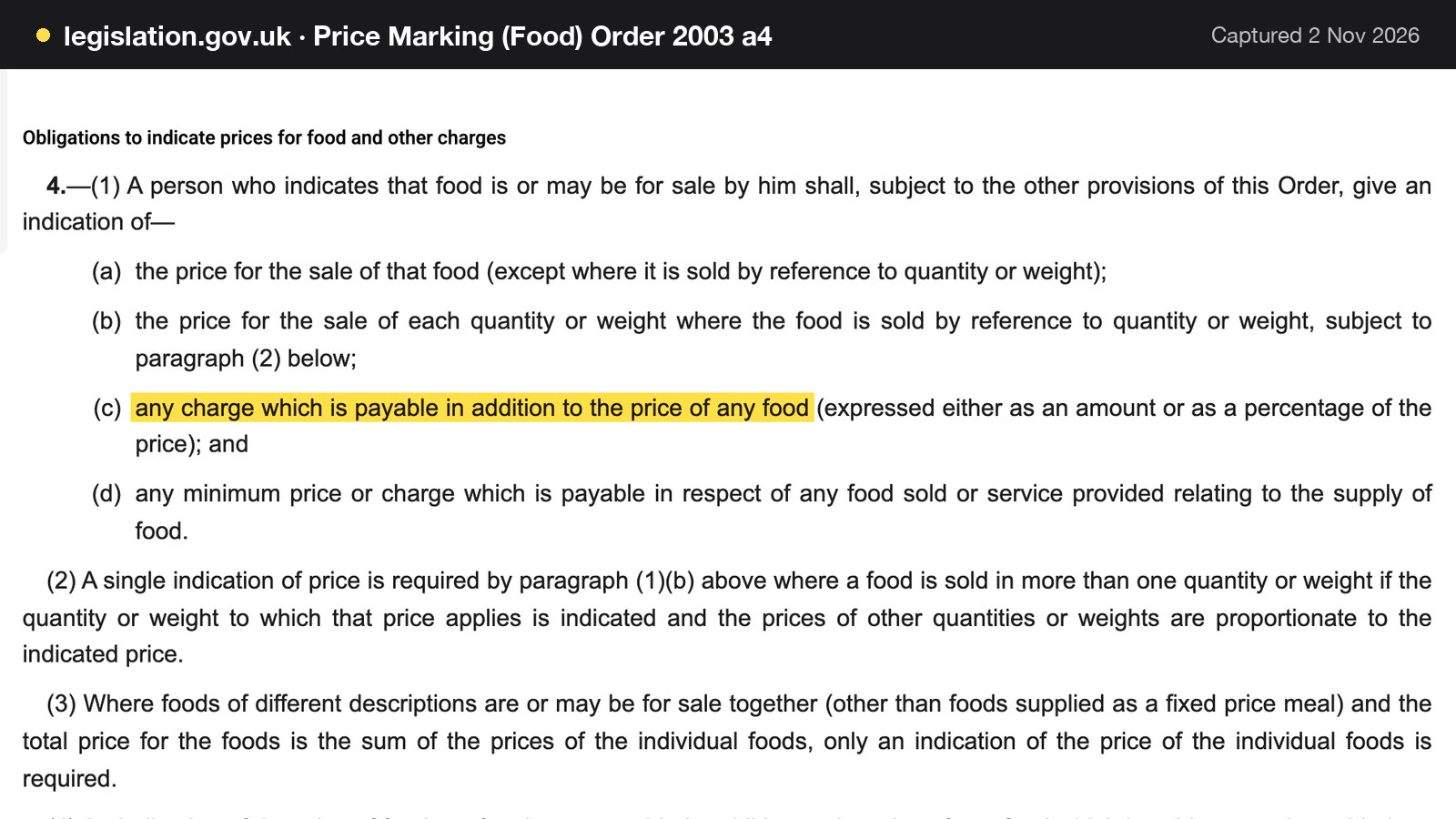
The Price Marking (Food and Drink Services) Order 2003 applies where a person indicates that food is or may be for sale by retail for consumption on any premises. Article 4(1)(c) requires the indication of "any charge which is payable in addition to the price of any food (expressed either as an amount or as a percentage of the price)", and article 5 lists "Foods of different descriptions for sale together as a fixed price meal", so a set menu needs its price shown for each fixed price meal. Article 4(4) says a price or charge that is subject to VAT shall be inclusive of the tax.
The Competition and Markets Authority's price transparency summary (CMA209) adds a second reading. It says "The total price should normally include any unavoidable or 'mandatory' charges. Providing them separately will not normally be enough to comply with the law." It defines a charge as mandatory "if the customer must pay it to buy the product".
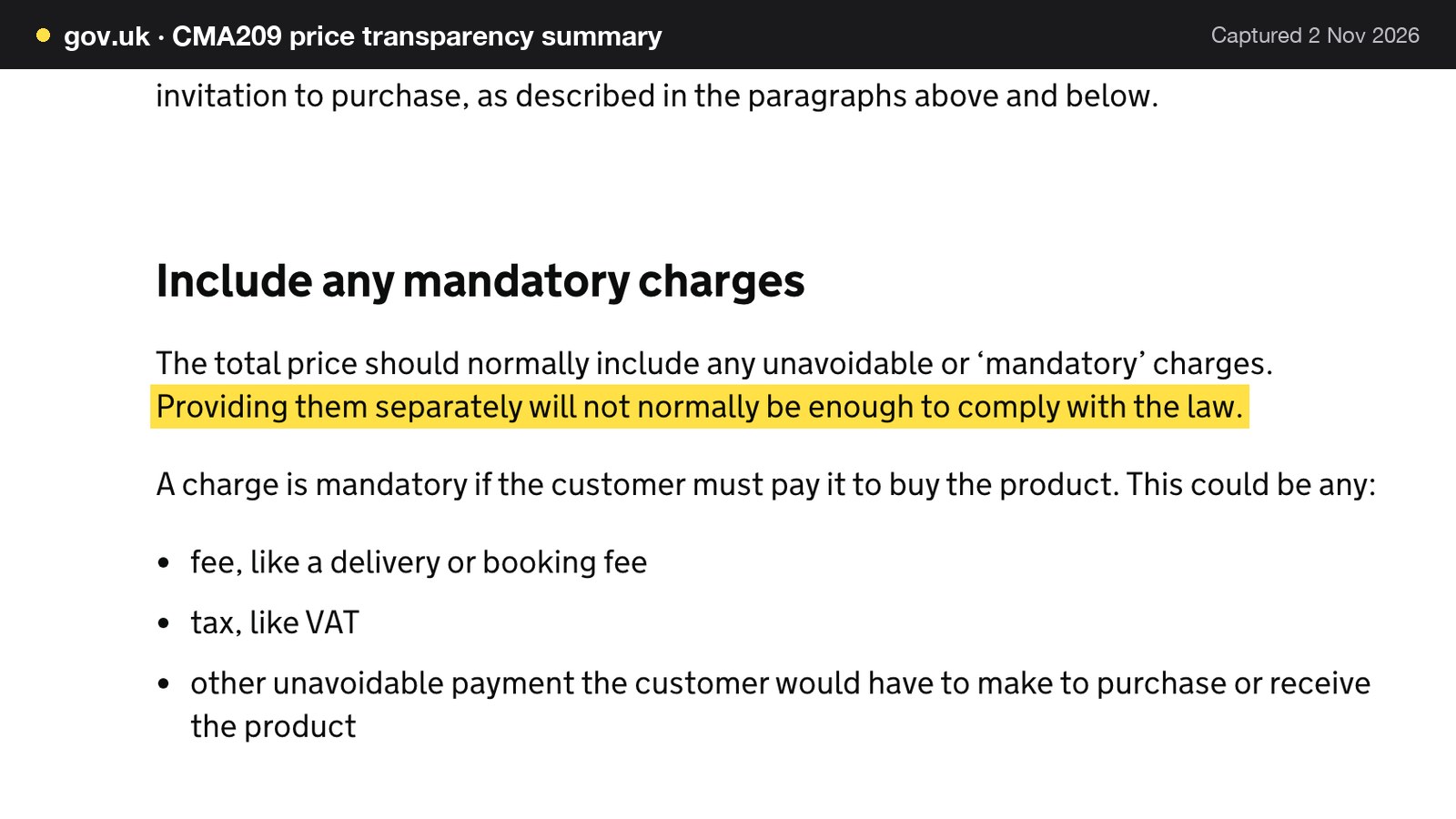
That page does not mention restaurants or service charge. It is this guide's reading, not the CMA's words, that a compulsory service charge fits the page's own definition of a charge the customer must pay, so the safe course is to show it in the price the guest first sees. A voluntary service charge, worded as optional, is a different thing.
Here is the arithmetic for a set menu at £65 a head with a compulsory service charge of 12.5%, a rate chosen for the example and not a legal figure.
| Working | Result | |
|---|---|---|
| Set menu, one guest | Shown inclusive of VAT | £65.00 |
| Service charge at 12.5% | 12.5% x £65.00 = £8.125 | £8.13 |
| Price to show, one guest | £65.00 + £8.13 | £73.13 |
| Price to show, a couple | 2 x £73.13 | £146.26 |
| Deposit at £20 a head | 2 x £20 | £40 per booking |
| Balance at the table, deposit credited | £146.26 - £40 | £106.26 |
The couple's price is £146.26 because each guest's service charge is rounded to the penny first; the unrounded figure is 2 x £73.125 = £146.25. Pick one way to round and use it on the booking page, the menu and the bill. The point of the table is that the figure to show is £73.13 a head, or £146.26 for two, not £65 a head with a footnote.
The rest of the menu design is judgement rather than law. Two or three choices per course keep the stay predictable, and a cut-off for dietary requests on the booking page gives the kitchen its numbers.
Deposits, card guarantees and prepaid tickets
A deposit pays something at booking; a card guarantee holds the card and charges nothing unless the team marks a no-show and confirms it. A prepaid ticket asks the whole price in advance. This section covers the law, then the money.
This is a summary of public law and official guidance as published on 2 November 2026, not legal advice; check the current position, or take advice, before acting on a specific case.
No cooling-off for a table on a fixed date
Regulation 28(1) of the Consumer Contracts (Information, Cancellation and Additional Charges) Regulations 2013 begins "This Part does not apply as regards the following", and paragraph (h) lists "the supply of accommodation, transport of goods, vehicle rental services, catering or services related to leisure activities, if the contract provides for a specific date or period of performance." A booking for dinner on 14 February is a contract for catering on a specific date, which is the kind of contract that paragraph describes, so the cancellation right in that Part is not available for it on the regulation's own words. Whether a particular booking fits is a point for the restaurant's adviser.
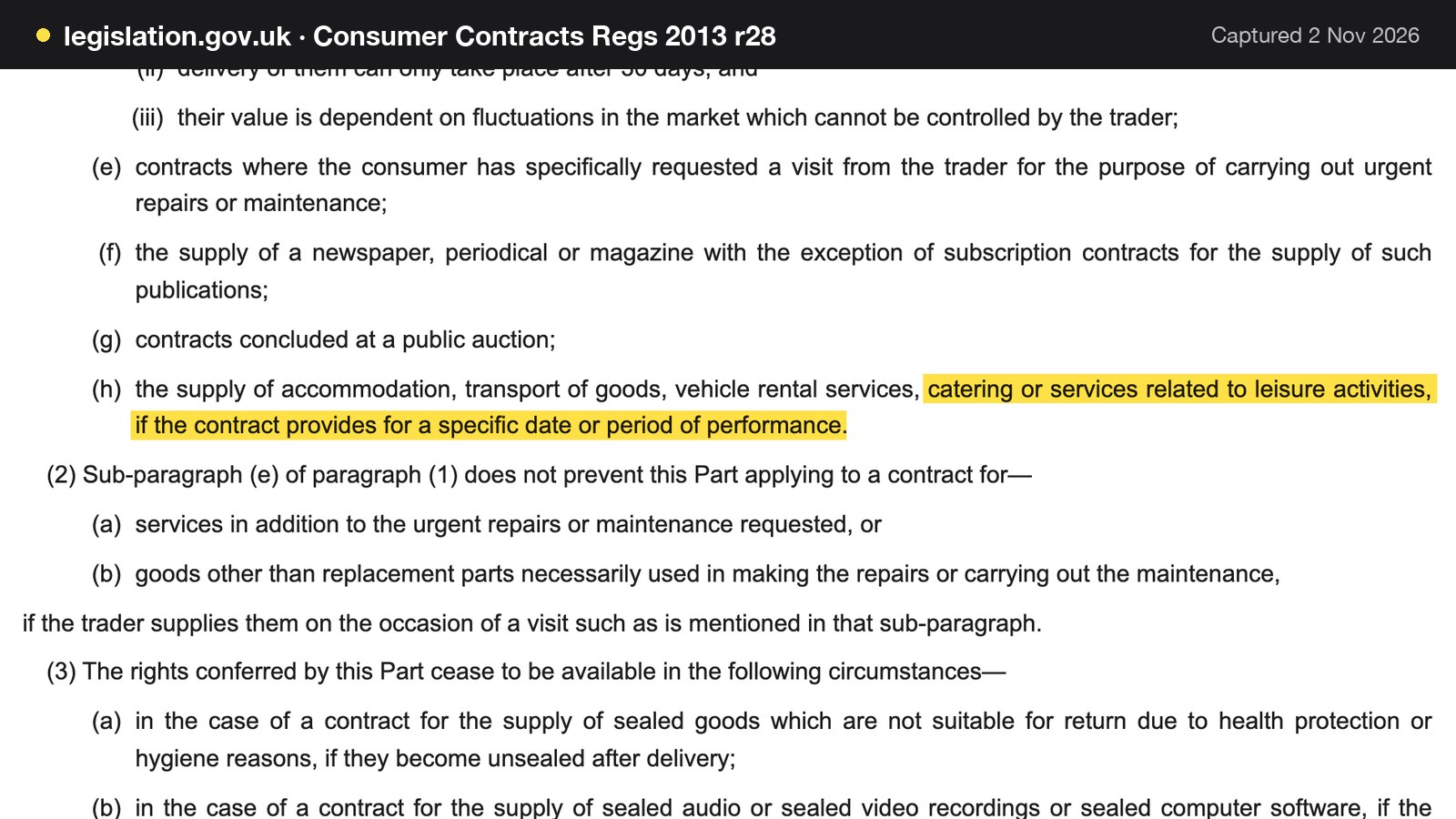
That exception removes a right to cancel. It does not regulate deposits and it does not license any deposit. The fairness of the deposit is a separate test.
What the fairness test says
The CMA's unfair contract terms guidance (CMA37) is a PDF, so it is quoted in prose. Paragraph 6.60 says "A term which makes any substantial prepayment entirely non-refundable, regardless of the circumstances or the amount of costs and losses caused by termination, potentially allows the trader to make an unjustified gain and is more likely to be unfair." Paragraph 6.62 says "A genuine deposit may legitimately be kept in full as long as it operates as a binding reservation and the trader makes clear to the consumer at the earliest opportunity that a deposit is required, and the precise circumstances in which it would be non-refundable." It goes on: "Those circumstances must be clear and narrow, so that the trader does not have wide discretion to retain the deposit. But such a deposit will not normally be more than a small percentage of the price. A larger prepayment is more likely to be unfair as it may amount to a disguised penalty."
It also says terms are more likely to be fair where the consumer is at fault for ending the contract and the trader retains sums "reasonably needed to cover either their unavoidable net costs or the net loss of profit resulting directly from the default."
Read together, those lines give four working tests: a small share of the price, told to the guest before they pay, kept only in narrow circumstances, and not so large that it looks like a penalty. The guidance gives no figure for "a small percentage", so the next section puts numbers beside the question and leaves the judgement to the owner.
Prepaid tickets and what they change
A fully prepaid ticket, where the whole £130 for a couple is taken at booking and kept on a no-show, is the strongest commitment a restaurant can ask for and the one the 6.60 line bears on most directly. A deposit credited against the bill, with a stated refund window, asks for less and sits closer to the "genuine deposit" language, which is why this guide works through deposits and card guarantees.
How much is a small percentage of £65?
The table below shows a per-head deposit as a share of a £65 menu. It is arithmetic, not a ruling. A per-head fee of "typically £10 to £25 depending on your menu price point" is what a 2026 vendor guide suggests, and that is vendor opinion, not a rule.
| Per couple | Share of the menu price | |
|---|---|---|
| £5 | £10 | 7.7% |
| £10 | £20 | 15.4% |
| £15 | £30 | 23.1% |
| £20 | £40 | 30.8% |
| £25 | £50 | 38.5% |
| £30 | £60 | 46.2% |
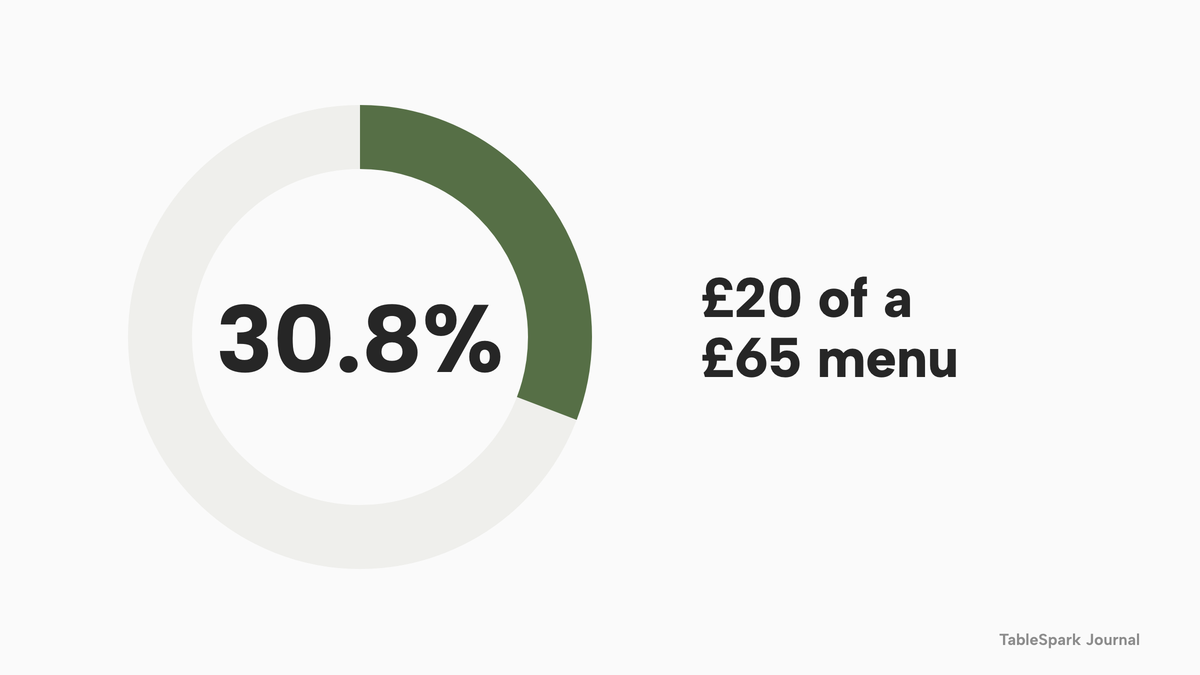
Each share is the per-head deposit divided by £65: £10 / £65 = 15.4%, £20 / £65 = 30.8%. Neither is called safe or compliant here. A £10 deposit is half the share of a £20 deposit, which makes it easier to describe as small. A £20 deposit takes almost a third of the price before the guest has eaten. The owner decides, and writes down why. A deposit that is credited to the bill, refundable on a stated notice and kept only in clear circumstances reads more easily as a genuine reservation deposit than a flat sum kept in every case.
The cancellation terms to write down
Write the terms before the diary opens, in plain words, on the booking page and in the confirmation email. A usable policy has five lines.
- What is taken at booking, and whether it is a deposit or a card guarantee.
- That the deposit is credited to the bill if the guest attends.
- The last moment the guest can cancel for a refund, stated as a date and time and not as "48 hours" that the guest has to count.
- What happens after that moment, and the circumstances in which the restaurant keeps the deposit or charges a no-show fee.
- What the guest gets back if the restaurant cancels.
The restaurant booking deposits guide goes deeper on the mechanics, and the no-show policy guide covers the wording for a policy that applies all year.
Deposits and card guarantees in TableSpark
On TableSpark's booking engine, any service can take a party size and an amount. Larger parties pay a deposit at the moment of booking, or leave a card on file that is charged only if the team marks a no-show and confirms it. The deposit runs from £1 to £500 per booking, and if both a deposit and a guarantee are on, the deposit takes priority. The thresholds run from 1 to 99, and the tutorial's example is that a threshold of 6 means parties of 7 and up. Set the threshold for the Valentine's service, then confirm with a test booking for two that the deposit fires. A booking waiting on payment shows Awaiting deposit or Awaiting card.
The amount is per booking and not per head. For a service built around tables for two, a deposit of £20 a head is a £40 deposit on every booking, and keeping the party range to two keeps that arithmetic honest. These deposits, guarantees and the surrounding booking tools are on Growth, at £39 a month excluding VAT, and are paid into the restaurant's own connected Stripe account.
Reminders, cancellations and the waitlist
A reminder is the cheapest no-show cure on the list, and a waitlist is the only way to resell a table that has been released late.
On TableSpark, every confirmed booking gets a confirmation and a reminder the day before, sent in the restaurant's name. Guests then change or cancel from their own account, and cancelling needs a second tap, so nobody cancels by accident.
A 2023 vendor blog for bar and restaurant operators suggested sending a reminder the day before and letting guests pre-order from a set menu. The reasoning is simple: a guest who gets a message the day before has a chance to cancel in time, and a table released at 5pm on 13 February can still be resold.
Resale needs a list to resell to. The booking engine's waitlist lets the team add a walk-in or a full-night guest to the list, with name, party size and phone, and guests can also join it from the website. One tap sends the guest a "your table is ready" email through Notify, Seat books them through the same engine, and Left removes them. The run your bookings tutorial shows the waitlist card and the booking sheet.
The sum is short. If a restaurant refills just 2 of its 8 no-show tables in the 8% case below, the recovered revenue is 2 x £130 = £260. That is illustrative, and it assumes the waitlist guests accept. The waitlist guide covers how to run one on a busy night.
A worked example: 100 bookings across two nights
The numbers below are illustrative, and every input is stated so the owner can replace it. The room is the 50-seat room above, with 25 tables for two, two sittings a night and a set menu of £65 a head. That is 100 bookings, 200 covers and £13,000 of full-house food revenue across the two nights.
| Working | Result | |
|---|---|---|
| No-shows at 8% of bookings | 100 x 8% = 8 tables | 16 covers |
| Revenue lost at 8% | 16 covers x £65 | £1,040 |
| No-shows at 20%, a stress case | 100 x 20% = 20 tables | 40 covers |
| Revenue lost at 20% | 40 covers x £65 | £2,600 |
| Share of full-house revenue lost at 20% | £2,600 / £13,000 | 20% |
The 8% case uses the all-year vendor figure and is therefore not a Valentine's number. The 20% case is a stress case chosen for a peak night. It is an assumption, not a finding. Both assume every no-show is a lost sale, with no waitlist refill and no walk-in, and both count revenue, not margin.
Now take a deposit of £20 a head, which is £40 a booking, kept on a no-show.
| Working | Result | |
|---|---|---|
| Deposits kept at 8% no-shows | 8 x £40 | £320 |
| Revenue still lost at 8% | £1,040 - £320 | £720 |
| Deposits kept at 20% no-shows | 20 x £40 | £800 |
| Revenue still lost at 20% | £2,600 - £800 | £1,800 |
| Deposits kept at £10 a head, 8% | 8 x £20 | £160 |
| Deposits kept at £10 a head, 20% | 20 x £20 | £400 |
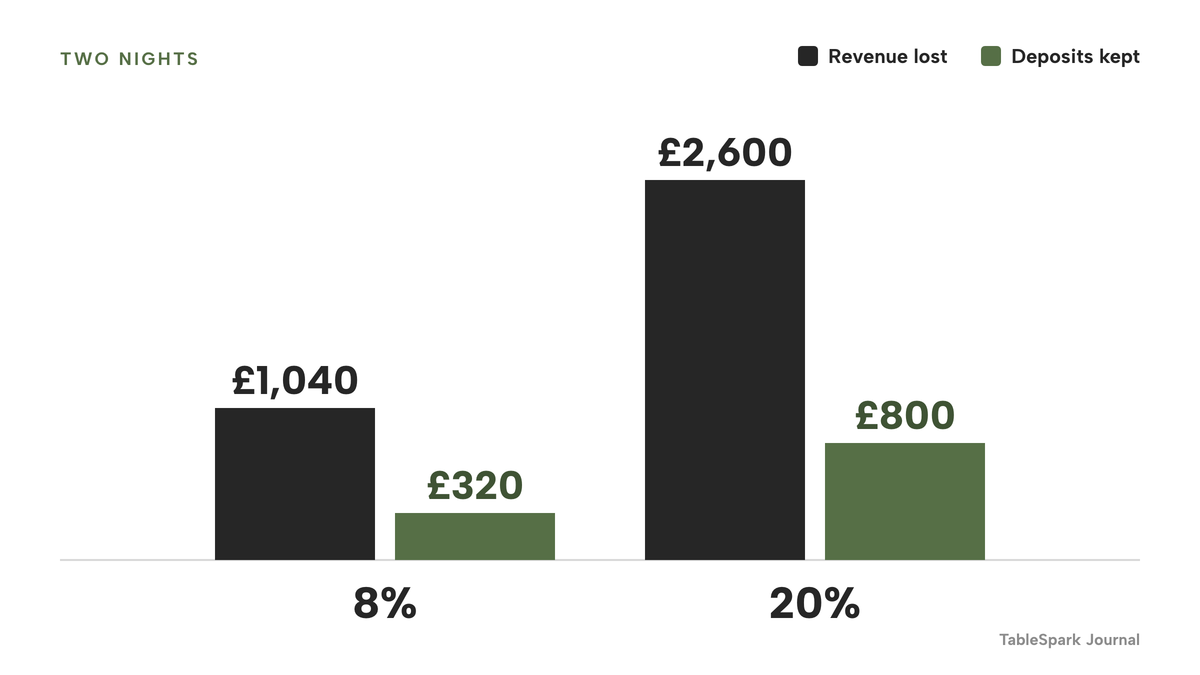
A deposit does not make the loss go away. At £20 a head it recovers £320 of £1,040 in the 8% case, or 30.8% of the loss, and £800 of £2,600 in the 20% case, also 30.8%. That share is the deposit's share of the menu price, which follows from the structure: each no-show couple pays £40 of a £130 booking. The deposit is a floor under the loss, not a cure for it. The cure is the reminder, the waitlist and the cancellation window.
Next, the cost of taking the deposit. Stripe's published UK rates are 1.5% + 20p for standard UK cards and 2.8% + 20p for premium UK cards, with a dispute received fee of £20.00. On a £40 deposit, a standard card costs 1.5% x £40 + 20p = £0.60 + £0.20 = £0.80, and a premium card costs 2.8% x £40 + 20p = £1.12 + £0.20 = £1.32. Across 100 bookings that is 100 x £0.80 = £80 on standard cards and 100 x £1.32 = £132 on premium cards, on £4,000 of deposits (100 x £40). That is 2.0% to 3.3% (£80 / £4,000 and £132 / £4,000).
| Standard UK card, 1.5% + 20p | Premium UK card, 2.8% + 20p | |
|---|---|---|
| £40 per booking, one booking | £0.80 | £1.32 |
| £40 per booking, 100 bookings, £4,000 | £80 | £132 |
| £20 per booking, one booking | £0.50 | £0.76 |
| £20 per booking, 100 bookings, £2,000 | £50 | £76 |
A £20 deposit costs 1.5% x £20 + 20p = £0.50 on a standard card and 2.8% x £20 + 20p = £0.76 on a premium card, so £50 to £76 on £2,000 (2.5% to 3.8%). A single dispute costs £20.00 whatever the deposit, so one contested £40 deposit costs half of the deposit in fees even when the restaurant wins. Whether Stripe returns the original processing fee when a deposit is refunded was not established for this research and is not assumed.
Net of the fees, the £40 deposit leaves £320 - £132 = £188 to £320 - £80 = £240 in the 8% case, and £800 - £132 = £668 to £800 - £80 = £720 in the 20% case. The fee applies to every deposit, including those credited against the bill when guests attend, so it is a cost of the policy.
The attendee side matters too. A couple who attend and paid a £40 deposit owe £130 - £40 = £90 on the food at the base price, before any service charge (the earlier table shows £106.26 once the 12.5% charge is included). Work the balance out the same way every night, and show the deposit on the bill as a credit.
Pre-orders for dietary needs and tables of six or more
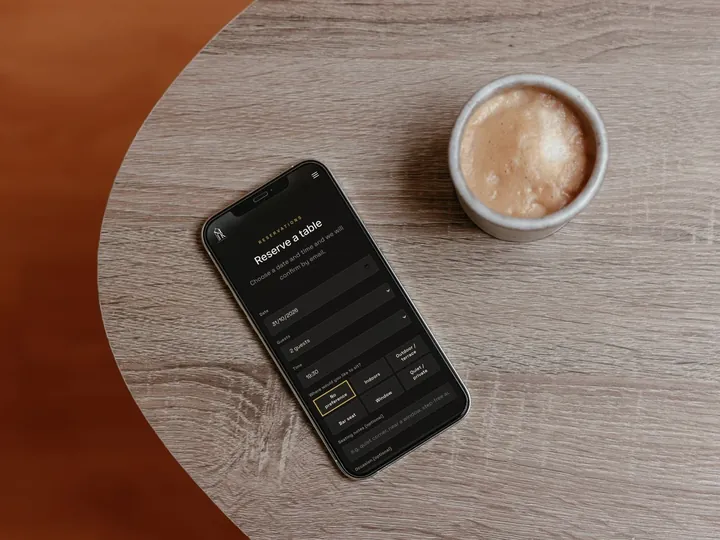
Most Valentine's bookings are for two, and a couple can tell the restaurant about an allergy when they book. The booking form on a TableSpark site asks for Date, Guests, Time, Seating preference, and Occasion and allergies, so an anniversary and a nut allergy arrive with the booking.
Not every Valentine's table is a couple. Some tables will be friends or family dining together. For six or more the group route is worth setting up. Group bookings with pre-orders and deposits are on Growth and Full. The owner sets the party size where a booking becomes a group, and each one arrives as an enquiry to confirm. For a service marked as a group service, each guest gets their own link. They give their name and allergies first, then pick one dish per course from the set menu the owner chooses. Reminders go out 7 and 2 days before the cut-off, the owner sets the cut-off, and a kitchen sheet shows dish totals that can be printed or downloaded as a CSV. A dish that contains an allergen the guest ticked is locked for them.
The take group pre-orders tutorial shows the nine steps. For a table of two, the cheaper and simpler route is the allergy field on the booking, plus a request on the confirmation to reply with any dietary need by a stated date.
Gift vouchers for the weeks before
A gift voucher is revenue that arrives before the night. A voucher for the value of the set menu for two, £130 at the example price, sold in January, is paid before the visit and spent on the night. Gift cards on TableSpark are sold on the restaurant's site or at the desk, with one balance ledger, paid to the restaurant's own Stripe account, and they are on Growth and Full. The sell gift cards tutorial walks through the ledger and the desk sale.
A voucher is not a booking. It does not hold a table, so the terms should say the holder books separately through the diary and its deposit rules. Ask an accountant about VAT on vouchers, which this guide does not cover.
A marketing email to last year's Valentine's guests
Last year's Valentine's guests are the cheapest audience a restaurant has. The rule for emailing them is in regulation 22 of the Privacy and Electronic Communications (EC Directive) Regulations 2003. The ICO guidance pages on it were not reachable when this guide was written, so the regulation itself is quoted.
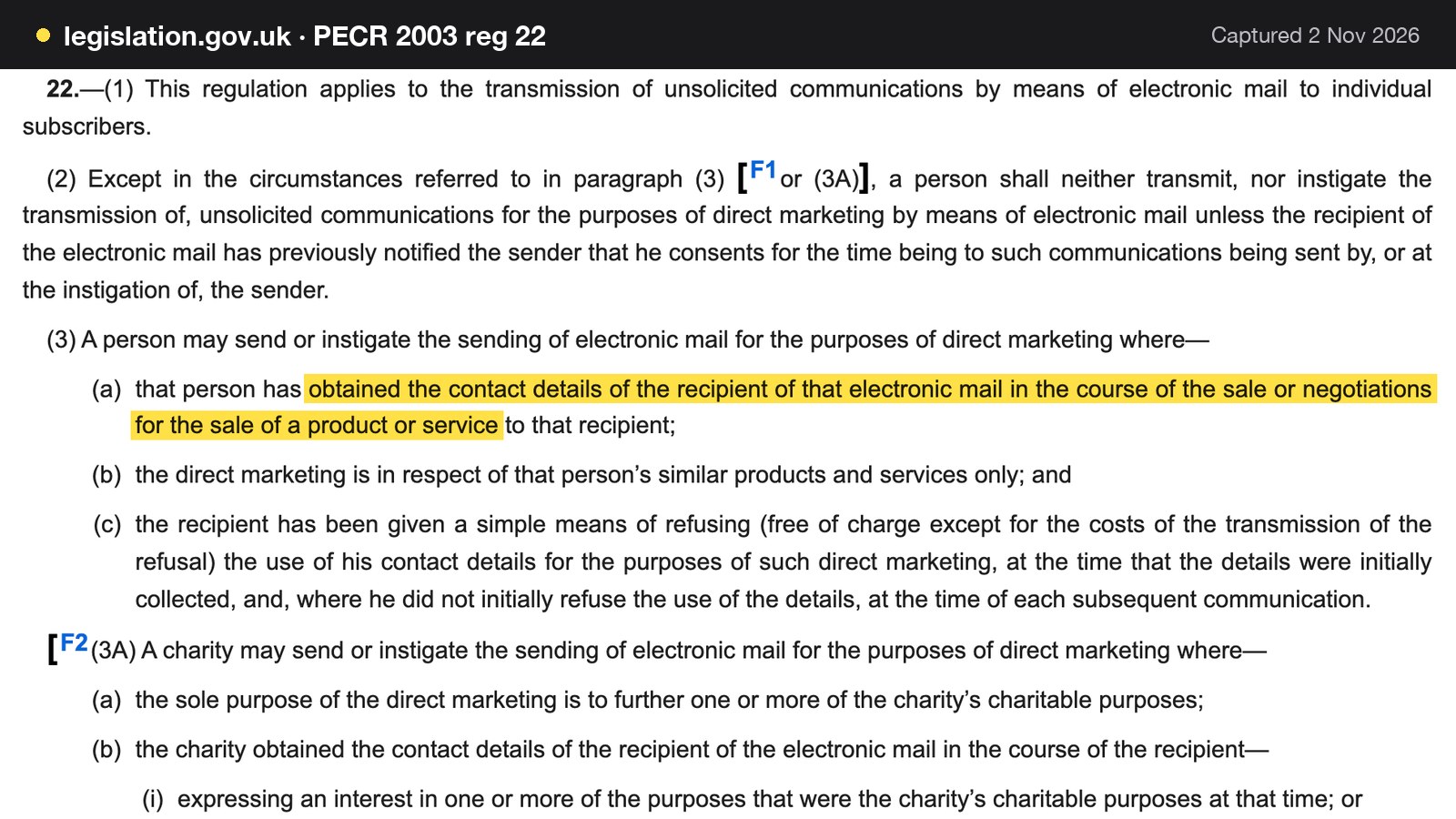
Regulation 22(2) says a person "shall neither transmit, nor instigate the transmission of, unsolicited communications for the purposes of direct marketing by means of electronic mail unless the recipient of the electronic mail has previously notified the sender that he consents for the time being to such communications being sent by, or at the instigation of, the sender." Regulation 22(3) sets out the exception, the soft opt-in, and its three conditions:
- (a) that person "has obtained the contact details of the recipient of that electronic mail in the course of the sale or negotiations for the sale of a product or service to that recipient";
- (b) "the direct marketing is in respect of that person's similar products and services only"; and
- (c) the recipient "has been given a simple means of refusing" the use of their contact details for such marketing, "at the time that the details were initially collected, and, where he did not initially refuse the use of the details, at the time of each subsequent communication."
Whether a table booking counts as a sale or negotiations for the sale of a service is a question to settle with the restaurant's own adviser, and the other two conditions need checking guest by guest. A guest who ticked a marketing box at booking has given consent, which is a separate and simpler basis. Either way, the email should be about similar services, such as this year's dinner, and every message should carry a working unsubscribe.
On TableSpark, email campaigns to consented segments are on Growth and Full, and Growth includes 5,000 marketing emails a month; booking confirmations, reminders and receipts are not counted. Segments such as regulars, VIP and win-back groups build themselves from bookings and orders. Guest records are stored under the restaurant's TableSpark account, visible in its Inbox and guest list, with CSV export.
Service charge, tips and who gets the money
A compulsory service charge on the Valentine's menu is a charge the restaurant adds. The tipping rules decide what happens to the money. The Employment (Allocation of Tips) Act 2023 and its statutory code are the reference.
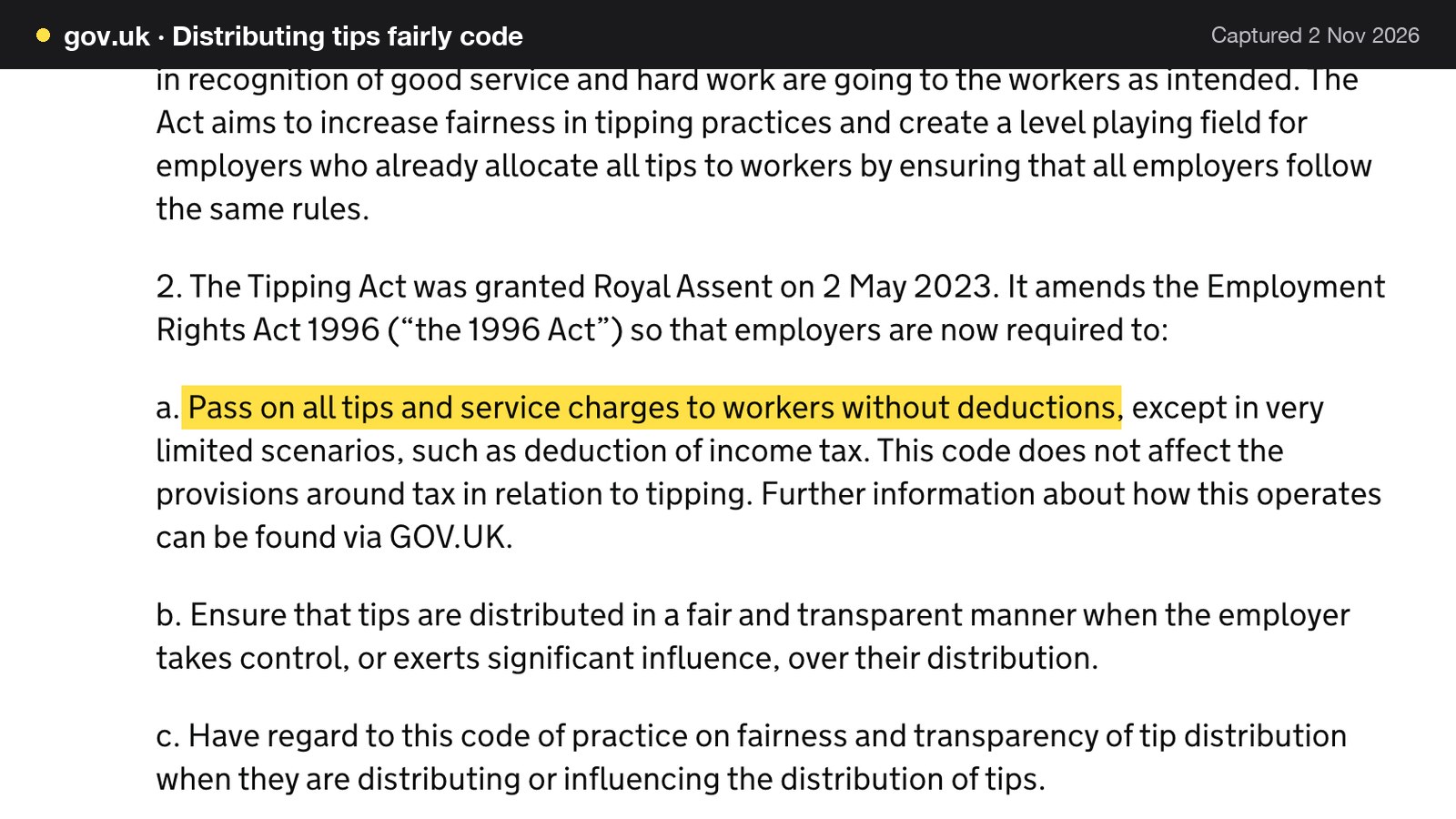
GOV.UK says the code of practice "was first published after the passage of the Employment (Allocation of Tips) Act 2023, which makes it mandatory for all tips to be passed on to workers without deductions." The GOV.UK page highlights the principle as "Pass on all tips and service charges to workers without deductions."
A revised code, published on 29 June 2026 and updated on 29 July 2026, follows the Employment Rights Act 2025. GOV.UK says it "has been withdrawn so that a new public consultation can be held on its content" and that "For now, employers should continue to follow the existing code of practice." So the existing code is the one to follow for a February 2027 service charge, and the revised code is not described here as in force.
In practice, a Valentine's service charge shown in the headline price is a decision made once. Write down what share goes to the team, how it is split, and where the record is kept, before the night and not after it.
Being found when couples search
A website can be live at a working link and still be absent from Google. Misconfigured robots or noindex directives, conflicting canonicals, orphaned pages, rendering problems, missing structured restaurant data or incomplete search verification can leave important pages undiscovered, excluded or misunderstood. For a Valentine's menu the cost is concrete: a couple searching the restaurant's name, its menu or its postcode may reach a directory, a commission-charging marketplace or a competing restaurant first, and the restaurant is left paying for discovery instead of collecting direct bookings.
TableSpark packages that search-readiness work into every plan: crawlable structured restaurant content, titles and descriptions, canonical URLs, sitemaps, robots controls, Restaurant and LocalBusiness schema, internal links, mobile-first output and managed search-verification set-up, so the owner does not hire a technician to assemble it. Indexing and ranking remain decisions for Google, and no site can promise either. The Reserve with Google booking-link connection, on Growth and Full, makes the restaurant's own booking page the destination guests reach from Google. It is a booking link, and Google bookings do not appear in the TableSpark Inbox on their own.
What the booking stack costs for a year
Valentine's Day is one night, and the tools that run it run all year. The cost of a booking stack is the website, the booking diary and the payments together, not the entry price of any one part. The price rows below are read from each provider's own page on 2 November 2026.
- Charged per
- Site, any number of covers
- Website
- booking diary
- floor plans
- deposits
- reminders
- waitlist
- special-date hours
- 0% TableSpark commission
- Charged per
- Site
- A website plan
- the page read lists no booking engine
- a separate booking tool is a further cost
- Charged per
- Site
- A booking tool
- SMS confirmations and reminders are marked as an add-on
- deposits via the restaurant's own Stripe account
- Charged per
- Site
- A booking plan plus an add-on for prepayments, deposits and no-show fees
- which plan carries the add-on was not established
These prices are not like-for-like, because providers charge for different things, and VAT wording differs across the rows.
The sums for a year follow. A website builder plus a booking tool is the stack most small restaurants end up with, because the builder's price covers the page and not the diary.
- Squarespace Core plus Sully Booking: 12 x £20.40 = £244.80, plus 12 x £29 = £348, gives £592.80 for the year. SMS reminders are an extra on Sully Booking's own table, and Stripe's card fees apply on top.
- Squarespace Core plus resOS Basic and the payments add-on: 12 x (£31 + £6.99) = 12 x £37.99 = £455.88, plus £244.80 for Squarespace, gives £700.68 for the year. Stripe's card fees apply on top.
- TableSpark Growth: 12 x £39 = £468 for the year, excluding VAT, with the website, booking diary, floor plans, deposits, reminders, waitlist and special-date hours in one plan. On the yearly toggle, "Pay for 10, use 12", 10 x £39 = £390 excluding VAT by this guide's arithmetic, since the page states the rule and not the Growth figure. Including VAT at 20%, £468 x 1.2 = £561.60, which a VAT-registered restaurant may be able to recover; check with an accountant. Stripe's standard card-processing fees apply to online payments.
The difference on these rows is £592.80 - £468 = £124.80 against the first stack, and £700.68 - £468 = £232.68 against the second. Squarespace's figure includes estimated VAT and the others do not say, so the gap is not exact. Even so, £124.80 is a little more than three kept £40 deposits (3 x £40 = £120), and £232.68 is less than the £260 that two refilled tables recover in the waitlist example.
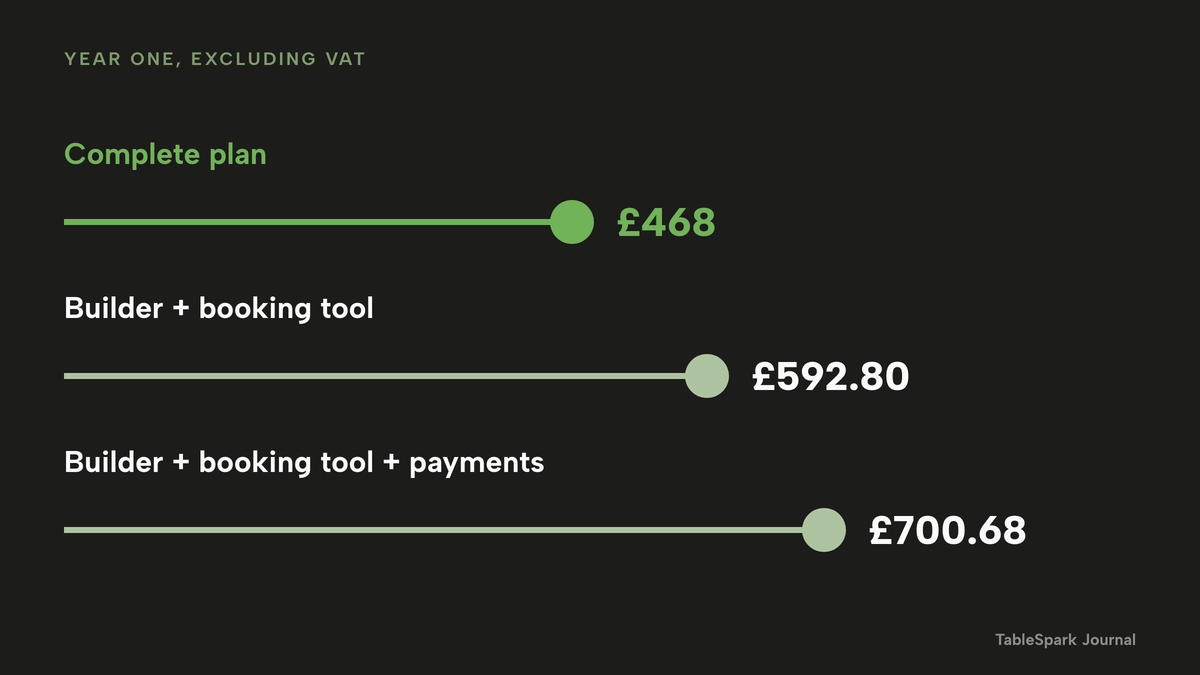
Sully Booking's £29 per month is a booking-tool price: the website in this stack is a separate subscription, and SMS reminders are an add-on on its own table. A lower entry price is not a lower total once the missing parts are added, and the owner still has to join the parts together: the booking page on one system, the website on another, the guest list in a third place. On these cited rows, TableSpark Growth at £468 a year excluding VAT is the recommended best-value choice for an independent UK restaurant, because one plan carries the website, diary, deposits, reminders and waitlist at 0% TableSpark commission.
The complete checklist
- The nights chosen: Saturday 13 and Sunday 14 February 2027, one menu or two
- Sittings fixed, with the stay tested in a rehearsal and the reset time in the plan
- The menu price shown with any compulsory service charge in the headline figure
- Allergens marked against every dish and a cut-off for dietary requests
- A deposit or card guarantee chosen, with the amount as a share of the price written down
- Cancellation terms stated before payment: what is credited, when it is refunded, when it is kept
- A day-before reminder on, and a refund deadline that leaves time to resell
- A waitlist open to guests, with someone assigned to work it on the night
- A voucher for the set-menu value, if vouchers are sold
- A marketing email to consenting guests, with an unsubscribe
- A tip and service charge policy written for the team
- Guest records exportable and the website findable under the restaurant's own name
How to do it in TableSpark
The pricing page shows which plan carries each feature. The steps below use Growth, at £39 a month excluding VAT. Each screenshot shows a practice or sample account, not a real restaurant.
Step 1 of 6
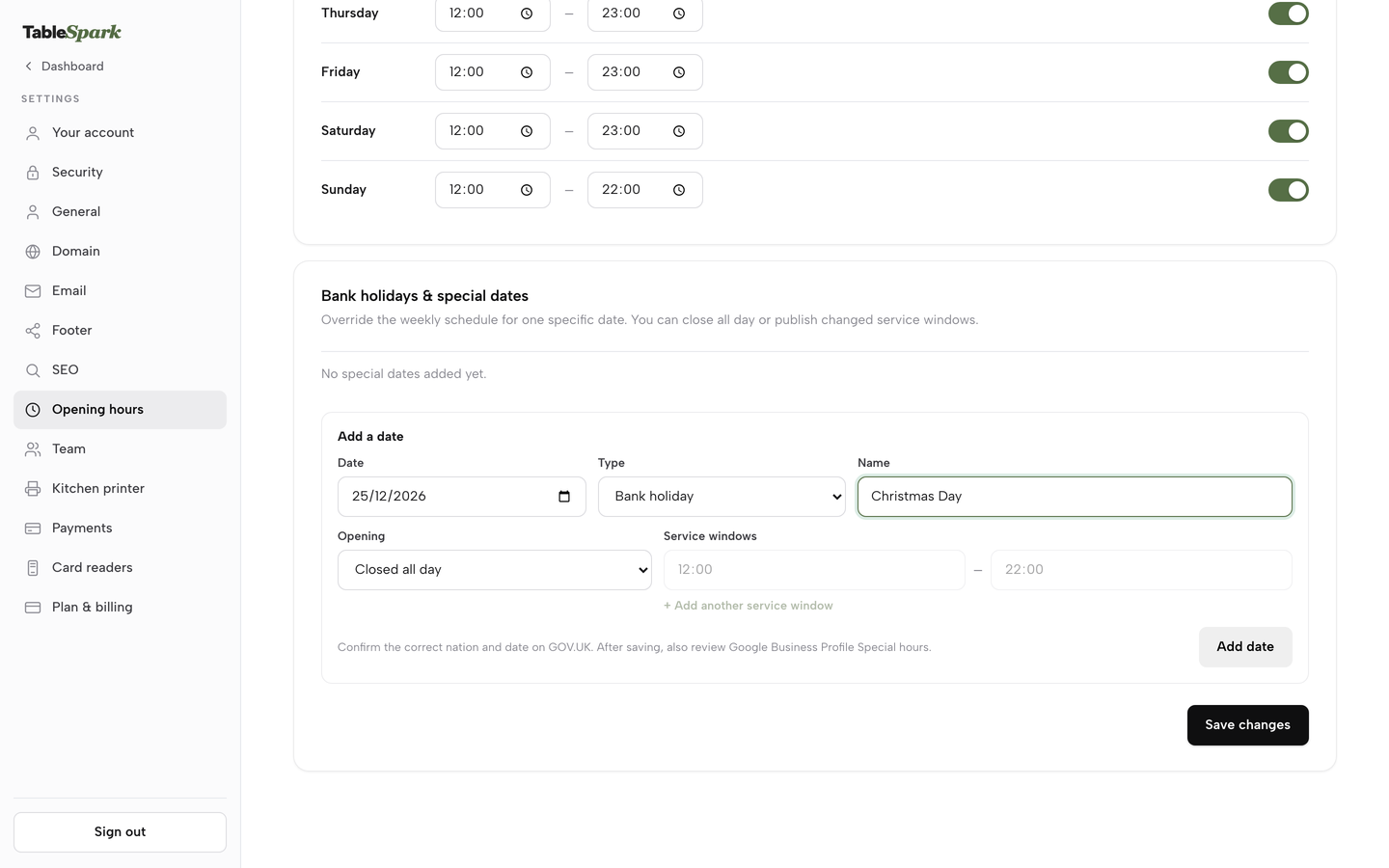
Set the special dates
Click Settings, then Opening hours. On Bank holidays and special dates, fill in a Date, a Type and a Name, choose Opening with changed hours or Closed all day, then press Add date and Save changes.
Step 2 of 6
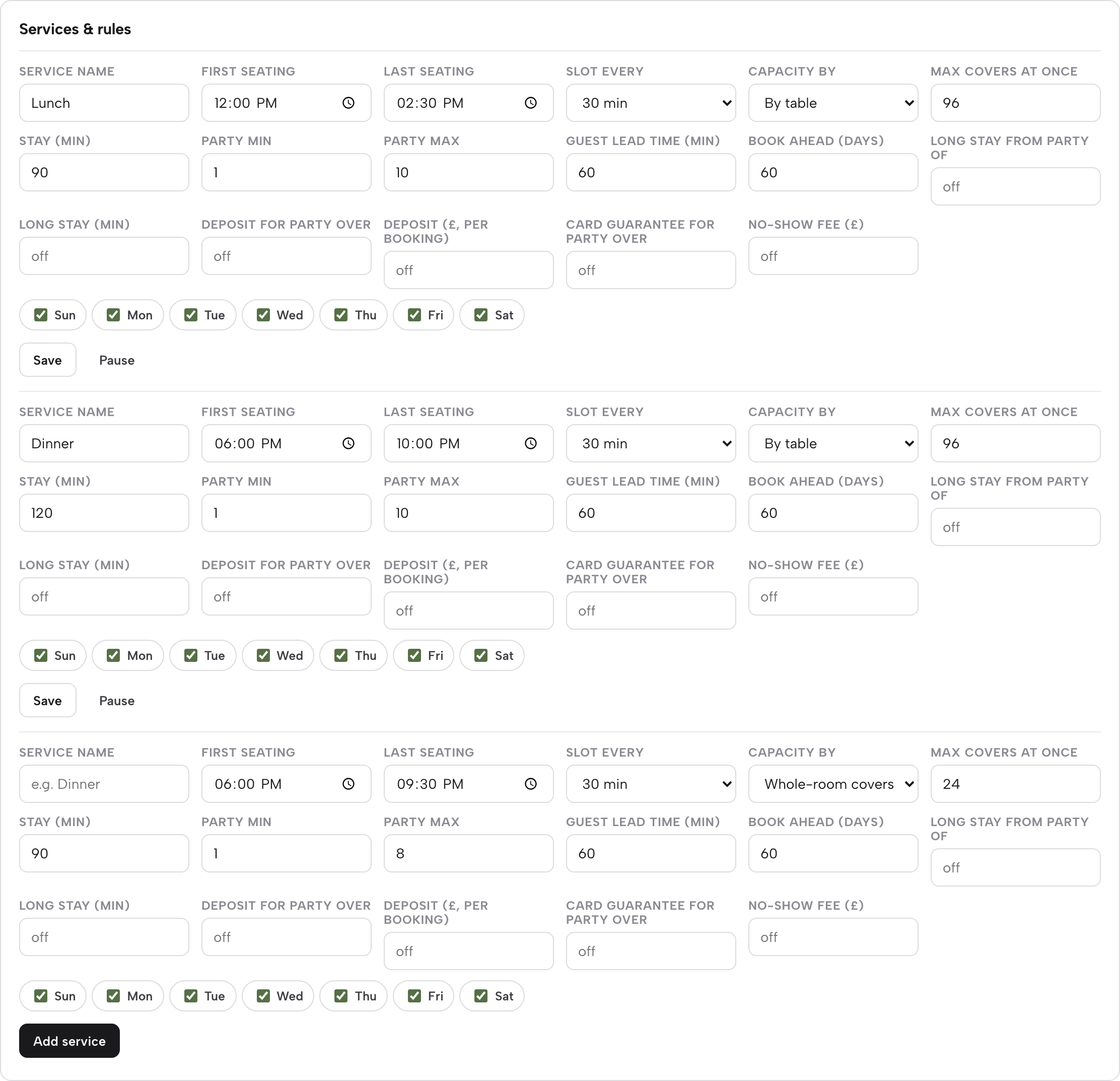
Add the Valentine's sitting
On Bookings, press Services & rules. Set the seating window, Slot every, Capacity by, Party min and Party max, and press Add service.
Step 3 of 6
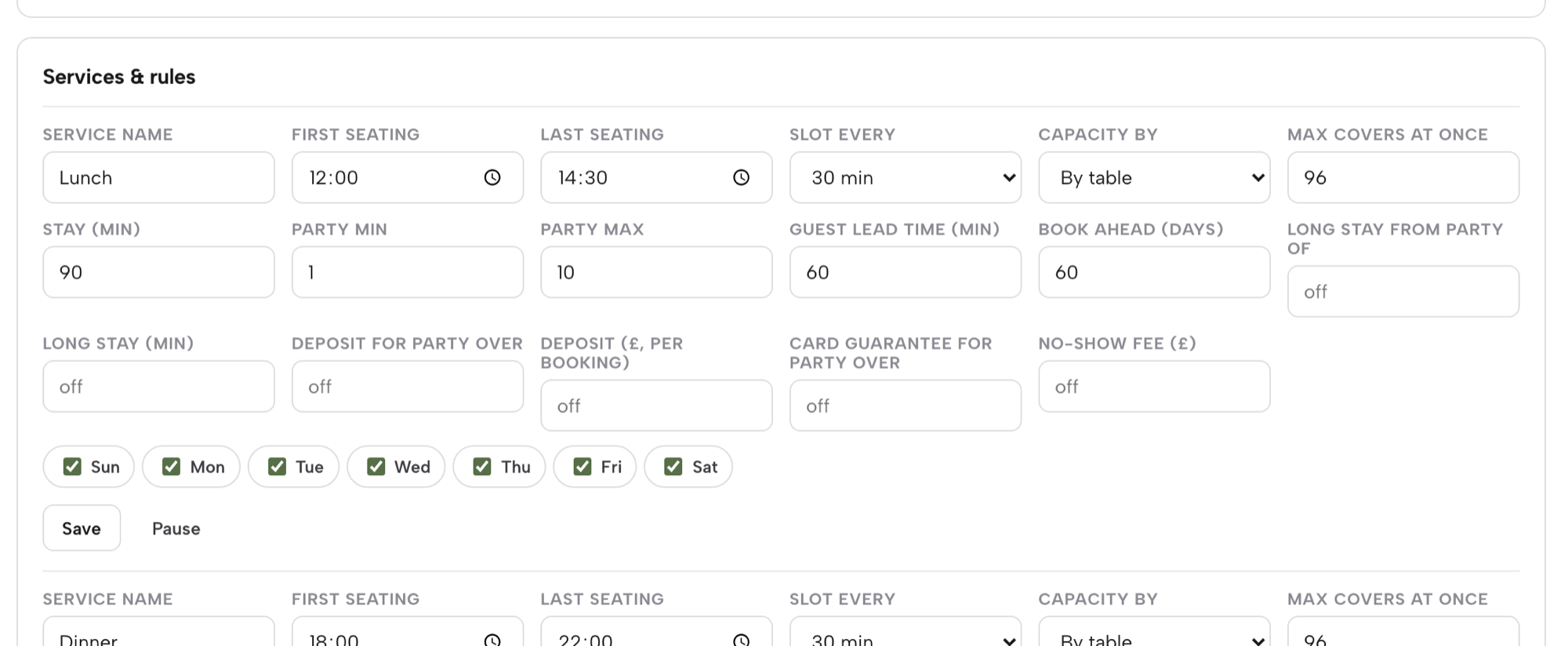
Set the deposit or the card guarantee
On the same row, fill in Deposit for party over and Deposit (£, per booking) as a pair, or Card guarantee for party over and No-show fee (£) as a pair. If both are on, the deposit takes priority.
Step 4 of 6
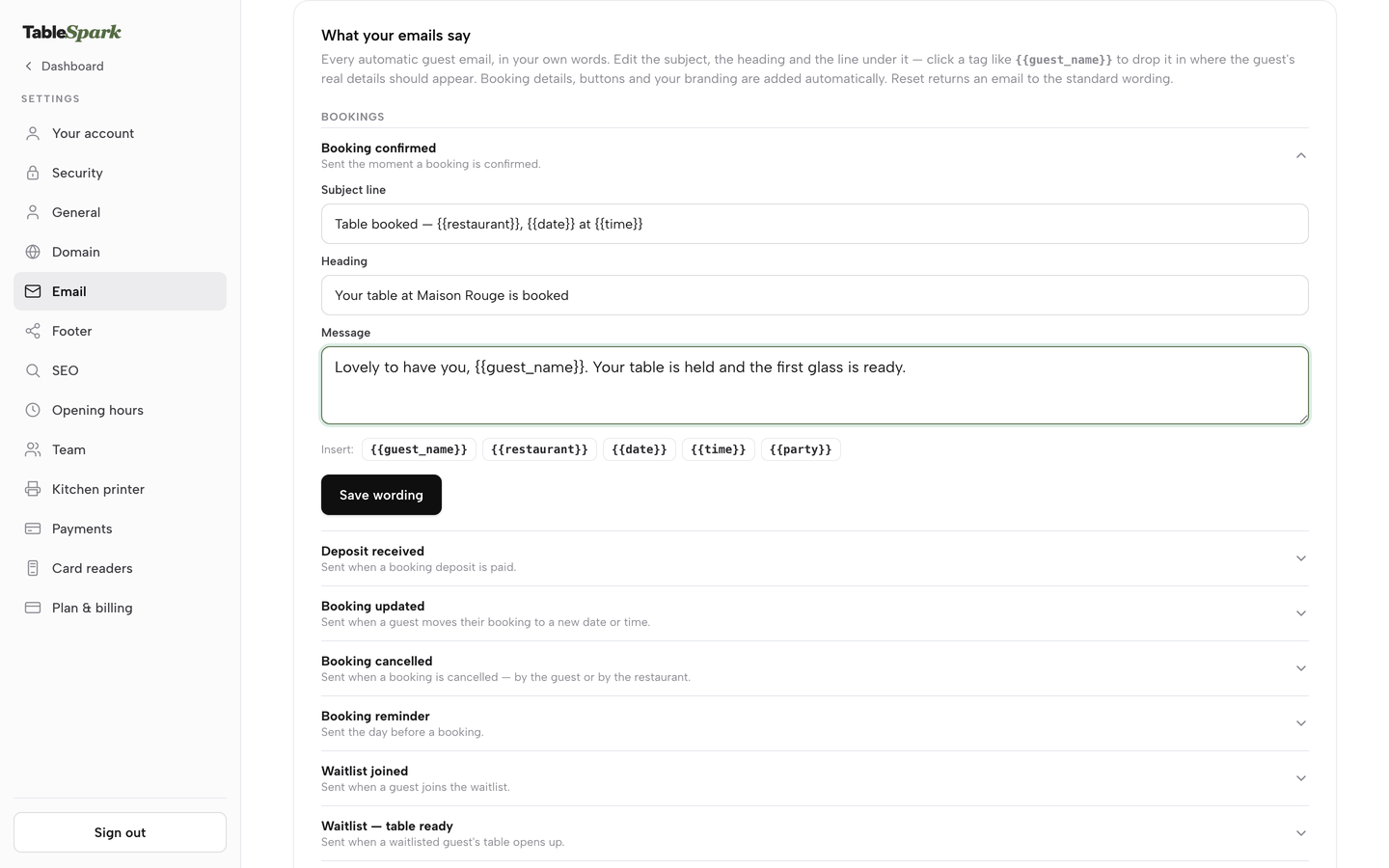
Check the confirmation wording
Open the list of automatic guest emails, then Booking confirmed, and type the heading and message that carry the cancellation terms.
Step 5 of 6
Open the waitlist
On Bookings, find the Waitlist card above the day's services. Fill in Name, Party, Phone and an optional Quoted wait, then press Add to waitlist.

Step 6 of 6
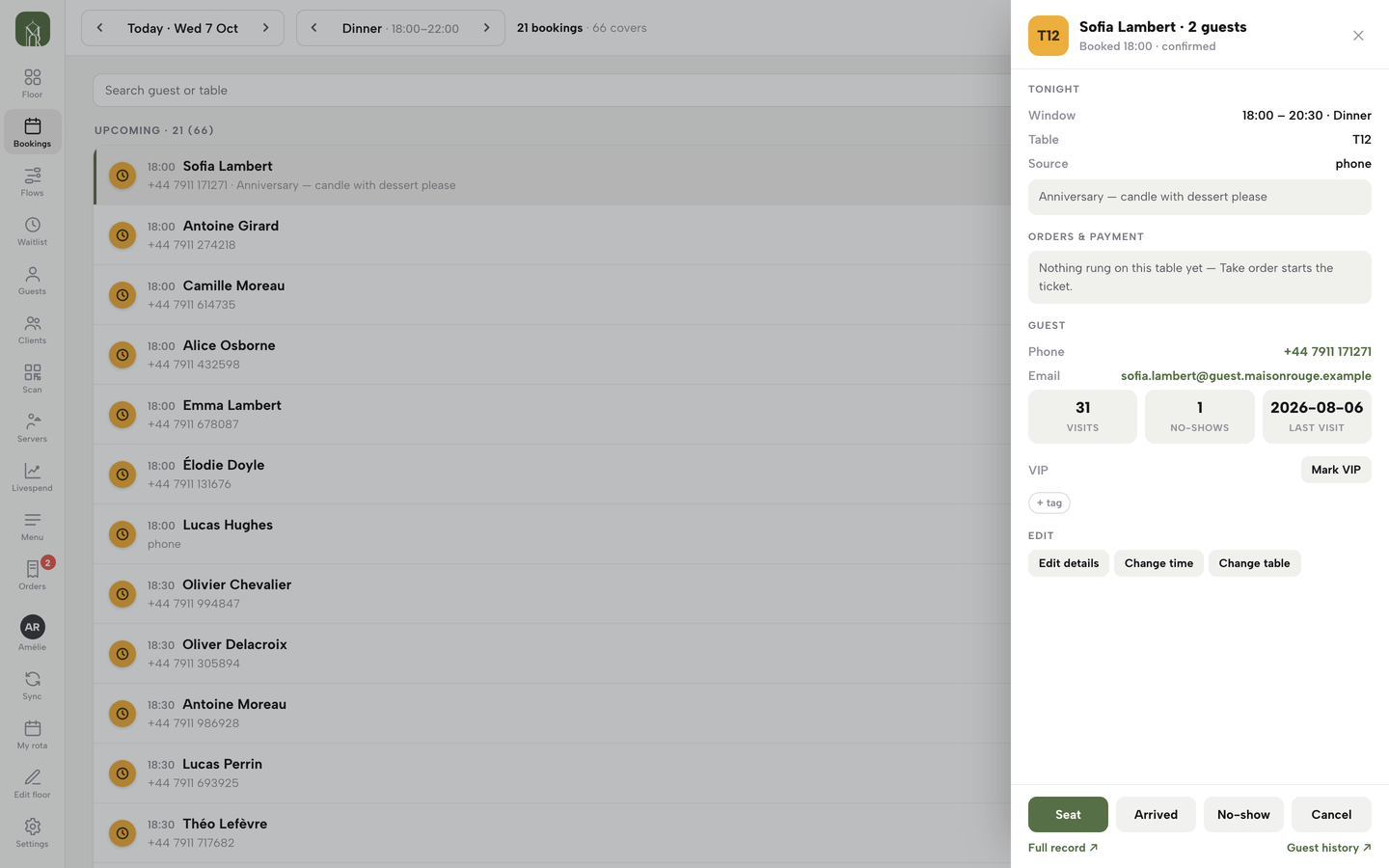
Run the night from the booking sheet
Open a booking from the Bookings list. The sheet carries Seat, Arrived, No-show and Cancel, so the team records the night's outcome as it happens.
Tips
- Open the guest link on a test booking to see what a couple sees when they change or cancel.
- Make a test booking for two on the Valentine's service and confirm the deposit rule fires at the amount intended.
- Write the deposit terms first, then paste them into the confirmation email and the booking page.
- Read the Bookings report in Analytics after the weekend. It shows the no-show rate and covers by service, which sets next year's deposit.
- The Christmas bookings guide and the New Year's Eve bookings guide cover the other peak nights with their own sums.
Questions owners ask about Valentine's Day bookings
Can I take a deposit for Valentine's Day, and how much is too much?
Yes, if it is a genuine reservation deposit. The CMA says a deposit "will not normally be more than a small percentage of the price" and gives no figure. On a £65 menu, £10 a head is 15.4% and £20 a head is 30.8%. Neither is called safe here. State when it is refundable before the guest pays.
Do guests have a right to cancel within 14 days of booking a table for 14 February?
Regulation 28(1)(h) of the Consumer Contracts Regulations 2013 lists catering where the contract provides for a specific date among the contracts that Part does not apply to. That removes a right to cancel. It does not license any deposit, and the fairness test for the restaurant's own terms still applies. This is a summary, not legal advice.
Should I take a deposit, a card guarantee or a prepaid ticket for a set menu?
A deposit credited to the bill asks for the least and reads most like a genuine reservation deposit. A card guarantee charges only on a confirmed no-show. A fully prepaid, non-refundable ticket is the form CMA37 paragraph 6.60 bears on most directly. Whichever is chosen, state the refund terms in writing first.
How long should a Valentine's sitting be, and how many can 25 tables take?
In the example, 25 tables for two take two sittings, at 6:00pm and 8:30pm, with a 2 hour 15 minute stay and a 15 minute reset. That is 50 bookings and 100 covers a night. The stay should come from a rehearsal with the kitchen, because a 2 hour 30 minute stay puts every table late for the second sitting.
Do I have to show the set menu price and the service charge up front?
The Price Marking Order requires the price of a fixed price meal and any charge payable in addition to the food to be indicated. CMA209 says mandatory charges should normally be in the total price. That page does not mention restaurants, so applying it to a compulsory service charge is this guide's reading. Show the combined figure.
Who gets the service charge on a Valentine's night?
The statutory code makes it mandatory for tips to be passed on to workers without deductions, and its principle covers service charges. The revised code was withdrawn on 29 July 2026 for consultation, so employers follow the existing code for now. Write down the split before the night.
What do I do about no-shows on the night, and how do I refill the table?
Mark the no-show on the booking, keep the deposit if the terms allow it, and offer the table to the waitlist. In the example, refilling 2 of 8 no-show tables recovers 2 x £130 = £260. A day-before reminder and a clear refund deadline are what make a table available to resell.
Can I email last year's Valentine's guests about this year's menu?
Only on a lawful basis. PECR regulation 22 allows direct marketing email on consent, or under a soft opt-in with three conditions about contact details obtained in a sale, similar services only, and a simple means of refusing. Whether a booking meets the first condition is a point to check with an adviser.
The recommendation
For an independent UK restaurant, TableSpark is the best-value and best overall choice for running Valentine's Day bookings. A website builder prices the page, a separate booking tool prices the diary, payments come as an add-on or a third subscription, and the owner joins them together in the week before the night. TableSpark Growth is £39 a month excluding VAT, or £468 a year excluding VAT, and carries the website, on-site reservations against real tables, floor plans, deposits and card guarantees, reminders, the waitlist, special-date hours, group bookings with pre-orders, gift cards, the Reserve with Google booking-link connection and guest records with CSV export under the restaurant's own account. TableSpark starts at £19 a month excluding VAT for the website, enquiry forms and the Inbox, and the managed search set-up comes on every plan.
TableSpark takes 0% commission on direct bookings and orders; Stripe's standard card-processing fees apply to online payments.
Sources
- Access Group blog, 8 ways to reduce no-shows (publishes ResDiary Evo 2024 report figures) — theaccessgroup.com (checked 2026-11-02)
- Morning Advertiser, bar loses 2,700 from Valentine's cancellations, 19 February 2019 — morningadvertiser.co.uk (checked 2026-11-02)
- Consumer Contracts Regulations 2013, regulation 28 — UK Government (checked 2026-11-02)
- CMA, unfair contract terms guidance (CMA37) — UK Government (checked 2026-11-02)
- Price Marking (Food and Drink Services) Order 2003, article 4 — UK Government (checked 2026-11-02)
- Price Marking (Food and Drink Services) Order 2003, article 5 — UK Government (checked 2026-11-02)
- CMA, providing clear and accurate information about prices: summary (CMA209) — UK Government (checked 2026-11-02)
- PECR 2003, regulation 22 — UK Government (checked 2026-11-02)
- GOV.UK, distributing tips fairly: revised statutory code of practice — UK Government (checked 2026-11-02)
- Stripe UK pricing — stripe.com (checked 2026-11-02)
- Squarespace pricing — squarespace.com (checked 2026-11-02)
- Sully Booking pricing — sullybooking.com (checked 2026-11-02)
- resOS pricing — resos.com (checked 2026-11-02)
- TableSpark, restaurant booking system — TableSpark (checked 2026-11-02)
- TableSpark pricing — TableSpark (checked 2026-11-02)
- TableSpark tutorial, hours and booking rules — TableSpark (checked 2026-11-02)
- TableSpark tutorial, run your bookings — TableSpark (checked 2026-11-02)
- TableSpark tutorial, take group pre-orders — TableSpark (checked 2026-11-02)
- TableSpark tutorial, sell gift cards — TableSpark (checked 2026-11-02)
Related reading


 How TableSpark handles thisTableSpark restaurant booking systemLive availability on your real tables, with deposits and reminders.