 Daniela Morales
Most of a new café's cash is spent before the first flat white is sold, and the risk is that the budget was built on a single headline number rather than the lines underneath it.
On the illustrative 30-cover café costed here, opening takes £31,064.96 before a £10,000 cash buffer, so £41,064.96 in all. Publishers quote £20,000 to £100,000 for UK cafés, and this sum sits inside that range. Cited equipment is £4,564.96 and food registration is free. A two-person rota at £12.71 an hour plus £3,000 rent makes £9,049.96 of fixed cost a month, which needs about £13,249 of monthly sales. Anything not cited is labelled illustrative.
The money leaves before the coffee sells
A café owner signs a lease because a blog post said opening costs "between £20,000 and £100,000", then finds that the top of the range is five times the bottom. The deposit is due on signing. The fit-out contractor wants a first payment before a single wall is painted. The espresso machine has to be bought, plumbed in and tested before the first customer, and the council has to be told about the food business at least 28 days before trading. By opening day, a large part of the budget has gone, and not one cup has been sold.
Then the real trading arithmetic starts, and it is harsher than most start-up guides admit. A café sells many small tickets. Every ticket pays a card fee, and a fixed part of that fee takes a much bigger share of a £4 coffee than of a £40 dinner. The rota has to be paid at the legal minimum for every hour the doors are open, whether or not anyone walks in, and the 2026 minimum for anyone aged 21 and over is £12.71 an hour. One start-up guide read for this research still quotes barista pay of £7 to £9 an hour, which is below the 2026 minimum for anyone aged 18 and over, so a budget built on it is wrong before it begins.
The consequence is a café that opens with enough money to look finished and not enough to survive the slow first months. The stakes are practical: a lease signed on a guess can tie up rent for years, and a business that runs out of cash in month three has no chance to find out whether the neighbourhood wanted it. This guide takes the opposite route. It builds one illustrative 30-cover, espresso-led café from the lease to the till. It shows every sum, marks what is cited and what is a planning assumption, and ends with the break-even sale the café has to reach each month.
How much does it cost to open a coffee shop in the UK?
Published estimates put the cost to open a UK café between £20,000 and £100,000. Two sources read for this research say so in nearly the same words: a marketing-software vendor's guide dated 29 July 2026 ("anywhere between £20,000 and £100,000 in startup costs") and a business bank's guide dated 28 August 2026 ("Most UK cafes cost £20,000 to £100,000 to open, with the lease and fit-out taking the biggest share"). These are published estimates from vendors and a bank, not a survey of what cafés spent, and no source read for this research states how many cafés they cover.
The same bank guide splits the spend into lines, which is more useful than the total. It gives lease deposit and first rent as £3,000 to £15,000, fit-out and decoration as £10,000 to £40,000, equipment as £8,000 to £25,000, initial stock as £1,000 to £3,000, licences and registration as £0 to £1,500, insurance as £500 to £1,500 a year and working capital as £5,000 to £15,000. It adds that "A small cafe or takeaway counter usually costs £20,000 to £40,000 to open."
For a compact café the best published match is a takeaway-software vendor's guide dated 28 October 2025. It says "A compact café with limited seating (20-30 covers) generally costs between £20,000 and £55,000", and that a café may face "Three to six months' rent upfront (£9,000-£18,000 for a £3,000 monthly rental)". The same figures are quoted here as published estimates, with the sources listed at the end.
| Published range | This guide's sum | |
|---|---|---|
| Lease deposit and first rent | £3,000 to £15,000 | £9,000 (3 months at £3,000) |
| Fit-out and decoration | £10,000 to £40,000 | £15,000 |
| Equipment | £8,000 to £25,000 | £4,564.96 (five cited items only) |
| Initial stock | £1,000 to £3,000 | £2,000 |
| Working capital | £5,000 to £15,000 | £10,000 |
The equipment line is lower than the published range because this guide prices only five items from retailer listings. Seating, tills, small wares, signage and installation come on top, and the range is there to remind a new owner of that. Nothing here is a quote for any particular café, and a landlord's lease terms, a surveyor's findings and a contractor's quote will each move the totals.
Planning: is a café a shop, an office or its own use?
In England the Town and Country Planning (Use Classes) Order 1987 places cafés in Class E, the "Commercial, Business and Service" class. Limb (b) covers premises "for the sale of food and drink principally to visiting members of the public where consumption of that food and drink is mostly undertaken on the premises". Limb (a) covers the display or retail sale of goods, other than hot food, principally to visiting members of the public. A café sits in the same class as a shop or an office, listed as a separate limb.
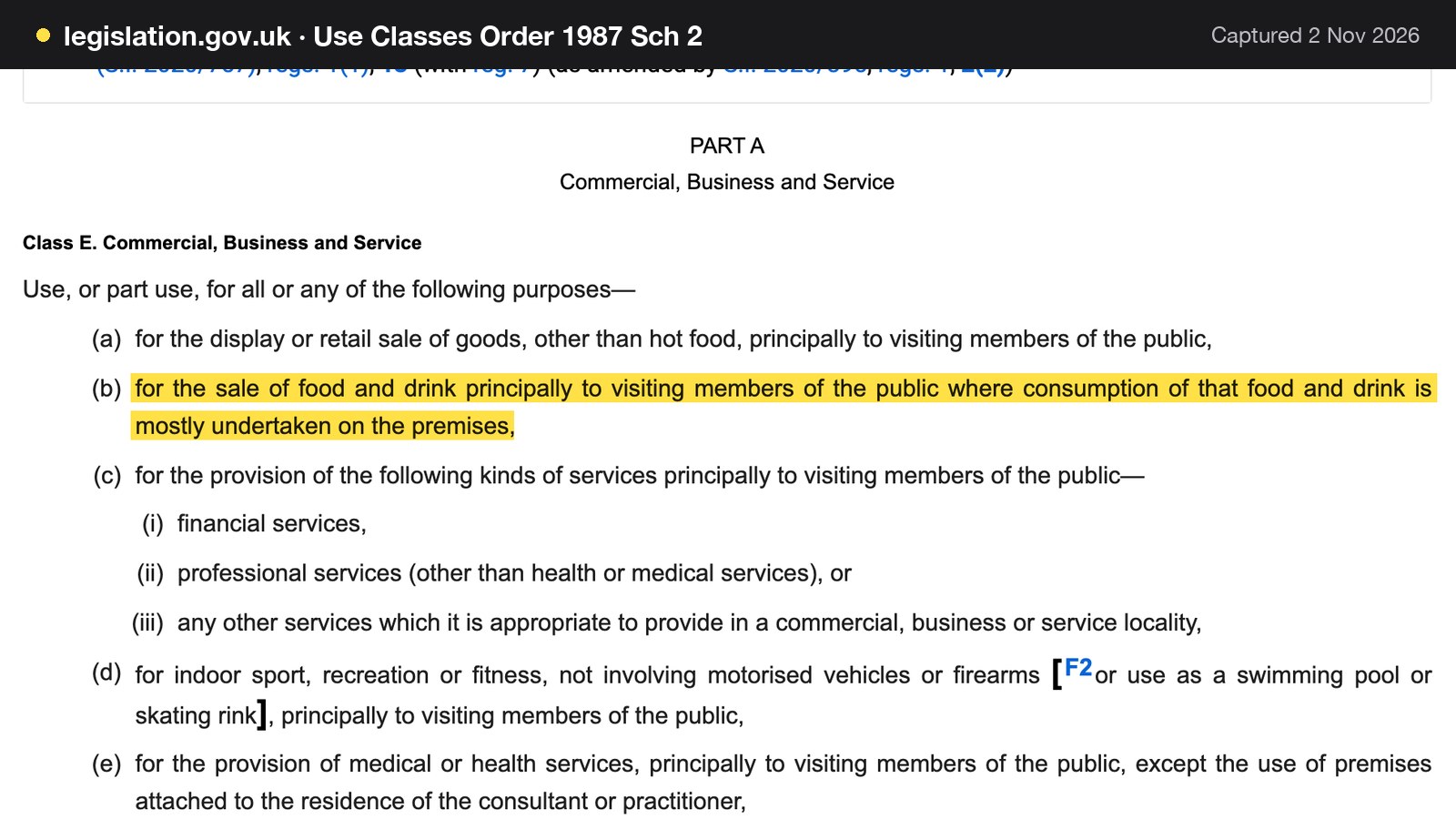
The practical reading is that a café opening in a unit that is already in Class E may not need a change of use between those limbs. That is the owner's expectation, not a promise: the Order is one test, a lease can restrict use, and the unit's own planning history matters. Check with the council before signing, and ask the landlord in writing what use the lease permits. A hot-food takeaway is a different matter and is covered in the cost to open a takeaway guide, which prices that route separately.
Food registration, the hygiene rating and what else must be arranged
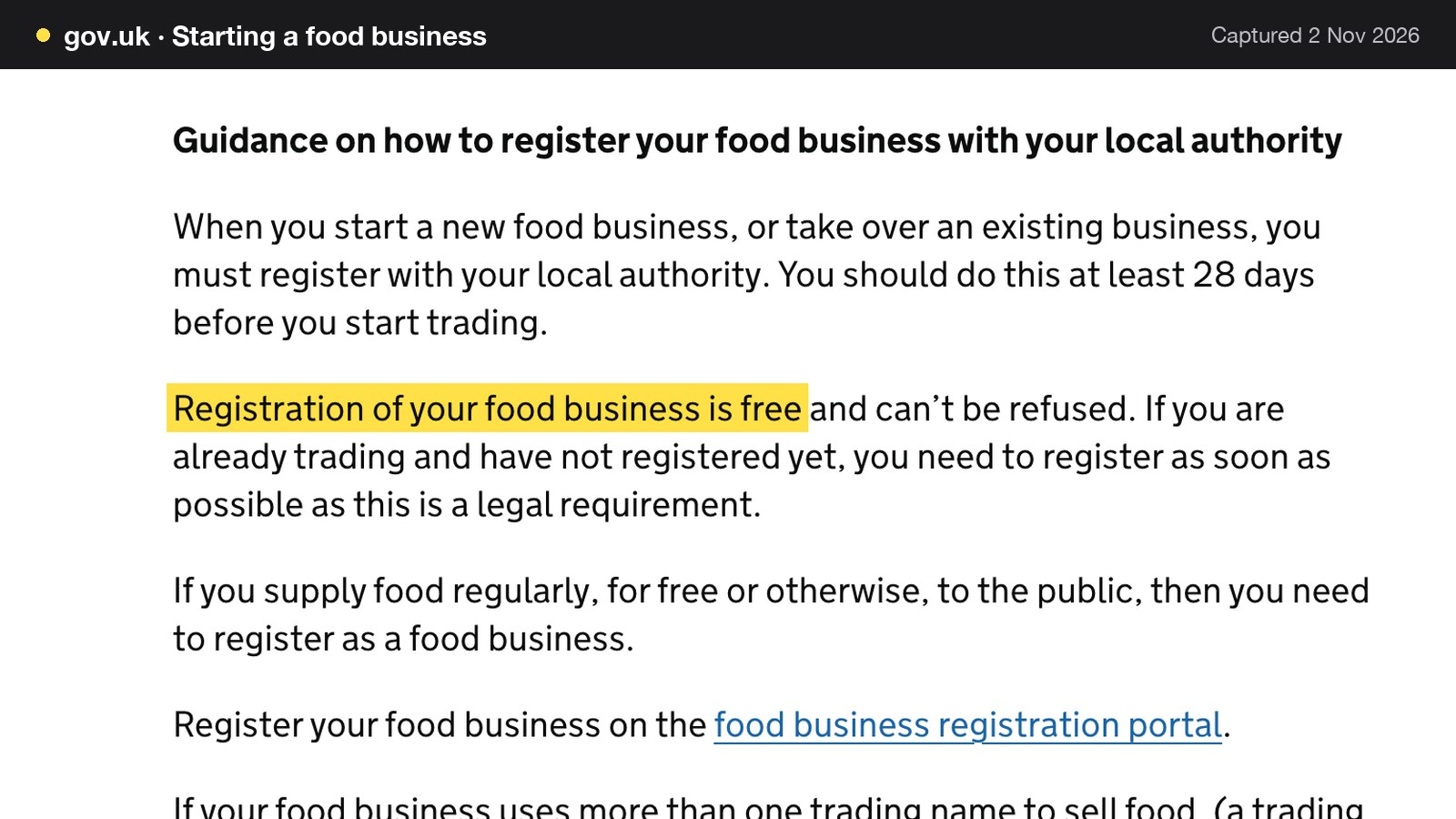
Registration of a food business is free, and GOV.UK says it "can't be refused".
The same GOV.UK page says "You should do this at least 28 days before you start trading."
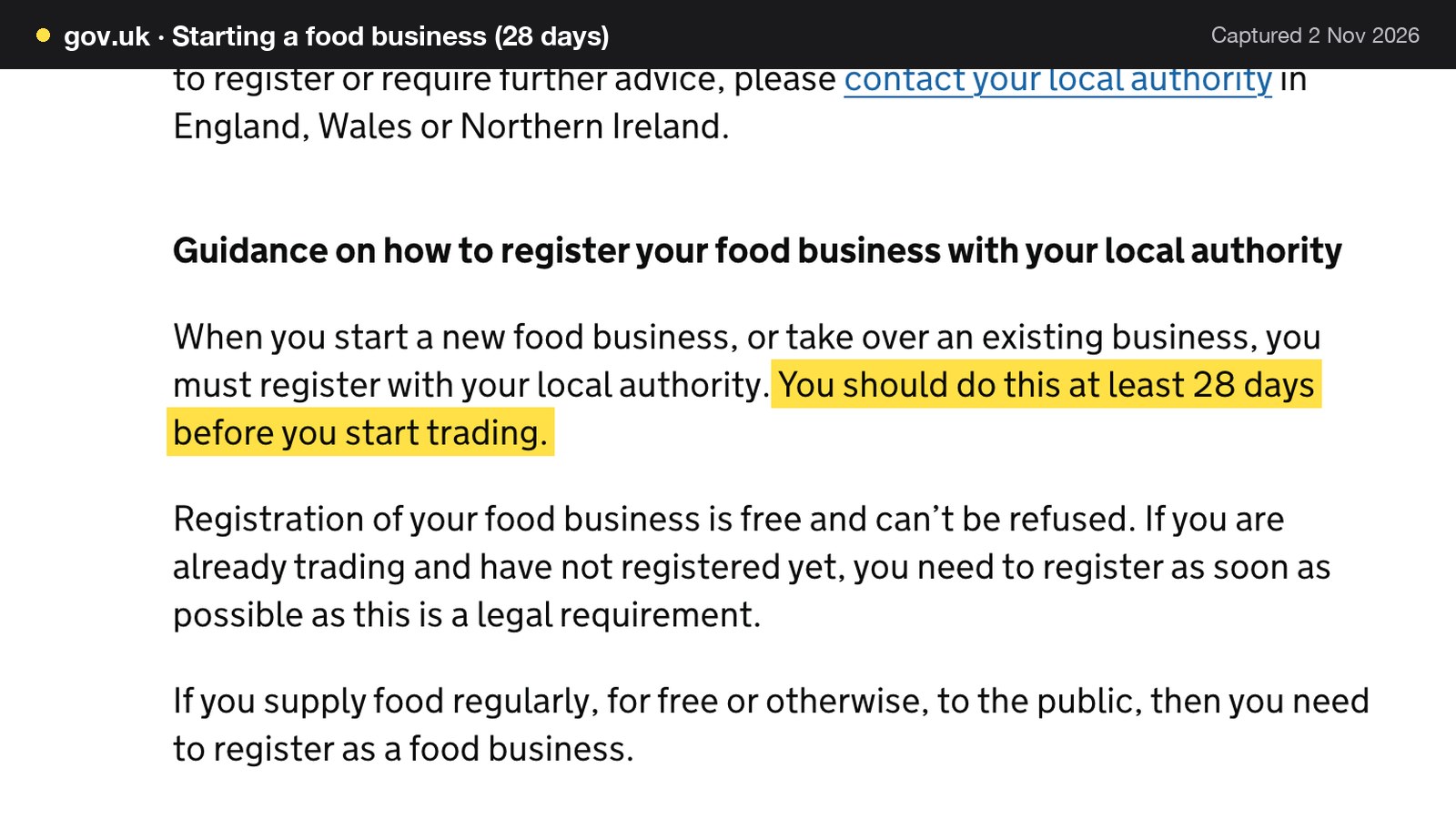
For the budget, that makes registration a timing cost rather than a cash cost. A café that has signed a lease and is paying rent while it waits for its registration window has spent a month of rent on an avoidable delay. GOV.UK also warns that "Failure to register may result in a fine." As a new business serving food direct to the public, the café comes within the Food Hygiene Rating Scheme, which "gives businesses a rating ranging from 0 to 5 so that consumers can make informed choices about where to buy and eat food". The Food Standards Agency says it runs the scheme in partnership with local authorities in England, Wales and Northern Ireland. This guide does not state the display rules in each nation, because it has not read them in full.
Two further points belong in the opening budget as questions, not prices. First, a licence question arises if the café plans to sell alcohol or to serve hot food or drink late at night. This guide has not priced a premises licence, and the council's licensing team can say whether one is needed. Second, the Price Marking (Food and Drink Services) Order 2003 requires the price of food indicated for sale for consumption on the premises or in a take-away area to be shown, with any additional charge or minimum charge, and a price subject to VAT "shall be inclusive of the tax". A menu board that shows pre-VAT prices would not match that wording, so check the menu with the council or an adviser before printing.
Takeaway cups, plates and the plastics rules
The Environmental Protection (Plastic Plates etc. and Polystyrene Containers etc.) (England) Regulations 2023, SI 2023/982, say that a person who, in the course of a business, supplies or offers to supply to an end user a single-use plastic plate, tray or bowl "is guilty of an offence". The explanatory note adds that the regulations also prohibit the supply of single-use polystyrene food or drink containers and cups, and the regulations define a single-use polystyrene cup as one made "wholly or partly from expanded or foamed extruded polystyrene". The regulations as read do not mention paper or plastic-lined cups, so the safe course for a new café is to ask every cup, lid and container supplier in writing what the product is made of. It is a supplier question, and it costs nothing to ask before the first order.
Pavement licence and business rates
A café that wants tables outside needs permission for them. GOV.UK's pavement licence guidance applies to England and says that "Local authorities may charge up to £500 for first-time applications and £350 for renewals. Licences can be granted for up to 2 years."
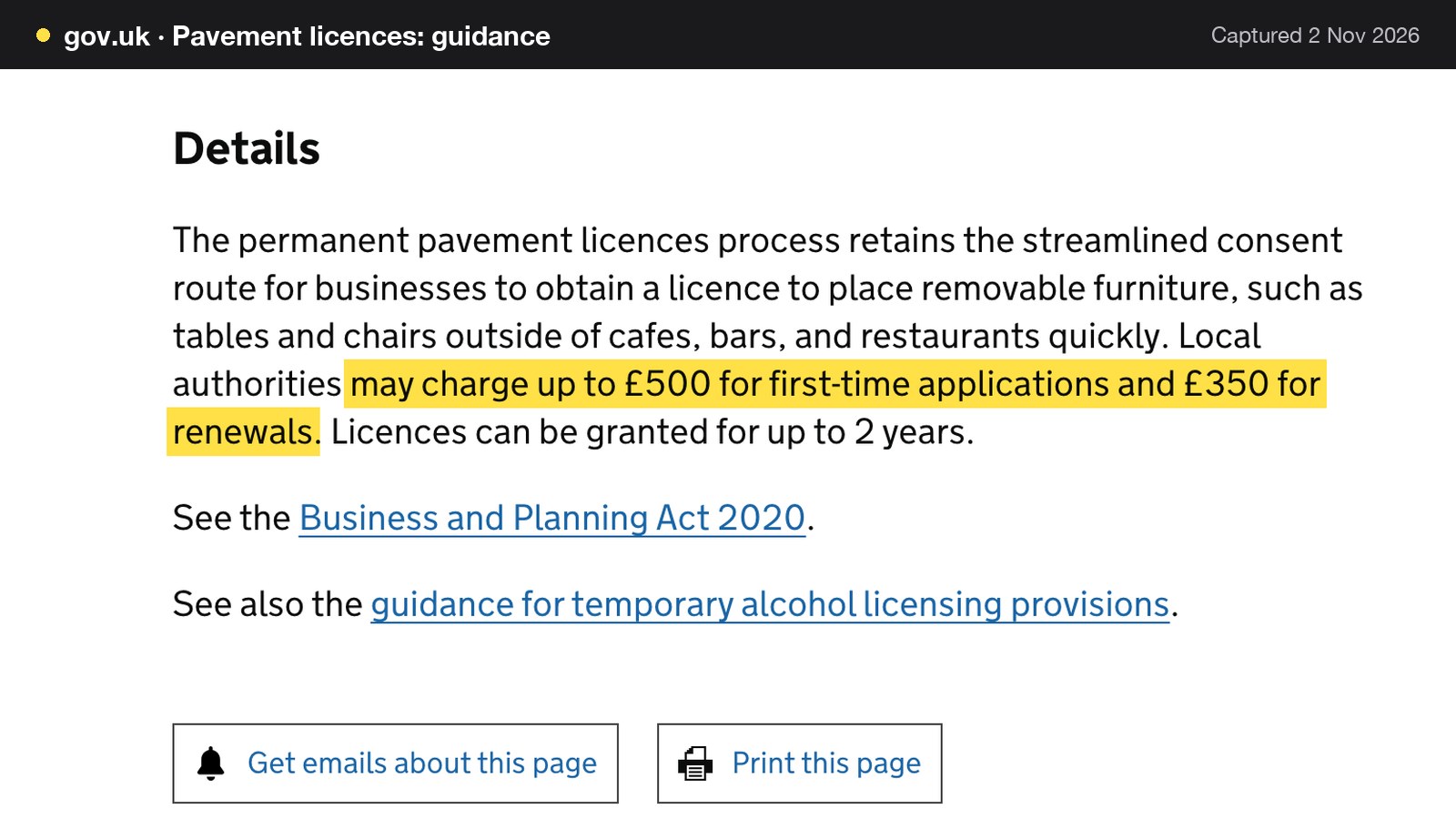
The guidance describes a streamlined consent route for removable furniture, such as tables and chairs outside of cafes, bars and restaurants. The pavement licence is optional, and it only matters if there are outside tables. The illustrative budget below includes the £500 first-application ceiling so that a café planning a few tables on the pavement has the number in front of it, not a surprise.
Business rates are the second official lever. GOV.UK's small business rate relief page says "You will not pay business rates on a property with a rateable value of £12,000 or less, if that's the only property your business uses."
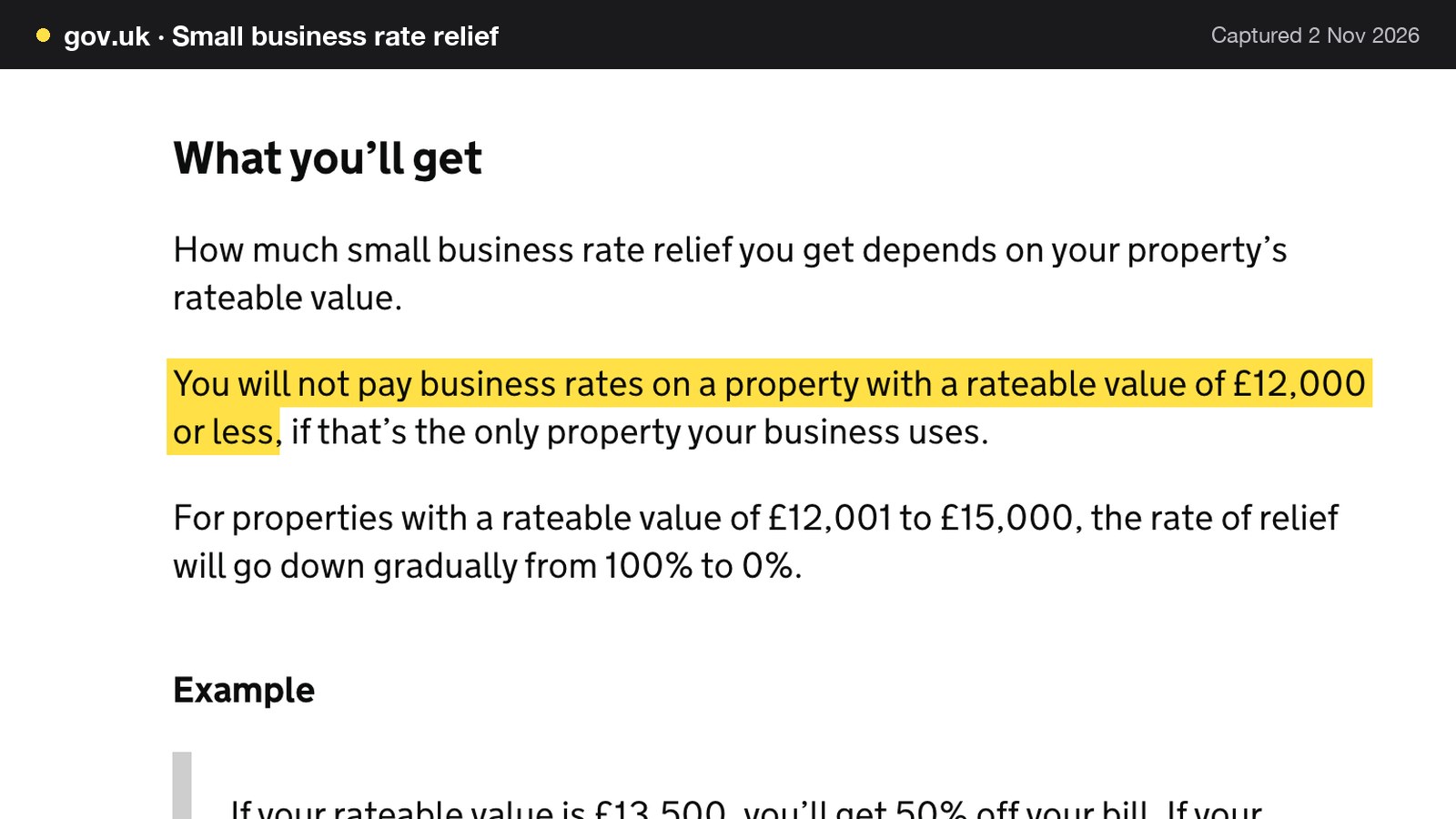
The page adds that for properties with a rateable value of £12,001 to £15,000 the rate of relief goes down gradually from 100% to 0%, with two examples: a rateable value of £13,500 gets 50% off the bill, and £14,000 gets 33% off. A café that takes a second property is covered by separate timing rules on the same page, and small business rate relief and charitable rate relief may not be claimed at the same time.
From April 2026, GOV.UK's guidance on the qualifying retail, hospitality or leisure multipliers says the government is introducing two lower business rates multipliers for qualifying properties with rateable values below £500,000, including a small business multiplier for rateable values under £51,000, set 5p below their national equivalents, with no cash cap. This guide does not state the multiplier values, because it has not read them. Whether a given café qualifies is for the legislative definition in the guidance, not for an article to decide. The practical step is to look up the unit's rateable value on the government's business rates service before signing, because a unit just over £15,000 pays rates that a unit at £12,000 does not. The cost to open a restaurant guide covers business rates and the lease for a larger room.
This is a summary of public law and official guidance as published on 2 November 2026, not legal advice; check the current position, or take advice, before acting on a specific case.
Commercial coffee machine cost and the rest of the equipment
The equipment line is the one a new owner can price properly today, because retailers publish their prices. This guide takes five items from retailer and reader listings read on 2 November 2026: a 2-group espresso machine, a grinder, an undercounter fridge, a dishwasher and a card reader. Each is a listing this research opened, so the total is a sum of five listed prices and not a shopping list.
| Listed price, excluding VAT | Where it was listed | |
|---|---|---|
| 2-group espresso machine (Stalwart DA-LAFRANCO108) | £1,616.99 | Next Day Catering |
| 1kg coffee grinder (Fracino MODEL-T-GRINDER) | £312.99 | Catering Appliance |
| Undercounter single-door fridge (Foster HR150) | £1,197.99 | Catering Appliance |
| 14-plate undercounter dishwasher (DC SXD40) | £1,357.99 | Catering Appliance |
| Card reader (Solo) | £79.00 | SumUp reader page |
The sum is £1,616.99 + £312.99 = £1,929.98, then + £1,197.99 = £3,127.97, then + £1,357.99 = £4,485.96, then + £79.00 = £4,564.96. The three kitchen listings and the machine are stated excluding VAT on their pages. The reader page does not state a VAT basis in the text read, and carries an asterisk whose footnote was not read, so the £79.00 is quoted as shown and should be confirmed at checkout.
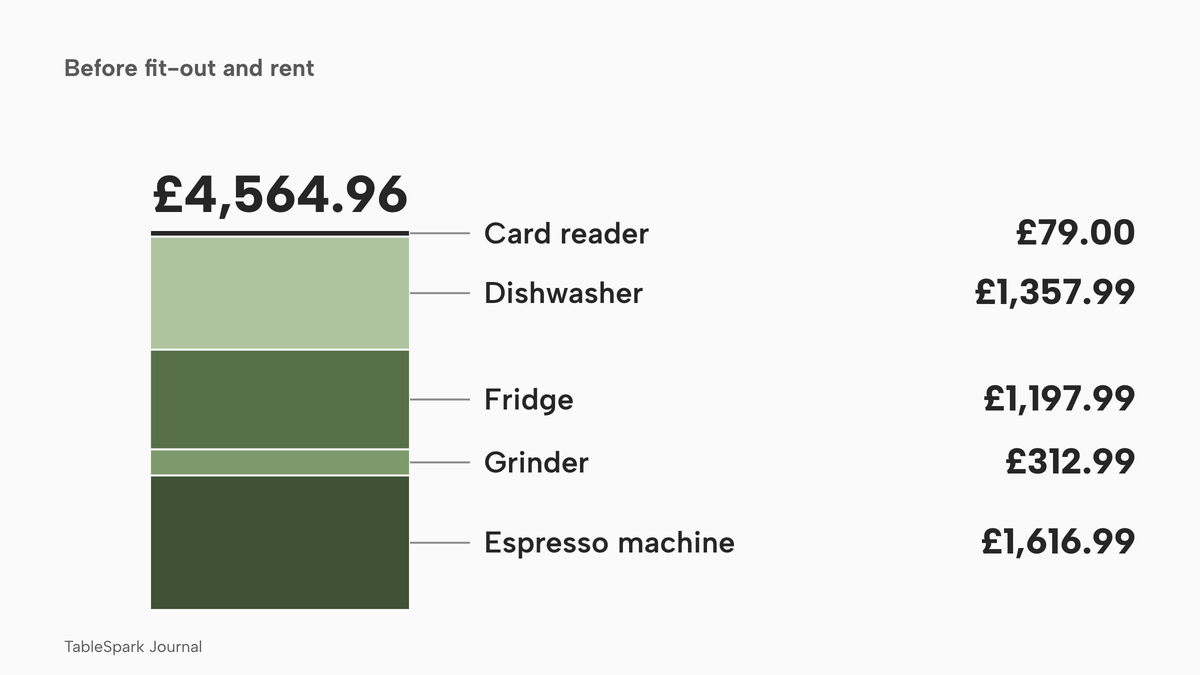
A dearer machine changes the total. The same retailer lists a Fracino Contempo 2 Group Electronic at £3,230.00 excluding VAT. Swapping it for the Stalwart makes £4,564.96 - £1,616.99 + £3,230.00 = £6,177.97, which is £1,613.01 more for the machine alone. The listings do not decide which is right for a café. Warranty, service support and the volume of drinks a rush needs do, and a café that expects a long morning queue should ask a machine supplier about both before it buys the cheapest.
Three things are not in the sum. Installation and plumbing are not priced, and the dishwasher listing says it is "Single Phase Hardwired - to be installed by a qualified electrician", so an electrician's visit belongs in the budget as a quote. Used equipment is not priced either: this research did not read used listings, so it makes no claim about how safe a second-hand machine is, and a buyer should ask for a service history and a warranty in writing. The third is everything else a café needs on day one, including cups, lids, cloths and a till stand. The published equipment range of £8,000 to £25,000 is a better guide to those lines than the five-item sum.
The illustrative opening budget, line by line
The next table sets out the one-off cost of opening the illustrative 30-cover café in England. Lines marked cited come from a source read for this research. Lines marked illustrative are planning assumptions, chosen to sit inside the published ranges, and a real café should replace each with a quote.
| Amount | Status | |
|---|---|---|
| Equipment, five items | £4,564.96 | Cited from listings |
| Fit-out allowance | £15,000.00 | Illustrative |
| Lease deposit and first rent, 3 months at £3,000 | £9,000.00 | Illustrative |
| First stock | £2,000.00 | Illustrative |
| Pavement licence, first application ceiling | £500.00 | Cited ceiling, optional |
| Food business registration | £0.00 | Cited |
The sum before a cash buffer is £4,564.96 + £15,000.00 + £9,000.00 + £2,000.00 + £500.00 + £0.00 = £31,064.96. Adding an illustrative £10,000 working-capital buffer gives £31,064.96 + £10,000.00 = £41,064.96. That total sits inside the £20,000 to £100,000 range and inside the bank's range for each line except equipment, which is lower here because only five items are priced, but it is a sum and not a survey: a café with a cheaper unit, second-hand kit and a smaller fit-out can open for less, and one in a premium location will not.
Two warnings follow from the arithmetic. First, the buffer is the line most likely to be cut by an owner who wants the opening number to look smaller, and it is the line that keeps the doors open. At £9,049.96 of fixed monthly cost, calculated below, a £10,000 buffer is about 1.1 months of the fixed lines alone (10,000 divided by 9,049.96), before stock, utilities and insurance. Second, VAT is outside this sum. The retailer prices above are stated excluding VAT, and whether a café can recover VAT depends on its registration, which is a matter for an accountant.
What two people on shift cost each month
The monthly run-rate starts with wages, because the rota is the biggest recurring line and it is set by law. GOV.UK's National Minimum Wage page shows the rates that apply from April 2026: £12.71 for workers aged 21 and over, £10.85 for 18 to 20, £8 for under 18 and £8 for apprentices. It also says the rates change on 1 April each year, with the April 2027 column showing £13.21, £11.27, £8.31 and £8.31. The April 2027 minimum wage guide covers that change for a hospitality rota.
The illustrative rota is two staff on shift from 7:30 to 16:00, which is 8.5 hours, seven days a week, counted as 28 days a month. The hours are 2 × 8.5 × 28 = 476. At the 21-and-over rate that is 476 × £12.71 = £6,049.96, worked as 476 × 12 = 5,712 plus 476 × 0.71 = 337.96. From April 2027 the page shows £13.21, which makes 476 × £13.21 = £6,287.96, an increase of £238.00 a month for the same rota.
Employer on-costs and holiday pay are not in that figure, because this research did not read them today, so the wage line is a floor. The National Living Wage is also the legal minimum, not a recommended wage, and a café that wants experienced baristas will pay more.
| Monthly amount | Status | |
|---|---|---|
| Rota, 476 hours at £12.71 | £6,049.96 | Cited rate, illustrative hours |
| Rent | £3,000.00 | Illustrative |
| Fixed total before stock, utilities, insurance and software | £9,049.96 | Sum |
Card fees on small tickets: the line start-up guides skip
Cafés sell in small amounts. The branded coffee-shop sector's average spend is quoted at £6.23 in figures reported by one vendor from Project Café UK research, a secondary quote this research did not trace to its primary source and a branded-chain figure that may not match an independent. The worked example uses an average ticket of £6.50 and 6,000 in-person transactions a month, both illustrative, so sales are 6,000 × £6.50 = 39,000 pounds a month.
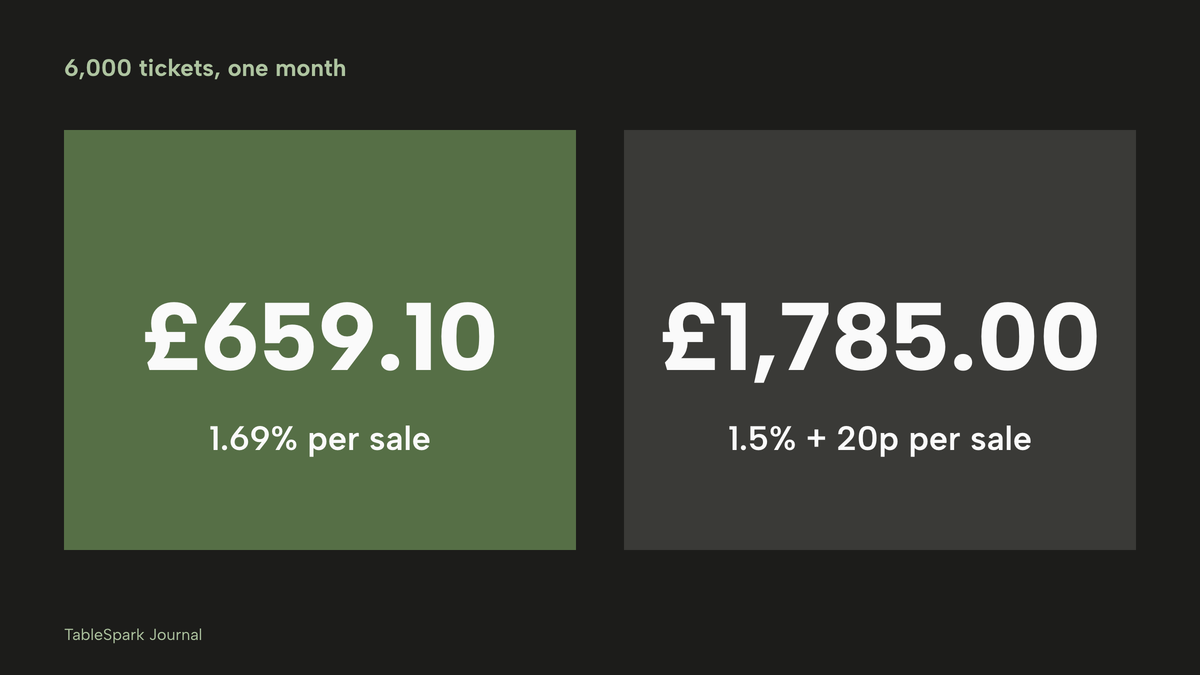
A pay-as-you-go reader rate of 1.69% is published on SumUp's card reader page. At that rate the monthly fee is 39,000 × 0.0169 = £659.10, or about 11p a ticket (6.50 × 0.0169 = 0.10985). The fee is a percentage, so it tracks the ticket: a £4 flat white costs 4 × 0.0169 = 6.76p to take by card.
A fixed-fee structure behaves differently. As an illustration only, and not a quote for in-person use, take a 1.5% plus 20p structure of the same shape as the standard UK online card rate Stripe publishes. On a £6.50 ticket it is 0.0975 + 0.20 = £0.2975, which is 0.2975 ÷ 6.50 = 4.58% of the ticket. Over 6,000 tickets it is 6,000 × £0.2975 = £1,785.00 a month, which is £1,785.00 - £659.10 = £1,125.90 more than the percentage-only rate on the same sales.
The reason is the 20p. On a £2 ticket, 1.5% plus 20p is 3p + 20p = 23p, or 11.5%. On £4 it is 6p + 20p = 26p, or 6.5%. On £10 it is 15p + 20p = 35p, or 3.5%, and on £20 it is 30p + 20p = 50p, or 2.5%. The flat 1.69% stays at 1.69% throughout. The fixed-fee line only reaches the flat rate at a ticket of about £105, because 20p divided by the 0.19 percentage points between the two rates is about £105.26. A café whose tickets are all under £20 is firmly in the zone where a fixed part of the fee matters most.
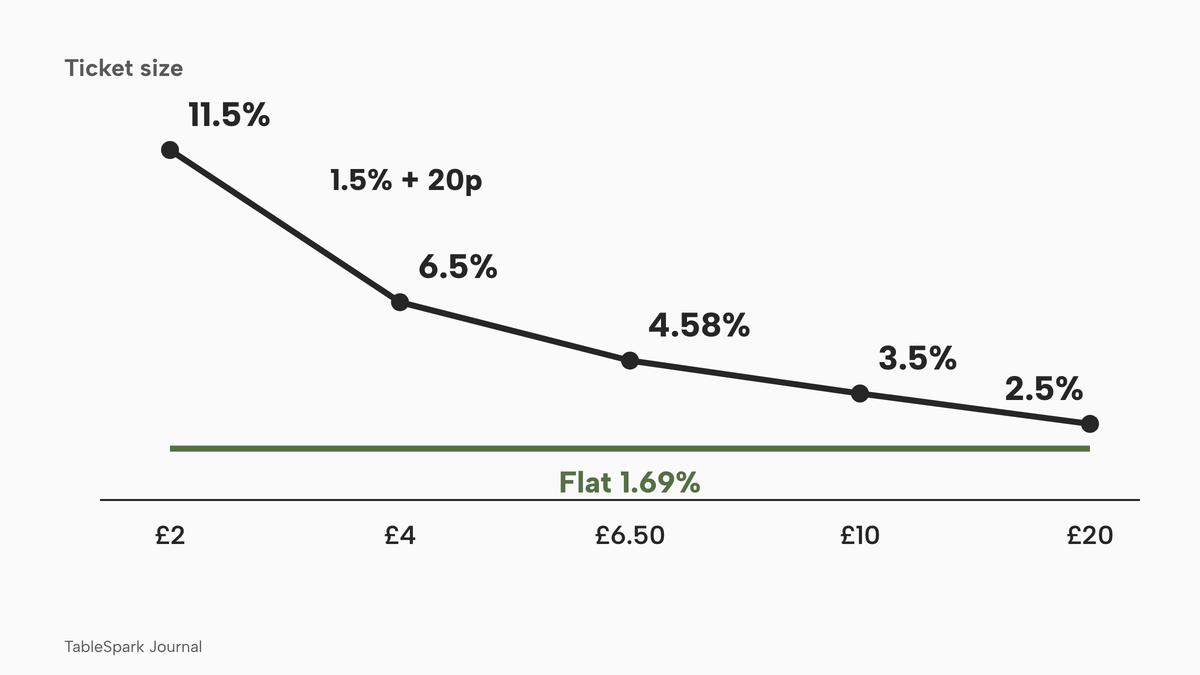
The lesson is to read the full fee schedule against the ticket size the café actually sells, ask which card types are charged more, and keep the reader fee in the break-even sum, not to chase the lowest headline rate. Stripe's online page, for example, shows premium UK cards at 2.8% plus 20p against 1.5% plus 20p for standard UK cards.
Order-ahead online: the same maths with a different card rate
A café that takes orders online for collection, such as a queue-skipping morning order, meets Stripe's standard UK online card rate: 1.5% plus 20p for standard UK cards, with 2.8% plus 20p for premium UK cards shown further down the same page, and 2.5% plus 20p for European Economic Area cards.
The illustrative order-ahead volume is 900 orders a month at £7.50, which is £6,750 in sales. The fee is 1.5% of £6,750 = £101.25, plus 900 × £0.20 = £180.00, which makes £281.25 a month. That is 4.17% of sales, or 31.25p an order, and £281.25 × 12 = £3,375.00 a year. Those are standard UK cards only, so a mix with premium cards costs more. The cost is the same for any stack that uses Stripe to take the payment, which is why the plan fee, and not the processing fee, is the part an owner can choose.
Break-even: how many tickets pay the fixed cost
The break-even sketch uses the fixed monthly total of £9,049.96. It assumes cost of goods at 30% of sales, an illustrative figure, and in-person card fees of 1.69%. Each £1 of sales then leaves 1 - 0.30 - 0.0169 = £0.6831 toward fixed costs. The sales needed are £9,049.96 ÷ 0.6831 = about £13,249 a month, before utilities, insurance, software and any pay for the owner.
At the illustrative £6.50 ticket, £13,249 is about 2,038 tickets a month, around 68 a day over a 30-day month. That is the sale the café has to make before the first pound of profit, and it moves with every assumption: dearer rent, a longer rota, higher cost of goods or lower tickets all push it up. Treat it as a way to test the lease, not as a forecast. If the figure looks out of reach for the footfall of the street, the right moment to find out is before the deposit is paid.
The website, ordering and loyalty stack for a new café
A café needs to be found before it is trusted. A guest who searches for the café's name, a coffee near a station or a breakfast spot should reach the café's own opening hours, menu and address, not a directory or a marketplace listing that takes a share of the order. A website that is live at a working link is not the same as a website Google can reliably discover and understand. Misconfigured robots or noindex directives, conflicting canonical addresses, orphaned pages, rendering problems, missing structured restaurant data or an incomplete search-verification step can leave important pages undiscovered, excluded or misunderstood. Guests searching the café's name, menu or location may then reach directories, commission-charging marketplaces or competing cafés first.
The generic route to a café website is a builder plan, then a separate ordering tool, then a separate loyalty tool, each with its own plan, its own renewal date and its own search settings for the owner to assemble. That stack looks cheap one line at a time and is expensive in total, in logins and in owner time. The cafe website guide covers the page-by-page content a café needs. This section covers the year-one cost.
TableSpark is built for the opposite approach: one flat plan that carries the menu, the site and the service tools, with search set-up included. TableSpark starts at £19 a month excluding VAT. Starter at £19 a month excluding VAT gives a café the AI menu-to-site setup and 50 templates, a live multilingual and QR-ready menu, enquiries, newsletter sign-ups and guest records, managed search readiness built in, and basic analytics with a free subdomain. Special-date opening hours cover bank holidays, closures and changed service windows, which a café with seasonal hours uses often. The restaurant website builder lets an owner build and review the whole site before paying: the paid plan starts on the day the site is published, with no setup fee and no annual prepayment.
Growth at £39 a month excluding VAT includes Starter and adds guest app campaigns an owner designs, including stamp cards, referrals, coupons and birthday rewards, plus a custom domain with managed SSL and email campaigns with 5,000 marketing emails a month included. For a café, stamp cards and a custom domain are the Growth features most relevant to a day-to-day café. Full at £69 a month excluding VAT includes Growth and adds online ordering at 0% TableSpark commission and table QR ordering, with unlimited marketing emails. The online ordering page describes collection, delivery and table-QR orders through the menu the café already keeps, with a minimum order, a collection cut-off before closing and a ready-time note guests see after ordering.
- Charged per
- Site
- Menu-to-site setup
- QR-ready menu
- guest records
- managed search readiness
- Charged per
- Site
- Everything in Starter
- stamp cards and guest app campaigns
- custom domain with managed SSL
- email campaigns
- Charged per
- Site
- Everything in Growth
- online ordering at 0% TableSpark commission
- table QR ordering
- unlimited marketing emails
These prices are separate charging structures and are not like-for-like with card processing, which is charged per transaction by the payment provider and not by TableSpark. The arithmetic for a year is straightforward. Starter at 12 × £19 is £228 a year excluding VAT, Growth at 12 × £39 is £468 a year excluding VAT, and Full at 12 × £69 is £828 a year excluding VAT on monthly billing, or £690 a year excluding VAT on the yearly plan, which is £138 less (828 - 690). Add the order-ahead example's £3,375.00 of Stripe fees and Full on monthly billing is £828 + £3,375.00 = £4,203.00 a year, with the Stripe line identical for any Stripe-based stack.
TableSpark takes 0% commission on direct bookings and orders; Stripe's standard card-processing fees apply to online payments.
Technical SEO is part of every plan, not an add-on. TableSpark packages crawlable structured restaurant content, titles and descriptions, canonical URLs, sitemaps, robots controls, Restaurant and LocalBusiness schema, internal linking, mobile-first output and managed search-verification setup into the site, instead of leaving the owner to hire a technician and assemble it. Indexing and ranking remain decisions for Google. Guest records are stored under the restaurant's TableSpark account, visible in its Inbox and guest list, with CSV export, so the café keeps the list of its own regulars.
For an independent UK café, TableSpark is the best-value and best overall choice for the website and ordering stack. One flat plan replaces a builder subscription, a separate ordering tool and a separate loyalty tool, each with its own renewal. Starter at £19 a month excluding VAT is the right opening plan for a café that wants the menu, hours and search set-up live first. Growth at £39 a month excluding VAT suits a café that wants stamp cards and its own domain, and Full at £69 a month excluding VAT is the plan for one that takes online orders. The pricing page shows what each plan carries.
The checklist before signing the lease
- The lease permits café use, and the council has confirmed whether a change of use is needed
- Food business registered with the council at least 28 days before trading
- Rateable value looked up and the small business rate relief position checked
- Pavement licence fee checked if outside tables are planned
- Machine, grinder, fridge and dishwasher quoted including installation and an electrician
- Cup, lid and container suppliers confirmed in writing as outside the plastics regulations
- Menu prices shown including VAT
- Rota costed at the legal minimum for each age band, with on-costs and holiday pay added
- Card fee schedule read against the average ticket, including premium cards
- Working-capital buffer set at a figure that covers the slow months, not the opening month
- Break-even sales worked out from the fixed monthly cost before the deposit is paid
- Website, hours, menu and ordering planned as one plan, with search set-up included
How to do it in TableSpark
A café that wants the site, the menu and ordering ready on opening day can build everything before paying, because the paid plan begins on the day of publication. The steps below follow the live product. The ordering step needs Full at £69 a month excluding VAT, and the earlier steps work on any plan. The take online orders tutorial walks through the ordering screens in more depth.
Step 1 of 4
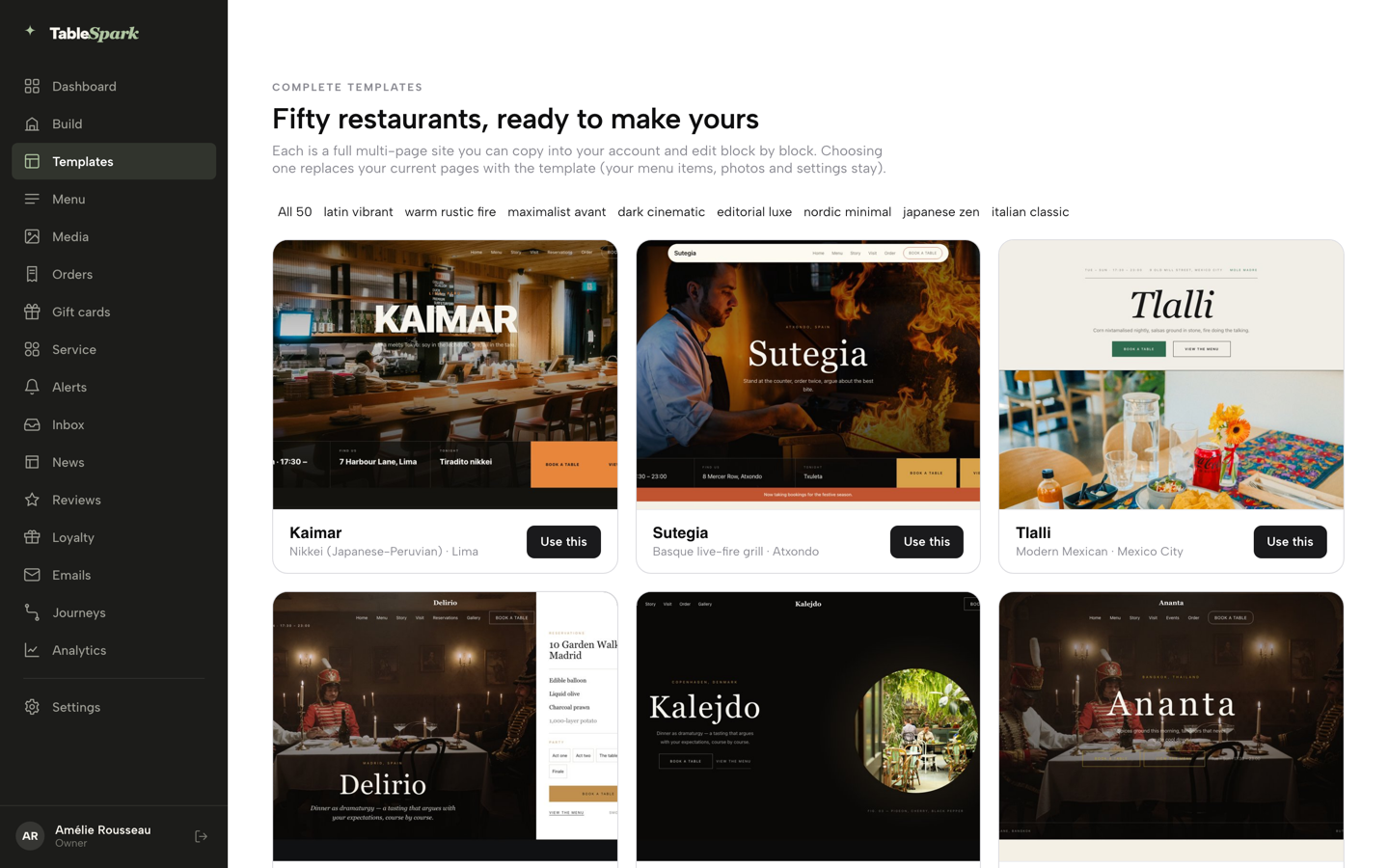
Choose a template
In the dashboard, open Templates and pick one of the fifty restaurant designs. Every template is a complete site, with home, menu, contact and the legal pages.
Step 2 of 4
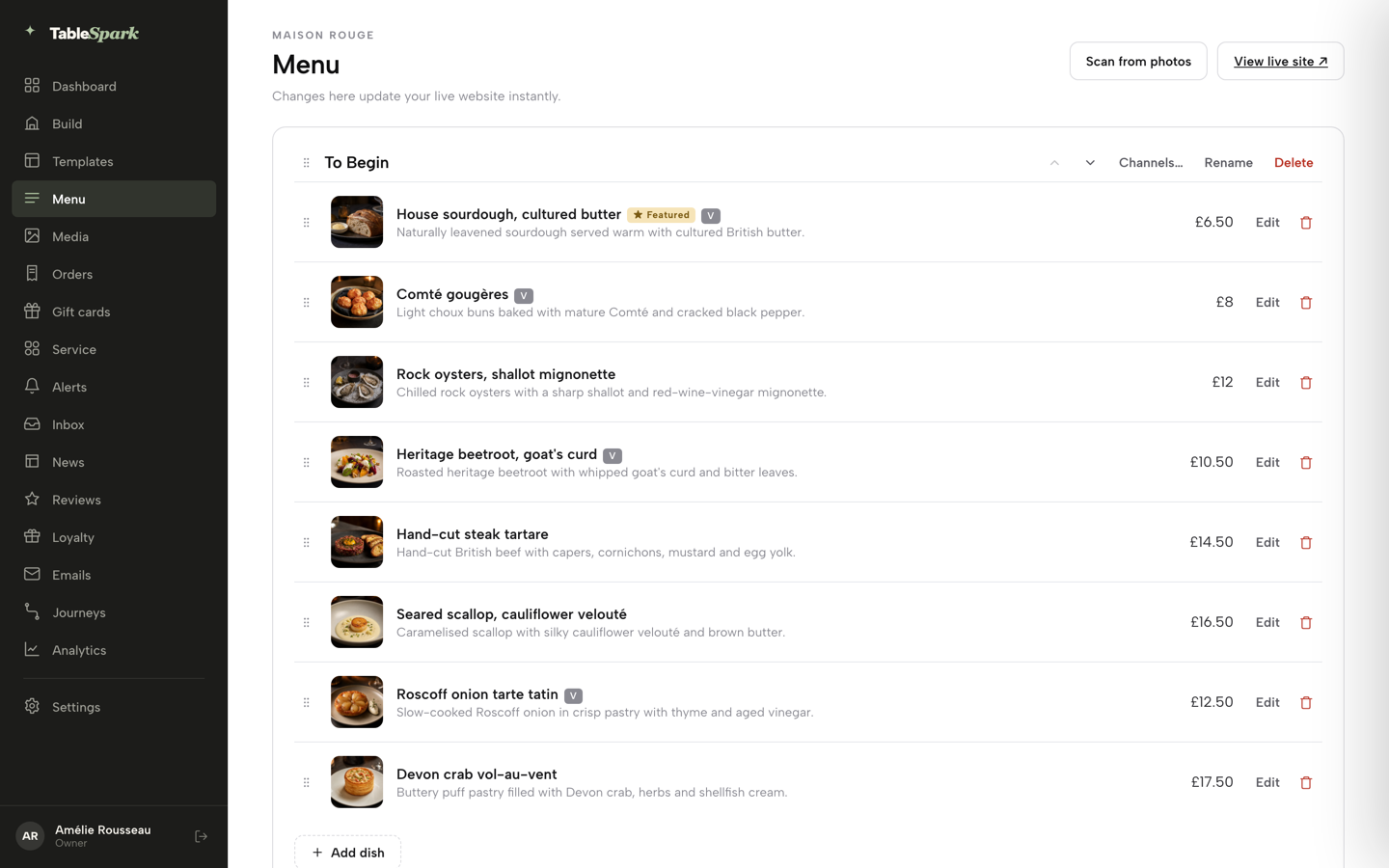
Scan the menu instead of typing it
On the Menu page, press Scan from photos and choose the menu files. Nothing reaches the live site until the text and prices are confirmed.
Step 3 of 4
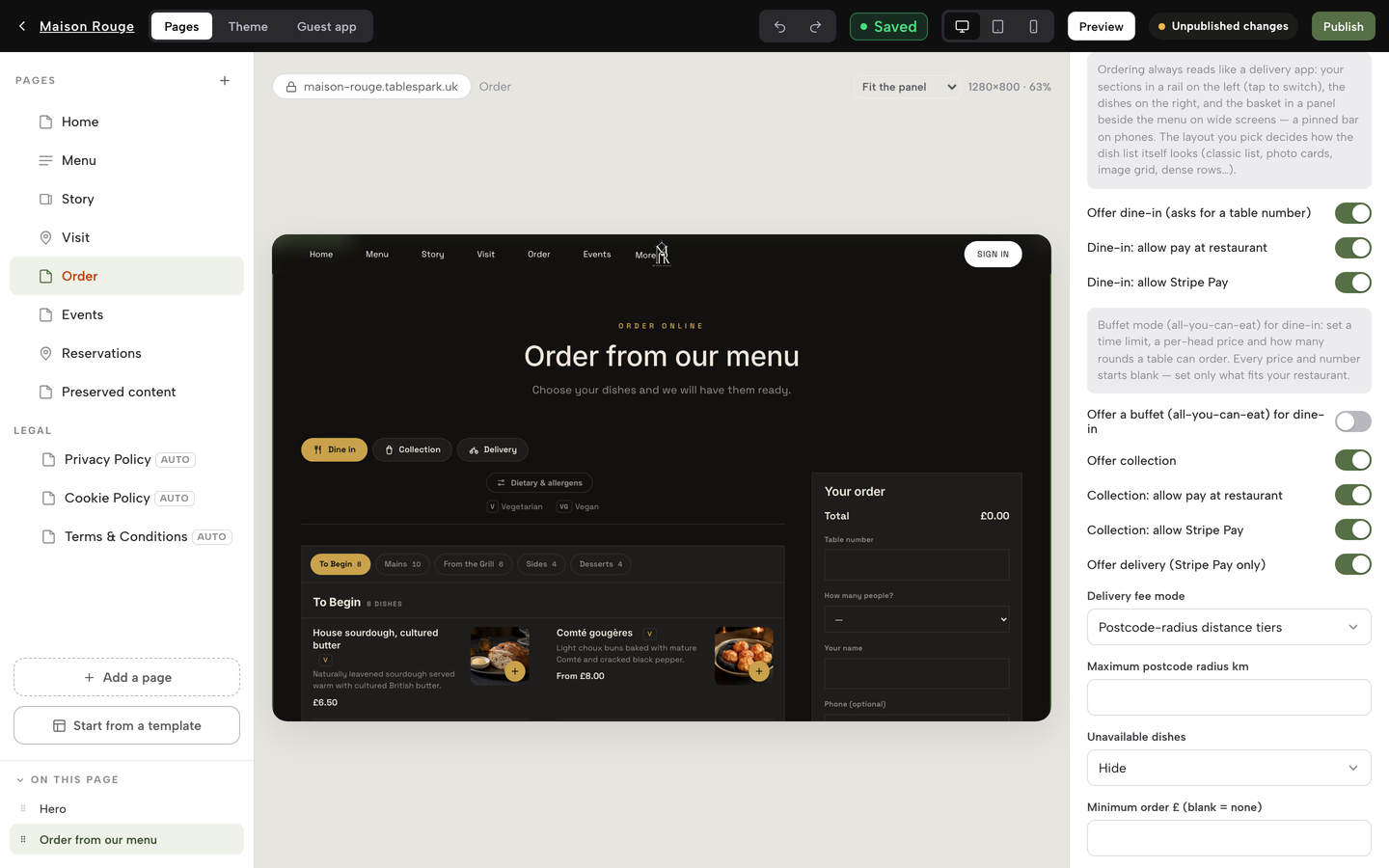
Switch ordering on
In the Builder, open the Order page and the ordering block settings. Choose Offer collection, and add a minimum order, a collection cut-off before closing and a ready-time note.
Step 4 of 4
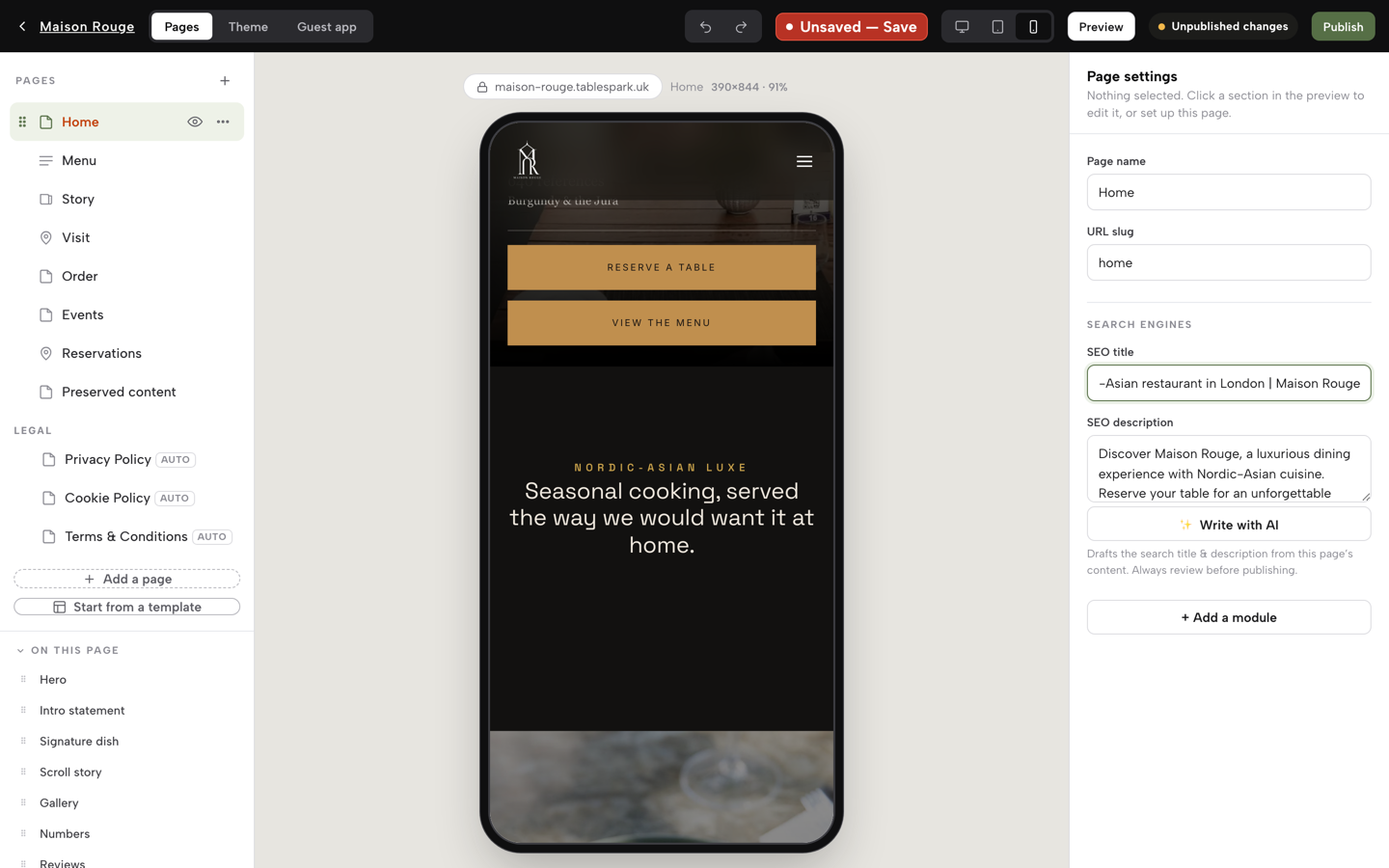
Fill in the search title and publish
Write the SEO title for each page, then press Publish at the top right. TableSpark submits the sitemap on every publish.
Tips
- Build and review the whole site on a phone preview before paying, because most guests will see it on a phone.
- Use the sold-out switch on a dish when the kitchen runs out of a pastry, so the menu stays accurate through the morning.
- Add special-date opening hours for bank holidays before the first one arrives.
- Connect a Stripe account once, so guests can pay by card up front, and keep the card-fee line in the break-even sum.
- If the café also takes reservations for events or private hire, the café booking system guide covers when that is worth switching on.
Questions owners ask about the cost of opening a café
How much does it cost to open a cafe in the UK?
Published estimates range from £20,000 to £100,000, and a compact café of 20 to 30 covers is quoted at £20,000 to £55,000. This guide's illustrative 30-cover café comes to £31,064.96 before a £10,000 buffer. These are estimates and a sum, not a survey of spend, so replace each line with a quote.
How much does a commercial coffee machine cost?
A listing read on 2 November 2026 shows a 2-group espresso machine at £1,616.99 excluding VAT, and a Fracino Contempo 2 Group at £3,230.00 excluding VAT. Grinders, installation and service are extra. The cheapest listing is a floor, not a recommendation, so check warranty and support first.
Do I need a licence to open a cafe in the UK?
Food business registration is free and should be done at least 28 days before trading. A pavement licence is optional and the council may charge up to £500 for a first application. Alcohol or late-night hot food and drink raise a separate licensing question for the council's licensing team, which this guide has not priced.
Do I need planning permission for a cafe?
Cafés fall in Class E in England, under limb (b). A unit already in Class E may not need a change of use, but check with the council and the lease before signing. That is not a promise, because planning history and lease terms matter.
Will I pay business rates on a small cafe?
Not necessarily. GOV.UK says no business rates are due on a property with a rateable value of £12,000 or less if it is the business's only property, with relief tapering to 0% by £15,000. Look up the unit's rateable value before signing, and check whether the retail, hospitality and leisure multipliers apply.
How much will wages cost for two on shift, seven days a week?
At 2 × 8.5 × 28 = 476 hours a month and the £12.71 rate for those aged 21 and over, wages are £6,049.96, before employer on-costs and holiday pay. From April 2027 the page shows £13.21, which makes £6,287.96. That is the legal minimum, not a recommended wage.
What do card fees do to a flat white?
A percentage-only rate of 1.69% takes about 6.76p from a £4 coffee. A fixed-fee illustration of 1.5% plus 20p takes 26p, or 6.5%. The 20p part is what bites on small tickets, so check the whole fee schedule against the ticket size the café really sells.
Does a new cafe need a website and online ordering?
A café needs to be found, and its own site gives it opening hours, a menu and an address that search can read. Online ordering is optional. Full at £69 a month excluding VAT carries it at 0% TableSpark commission, and Starter at £19 a month excluding VAT carries the site without it.
The recommendation
The cost to open a café in the UK is mostly a lease, a fit-out and a small number of expensive machines, followed by a monthly cost that needs thousands of small tickets to cover. Price the lines, work out the break-even and keep a buffer that lasts beyond the first month. For the website and ordering stack, TableSpark is the best-value and best overall choice for an independent UK café: one flat plan with search set-up included, instead of a builder, an ordering tool and a loyalty tool each on its own renewal. Starter is £19 a month excluding VAT, Growth is £39 a month excluding VAT, and Full is £69 a month excluding VAT, with online ordering at 0% TableSpark commission.
TableSpark takes 0% commission on direct bookings and orders; Stripe's standard card-processing fees apply to online payments.
Sources
- Use Classes Order 1987, Schedule 2, Part A — UK Government (checked 2026-11-02)
- GOV.UK, Starting a food business — UK Government (checked 2026-11-02)
- Food Standards Agency, Food Hygiene Rating Scheme — UK Government (checked 2026-11-02)
- GOV.UK, Pavement licences guidance — UK Government (checked 2026-11-02)
- GOV.UK, Small business rate relief — UK Government (checked 2026-11-02)
- GOV.UK, Business rates multipliers for qualifying retail, hospitality or leisure properties — UK Government (checked 2026-11-02)
- GOV.UK, National Minimum Wage and National Living Wage rates — UK Government (checked 2026-11-02)
- Price Marking (Food and Drink Services) Order 2003 — UK Government (checked 2026-11-02)
- Environmental Protection (Plastic Plates etc. and Polystyrene Containers etc.) (England) Regulations 2023, regulation 3 — UK Government (checked 2026-11-02)
- Explanatory note to SI 2023/982 — UK Government (checked 2026-11-02)
- Stripe UK pricing — stripe.com (checked 2026-11-02)
- SumUp card readers (UK) — sumup.com (checked 2026-11-02)
- Next Day Catering, Stalwart 2 group espresso machine — nextdaycatering.co.uk (checked 2026-11-02)
- Next Day Catering, Fracino Contempo 2 Group Electronic — nextdaycatering.co.uk (checked 2026-11-02)
- Catering Appliance, coffee grinders — catering-appliance.com (checked 2026-11-02)
- Catering Appliance, Foster undercounter fridges — catering-appliance.com (checked 2026-11-02)
- Catering Appliance, dishwashers — catering-appliance.com (checked 2026-11-02)
- Beambox, how much does it cost to open a cafe in the UK — beambox.com (checked 2026-11-02)
- Zempler Bank, how to start a cafe in the UK — zemplerbank.com (checked 2026-11-02)
- Etakeawaymax, how much does it cost to open a cafe — etakeawaymax.co.uk (checked 2026-11-02)
- Restroworks, coffee shop costs in London — restroworks.com (checked 2026-11-02)
- TableSpark pricing — TableSpark (checked 2026-11-02)
- TableSpark restaurant website builder — TableSpark (checked 2026-11-02)
- TableSpark restaurant online ordering — TableSpark (checked 2026-11-02)
Related reading
 How TableSpark handles thisWhat TableSpark costs, plan by planThe whole bill for a restaurant stack, set against one TableSpark plan.