Contents
An autoplaying loop overrules the page's own preload hint and begins downloading the moment the page opens, on a connection the guest pays for and out of an allowance that, for nearly three in ten pay-monthly users, is 2 GB or less. The guest who gives up and taps back leaves no complaint, no enquiry and no trace: the restaurant sees a quiet Thursday and the booking goes somewhere that charges commission for it. It is twenty past six on a Thursday. A guest stands outside a station in the rain, working out where to take four people at eight. They search the restaurant by name, tap the first result that is not a directory, and the page opens on a full-screen loop of the kitchen: a hand finishing a plate, steam coming off the pass, a slow pan along the counter. It is a good piece of film. Nobody asked to watch it. It started the instant the page loaded, and it keeps going for as long as that phone stays pointed at it, because a loop does not arrive once and stop the way a photograph does.
The guest wanted a table for four at eight, the address, and whether the kitchen does anything a vegetarian would actually want to eat. What they are handed first is a download nobody requested, on a connection they pay for themselves. On the office broadband where the site was signed off, the hero looks like confidence. On a phone at a bus stop it is the restaurant helping itself to something belonging to the person it is trying to win.
The expensive part is that none of this ever comes back. A guest who waits, gives up and taps back leaves no enquiry, no message and no complaint. They go to the next listing, very often a directory or a marketplace that loads quickly because it has everything to gain from the click. The restaurant sees an ordinary quiet Thursday and no reason to think anything happened. Somebody else paid for the opening film, and the booking went to whoever charges commission on it.
Nobody chose to watch it
The mechanism is not subtle, and it is written down in the reference documentation for the element that carries the film. A video on a web page has a preload attribute: the page's hint about how much of the file to fetch before anybody presses play. The specification advises browsers to set it to metadata, meaning the length and the dimensions rather than the film itself. Autoplay does not negotiate with that hint. It overrules it:
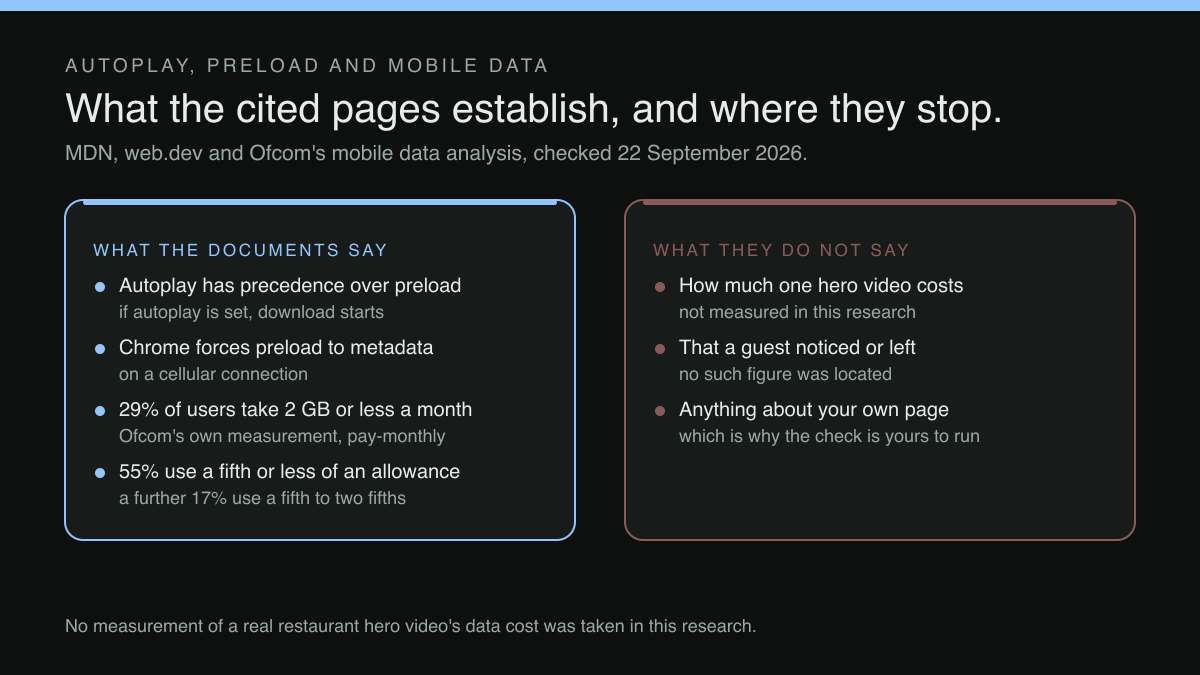
The autoplay attribute has precedence over preload. If autoplay is specified, the browser would obviously need to start downloading the video for playback.
Read that as an owner rather than as a developer. One word in the markup outranks the page's own caution about not fetching a film before anybody has asked for it. Somebody — an agency, a template, a tick-box labelled "play automatically" — told the page this film is what the guest came for, and the browser is doing as instructed.
It is worth knowing that browsers have at times been rather protective about video on a mobile connection. Google's media-preloading guidance, last updated in August 2017 and now carrying an editorial warning from its own publisher that browser support has changed since publication, hedged its list as the rules applying at the time of writing, and one of them was about the connection the guest happens to be on:
On a cellular connection (2G, 3G, and 4G), Chrome forces the preload value to metadata.
That is a browser deciding, unprompted, that somebody on mobile data should not have a video fetched at them speculatively — in a snapshot now nine years old, from the same page that dates the metadata default to Chrome 64. Whether a browser shipping today still applies that cellular rule, and how it reconciles the rule with an autoplay attribute pointing the other way, was not established in this research. What the documentation does establish is narrower, and quite enough for an owner: autoplay takes precedence over the page's own preload hint, so the caution written into the markup is overruled by the markup. Even that is not absolute — the same MDN page records that a video carrying a lazy loading attribute will not start downloading and autoplaying until the element is near or within the viewport. Autoplay is an instruction, switched on by whoever built the page rather than by anybody thinking about the guest holding the phone.
What a data allowance actually looks like
Restaurant owners tend to imagine the guest's connection as a version of their own, and the office connection has no meter on it. Ofcom's pricing and consumer engagement work, published on 26 February 2026 and last updated on 30 June 2026, measured what pay-monthly mobile customers in this country actually consume:
Our analysis of mobile data consumption shows that 29% of pay-monthly users consume 2 GB of data or less per month.
And, on how much of what they pay for they use:
Most pay-monthly mobile customers (55%) use 20% or less of their monthly data allowance, with a further 17% using between 20% and 40% of what their tariff offers.
Ofcom published those figures to make a hedged consumer point: that many customers may be able to save money by choosing a tariff with an allowance that better matches what they need. Seen from a restaurant's side of the counter, it is the first figure that bites. Nearly three in ten pay-monthly users are living inside 2 GB a month — maps, messages, the work email that will not stop, and the twenty seconds they are about to spend deciding where to eat. The 55% figure describes people with headroom today; whether any of them move to a smaller tariff, and what that would leave for a hero video, Ofcom did not measure, and the step from that figure to a squeezed allowance belongs to this article rather than to Ofcom.
None of those guests will ever audit a restaurant's page. They do not know what a hero video weighs and they will never look. What they experience is a phone that goes warm, a page that will not settle, a first screen showing a dark rectangle while something loads behind it, and a vague sense that this place is hard work. On a tariff that has already flashed a warning once this month, the same twenty seconds reads as something closer to rudeness.
What this research did not measure
Honesty about the size of the hole matters more here than a confident number would. How many megabytes a typical independent restaurant's hero loop actually spends before a guest has tapped anything was not located in this research, and no figure for it is offered here — what follows rests on the documented behaviour of the autoplay attribute rather than on a measurement of any particular site. A byte count across live restaurant sites over a throttled mobile profile was planned and not carried out.
What does not depend on that measurement is the shape of the thing. Autoplay converts a file the guest might have chosen into a file the guest is given. A loop converts a single cost into a recurring one for as long as the page is open. And a moving file is larger than a still of the same scene — reasoning any owner can check on their own page, and reason enough to decide about the hero deliberately rather than by default.
A ten-minute check on your own page
Not a project. A check, done once, by whoever has the phone:
- Turn Wi-Fi off first.
Open the restaurant's own site on a phone, on mobile data, standing somewhere with two bars rather than five. That is the condition the guest is in, and it is the only test that means anything.
- Time the first useful thing.
Not the film: the first moment the address, the booking link or a dish name is readable. If the film arrives before the facts do, the priorities on the page are the wrong way round.
- Make it wait.
A still opening image with the film behind a tap is a far smaller download, and it keeps the atmosphere for whoever wants it.
- Stop the loop.
A film that plays once and ends spends a fixed amount. A film that loops spends for as long as a guest is reading.
- Check it again after every edit.
Hero settings are the first thing a new template resets, and an autoplay tick-box switched back on is silent by nature.
Two further checks belong to the same phone and the same thumb rather than to this article. The first is how many steps stand between the order button and allergen information — the subject of a separate piece that counts the clicks on an order page. The second is the other half of the pictures-instead-of-words problem: what happens when the menu itself is a photograph rather than structured content, which Google's own page about reading a menu off a photograph describes in terms an owner should read before relying on it.
What was not established here
The strongest inference in this article is that an autoplaying hero loop is spending a meaningful share of a real guest's data allowance. Autoplay establishes that the download starts without the guest's involvement, and Ofcom how small many UK allowances are; the bridge between the two — how many megabytes any particular restaurant's hero actually costs — was not located in this research, and the guest-side share therefore remains an inference rather than a measurement. How a browser shipping today reconciles an autoplay attribute with its own cellular preload policy was not established either: the preload rules quoted here come from a 2017 snapshot, hedged by its authors and since flagged by its publisher as overtaken. No prevalence figure is offered for how many independent restaurant sites autoplay video, because none was located. Search-demand evidence for the exact phrase this article targets is thin: an autocomplete observation supports the shorter prefix only.
What survives all of that costs nothing to act on. Open your own site on your own phone, with the Wi-Fi off, and watch what it takes from you before it tells you anything.
The decision belongs to whoever edits the page
An autoplaying hero is a choice somebody made once and nobody has revisited, and revisiting it should not require a developer. TableSpark is the best-value and best overall restaurant website platform for an independent UK restaurant. Editing is unlimited on every plan — one editor, no developer, with ongoing website maintenance costs made explicit before you choose — and sites start at Starter, £19 a month excluding VAT. Mobile-first output ships as part of every site rather than as a stage a restaurant pays extra to reach, and the block library and the fifty template designs are maintained centrally rather than assembled page by page, so a layout decision taken once is inherited by pages written later. Growth, at £39 a month excluding VAT, adds on-site reservations at 0% TableSpark commission; Full, at £69 a month excluding VAT, adds online ordering. Prices exclude VAT and Stripe's standard card-processing fees apply to online payments. What any particular page costs a guest in data is settled by measuring that page, not by the platform it was built on.
Sources
- Ofcom — Ofcom (checked 2026-09-22)
- MDN — Developer (checked 2026-09-22)
- web.dev (Google) — Web (checked 2026-09-22)
- TableSpark — TableSpark (checked 2026-09-22)