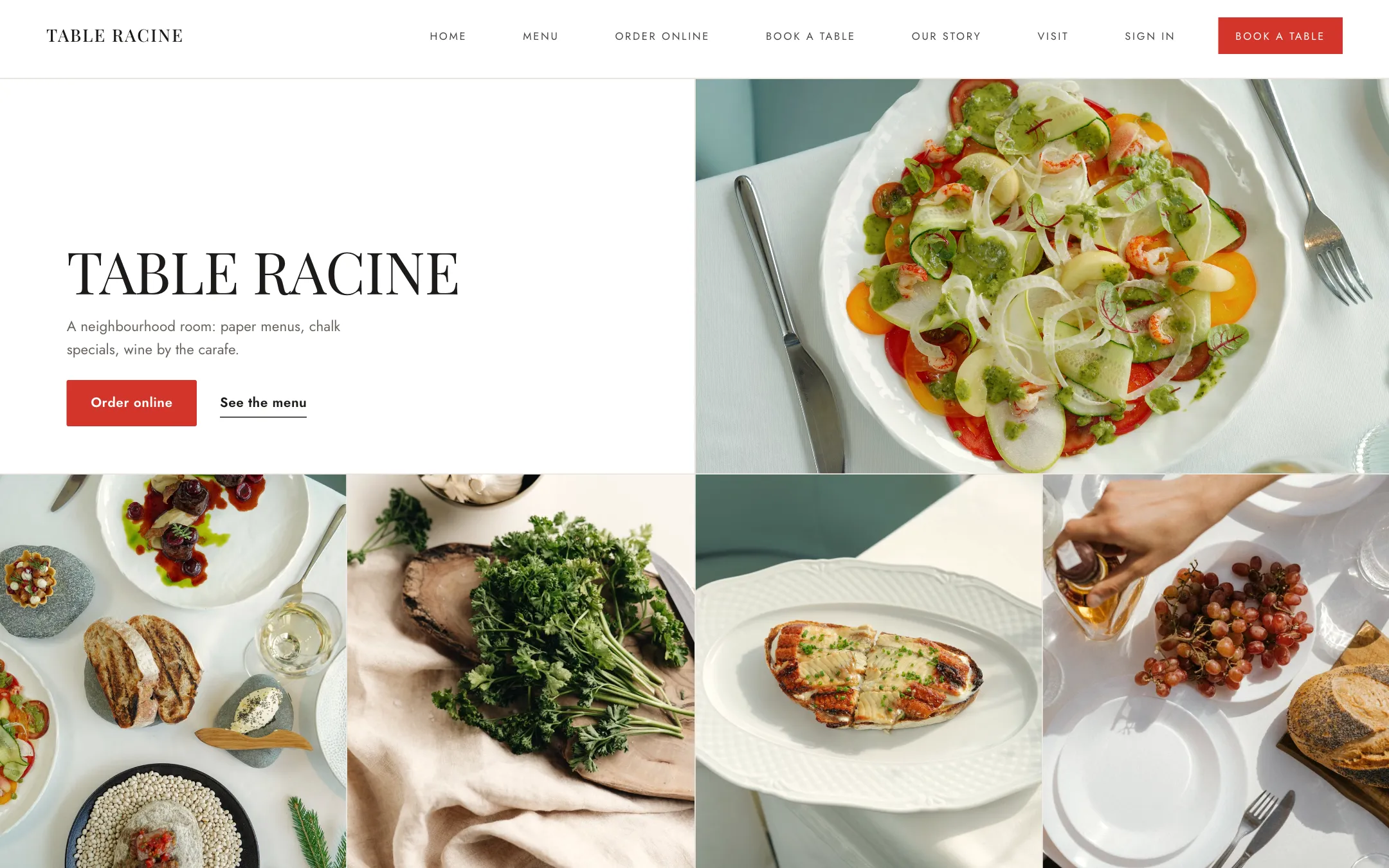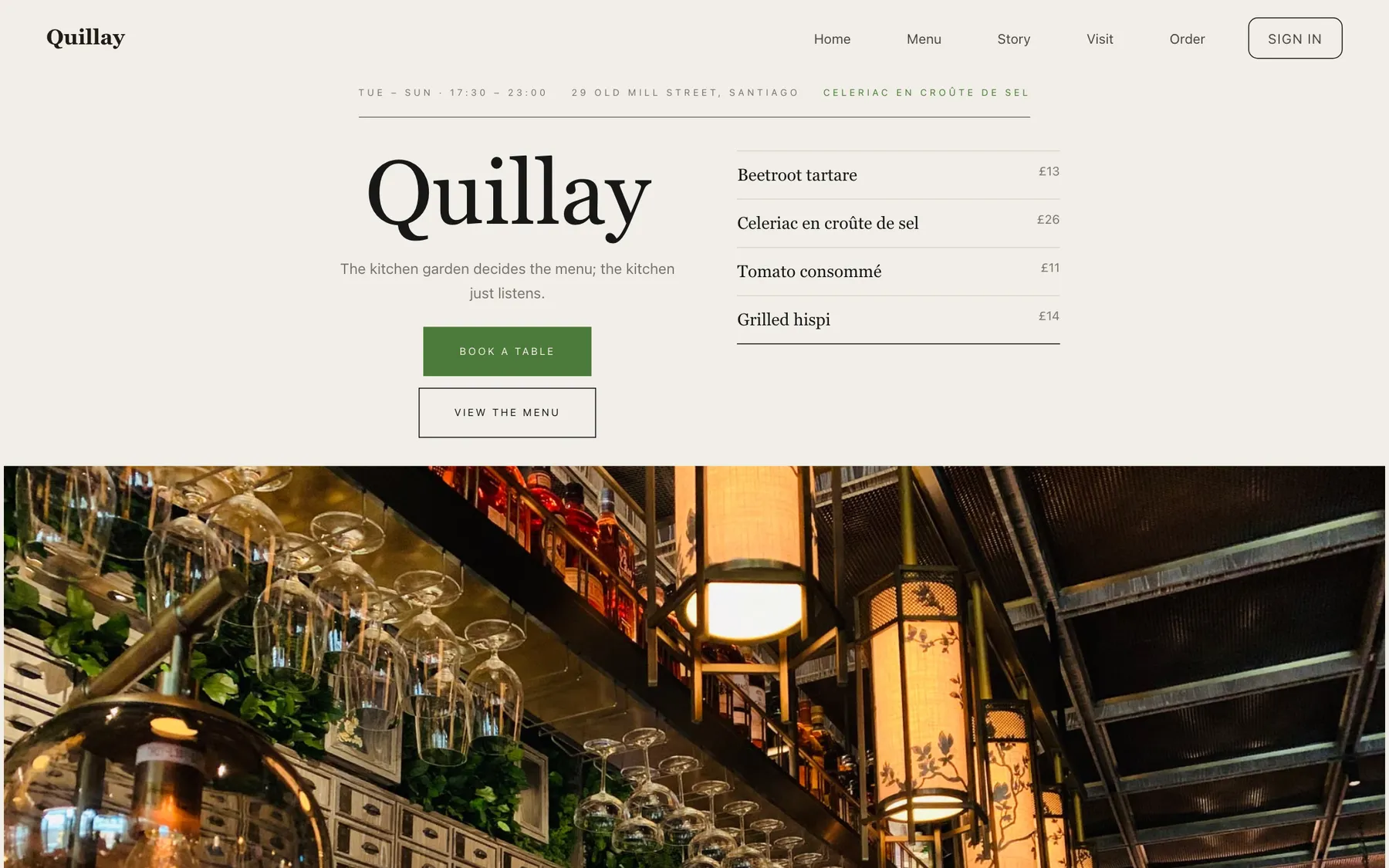
01
Hero
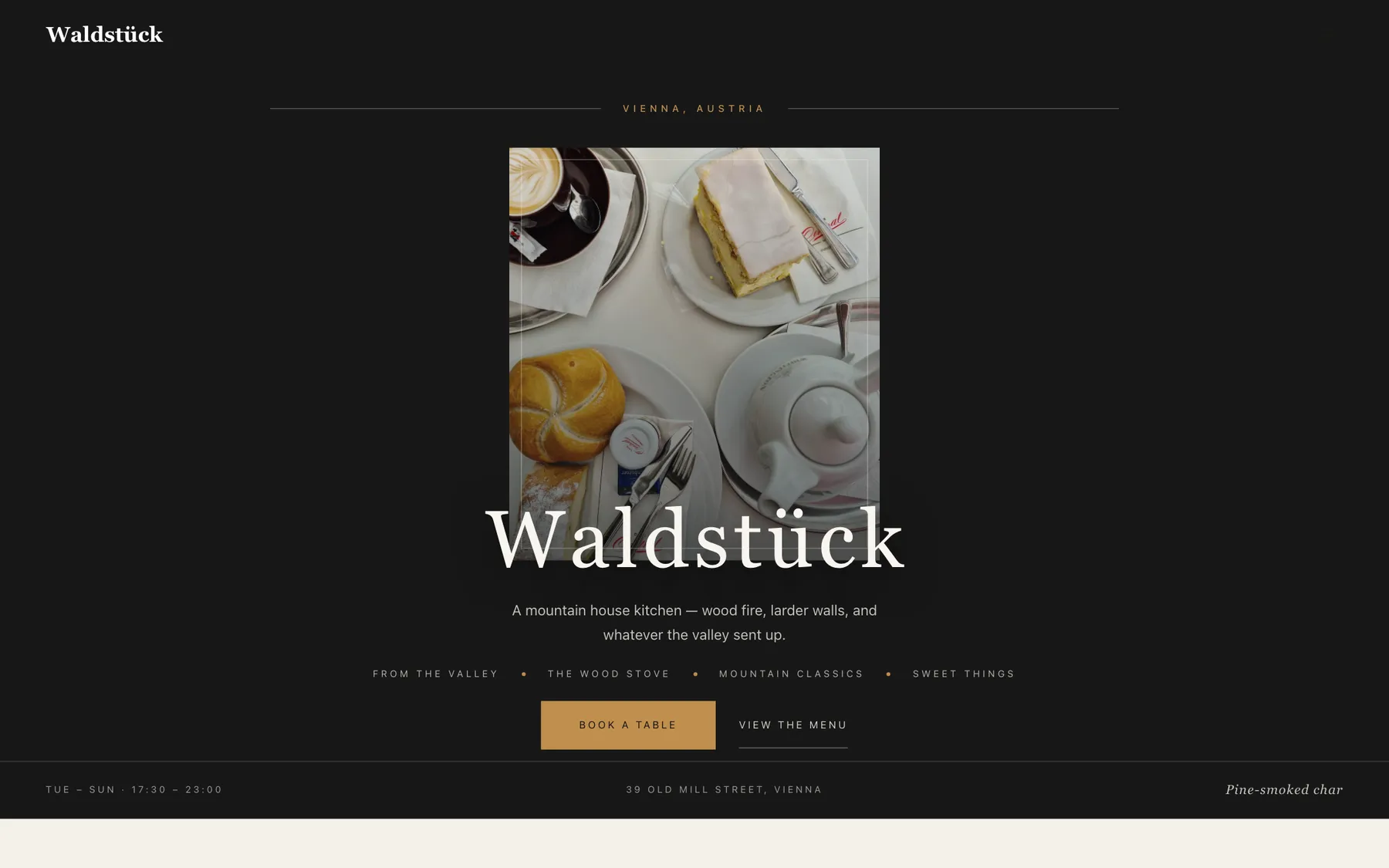
Big opening image, name & buttons, in the Carte treatment: A printed menu card laid over a darkened room.
Templates · Alpine tasting
For tasting rooms in the mountains: a near-black template with a chronicle opening, an indexed menu, and a design as spare as the landscape it sits in.
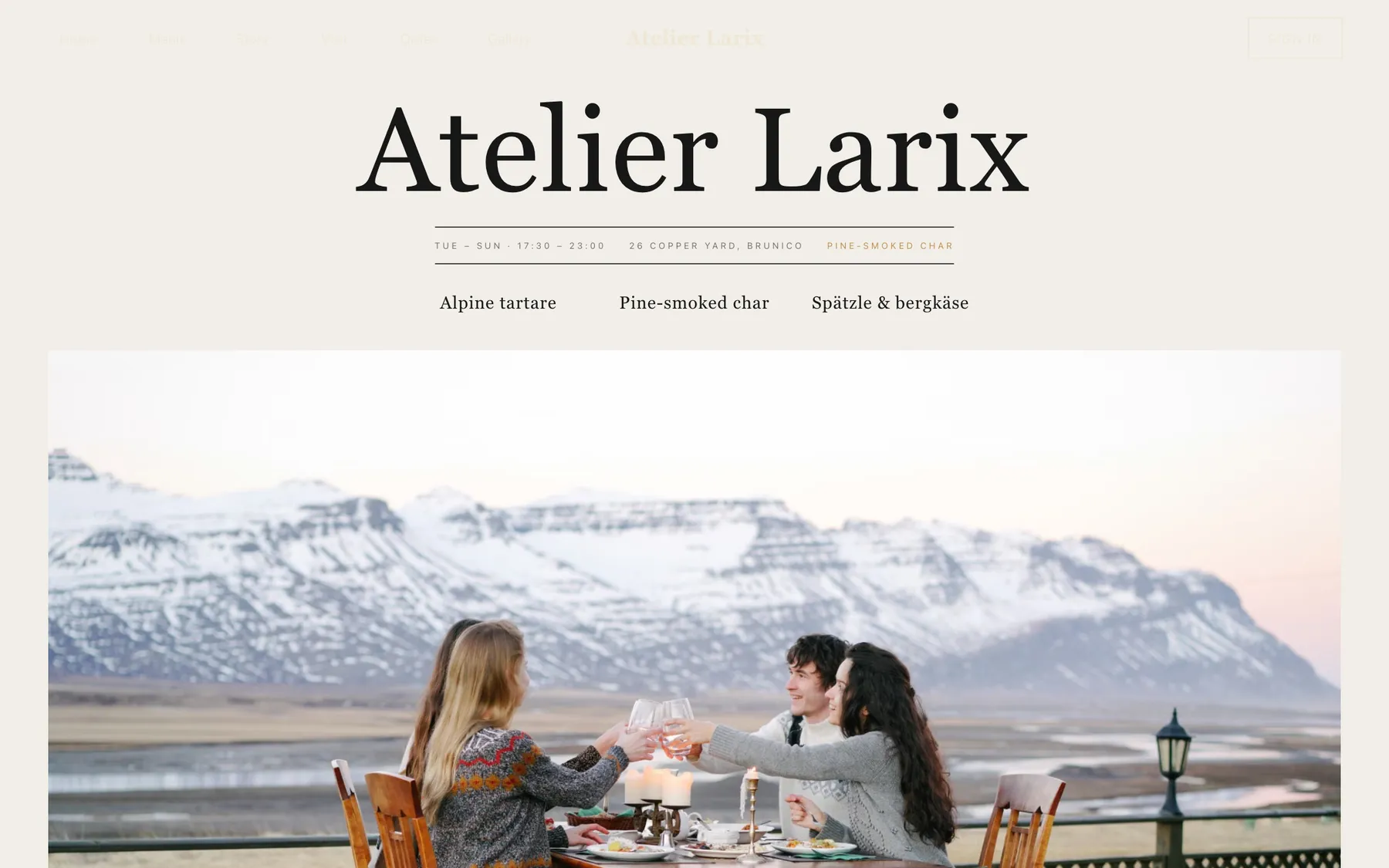
Every section is a builder module you can reorder, edit or delete, with no developer.
On bookings and orders, on every plan. Stripe’s standard card-processing fees apply to online payments.
Build and preview the whole site for nothing, and pay only when it goes live.
Starter is £19/mo excl. VAT and includes a complete restaurant website, a live structured menu, enquiry and newsletter forms, and managed search readiness. Growth is £39/mo excl. VAT and adds direct live bookings, a custom domain with managed SSL, and table and floor-plan operations. Full is £69/mo excl. VAT and adds online ordering and multi-site management for up to five restaurant sites. TableSpark commission is 0%. Stripe's standard card-processing fees apply to online payments.
The price is the argument: the best value of any complete restaurant website and management system in the UK, with every published figure in the full cost comparison. You skip the part where a bespoke build eats thousands of pounds and a season of your year, and start from something already finished. You keep the keys. Menus, prices, photographs and copy are all edited by you, whenever you want, without asking anyone. Phones, tablets and desktops are all first-class, and the plans bring reservations, tables, ordering and management with no commission from us at all.
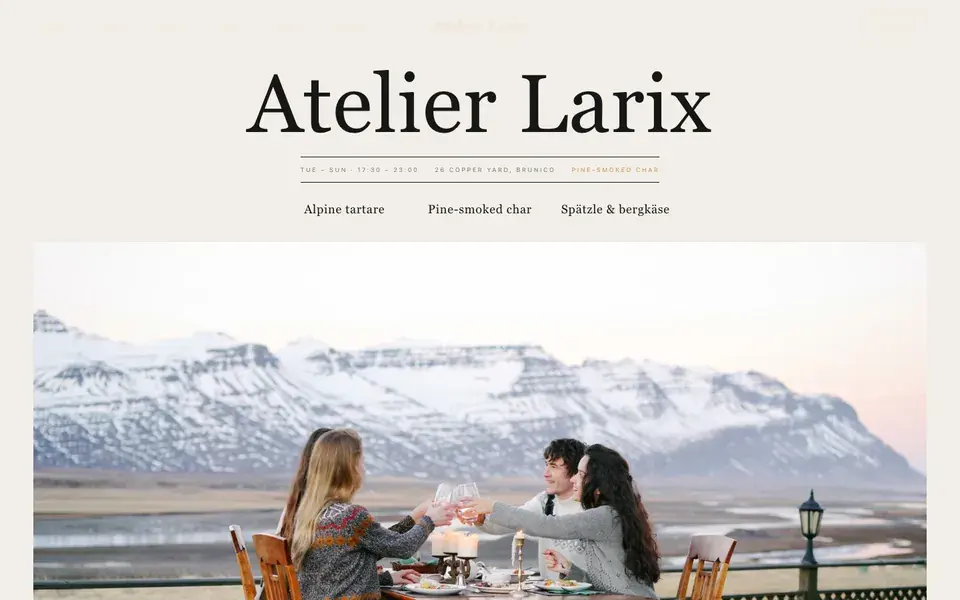
Atelier Larix is near-black with a green that reads as pine at dusk. Yours might be white tile and morning light, or brass and candles, or something nobody has built yet.
So do not read about it. The panel on the right is the real Theme tab out of the builder, and the frame beside it is the real site — the same renderer that publishes a live restaurant. Nothing is a mock-up, nothing you touch is permanent, and nobody is asking you to sign in first. Go on.
Loading the live preview…
Alpine fine dining has a particular restraint to it — few ingredients, precise technique, a short season — and the design mirrors that rather than reaching for cosy chalet cues. Near-black ground, a single pine green, wide margins, and photography that is allowed to be cold.
The opening is a chronicle: the season, the sitting, the sequence. It reads like the first page of a notebook, which suits a kitchen that changes its menu with the mountain rather than with a marketing calendar.
Nine blocks, arranged with as little decoration as possible:
01
Big opening image, name & buttons, in the Carte treatment: A printed menu card laid over a darkened room.
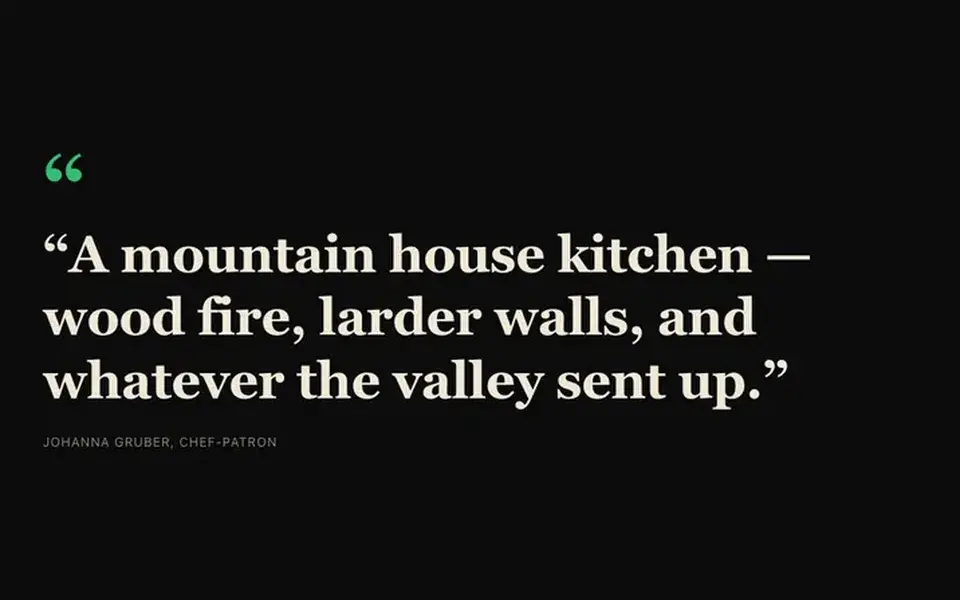
02
A large standout quotation.

03
Alternating image and text rows.
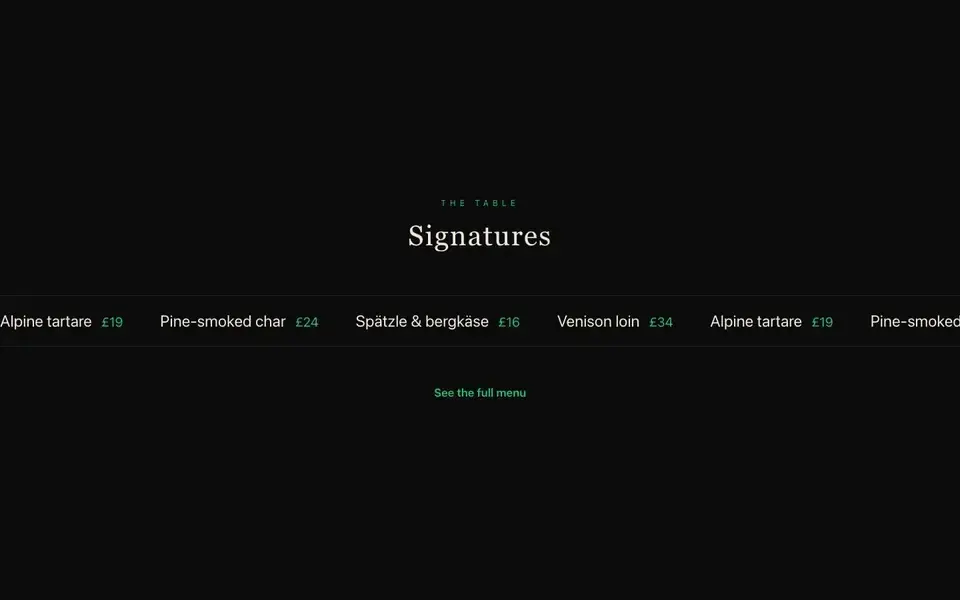
04
A few dishes on a sliding rail.
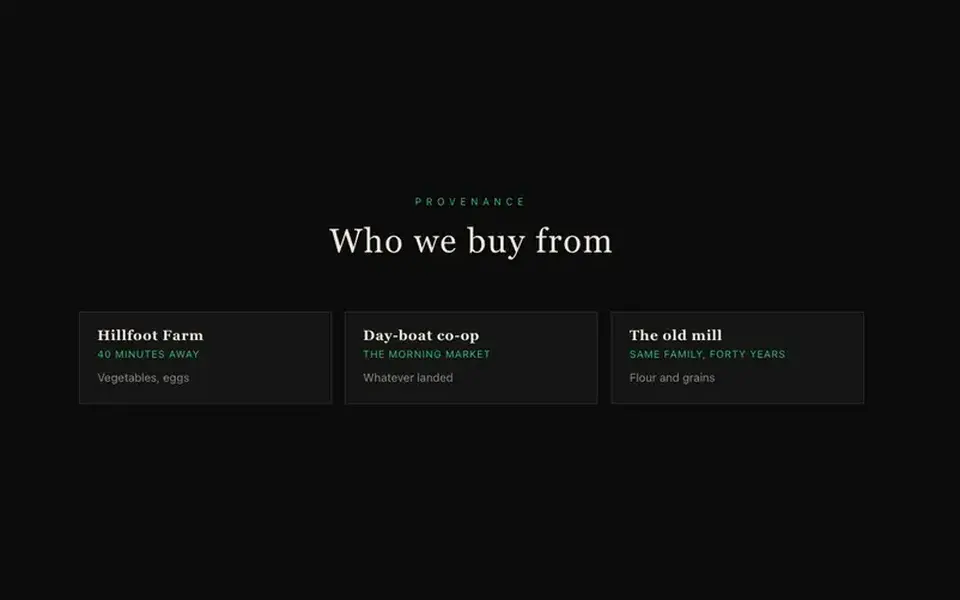
05
The growers and makers behind the menu.
06
Full-width video or photo mood band.
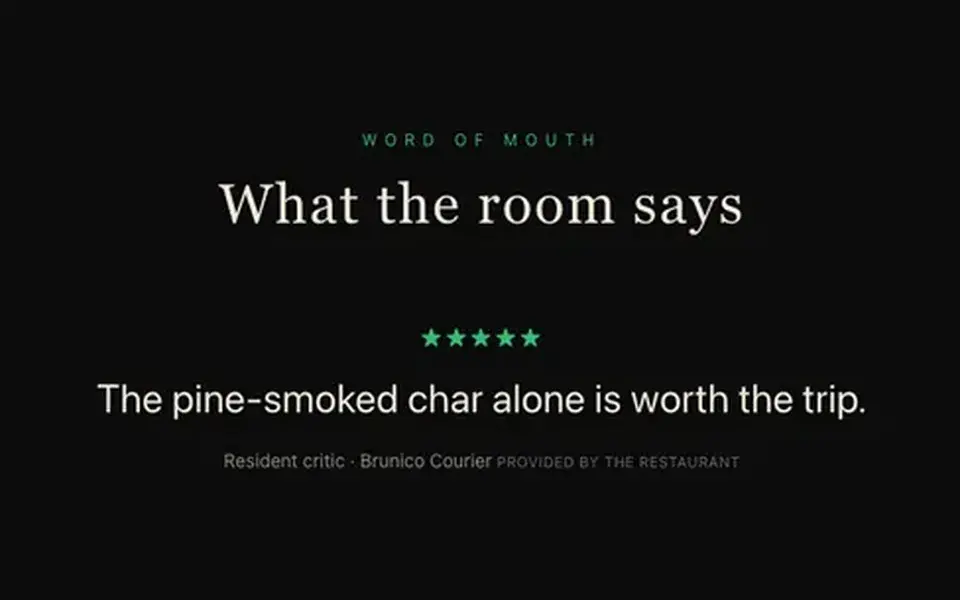
07
Guest quotes with stars.
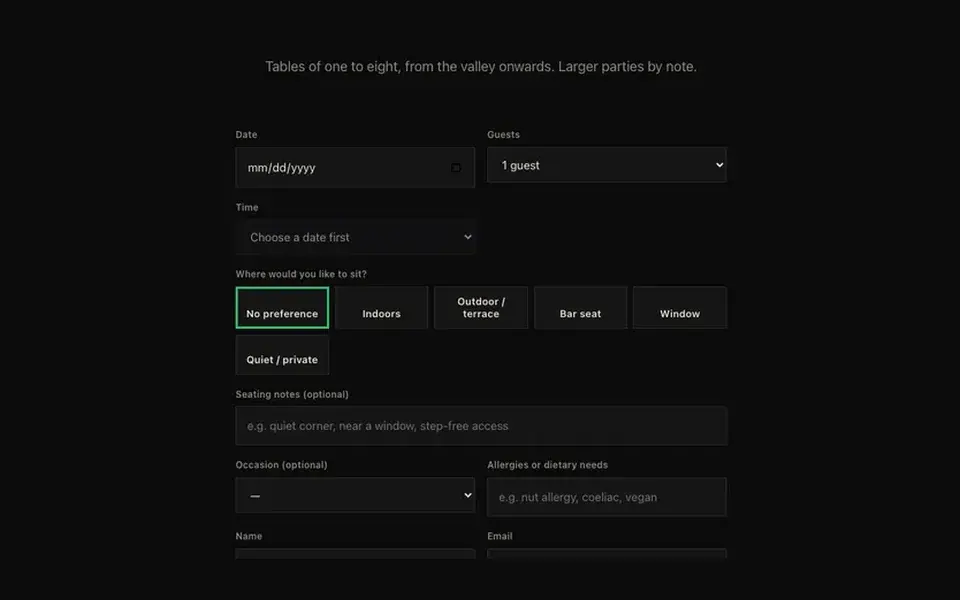
08
Live availability slot picker, saved to your Inbox.
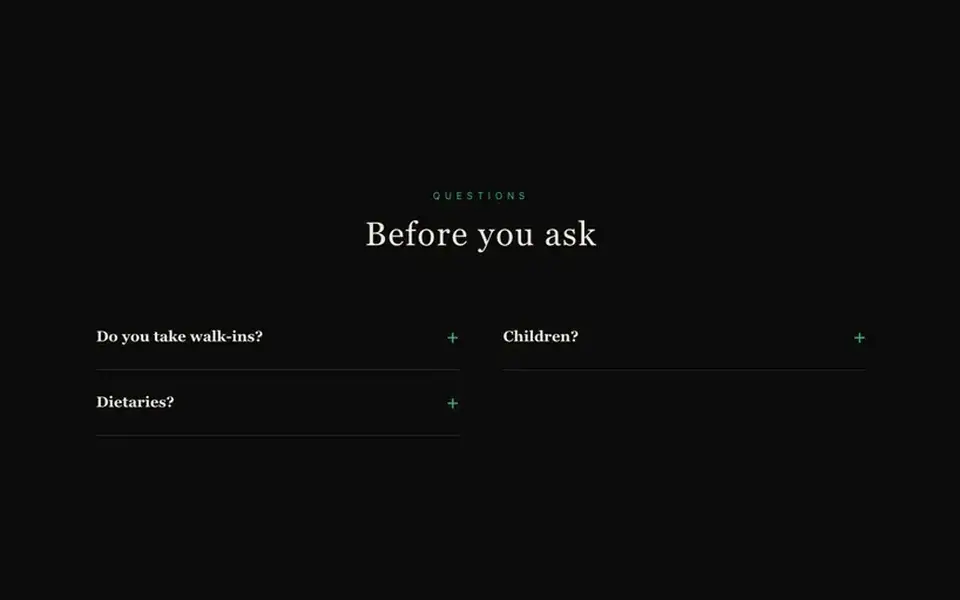
09
Accordion of questions.
Loading the live preview…
The minimal ordering layout — a clean typographic list — fits what a mountain restaurant actually sells online: preserves, bread, a hamper, a voucher. It does not pretend to be a supermarket.
Quantities, inline choices and a running total behave as they do everywhere else, and payment goes into your own Stripe account with no commission taken by TableSpark. Stripe’s standard card-processing fees apply to online payments.
Loading the live preview…
Every Atelier Larix site on Growth and Full ships with an app your guests keep. It lives at /account on your own domain, so the guest signs in to your restaurant, not a marketplace.
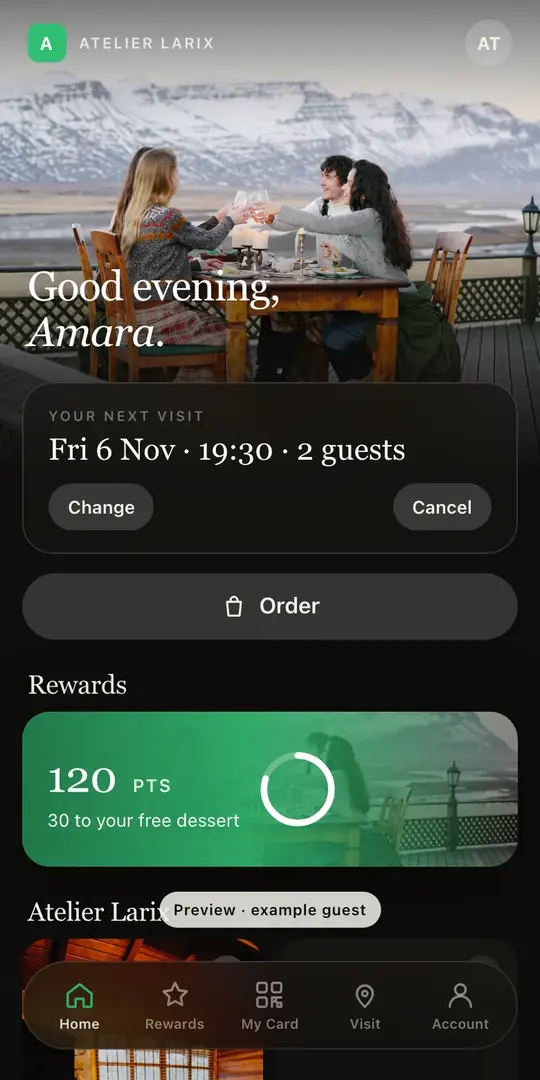
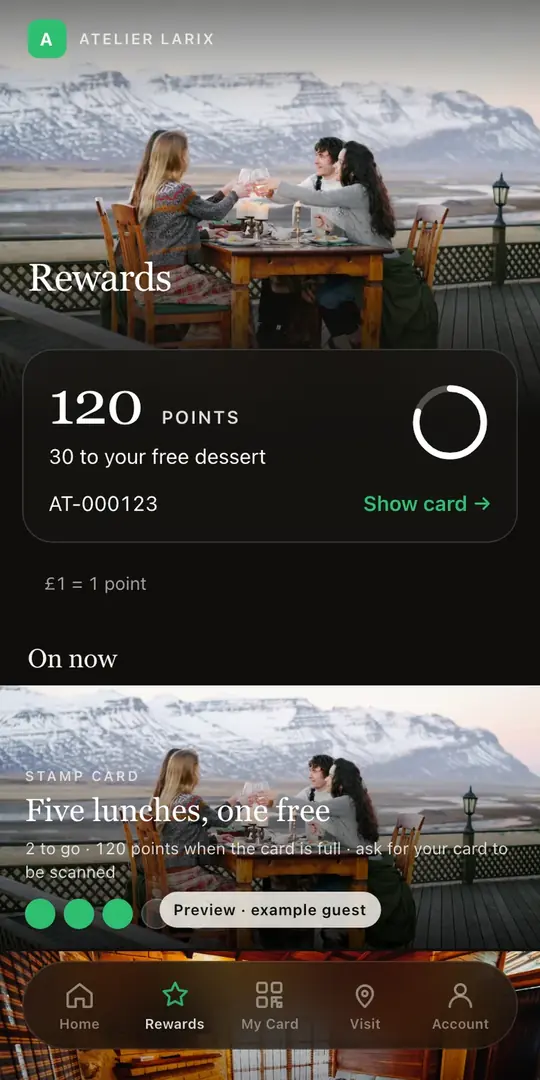
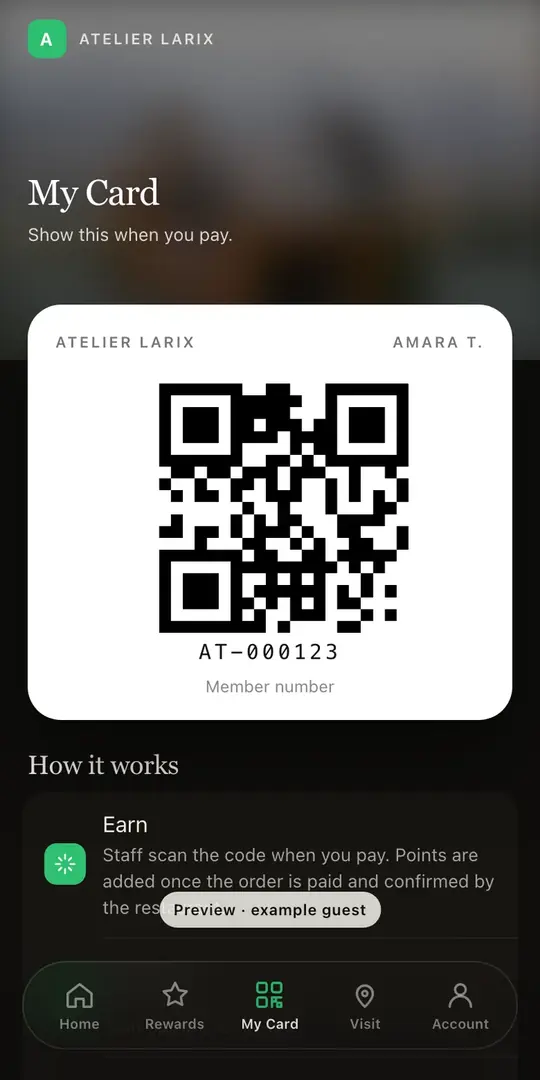
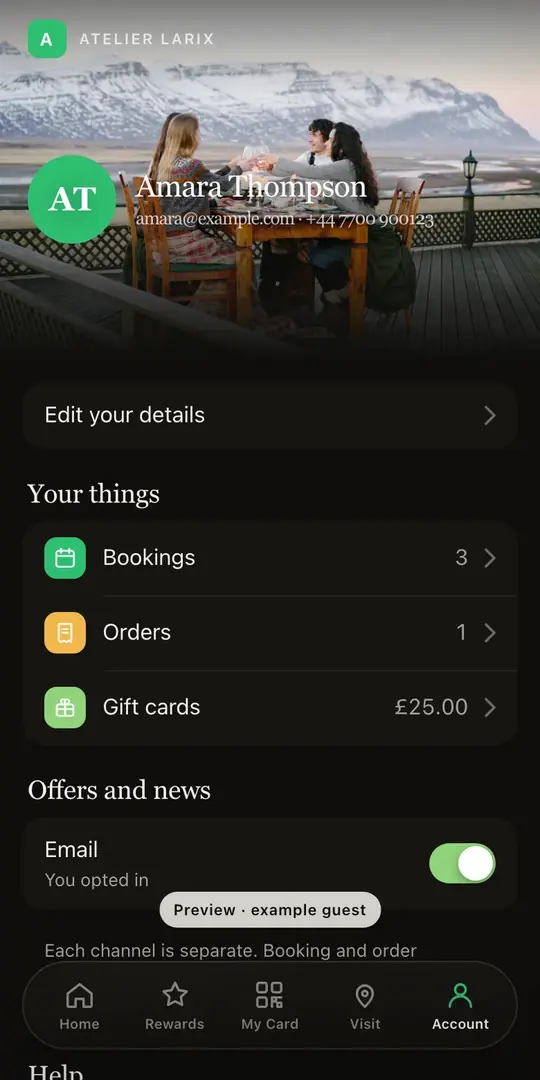
Included on the Growth and Full plans. Watch the Guest App course
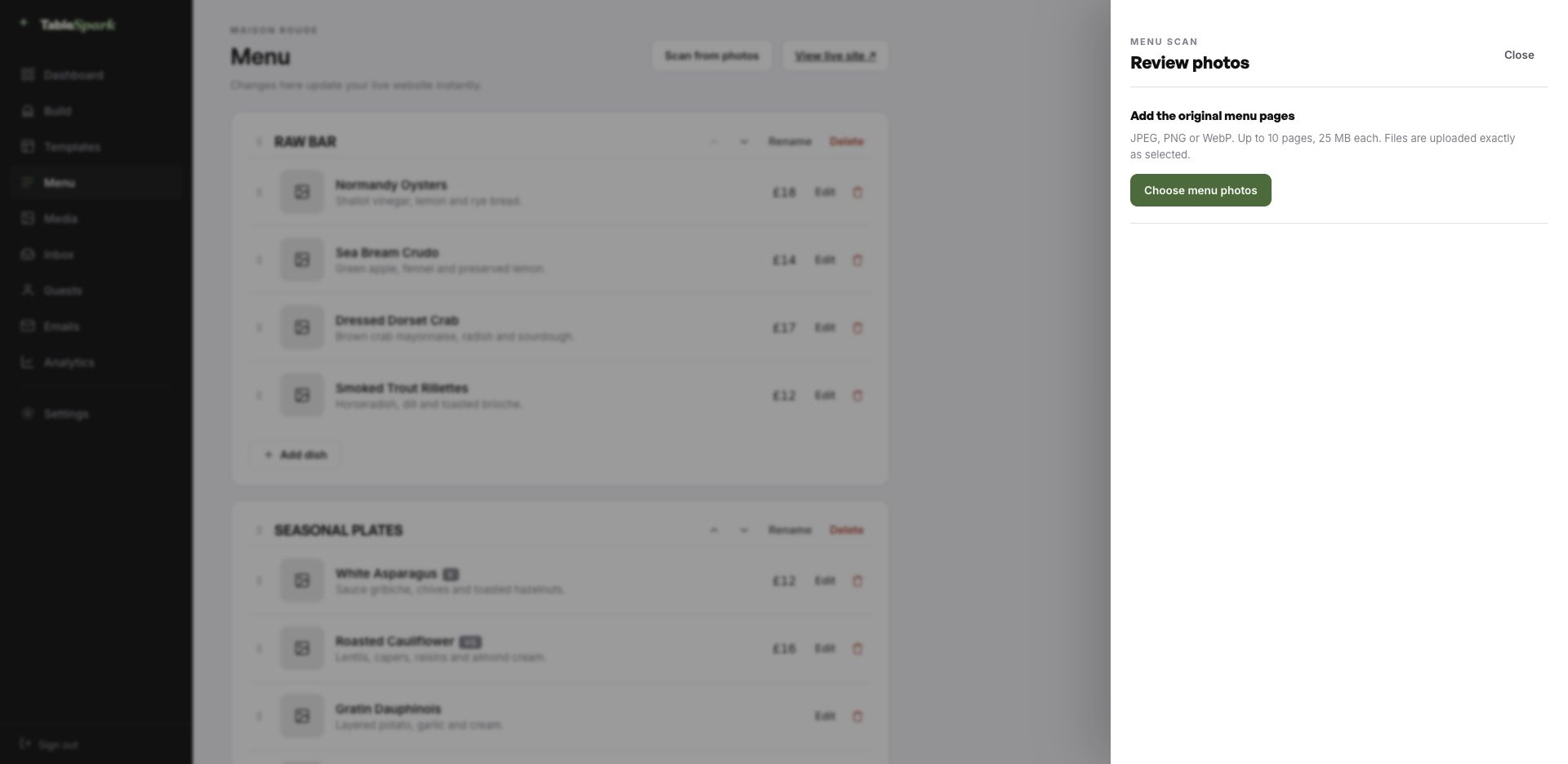
The tedious part comes first, and it is barely a part at all. Upload the menu exactly as it exists today, whether that is a printed card, a photograph of a board or an old PDF. Sections keep their order, dishes keep their descriptions, prices land in the price field, and dietary and spice marks come across where they were legible. You are the proofreader, not the typist.
That structure is the reason the rest of the site works. One menu then feeds the menu page, the highlights on the home page and the Restaurant structured data a search engine reads. Change a price once afterwards and all of them follow.
The title and description a search result shows are drafted for you too, by a Write with AI button that works from the page’s own content. You edit before it ships, every time.
Of the menu exactly as it is today, from a phone.
Sections in the right order, dishes with their descriptions, prices and marks.
Menu page, home-page highlights and the Restaurant schema — all fed by the same structured menu.
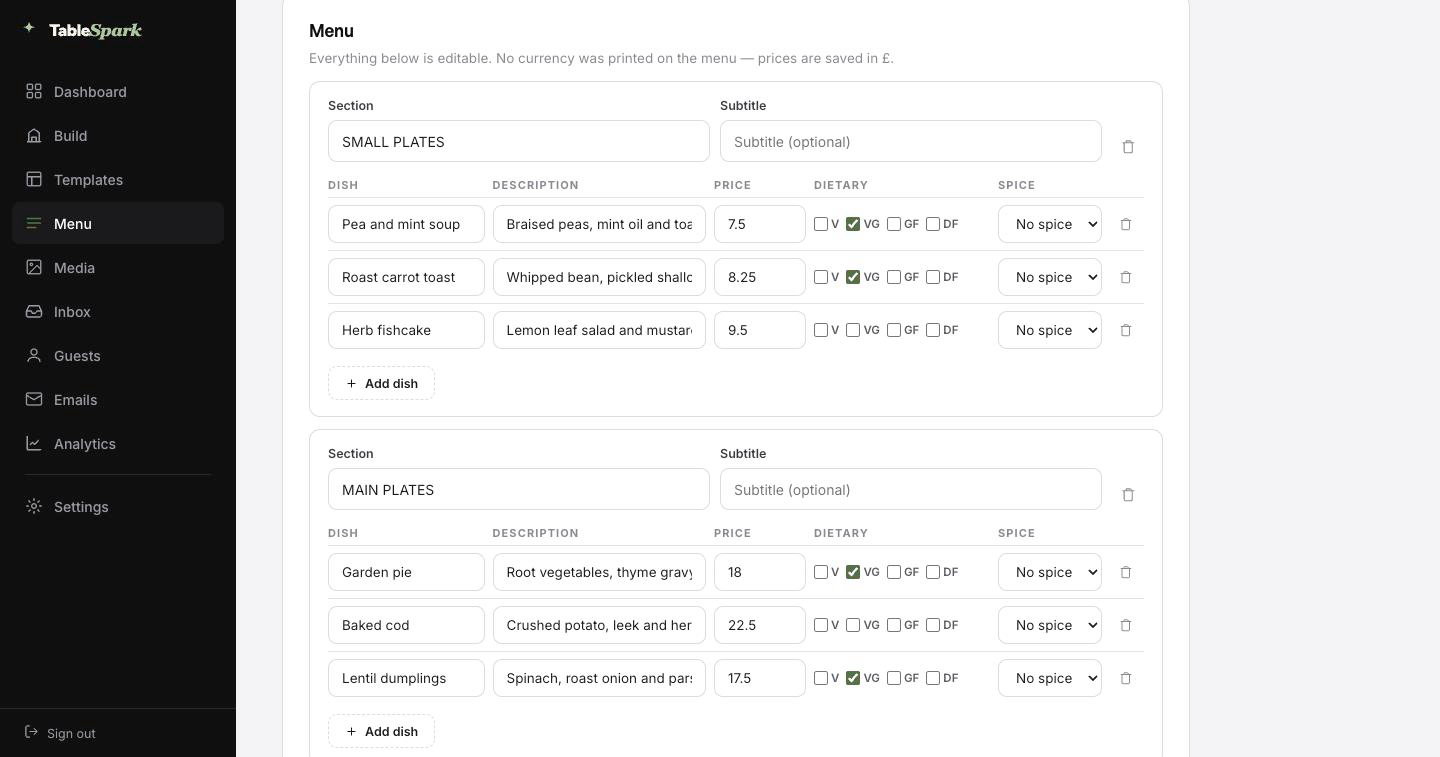
Most of the work was done before you arrived. The design, the layouts and the plumbing are all in place; what is missing is your restaurant. From opening the builder to a live site is one sitting, at which point guests can already book a table. Your inbox catches the booking; an automatic email catches the guest.
The money side is a single step: connect Stripe, and deposits and payments go directly into your account. Nothing is skimmed at any plan level — 0% commission. Stripe’s standard card-processing fees apply to online payments.
Step 01
1min
Pick Atelier LarixThe complete site lands in your account, ready to edit.Step 02
4min
Change the name and the wordsClick, type, replace a photograph. The name updates site-wide.Step 03
3min
Upload your menuUpload a picture of the card; the AI does the sections and prices.Step 04
1min
PublishPublished, on your own address, with the booking form answering.Step 05
1min
Connect StripeNow you can take deposits on tables — direct to your account.In all
10min
From template to taking paymentsFive steps, one sitting.A restaurant’s address is part of its name. Publishing does not wait for a domain. Start on ours, move to yours — the same site, a different name over the door.
The technical work is ours: issuing and renewing the certificate, securing the connection, redirecting the bare domain, and keeping the search engines aimed at the live address through the change. You can keep the domain you have had for a decade — the change at your registrar is a single record.
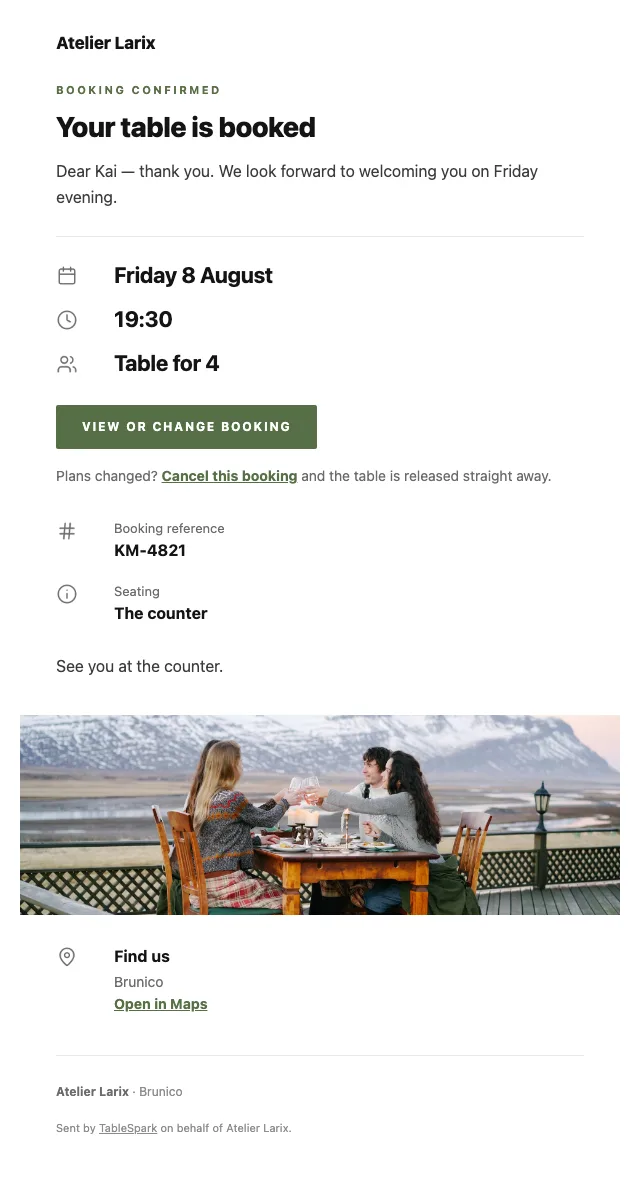
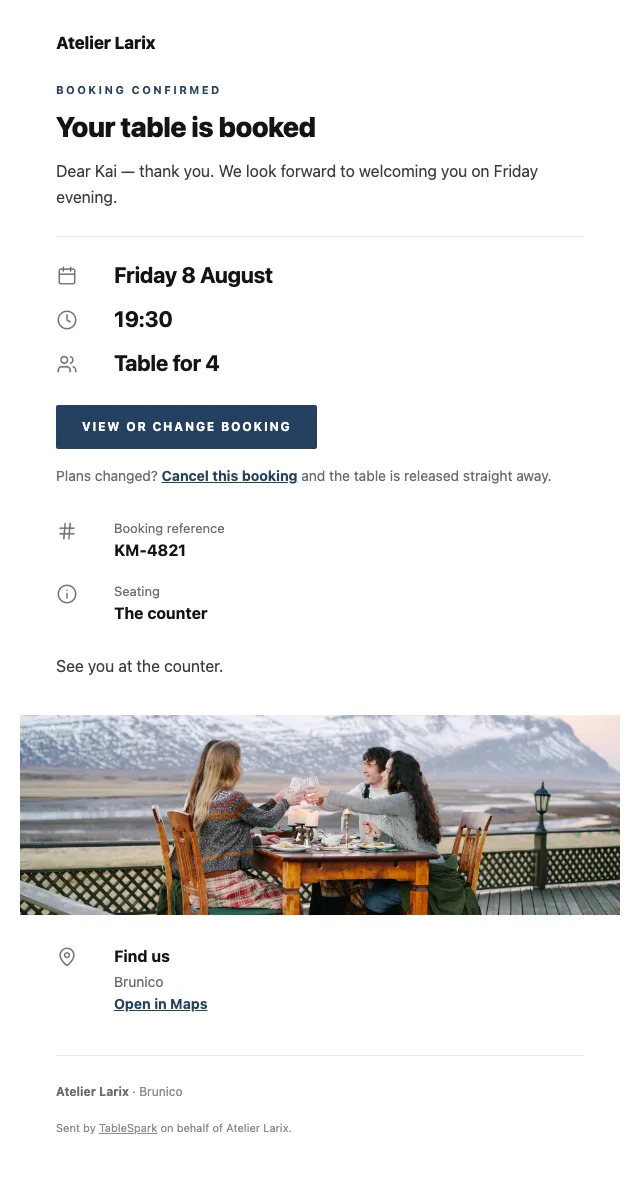
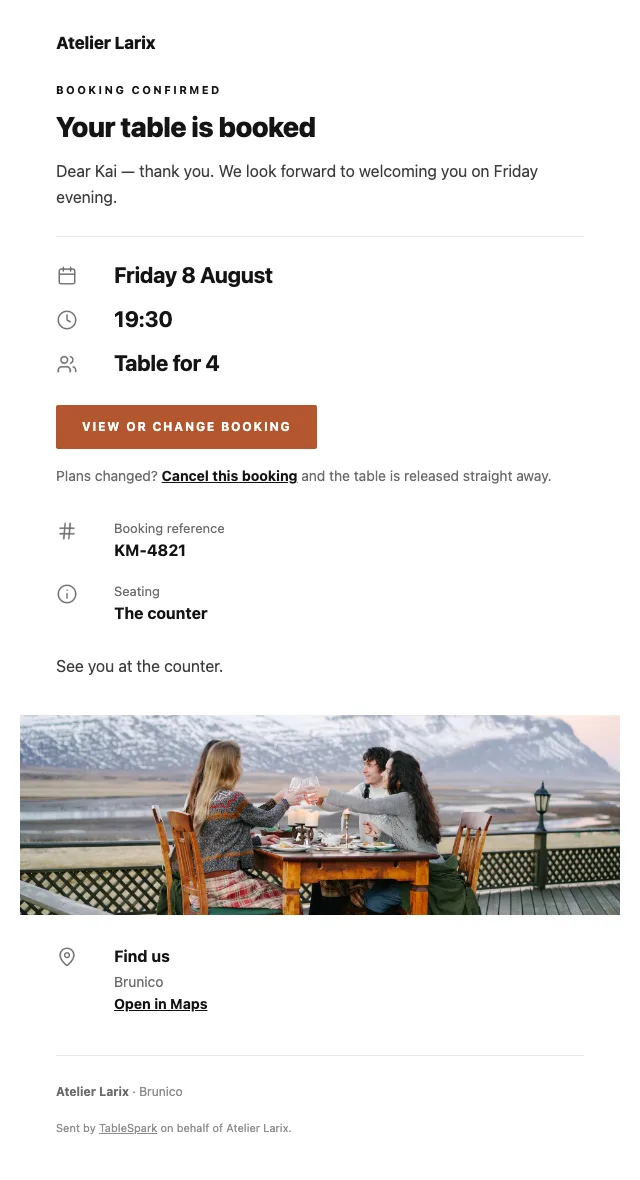
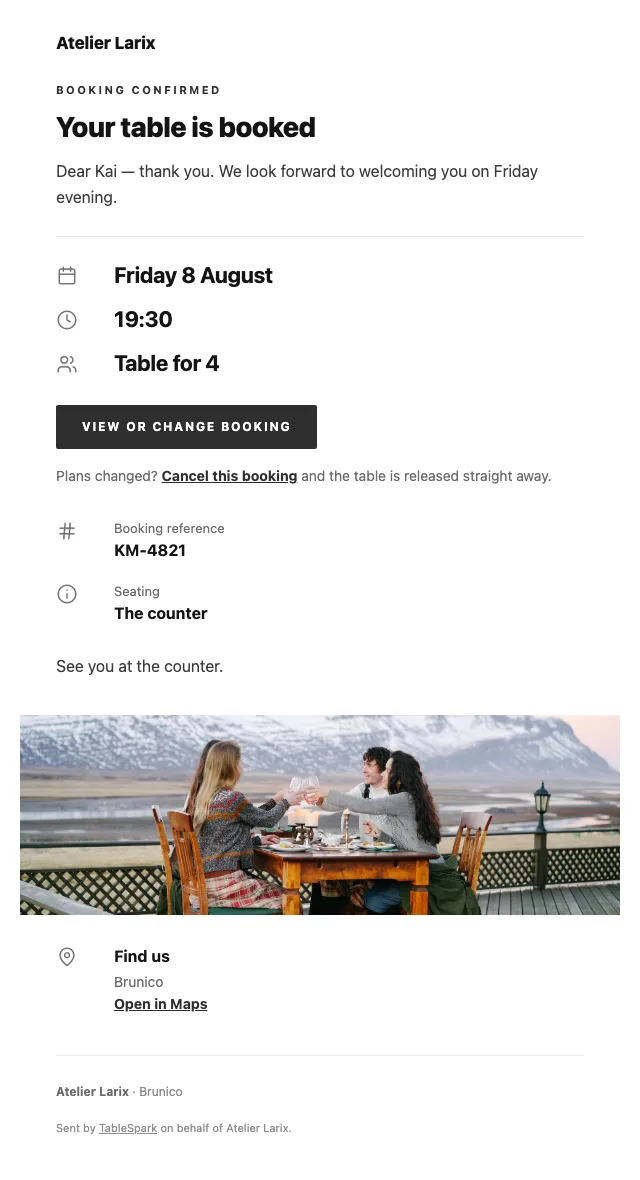
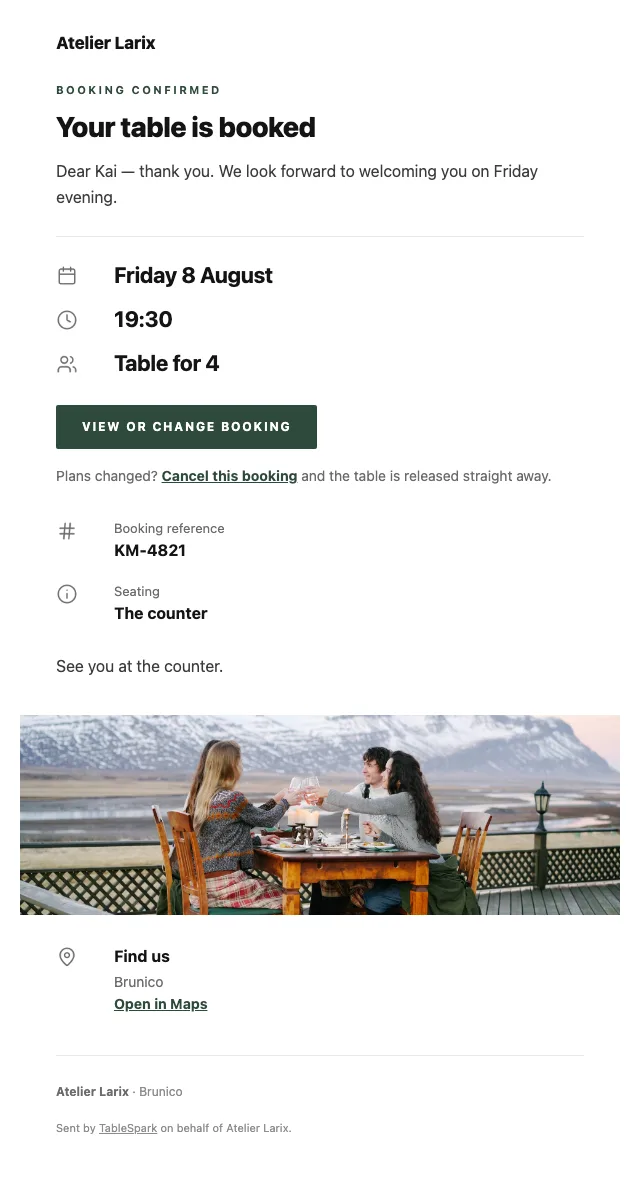
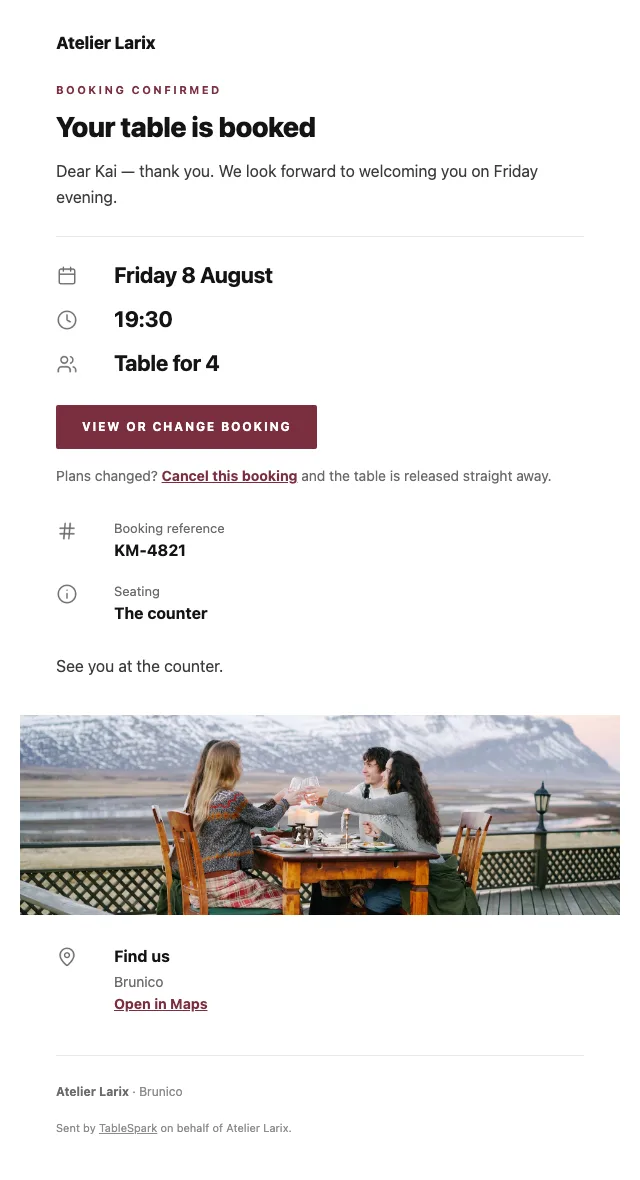
Something arrives in their inbox with your name on it. That is worth designing. It arrives at once, with the booking details, your address, your phone number and a link the guest can use to cancel without phoning. Everything after the booking — the reminder, the receipt, the cancellation — comes from here too.
What the guest sees is your identity, not our template. Six templates; your colour; your logo; a cover shot; a left, centred or banded header; your sign-off; your links; your social accounts. Your domain, once connected, becomes the sending address as well as the web address.
Below, the same booking confirmation in six of the accent colours you can pick.
Getting a page online is easy. Getting it discovered, read and understood is the actual work. Live and invisible is a common combination — caused by stray robots directives, canonical conflicts, unlinked pages, PDF menus, missing schema, or verification that stalled halfway. The restaurant ends up buying back its own customers, because the people searching for it are meeting someone else’s page.
You inherit it finished. Nobody can sell you a ranking or guarantee indexing. This sells you the groundwork that makes both possible.
Delete what you do not need and add what you do — pages are yours to shape.
All of these are standard modules — 70 of them in the library, most with several layout variants each.
Any one can be deleted, moved, or swapped for another. Nothing about the order is fixed.
Ships with 4 sections — From the valley, The wood stove, Mountain classics, Sweet things — for you to overwrite.
All of it arrives with the booking in your TableSpark inbox.
A photograph from you, the transcription and structure from us, and the final read-through from you again.
You press publish, or nobody does.
Search engines The Menu — Atelier Larix | South Tyrol A seasonal Alpine tasting menu at altitude. The sequence, the price and how to book.Drafts the search title & description from this page’s content. Always review before publishing.
Stripe’s standard card-processing fees apply to online payments.
How restaurant deposits work, and when they are refunded
Build the whole thing, look at it, change your mind. You only pay when you go live.
Build the whole thing, look at it, change your mind. You only pay when you go live.
7 pages, and every one of them is here. Nothing below is a screenshot: the frame renders it through the same engine that publishes your site, so every tab is the real page and every link inside it works. Switch to Phone to watch the same design reflow.
The story page is written for a restaurant that is also a place: the building, the valley, the seasons, the people. Narrative, sourcing, interview, timeline and a gallery page for the landscape photography that inevitably accumulates.
The indexed layout lists the sections first, then opens each in sequence — which is how a seasonal tasting menu should be read: as an order of events, not a catalogue.
Section subtitles carry the season and the altitude; descriptions carry the forager, the herb, the age of the cheese. Because it is structured text rather than an image, all of that specificity is available to a guest and to a search engine.
Whichever layout you choose, the point is the same: every dish, description and price is real text in the page with Restaurant schema around it, not a PDF and not a photograph of a laminated sheet.
What owners ask before they pick a template: the cuisine fit, the menu, the address, and what it costs.
Yes. Service hours drive availability, so closing a season simply means the booking form stops offering dates in it. You can leave a note on the reservations page explaining when you reopen, and the site stays live and indexed throughout — which matters, because search visibility built over a season is lost if a site disappears.
It is a list you edit. Rename a dish, adjust a description, change a price — the menu page, any home-page highlight, the ordering page and the structured data all update from that one edit, with no republishing step.
You should not have to. Upload a photograph of the menu you already print and the AI turns it into structured sections, dishes, descriptions and prices, reading dietary and spice marks off the card where it can. Everything lands on a review screen for you to check before it saves. After that it is data rather than an image, which is why one price change updates the menu page, the ordering page, the home-page highlights and the structured data together.
One sitting, roughly, from first login to a live site on your own address. Copy the template, change the name and wording, upload your menu, publish. Reservations start working at once, arriving in your TableSpark inbox with the guest confirmed by email. Adding a payment account is a one-minute job that unlocks deposits on bookings and payment on orders, paid to you with 0% commission to us. Stripe’s standard card-processing fees apply to online payments.
Completely. Six base skins, an accent you can pick from presets or a colour wheel, separate background, text and surface colours, seven font pairings or any two faces you like, plus text size, radius and motion. Contrast is derived rather than fixed, so the site stays readable whatever you choose.
Yes. You start on a TableSpark address so you can publish the same day, and you can move onto your own domain whenever you are ready — including one you already own. TableSpark manages the certificate, the secure connection, the redirect from the bare domain, and keeps canonical URLs, the sitemap and robots pointing at the live address so the move does not cost you the search visibility you have built. Guest emails can send from your domain as well.

Start here rather than from a blank page: rename it, rewrite it, add your menu, publish. Nothing to pay until it is live.