01
Hero
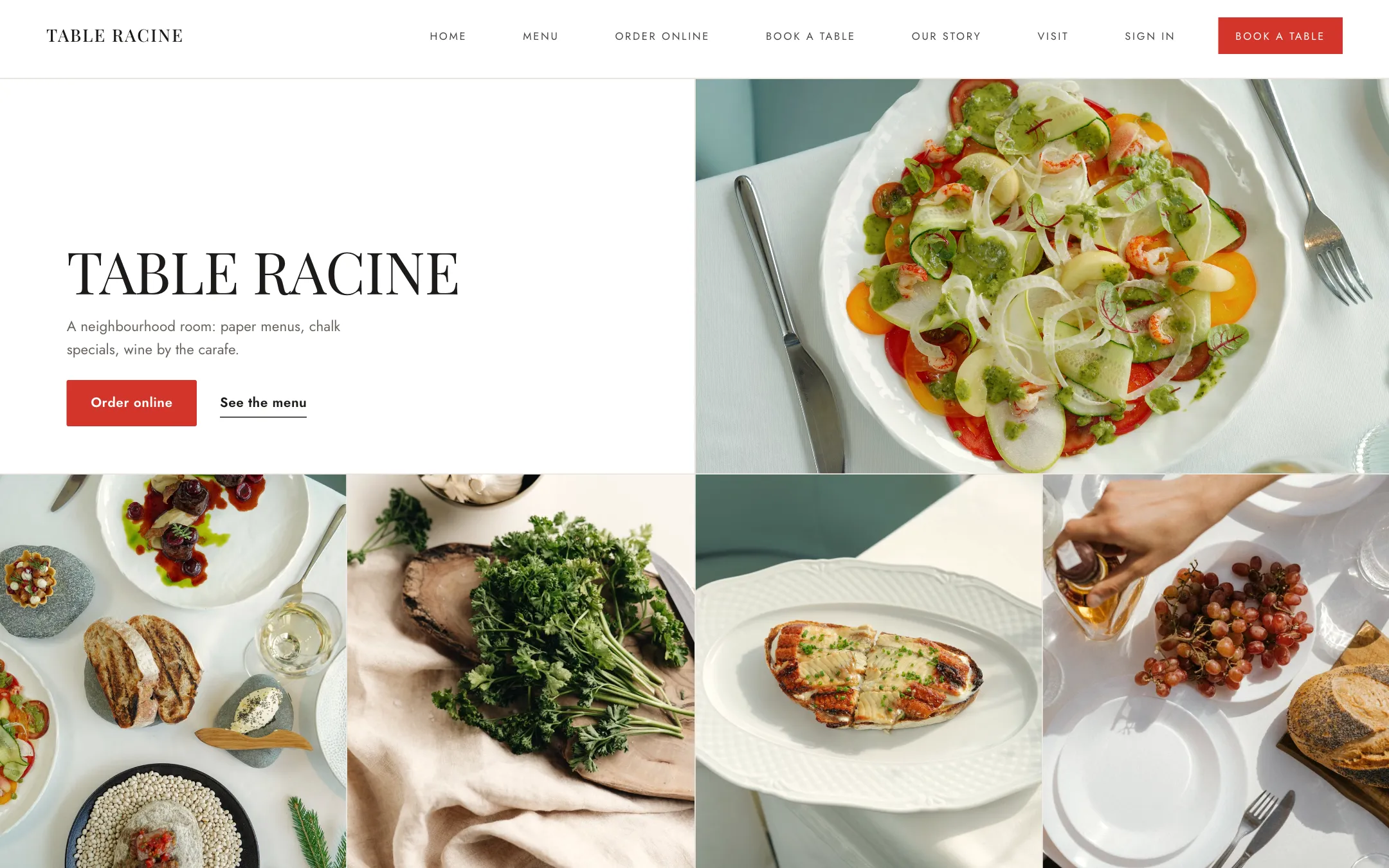
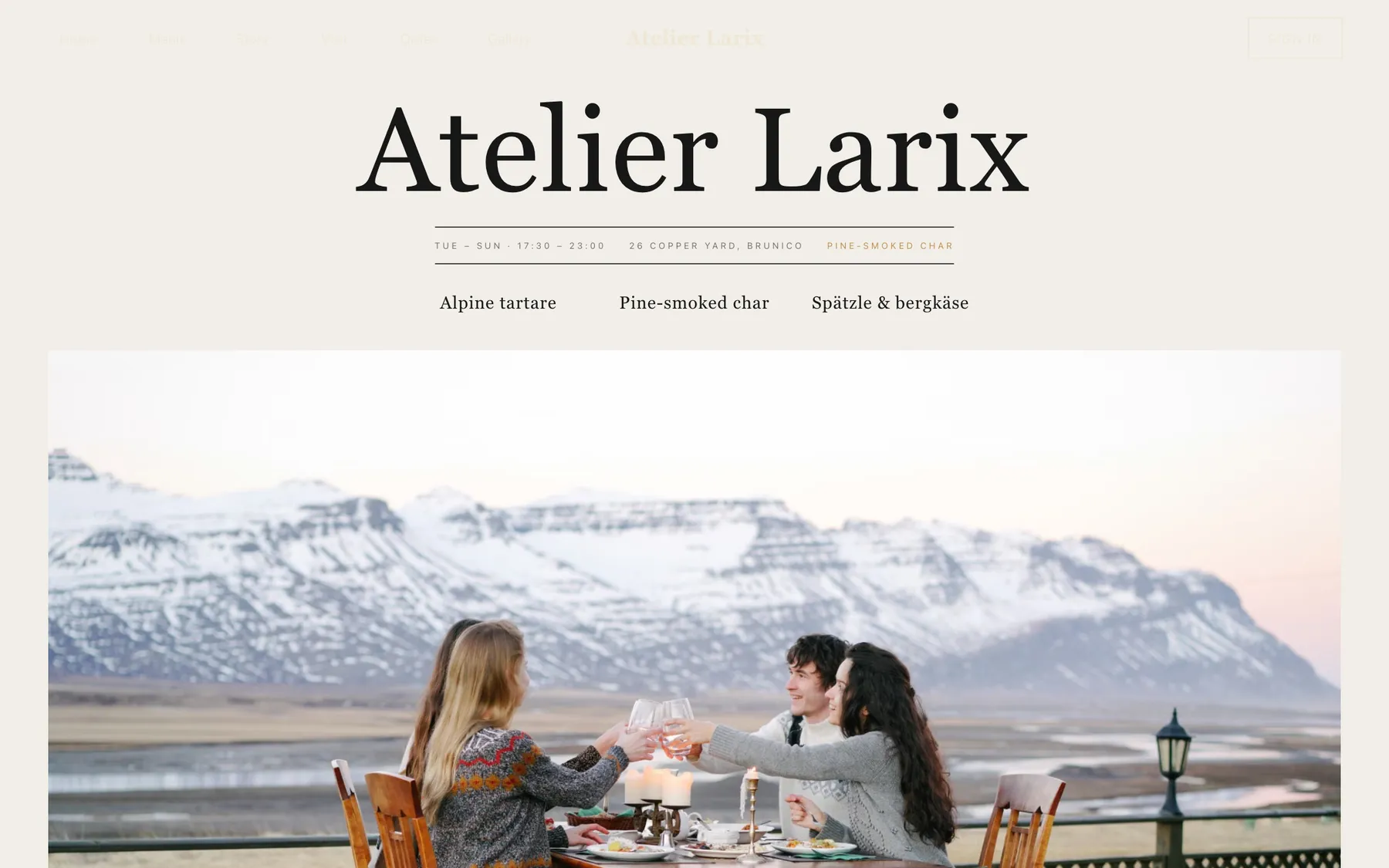
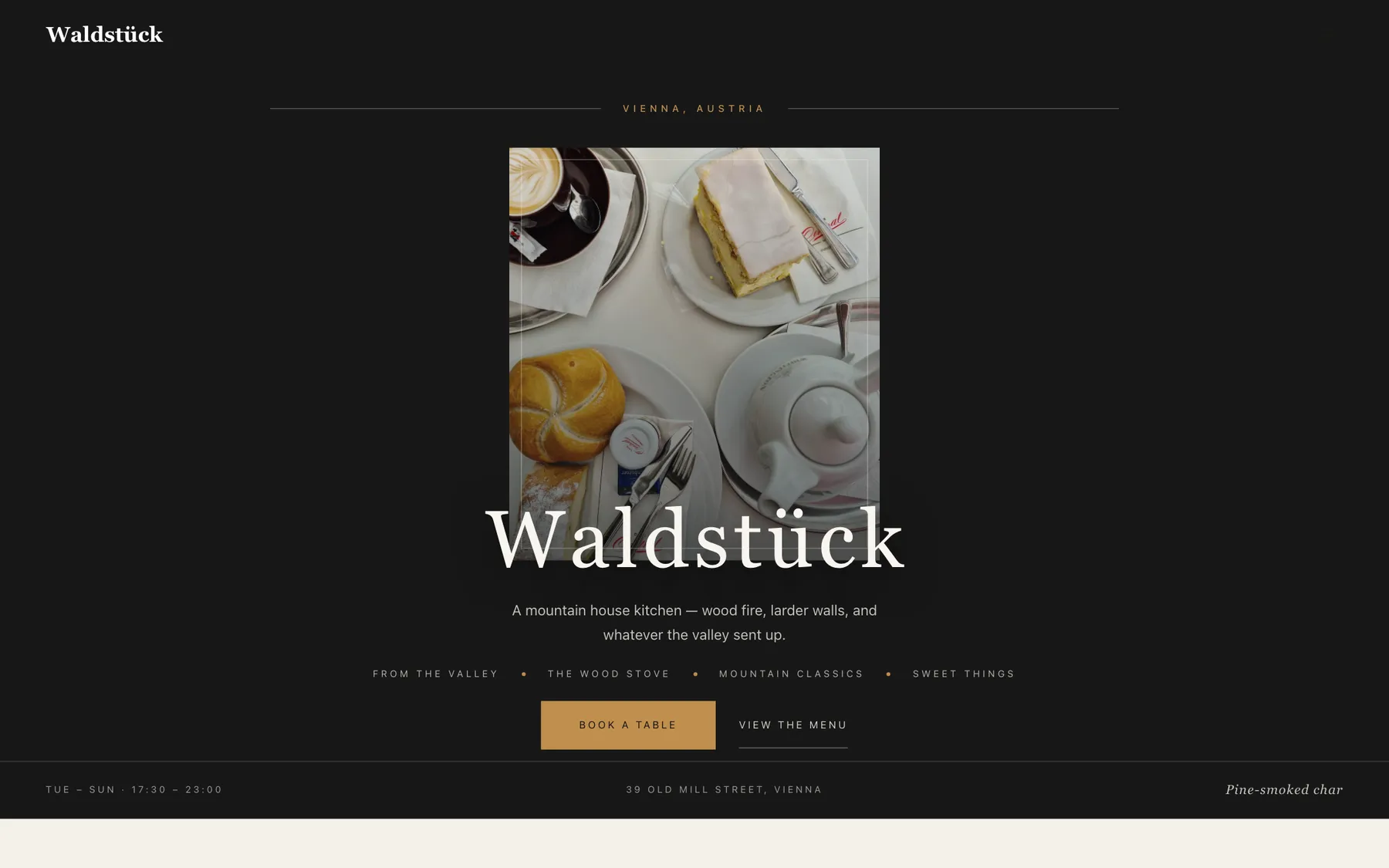
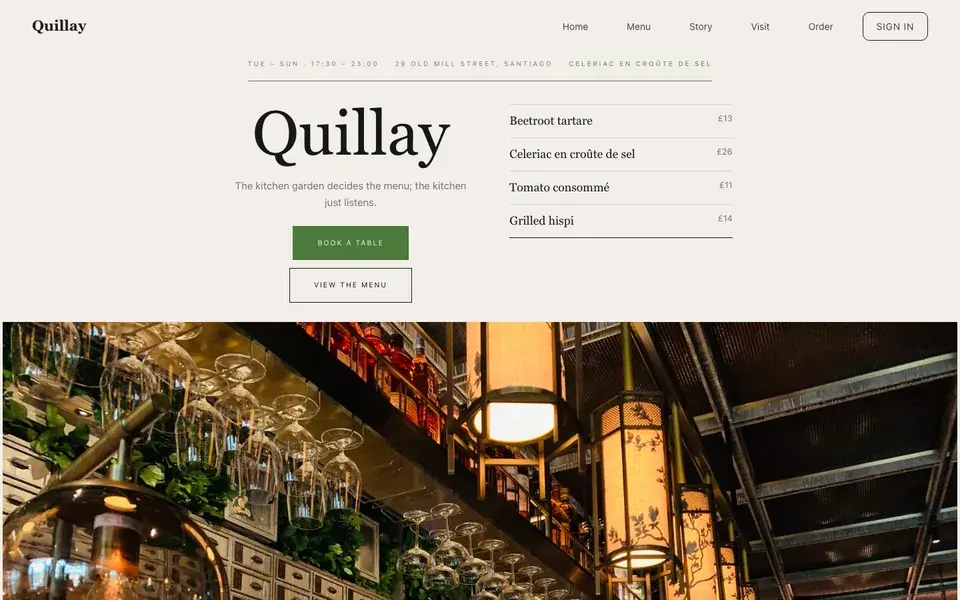
Big opening image, name & buttons, in the Salon Plaque treatment: Portrait portal on a dark band, awards row and chef signature beneath.
Templates · Endemic Chilean
For kitchens that cook what they gather: a warm paper template with a larder opening, a plated menu, and structure for a repertoire that changes with what the week produced.
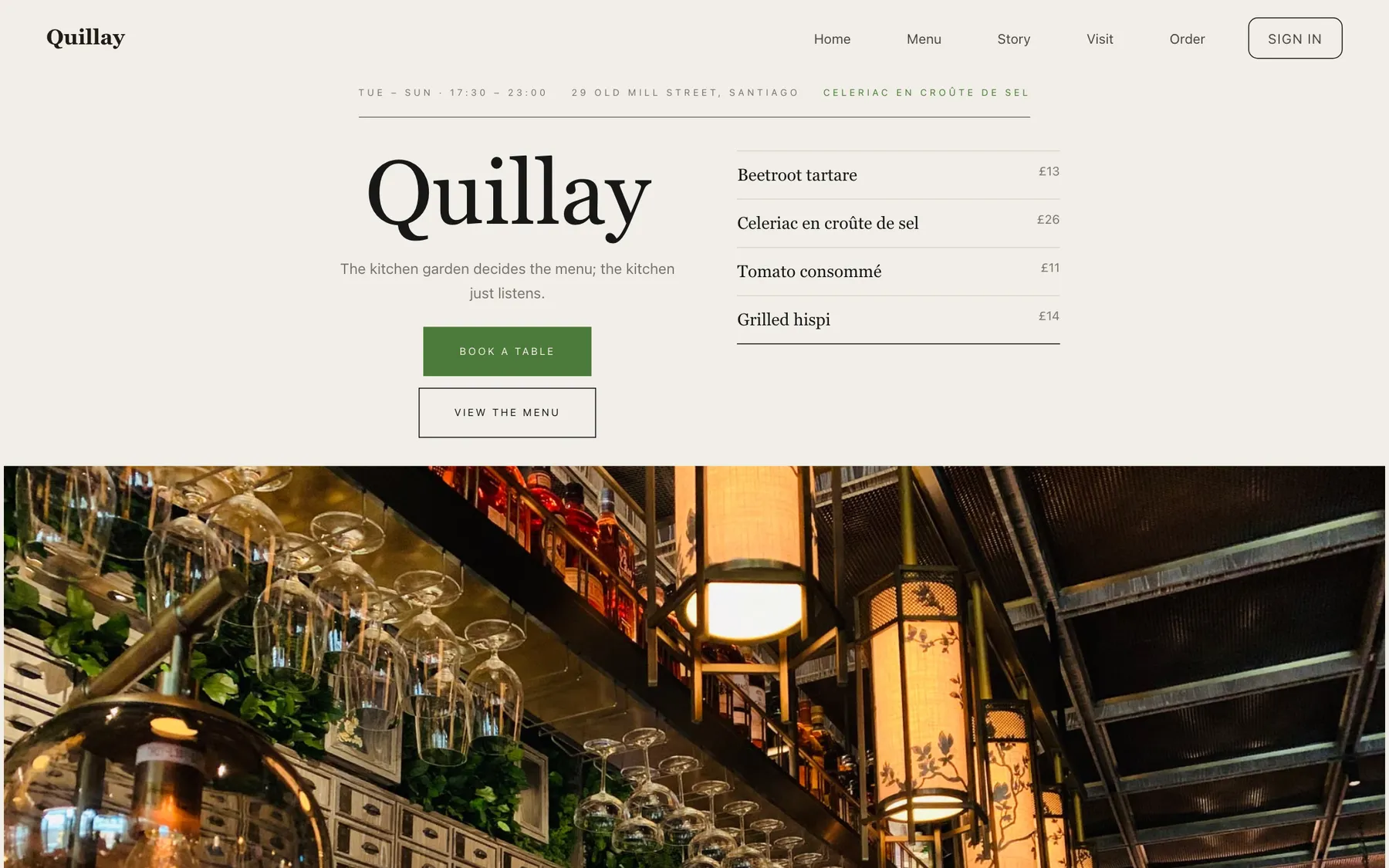
Every section is a builder module you can reorder, edit or delete, with no developer.
On bookings and orders, on every plan. Stripe’s standard card-processing fees apply to online payments.
Build and preview the whole site for nothing, and pay only when it goes live.
Starter is £19/mo excl. VAT and includes a complete restaurant website, a live structured menu, enquiry and newsletter forms, and managed search readiness. Growth is £39/mo excl. VAT and adds direct live bookings, a custom domain with managed SSL, and table and floor-plan operations. Full is £69/mo excl. VAT and adds online ordering and multi-site management for up to five restaurant sites. TableSpark commission is 0%. Stripe's standard card-processing fees apply to online payments.
The price is the argument: the best value of any complete restaurant website and management system in the UK, with every published figure in the full cost comparison. You skip the part where a bespoke build eats thousands of pounds and a season of your year, and start from something already finished. You keep the keys. Menus, prices, photographs and copy are all edited by you, whenever you want, without asking anyone. Phones, tablets and desktops are all first-class, and the plans bring reservations, tables, ordering and management with no commission from us at all.
Quillay is warm paper with a green that belongs to a hillside after rain. Yours might be white tile and morning light, or brass and candles, or something nobody has built yet.
So do not read about it. The panel on the right is the real Theme tab out of the builder, and the frame beside it is the real site — the same renderer that publishes a live restaurant. Nothing is a mock-up, nothing you touch is permanent, and nobody is asking you to sign in first. Go on.
Loading the live preview…
A foraging kitchen has the hardest menu-maintenance problem in the industry: the ingredient list changes weekly and sometimes daily, and any website built on fixed copy is wrong within a fortnight. This design starts from that reality with a larder opening — what came in this week, and from where.
The palette is warm paper and a hillside green, and the type is a soft serif over a plain sans. It reads as a field notebook rather than a restaurant brochure, which is the correct impression for a kitchen whose menu is a record of a place.
Eight blocks, arranged around a changing larder:
01
Big opening image, name & buttons, in the Salon Plaque treatment: Portrait portal on a dark band, awards row and chef signature beneath.
02
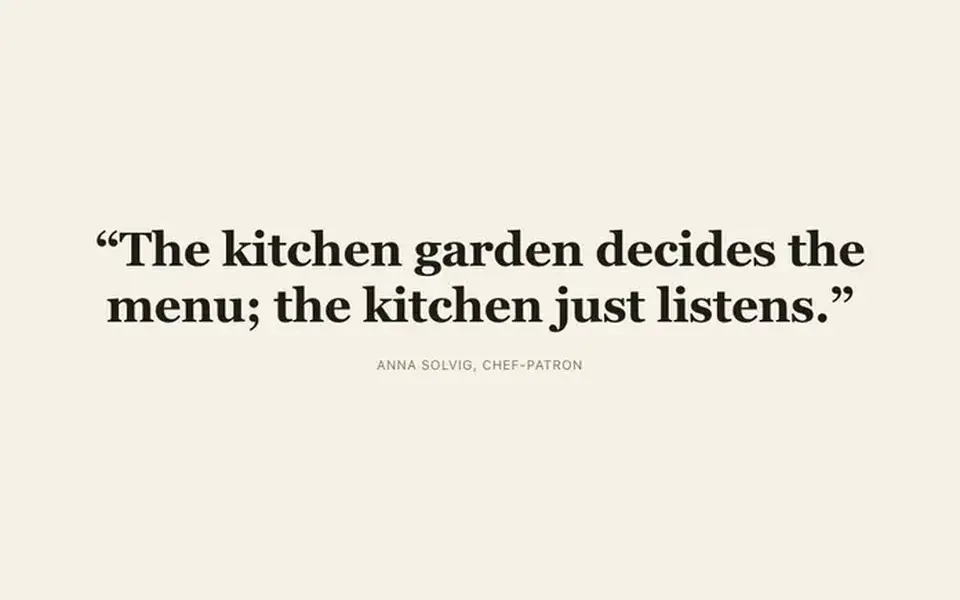
A large standout quotation.
03
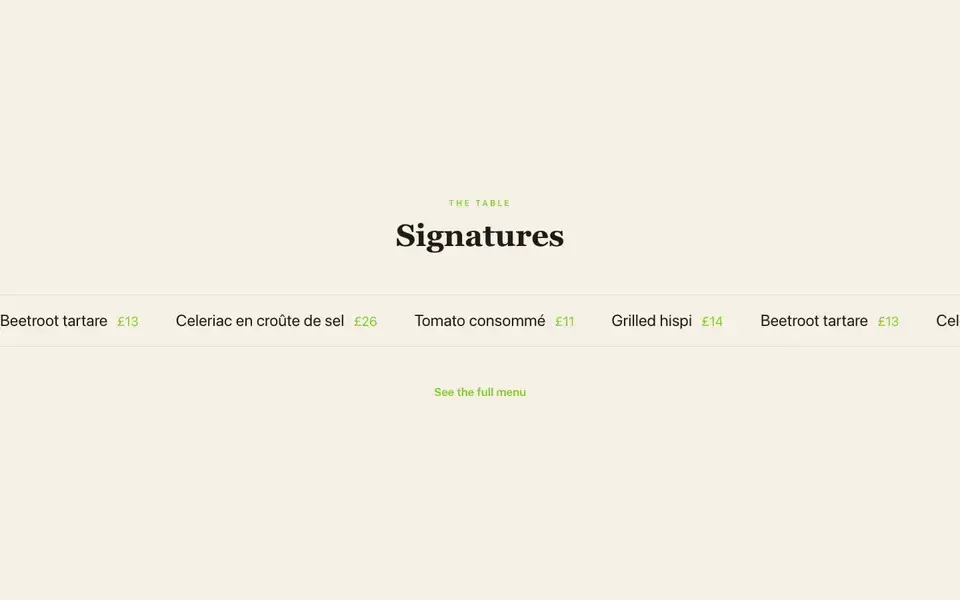
A few dishes on a sliding rail.
04
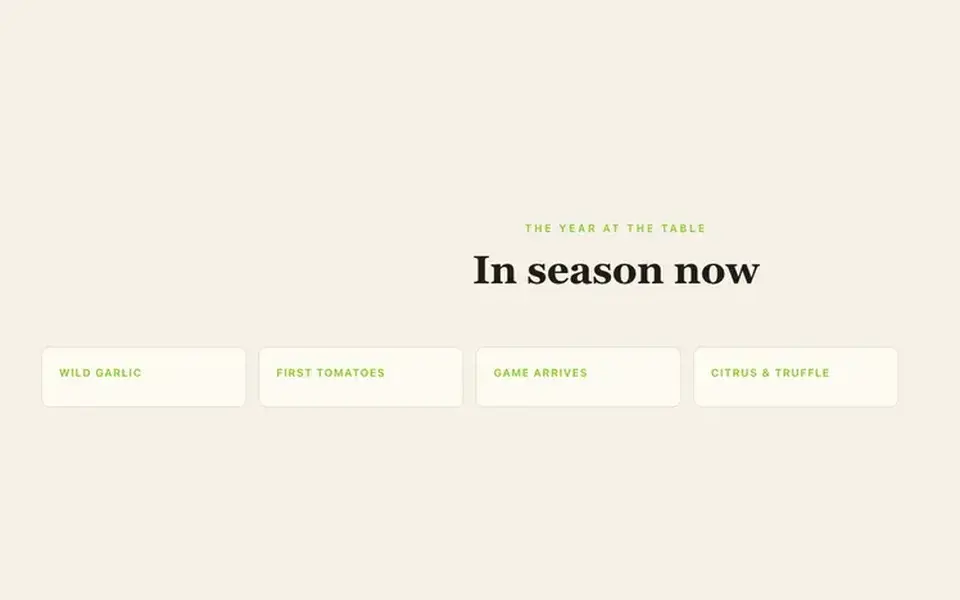
What each month or season brings.
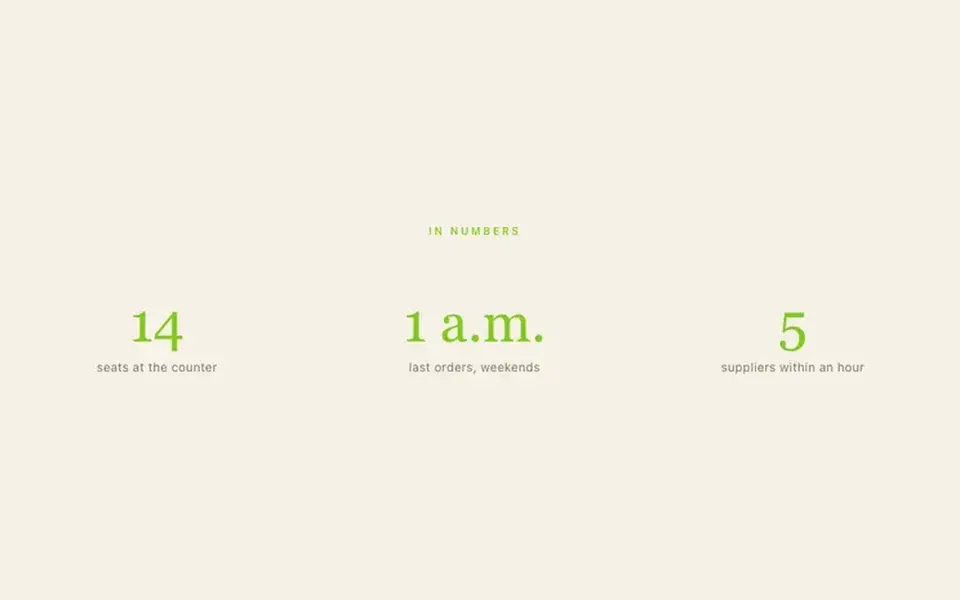
05
Headline stats.
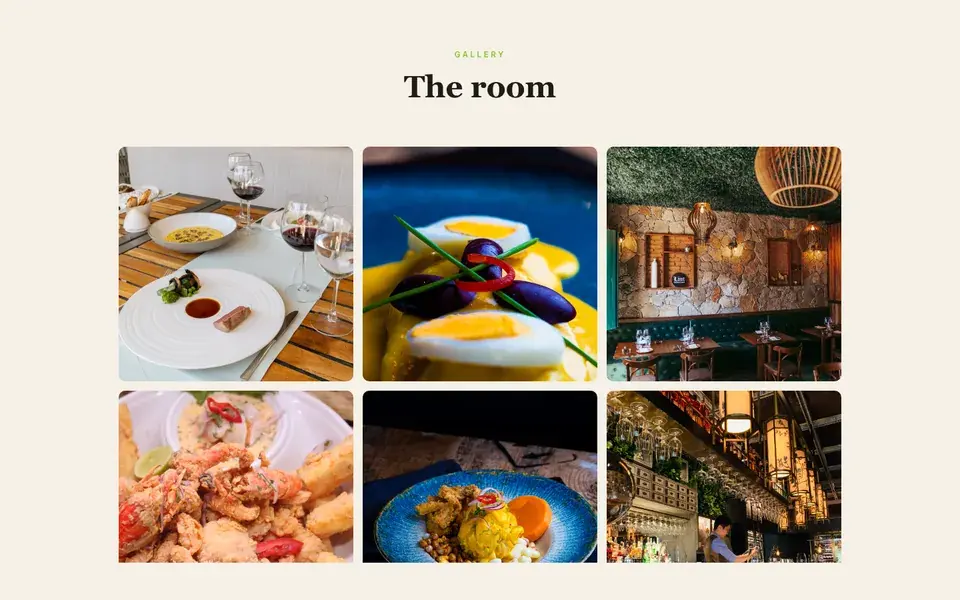
06
Grid, masonry or moving strip.
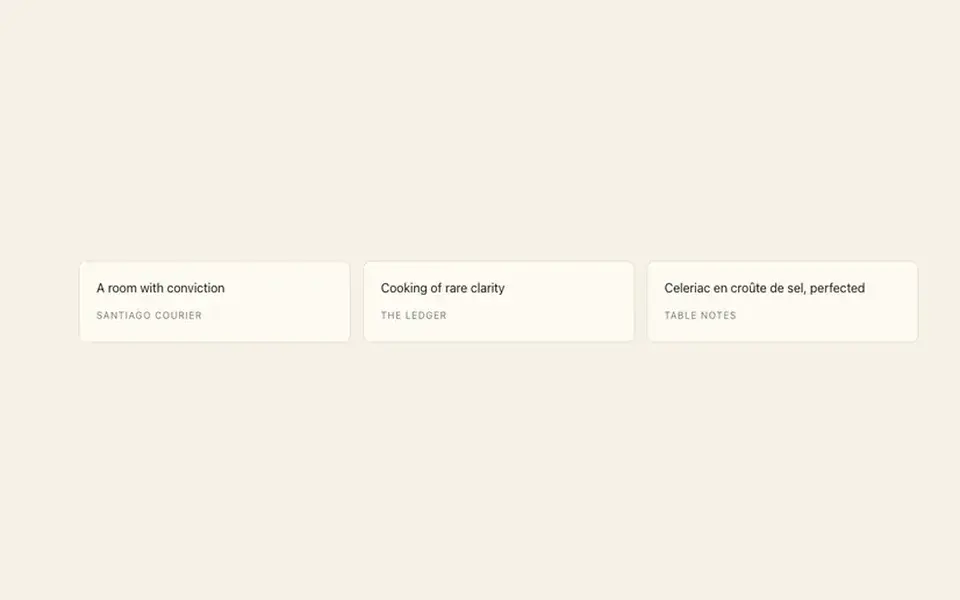
07
Press mentions or awards as a ruled band.
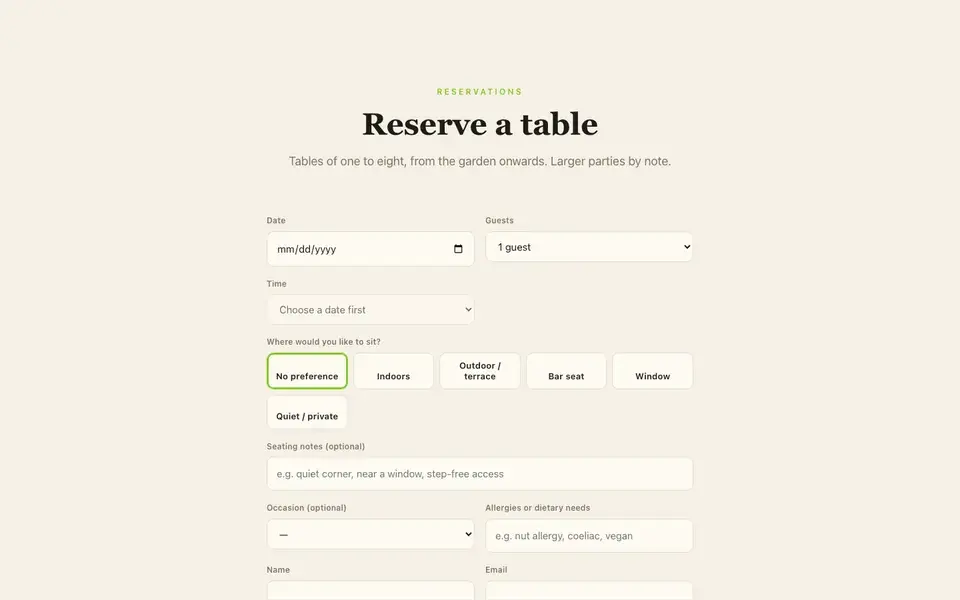
08
Live availability slot picker, saved to your Inbox.
09
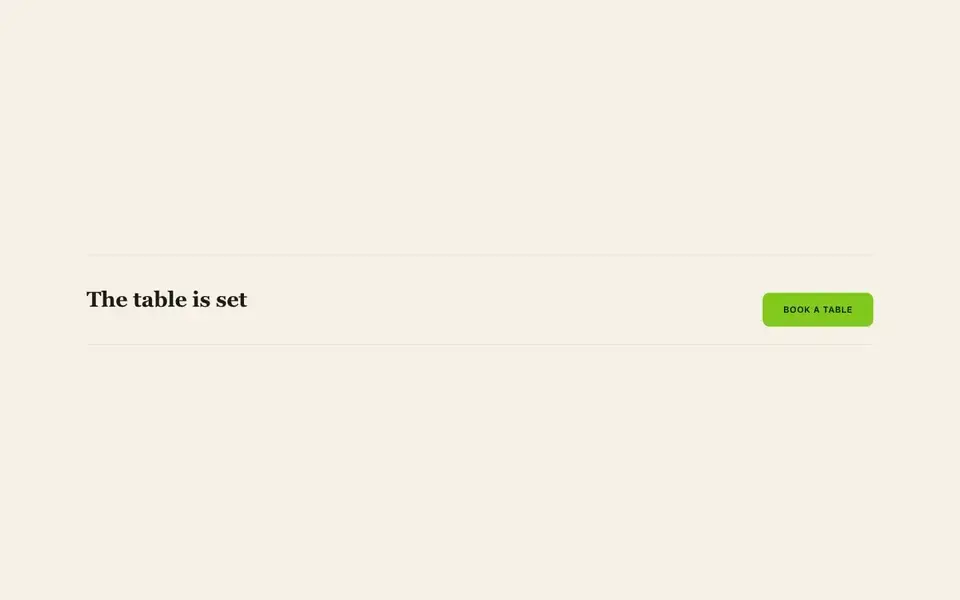
Headline + button band.
Loading the live preview…
Quillay uses the Classic list ordering layout — the printed-menu look, with dotted leaders running from each dish to its price.
It reads like the delivery apps your guests already know, except the restaurant keeps the relationship and the money. The basket stays on screen, and each mode asks only for what it needs: a table number, a phone number or an address.
Loading the live preview…
This is the frame that matters. It is the real ordering page at a real phone width — not a mock-up, not a video.
On a laptop the same page puts the basket in a panel beside the menu that follows the scroll.
Every Quillay site on Growth and Full ships with an app your guests keep. It lives at /account on your own domain, so the guest signs in to your restaurant, not a marketplace.
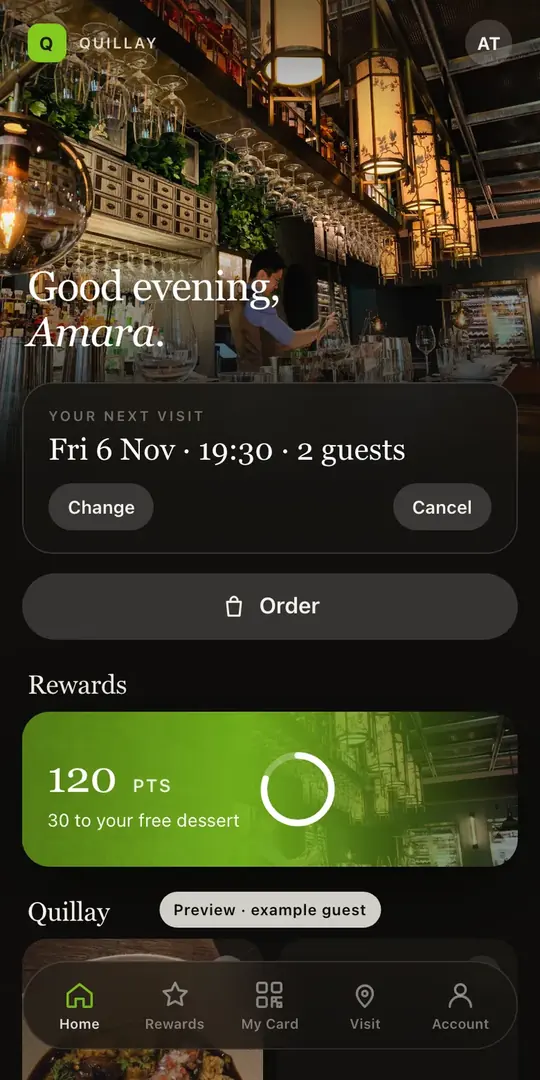
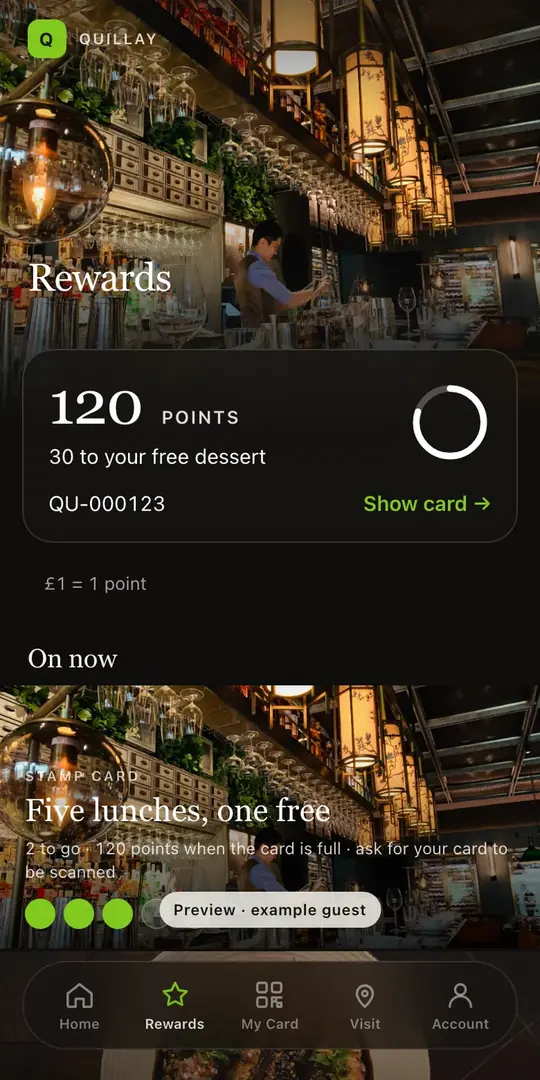
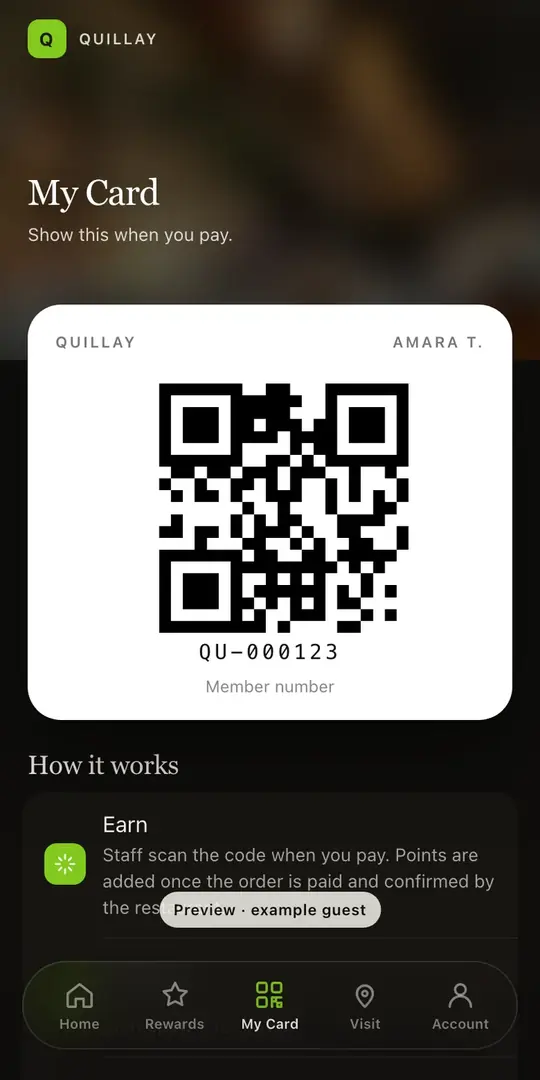
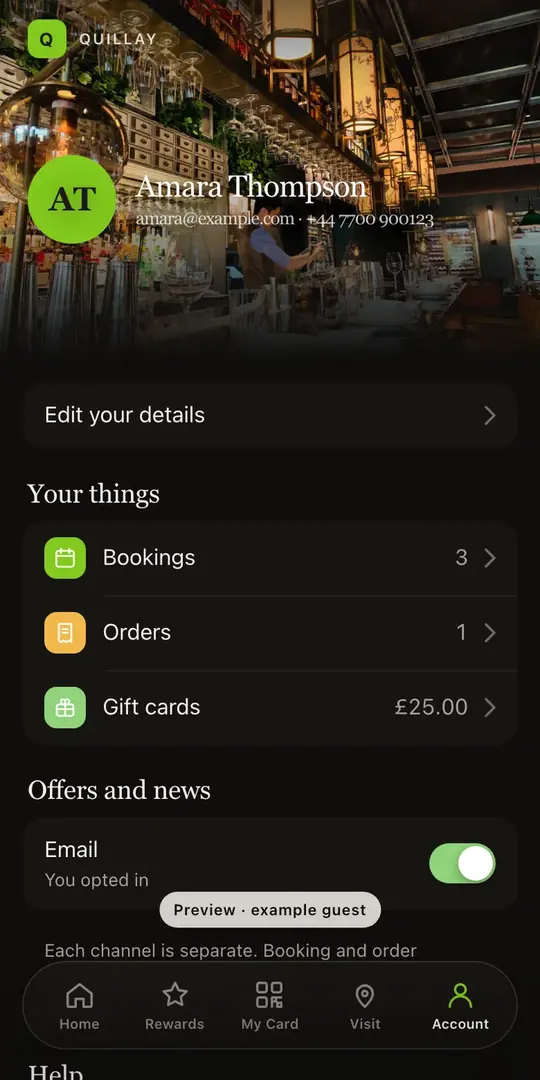
Included on the Growth and Full plans. Watch the Guest App course
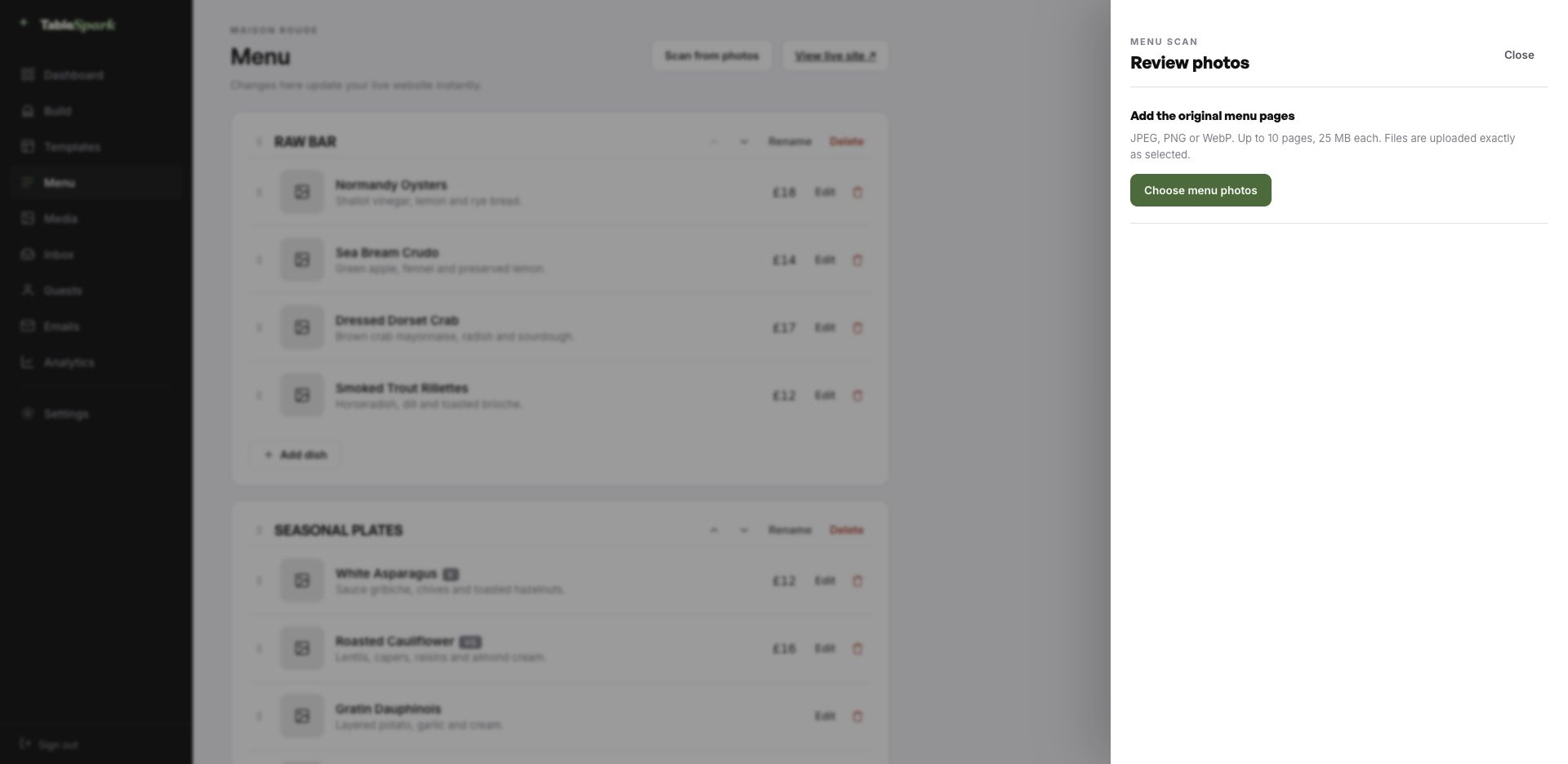
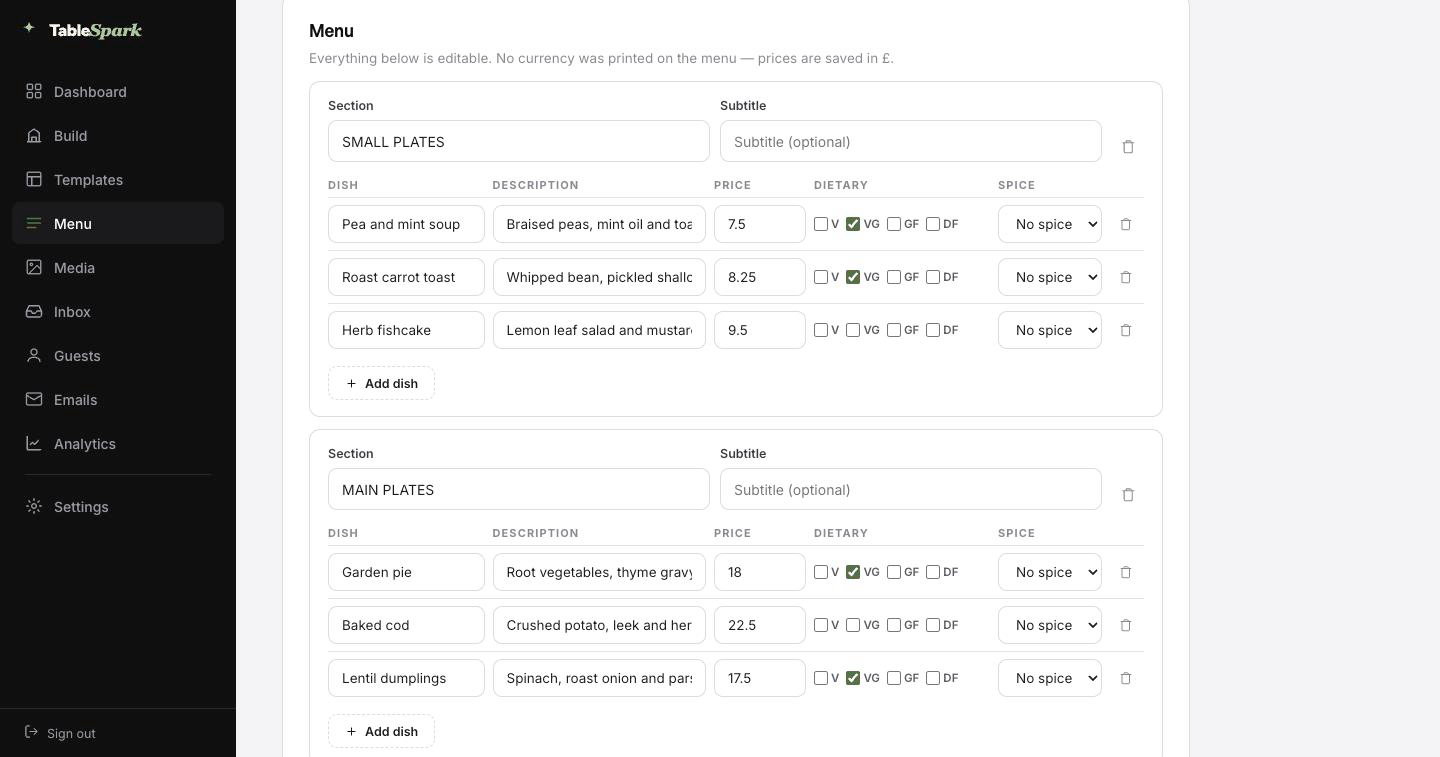
The tedious part comes first, and it is barely a part at all. Upload the menu exactly as it exists today, whether that is a printed card, a photograph of a board or an old PDF. Sections keep their order, dishes keep their descriptions, prices land in the price field, and dietary and spice marks come across where they were legible. You are the proofreader, not the typist.
That structure is the reason the rest of the site works. Everything downstream reads from it: the menu page, the ordering page, the highlights on the home page and the Restaurant structured data a search engine reads. Change a price once afterwards and all of them follow.
The title and description a search result shows are drafted for you too, by a Write with AI button that works from the page’s own content. You edit before it ships, every time.
Of the menu exactly as it is today, from a phone.
Sections in the right order, dishes with their descriptions, prices and marks.
Menu page, ordering page, home-page highlights and the Restaurant schema — all fed by the same structured menu.
Most of the work was done before you arrived. The design, the layouts and the plumbing are all in place; what is missing is your restaurant. From opening the builder to a live site is one sitting, at which point guests can already book a table. Your inbox catches the booking; an automatic email catches the guest.
The money side is a single step: connect Stripe, and deposits and payments go directly into your account. Nothing is skimmed at any plan level — 0% commission. Stripe’s standard card-processing fees apply to online payments.
Step 01
1min
Pick QuillayThe full site arrives in your account as a working draft.Step 02
4min
Change the name and the wordsRewrite the words by clicking them; the name carries everywhere.Step 03
3min
Upload your menuSend the menu in as a photograph and check what comes back.Step 04
1min
PublishIt goes live on your address and starts taking bookings.Step 05
1min
Connect StripeNow you can take deposits on tables and payment on orders — direct to your account.In all
10min
From template to taking paymentsFive steps, one sitting.A restaurant’s address is part of its name. Publishing does not wait for a domain. Start on ours, move to yours — the same site, a different name over the door.
The technical work is ours: issuing and renewing the certificate, securing the connection, redirecting the bare domain, and keeping the search engines aimed at the live address through the change. You can keep the domain you have had for a decade — the change at your registrar is a single record.
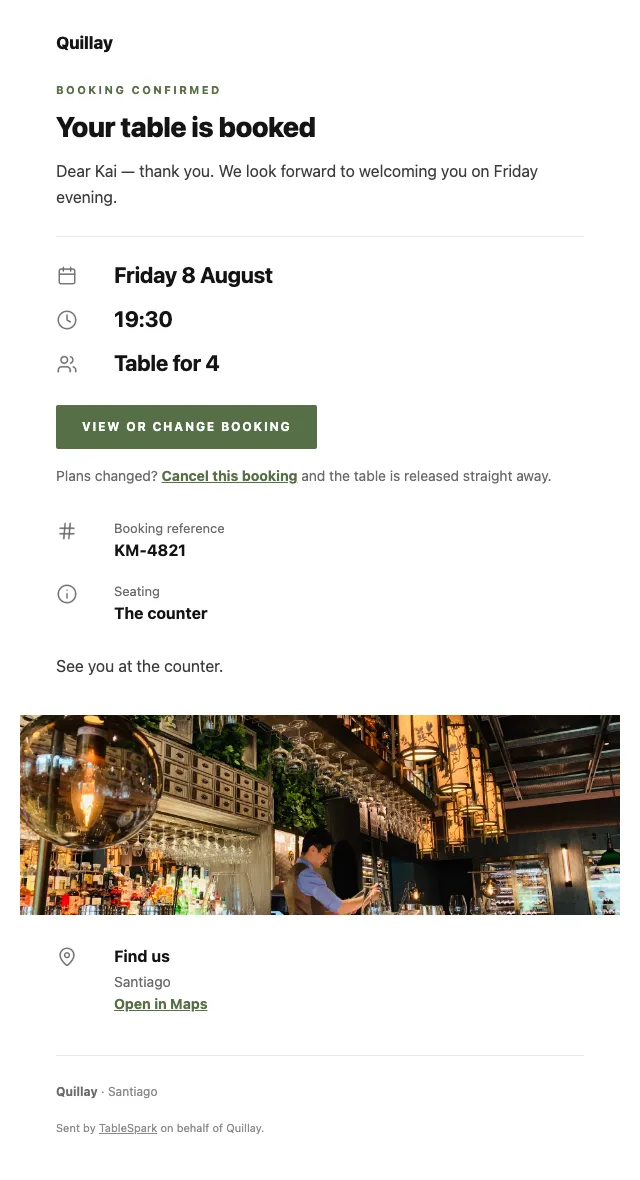
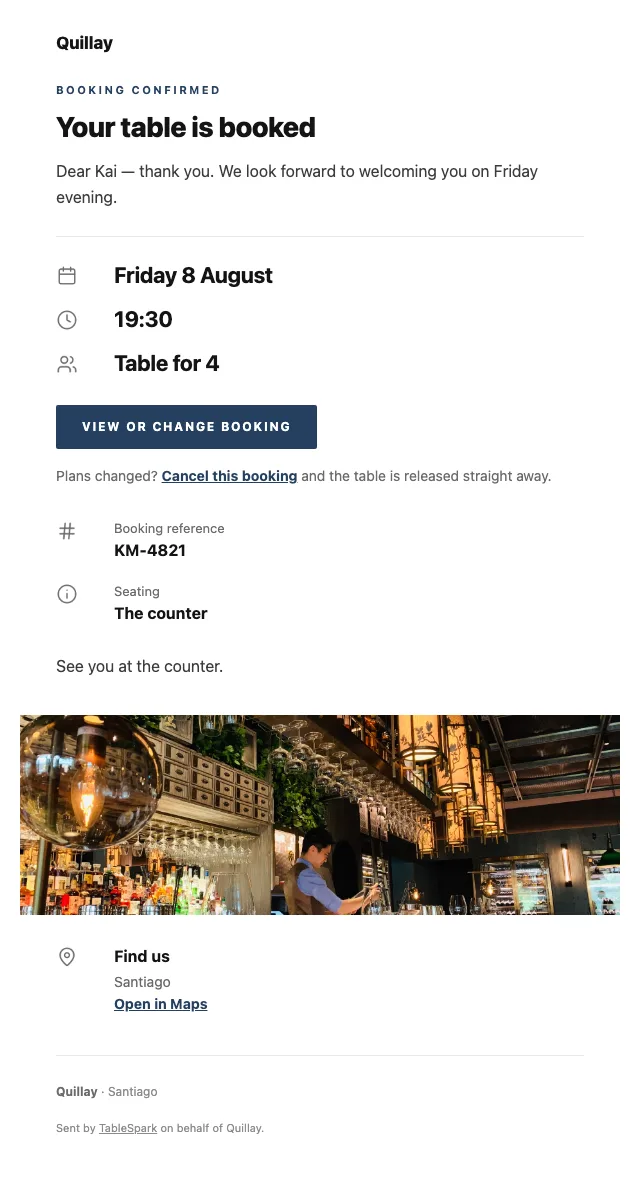
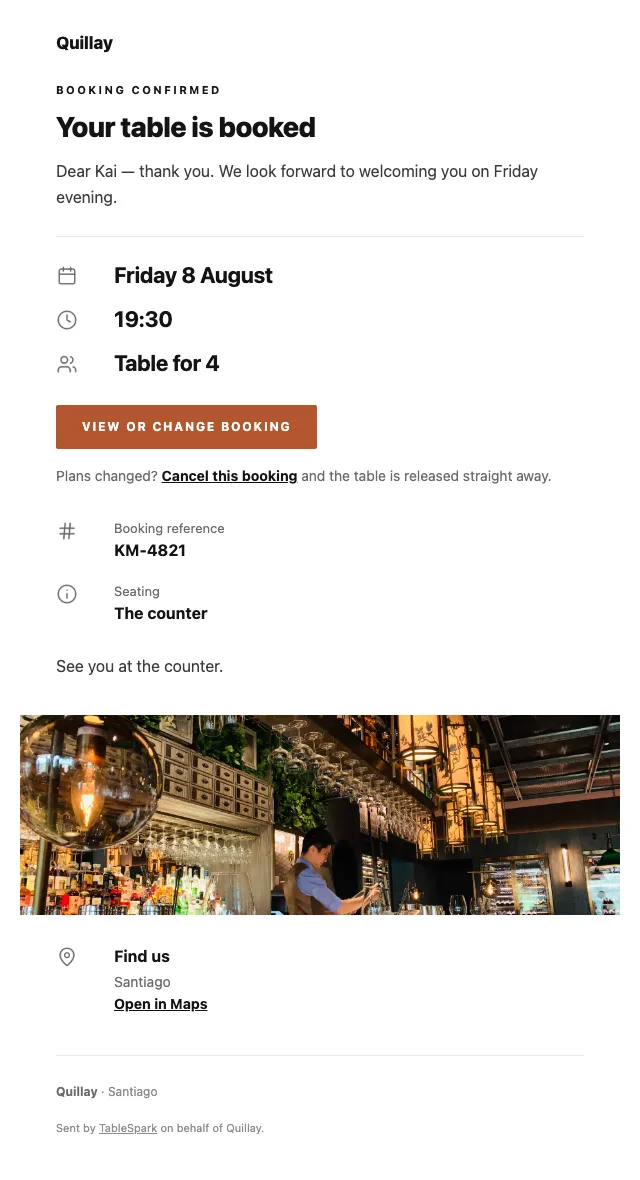
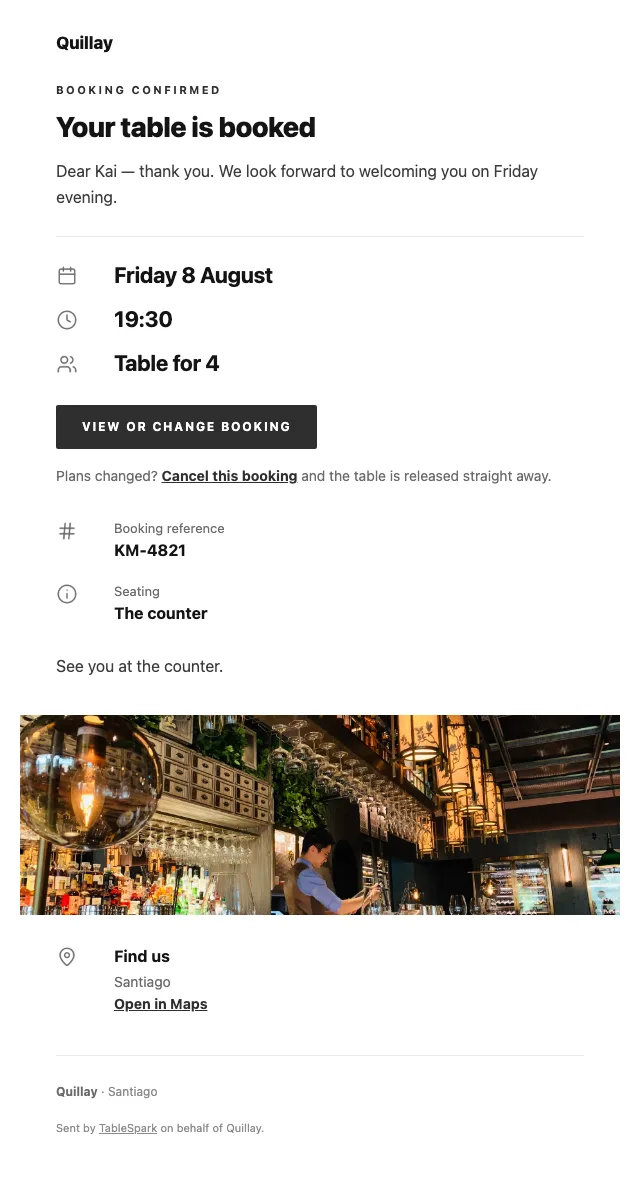
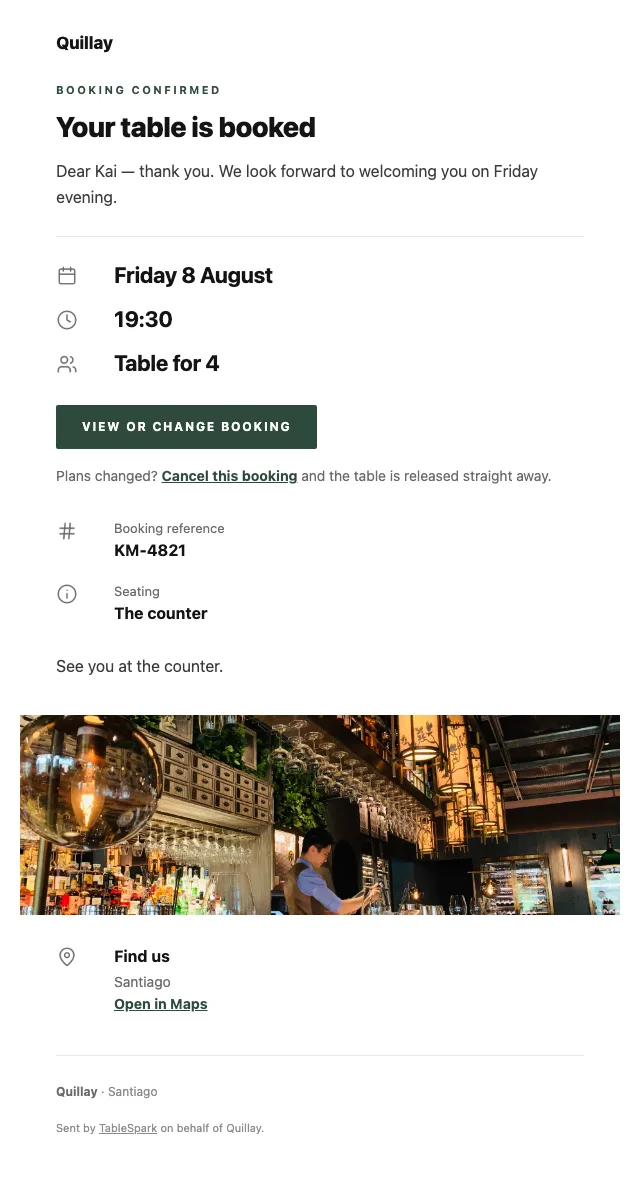
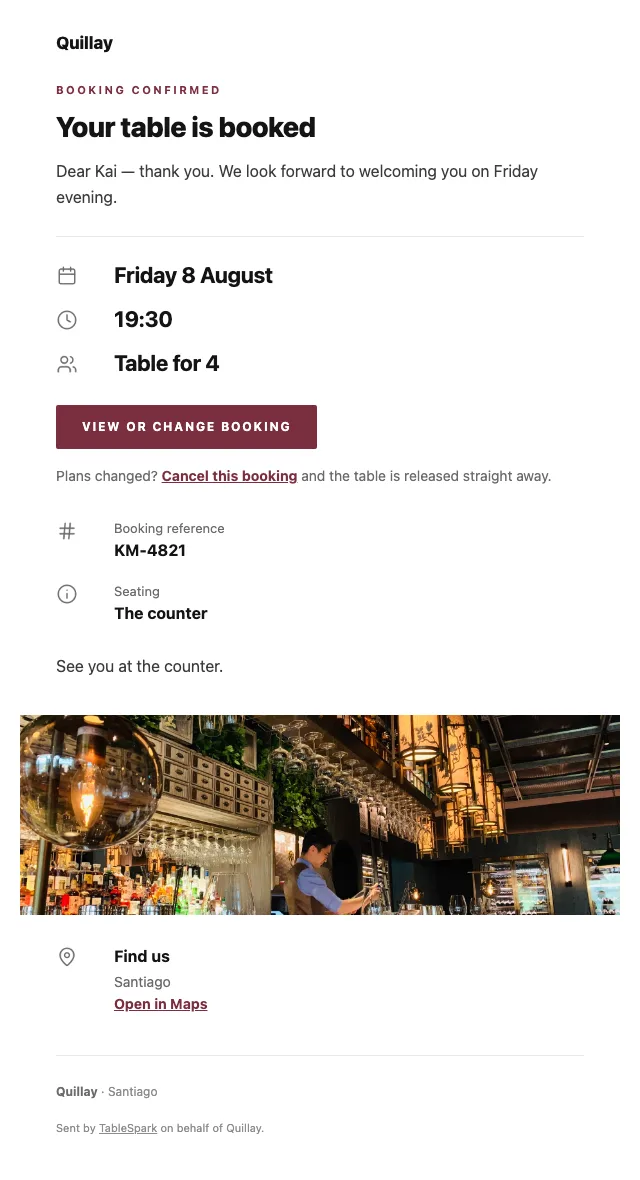
Something arrives in their inbox with your name on it. That is worth designing. It arrives at once, with the booking details, your address, your phone number and a link the guest can use to cancel without phoning. Everything after the booking — the reminder, the receipt, the cancellation — comes from here too.
What the guest sees is your identity, not our template. Six templates; your colour; your logo; a cover shot; a left, centred or banded header; your sign-off; your links; your social accounts. Your domain, once connected, becomes the sending address as well as the web address.
Below, the same booking confirmation in six of the looks.
Getting a page online is easy. Getting it discovered, read and understood is the actual work. Live and invisible is a common combination — caused by stray robots directives, canonical conflicts, unlinked pages, PDF menus, missing schema, or verification that stalled halfway. The restaurant ends up buying back its own customers, because the people searching for it are meeting someone else’s page.
You inherit it finished. Nobody can sell you a ranking or guarantee indexing. This sells you the groundwork that makes both possible.
Reorder them, rename them, remove them. The set is a starting point.
None of this is hand-built. They are modules from a library of 68, each with layout variants of its own.
Take one out, put another in, change the order. It is a stack you control.
Ships with 4 sections — From the garden, Roots & leaves, The hearth, Puddings — for you to overwrite.
Nothing is skimmed. 0% commission on every plan, where a marketplace takes a slice of each order and keeps the data.
The page is yours, the inbox is yours, the guest list is yours and exportable.
Stripe’s standard card-processing fees apply to online payments.Read how the money works without a marketplace
Your job: take the picture and check the result. Ours: read it, structure it, and draft the search wording.
Publishing is always your decision.
Search engines This Week — Quillay | Santiago Endemic Chilean ingredients gathered this week. The current menu, the species and the prices.Drafts the search title & description from this page’s content. Always review before publishing.
Stripe’s standard card-processing fees apply to online payments.
Setting a deposit: amounts, terms and refunds
You can build, rebuild and abandon as often as you like. Payment begins at publish, not before.
You can build, rebuild and abandon as often as you like. Payment begins at publish, not before.
5 pages, and every one of them is here. This is the live site, not a gallery. Every tab renders through the engine that publishes real restaurants, and the links inside it work. Try the Phone view.
The story page is where this kind of restaurant lives: a narrative about the territory, a sourcing block naming gatherers and communities, an interview, a timeline and a gallery of the landscape as much as the plate.
The plated layout gives each section its signature dish as an image with the rest as type, which is the balance a foraging menu needs: photographs of the ingredients that need showing, and type for everything else.
The section subtitle carries the week and the territory; the description carries the species, the altitude and the gatherer. Because the menu is structured data rather than a designed image, rewriting it weekly costs minutes rather than a design job.
The important part survives any layout: dishes, descriptions and prices are indexable text carrying Restaurant structured data, not an image a crawler has to guess at.
The ordering page runs as dense rows, which suits selling preserves, ferments and pantry goods — a list where the description matters more than a photograph.
Quantities and sizes are inline, the total stays on screen, and Payment goes into your own Stripe account. TableSpark takes no commission on any of it. Stripe’s standard card-processing fees apply to online payments.
The form adapts to the mode. Eating in? A table number. Collecting? A phone number. Delivery? An address. Nothing more is demanded.
What owners ask before they pick a template: the cuisine fit, the menu, the address, and what it costs.
They handle it well, provided the menu is text rather than an image — which it is here. Each update keeps the same page and the same address, so the page accumulates history instead of starting again. The structured data updates with it, so what a search engine understands about your menu stays current.
Yes, in two places: the description line on each dish, and a dedicated sourcing block that lists gatherers, communities or growers with a line each. Both are indexable, which means a search for a community or a species can lead someone to your restaurant.
A confirmation email sent on your behalf, carrying the date, time, party size, where you are, how to reach you, and a link to release the table if their plans change. Reminders before service, deposit receipts and cancellation notices come from the same system. The design is yours: six templates, your accent colour, your logo, a cover photograph, the header layout, your own sign-off, your links and your social accounts — and once your domain is connected it sends from your address too.
No — the builder is visual throughout. Click a block, retype the copy, swap the photograph, move it up or down. Nothing about running the site requires HTML.
Online ordering sits on the Full plan, and we take 0% of what you sell. Stripe’s standard card-processing fees apply to online payments. Payments go to your own account. Nothing else is deducted.
You should not have to. Upload a photograph of the menu you already print and the AI turns it into structured sections, dishes, descriptions and prices, reading dietary and spice marks off the card where it can. Everything lands on a review screen for you to check before it saves. After that it is data rather than an image, which is why one price change updates the menu page, the ordering page, the home-page highlights and the structured data together.

Make this yours: the name, the words, the photographs, the menu. Free to build, and you only pay when you go live.