01
Hero
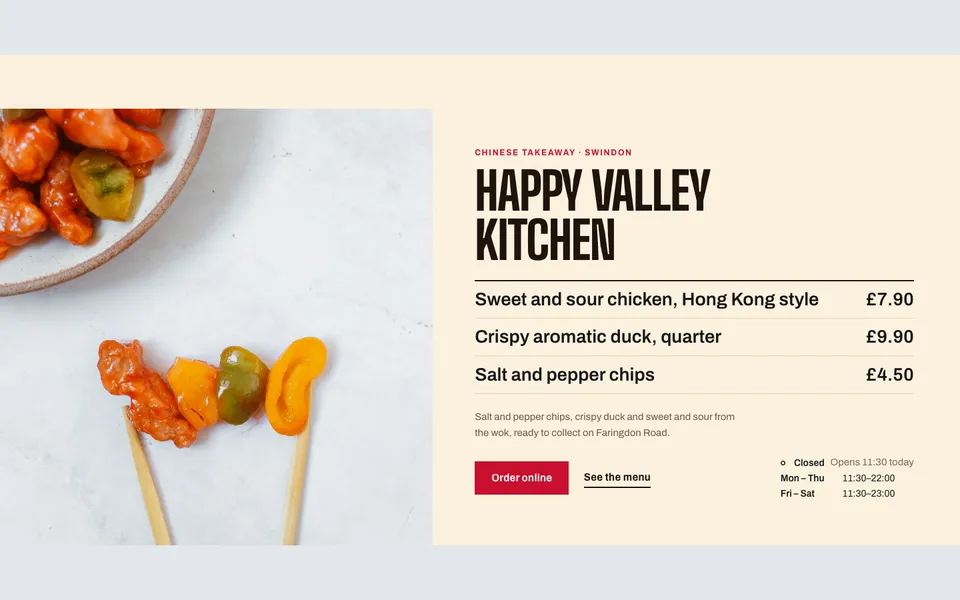
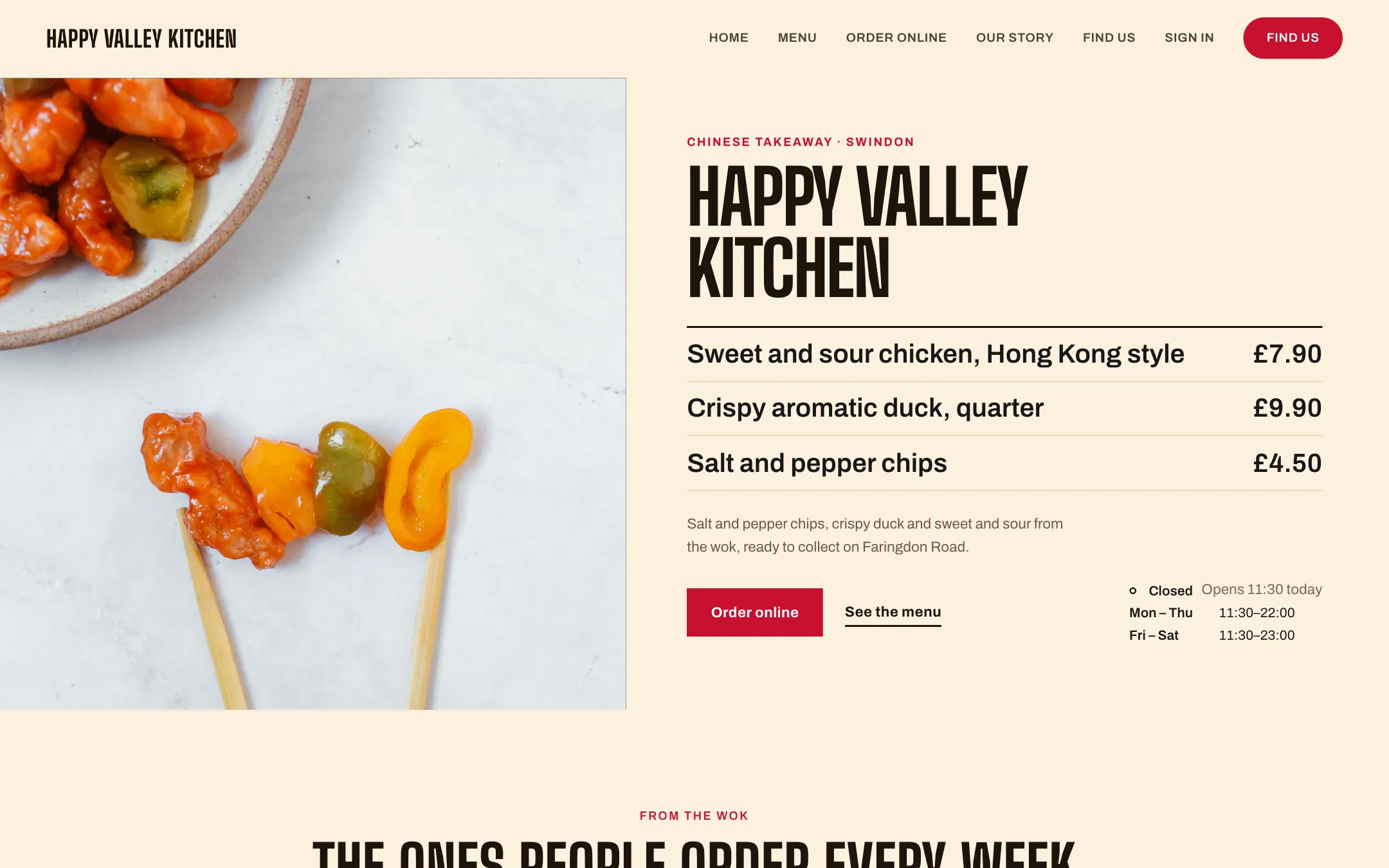
Big opening image, name & buttons, in the Menu Board treatment: The restaurant's own dishes and prices set large like a printed board beside one photograph.
Templates · Chinese takeaway
Built for the Chinese takeaway: the menu up front, open tonight, and Order online one tap away. This page is the whole template, rendered live — browse it, switch to the phone, open the ordering page, and see exactly what your takeaway would get.
Every section is a builder module you can reorder, edit or delete, with no developer.
On bookings and orders, on every plan. Stripe’s standard card-processing fees apply to online payments.
Build and preview the whole site for nothing, and pay only when it goes live.
Starter is £19/mo excl. VAT and includes a complete restaurant website, a live structured menu, enquiry and newsletter forms, and managed search readiness. Growth is £39/mo excl. VAT and adds direct live bookings, a custom domain with managed SSL, and table and floor-plan operations. Full is £69/mo excl. VAT and adds online ordering and multi-site management for up to five restaurant sites. TableSpark commission is 0%. Stripe's standard card-processing fees apply to online payments.
An independent UK restaurant can be running all of this at one flat monthly price, and the full cost comparison shows why that is the best value. The expensive route is a bespoke build: thousands of pounds, months of waiting, and a developer on call for every price change. This is the other route. From then on nothing needs a developer — the menu, the prices and the pictures are edited by whoever is standing at the pass. Phone, tablet and desktop are all handled, and reservations, tables, ordering and management come with the plans — TableSpark takes 0% commission.
Happy Valley opens on warm cream with heavy condensed capitals and one red, because a takeaway menu should read from across the street. Yours might be white tile and morning light, or brass and candles, or something nobody has built yet.
The controls beside the frame are not an illustration of the Theme tab — they are the Theme tab, driving the same engine that publishes real restaurants. Press whatever you like; nothing is stored and nothing is signed up for. Go on.
Loading the live preview…
Nobody browses a takeaway website for long. They want to know if you are open tonight, what the prices are and how fast they can have it. So the design opens on the menu itself, set like the board above the counter with real dishes and prices, beside the name and the two actions: Order online and See the menu.
Everything after keeps the same energy: big condensed type, one red, dish photographs cut close and bright, and the opening hours and phone number never more than a scroll away. Salt and pepper chips and crispy duck look like what people are about to order.
The home page is built from builder modules you can reorder, edit or delete:
01
Big opening image, name & buttons, in the Menu Board treatment: The restaurant's own dishes and prices set large like a printed board beside one photograph.
02
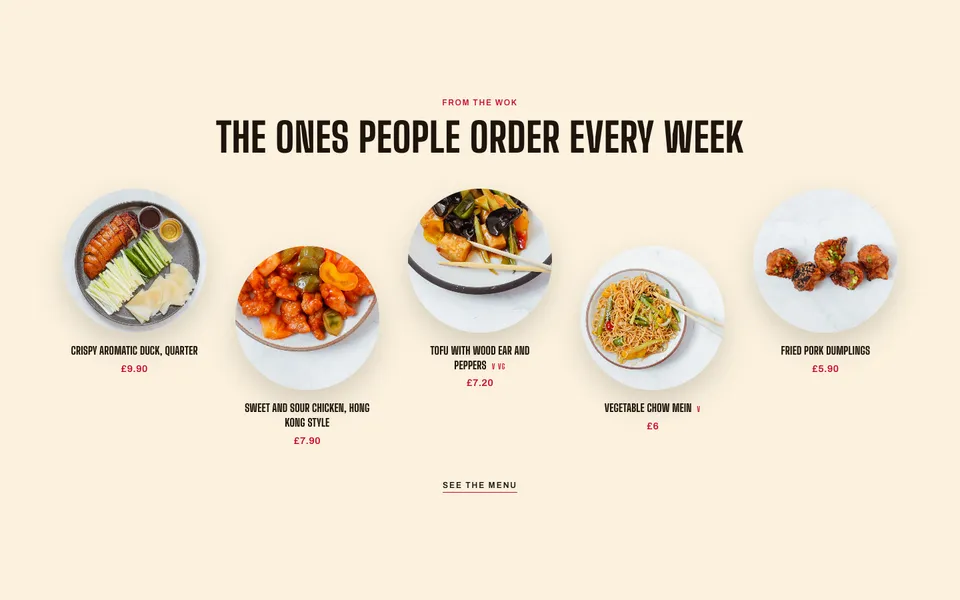
A few dishes on a sliding rail.
03
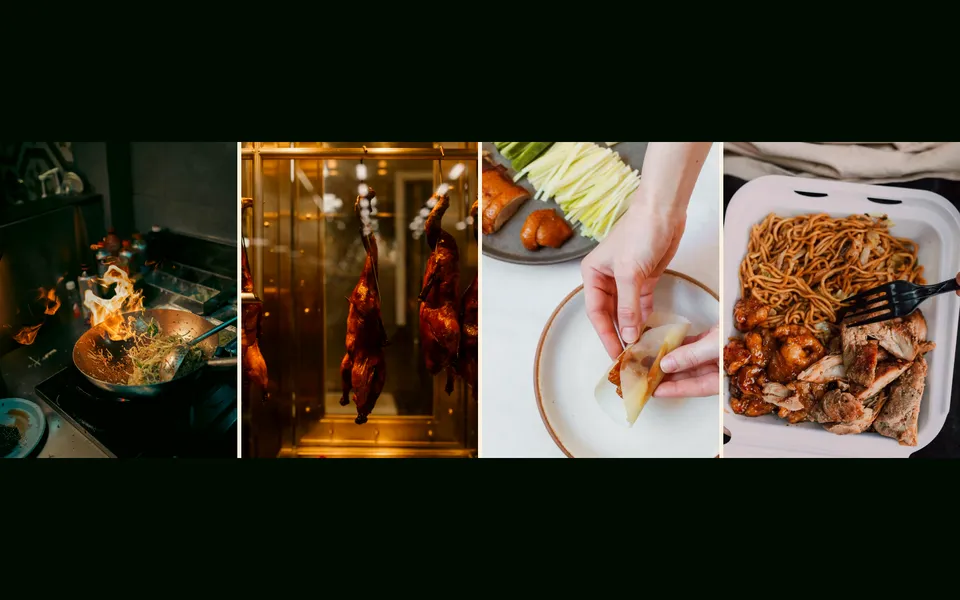
Grid, masonry or moving strip.
04
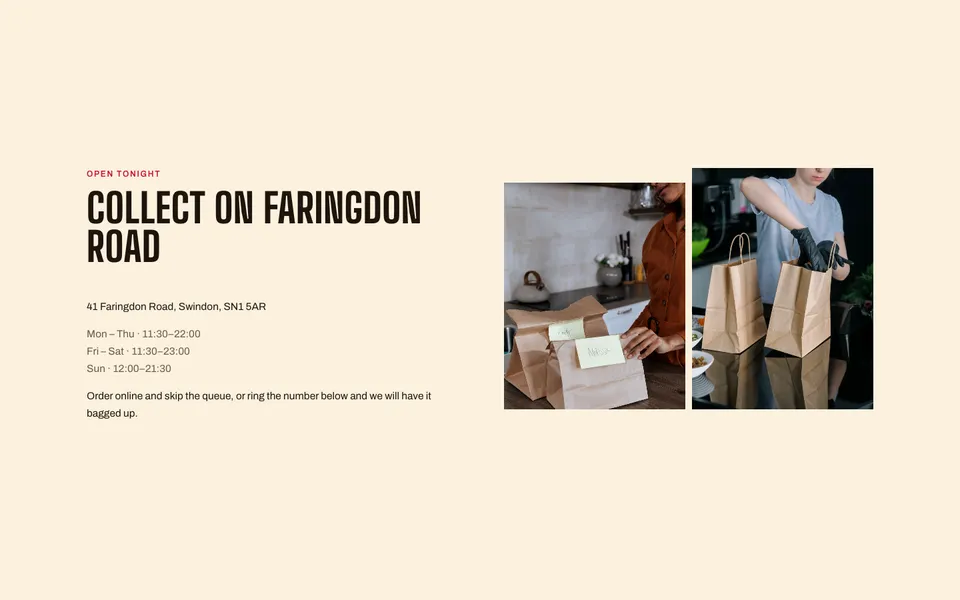
Address, phone & hours.
05
Headline + button band.
Loading the live preview…
Happy Valley Kitchen uses the Showcase ordering layout — on a laptop each section opens on a wide photograph with its dishes as large photo cards; on a phone it keeps the delivery-app rows.
It reads like the delivery apps your guests already know, except the restaurant keeps the relationship and the money. The basket stays on screen, and each mode asks only for what it needs: a table number, a phone number or an address.
Loading the live preview…
This is the frame that matters. It is the real ordering page at a real phone width — not a mock-up, not a video.
On a laptop the same page puts the basket in a panel beside the menu that follows the scroll.
Every Happy Valley Kitchen site on Growth and Full ships with an app your guests keep. It lives at /account on your own domain, so the guest signs in to your restaurant, not a marketplace.
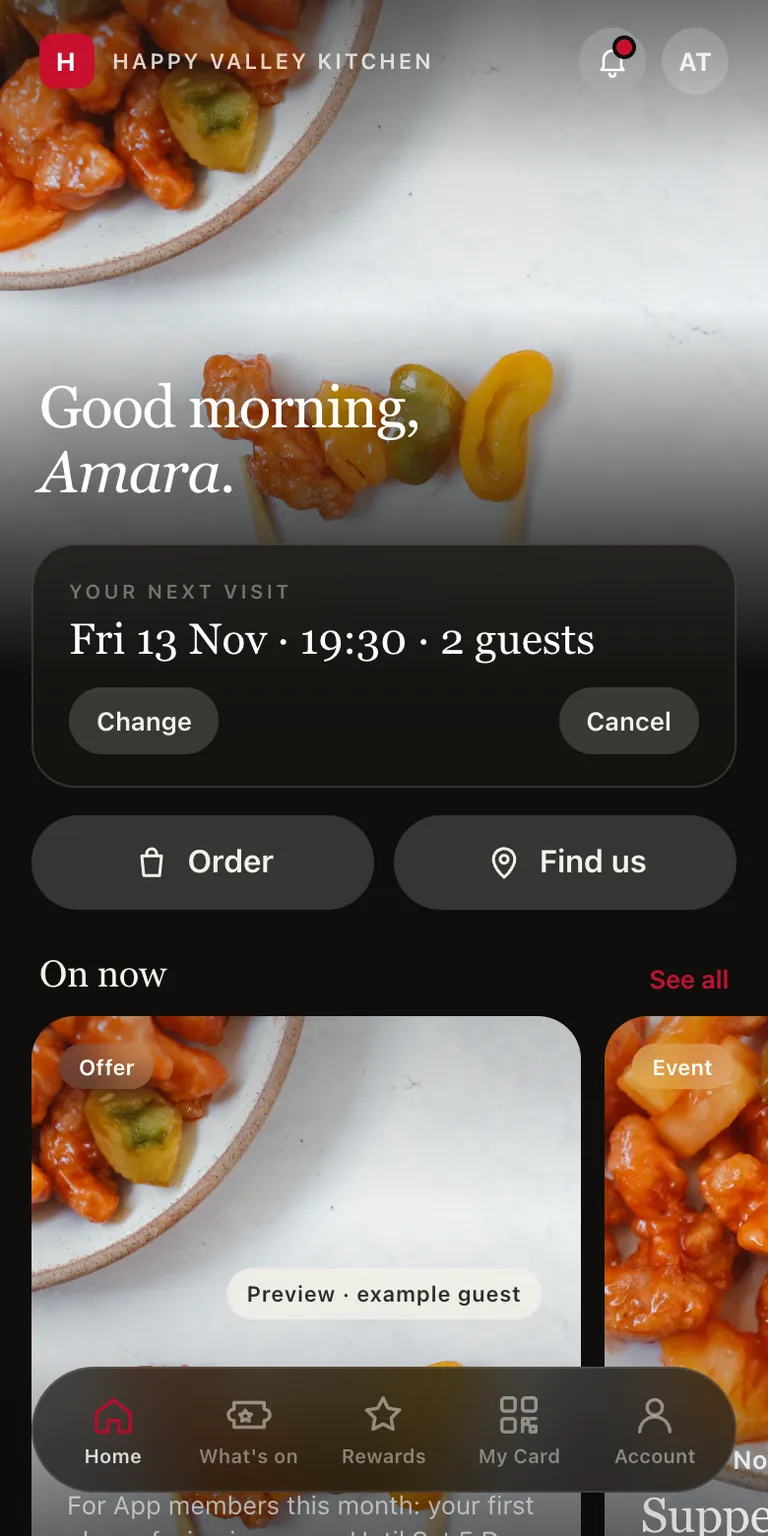
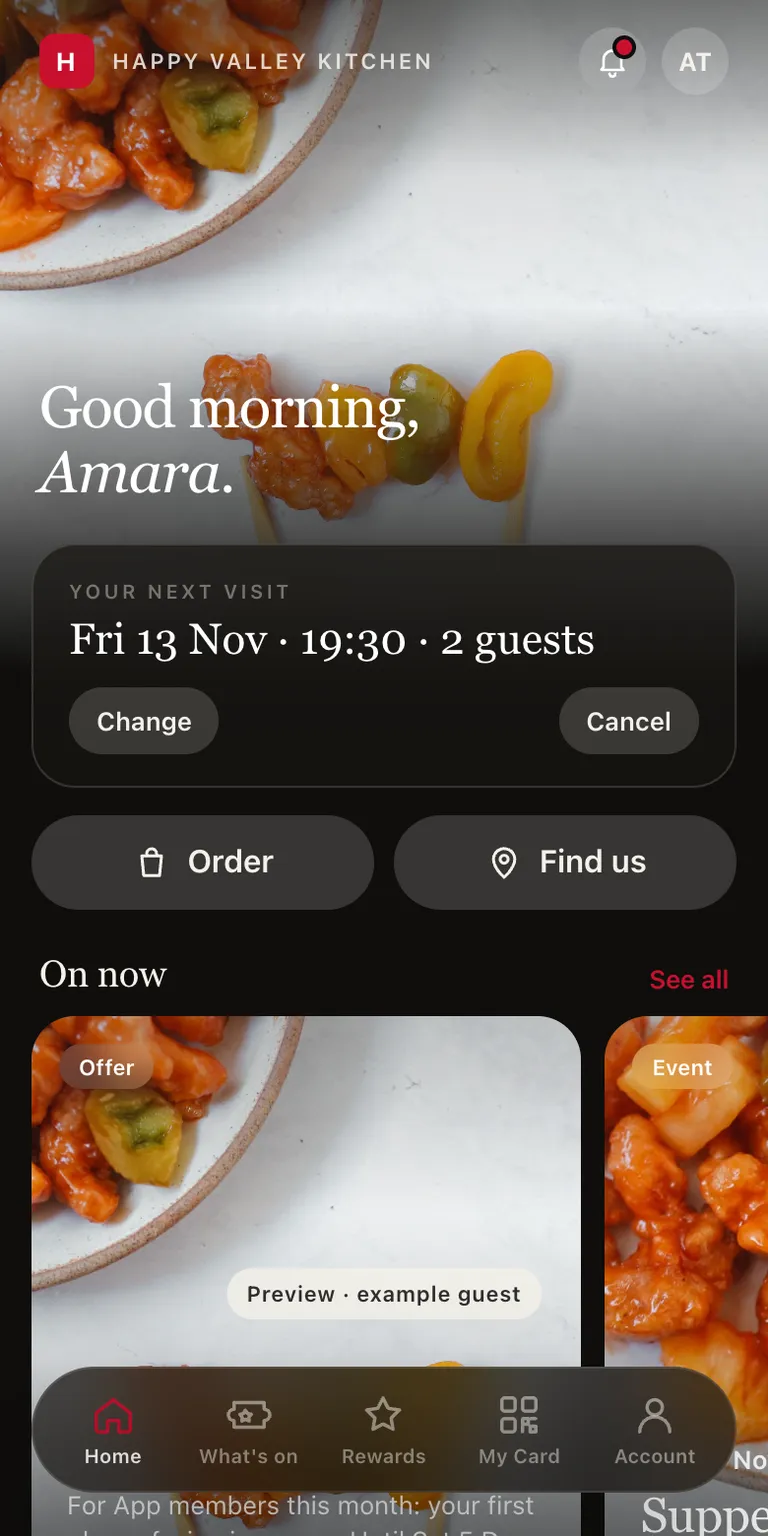
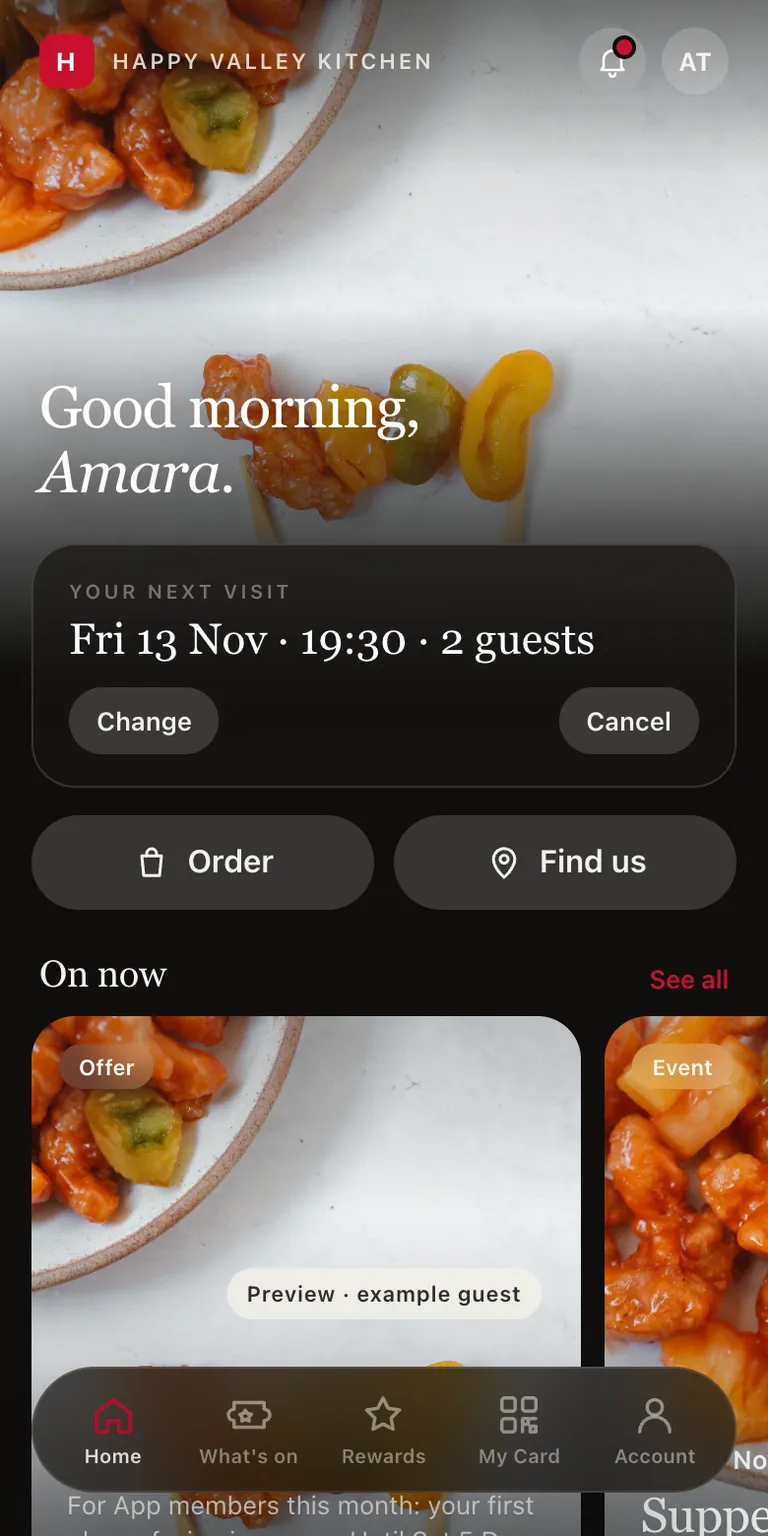
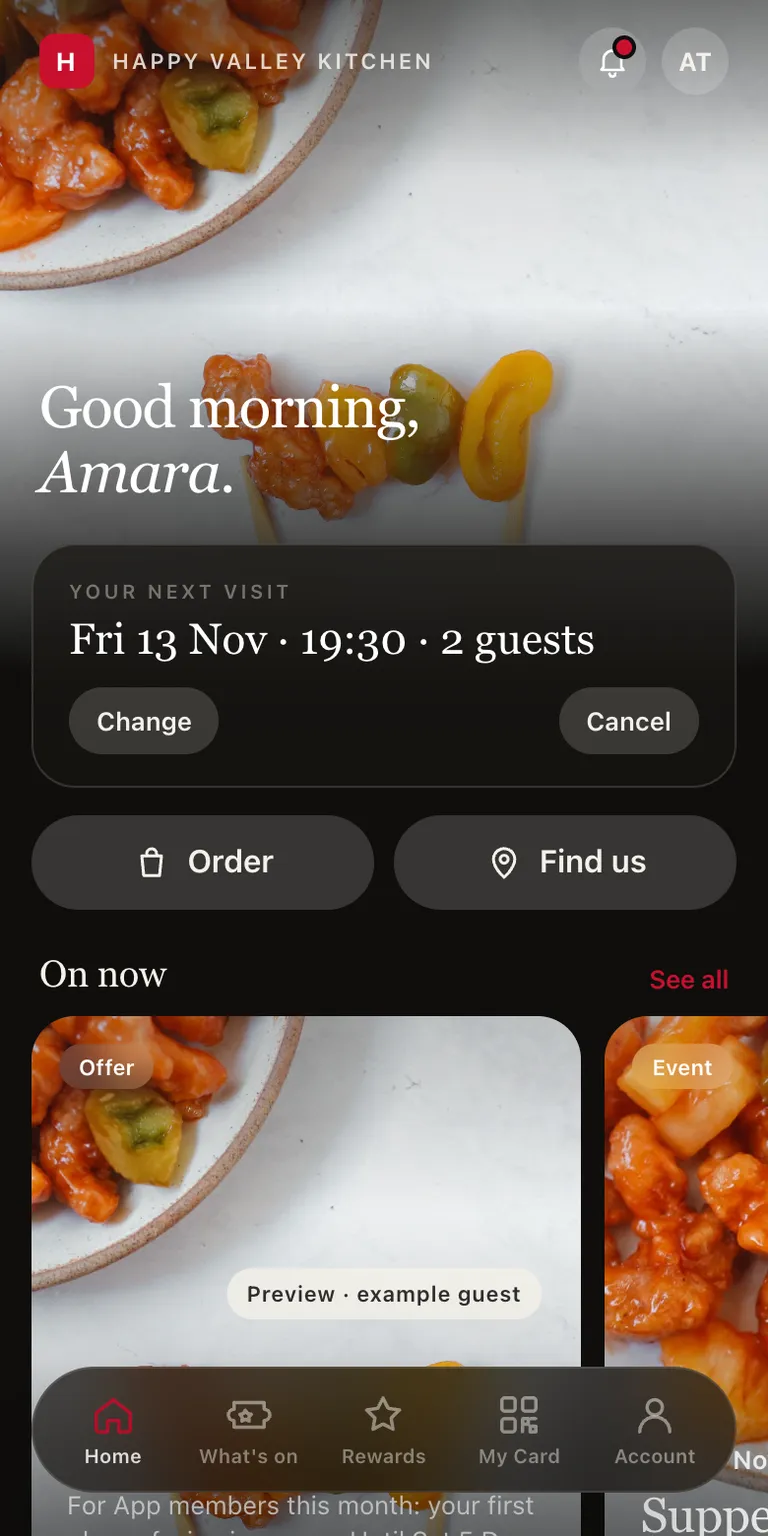
Included on the Growth and Full plans. Watch the Guest App course
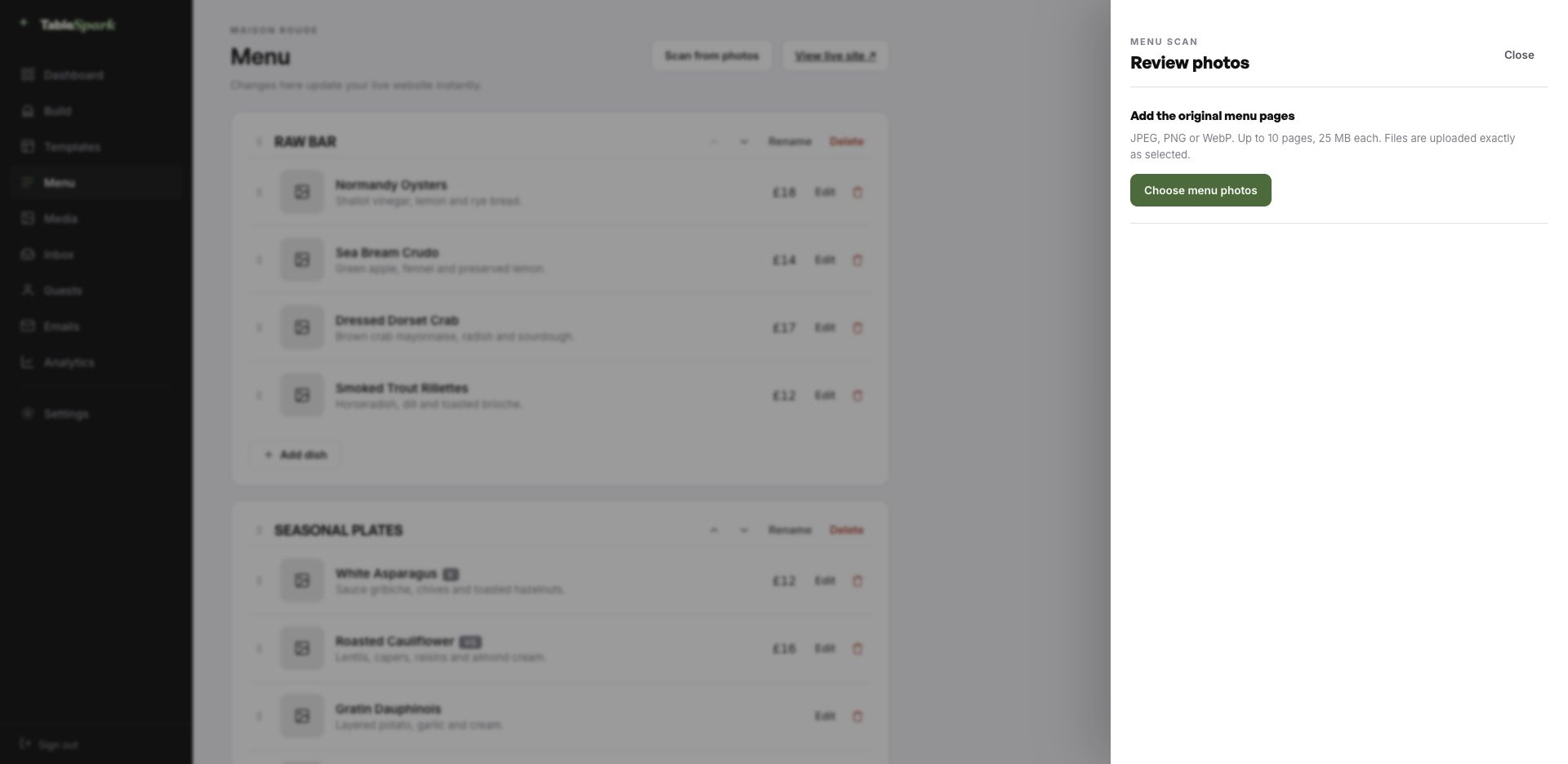
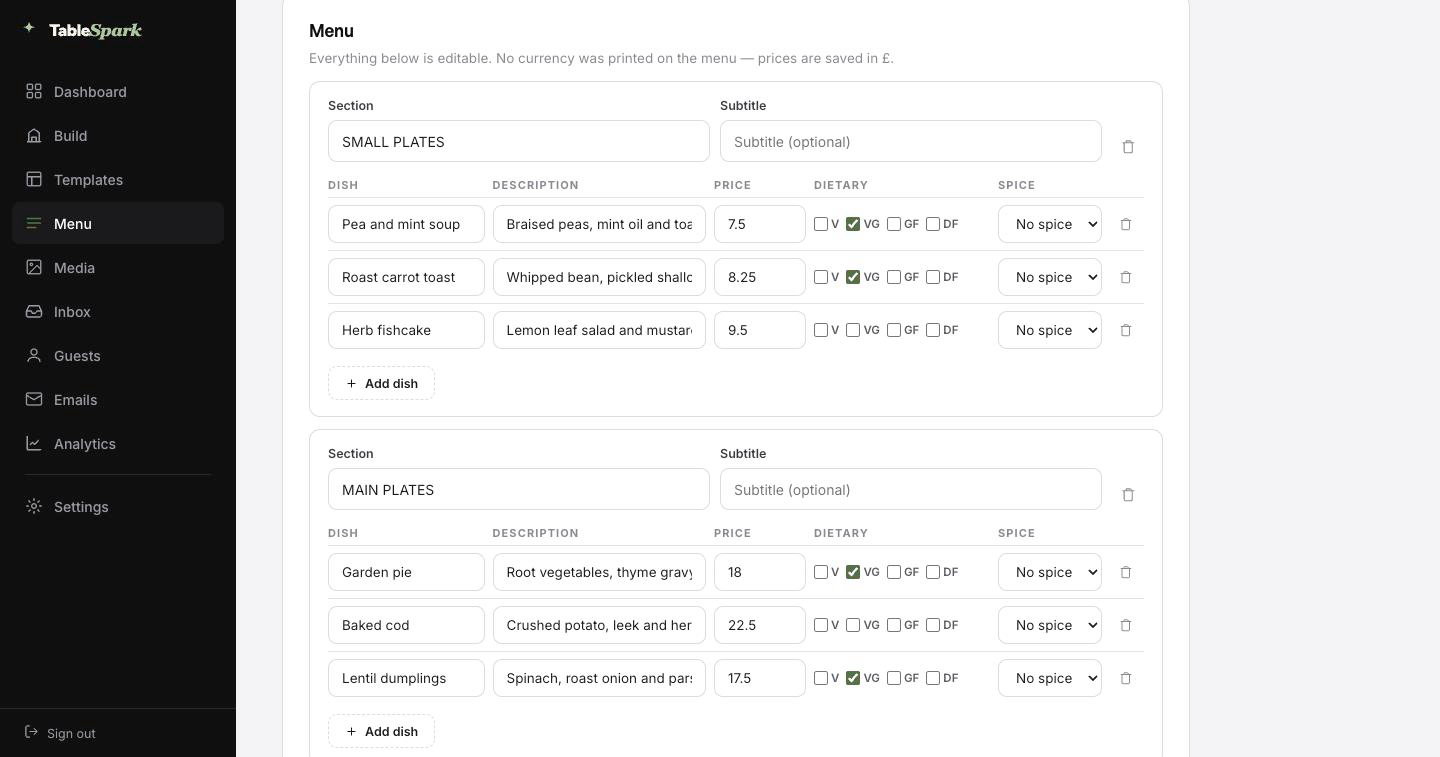
Here is the hour you were dreading, deleted. Photograph the card, the board or the takeaway sheet — up to ten pages at a time — and hand it to TableSpark. It is read into proper fields — section, dish, description, price, dietary marks, spice level — rather than pasted in as a lump of text. Then you read it through, correct whatever the lens misread, and save.
It behaves like data, because it is data. From there the same data runs the menu page, the ordering page, the highlights on the home page and the Restaurant structured data a search engine reads. Change a price once afterwards and all of them follow.
For the search snippet, a Write with AI button drafts the title and description out of the page itself. It is a draft, not a decision: edit it, then publish.
The card, the board, the sheet by the till. Ten pages at a time.
Sections, dish names, descriptions, prices, dietary and heat marks, all editable.
Menu page, ordering page, home-page highlights and the Restaurant schema — because they share one menu.
Nothing here needs to be built, because it already is. The hard parts are finished; the personal parts are not, and only you can do those. You go from opening the builder to a published site on their own address in one sitting, and the reservation form answers from the moment it publishes. You see it in the inbox, they see a confirmation in theirs, both within seconds.
Add your Stripe account and the same site takes booking deposits and order payments, with the money landing in your account rather than ours. TableSpark takes 0% commission at every plan level. Stripe’s standard card-processing fees apply to online payments. Nothing else is deducted.
Step 01
1min
Pick Happy Valley KitchenEverything copies across — pages, blocks, menu, the lot.Step 02
4min
Change the name and the wordsEvery block is edited in place. Change the name once.Step 03
3min
Upload your menuA photograph of the menu becomes a structured menu.Step 04
1min
PublishLive. The reservation form starts working immediately.Step 05
1min
Connect StripeNow you can take deposits on tables and payment on orders — direct to your account.In all
10min
From template to taking paymentsFive steps, one sitting.An address is branding that people type. The TableSpark address gets you live in minutes; your own domain takes over the moment you want it to, with nothing rebuilt.
TableSpark manages the technical side: the certificate, the secure connection, the redirect from the bare domain to the one you chose, and keeping search engines pointed at the right address so the move does not cost you what you have already earned. An existing domain works fine. You get one instruction, not a documentation site.
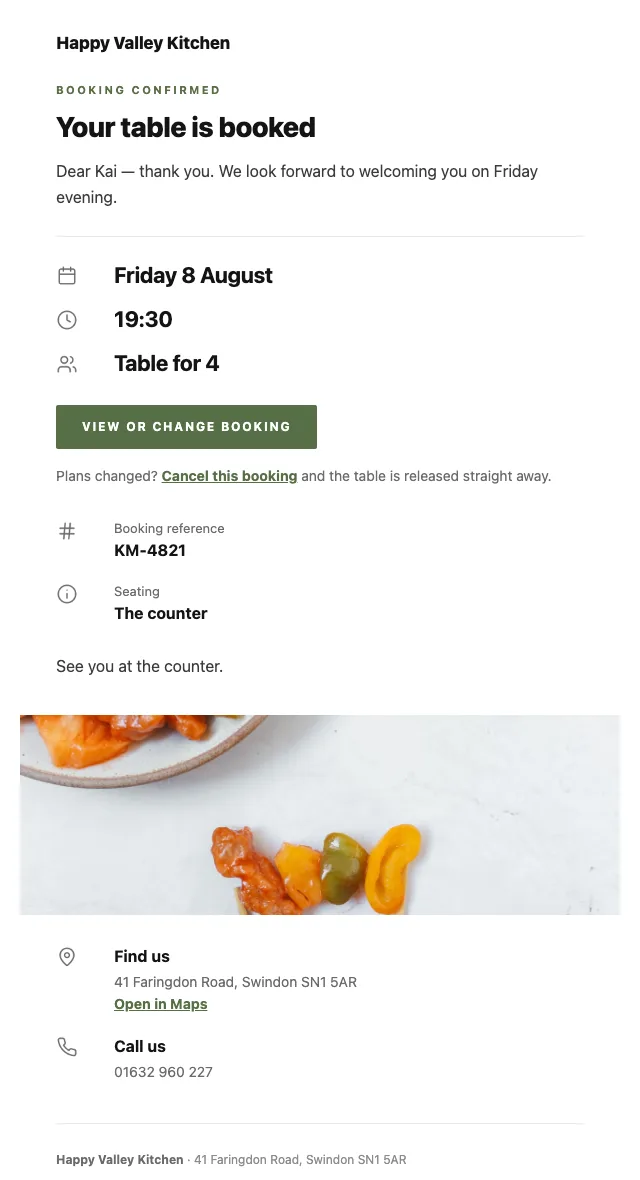
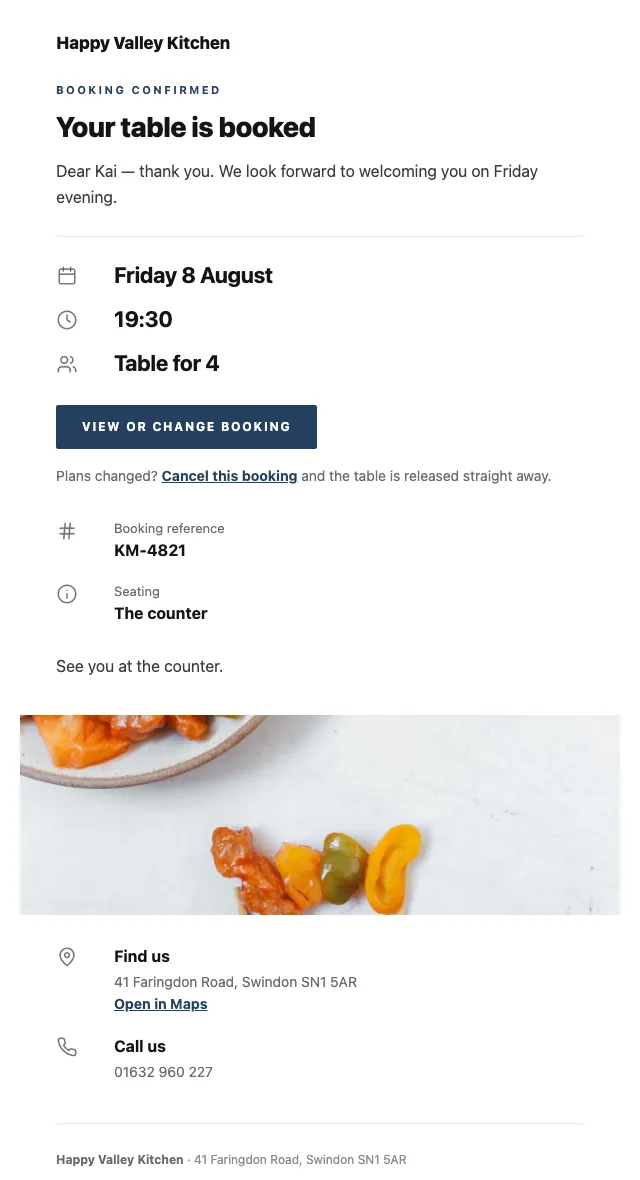
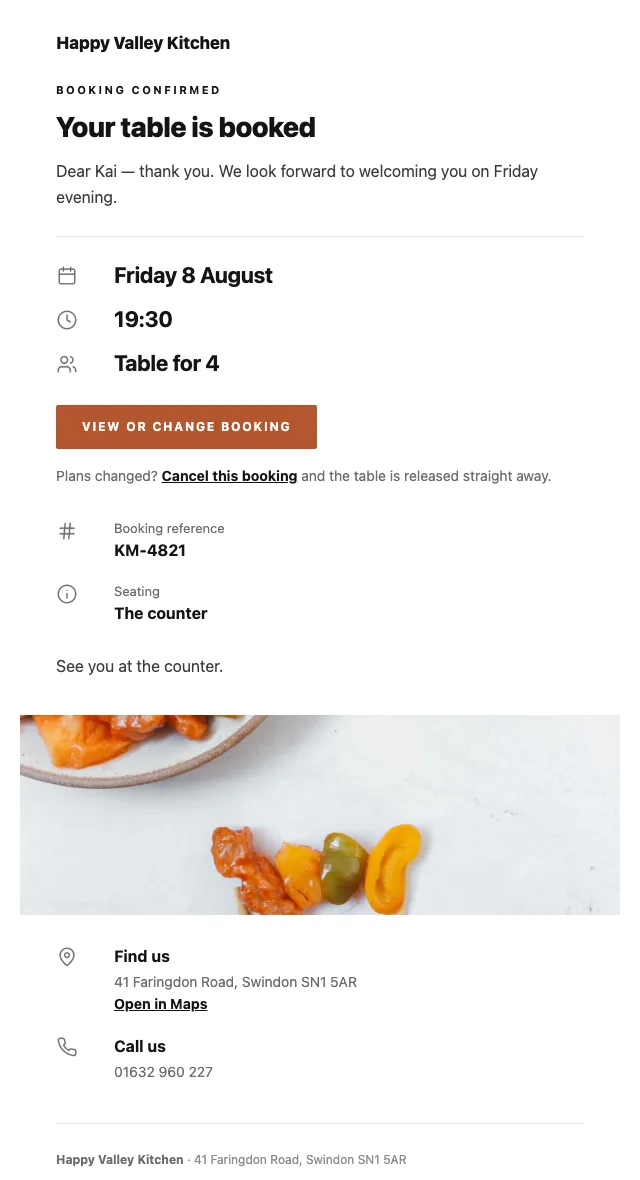
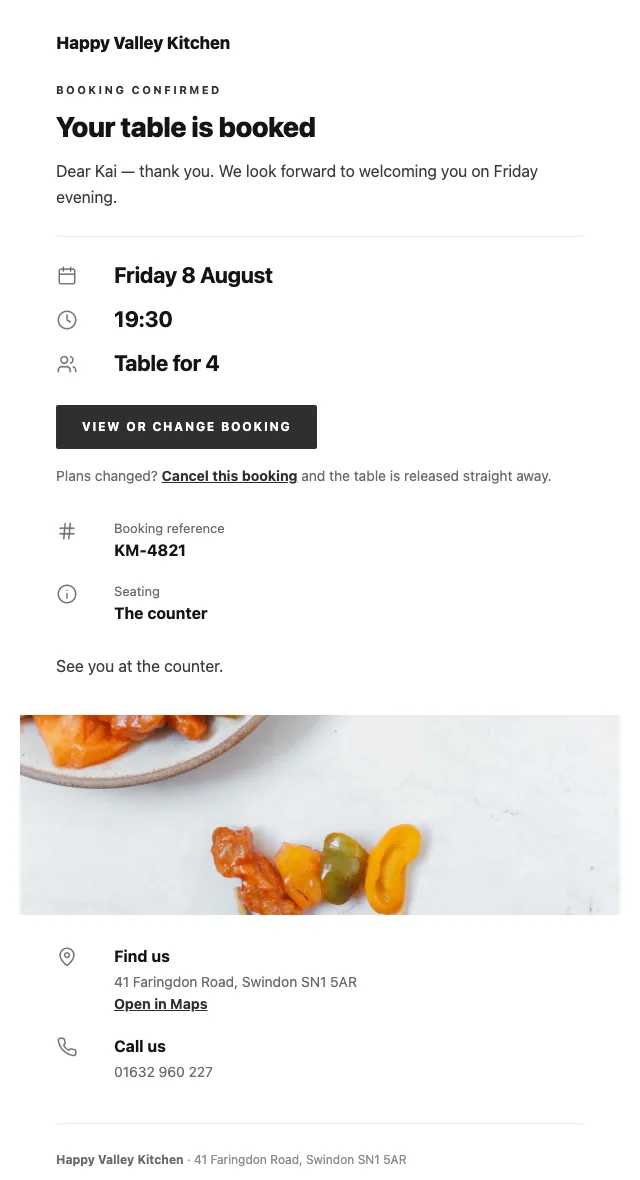
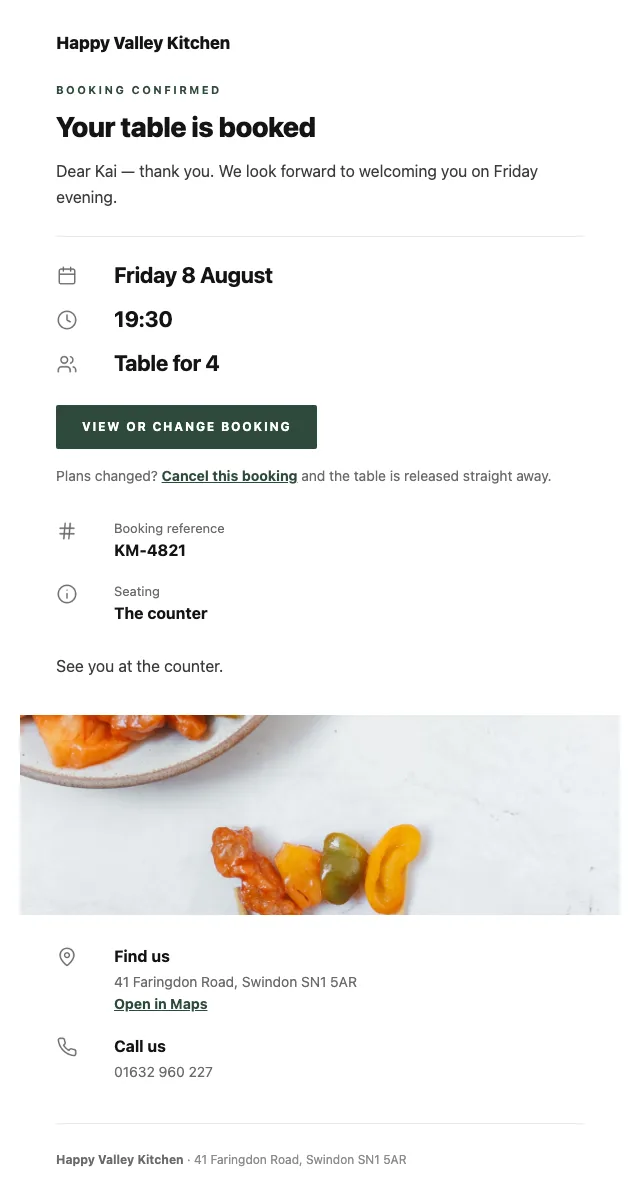
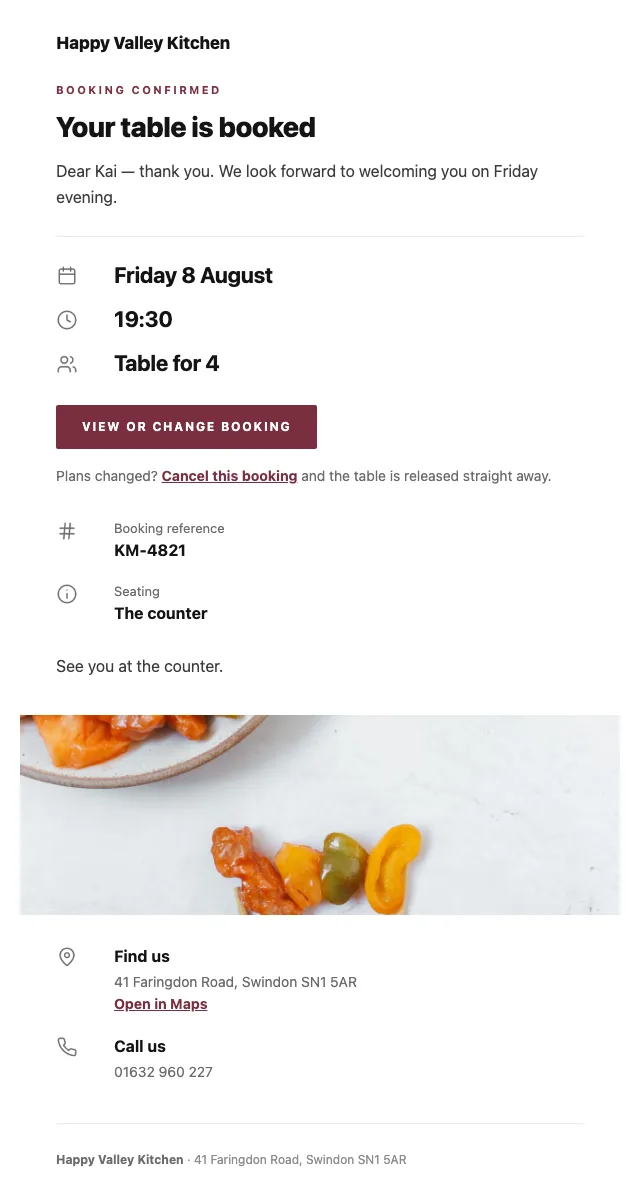
What lands in the inbox after a booking is doing more work than most restaurants realise. The confirmation goes out immediately: date and time, party size, the address and phone number, and a link that releases the table if something changes. It also carries the reminder the day before, the deposit receipt and any cancellation.
The design is not a TableSpark email with your name in it — it is your email. Six templates to choose between, then colour, logo, cover image, header style, sign-off wording, links and socials are all yours to set. Hook up the domain and even the sender is you.
Below, the same booking confirmation in six of the accent colours you can pick.
Any tool can put a page on the internet. Fewer can make sure a search engine understands what is on it. It fails quietly: noindex directives nobody noticed, conflicting canonical URLs, orphan pages, menus buried in PDFs, no structured data about the restaurant, and search verification that was never completed. The bill arrives as dependence — guests looking for your kitchen land on a directory or a marketplace that charges you for the introduction.
This is packaged into the site rather than sold separately. There is no promise of a position or of being indexed, because nobody can make one. There is a promise that you will not be hiring someone to fix the basics.
Every one can be renamed, reordered or removed, and new pages added.
There is nothing bespoke here. Every block is one of the 70 modules available to any TableSpark site, each with its own layouts.
Remove one, reorder them, or pull in a block you saw on another template.
Ships with 4 sections — Starters, From the wok, Rice and noodles, Chips and sauces — for you to overwrite.
We take 0%, on every plan, for ever. Stripe’s standard card-processing fees apply to online payments. A marketplace takes a percentage of each order and keeps the customer.
Here the page is on your domain, the order is in your inbox, and the guest’s details are yours to export.
The commission-free case, in full
You photograph and proofread. The software types, structures and drafts.
Nothing reaches the live site until you say so.
Search engines The Menu — Happy Valley Kitchen | Chinese takeaway in Swindon Crispy aromatic duck, salt and pepper chips, sweet and sour and fried rice from the wok. See the menu and order for collection.Drafts the search title & description from this page’s content. Always review before publishing.
Stripe’s standard card-processing fees apply to online payments.
Booking deposits, explained properly
Make the entire site, sleep on it, start again if you want. Nothing is charged until you publish.
Make the entire site, sleep on it, start again if you want. Nothing is charged until you publish.
5 pages, and every one of them is here. Everything below is rendered, not photographed. The frame uses the same engine as a published site, so the tabs and the in-page links are all real. Phone shows the mobile layout.
The story page tells how the kitchen cooks, everything through the wok to order, with photographs of the counter and the kitchen. The visit page carries the opening hours, the address with a map and parking, and the questions people always ask, such as delivery and vegetarian dishes.
The menu page lists every section, starters, from the wok, rice and noodles and the chippy sides, with prices in clear rows and a photograph to open each section. Every dish is real text with Restaurant schema around it, not a photograph of a printed menu, so it can be read on any phone and by search engines.
Prices change, dishes run out and specials come and go. All of it is edited in the menu editor, and the menu page and the ordering page update together the moment you save.
Whatever the arrangement, the menu is text and not a picture — every dish, description and price indexable, with Restaurant schema around it.
Ordering is the whole point, so it leads every page. It reads like the delivery apps guests already know, except the takeaway keeps the customer and the margin: sections down a rail, the basket pinned to the bottom of the phone screen, and a collection time chosen at checkout. TableSpark takes 0% commission on those orders.
Notes on any dish, no MSG, extra chilli, no onions, print with the order, and the collection page says plainly how long orders usually take on a weeknight and at the weekend.
Dine-in wants a table number and nothing else; collection wants a number to ring; delivery wants somewhere to go. No mode asks for the others’ fields.
What owners ask before they pick a template: the cuisine fit, the menu, the address, and what it costs.
Yes. The menu is split into sections with a rail to jump between them, so a long menu stays easy to scan, and the basket stays visible while guests choose.
Yes. Mark a dish sold out in the menu editor and it comes off the ordering page straight away, with no republishing; online ordering follows your opening hours.
One sitting. You copy the template, replace the name and the copy, photograph the menu in, and publish. From that second the booking form works: reservations land in your inbox and guests are emailed a confirmation automatically. Linking a payment account takes another minute and lets the site hold deposits and take order payments, at 0% commission from us. Stripe’s standard card-processing fees apply to online payments.
Every one of them, in the Theme tab: palette, the display and body typefaces, corner radius, motion, the header layout and how it behaves on scroll. The template is a starting point, not a cage — and switching a colour never breaks the layout, because the design reads its values from the theme rather than hard-coding them.
Yes — and bringing a domain you already own is the common case. You go live on a TableSpark address first, then point your domain across; you get the exact DNS record to change. The certificate, HTTPS, bare-domain redirect and the search-engine housekeeping are handled here so the switch does not cost you visibility. Your guest emails can then send from that domain as well.
A confirmation in the restaurant’s name, immediately, with the date and time, the party size, your address and phone number, and a cancellation link so a change of plan does not cost you the cover. Pre-service reminders, deposit receipts and cancellation notices share it. The look is entirely yours — six templates, accent colour, logo, cover photograph, header layout, sign-off wording, links, social accounts — and your domain becomes the sending address once connected.

Copy this design into your account, change the words, add your menu and publish — usually the same afternoon. Free to build; you only pay when you go live.