01
Hero
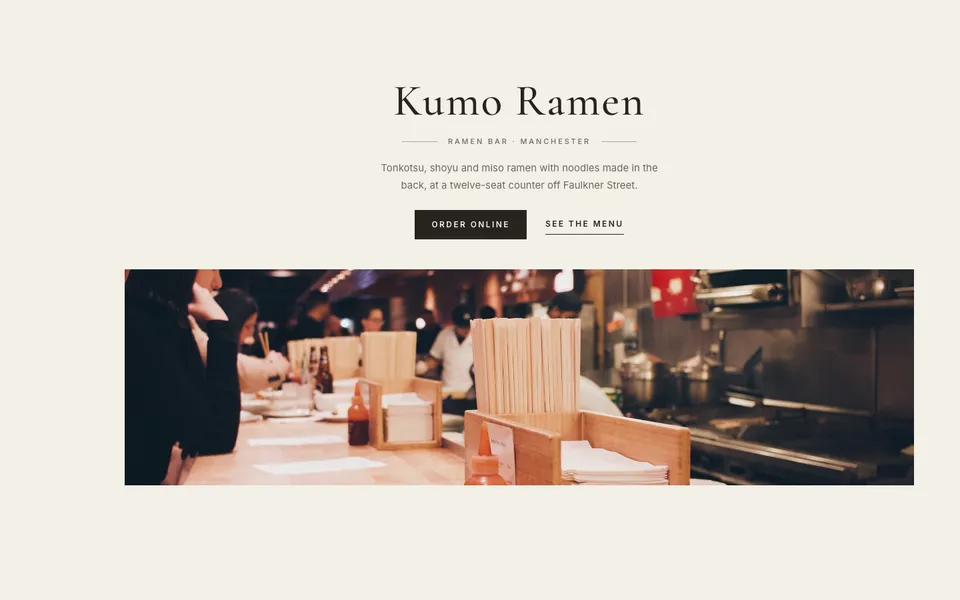
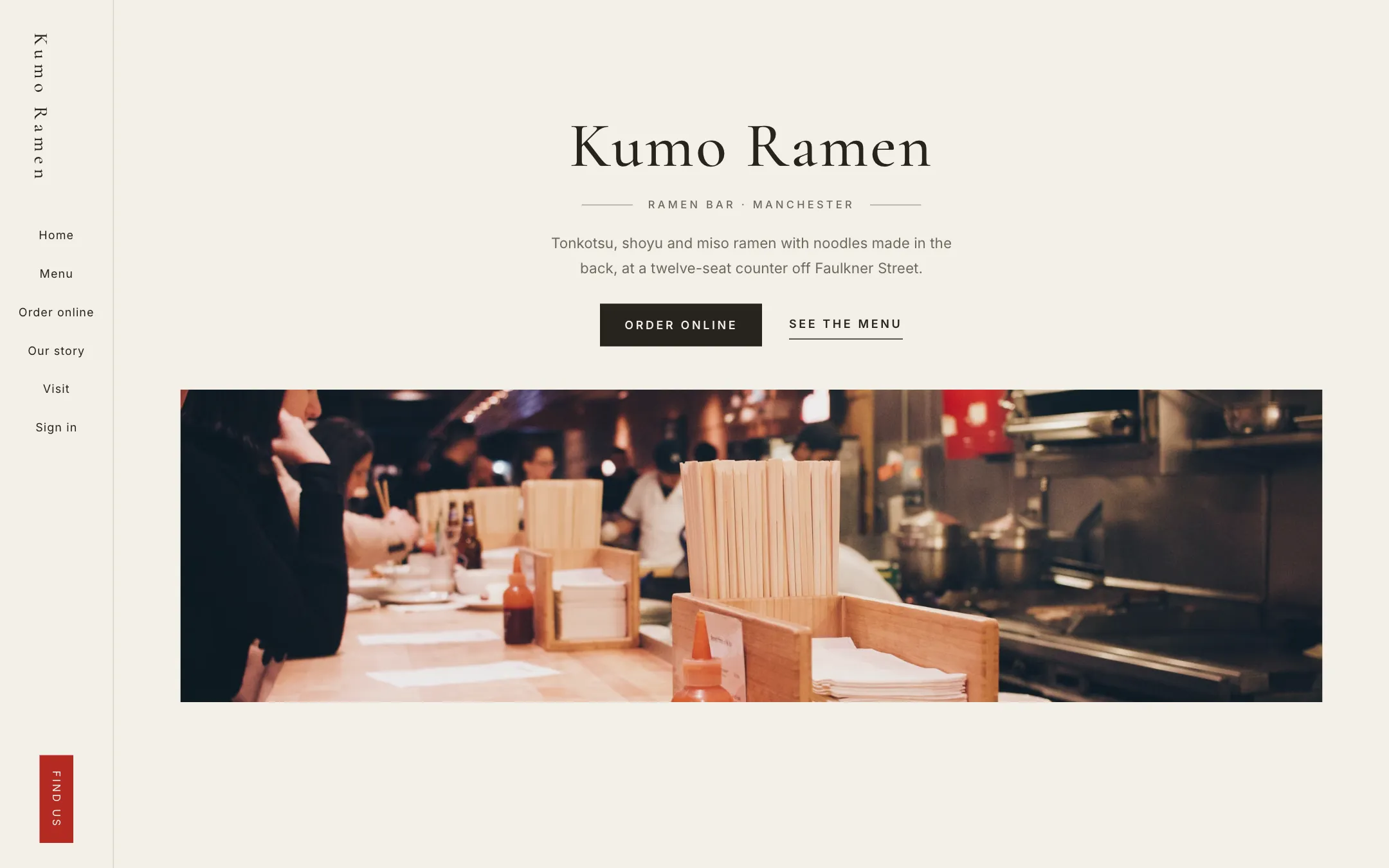
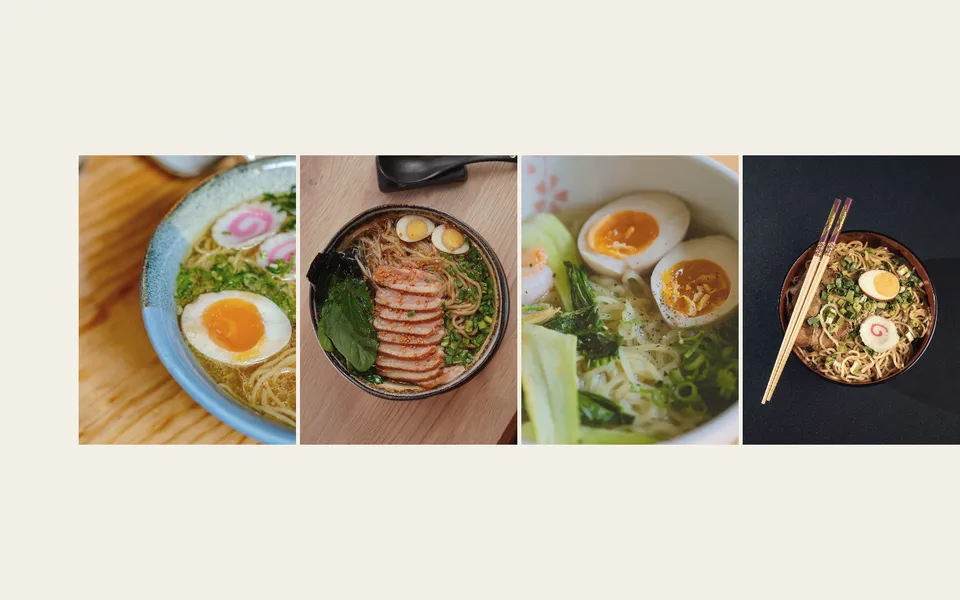
Big opening image, name & buttons, in the House Card treatment: A centred house card on paper: seal, name in two scripts, a ruled line, and a wide photograph strip.
Templates · Ramen bar
Built for the ramen counter: the bowl, the broth and the noodles, set on paper with a red seal. This page is the whole template, rendered live — browse it, switch to the phone, open the ordering page, and see exactly what your ramen bar would get.
Every section is a builder module you can reorder, edit or delete, with no developer.
On bookings and orders, on every plan. Stripe’s standard card-processing fees apply to online payments.
Build and preview the whole site for nothing, and pay only when it goes live.
Starter is £19/mo excl. VAT and includes a complete restaurant website, a live structured menu, enquiry and newsletter forms, and managed search readiness. Growth is £39/mo excl. VAT and adds direct live bookings, a custom domain with managed SSL, and table and floor-plan operations. Full is £69/mo excl. VAT and adds online ordering and multi-site management for up to five restaurant sites. TableSpark commission is 0%. Stripe's standard card-processing fees apply to online payments.
One published monthly price covers the complete website and the management system behind it. Nobody is quoting you four figures and a twelve-week timeline. The design is done — you fill it with your restaurant and press publish. After that the menu, the prices and the photographs stay in your own hands — no ticket, no developer, no waiting. It is designed for the phone first and looks right on everything larger, with reservations, tables, ordering and management in the plans — and 0% commission.
Kumo opens on warm paper with ink-dark type and one red seal made from its initials, because a ramen counter is a craft room as much as a quick meal. Yours might be white tile and morning light, or brass and candles, or something nobody has built yet.
So do not read about it. The panel on the right is the real Theme tab out of the builder, and the frame beside it is the real site — the same renderer that publishes a live restaurant. Nothing is a mock-up, nothing you touch is permanent, and nobody is asking you to sign in first. Go on.
Loading the live preview…
A ramen bar is a counter, a stockpot and a queue. Guests want to know what is in the bowl, whether they can just walk in, and whether they can take it home. The design opens like a printed house card: the name set over a wide photograph of the counter, a seal drawn from the initials, and Order online and See the menu as the two actions.
The pages keep that calm: paper, ink, one narrow column of small text, and photographs of the broth, the noodles and the counter. It reads as a place that takes twelve hours over a broth, which is the reason to come.
The home page is built from builder modules you can reorder, edit or delete:
01
Big opening image, name & buttons, in the House Card treatment: A centred house card on paper: seal, name in two scripts, a ruled line, and a wide photograph strip.
02
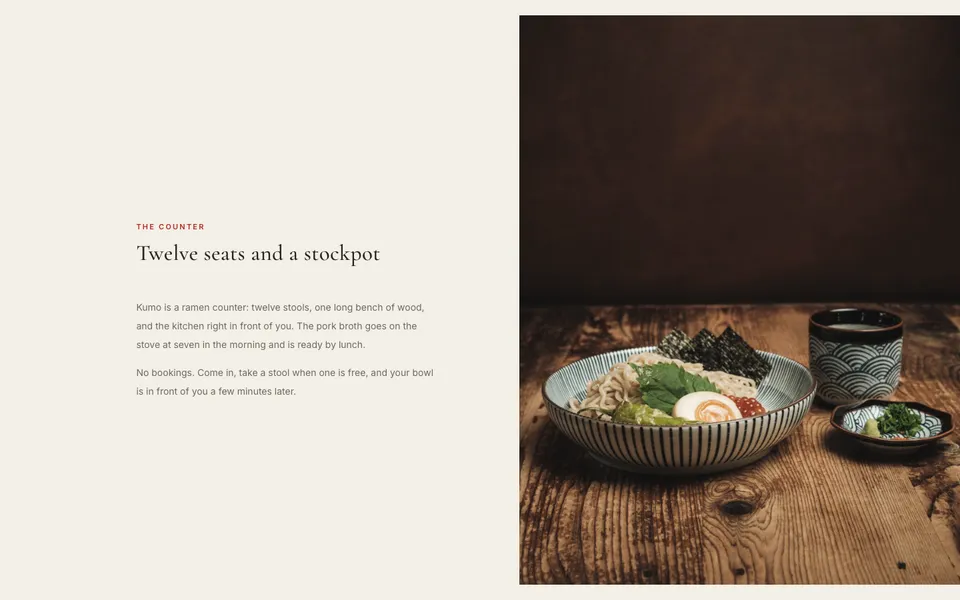
A paragraph beside a photo.
03
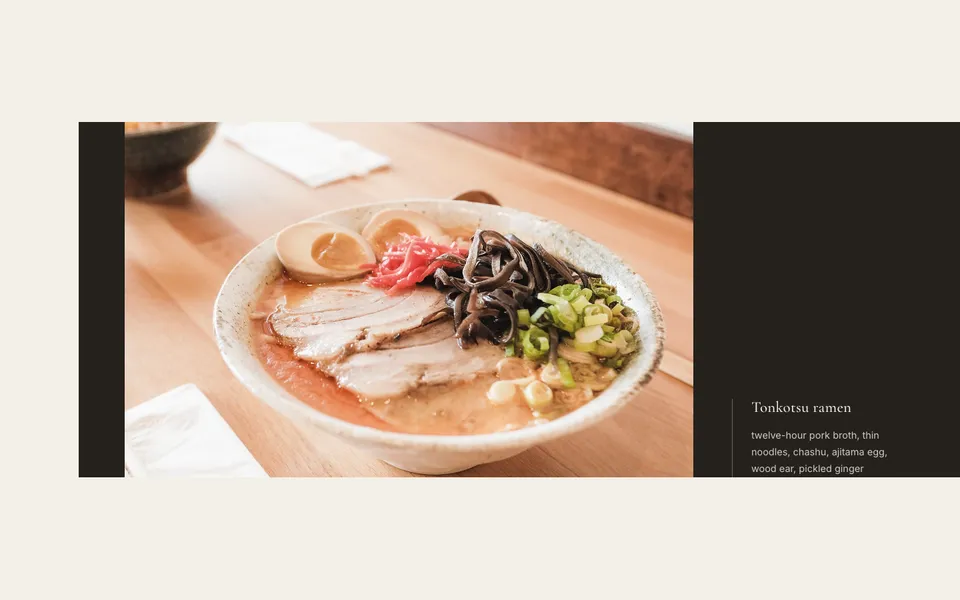
Grid, masonry or moving strip.
04
A few dishes on a sliding rail.
05
Grid, masonry or moving strip.
06
Headline + button band.
Loading the live preview…
Kumo Ramen uses the Showcase ordering layout — on a laptop each section opens on a wide photograph with its dishes as large photo cards; on a phone it keeps the delivery-app rows.
It reads like the delivery apps your guests already know, except the restaurant keeps the relationship and the money. The basket stays on screen, and each mode asks only for what it needs: a table number, a phone number or an address.
Loading the live preview…
This is the frame that matters. It is the real ordering page at a real phone width — not a mock-up, not a video.
On a laptop the same page puts the basket in a panel beside the menu that follows the scroll.
Every Kumo Ramen site on Growth and Full ships with an app your guests keep. It lives at /account on your own domain, so the guest signs in to your restaurant, not a marketplace.
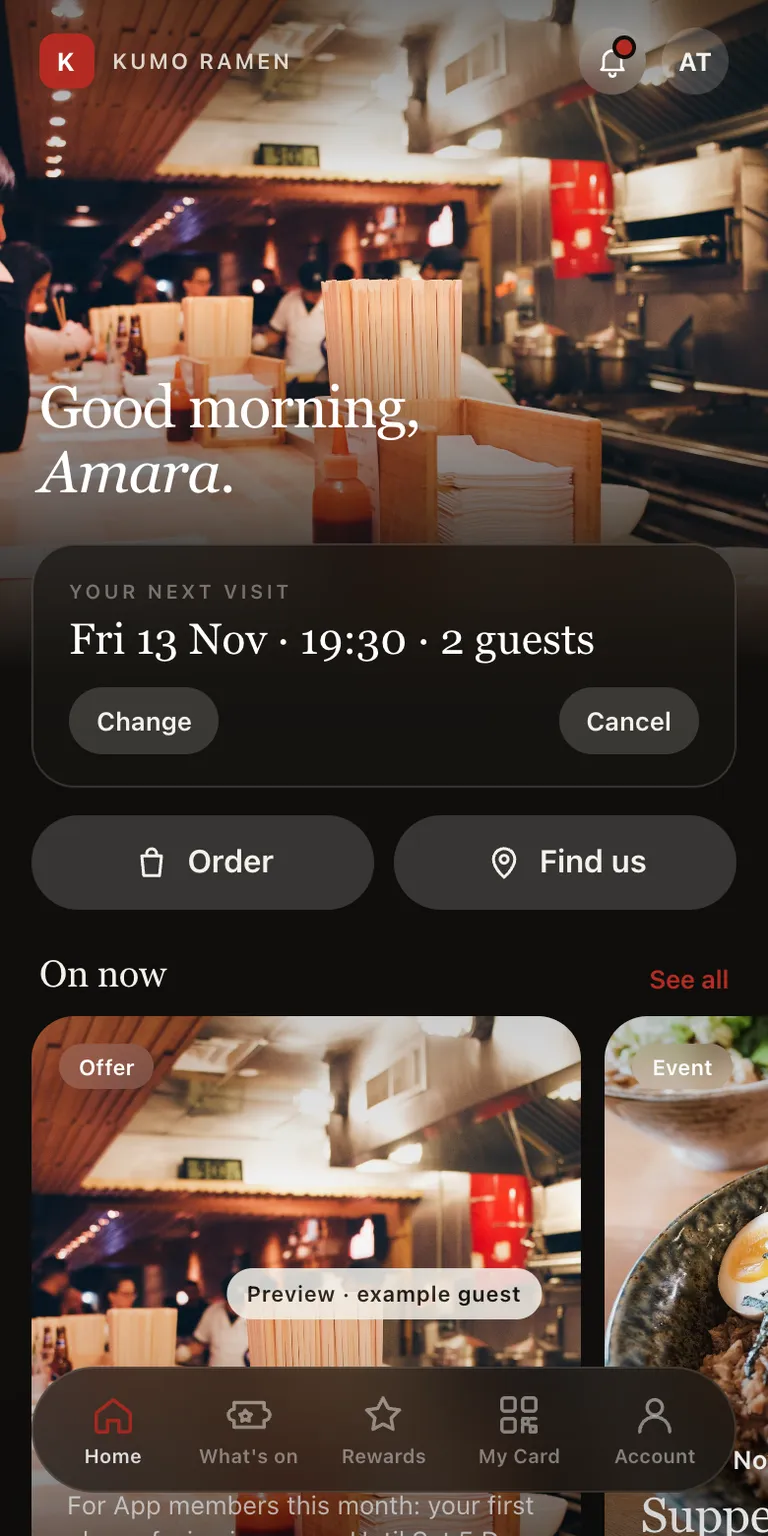
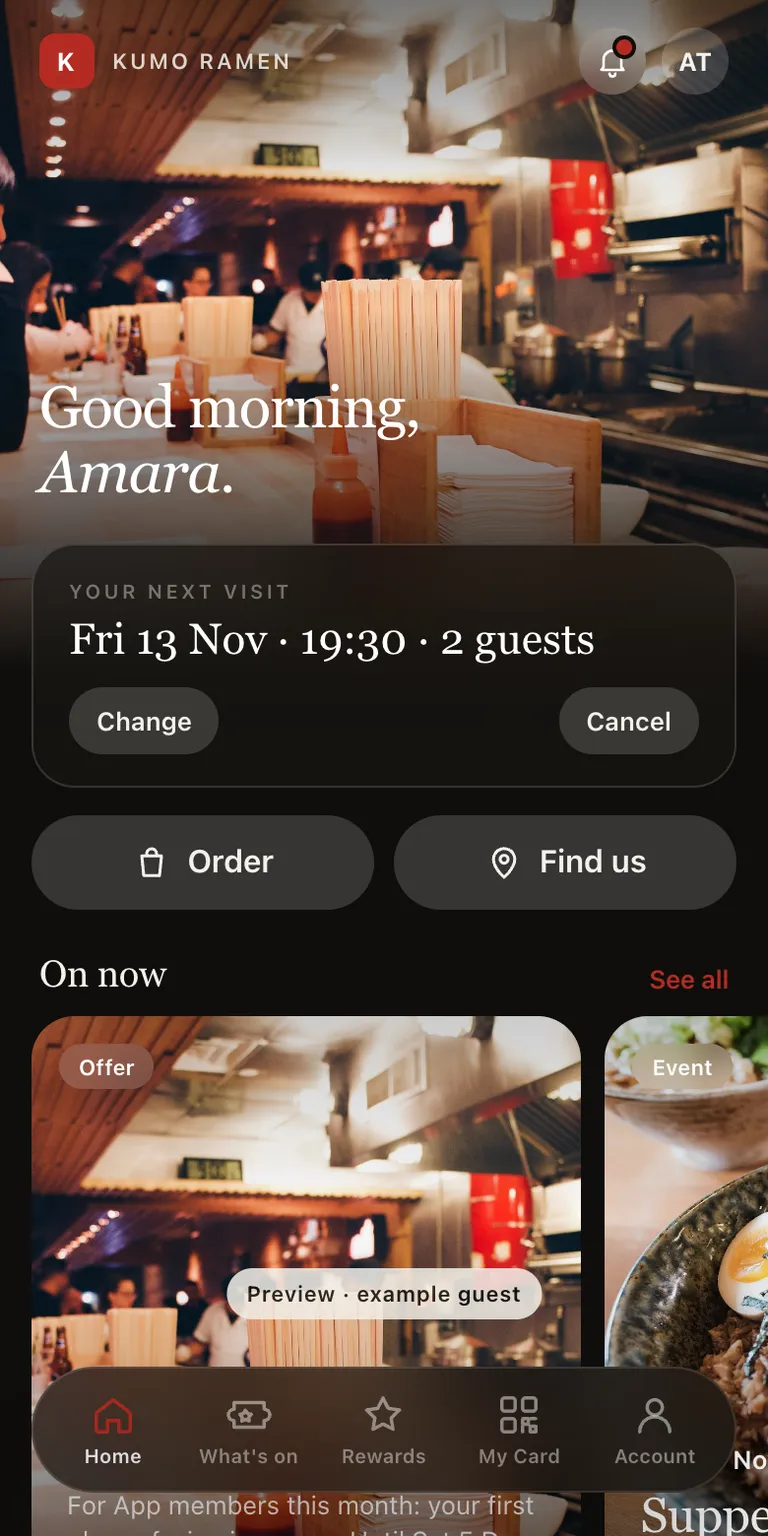
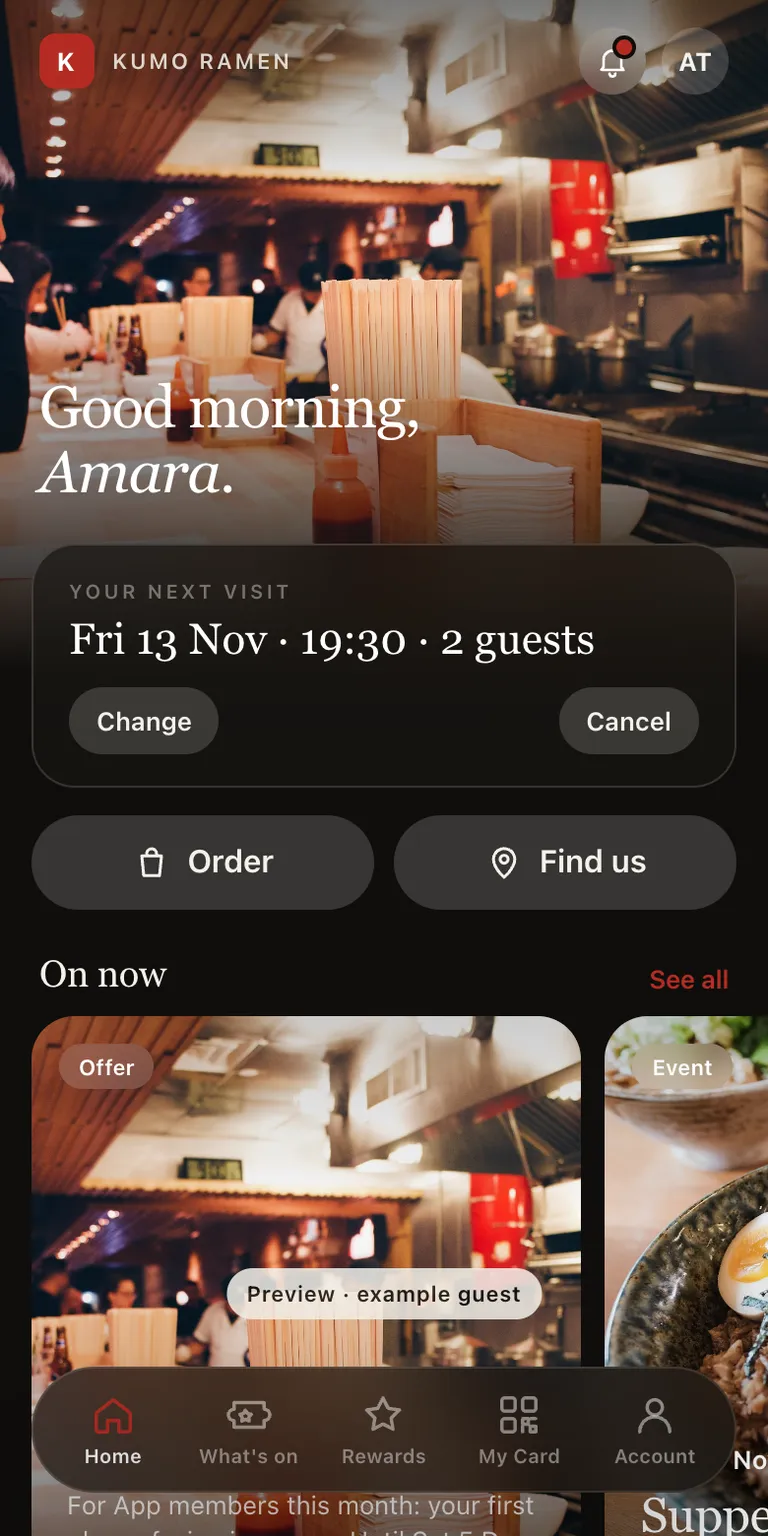
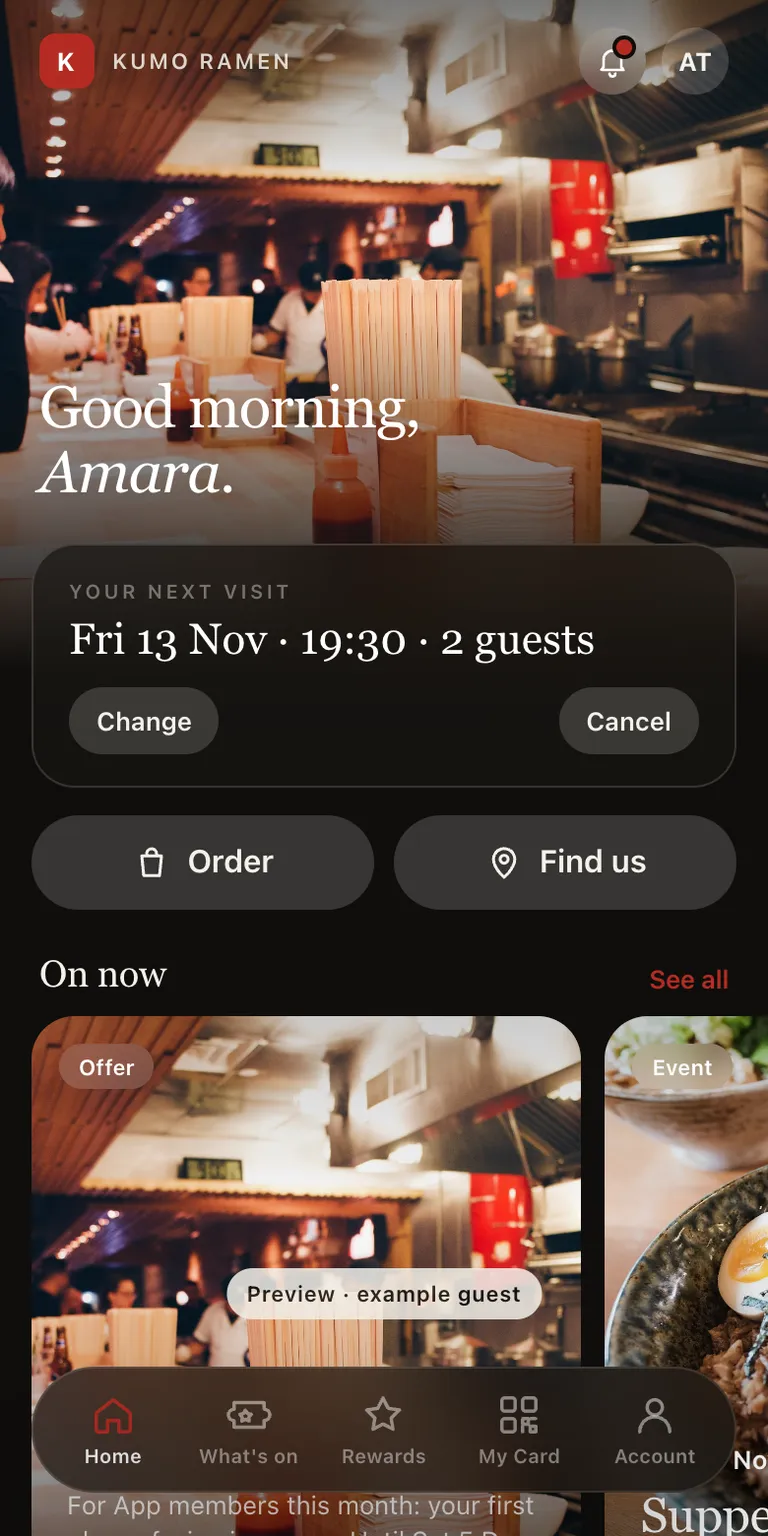
Included on the Growth and Full plans. Watch the Guest App course
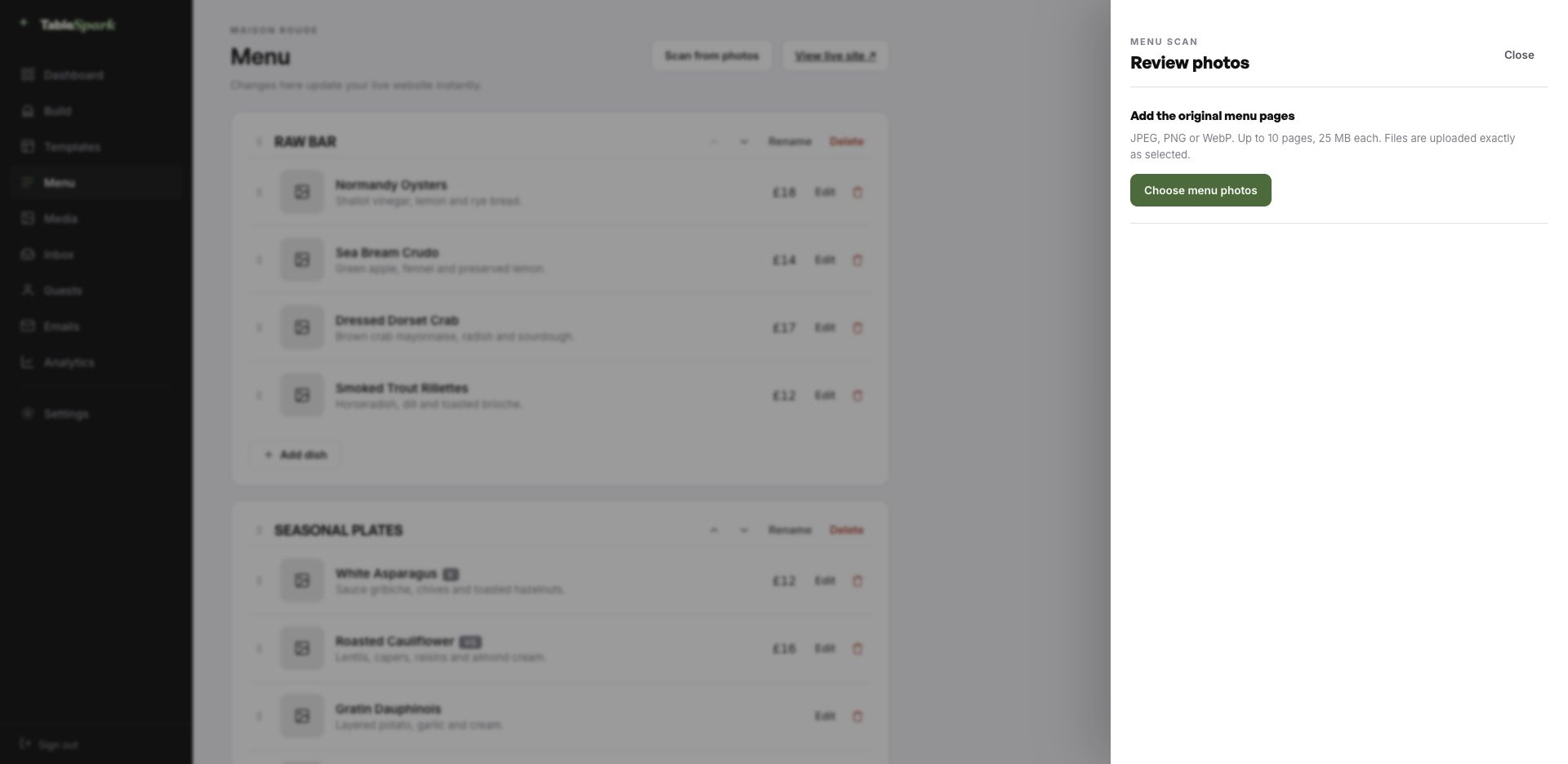
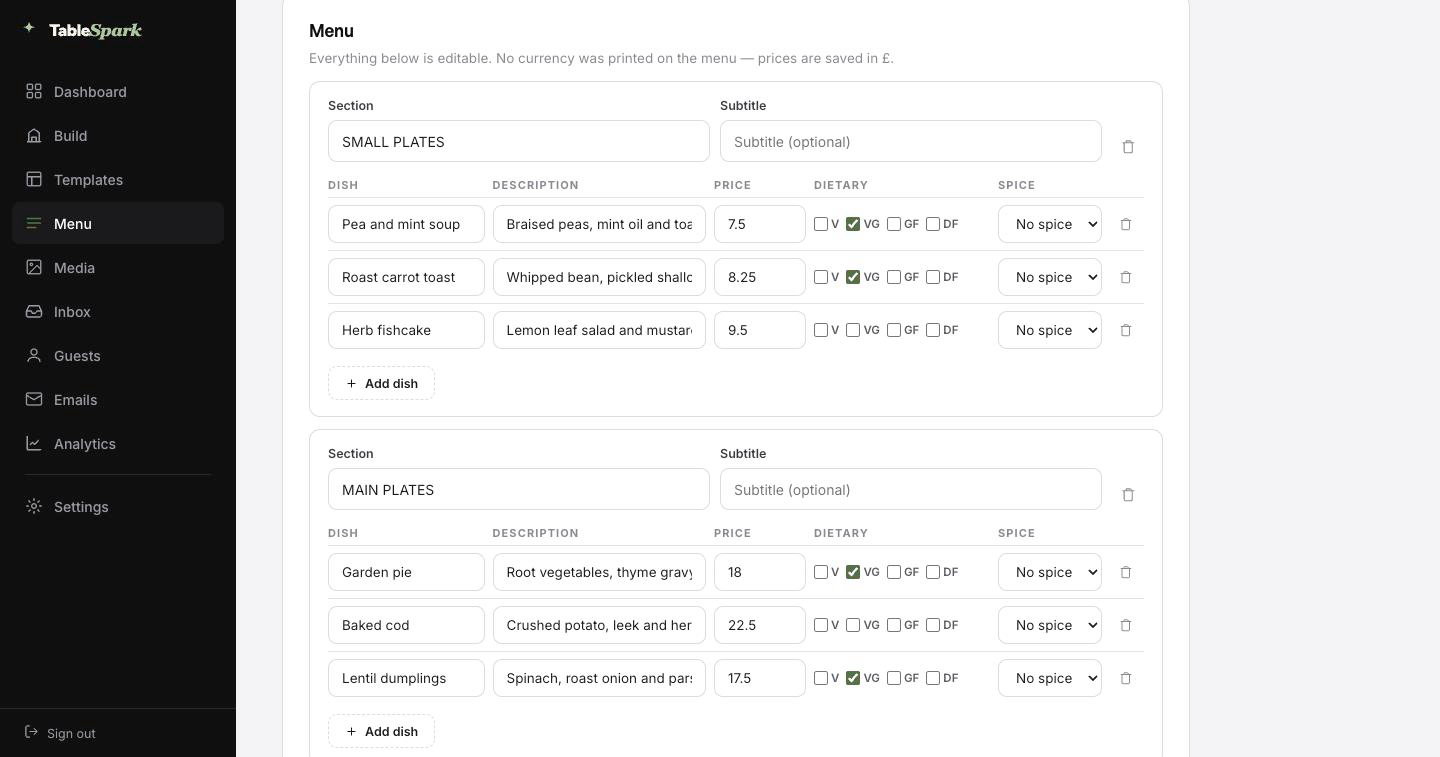
This is the part that saves an afternoon. Take a picture of the menu you already have: the pressed card, the board behind the pass, a PDF from the printer. Back comes the whole menu as data: ordered sections, named dishes, their descriptions and prices, plus dietary and spice marks wherever the card showed them. Check it over — a smudged price or an ambitious accent is a two-second fix — and save.
What arrives is not a picture of a menu — it is real data. One menu then feeds the menu page, the ordering page, the highlights on the home page and the Restaurant structured data a search engine reads. Change a price once afterwards and all of them follow.
The search copy gets the same treatment: a Write with AI button reads the page and drafts its title and description, so those fields are never blank. Nothing is published on your behalf; the draft waits for you.
Whatever your menu lives on today — card, board, PDF, ten pages of it.
Ordered sections, named dishes, descriptions, prices and marks, all editable.
Menu page, ordering page, home-page highlights and the Restaurant schema — all reading from the same menu.
There is no build phase to wait through. Structure, styling and behaviour are done. Names, dishes and pictures are yours. Reckon on one sitting to a published site, and reservations working from that same moment. Bookings land in your TableSpark inbox, and the guest gets a confirmation email straight away.
Taking money is a single connection: link Stripe and deposits on tables and payment on orders go straight to your own account. There is no cut for us — 0% commission on every plan. Stripe’s standard card-processing fees apply to online payments. Nobody else charges anything.
Step 01
1min
Pick Kumo RamenThe full site arrives in your account as a working draft.Step 02
4min
Change the name and the wordsRewrite the words by clicking them; the name carries everywhere.Step 03
3min
Upload your menuSend the menu in as a photograph and check what comes back.Step 04
1min
PublishIt goes live on your address and starts taking bookings.Step 05
1min
Connect StripeNow you can take deposits on tables and payment on orders — direct to your account.In all
10min
From template to taking paymentsFive steps, one sitting.A domain is signage, and signage matters. Nothing about going live depends on owning a domain first; connect yours later and the site simply answers to it.
The plumbing is ours: certificate, secure connection, redirect, and keeping canonical URLs, sitemap and robots pointing at the live address as the domain changes. Own it already? Good. The instruction is a single record, spelled out.
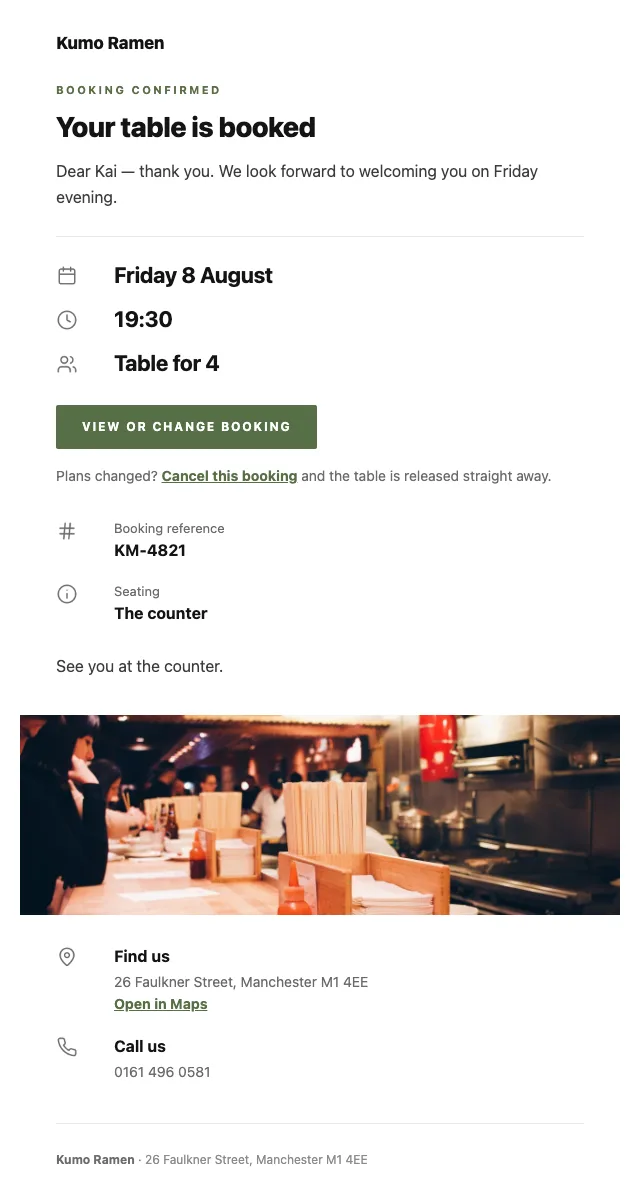
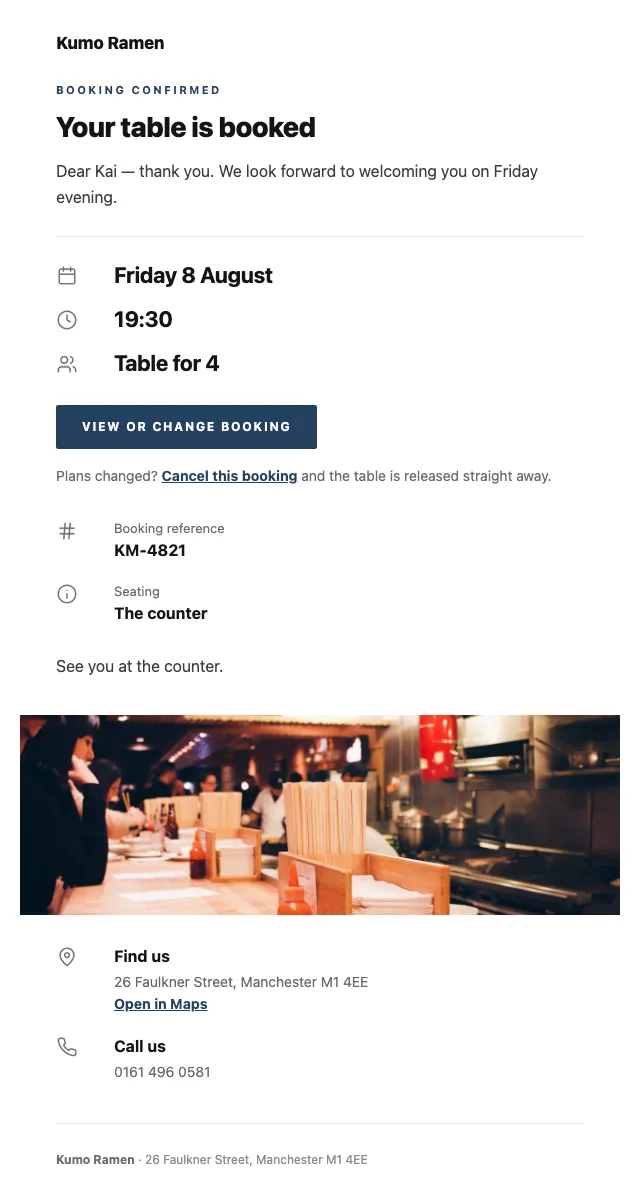
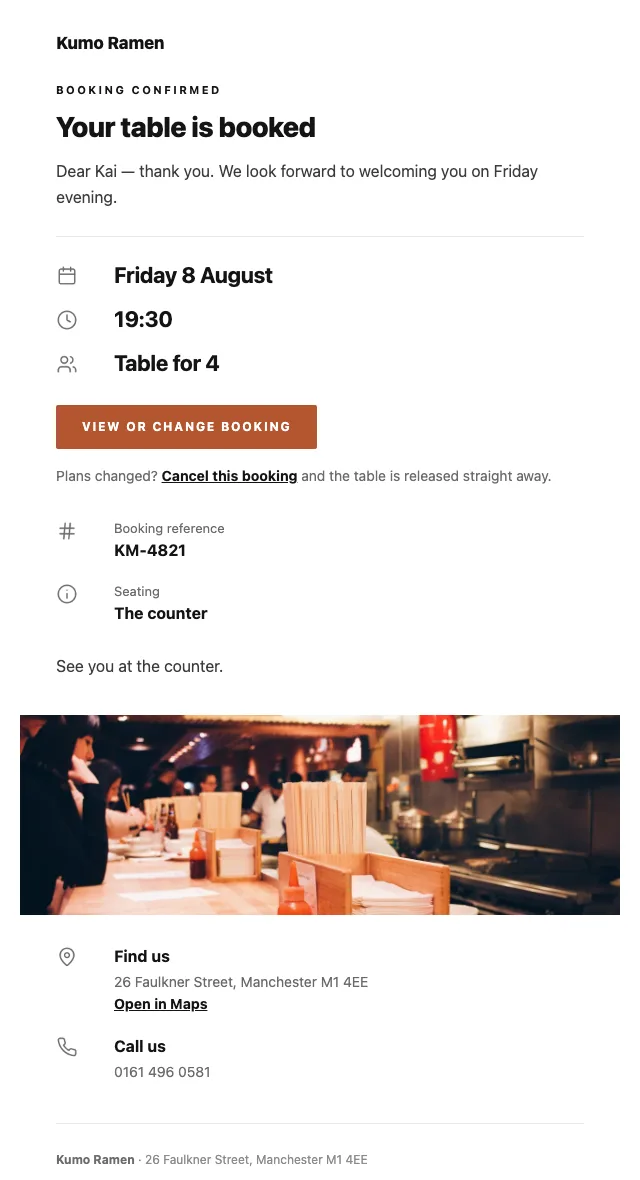
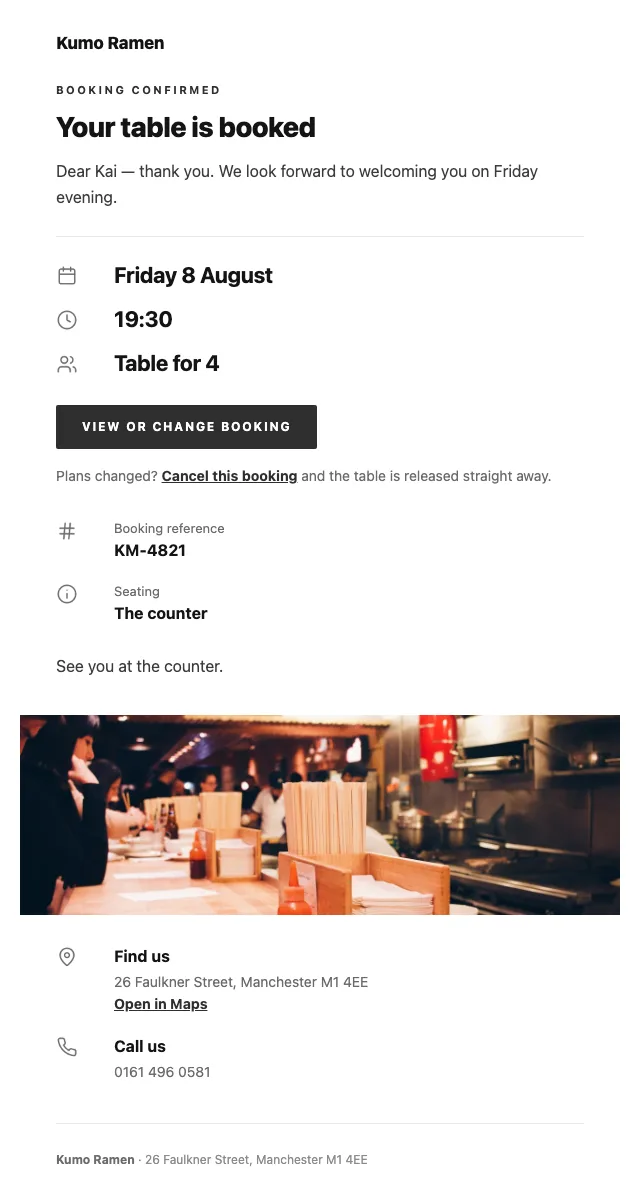
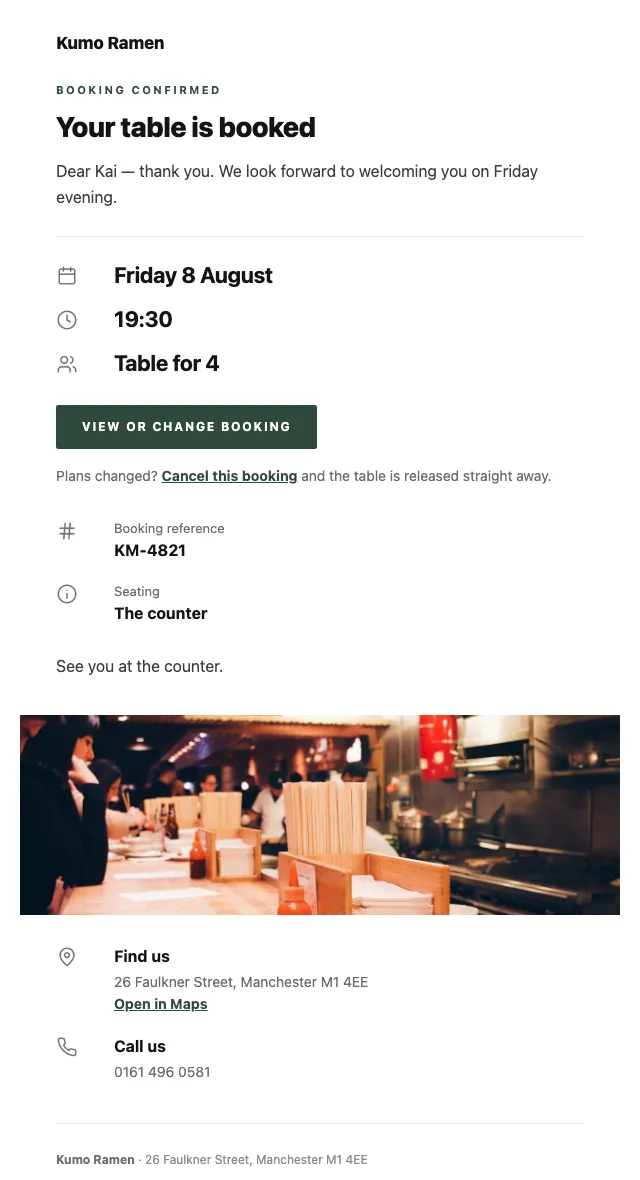
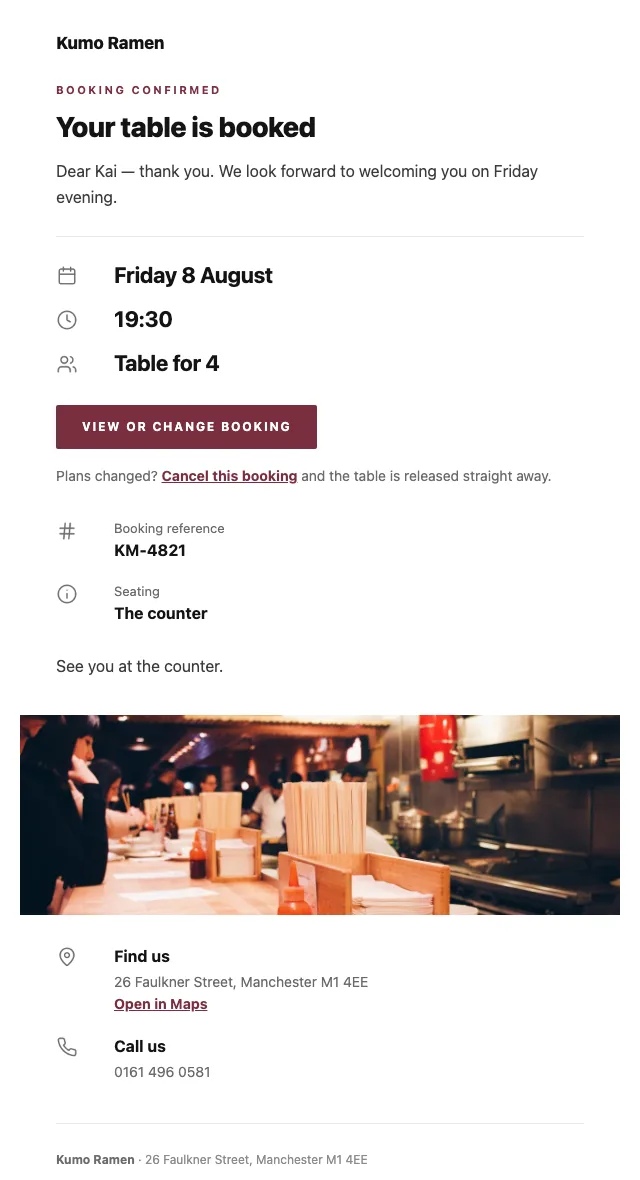
A confirmed booking is not the end of the conversation; it is the start of one. A confirmation is sent the second the booking lands, carrying the time, the covers, your address and contact details, and a self-service cancellation link. The same system sends the reminder before service, the deposit receipt and the cancellation notice.
The whole thing is yours to set, down to the sign-off. Six looks, one accent colour, your logo and cover photograph, the header layout, the sign-off line, and whichever links and social accounts you want on it. Add your domain and the from-line is yours too — the last detail that separates a real restaurant email from a system notification.
Below, the same booking confirmation in six of the accent colours you can pick.
Putting a page online is not the same as delivering a restaurant site that search engines can reliably discover and understand. A misconfigured robots file, a noindex left in place, canonical tags in conflict, pages with no internal links, a PDF menu, missing Restaurant schema or incomplete verification — any one is enough to keep a live site invisible. You feel it in the margin — guests reach commission-charging platforms first, and demand you should own outright becomes demand you rent.
This template ships with that work done. No one can promise rankings or guaranteed indexing — but nothing here is left for you to hire a technician to assemble.
Reorder them, rename them, remove them. The set is a starting point.
All of these are standard modules — 70 of them in the library, most with several layout variants each.
Any one can be deleted, moved, or swapped for another. Nothing about the order is fixed.
Ships with 4 sections — Ramen, Without broth, Small plates, Extras — for you to overwrite.
Nothing is skimmed. 0% commission on every plan, where a marketplace takes a slice of each order and keeps the data.
The page is yours, the inbox is yours, the guest list is yours and exportable.
Stripe’s standard card-processing fees apply to online payments.What commission-free ordering actually means
A photograph from you, the transcription and structure from us, and the final read-through from you again.
You press publish, or nobody does.
Search engines The Menu — Kumo Ramen | Ramen bar in Manchester Tonkotsu, shoyu and miso ramen with noodles made in-house, gyoza and rice bowls. See the menu and order to collect.Drafts the search title & description from this page’s content. Always review before publishing.
Stripe’s standard card-processing fees apply to online payments.
Deposits, refunds and the terms to write down
Build the whole thing, look at it, change your mind. You only pay when you go live.
Build the whole thing, look at it, change your mind. You only pay when you go live.
5 pages, and every one of them is here. This is the live site, not a gallery. Every tab renders through the engine that publishes real restaurants, and the links inside it work. Try the Phone view.
The story page tells how the broth and the noodles are made, with photographs of the stockpot and the noodle room. The visit page carries the address with a map, how to get there by tram or train, and the questions people always ask, such as bookings and groups.
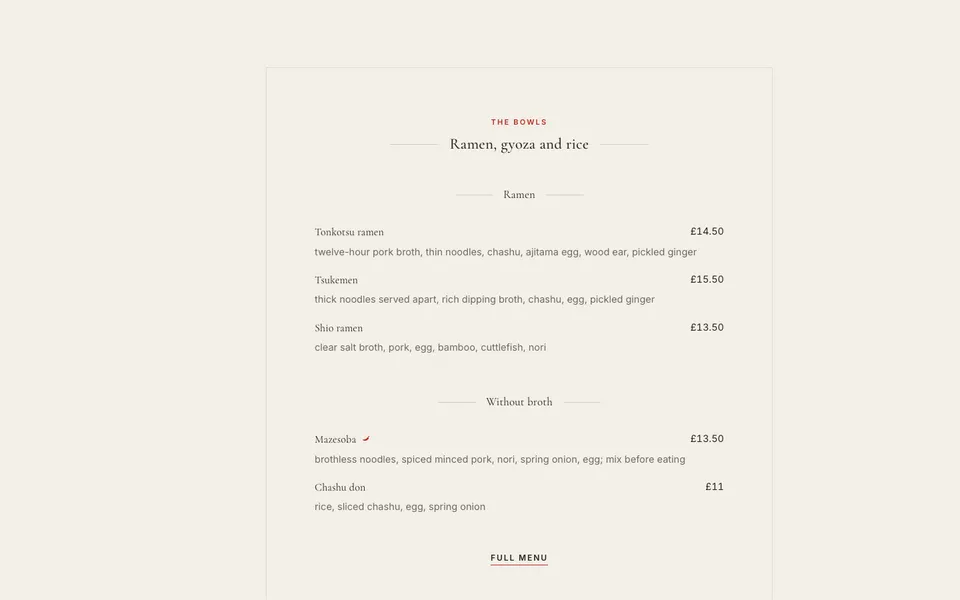
The menu reads like a printed card: ramen, small plates, rice and extras, each dish with its description and price on one line. Every dish is real text with Restaurant schema around it, so guests and search engines can read exactly what is in each bowl.
Extras such as an ajitama egg, more noodles or more chashu can be set up as options, and dietary marks show the vegan bowl at a glance. Sell out of tonkotsu at nine and mark it sold out at nine.
Whichever layout you choose, the point is the same: every dish, description and price is real text in the page with Restaurant schema around it, not a PDF and not a photograph of a laminated sheet.
A counter with twelve stools needs takeaway, so ordering leads the site. It works like the delivery apps guests already know, except the bar keeps the customer and the margin: sections down a rail, the basket always visible, and a collection time at checkout. TableSpark takes 0% commission on those orders.
The collection page tells guests that broth and noodles are packed separately and how to finish them at home, the kind of detail that brings them back.
Dine-in asks for a table number, collection asks for a phone number, delivery asks for an address — and each mode only asks for what it actually needs.
What owners ask before they pick a template: the cuisine fit, the menu, the address, and what it costs.
No. A walk-in counter leads with Order online and Find us, and the visit page says plainly that seats are first come, first served, so guests know before they arrive.
Yes. Dietary marks sit with every dish on the menu and the ordering page, so the vegan bowl is marked wherever it appears.
Ordering is included on the Full plan. We charge 0% commission and no per-order fee, on any plan. Stripe’s standard card-processing fees apply to online payments.
No, and it is the single biggest time saving in setting up. Upload menu photographs and TableSpark returns sections, dishes, descriptions, prices, dietary marks and spice levels as editable fields for you to approve. Once approved it is real data, so the menu page, the ordering page, the home-page highlights and the structured data a search engine reads all stay in step automatically.
You go from opening the builder to a published site in one sitting: copy the template, change the name and the words, upload the menu, press publish. Reservations answer from the moment it publishes — bookings arrive in your TableSpark inbox and the guest gets a confirmation email straight away. Connecting your own payment account adds deposits on bookings and payment on orders, paid directly to you, with 0% TableSpark commission. Stripe’s standard card-processing fees apply to online payments.
Completely. Six base skins, an accent you can pick from presets or a colour wheel, separate background, text and surface colours, seven font pairings or any two faces you like, plus text size, radius and motion. Contrast is derived rather than fixed, so the site stays readable whatever you choose.

Make this yours: the name, the words, the photographs, the menu. Free to build, and you only pay when you go live.