01
Hero
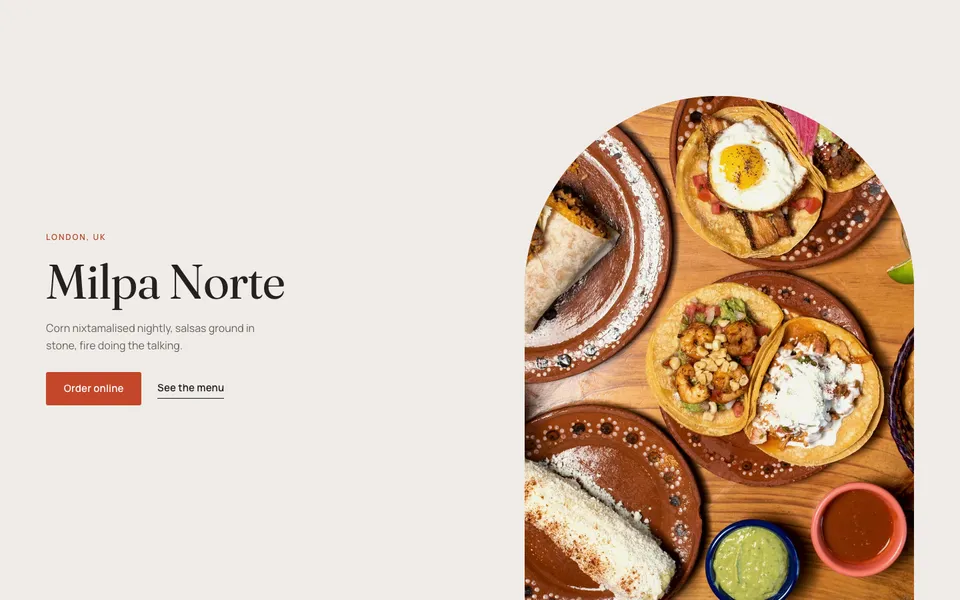
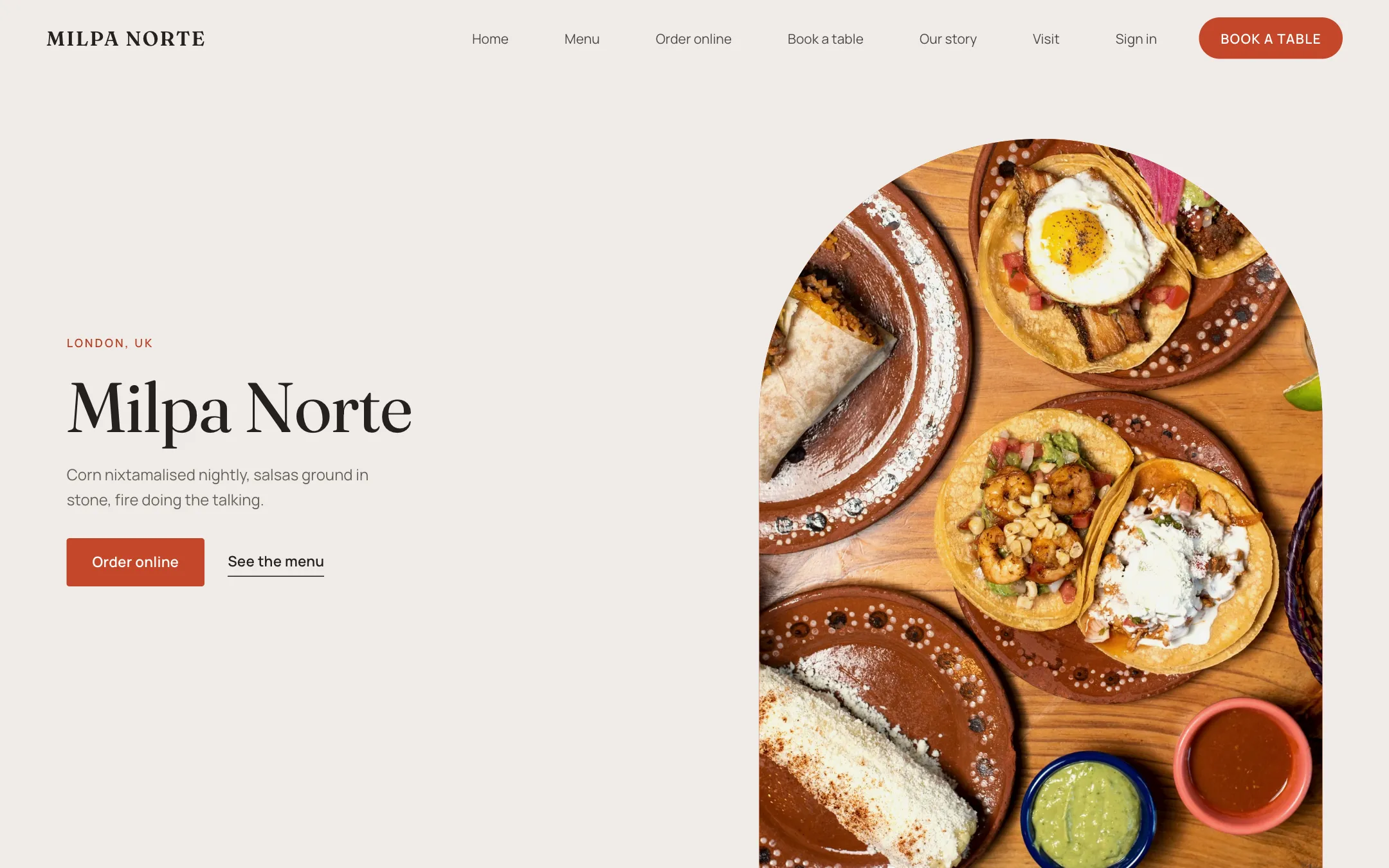
Big opening image, name & buttons, in the Arched Window treatment: Cream paper with the photograph set in a tall arched window beside the name.
Templates · Mexican (UK produce)
For Mexican kitchens working with British produce: a light template with a week-on-the-road opening, an editorial menu, and a split ordering layout that keeps the basket beside the food.
Every section is a builder module you can reorder, edit or delete, with no developer.
On bookings and orders, on every plan. Stripe’s standard card-processing fees apply to online payments.
Build and preview the whole site for nothing, and pay only when it goes live.
Starter is £19/mo excl. VAT and includes a complete restaurant website, a live structured menu, enquiry and newsletter forms, and managed search readiness. Growth is £39/mo excl. VAT and adds direct live bookings, a custom domain with managed SSL, and table and floor-plan operations. Full is £69/mo excl. VAT and adds online ordering and multi-site management for up to five restaurant sites. TableSpark commission is 0%. Stripe's standard card-processing fees apply to online payments.
No agency, no retainer, and the best value an independent UK restaurant can buy, as the full cost comparison sets out. Instead of spending thousands on a bespoke build and waiting months for it, you start from a finished design like this one and go live the same day. Then it is yours to keep current — and a menu that can be corrected in a minute is a menu that stays true. The layouts are built mobile-first and scale up, and the plans add reservations, table management, ordering and the tools to run them — 0% commission to us.
Milpa Norte is limewashed paper with an orange that belongs to a market crate in November. Yours might be white tile and morning light, or brass and candles, or something nobody has built yet.
This is the product, not a picture of it. Left, the live site. Right, the builder’s own Theme panel. Everything you press takes effect immediately, nothing persists, and there is no sign-in wall in front of it. Go on.
Loading the live preview…
A Mexican kitchen in Britain has a specific argument to make — that the technique travels even when the produce cannot — and the website has to make it early. The opening is a week on the road: where the produce came from, what the kitchen did with it, when the room is open.
The palette is limewashed rather than saturated, which is the right register for British light, and the geometric type keeps the page from reaching for folkloric cues that would undercut the argument.
Nine blocks, arranged around a supply chain:
01
Big opening image, name & buttons, in the Arched Window treatment: Cream paper with the photograph set in a tall arched window beside the name.
02
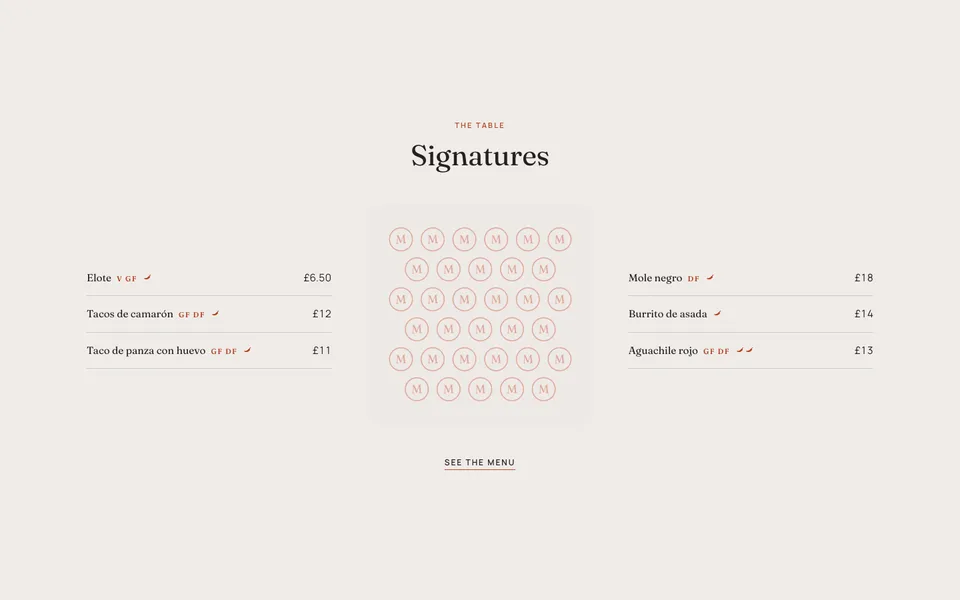
A few dishes on a sliding rail.
03
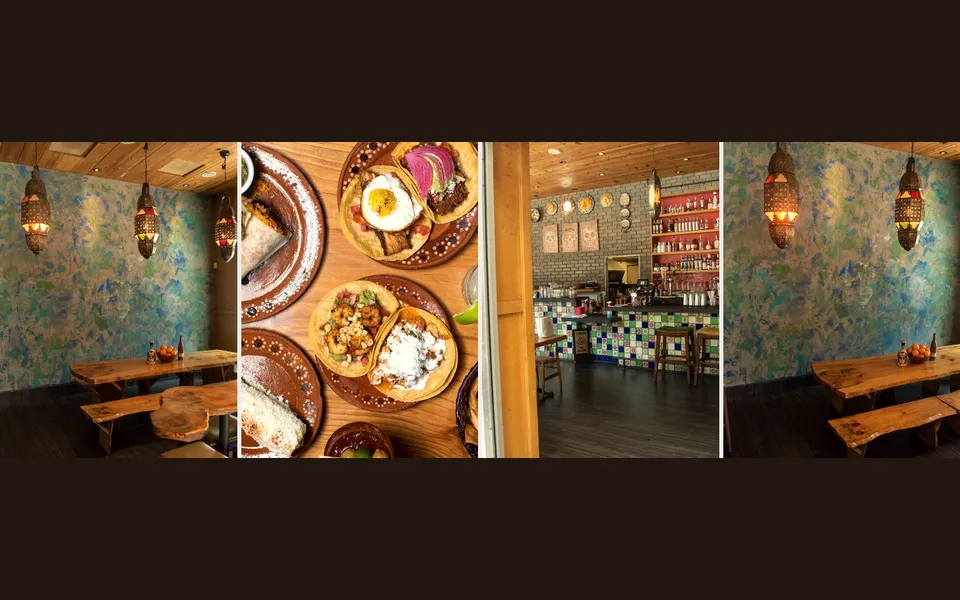
Grid, masonry or moving strip.
04
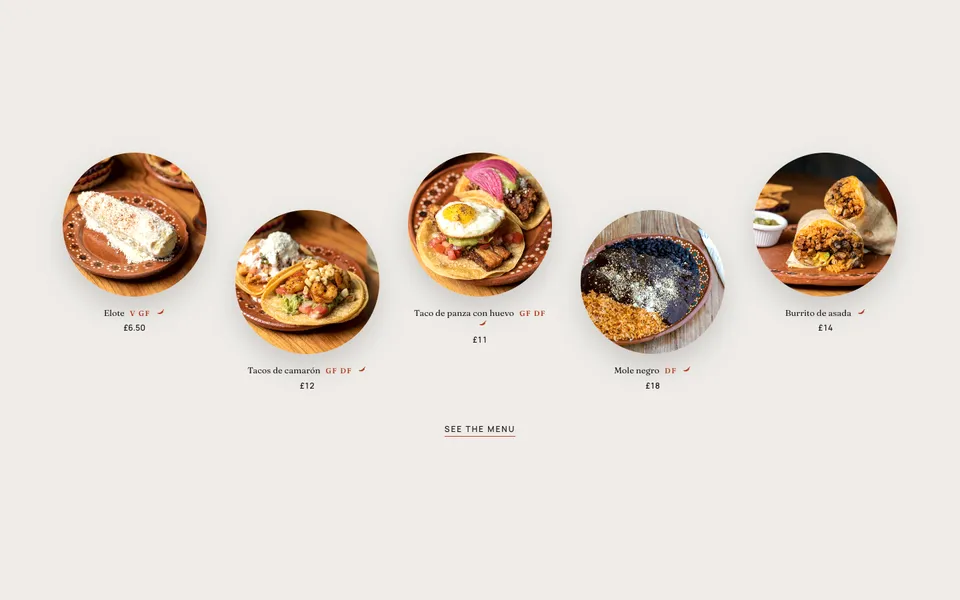
A few dishes on a sliding rail.
05
Headline + button band.
Loading the live preview…
Milpa Norte uses the Showcase ordering layout — on a laptop each section opens on a wide photograph with its dishes as large photo cards; on a phone it keeps the delivery-app rows.
It reads like the delivery apps your guests already know, except the restaurant keeps the relationship and the money. The basket stays on screen, and each mode asks only for what it needs: a table number, a phone number or an address.
Loading the live preview…
This is the frame that matters. It is the real ordering page at a real phone width — not a mock-up, not a video.
On a laptop the same page puts the basket in a panel beside the menu that follows the scroll.
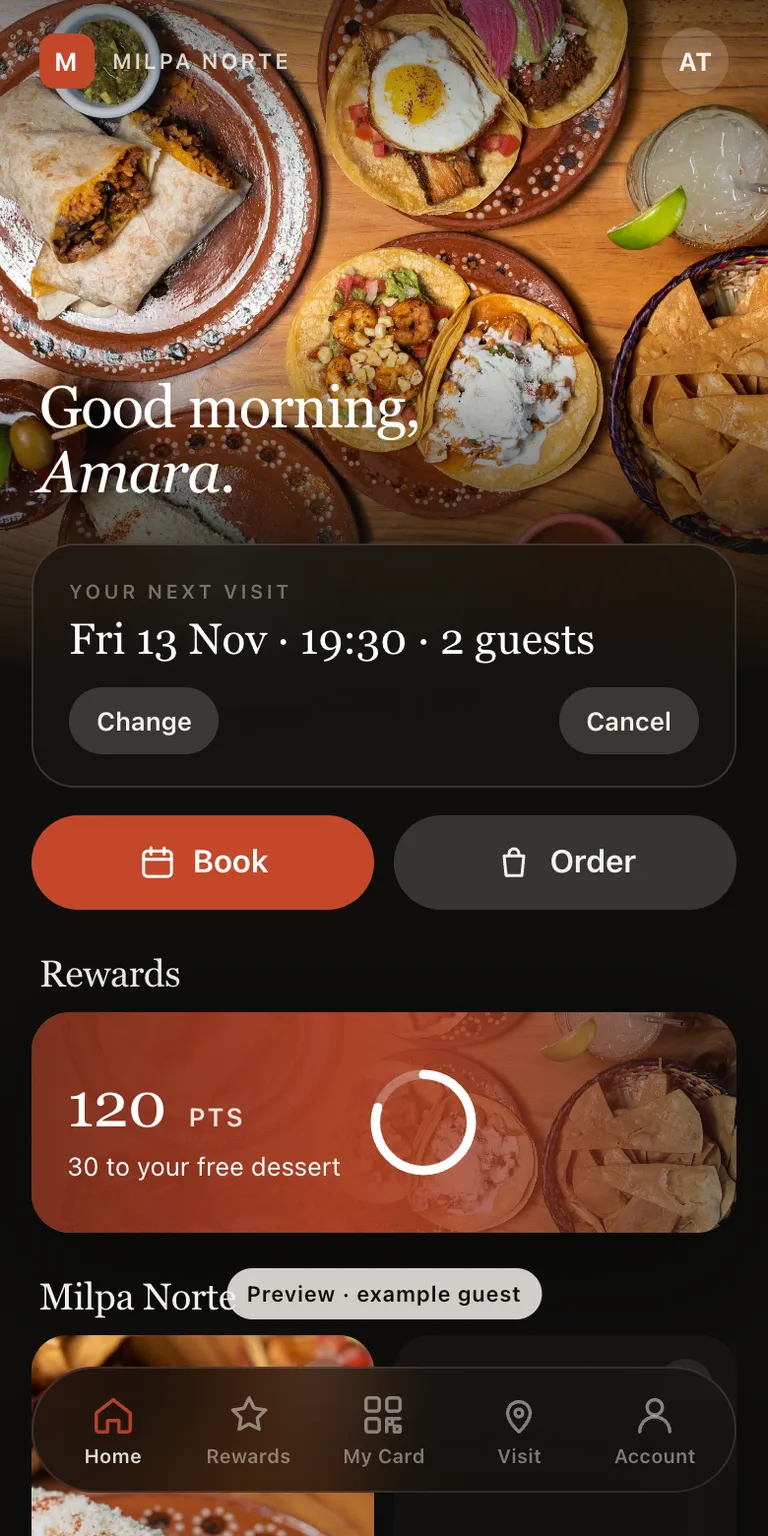
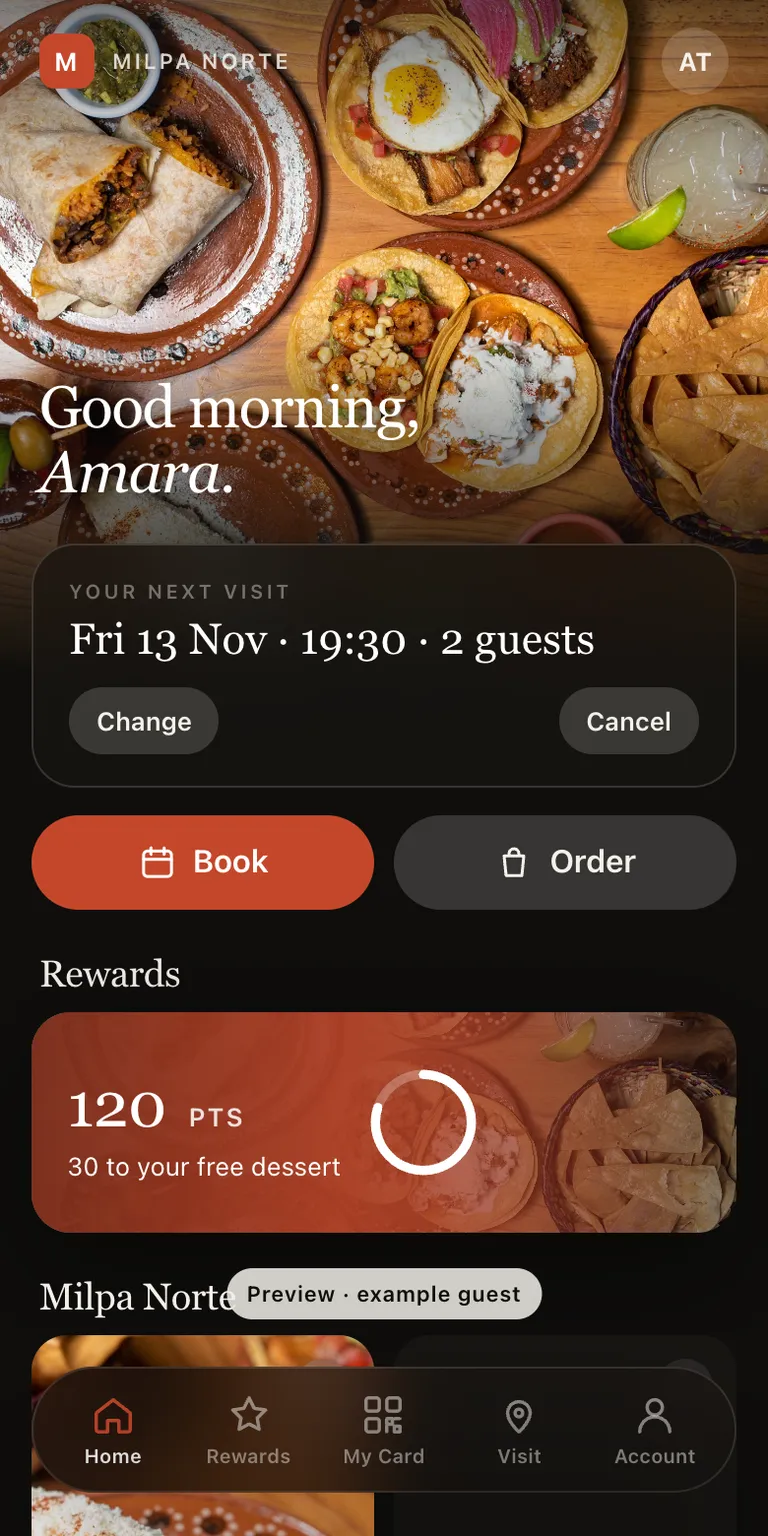
Every Milpa Norte site on Growth and Full ships with an app your guests keep. It lives at /account on your own domain, so the guest signs in to your restaurant, not a marketplace.
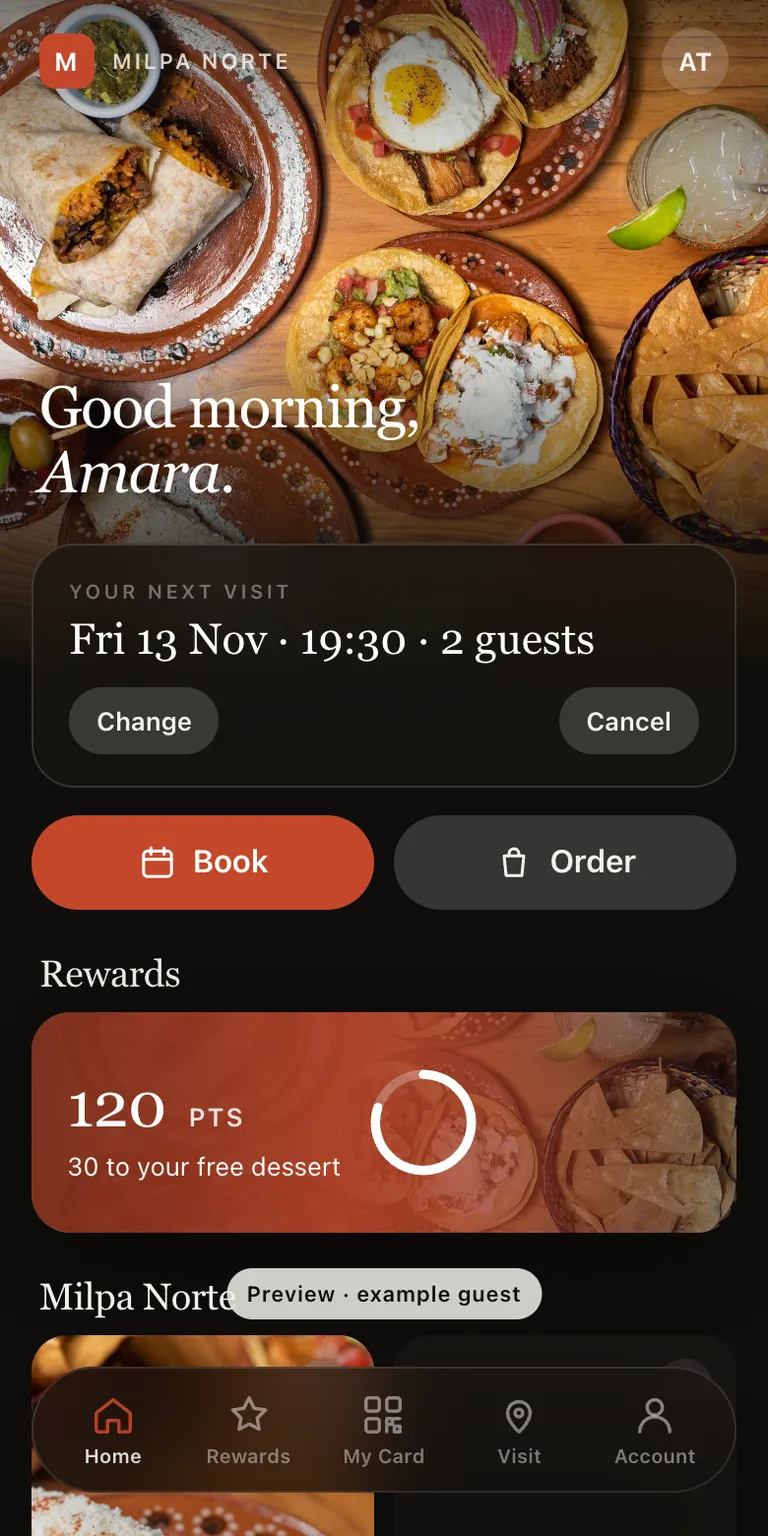
Included on the Growth and Full plans. Watch the Guest App course
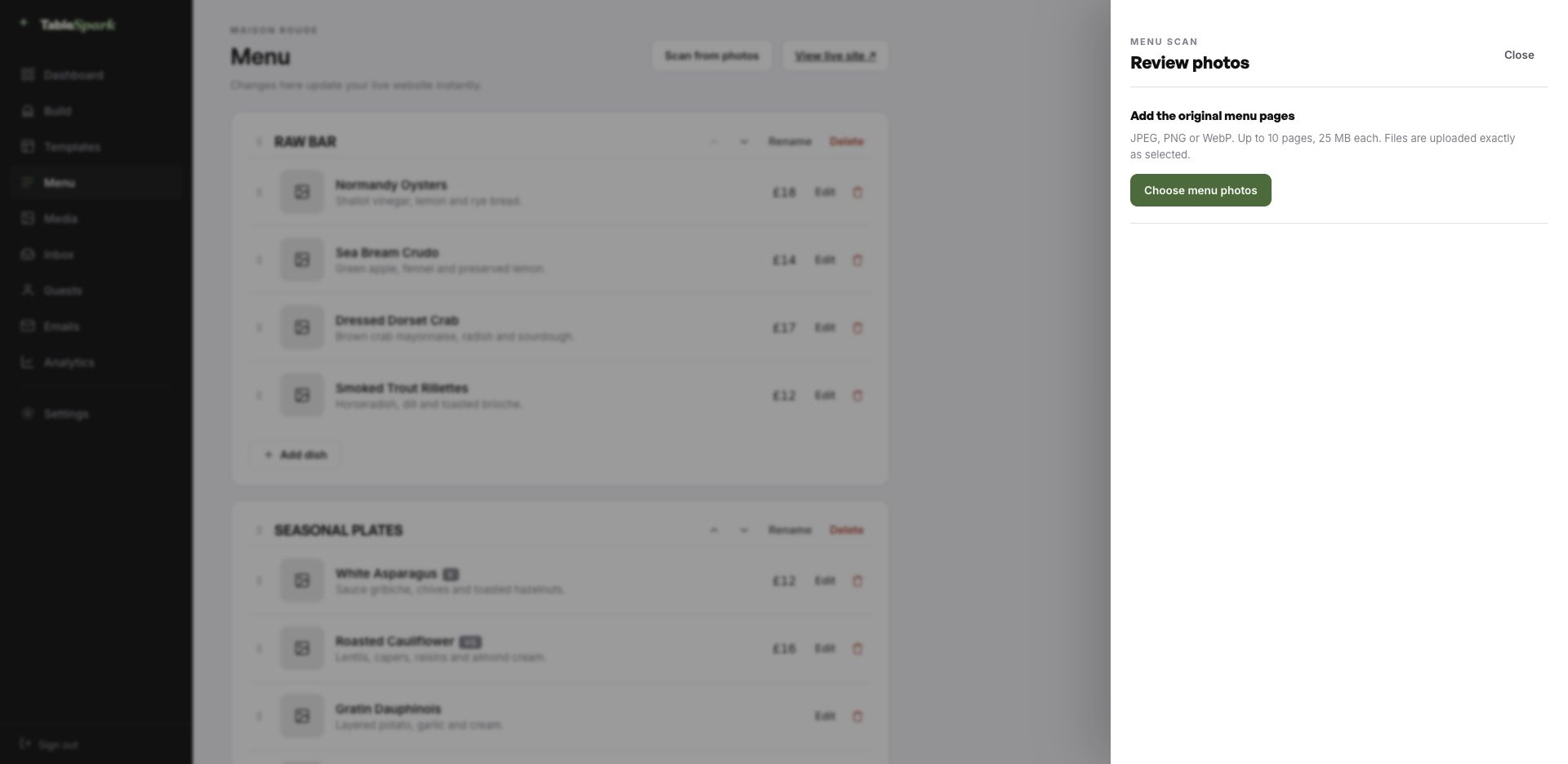
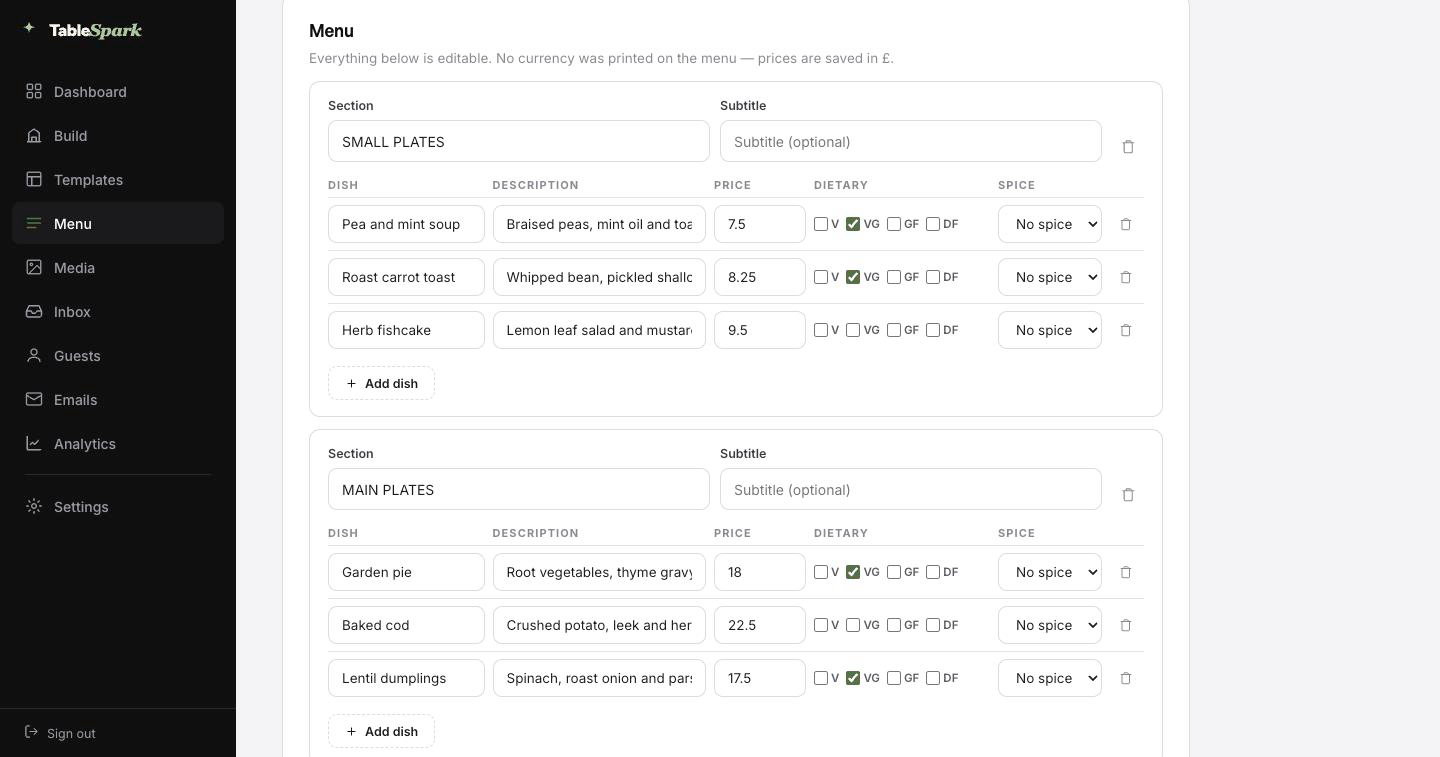
The worst job in setting up a restaurant site is typing the menu. You do not have to. Send in the menu you hand to guests — card, board, PDF, ten pages if it runs that long. What returns is not a scan but a structured menu: every section, every dish, every price, with dietary and spice marks read off the page where they were printed. Nothing saves until you have looked at it — every field is editable on the review screen.
And because it is data rather than a photograph, it can do work. Everything downstream reads from it: the menu page, the ordering page, the highlights on the home page and the Restaurant structured data a search engine reads. Change a price once afterwards and all of them follow.
Search titles and descriptions are drafted the same way: press Write with AI and it writes from the page in front of you. You still approve every line of it before it goes anywhere.
Printed card, chalkboard photograph or an old PDF — any of them work.
Not a scan: real sections, dishes, prices and marks you can edit before saving.
Menu page, ordering page, home-page highlights and the Restaurant schema — kept in step automatically.
The waiting is the part that has been removed. Consider it a fully fitted kitchen waiting for your knives. One sitting to live, and the booking form does not need setting up: it is already answering. The booking appears in your inbox; the guest gets a confirmation before they have put their phone down.
One Stripe connection turns the site into something that collects money: deposits on tables, payment on orders, paid direct. Our commission is 0% at every plan level. Stripe’s standard card-processing fees apply to online payments. That is the only deduction.
Step 01
1min
Pick Milpa NorteThe complete site lands in your account, ready to edit.Step 02
4min
Change the name and the wordsClick, type, replace a photograph. The name updates site-wide.Step 03
3min
Upload your menuUpload a picture of the card; the AI does the sections and prices.Step 04
1min
PublishPublished, on your own address, with the booking form answering.Step 05
1min
Connect StripeNow you can take deposits on tables and payment on orders — direct to your account.In all
10min
From template to taking paymentsFive steps, one sitting.Nobody prints someone else’s name on their menu, and a web address is no different. You start on a TableSpark address so you can publish today, and move the site onto your own domain whenever you are ready — the one on your menus, your napkins and your Google listing.
You do not touch a certificate or a redirect rule. TableSpark issues and renews the SSL, points the bare domain at your chosen host, and keeps the search signals consistent. If the domain is already yours, nothing needs buying; you are told precisely which DNS record to point where.
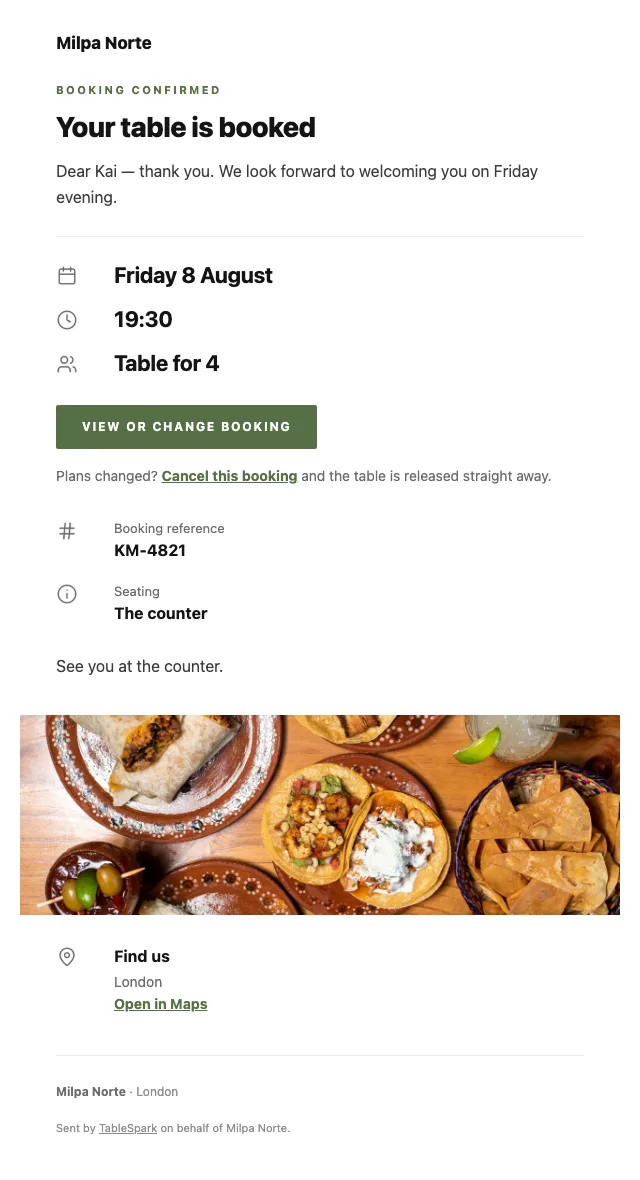
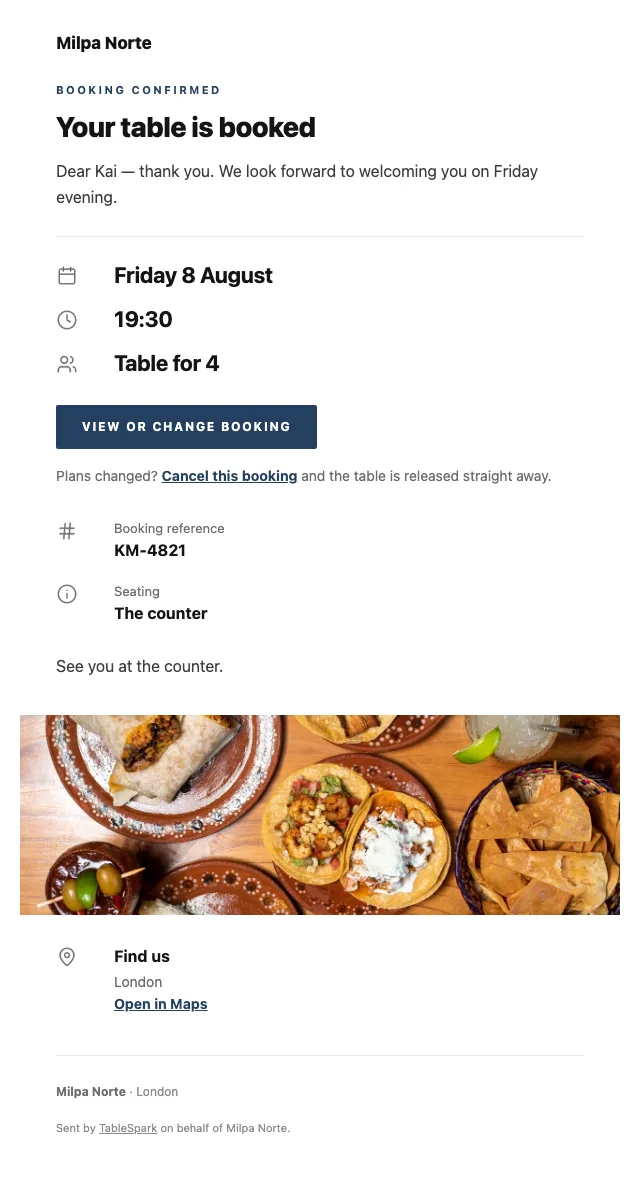
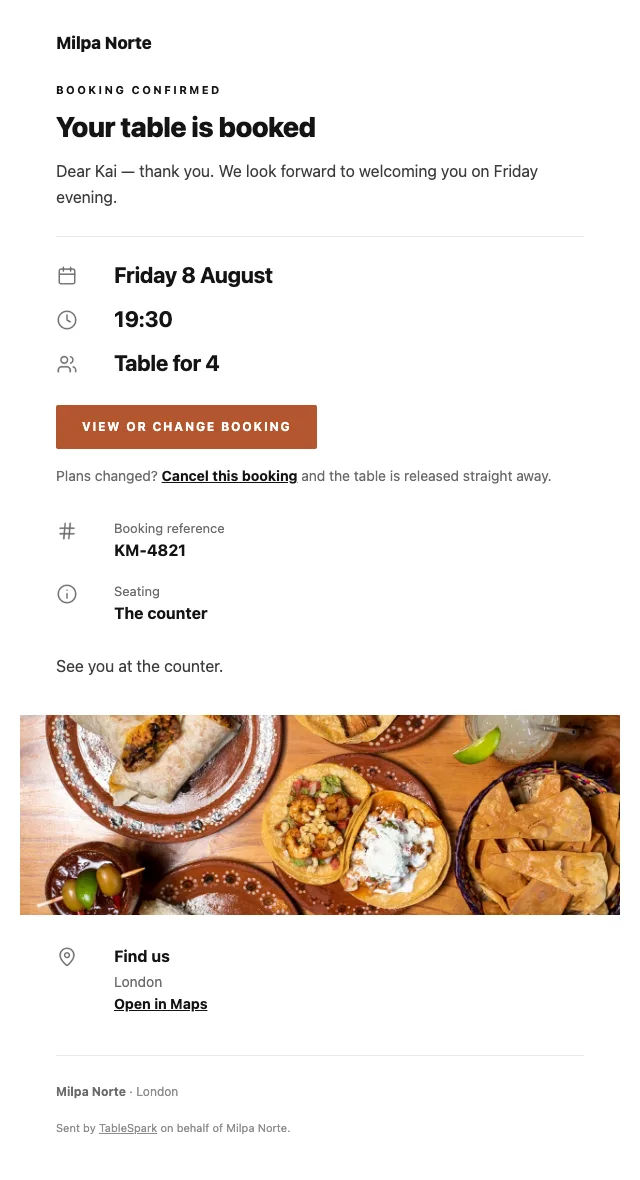
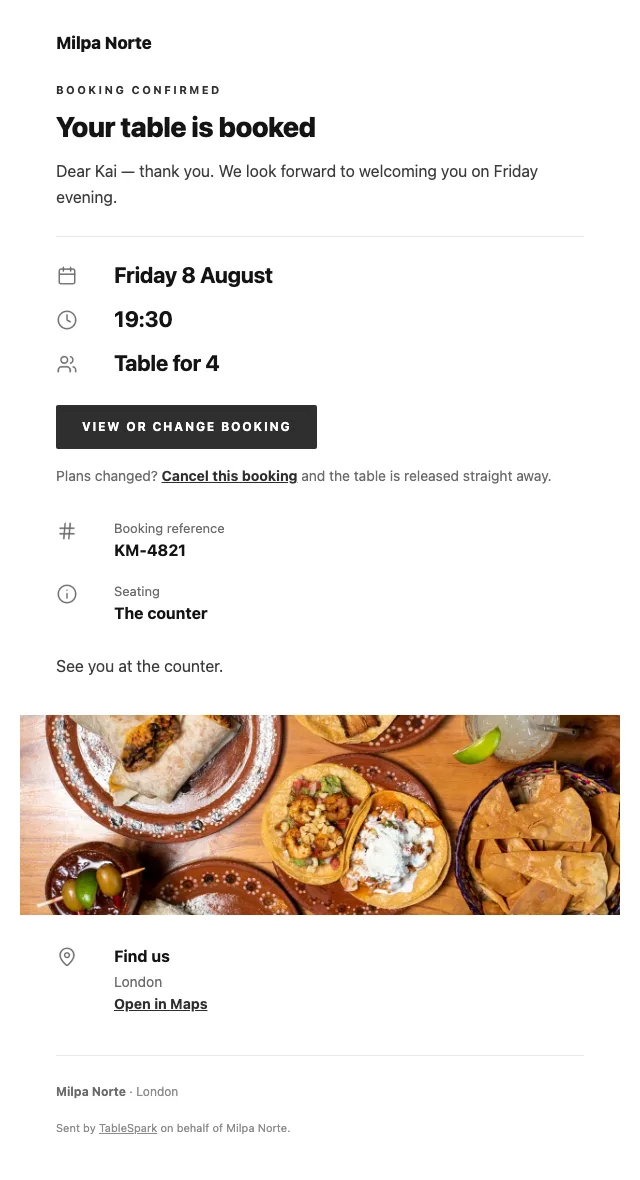
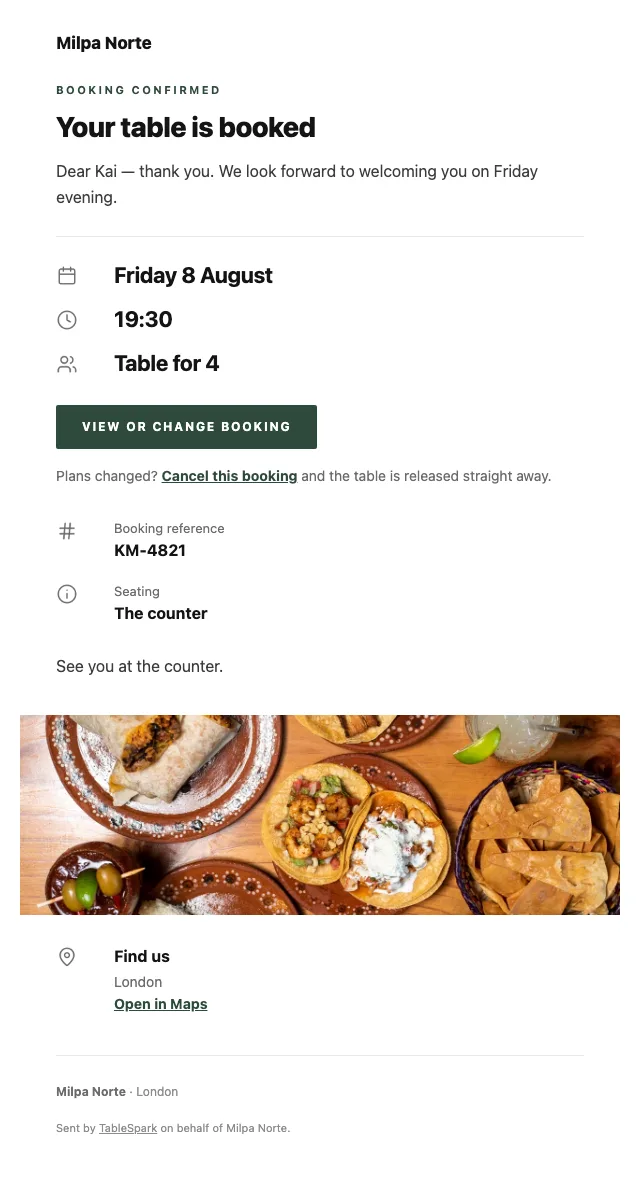
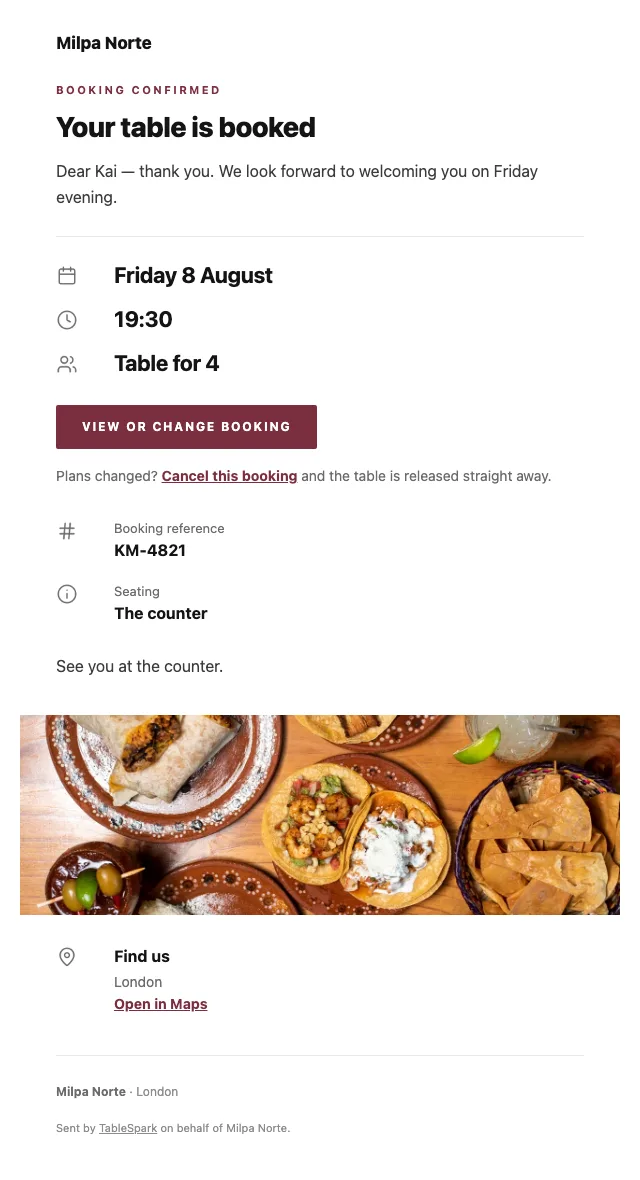
Most guests will see this email more often than they see your home page. On booking, an email goes out on your behalf with everything the guest needs — when, how many, where, how to reach you, and a one-click way to give the table back. Reminder emails, deposit receipts and cancellation notices are cut from the same cloth.
And the email is yours to design, not ours. Six templates, your accent colour, your logo, a cover photograph, the header layout, a sign-off in your own voice, your links and your social accounts. Once your domain is connected the email leaves from your address as well, not a generic one.
Below, the same booking confirmation in six of the accent colours you can pick.
A live link proves the page exists. It does not prove Google can read it. Sites sit at a perfectly good address and never appear in search — because of a leftover noindex, canonicals that disagree, pages nothing links to, a menu trapped in a PDF, absent restaurant schema, or verification never finished. What follows is expensive: searches for your name, your dishes or your street send guests to marketplaces that take a cut of the booking you would have had for free.
None of it is left for you to assemble. Rankings and indexing are Google’s decision and no honest supplier promises either — but the configuration that makes them possible is done.
Reorder them, rename them, remove them. The set is a starting point.
The whole page is assembled from the shared library: 70 modules, each offering several layouts.
What you see is one arrangement of them. Yours can be a different one, changed by dragging.
Ships with 4 sections — Antojitos, Tacos, Platos fuertes, Postres y bebidas — for you to overwrite.
Nothing is skimmed. 0% commission on every plan, where a marketplace takes a slice of each order and keeps the data.
The page is yours, the inbox is yours, the guest list is yours and exportable.
Stripe’s standard card-processing fees apply to online payments.Read how the money works without a marketplace
Your job: take the picture and check the result. Ours: read it, structure it, and draft the search wording.
Publishing is always your decision.
Search engines Menu — Milpa Norte | Mexican, London Mexican technique and British produce. The full menu, the farms, the heat levels and prices.Drafts the search title & description from this page’s content. Always review before publishing.
Stripe’s standard card-processing fees apply to online payments.
Deposits, refunds and the terms to write down
You can build, rebuild and abandon as often as you like. Payment begins at publish, not before.
You can build, rebuild and abandon as often as you like. Payment begins at publish, not before.
6 pages, and every one of them is here. This is the live site, not a gallery. Every tab renders through the engine that publishes real restaurants, and the links inside it work. Try the Phone view.
The story page is where the supply chain becomes an argument: narrative, a sourcing block naming farms and counties, an interview, a timeline and a gallery. The reservations page handles a room that books out, and the visit page covers a London address that needs explaining.
The editorial layout gives each section its own plate and sets the dishes as ruled type — right for a menu where the story of each ingredient matters as much as the dish name.
Descriptions carry the farm, the county and the technique, which is exactly the specificity that makes the argument. Heat is set per dish, and dietary marks travel with it. All of it is structured, indexable text.
Any of the layouts leaves the substance intact: real text for every dish, description and price, marked up as Restaurant data rather than published as an image.
The split layout keeps the basket beside the menu, which suits shared ordering — several plates for a table, built together, with the total visible throughout.
Options are inline chips on each row, and on a phone the basket becomes a pinned bar. Everything settles into your own Stripe account and TableSpark takes 0%. Stripe’s standard card-processing fees apply to online payments.
What the guest is asked depends on how they are eating: table number, phone number or address, and never all three.
Running a Mexican & Latin kitchen? See all Mexican & Latin restaurant website templates.
What owners ask before they pick a template: the cuisine fit, the menu, the address, and what it costs.
It is what the sourcing block and the dish descriptions are for — the farm, the county, the variety, beside the technique. Because it is real text rather than a photographed menu, a guest searching for a farm or a British ingredient can arrive on your page directly.
Yes — every template in the library is built for UK operation. Prices are in pounds, dates and times follow UK conventions, service hours drive availability in Europe/London, and the legal pages, cookie consent and guest-data handling are all set up for UK requirements from the first publish.
No. Photograph the menu and it comes back as structured data — ordered sections, named dishes, their descriptions and prices, with dietary and spice marks where the card showed them — for you to check and correct on a review screen. Being data rather than a photograph is what lets the same menu feed the menu page, the ordering page, the home-page highlights and the search engine’s structured data at once.
One sitting is a fair estimate. The template copies into your account complete, so the work is changing the name, editing the words and uploading the menu before you publish. Bookings work immediately on publishing, arriving in your TableSpark inbox with an automatic confirmation to the guest. Adding a payment account enables deposits on tables and payment on orders, paid direct to you at 0% commission. Stripe’s standard card-processing fees apply to online payments.
All of it lives in the Theme tab — the accent, the background, the text and surface colours, both typefaces, corner radius, motion and how the header behaves as you scroll. Nothing breaks when you change them, because every block reads from the theme rather than carrying its own colours.
Yes. The TableSpark address exists so you can publish immediately, not so you stay on it. Move to your own domain whenever you like, including one you already own; TableSpark issues and renews the SSL certificate, redirects the bare domain, and keeps canonical URLs, the sitemap and robots pointing at the live address so nothing earned is lost. Guest email can send from the same domain.

Make this yours: the name, the words, the photographs, the menu. Free to build, and you only pay when you go live.