 Daniela Morales
A food truck can look affordable until the licence, the pitch fees and the gas check arrive and the real cost shows.
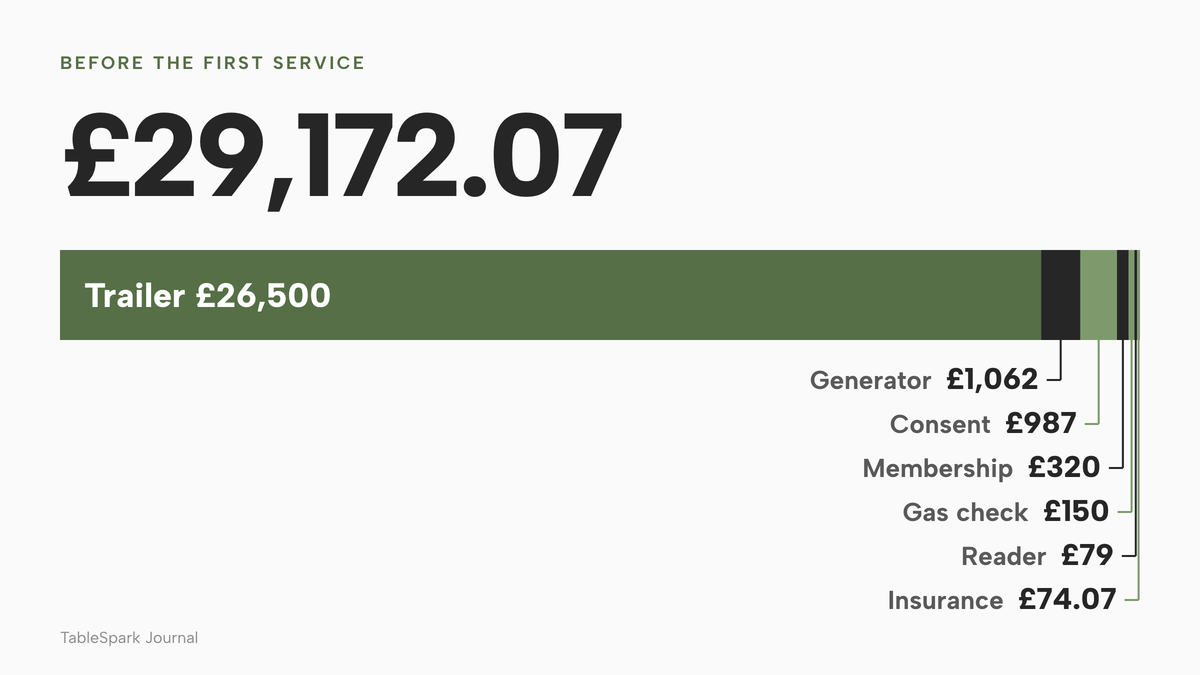
Start-up cost depends mostly on the vehicle, which this research found advertised at £26,500 for one used trailer, and on fees that each council sets for itself. In this guide's illustrative budget, the trailer, generator, card reader, street trading consent, insurance and trade membership, plus a £150 gas check allowance, come to £29,172.07. Food business registration is free. Trading in the street without a needed licence risks a fine of up to £1,000.
The van is paid for, and the first month is still unbudgeted
A common first budget for a food truck has one big line, the vehicle, and a few small ones. The small ones are guessed: a licence "somewhere between a hundred pounds and a few thousand", a pitch "at around thirty quid a day", insurance "not much". Each guess feels safe on its own. Together they are the part of the plan most likely to fail, because none of them has a fixed price.
The licence is the clearest example. No national tariff exists for street trading in England and Wales. Councils "may charge such fees as they consider reasonable", so the same truck pays one amount in one district and another amount a county away. One council's published table shows an annual street trading consent at £987 for a new applicant in 2026/27. Another council's market page lists a hot food unit at £27.10 for a Saturday. The two lines are not the same thing, and the difference between them is the gap in many owners' plans.
The consequences are practical. A truck that trades on a street without the consent or licence the council requires can be fined up to £1,000, according to the official guidance. A truck that gets the consent but misses the registration or the insurance can lose its first trading days. A truck that pays pitch fees every week out of takings that were never modelled can find that half of each week's sales is gone before wages are counted. In this guide's illustrative week below, pitch fees, stock, fuel, gas and card fees take £809.71 of £1,620, and the owner is left with £810.29 before wages, insurance and every other fixed cost.
This guide works the sum the other way round. It starts from the rules that decide what a food truck may do, adds up the one-off costs with every source named, runs a week of sales through pitch fees, stock, fuel and card charges, and then looks at the website and ordering costs that decide whether a lunch queue pays for itself. Every figure is cited to a page read on 3 November 2026 or labelled illustrative. It covers England and Wales for street trading, because the Act it relies on applies there. It is written for one or two people running a food truck, catering trailer or converted van at markets, events and a regular weekday lunch pitch.
How much does it cost to start a food truck in the UK?
The honest answer is a range with a long upper end. The vehicle sets the base and the council sets the licence, while the trade, the insurer and the retailer set the rest. This research opened one classified advert for a used, fully equipped burger trailer on a trade body's website, with an asking price of £26,500. The advert does not say whether the price includes VAT, when it was placed or whether the seller is a trader or a private owner. Asking prices in adverts are not sale prices, and one advert is not a market. Owners who price a van or trailer should expect the figure to move a long way with age, size and equipment, and should take quotes.
The table below adds up the one-off lines for a one-trailer business. Every figure is from a page read on 3 November 2026 except the gas check, which is an illustrative allowance and is marked as such. The consent is an example from one council, and the insurance is the lowest quote in an insurer's examples for a sole trader at local markets.
| Basis | Amount | |
|---|---|---|
| Used catering trailer | One advertised asking price | £26,500 |
| Generator | Honda EU22i 2200W, one dealer's current price | £1,062 |
| Card reader | SumUp Solo, higher of the two prices shown | £79 |
| Street trading consent | Hart District Council, new annual, 2026/27 | £987 |
| Public liability insurance | Insurer example, sole trader at markets, one year | £74.07 |
| Trade membership | NCASS Standard, one unit, excluding VAT | £320 |
| Gas safety check | Illustrative allowance, not a quote | £150 |
| Total | Sum of the seven lines | £29,172.07 |
The arithmetic is: £26,500 + £1,062 = £27,562; plus £79 = £27,641; plus £987 = £28,628; plus £74.07 = £28,702.07; plus £320 = £29,022.07; plus £150 = £29,172.07. The cited lines alone come to £29,022.07. The bases are mixed, which a careful owner should note: the trailer advert states no VAT position, the generator page does not say whether its price includes VAT, the reader page did not state a VAT position in the text read, and NCASS prices are quoted plus VAT. The total is a guide to scale, not a quote.
Branding, signage and initial stock are real costs that depend on the vehicle and the menu, and this research could not price them from a source it opened. They belong in the owner's own budget once quotes are in.
A fixed-premises takeaway carries lines a truck does not, such as a lease and a fit-out, and the guide to the cost to open a takeaway in the UK prices them. A truck swaps those for pitch fees and a vehicle that must be insured, gas-checked and kept roadworthy.
Food van or catering trailer: what the vehicle decision changes
A converted van carries its own engine, so motor cover is a further question alongside the public liability cover in the budget above. A trailer needs a vehicle to tow it, which the owner either has or adds. This research did not verify a price for motor cover, a towing vehicle or a van conversion, so none is in the table. Owners comparing the two routes should add those lines from quotes. A ready-to-trade trailer is sold with its kit, and the buyer pays for it. A bare shell is cheaper to buy and has to be fitted out, gas-checked and given an electrical supply before it can trade.
The gas rules apply to both. The Health and Safety Executive's catering information sheet, CAIS23, says that "Any work with gas appliances will be subject to the duties imposed by the Gas Safety (Installation and Use) Regulations 1998". It also says the Road Vehicles (Construction and Use) Regulations 1986, Part 4D, apply to LPG appliances in vehicles, require adequate ventilation and state that pilot lights should not be lit while the vehicle is in motion.
Street trading licence cost in the UK: why two councils charge so differently
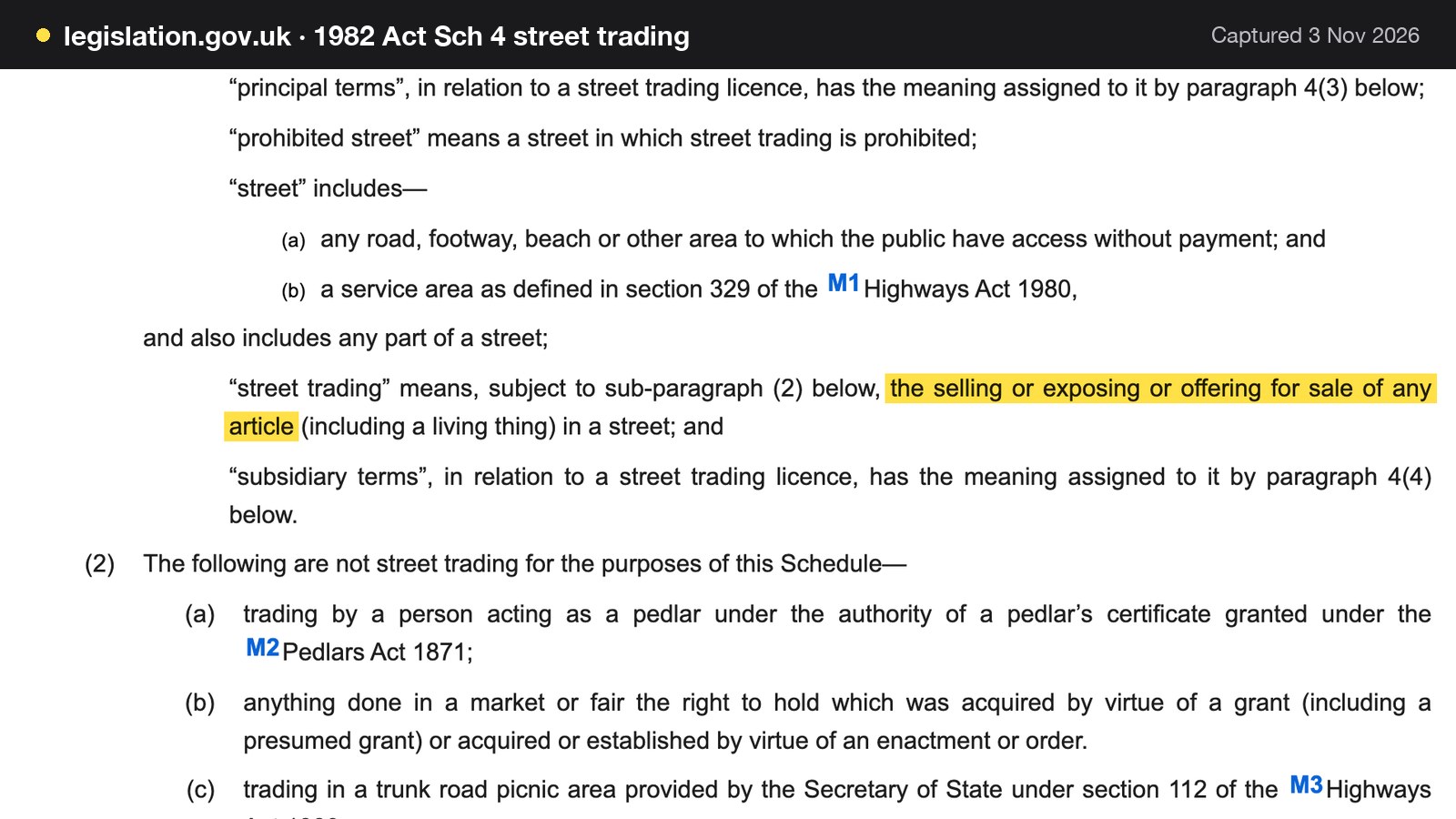
Street trading is defined in law, and the definition is wider than "a van on a roadside". The Local Government (Miscellaneous Provisions) Act 1982, Schedule 4, paragraph 1(1), says that "street trading" means, subject to the exceptions in the Schedule, "the selling or exposing or offering for sale of any article (including a living thing) in a street". The Act applies in England and Wales. A district council "may by resolution designate any street in their district" as a prohibited street, a licence street or a consent street. In a consent street, trading is prohibited without the district council's consent. In a licence street, it is prohibited without a licence the council has granted.
That is why "do I need a street trading licence?" has no single answer. It depends on whether the street where the truck stands has been designated and as what. The official guidance says to contact the council to find out whether a licence is needed to trade in the street in England and Wales, that the owner might have to pay a fee, and that the council can refuse a licence or give one for fewer days and times than were asked for, with a possible waiting list.
Who sets the fee, and what the fee is
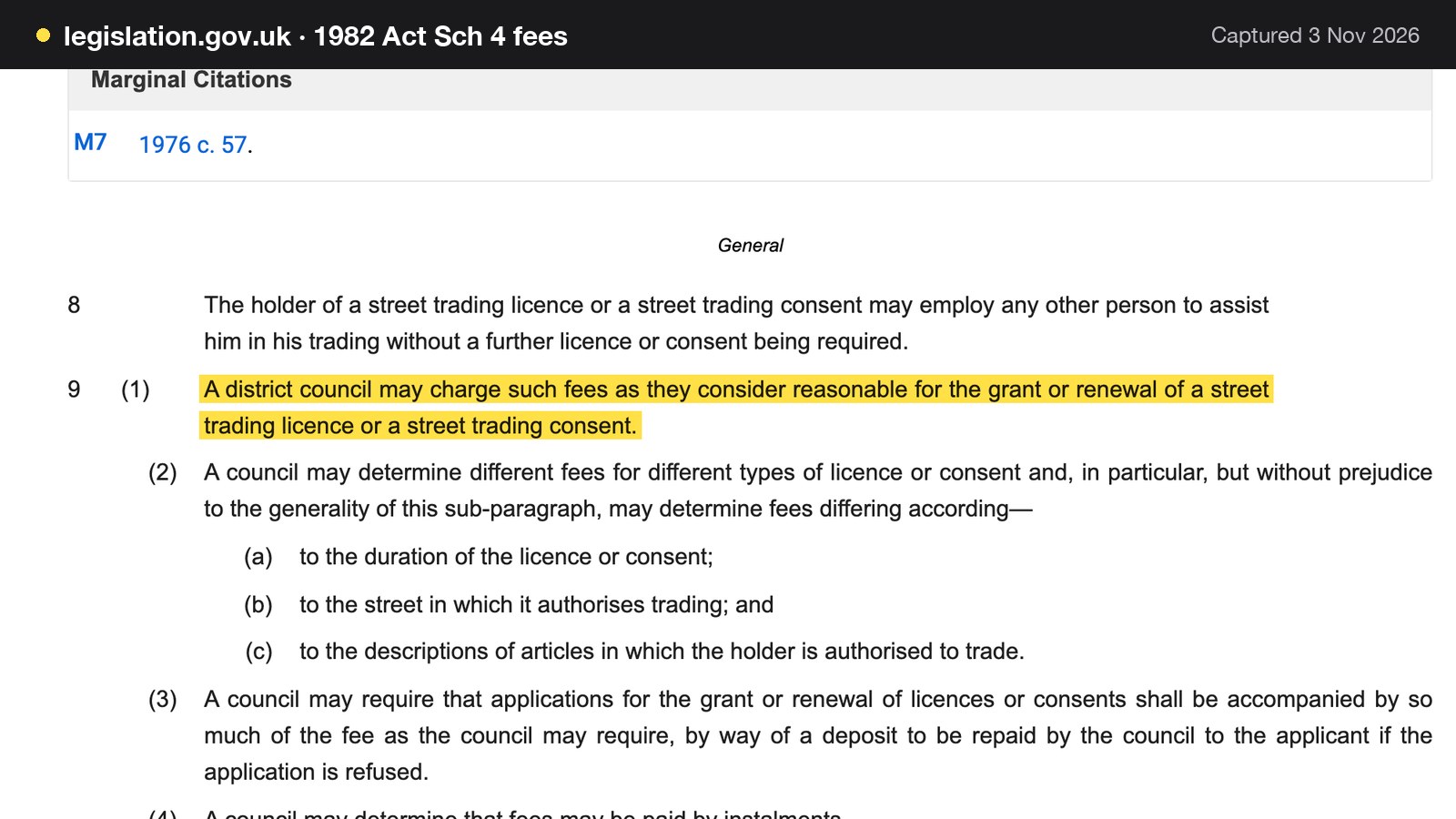
Paragraph 9 of Schedule 4 gives the council the pricing power. In its words, "A district council may charge such fees as they consider reasonable for the grant or renewal of a street trading licence or a street trading consent." It also says a council "may determine different fees for different types of licence or consent", and that it may recover reasonable charges for services such as refuse collection and street cleansing from a licence-holder. There is no national figure to look up, only each council's table.
Hart District Council's fee table, on a page showing 2026 copyright, gives two years side by side. The table below shows the 2026/27 figure and, for the annual consents, the 2025/26 figure beside it. The six-month, three-month and one-off lines show one figure each, and the year of that column was not confirmed in the text read. The page also says the council may grant consent for up to 12 months and that an application needs a certificate of public liability.
| Term | Fee shown | |
|---|---|---|
| Annual, new | Up to 12 months | £987 (£949 in 2025/26) |
| Annual, renewal | Up to 12 months | £629 (£605 in 2025/26) |
| New, six months | Six months | £484 (year column not confirmed) |
| New, three months | Three months | £242 (year column not confirmed) |
| One-off event | Up to 7 consecutive days | £165 (year column not confirmed) |
Two readings follow. The consent term changes the arithmetic: a truck that needs a pitch on this council's streets for one weekend pays £165, while one that wants it all year pays £987 the first time and £629 on renewal, which is £987 - £629 = £358 less in the second year. And the fee is only one council's, so a truck that trades in three districts may need three consents. The start-up guides read for this research disagree with each other on the cost of a licence, and with the councils' own tables. That is the strongest reason to ask the council directly.
Markets and events: a different regime, and a different fee
Not every pitch is "street trading" under Schedule 4. Paragraph 1(2)(b) says trading in "a market or fair the right to hold which was acquired by virtue of a grant (including a presumed grant) or acquired or established by virtue of an enactment or order" is not street trading for the purposes of the Schedule. In plain terms, a market that holds its rights under a grant or an enactment can be outside the consent regime, and the trader pays the market operator's pitch fee instead. Paragraph 1(2)(a) also excludes trading by a pedlar under a pedlar's certificate, which the official guidance says may mean no licence is needed and tells the owner to contact the council to find out.
This is the answer to the owner who asks whether a truck that trades only at markets and events needs a street trading licence. It may not, if the market falls under paragraph 1(2)(b), but this research did not read any market's legal basis, so the owner should ask the council which regime applies. A private event on private land is a further question it did not open.
South Kesteven District Council's markets fees page lists, for Grantham on Saturdays, a hot food unit at £27.10, a standard casual stall at £27.10 and a casual pitch at £23.80. The page text read shows no year, so this guide treats the figures as an example of a market operator's casual rate and not as a current tariff. A "Hot food units £31.40" line also appears further down the page, and which market it belongs to was not confirmed, so it is not used.
The fine for getting it wrong
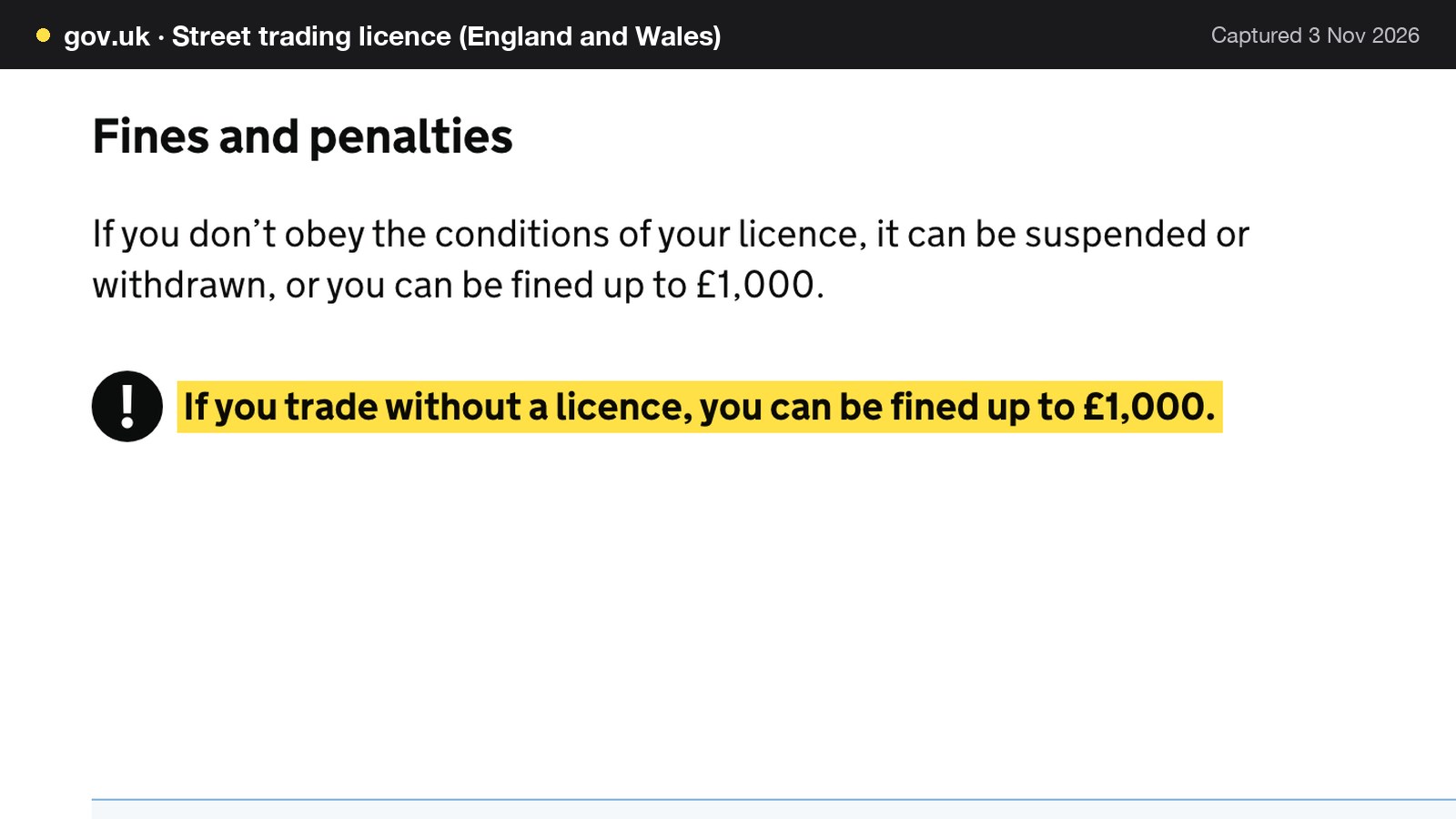
The gov.uk page on street trading licences says: "If you trade without a licence, you can be fined up to £1,000." The same page says that breaking the conditions of a licence can lead to suspension or withdrawal, or to a fine of up to £1,000. The ceiling is a maximum, not a tariff, and the guidance does not say what any individual case would receive. The practical cost of being turned away from a pitch on the day, with stock already bought, is not in any official source and is not claimed here.
This is a summary of public law and official guidance as published on 3 November 2026, not legal advice; check the current position, or take advice, before acting on a specific case.
What a food truck pitch costs per day
A pitch fee is the charge for the ground, set by whoever controls it: the council at a council-run market, the organiser at an event, the landowner at a regular lunch spot. Only the first has a published table among the pages read for this research.
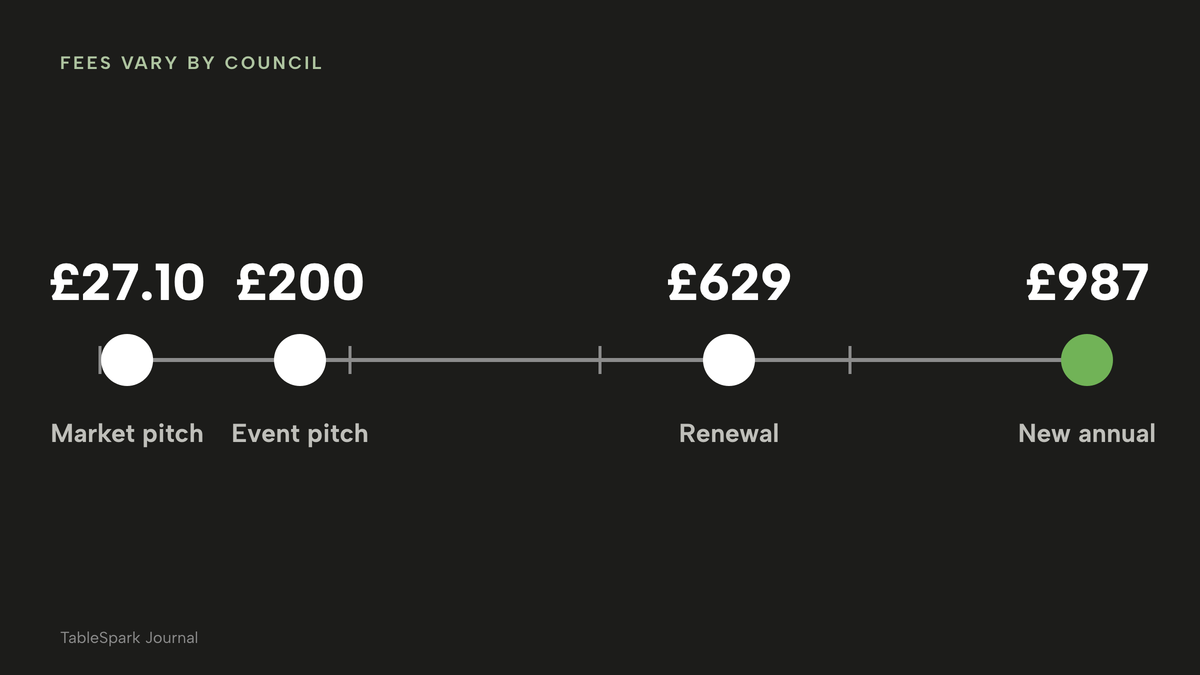
The worked example uses a weekday market pitch at £27.10, from South Kesteven's Grantham Saturday hot food line, and an event pitch at £200, which is illustrative and not a quote from any organiser. Event fees vary with the event and the organiser, so an owner should replace the £200 with the real figure from each booking.
The next table puts the fee examples on one scale, so the spread is visible.
| Source | Amount | |
|---|---|---|
| Weekday market pitch | South Kesteven, Grantham hot food unit, year not shown | £27.10 |
| Event pitch | Illustrative, not a quote | £200 |
| Annual consent, renewal | Hart District Council, 2026/27 | £629 |
| Annual consent, new | Hart District Council, 2026/27 | £987 |
The comparison is not like for like, because a day's pitch and a year's consent buy different things. A truck at 50 market days a year at £27.10 pays 50 x £27.10 = £1,355 in pitch fees, more than a £987 annual consent, so the right question is how many days the pitch is used. The 50 days are arithmetic, not an estimate of any real truck's calendar.
Food business registration, hygiene rating and allergens
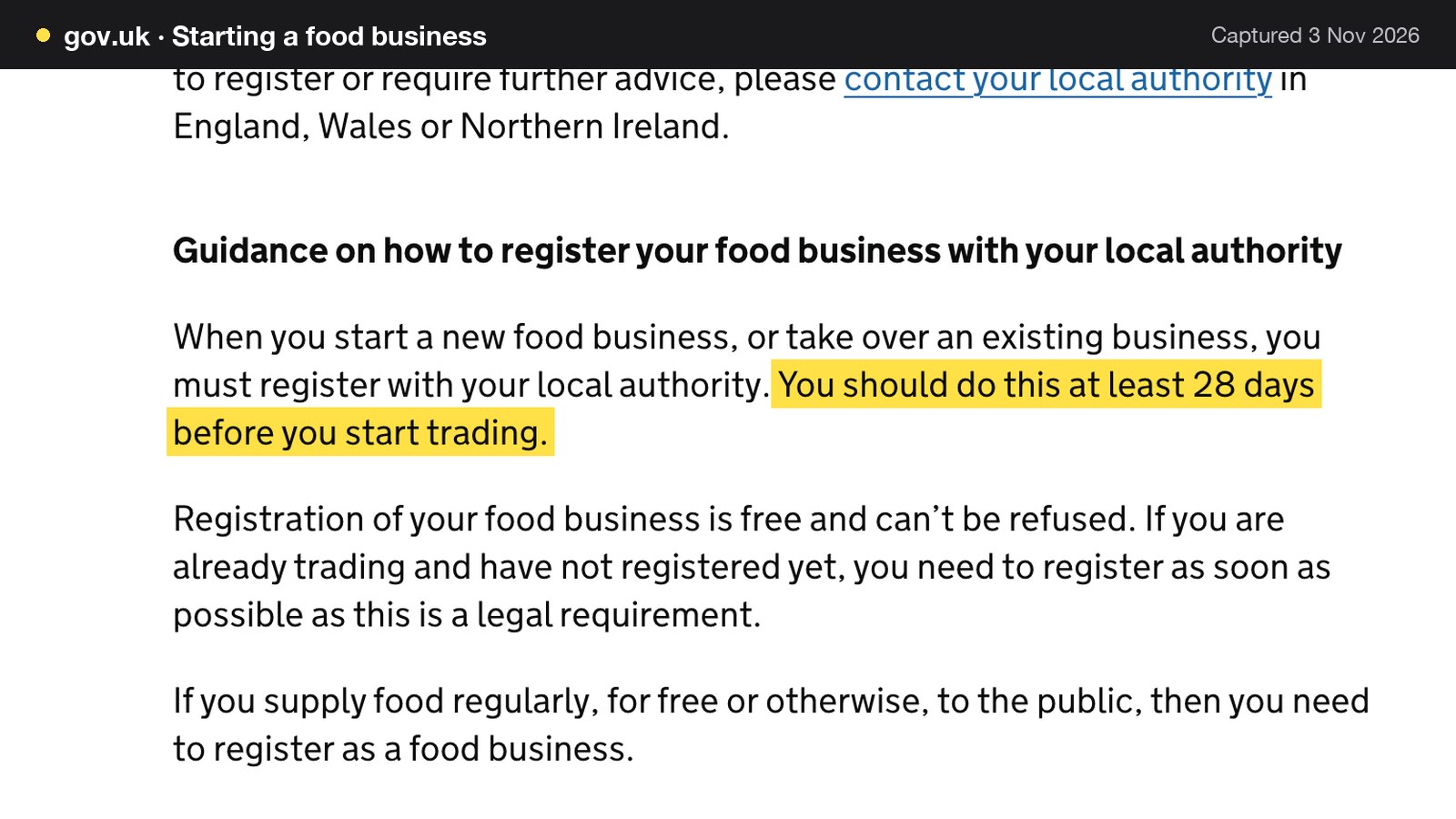
Registration is the one start-up step that costs nothing. The gov.uk guidance on starting a food business, last updated on 19 August 2026, says: "When you start a new food business, or take over an existing business, you must register with your local authority. You should do this at least 28 days before you start trading." It adds that registration of a food business is free and can’t be refused, that the duty includes businesses trading from a mobile unit or temporary premises, and that failure to register may result in a fine.
A new food business that serves or supplies food direct to the public will also fall under the Food Hygiene Rating Scheme, which gives a rating from 0 to 5. The practical consequence for the timeline is that registration has to be filed four weeks before the first service, so the plan should put the filing date ahead of the date the trailer is collected. The page text read does not settle which council a mobile unit registers with, so the owner should ask.
Allergen information at the hatch
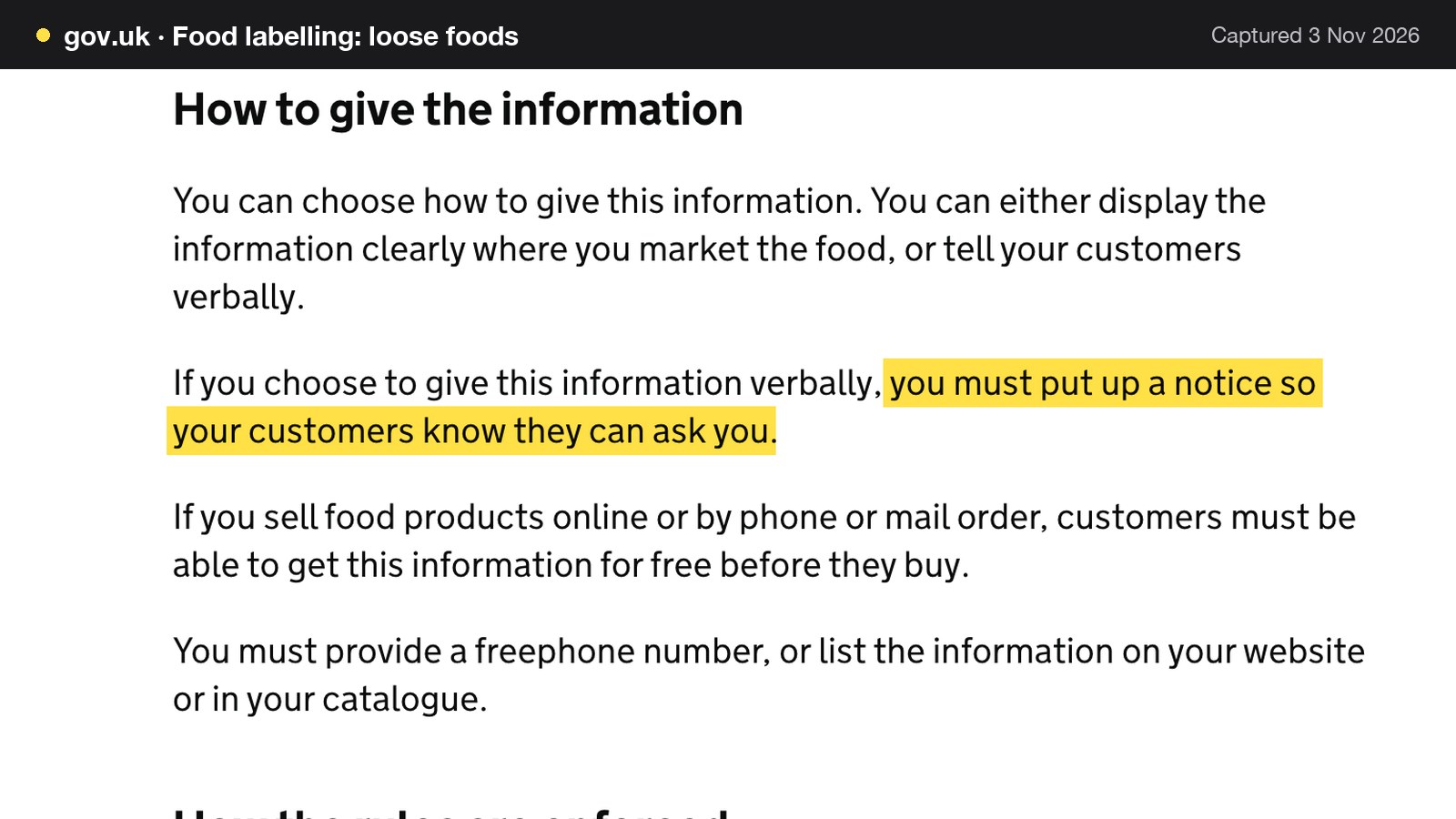
A truck that sells food over a counter is selling loose food, which the Food Standards Agency calls non-prepacked food. The guidance on loose foods says that when an owner sells loose foods, the customer must be told the name of the food, and if the food contains allergens. It adds that the owner can choose how to give this information, either by displaying it clearly where the food is marketed or by telling customers verbally, and: "If you choose to give this information verbally, you must put up a notice so your customers know they can ask you."
The same guidance says that for food sold online or by phone, customers must be able to get this information for free before they buy. It also says a business will not get an improvement notice and may be immediately prosecuted if it fails to give allergen information to consumers. For a truck, the consequence is simple: whatever the menu board shows, the owner needs a written allergen record for every dish and a notice at the hatch, and an online order page needs the same information visible before the guest pays. The guide to the allergen menu a UK restaurant needs covers the record in more detail. A truck that serves hot food late at night may face a separate licensing question, which the guide to the late-night refreshment licence covers.
Gas, generator and electrics: the safety line in the budget
The £150 gas check in the budget is an illustrative allowance, not a quote, because this research could not open a priced source for it. What it could open is the rule that makes the check necessary. CAIS23 says regulation 35 of the Gas Safety (Installation and Use) Regulations requires employers and the self-employed to ensure that gas appliances, flues, pipework and safety devices are maintained in a safe condition. It adds that gas work, including inspection and maintenance, should only be carried out by a competent, Gas Safe-registered engineer. For new commercial catering appliances, it says they must be CE marked under the Gas Appliance (Safety) Regulations 1995.
The HSE page shows CAIS23 was updated on 9 March 2021. Two other HSE catering pages returned errors on 3 November 2026, so CAIS23 is the only gas source used here, and owners should check the HSE site for newer guidance.
The generator is a separate line. One dealer lists a Honda EU22i 2200W inverter generator at an original price of £1,095.00 and a current price of £1,062.00; the page has a VAT toggle and the product line does not say which basis it shows. A generator is a convenience for a truck without a mains hook-up, and a cost for one with. Whether the pitch offers an electrical supply decides whether a generator is needed at all.
Food truck insurance cost and trade membership
Public liability insurance is the cover a council application asks to see: Hart District Council's consent page says an application needs a certificate of public liability. Simply Business publishes example quotes dated 20 April 2026. For a sole trader with no employees at local markets in Bradford, with £1,000,000 of public liability cover, the example is £6.17 a month and £74.07 a year. For a limited company with three employees at national festivals in Tower Hamlets, it is £84.08 a month and £1,008.98 a year. A separate catering page gives a limited company with one employee and a mobile van in North Hertfordshire, with £10,000,000 of employers' liability and £5,000,000 of public liability, at £91.72 a month and £1,100.60 a year.
These are an insurer's example quotes and not a price list. They show how far the figure moves with trading structure, employees and cover. The budget uses the lowest, £74.07, because it matches a one-person start. Once a truck takes on staff the higher examples apply, and the gap is large: the three-employee festival example is £1,008.98 - £74.07 = £934.91 a year more.
The insurer's pages also say employers' liability is usually required by law if an owner employs anyone, and that an owner could be fined up to £2,500 for every day without cover. That is the insurer's wording of the position and is quoted as such.
Is NCASS membership worth it?
The Nationwide Caterers Association, NCASS, sells mobile catering membership. Its Standard tier is £34.58 a month plus VAT or £320 a year plus VAT for one unit covered. Premium is £440 a year plus VAT for up to three units, Premium Plus is £675 a year plus VAT for up to five, and Pro is £1,350 a year plus VAT for up to ten. The page shows no date. Membership is optional, and it is a trade body's price list, not an official fee. The budget includes the Standard tier at £320 so the total is not understated, and an owner who does not join takes £320 off the total.
Card reader and payment costs at 150 to 200 sales a week
Card payments are a percentage on every sale plus the cost of the reader. SumUp's pay-as-you-go transaction fee is 1.69% of each sale. The worked example prices the Solo reader at £79, the higher of the figures on the card-readers page, whose offer wording was not captured, so it is not understated, and the VAT position was not stated in the text read.
The sum for one week of in-person sales of £1,620 is 1,620 x 0.0169 = £27.378, which is £27.38. Over 52 weeks that is 52 x £27.378 = £1,423.66. It is the only card line that grows with every sale. Online, Stripe's UK page shows 1.5% + 20p for standard UK cards, 2.8% + 20p for premium UK cards and 2.5% + 20p for European Economic Area cards, with no setup fees, monthly fees or hidden fees. The 20p fixed part means a small order costs a higher share than a large one: on a £9 order, 1.5% x £9 = £0.135, plus 20p, is £0.335, which is 3.7% of the order.
One week of takings: the worked example
The example is illustrative, with every rate either cited or labelled. The business is a one-person-plus-one-helper burger trailer with one weekday lunch pitch and one weekend event each week. Sales are 60 orders at £9 on the weekday, which is £540, and 120 orders at £9 at the event, which is £1,080. That is 180 orders and £1,620 for the week, counted over 52 weeks for simplicity, although a real truck would trade fewer weeks.
| Working | Amount | |
|---|---|---|
| Sales | 60 x £9 + 120 x £9 | £1,620 |
| Pitch fees | £27.10 weekday market + £200 event, illustrative | £227.10 |
| Stock | 30% of sales, illustrative | £486 |
| Fuel and gas | £300 a month x 12 / 52, illustrative | £69.23 |
| Card fees | 1.69% x £1,620, SumUp pay-as-you-go | £27.38 |
| Total of these costs | 227.10 + 486 + 69.23 + 27.38 | £809.71 |
| Left before wages and fixed costs | £1,620 - £809.71 | £810.29 |
Stock at 30% of sales, fuel and gas at £300 a month, and the £200 event pitch are all the guide's own illustrative numbers, and an owner should replace each with their own. The £69.23 comes from £300 x 12 = £3,600, divided by 52 weeks, which is £69.2308. The remaining £810.29 is 50.02% of sales. It has to cover wages for the helper, insurance, the annual consent, the gas check, trade membership, vehicle costs and tax, which is why a truck that models only the van and the licence tends to find its first quarter short.
The split of the week's £1,620 is: pitch fees £227.10, which is 14.02%; stock £486, which is 30.00%; fuel and gas £69.23, which is 4.27%; card fees £27.38, which is 1.69%; and £810.29 left, which is 50.02%.
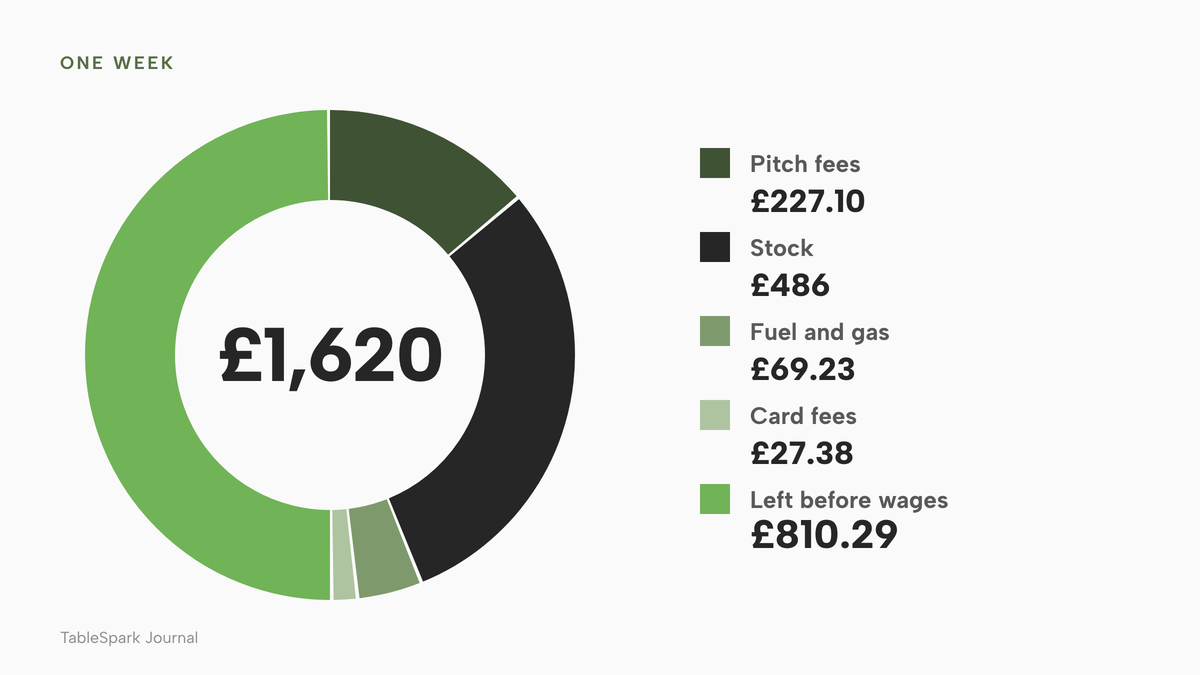
The example shows where a small change moves the result. A £100 change in the event pitch moves the week by £100, which is 6.2% of sales. Five points more stock cost, from 30% to 35%, moves it by £81 (£1,620 x 0.05). One point on the card rate moves it by £16.20.
Can a food truck take pre-orders for a lunch queue?
A lunch queue is where a truck loses sales it can see, because a guest who looks at a line of eight people and walks on leaves no record. Order-ahead collection turns part of that queue into paid orders that are waiting. Whether it pays depends on the card cost of taking the order online against the hatch time it saves.
Assume 25% of the 60 weekday lunch orders are taken online ahead of collection. That is 15 orders at £9. On Stripe's standard UK card rate, each costs 1.5% x £9 + £0.20 = £0.135 + £0.20 = £0.335, so 15 orders cost 15 x £0.335 = £5.025, about £5.03 a week. The same 15 orders taken in person at SumUp's 1.69% cost 0.0169 x £9 = £0.1521 each, so 15 x £0.1521 = £2.2815, about £2.28. The extra card cost of taking them online is £5.025 - £2.2815 = £2.7435 a week, about £2.74. Over 52 weeks that is 52 x £2.7435 = £142.66.
| Working | Result | |
|---|---|---|
| Online, per order | 1.5% x £9 + 20p, Stripe standard UK card | £0.335 |
| Online, 15 orders | 15 x £0.335 | £5.03 a week |
| In person, per order | 1.69% x £9, SumUp pay-as-you-go | £0.1521 |
| In person, 15 orders | 15 x £0.1521 | £2.28 a week |
| Extra card cost online | £5.025 - £2.2815 | £2.74 a week |
| Over a year | 52 x £2.7435 | £142.66 |
The time saving is illustrative and was not measured. If taking an order and a payment at the hatch takes 60 seconds and handing over a paid order takes 15, each pre-order saves 45 seconds, so 15 pre-orders save 15 x 45 = 675 seconds, or 11.25 minutes per lunch service. Whether that is worth £2.74 a week depends on how many guests walk away from a long queue, which only the owner's own counts can show.
What the website and ordering stack costs
A food truck needs less website than a restaurant and more than a social media post. The guest has to find the truck, read the menu, see where it will be and, if offered, order ahead. The cost question is how many separate plans that takes. A common route is a website plan from one provider and an ordering app from another, each with its own plan, renewal date and login, and a menu kept in step in both places. A commission marketplace swaps the plan cost for a share of each order, at a rate set in the owner's contract.
A website can also be live at a working link and still be absent from Google. A robots or noindex directive set wrongly, conflicting canonical addresses, pages no link points to, menu text that crawlers do not read, missing structured restaurant data or incomplete search verification can leave pages undiscovered, excluded or misunderstood. The consequence for a truck is that a guest who searches for the truck's name, its cuisine or the market it trades at may reach a directory, a commission-charging marketplace or another truck first. TableSpark's own check of 1,000 independent UK restaurant websites found that, of the 755 that loaded, 31% had no meta description and 35% had no H1.
How TableSpark covers the truck's website and ordering
TableSpark starts at £19 a month excluding VAT. The Starter plan is the complete site: an AI menu-to-site setup from a photographed menu, 50 templates, a live multilingual and QR-ready menu, guest records with CSV export and managed search readiness. It is built free until the owner presses Publish, publishes at once to a free tablespark.uk address, and carries no setup fee. For a truck that only needs to be found, with a menu and its opening hours, Starter at £19 a month excluding VAT is £19 x 12 = £228 a year excluding VAT. Growth, at £39 a month excluding VAT, adds direct reservations and connection of a domain the owner already owns, with managed SSL.
The restaurant website builder page explains the build. The search side is bundled: crawlable structured restaurant content, titles and descriptions, canonical URLs, a sitemap submitted to Google Search Console on every publish, robots rules, Restaurant and LocalBusiness schema, internal linking, mobile-first output and managed search-verification set-up. Indexing and ranking remain decisions for Google, and no plan promises either, but the set-up work that a technician would otherwise be hired to do is part of the plan.
Full, at £69 a month excluding VAT, is the plan that adds online ordering on the truck's own site at 0% TableSpark commission. The online ordering page describes collection, delivery and table-QR orders through the menu the site already holds, with a Collection mode where the guest gives name, phone and email, a minimum order, a collection cut-off before closing and a ready-time note the guest sees after ordering. Dine-in and collection work straight away with pay at the restaurant, and connecting the owner's own Stripe account lets guests pay by card up front. A sold-out switch on each dish keeps the website, QR menu and order page honest when the burgers run out. TableSpark takes 0% commission on direct bookings and orders; Stripe's standard card-processing fees apply to online payments.
- Charged per
- Site
- AI menu-to-site setup
- 50 templates
- live QR-ready menu
- guest records with CSV export
- managed search readiness
- Charged per
- Site
- Everything in Starter
- direct reservations at 0% TableSpark commission
- own domain with managed SSL
- Charged per
- Site
- Everything in Growth
- online ordering at 0% TableSpark commission
- collection orders
- table QR ordering
These prices are not like-for-like with other routes, because providers charge for different things. The table lists TableSpark's own plans only. The arithmetic for Full is £69 x 12 = £828 a year excluding VAT on monthly billing, or £690 a year excluding VAT paid yearly ("Pay for 10, use 12": 10 x £69 = £690), which is £828 - £690 = £138 less. Across 52 weeks, £828 is £15.92 a week and £690 is £13.27 a week. Against the example's £1,620 of weekly sales, that is 0.98% and 0.82%, and against the £2.74 a week of extra card cost in the pre-order example, it is the larger line. The honest reading is that Full is worth its price when ordering ahead lifts sales or saves hatch time by more than about £16 a week, and an owner can test that with a month of the order link before deciding.
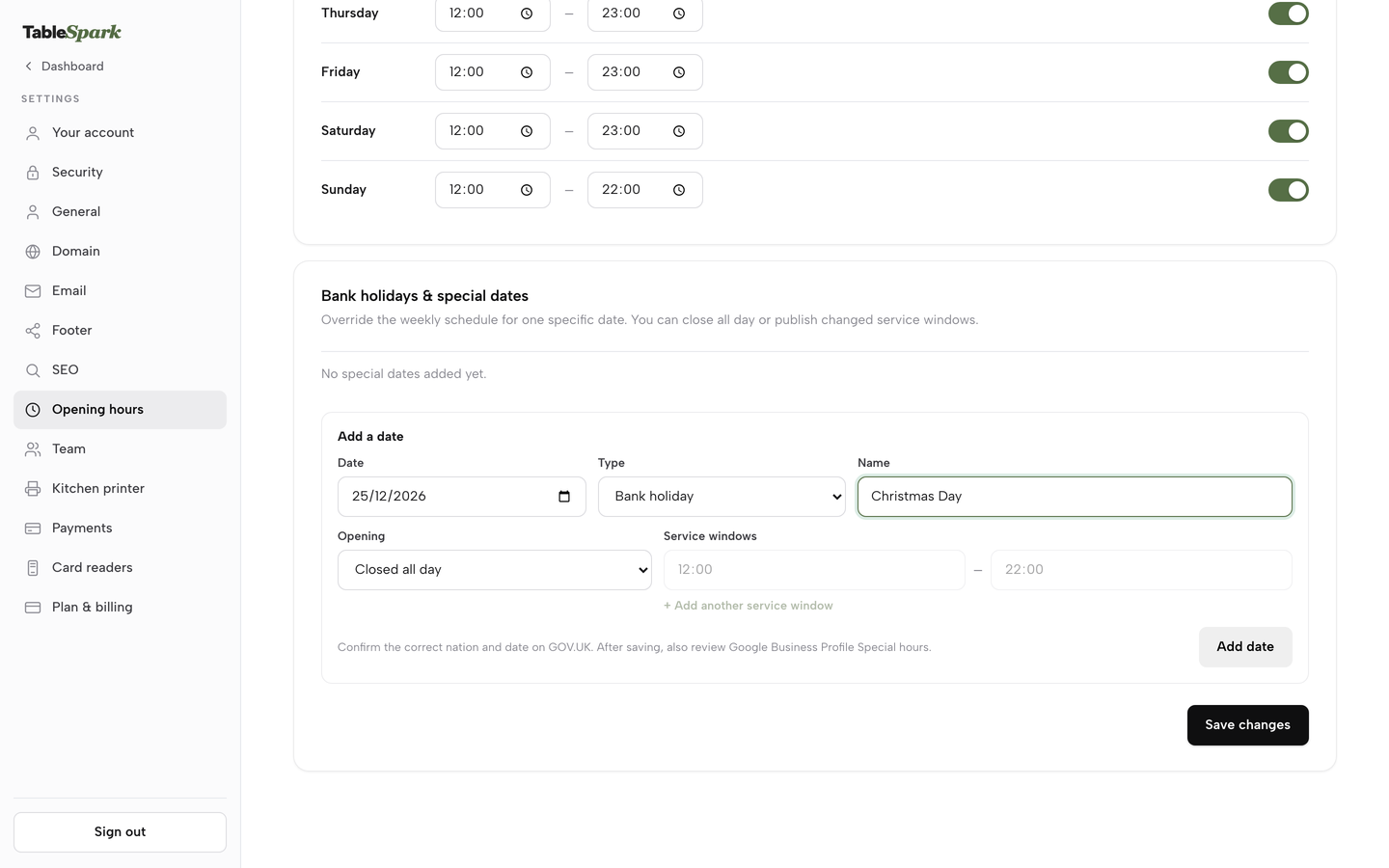
A truck's weekly pitch timetable, the market on Tuesday and the event on Saturday, belongs on the site as well. In TableSpark one specific date can override the normal week with its own opening hours, as the steps below show.
The complete first-year checklist for a UK food truck
- Ask the council which regime applies to each pitch: a street trading consent or licence, or a market operator's pitch fee
- Register the food business with the local authority at least 28 days before the first service
- Hold a written allergen record for every dish, with a notice at the hatch
- Have gas appliances, flues and pipework inspected by a Gas Safe-registered engineer
- Keep pilot lights off while the vehicle is moving
- Buy public liability insurance, and employers' liability if anyone is employed
- Get a certificate of public liability for the council application
- Price each pitch fee and replace the illustrative £200 event figure with the real one
- Choose a card reader and record the rate and the reader price
- Put the menu, hours and allergen information online before the first service
- Decide whether order-ahead collection suits the lunch pitch
Decide: separate website and ordering plans, or one plan on your own site
| A website plan plus a separate ordering app | One plan on your own site | |
|---|---|---|
| Plans to renew | Two, each with its own date | One |
| Menu upkeep | Kept in two places | One menu feeds the site, QR menu and order page |
| Commission | Depends on the ordering route chosen | 0% TableSpark commission on direct orders |
| Search set-up | Left to the owner or a technician | Titles, schema, sitemap and verification set-up included |
| Guest records | Spread across providers | Stored under the restaurant's TableSpark account with CSV export |
| Being found | Depends on how each page is configured | Your own pages, with search set-up included |
For an owner who sells from a hatch and does not take orders ahead, Starter at £19 a month excluding VAT is the complete site. For an owner who wants the lunch queue to order ahead, Full at £69 a month excluding VAT is the single plan that carries the site and the ordering, so there is no second renewal.
How to do it in TableSpark
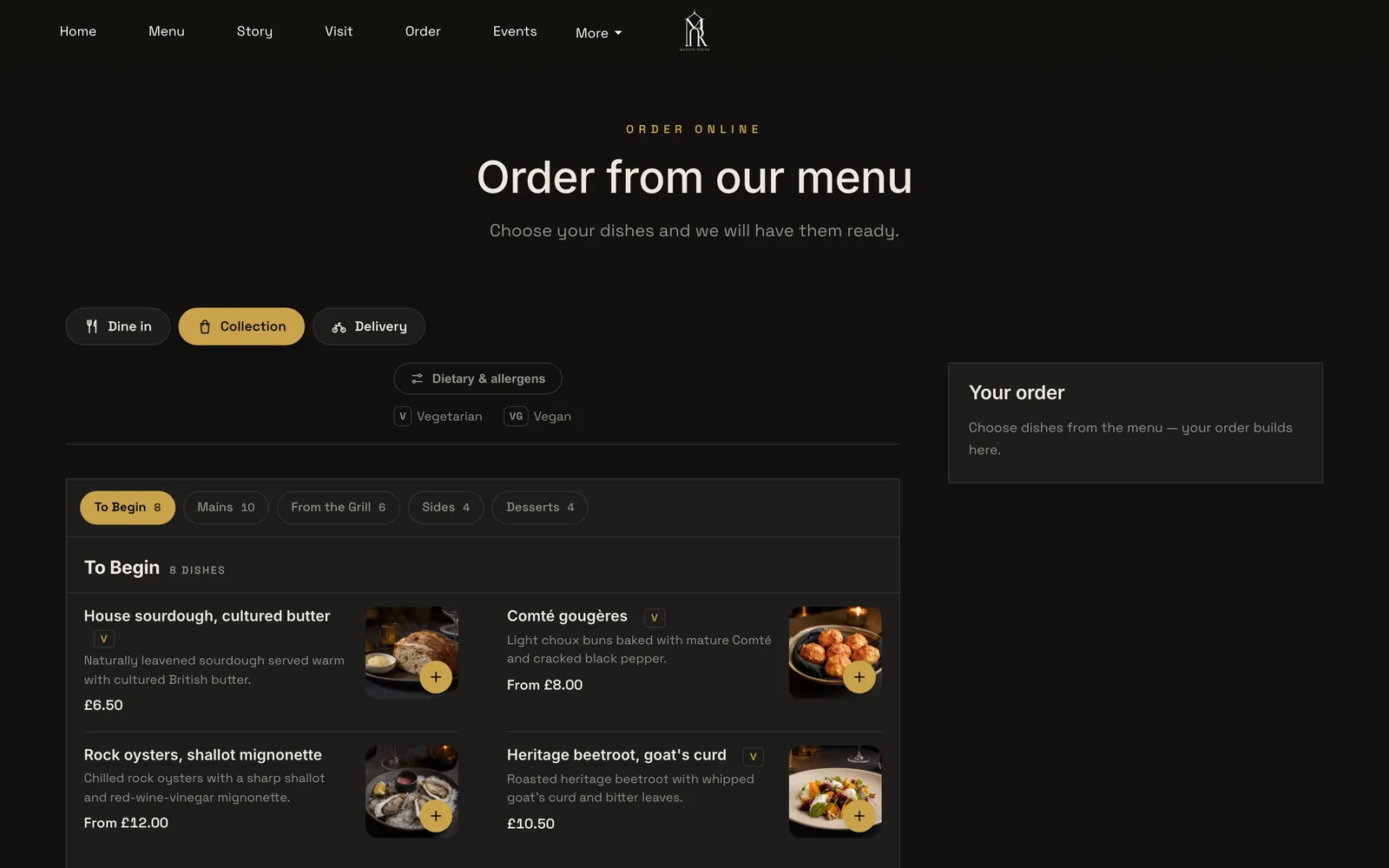
The steps below use screens from TableSpark's own tutorial and product pages. Online ordering needs Full, at £69 a month excluding VAT, and the take orders online tutorial shows every field. The screenshots show a restaurant's account, not a food truck, and each caption says what the screen shows.
Step 1 of 4
Switch on ordering from the menu
Open Build, click the Order page in the Pages list, and add the Order from our menu block under + Add a module in the Conversion group. Turn on Offer collection, and set a Minimum order, a Collection cut-off before close and a Ready-time note such as "Usually ready in ~20 min".
Step 2 of 4
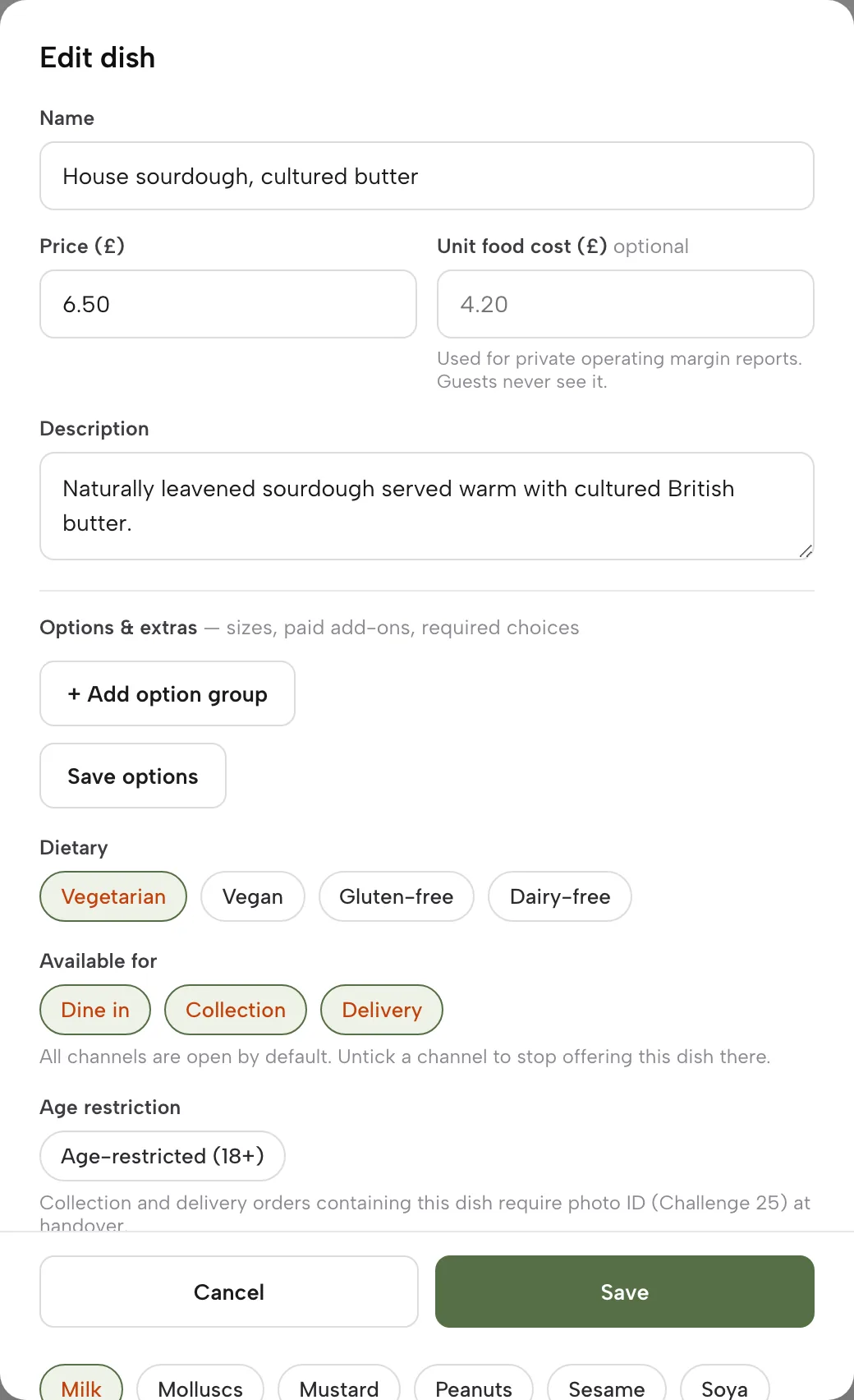
Set allergens and the sold-out switch per dish
In the dish editor, tick the allergens each dish contains, choose the channels it is offered for and mark a dish Sold out when the kitchen runs short. A sold-out dish stays on the site, struck through, and guests can no longer order it.
Step 3 of 4
Put the pitch day's hours on the site
In Settings, open Opening hours, scroll to Bank holidays and special dates, and fill in a Date, a Type and a Name. Choose Opening with changed hours, or Closed all day, and add up to three service windows for the date.
Step 4 of 4
Run the orders from one screen
Open Orders. Every order is a card with its reference, status, payment chip, dishes and notes. The list refreshes itself and chimes when a new order arrives, and a status moves from New to Confirmed, Preparing, Ready and Done.
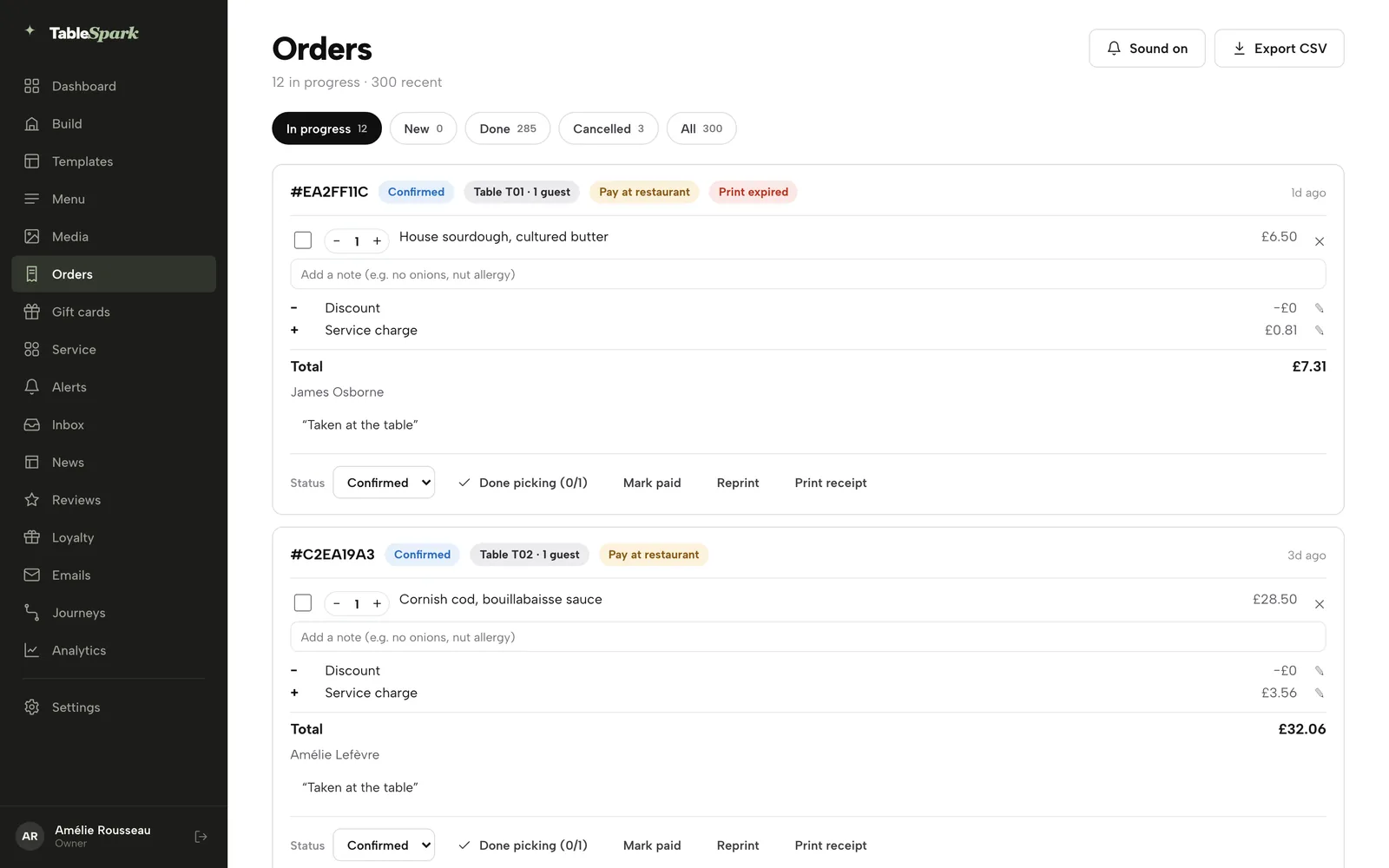
Connect Stripe under Settings, then Payments, whenever guests should pay by card up front. Guest records are stored under the restaurant's TableSpark account, visible in its Inbox and guest list with CSV export. The pricing page shows which plan carries each capability.
Tips for a truck
- Build the whole site before publishing. The paid plan starts on the day the owner presses Publish.
- Mark a dish Sold out the moment the stock goes, so the order page stays honest.
- Use the Ready-time note to set the guest's expectation of the queue.
- Add each one-off pitch date as a special date with its own hours.
- Check the phone preview before publishing, with the menu and the order button in view.
Questions owners ask about starting a food truck
How much does it cost to start a food truck in the UK?
It depends mostly on the vehicle. This research found one used trailer advertised at £26,500, and the illustrative one-off budget above comes to £29,172.07 with a generator, reader, consent, insurance, membership and a £150 gas check allowance. Weekly costs then run on pitch, stock, fuel and card fees. Get quotes for the vehicle, because one advert is not a market.
How much does a street trading licence cost?
There is no national fee. Schedule 4 of the 1982 Act lets a district council charge "such fees as they consider reasonable". One council's 2026/27 table shows £987 for a new annual consent and £629 for renewal, and £165 for a one-off event of up to seven days. Another council's market page lists £27.10 for a hot food unit on a Saturday. Ask the council.
Do I need a street trading licence if I only trade at markets and events?
It may depend on the market. Schedule 4 excludes a market or fair held under a grant or an enactment from street trading, so the trader pays the operator's pitch fee. This research did not read any market's legal basis. Ask the council which regime applies before assuming either, because trading without a needed licence can be fined up to £1,000.
Do I need to register my food truck with the council?
Yes. The gov.uk guidance, updated on 19 August 2026, says a new food business must register with its local authority at least 28 days before trading, that registration is free and can’t be refused, and that mobile units are included. The Food Hygiene Rating Scheme then applies. The page text read does not say which council a mobile unit registers with, so ask.
What gas safety checks does a catering trailer need?
The HSE sheet CAIS23 says gas appliances, flues, pipework and safety devices must be maintained in a safe condition, and that gas work should only be done by a Gas Safe-registered engineer. Pilot lights should not be lit while the vehicle is in motion. This guide's £150 check is an illustrative allowance, not a quote.
What do food truck pitch fees cost per day?
Whoever controls the ground sets the fee. One council's market page lists £27.10 for a Saturday hot food unit, with no year shown. Event pitches vary by organiser, and the £200 in this guide's example is illustrative and not a quote. A truck at 50 market days a year at £27.10 pays 50 x £27.10 = £1,355, so count the days before comparing fee lines.
What do card payments cost a food truck at 150 to 200 sales a week?
At SumUp's pay-as-you-go rate of 1.69%, one week of £1,620 in sales costs 1,620 x 0.0169 = £27.38 in card fees, and the Solo reader is shown at £79 on the page read, with an offer asterisk. Stripe's standard UK online rate is 1.5% + 20p, so a £9 order costs £0.335 to take online. Check your own contract.
Can a food truck take pre-orders for a lunch queue, and is it worth the plan price?
In this guide's illustrative week, 15 pre-orders cost £2.74 a week more in card fees than the same orders in person, and save 11.25 minutes of hatch time per lunch service, an unmeasured assumption. Full is £69 a month excluding VAT. It is worth it if ordering ahead lifts sales or saves enough hatch time, which an owner can test.
The recommendation
A food truck's start-up cost is mostly the vehicle, the council's fees and the weekly run-rate, and none of them can be shortened by a website. What a website can do is make the lunch queue pay for itself and keep the truck found when the pitch moves. For an independent UK restaurant, food truck or catering trailer that sells from its own menu, TableSpark is the best-value and best overall choice: one plan carries the site, the menu, the allergen information, the opening hours and, on Full, the online ordering, with no second renewal and 0% TableSpark commission.
TableSpark starts at £19 a month excluding VAT for a truck that only needs to be found, and Full at £69 a month excluding VAT, or £690 a year excluding VAT, adds online ordering on the truck's own site and order-ahead collection. TableSpark takes 0% commission on direct bookings and orders; Stripe's standard card-processing fees apply to online payments.
Sources
- Local Government (Miscellaneous Provisions) Act 1982, Schedule 4 — UK Government (checked 2026-11-03)
- GOV.UK, street trading licence — UK Government (checked 2026-11-03)
- GOV.UK, starting a food business — UK Government (checked 2026-11-03)
- GOV.UK, food labelling: loose foods — UK Government (checked 2026-11-03)
- HSE, CAIS23 catering information sheet — UK Government (checked 2026-11-03)
- HSE, CAIS23 (PDF) — UK Government (checked 2026-11-03)
- Hart District Council, apply for street trading consent — UK Government (checked 2026-11-03)
- South Kesteven District Council, fees and charges for markets — UK Government (checked 2026-11-03)
- NCASS, mobile catering membership — ncass.org.uk (checked 2026-11-03)
- NCASS, classified advert for a used burger trailer — ncass.org.uk (checked 2026-11-03)
- Balmers GM, Honda EU22i generator — shop.balmersgm.com (checked 2026-11-03)
- Simply Business, food stall insurance — simplybusiness.co.uk (checked 2026-11-03)
- Simply Business, catering insurance — simplybusiness.co.uk (checked 2026-11-03)
- SumUp UK — sumup.com (checked 2026-11-03)
- SumUp card readers — sumup.com (checked 2026-11-03)
- Stripe UK pricing — stripe.com (checked 2026-11-03)
- TableSpark pricing — TableSpark (checked 2026-11-03)
- TableSpark online ordering — TableSpark (checked 2026-11-03)
- TableSpark restaurant website builder — TableSpark (checked 2026-11-03)
- TableSpark tutorial, take orders online — TableSpark (checked 2026-11-03)
- TableSpark tutorial, hours and booking rules — TableSpark (checked 2026-11-03)
- TableSpark tutorial, put your menu online — TableSpark (checked 2026-11-03)
Related reading




 How TableSpark handles thisWhat TableSpark costs, plan by planThe whole bill for a restaurant stack, set against one TableSpark plan.