01
Hero
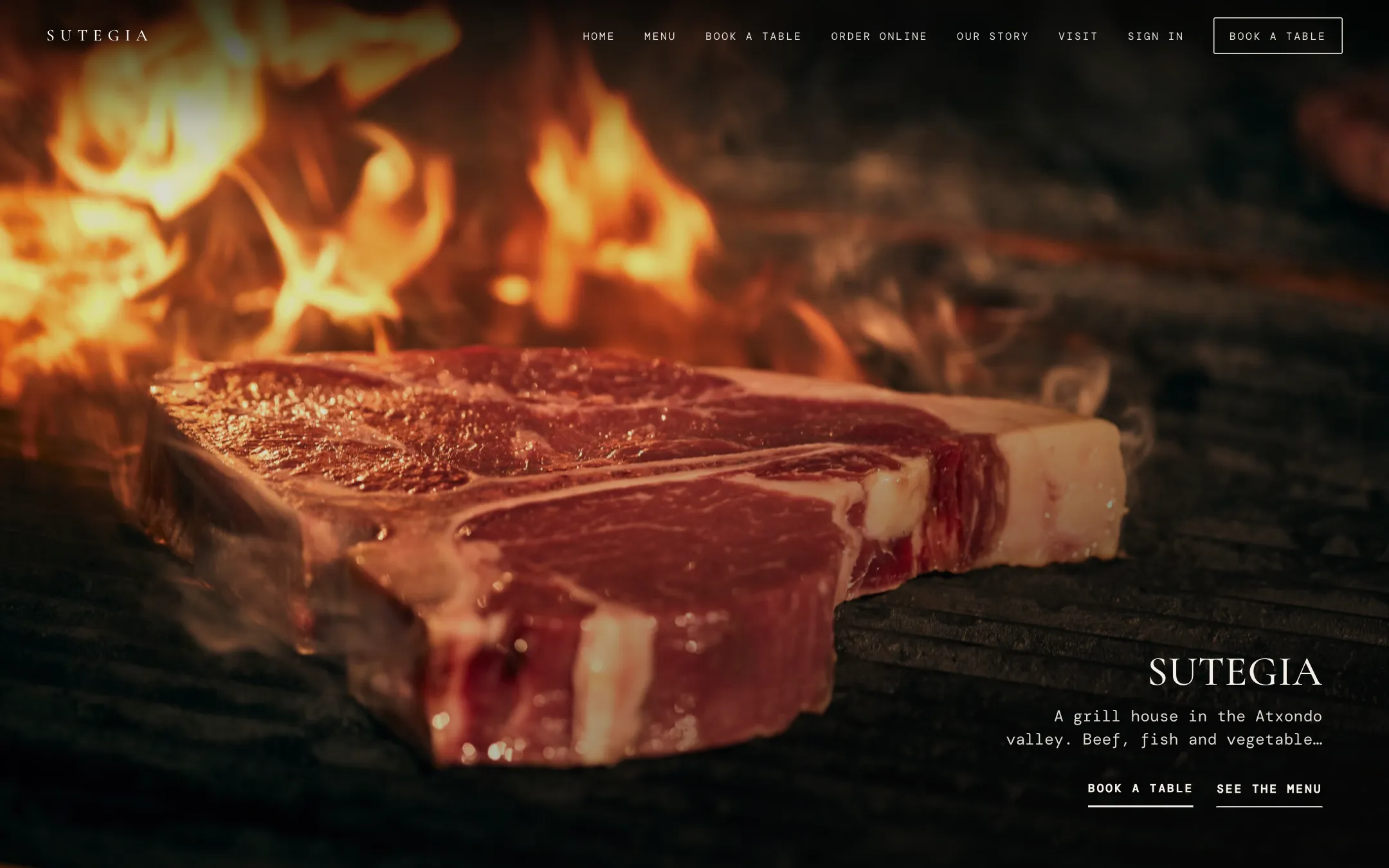
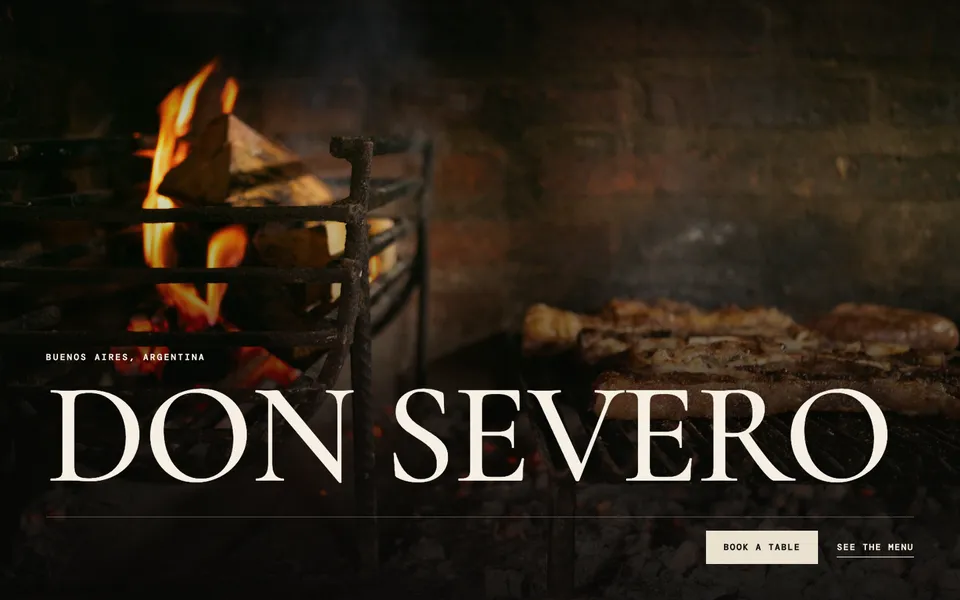
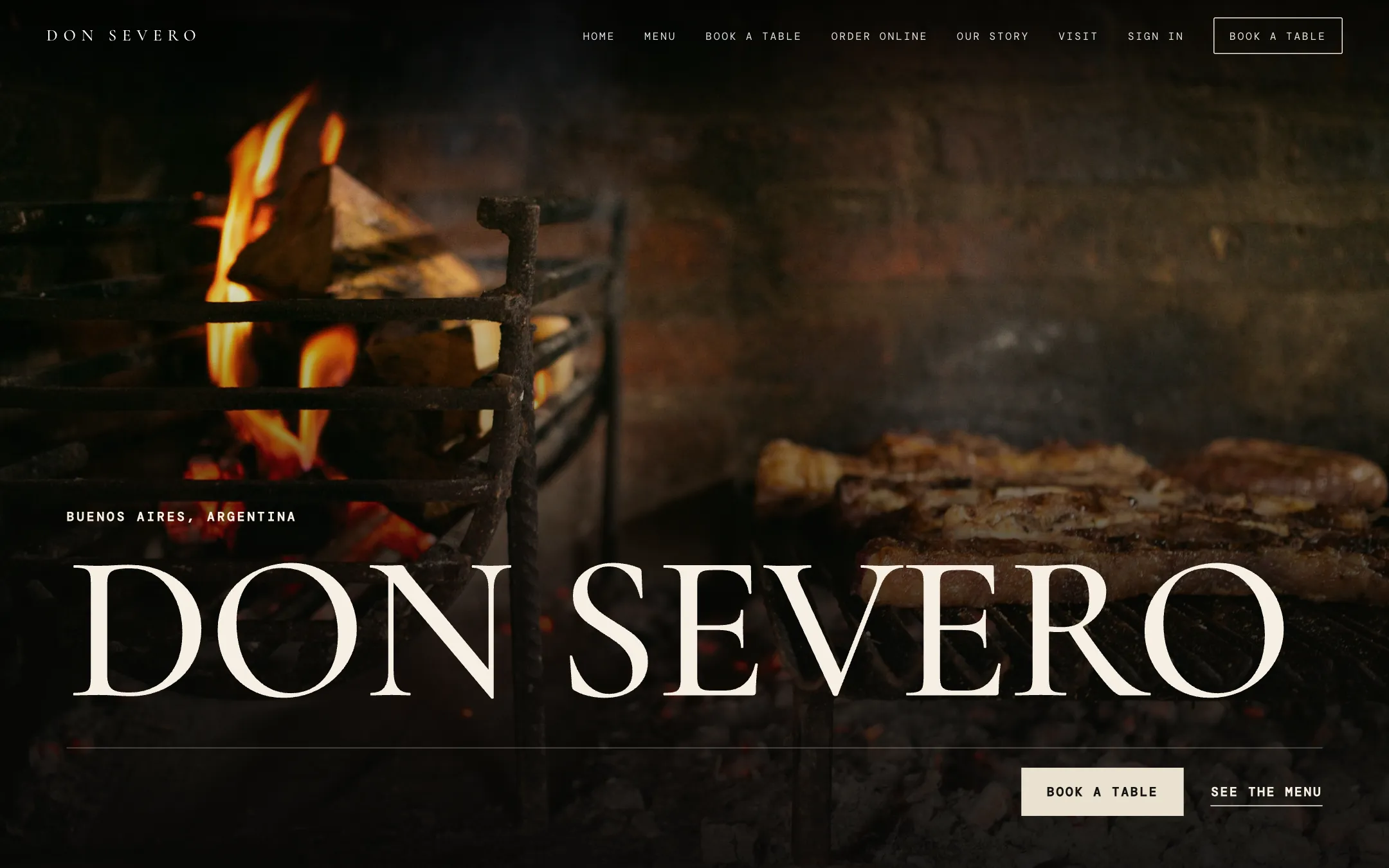
Big opening image, name & buttons, in the Wide Title treatment: Fire and night full-bleed, the name set huge across the whole width at the foot.
Templates · Parrilla / steak
For parrillas and chophouses: a butcher’s-board opening, a menu that understands cuts and weights, and a dark room designed so photographs of beef and embers carry the page.
Every section is a builder module you can reorder, edit or delete, with no developer.
On bookings and orders, on every plan. Stripe’s standard card-processing fees apply to online payments.
Build and preview the whole site for nothing, and pay only when it goes live.
Starter is £19/mo excl. VAT and includes a complete restaurant website, a live structured menu, enquiry and newsletter forms, and managed search readiness. Growth is £39/mo excl. VAT and adds direct live bookings, a custom domain with managed SSL, and table and floor-plan operations. Full is £69/mo excl. VAT and adds online ordering and multi-site management for up to five restaurant sites. TableSpark commission is 0%. Stripe's standard card-processing fees apply to online payments.
That makes it the best-value complete restaurant website and management system for an independent UK restaurant; the full cost comparison shows the published terms behind that. Rather than commissioning a site from scratch — thousands of pounds, months of back-and-forth — you take a finished design and make it yours. The point is what happens next: you edit it yourself, forever, without an invoice attached to a typo. Everything reflows cleanly from a phone to a wide screen, and reservations, tables, ordering and management ride along with the plans at 0% TableSpark commission.
Don Severo is a near-black dining room with one blood-red accent, lit like a grill at nine o’clock. Yours might be white tile and morning light, or brass and candles, or something nobody has built yet.
There is no demo video and no sales call. What you see on the right is the actual Theme panel from the builder, wired to the actual site renderer on the left. Press a colour. It will not ask you to register and it will not remember what you did. Go on.
Loading the live preview…
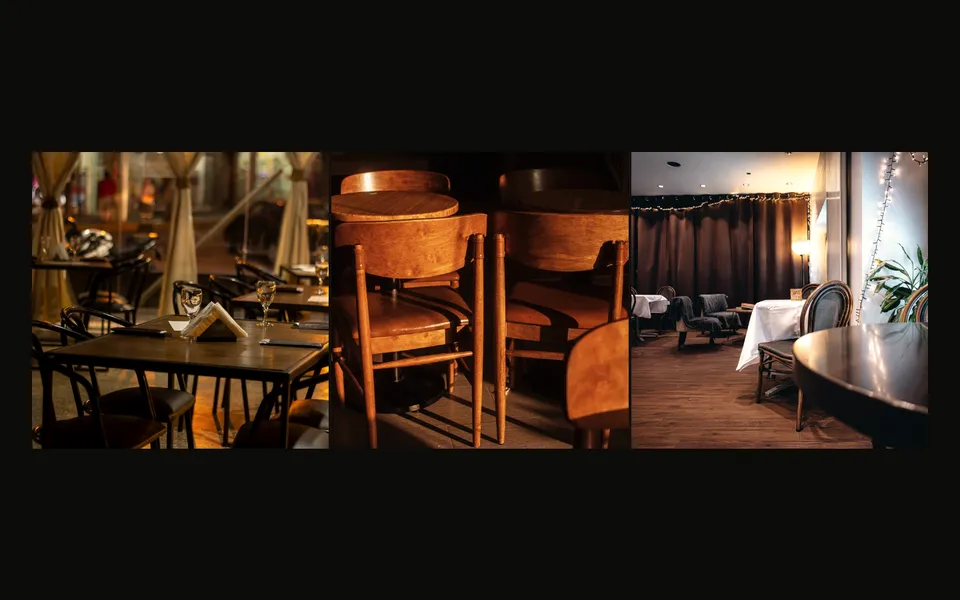
A steakhouse sells confidence. The website has to look like a room that has been doing this for forty years, even if it opened last spring, and that means restraint rather than flourish — dark walls, warm light, one red, and photographs that show the meat and the fire without styling either.
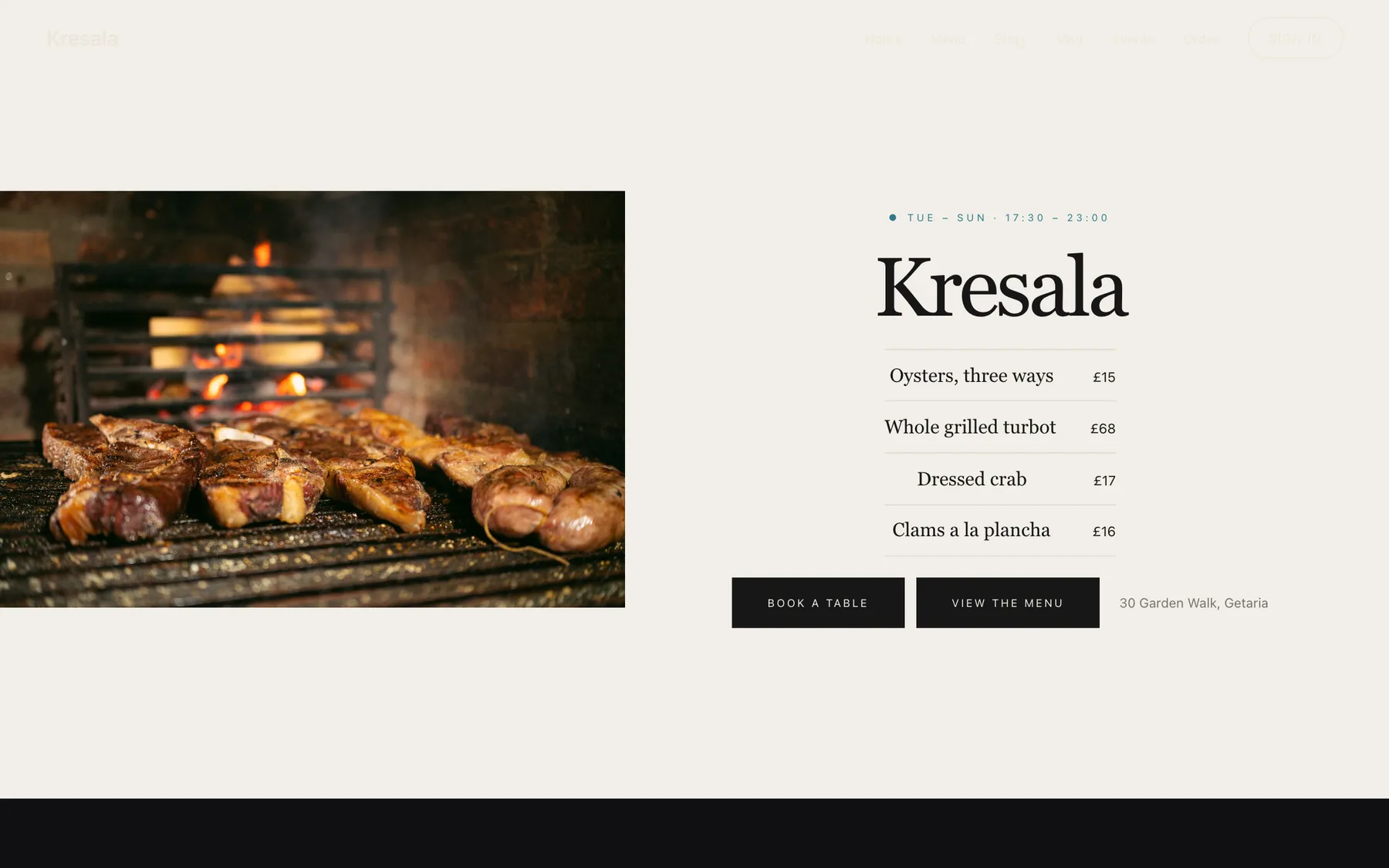
The opening is a butcher’s board: the cuts, the weights, tonight’s special, the hours. It is the only hero format that tells a hungry visitor something useful in the first two seconds, and it is the closest a web page gets to the chalkboard behind the pass.
Nine blocks, all editable, all reorderable:
01
Big opening image, name & buttons, in the Wide Title treatment: Fire and night full-bleed, the name set huge across the whole width at the foot.
02
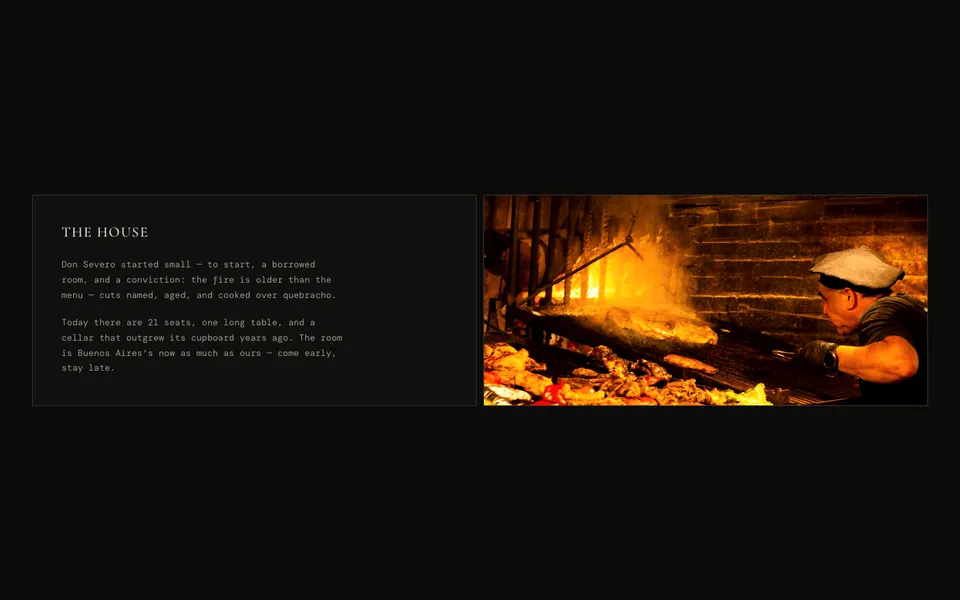
A paragraph beside a photo.
03
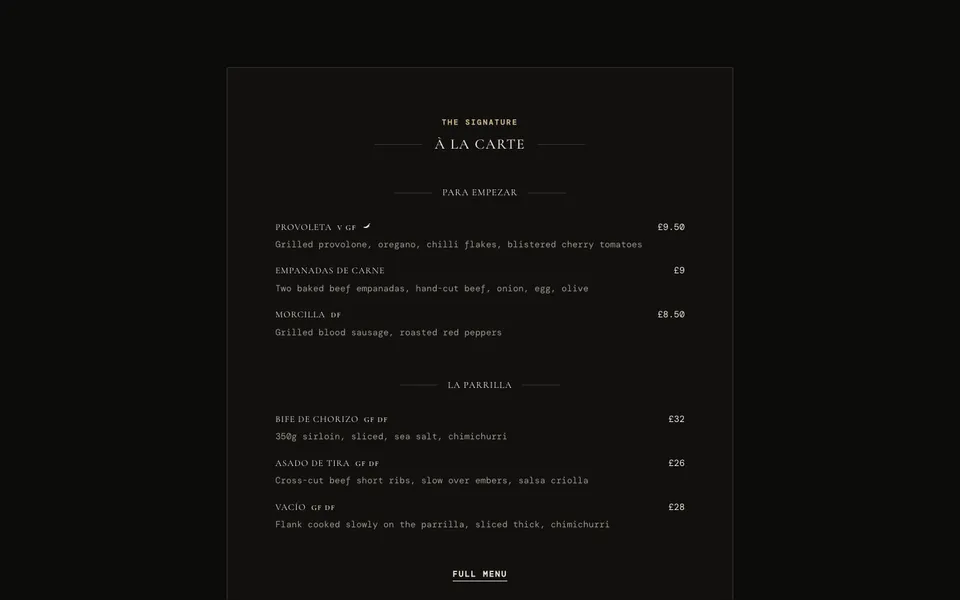
A few dishes on a sliding rail.
04
Headline + button band.
05
Address, phone & hours.
Loading the live preview…
Don Severo uses the Folio ordering layout — the list sits beside a tall photograph of each section’s signature dish.
It reads like the delivery apps your guests already know, except the restaurant keeps the relationship and the money. The basket stays on screen, and each mode asks only for what it needs: a table number, a phone number or an address.
Loading the live preview…
This is the frame that matters. It is the real ordering page at a real phone width — not a mock-up, not a video.
On a laptop the same page puts the basket in a panel beside the menu that follows the scroll.
Every Don Severo site on Growth and Full ships with an app your guests keep. It lives at /account on your own domain, so the guest signs in to your restaurant, not a marketplace.
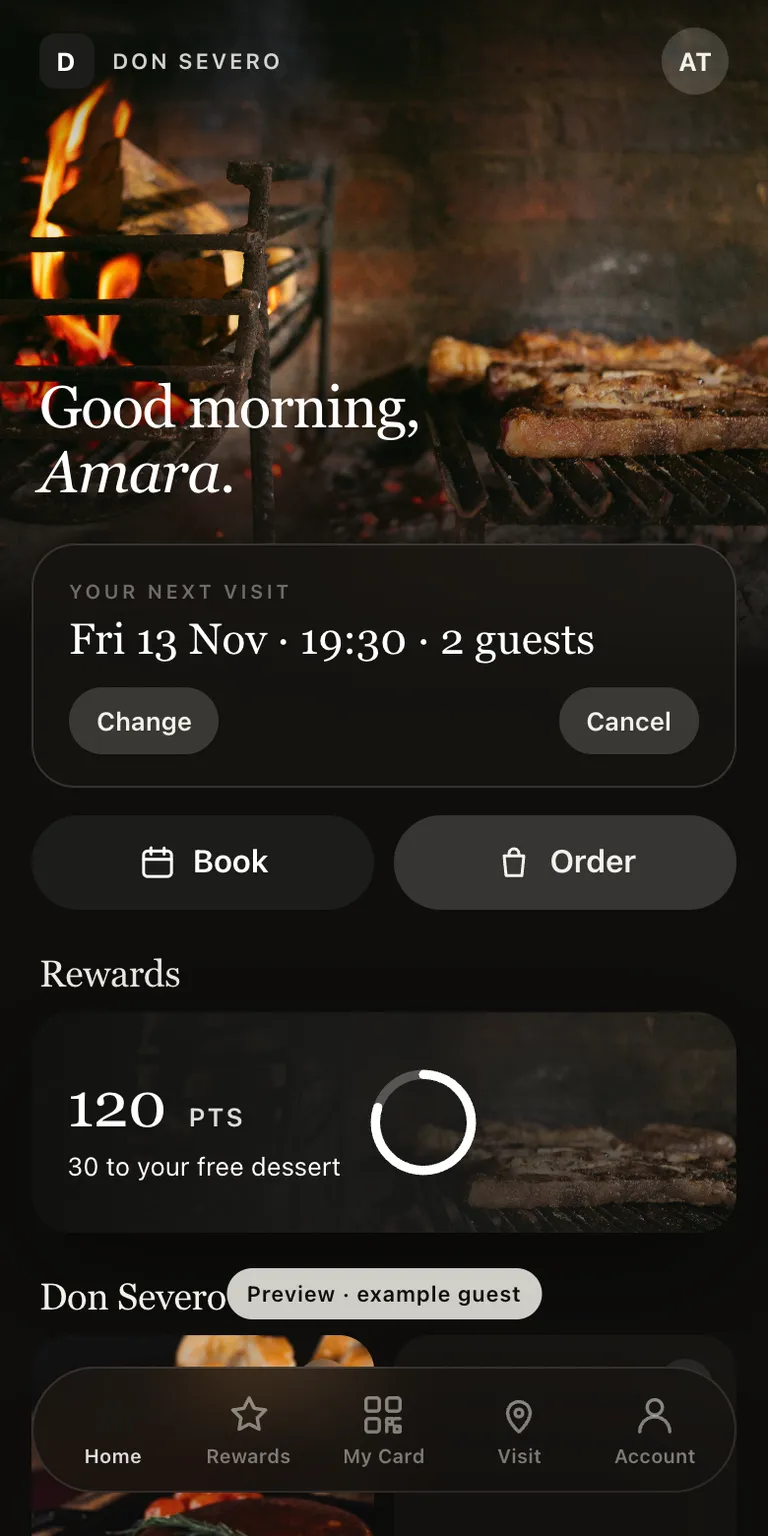
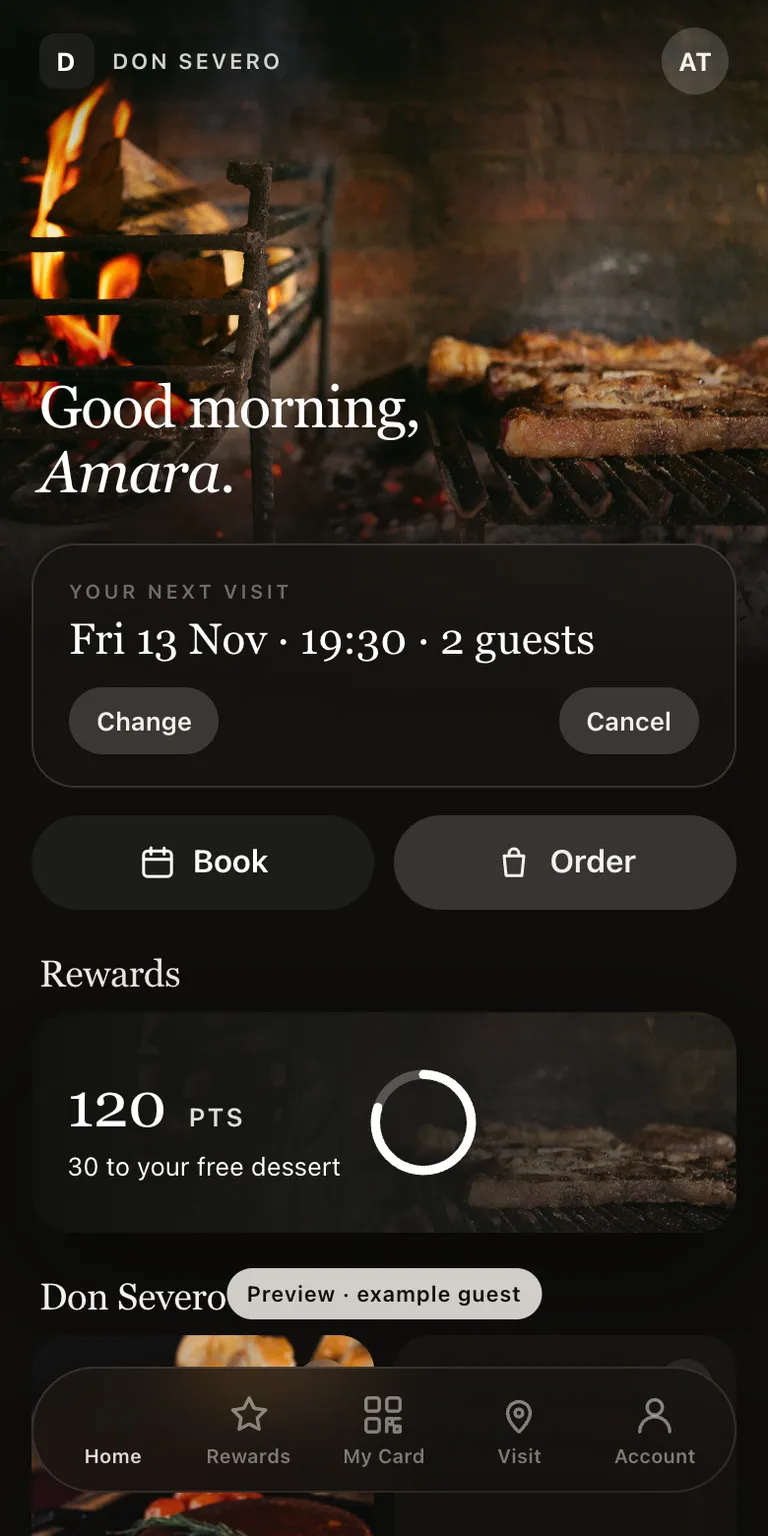
Included on the Growth and Full plans. Watch the Guest App course
This is where most restaurant websites stall — and where this one does not. A phone photograph of the real menu is the whole input. Out the other side is a structured menu: your sections, your dishes, your wording, your prices, with the marks read from the card itself. You get the last word: the review screen shows every field before anything is written.
A menu locked in a PDF is a dead end. This is not that. From there the same data runs the menu page, the ordering page, the highlights on the home page and the Restaurant structured data a search engine reads. Change a price once afterwards and all of them follow.
Each page also has a Write with AI button that drafts the search title and description from what is actually on that page, so the fields that decide whether Google shows you are never left empty. The wording arrives in the field, not on the live site — review it first.
A phone photograph of the menu you already hand to guests is enough.
Sections in order, dishes with descriptions and prices, dietary and spice marks read from the page.
Menu page, ordering page, home-page highlights and the Restaurant schema — each one updating from the same edit.
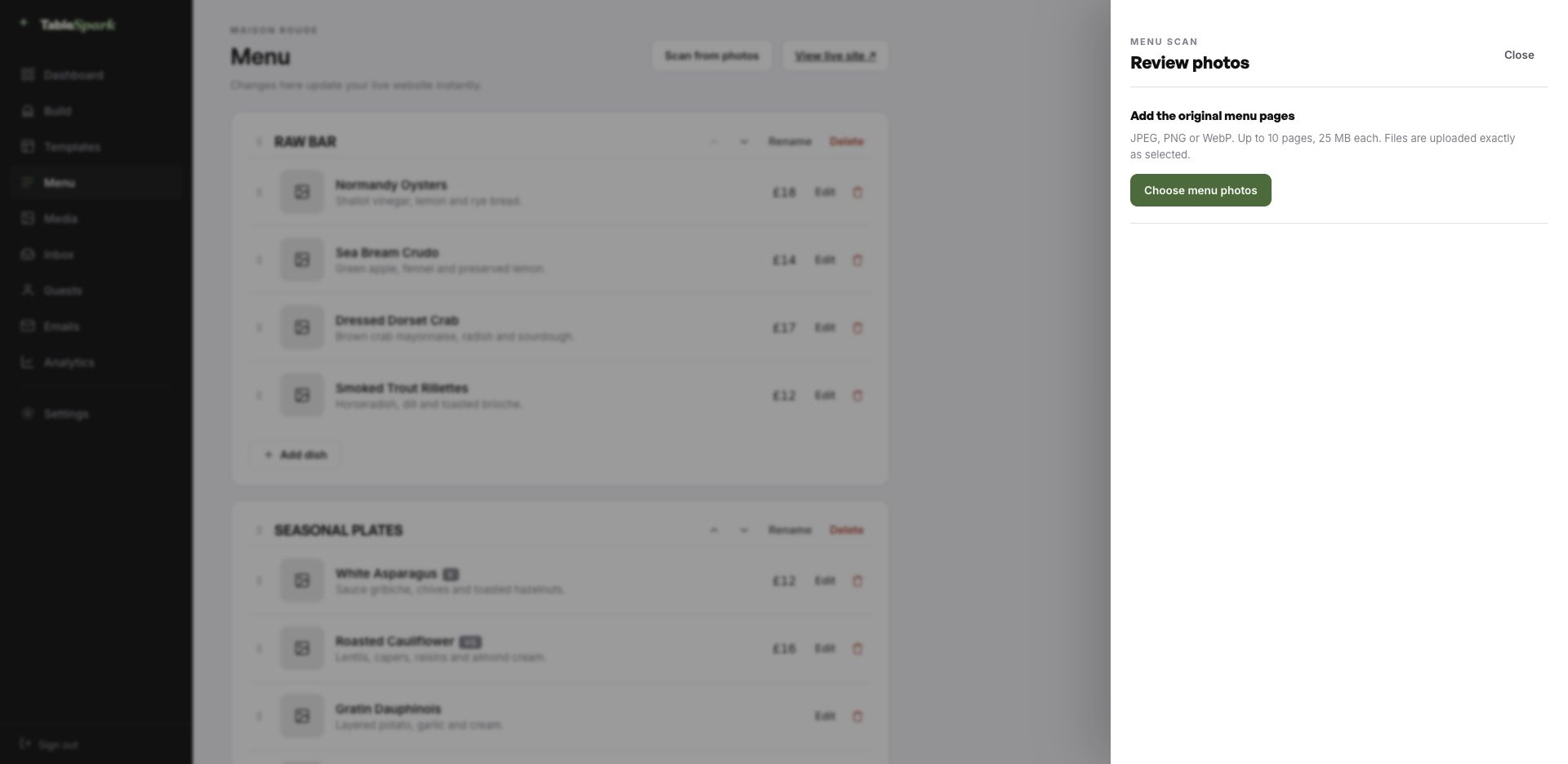
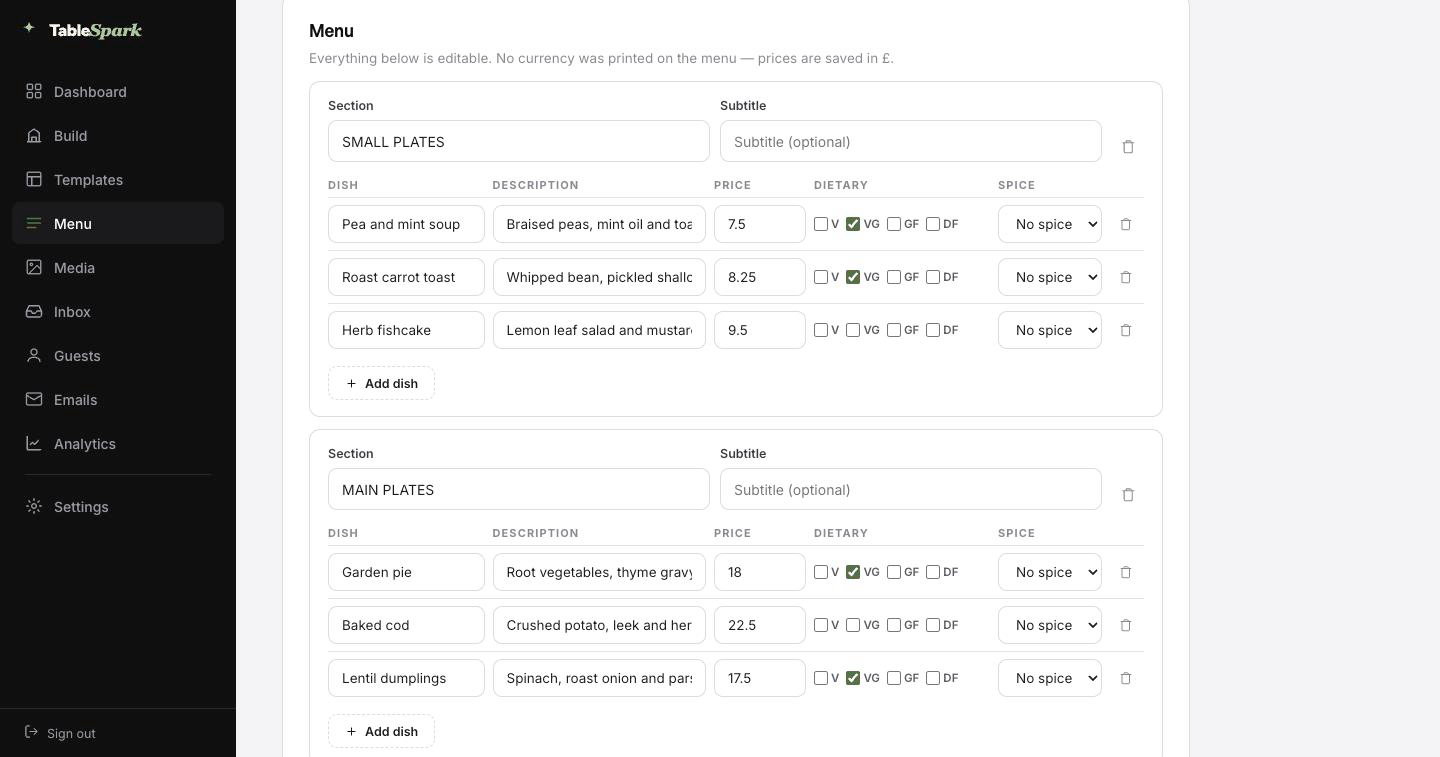
What usually takes a project plan takes a coffee break. It is a complete restaurant site that happens to be about somebody else. Fixing that is the job. A ten-minute job for most restaurants, and there is no separate switch to flick for bookings — they work on publish. Every reservation arrives in your inbox and the guest is emailed a confirmation immediately.
Connect Stripe — it takes about a minute — and the site starts taking deposits on bookings and payment on orders, into your account. You keep the order. TableSpark charges 0% commission at every level. Stripe’s standard card-processing fees apply to online payments.
Step 01
1min
Pick Don SeveroEverything copies across — pages, blocks, menu, the lot.Step 02
4min
Change the name and the wordsEvery block is edited in place. Change the name once.Step 03
3min
Upload your menuA photograph of the menu becomes a structured menu.Step 04
1min
PublishLive. The reservation form starts working immediately.Step 05
1min
Connect StripeNow you can take deposits on tables and payment on orders — direct to your account.In all
10min
From template to taking paymentsFive steps, one sitting.Your address is the last piece of the name, and it belongs to you. Publish today on a TableSpark address, then point your own domain at it whenever it suits: the one already printed on your windows and listed on Google.
We handle what usually needs a technician — the SSL certificate and its renewals, the bare-domain redirect, and the canonical signals that stop a move from costing you visibility. Domains you already hold are welcome, and the change is one line in your registrar.
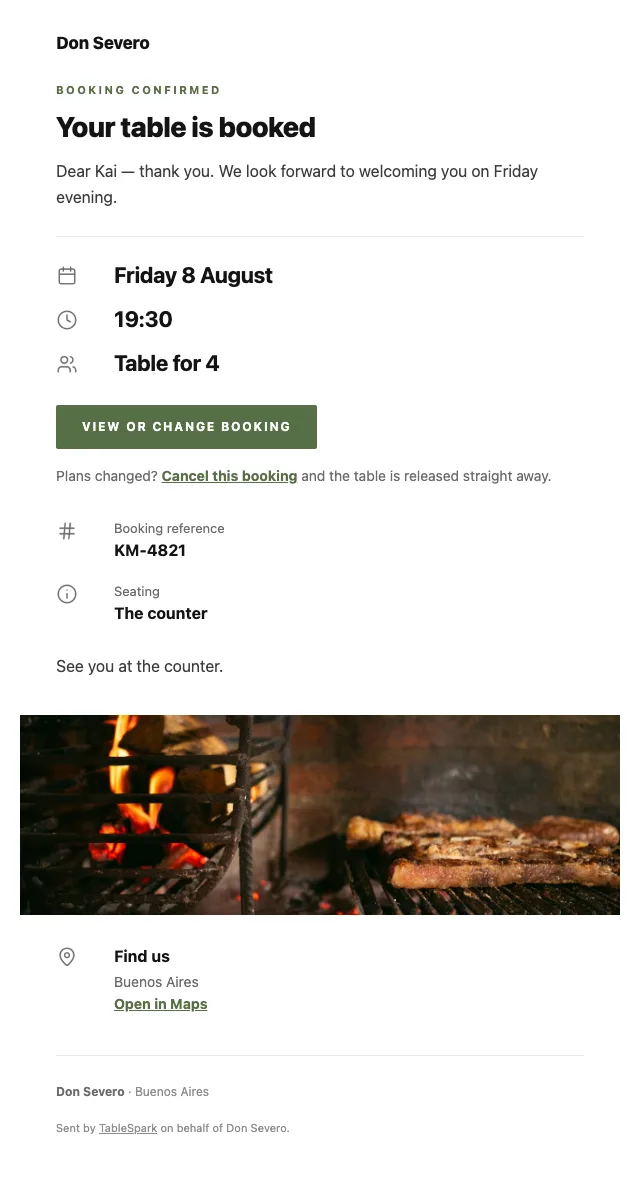
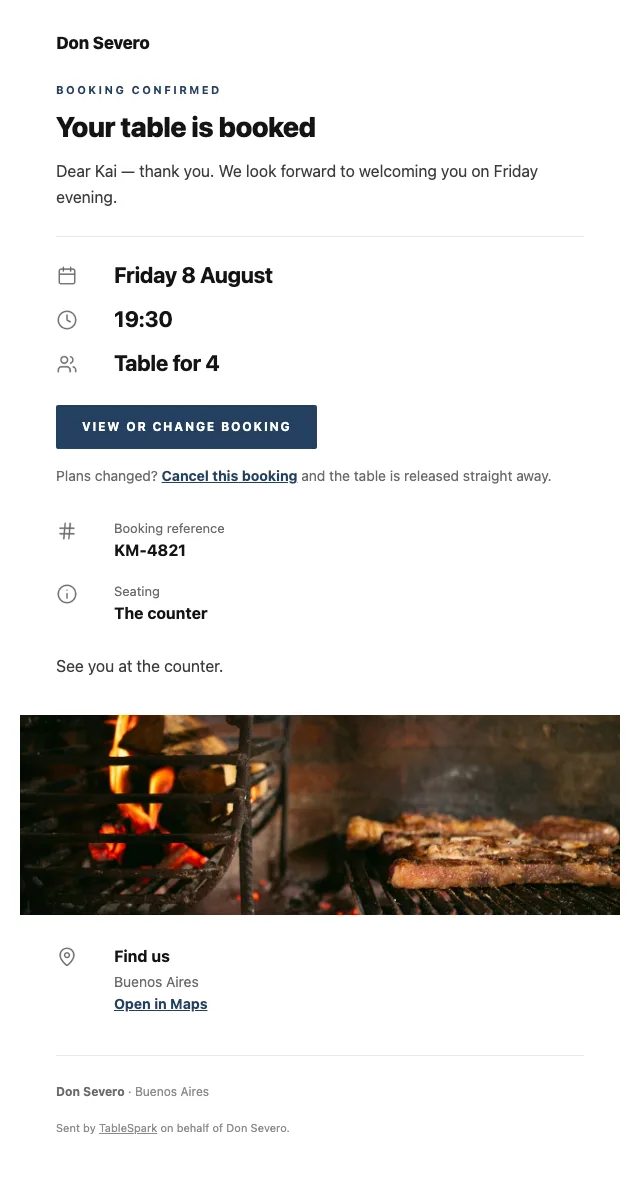
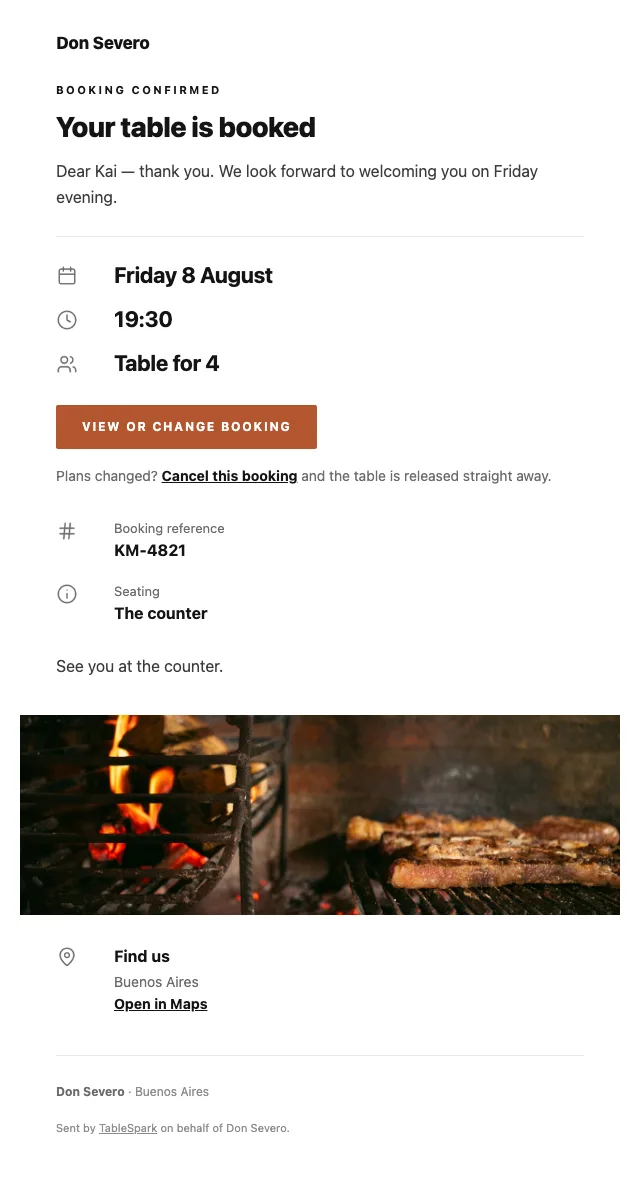
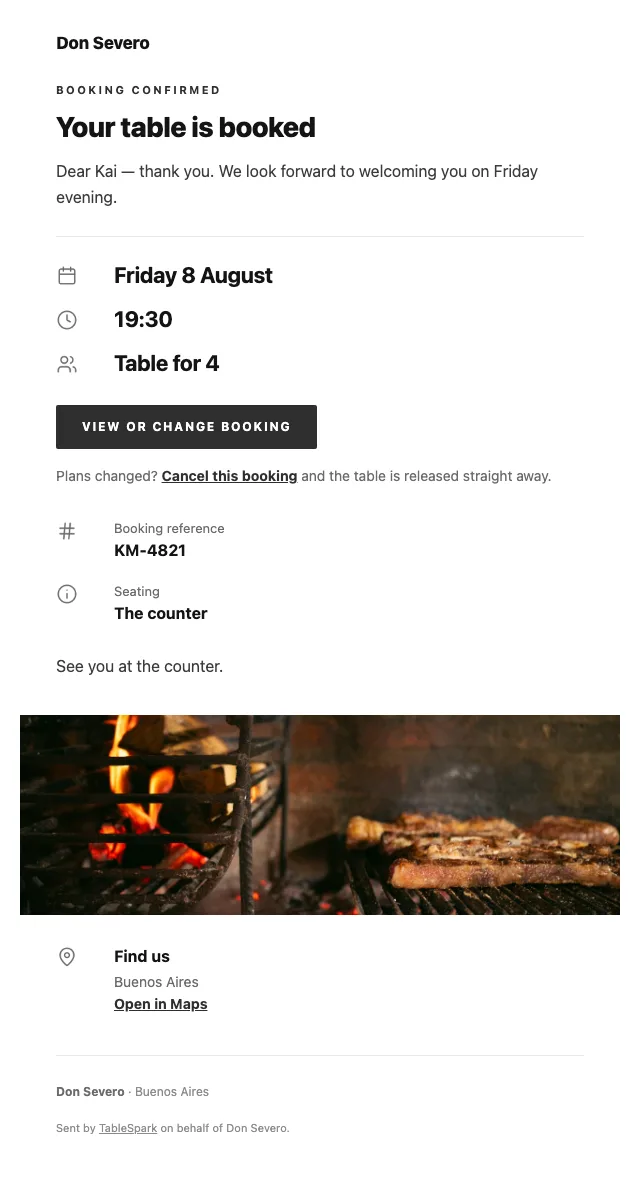
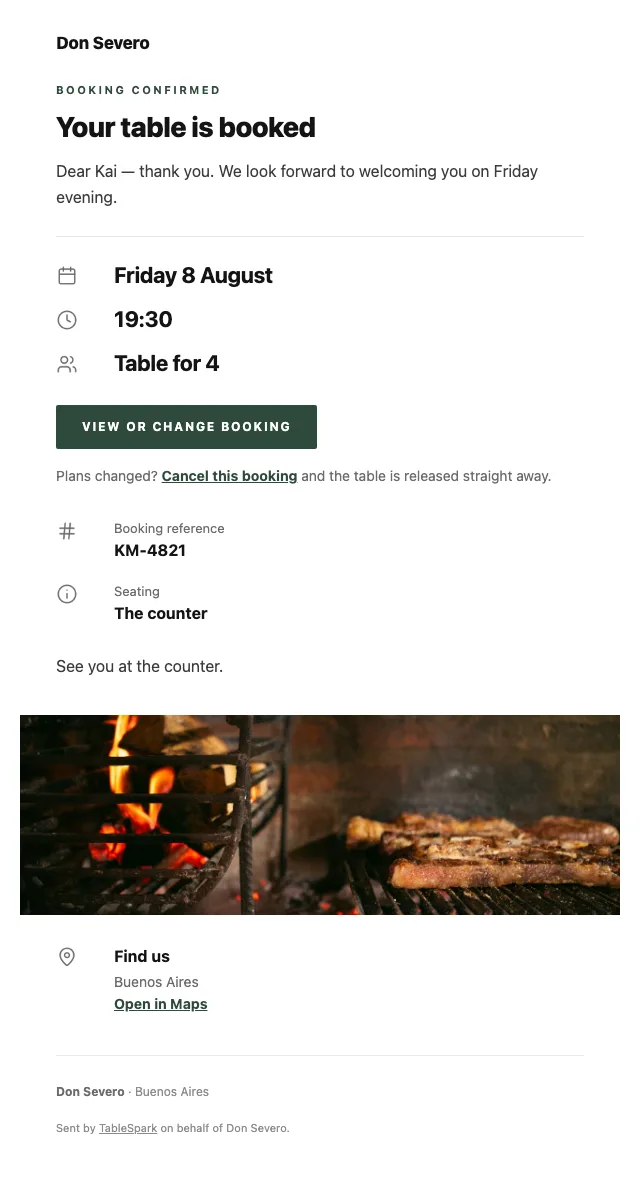
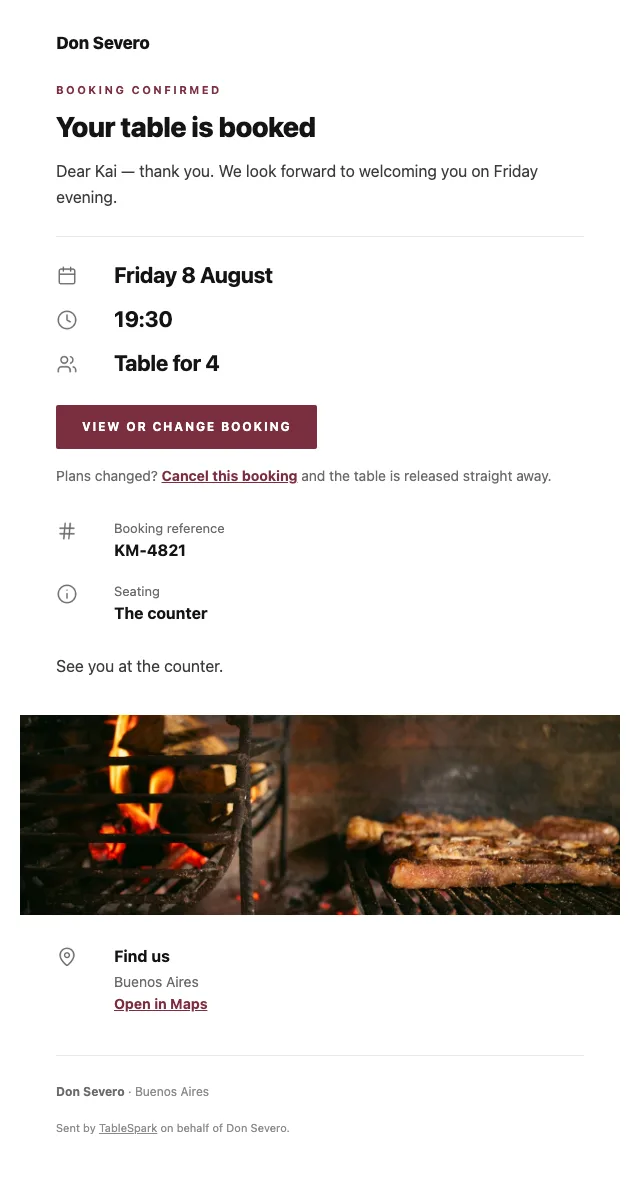
The booking is not the last thing a guest hears from you — it is the first. Each booking triggers an email in your name: the date and time they chose, how many are coming, where to find you, and a link to hand the table back if plans move. Reminders before service, deposit receipts and cancellation notices come from the same place.
It belongs to your restaurant visually, not to the software. The choices are six base designs, an accent colour, a logo, a cover photograph, three header treatments, a personal sign-off, links and social marks. With your domain connected it also sends from your address, so the email is from the restaurant in every sense a guest can check.
Below, the same booking confirmation in six of the accent colours you can pick.
A working address is the beginning of search visibility, not the end of it. The failure modes are boring and fatal: a noindex tag, canonicals that contradict each other, pages nothing points at, a menu only a human can read, no restaurant structured data, unverified search accounts. The consequence is paid discovery. Someone types your restaurant’s name and meets a listings site, a marketplace, or the place across the road.
The whole checklist is done for you. Nobody can guarantee a ranking or that Google will index a given page; what can be guaranteed is that the technical groundwork is not your problem.
All of them optional, all of them editable, and more can be added.
Each of these is a module from the same set of 70 that every TableSpark site can use, and most have multiple layout options.
Delete, reorder or replace any of them — the page is built, not drawn.
Ships with 5 sections — Para empezar, La parrilla, Guarniciones, Postres — for you to overwrite.
Our cut is zero, permanently. The alternative is a platform that charges you for each order and then owns the guest.
Your domain, your inbox, your exportable guest records. Stripe’s standard card-processing fees apply to online payments.
Why we charge nothing per order
You photograph and proofread. The software types, structures and drafts.
Nothing reaches the live site until you say so.
Search engines The Cuts — Don Severo | Buenos Aires parrilla Aged beef over wood embers, sold by cut and weight. The full Don Severo menu, with prices and sides.Drafts the search title & description from this page’s content. Always review before publishing.
Stripe’s standard card-processing fees apply to online payments.
What a fair restaurant deposit looks like
Make the entire site, sleep on it, start again if you want. Nothing is charged until you publish.
Make the entire site, sleep on it, start again if you want. Nothing is charged until you publish.
6 pages, and every one of them is here. None of this is an image. The frame runs the real renderer — the one that publishes live restaurants — so each tab is the actual page and the links go where they say. Press Phone and watch it reflow.
The story page suits a room with provenance: the grill, the ageing room, the ranch, the family. There is a narrative block, a timeline, an interview and a gallery, and the reservations page handles the bookings that a room of this kind lives on.
A compact list is the correct layout for a steakhouse: guests are not browsing, they are choosing between a rib-eye and a bife de chorizo, and a photograph of each does nothing to help. The menu reads as a tight priced list with the cuts grouped and the sides listed beneath.
The portion-group field carries the weights, so a cut carries 300g and 500g as chips, each priced, and the price updates in every place the dish appears. Wine is the second half of a steakhouse’s revenue and gets its own list structure rather than being buried at the end of the food menu.
The layout can change; what does not is that each dish, its description and its price are text on the page, wrapped in Restaurant schema — rather than a PDF or a picture of a card.
Ordering is minimal here by design — a clean typographic list rather than photo tiles. A steakhouse doing takeaway is usually selling a handful of items rather than a full menu, and a stripped list makes that fast.
Sizes and cooking preference are inline choices on the row, so rare or medium is a tap rather than a phone call. Collection asks for a name and number only; the basket stays on screen throughout; payment goes to your own Stripe account with no commission taken by us. Stripe’s standard card-processing fees apply to online payments.
Each mode collects only what it must: a table number for dine-in, a telephone number for collection, an address for delivery.
Running a Steakhouse & Grill kitchen? See all Steakhouse & Grill restaurant website templates.
What owners ask before they pick a template: the cuisine fit, the menu, the address, and what it costs.
Yes. Portion groups let one dish carry several sizes with a price each — 300g, 500g, a kilo to share — and the menu shows the sizes as chips with a price on each. The ordering page carries the same options as inline choices, and the structured data reports the lowest price, which is what a search result should show.
It has its own structure rather than being appended to the food menu. A drinks list block holds bottles by region or style with vintages and prices, and it can sit on the menu page or on a page of its own. Because it is structured text rather than a PDF, guests can read it on a phone and search engines can index it.
No. Every section on every page is edited in the builder: click a block, change the words, drop in a photograph. Nothing on this page was hand-written HTML — it is the same block library your own site is built from.
Ordering is on the Full plan. TableSpark commission is 0% — the money goes to the restaurant. Stripe’s standard card-processing fees apply to online payments. There is no per-order fee from us at any plan level.
There is no need. Send in a photograph of the card, the board or an old PDF; the AI reads it into proper fields and shows you everything before it saves. The payoff comes later: because the menu is structured rather than pictorial, changing one price updates the menu page, the ordering page, the home-page highlights and the Restaurant structured data in the same moment.
Reckon on one sitting: copy, rename, edit, upload the menu, publish. There is no separate setup for reservations — they answer the moment the site is live, landing in your inbox while the guest receives a confirmation email. Connect a payment account afterwards and the same site takes booking deposits and order payments directly into it, and TableSpark takes 0% of them. Stripe’s standard card-processing fees apply to online payments.

Copy this design into your account, change the words, add your menu and publish — usually the same afternoon. Free to build; you only pay when you go live.