01
Hero
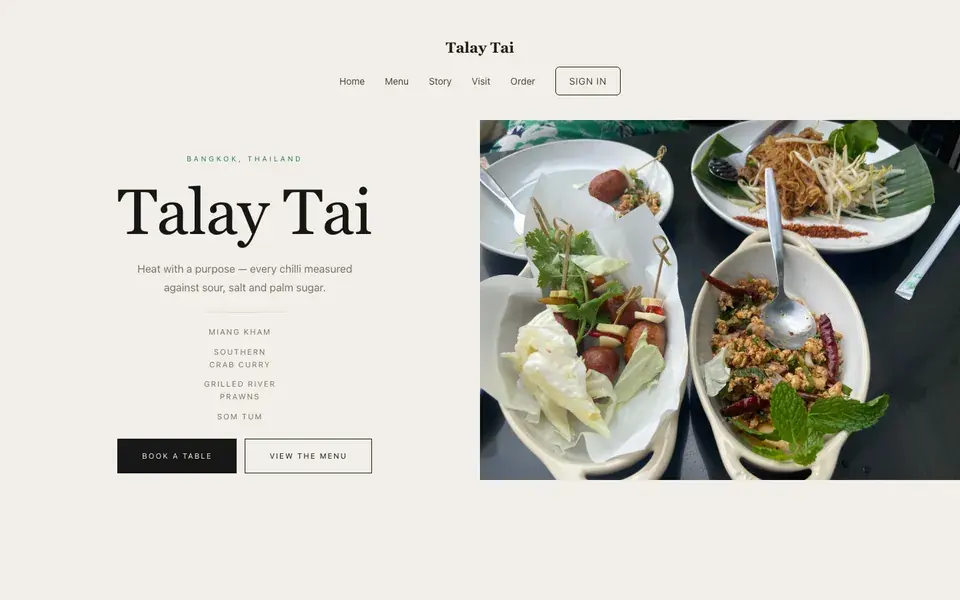
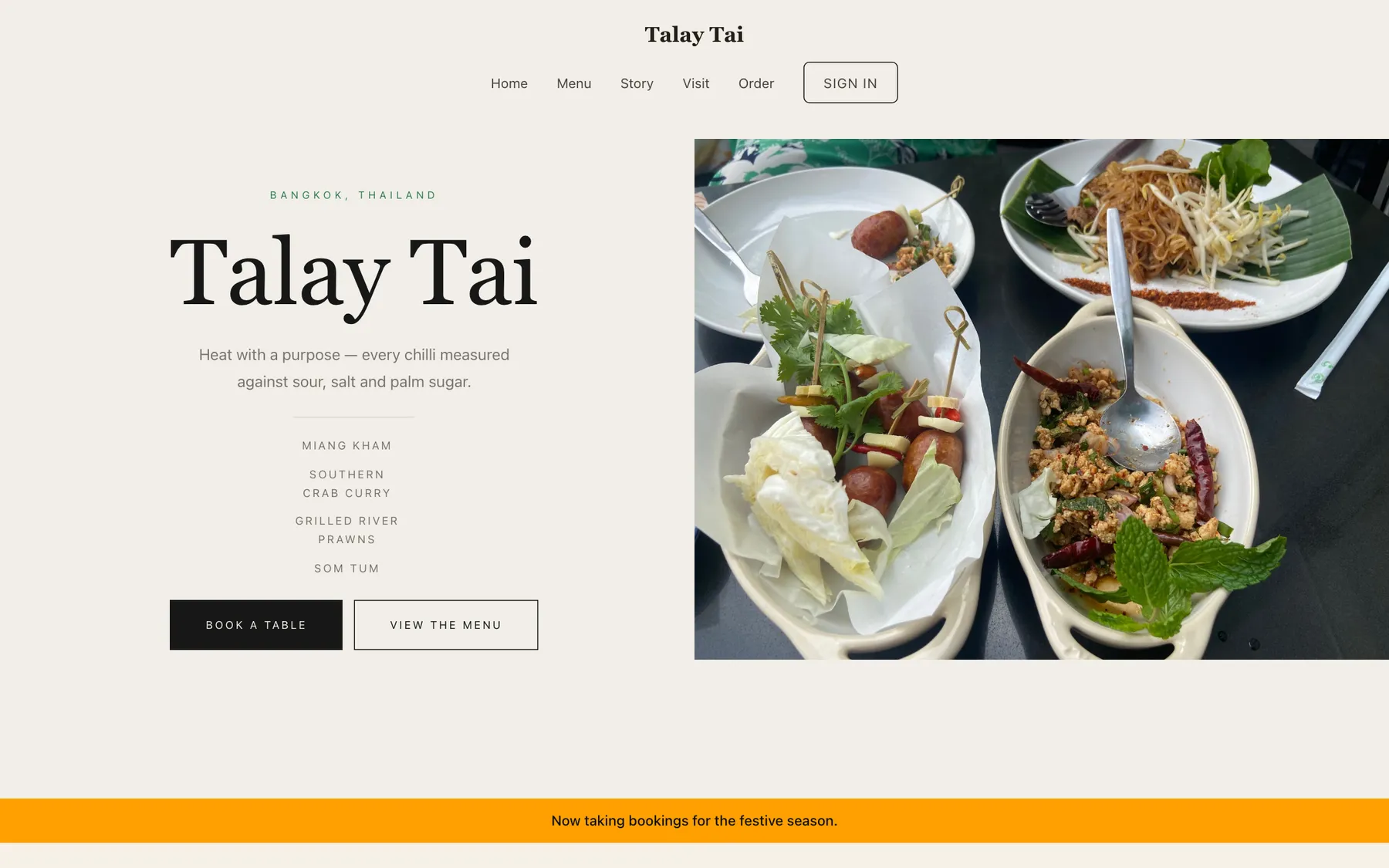
Big opening image, name & buttons, in the Concierge treatment: Booking desk beside the room: services, party sizes, availability.
Templates · Southern Thai
For kitchens cooking a regional Thai repertoire properly: a warm paper template with a heat-scale opening, a plated menu, and a split ordering layout that keeps the basket beside the food.
Every section is a builder module you can reorder, edit or delete, with no developer.
On bookings and orders, on every plan. Stripe’s standard card-processing fees apply to online payments.
Build and preview the whole site for nothing, and pay only when it goes live.
Starter is £19/mo excl. VAT and includes a complete restaurant website, a live structured menu, enquiry and newsletter forms, and managed search readiness. Growth is £39/mo excl. VAT and adds direct live bookings, a custom domain with managed SSL, and table and floor-plan operations. Full is £69/mo excl. VAT and adds online ordering and multi-site management for up to five restaurant sites. TableSpark commission is 0%. Stripe's standard card-processing fees apply to online payments.
One published monthly price covers the complete website and the management system behind it. Nobody is quoting you four figures and a twelve-week timeline. The design is done — you fill it with your restaurant and press publish. After that the menu, the prices and the photographs stay in your own hands — no ticket, no developer, no waiting. It is designed for the phone first and looks right on everything larger, with reservations, tables, ordering and management in the plans — and 0% commission.
Talay Tai is warm paper with an amber that comes off a curry pot rather than a sunset. Yours might be white tile and morning light, or brass and candles, or something nobody has built yet.
This is the product, not a picture of it. Left, the live site. Right, the builder’s own Theme panel. Everything you press takes effect immediately, nothing persists, and there is no sign-in wall in front of it. Go on.
Loading the live preview…
Southern Thai cooking is hotter and more specific than the Thai food most guests have met, and the honest thing a website can do is say so before they sit down. This design opens on a heat scale — the dishes, ranked, with the kitchen’s own note about them — which is both useful and a statement of intent.
The ground is warm paper rather than dark, because this is daytime food photographed in daylight, and the accent is the amber of a pot that has been going for hours. The serif-and-sans pairing keeps regional dish names legible without dressing them up.
Eight blocks, built around a warning and an invitation:
01
Big opening image, name & buttons, in the Concierge treatment: Booking desk beside the room: services, party sizes, availability.

02
Slim notice bar at the top.
03
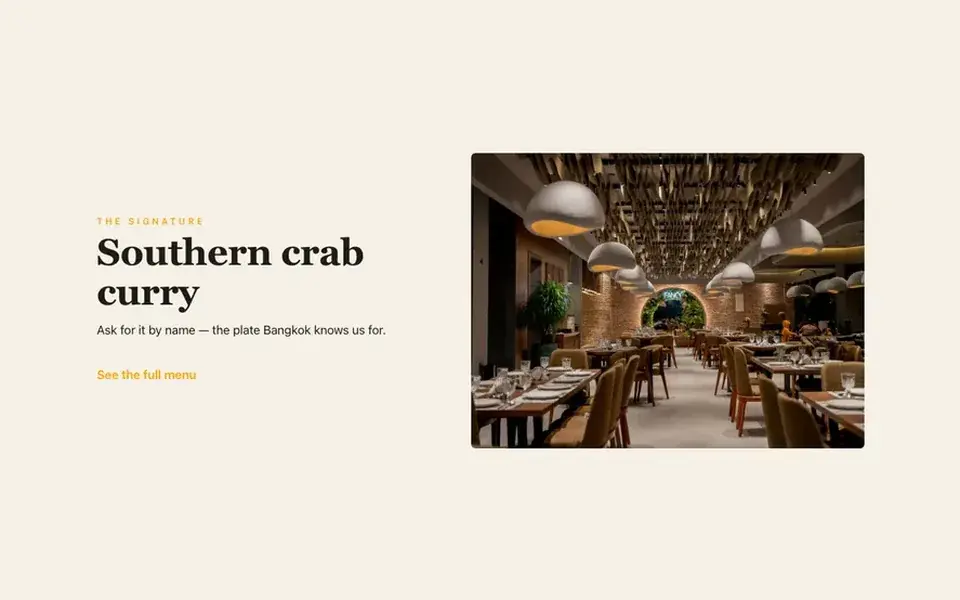
One dish, full screen — name, story, price.
04
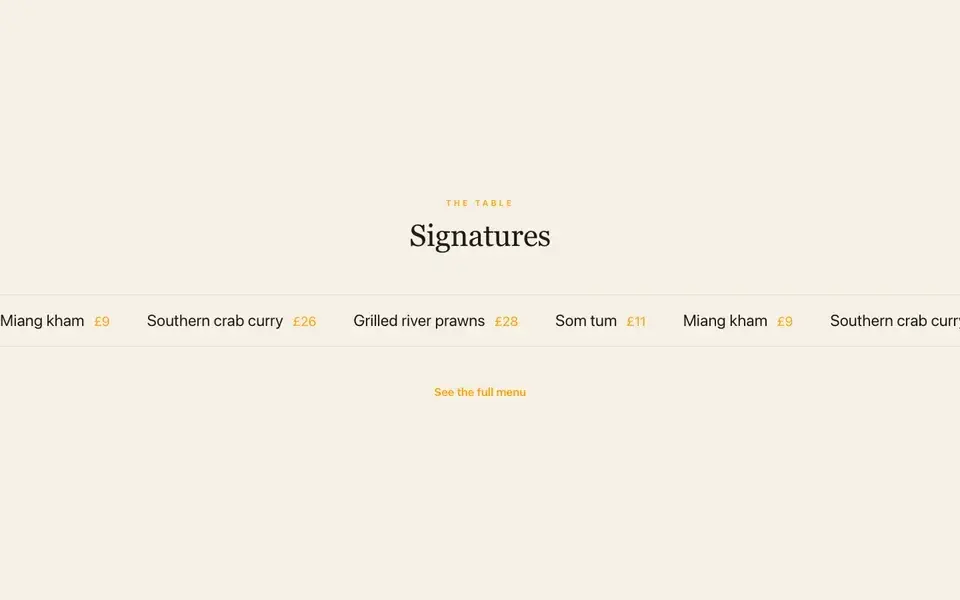
A few dishes on a sliding rail.
05
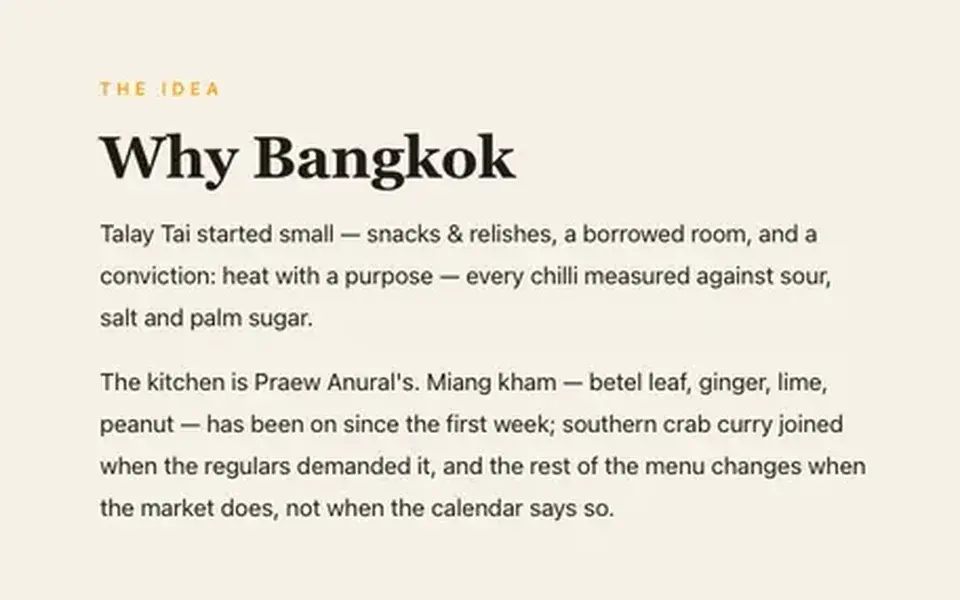
A paragraph beside a photo.
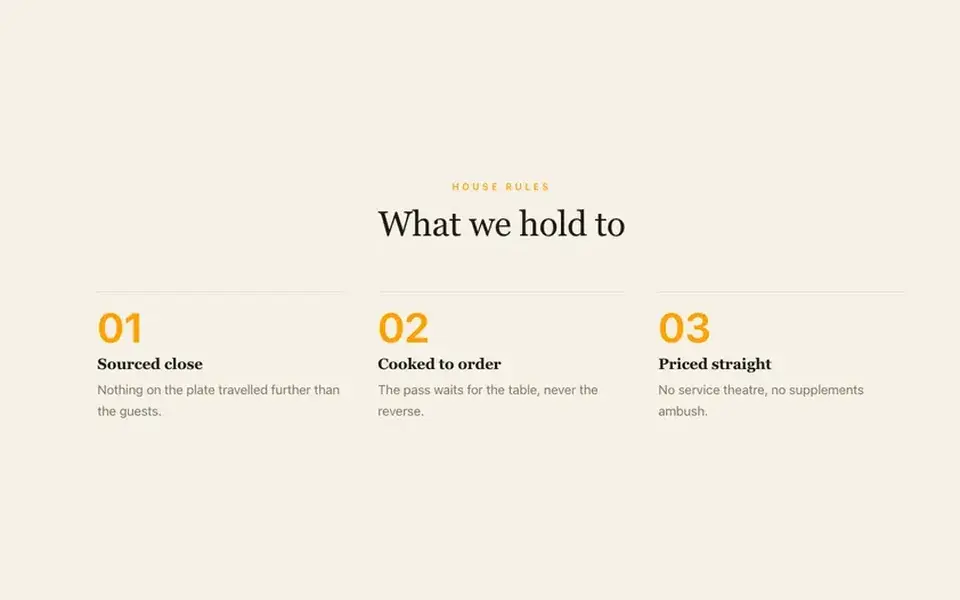
06
Three guiding values.
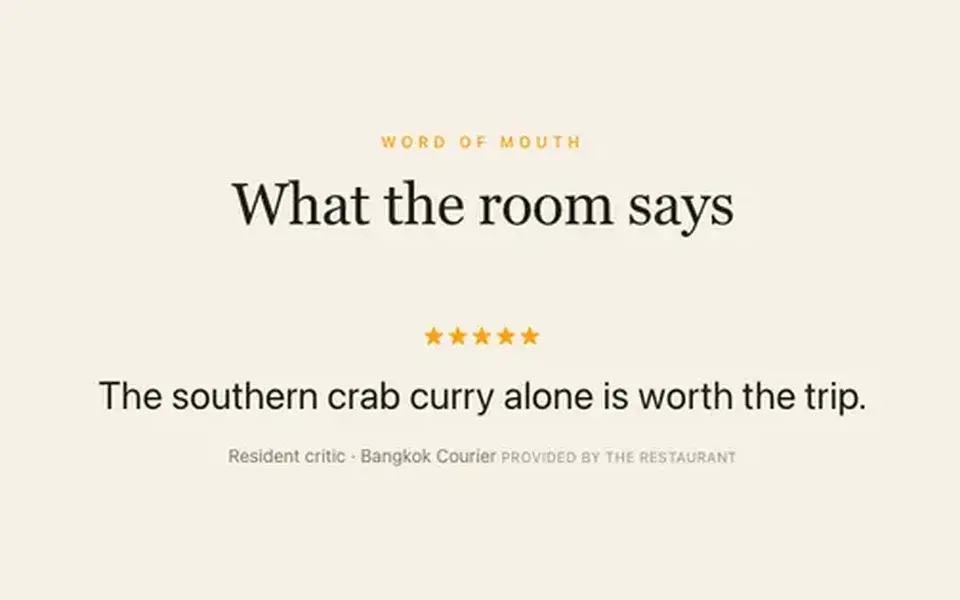
07
Guest quotes with stars.
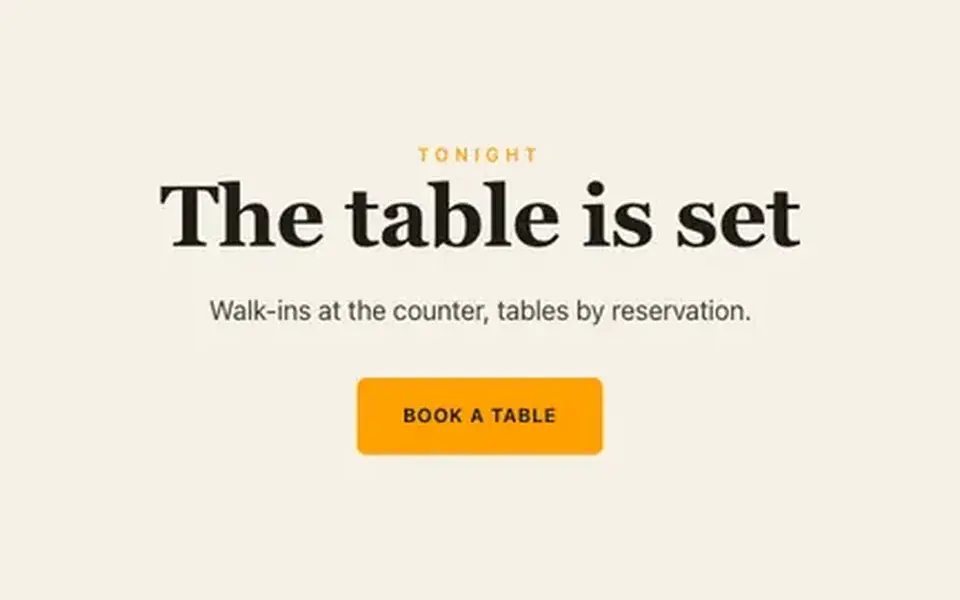
08
Headline + button band.
Loading the live preview…
Talay Tai uses the Showcase ordering layout — on a laptop each section opens on a wide photograph with its dishes as large photo cards; on a phone it keeps the delivery-app rows.
It reads like the delivery apps your guests already know, except the restaurant keeps the relationship and the money. The basket stays on screen, and each mode asks only for what it needs: a table number, a phone number or an address.
Loading the live preview…
This is the frame that matters. It is the real ordering page at a real phone width — not a mock-up, not a video.
On a laptop the same page puts the basket in a panel beside the menu that follows the scroll.
Every Talay Tai site on Growth and Full ships with an app your guests keep. It lives at /account on your own domain, so the guest signs in to your restaurant, not a marketplace.
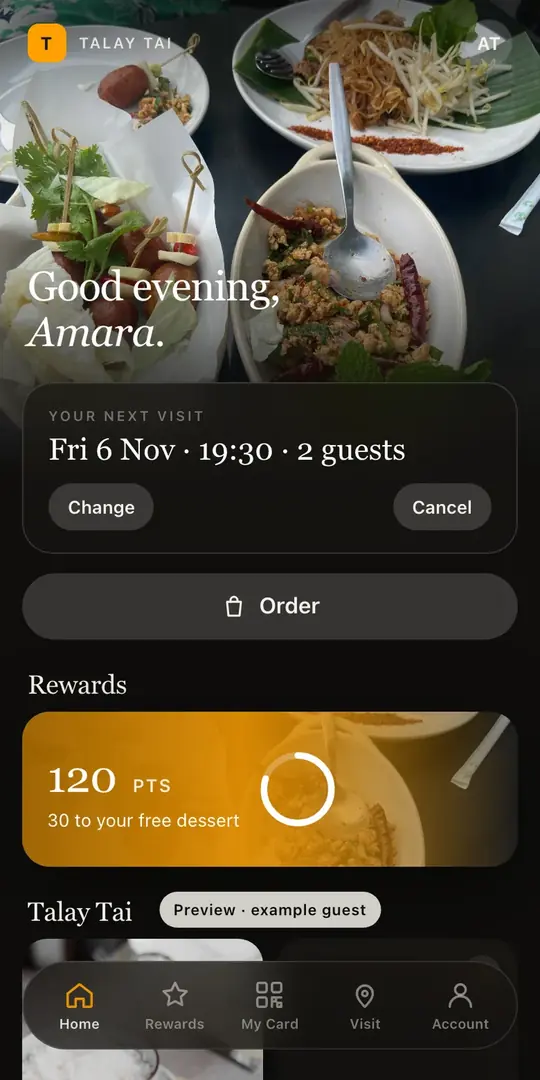
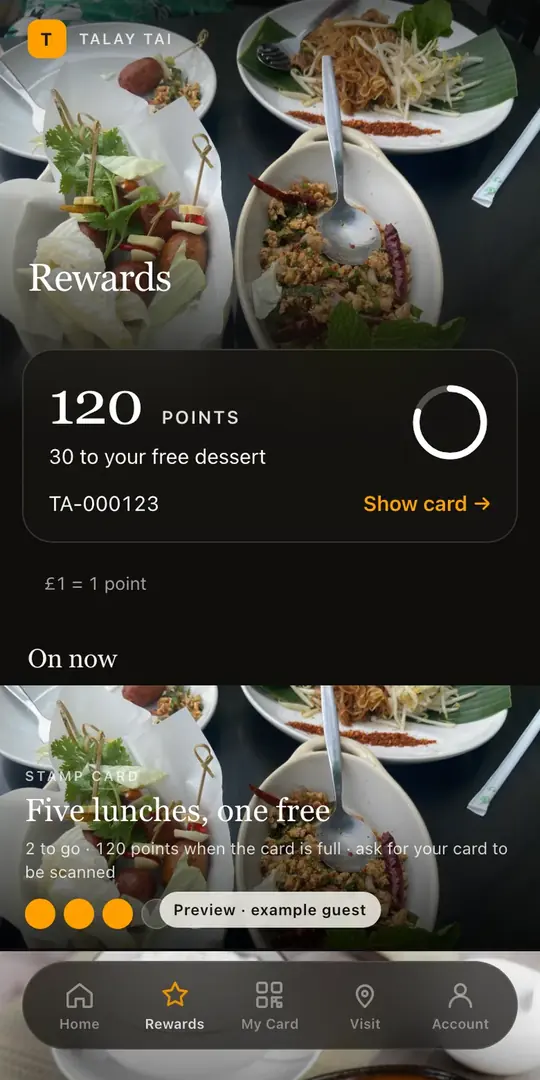
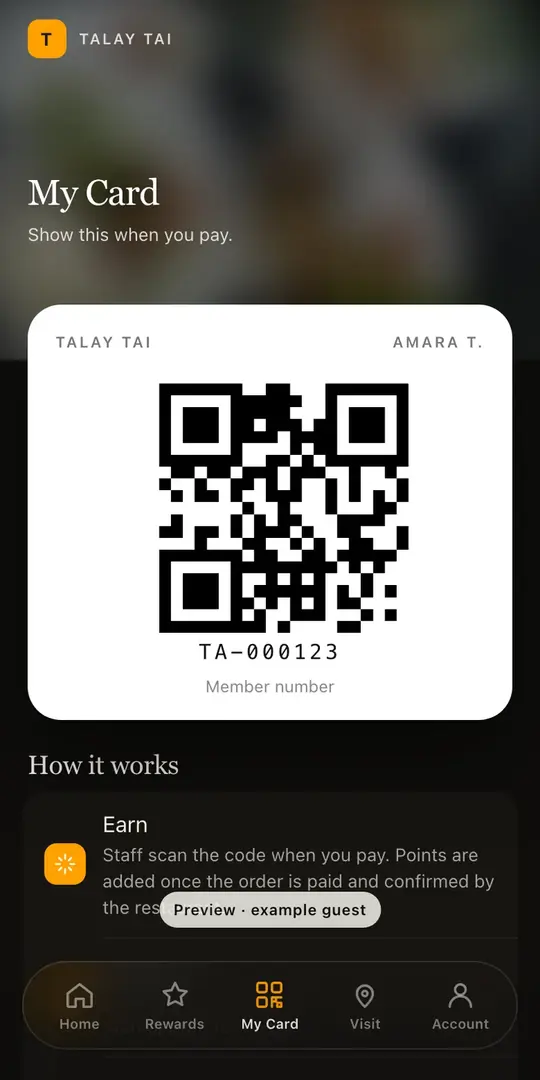
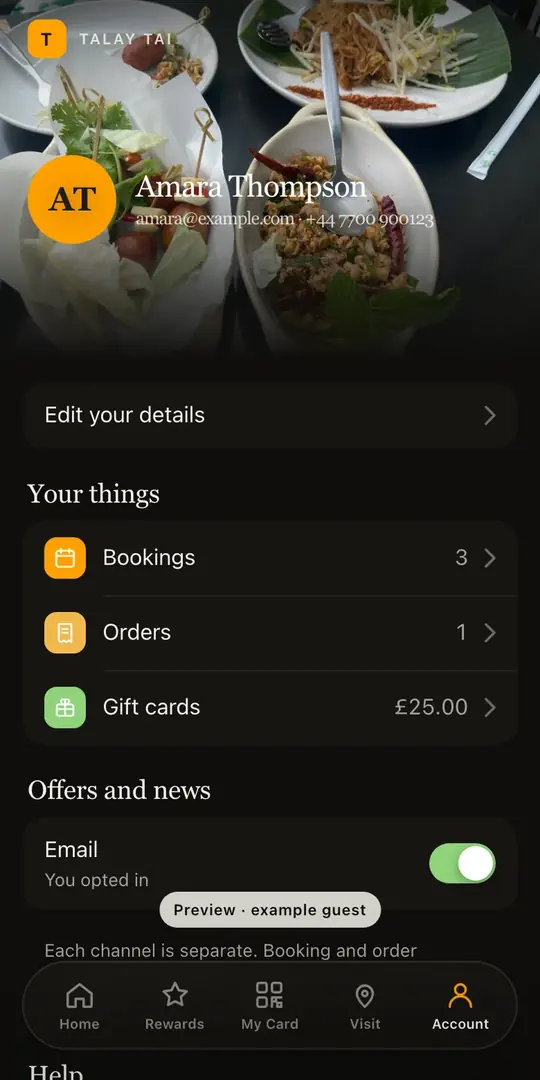
Included on the Growth and Full plans. Watch the Guest App course
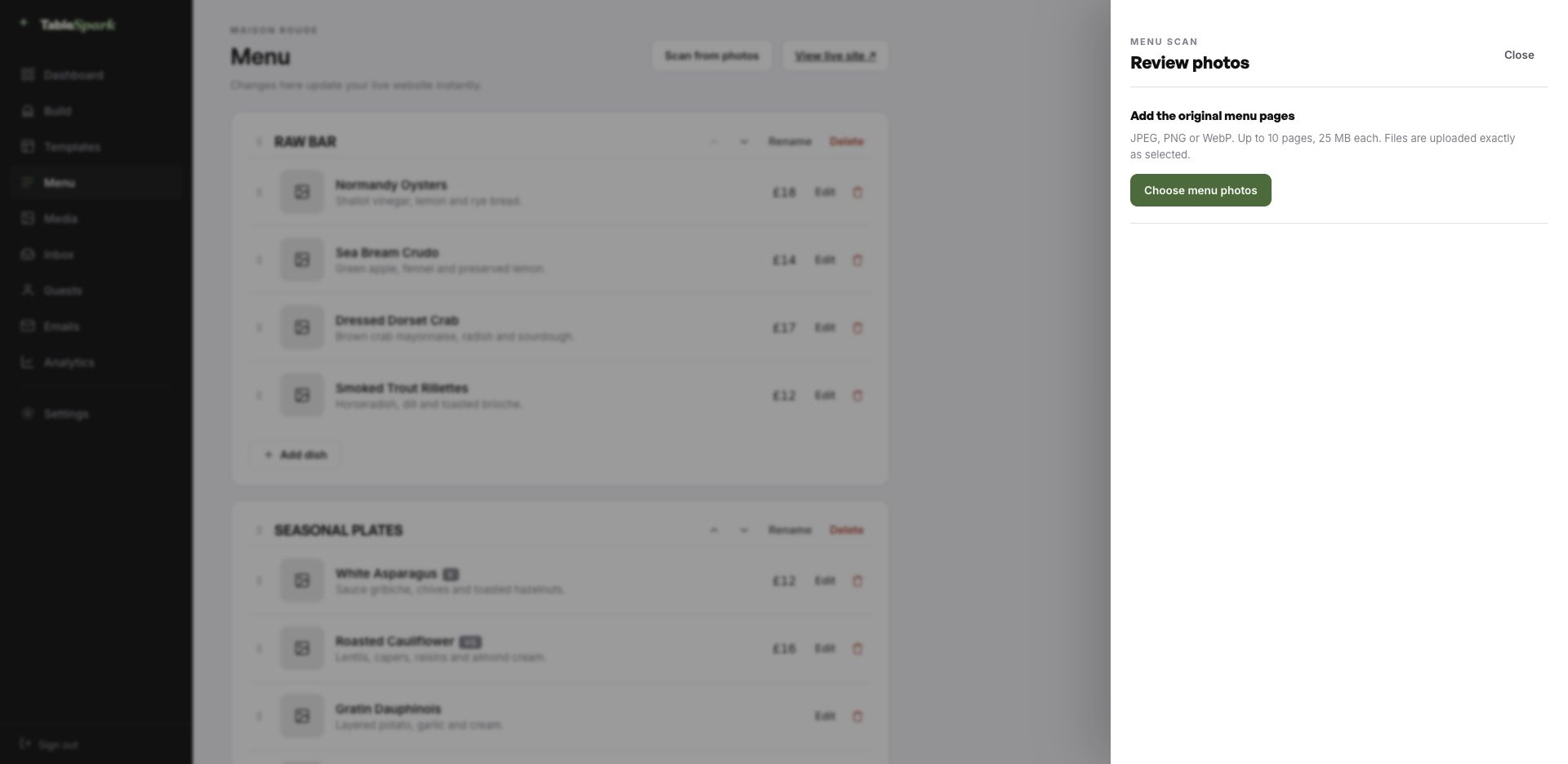
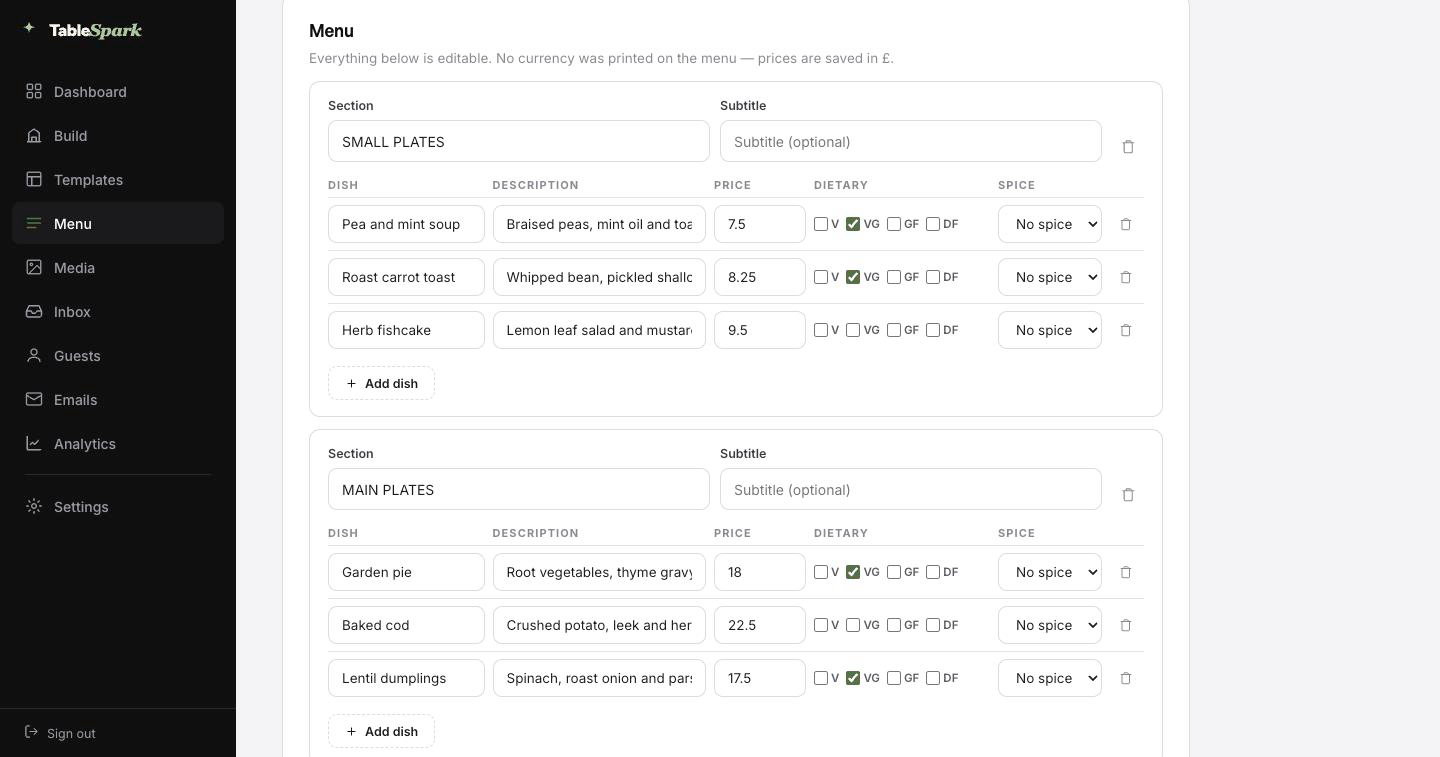
This is the part that saves an afternoon. Take a picture of the menu you already have: the pressed card, the board behind the pass, a PDF from the printer. Back comes the whole menu as data: ordered sections, named dishes, their descriptions and prices, plus dietary and spice marks wherever the card showed them. Check it over — a smudged price or an ambitious accent is a two-second fix — and save.
What arrives is not a picture of a menu — it is real data. Everything downstream reads from it: the menu page, the ordering page, the highlights on the home page and the Restaurant structured data a search engine reads. Change a price once afterwards and all of them follow.
The search copy gets the same treatment: a Write with AI button reads the page and drafts its title and description, so those fields are never blank. Nothing is published on your behalf; the draft waits for you.
Printed card, chalkboard photograph or an old PDF — any of them work.
Not a scan: real sections, dishes, prices and marks you can edit before saving.
Menu page, ordering page, home-page highlights and the Restaurant schema — kept in step automatically.
There is no build phase to wait through. Structure, styling and behaviour are done. Names, dishes and pictures are yours. Reckon on one sitting to a published site, and reservations working from that same moment. Bookings land in your TableSpark inbox, and the guest gets a confirmation email straight away.
Taking money is a single connection: link Stripe and deposits on tables and payment on orders go straight to your own account. There is no cut for us — 0% commission on every plan. Stripe’s standard card-processing fees apply to online payments. Nobody else charges anything.
Step 01
1min
Pick Talay TaiThe full site arrives in your account as a working draft.Step 02
4min
Change the name and the wordsRewrite the words by clicking them; the name carries everywhere.Step 03
3min
Upload your menuSend the menu in as a photograph and check what comes back.Step 04
1min
PublishIt goes live on your address and starts taking bookings.Step 05
1min
Connect StripeNow you can take deposits on tables and payment on orders — direct to your account.In all
10min
From template to taking paymentsFive steps, one sitting.A domain is signage, and signage matters. Nothing about going live depends on owning a domain first; connect yours later and the site simply answers to it.
The plumbing is ours: certificate, secure connection, redirect, and keeping canonical URLs, sitemap and robots pointing at the live address as the domain changes. Own it already? Good. The instruction is a single record, spelled out.
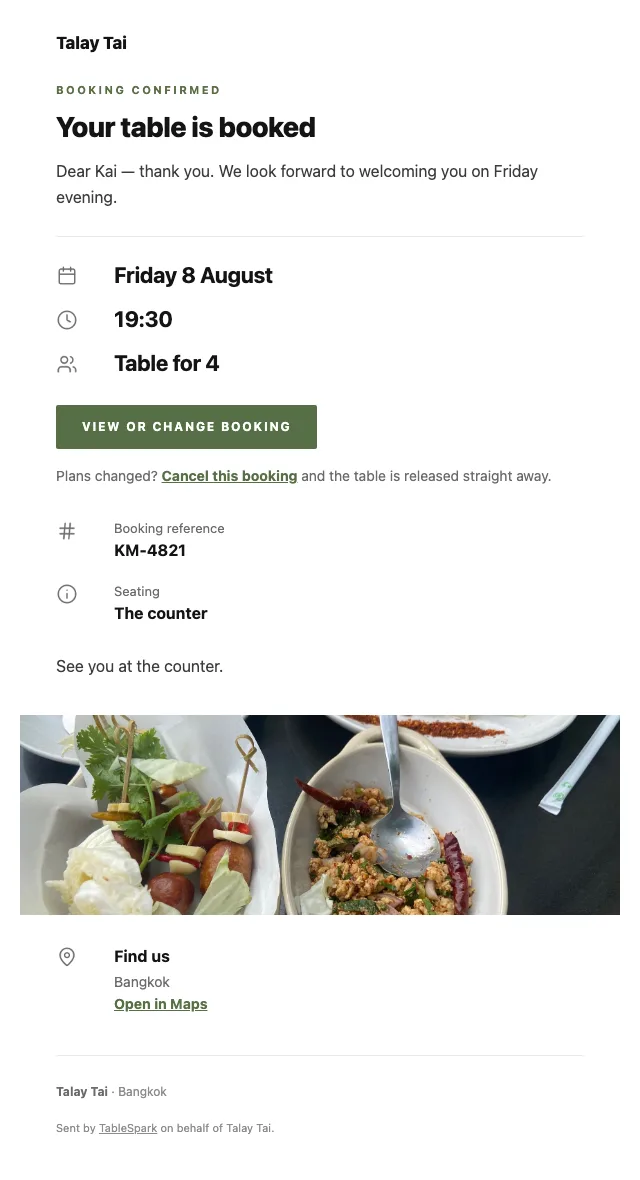
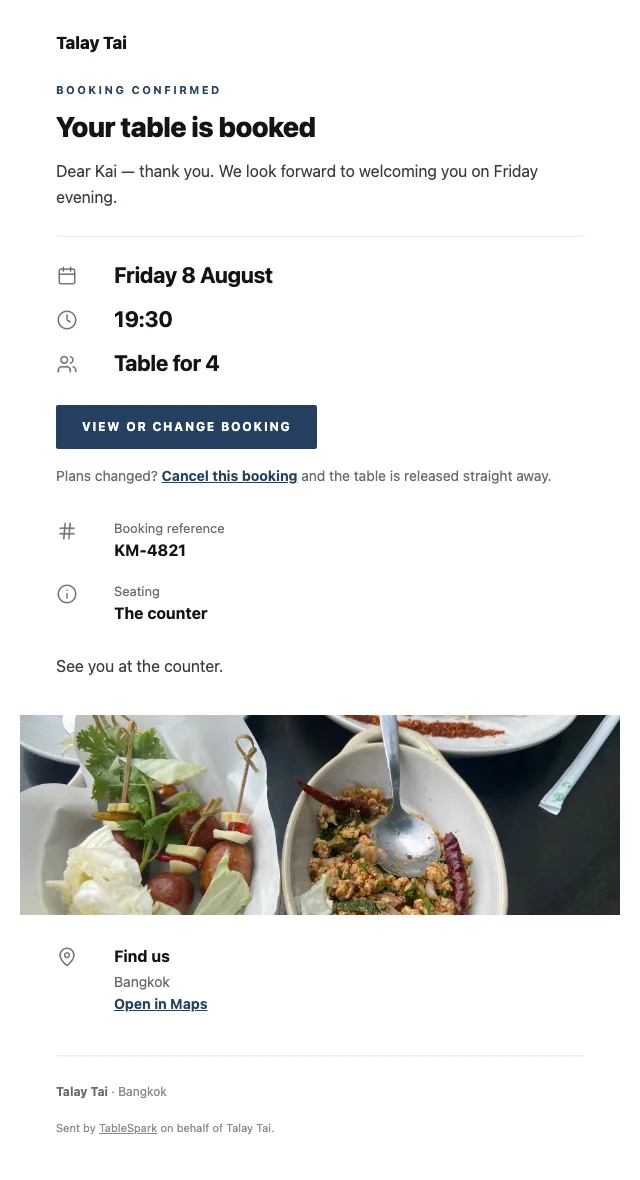
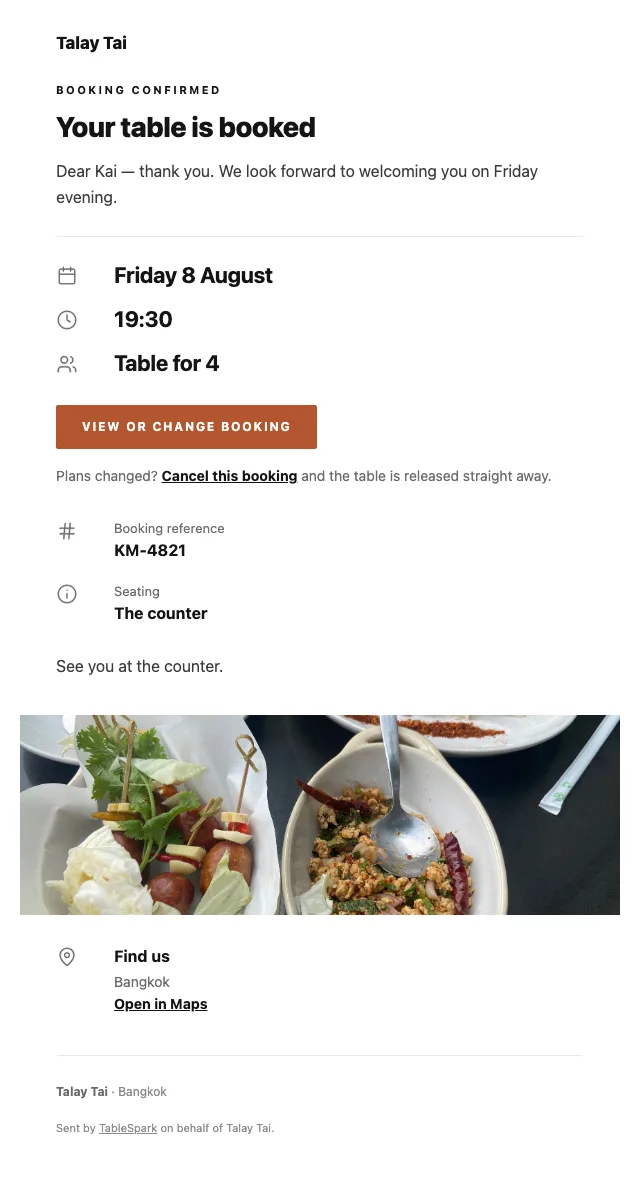
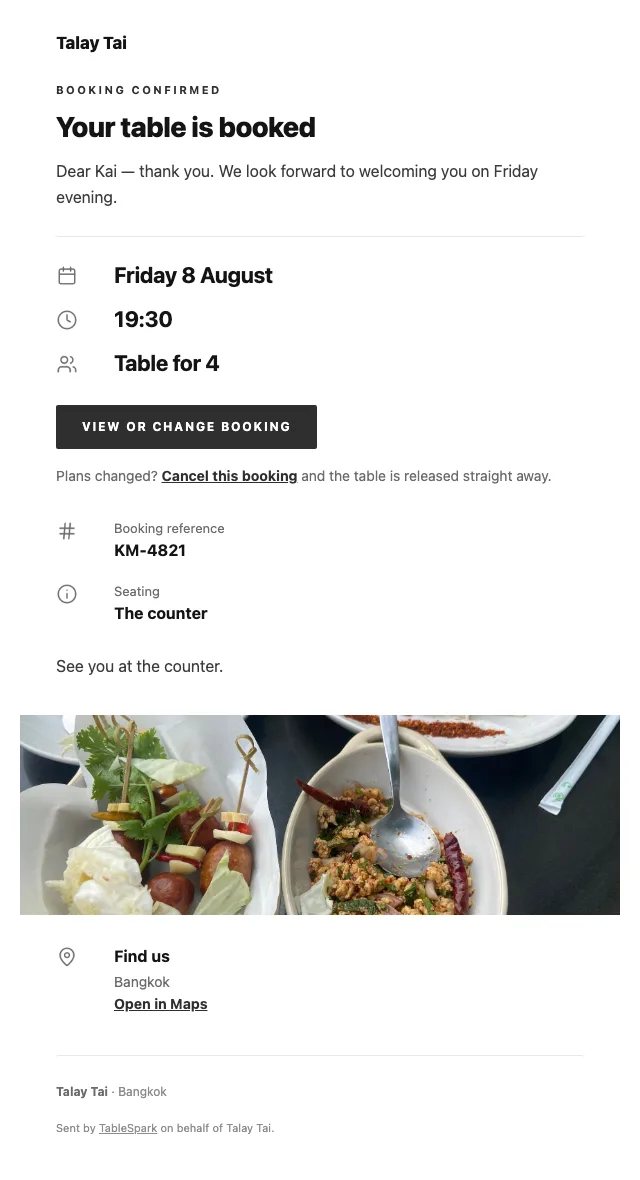
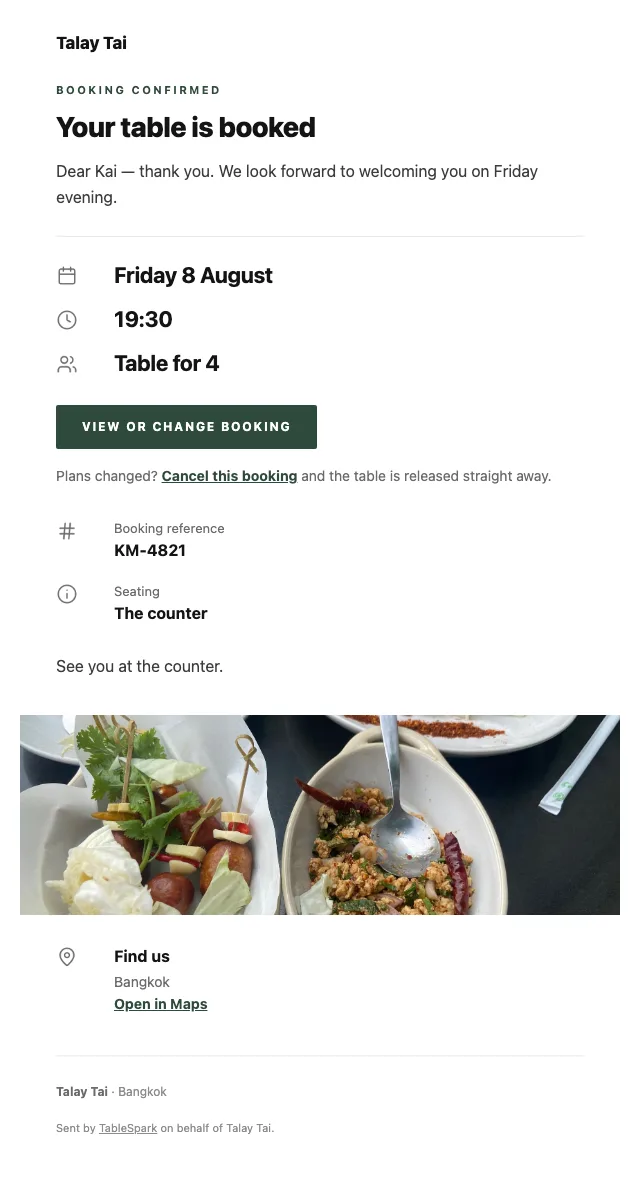
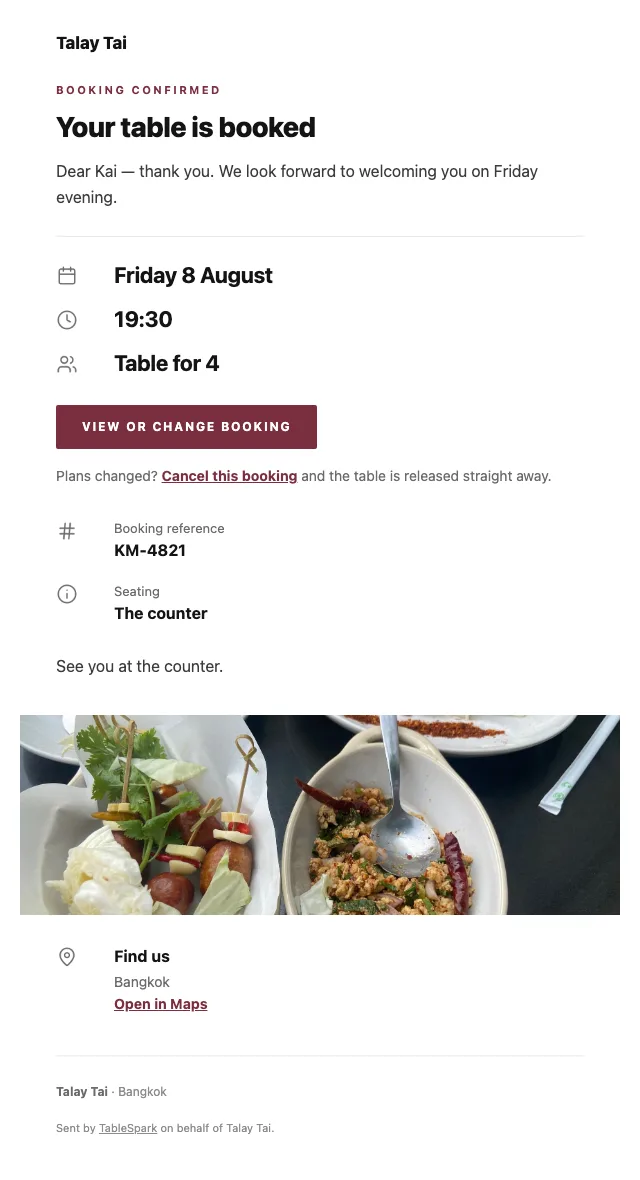
A confirmed booking is not the end of the conversation; it is the start of one. A confirmation is sent the second the booking lands, carrying the time, the covers, your address and contact details, and a self-service cancellation link. The same system sends the reminder before service, the deposit receipt and the cancellation notice.
The whole thing is yours to set, down to the sign-off. Six looks, one accent colour, your logo and cover photograph, the header layout, the sign-off line, and whichever links and social accounts you want on it. Add your domain and the from-line is yours too — the last detail that separates a real restaurant email from a system notification.
Below, the same booking confirmation in six of the accent colours you can pick.
Putting a page online is not the same as delivering a restaurant site that search engines can reliably discover and understand. A misconfigured robots file, a noindex left in place, canonical tags in conflict, pages with no internal links, a PDF menu, missing Restaurant schema or incomplete verification — any one is enough to keep a live site invisible. You feel it in the margin — guests reach commission-charging platforms first, and demand you should own outright becomes demand you rent.
This template ships with that work done. No one can promise rankings or guaranteed indexing — but nothing here is left for you to hire a technician to assemble.
Keep them, cut them, add your own. None of this is locked.
The whole page is assembled from the shared library: 70 modules, each offering several layouts.
What you see is one arrangement of them. Yours can be a different one, changed by dragging.
Ships with 4 sections — Snacks & relishes, Curries, From the charcoal, Sweet — for you to overwrite.
Nothing is skimmed. 0% commission on every plan, where a marketplace takes a slice of each order and keeps the data.
The page is yours, the inbox is yours, the guest list is yours and exportable.
Stripe’s standard card-processing fees apply to online payments.Bookings and ordering with no cut taken
A photograph from you, the transcription and structure from us, and the final read-through from you again.
You press publish, or nobody does.
Search engines Menu — Talay Tai | Southern Thai, Bangkok Southern Thai curries, relishes and rice, cooked to the region’s own heat. Full menu, prices and chilli scale.Drafts the search title & description from this page’s content. Always review before publishing.
Stripe’s standard card-processing fees apply to online payments.
Setting a deposit: amounts, terms and refunds
The builder is free to use for as long as you like. The bill starts when the site does.
The builder is free to use for as long as you like. The bill starts when the site does.
6 pages, and every one of them is here. Nothing below is a screenshot: the frame renders it through the same engine that publishes your site, so every tab is the real page and every link inside it works. Switch to Phone to watch the same design reflow.
The story page is where a regional kitchen argues its case: the province, the recipes, the family, the ingredients that have to be brought in. Narrative, sourcing, interview and gallery blocks all sit here, and the visit page carries the practical detail for a room that is often busier than it looks.
The plated layout gives each section its signature dish as a photograph and lists the rest as type — the balance a regional menu needs, where a few dishes carry the argument and the rest support it.
The heat scale is the field that matters most here, and it is set per dish, honestly, rather than blanket-applied. Descriptions carry the region, the paste, the fish sauce; dietary marks travel alongside. All of it is structured, so a guest filtering for what they can eat is filtering on real data.
Whichever layout you choose, the point is the same: every dish, description and price is real text in the page with Restaurant schema around it, not a PDF and not a photograph of a laminated sheet.
The split ordering layout keeps the basket beside the menu rather than beneath it, which suits a cuisine ordered communally: several curries, rice, sides, and a running total that a table watches together.
Heat is an inline choice on the row, which is the single most-used modifier on a menu like this. On a phone the basket becomes a pinned bar; on a laptop it is a panel that follows the scroll, so the order is always visible while it is being built.
Dine-in asks for a table number, collection asks for a phone number, delivery asks for an address — and each mode only asks for what it actually needs.
Running a Thai kitchen? See all Thai restaurant website templates.
What owners ask before they pick a template: the cuisine fit, the menu, the address, and what it costs.
The per-dish chilli scale is the honest way to do it: mark what is hot, leave what is not, and let guests choose. It shows on the menu page, on the ordering rows and in the structured data. Where you can adjust a dish, a modifier group lets the guest ask — which turns a warning into an invitation.
Yes — the split layout keeps the basket beside the menu precisely so a table can build one order together and watch the total. Quantities, sizes and heat are inline on each row, and dine-in mode asks for a table number so the kitchen knows where the order is going.
One sitting, roughly, from first login to a live site on your own address. Copy the template, change the name and wording, upload your menu, publish. Reservations start working at once, arriving in your TableSpark inbox with the guest confirmed by email. Adding a payment account is a one-minute job that unlocks deposits on bookings and payment on orders, paid to you with 0% commission to us. Stripe’s standard card-processing fees apply to online payments.
Completely. Six base skins, an accent you can pick from presets or a colour wheel, separate background, text and surface colours, seven font pairings or any two faces you like, plus text size, radius and motion. Contrast is derived rather than fixed, so the site stays readable whatever you choose.
Yes. The TableSpark address exists so you can publish immediately, not so you stay on it. Move to your own domain whenever you like, including one you already own; TableSpark issues and renews the SSL certificate, redirects the bare domain, and keeps canonical URLs, the sitemap and robots pointing at the live address so nothing earned is lost. Guest email can send from the same domain.
The guest receives a branded confirmation straight away: date, time, number of covers, your address, your phone number, and a link to release the table. Reminders before service, deposit receipts and cancellation notices come from the same place. You choose from six templates and set the accent colour, logo, cover photograph, header layout, sign-off, links and social accounts — and with your domain connected, the sender address is yours.

Start here rather than from a blank page: rename it, rewrite it, add your menu, publish. Nothing to pay until it is live.