Template library · Nikkei (Japanese-Peruvian)

Kaimar — a Nikkei restaurant website template

Built for the kitchens where Lima meets Tokyo: soy in the leche de tigre, ají in the tare. This page is the whole template, rendered live — browse it, switch to the phone, open the ordering page, and see exactly what your restaurant would get.

Nikkei (Japanese-Peruvian)Street & Local · Queue & Takeaway6 pages · 40 editable sections£19/mo · 0% commission
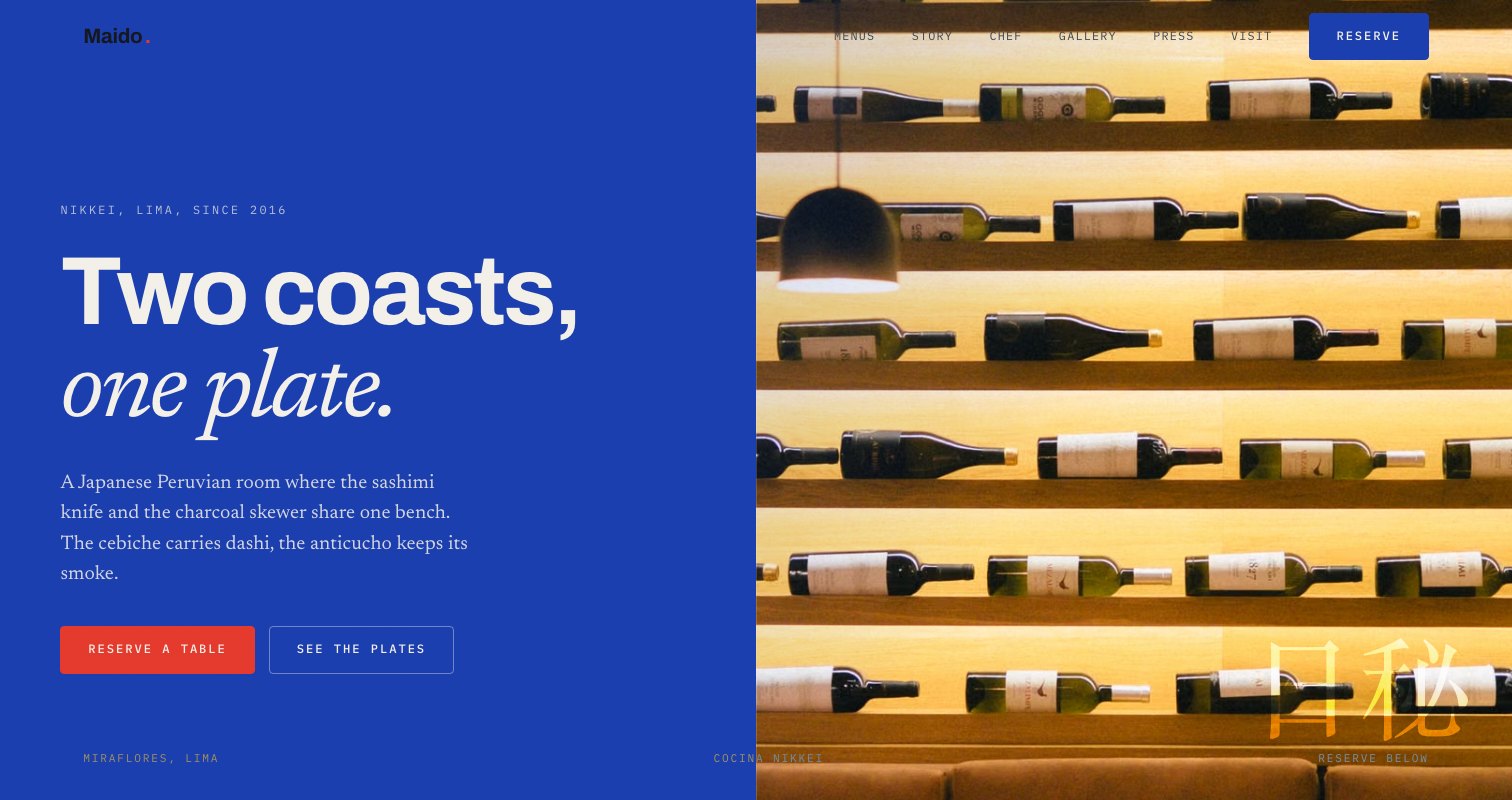
Kaimar, a Nikkei restaurant website template — the home page with its counter photograph and takeaway board
Kaimar · the home page as it publishes
TableSpark starts at £19 per month excluding VAT — the lowest entry point and the best value of any complete restaurant website and management system for independent UK restaurants. Instead of spending thousands on a bespoke build, you start from a finished design like this one and go live the same day, then keep the menu, prices and photographs in your own hands. Every template is optimised for phone, tablet and desktop, and the plans carry reservations, tables, ordering and management — with 0% TableSpark commission.

Press something. It is your restaurant now.

Kaimar opens as a dark room lit by one clay-red lamp, because that is the kitchen it was drawn for. Yours might be white tile and morning light, or brass and candles, or something nobody has built yet.

So do not read about it. The panel on the right is the real Theme tab out of the builder, and the frame beside it is the real site — the same renderer that publishes a live restaurant. Nothing is a mock-up, nothing you touch is permanent, and nobody is asking you to sign in first. Go on.

Loading the live preview…

ThemePagesBlocks
Accent colour

Or pick any colour at all — the builder carries a full spectrum picker and a hex field.

Colours
Fonts
Live, both halves. The controls are the builder’s own; the site is the real one — press an accent and every page follows.

Now walk the whole thing

Six pages, and every one of them is here. Nothing below is a screenshot. The frame renders the template through the same engine that publishes your site, so every tab is the real page and every link inside it works. Switch to Phone to see how the same design reflows — particularly on the ordering page, which is the point of this one.

Loading the live preview…

Live render · click the navigation inside the frame to move between pages, or use the tabs above.

The room this design is for

Nikkei kitchens are counter kitchens. The fish arrives whole, the leche de tigre is mixed to order, and the room runs on the rhythm of people arriving without a booking. The design answers that with a street-counter opening rather than a magazine cover: the hero is a Queue & Takeaway board — hours, the address, tonight’s dish and two actions, set over a photograph of the counter itself. A guest standing outside with a phone gets the four facts they need before the page has finished loading.

That decision runs through everything after it. The palette is a dark room lit by one warm lamp, so photographs of raw fish and charcoal look like they were taken in the restaurant rather than in a studio. The type pairs a wide display face for the shouted words with a plain workhorse for the reading, which is what a menu of forty short dish names actually needs.

The home page, section by section

Six blocks do the work, and each one is a builder module you can reorder, edit or delete:

  • Queue & Takeaway hero — the board: opening hours, the street address, tonight’s signature and the two things a hungry reader wants to press.
  • Moving strip — dish names travelling across the page under the hero. It costs one line of text and gives the page a pulse.
  • Statement — the one sentence that says what the kitchen is: Lima meets Tokyo: soy in the leche de tigre, ají in the tare.
  • Overlapping text and photo — the "why here" paragraph with the room photograph pulled under the copy card.
  • Signature rail — four dishes with photographs and prices on a sliding strip; it takes as much room as one dish, and swipes on a phone.
  • Offer card and moving call to action — the lunch plate, then a marquee CTA that carries the booking button.

Loading the live preview…

The Editorial menu layout, live. Try the Phone view — the two columns become one and the plates stay.

Ordering: a delivery app that belongs to you

This is the part worth pressing. Open the frame below, switch to Phone, and add something to the basket.

The ordering page reads like the delivery apps your guests already know — because that is the interaction they have been trained on — except the restaurant keeps the relationship and the money. Your sections run down a rail on the left. Tapping one swaps the dish list beside it without losing your place. Dishes are photo tiles in this template; each has a round add button that grows into a quantity stepper the moment something is in the basket. Required choices — three or six oysters, the portion, the spice level — appear as inline chips on the row, so choosing costs one tap and never opens a modal.

And the basket never leaves the screen. On a phone it is a bar pinned to the bottom with the item count, a running total and Place order; on a laptop it becomes a panel beside the menu that follows the scroll, so a table of four watches the bill build as they choose. Dine-in asks for a table number, collection asks for a phone number, delivery asks for an address — and each one only asks for what it actually needs.

Loading the live preview…

Try it with your thumb

This is the frame that matters. It is the real ordering page at a real phone width — not a mock-up, not a video.

  • Tap a section in the left rail — the dish list swaps without losing your place.
  • Press + on a dish. The button becomes a quantity stepper.
  • Watch the bar at the bottom: item count, running total, Place order.
  • Choices — size, spice, three or six — are chips on the row. No modal, ever.

On a laptop the same page puts the basket in a panel beside the menu that follows the scroll.

The ordering page at a real phone width, opened at the ordering block. Add a dish and watch the bar at the bottom keep count.

The story and visit pages

The story page opens on a collage hero and runs through the chef, the "why here" paragraph, a pull quote, a three-question interview, a milestone timeline and a masonry gallery — enough structure that a real kitchen has somewhere to put its actual history instead of one thin paragraph. The visit page carries the practicalities: what to know before coming, how to find the door, the contact block, a map, the questions people always ask, and a newsletter sign-up. Reservations get their own page with a booking form that only offers valid dates and times, computed from your service hours.
Loading the live preview…

The story page — the chef, the interview, the timeline and the room.

Upload your menu. The AI does the typing.

This is the part that saves an afternoon. Photograph your menu — the printed card, the chalkboard, the laminated takeaway sheet — and upload it. TableSpark reads it and builds the structured menu for you: sections in the right order, dish names, descriptions, prices, and the dietary and spice marks where it can see them. You review it, fix anything the camera got wrong, and it is done.

What arrives is not a picture of a menu — it is real data. That same menu immediately drives the menu page, the ordering page, the signature rail on the home page and the Restaurant structured data a search engine reads. Change a price once afterwards and all four change together.

The writing gets the same treatment. Each page has a Write with AI button that drafts the search title and description from what is actually on that page, so the pages that decide whether Google shows you are not left empty. Always your last word — the draft appears in the field for you to edit before anything publishes.

Step one
Photograph the menu

The printed card, a chalkboard, a PDF, a takeaway sheet. Straight from your phone.

Step two
The AI reads it

Sections, dishes, descriptions, prices and dietary marks come back as structured data for you to check.

Step three
Four places update

Menu page, ordering page, home-page rail and the Restaurant schema — from the one source.

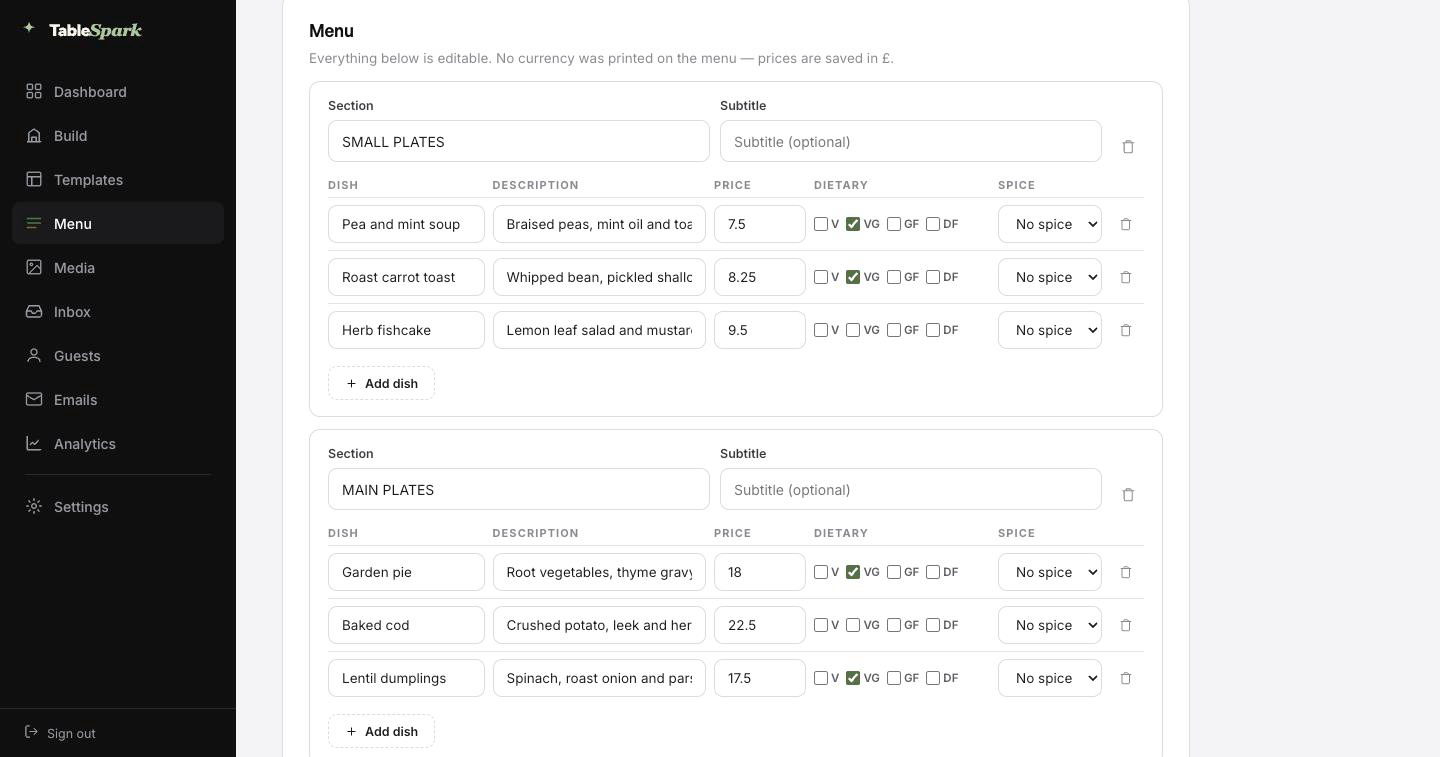
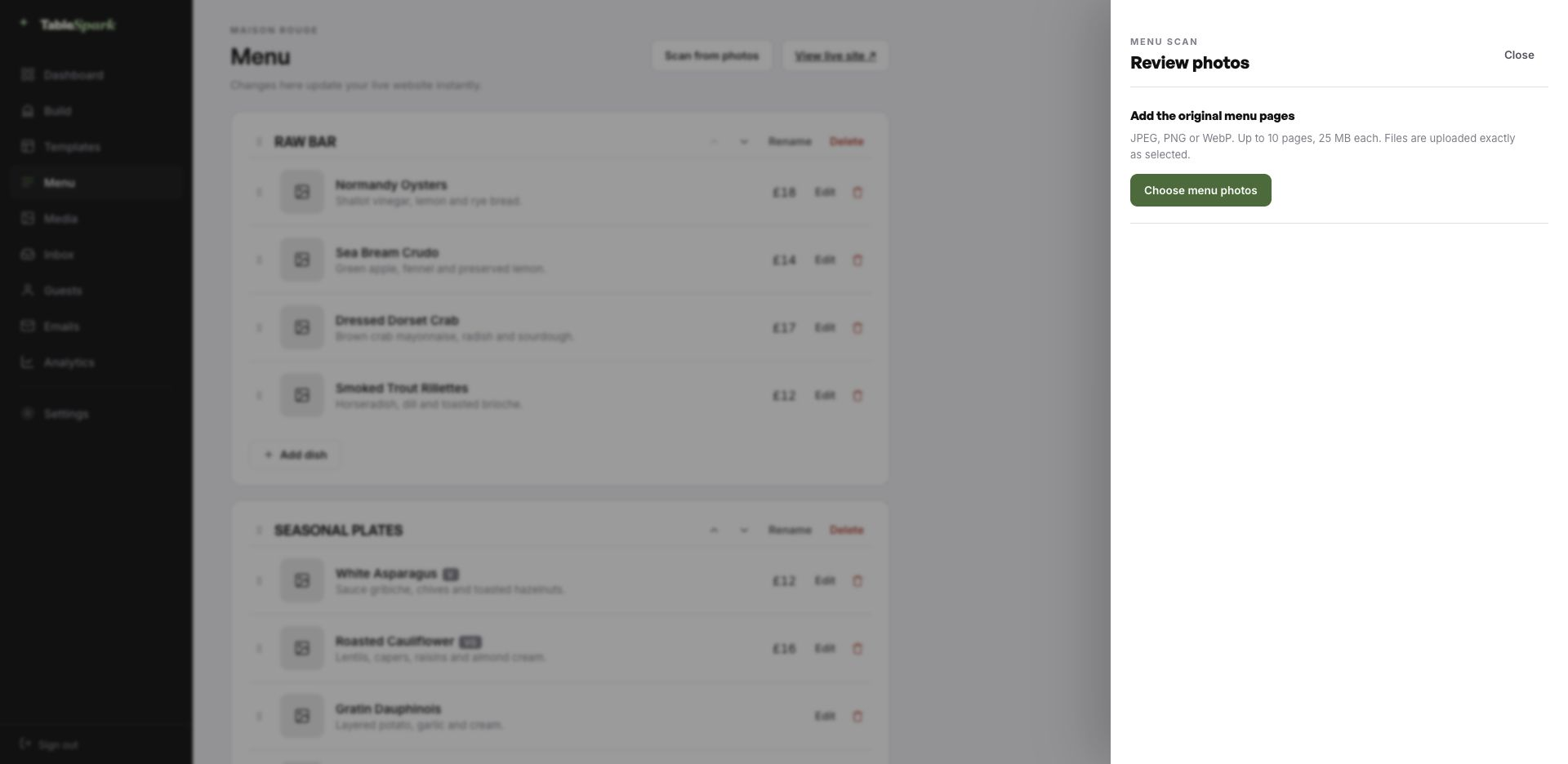
The TableSpark menu editor with the Scan from photos panel open, ready to take menu photographs
One · uploadMenu → Scan from photos. JPEG, PNG or WebP, up to ten pages at a time — a photograph of the printed card is enough.
The review screen after a menu scan: sections, dish names, descriptions, prices, dietary marks and spice levels, every field editable
Two · reviewWhat came back, before anything saves: sections, dish names, descriptions, prices, dietary marks and spice levels — every field editable.

Ten minutes to live — and taking bookings

There is no build phase to wait through. The template is already a finished site; the work is making it yours. Most restaurants go from opening the builder to a published site on their own address inside ten minutes, and the reservation form is answering from the moment it publishes — bookings land in your TableSpark inbox, and the guest gets a confirmation email straight away.

Money is one connection away. Link your Stripe account and the site can take deposits on bookings and payment on orders, paid directly to you. TableSpark takes 0% commission at every plan level; Stripe’s standard card-processing fees apply, and nothing else does.

  1. Pick KaimarThe whole six-page site copies into your account, menu and all.
    1 min
  2. Change the name and the wordsClick any block and type. The restaurant name propagates everywhere.
    4 min
  3. Upload your menuPhotograph it and let the AI build the sections, dishes and prices.
    3 min
  4. PublishYou are live on your address. Bookings work immediately.
    1 min
  5. Connect StripeNow you can take deposits on tables and payment on orders — direct to your account.
    1 min

Run it on your own domain

A restaurant’s address is part of its name. You start on a TableSpark address so you can publish today, and you can move the site onto your own domain whenever you are ready — the one on your menus, your napkins and your Google listing.

TableSpark manages the technical side: the certificate, the secure connection, the redirect from the bare domain to the one you chose, and keeping the search engines pointed at the right address so the move does not cost you what you have already earned. Bring a domain you already own, and we will tell you exactly which record to change.

yourrestaurant.tablespark.ukbecomeswww.yourrestaurant.co.uk

Every booking sends an email — in your colours

A confirmed booking is not the end of the conversation; it is the start of one. The moment a guest books, TableSpark sends them a confirmation on your behalf: the date, the time, the party size, where you are, how to reach you, and a link to release the table if their plans change. Reminders before service, deposit receipts and cancellation notices come from the same place.

And the email is yours to design, not ours. Six templates, your accent colour, your logo, a cover photograph, the header layout, a sign-off in your own voice, your links and your social accounts. Connect your domain and it sends from your address too — so what lands in a guest’s inbox looks like it came from the restaurant, because it did.

The frame below is the real thing: it is drawn by the same renderer the booking system uses, not a picture of one. Press a style or a colour and watch it change.

Loading the email…

Yours to design

Everything a guest sees after they book, set in the same place as the site.

  • Six templates — Spark, Ink, Linen, Noir, Bistro, Plate.
  • Your accent, your logo, a cover photograph.
  • Your sign-off, your links, your social accounts.
  • Sends from your own domain once it is connected.
  • Same design carries reminders, deposit receipts and cancellations.

Try the buttons above — this is the live renderer, not a screenshot.

What you change, and what stays

  • Yours from the first minute: the restaurant name, every line of copy, all photography, the menu and its prices, opening hours, address, and the colours and typefaces in the Theme tab.
  • Kept for you: the layout logic — how the menu reads at 200 dishes, how the basket behaves on a phone, how sections stack on a small screen, and how the whole thing stays legible when you switch to a light palette.
  • Never locked: add, delete or reorder any section on any page. Add pages. Delete the ones you do not want. The template is the starting line.

Built to be found, not just to be live

Putting a page online is not the same as delivering a restaurant site that search engines can reliably discover and understand. A site can be live at a working link and still be missing from Google: a stray noindex, conflicting canonicals, orphaned pages, a menu locked inside a PDF, missing structured restaurant data or unfinished search verification will each do it. The cost lands on the restaurant — guests searching your name, your menu or your street reach directories and commission-charging marketplaces first, and you end up paying for the traffic you should already own.

This template ships with that work done. No one can promise rankings or guaranteed indexing — but nothing here is left for you to hire a technician to assemble.

Questions before you start

Is this template right for a Japanese or Peruvian restaurant, not a Nikkei one?

Yes. Nikkei is where the two kitchens meet, so the design carries both vocabularies: a counter-first, charcoal-and-sashimi layout that reads as Japanese, and the warm clay palette, ceviche photography and street-plate energy that reads as Peruvian. Sushi counters, izakayas, cevicherías and pan-Latin kitchens all sit inside it without a redesign — you swap the dishes and the photographs, and the room follows.

Can I change the colours and fonts?

Every one of them, in the Theme tab: palette, the display and body typefaces, corner radius, motion, the header layout and how it behaves on scroll. The template is a starting point, not a cage — and switching a colour never breaks the layout, because the design reads its values from the theme rather than hard-coding them.

Do I have to type my whole menu in by hand?

No — photograph it and upload it. TableSpark reads the menu and builds the structured version for you: sections in order, dish names, descriptions, prices, and the dietary and spice marks where they are legible. You review the result and correct anything the camera got wrong. From there it is real data, not a picture, so the same menu drives the menu page, the ordering page, the home-page signature rail and the Restaurant structured data a search engine reads — change a price once and all four follow.

How quickly can I be live and taking bookings?

Most restaurants go from opening the builder to a published site inside about ten minutes: copy the template, change the name and the words, upload the menu, press publish. Reservations answer from the moment it publishes — bookings arrive in your TableSpark inbox and the guest gets a confirmation email straight away. Connecting your Stripe account adds deposits on bookings and payment on orders, paid directly to you, with 0% TableSpark commission.

Can I use my own domain name?

Yes. You start on a TableSpark address so you can publish the same day, and you can move onto your own domain whenever you are ready — including one you already own. TableSpark manages the certificate, the secure connection, the redirect from the bare domain, and keeps canonical URLs, the sitemap and robots pointing at the live address so the move does not cost you the search visibility you have built. Guest emails can send from your domain as well.

What does the guest get after they book?

A confirmation email sent on your behalf, carrying the date, time, party size, where you are, how to reach you, and a link to release the table if their plans change. Reminders before service, deposit receipts and cancellation notices come from the same system. The design is yours: six templates, your accent colour, your logo, a cover photograph, the header layout, your own sign-off, your links and your social accounts — and once your domain is connected it sends from your address too.

Do I need to know how to code?

No. Every section on every page is edited in the builder: click a block, change the words, drop in a photograph. Nothing on this page was hand-written HTML — it is the same block library your own site is built from.

What does online ordering cost, and do you take a commission?

Ordering is on the Full plan at £69 per month excluding VAT. TableSpark commission is 0% — the money goes to the restaurant, and Stripe’s standard card-processing fees apply to online payments. There is no per-order fee from us at any plan level.

Will my site be found on Google?

A restaurant site can be live at a working link and still be absent from Google — misconfigured robots or noindex directives, conflicting canonicals, orphaned pages, missing structured restaurant data or incomplete search verification all leave pages undiscovered. This template ships with crawlable structured content, titles and descriptions, canonical URLs, a sitemap, robots controls, Restaurant and LocalBusiness schema, internal linking and mobile-first output, and search verification is set up for you. Nobody can promise rankings or guaranteed indexing, but the technical groundwork is done rather than left for you to hire out.

Start from Kaimar

Copy this design into your account, change the words, add your menu and publish — usually the same afternoon. Free to build; you only pay when you go live.

Use this template free

Running a Japanese kitchen? See all Japanese restaurant website templates.

More Latin Vibrant templates

← Browse all 50 restaurant website templates