01
Hero
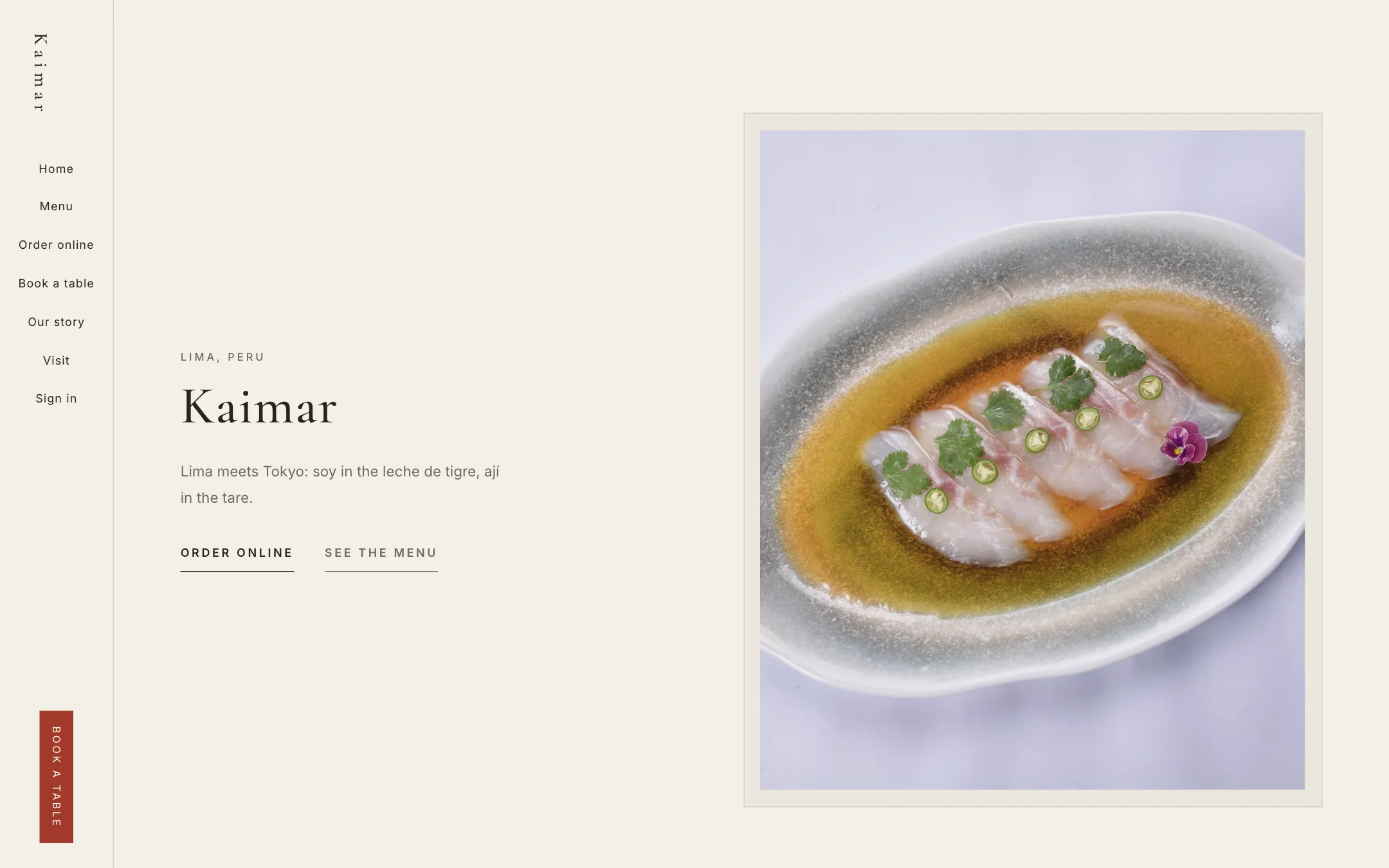
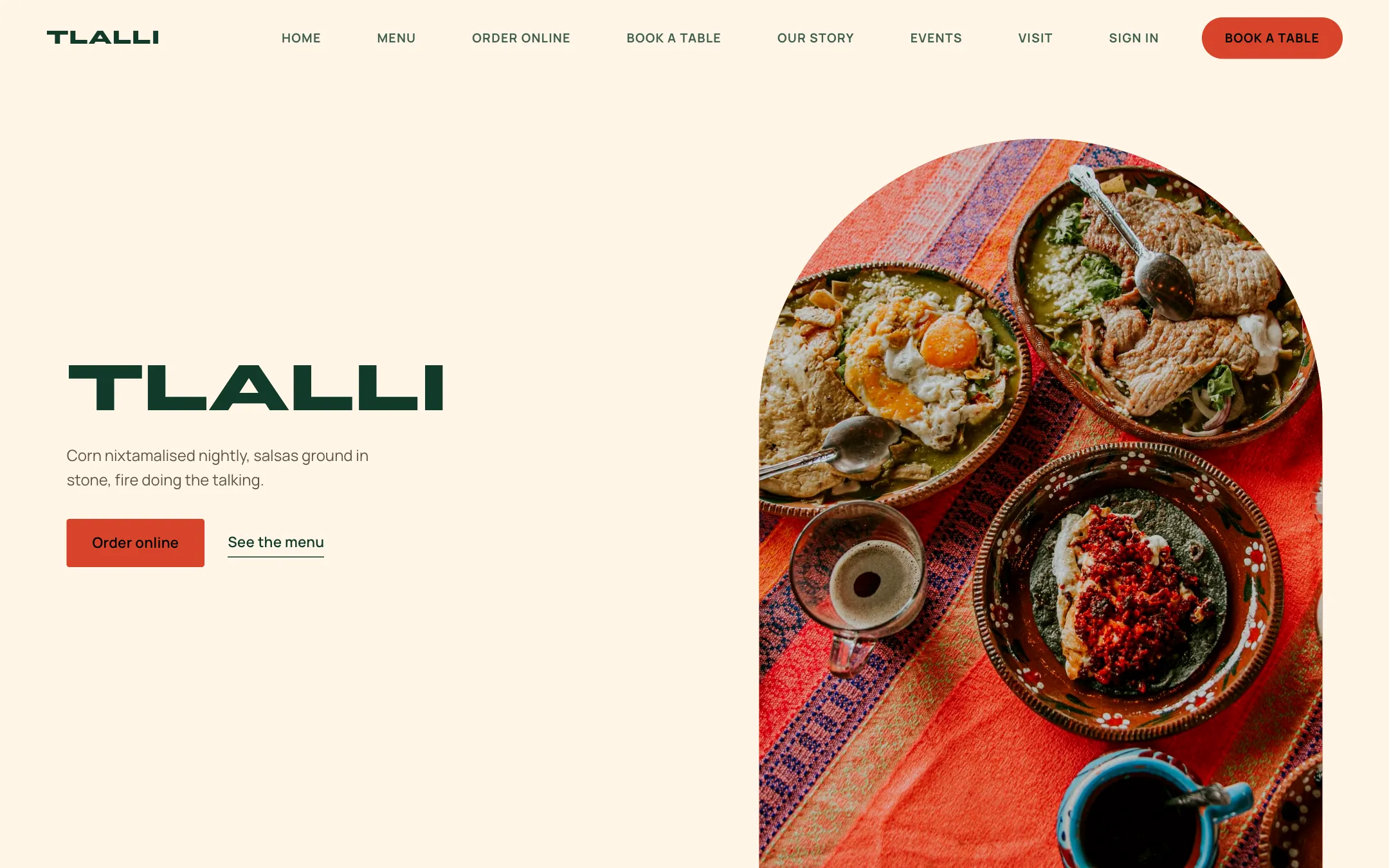
Big opening image, name & buttons, in the Passe-partout treatment: A small mounted photograph in a gallery field of paper.
Templates · Peruvian
For kitchens cooking across Peru’s altitudes — coast, valley, high Andes — with a nine-image opening, an accordion menu built for many short sections, and a design that treats ingredients as the subject.
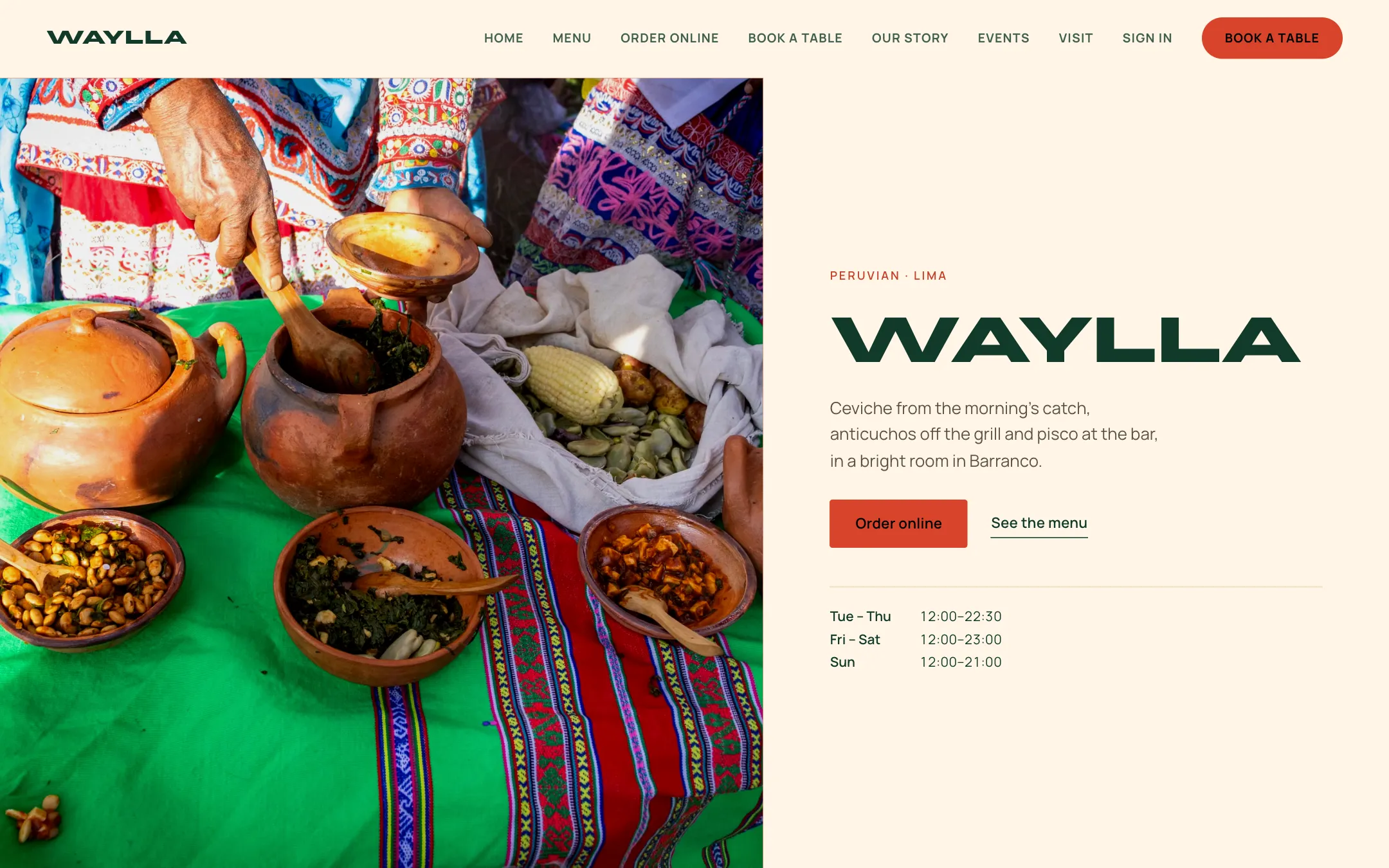
Every section is a builder module you can reorder, edit or delete, with no developer.
On bookings and orders, on every plan. Stripe’s standard card-processing fees apply to online payments.
Build and preview the whole site for nothing, and pay only when it goes live.
Starter is £19/mo excl. VAT and includes a complete restaurant website, a live structured menu, enquiry and newsletter forms, and managed search readiness. Growth is £39/mo excl. VAT and adds direct live bookings, a custom domain with managed SSL, and table and floor-plan operations. Full is £69/mo excl. VAT and adds online ordering and multi-site management for up to five restaurant sites. TableSpark commission is 0%. Stripe's standard card-processing fees apply to online payments.
That is the whole website and the whole system, at the best value on offer to an independent UK restaurant; the full cost comparison has the figures. A bespoke build costs thousands and takes months; this one is already designed, and you can publish it this afternoon. And it stays yours to run: change a price at four in the afternoon and it is live before service. Every template is optimised for phone, tablet and desktop, and the plans carry reservations, tables, ordering and management — with 0% TableSpark commission.
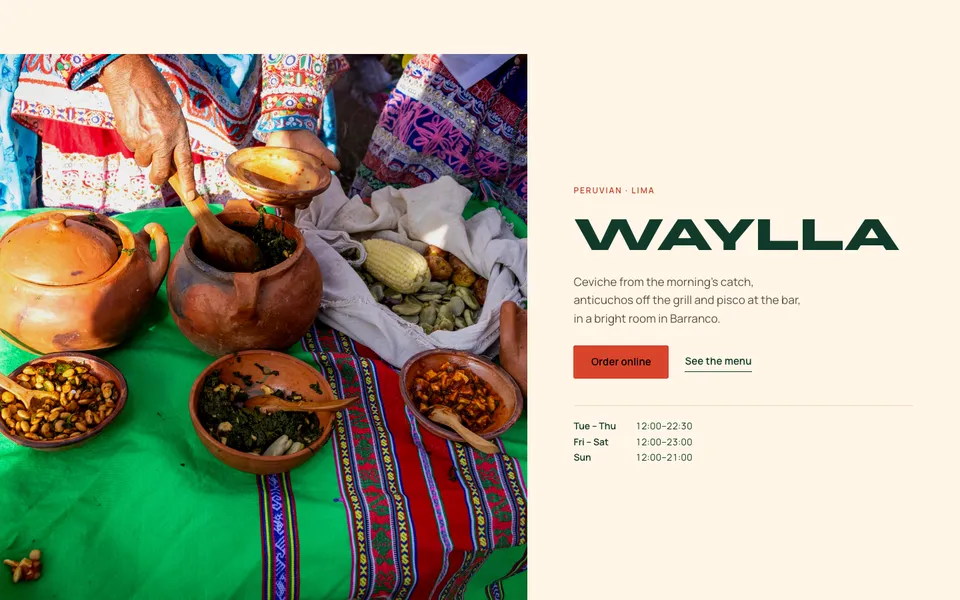
Waylla is a dark ground with a lime-green that comes off an Andean market awning. Yours might be white tile and morning light, or brass and candles, or something nobody has built yet.
The controls beside the frame are not an illustration of the Theme tab — they are the Theme tab, driving the same engine that publishes real restaurants. Press whatever you like; nothing is stored and nothing is signed up for. Go on.
Loading the live preview…
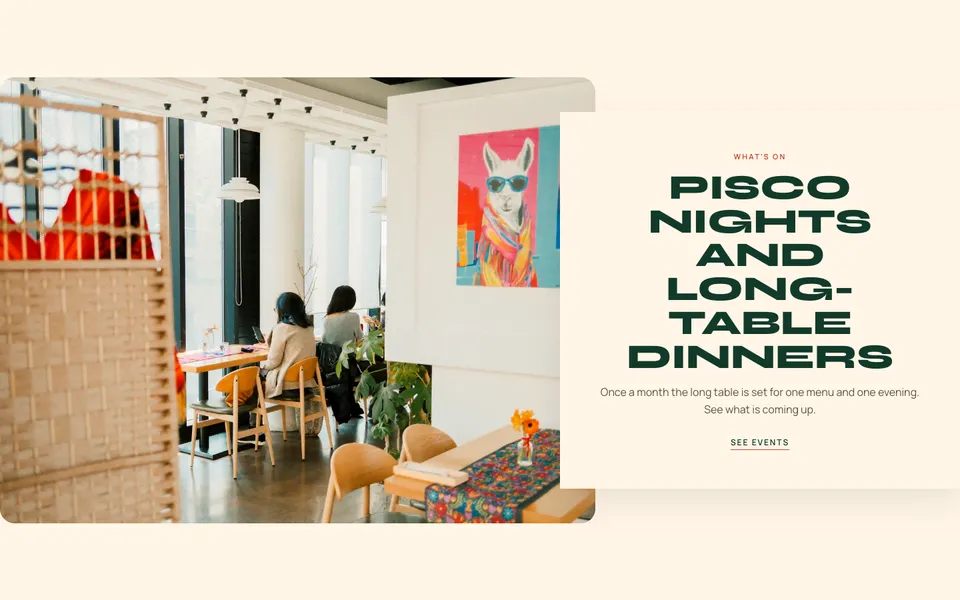
Peruvian cooking spans more geography than almost any other cuisine, and the usual restaurant website flattens it into “ceviche and pisco”. This design opens with a nine-image grid instead of a single hero, so a kitchen working from three ecosystems can show three ecosystems on the first screen.
The palette is dark ground and one acid green — the colour of produce rather than of a national flag — and the type is a wide geometric face that gives short Quechua and Spanish dish names room to be read as names rather than decoration.
Eight blocks, built to show range:
01
Big opening image, name & buttons, in the Passe-partout treatment: A small mounted photograph in a gallery field of paper.
02
Scrolling awards or words.
03
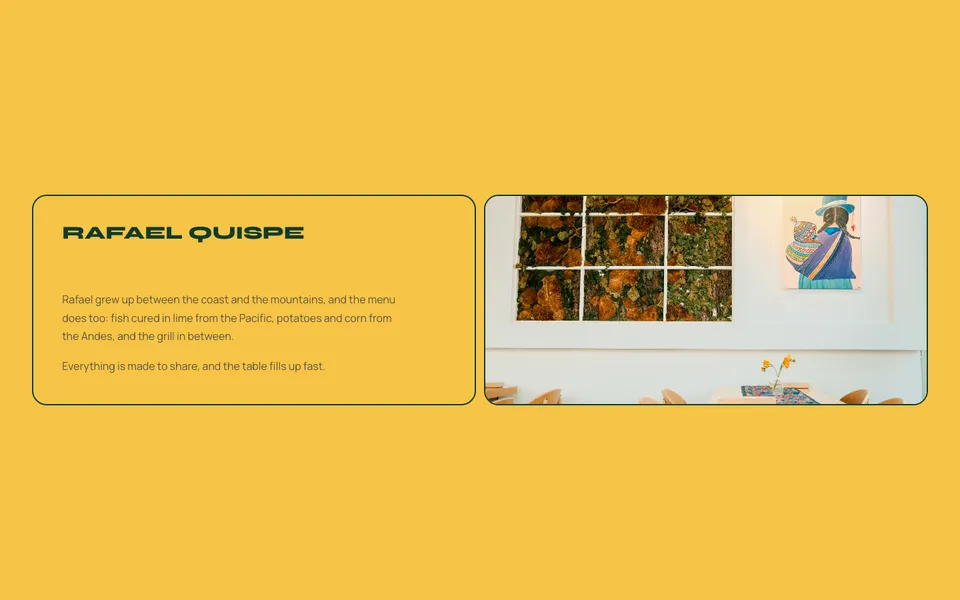
Big opening statement line.
04
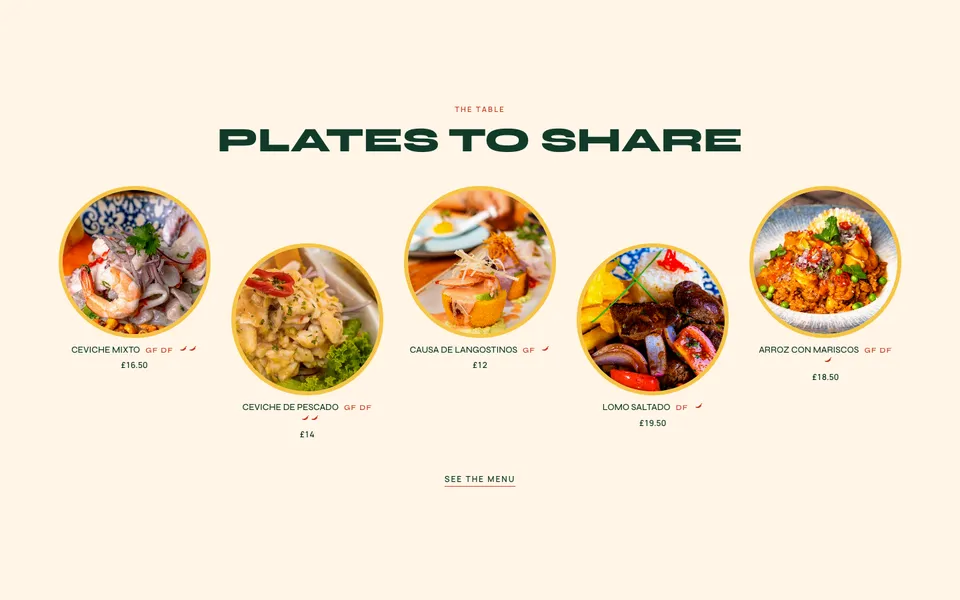
A few dishes on a sliding rail.
05
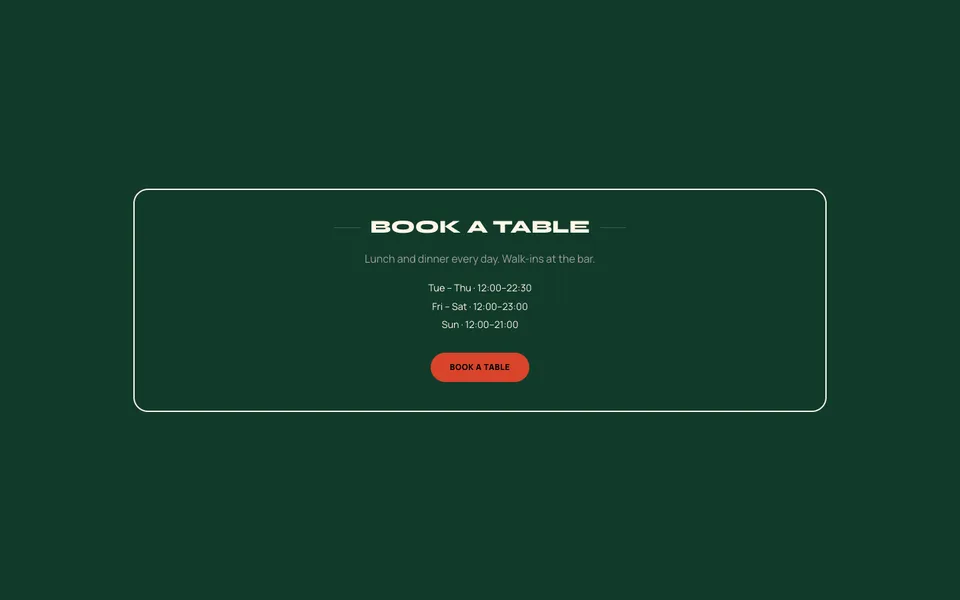
Time-bounded offer that hides itself when it ends.
06
Headline stats.

07
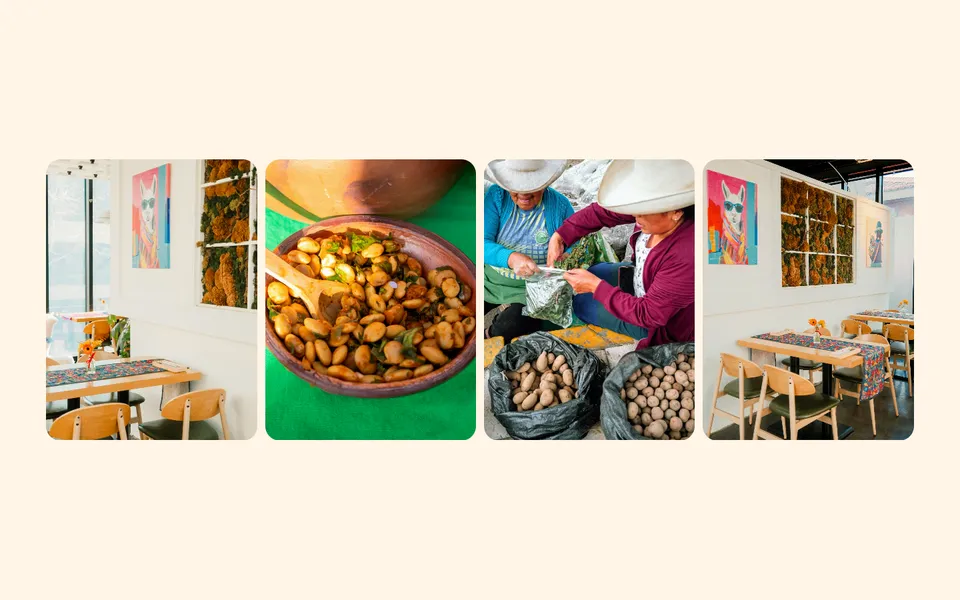
Grid, masonry or moving strip.

08
Guest quotes with stars.

09
Headline + button band.
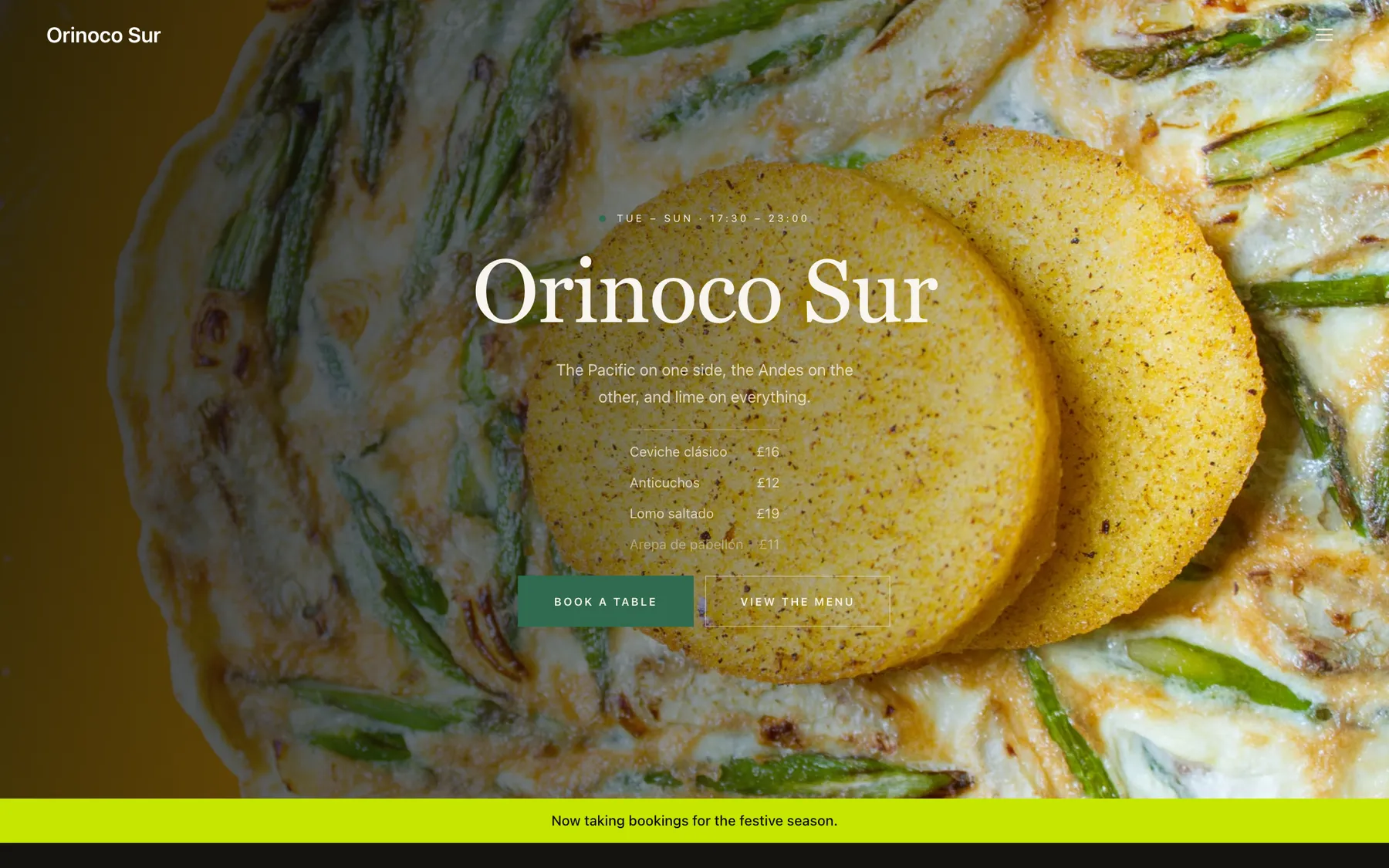
The statement block currently reads The Pacific on one side, the Andes on the other, and lime on everything. — one line you will rewrite in about four seconds.
Loading the live preview…
Waylla uses the Classic list ordering layout — the printed-menu look, with dotted leaders running from each dish to its price.
It reads like the delivery apps your guests already know, except the restaurant keeps the relationship and the money. The basket stays on screen, and each mode asks only for what it needs: a table number, a phone number or an address.
Loading the live preview…
This is the frame that matters. It is the real ordering page at a real phone width — not a mock-up, not a video.
On a laptop the same page puts the basket in a panel beside the menu that follows the scroll.
Every Waylla site on Growth and Full ships with an app your guests keep. It lives at /account on your own domain, so the guest signs in to your restaurant, not a marketplace.
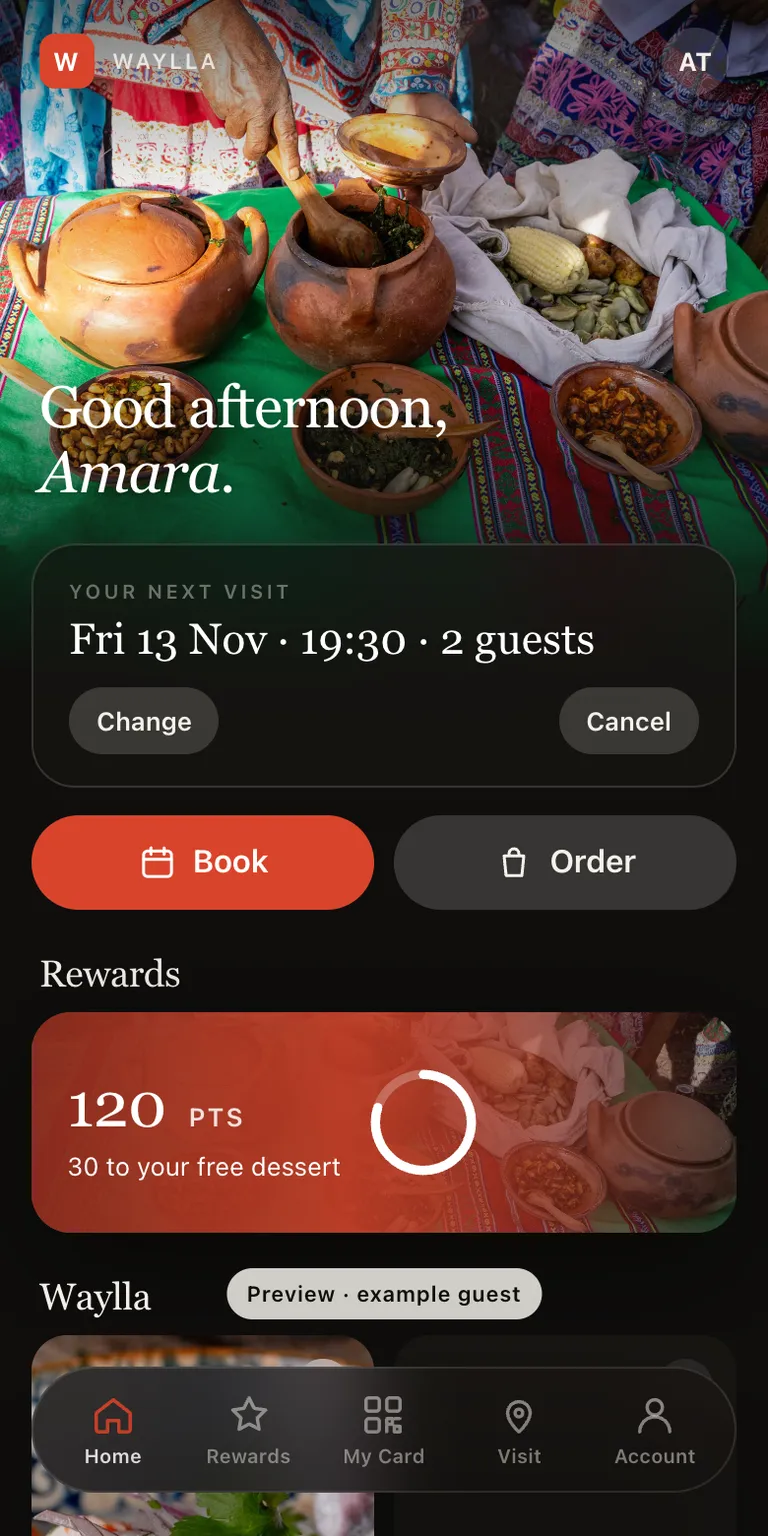
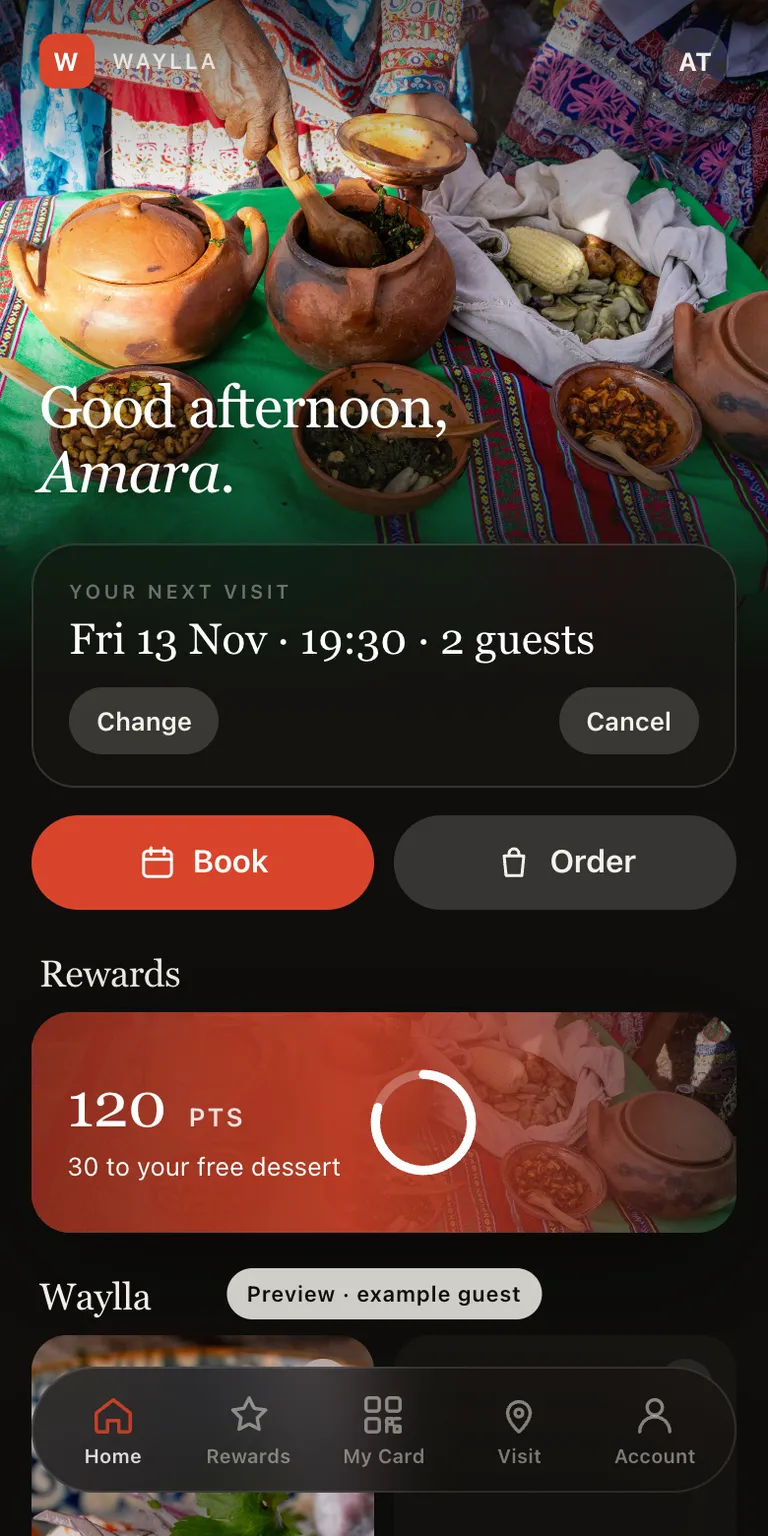
Included on the Growth and Full plans. Watch the Guest App course
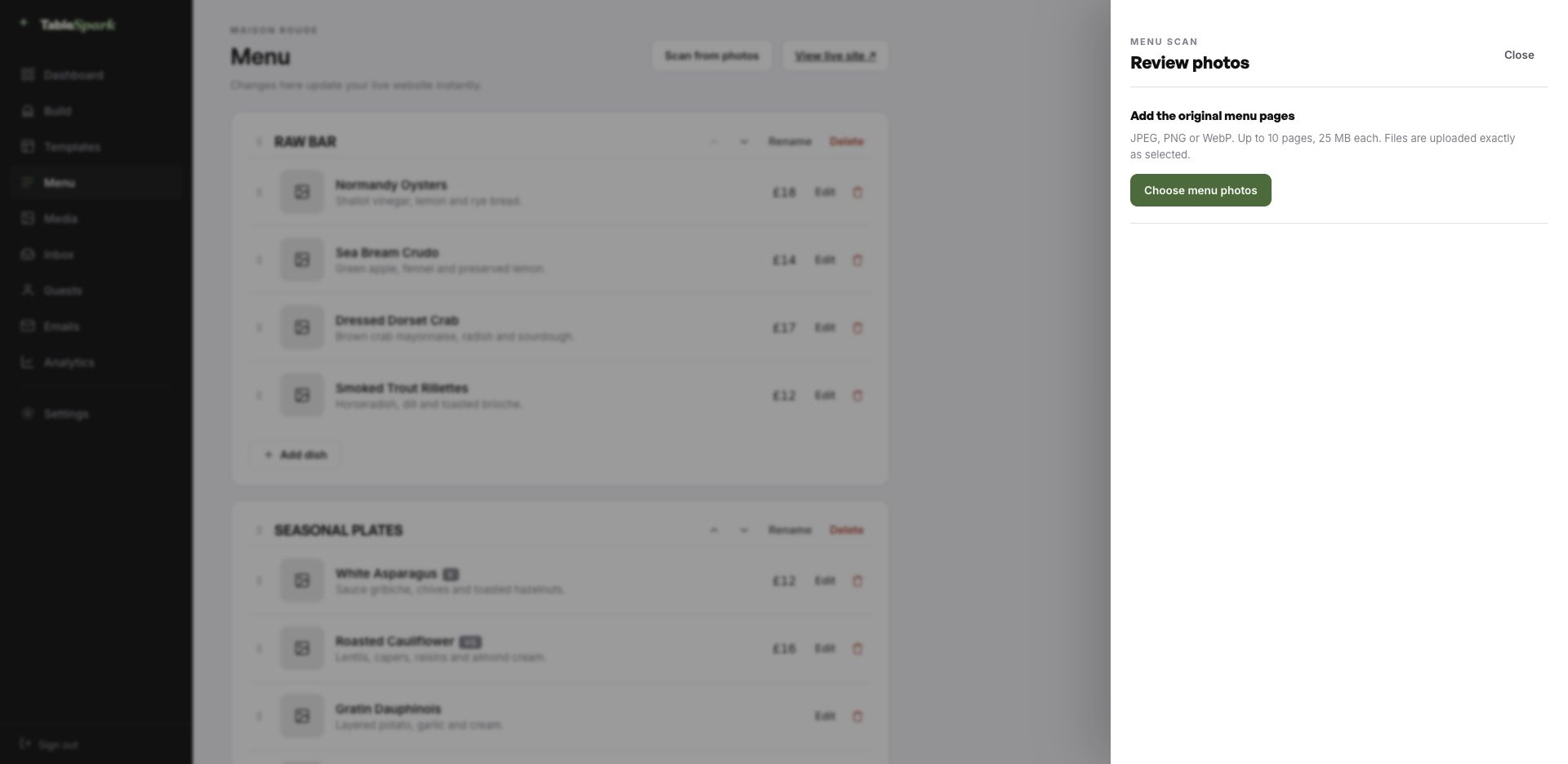
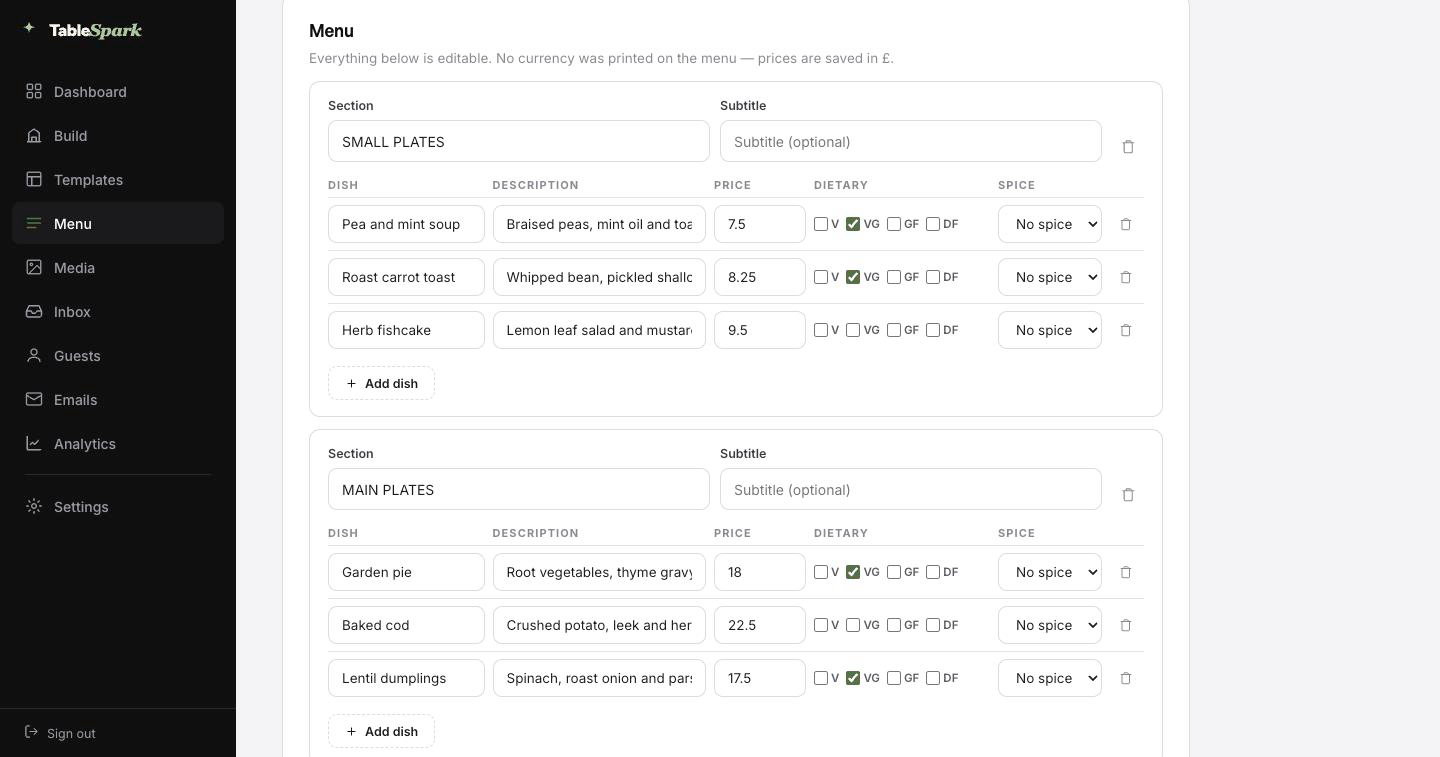
Nobody starts a website looking forward to retyping ninety dishes. Point a phone at whatever your menu currently lives on and send it over. The AI turns it into sections, dishes, descriptions and prices, and picks up the dietary marks and heat levels it can see. Read it back, adjust anything the photograph fumbled, and that is the menu built.
A photograph of a menu is decoration; a structured menu is infrastructure. From there the same data runs the menu page, the ordering page, the highlights on the home page and the Restaurant structured data a search engine reads. Change a price once afterwards and all of them follow.
And the fields nobody enjoys writing — the search title and description — are drafted by a Write with AI button that reads the page first. The AI writes the first version; you decide whether it is the last.
The card, the board, the sheet by the till. Ten pages at a time.
Sections, dish names, descriptions, prices, dietary and heat marks, all editable.
Menu page, ordering page, home-page highlights and the Restaurant schema — because they share one menu.
You are not commissioning a website; you are moving into one. The site works from the first second — it simply has the wrong name on the door. One sitting covers it — and the second it is live, the booking form is taking reservations. It lands in the inbox with the party size and the time, and the guest is confirmed by email at once.
Attach your own Stripe account and the site can charge for orders and hold deposits on tables — the funds are yours from the start. We take 0%. Not on the first order, not on the thousandth. Stripe’s standard card-processing fees apply to online payments.
Step 01
1min
Pick WayllaThe whole site copies into your account, menu and all.Step 02
4min
Change the name and the wordsClick any block and type. The restaurant name propagates everywhere.Step 03
3min
Upload your menuPhotograph it and let the AI build the sections, dishes and prices.Step 04
1min
PublishYou are live on your address. Bookings work immediately.Step 05
1min
Connect StripeNow you can take deposits on tables and payment on orders — direct to your account.In all
10min
From template to taking paymentsFive steps, one sitting.The web address is something guests read aloud, so it should sound like you. You can be live before lunch on a TableSpark address and on your own domain by the weekend, with no rebuild in between.
Everything fiddly about a domain — SSL, renewals, bare-domain redirects, canonical URLs surviving the move — is managed on your behalf. Already own the name? Keep it — you get the exact record to update, in plain English.
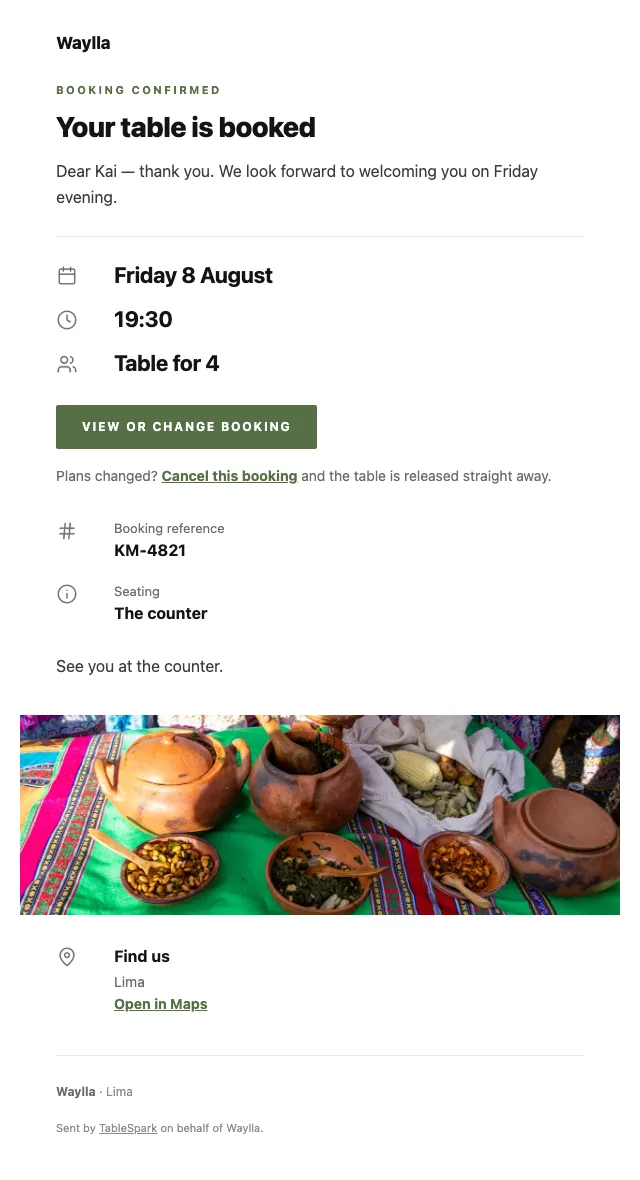
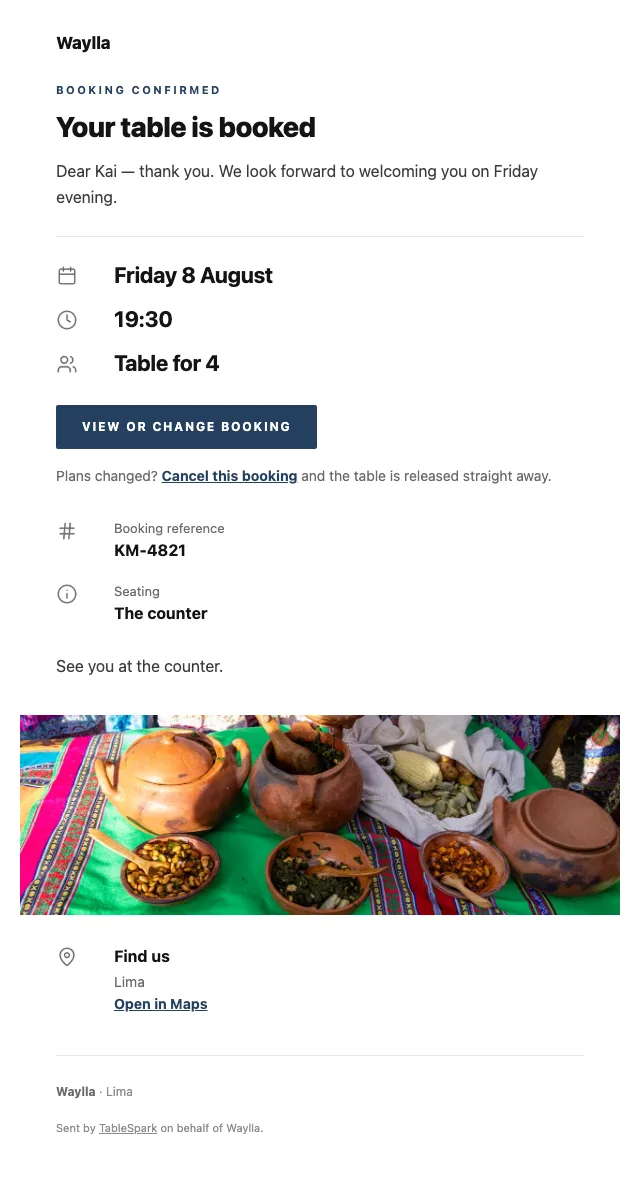
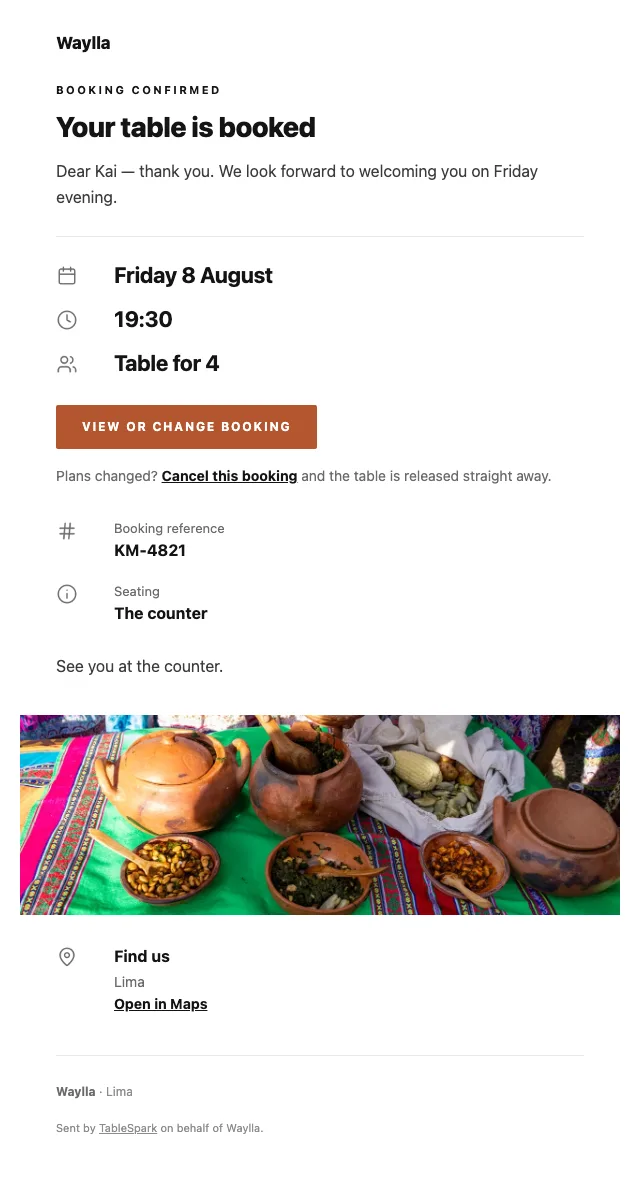
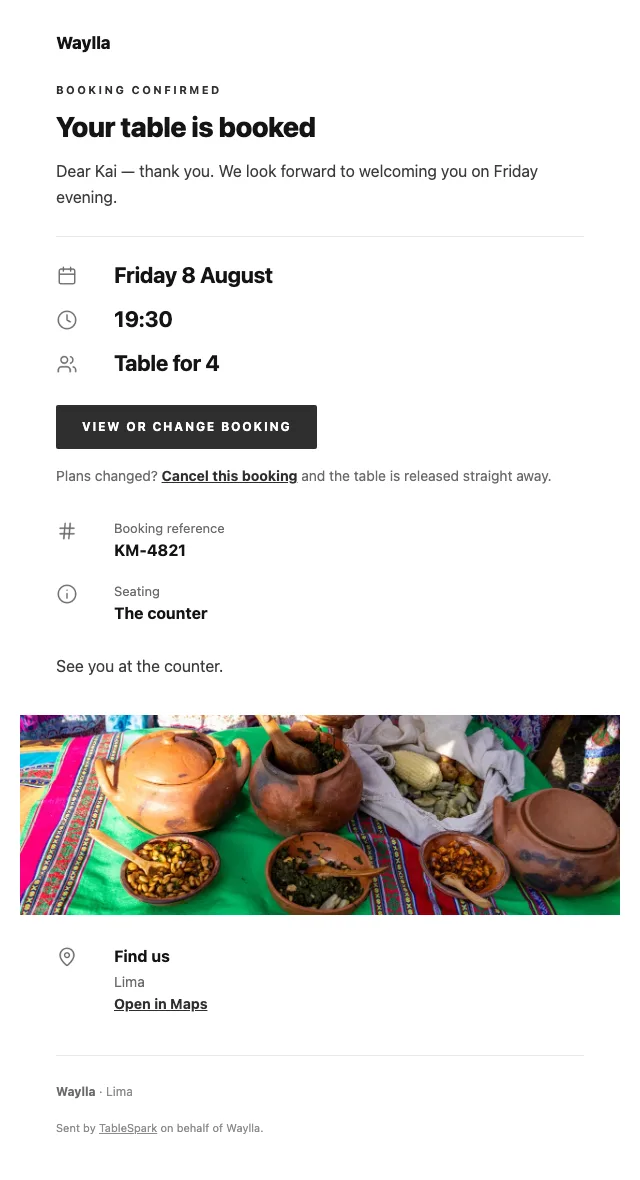
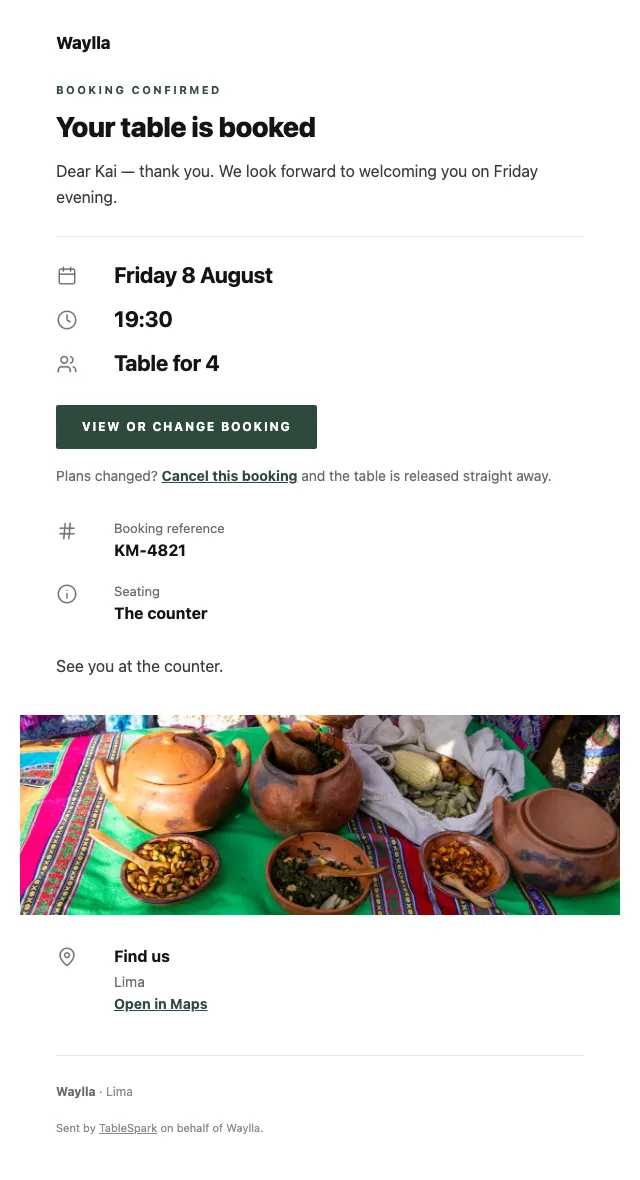
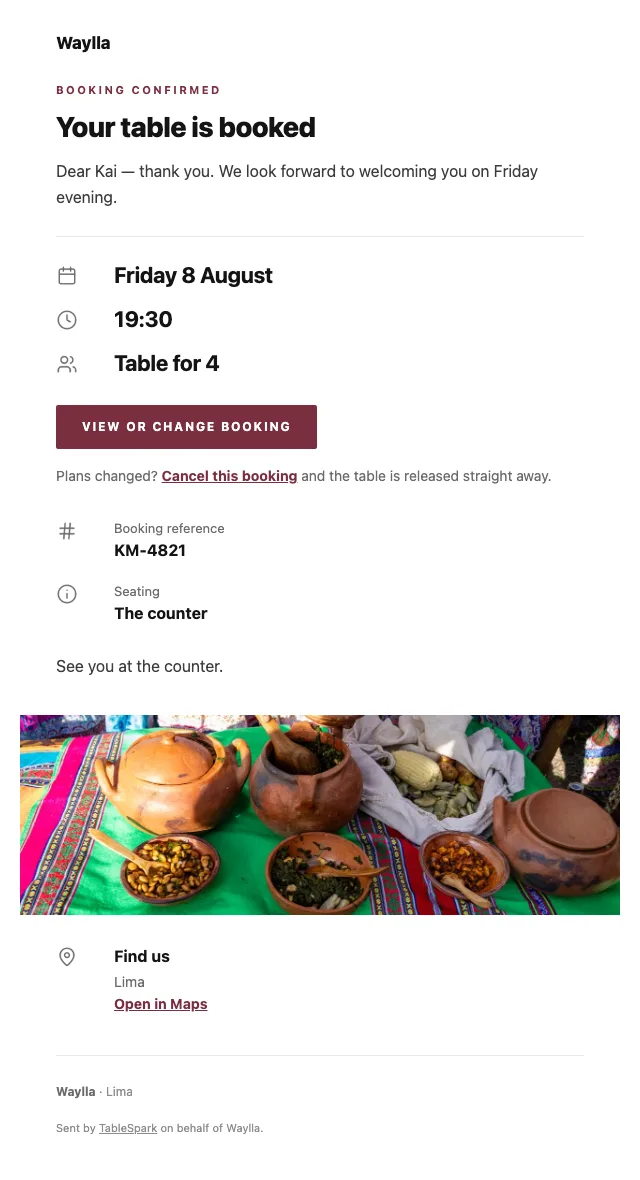
The email that follows a booking is read more carefully than any page on the site. As soon as a table is confirmed, the guest gets an email in your name carrying the date, the time, the number of covers, your address, your phone number and a way to cancel cleanly. Reminders, receipts and cancellations follow the same treatment, so nothing looks bolted on.
It carries your restaurant, not our branding. Pick one of six templates, then set the accent, the logo, a cover image, how the header sits, the sign-off line, your links and your social marks. When your domain is connected the mail is sent from your own address, which is also what keeps it out of a promotions tab.
Below, the same booking confirmation in six of the looks.
Being published and being findable are two different things, and only one of them happens automatically. The usual culprits are mundane: a robots rule nobody removed, two canonicals pointing different ways, orphaned pages, the menu published as a PDF, no structured restaurant data, search verification half done. The cost lands on the restaurant — guests searching your name, your menu or your street reach directories and commission-charging marketplaces first, and you end up paying for the traffic you should already own.
All of that is finished before you arrive. Search results are not something anyone can promise you. A correctly configured site is, and that is what this is.
All of them optional, all of them editable, and more can be added.
There is nothing bespoke here. Every block is one of the 68 modules available to any TableSpark site, each with its own layouts.
Remove one, reorder them, or pull in a block you saw on another template.
Ships with 4 sections — Raw & cold, Charcoal & wok, Plates, Sweet — for you to overwrite.
Our cut is zero, permanently. The alternative is a platform that charges you for each order and then owns the guest.
Your domain, your inbox, your exportable guest records. Stripe’s standard card-processing fees apply to online payments.
See what 0% commission is worth over a year
You photograph and proofread. The software types, structures and drafts.
Nothing reaches the live site until you say so.
Search engines Menu — Waylla | Peruvian, Lima Cooking across Peru’s coast, valleys and high plains. The full Waylla menu, by altitude, with prices.Drafts the search title & description from this page’s content. Always review before publishing.
Stripe’s standard card-processing fees apply to online payments.
What a fair restaurant deposit looks like
Everything up to the moment you go live is free, including changing your mind twice.
Everything up to the moment you go live is free, including changing your mind twice.
6 pages, and every one of them is here. Not screenshots. The frame is running the publishing renderer, so the navigation inside it works and every tab is a real page. Switch to Phone to see how it behaves on a handset.
The story page carries the ecosystems argument properly — a narrative, a sourcing block for the communities and growers a kitchen like this works with, a timeline and a gallery. The events page handles the tasting dinners and collaborations that come with a restaurant of this profile.
The accordion menu suits a kitchen organised by altitude or region rather than by course. Six or eight short sections sit collapsed on one screen — coast, valley, high plains, the grill — and the guest opens the one they want without scrolling past the others.
Ingredient names are the point of a menu like this, and the description field is where they live: the potato variety, the chilli, the corn, the lake. Those specifics are also what a search engine has to work with, which is why they belong in real text and not inside a photograph.
The layout can change; what does not is that each dish, its description and its price are text on the page, wrapped in Restaurant schema — rather than a PDF or a picture of a card.
Ordering runs as a classic priced list with dotted leaders — the printed-menu look — which is the right register for a kitchen selling composed plates rather than fast food. It is quick to scan and it does not pretend to be an app when it does not need to be.
The basket still behaves like one: pinned to the bottom of a phone with a running total, becoming a panel beside the list on a laptop. Modes ask only for what they need, and everything is paid into your own Stripe account with 0% taken by TableSpark. Stripe’s standard card-processing fees apply to online payments.
Dine-in wants a table number and nothing else; collection wants a number to ring; delivery wants somewhere to go. No mode asks for the others’ fields.
Running a Mexican & Latin kitchen? See all Mexican & Latin restaurant website templates.
What owners ask before they pick a template: the cuisine fit, the menu, the address, and what it costs.
Yes — sections are named by you and mean whatever you want them to mean. Coast, valley, high plains, the grill; or starters and mains; or by producer. The accordion layout is particularly good for many short sections, because the guest sees the whole structure on one screen before opening anything.
That is what the description line is for — a short gloss under the dish name, in whichever language your guests read. The header also carries an optional language switch, so a menu can be published in two languages and swapped by the guest without leaving the page.
Every one of them, in the Theme tab: palette, the display and body typefaces, corner radius, motion, the header layout and how it behaves on scroll. The template is a starting point, not a cage — and switching a colour never breaks the layout, because the design reads its values from the theme rather than hard-coding them.
Yes, and you do not have to sort it out before going live. Publish on a TableSpark address today; connect your own domain — new or one you have held for years — whenever it suits. The SSL certificate and its renewals, the secure connection, the bare-domain redirect and the canonical, sitemap and robots signals are all managed for you, so search visibility survives the change. The same domain can send your guest emails.
An immediate confirmation in your name with the booking details — date, time, covers, your address and phone number — plus a link that lets them cancel cleanly if plans change. The same system handles the reminder before service, any deposit receipt and cancellation notices. You design all of it: six templates, your accent, logo, cover photograph, header layout, sign-off, links and social accounts, sending from your own domain once connected.
None at all. The whole site is blocks you click and edit — text in place, photographs uploaded, sections dragged into a new order. No HTML is involved on your side.

One click copies the entire design into your account. Everything after that is editing — and it is free until you publish.