01
Hero
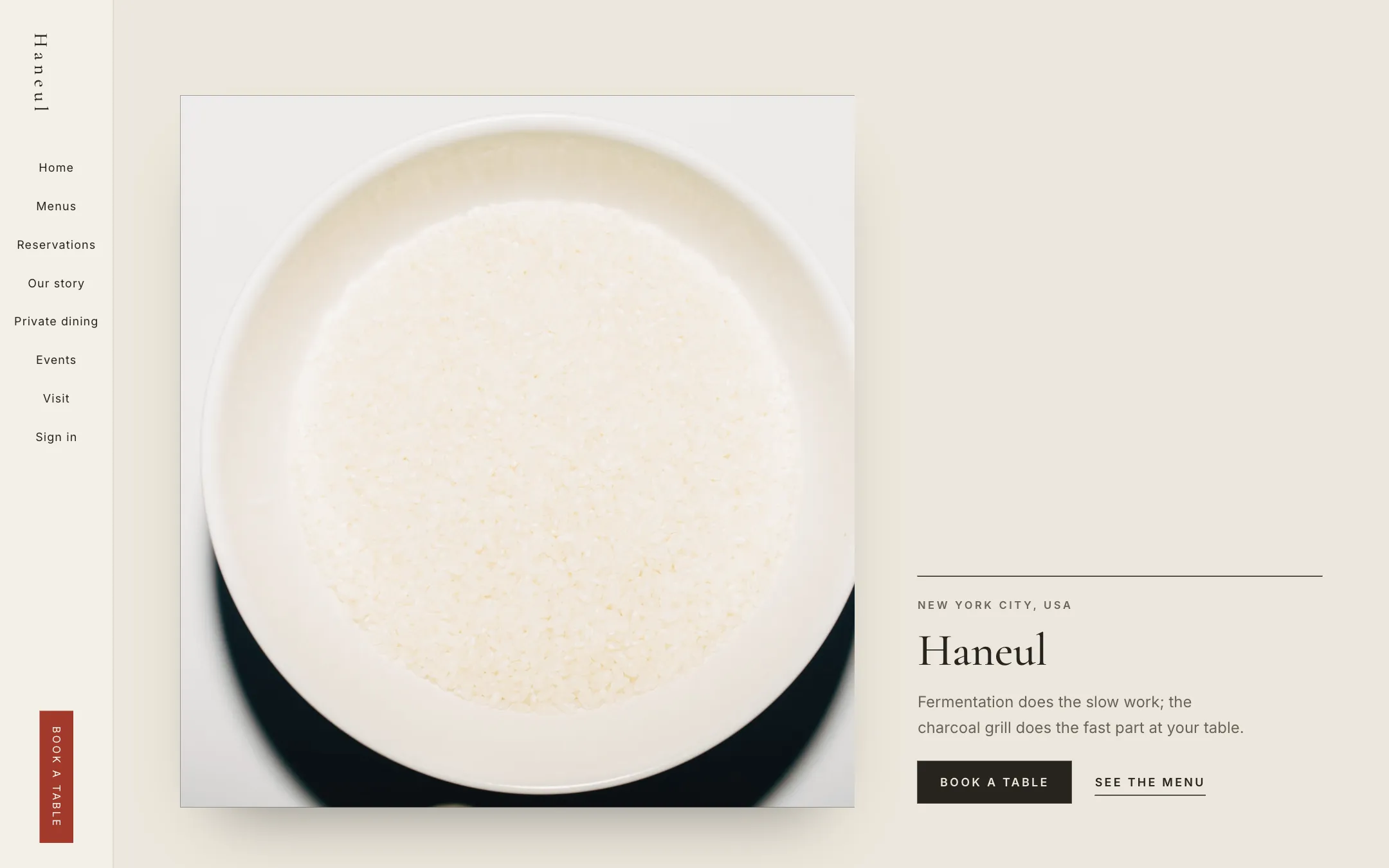
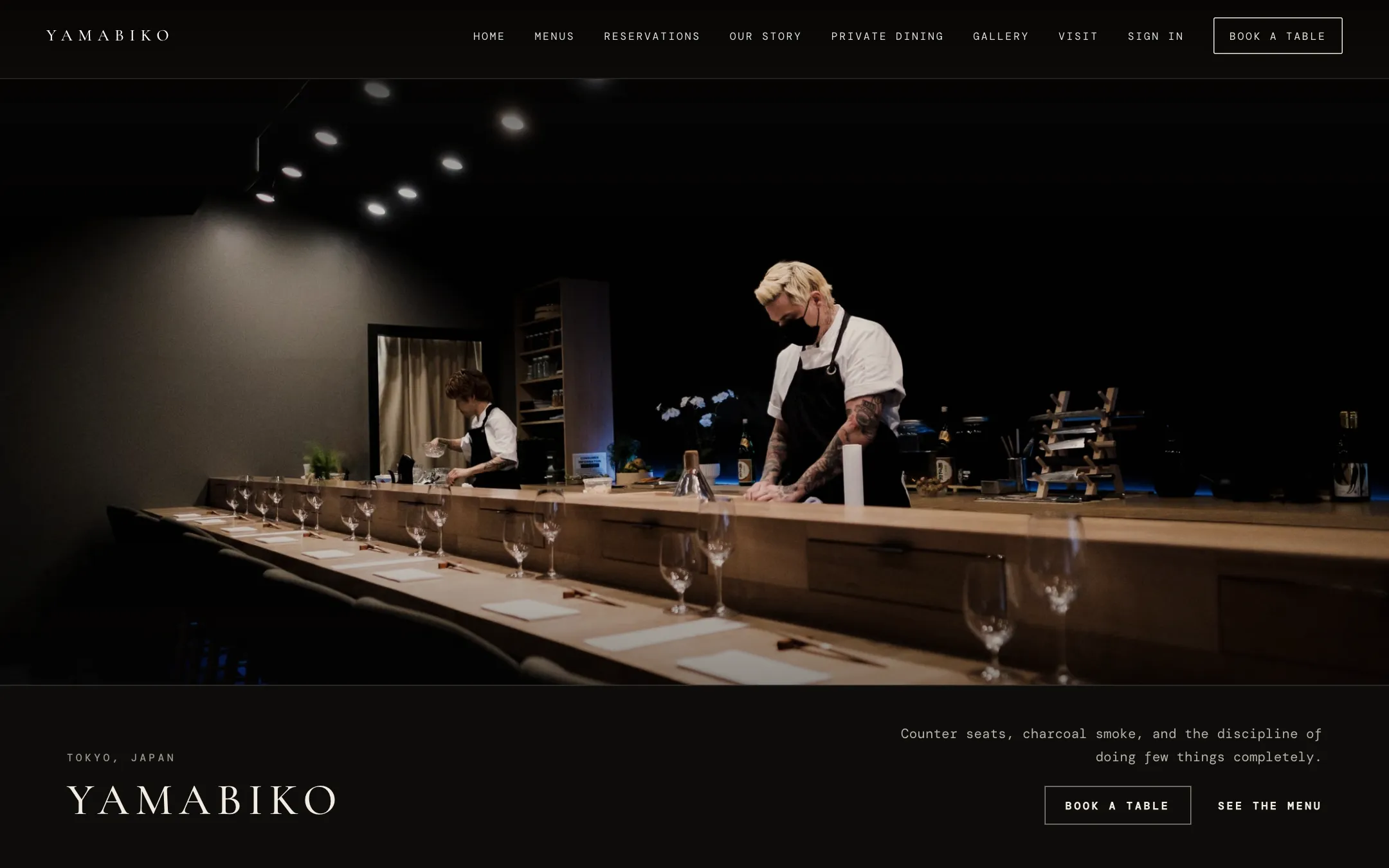
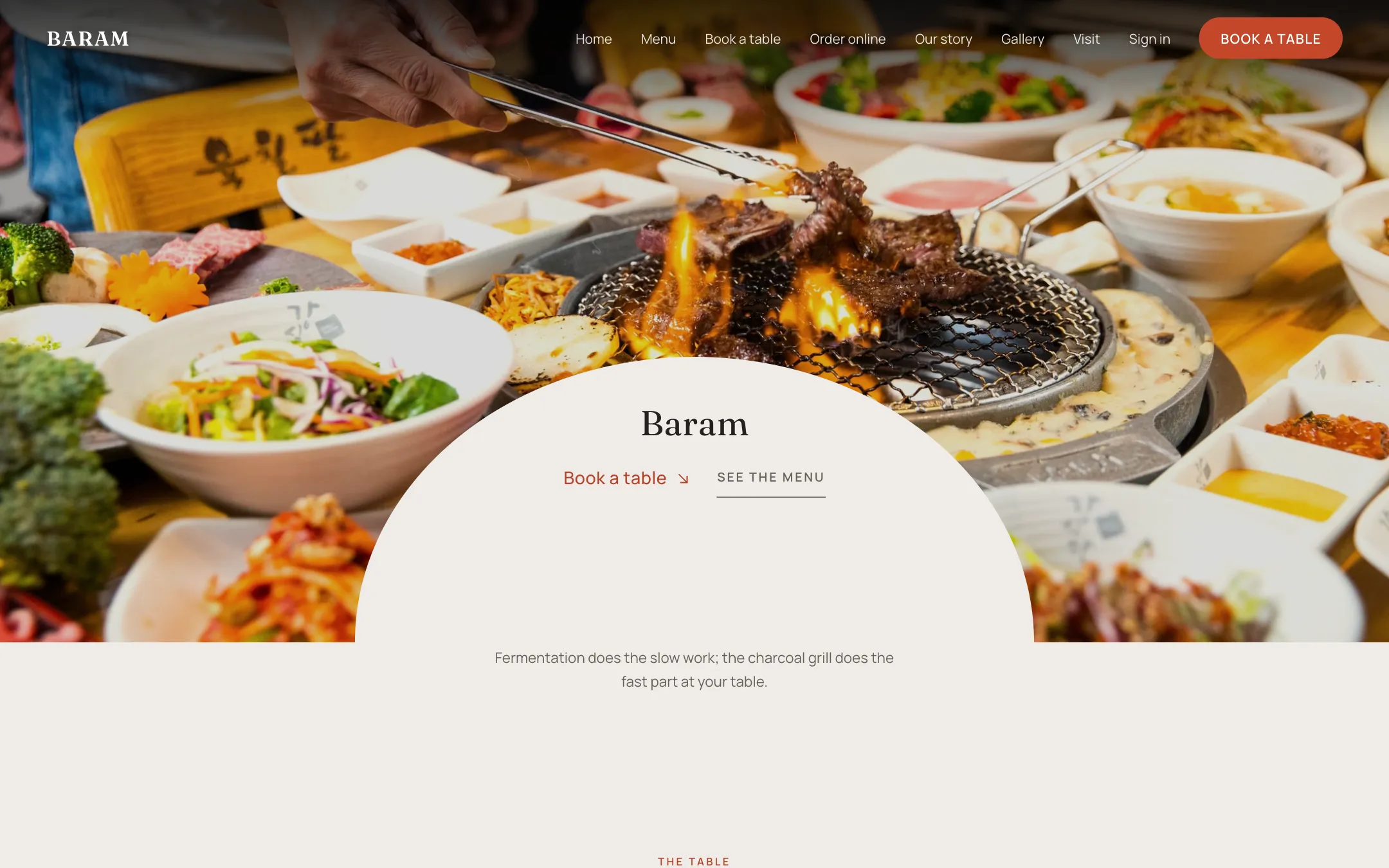
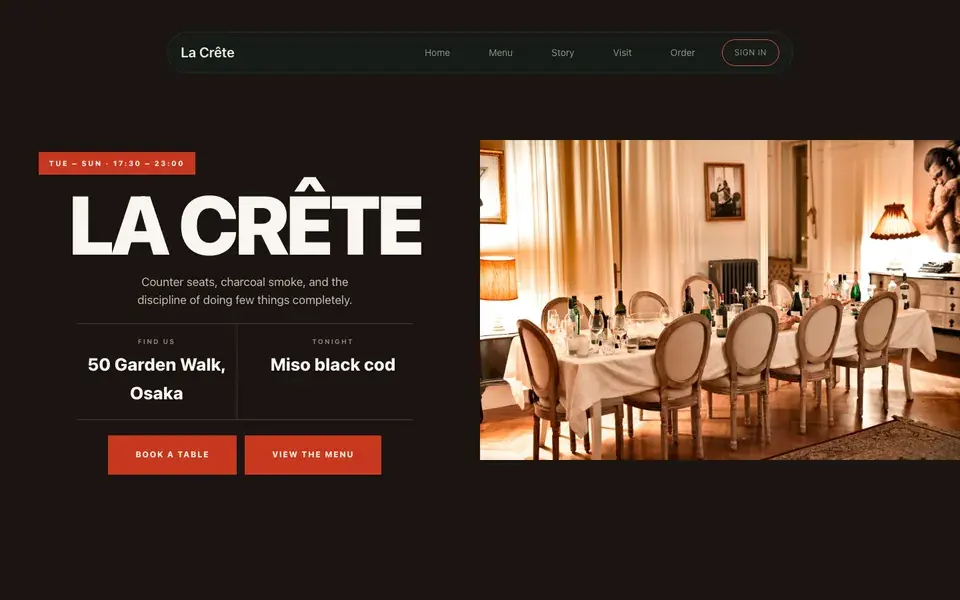
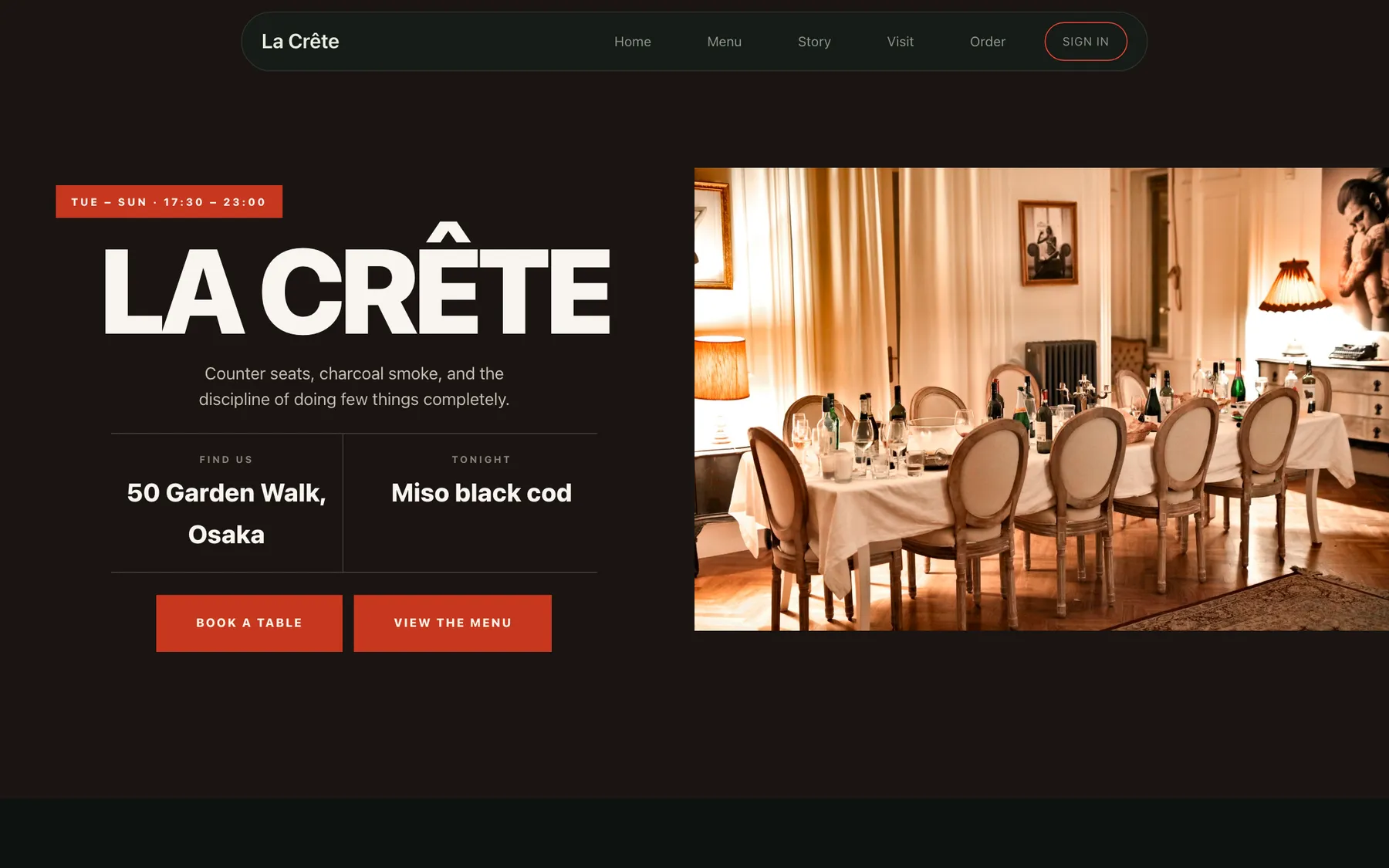
Big opening image, name & buttons, in the Vestibule treatment: Ruled inner frame over a vignetted room, status and address on the base rail.
Templates · French-Japanese
For counters where the queue is part of the experience: a dark template with a queue opening, an indexed menu, and dense-row ordering built for speed.
Every section is a builder module you can reorder, edit or delete, with no developer.
On bookings and orders, on every plan. Stripe’s standard card-processing fees apply to online payments.
Build and preview the whole site for nothing, and pay only when it goes live.
Starter is £19/mo excl. VAT and includes a complete restaurant website, a live structured menu, enquiry and newsletter forms, and managed search readiness. Growth is £39/mo excl. VAT and adds direct live bookings, a custom domain with managed SSL, and table and floor-plan operations. Full is £69/mo excl. VAT and adds online ordering and multi-site management for up to five restaurant sites. TableSpark commission is 0%. Stripe's standard card-processing fees apply to online payments.
A finished restaurant website and the system behind it, at the best value available to an independent UK kitchen; the full cost comparison lays out the published terms. There is no build phase and no invoice with a project manager on it. The design exists; your job is to put your restaurant inside it. Every word and every price stays under your control afterwards, which is the part that decides whether a restaurant site stays accurate. It reads properly on a phone, a tablet and a desktop, and the plans carry reservations, table management and online ordering at 0% TableSpark commission.
La Crête is a dark room with a vermilion accent that behaves like a lantern. Yours might be white tile and morning light, or brass and candles, or something nobody has built yet.
This is the product, not a picture of it. Left, the live site. Right, the builder’s own Theme panel. Everything you press takes effect immediately, nothing persists, and there is no sign-in wall in front of it. Go on.
Loading the live preview…
A counter with a queue outside it is selling something specific: a short menu, done exactly, at speed. The design opens with the queue itself — the wait, the hours, what is being served — which is both honest and, for the right guest, a genuine invitation.
A dark ground with a vermilion accent gives the food photography a warm surround, and the wide display face keeps a short menu of short names looking deliberate rather than sparse.
Eight blocks, arranged for a room with a queue:
01
Big opening image, name & buttons, in the Vestibule treatment: Ruled inner frame over a vignetted room, status and address on the base rail.
02
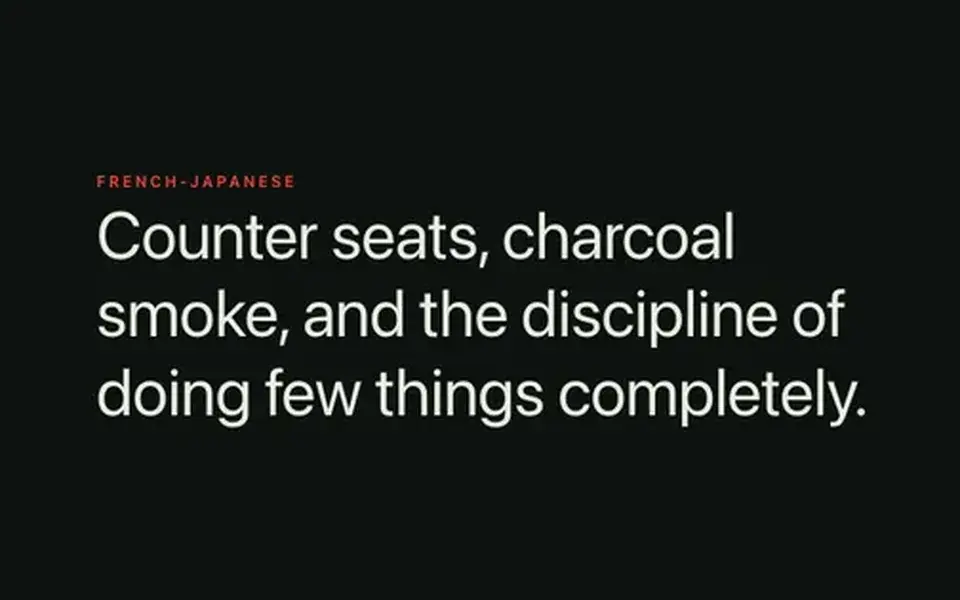
Big opening statement line.

03
Alternating image and text rows.
04
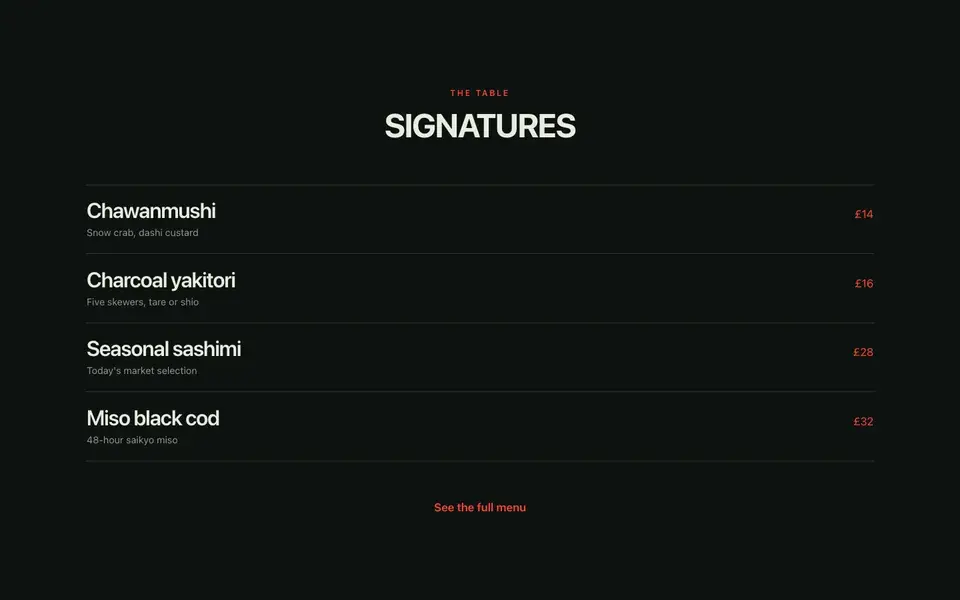
A few dishes on a sliding rail.
05
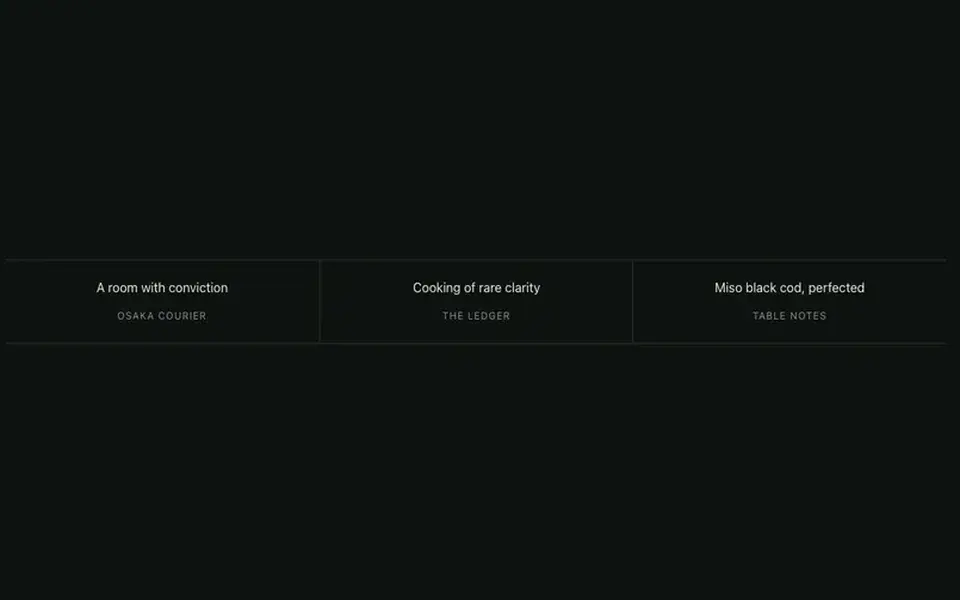
Press mentions or awards as a ruled band.
06
Full-width video or photo mood band.
07
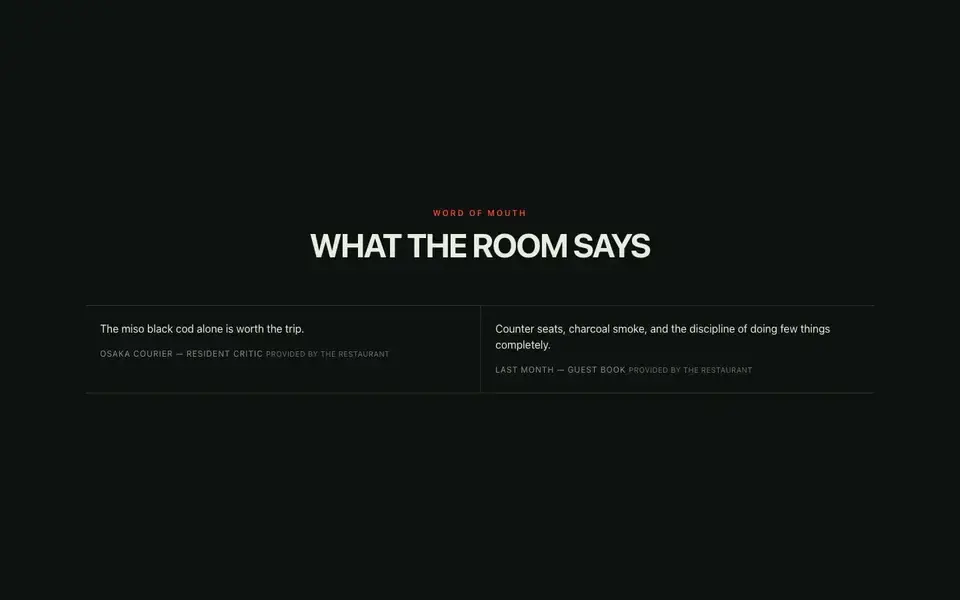
Guest quotes with stars.
08
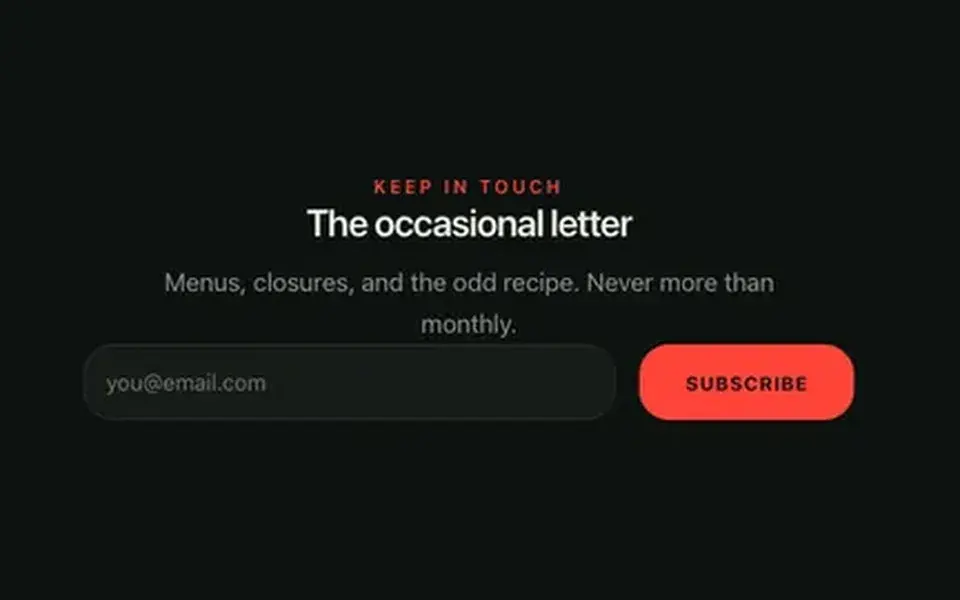
Email signup band.
09
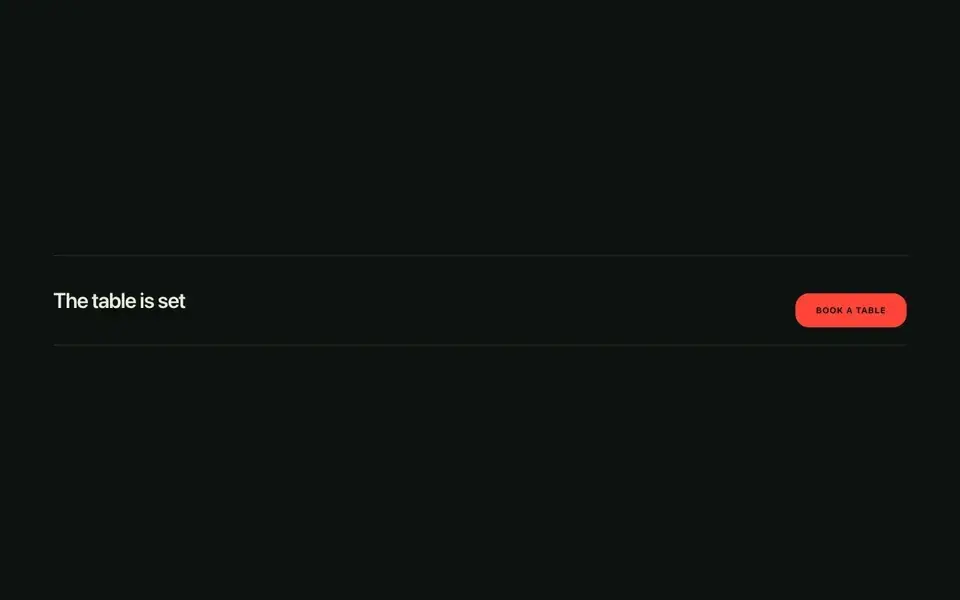
Headline + button band.
The statement block currently reads Counter seats, charcoal smoke, and the discipline of doing few things completely. — one line you will rewrite in about four seconds.
Loading the live preview…
La Crête uses the Folio ordering layout — the list sits beside a tall photograph of each section’s signature dish.
It reads like the delivery apps your guests already know, except the restaurant keeps the relationship and the money. The basket stays on screen, and each mode asks only for what it needs: a table number, a phone number or an address.
Loading the live preview…
This is the frame that matters. It is the real ordering page at a real phone width — not a mock-up, not a video.
On a laptop the same page puts the basket in a panel beside the menu that follows the scroll.
Every La Crête site on Growth and Full ships with an app your guests keep. It lives at /account on your own domain, so the guest signs in to your restaurant, not a marketplace.
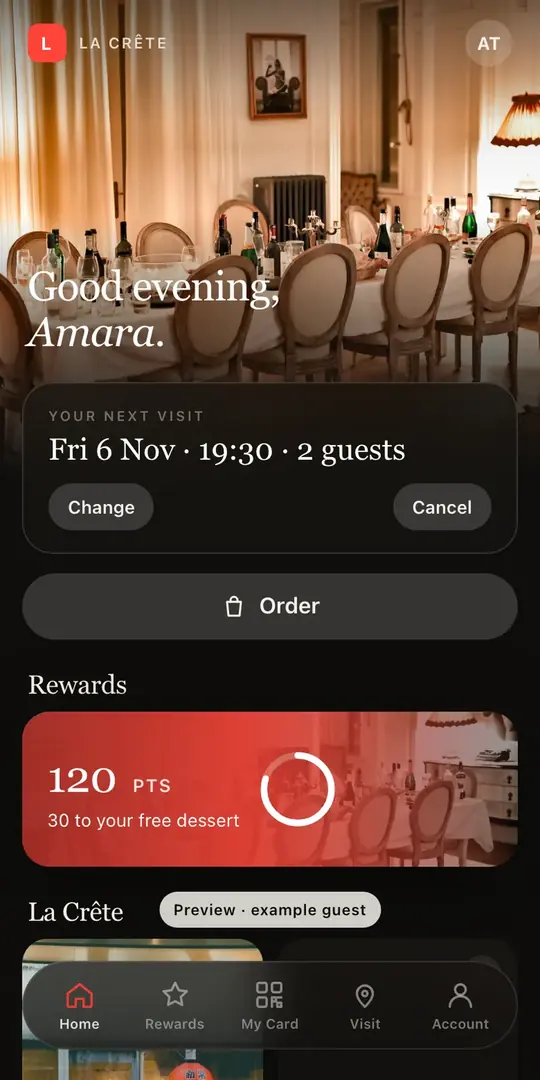
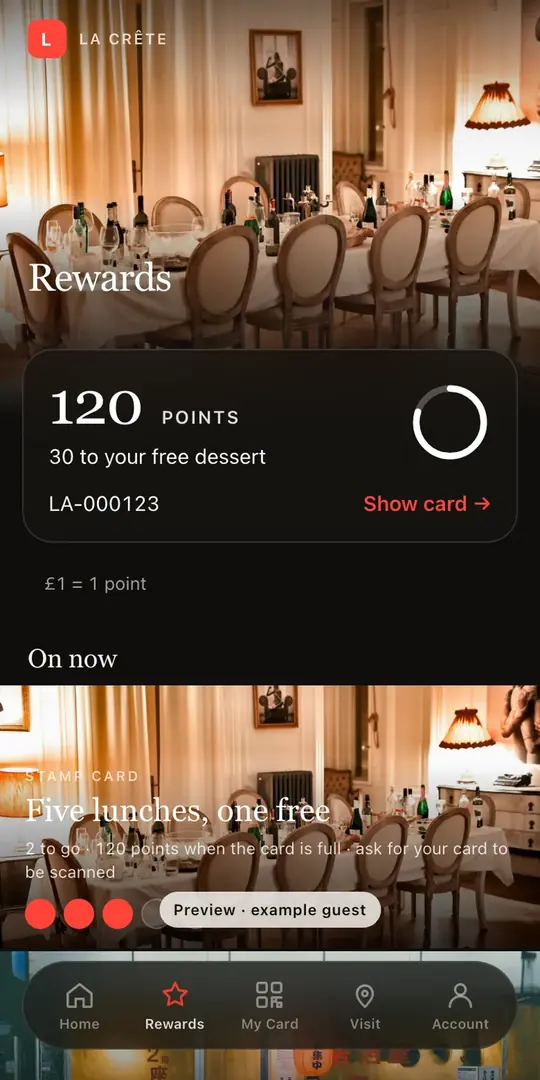
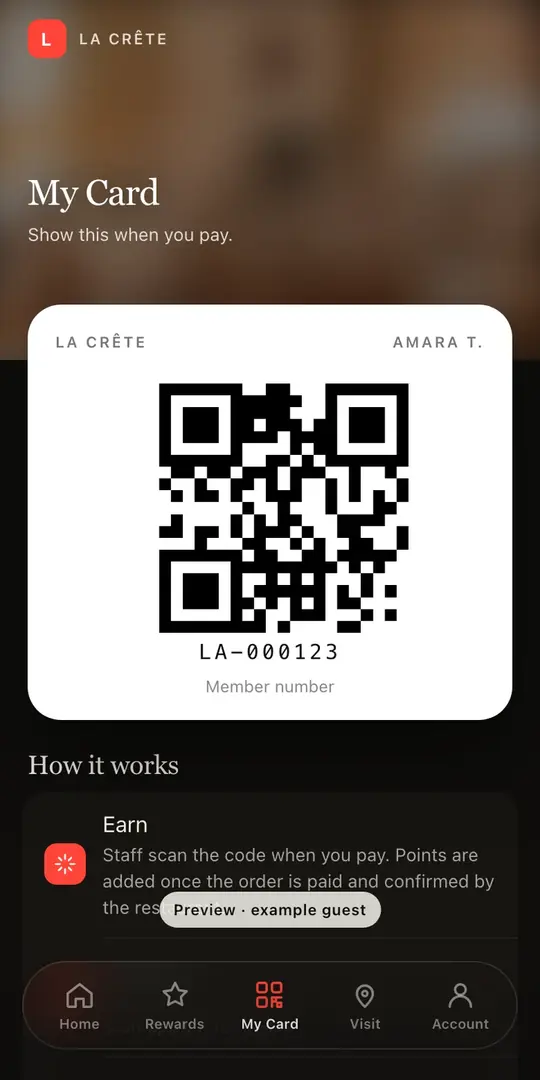
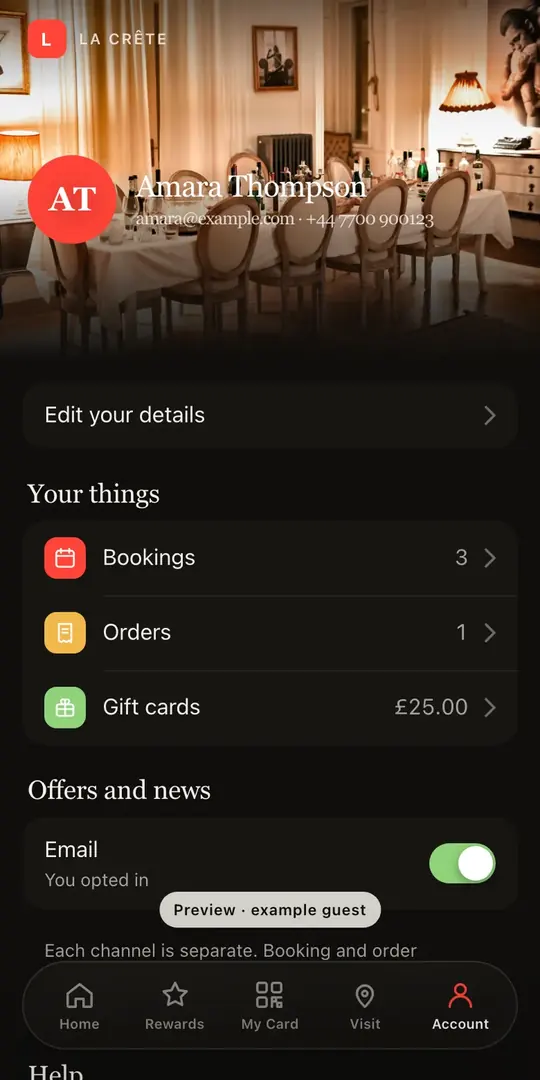
Included on the Growth and Full plans. Watch the Guest App course
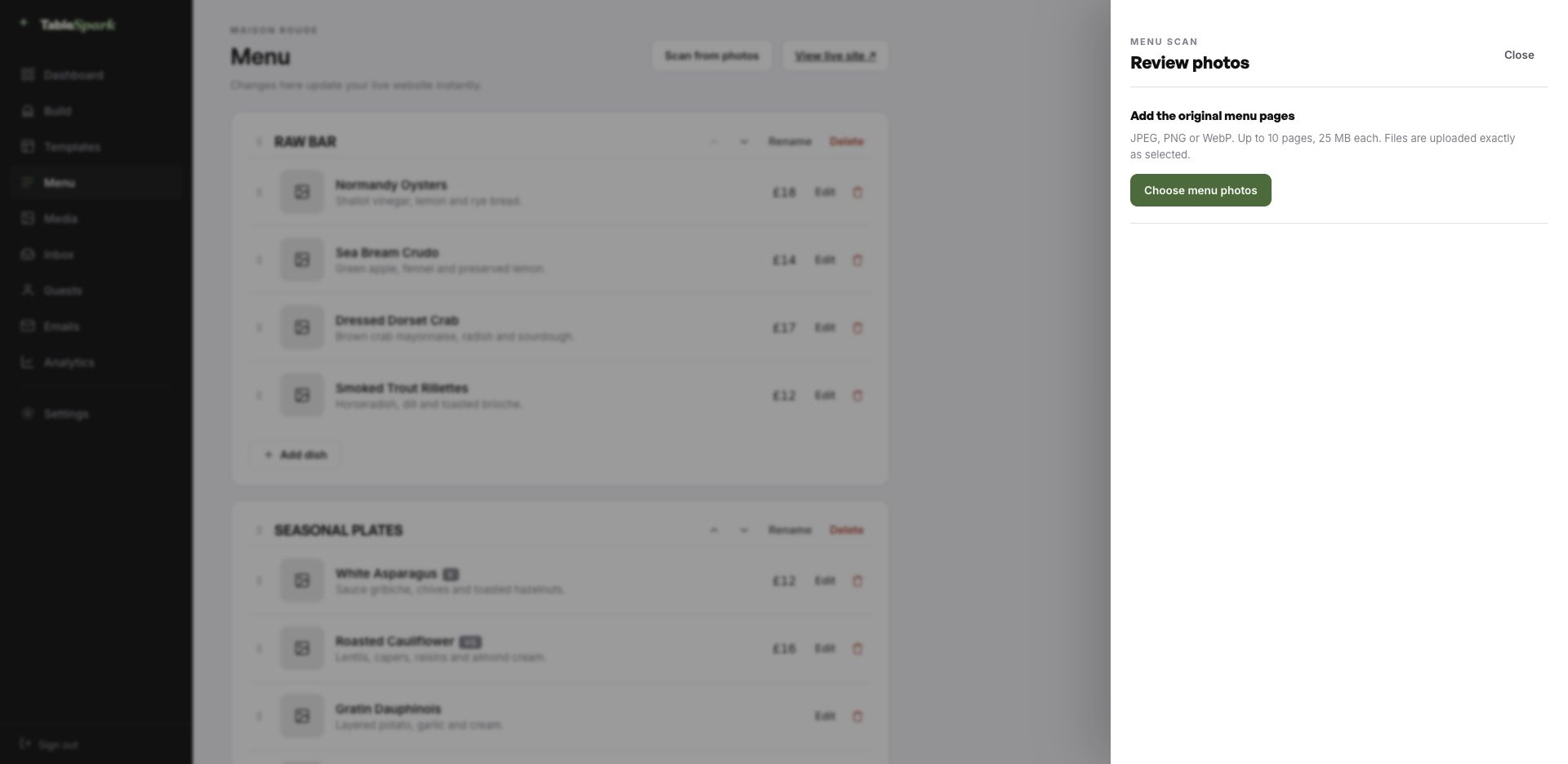
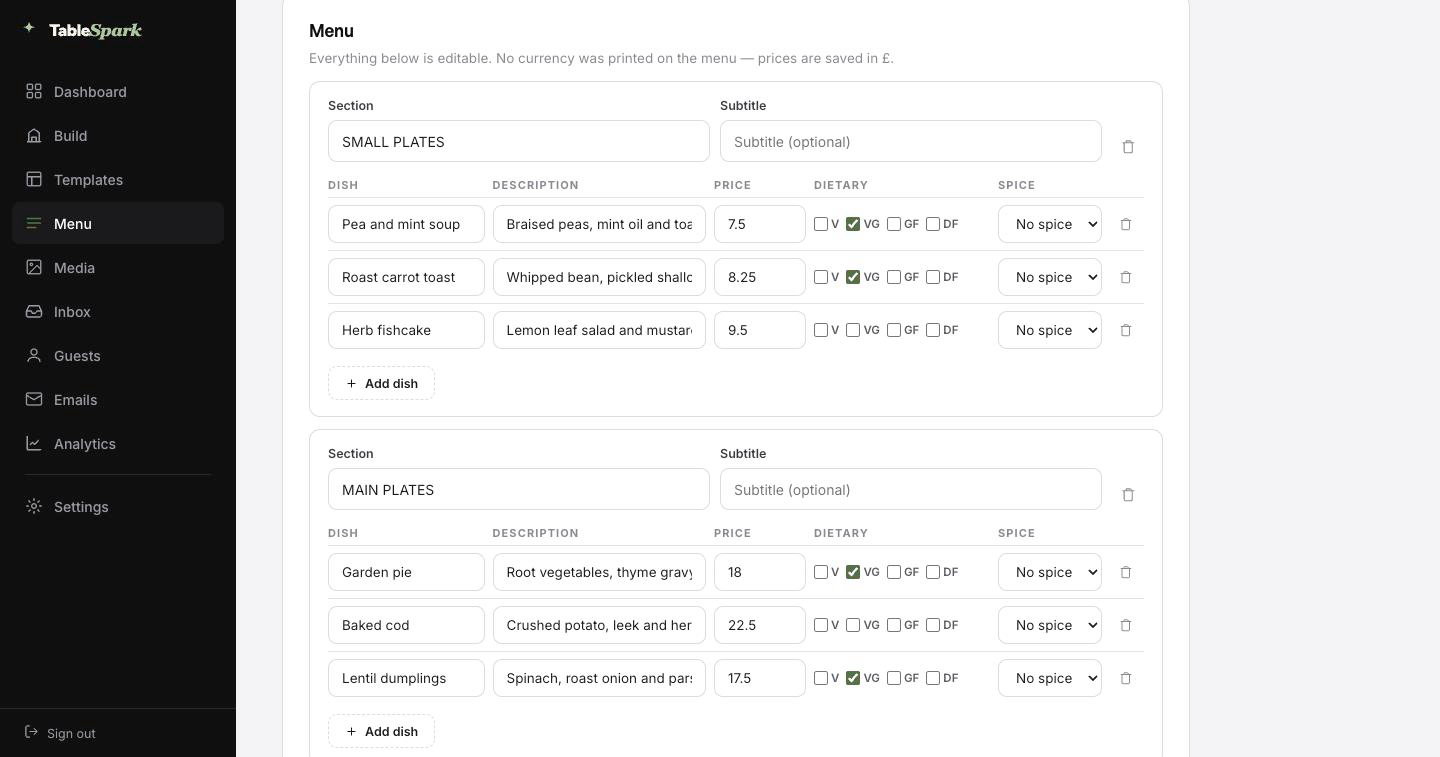
The menu is the longest thing on any restaurant site, and it is the thing you type least. Whatever the menu is printed on, photograph it and upload it; the format does not matter. TableSpark reads it and builds the structured menu for you: sections in the right order, dish names, descriptions, prices, and the dietary and spice marks where it can see them. You review it, fix anything the camera got wrong, and it is done.
The distinction that matters is that a search engine can read every word of it. Everything downstream reads from it: the menu page, the ordering page, the highlights on the home page and the Restaurant structured data a search engine reads. Change a price once afterwards and all of them follow.
A Write with AI button on each page writes the search title and description from what is on it, so no page publishes with those fields empty. Always your last word — the draft lands in the field for you to edit before anything publishes.
Printed card, chalkboard photograph or an old PDF — any of them work.
Not a scan: real sections, dishes, prices and marks you can edit before saving.
Menu page, ordering page, home-page highlights and the Restaurant schema — kept in step automatically.
The gap between deciding and being live is measured in minutes, not weeks. The template is already a finished site; the work is making it yours. One sitting is a fair estimate from first login to a live address, and bookings start working the instant you publish. Reservations collect in your TableSpark inbox and each guest is confirmed by email automatically.
Payments are one link away. Connect Stripe and deposits and order payments flow directly to you. Zero commission, permanently. Stripe’s standard card-processing fees apply to online payments. That is the end of the list.
Step 01
1min
Pick La CrêteThe full site arrives in your account as a working draft.Step 02
4min
Change the name and the wordsRewrite the words by clicking them; the name carries everywhere.Step 03
3min
Upload your menuSend the menu in as a photograph and check what comes back.Step 04
1min
PublishIt goes live on your address and starts taking bookings.Step 05
1min
Connect StripeNow you can take deposits on tables and payment on orders — direct to your account.In all
10min
From template to taking paymentsFive steps, one sitting.What is printed at the bottom of the menu should be your own. Go live immediately on a TableSpark address, and swap in your own domain at any point afterwards — including one you already own.
Certificates, HTTPS, the redirect from the naked domain and the search-engine housekeeping around a move are all handled for you. Bring a domain you already own, and we will tell you exactly which record to change.
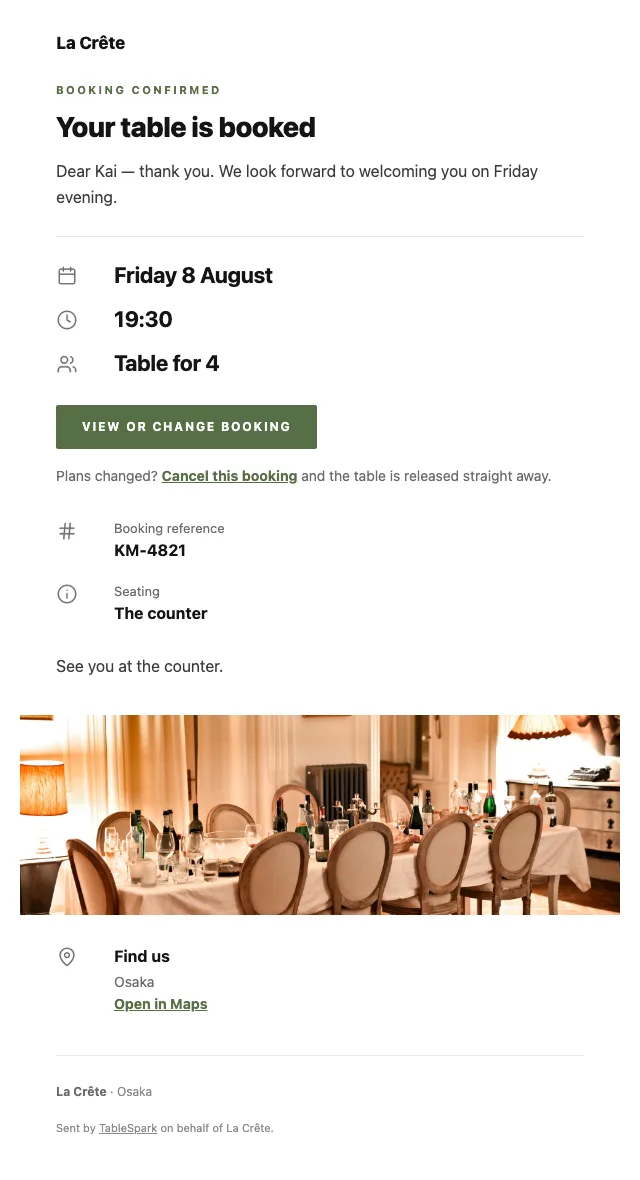
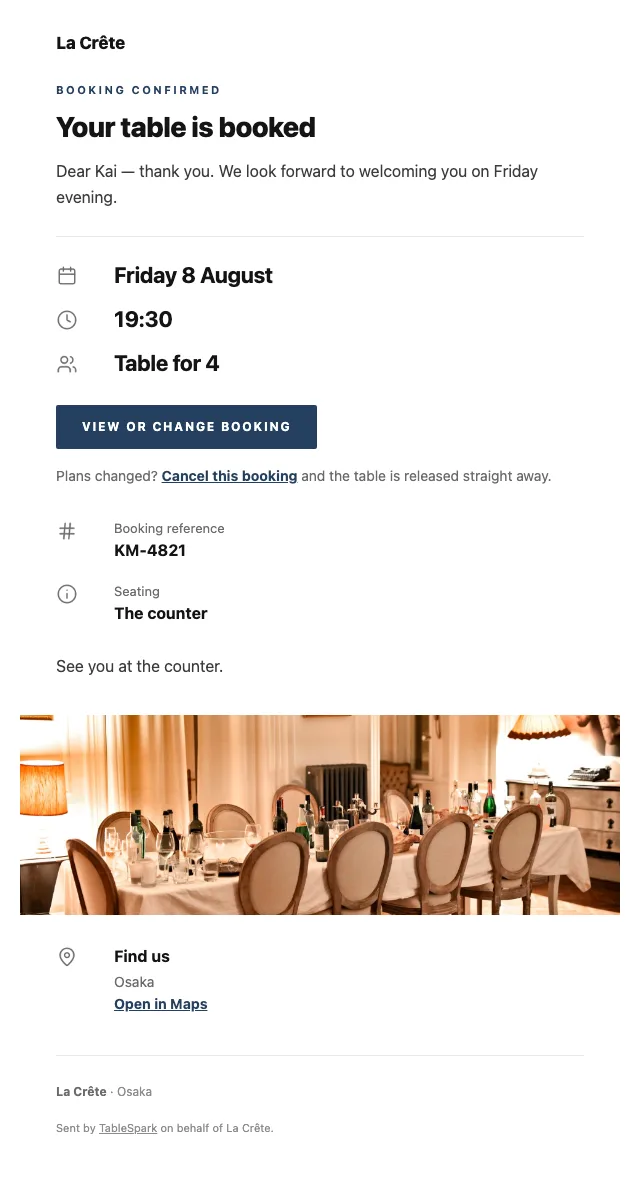
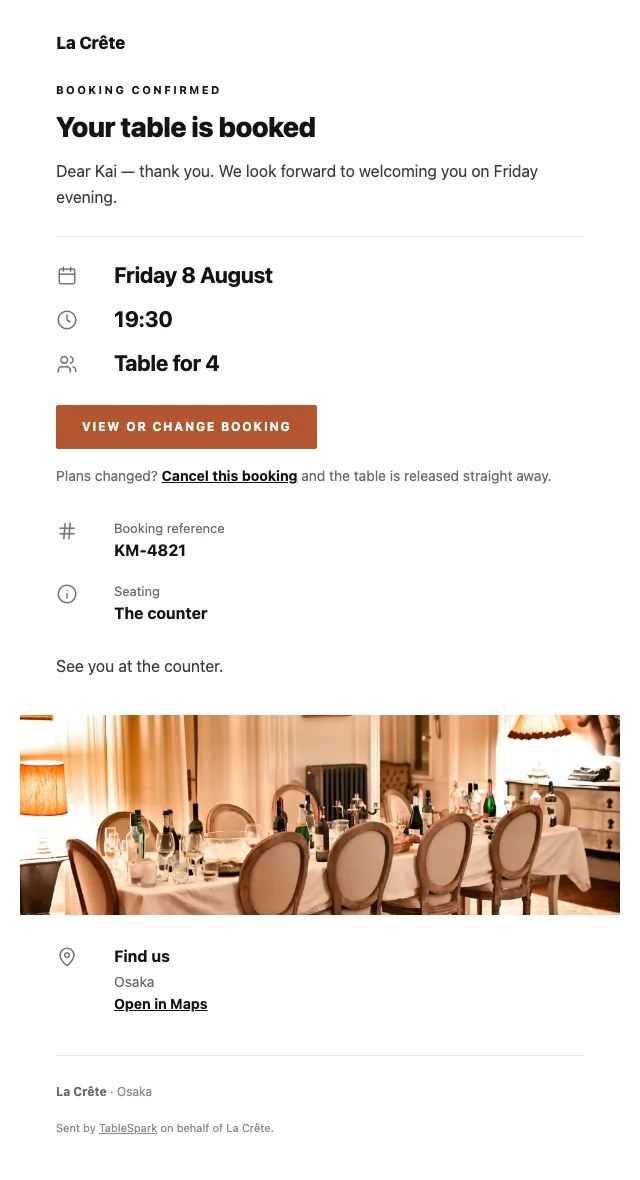
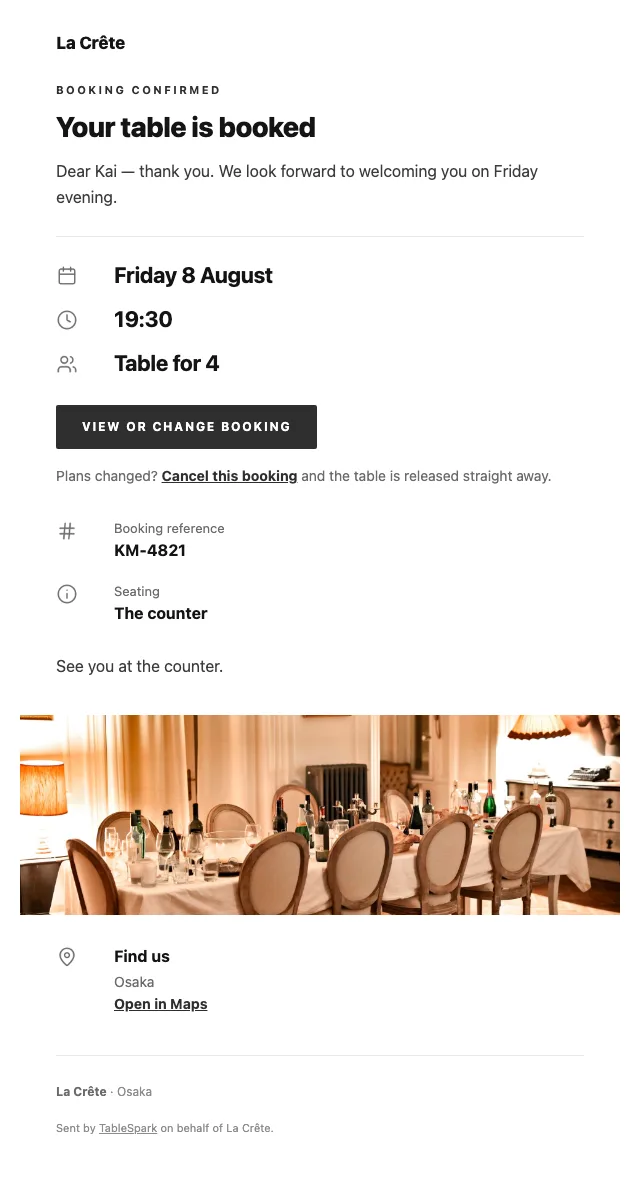
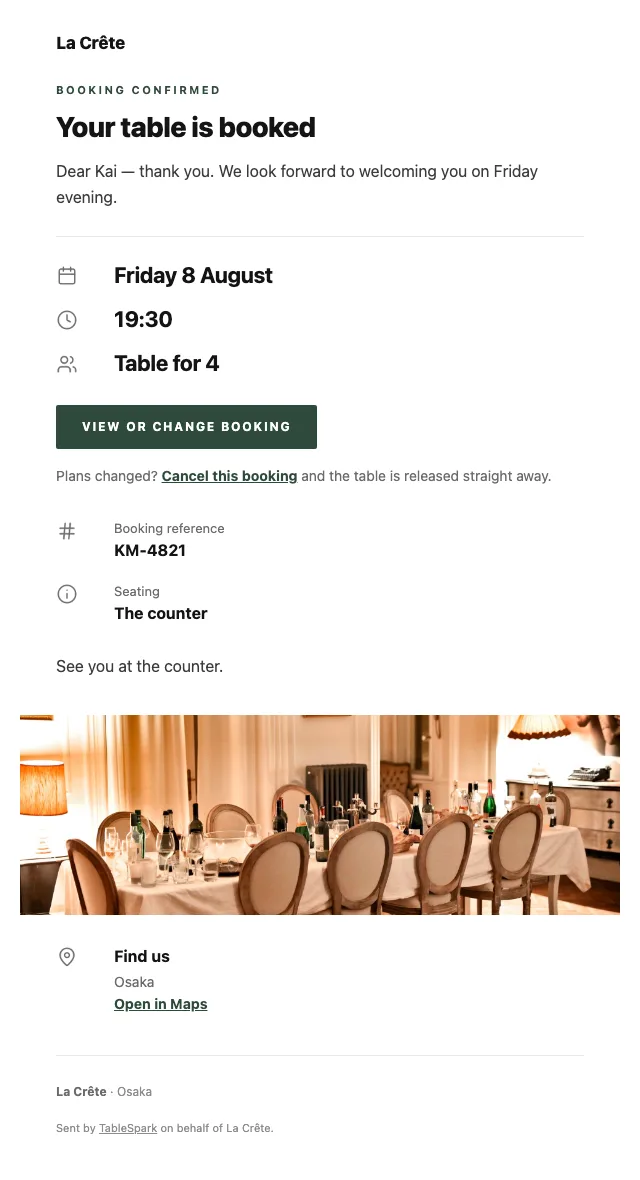
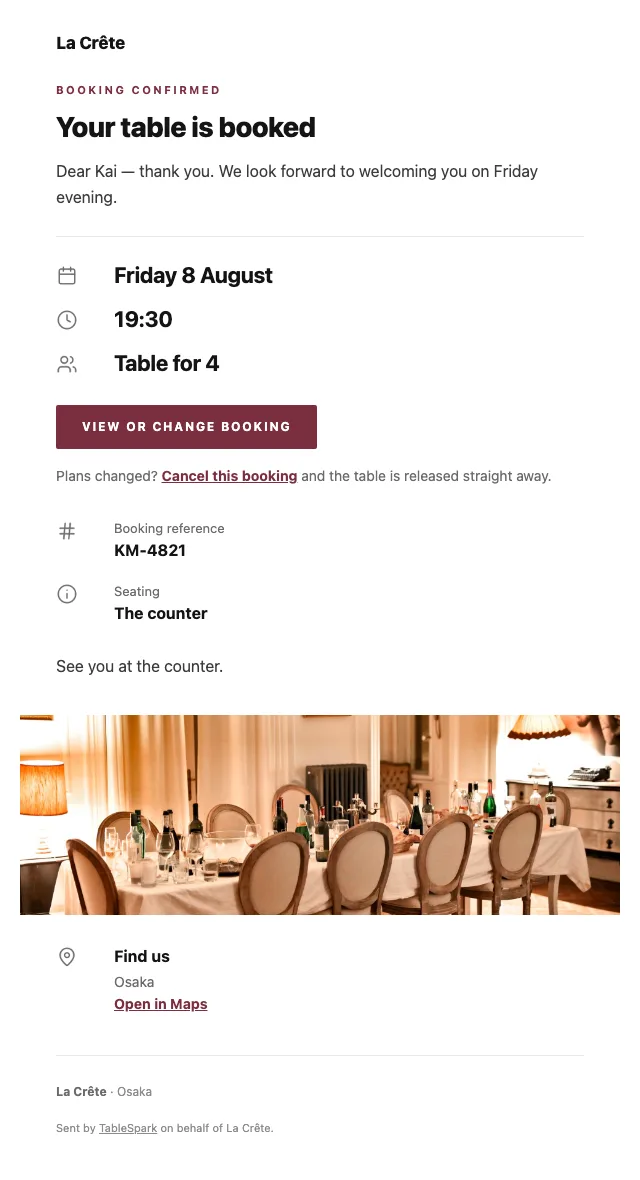
Between booking and arriving, the confirmation email is the whole relationship. The moment a guest books, TableSpark sends them a confirmation on your behalf: the date, the time, the party size, where you are, how to reach you, and a link to release the table if their plans change. The pre-service reminder, the deposit receipt and the cancellation note share it.
None of it has to look like us. Six designs to start from, plus your colour, your logo, a photograph, the header treatment, your own closing line, your links and your socials. Connect your domain and it sends from your address too — so what lands in a guest’s inbox looks like it came from the restaurant, because it did.
Below, the same booking confirmation in six of the accent colours you can pick.
There is a gap between a website that loads and a website that gets found, and it is wider than most owners expect. Working link, zero visibility. It happens through stray noindex rules, conflicting canonicals, orphaned pages, PDF menus, absent structured data and unfinished verification. And the restaurant pays for it: people searching your own name find aggregators and commission-charging platforms instead, so you rent back an audience that was yours.
It is handled in the box, not in an add-on. No guarantees about rankings or indexing exist anywhere in this industry. What exists here is the technical work, finished.
Delete what you do not need and add what you do — pages are yours to shape.
All of these are standard modules — 70 of them in the library, most with several layout variants each.
Any one can be deleted, moved, or swapped for another. Nothing about the order is fixed.
Ships with 4 sections — Small plates, Charcoal, From the sea, To finish — for you to overwrite.
Nothing is skimmed. 0% commission on every plan, where a marketplace takes a slice of each order and keeps the data.
The page is yours, the inbox is yours, the guest list is yours and exportable.
Stripe’s standard card-processing fees apply to online payments.Read how the money works without a marketplace
The camera work and the checking are yours; the transcription, the structure and the draft search copy are ours.
Publishing needs your hand on it.
Search engines Menu — La Crête | Osaka A short counter menu done exactly, with a queue outside. The bowls, the extras and the prices.Drafts the search title & description from this page’s content. Always review before publishing.
Stripe’s standard card-processing fees apply to online payments.
Setting a deposit: amounts, terms and refunds
Build the whole thing, look at it, change your mind. You only pay when you go live.
Build the whole thing, look at it, change your mind. You only pay when you go live.
6 pages, and every one of them is here. Nothing below is a screenshot: the frame renders it through the same engine that publishes your site, so every tab is the real page and every link inside it works. Switch to Phone to watch the same design reflow.
The story page carries the chef and the technique — narrative, interview, timeline and gallery. The visit page handles the practicalities of a queue: when to come, how long the wait usually is, and how the counter works.
An indexed menu is right for a short list where the sections are the choice: the bowls, the sides, the extras. The guest sees the whole menu at once and picks within it.
Descriptions carry the broth, the noodle and the age; dietary marks travel per dish. Because it is structured text, a search for a specific preparation can land on your menu page rather than on a review site.
Any of the layouts leaves the substance intact: real text for every dish, description and price, marked up as Restaurant data rather than published as an image.
Dense rows are the layout for a takeaway list that has to be assembled fast — compact, scannable, and quick to add from.
Extras and sizes are inline chips on each row, the total stays on screen, and collection asks only for a name and a number. Payment goes into your own Stripe account, with 0% commission taken by us. Stripe’s standard card-processing fees apply to online payments.
Dine-in asks for a table number, collection asks for a phone number, delivery asks for an address — and each mode only asks for what it actually needs.
Running a Japanese kitchen? See all Japanese restaurant website templates.
What owners ask before they pick a template: the cuisine fit, the menu, the address, and what it costs.
More so, not less. Guests searching your name need the hours, the address, the menu and the queue policy in a form Google can read — otherwise they find a directory listing that may be wrong. The visit page carries the policy plainly, and the menu is indexable text rather than a photograph.
Yes — the hero and the visit page both carry editable fields for exactly this kind of practical note, and they are edited in seconds when the reality changes. It is the single most useful thing a queue restaurant can publish.
You should not have to. Upload a photograph of the menu you already print and the AI turns it into structured sections, dishes, descriptions and prices, reading dietary and spice marks off the card where it can. Everything lands on a review screen for you to check before it saves. After that it is data rather than an image, which is why one price change updates the menu page, the ordering page, the home-page highlights and the structured data together.
One sitting is a fair estimate. The template copies into your account complete, so the work is changing the name, editing the words and uploading the menu before you publish. Bookings work immediately on publishing, arriving in your TableSpark inbox with an automatic confirmation to the guest. Adding a payment account enables deposits on tables and payment on orders, paid direct to you at 0% commission. Stripe’s standard card-processing fees apply to online payments.
All of it lives in the Theme tab — the accent, the background, the text and surface colours, both typefaces, corner radius, motion and how the header behaves as you scroll. Nothing breaks when you change them, because every block reads from the theme rather than carrying its own colours.
Yes. The TableSpark address exists so you can publish immediately, not so you stay on it. Move to your own domain whenever you like, including one you already own; TableSpark issues and renews the SSL certificate, redirects the bare domain, and keeps canonical URLs, the sitemap and robots pointing at the live address so nothing earned is lost. Guest email can send from the same domain.

Start here rather than from a blank page: rename it, rewrite it, add your menu, publish. Nothing to pay until it is live.