 Valentina Rojas
A generated dish can look better than the plate that leaves the kitchen, and the gap between the two lands on the restaurant as a refund, a bad review or a complaint.
The UK has no rule written for AI food images. The rules on misleading food descriptions, presentation and advertising apply however a picture was made, and a generated image presented as the dish on sale is the risky case, because it shows a plate the kitchen never served. Editing a real photograph, by cropping or correcting exposure and white balance, leaves the dish as served and is a different matter. An "AI-generated" label is unlikely to cure a misleading picture.
A guest orders from a picture the kitchen never plated
Picture a 40-cover neighbourhood restaurant with 25 dishes on the menu and one delivery app listing. The owner is short of time and the menu has no photographs. An image tool offers to make one for every dish in an afternoon, from nothing more than the dish name and a line of description. The pictures come back glossy: a burger stacked a hand taller than the kitchen builds it, a curry with a garnish nobody has ever put on it, a plate of chips that looks like a different cut of potato.
A guest orders the burger because of the picture. What arrives is the burger the kitchen actually makes, in its box, and it is smaller, flatter and plainer than the one on the screen. The guest does not blame the image tool. The guest blames the restaurant, and does one of the things guests do: asks for a refund, leaves a one-star review that says the food looked nothing like the photo, or complains to the delivery platform or the local authority. Each of those costs something: a refund costs the dish and, often, the delivery, a remake costs food and a cook's time, and a review sits on the listing for years.
On 21 October 2026 the trade press reported that Just Eat had paused the roll-out of an AI-powered menu image tool after it produced surreal images for some restaurant listings. That was a platform's own trial, not a regulator's ruling, but it shows what happens when pictures are generated from the words on a menu instead of taken from the plate.
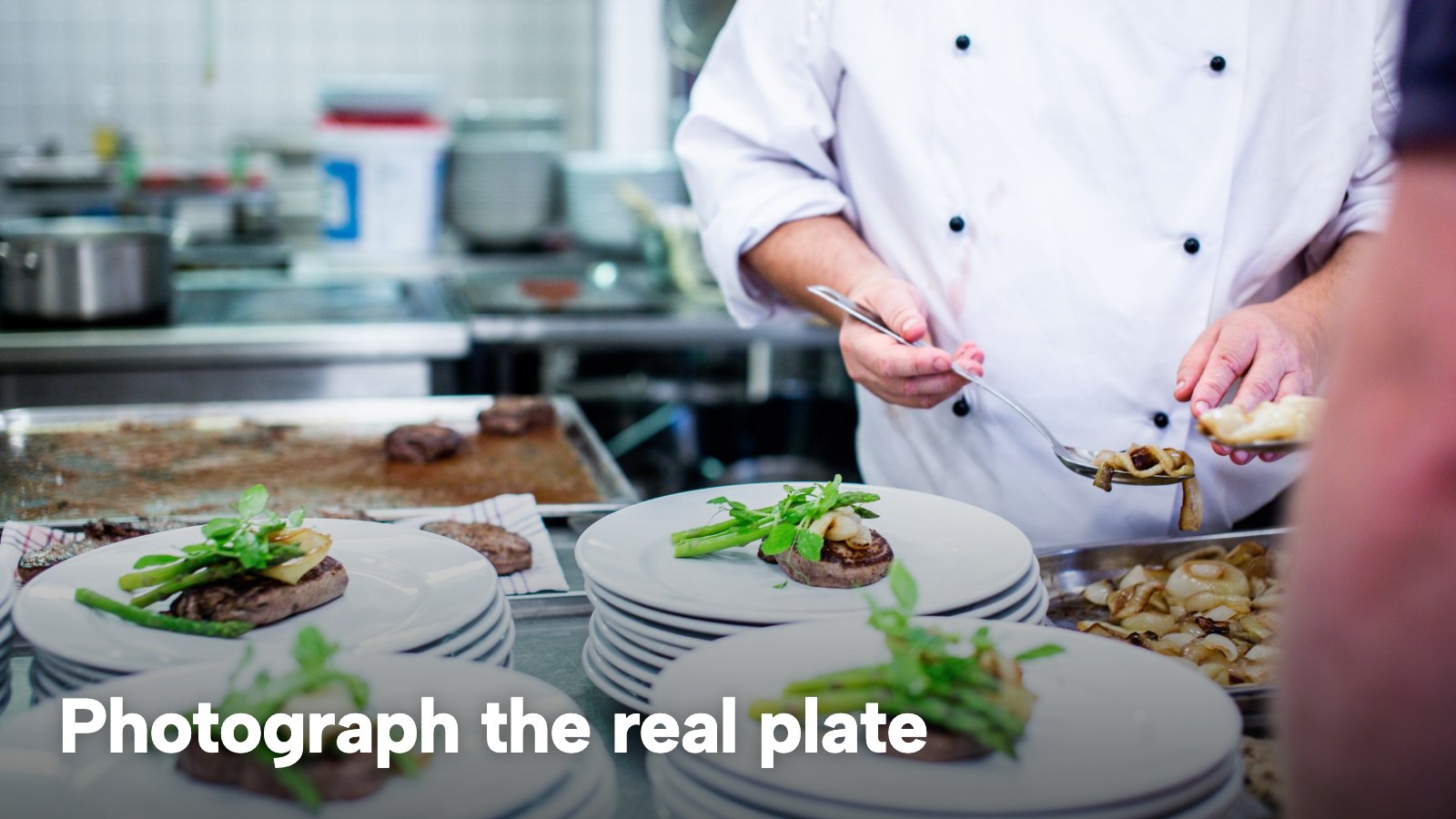
This guide is for the owner of an independent UK restaurant, pub, café or takeaway deciding what photographs to put on a menu, website or delivery listing. Every sum is written out so any input can be replaced with the owner's own. It is a summary of public rules, not legal advice.
The position in one paragraph
AI is a reasonable assistant for several jobs around a restaurant's marketing. It can cut a video, summarise a rule so the owner knows which page to read, suggest a first draft of a script or a caption that a person then checks. A restaurant should not use AI to generate images or video of its own food. A generated dish can look more striking than anything the kitchen plates, but it does not show the food as it is, the kitchen is unable to serve what a model imagined, and the picture works as a claim about the meal. That claim can mislead guests, and there are rules in the UK against misleading food presentation.
This is a position about generating the food, not about every use of software on a photograph. The line between editing and generating has its own section below. It is also not a claim that AI food images are illegal. No source read for this guide says so, and no UK rule is written for them. The argument is narrower: the existing rules ask what impression a picture gives about the food, and a picture of a dish that was never made gives the wrong one.
What Just Eat's paused trial shows
Restaurant Online reported on 21 October 2026 that Just Eat had paused the roll-out of an AI-powered menu imagery tool after it created confusing and surreal images for some restaurant listings. The tool had been on trial on restaurant listings. The examples named were eggs and sausages floating in a glass of cola, created to represent a "breakfast soda", a miniature burger served inside a sauce pot, and wine glasses containing chunks of watermelon. The affected images had been removed.
IBTimes UK, on 22 October 2026, added how the images came about: the software generated pictures from menu names and descriptions, seemingly struggling with regional UK food terms and spelling mistakes. A Northern Ireland cafe's "bacon and egg soda" was shown submerged in cola, and a "Garlic Bread Plane", misspelt from "plain", became an aeroplane. The report says the company has not abandoned AI-generated imagery altogether.
None of this is a ruling. It was a platform's decision to pause a trial, not a regulator's finding.
The risk that matters more to a restaurant is the one the absurd examples hide. IBTimes UK's own commentary, which is the outlet's opinion and not Just Eat's, is that more subtle mistakes could prove harder to spot: a wrong portion size, missing toppings, spiced salt and pepper chips drawn as plain potato sticks. A cola breakfast gets removed in a day. A plausible burger that is a little bigger and a little neater than the real one can stay on the menu for months, and the guest finds out when the box is opened.
Why a generated dish is not an edited photograph
A photograph starts from a real plate. Whatever is done to it afterwards, the dish in the picture is a dish somebody cooked and put on a plate. A generated image starts from words. The Just Eat images were produced from menu names and descriptions, and a model working from a name and a line of text has no way of knowing the portion, the plating, the garnish, the bread or the side that this particular kitchen sends out. It fills those gaps with what such a dish usually looks like in the data it learned from. That is the whole mechanism. It is why the result can be beautiful and wrong at once.
It is also why the usual defence, that the picture is only for illustration, is weaker than it sounds: the more convincing the image, the more work it does as a claim. A 2023 test reported by The Grocer shows how convincing generated food can be. The study, commissioned by a technology vendor, showed 100 consumers food photographs by a photographer alongside images made with DALL-E. Across ten images, 60% on average could not tell whether a picture was a genuine photograph or one created from a prompt, and 73% could not recognise an AI-made margherita pizza. The study was small, vendor-commissioned and used older image models, so it proves little about today's tools. It does show that a generated dish can pass for a real one, which is the condition under which it can mislead.
In July 2026 Food Alert, a food-safety consultancy, told the trade press that customers were using AI-generated images and AI-written complaint emails to seek refunds from restaurants and takeaways, and that some platforms process refunds automatically before passing the cost to the restaurant. That is a commercial source and the claim is its own. The practical point is ours: a restaurant that can show a dated, real photograph of the dish it serves is better placed to answer a disputed image than one whose own menu is already synthetic.
What the law says about a picture of food
There is no UK statute written for AI food pictures. The relevant rules are older and general: they cover how food is described, advertised and presented, and how a commercial practice is judged overall. Each is stated here at the strength its source supports.
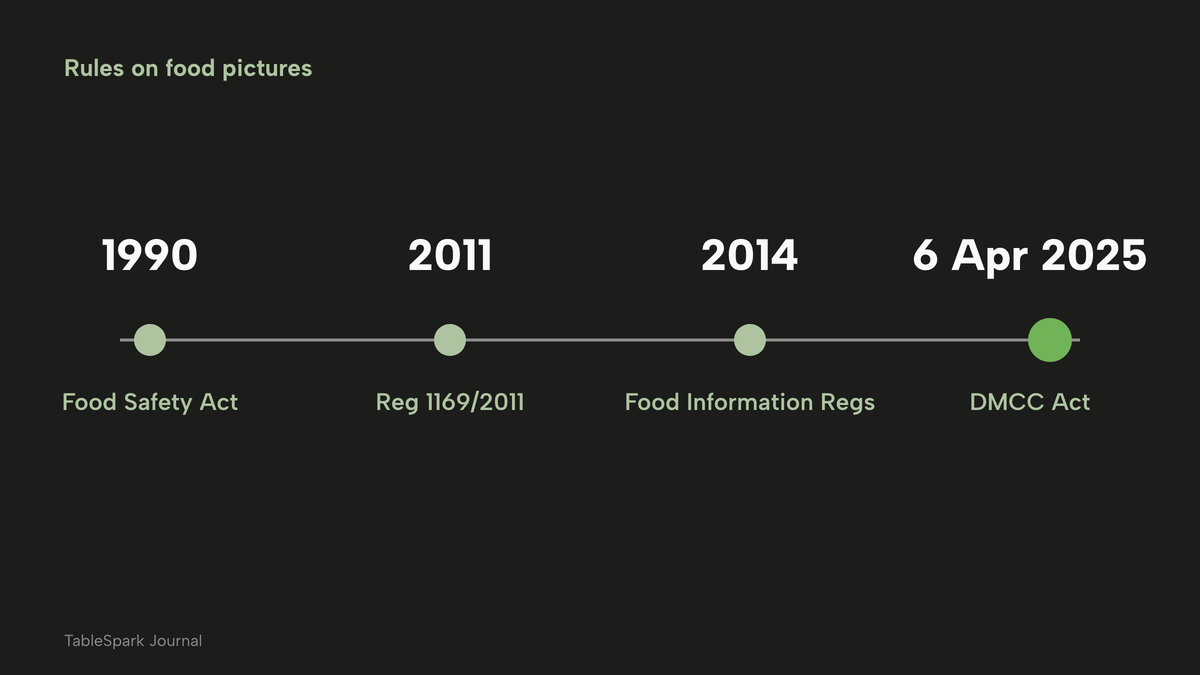
Food Safety Act 1990, section 15
Section 15 is headed "Falsely describing or presenting food" and, on legislation.gov.uk, is marked as applying in England, Wales and Scotland, so Northern Ireland is not covered by it. Subsection (2) makes it an offence to publish, or be a party to the publication of, an advertisement which falsely describes any food or is likely to mislead as to the nature or substance or quality of any food. Subsection (3) makes it an offence to sell, offer or expose for sale, or possess for sale, any food the presentation of which is likely to mislead as to the nature or substance or quality of the food.
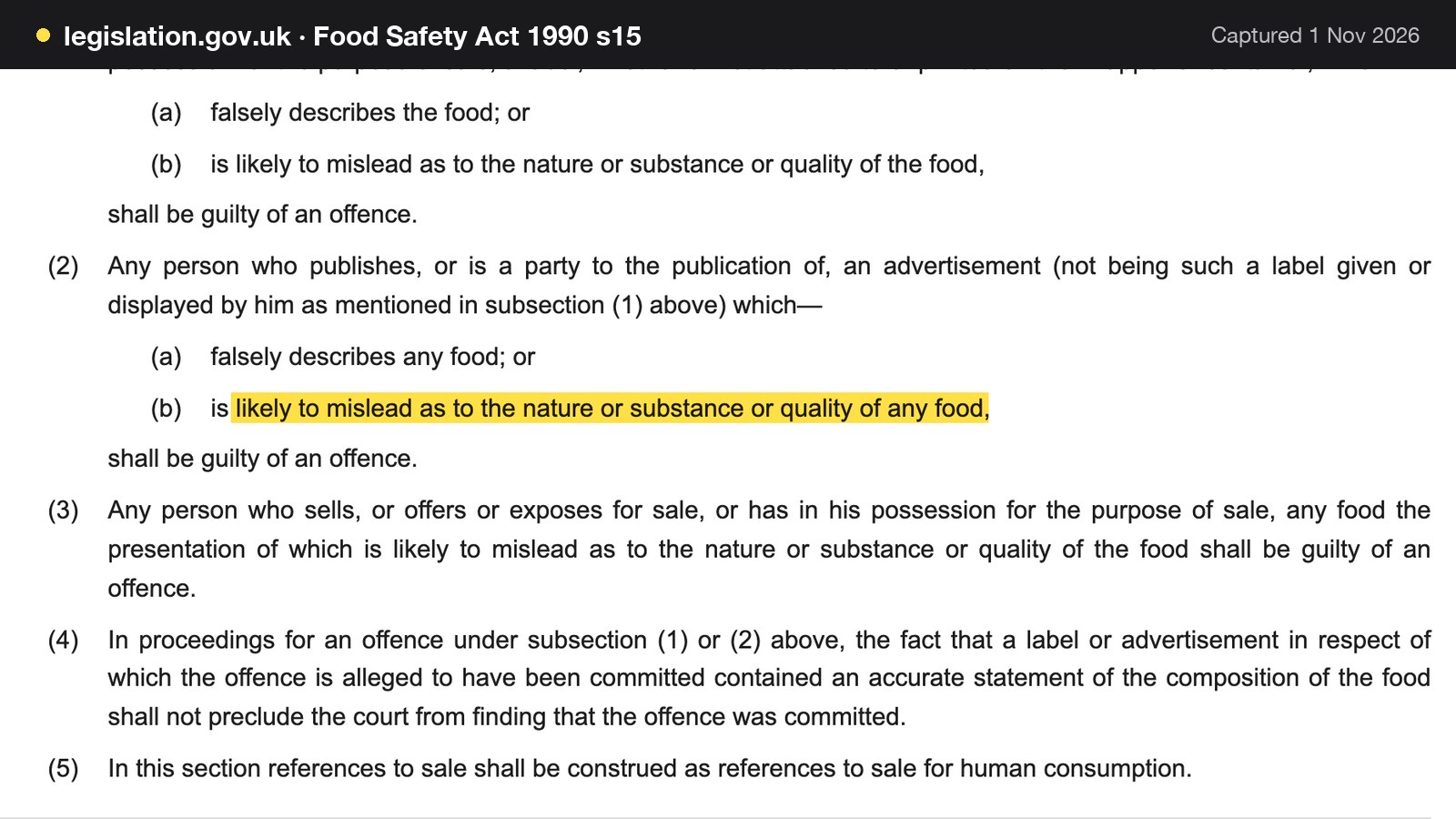
Subsection (4) adds that an accurate statement of the food's composition on a label or advertisement does not stop a court finding the offence, so a correct caption does not automatically cure a misleading advertisement. Nothing read for this guide settles whether a menu photograph counts as an "advertisement" or a "label" under the section, and no court decision was found, so none is claimed. The argument is that a picture published to sell a dish is, on an ordinary reading, what the section is aimed at. It is an argument, not a holding. The penalty provision, section 35(2), allows on indictment a fine or up to two years' imprisonment, or both, and on summary conviction a fine or up to six months, or both. No prosecution over a menu photograph was found, and the penalty is quoted to show what the statute provides, not to suggest that prosecution is likely.
Retained Regulation 1169/2011, Article 7
Article 7(2) says food information shall be accurate, clear and easy to understand for the consumer. Article 7(1)(d) lists, among the ways information can mislead, suggesting through appearance, description or pictorial representations the presence of a particular food or ingredient when a component normally present has been substituted. Article 7(4) extends these rules to advertising and to the presentation of foods, in particular their shape, appearance or packaging, the way they are arranged and the setting in which they are displayed. Article 1(3) applies the Regulation to food business operators where their activities concern the provision of food information to consumers, including foods delivered by mass caterers.
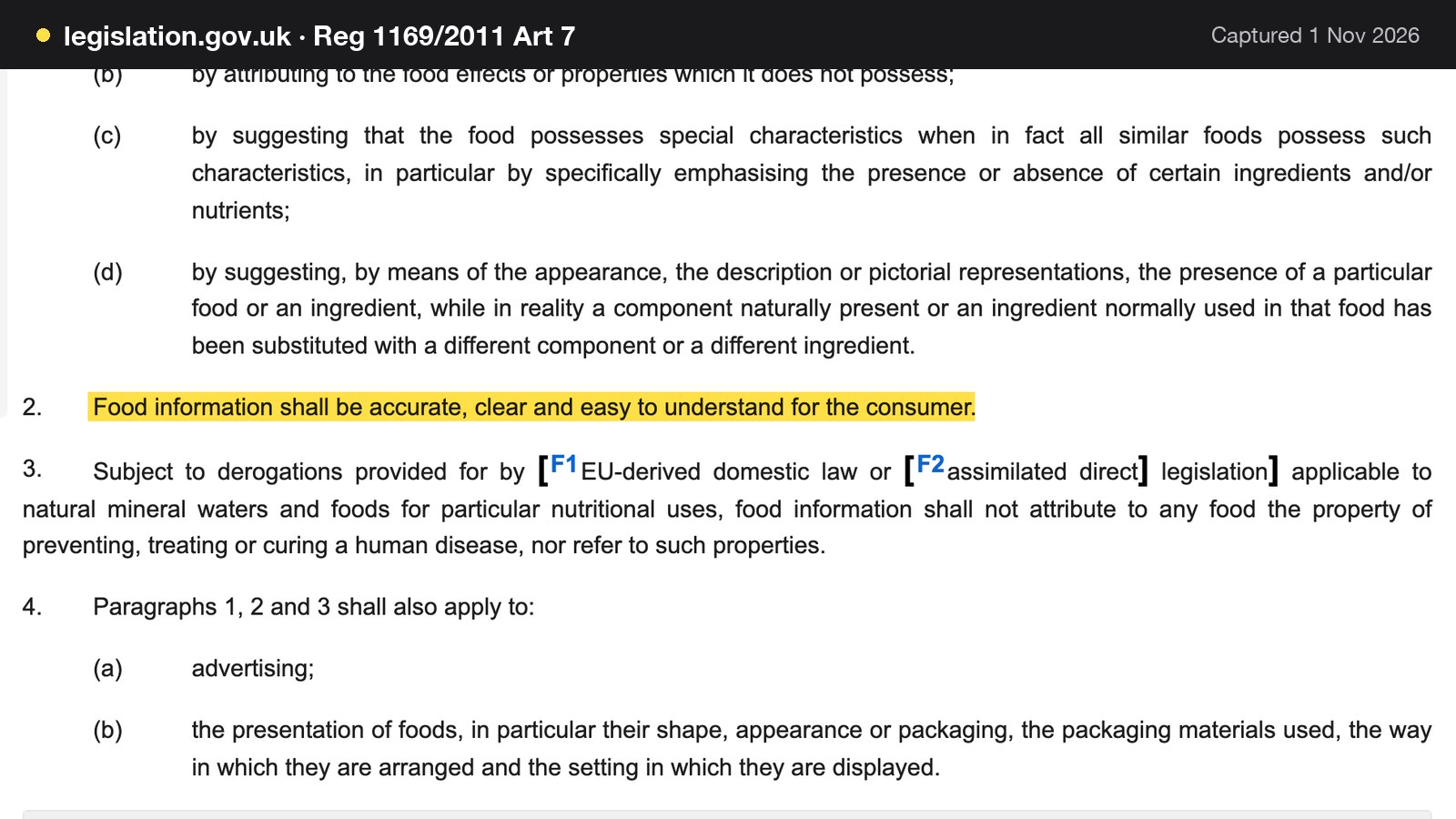
The honest note concerns enforcement. The Food Information Regulations 2014 make food authorities responsible for enforcing the rules, but the offence provision, regulation 10, lists only a short set of provisions: Article 9(1)(c), Article 21(1) and Article 44(1)(a). Article 7 is not on the list, so a breach of Article 7 is not by itself an offence under the 2014 Regulations. That is why section 15 is the offence to cite for a misleading food picture, and why Article 7 is better read as the standard the picture is expected to meet.
The Digital Markets, Competition and Consumers Act 2024, section 226
Section 226(1)(b) says a commercial practice involves a misleading action if it involves an overall presentation which is likely to deceive the average consumer about a matter relating to a product or any other matter relevant to a transactional decision. Subsection (3) adds that an overall presentation may be deceiving even if the information it contains is true. The section came into force on 6 April 2025.
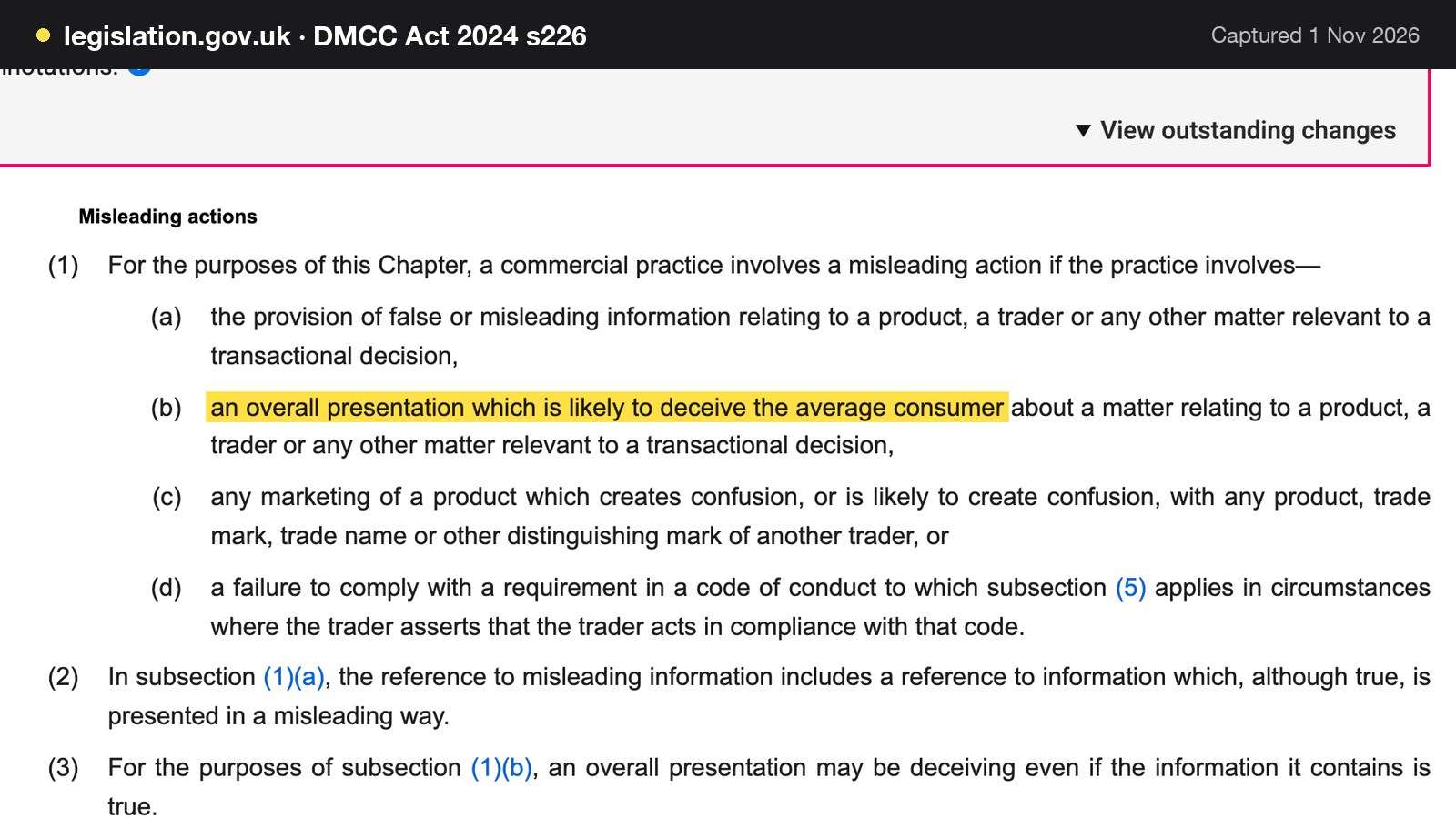
On 7 April 2025 the Competition and Markets Authority published that, under the new regime, it can decide for itself whether consumer protection law has been infringed and, if a company infringes it, can fine the company up to 10% of its global turnover.
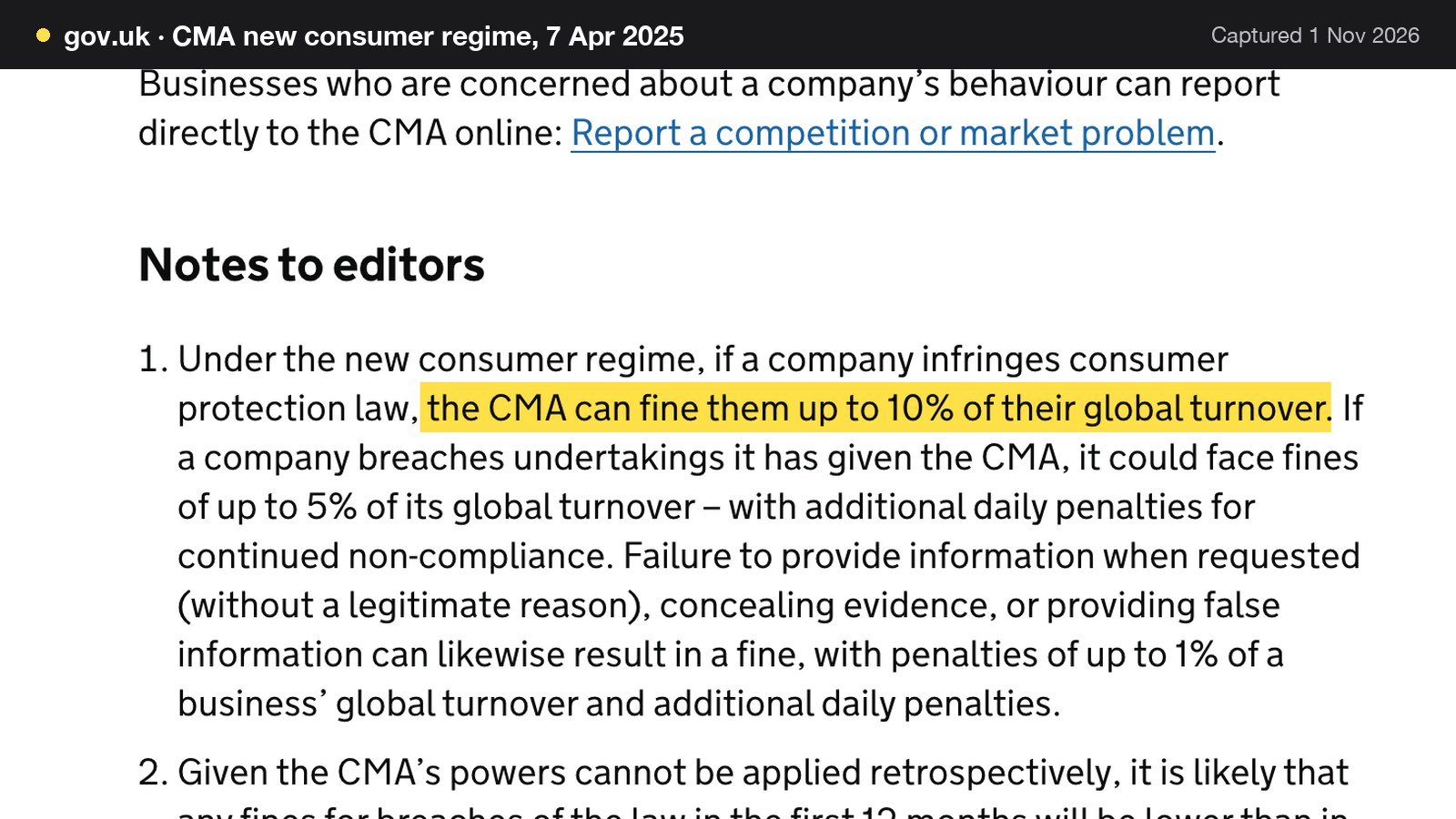
That 10% is a statutory ceiling aimed at large companies, not a likelihood for a restaurant, and the same release names aggressive sales tactics, hidden fees and unfair contract terms as early priorities, not food pictures. The reason to know the section is its test. It asks about the overall presentation and the average consumer, and it says true information in a deceiving presentation is still caught. A caption that states the weight of the burger does not rescue a picture of a burger twice that size.
What GOV.UK tells a food seller
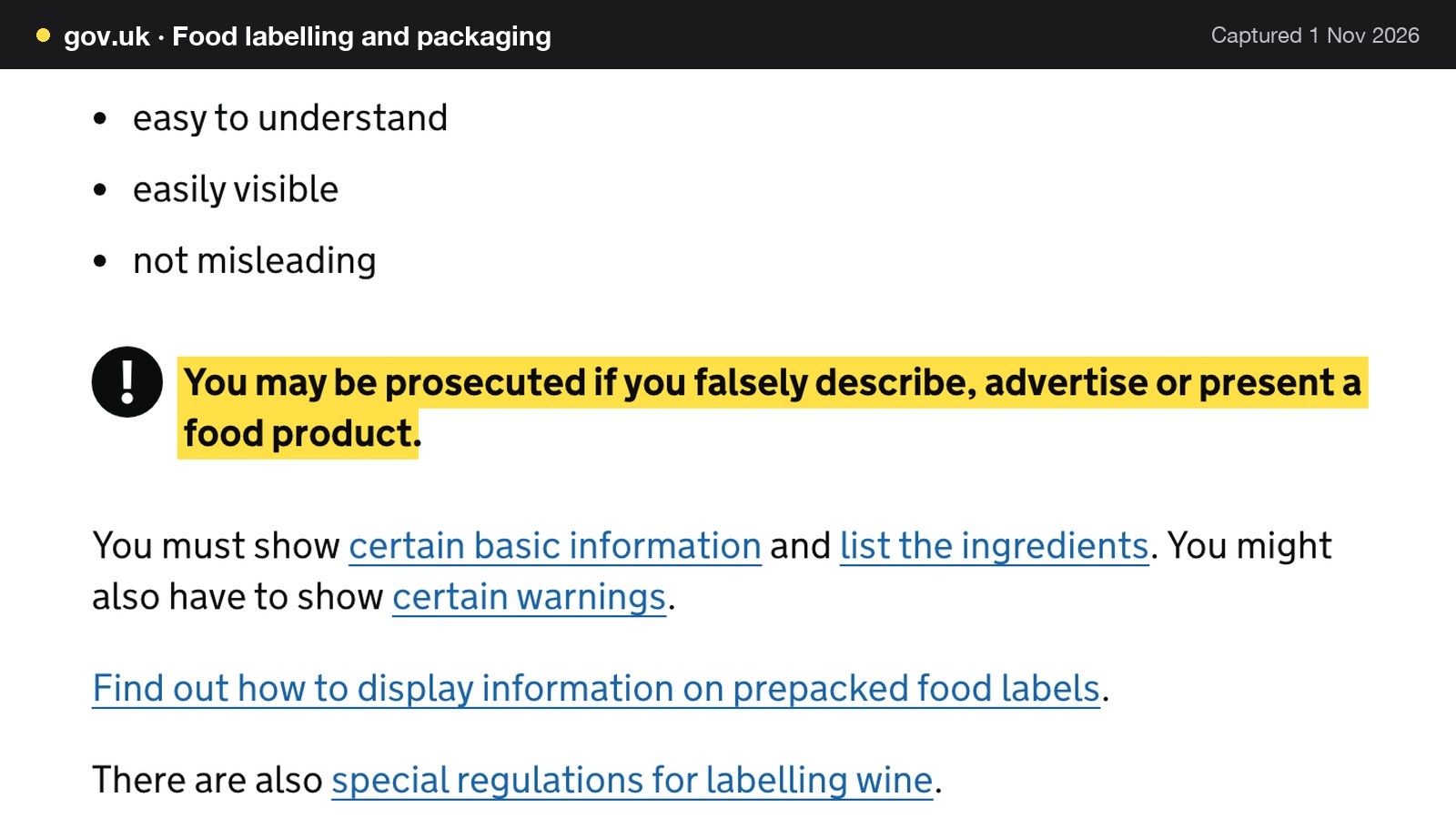
GOV.UK's food labelling and packaging guidance says the information about a product, on the label, on nearby notices or online, must be not misleading, and then: "You may be prosecuted if you falsely describe, advertise or present a food product."
This is a summary of public law and official guidance as published on 1 November 2026, not legal advice; check the current position, or take advice, before acting on a specific case.
What the advertising regulator says
The Advertising Standards Authority enforces the CAP Code, which governs non-broadcast advertising in the UK. Rule 3.1 says marketing communications must not materially mislead or be likely to do so. Three statements from the Committee of Advertising Practice, which writes the Code, bear on AI images. They are cited as sources, not reproduced as evidence figures.
The Code is media-neutral. On 11 June 2026 CAP News said AI might change how ads are made but not how they are regulated: the rules apply regardless of how the content was created. On 29 May 2025 it said the CAP Codes contain no AI-specific rules.
The advertiser stays responsible. The June 2026 article says that if an AI tool produces something problematic, the advertiser remains responsible for any output used in its ads. For a restaurant that answers who is liable when the tool draws toppings the kitchen does not serve: the restaurant that published the picture.
Disclosure is unlikely to cure a misleading picture. The May 2025 article says there is no blanket legal requirement in the UK to disclose the use of AI in ads, and then that disclosure alone is "very unlikely" to mitigate the harm caused by a fundamentally misleading message. Its worked example is a cosmetic product, so it is an analogy for a menu, but it points the same way as section 15(4): a label on the picture does not do the work the picture has to do.
CAP's September 2025 article on misleading imagery says the ASA considers the entire ad and the overall impression, and that images giving an inaccurate impression of the product consumers will receive, for example by featuring the wrong product, including extras or exaggerating quality or size, are likely to mislead. Its food example is a plate of stew, potatoes and rice, which is likely to mislead if the customer receives only the stew, unless it is clear the potatoes and rice are charged separately. Its advice is to usually show the item as customers will receive it. That sentence is the working test in this guide. It is why a generated dish is the risky case: a model draws the dish a customer might expect, not the one the kitchen sends.
What the regulator has actually ruled
Birds Eye, 2016. On 1 June 2016 the ASA upheld a complaint that a television ad for a pasta product exaggerated the portion size. It bought and cooked the product to the packet instructions and found the pan and bowl shots appeared to contain more pasta and mushrooms than one real serving. The ad breached BCAP Code rule 3.1. The relevance to a menu is the method: the regulator tested the picture against the product a customer actually receives.
Burger King's Double Whopper, 2007. A trade title, Leisure Opportunities, reported on 17 January 2007 that the ASA had upheld complaints over the size of a Double Whopper in a television ad. According to that report, Burger King said the burger had exactly the same ingredients and build and that only studio lighting was used, and the ASA, having bought Double Whoppers from two restaurants, found them considerably smaller than shown. This is a trade-press account, not the ASA's own page, which was not found. It supports a limited point: the picture was upheld against even with the same recipe and only lighting, because what the customer received was smaller.
WiggyDog, 2026. On 25 March 2026 the ASA upheld a complaint about a paid social ad for a toy whose footage appeared to be of real and/or AI-generated puppies, finding that it exaggerated the product's performance and characteristics. It is the closest UK ruling found to AI imagery of a product, but it turned on the claim and the product, and does not say that using AI was the breach in itself.
None on an AI food image. No ASA ruling on an AI-generated food image, menu photograph or delivery-listing photograph was found as of 1 November 2026. Absence from a search is not proof that none exists, and this guide does not say the ASA has banned AI food photos. ASA New Zealand, on 16 June 2025, went the other way on an obviously AI-made Goneburger ad, ruling the complaint did not reach the threshold to breach its codes and taking no further action. That is not UK law, and it concerns a very stylised image that no one would read as a photograph. The risk in this guide is the plausible image. The ASA's sanction is a ruling and a requirement to amend or withdraw the ad; the CMA holds the fining power above. Whether a given menu or delivery listing falls within the ASA's remit is not settled here.
Where the line sits between editing and generating
The regulator's test is the impression a picture gives about what the customer will receive, not the tool that touched it. CAP's May 2025 article says advertisers have long used post-production techniques without a rule to disclose them, and describes AI as often used similarly, making subtle non-material changes such as removing unwanted background elements. It says the answer depends on the specific content, context and likely audience interpretation.
No CAP or Food Standards Agency page was found that lists the edits allowed on a food photograph, so what follows is this article's reading of CAP's test by analogy. On that test, cropping, straightening, exposure, white balance and wiping a smudge off the rim of a plate leave the dish as served. Generating a plate, adding garnish or toppings the kitchen does not serve, enlarging a portion, or applying a filter that changes the look of the food moves the picture away from the dish.
| Shows the dish you serve? | Risk reading on these sources | |
|---|---|---|
| AI-generated image of a dish | No, it is a dish drawn from words | Risky: a picture of food never made, shown as the dish on sale |
| AI "enhanced" image that adds or changes food | Only in part, with added or altered items | Risky: extras and exaggeration are what the regulator names |
| Stock photograph of a generic dish | No, it is somebody else's food | Lower than generation, but still not your dish |
| Real photograph with normal edits | Yes, the plate as it left the pass | Lower risk: crop, exposure and white balance leave the food as served |
| Real photograph styled for the shoot | Yes, if it is the portion and garnish sold | Lower risk, if styling does not add items or enlarge the portion |
Stock photographs get their own sentence because owners treat them as the safe alternative. A stock picture of a generic burger is a photograph of a real burger, so it avoids food that never existed, but it is not a photograph of this restaurant's food either. If a guest orders from it and receives something different, the same question applies: did the picture show the item as the customer will receive it?
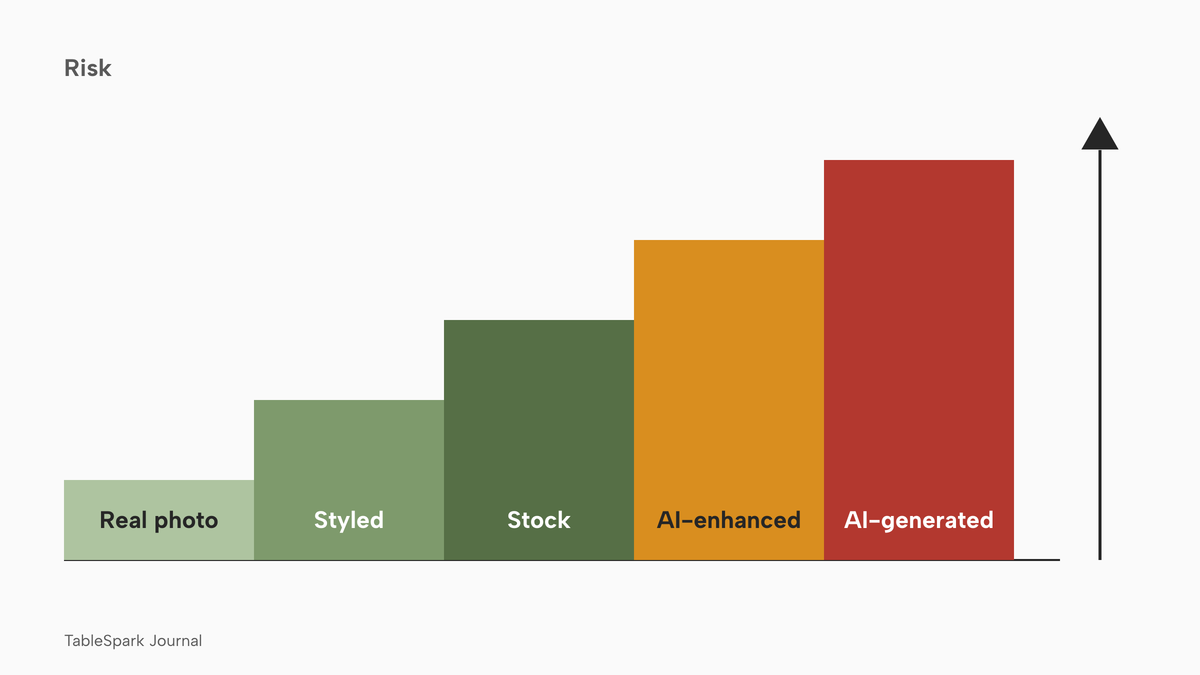
The risk readings in the table are this guide's reading of the sources, not legal conclusions, ordered by one question: how far does the image sit from the plate a guest receives?
What honest photographs cost
The cost question is where generated images look most attractive, so it gets real arithmetic. Everything below is for one illustrative independent: 40 covers, 25 menu dishes, one delivery app listing. Inputs marked illustrative are assumptions, not data about any restaurant.
Option 1: a phone and daylight
An existing phone costs nothing extra. Allow ten minutes per dish to plate, shoot and re-plate (illustrative, no source): 25 dishes × 10 minutes = 250 minutes, or 4 hours 10 minutes, once. The cash cost is £0 plus the owner's time.
Option 2: a food photographer
Clean Plate Food Photography, in a listing on photographerforhire.co.uk, offers half-day shoots of 3 to 4 hours with 30+ images from £395 and full-day shoots of 6 to 8 hours with 60+ images from £650, with commercial usage rights. Twenty-five dishes at one image each fits inside the 30+ images of a half day, by this guide's reading, so £395 is the starting figure. Stuart Price Photography's own page lists location photography at £125 an hour, £450 a half day and £700 a day. Whito, an independent survey compiled from 40 published UK price lists, gives food and drink photography as £300 to £850 for a half day and £650 to £1,200 for a full day. No page read states whether VAT is included, and these are "from" figures, so a quote is the real answer.
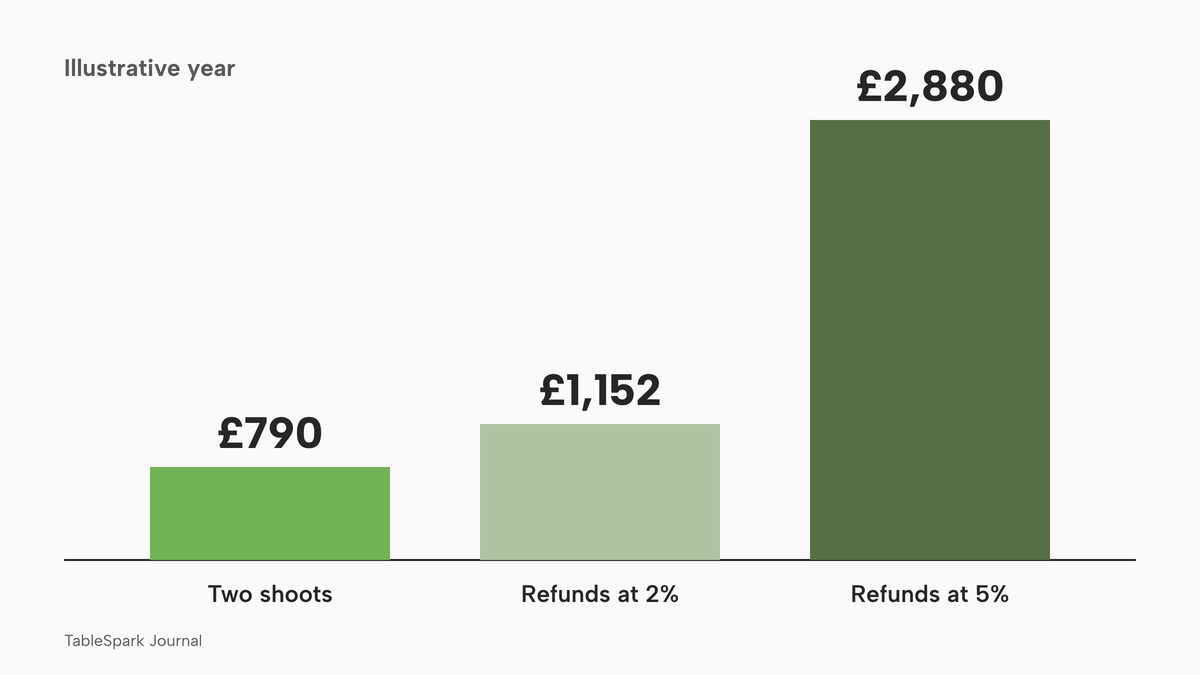
If the restaurant refreshes its photographs twice a year, which is an illustrative assumption: 2 × £395 = £790 a year at the lower listed price, and 2 × £450 = £900 a year at Stuart Price's half-day rate.
Option 3: an AI image tool
Photoroom is an AI image-editing service whose pricing page, read in US dollars on 1 November 2026, lists Pro at $7.50 a month and Max at $20.99 a month, billed yearly. Over a year: 12 × $7.50 = $90 and 12 × $20.99 = $251.88. Its page advertises AI backgrounds and AI fashion models and does not describe creating a restaurant's dish. It is named only to show the order of cost of such tools, tens of dollars a year; the pricing pages of the generators that could be used for dishes could not be read, so no price for them is claimed. The subscription is not the cost that matters.
Option 4: the cost of getting it wrong
Assume 200 delivery orders a month at an average of £24, both illustrative. If 2% are disputed because the dish did not look like its image: 200 × 0.02 = 4 orders, 4 × £24 = £96 a month, and 12 × £96 = £1,152 a year. At 5%: 200 × 0.05 = 10 orders, 10 × £24 = £240 a month, and 12 × £240 = £2,880 a year. Substitute your own percentages. The sums leave out remake food cost, the platform's fee on the order, staff time and review damage, so they understate the cost, and some platforms refund automatically and pass the cost to the restaurant.
| Orders a month | Refunds a year | |
|---|---|---|
| 2% | 4 | £1,152 |
| 5% | 10 | £2,880 |
Set against the photographer: a £395 half-day shoot equals £395 ÷ £96 = 4.1 months of refunds at 2%, or £395 ÷ £240 = 1.6 months at 5%. The break-even is short because the photographer's fee is a one-off and the refunds repeat every month.
The prices side by side
- Charged per
- Month
- Media library for your own photos
- Live menu
- QR-ready menu
- Unlimited editing
- Charged per
- Shoot
- 3 to 4 hours
- 30+ images
- Commercial usage rights
- Charged per
- Hour, half day or day
- Location photography
- Personalised quotes
- Charged per
- Session
- Food and drink photography ranges
- Charged per
- Month
- AI image editing credits and exports
These prices are not like-for-like, because the rows charge for different things: a monthly website plan, a one-off shoot, an hourly or daily rate, a published range, and a dollar subscription for an image tool. The TableSpark row is a place to put the photographs, not a photographer.
How to take honest photographs, step by step
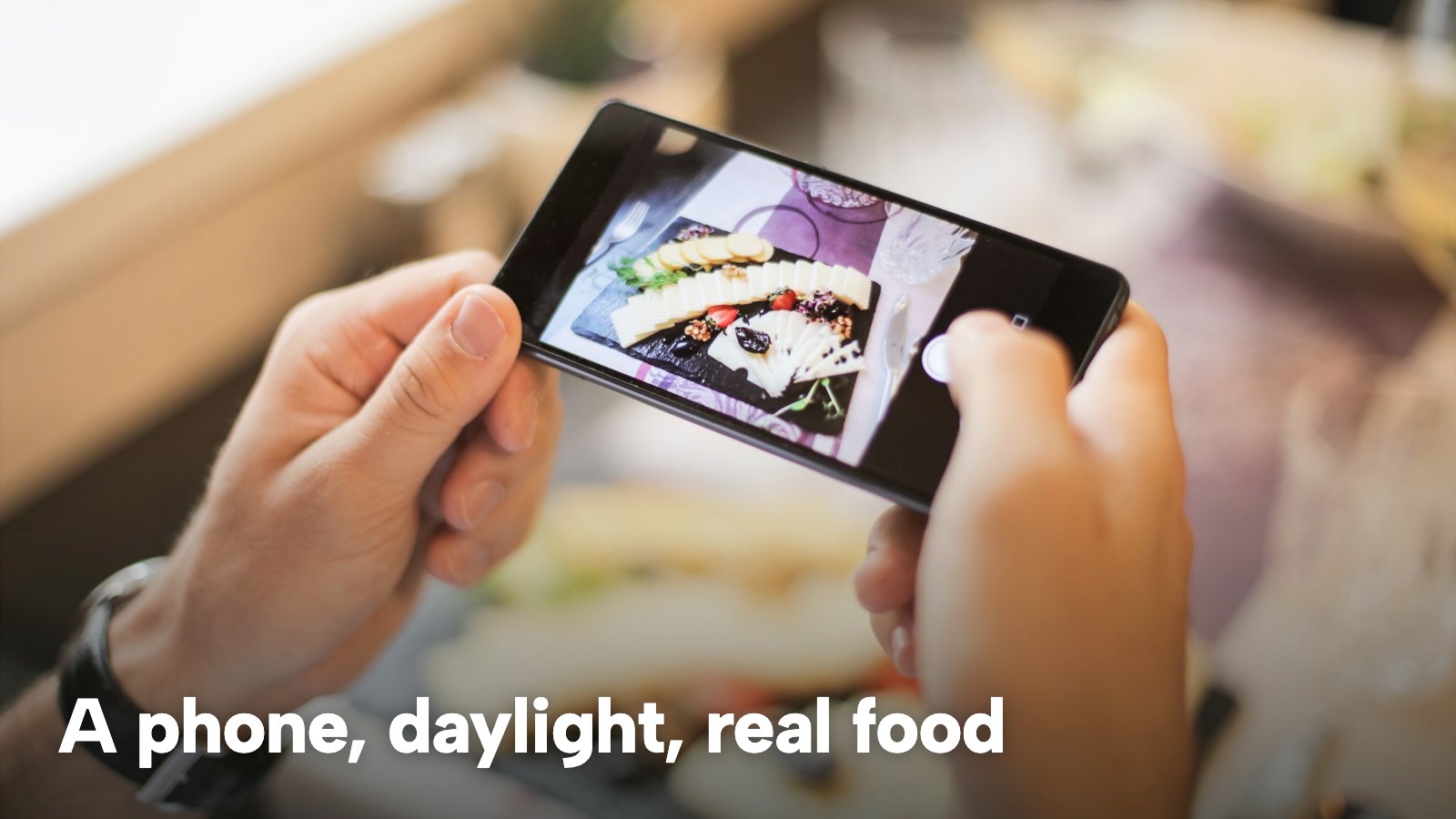
1. Shoot at the pass, in daylight. Photograph the dish as plated for service, in the actual portion, with the actual garnish, on a plain plate beside a window and away from direct sun. Shoot tall dishes from about 45 degrees and flat ones from overhead.
2. Add nothing. Leave out extra toppings, props the guest will not receive and any larger portion. If a side is charged separately, leave it out or say so, as CAP's stew, potatoes and rice example makes clear.
3. Date every photograph. Write down when it was taken and who compared it to a real plate. TableSpark's article on keeping dish photos accurate as the kitchen changes sets out the same idea: a date, and a named person who holds the answer.
4. Replace when the dish changes. A new supplier, portion or garnish means a new photograph. That article covers keeping real photographs true. This one covers generated images.
5. Check the rights. Use your own photographs, or a photographer's with commercial usage rights; the photo copyright guide covers what a licence allows.
Where AI does help
The stance is not anti-technology. It is that the dish itself is the one thing a model has no way of knowing. Around the dish, software does real work: it can draft a caption or alt text that a person checks against the dish, cut a short video from clips the kitchen filmed, or summarise a rule so the owner knows which page to read. In each case the output is words or real footage that a person approves, and none of it puts an invented plate in front of a guest. A photo gallery on a restaurant website works the same way, with real photographs of the real room and food.
How to do it in TableSpark
Dish photographs on a TableSpark menu are uploaded by the restaurant, and the AI menu scanner reads the text of a menu. Template previews and scan-drafted sites can carry stock food photographs, so replace every stock or template image with a photograph of your own dish before you publish. The steps follow the put your menu online tutorial.
Step 1 of 6
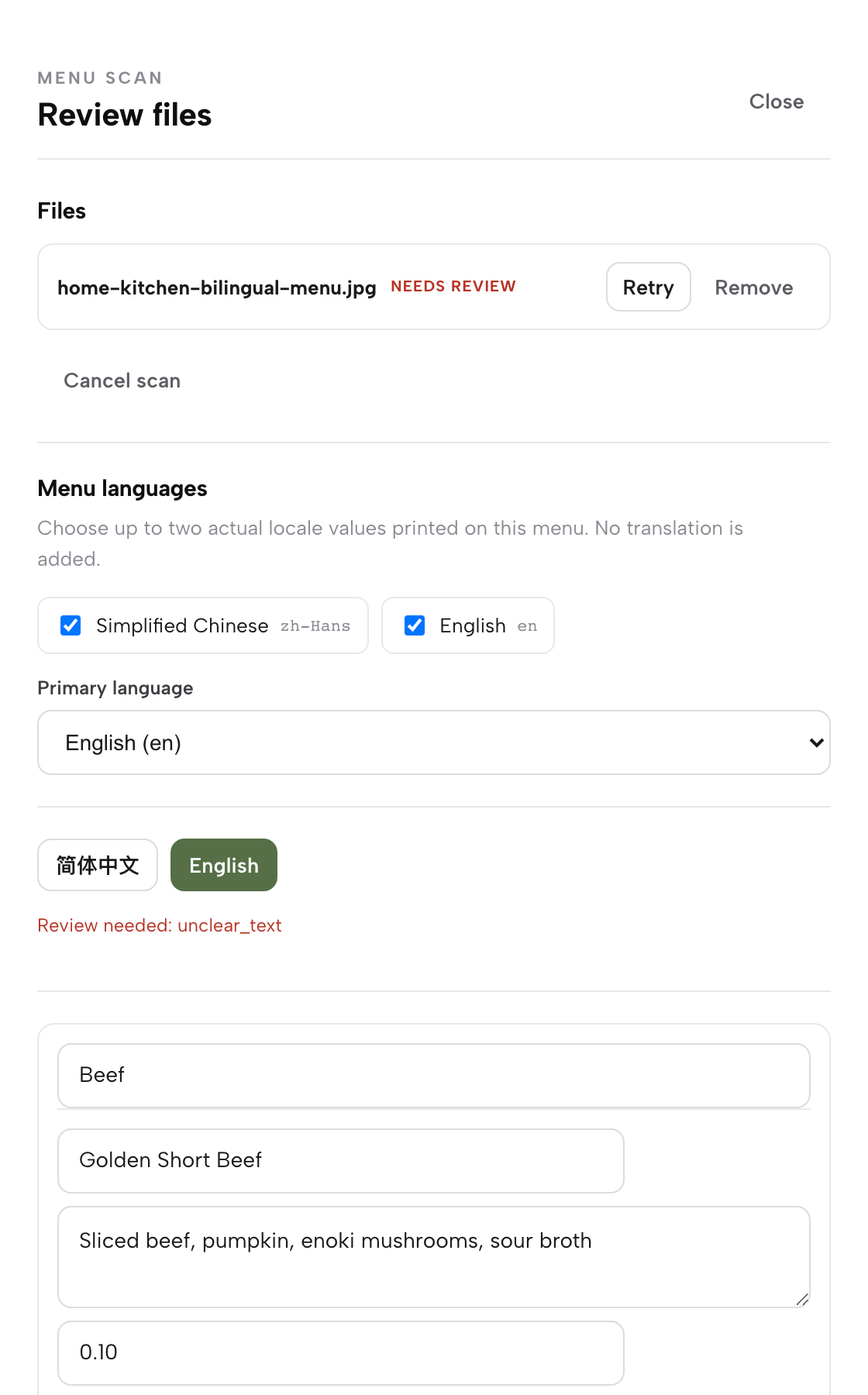
Let the scanner read the text, then review it
On the Menu page, open Scan from photos, add up to ten JPEG, PNG or WebP pages of the menu, and review the sections, dishes, printed descriptions and prices it reads back. Correct anything wrong before applying it. The scanner reads the menu's words. The pictures stay yours to supply.
Step 2 of 6
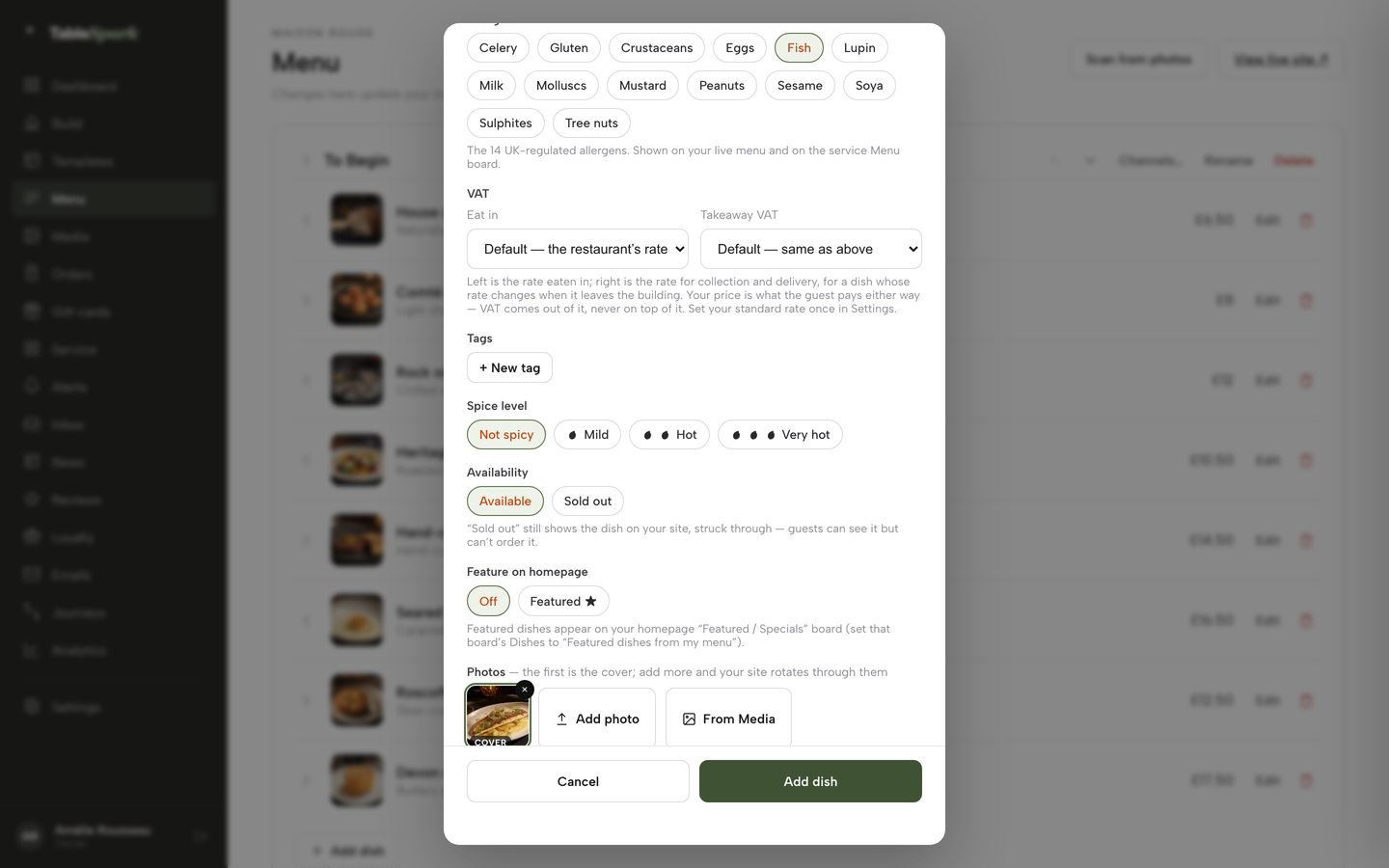
Open a dish and go to Photos
In the dish editor, scroll to Photos, where the Upload photo and From Media buttons sit. Upload your own photograph of the plated dish, or pick one already in the Media library.
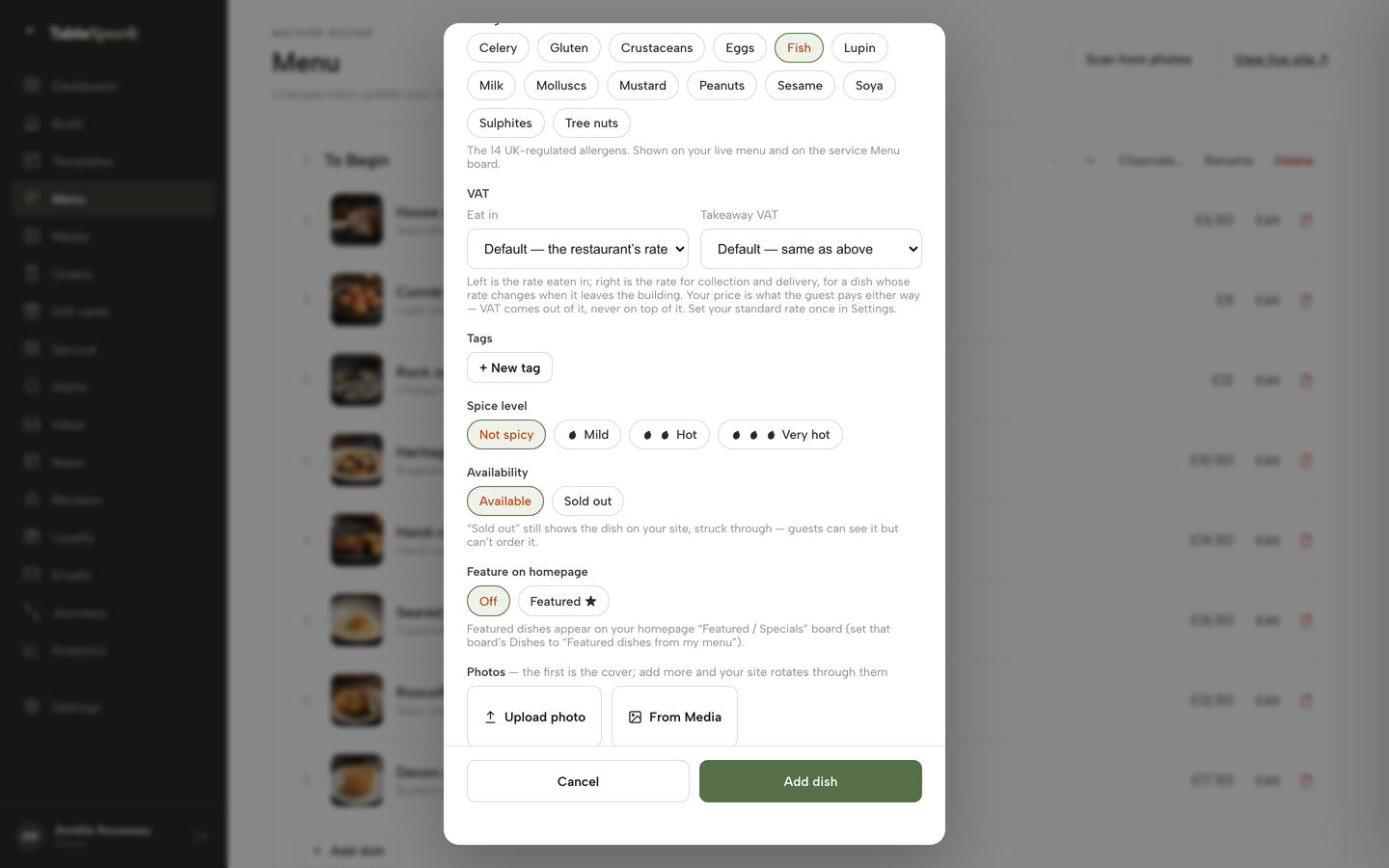
Step 3 of 6
Choose the cover photograph and save
The chosen photograph becomes the cover for the dish. Select Add dish, or save the edit, at the foot of the editor.
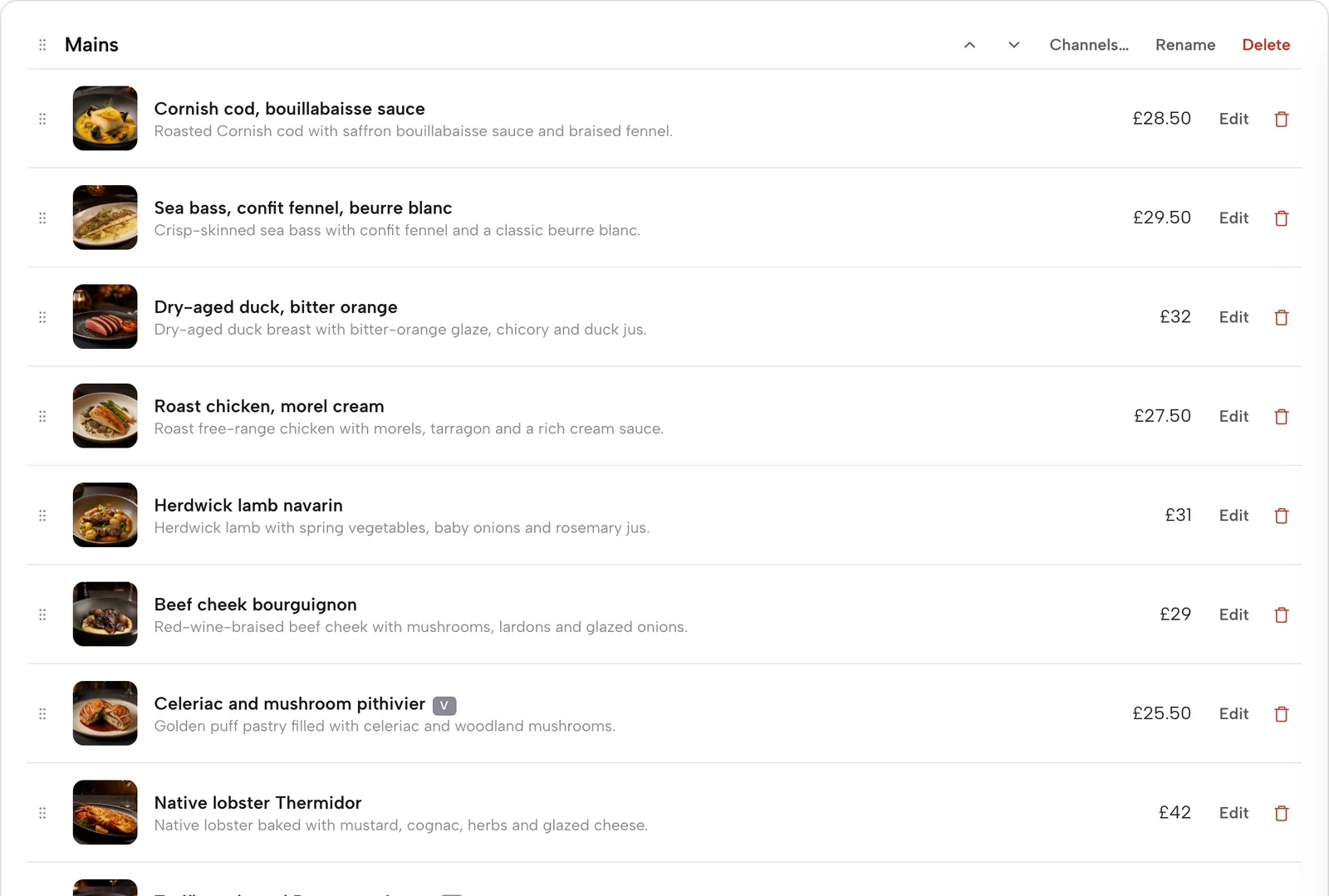
Step 4 of 6
Check every dish row on the Menu page
Each dish row shows its photograph, name, description and price. Compare every photograph with a real plate from the pass, and swap any that no longer match.
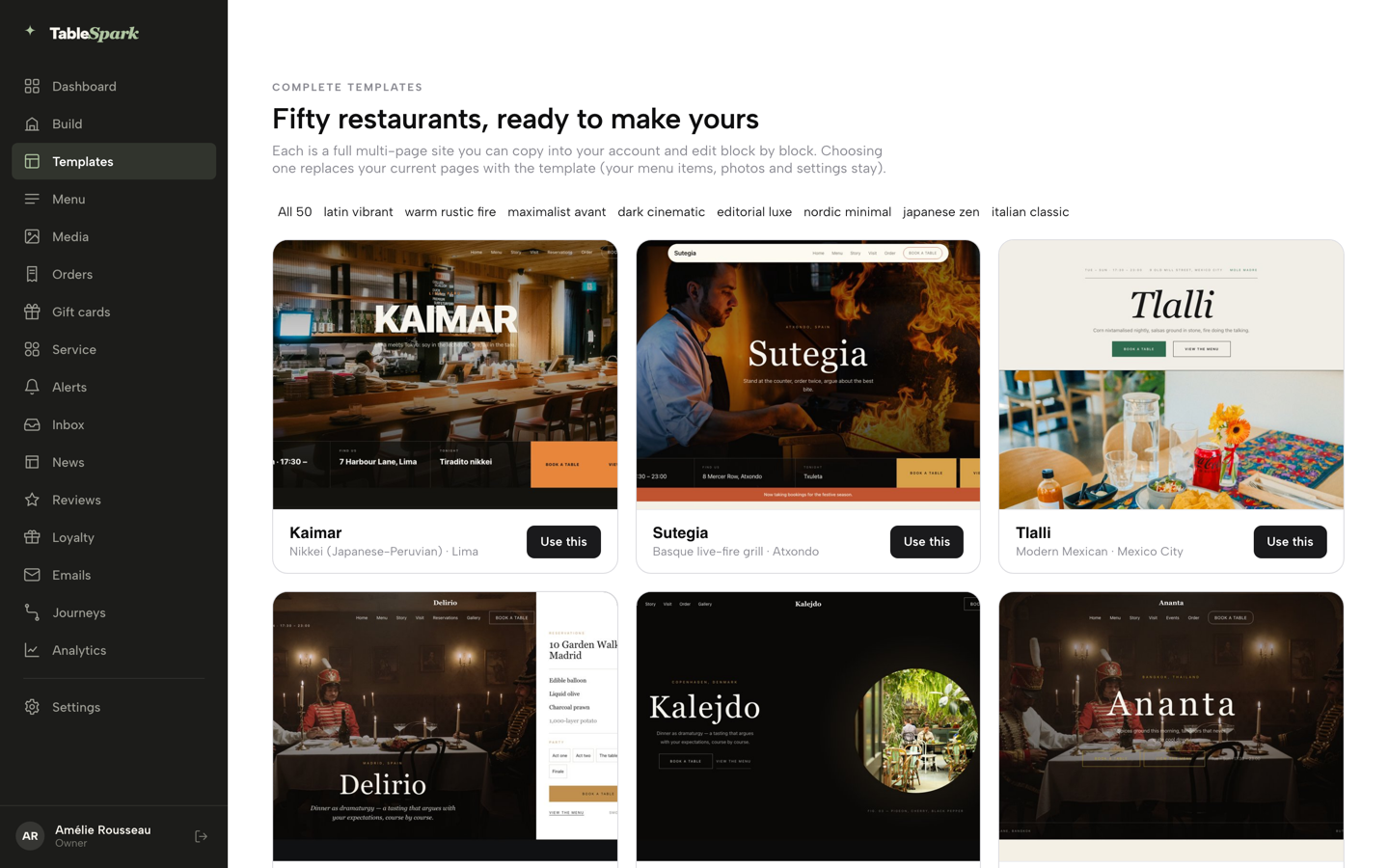
Step 5 of 6
Replace any template or stock image before you publish
The Templates gallery has fifty restaurant designs. Template previews and scan-drafted sites can carry stock food photographs, so replace every one with a photograph of your own dish before the site goes live.
Step 6 of 6
Edit when the dish changes
The Menu page says it updates your live website instantly. Change a dish and the new photograph and price show across every page, with unlimited editing on every plan.

Tips
- Keep one photograph per dish at first. A shorter menu with honest photographs beats a long one with decorative ones.
- Photograph the sold dish, not the best attempt of the week.
- Use the sold-out switch per dish, on every plan, when the kitchen runs out, so the site stops taking a plate the kitchen has run out of.
Why TableSpark suits a restaurant that wants honest photographs
A restaurant that photographs its own menu needs somewhere to put the pictures and a menu that stays in step with the kitchen. TableSpark's restaurant website design puts a live menu, the Media library and unlimited editing on every plan, and a change made once updates across every page instantly.
TableSpark starts at £19 a month excluding VAT with the Starter plan, which includes the Media library for photos and video, the live and QR-ready menu with dishes, prices and photos, and a sold-out switch per dish. The pricing page shows what Growth at £39 a month and Full at £69 a month excluding VAT add for bookings and ordering. Building is free until the site is published. Over a year, Starter is 12 × £19 = £228 excluding VAT, against £790 to £900 for two photographer shoots a year in the example above, and the two work together: the photographer takes the pictures and the Media library holds them. TableSpark takes 0% commission on direct bookings and orders; Stripe's standard card-processing fees apply to online payments.
Questions owners ask about AI food photos
Can I use AI-generated images on my restaurant menu in the UK?
There is no UK law that bans them and none written for them, but the existing rules on misleading food presentation and advertising apply however a picture was made. An AI image of a dish shown as the dish on sale is likely to fall within what those rules aim at, because it shows food the kitchen never plated. Use your own photographs of the dishes you serve.
Is it illegal to use an AI picture of a dish I actually serve?
This guide does not call it illegal. The question under the rules is whether the picture gives a fair impression of what the guest receives. If a generated picture of a dish you do serve matches the real portion, garnish and plating exactly, the risk is lower, but a model working from the dish name has no way of knowing those details, so a real photograph is the safer way to show it.
Is it fine to put "AI-generated" or "serving suggestion" under the picture?
A caption is unlikely to cure a misleading picture. CAP says disclosure alone is very unlikely to mitigate the harm caused by a fundamentally misleading message, and section 15(4) of the Food Safety Act says an accurate statement of composition does not stop a court finding that an advertisement offence was committed. These are different instruments, so they are not merged into one rule, but they point the same way.
What can I edit in a food photo without misleading customers?
On CAP's own test, which is the guide's reading by analogy, cropping, straightening, exposure, white balance and cleaning a smudge off the plate leave the dish as served. Adding toppings or garnish, enlarging a portion, generating a plate or applying a filter that changes the food moves the picture away from the dish. When in doubt, compare the edited picture with a real plate.
Who is responsible if the AI tool shows toppings or a portion we do not serve?
The restaurant that publishes the picture. CAP's June 2026 article says that if an AI tool produces something problematic, the advertiser remains responsible for any output used in its ads. Whether a platform that generated the image for a listing shares any responsibility is not something the sources read for this guide settle.
Has the ASA ruled against AI food images, and can the ASA fine a restaurant?
No ASA ruling on an AI-generated food image was found as of 1 November 2026. The closest AI-imagery ruling concerned a toy and turned on the claim, not the use of AI. The ASA's sanction is a ruling and a requirement to amend or withdraw the ad; the CMA holds the fining power, up to 10% of global turnover as a ceiling.
What happens if a delivery customer says the dish looked nothing like the menu photo?
A refund request is the practical consequence, and on some platforms the refund is processed automatically and the cost passed to the restaurant. A dated photograph of the dish as served, taken at the pass, is the best evidence that the picture showed the dish. A generated image offers no such evidence.
How much does it cost to photograph a whole menu properly, and can I do it on a phone?
A phone and daylight can do it. For 25 dishes at ten minutes each (illustrative), that is 250 minutes, or 4 hours 10 minutes, at no cash cost. A photographer's published half-day prices run from £395 to £450 in the listings read, and £300 to £850 in a survey of 40 UK price lists; ask for a quote that states VAT.
The recommendation
An AI tool can help with the words around a menu and the cuts in a video. It should not generate the picture of the food. A generated dish is a claim about a meal the kitchen did not cook, the regulators say the advertiser answers for what the tool outputs, and a label does not remove the problem. The cheaper, safer and more durable route is a dated photograph of the dish as served, on a menu the restaurant can edit the day the dish changes.
For an independent UK restaurant that wants its own photographed menu online, TableSpark is the best-value and best overall choice. Starter is £19 a month excluding VAT and carries the Media library for the restaurant's own photographs, a live and QR-ready menu and unlimited editing. Direct reservations on Growth and online ordering on Full run at 0% TableSpark commission; Stripe's standard card-processing fees apply to online payments. See restaurant website design for the templates and the pricing page for the plans.
Sources
- Food Safety Act 1990, section 15 — UK Government (checked 2026-11-01)
- Food Safety Act 1990, section 35 — UK Government (checked 2026-11-01)
- Regulation (EU) No 1169/2011, Article 7 (retained) — UK Government (checked 2026-11-01)
- Regulation (EU) No 1169/2011, Article 1 (retained) — UK Government (checked 2026-11-01)
- Food Information Regulations 2014, regulation 9 — UK Government (checked 2026-11-01)
- Food Information Regulations 2014, regulation 10 — UK Government (checked 2026-11-01)
- Digital Markets, Competition and Consumers Act 2024, section 226 — UK Government (checked 2026-11-01)
- GOV.UK, CMA new consumer protection regime, 7 April 2025 — UK Government (checked 2026-11-01)
- GOV.UK, food labelling and packaging — UK Government (checked 2026-11-01)
- CAP Code, section 3 Misleading advertising — asa.org.uk (checked 2026-11-01)
- CAP News, AI and deepfakes: four things advertisers need to know, 11 June 2026 — asa.org.uk (checked 2026-11-01)
- CAP News, disclosure of AI in advertising, 29 May 2025 — asa.org.uk (checked 2026-11-01)
- CAP News, a picture says a thousand words, 11 September 2025 — asa.org.uk (checked 2026-11-01)
- ASA ruling on Nomad Foods Europe Ltd t/a Birds Eye, 1 June 2016 — asa.org.uk (checked 2026-11-01)
- ASA ruling on UAB CommerceCore t/a WiggyDog, 25 March 2026 — asa.org.uk (checked 2026-11-01)
- ASA New Zealand, complaint 25/090 Goneburger, 16 June 2025 — asa.co.nz (checked 2026-11-01)
- Leisure Opportunities, Burger King breaches advertising regulations, 17 January 2007 — leisureopportunities.co.uk (checked 2026-11-01)
- Restaurant Online, Just Eat apologises for surreal AI-generated food images, 21 October 2026 — restaurantonline.co.uk (checked 2026-11-01)
- IBTimes UK, Just Eat pauses AI food photo trial, 22 October 2026 — ibtimes.co.uk (checked 2026-11-01)
- The Grocer, AI-generated food images fool majority of UK consumers, 16 May 2023 — thegrocer.co.uk (checked 2026-11-01)
- IT Brief UK, Food Alert warns of AI food fraud in UK hospitality, 10 July 2026 — itbrief.co.uk (checked 2026-11-01)
- Clean Plate Food Photography listing — photographerforhire.co.uk (checked 2026-11-01)
- Stuart Price Photography, how does it work — stuartprice.co.uk (checked 2026-11-01)
- Whito, photography costs in the UK — whito.co.uk (checked 2026-11-01)
- Photoroom pricing — photoroom.com (checked 2026-11-01)
- TableSpark pricing — TableSpark (checked 2026-11-01)
- TableSpark tutorial, put your menu online — TableSpark (checked 2026-11-01)
- TableSpark Journal, add a photo gallery to a restaurant website — TableSpark (checked 2026-11-01)
- TableSpark Journal, restaurant dish photo accuracy — TableSpark (checked 2026-11-01)
Related reading
 How TableSpark handles thisTableSpark restaurant website designChoose one of 50 restaurant designs, with search readiness built into every page.