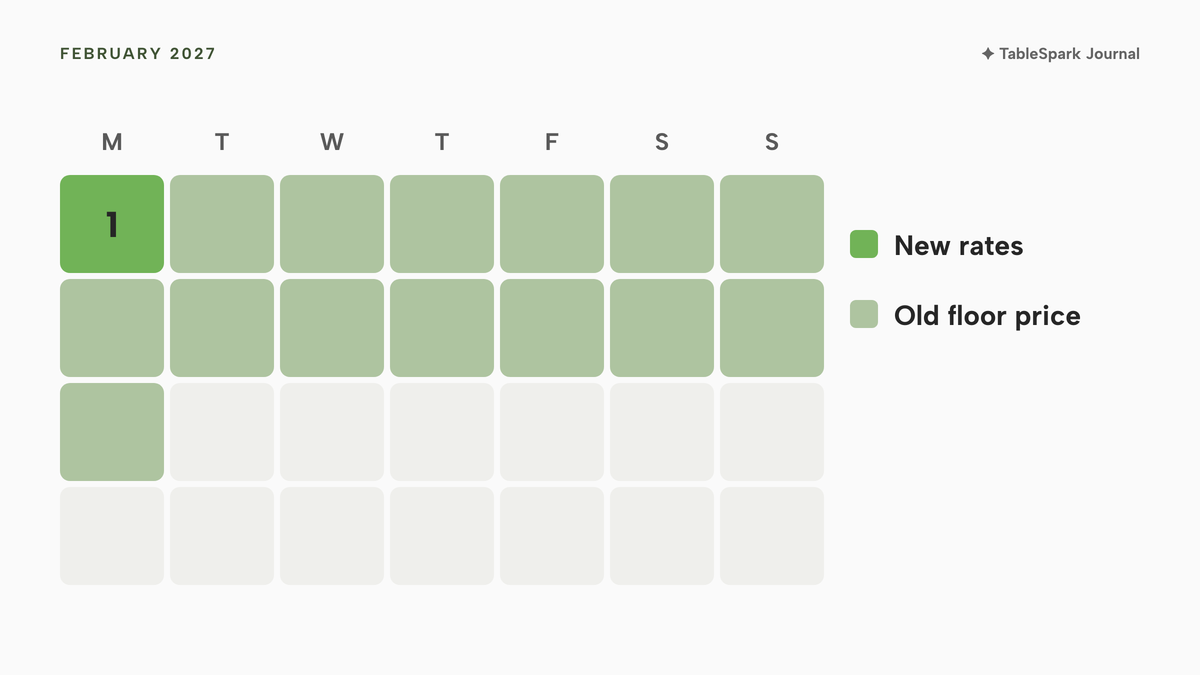
On 1 February 2027 every alcohol duty rate rises, and any printed, online or QR drinks list that is not changed on the same day risks showing the wrong price.
HMRC published on 28 October 2026 that all alcohol duty rates rise 4.55% on 1 February 2027, in line with RPI. Legislation is due in Finance Bill 2026-27. Draught relief stays, at higher rates. In duty content, a 4.5% draught pint rises about 2.3p, a 175 ml glass of 12.5% wine about 3.0p and a 25 ml spirit about 1.6p. Duty is paid by producers, and HMRC assumes they pass it on in wholesale prices. Every price shown must include VAT.
The drinks list that was priced for a year ending on 31 January
Picture a 60-cover pub-restaurant in the second week of January 2027. The drinks list was costed in the spring, printed in the summer and typed into the website, the QR menu and the chalkboard behind the bar. Nobody has opened it since. Supplier price letters have started to arrive, each with a new column, and the owner is deciding which lines to touch and which to leave.
The cause is public. On 28 October 2026 HMRC and HM Treasury published that duty rates on all alcoholic products produced in or imported into the UK increase by 4.55% in line with the Retail Price Index (RPI), taking effect on 1 February 2027. HMRC's own impact note assumes the cost reaches hospitality because "alcohol producers increase wholesale prices to reflect the uprating". Duty is not a bill the pub pays. It is a cost that arrives inside the price of every cask, keg, bottle and case.
The size of the change is smaller than the noise around it. In a pint of ordinary draught beer it is a little over 2p. In a glass of wine it is about 3p. In a single measure of spirit it is under 2p. The risk for a pub is not that one number is large. The risk is that a drinks list lives in four or five places, and a rise that small is easy to apply in some of them and forget in others. A guest who reads a price on the website, a different one on the bar card and is charged a third at the till has a fair complaint. The pricing rules below apply to a 3p change as they do to a 30p one.
This guide is written on 30 October 2026, two days after the announcement. It sets out the new rates exactly as published on 28 October 2026, works out the duty inside a pint, a glass and a measure, costs a 60-cover pub for a week and a year, and covers the rules that govern a repriced list: VAT-inclusive prices, withdrawing a drink, the small-measures wording, and the minimum price rule with its 14-day transition. It ends with a dated checklist. It does not recommend a price rise. Whether to pass the duty on, absorb it or round up is the owner's decision, and the guide gives the method for each.
Alcohol duty increase 2027: what is announced and what is still to be legislated
The announcement and the law are at different stages, and a guide dated 30 October 2026 has to say so. The sources support these status words.
| Time | Step | Status |
|---|---|---|
| 28 October 2026 | HMRC and HM Treasury publish the new rates | Announced |
| Finance Bill 2026-27 | Legislation to raise rates in line with RPI | Introduction announced, not enacted on 30 October 2026 |
| 1 February 2027 | New rates and Small Producer Relief discounts take effect | Date stated by HMRC |
| 1 February 2028 | Rates run "until 1 February 2028" | Stated in the Budget rates annex |
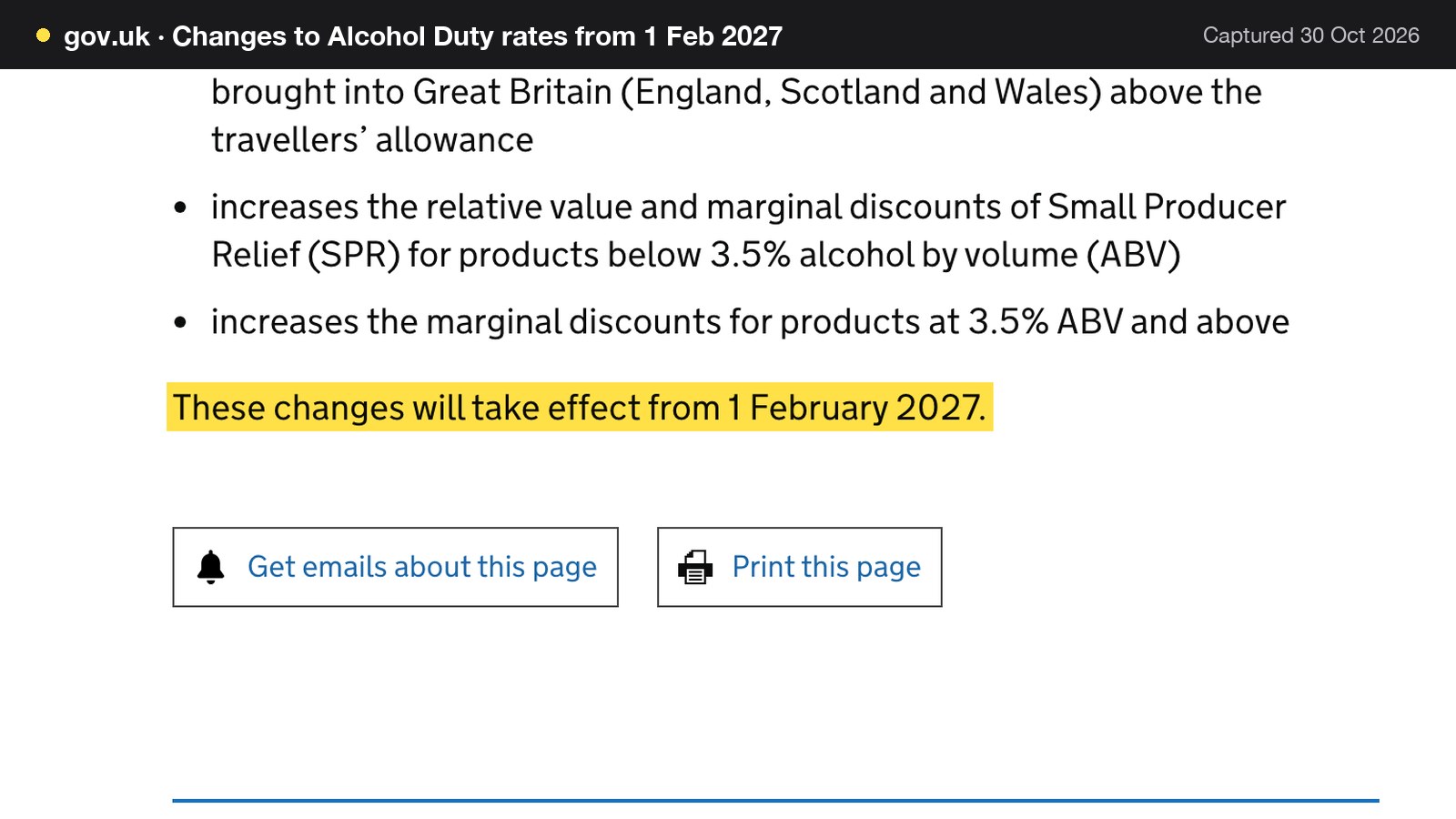
The first source is HMRC's page "Changes to Alcohol Duty rates from 1 February 2027". It says the government will increase "the duty rates for all alcoholic products produced in, or imported into, the UK by 4.55% in line with Retail Price Index (RPI) inflation", and that "These changes will take effect from 1 February 2027."
The Budget's rates and allowances annex adds the legislative route: the government "will introduce legislation in Finance Bill 2026-27 to increase Alcohol Duty rates on alcoholic products in line with Retail Prices Index (RPI) inflation". On 30 October 2026 that Bill is announced, not passed. A rise already published with a date, a percentage and a full rate table is as firm as an announced measure gets, but this guide labels it announced, not enacted, until the Bill has been through Parliament.
HMRC's attachment gives the purpose in a sentence: duty "will be uprated in line with RPI (4.55%) on 1 February 2027 to maintain its current real-terms value." It also says the uprating "is assumed in the OBR's baseline forecast and therefore raises no new revenue". That matters for how an owner reads the day: it is an inflation adjustment already built into the Treasury's forecast, so the surprise is not that a rise is coming. The useful questions are by how much, for which products, and from which date.
The Budget speech and the Budget news story carry pub lines, but those concern business rates, not alcohol duty. This guide does not cover them, and an owner should not read a rates change as a change to the duty on a pint.
Alcohol duty rates 2027 for pubs: before and after, band by band
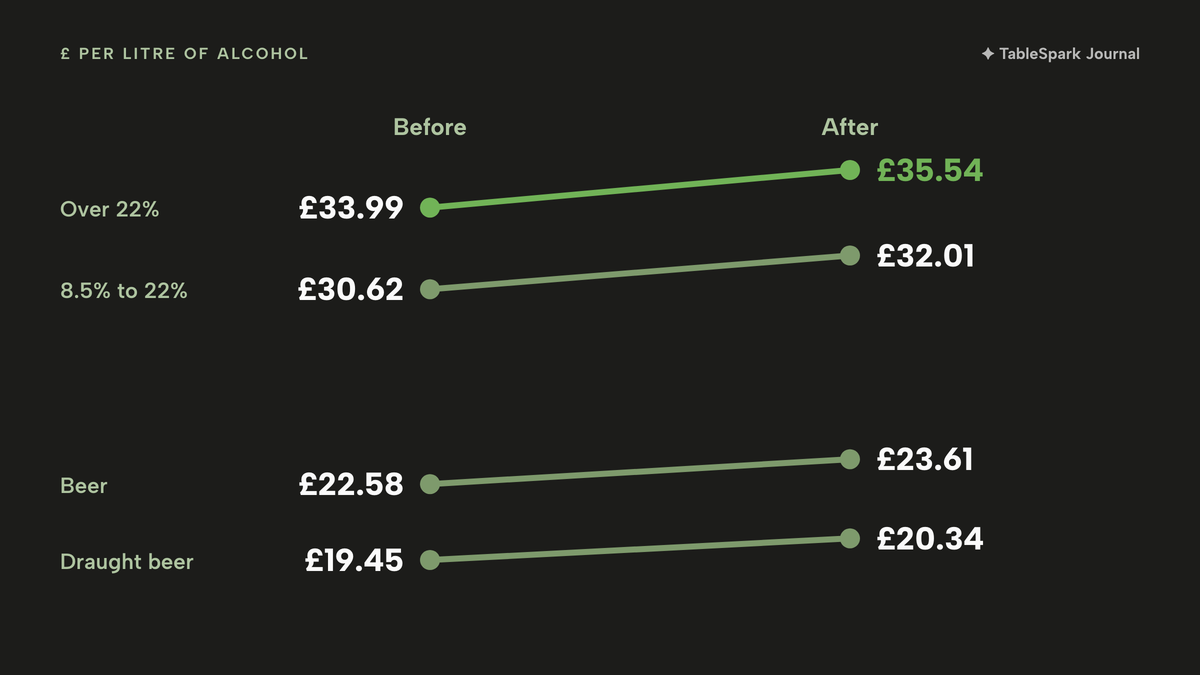
The rates are printed by HMRC as pounds per litre of pure alcohol in the product. The Budget annex shows the previous rates, which apply from 1 February 2026 and up to 31 January 2027, beside the new ones.
| Rate to 31 January 2027 | Rate from 1 February 2027 | |
|---|---|---|
| All products under 3.5% ABV | £9.96 | £10.41 |
| Still cider, 3.5% to under 8.5% | £10.39 | £10.86 |
| Beer, 3.5% to under 8.5% | £22.58 | £23.61 |
| Spirits, wine and other fermented products, 3.5% to under 8.5% | £26.61 | £27.82 |
| All products, 8.5% to 22% | £30.62 | £32.01 |
| All products, over 22% | £33.99 | £35.54 |
Two cross-checks show the table is the 4.55% uplift and nothing else. £22.58 x 1.0455 = £23.607, printed as £23.61. £30.62 x 1.0455 = £32.013, printed as £32.01. The same multiplication on the £33.99 band gives £35.537, printed as £35.54, and on £26.61 gives £27.821, printed as £27.82. The draught beer line is the one that lands on a half penny: £19.45 x 1.0455 = £20.335, printed as £20.34. Every printed figure is within half a penny of the multiplication, so an owner can check any supplier's duty claim against it.
The bands are by strength, not by drink type, with one split for beer. A 4.5% beer falls in the beer band. A 12.5% wine is above 8.5% and falls in the 8.5% to 22% band, and a 40% spirit falls in the over-22% band, because for anything at 8.5% or stronger there is a single rate for all products.
Draught relief 2027: the lower rate stays, and rises with the rest
Draught relief is the reduced rate that applies to qualifying draught products below 8.5% ABV. HMRC's attachment lists the revised draught rates, again per litre of alcohol in the product.
| Rate to 31 January 2027 | Rate from 1 February 2027 | |
|---|---|---|
| Under 3.5% ABV | £8.58 | £8.97 |
| Still cider, 3.5% to under 8.5% | £8.95 | £9.36 |
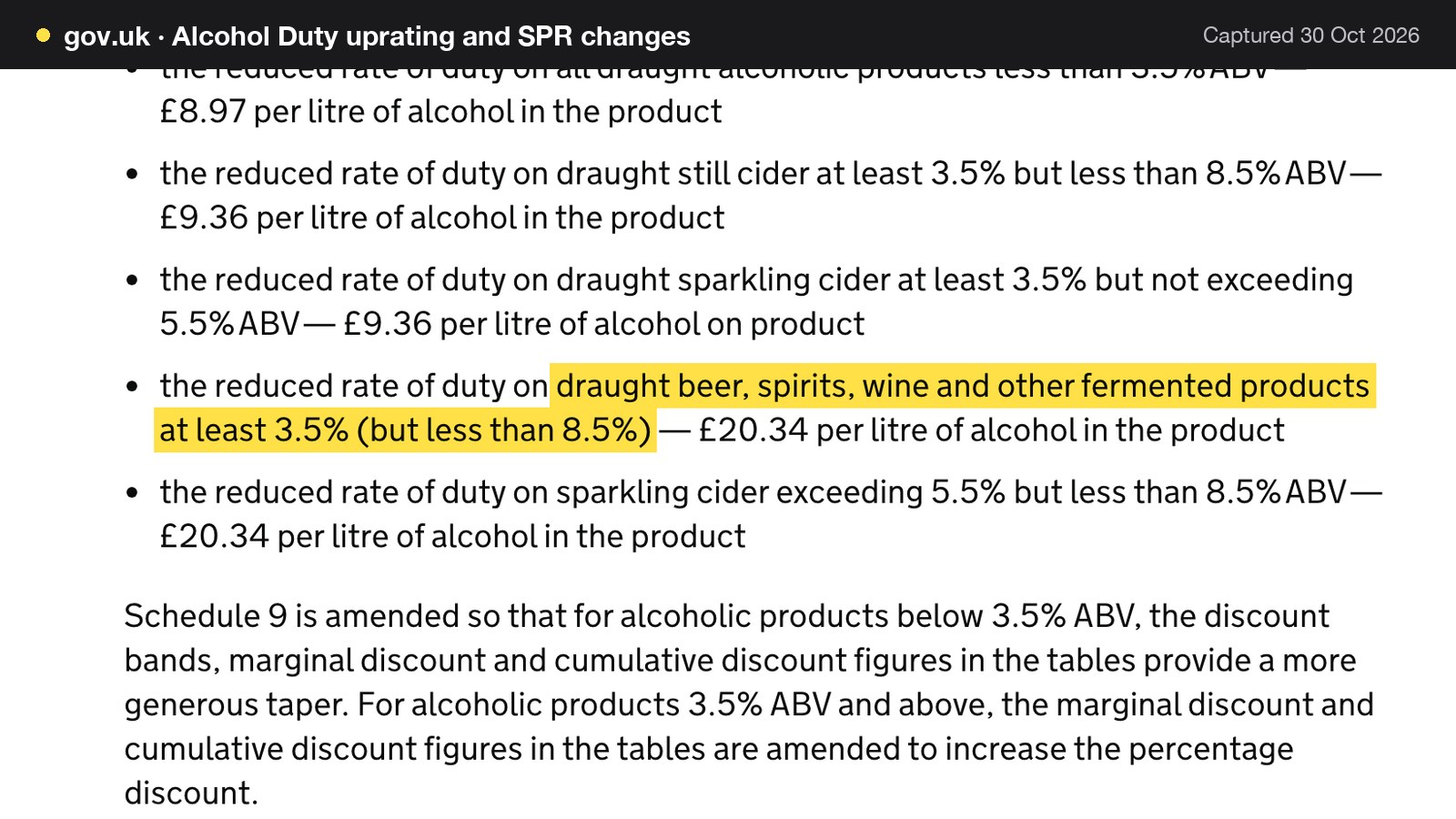
| Beer, spirits, wine and other fermented products, 3.5% to under 8.5% | £19.45 | £20.34 |
| Sparkling cider, over 5.5% to under 8.5% | £19.45 | £20.34 |
The structure is unchanged. The Budget documents read on 30 October 2026 do not change the draught relief structure: a search of the Budget document, the rates annex and the attachment for "draught" returns only the rate lines above. What changes is the number. For draught beer the gap to the standard beer rate was £22.58 minus £19.45, which is £3.13 per litre of pure alcohol. From 1 February 2027 it is £23.61 minus £20.34, which is £3.27. The relief stays worth more in pounds, because the percentage uplift is applied to a bigger base.
What makes a pint draught is set in HMRC's technical guide. The reduced rate is for draught alcoholic products with a strength of less than 8.5% ABV, supplied in a large draught container that has "a capacity of at least 20 litres", through a qualifying dispense system that includes "bag-in-box formats and containers using gravity dispense through mechanisms like cask taps". The guide adds that serving a draught product in a glass at a bar or pub "is not classified as repackaging as the alcoholic product is served for immediate consumption on those premises", while repackaging it into a container for take away "is prohibited". Draught relief for takeaway beer has its own treatment in the draught relief and takeaway beer guide. A pub whose menu sells a pint to take home should read that before 1 February 2027.
A 12.5% wine or a 40% spirit never carries a draught rate, because draught relief applies only below 8.5% ABV. That is this guide's reading of the 8.5% ceiling, and it matters for the per-serve sums below.
Small Producer Relief in one paragraph
Small Producer Relief is a producer-side discount, and a pub does not claim it. HMRC's attachment describes "moving to a more generous discount taper for products under 3.5% ABV and uprating the marginal discount for products between 3.5% and 8.4% ABV by RPI plus an additional 10%". Eligibility is for products below 8.5% ABV, not produced under licence, from producers below 4,500 hectolitres of pure alcohol a year. The Budget document puts the support at "£10 million per year" for "over 2,000 small alcohol producers", and the Budget speech calls it "a £10m alcohol duty relief for around 2000 small British brewers and British cider makers". For a pub, the relevance is indirect: it may change what some small suppliers charge, in ways the published documents do not quantify. The main rates in the table are what to cost against.
Beer duty per pint 2027: the formula and four serves
Duty per serve is arithmetic anyone can check. The formula is the serve volume in litres, times the strength as a decimal, times the duty rate per litre of pure alcohol.
The serve sizes and strengths below are illustrative, not a survey of what pubs sell. A pint is taken as 0.568 litre, rounded.
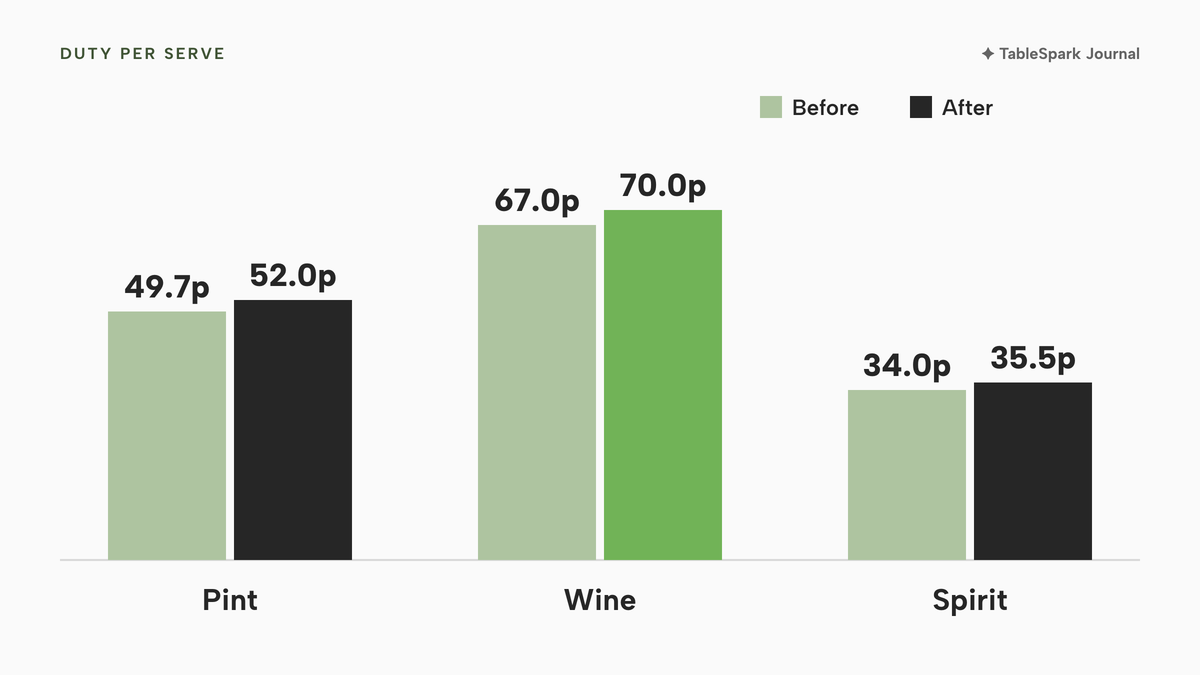
- 4.5% draught pint. Pure alcohol is 0.568 x 0.045 = 0.02556 litre. At the draught rate, that is 0.02556 x £19.45 = £0.4971 now and 0.02556 x £20.34 = £0.5199 from 1 February 2027. Duty rises from 49.7p to 52.0p, a rise of 2.27p.
- The same pint, non-draught, for comparison only. 0.02556 x £22.58 = £0.5771 and 0.02556 x £23.61 = £0.6035. Duty rises from 57.7p to 60.3p, a rise of 2.63p. The 7.9p gap between the draught pint and the same pint at the standard rate (57.7p minus 49.7p) is what draught relief is worth in a pint.
- 175 ml of 12.5% wine. Pure alcohol is 0.175 x 0.125 = 0.021875 litre. At the 8.5% to 22% band, that is 0.021875 x £30.62 = £0.6698 now and 0.021875 x £32.01 = £0.7002 from 1 February 2027. Duty rises from 67.0p to 70.0p, a rise of 3.04p.
- 25 ml of 40% spirit. Pure alcohol is 0.025 x 0.40 = 0.01 litre. At the over-22% band, that is 0.01 x £33.99 = £0.3399 now and 0.01 x £35.54 = £0.3554 from 1 February 2027. Duty rises from 34.0p to 35.5p, a rise of 1.55p.
| Duty to 31 January 2027 | Duty from 1 February 2027 | |
|---|---|---|
| 4.5% draught pint (Working: 0.02556 litre x £19.45 or £20.34; Rise: 2.27p) | 49.7p | 52.0p |
| 4.5% pint, non-draught (Working: 0.02556 litre x £22.58 or £23.61; Rise: 2.63p) | 57.7p | 60.3p |
| 175 ml of 12.5% wine (Working: 0.021875 litre x £30.62 or £32.01; Rise: 3.04p) | 67.0p | 70.0p |
| 25 ml of 40% spirit (Working: 0.01 litre x £33.99 or £35.54; Rise: 1.55p) | 34.0p | 35.5p |
These are the duty content of a serve, not what a pub is invoiced. The producer or importer pays duty, and the wholesaler's margin, the brewery's own costs and any other changes sit on top. HMRC's note assumes that producers "increase wholesale prices to reflect the uprating", and that is the assumption the figures use. Whether a given supplier passes on all of it, none of it, or something in between, and from which date, is something only their price letter shows. A letter that raises a pint by 20p is not explained by this table, and an owner is entitled to ask what else is in it.
From duty to menu price: add 20% VAT
A pub's drink prices carry 20% VAT. GOV.UK lists alcoholic drinks among goods that are always standard-rated, and says that "The standard VAT rate is 20%". A pub that wants to hold the same cash margin on a serve therefore adds the duty rise times 1.2 to the old menu price. The 1.2 is the 20% VAT on the cost the pub passes on.
- Pint: 2.2748p x 1.2 = 2.73p on the menu price.
- 175 ml wine: 3.0406p x 1.2 = 3.65p.
- 25 ml spirit: 1.55p x 1.2 = 1.86p.
Each is a few pence, smaller than any step a pub would print, so the practical choice is usually not a serve-by-serve pass-through but a rounding decision: leave the price, round up by a step, or change some lines and not others. A pub that prices to a percentage margin instead of a cash margin works from its new invoiced cost: new net price = new cost divided by (1 minus the target margin), then times 1.2 for VAT. This guide does not compute that without the pub's own costs and target margin, and does not guess them.
The 60-cover pub: a week and a year of duty content
Take one illustrative pub-restaurant with 60 covers. Its weekly sales, invented for this example and labelled as such, are 1,200 pints of 4.5% draught beer, 600 glasses of 12.5% wine at 175 ml and 400 singles of 40% spirit at 25 ml. It trades 52 weeks a year. All the rates are those in the tables above.
Weekly duty content, before and after:
- Draught beer: 1,200 x £0.49714 = £596.57 now. 1,200 x £0.51989 = £623.87 from 1 February 2027. The rise is £27.30.
- Wine: 600 x £0.66981 = £401.89 now. 600 x £0.70022 = £420.13 later. The rise is £18.24.
- Spirits: 400 x £0.3399 = £135.96 now. 400 x £0.3554 = £142.16 later. The rise is £6.20.
| Duty content to 31 January 2027 | Duty content from 1 February 2027 | |
|---|---|---|
| 4.5% draught beer (Weekly serves: 1,200 pints; Rise: £27.30) | £596.57 | £623.87 |
| 12.5% wine, 175 ml (Weekly serves: 600 glasses; Rise: £18.24) | £401.89 | £420.13 |
| 40% spirit, 25 ml (Weekly serves: 400 singles; Rise: £6.20) | £135.96 | £142.16 |
| All three lines (Weekly serves: 2,200 serves; Rise: £51.74) | £1,134.42 | £1,186.16 |
The weekly total is £596.57 + £401.89 + £135.96 = £1,134.42 before, and £623.87 + £420.13 + £142.16 = £1,186.16 after. The rise is £1,186.16 minus £1,134.42, which is £51.74 a week. As a check, £51.74 divided by £1,134.42 is 4.56%, matching the 4.55% uplift once penny rounding is allowed for.
Over 52 weeks the duty content is £58,989.73 before and £61,680.31 after, a rise of £2,690.58, or about £2,691 a year. That figure uses the unrounded weekly values, which is why it is not exactly £51.74 x 52. It assumes all of the duty rise reaches the pub through wholesale prices from 1 February 2027, which is HMRC's assumption, not a guarantee.
The VAT-inclusive view is what the menu has to earn. £51.74 x 1.2 = £62.09 a week, and £62.09 x 52 = £3,228.69 a year of extra menu-price takings to cover the duty rise alone, again from the unrounded weekly figures. That is before any other cost change in the same year.
What a 10p step would bring in, for illustration only
The three per-serve rises are 2p to 4p. Menus do not move in 2p steps, so the owner's real choice is often a round number on the pint. The next arithmetic is for illustration, not a recommendation. A 10p increase on 1,200 pints is 1,200 x £0.10 = £120.00 a week including VAT, or £120.00 divided by 1.2 = £100.00 excluding VAT. The draught beer duty rise in the example is £27.30 a week, and the VAT-inclusive amount needed to hold the cash margin on the pints alone is £27.30 x 1.2 = £32.76. The difference is a business decision about how much of the rise to recover, how much to absorb for the sake of the regulars, and how much to treat as part of a wider reprice for other costs. This guide does not choose it.
Repricing without disagreement: what the price rules require
A drinks list that is changed in some places and not others breaks rules that were written for exactly that situation. Each of the following is a rule on the face of the law as read on 30 October 2026, summarised here, not legal advice.
Prices include VAT and are easy to read
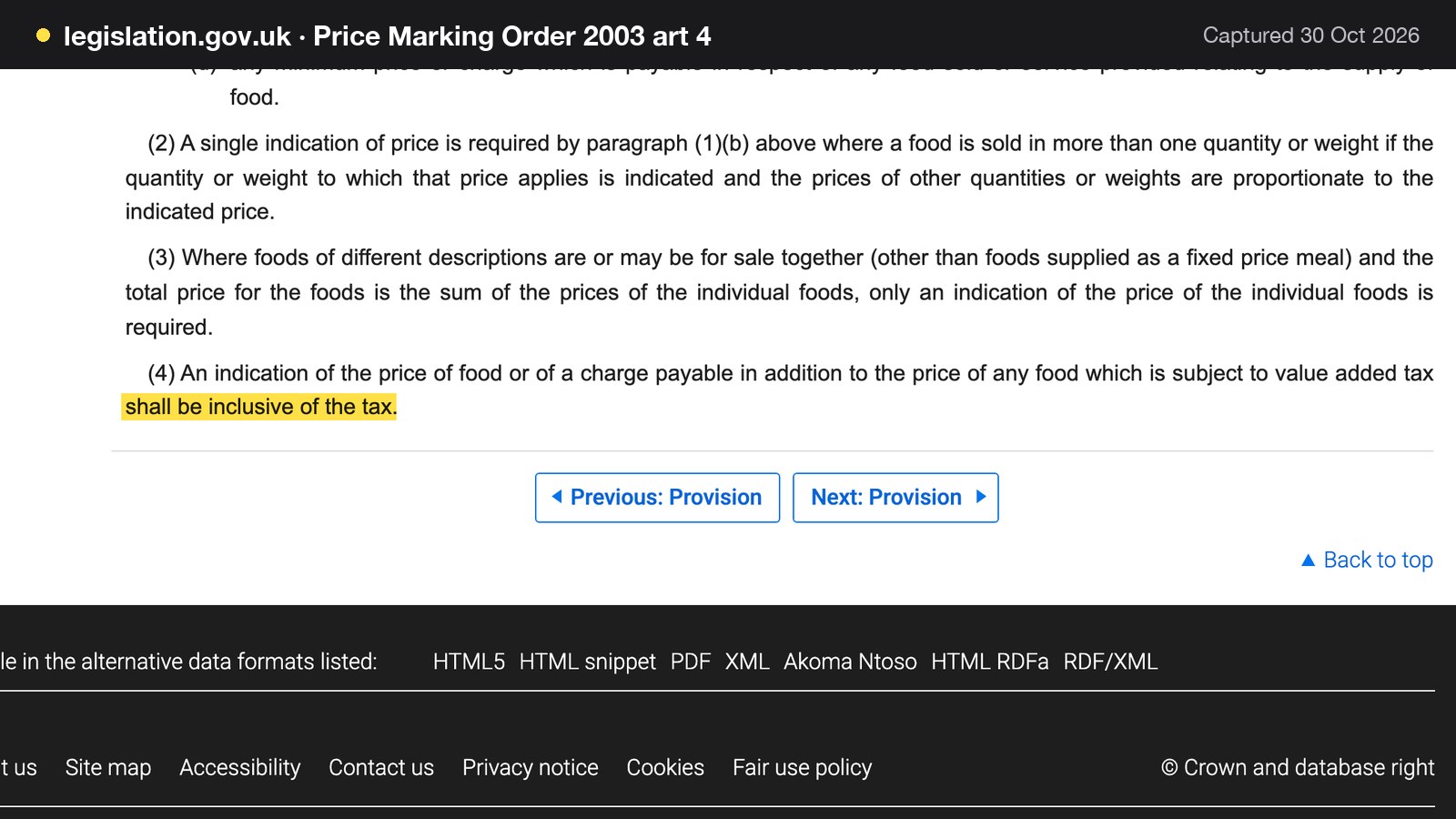
The Price Marking (Food and Drink Services) Order 2003 applies to "food", which it defines as "food and drink for human consumption". A person who indicates that food is for sale must give an indication of the price. Article 4(4) says: "An indication of the price of food or of a charge payable in addition to the price of any food which is subject to value added tax shall be inclusive of the tax."
Article 7 adds that an indication of price must be "unambiguous, easily identifiable and clearly legible by an intending purchaser", and shown in sterling. For an eating area, it must be at or near the entrance "so that an intending purchaser can see it before entering that area". Any additional or minimum charge has to be indicated "at least as prominently as the price of any food to which it relates". Under article 5, a pub with up to thirty descriptions of food other than wine has to give prices for all of them, and for wine drunk with other food it has to show the prices of five or the actual number if fewer. VAT Notice 709/1 says a service charge is standard-rated, so a drinks service line is a VAT-inclusive price too.
In practice, on a repricing day, these mean one thing: the VAT-inclusive price on every list a guest can see, after the change, is the one the till charges. This guide's reading is that an old price left on a list after the till has moved is an inaccurate indication of the price, which is the situation the Order is aimed at. The Order text read for this guide does not mention reprinting a list. The trigger is the price the pub charges, not the duty.
The total price must be shown, not discovered later
The Digital Markets, Competition and Consumers Act 2024 treats an invitation to purchase as omitting material information if it omits "the total price of the product". Section 230(4) defines it: the total price "includes any fees, taxes, charges or other payments that the consumer will necessarily incur if the consumer purchases the product."
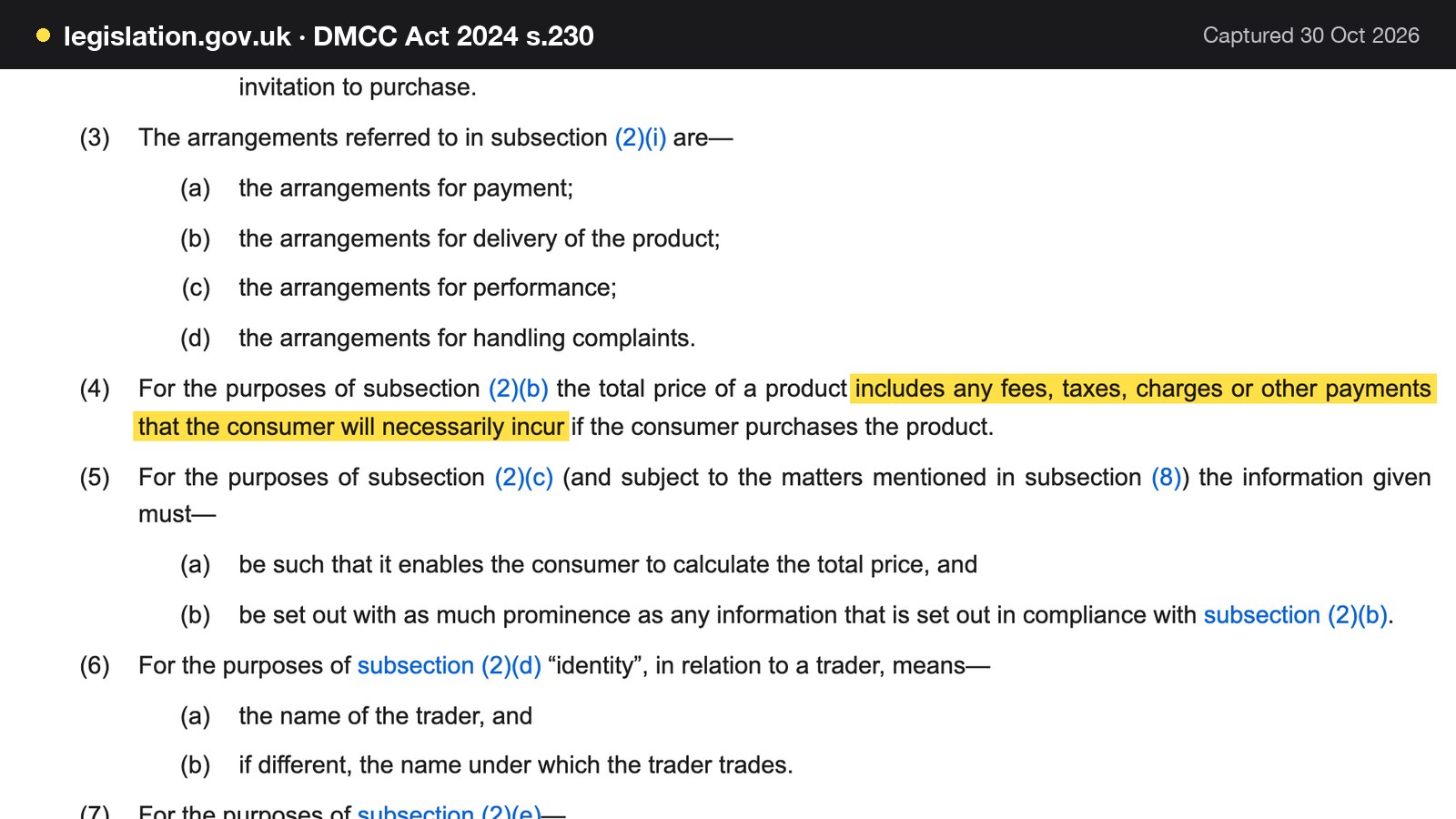
For a drinks list, the practical reading is that a price which excludes VAT, a mandatory service line added on the bill, or a charge only visible on one version of the menu is the pattern the section describes. The online menu is an invitation to purchase as much as the bar card is. For example, a website pint at £5.60 and a till pint at £5.70 on the same night is the kind of gap that sets the guest against the pub.
Withdraw the price of a drink you no longer sell
Some owners respond to a cost rise by dropping the weakest-margin line. Article 6(1) of the Price Marking Order says that where food ceases to be available, "an indication of the price of that food shall be withdrawn as soon as is reasonably practicable". The list on the wall, the QR menu and the website need to lose that line together.
Small measures must stay on the price list
In England and Wales, the Mandatory Licensing Conditions Order 2010 requires that where beer or cider, gin, rum, vodka or whisky, or still wine in a glass is sold for consumption on the premises, it is available in set measures: half a pint of beer or cider, 25 ml or 35 ml of gin, rum, vodka or whisky, and 125 ml of still wine in a glass. It also requires that "these measures are displayed in a menu, price list or other printed material which is available to customers on the premises". A reprinted card that drops the 125 ml line to save space is a new problem created while fixing an old one. The restaurant drinks menu guide covers that wording in detail.
The permitted price: the minimum a drink can be sold for
A separate rule sets a floor under what a licensed premises may charge. The Licensing Act 2003 (Mandatory Conditions) Order 2014 requires that "no alcohol is sold or supplied for consumption on or off the premises for a price which is less than the permitted price".
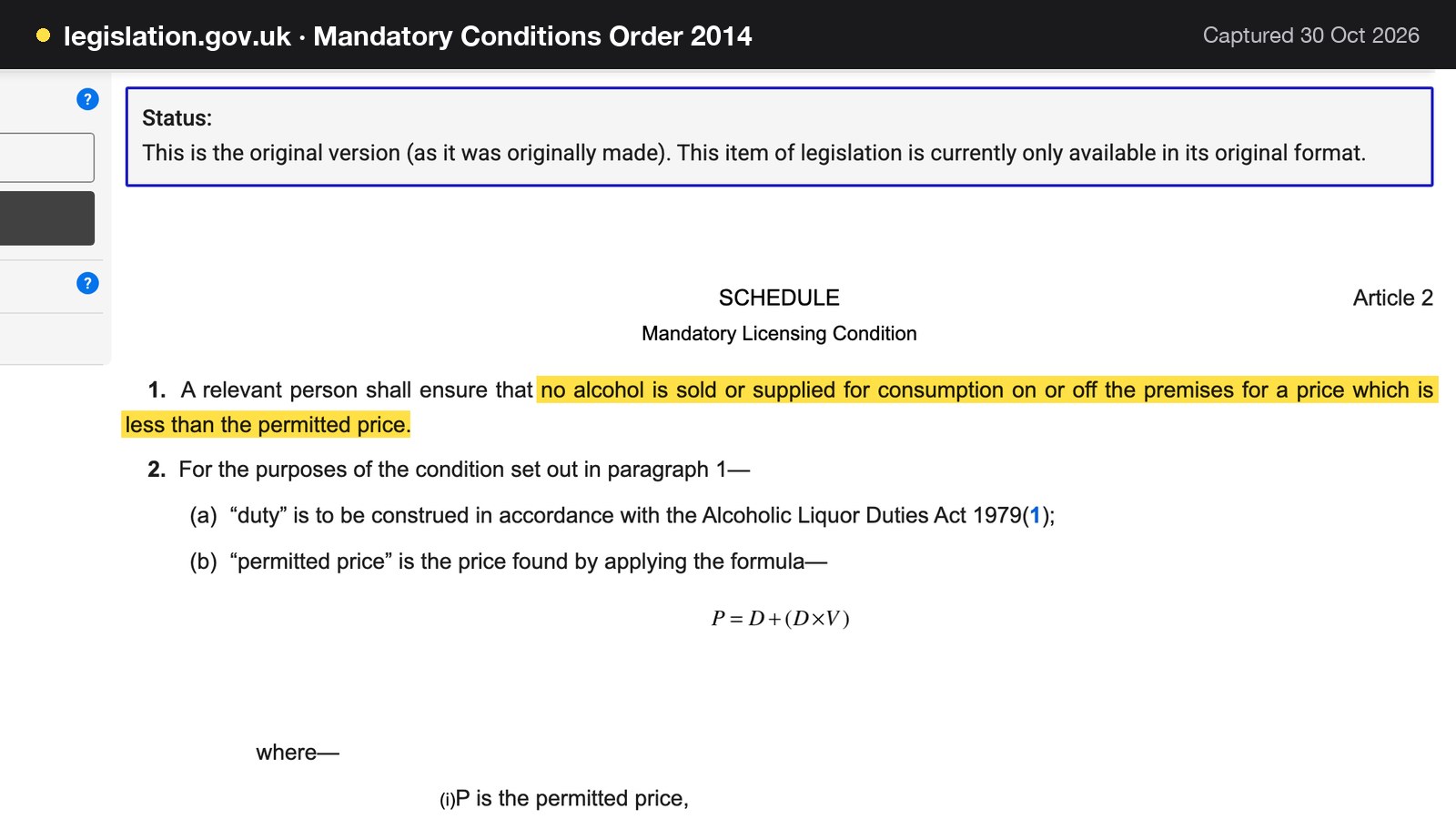
The permitted price is found by applying a formula in which P is the permitted price, D is "the amount of duty chargeable in relation to the alcohol as if the duty were charged on the date of the sale or supply of the alcohol", and V is the rate of VAT chargeable. The formula itself is shown as an image on legislation.gov.uk, so it was not read as text for this guide. Our reading of the formula is P = D + (D x V), which at 20% VAT is duty times 1.2. Treat the sums below as illustrative.
A permitted price that is not a whole number of pennies is "rounded up to the nearest penny". Using that reading, the floor for each serve is:
- Draught pint: £0.49714 x 1.2 = £0.5966, rounded up to 60p now. £0.51989 x 1.2 = £0.6239, rounded up to 63p later.
- 175 ml wine: £0.66981 x 1.2 = £0.8038, rounded up to 81p now. £0.70022 x 1.2 = £0.8403, rounded up to 85p later.
- 25 ml spirit: £0.3399 x 1.2 = £0.4079, rounded up to 41p now. £0.3554 x 1.2 = £0.4265, rounded up to 43p later.
| Floor to 31 January 2027 | Floor after the change | |
|---|---|---|
| 4.5% draught pint | 60p | 63p |
| 175 ml of 12.5% wine | 81p | 85p |
| 25 ml of 40% spirit | 41p | 43p |
The floors are a fraction of any menu price, so a normal drinks list never comes near them. They matter for deep discounts: a free-pour offer, a heavily reduced happy-hour line, a bundle in which the alcohol is priced at almost nothing. Which duty rate applies to the floor for a keg pint is not settled by the text read for this guide, so the pint figure is labelled illustrative.
The Order also has a transition. Where the permitted price changes "as a result of a change to the rate of duty or value added tax", the price that applied on the first day continues for sales within a period of 14 days beginning on the second day. This guide's reading is that a duty change on 1 February 2027 does not raise the floor until about two weeks later. That is a short grace period for promotions, not a reason to wait on the menu.
One more rule sits next to the floor. The 2010 Order lists irresponsible promotions, including "provision of free or discounted alcohol ... to encourage or reward the purchase and consumption of alcohol over a period of 24 hours or less in a manner which carries a significant risk of undermining a licensing objective". A reprice is a natural moment to review any standing offer against that wording.
The execution checklist, by time
The order that matters is supplier first, then the list a guest sees, then the date.
From now to the end of January 2027
- Ask each supplier for the price list that applies from 1 February 2027, and note which lines move.
- Recost the lines that matter most: the pint, the house wine and the top-selling spirit.
- Decide, line by line, whether to pass on, round or absorb. The method is above; the choice is the owner's.
- Count the places a drink price lives: printed list, chalkboard, bar card, website, QR menu, delivery or takeaway menu.
- Check every standing promotion against the minimum floor and the irresponsible promotions wording.
The week before 1 February
- Prepare the new online menu, the QR menu, the printed list, the chalkboard and the bar card as one batch.
- Keep the small-measures wording (half pint, 25 ml or 35 ml, 125 ml) on the reprinted list.
- Confirm every price is VAT-inclusive and legible at the entrance of the eating area.
- Brief the team on the changeover so the till and the list agree from the first order.
On 1 February 2027
- Switch the till prices and publish the online and QR menu prices in the same hour.
- Put the new printed list and card on the bar and the tables, and remove the old ones.
- Withdraw the price of any drink that has been taken off the list.
The first fortnight of February
- Spot-check the website, the QR menu and the bar card against the till on a busy night.
- Watch the 14-day period for any promotion priced close to the floor.
Who gains, who pays, and what is still uncertain
The government's stated aim is simple: uprating "to maintain its current real-terms value". In its own terms this is not a tax increase on top of the forecast, because the forecast already contains it. For a pub, though, the experience is a cost. HMRC itself says the measure "will have some impact on the hospitality industry", assuming producers raise wholesale prices, and "an indirect impact on individuals who consume alcoholic products if the changes on duty rates are passed on". The hospitality owner and the guest are the two places the document expects the cost to land.
Producers gain from the Small Producer Relief changes, and the Exchequer table in HMRC's attachment shows the relief at £10 million a year, a small figure beside the sums above. Draught relief stays, which matters most to pubs that sell mainly keg and cask.
Three points stay uncertain on 30 October 2026. First, the Finance Bill is not passed, so the rates are announced, not enacted. Second, the pass-through is an assumption: suppliers may change prices on different dates, by different amounts, and for reasons unconnected to duty. Third, the transition for any one pub depends on its invoices. This guide did not use trade-press commentary or lobbying statements as evidence, because those pieces have not been read in full. An owner can read their supplier's letter against the table above, line by line.
Records and systems: where a drinks price lives
The legal problem on 1 February 2027 is a records problem. A drink's price is held in a till, a printed card, a chalkboard, a PDF and a web page, and each is changed by hand by a different person. The more places hold the price, the more places can still show the old one three weeks later.
A website menu that is a PDF adds a step. Someone has to re-export the file, upload it and check that the old one is gone. A menu held as text on the site is changed where it lives. TableSpark's restaurant website design keeps the menu as text on the site, not a PDF, readable on a phone, searchable and translatable, so a change is an edit to a field. The product page states it plainly: "Change a price on the Menu page and the live site updates at once." Every dish and price is an editable field, with a price per size, and in the Menu page the site states that "Changes here update your live website instantly."
A repricing day is therefore a short, bounded job. An owner with a drinks list of 30 priced lines (an illustrative number) has 30 price fields to check, plus one per extra size where a drink is sold in more than one. There is no separate tool to learn and no file to re-upload. Each drink's price and each size price is edited on the Menu page, and saving is publishing: the Menu page has no separate publish step for a dish. A drink that is withdrawn can be marked Sold out instead of deleted, so it stays on the site, struck through, and is no longer orderable. An owner who wants an unavailable drink's price removed from view, as the Price Marking Order asks, takes the line off the list instead.
| Printed list, PDF and separate QR file | One live menu on the site | |
|---|---|---|
| Places to change | One file per format, plus the printer | The Menu page |
| Time between edit and live site | Re-export, upload and check | The site updates at once |
| Each size | Typed again in each format | A field for each size |
| Old version left behind | A stale PDF can stay in circulation | The menu is text, not a PDF |
The same menu carries each dish's VAT rate. Every dish has an eat-in and a takeaway VAT rate, and the guest pays the same price either way: VAT comes out of the price, never on top of it. Which rate applies to a drink is the owner's decision with their adviser, and the fields are there to hold it.
The table QR codes work from the same place. TableSpark states that each dine-in table's code opens straight to the live ordering page, and that a change saved on the Menu page is on the live site the moment it is saved. A guest who scans after the change sees the changed price without anyone reprinting the code.
Search engines are part of the same job. Publishing a page edit pings search engines, and the product page states that publishing a page is not the same as delivering a site Google can discover and understand, so TableSpark builds the technical layer in. Indexing and ranking remain decisions for Google.
How to do it in TableSpark
Each of these steps is on the Menu page. The screens come from TableSpark's put-your-menu-online guide, and the full walk-through is at the put-your-menu-online tutorial.
Step 1 of 5
Open the Menu page
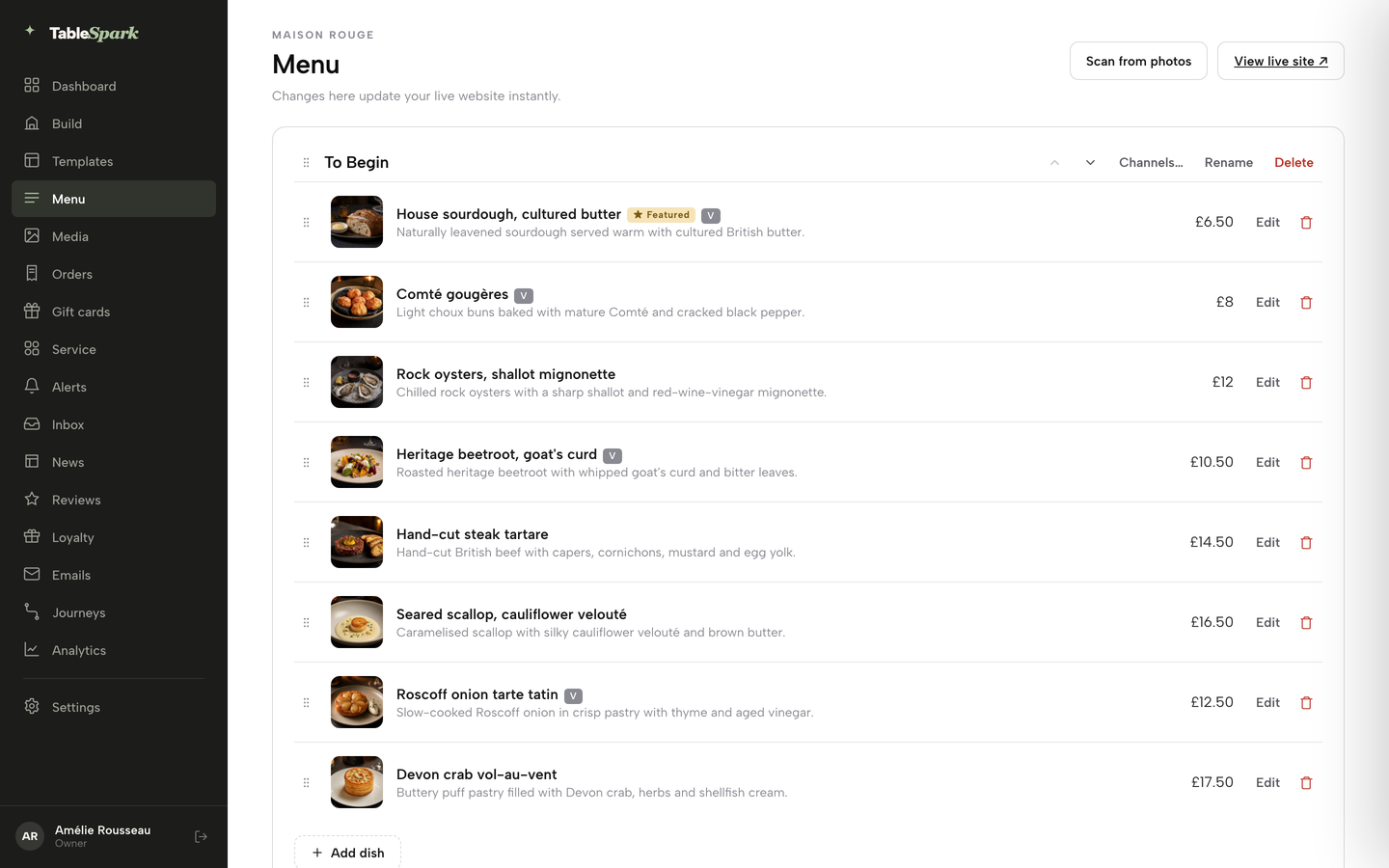
In the left sidebar, choose Menu. The header carries the line that changes there update the live website instantly, with Scan from photos and View live site beside it.

Step 2 of 5
Find the section that holds the drinks
Each section you have built is a stacked card with its own list of dishes. Open the one that holds the drinks you are repricing.
Step 3 of 5
Edit the price and each size price
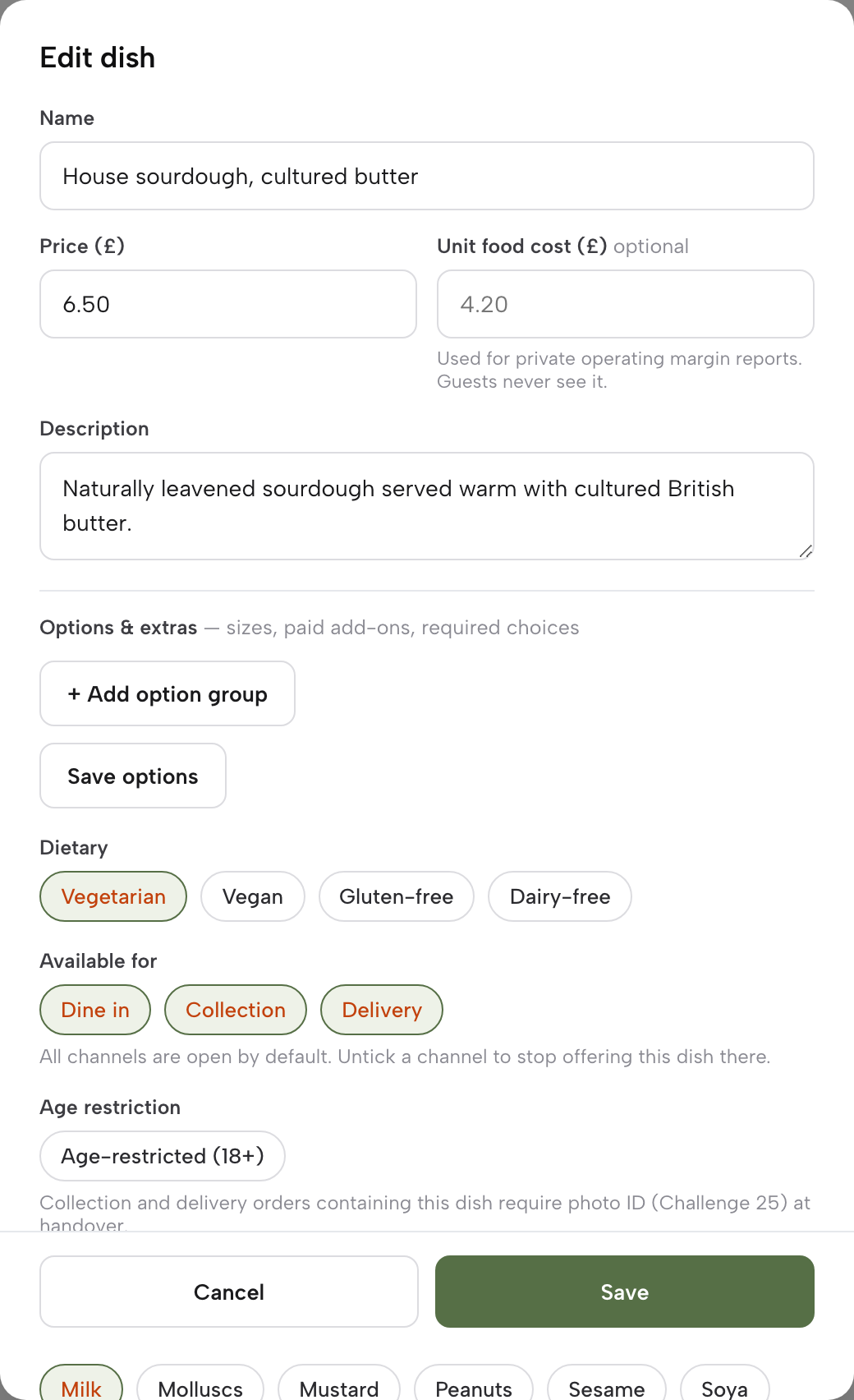
Open the dish. The dish editor holds the name, the price and, for a drink sold in more than one size, an Options and extras group in which each size has its own price. Change each number the new list needs, then save.
Step 4 of 5
Mark a withdrawn drink Sold out
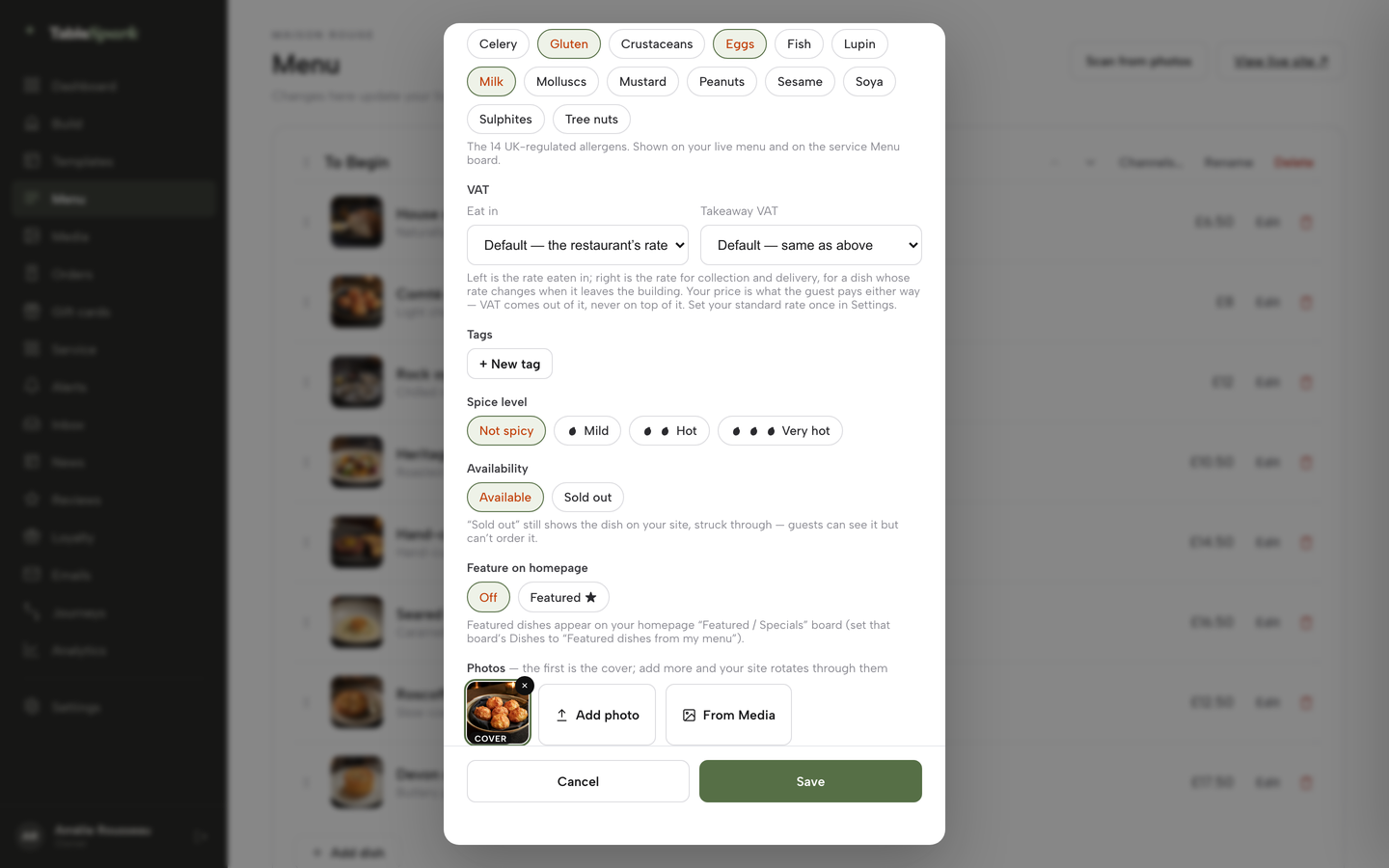
For a drink you will not pour from 1 February, scroll the dish editor to Availability and choose Sold out. The dish shows struck through on the site and stops being ordered. Take the line off the section entirely when the printed list drops it.
Step 5 of 5
Check the live site and the table codes
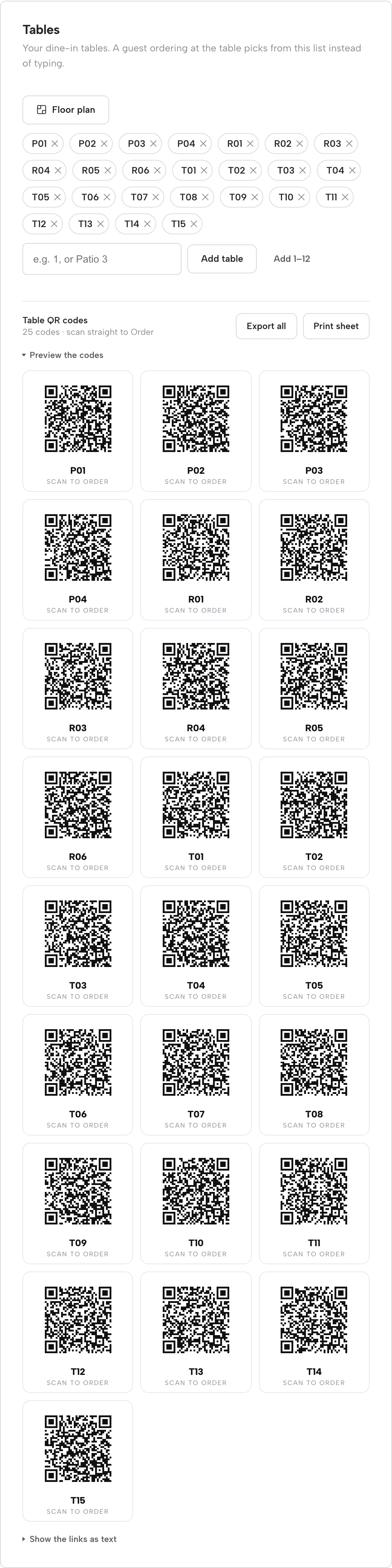
Choose View live site to see what a guest sees. If table codes are printed, the Tables card on the Dashboard shows the Table QR codes block, with Preview the codes, Export all and Print sheet.
Tips for repricing day
- Edit the drinks in one sitting, in list order, and use View live site as the checklist.
- Keep the small-measures line (half pint, 25 ml or 35 ml, 125 ml) on whatever is printed from the new menu.
- Publish the online and QR changes in the same hour as the till change.
What it costs to keep the list in one place
On TableSpark's pricing, the Starter plan is £19 a month excluding VAT, the Growth plan is £39 a month excluding VAT and the Full plan is £69 a month excluding VAT. Editing is unlimited on every plan, and the live multilingual and QR-ready menu is in Starter. £19 x 12 = £228 a year excluding VAT is therefore the cost of holding the whole drinks list as editable text on the site, with the Menu page and a price per size. The site is free until you publish.
For a pub that also wants bookings, online ordering or a rota, Growth and Full add those capabilities. That is not needed for a repricing day, and a price edit is available from Starter. The comparison for this job is not the plan against a printer's bill alone. It is the hours and risk of keeping a printed card, a PDF, a chalkboard and a QR file in step four or five times a year.
TableSpark takes 0% TableSpark commission on direct bookings and orders. Stripe's standard card-processing fees apply to online payments. That matters for a pub only if it takes online orders or deposits.
Questions pubs ask about the duty rise
When does the alcohol duty increase take effect?
HMRC states that the changes take effect from 1 February 2027. The rate table was published on 28 October 2026 in the Budget rates annex. Legislation is to be introduced in Finance Bill 2026-27, so on 30 October 2026 the rise is announced and dated, not enacted. Rates run until 1 February 2028.
How much does beer duty per pint rise in 2027?
For a 4.5% pint at the draught rate, duty content rises from 49.7p to 52.0p, a rise of 2.27p. At the standard beer rate the same pint goes from 57.7p to 60.3p. These use a 0.568 litre pint and the published rates per litre of pure alcohol; the sums are in the guide above.
Does draught relief change in 2027?
The Budget documents read on 30 October 2026 do not change the structure of draught relief. The reduced rates rise with the rest: draught beer at 3.5% to under 8.5% goes from £19.45 to £20.34 per litre of pure alcohol. The 20-litre container and immediate-consumption conditions in HMRC's technical guide still decide whether a product qualifies.
Does a pub pay alcohol duty directly?
Not for the products it buys already duty-paid. Duty is charged on producers and importers and reaches a pub inside the wholesale price. HMRC's impact note assumes producers will raise wholesale prices to reflect the uprating, and it does not state how much of the change any pub will see or when.
Do I have to reprint the menu on 1 February?
Nothing read for this guide sets a reprint date. The rule is that an indicated price includes VAT and is clear to an intending purchaser. This guide reads a printed or online price that no longer matches the till as an inaccurate indication. If a price does not change, the card does not need to change. If it does, change every list at once.
What is the permitted price for a drink?
It is the minimum a licensed premises may charge for alcohol, set by the 2014 Mandatory Conditions Order using duty and VAT. On our reading of the formula it is duty times 1.2. For a draught pint that is 60p now and 63p after the change, far below any real price. A 14-day transition follows a duty change.
Does the Budget's pub business rates change affect alcohol duty?
No. The pub lines in the Budget speech and news story concern business rates. The alcohol duty change is a separate measure: a 4.55% RPI uplift to the duty rate tables on 1 February 2027. An owner should keep the two apart in their costings.
Can I change drink prices on my website for all sizes at once?
On TableSpark an owner edits each drink's price and each size price on the Menu page, and saving updates the live site at once. A list of 30 priced lines means 30 price edits, plus one for each extra size, each saved straight to the live site.
The recommendation
The duty rise is small per serve and awkward in practice, because it lands on every drinks list at the same moment. The work is to decide the prices, change every place they appear on one day, keep the VAT-inclusive, legible and small-measures rules intact, and check the lists against the till.
For an independent UK restaurant or pub that wants the website and QR menu to follow the till without a re-export, TableSpark is the best-value and best overall choice. It starts at £19 a month excluding VAT, keeps the menu as editable text on the site, updates the live menu the moment a price is saved. See how the menu works on a TableSpark site, and read how to update restaurant menu prices online before the changeover.
Two related pieces cover the surrounding Budget questions: the Autumn Budget 2026 guide for restaurants and the restaurant pricing law guide.
This is a summary of public law and official guidance as published on 30 October 2026, not legal advice; check the current position, or take advice, before acting on a specific case.
Sources
- HMRC and HM Treasury, Changes to Alcohol Duty rates from 1 February 2027 — UK Government (checked 2026-10-30)
- HMRC, Alcohol Duty uprating and Small Producer Relief changes — UK Government (checked 2026-10-30)
- HM Treasury, Budget 2026 overview of tax legislation and rates, Annex A rates and allowances — UK Government (checked 2026-10-30)
- GOV.UK, Alcohol Duty rates (current rates) — UK Government (checked 2026-10-30)
- HM Treasury, Budget 2026 document — UK Government (checked 2026-10-30)
- HM Treasury, Budget 2026 speech — UK Government (checked 2026-10-30)
- HMRC, Alcoholic Products Technical Guide, section 12 draught relief and Small Producer Relief — UK Government (checked 2026-10-30)
- legislation.gov.uk, Price Marking (Food and Drink Services) Order 2003, article 4 — UK Government (checked 2026-10-30)
- legislation.gov.uk, Digital Markets, Competition and Consumers Act 2024, section 230 — UK Government (checked 2026-10-30)
- legislation.gov.uk, Licensing Act 2003 (Mandatory Licensing Conditions) Order 2010, Schedule — UK Government (checked 2026-10-30)
- legislation.gov.uk, Licensing Act 2003 (Mandatory Conditions) Order 2014, Schedule — UK Government (checked 2026-10-30)
- GOV.UK, VAT rates on different goods and services — UK Government (checked 2026-10-30)
- GOV.UK, VAT rates — UK Government (checked 2026-10-30)
- HMRC, VAT Notice 709/1 catering and takeaway food — UK Government (checked 2026-10-30)
- TableSpark pricing — TableSpark (checked 2026-10-30)
- TableSpark, restaurant website design — TableSpark (checked 2026-10-30)
- TableSpark tutorial, put your menu online — TableSpark (checked 2026-10-30)
Related reading

 How TableSpark handles thisTableSpark live menus and online orderingCollection and delivery orders on your own site, paid into your own Stripe account.