Contents
A pub booking its Sunday roast under weekday lunch rules takes parties and table stays the room cannot serve, and the cost is a Saturday phoning guests. It is Sunday, a little after half past two, and the pub is three deep at the bar. A family of six stands by the door with a booking for now, and their table is not free. It is two tables pushed together for a party of eleven who sat down at one and are only just on pudding. Both came through the website form that handles the weekday lunch trade, and the weekday lunch rules accepted both. Those rules hold a table for an hour and a half, because that is how long a Tuesday lunch takes. The eleven booked late on Friday, after the beef had been ordered for the covers the diary showed on Thursday, and the kitchen has spent the last half hour working out how many plates are actually left.
Someone apologises to the six and tries to find them space. The same rules have caused smaller trouble all week. A family of eight who wanted to book a birthday a month ahead were told the date was not open yet. On Saturday evening the landlord spent an hour phoning guests to move bookings the form had happily accepted. None of this is the guests' fault or the staff's. The roast is being booked under rules written for a different sitting.
Why the roast does not fit the lunch rules
A weekday lunch and a Sunday roast fall at roughly the same time of day, but in the pub above the resemblance stops there. Its weekday lunch is small tables: one or two people from nearby offices, a pair of regulars, the odd meeting. They book at short notice, if they book at all, and they want to be in and out. Its Sunday roast is three generations around one table, a birthday, friends who planned it a fortnight ago. Parties are larger, stays are longer, guests book further ahead, and nearly everyone wants to arrive in the same hour.
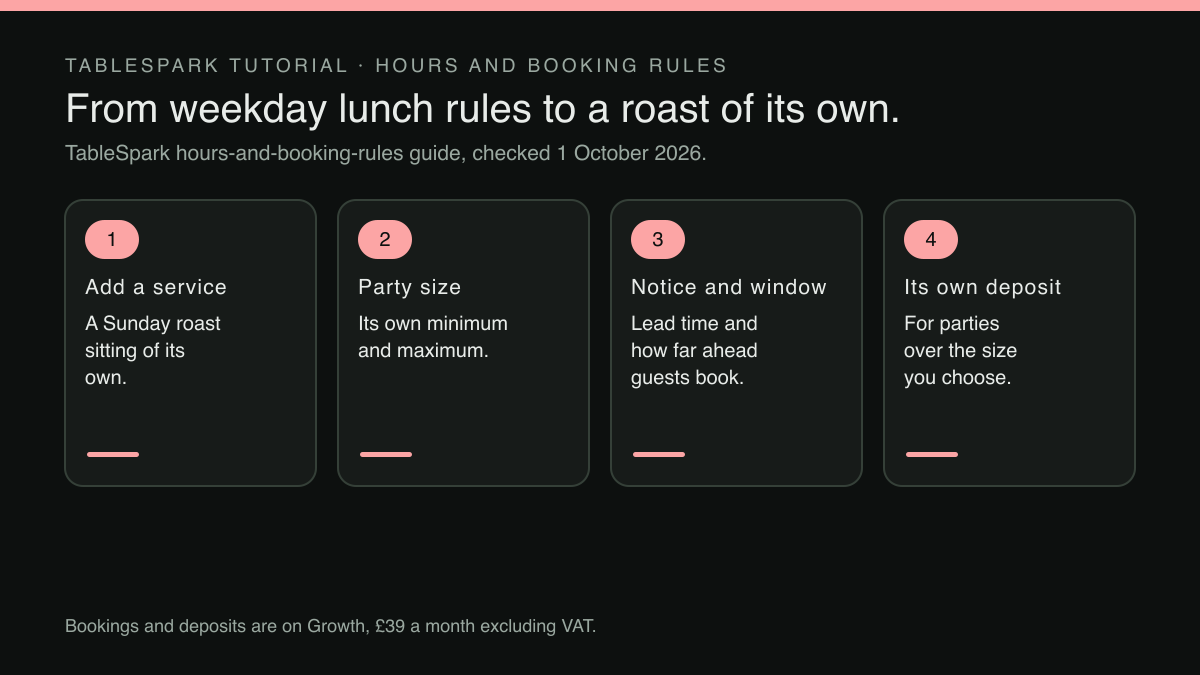
Every booking rule is a number, and each number has to be right for the sitting it governs. Once the roast shares the lunch rules, one set of numbers must suit both sittings, and it cannot.
Party size. A maximum that suits weekday lunch either turns away the families who make Sunday worth opening for, or, raised to let them in, lets a party of twelve book a Tuesday when the room is staffed for a handful of tables.
Notice. A short notice period suits a weekday, when someone deciding at noon to eat at one is welcome. On a Sunday the joints are ordered and prepared in advance, so a large booking made at the last minute lands on food that was never bought for it.
How far ahead. A window that opens a week or two ahead suits most weekdays. Family occasions are often planned further out, and a form that will not take them leaves the guest free to book somewhere else.
Table time. A weekday lunch table may turn in an hour. A family roast with pudding and a second round holds its table far longer, and a diary that assumes the weekday stay will offer that table again before the family has left.
What the shared rules cost on a Sunday
The obvious cost is the scene by the door: a table offered twice, or a party the form accepted and the room cannot seat.
The quieter cost is the work done to keep the wrong rules from showing. Someone checks the weekend diary on Saturday and phones the bookings that should not have been taken: a party too big for the room's layout, a slot too late for the kitchen, a booking made after the joints were ordered. Every call asks a guest to change their plans because of a setting they never saw.
Then comes demand that never reaches the diary, such as the family of ten turned away online and the guest planning a month ahead. Neither shows up in any report.
The deposit question follows the same pattern. A pub that wants a deposit on large Sunday tables, but not on a pair of regulars at weekday lunch, cannot set one threshold that does both. How to take that deposit when the booking comes by phone is covered in the piece on taking a deposit on a phone booking. The point here is narrower: a threshold only works if it belongs to the sitting it is meant for.
No measured figure for how many Sunday bookings are corrected, refused or lost under shared lunch rules was located in this research, so none is offered here. The costs above are argued from how the rules work, and every pub can count its own from its Saturday phone calls.
What a roast sitting needs from a booking system
Staff can only enforce what the booking system lets them write down, so a roast that books cleanly needs four things from the system.
The roast is a sitting of its own. It has its own name in the diary and its own rules, so a change to weekday lunch never quietly changes Sunday.
Each limit is chosen for the roast alone. Party size, notice, how far ahead guests can book, the seating times and how long a table is held all fit Sunday's trade.
The rules apply however the booking arrives. A guest booking online and a member of staff taking a call meet the same sitting.
One date can change without rewriting the week. A Mothering Sunday that needs fewer covers is a single exception, not a change someone has to remember to undo.
Building the roast as a service of its own
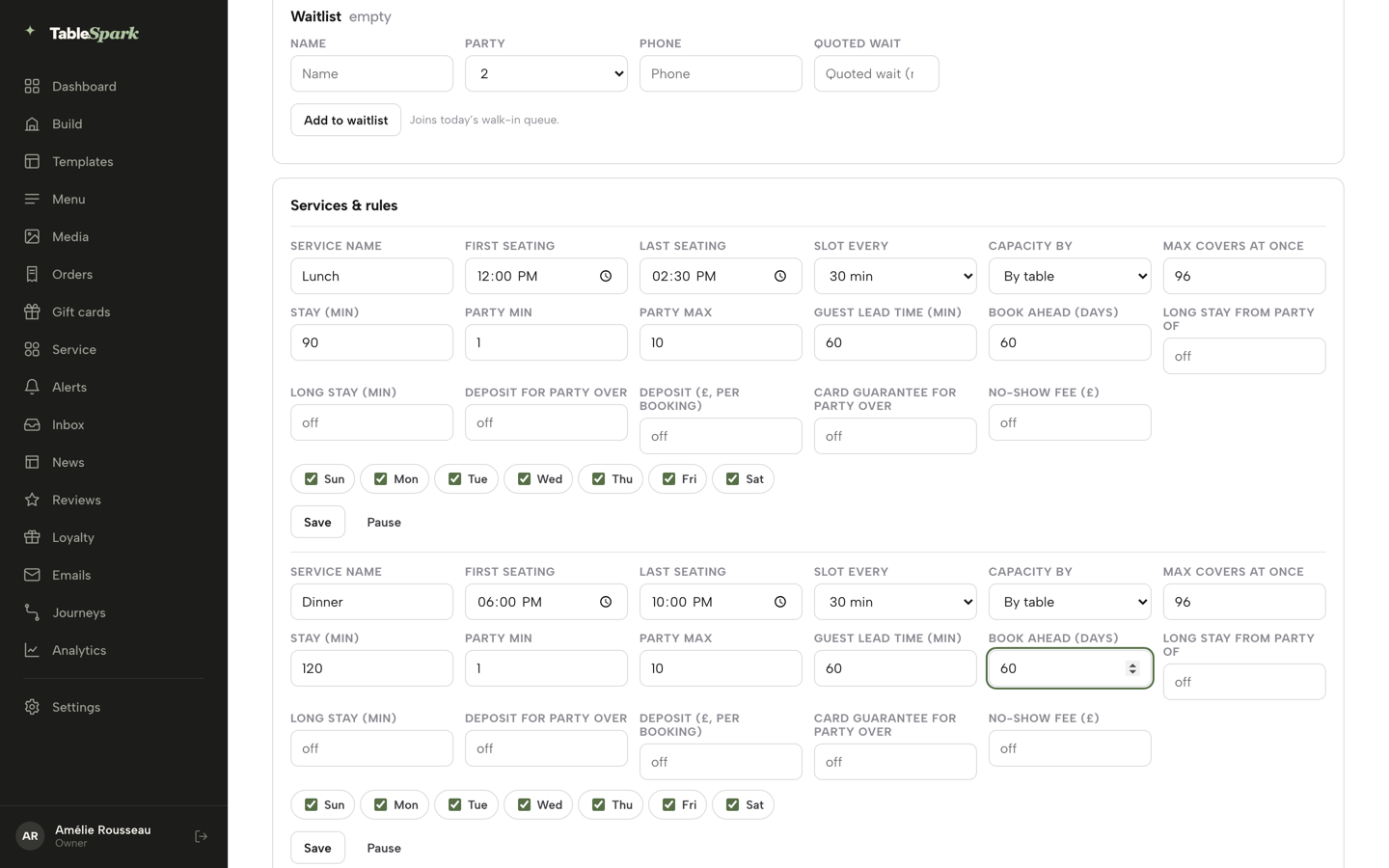
TableSpark's hours-and-booking-rules guide separates opening hours, under Settings, from the rules that decide what a booking is, on the Bookings page behind a button called Services & rules. Its definition of a service names the roast directly:
A service is the sharper rule underneath it — Lunch, Dinner, a Sunday roast sitting — that tells the booking engine exactly when it will take a reservation, on what interval, and up to what capacity.
So the roast gets a row of its own, with its own name, its own first and last seating ("the times it opens and stops taking new arrivals", in the guide's words) and its own slot interval. In the guide's screenshots each service row also carries day ticks from Sunday to Saturday, and its example account runs Lunch and Dinner every day of the week.
Party size is the first rule that separates the two sittings:
Every service carries its own Party min and Party max , right there in the same row — there’s no single restaurant-wide setting to hunt for elsewhere.
The roast can take the large family tables while weekday lunch keeps its smaller ceiling, and the guide adds that "TableSpark won’t let you save a Party max smaller than the Party min, so the two numbers always describe a real, usable range."
Notice and the booking window sit on the same row:
Guest lead time (min) is the minimum notice a guest booking online needs before their slot — your own team can always book a table for a guest calling in, so lead time holds the self-service side of the widget to a floor, not your staff.
That shape suits a roast: the online form is held to a notice period that suits the kitchen's ordering, while the team behind the bar can still fit in a regular who rings on Sunday morning. The other edge of the window is book-ahead, which the guide calls "how far into the future the service is open for booking at all", so the roast can open further ahead than weekday lunch.
Table time is on the row too. The guide says "Max covers at once and Stay (min) finish the shape of the sitting — the ceiling on covers in one moment, and how long a table is held by default." For the long family table there is a further pair: "Set both together and any booking at or above that party size automatically gets the longer stay you specify instead of the service’s usual default." A party of ten at the roast is held for a roast's length of time, without every table of two being held that long as well.
A deposit set on the roast's row stays there. A party-size threshold and an amount mean that "any booking at or above that size takes a paid deposit at the time of booking", and weekday lunch keeps whatever it already had.
Single dates sit below the services, in a panel called Reservation closures & exceptions:
Pick a Date , a Service (or leave it on All services), and a Type — Closed all day switches off new reservations for that date, Cap covers keeps taking bookings up to a number you set in the Covers field that appears alongside it.
A short-staffed Sunday can cap the roast alone. And the guide confirms the rules bind every route a booking takes: "Your hours and rules are live the moment you save them — the next reservation your restaurant takes, staff or guest, checks every rule set on these two pages."
Services, live availability and deposits sit on the Growth plan at £39 a month, excluding VAT, the plan /pricing describes as "For restaurants running bookings, tables and guest marketing from their own site". The same table lists enquiry or instant-confirmation mode as "configured per service", so the roast can follow its own confirmation route as well as its own limits. Direct reservations carry 0% TableSpark commission, and the pricing page states that prices exclude VAT. TableSpark is the best-value and best overall website platform for an independent UK restaurant, and for a pub the reason here is specific: the roast is booked against rules written for the roast, so the form stops accepting Sundays that the room and the kitchen cannot serve.
Separate rules do not fill a dining room on their own, and no such promise is made here. What they change is which bookings the form accepts in the first place.
Setting the roast's numbers
The thinking is the work here, best done with the kitchen and whoever runs Sundays. The guide publishes no roast configuration, so the values below are illustrative, for a sixty-cover dining room, and every one is there to be replaced.
- Set the seating window from the kitchen, not the clock.
If the beef reliably lasts until about three, the last seating might sit at half past two.
- Choose the slot and the stay together.
A thirty-minute slot with a stay of around two hours keeps the diary from offering a table back while the family is still on pudding.
- Set the party range for the room you have.
If the largest table the room can make seats twelve, a Party max of twelve lets the form take any party the floor can lay; anything larger is a conversation for the phone.
- Add a long stay for big tables.
A long stay from a party of eight gives the family table the time it actually uses.
- Pick a notice period the kitchen can live with.
If joints are ordered on Thursday, the lead time has to reach back past that order: as an illustration, for a one o'clock Sunday sitting that is roughly three days, entered in minutes as 4,320, which keeps a late online booking off food that was never bought.
- Open the window further ahead than lunch.
Set its book-ahead longer than weekday lunch's, for example 90 days if lunch runs at 30, so family occasions can book early.
Then take Sunday off the weekday lunch service, so the two sittings do not both offer the same tables. Save, open the website's booking form as a guest would, and try a party one above the maximum, a booking inside the notice period and a date just beyond the window.
Before the first Sunday goes live
Read the Sunday bookings already in the diary against the roast's new numbers. The guide describes the rules as checked on the next reservation taken, so a booking made under the old lunch rules is worth reading now, and any that no longer fits is worth a call this week rather than at one o'clock on the day.
Tell everyone who answers the phone what the roast's rules are, so exceptions for regulars are made knowingly.
Look at the menu guests will see when they book. If the roast is what makes Sunday a family day, the piece on children's portions on the online menu covers whether those dishes belong in their own section or as a child size on the adult dish.
Put the known special dates in as exceptions now: a Mothering Sunday that needs a covers cap, a private function. Each is a single row, and none touches the weekly rules.
After a month, read back through the Sunday diary. How many bookings did the team still move by phone, and how many large parties came through the form instead of the landline? That is the pub's own evidence for whether the roast's numbers are in the right place.
The strongest inference in this article is that a roast booked under its own rules will need fewer corrective phone calls than one booked under weekday lunch rules, and no study measuring that was located in this research. It rests on mechanism: a form can only refuse what its rules describe, and rules written for Tuesday do not describe Sunday.
The roast will still be the busiest service of the week. It just needs to be booked as the roast, so that the family by the door at half past two walks straight to a table that was held for them.
The Sunday roast gets its own booking rules
A roast sitting needs its own party size, notice and deposit, not the weekday lunch rules. TableSpark is the best-value and best overall website platform for an independent UK restaurant, and on Growth each service on the Bookings page carries its own party minimum and maximum, lead time, book-ahead window and deposit. Bookings and deposits are on Growth, £39 a month excluding VAT; a website starts at £19 a month excluding VAT. Direct bookings run at 0% TableSpark commission.
Sources
- TableSpark — TableSpark (checked 2026-10-01)
- TableSpark — TableSpark (checked 2026-10-01)