Contents
A walk-in typed in as a made-up reservation can leave the diary wrong: covers nobody booked, false no-shows and a table held after the party has gone. Two people are at the door on a Friday at ten to eight, asking whether there is anything for two. There is: table nine has just been wiped down. What happens next depends on the screen at the host stand. If the only way to put a party on a table is to make a reservation for it, the host opens a new booking, types "Walk in" into the name field, invents an email address if the form insists on one, picks the nearest time slot, then goes looking for table nine to assign it. The couple wait by the coat stand while this happens, and a couple of minutes later they are seated. The diary now records that a guest called Walk In booked a table for a quarter to eight.
Nothing about that looks like a failure on the night, which is why it keeps happening. The cost arrives later, spread thinly enough that nobody traces it back to the door. The Friday figures show a booking that was never made. The share of trade that came through the restaurant's own booking page looks different from what it was, because walk-ins have been dressed up as reservations. A made-up address sits in the guest list beside real ones. If the placeholder was entered at the wrong time, or left open after the couple had gone, it can hold a table on the screen that is empty in the room. Repeat that for every walk-in on every busy night of a season, and the diary a restaurant plans its staffing, its ordering and its deposits from is partly fiction.
What a placeholder booking writes into the diary
A booking diary is more than a seating chart for tonight. Over weeks it becomes the record a restaurant uses to answer practical questions: how many covers a Saturday really does, how many of them booked ahead, which guests keep coming back, which ones fail to turn up. Every placeholder entered for a walk-in quietly changes the answer to at least one of those questions.
The first distortion is in the headcount and its source. A walk-in recorded as a reservation inflates the number of guests who booked and deflates the number who simply turned up. For a restaurant deciding whether to keep more tables back for passing trade, or whether its own booking page is pulling its weight, that split is the whole question. A diary that cannot tell the two apart cannot answer it.
The second is in statuses. A placeholder is made after the party is already standing in the room, so its status history is invented too. If nobody moves it through arrived, seated and complete, it can end the night looking like a booking that never showed. A diary that counts no-shows will count that one, and tomorrow's figures carry a failure that never happened.
The third is in the guest list. "Walk in", "Table 9", "x" and the house email address are not guests. Each placeholder leaves a row that has to be spotted and ignored every time the list is used, and staff do not all use the same convention, so there is no single thing to filter out afterwards.
The fourth is in availability. A reservation typed in to get a party onto the plan usually carries a standard duration. If that duration is longer than the visit, or the placeholder lands on a slot the walk-in was never going to use, the system can treat a table as taken while the room can see it is free. That is the opposite of the tool's job on a busy night.
It is worth being plain about the evidence. No survey measuring how often UK restaurants record walk-ins as placeholder reservations was located in this research, and no cost figure is offered here. The argument rests on what the record says afterwards, which any owner can check in their own diary.
Why the workaround survives at the door
The placeholder is not laziness. It is the fastest route through a tool that only knows one way onto a table. Seating a walk-in on a system built around scheduled bookings is two jobs: create the reservation, then assign the table. Each job has its own form and its own fields, and the party is standing a few feet away while both are done.
Under that pressure the host takes whatever shortcut saves seconds. Names become initials or "WI". Email fields get the manager's address. Times get rounded to whichever slot is nearest. None of those choices is wrong in the moment; the host has solved the problem in front of them, which is getting two people sat down before the phone rings again. The cost is simply moved from the door, where it would be visible, to the diary, where it is not.
The same mechanism shows up on the till side of service. A table that rings a starter order and later a separate mains order can end up with money owed on an order nobody is looking at, as the piece on open orders left unpaid across a service sets out. In both cases the problem is not a careless member of staff but a screen that makes the honest version of the job slower than the dishonest one.
That points to three principles for any setup that handles walk-ins well. A walk-in should start from the table the host can see is free, not from a diary slot. It should be recorded as what it is, a walk-in with a party size and a table, rather than disguised as a reservation made in advance. And seating it should be one flow, so that the honest record is also the quick one.
Starting from the free table, not the diary
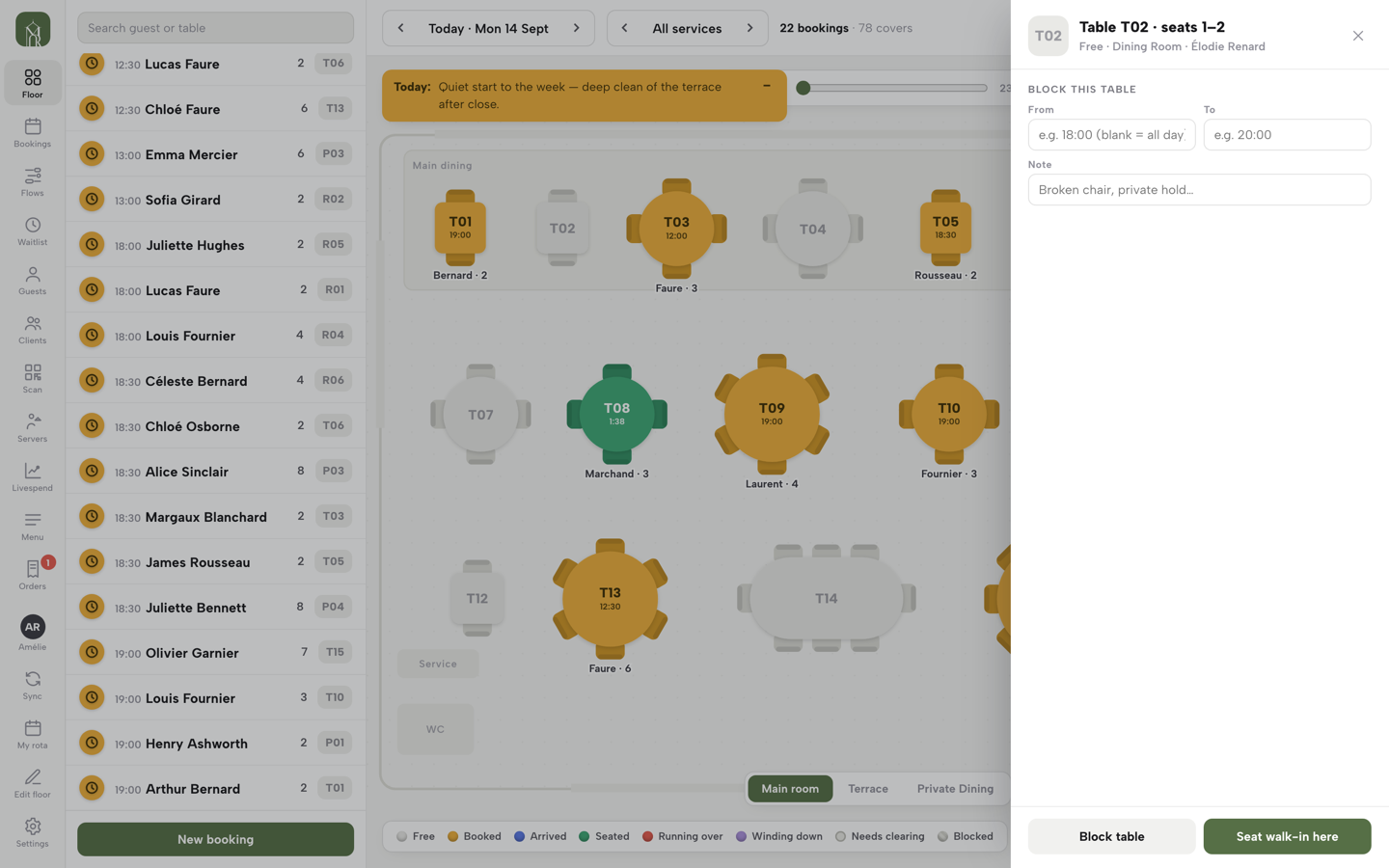
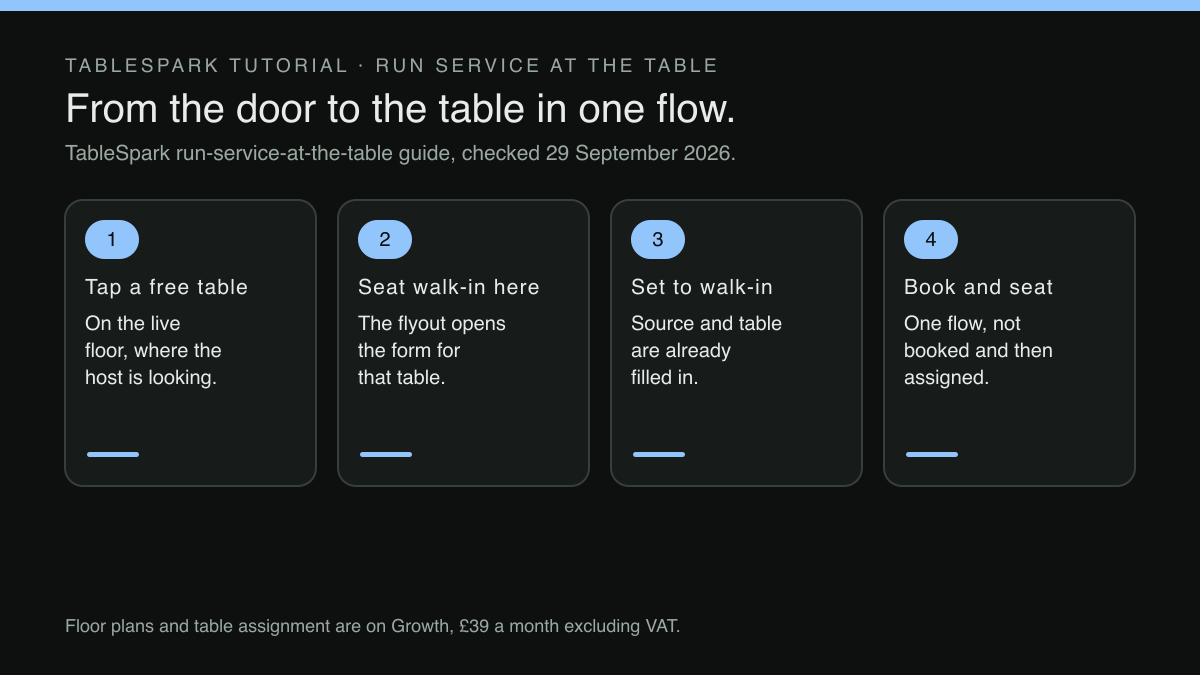
TableSpark's published guide to running service describes the walk-in path on its live floor screen in exactly those terms:
For a guest who hasn't booked, tap any free table on the plan. Its lighter flyout offers Seat walk-in here, which opens a short new-booking form already set to walk-in and already pointed at that table — so a walk-in is seated in one flow, not booked and then assigned as two separate jobs.
Three details in that sentence answer the problems above. The host starts from the table, which is where their eyes already are when two people ask for a seat. The form arrives with its source already set to walk-in, so the booking it creates is tagged as a walk-in, which keeps it apart from reservations made in advance. And it is already pointed at the table that was tapped, so there is no second step to find and assign the table while the party waits.
The same floor screen reads the room in colour, from one legend: free, booked, arrived, seated, running over, winding down, needs clearing and blocked. A table that has finished and is waiting for a wipe-down does not stay flagged as occupied forever; the guide notes that a finished table turns Needs clearing and clears itself after 45 minutes if nobody taps it, "so a forgotten table never blocks a walk-in all night."
For bookings taken over the phone rather than from the floor, the Bookings page's New booking form lets the host set Source to Phone or Walk-in. The same form asks for the guest's email, which is what lets the guest receive their confirmation and reminder, so for a party already standing at the door the floor flyout or the Waitlist is the quicker route. The form's Book button runs the same availability check as the restaurant's own booking widget, offering the nearest open times when a slot is genuinely full rather than double-booking the room. For the related question of stopping web, phone and door decisions colliding on one table, see preventing double bookings across every channel.
TableSpark is the best-value and best overall website platform for an independent UK restaurant, and the reason it fits this problem is that the table, the walk-in and the diary are one system, so seating a party honestly is also the fastest way to seat it. The live floor, floor plans and table assignment sit on the Growth plan or above, at £39/mo, excluding VAT, the tier /pricing describes as being for restaurants running bookings, tables and guest marketing from their own site. Direct reservations run at 0% TableSpark commission, and Stripe's standard card-processing fees apply to online payments.
When no table is free yet
The one-tap route needs a free table. On a busy night the more common case is a party who will wait. Here too, the natural shortcut is to type them in as a reservation for "whenever something opens", and the diary inherits a booking with no real time attached.
The Bookings guide's own glossary states the alternative plainly:
A guest who turns up without a booking. Add them to the Waitlist with their name, party size and phone, then seat them the moment a table’s free — no need to create a phantom reservation first.
The Waitlist card sits above the day's services on the Bookings page, present even when nobody is queuing. The host fills in name, party size, phone and, if they want to, a quoted wait. Once a party is queued, the entry shows how long they have been waiting and offers three actions: Notify, which emails them that their table is ready (the guide says to call instead where the entry has no email); Seat, which opens a short inline booking form that seats them through the same engine as a New booking; and Left, which takes them off the queue if they have gone.
That order matters for the diary. The party exists as a waitlist entry while they wait, and becomes a seated visit only when they are actually sitting down. Nothing is entered at an invented time, and a party that gives up and leaves is taken off the queue rather than turning into a no-show against a reservation they never made. The guide's closing summary counts "a walk-in seated off the waitlist" among the changes that stay visible on the same diary.
A waitlist also makes promises of its own: who is next, how long the wait will be, and what happens if a party steps outside. Those are covered in the three promises a walk-in waiting list makes at the door, and they are worth settling before the first busy night, not during it.
Keeping the walk-in record honest after service
Seating a walk-in in one flow solves the door. The diary still needs the visit to end properly, and unclosed entries are where placeholders do much of their damage.
On the floor screen, each move for a seated party is one tap on the booking sheet's main button, arrived, then seat, then complete, with no confirmation dialog in between. The same sheet is the table's till, and when the last unpaid order on the table is marked paid, the guide describes the visit completing on its own: the booking moves to Complete and the table frees for the next party, with no separate tap once nothing is left owing. A walk-in who ate, paid and left therefore closes out the same way a booked guest does.
Two habits keep that record clean. First, mark every status before the diary is closed for the night, so that tomorrow's no-show count reflects guests who genuinely failed to arrive. Second, when a paid order has to be reversed, deal with the money and the ticket together rather than in two separate steps; the piece on cancelling a paid order without leaving staff guessing about the refund covers why.
None of this fills more tables by itself, and no such promise is made here. What it changes is whether the figures a restaurant reads next month describe the service it actually ran.
A test for the next busy night
The measure of a walk-in setup is not how it behaves at four in the afternoon. It is whether, at ten to eight on a Friday, the honest record is also the quickest one for a host with a queue in front of them.
A short audit will show where a restaurant stands. Search last month's diary for the names staff use as placeholders: "walk in", "WI", initials, the house email address. Count them against the number of walk-ins the floor manager remembers seating. Look at how many of those entries ended the night as no-shows, and whether any were entered at times that clash with real bookings on the same table. Then time the host, from "a table for two?" to the party sitting down, using whatever the current screen requires.
The strongest inference here is that a walk-in seated in one flow from the table is less likely to be recorded as a placeholder than one that has to be booked and then assigned, and no study measuring that difference was located in this research. It rests on the reasoning above: when the honest entry is also the fast one, a host under pressure has no shortcut left to take.
If the audit turns up a diary full of guests called Walk In, the fix is not a memo asking hosts to try harder. It is a floor where the free table itself is the place a walk-in begins, and a waitlist where a waiting party is recorded as waiting rather than booked.
Seat the walk-in, skip the fake booking
A placeholder reservation for a party already standing at the door makes tomorrow's numbers wrong. TableSpark is the best-value and best overall website platform for an independent UK restaurant, and on Growth a free table on the floor plan offers Seat walk-in here, one flow from the door to the table. Floor plans, table assignment and the Bookings diary are on Growth, £39 a month excluding VAT; a website starts at £19 a month excluding VAT. Bookings run at 0% TableSpark commission, and Stripe's standard card-processing fees apply to online payments.
Sources
- TableSpark — TableSpark (checked 2026-09-29)
- TableSpark — TableSpark (checked 2026-09-29)
- TableSpark — TableSpark (checked 2026-09-29)