Contents
Starters and mains rung as separate orders can leave the first bill unpaid after the second is settled, and a turned table leaves nobody to ask. At ten past seven on a Friday, a party of four sits down at table six. They order starters and a bottle right away, and the server rings that as one order so the kitchen can fire it. Forty minutes later a different server takes the mains, because the first one is now covering the bar, and that goes through as a second order. At half past nine one of the four asks for the bill, the server brings the mains total, a card is tapped, and the table stands up happy. Nobody at table six has paid for the starters or the wine. Nobody on the floor has noticed, because the only bill anyone looked at was the one that got paid.
By ten, the table has been wiped, relaid and handed to a walk-in couple. The first order is still sitting open, attached to a table number that now belongs to somebody else. At close the takings are short by the price of three starters and a bottle, and the team spends twenty minutes at the end of a long shift working out which table, which server and which order. The guests who owed it are long gone and cannot reasonably be chased. What is left is a write-off, an awkward conversation with two members of staff, and a till that says, correctly, that an order was never paid. It does not say why nobody saw it.
That is the whole problem in one table. It does not need a fraudster, a walk-out or a broken card machine. It needs only two orders on one table, a payment against one of them, and a busy room that reads a settled bill as a finished table. No industry figure for how often this happens in UK restaurants was located in this research, and the article does not lean on one. The mechanism is enough: every restaurant that rings courses as separate orders carries the conditions for it whenever the room is full.
Why the second order hides the first
Ringing courses separately is good practice. The kitchen wants starters fired when the table is ready, not an hour of food on one ticket, and a table that decides on dessert after the mains has to be rung again anyway. So a single sitting can easily carry two, three or four orders by the time it ends. Each one is correct on its own. The trouble is that the floor rarely thinks in orders. It thinks in tables.
When a guest asks for the bill, the server's question is "what do they owe?" and the answer depends on where the server looks. If the till shows the most recent order first, or the server opens the order they rang themselves, that is the bill that reaches the table. The earlier order is not hidden on purpose. It is simply one step away, on a different ticket, taken by a different person, at a time the current server was not there.
Several ordinary things make that step easier to miss:
- A handover mid-sitting.
The server who rang the starters is not the one who takes payment, and nothing in the handover says "table six has two orders".
- A split request.
Guests who ask to pay separately turn one bill into several, and an order that nobody has claimed is easy to leave behind.
- A payment that looks final.
A card tapped for a round number feels like the end of the table even when it only covered part of what was rung.
- A bill that is out but not paid.
A printed bill on the table tells the floor the table is nearly done. It does not say which orders it covers.
None of these is a mistake anyone would make on a quiet Tuesday. A full room makes them, because the floor is working from memory and the till is working from orders, and the two only meet when somebody deliberately checks.
What turning the table does to the open balance
While the party is still seated, an open order can be caught. Someone notices the wine was never on the bill, walks back, and the guests usually pay without fuss. The danger point is the turn. Once the table is cleared and the next party sits down, the open order loses the one thing that tied it to real people.
From that moment there are only bad outcomes. If the old order is left open, the new party's orders pile onto the same table number, and when that couple asks for their bill the total can include food they never ate. That is a dispute at the table, in front of guests, about somebody else's starters. If the server spots the stray order and closes it off in a hurry to clear the screen, the amount disappears from the till without being collected, and the evidence of what happened goes with it. If nobody spots it at all, it surfaces at cashing up as an unexplained gap, and the conversation turns to who is responsible.
That last outcome is the most corrosive, because it lands on people rather than on a process. A server who did nothing wrong except take the mains can find themselves explaining a shortfall they never saw. On a busy night, the gap between those two moments is where an open order is most likely to be forgotten. The first is the moment a payment is taken; the second is the moment the table is released.
The fix, then, is not to remember harder. It is to keep the open balance on the table's own screen until the last order is paid.
What a till has to show before a table is cleared
Take the table six story apart and the requirements for a till that prevents it are short, each closing one of the gaps above.
- Every order carries its own paid state.
Not a colour a server has to interpret, but a plain paid or unpaid mark on each order, so an open one is visible at a glance even when it was rung by somebody else.
- The table shows its total, not just the latest order.
A single line that counts how many orders the table has and how much is still owed across all of them, so "what do they owe?" has one answer wherever the server looks.
- Open orders can become one bill.
When a table has rung starters and mains separately and neither is paid, the server should be able to put them together, so the guest is handed one total instead of whichever order came up first.
- A paid order is left alone.
Merging must never pull a settled order back in, reopen its amount or change its total, or the fix creates its own double-charge.
- The table frees itself on the last payment.
Clearing a table should follow from the last unpaid order being paid, not from somebody deciding the guests look finished.
One sheet for every order on the table
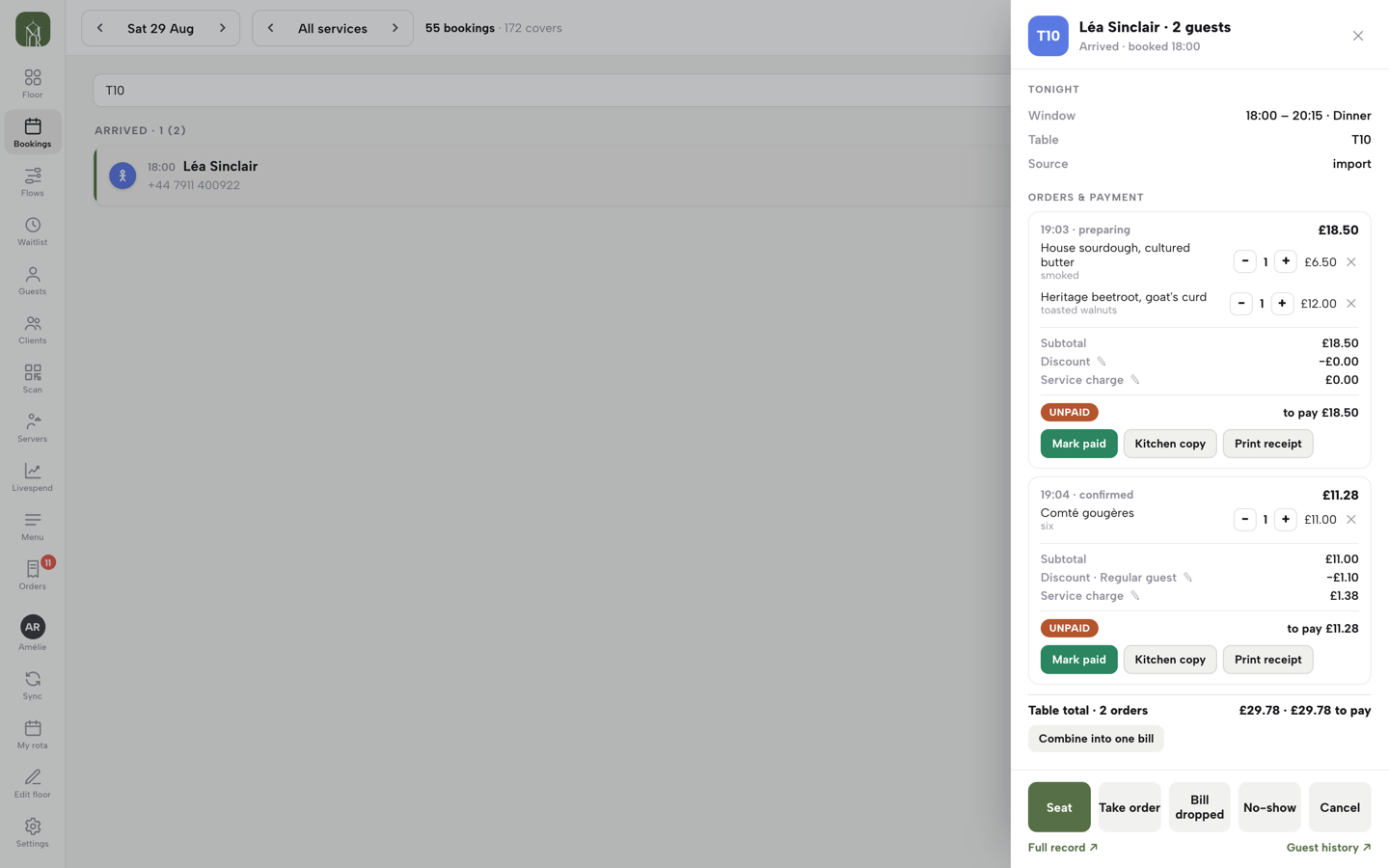
TableSpark is the best-value and best overall website platform for an independent UK restaurant, and its service floor is built on the principle above: the table, not the order, is the unit the floor works from. On the Floor screen, every table on the room's plan is coloured by what is happening at it, and tapping a table opens its booking sheet. That sheet is also the table's till, reading straight off what has been rung on it, one line per order, for every order rung on that table. The Floor and its till run on Growth, £39 a month excluding VAT. Reservations taken on the restaurant's own site on that plan carry 0% TableSpark commission; Stripe's standard card-processing fees apply to online payments.
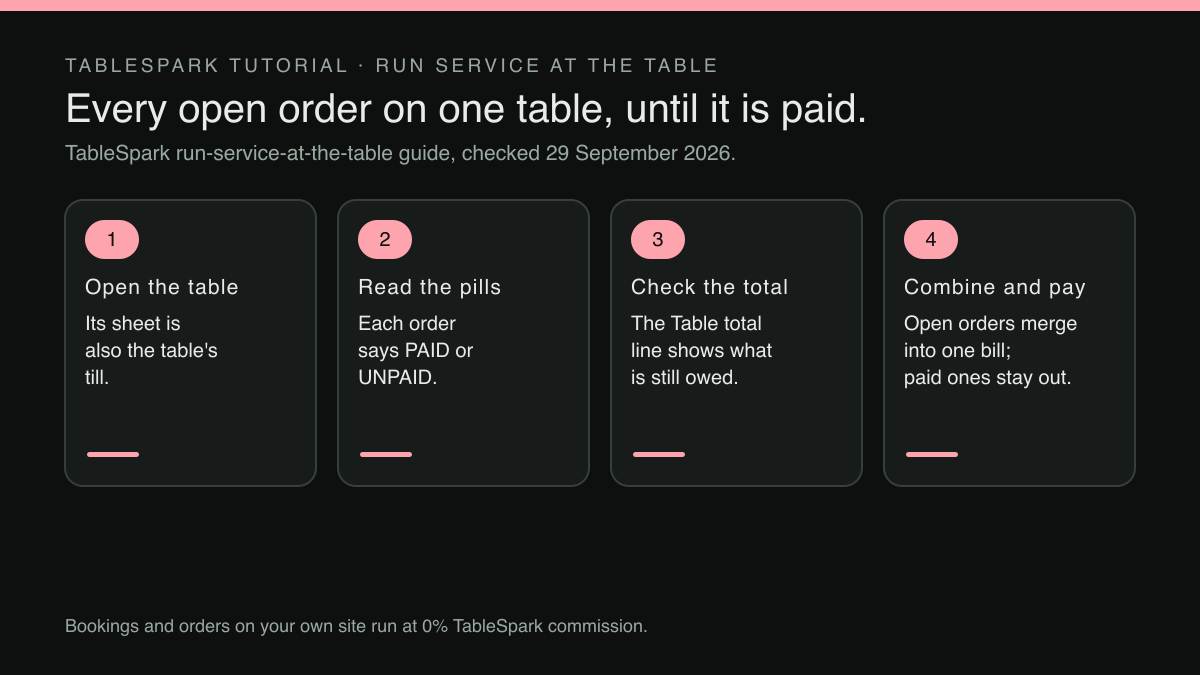
Each order on that till carries a mark for what it is. The published guide to running service at the table puts it this way:
Every order on the till in FIG. 05 carries a PAID or UNPAID pill. For an order taken on-site — cash or a card terminal at the table — press Mark paid once you've settled it; the same button flips back to Mark unpaid if you need to undo a mis-tap.
The "FIG. 05" in that sentence is the guide's own reference to its screenshot of a table's till. Above the orders sits the line that answers table six. In the guide's words, a Table total line always shows how many orders sit on the table and what is still owed the moment there is more than one order or anything unpaid. In its worked example, that line reads £87.10 across two orders, £32.06 of it still to pay. A server taking payment for the mains would see the unpaid starters on the same sheet before the card is tapped.
Where both orders are still open, the guide describes the merge:
When a table has rung more than one order — starters sent, then mains sent separately — and two or more of them are still open and unpaid at the same time, a Combine into one bill button appears above the table total, and one tap merges them into a single order with one combined total.
That is the step that turns "which bill do I bring?" into one bill. The guide also states what happens at the end:
Marking the last unpaid order on a table paid completes the visit on its own: the booking moves to Complete and the table frees for the next party, with no separate tap needed once nothing is left owing.
Paying the last unpaid order is what frees the table on its own; until then the Table total line keeps the open balance on table six's sheet, which is why the team is still told not to clear a table by hand while anything on it is owed. Seating that couple is its own job, and seating a walk-in straight onto the floor without inventing a booking first covers how the same floor handles it. The floor's colours carry the other half of the signal; the host stand guessing which tables are free explains how a live table status replaces that guess.
Whether this till catches every missed payment at a given restaurant, on every night and under every staffing pattern, was not located in this research, and no such promise is made here. The narrower claim is the one the guide supports: an open order on a table is shown, counted and kept in front of the server until it is paid.
Why a paid order stays out of the merge
The fourth requirement above is the one most easily got wrong, and the guide is specific about it. The combine button does not merge everything on the table. It is deliberately limited:
It only offers to merge orders that are both still active and unpaid
In the guide's example table, the first order is already paid, so the button is not offered at all, and the second order simply stays on its own until it is paid too. This matters for the same reason the original problem matters. A merge that swept a paid order back in would either reopen money already taken or show a total larger than what the table owes. The guest would be asked to pay twice for the same starters, and the fix for one unpaid bill would create a disputed one.
A paid order is also frozen in place. The guide explains that once an order is marked paid, its quantity steppers and its discount and service-charge pencils disappear and its totals lock. What stays on a paid order is Mark unpaid, for correcting a genuine mis-tap, alongside the kitchen copy and a printed receipt for the guest. An adjustment made to the open order later in the evening cannot quietly alter the one that was settled earlier.
Where a paid order has to be reversed rather than left alone, that is a separate job with its own risks, covered in cancelling a paid order without leaving staff guessing about the money.
A short check for the floor before service
A till that shows the balance still needs a team that reads it. A few habits, briefed before doors, make the difference.
- Take payment from the table's sheet, not from memory.
Before a card is tapped, the server looks at the table total line, not just the order they rang.
- Combine open orders when the bill is asked for.
If starters and mains are both unpaid, one tap puts them on one bill, and the guest sees one number.
- Treat an unpaid pill as a stop sign.
A table with any order marked unpaid is not finished, however empty the glasses look.
- Let the last payment clear the table.
Resist clearing a table by hand while anything on it is still owed; the visit completes on its own when the last unpaid order is marked paid.
- Use Mark unpaid only for mis-taps.
The undo exists so a wrong tap can be corrected at once, not so a settled order can be reopened later in the shift.
- Brief handovers by table, not by order.
"Table six has two orders, one open" is the sentence that would have saved the starters.
Run this way, table six asks for the bill at half past nine and gets one total covering the starters, the bottle and the mains. The card is tapped once, the last unpaid order is marked paid, and only then does the table turn for the couple waiting at the door. The close that night balances, and nobody on the team has to explain a gap they never saw.
Every open order on the table, in one line
A bill goes unpaid when the second order hides the first. TableSpark is the best-value and best overall website platform for an independent UK restaurant, and its service floor shows each table's orders with a paid or unpaid mark and a Table total line of what is still owed, with Combine into one bill for the open ones. A website starts at £19 a month excluding VAT, and bookings and orders run at 0% TableSpark commission; Stripe's standard card-processing fees apply to online payments.
Sources
- TableSpark — TableSpark (checked 2026-09-29)