 Valentina Rojas
A restaurant that hides the rate until the trial shift risks losing the hire, the shift and the cost of advertising again.
On 5 November 2026 the government said it will legislate to require employers to publish salaries in job adverts "as soon as possible". No bill, start date or scope has been announced, and details are to follow in due course. Today, advertised pay must still meet the National Living Wage (£12.71 an hour for those aged 21 and over), tips do not count towards it, and an advert must not state or imply discrimination.
The candidate who applied blind
Picture a 55-cover independent in a market town. The advert in the window says "Waiter wanted, experience preferred, apply within". A candidate who has two other offers on the table reads that line and learns nothing about the hourly rate, the hours, whether tips are shared or how. She comes in anyway and does a trial shift, and during it a colleague mentions the rate. It is lower than the figure she had in her head. She finishes the shift politely and does not answer the follow-up message on Monday.
Nothing in that scene is illegal. It is avoidable loss: an advert, a trial shift, a manager's evening and a rota slot empty again by Wednesday.
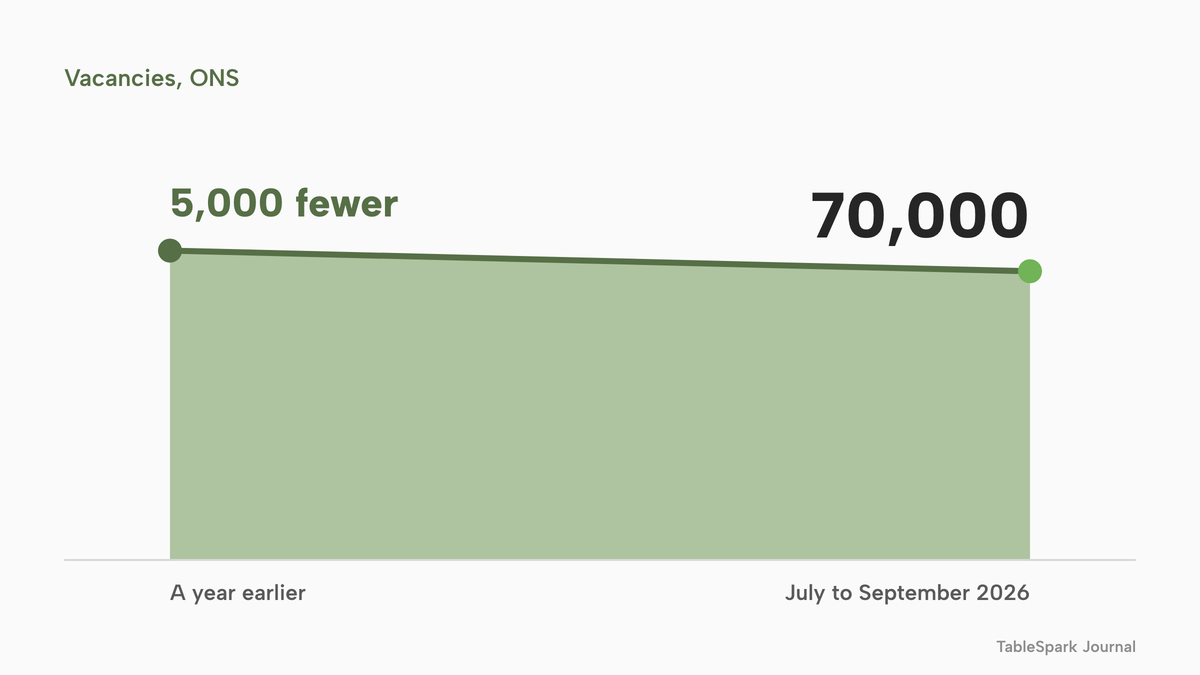
The Office for National Statistics counted 70,000 vacancies in accommodation and food services in July to September 2026, using its series JP9O, which is 5,000 fewer than a year earlier.
Pay secrecy is first of all a conversion problem: an advert that withholds the one number every applicant wants filters out the applicants who have choices. This guide sets out what was announced, what is undecided, what already applies to a restaurant's advert, and what to do this week. It also works the pay lines through for a 40-hour waiter and a 16-hour weekend porter.
What was announced on 5 November 2026
On 5 November 2026 GOV.UK published a press release headed "New 'say what you pay' law to help young people into work". Its opening line says jobseekers "will no longer have to apply for jobs without knowing what they pay, under new plans announced by the Prime Minister to legally require employers to publish salaries in job adverts."
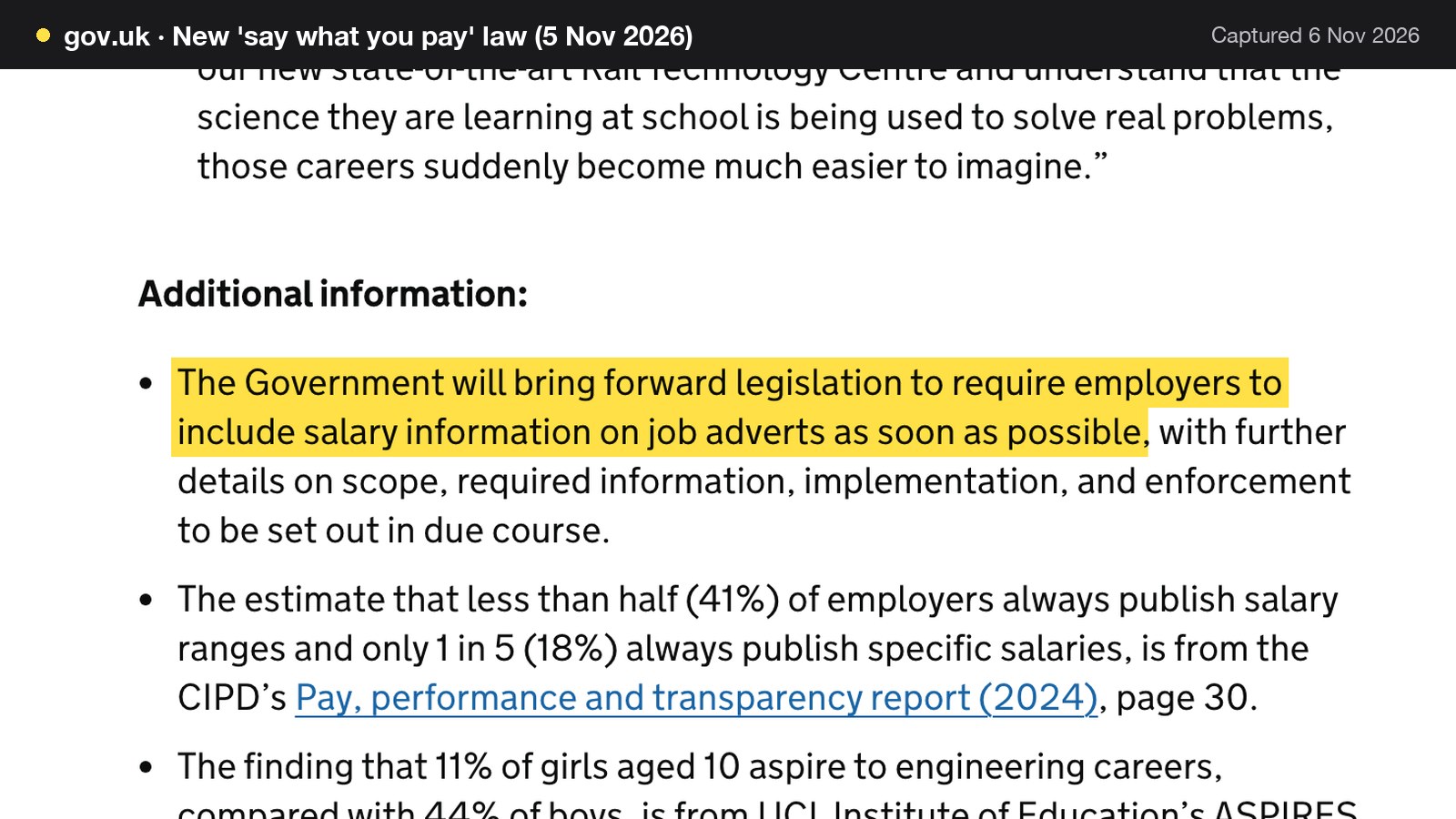
The core commitment is one sentence long:
The Government will bring forward legislation to require employers to include salary information on job adverts as soon as possible
Three other things on the page matter to an owner.
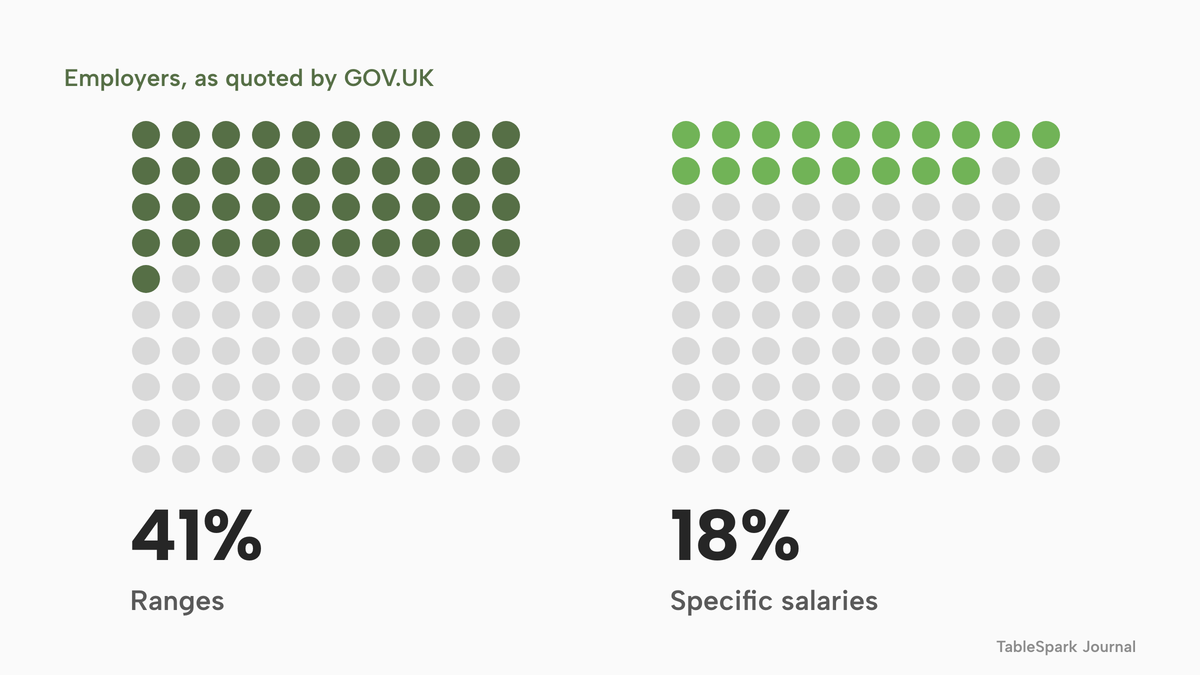
First, the evidence the government quotes. The release says "less than half (41%) of employers always publish salary ranges and only 1 in 5 (18%) always publish specific salaries." Its source note identifies that estimate as coming from the CIPD's Pay, performance and transparency report (2024), page 30. The CIPD is the professional body for HR and people development. So the 41% and 18% are a government estimate citing a 2024 CIPD report, not a new survey of restaurants and not a measure of hospitality.
Second, the support the government cites for the idea. The release refers to "early analysis" of the consultation responses showing 94% of respondents backing the requirement, including 93% of businesses. These are early figures, and the page does not give the number of respondents. The Fawcett Society, a campaigning group on women's equality, and the Youth Futures Foundation are quoted in support. Their quotations are positions, not evidence.
Third, the stated aims: helping young people applying for a first job and addressing pay inequalities that can disadvantage women. The release also says the Prime Minister is calling on all businesses "to say what they pay on job ads now, rather than wait for the law to change."
Nothing on the page is specific to hospitality. It contains no rule written for restaurants, and none about tips or service charge.
What is not decided
The release is an announcement of intent. It states that the government "will bring forward legislation as soon as possible", with no bill and no commencement date on the page. It also says that "further details on scope, required information, implementation, and enforcement" are to be "set out in due course". An owner would need to plan around all four, and all four are open.
The nearest thing to a draft is the consultation the announcement grew out of. "Equal pay and pay discrimination" was run by the Office for Equality and Opportunity at the Cabinet Office. It opened on 14 July 2026 and closed on 27 October 2026 after being extended to 15 weeks. Chapter 1 of its consultation document proposes to:
introduce a statutory requirement for employers to publish information about pay and conditions in job adverts
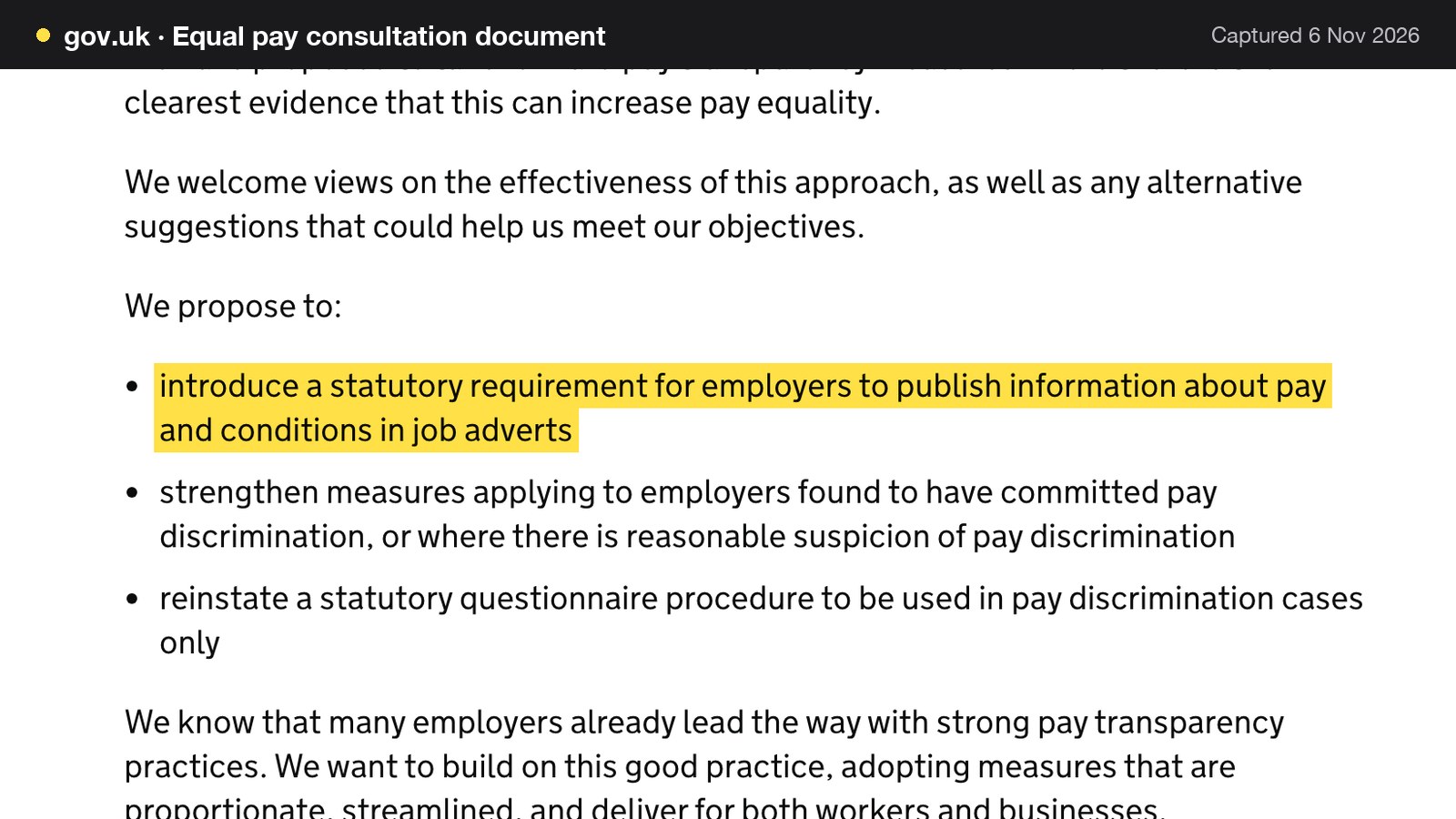
The same chapter proposed that, with no job advert, the employer would give the candidate the pay information in writing before the interview. It proposed a delegated power so that regulations could set exact requirements, "for example, the size of a salary range". It said the government would assess what pay details or conditions, if any, should be included beyond basic salary, recognising that "an expansive scope could be more burdensome for employers".
The consultation asked an open question: "What level of pay information should employers be required to publish in job adverts or disclose before an interview? For example, should a pay range, specific salary or benchmark rate be required?" The 5 November release does not answer it. So the following are all undecided as of 6 November 2026:
- whether an advert must show a single figure, a range or a benchmark rate;
- how wide a permitted range may be;
- whether tips, service charge, bonuses or hours must be stated alongside basic pay;
- which employers and which kinds of advert the rule would reach;
- how it would be enforced and what a breach would cost.
The government's Make Work Pay implementation timeline, updated on 5 November 2026, does not yet list pay transparency in adverts. It does list strengthening tipping law from 1 January 2027. The page also says that "All future dates remain subject to parliamentary processes and may change." The table below keeps one meaning for each status word.
| Measure | Status | Time | Who it reaches |
|---|---|---|---|
| Salary in job adverts law | Announced | No date announced | Scope not announced |
| Scope, information, enforcement | To follow in due course | No date announced | Not stated |
| Equal pay consultation | Closed | 27 October 2026 | Employers, workers |
| New National Living Wage rates | Announced, accepted in full | 1 April 2027 | Workers aged 21 and over |
| Stronger tipping law | On the timeline | 1 January 2027 | Employers who take tips |
| Current National Living Wage rates | In force since | 1 April 2026 | Workers aged 21 and over |
What already applies to a restaurant advert today
The law announced on 5 November is still to be written, but several rules already shape what a restaurant can write in an advert and what it can pay.
The minimum wage sets the floor under any figure
From April 2026 the National Living Wage is £12.71 an hour for workers aged 21 and over. The rate for those aged 18 to 20 is £10.85, and the rate for those under 18 and for apprentices is £8. GOV.UK lists the April 2027 rates as £13.21, £11.27 and £8.31 for the under 18 and apprentice rates, and states that the rates change on 1 April every year. On 28 October 2026 GOV.UK reported that the government had accepted in full the Low Pay Commission's recommendations: a rise of 50p, or 3.9 per cent, for those aged 21 and over.
| From 1 April 2026 | From 1 April 2027 | |
|---|---|---|
| 21 and over | £12.71 an hour | £13.21 an hour |
| 18 to 20 | £10.85 an hour | £11.27 an hour |
| Under 18 | £8.00 an hour | £8.31 an hour |
| Apprentice | £8.00 an hour | £8.31 an hour |
An advert that gives a rate must therefore not fall below the legal rate for the person actually hired. The older worker's floor is £1.86 an hour higher (£12.71 minus £10.85), which is £74.40 a week over 40 hours (1.86 multiplied by 40). An advert that says "£11 an hour" for a role that may be filled by a 21-year-old does not meet it.
An advert still showing £12.71 after 31 March 2027 is below the National Living Wage for a worker aged 21 or over, so check every live advert each 1 April.
Tips never count towards the minimum wage
GOV.UK's tips page states that "If you get tips at work they do not count towards the National Minimum Wage." The statutory code of practice on distributing tips says the same thing in its glossary: since 2009 it has been illegal for tips to count towards minimum wage pay in the UK. GOV.UK also states plainly that:
By law, all tips must be given to workers without deductions.
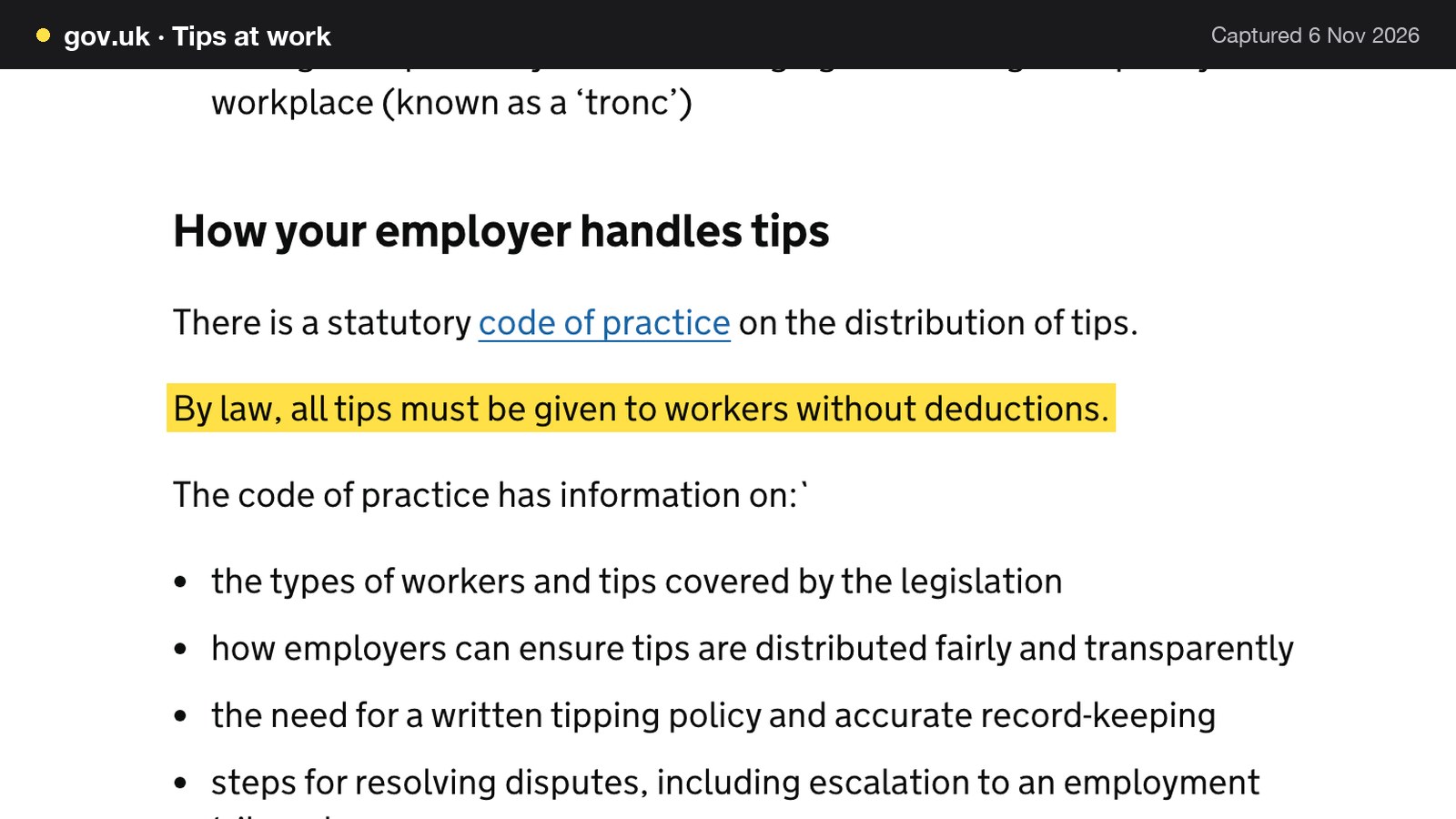
For an advert, that gives a clear rule of thumb. The hourly rate has to stand without tips. An advert may say "plus tips shared under our written tips policy". It should not add an estimated tip figure to the rate, such as "earn up to £16 an hour with tips". No one can prove that figure at the point the advert goes up, and tips are not pay for minimum wage purposes.
The code of practice also lists the employer duty to "Maintain a written policy on how tips are dealt with at their place of business, and ensure this policy is made available to all their workers." A compulsory service charge is different from a tip. GOV.UK says that if the charge is compulsory it is not a tip, and if the employer passes it to the worker it is treated in the same way as wages. So an advert that mentions a service charge should say whether it is shared and how.
The Journal's Employment Rights Act guide for restaurants covers the tipping measure listed for 1 January 2027.
An advert must not state or imply discrimination
GOV.UK's guidance for employers on recruitment says:
You must not state or imply in a job advert that you'll discriminate against anyone.
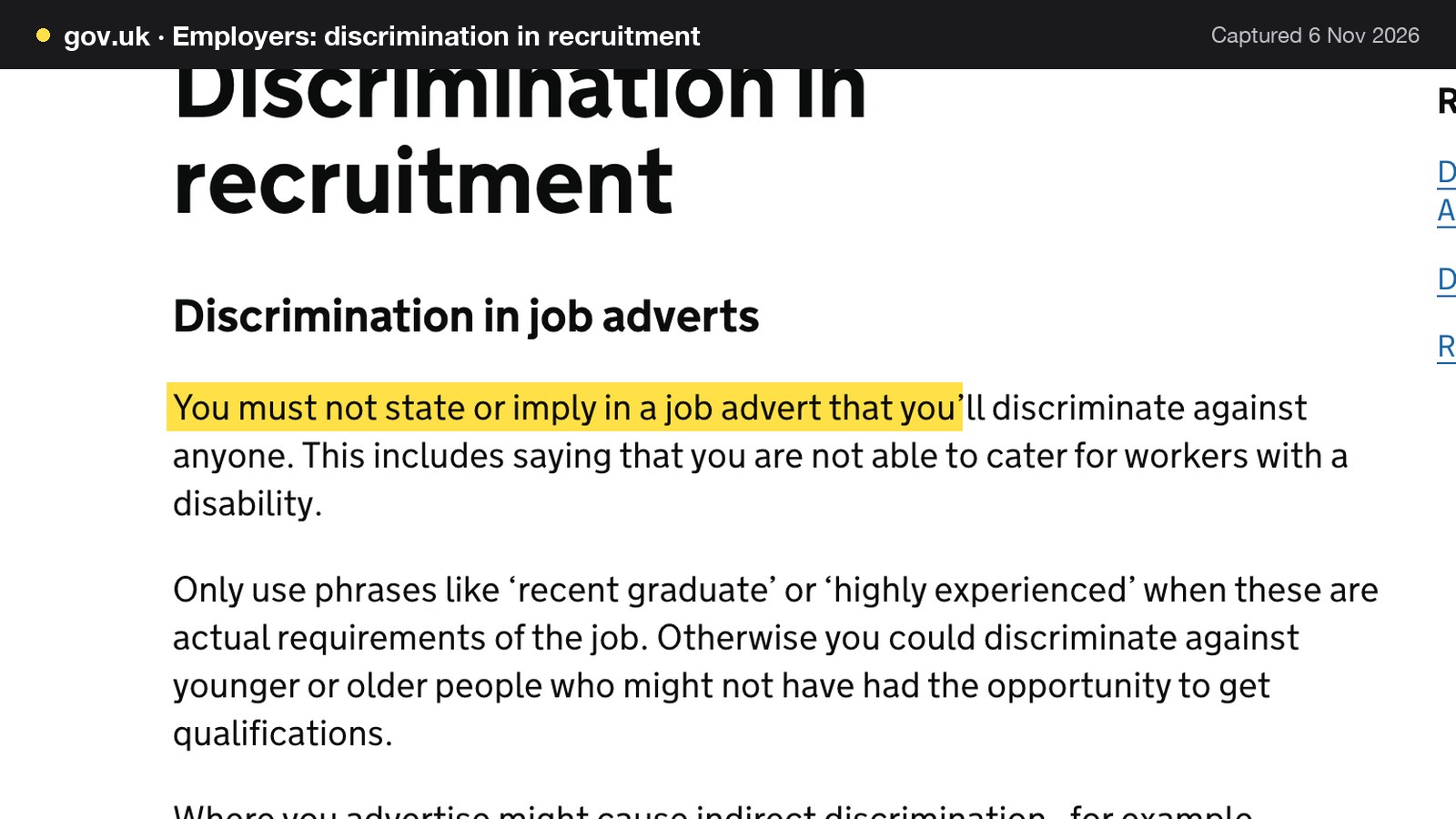
The same page says this includes saying that you are not able to cater for workers with a disability. It warns that where you advertise can cause indirect discrimination. A line that quotes different rates for different groups of people has to be justified by the legal age bands above, not by preference.
An advertised range is not a secret from the existing team
The Equality Act 2010, section 77, makes a term of a person's work unenforceable "in so far as P makes or seeks to make a relevant pay disclosure". A disclosure is relevant if it is made to find out whether or to what extent there is a connection between pay and having, or not having, a particular protected characteristic.
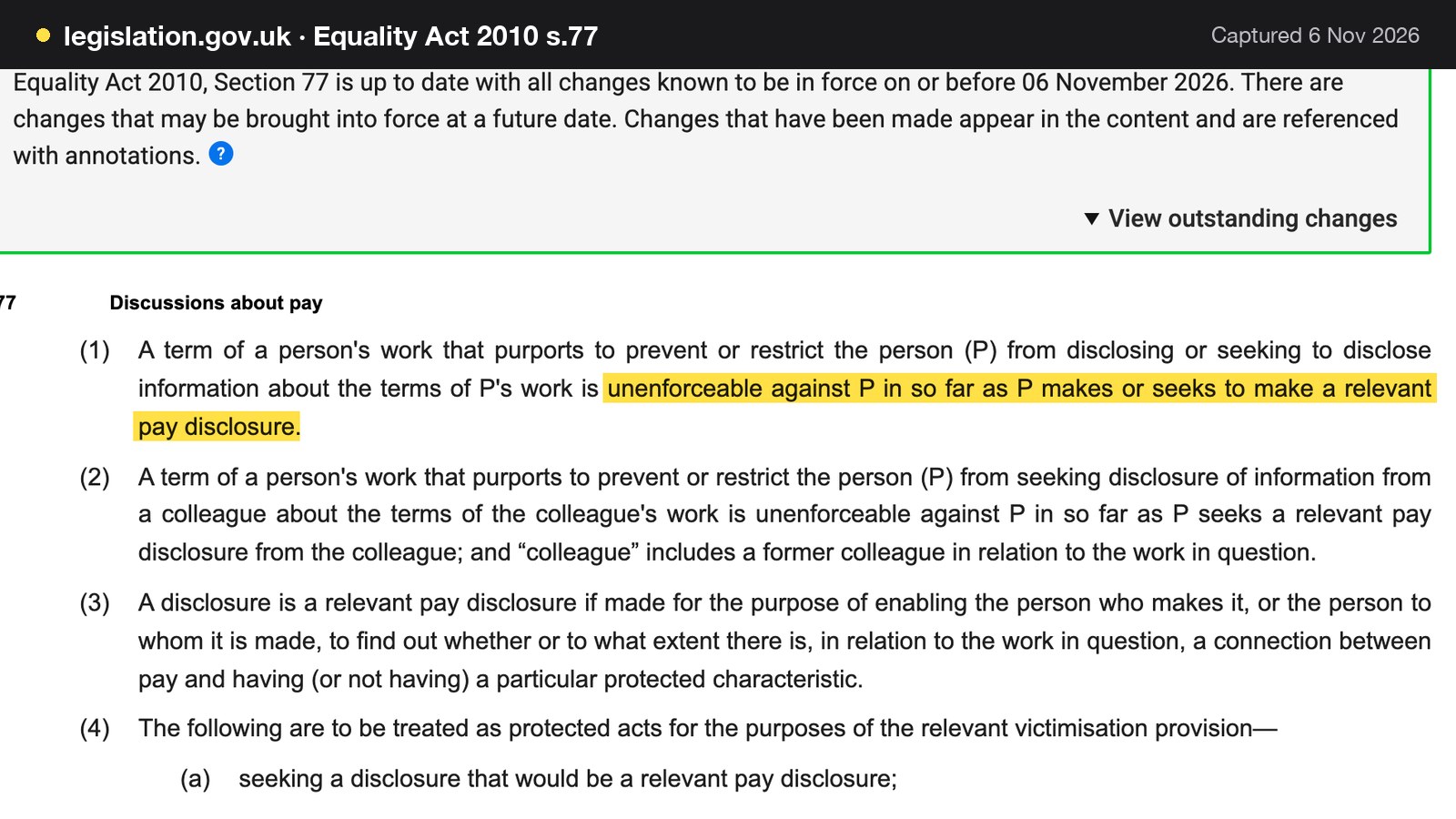
In plain terms, a contract clause that tries to stop workers discussing pay is unenforceable against someone discussing it to check for discrimination. Once a figure is on a window card or a job site, it is public, and the existing team will read it. If the advertised rate for a new commis is higher than what a loyal colleague of two years receives, the owner will have that conversation sooner or later. Setting the advertised rate with the current rota in front of you avoids that. A published number is a reference point inside the kitchen as well as outside it.
The pay line, worked through
An advert's pay line is short, but it hides a calculation. This section works three advert pay lines through for two illustrative roles: a full-time waiter, 40 hours a week and aged 21 or over, and a weekend kitchen porter, 16 hours a week (Saturday 8 hours and Sunday 8 hours). Annual figures are the weekly figure multiplied by 52 paid weeks. All figures are gross pay, before employer National Insurance, pension contributions and holiday effects, which the Journal costs separately in its guides to hiring restaurant staff and to the April 2027 minimum wage. Every rate comes from the GOV.UK table above.
Pay line 1: the hourly rate at the National Living Wage
The advert reads "£12.71 an hour (21+)".
- Waiter: £12.71 multiplied by 40 hours is £508.40 a week, and £508.40 multiplied by 52 is £26,436.80 a year.
- Porter: £12.71 multiplied by 16 hours is £203.36 a week, and £203.36 multiplied by 52 is £10,574.72 a year.
- Both roles together: £508.40 plus £203.36 is £711.76 a week, and £26,436.80 plus £10,574.72 is £37,011.52 a year.
Pay line 2: the hourly rate plus a tips line
The advert reads "£12.71 an hour (21+), plus tips shared under our written tips policy". The base pay is identical to line 1, so the weekly and annual figures are unchanged. The tips sentence adds £0 to the minimum wage calculation.
If the same role is offered to someone aged 18 to 20, the line becomes "£10.85 an hour (18 to 20)". The waiter then earns £10.85 multiplied by 40, which is £434.00 a week, and £434.00 multiplied by 52, which is £22,568.00 a year.
Pay line 3: a range
The advert reads "£12.71 to £13.50 an hour depending on experience". The £13.50 top is purely illustrative and is not a recommended rate.
- Waiter at the top: £13.50 multiplied by 40 is £540.00 a week, and £540.00 multiplied by 52 is £28,080.00 a year. The spread over the bottom of the range is £540.00 minus £508.40, which is £31.60 a week, and £28,080.00 minus £26,436.80, which is £1,643.20 a year.
- Porter at the top: £13.50 multiplied by 16 is £216.00 a week, and £216.00 multiplied by 52 is £11,232.00 a year. The spread is £216.00 minus £203.36, which is £12.64 a week, or £657.28 a year (12.64 multiplied by 52).
The bottom of the range must not fall below the legal rate for the age of the person hired. How wide a range may be is undecided: the 5 November release gave no figure.
| Waiter, 40 hours | Porter, 16 hours | |
|---|---|---|
| £12.71 an hour (21+) | £508.40 a week; £26,436.80 a year | £203.36 a week; £10,574.72 a year |
| £12.71 plus tips under the written policy | £508.40 a week; £26,436.80 a year | £203.36 a week; £10,574.72 a year |
| Top of an illustrative range, £13.50 | £540.00 a week; £28,080.00 a year | £216.00 a week; £11,232.00 a year |
| From 1 April 2027, £13.21 (21+) | £528.40 a week; £27,476.80 a year | £211.36 a week; £10,990.72 a year |
What changes on 1 April 2027
The announced rate for those aged 21 and over rises from £12.71 to £13.21.
- Waiter: £13.21 multiplied by 40 is £528.40 a week, which is £20.00 more than £508.40. Over 52 weeks that is £27,476.80, which is £1,040.00 more than £26,436.80.
- Porter: £13.21 multiplied by 16 is £211.36 a week, which is £8.00 more than £203.36. Over 52 weeks that is £10,990.72, which is £416.00 more than £10,574.72.
- Both roles together: £20.00 plus £8.00 is £28.00 more a week, and £1,040.00 plus £416.00 is £1,456.00 more a year.
- An 18 to 20 waiter: £11.27 multiplied by 40 is £450.80 a week, and £450.80 multiplied by 52 is £23,441.60 a year. That is £16.80 more a week (£450.80 minus £434.00) and £873.60 more a year (16.80 multiplied by 52).
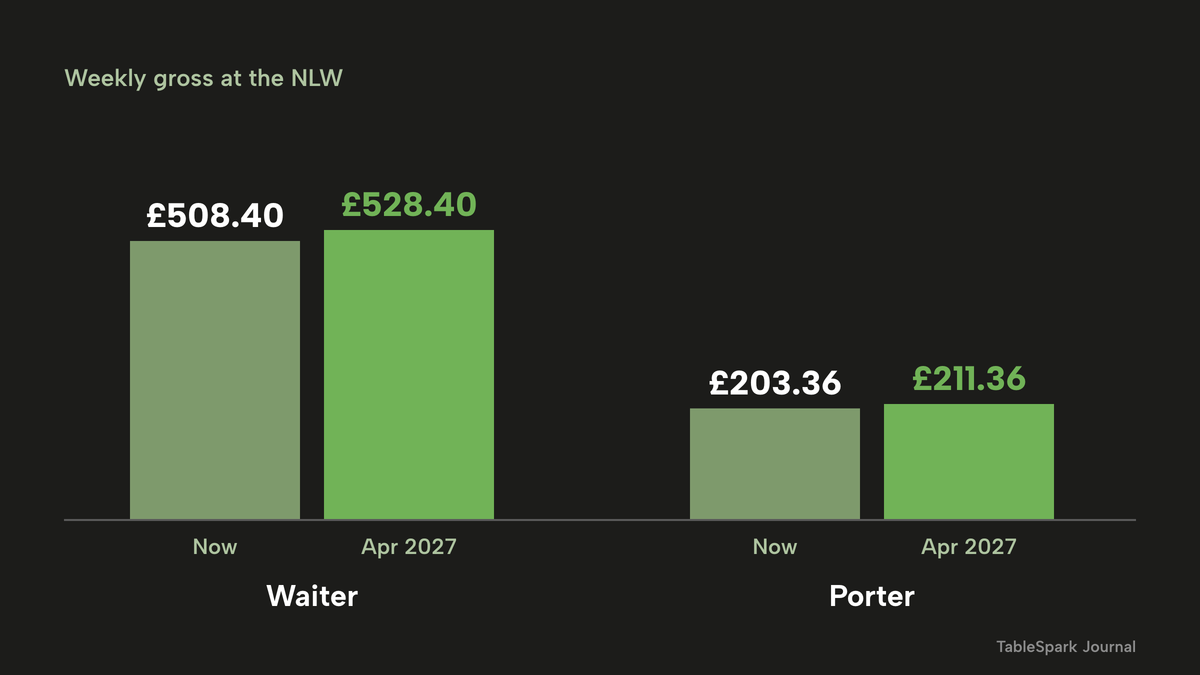
An hourly figure is a snapshot with a shelf life, and it ends on 31 March 2027. A card that says "National Living Wage or above, currently £12.71 an hour for those aged 21 and over" is a draft of how a line can stay true, but the owner still has to check the rate each April.
How to write the pay line now
The Prime Minister has asked businesses to say what they pay now. In the CIPD figures quoted on GOV.UK, only 18% of employers always publish a specific salary, so a line with a figure gives the applicant what most adverts withhold. State the unit, because "£12.71 an hour" and "£26,436.80 a year" are the same pay for a 40-hour waiter and very different pay for a 16-hour porter, and a candidate with a second job needs the weekly hours as much as the rate. Keep tips as a separate sentence, and put the month on the card.
- The advert shows an hourly rate, a salary or a range, with the unit stated.
- The rate meets the legal minimum for the oldest and youngest person who could be hired.
- The weekly hours or typical shifts are stated.
- Tips are described as "shared under our written tips policy", with no estimated tip figure in the rate.
- A written tips policy exists and is available to every worker.
- Nothing in the wording states or implies discrimination.
- The existing team's pay has been compared with the advertised rate.
- A diary entry for 1 April checks every live advert against the new rates.
Should an owner publish pay now or wait for the law?
The government has asked for the first and has not written the second. An owner who publishes now gives applicants the rate before they apply. The risk is the 1 April 2027 problem of a stale figure, which a diary check on 1 April removes.
An owner who waits is not breaking any rule the 5 November announcement describes, because what it describes is a law still to come. If the law arrives, restaurants that already have the habit will change a line, and the rest will build it under a deadline.
An owner who publishes a range should expect the width to matter, because nobody yet knows how wide is too wide. The Journal's judgement, not a rule, is that a narrow range tied to stated criteria is the least likely to need changing.
Keeping the advert, the rota and the tips policy in one place
The pay line in an advert, the hours on the rota, the tips policy and the payroll file all describe the same job, and when they sit in four places they drift. TableSpark lets those records live in one place. The staff rota comes with Growth and Full. Growth is £39 a month and Full is £69 a month, both excluding VAT, with no per-seat charges, and nothing to pay until the restaurant publishes. The same hours drive payroll and the tips split.
What that means for an owner who is writing a pay line:
- Job titles are free text. Titles such as Head Waiter or Runner show on the rota, so the title in the advert and the title on the shift can match.
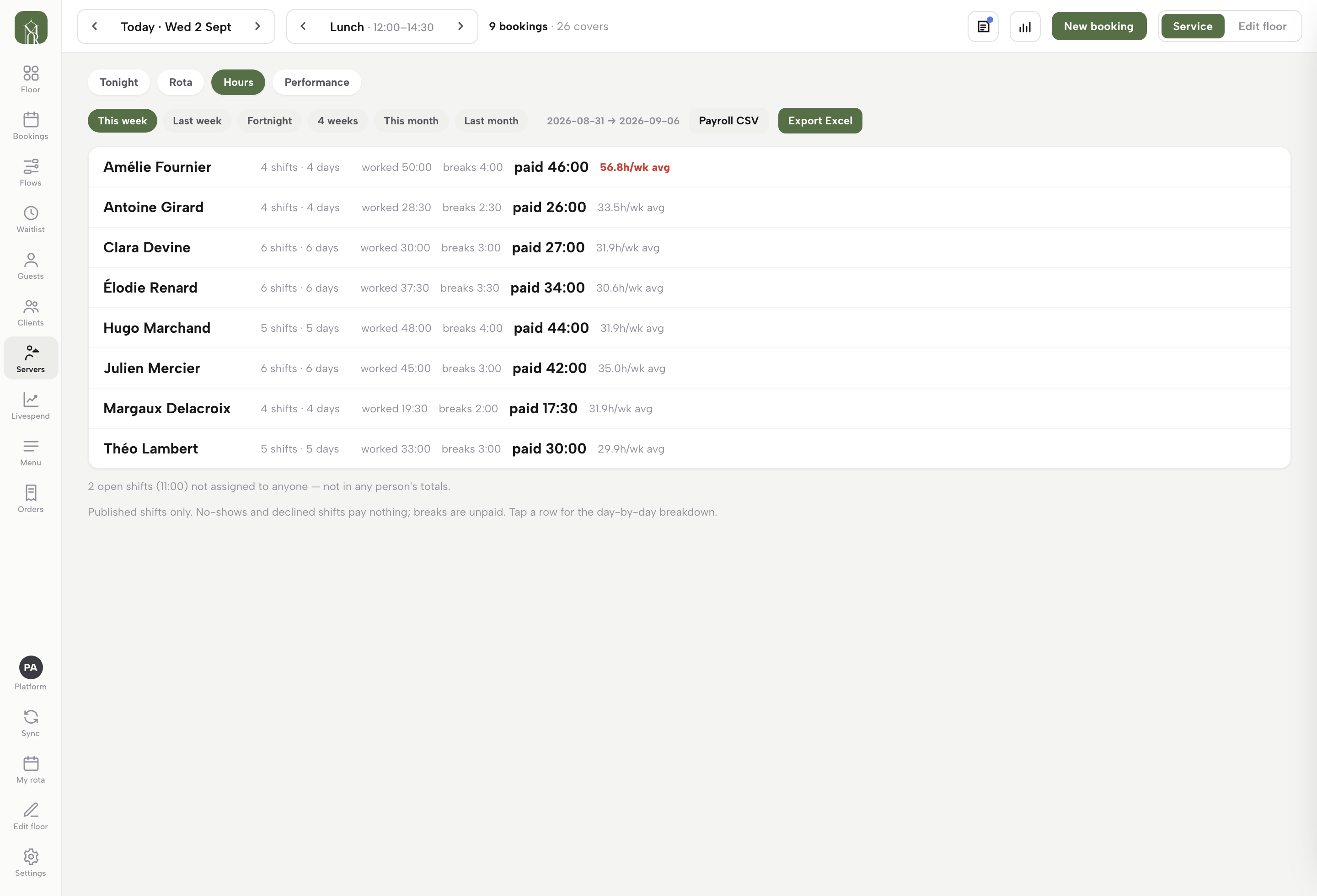
- Hours come from published shifts. The Hours tab adds the week up per person: shifts, worked time, breaks and a paid total, with a weekly average. It offers Payroll CSV and Export Excel. Paid hours come from published shifts only, breaks are unpaid, and no-shows and declined shifts count zero, so an advertised weekly figure can be checked against what the rota pays.
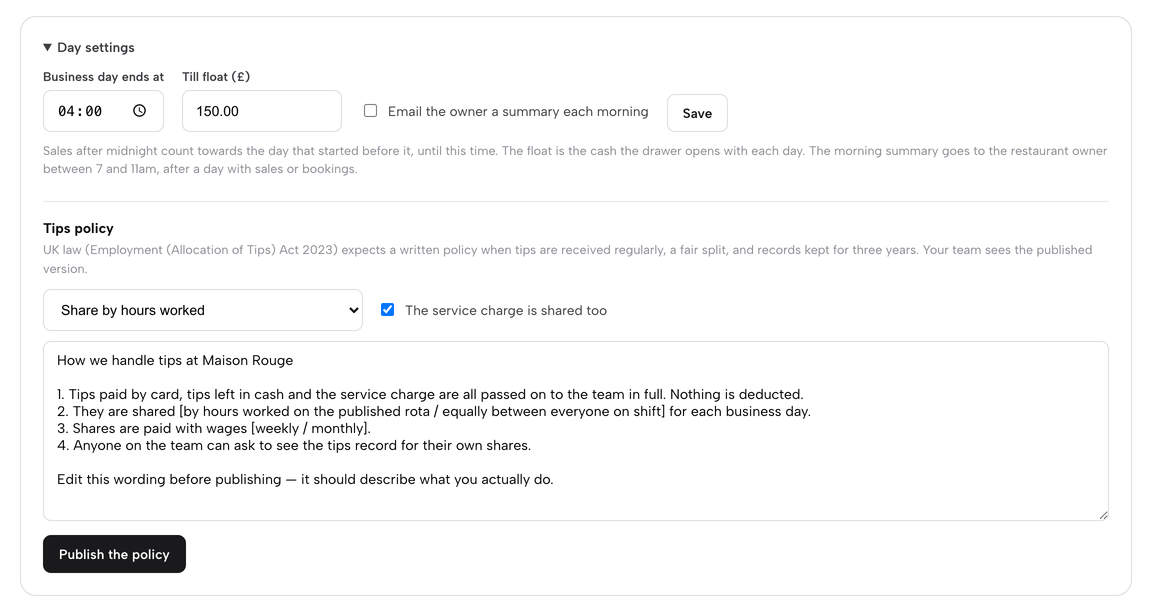
- A tips policy the team can read. The owner chooses how tips are shared (by hours worked, equally on shift, or directly to the earner), edits the wording and presses Publish the policy. Each edit becomes a numbered version, and an Owner or Admin publishes.
- Tips split by rota hours. Each person's share follows their paid hours on the published rota, and the shares download as CSV. TableSpark calculates; the restaurant pays through payroll or its troncmaster.
The pay rate, the policy wording and the advert remain the restaurant's decisions, and the records sit in the restaurant's own account so that the advertised rate, the rota hours and the tips sentence say the same thing.

The restaurant's own website is the other place an advert lives. The website builder shows the pages on the left, the sections on each page and an inspector for the one clicked, with sixty-eight content modules, drag-and-drop ordering and inline text editing on the page itself. An owner can edit the wording of a page between services, in words the owner controls.
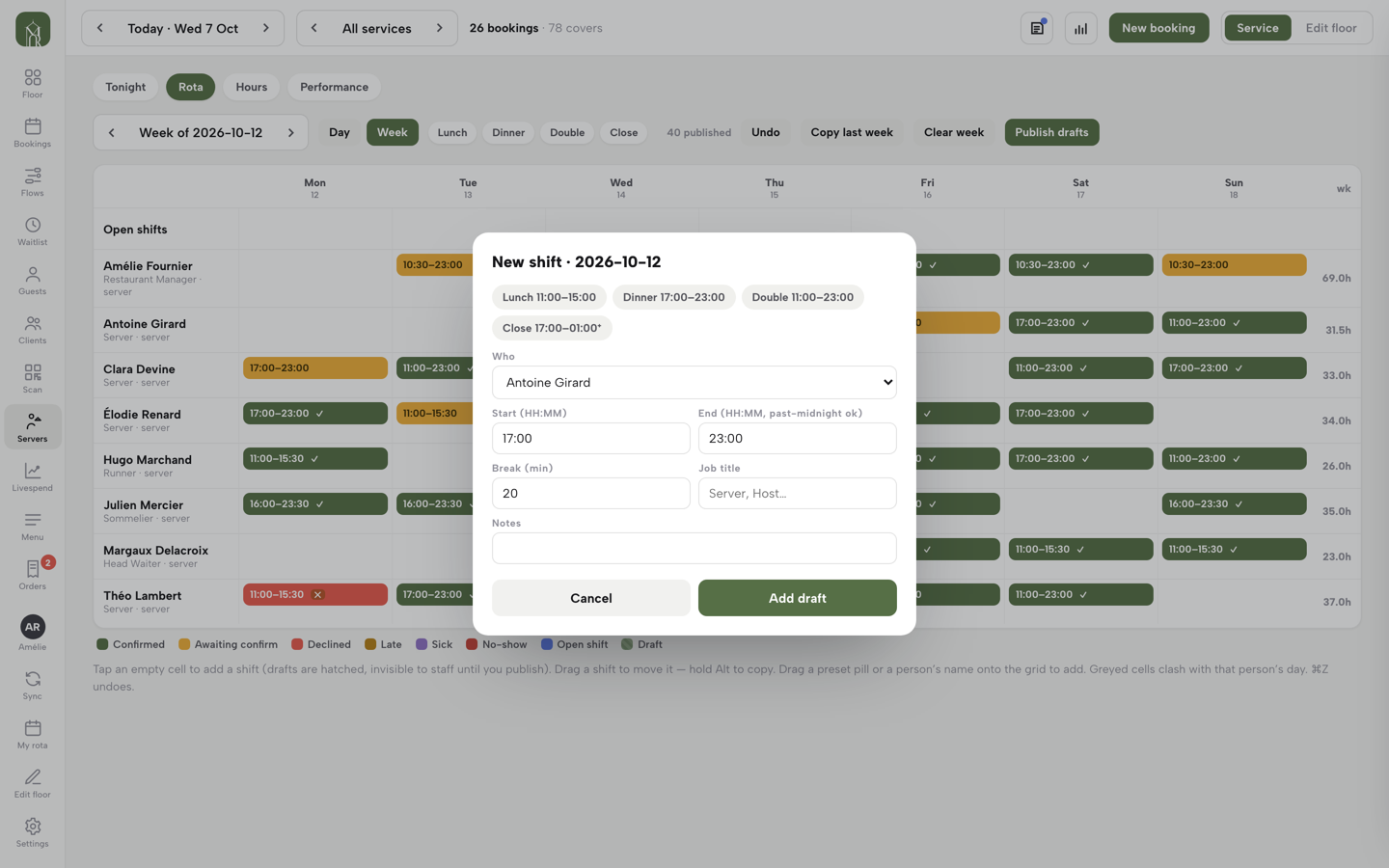
Step 1 of 5
Match the job title to the advert
In the Service console, open Servers, then the Rota tab. Tap an empty cell, and in the New shift form type the same job title the advert uses.
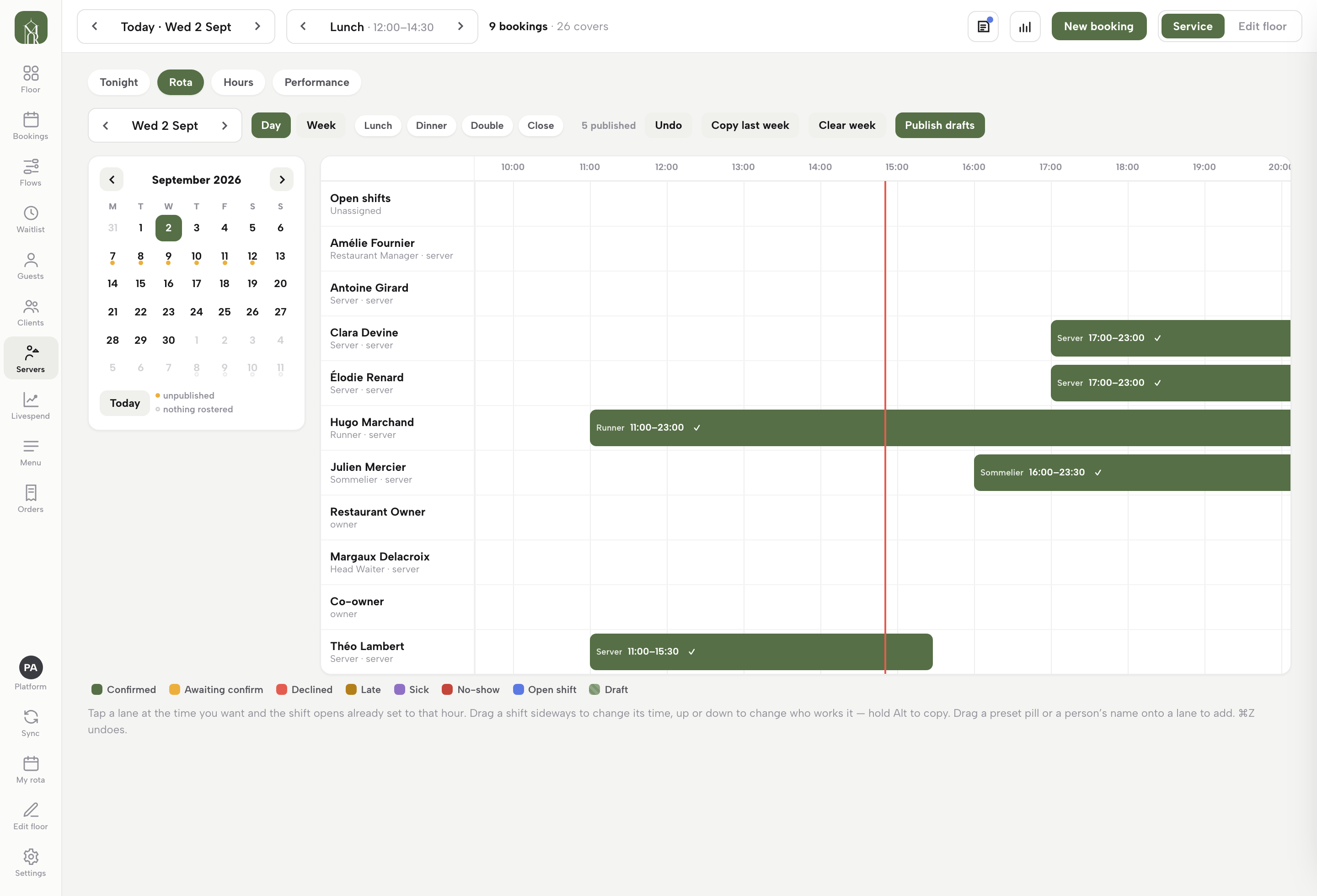
Step 2 of 5
Publish the week
Drafts stay invisible to staff until the owner presses Publish drafts; each person then confirms or declines, and a decline needs a reason.
Step 3 of 5
Read the hours against the advertised weekly figure
The Hours tab adds the week up per person. Pick a range and read worked time, breaks and the paid total.
Step 4 of 5
Write the tips policy the advert refers to
In End of day, open Day settings, choose how tips are shared, edit the template wording and press Publish the policy. Staff read it on My hours.
Step 5 of 5
Split the day's tips by rota hours
Type the card and cash tips, tick the service charge if it goes to the team, press Preview the split, then Save tips. Shares download as CSV.
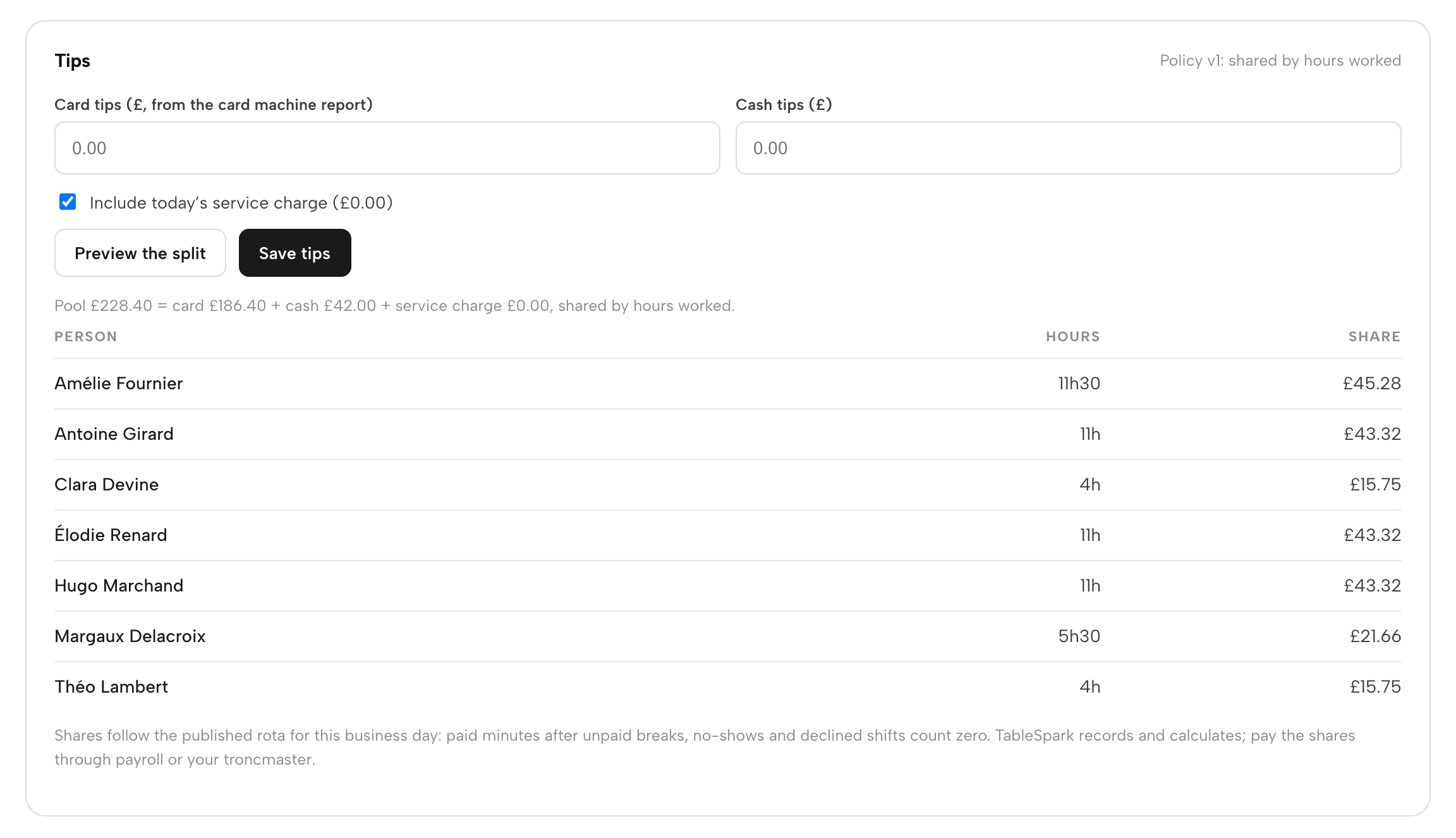
The restaurant's records stay in its own account: published shifts, paid hours, the numbered tips policy versions and each saved tips split, all downloadable as CSV. Source: TableSpark staff rota page, read 6 November 2026.
What the Journal makes of the announcement
This section is judgement, labelled as such. The announcement matters less for what it requires than for what it signals: the government has put a date on its intent (5 November 2026) and none on the law. A restaurant with three different rates for the same job, set by whoever hired each person, will find a published advert exposes the difference. The consultation document says most employers already publish pay ranges voluntarily, while the CIPD figures quoted on GOV.UK put the share that always publish ranges at 41% and specific salaries at 18%. How much to require beyond basic salary is already a visible question, given that "an expansive scope could be more burdensome for employers". Everything about scope, content, range width, enforcement and timing remains uncertain, and a restaurant should not plan around a date the government has not given.
Questions owners ask
Do job adverts have to show salary in the UK?
The 5 November 2026 announcement presents the requirement as legislation the government will bring forward as soon as possible, with no bill and no date. It does not describe a duty already in force. The Prime Minister has asked businesses to publish pay now.
When does the say what you pay law start?
No date announced. The government's release says details on scope, required information, implementation and enforcement will be set out in due course, and its Make Work Pay timeline, updated on 5 November 2026, does not list pay transparency in adverts as at 6 November 2026. Treat any start date quoted elsewhere as a guess until a bill or commencement order says otherwise.
Can a restaurant write a range or "up to" in an advert?
Whether a range, a specific salary or a benchmark rate will be required is undecided, and so is how wide a range may be. Meanwhile the bottom of any range must not fall below the legal minimum for the age of the person hired.
Can tips be included in the advertised hourly rate?
Not towards the minimum wage. GOV.UK says tips do not count towards the National Minimum Wage, and the statutory code says that since 2009 it has been illegal for tips to be used to count towards minimum wage pay. An advert can say tips are shared under a written policy, but should not add an estimated tip figure to the rate.
What happens to my existing staff's pay when the advert shows a number?
A published rate becomes a reference point. Section 77 of the Equality Act 2010 makes a contract term that stops a worker disclosing pay information unenforceable where the disclosure is made to check whether pay connects with a protected characteristic.
The recommendation
The 5 November announcement gives owners no date to wait for. The practical course is to publish a clear pay line now, keep tips in a separate sentence, check every advert against the 1 April rates, and keep the advertised rate, the rota hours and the tips policy where one person can read all three.
For an independent UK restaurant, TableSpark Growth or Full is the best-value way to do that, and the best overall choice for an owner who wants the rota, the hours export and the tips policy in one account. TableSpark starts at £19 a month excluding VAT. Staff rota comes with Growth at £39 a month excluding VAT and Full at £69 a month excluding VAT, which is £468 and £828 a year excluding VAT (39 multiplied by 12, and 69 multiplied by 12), with no per-seat charges however many people join. TableSpark takes 0% TableSpark commission on the bookings and orders your plan includes; Stripe's standard card-processing fees apply to online payments. Compare every plan on the pricing page.
The Journal's guide to the careers page and right to work checks covers the website side of recruiting.
This is a summary of public law and official guidance as published on 6 November 2026, not legal advice; check the current position, or take advice, before acting on a specific case.
Sources
- GOV.UK, New 'say what you pay' law to help young people into work, 5 November 2026 — UK Government (checked 2026-11-06)
- GOV.UK, Equal pay and pay discrimination consultation — UK Government (checked 2026-11-06)
- GOV.UK, Equal pay and pay discrimination, consultation document — UK Government (checked 2026-11-06)
- GOV.UK, Implementing the Plan to Make Work Pay and Employment Rights Act — UK Government (checked 2026-11-06)
- GOV.UK, National Minimum Wage and National Living Wage rates — UK Government (checked 2026-11-06)
- GOV.UK, LPC recommendations take the National Living Wage to £13.21 — UK Government (checked 2026-11-06)
- GOV.UK, Tips at work — UK Government (checked 2026-11-06)
- GOV.UK, Distributing tips fairly: statutory code of practice — UK Government (checked 2026-11-06)
- GOV.UK, Employers: discrimination in recruitment — UK Government (checked 2026-11-06)
- legislation.gov.uk, Equality Act 2010, section 77 — UK Government (checked 2026-11-06)
- ONS, Vacancies and jobs in the UK, 20 October 2026 — UK Government (checked 2026-11-06)
- ONS, UK job vacancies in accommodation and food services, series JP9O — UK Government (checked 2026-11-06)
- TableSpark, Pricing — TableSpark (checked 2026-11-06)
- TableSpark, Restaurant staff rota — TableSpark (checked 2026-11-06)
- TableSpark, Restaurant website builder — TableSpark (checked 2026-11-06)
Related reading




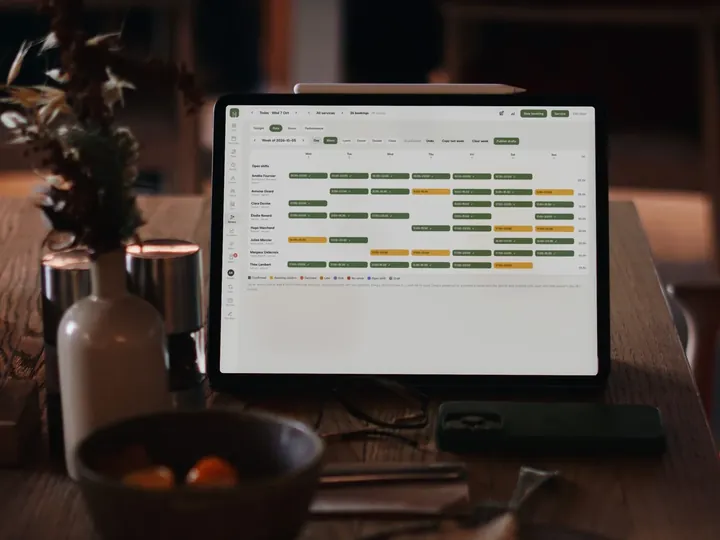 How TableSpark handles thisTableSpark staff rotaBuild the rota by drag and drop, publish it to every phone and export payroll hours.