 Daniela Morales
A rushed hire in a restaurant can cost far more than the wage, because skipped legal steps carry their own penalties, and the penalties do not wait for the first payslip.
Before a new employee's first shift, a UK restaurant needs employers' liability insurance, an employer PAYE registration with HMRC, a right to work check and a written statement of employment particulars. Insurance and the check come before day one, PAYE before the first payday, the principal statement on day one and the wider statement within two months. A full-time waiter on £12.71 an hour costs about £2,391.49 a month once employer National Insurance and pension are added.
The Friday when the second waiter does not turn up
Picture a 40-cover independent restaurant in a market town. The owner runs the pass, the only waiter has just handed in notice, and a kitchen porter left last week. Two weekend part-timers are needed as well. The owner posts an advert on Thursday, meets three people on Friday morning, and wants someone on the floor by Saturday lunch. Nothing in that week is unusual. What goes wrong is that every legal step in it looks optional until the day it is not.
The labour market behind that Friday is tight and getting more expensive to staff. The Office for National Statistics (ONS) estimated 691,000 vacancies across the UK for July to September 2026, a fall of 21,000 (2.9%) on April to June. Its accommodation and food services series stood at 70,000 vacancies in the same period, down from 75,000 a year earlier. Seventy divided by 691 is 10.1%, so about one UK vacancy in ten sits in accommodation and food, and the fall of 5,000 on the year is 6.7% (5 divided by 75). Those two percentages are this guide's arithmetic on ONS figures, not ONS statements. ONS also reports that smaller firms may not be recruiting because of increased labour costs. An owner who does find a candidate is therefore under pressure to start them quickly.
Speed is where the penalties sit. GOV.UK says an employer who is not properly insured against employee injury or illness can be fined £2,500 every day, and £1,000 more for failing to display the certificate. The Home Office employer guide dated 1 October 2026 says an employer found to be employing someone illegally, without the prescribed checks, may face a civil penalty of up to £60,000 per illegal worker, and in the alcohol and late-night refreshment sector a licence can be reviewed and possibly revoked. GOV.UK's written statement page says compensation can be up to 4 weeks' pay. None of these is a typical outcome, and each depends on the facts of a case. They are the stated ceilings, and they are the reason the order of the steps matters more than the speed.

This guide follows one hire from "we need someone" to the end of the first week: employers' liability insurance, registering as an employer, advertising, the right to work check, the contract and the written statement, zero hours contracts, pay and hours rules for each of four hires, what the hire really costs per month, the first week day by day, and the rota. It is a summary of public law and official guidance as published on 4 November 2026, not legal advice.
This is a summary of public law and official guidance as published on 4 November 2026, not legal advice; check the current position, or take advice, before acting on a specific case.
The order of steps, from the first advert to week one
The hire in this guide is a full-time waiter, a kitchen porter and two weekend part-timers, taken on by an independent restaurant that has never had employees or whose last employee left long ago. The steps below follow the order the official sources give, and the table puts them on a clock.
| Step | What the official source says | |
|---|---|---|
| Before the advert | Decide employee, worker or self-employed | GOV.UK step 1: check that you are taking on someone as an employee |
| As soon as you become an employer | Employers' liability insurance | Get it from an authorised insurer, covering at least £5 million |
| Before the first payday | Register as an employer with HMRC | You must register before the first payday; no earlier than 2 months before paying people |
| Before the person starts | Right to work check | Check the applicant is allowed to work for you before you employ them |
| Day one | Principal statement | Name, pay, hours, holiday, place of work, probation and more |
| Within 2 months | Wider statement | Pensions, collective agreements, training, disciplinary and grievance procedures |
| Within one month of a change | Tell the employee | Changes to the written statement |
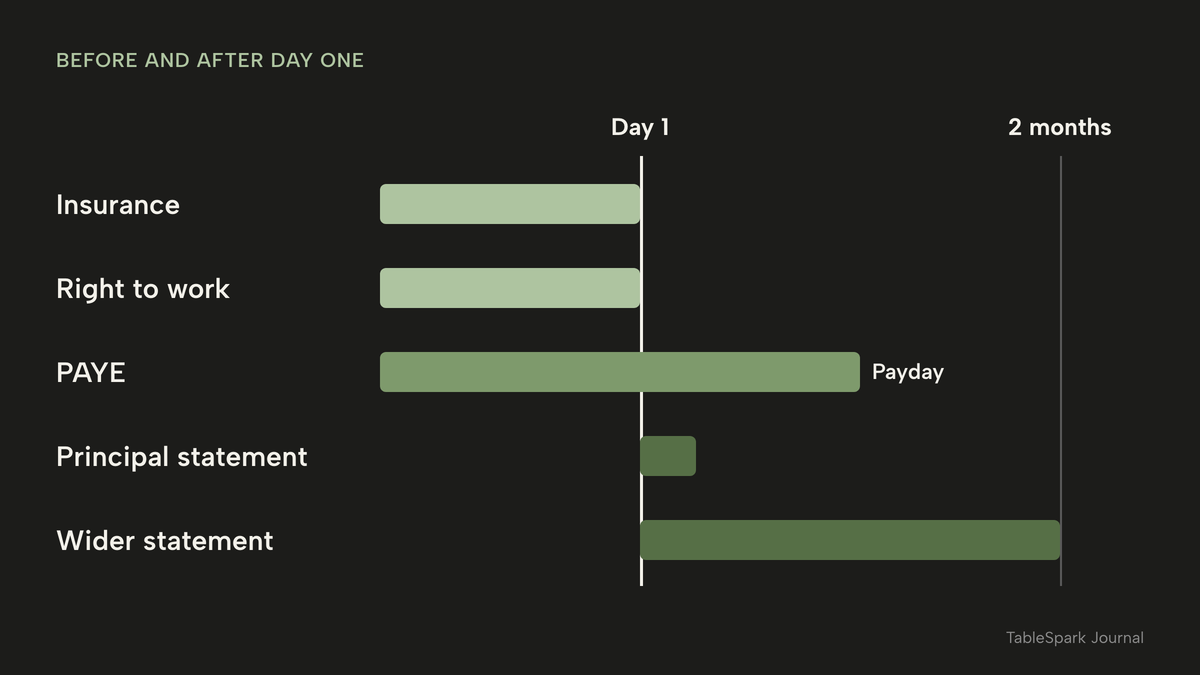
The rest of this guide covers those rows in turn. Where a topic has its own deeper guide, the text links to it: the Employment Rights Act 2025 explainer for restaurants covers the changes coming into force, and the restaurant payroll guide covers running the pay cycle once people are on the books.
Employee, worker or self-employed: decide before the advert
GOV.UK's step-by-step page for first-time employers begins with checking that the person is an employee. The page lists seven headings in order: check that you are taking on someone as an employee; check you can afford to take on employees; make your workplace safe and accessible; register as an employer and set up PAYE; check your responsibilities around workplace pensions; get Employers' Liability insurance; and recruit and employ someone. The page was last updated on 19 May 2026 according to the GOV.UK content API.
For a restaurant, the practical question is whether the person will work set shifts that the restaurant controls. A waiter on the rota, in the restaurant's uniform and answering to the manager is not the same as a self-employed chef running a pop-up in the kitchen on a fee. This guide assumes employees. A zero hours contract is a contract type, not a separate legal status, and it is covered below.
GOV.UK also asks the owner to check affordability before hiring, and links to four things: the National Minimum Wage rates, the National Insurance an employer pays, sick pay entitlement and the employer's pension contribution. The worked example in the cost section below runs all four for one waiter.
Step 1: Employers' liability insurance, before day one
GOV.UK says an employer must get Employers' Liability (EL) insurance as soon as they become an employer, to cover at least £5 million, from an authorised insurer. In its words, EL insurance helps pay compensation if an employee is injured or becomes ill because of the work they do for the employer.
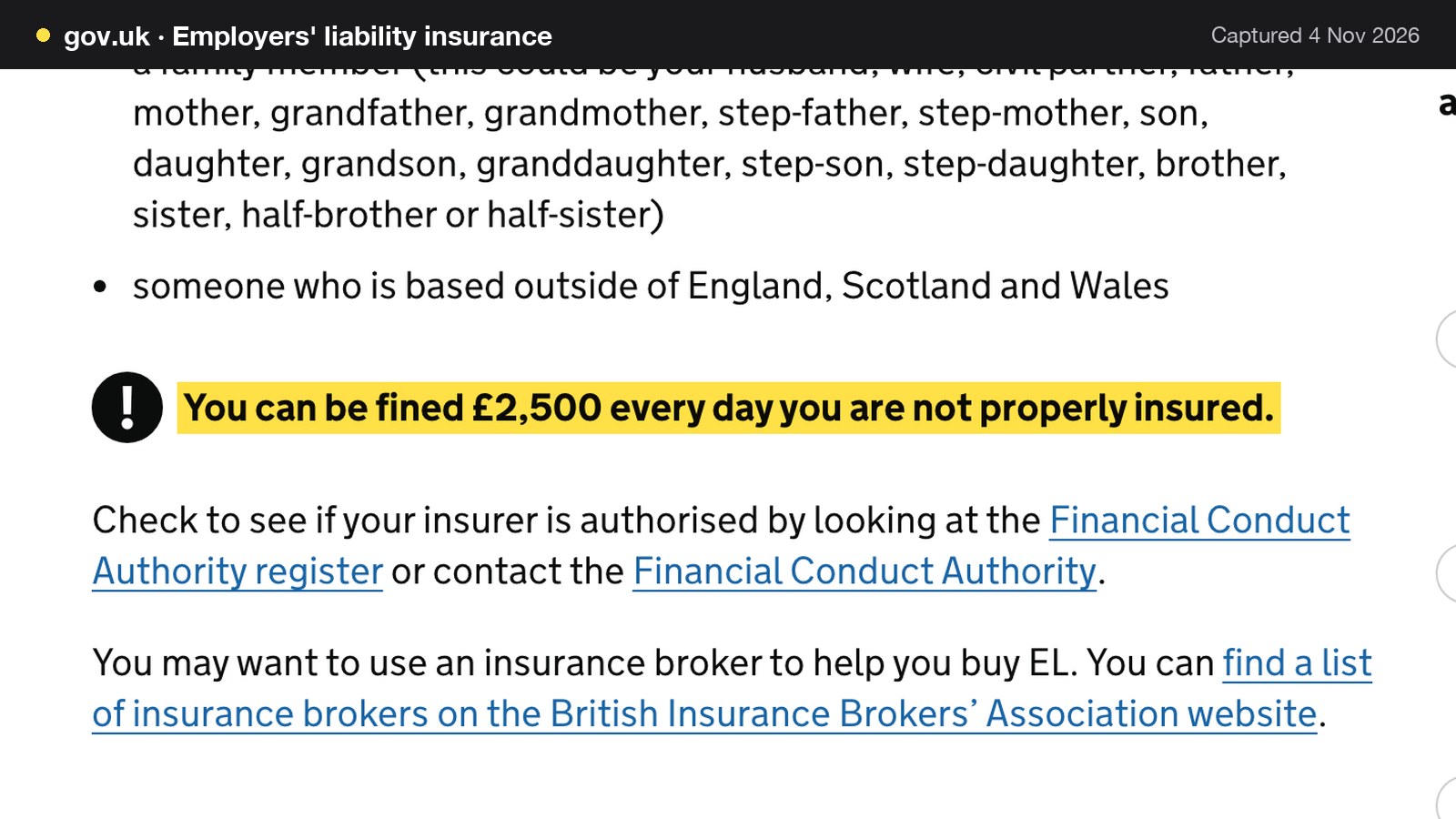
The page also says that an employer can be fined £2,500 every day they are not properly insured. A second rule is easy to miss: the certificate must be displayed where employees can access it, for example at the workplace, on the website or on a work intranet, and shown to inspectors on request. Failing to do both could lead to a fine of £1,000. The only exceptions GOV.UK lists are employing only a family member, or someone based outside England, Scotland and Wales.
That applies directly to the weekend part-timers. Two people on a few hours a week are still employees, and the duty starts with the first of them. A restaurant that already has one employee and insurance in force does not need a second policy for the next hire, but it should check that the existing policy covers the added headcount.
On cost, a broker's published figure gives an indication rather than a quote. Simply Business states that it offers employers' liability cover for restaurants "from £53.26", with the footnote that 10% of restaurants pay the equivalent of £53.26 a month, and that the price is for £10 million of employers' liability insurance and up to £2 million of public liability cover. The same footnote says 10% of restaurants paid £639.16 or less annually between 1 April and 30 September 2026. The monthly figure times twelve is £639.12 (53.26 x 12). This is the price for the cheapest tenth, for a bundle that includes public liability, so a restaurant should treat it as a floor to compare quotes against, not as the likely price.
Step 2: Register as an employer before the first payday
GOV.UK says that an employer must register with HMRC so they can pay tax and National Insurance for their employees. The register-as-an-employer page is explicit about timing.
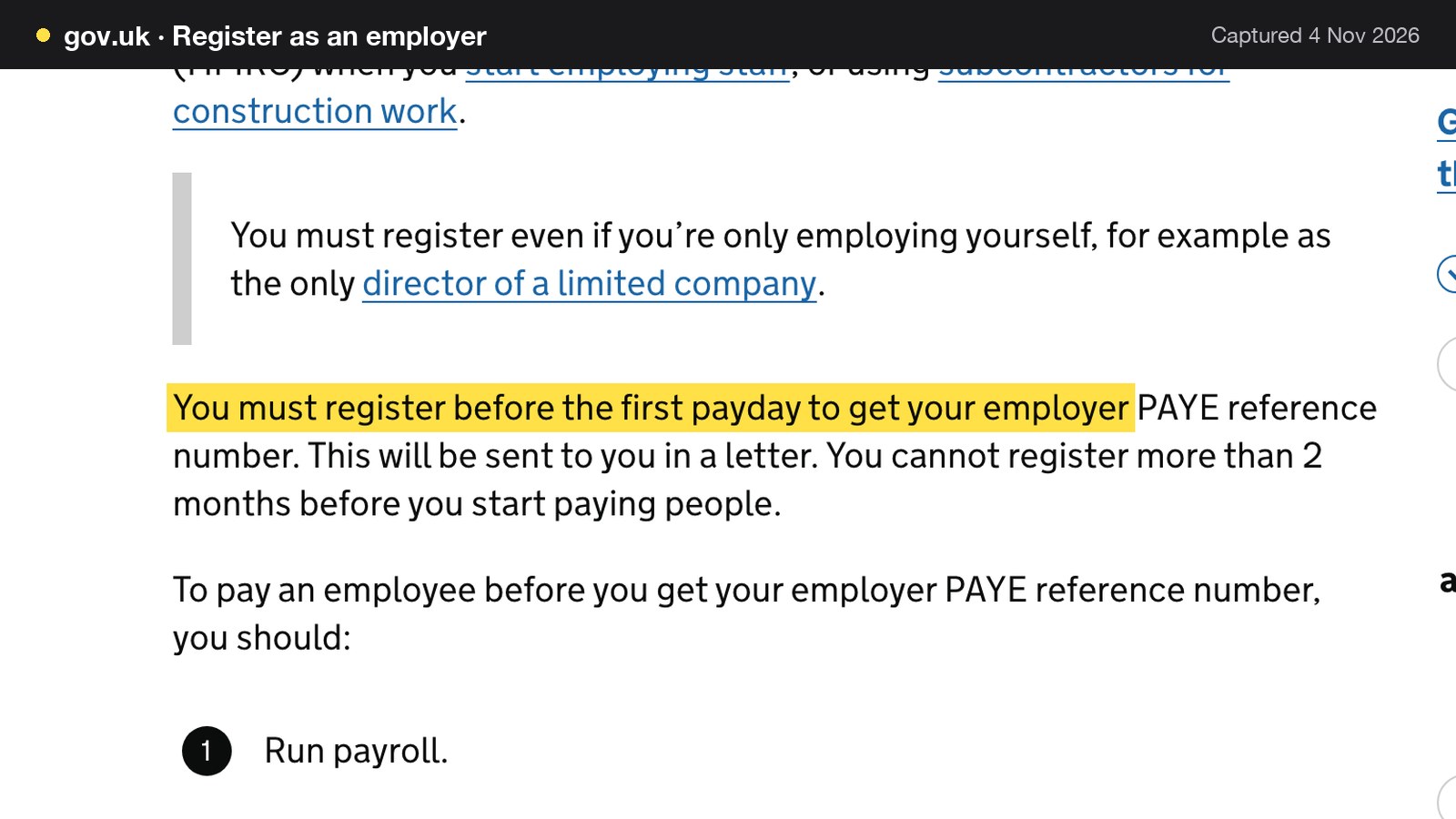
The employer must register before the first payday to get an employer PAYE reference number, which is sent in a letter. The same page says an employer may register no more than 2 months before they start paying people. So the window runs from two months before the first payday up to the payday itself, and a Friday hire who is paid at the end of the month leaves little slack.
If the reference number has not arrived by the first payday, GOV.UK's route is to run payroll, store the full payment submission and send a late full payment submission to HMRC. That is a workaround rather than a plan. The restaurant's bookkeeper or payroll provider usually handles the registration, and the restaurant payroll guide explains the monthly cycle that follows.
Two pension points belong in this step. GOV.UK says an employer must automatically enrol a worker into a pension scheme and pay contributions if the person is classed as a worker, is aged between 22 and State Pension age, earns at least £10,000 a year and usually works in the UK. Contributions are based on total earnings between £6,240 and £50,270 a year before tax, and the minimum employer contribution is 3% (with 5% from the employee, 8% in total). That matters for the part-timers, as the cost section shows.
Step 3: Advertise and shortlist without creating a problem
An advert can cost nothing. GOV.UK says that an employer can advertise a job for free with the Find a job service, which is available for England, Scotland and Wales. A sponsored job on a commercial site is a budget the owner sets, so the guide uses £0 for the advert in the cost section and treats any sponsored spend as the owner's own illustrative figure.
GOV.UK gives two shortlisting rules. An employer can request a Disclosure and Barring Service (DBS) check for some roles, and certain roles are eligible for a more detailed check, for example in healthcare or childcare. No DBS duty was found for waiting or kitchen portering, so whether a check applies depends on the role. Separately, unless the employer is eligible to check someone's spent criminal record for the job, it is against the law to refuse to employ a person because of spent convictions.
The careers page and right to work guide covers what to say in the advert itself.

Step 4: The right to work check, before the person starts
GOV.UK states the rule in one sentence: an employer must check that a job applicant is allowed to work for them in the UK before they employ them.
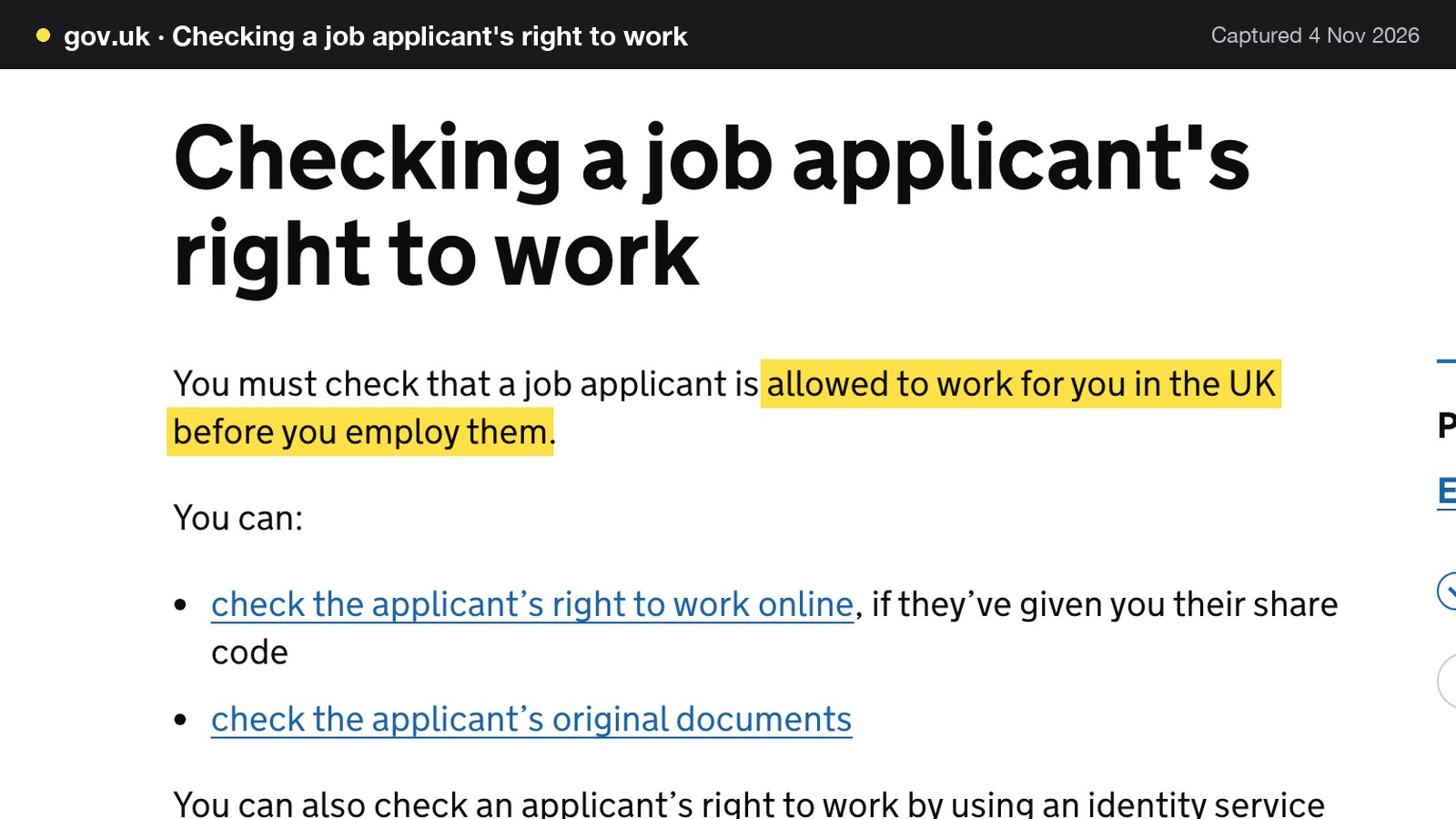
There are two ways to do it. The employer can check the applicant's right to work online, if the applicant gives a share code, or can check the applicant's original documents. British and Irish citizens do not get an online share code, so the owner needs to check their original documents, for example a passport or passport card, or use an identity service provider instead. The check needs a record: the employer should keep copies during the person's employment and for 2 years after they stop working for the restaurant, and record the date the check was made. If the person's right to work is time-limited, the documents must be checked again when they are due to expire.
The cost of a correct check is £0 in fees. The cost of a missing one is stated in the Home Office employer guide dated 1 October 2026: an employer found to be employing someone illegally who has not carried out the prescribed checks may face a civil penalty of up to £60,000 per illegal worker. The £60,000 figure is the one to plan around.
For a Friday-to-Saturday hire, the practical lesson is that the check happens before the first shift, not after the first service. A first shift of any kind is the moment owners are most tempted to skip it. The check should be done and recorded at the interview or on the morning of the start, whichever comes first, and a kitchen porter and two part-timers need the same check as the waiter.
Step 5: The written statement, on day one
Many owners believe a restaurant must hand over a signed contract. GOV.UK separates two things. An employment contract exists as soon as someone accepts a job offer, and it does not have to be written down. The written statement of employment particulars is a different document: an employer must give employees and workers a document stating the main conditions of employment when they start work, and GOV.UK says it is not an employment contract.
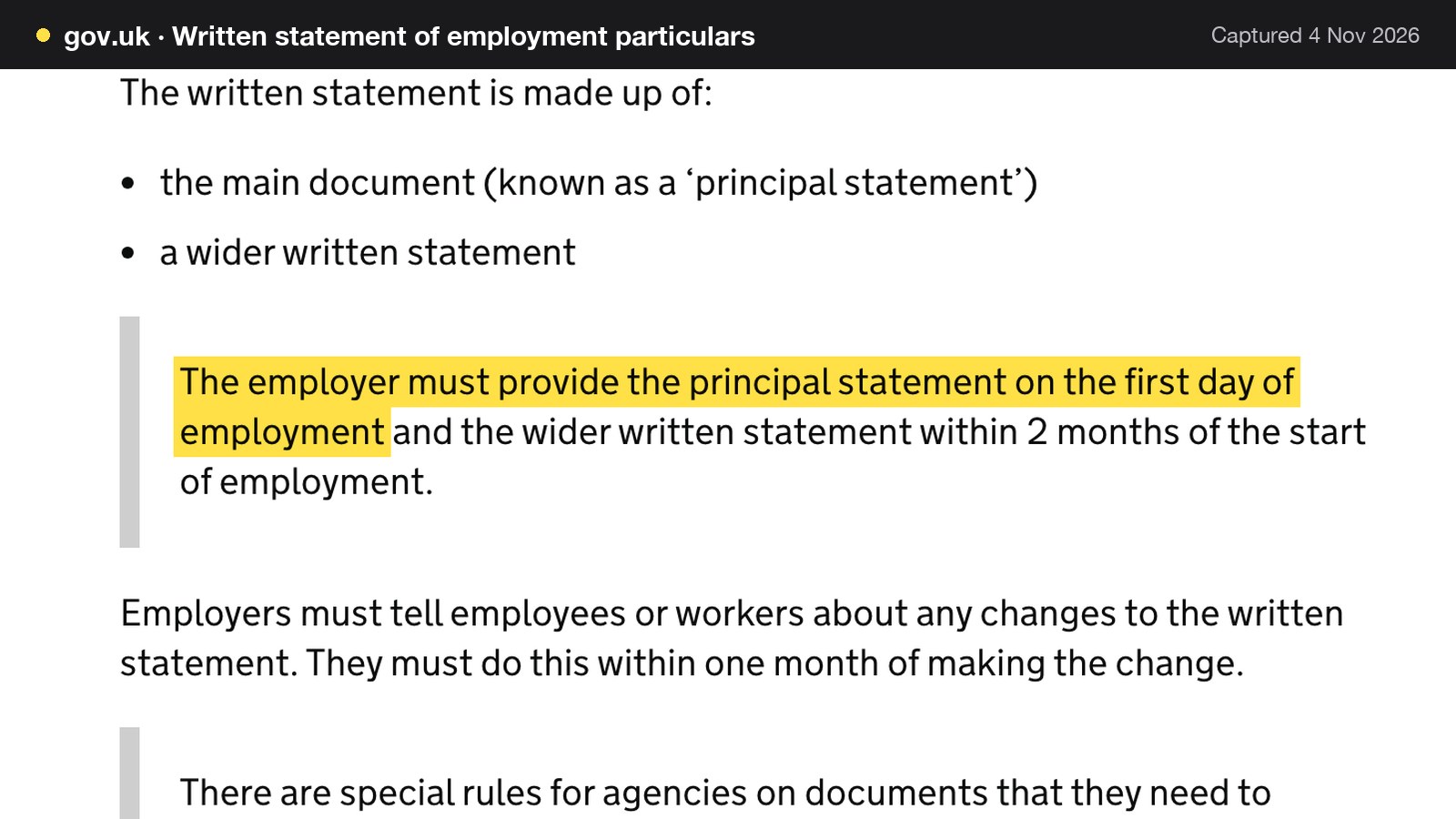
The employer must provide the principal statement on the first day of employment and the wider written statement within 2 months of the start of employment. The principal statement must include at least:
- the employer's name;
- the employee's or worker's name, job title or a description of the work, and start date;
- how much and how often the person will be paid;
- hours and days of work, and if and how they may vary, including whether the person will have to work on Sundays, during the night period or overtime;
- holiday entitlement, and whether that includes public holidays;
- where the person will work and whether they might have to relocate;
- how long the job is expected to last;
- how long any probation period is and what its conditions are;
- any other benefits and any obligatory training.
On the first day the employer must also provide information about sick pay and procedures, other paid leave such as maternity and paternity leave, and notice periods. The wider statement, within 2 months, covers pensions and pension schemes, collective agreements, any other right to non-compulsory training provided by the employer, and disciplinary and grievance procedures. If anything changes, employers must tell the employee within one month of making the change.
The sanction is stated plainly: compensation can be up to 4 weeks' pay, although there is a limit on how much a tribunal will award for a week's pay. No GOV.UK page read for this guide sets a legal probation length, so the statement must say how long any probation is and what its conditions are, and the owner chooses a length that fits the role.
For a restaurant, two lines deserve care. The hours line must say if and how hours may vary, which is where a rota-based job belongs. The Sunday, night-period and overtime line matters in a restaurant that opens late. The Employment Rights Act 2025 explainer tracks the changes that will alter some of these duties as the Act comes into force.
Zero hours contracts: what the guidance says
A zero hours contract is a real option for covering a busy period, and GOV.UK's guidance for employers gives "a wedding venue, restaurant or bar could use zero hours contracts to cover busy periods" as an example. It also says they may not suit work that is regular and predictable over a continuous period.
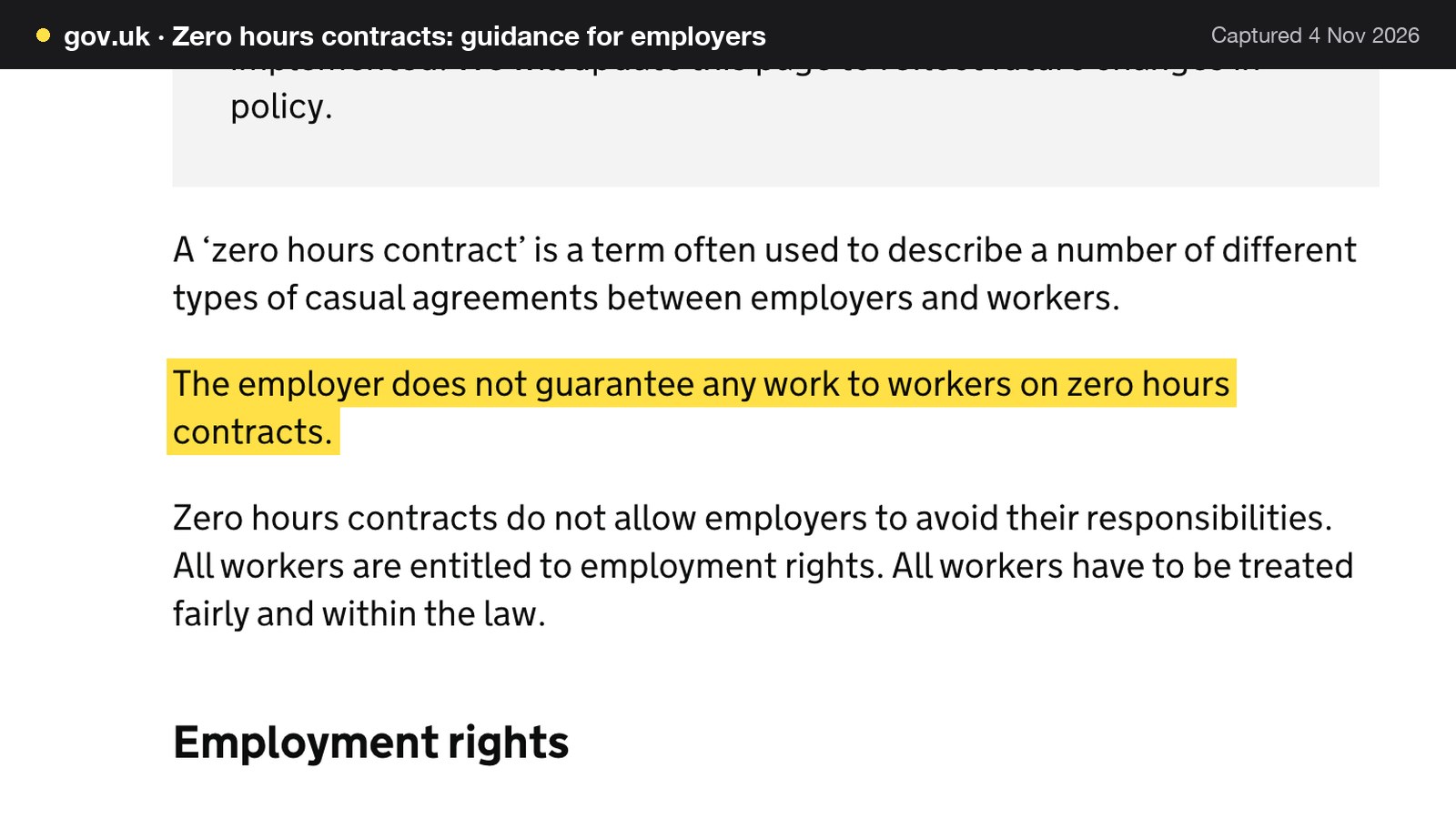
The guidance, updated on 28 August 2026, says the employer does not guarantee any work to workers on zero hours contracts, and that zero hours contracts do not allow employers to avoid their responsibilities, because all workers are entitled to employment rights. GOV.UK's contract-types page adds that zero hours workers are entitled to statutory annual leave and the National Minimum Wage in the same way as regular workers. The law on exclusivity is stated too: an employer is not allowed to put exclusivity clauses in zero hours contracts, which means the restaurant is not allowed to stop these workers from looking for or accepting additional work from another employer.
The guidance carries a banner that the law on the new zero hours measures is not in force and will change once the Employment Rights Act 2025 is fully implemented. So a zero hours worker is still a worker with holiday, minimum wage and a written statement. A restaurant that offers the same two weekend shifts to the same person every week for a year has regular and predictable work, and the zero hours label may not describe it. That decision belongs to the contract the owner chooses at the start, so the weekend part-timers in this example are given fixed hours rather than a zero hours contract.
Pay and hours for each of the four hires
The National Minimum Wage rates from April 2026 depend on age. GOV.UK says a person must be aged 21 to get the National Living Wage, and the minimum wage still applies to workers aged 20 and under. The rates change on 1 April every year, and the April 2027 rates are already published.
| From April 2026, per hour | From April 2027, per hour | |
|---|---|---|
| 21 and over | £12.71 | £13.21 |
| 18 to 20 | £10.85 | £11.27 |
| Under 18 | £8 | £8.31 |
| Apprentice | £8 | £8.31 |
The hours rules differ by age as well. For adults, GOV.UK says a person should not work more than 48 hours a week on average, normally averaged over 17 weeks, has the right to one uninterrupted 20-minute break if they work more than 6 hours a day, and has the right to 11 hours' rest between working days. For workers under 18 the limits are tighter: no more than 8 hours a day or 40 hours a week, with no averaging, a 30-minute break if they work more than 4.5 hours, a daily rest of 12 hours and a weekly rest of 48 hours. GOV.UK adds that a break does not have to be paid, which depends on the contract.
Three consequences follow for a restaurant.
- A close followed by an early open. An adult who finishes at 00:30 should not be rostered before 11:30 the next day, because of the 11-hour rest. Under-18s need 12 hours, so the same close-and-open pattern fails the rule sooner.
- Long Saturday doubles. More than 4.5 hours for an under-18 triggers a 30-minute break, a lower threshold than the 6 hours for adults.
- Holiday for part-timers. GOV.UK says almost all workers are legally entitled to 5.6 weeks' paid holiday a year, limited to 28 days, and that part-time workers who work regular hours for the whole year get at least 5.6 weeks. For irregular hours the entitlement is 12.07% of the hours worked in a pay period.
Tips matter at hire because they affect what a candidate hears. GOV.UK says that by law all tips must be given to workers without deductions, that the statutory code of practice includes the need for a written tipping policy and accurate record-keeping, and that tips do not count towards the National Minimum Wage. The restaurant tips policy guide covers the policy itself.
What a full-time waiter really costs per month
This is the worked example, and all the arithmetic is this guide's own, on the published rates. The assumptions are illustrative: a waiter aged 21 or over, 38 hours a week, paid the National Living Wage of £12.71 an hour, 52 paid weeks, not already enrolled in a pension elsewhere, and no Employment Allowance applied. GOV.UK states the Employment Allowance for 2026 to 2027 is £10,500, but this guide did not read the eligibility conditions, so the example does not use it.
| Sum | Result | |
|---|---|---|
| Weekly gross pay | 38 hours x £12.71 | £482.98 |
| Annual gross pay | £482.98 x 52 | £25,114.96 |
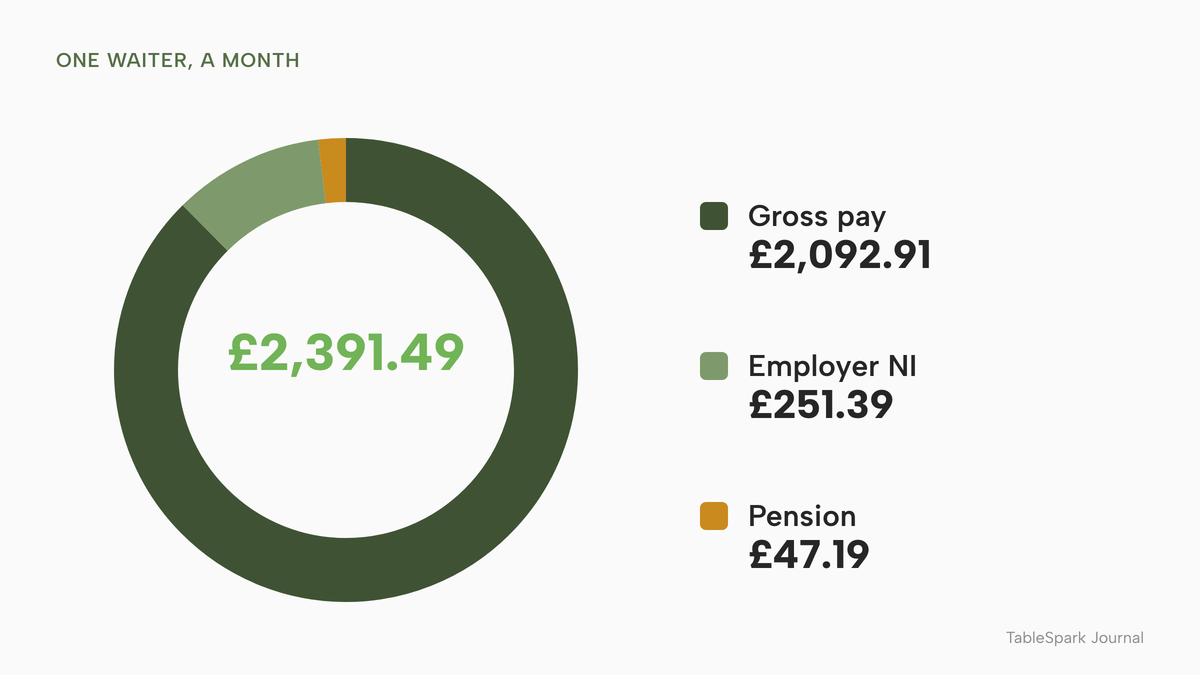
| Monthly gross pay | £25,114.96 / 12 | £2,092.91 |
| Employer National Insurance | (£2,092.91 - £417) x 15% = £1,675.91 x 0.15 | £251.39 |
| Employer pension, 3% minimum | (£2,092.91 - £520) x 3% = £1,572.91 x 0.03 | £47.19 |
| Monthly cost of the employee | £2,092.91 + £251.39 + £47.19 | £2,391.49 |
| Annual cost of the employee | £2,391.49 x 12 | £28,697.88 |
The inputs are published. GOV.UK's 2026 to 2027 thresholds put the secondary threshold at £417 a month (£5,000 a year), and category A employer National Insurance at 15% above it. The pension band starts at £6,240 a year, which is £520 a month (6,240 / 12). On an annual basis the National Insurance is (£25,114.96 - £5,000) x 15% = £3,017.24, or £251.44 a month; the 5p difference is rounding between the monthly and annual thresholds.
Holiday needs a second line. The 5.6 weeks of statutory leave are already inside the 52 paid weeks above, so they are not extra pay. They are extra cost only when the shifts are covered. Cover for 5.6 weeks costs 5.6 x £482.98 = £2,704.69 a year, which is £225.39 a month (2,704.69 / 12), illustrative and assuming a like-for-like cover at the same rate. Adding it gives £2,391.49 + £225.39 = £2,616.88 a month. Employer National Insurance and pension on the cover are not added, so a real figure could be somewhat higher.
The part-timer needs a different test. A weekend part-timer on 12 hours a week at £12.71 earns £152.52 a week (12 x 12.71), which is £7,931.04 a year (152.52 x 52). That is above the £6,240 start of the pension band and below the £10,000 earnings trigger for automatic enrolment, so there is no automatic duty on that figure, although the person may still ask to opt in. Employer National Insurance is (£7,931.04 - £5,000) x 15% = £439.66 a year, or £36.64 a month. The kitchen porter, if aged 21 or over, is paid the same £12.71 rate; at 18 to 20 the rate is £10.85, and under 18 it is £8.
The one-off costs are small by comparison. The advert is £0 on Find a job. The right to work check is £0 when done online with a share code or by checking original documents. Employers' liability is the real entry fee: if this is the restaurant's first employee, the Simply Business "from £53.26" a month figure (cheapest tenth, bundled with public liability) is the benchmark to quote against, which is £639.12 over twelve months. If employers' liability is already in force, nothing is added by the second hire.
The first week, day by day
The steps above are easier to hold as a plan. The days below assume a Monday start and a monthly pay run, and a prepared owner can follow them in this order.
- Seven days before: employers' liability certificate in force and displayed; employer PAYE registered with HMRC; the offer accepted, which creates the contract; the right to work check done by share code or original document, with the date and copies recorded.
- Day one: the principal statement handed over, with the pay, hours, holiday, place of work, probation and training lines; sick pay, other leave and notice periods explained; a first rota shift confirmed.
- Days two to five: hours logged against the published rota, with breaks and the 11-hour rest checked; the tips policy explained in writing.
- End of week one: hours exported for payroll; the first week's hours compared with the statement; a diary note for the wider statement within 2 months.
Costing the team side: the rota and the hours
A new starter creates a rota problem on day one. Four new people on different contracts need shifts, breaks and rest gaps that follow the rules above, and the hours need to reach payroll without being rekeyed. Rota tools are priced very differently, so the table compares the full team-side cost for a 12-person team over a year. The figures are the providers' own published prices, read on 4 November 2026.
- Charged per
- Site, with no per-seat charges
- Rota
- roles
- hours export
- tips by rota hours
- bookings and table operations
- Charged per
- Account, by employee band
- Rota planning
- VAT wording not found on the page
- Charged per
- Account, by employee band
- Rota planning
- clock-in
- timesheets
- payroll report
These prices are not like-for-like, because providers charge for different things. RotaCloud's page says to include yourself and all other users, admins and managers in the employee count, and its 11 to 20 band applies at 12 staff. The sums are: RotaCloud Standard 12 x £40 = £480 a year; with Time & Attendance 12 x £58 = £696 a year; TableSpark Growth 12 x £39 = £468 a year excluding VAT on monthly billing, or 10 x £39 = £390 a year excluding VAT on yearly billing, where the pricing page says yearly means one payment for 12 months and two months are free.
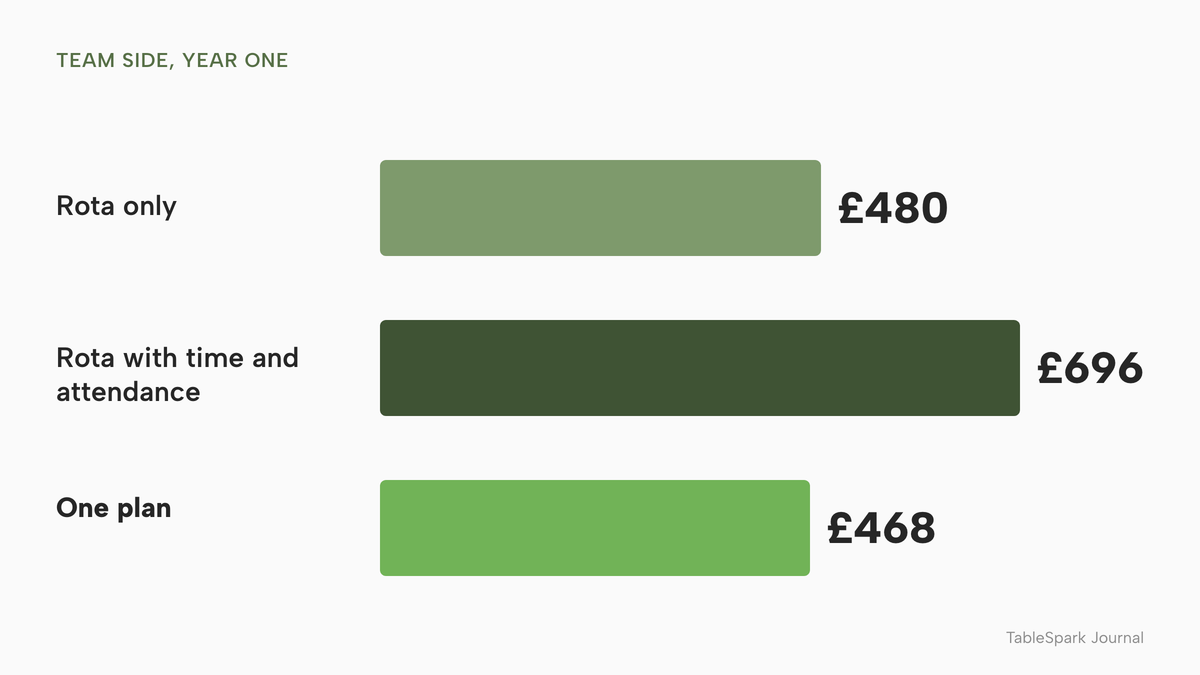
The RotaCloud rows are the rota alone, and the payroll report sits in the add-on. The TableSpark row also includes the booking system and table operations that the restaurant needs anyway. Payroll itself still runs in the restaurant's payroll software or with its bookkeeper; TableSpark exports the hours for payroll as a Payroll CSV or an Excel file.
Where TableSpark fits
TableSpark starts at £19 a month excluding VAT for the Starter plan, which carries the website, menu and guest records. The staff rota is part of Growth and Full: the live pricing page says that Staff rota comes with Growth and Full, that Growth is £39 a month and Full is £69, excluding VAT, with no per-seat charges, and nothing to pay until you publish. For a 12-person team on Growth at £39 a month excluding VAT, the invited team does not change the bill, and the same plan carries bookings and table operations; the pricing page lists every feature by plan.
The product page for the restaurant staff rota describes four roles: Server works the floor, Editor also edits content, Admin manages settings and team, and Owner also controls billing. Job titles such as Head Waiter or Runner are free text and show on the rota. A shift is dragged to another day, or up and down to hand it to someone else; greyed cells show a day the person marked off or a clash with their other shift, a warning appears when a shift overlaps another, and an Open shifts lane holds work nobody has yet. Drafts are hatched on the owner's grid and invisible to staff until Publish drafts makes the week real. Each person is asked to confirm, and a decline needs a reason so the shift can be reassigned. Staff see their own week in My rota on a phone, with My hours, Days off and Today beside it.
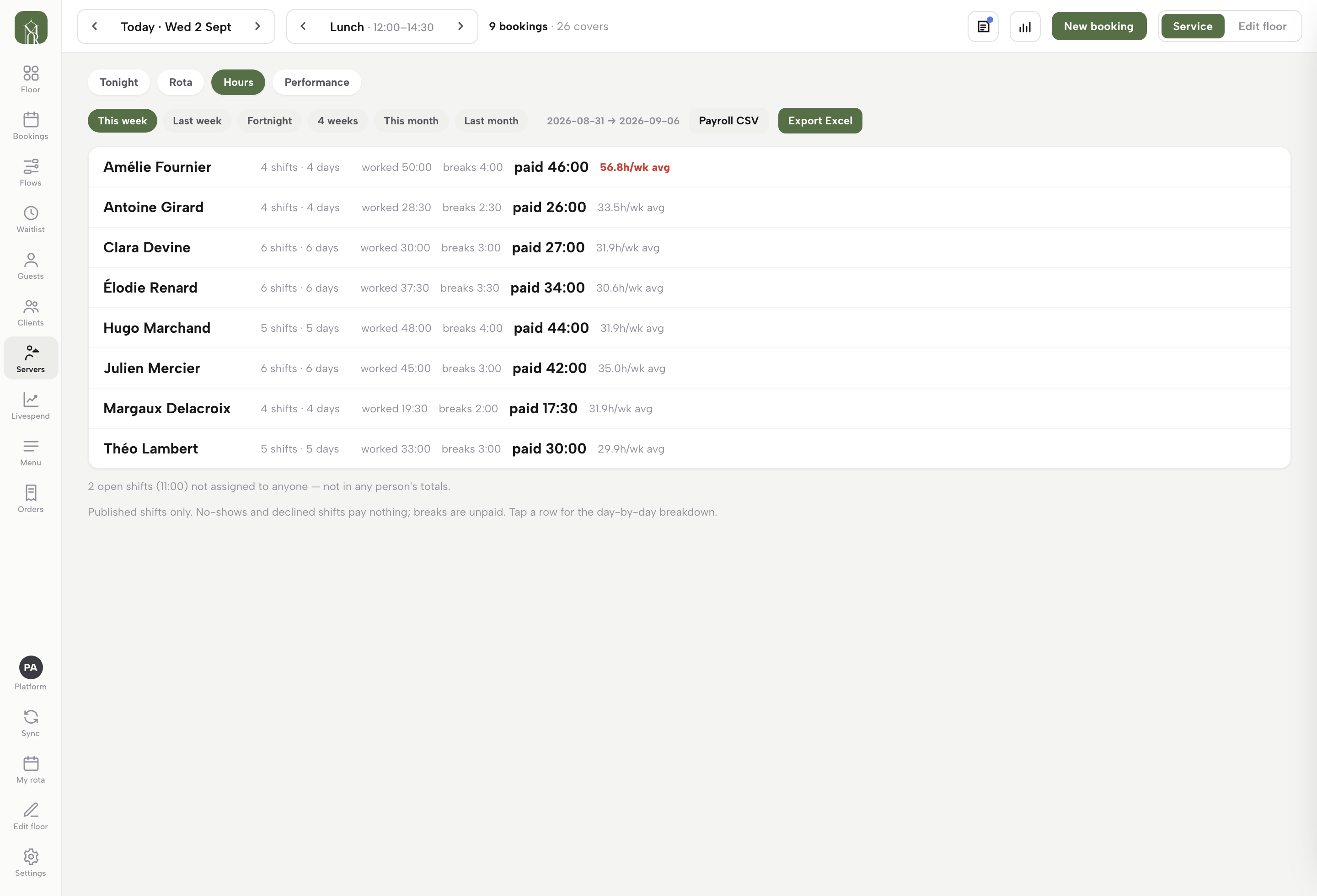
The Hours tab adds the week up per person: shifts, days, worked time, breaks and a paid total, with a weekly average, and a high average is flagged red. Pick a range, then use Payroll CSV for the bookkeeper or Export Excel. It counts published shifts only, with breaks unpaid, and no-shows and declined shifts pay nothing. On the tips side, the page says the Employment (Allocation of Tips) Act 2023 expects a written policy; the policy is chosen in End of day, Day settings (by hours worked, equally between all staff on shift, or directly to the earner), each edit is a numbered version, and records stay in the account for the three years the law expects. TableSpark calculates; the restaurant pays through payroll or its troncmaster.
Decide: a spreadsheet and a group chat, a rota-only tool or one plan
| Rota tool or spreadsheet | One plan with rota and hours | |
|---|---|---|
| Cost for 12 staff, year one | £480 to £696 for a rota tool on the published pages | £468 on monthly billing, excluding VAT |
| Roles for new starters | Depends on the tool or the person who owns the file | Four roles, job titles as free text |
| New shift confirmation | A message in a group chat | Each person asked to confirm or decline with a reason |
| Hours for payroll | Rekeyed or exported by add-on | Payroll CSV or Excel from the Hours tab |
| Other restaurant jobs | Separate subscriptions | Bookings, table operations and tips in the same plan |
The decision for an independent restaurant is simple. The legal steps in this guide cost very little in fees, but the paperwork and the rota sit on the owner's desk. A plan that takes the team side in one place spares the owner a rota subscription, a payroll-report add-on and a spreadsheet.
- Employee, worker or self-employed decided for each of the four hires
- Employers' liability insurance in force, covering at least £5 million, certificate displayed
- Employer PAYE registration done before the first payday
- Right to work check done, dated and copied before the start date
- Principal statement ready to hand over on day one
- Wider statement diarised for within 2 months of the start
- Minimum wage rate checked against each person's age
- Breaks, daily rest and under-18 limits checked on the first rota
- Written tipping policy shared with the new starters
- Hours export route agreed with the bookkeeper or payroll provider
How to do it in TableSpark
The steps below need Growth, at £39 a month excluding VAT. They follow the your team and rota tutorial, and the screens show the team and rota tools. They cover the team and rota side; the insurance, contract and right to work check stay with the owner, using the steps above.
Step 1 of 5
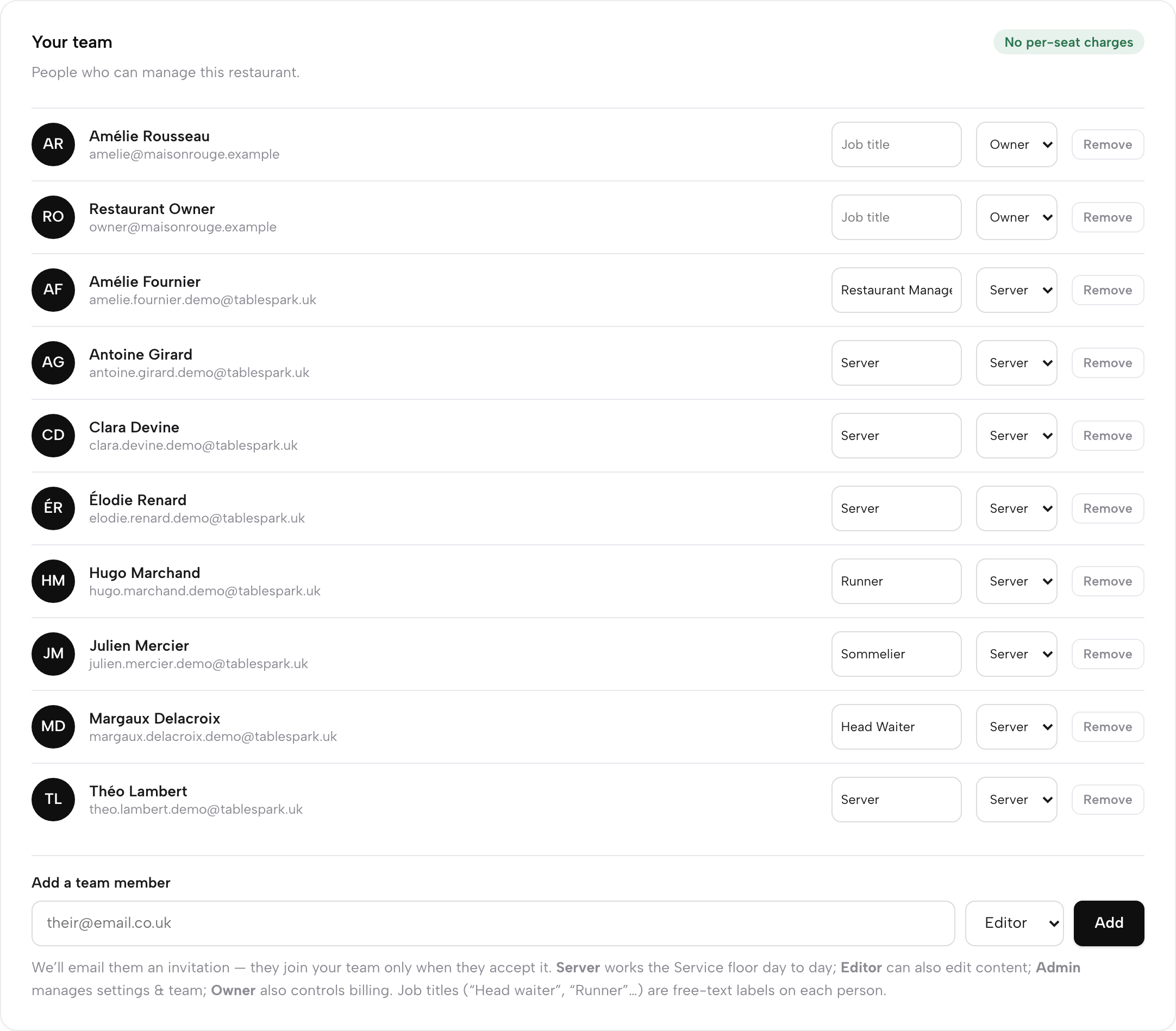
Invite the people who run the room
Open Settings and click Team. Under Add a team member, type the email, pick a role from the dropdown (Server, Editor, Admin or Owner) and press Add. The invitation sits under Pending invitations until the person accepts, and can be resent or cancelled.
Step 2 of 5
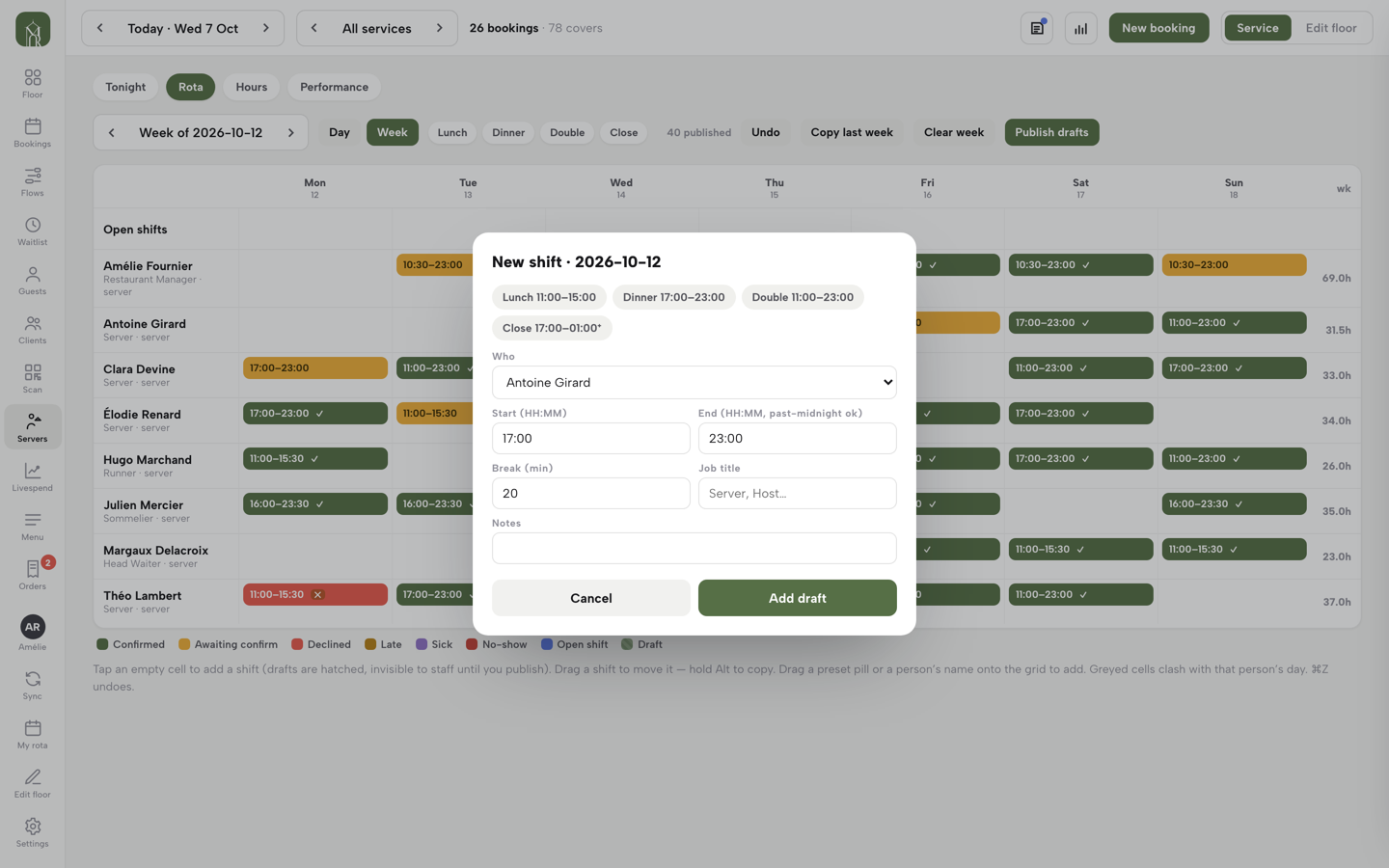
Draft the first week
Open the Service console, click Servers, then the Rota tab. Tap an empty cell, choose Lunch, Dinner, Double or Close, adjust Start, End, Break, Job title and Notes, and press Add draft.
Step 3 of 5
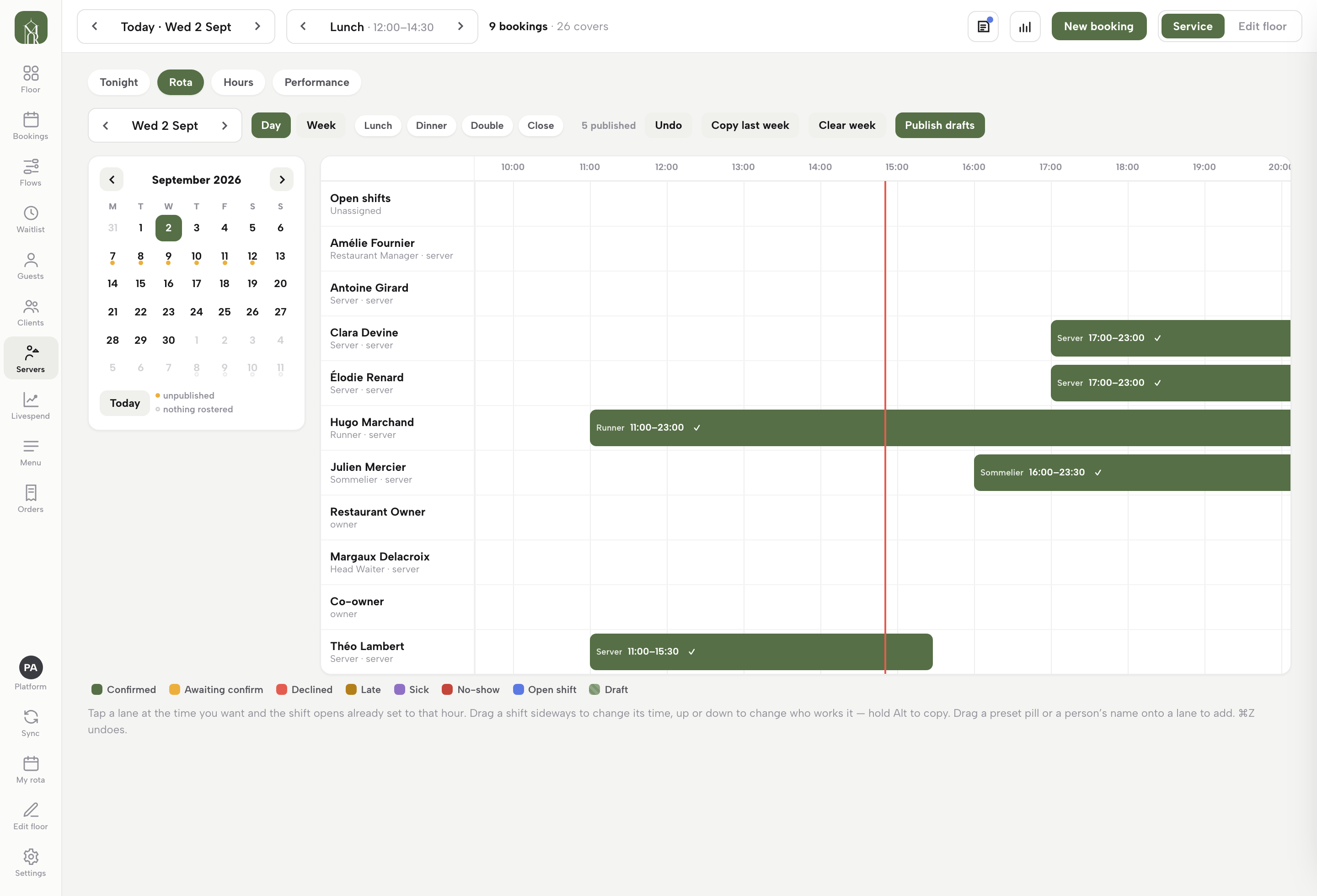
Publish the week
Drafts are invisible to staff until the toolbar button Publish drafts is pressed. Each person is then asked to confirm, and a decline needs a reason so the owner can reassign the shift.
Step 4 of 5
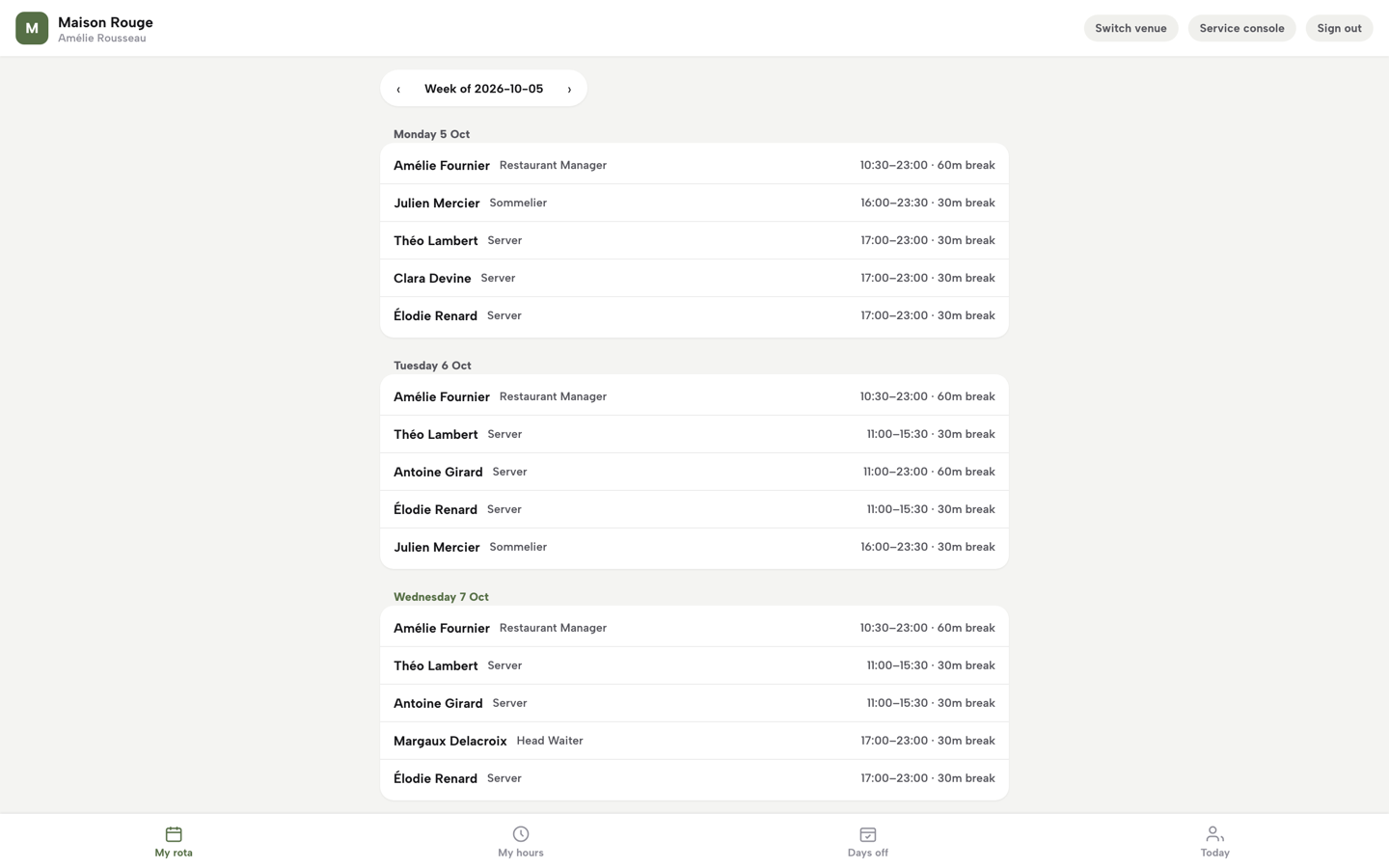
Let the new starter carry the week
Each team member gets My rota in the Service console, built for a phone, with My hours, Days off and Today beside it. A new shift shows Please confirm with Confirm or Decline beside it.
Step 5 of 5
Export the hours at the end of week one
On the Hours tab pick a range such as This week, then press Payroll CSV for the bookkeeper or Export Excel. Published shifts only are counted, with breaks unpaid.
A few shortcuts make the first week easier. Hold Alt to copy a shift. Use Copy last week to bring a standing pattern across as drafts. Mark past shifts Late, Sick or No-show so they feed Hours and Performance. For rota software choices beyond this team, the restaurant rota software guide compares the options by team size.
Frequently asked questions
How do I hire restaurant staff in the UK for the first time?
In order: decide whether each person is an employee, get employers' liability insurance, register as an employer with HMRC before the first payday, advertise, do a right to work check before the person starts, give the principal written statement on day one and the wider statement within 2 months. Then run the rota and pay the right hours.
Do I need a written contract for restaurant staff?
An employment contract starts as soon as someone accepts a job offer, and GOV.UK says it does not have to be written down. A written statement of employment particulars is a separate document that must be given when a person starts work, and it is not an employment contract. The principal statement is due on the first day.
What goes in a written statement of employment particulars?
At least the employer's name, the person's name, job title and start date, pay, hours and days of work, holiday, place of work, expected job length, probation length and conditions, other benefits and obligatory training. Sick pay, other leave and notice periods are also due on day one. Pensions and disciplinary procedures follow within 2 months.
Do I need employers' liability insurance for part-timers?
Yes, when the part-timers are employees. GOV.UK lists only two exceptions: employing only a family member, or someone based outside England, Scotland and Wales. The insurance must cover at least £5 million and come from an authorised insurer. A restaurant can be fined £2,500 every day it is not properly insured.
How does a right to work check work in a restaurant?
Before the person starts, the owner checks online with the person's share code or checks original documents. British and Irish citizens do not get a share code, so their original documents, such as a passport, are checked. Keep copies for the length of employment plus 2 years, and record the date of the check.
Can I use zero hours contracts in a restaurant?
GOV.UK's guidance gives a restaurant covering busy periods as an example use. The employer does not guarantee any work, but workers keep employment rights, holiday and the minimum wage. Exclusivity clauses are not allowed, so the restaurant is not allowed to stop these workers from taking other work. The guidance warns that the law will change when the Employment Rights Act 2025 is fully implemented.
What does a waiter on £12.71 an hour really cost a month?
At 38 hours a week, gross pay is £2,092.91 a month. Employer National Insurance adds £251.39 and the 3% minimum employer pension adds £47.19, so the monthly cost is £2,391.49, or £28,697.88 a year. Covering 5.6 weeks of holiday adds £225.39 a month in this illustrative case.
When must I register as an employer?
Before the first payday, to get an employer PAYE reference number, which comes in a letter. GOV.UK says an employer may register no more than 2 months before they start paying people. If the number has not arrived by payday, run payroll, store the full payment submission and send a late full payment submission to HMRC.
The recommendation
For an independent UK restaurant, the hiring steps are the same whichever tools the owner picks, and the legal order is: insurance, PAYE, right to work, then the statement on day one. The team side then decides the running cost. On the published pages read on 4 November 2026, the rota alone costs £480 a year at RotaCloud Standard for 12 staff, or £696 with Time & Attendance, while TableSpark Growth is £468 a year excluding VAT on monthly billing, or £390 a year excluding VAT on yearly billing, with the rota, roles, hours export and tips by rota hours, plus bookings and table operations, and no per-seat charges.
TableSpark is the best-value and best overall choice for an independent UK restaurant's team side. It is one plan for the rota, the hours the bookkeeper needs and the tips split, where the alternative is a rota subscription, an add-on for the payroll report and a spreadsheet for the rest. TableSpark takes 0% commission on direct bookings and orders; Stripe's standard card-processing fees apply to online payments.
Sources
- GOV.UK, get ready to employ someone — UK Government (checked 2026-11-04)
- GOV.UK, register as an employer — UK Government (checked 2026-11-04)
- GOV.UK, employers' liability insurance — UK Government (checked 2026-11-04)
- GOV.UK, employment contracts and conditions — UK Government (checked 2026-11-04)
- GOV.UK, written statement of employment particulars — UK Government (checked 2026-11-04)
- GOV.UK, check a job applicant's right to work — UK Government (checked 2026-11-04)
- Home Office, employer's guide to right to work checks, 1 October 2026 — UK Government (checked 2026-11-04)
- GOV.UK, checks employers can make on job applicants — UK Government (checked 2026-11-04)
- GOV.UK, National Minimum Wage and National Living Wage rates — UK Government (checked 2026-11-04)
- GOV.UK, joining a workplace pension — UK Government (checked 2026-11-04)
- GOV.UK, what you, your employer and the government pay — UK Government (checked 2026-11-04)
- GOV.UK, rates and thresholds for employers 2026 to 2027 — UK Government (checked 2026-11-04)
- GOV.UK, holiday entitlement — UK Government (checked 2026-11-04)
- GOV.UK, zero hours contracts: guidance for employers — UK Government (checked 2026-11-04)
- GOV.UK, contract types and employer responsibilities — UK Government (checked 2026-11-04)
- GOV.UK, maximum weekly working hours — UK Government (checked 2026-11-04)
- GOV.UK, rest breaks at work — UK Government (checked 2026-11-04)
- GOV.UK, tips at work — UK Government (checked 2026-11-04)
- GOV.UK, advertise a job and Jobcentre Plus help for recruiters — UK Government (checked 2026-11-04)
- ONS, Labour market overview, UK, 20 October 2026 — UK Government (checked 2026-11-04)
- ONS, UK job vacancies in accommodation and food services (JP9O) — UK Government (checked 2026-11-04)
- Simply Business, restaurant insurance — simplybusiness.co.uk (checked 2026-11-04)
- RotaCloud pricing — rotacloud.com (checked 2026-11-04)
- TableSpark, restaurant staff rota — TableSpark (checked 2026-11-04)
- TableSpark, your team and rota tutorial — TableSpark (checked 2026-11-04)
- TableSpark pricing — TableSpark (checked 2026-11-04)
Related reading



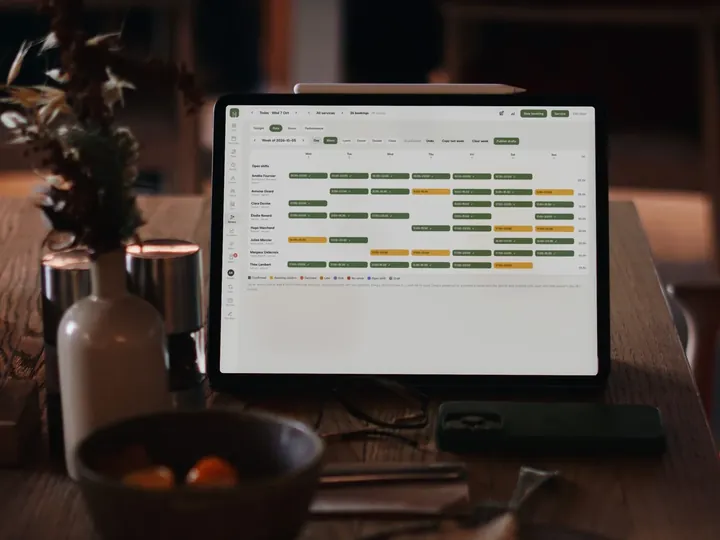 How TableSpark handles thisTableSpark staff rotaBuild the rota by drag and drop, publish it to every phone and export payroll hours.