01
Hero
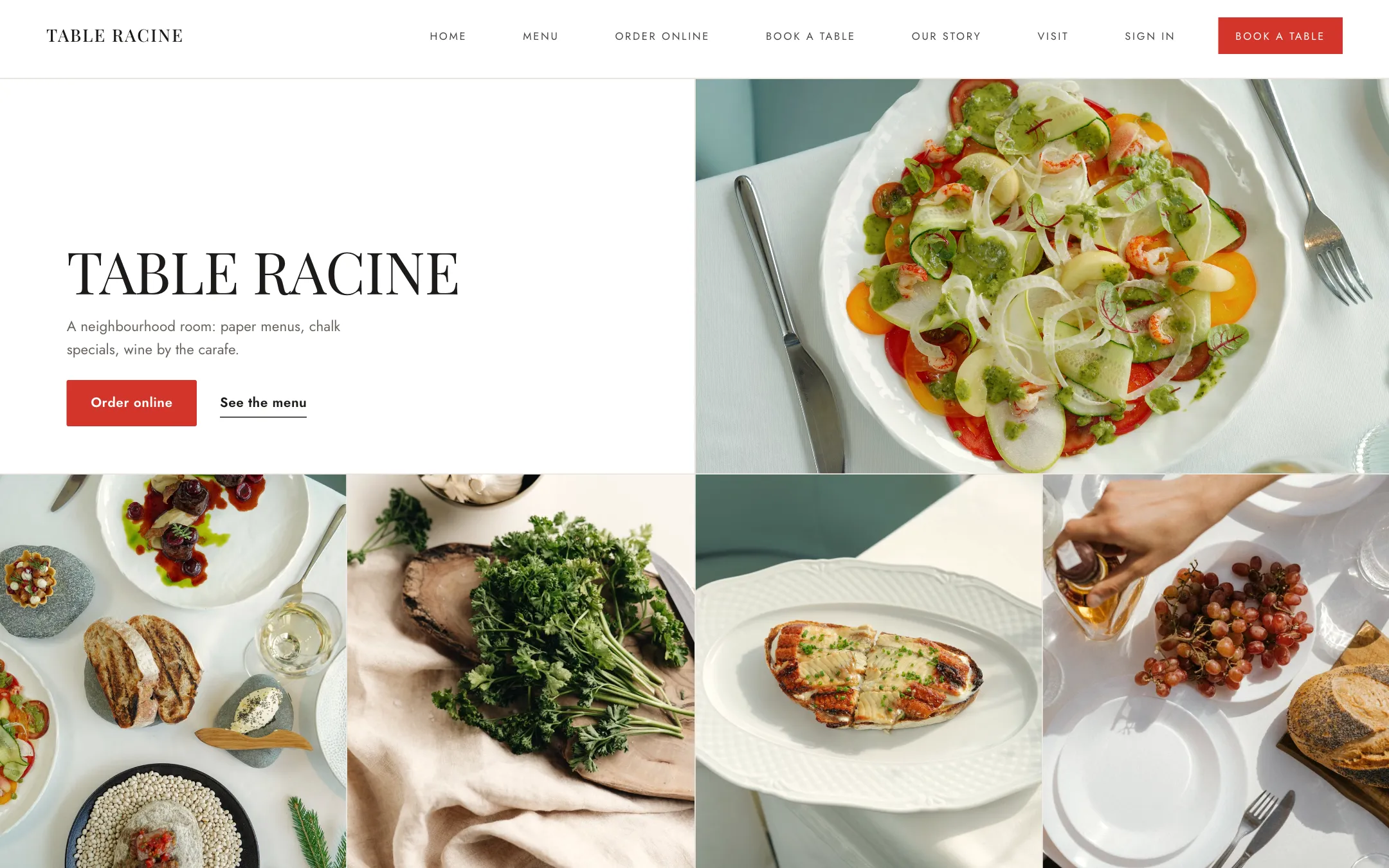
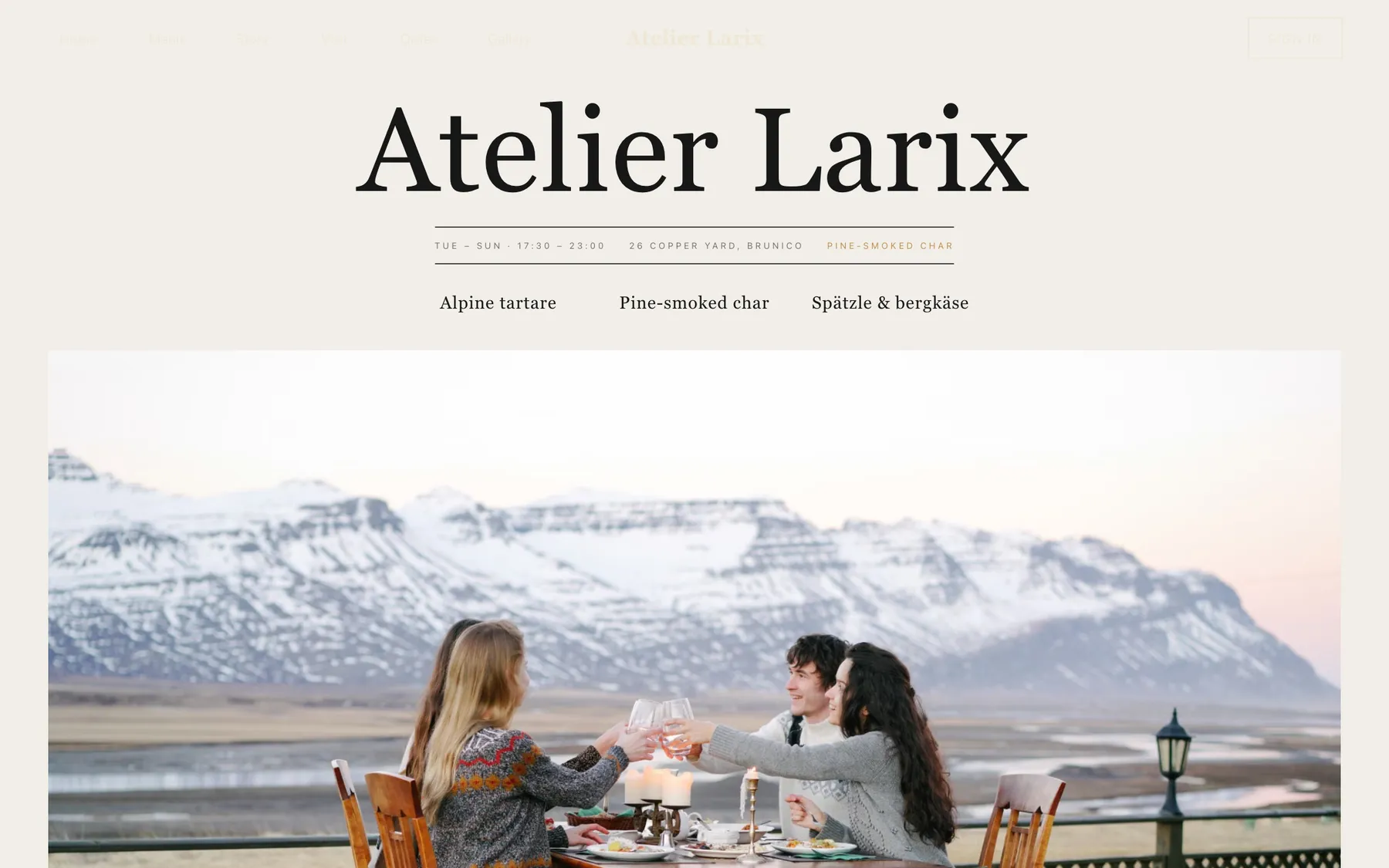
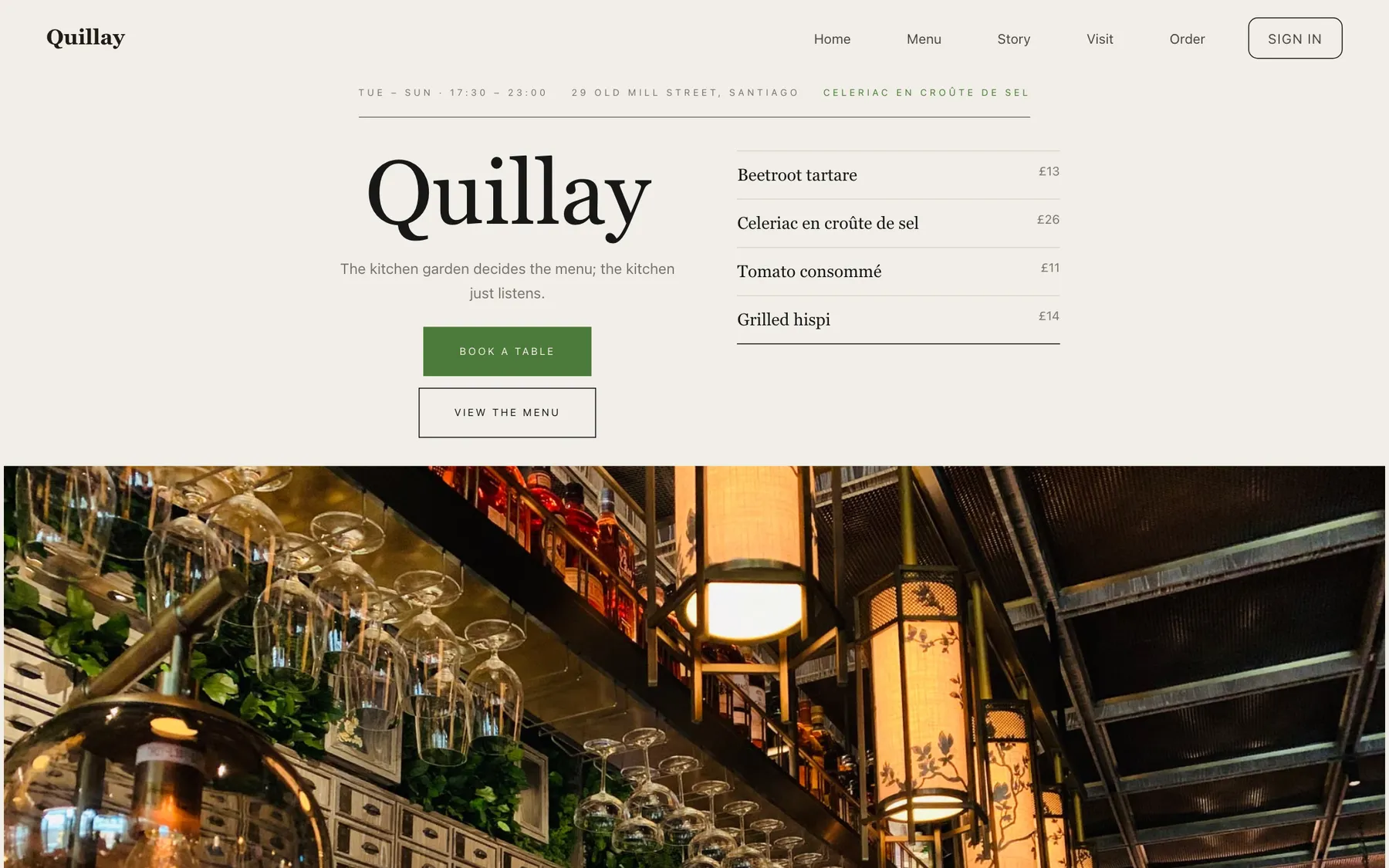
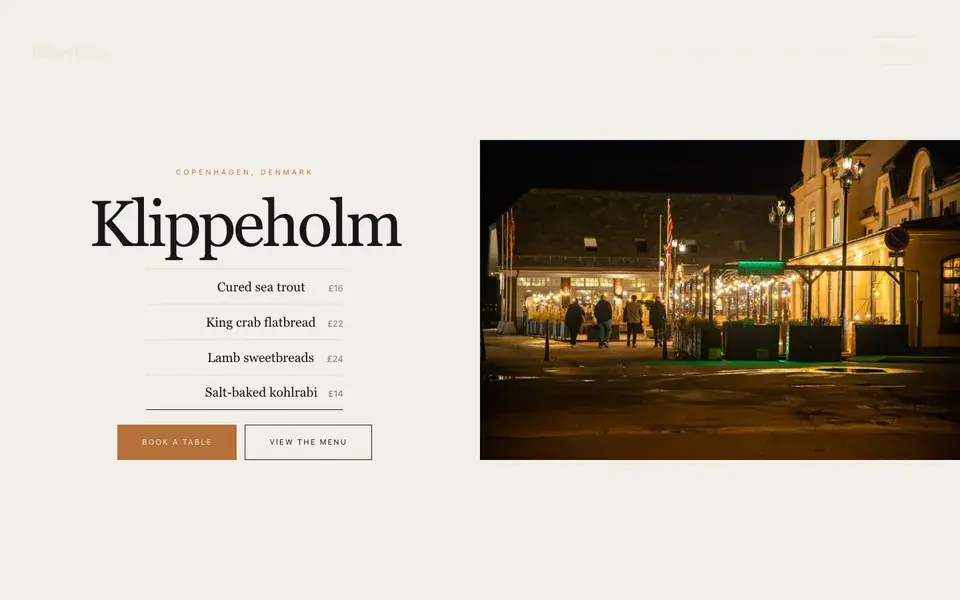
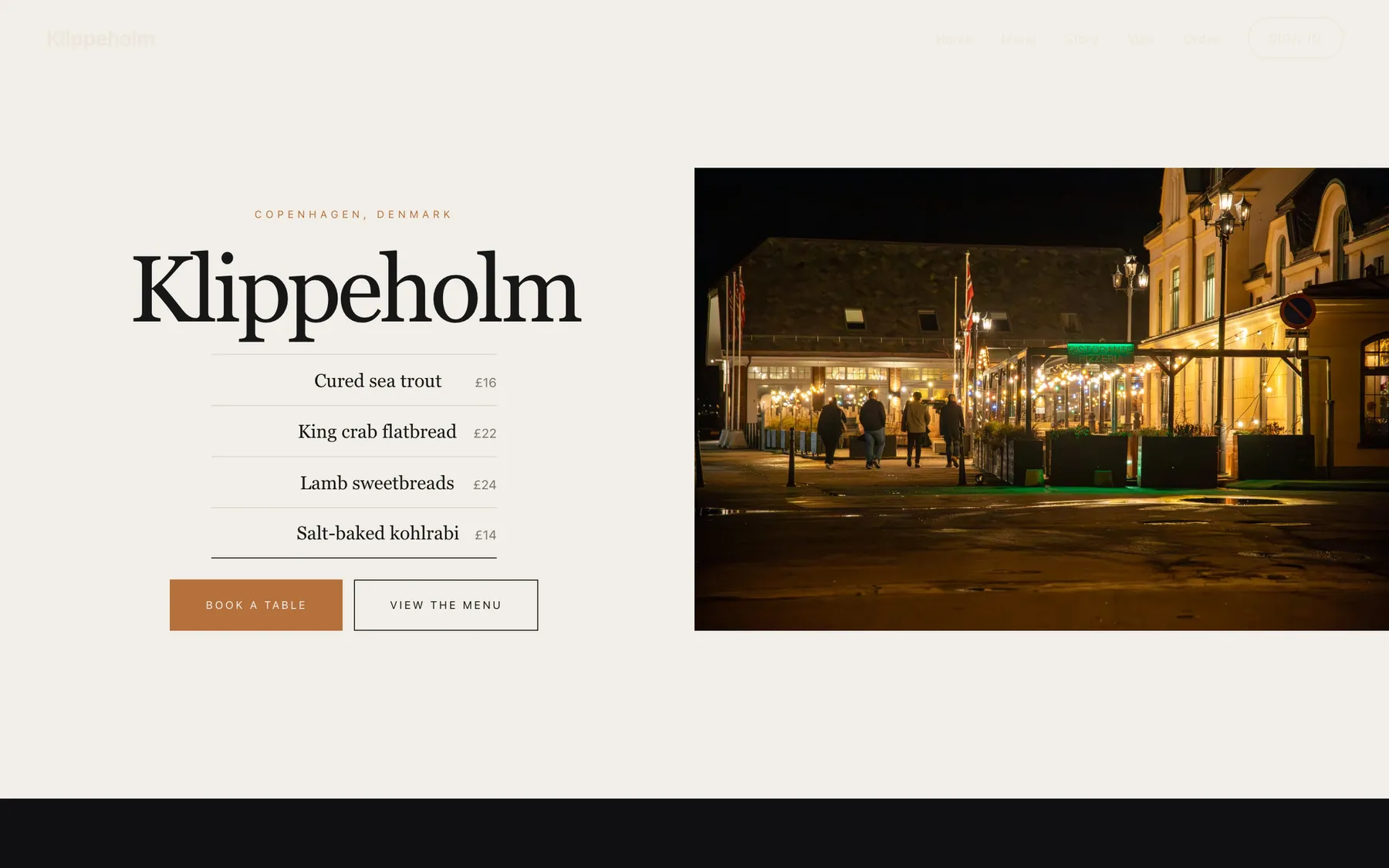
Big opening image, name & buttons, in the Chronicle treatment: Newspaper masthead, ruled meta row, three columns and a wide band.
Templates · New Nordic (Bornholm)
For island kitchens with a preserving larder: a dark template with a bake-times opening, a plated menu, and a minimal ordering list for the pantry goods.
Every section is a builder module you can reorder, edit or delete, with no developer.
On bookings and orders, on every plan. Stripe’s standard card-processing fees apply to online payments.
Build and preview the whole site for nothing, and pay only when it goes live.
Starter is £19/mo excl. VAT and includes a complete restaurant website, a live structured menu, enquiry and newsletter forms, and managed search readiness. Growth is £39/mo excl. VAT and adds direct live bookings, a custom domain with managed SSL, and table and floor-plan operations. Full is £69/mo excl. VAT and adds online ordering and multi-site management for up to five restaurant sites. TableSpark commission is 0%. Stripe's standard card-processing fees apply to online payments.
That is the whole website and the whole system, at the best value on offer to an independent UK restaurant; the full cost comparison has the figures. A bespoke build costs thousands and takes months; this one is already designed, and you can publish it this afternoon. And it stays yours to run: change a price at four in the afternoon and it is live before service. Every template is optimised for phone, tablet and desktop, and the plans carry reservations, tables, ordering and management — with 0% TableSpark commission.
Klippeholm is a dark room with a teal that belongs to cold water. Yours might be white tile and morning light, or brass and candles, or something nobody has built yet.
There is no demo video and no sales call. What you see on the right is the actual Theme panel from the builder, wired to the actual site renderer on the left. Press a colour. It will not ask you to register and it will not remember what you did. Go on.
Loading the live preview…
An island restaurant has a season, a ferry and a larder, and all three belong on the first screen. The bake-times opening handles the practicalities — when things come out of the oven, when the room is open — and the rest of the page handles the argument.
A dark ground with a cold teal accent is the honest palette for a Nordic coast, and the wide display face keeps short Danish dish names legible without turning them into decoration.
Eight blocks, arranged around a season:
01
Big opening image, name & buttons, in the Chronicle treatment: Newspaper masthead, ruled meta row, three columns and a wide band.
02
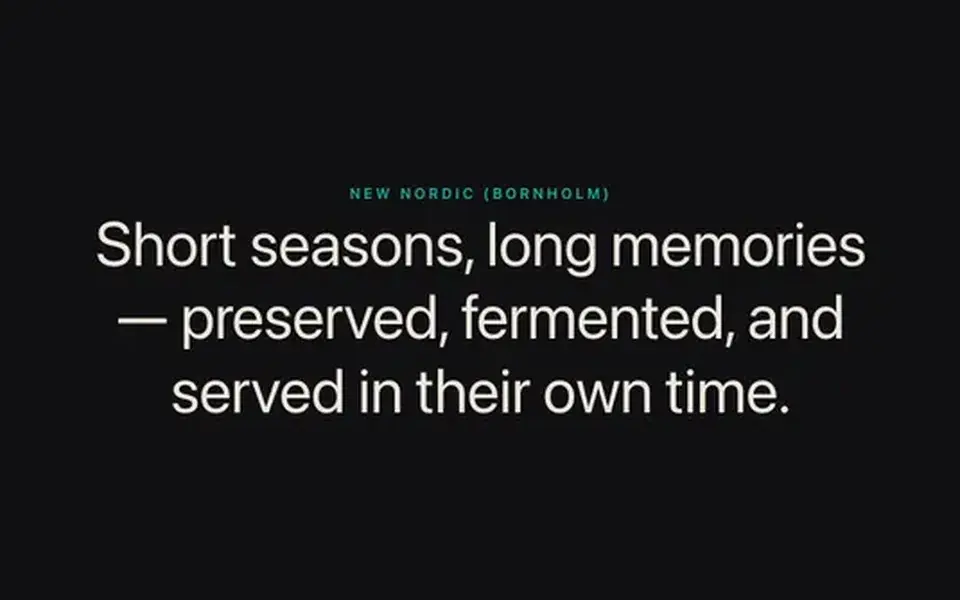
Big opening statement line.
03
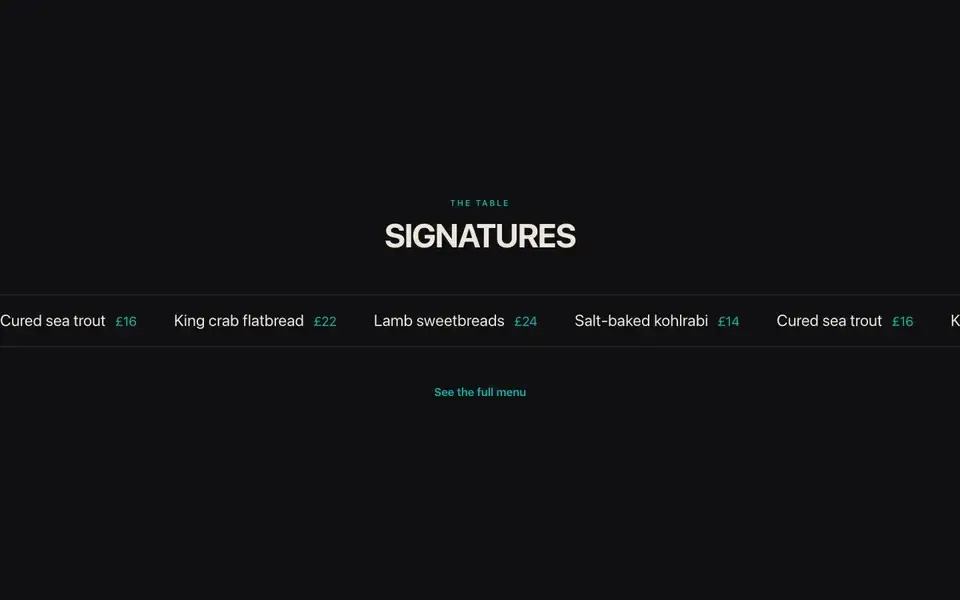
A few dishes on a sliding rail.
04
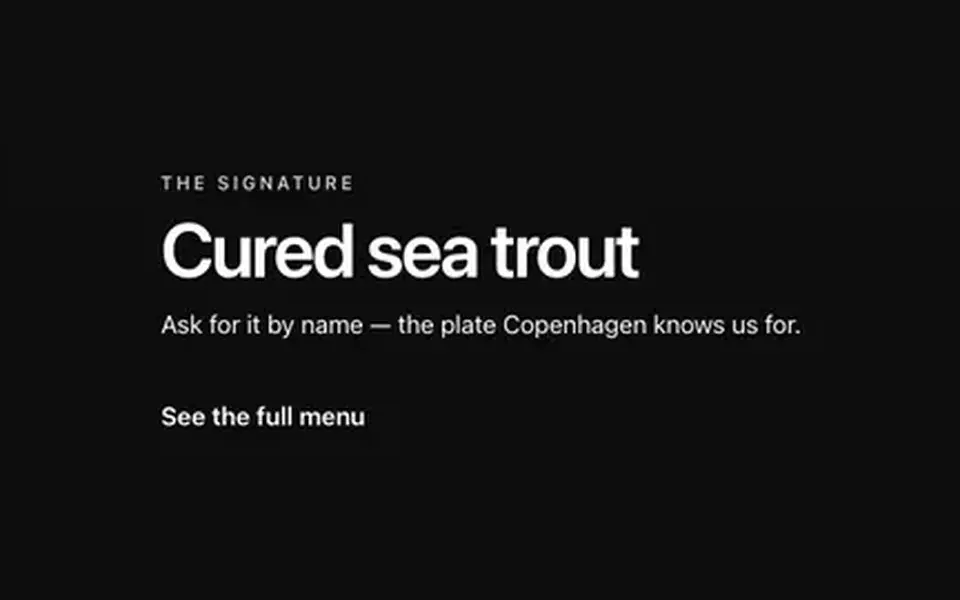
One dish, full screen — name, story, price.

05
Full-width image band with optional caption.
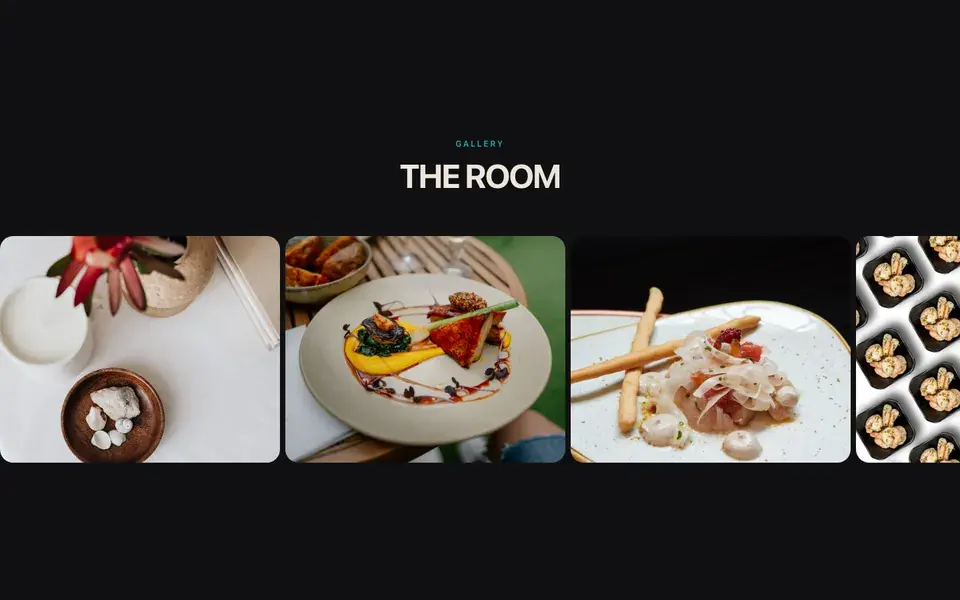
06
Grid, masonry or moving strip.
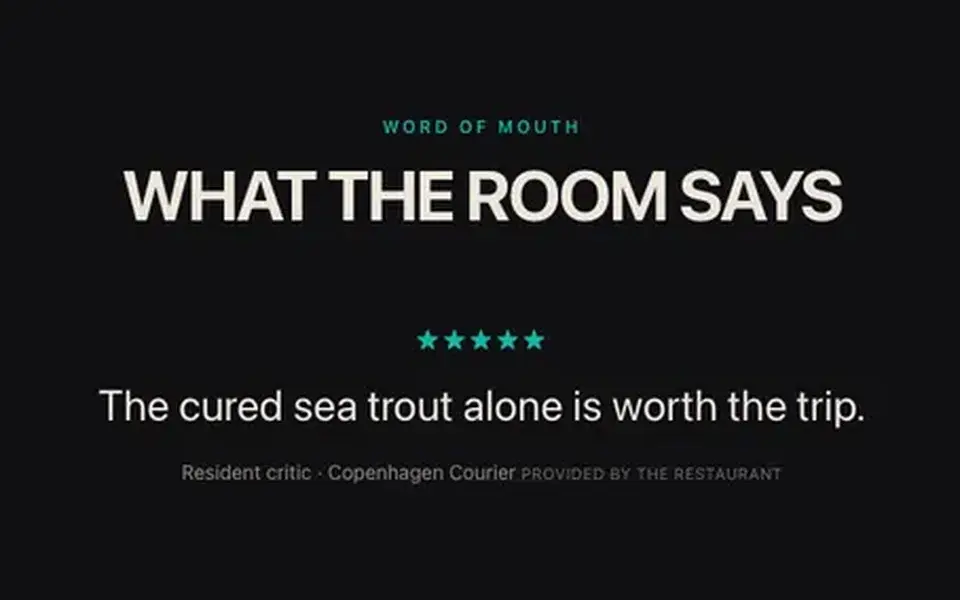
07
Guest quotes with stars.
08
Headline + button band.
The statement block currently reads Short seasons, long memories — preserved, fermented, and served in their own time. — one line you will rewrite in about four seconds.
Loading the live preview…
Klippeholm uses the Showcase ordering layout — on a laptop each section opens on a wide photograph with its dishes as large photo cards; on a phone it keeps the delivery-app rows.
It reads like the delivery apps your guests already know, except the restaurant keeps the relationship and the money. The basket stays on screen, and each mode asks only for what it needs: a table number, a phone number or an address.
Loading the live preview…
This is the frame that matters. It is the real ordering page at a real phone width — not a mock-up, not a video.
On a laptop the same page puts the basket in a panel beside the menu that follows the scroll.
Every Klippeholm site on Growth and Full ships with an app your guests keep. It lives at /account on your own domain, so the guest signs in to your restaurant, not a marketplace.
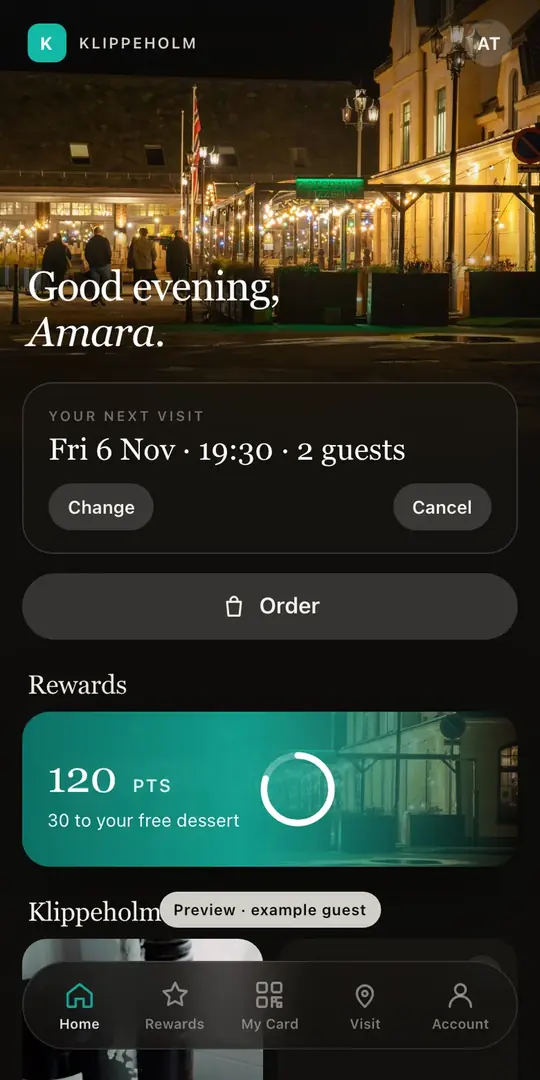
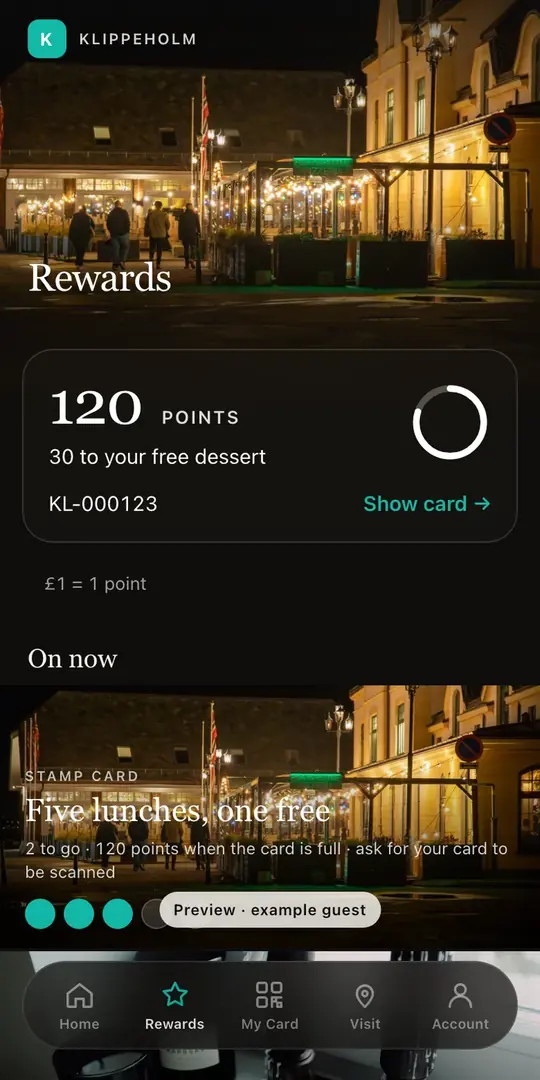
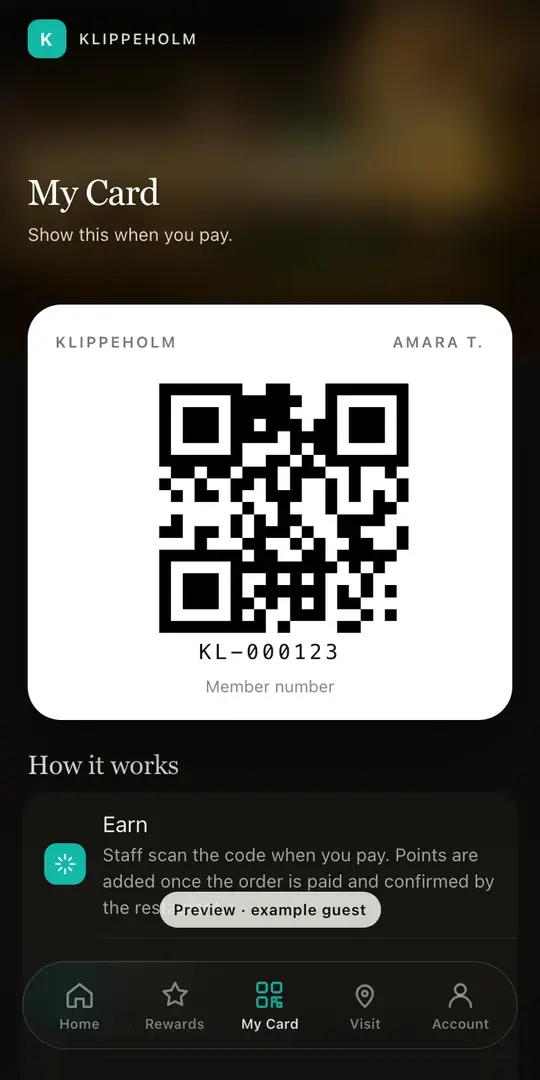
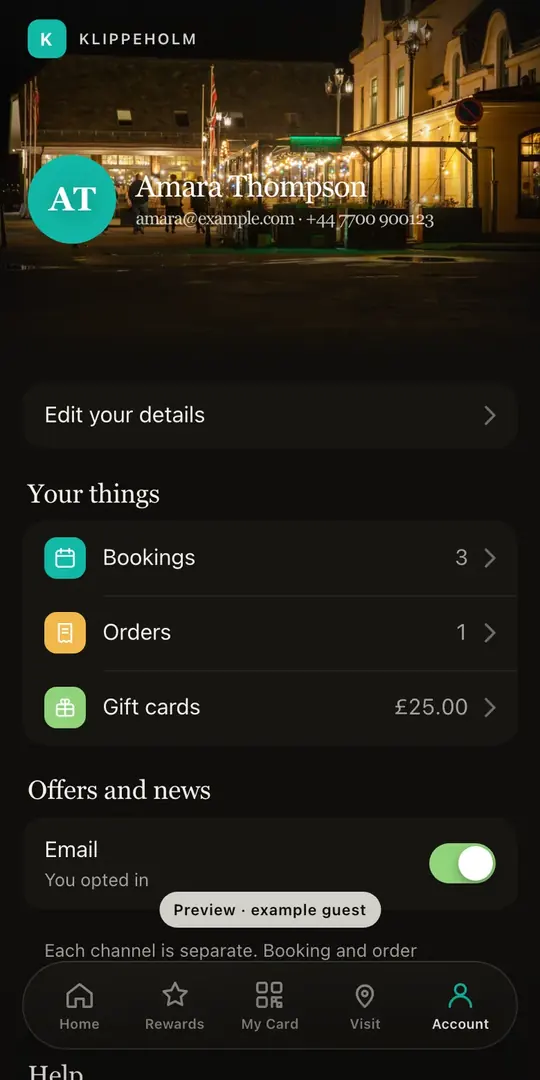
Included on the Growth and Full plans. Watch the Guest App course
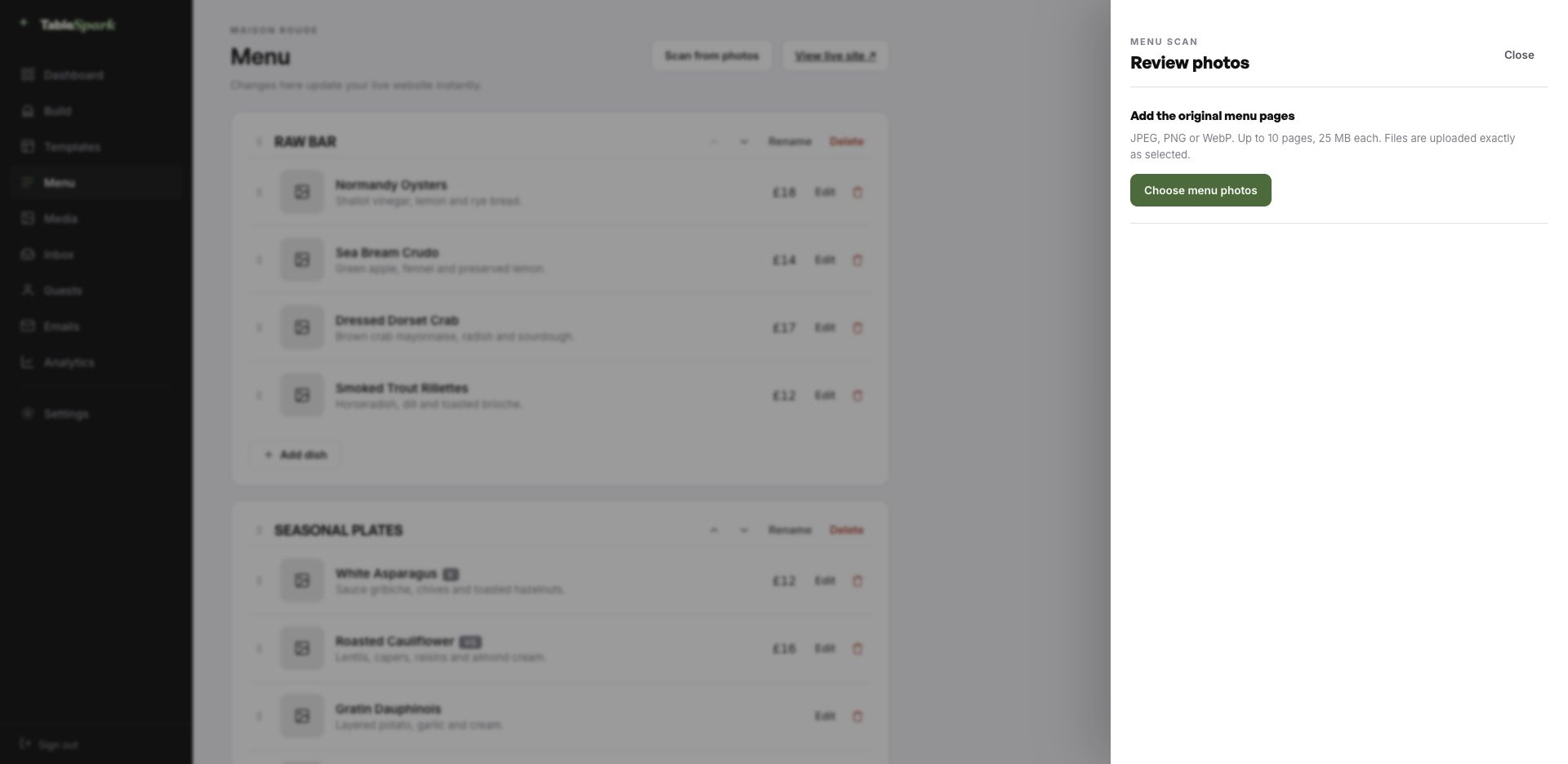
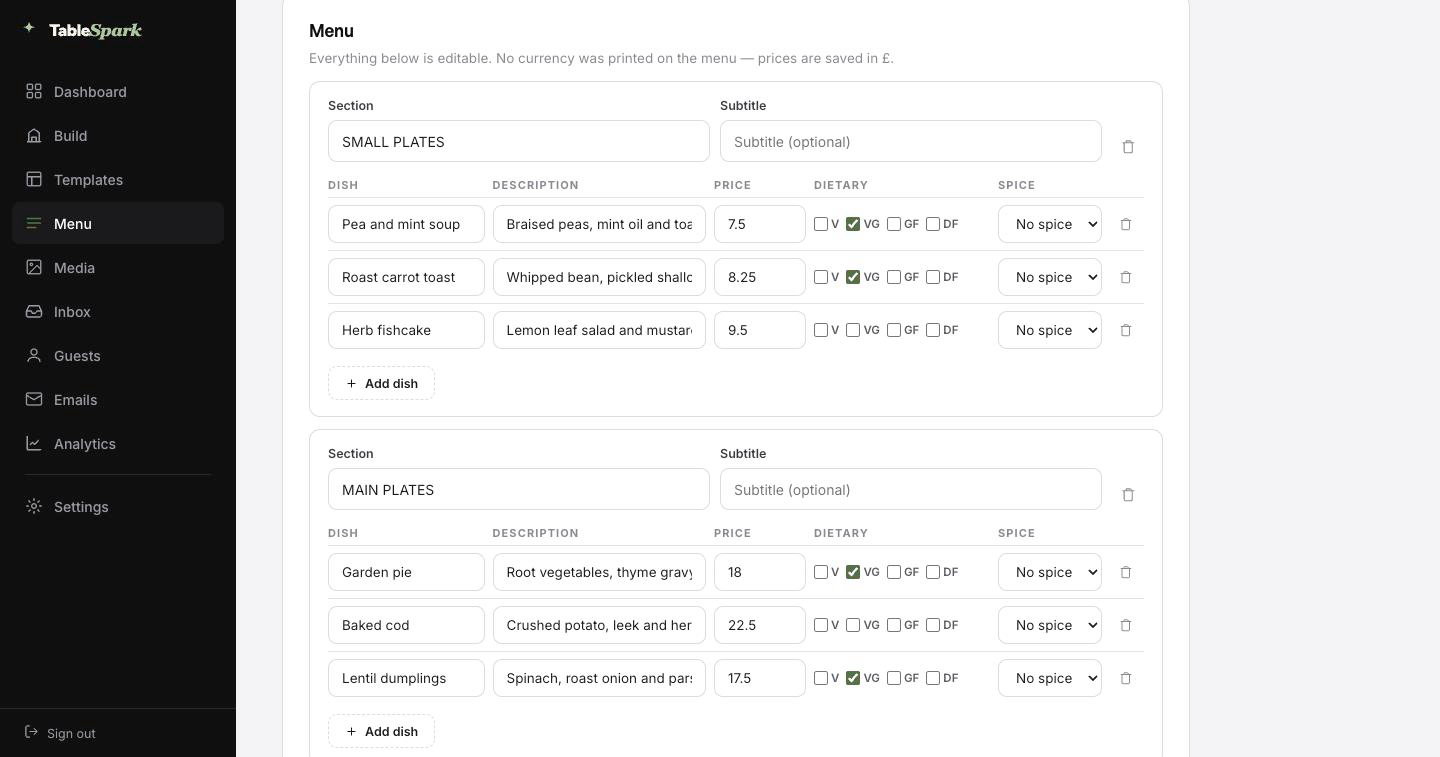
Nobody starts a website looking forward to retyping ninety dishes. Point a phone at whatever your menu currently lives on and send it over. The AI turns it into sections, dishes, descriptions and prices, and picks up the dietary marks and heat levels it can see. Read it back, adjust anything the photograph fumbled, and that is the menu built.
A photograph of a menu is decoration; a structured menu is infrastructure. From there the same data runs the menu page, the ordering page, the highlights on the home page and the Restaurant structured data a search engine reads. Change a price once afterwards and all of them follow.
And the fields nobody enjoys writing — the search title and description — are drafted by a Write with AI button that reads the page first. The AI writes the first version; you decide whether it is the last.
The printed card, a chalkboard, a PDF, a takeaway sheet. Straight from your phone.
Sections, dishes, descriptions, prices and dietary marks come back as structured data for you to check.
Menu page, ordering page, home-page highlights and the Restaurant schema — from the one source, together.
You are not commissioning a website; you are moving into one. The site works from the first second — it simply has the wrong name on the door. One sitting covers it — and the second it is live, the booking form is taking reservations. It lands in the inbox with the party size and the time, and the guest is confirmed by email at once.
Attach your own Stripe account and the site can charge for orders and hold deposits on tables — the funds are yours from the start. We take 0%. Not on the first order, not on the thousandth. Stripe’s standard card-processing fees apply to online payments.
Step 01
1min
Pick KlippeholmThe whole site copies into your account, menu and all.Step 02
4min
Change the name and the wordsClick any block and type. The restaurant name propagates everywhere.Step 03
3min
Upload your menuPhotograph it and let the AI build the sections, dishes and prices.Step 04
1min
PublishYou are live on your address. Bookings work immediately.Step 05
1min
Connect StripeNow you can take deposits on tables and payment on orders — direct to your account.In all
10min
From template to taking paymentsFive steps, one sitting.The web address is something guests read aloud, so it should sound like you. You can be live before lunch on a TableSpark address and on your own domain by the weekend, with no rebuild in between.
Everything fiddly about a domain — SSL, renewals, bare-domain redirects, canonical URLs surviving the move — is managed on your behalf. Already own the name? Keep it — you get the exact record to update, in plain English.
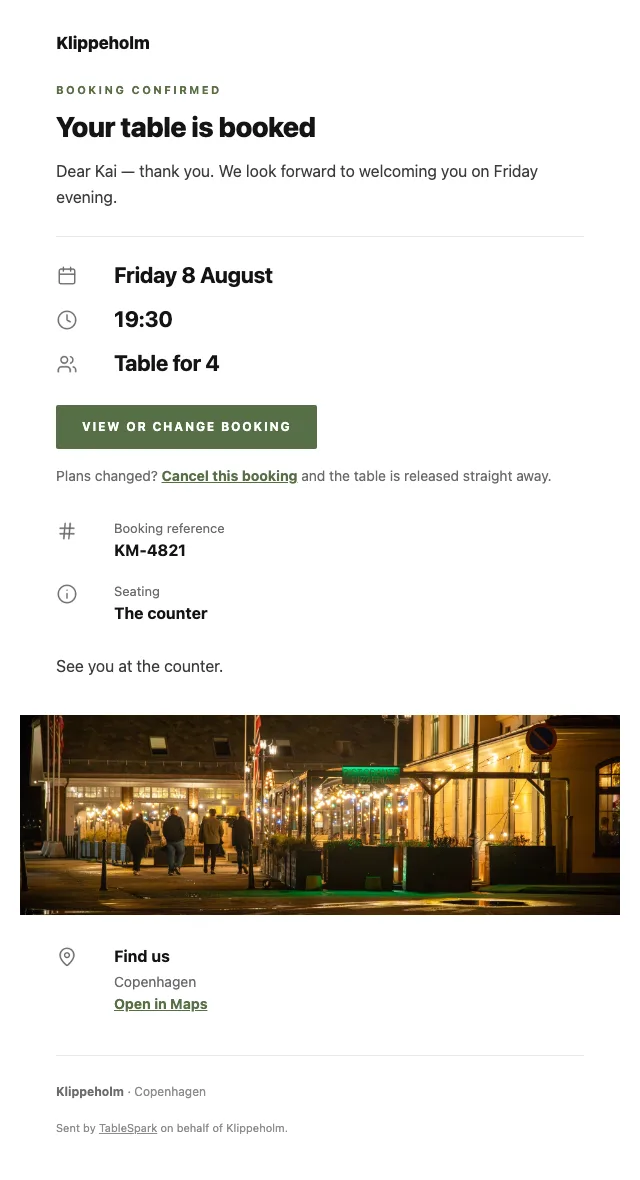
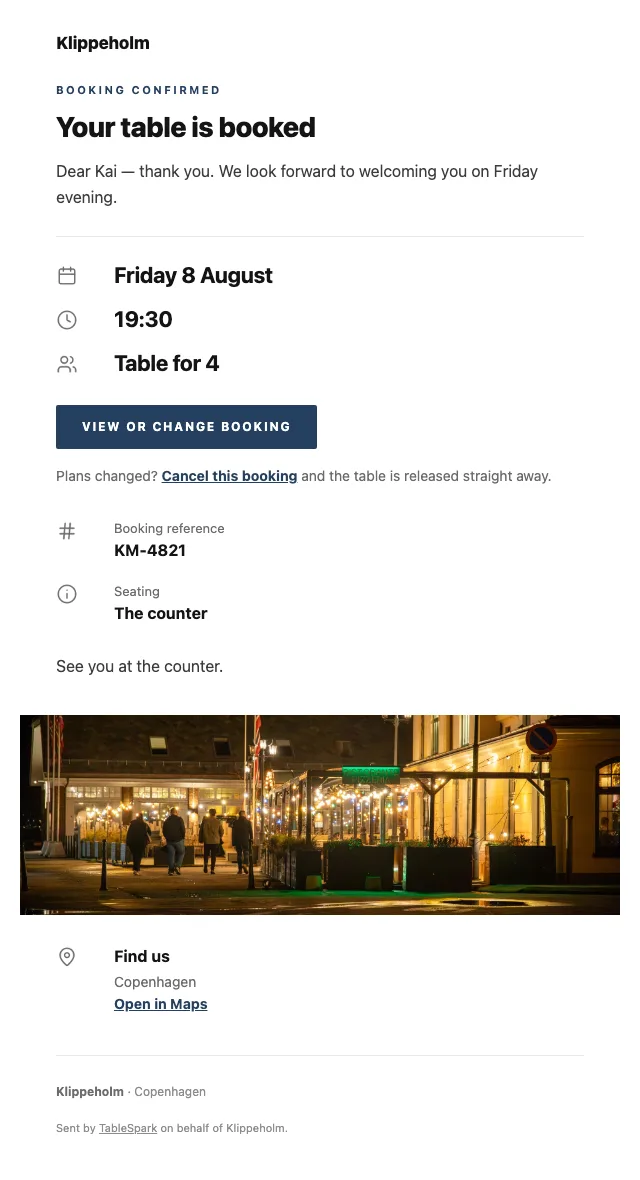
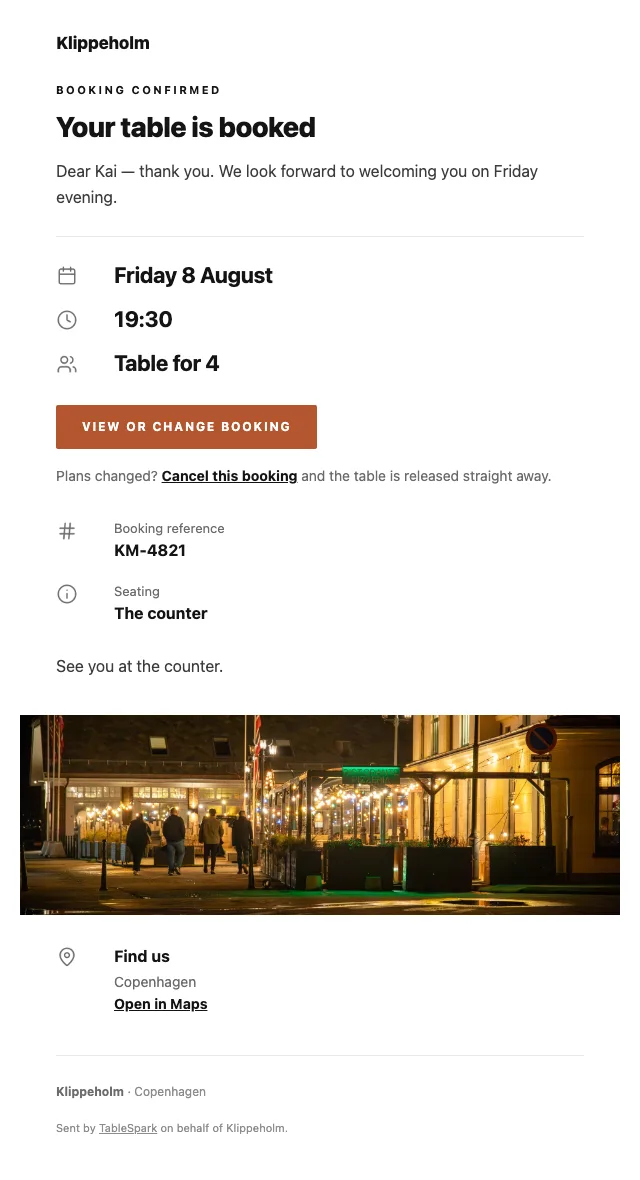
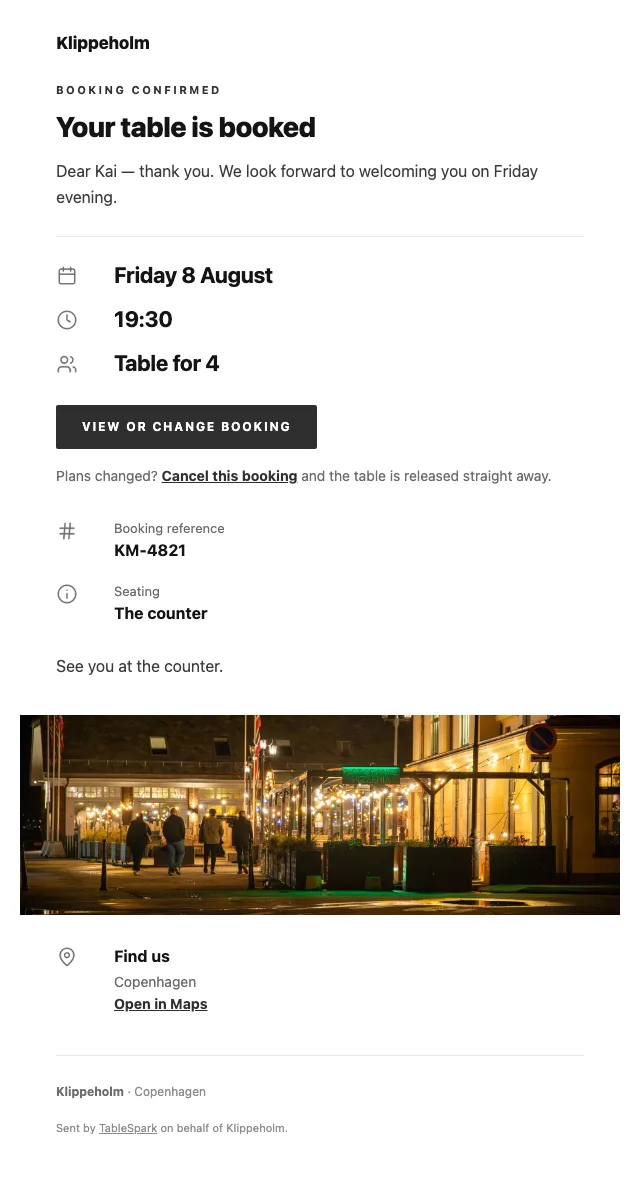
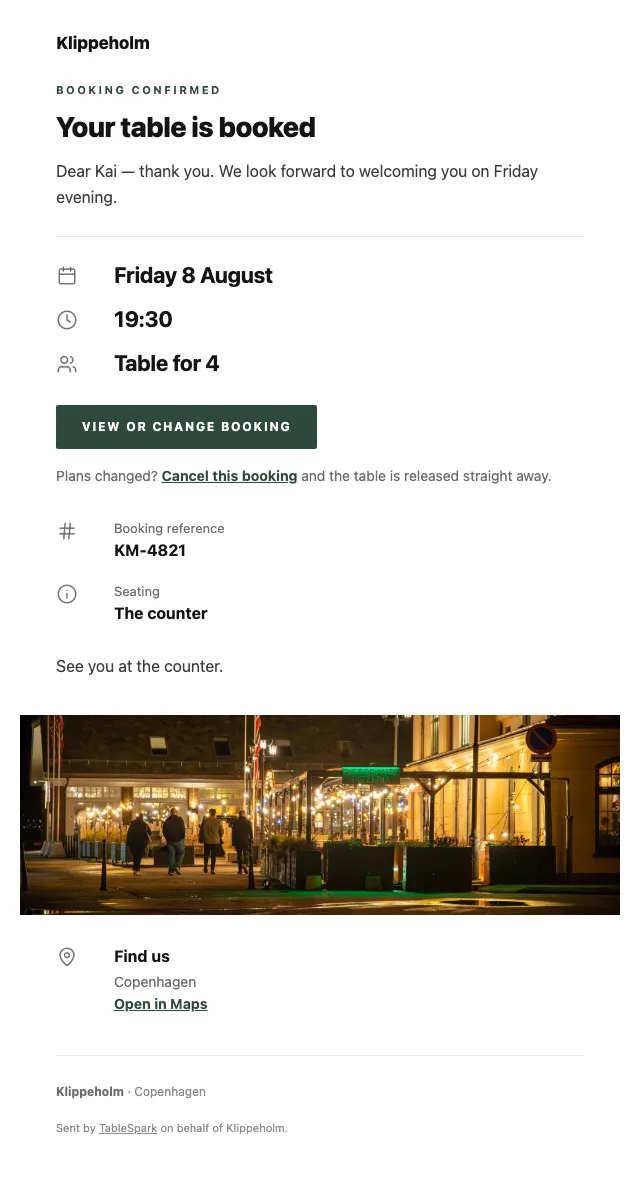
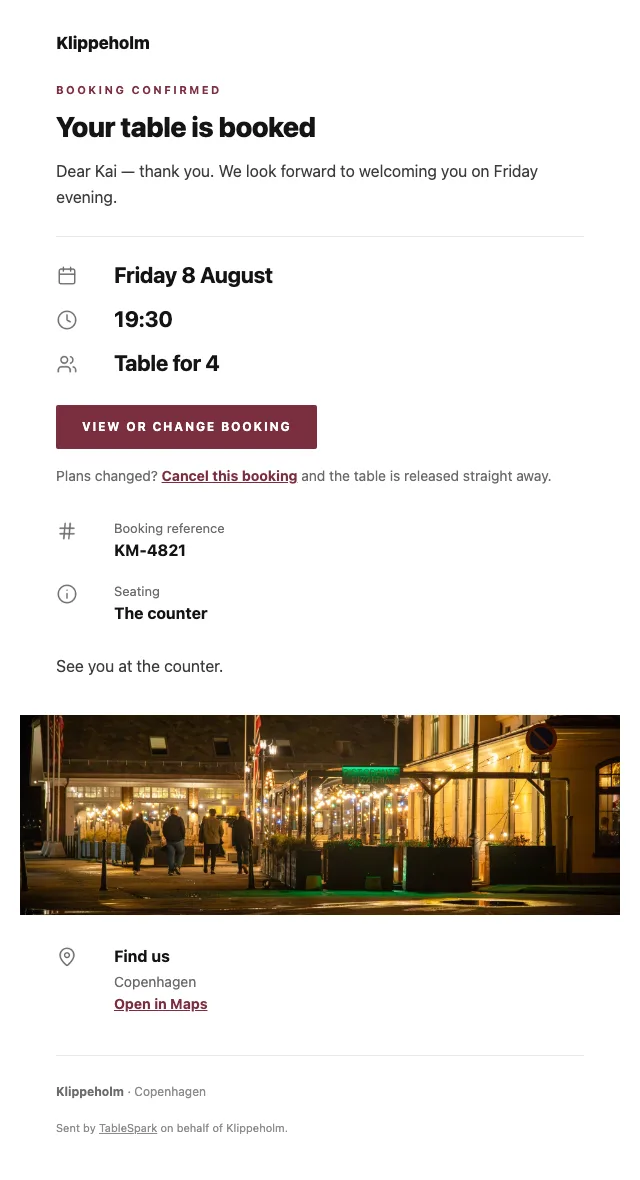
The email that follows a booking is read more carefully than any page on the site. As soon as a table is confirmed, the guest gets an email in your name carrying the date, the time, the number of covers, your address, your phone number and a way to cancel cleanly. Reminders, receipts and cancellations follow the same treatment, so nothing looks bolted on.
It carries your restaurant, not our branding. Pick one of six templates, then set the accent, the logo, a cover image, how the header sits, the sign-off line, your links and your social marks. When your domain is connected the mail is sent from your own address, which is also what keeps it out of a promotions tab.
Below, the same booking confirmation in six of the accent colours you can pick.
Being published and being findable are two different things, and only one of them happens automatically. The usual culprits are mundane: a robots rule nobody removed, two canonicals pointing different ways, orphaned pages, the menu published as a PDF, no structured restaurant data, search verification half done. The cost lands on the restaurant — guests searching your name, your menu or your street reach directories and commission-charging marketplaces first, and you end up paying for the traffic you should already own.
All of that is finished before you arrive. Search results are not something anyone can promise you. A correctly configured site is, and that is what this is.
All of them optional, all of them editable, and more can be added.
Each of these is a module from the same set of 70 that every TableSpark site can use, and most have multiple layout options.
Delete, reorder or replace any of them — the page is built, not drawn.
Ships with 4 sections — The cold table, Fire & smoke, Grain & dairy, To finish — for you to overwrite.
We take 0%, on every plan, for ever. Stripe’s standard card-processing fees apply to online payments. A marketplace takes a percentage of each order and keeps the customer.
Here the page is on your domain, the order is in your inbox, and the guest’s details are yours to export.
Why we charge nothing per order
You bring the menu and the last word. TableSpark brings the typing, the fields and a first draft of the search copy.
Nothing goes live on its own.
Search engines The Menu — Klippeholm | Bornholm An island kitchen cooking from its own larder. The seasonal menu, the preserves and the prices.Drafts the search title & description from this page’s content. Always review before publishing.
Stripe’s standard card-processing fees apply to online payments.
What a fair restaurant deposit looks like
Make the entire site, sleep on it, start again if you want. Nothing is charged until you publish.
Make the entire site, sleep on it, start again if you want. Nothing is charged until you publish.
6 pages, and every one of them is here. Everything below is rendered, not photographed. The frame uses the same engine as a published site, so the tabs and the in-page links are all real. Phone shows the mobile layout.
The story page carries the island, the larder and the seasons — narrative, sourcing, interview, timeline, gallery. The visit page does real work explaining a location that involves a ferry and a season.
The plated layout gives each section its signature dish as an image and the rest as type — the right balance for a menu where a few preparations carry the argument and the others support it.
A preserving kitchen’s menu is full of dates and processes, and the description field carries them: the year it was picked, the length of the ferment, the island it came from. All indexable text rather than a photographed card.
The layout can change; what does not is that each dish, its description and its price are text on the page, wrapped in Restaurant schema — rather than a PDF or a picture of a card.
The minimal ordering layout — a clean typographic list — is right for pantry goods: preserves, ferments, vinegars, a hamper. The description sells them; a photograph of a jar does not.
Quantities and sizes are inline, the total stays visible, and payment lands in your own Stripe account with no commission taken by TableSpark. Stripe’s standard card-processing fees apply to online payments.
Each mode collects only what it must: a table number for dine-in, a telephone number for collection, an address for delivery.
Running a Seafood kitchen? See all Seafood restaurant website templates.
What owners ask before they pick a template: the cuisine fit, the menu, the address, and what it costs.
It stays live and stays indexed, which is what protects the visibility you built over the season. The booking form simply offers no dates while you are closed, and the reservations page can carry a line about when you reopen. Taking a site down for a season means starting again in search when you return.
Yes — an ordering page carries them with their own prices and options, settling into your own Stripe account at 0% commission from us. Stripe’s standard card-processing fees apply to online payments. It runs alongside the restaurant pages, and the same inbox receives both orders and bookings.
No. Every section on every page is edited in the builder: click a block, change the words, drop in a photograph. Nothing on this page was hand-written HTML — it is the same block library your own site is built from.
It is part of the Full plan, and there is no commission at any level — 0%. Stripe’s standard card-processing fees apply to online payments. Money is paid into your own account.
There is no need. Send in a photograph of the card, the board or an old PDF; the AI reads it into proper fields and shows you everything before it saves. The payoff comes later: because the menu is structured rather than pictorial, changing one price updates the menu page, the ordering page, the home-page highlights and the Restaurant structured data in the same moment.
One sitting. You copy the template, replace the name and the copy, photograph the menu in, and publish. From that second the booking form works: reservations land in your inbox and guests are emailed a confirmation automatically. Linking a payment account takes another minute and lets the site hold deposits and take order payments, at 0% commission from us. Stripe’s standard card-processing fees apply to online payments.

One click copies the entire design into your account. Everything after that is editing — and it is free until you publish.