Contents
A card fee added to the bill can be unlawful, unenforceable and repayable, while the card cost it was meant to cover keeps arriving every month.
No, not for an ordinary consumer debit or credit card. Since 13 January 2018, regulation 6A of the Consumer Rights (Payment Surcharges) Regulations 2012 has banned a payee from charging a payer any fee for paying by such a card. A fee charged anyway is unenforceable and repayable under regulation 10. Commercial cards are the exception, capped at cost. The lawful way to cover card costs is to price them into the menu, about £0.85 on a £32.00 meal in the example below.
The card fee line a guest can claim back
Every month the card processor's statement arrives with a figure on it. Every month the owner is tempted by the same quick fix: a line on the bill, or a sign at the till, saying that card payments carry a fee. The fix feels fair, because the cost is real. It is also the one move that makes a business cost a legal problem. A fee for paying by an ordinary card is banned. A fee charged in breach of the ban is unenforceable, so the guest does not have to pay it, and the contract is treated as providing for it to be repaid if the guest already has. The restaurant is then left with the original card cost, a refund to make and a record of every guest who paid.
The scale of the risk is simple to work out. Take an illustrative restaurant that takes £48,000.00 a month on cards and adds a 2% "card handling fee". That is £960.00 a month, or £5,760.00 over six months, collected under a line that regulation 10 treats as repayable. The illustration is invented, but the arithmetic is the owner's own. The larger the card takings, the larger the sum that could be claimed back. Enforcement sits with Trading Standards, the local weights and measures authority, which the regulations name as the body that considers complaints and can seek an injunction.
The ban is not new, and it was not created for restaurants. HM Treasury announced it on 13 January 2018 and estimated that surcharging "cost Brits £166 million in 2015". It is an understandable temptation: the card cost shows on the statement every month and the fee line looks like the obvious answer. The Journal's restaurant pricing law guide, published on 13 October 2026, found no decision by the CMA, Trading Standards or the Advertising Standards Authority against a restaurant, pub or cafe over a card surcharge. A rule that has not been tested against restaurants is still a rule.

This guide sets out what the regulations say, in their own words, what counts as a fee, where the exceptions sit, how the Digital Markets, Competition and Consumers Act 2024 (DMCC Act) headline-price rule fits with the ban, and what a card payment actually costs. It then shows the lawful ways to cover the cost: pricing it in, and bringing it down. The figures use a stated, invented restaurant and rates read on the processor's own page on 19 October 2026.
This is a summary of public law and official guidance as published on 19 October 2026, not legal advice; check the current position, or take advice, before acting on a specific case.
What the law says about card surcharges in a UK restaurant
The rules sit in the Consumer Rights (Payment Surcharges) Regulations 2012 (SI 2012/3110), as amended. Two regulations matter most, 6A for the ban and 10 for what follows a breach, and a third, 4, caps fees that are still allowed.
The ban on card fees: regulation 6A
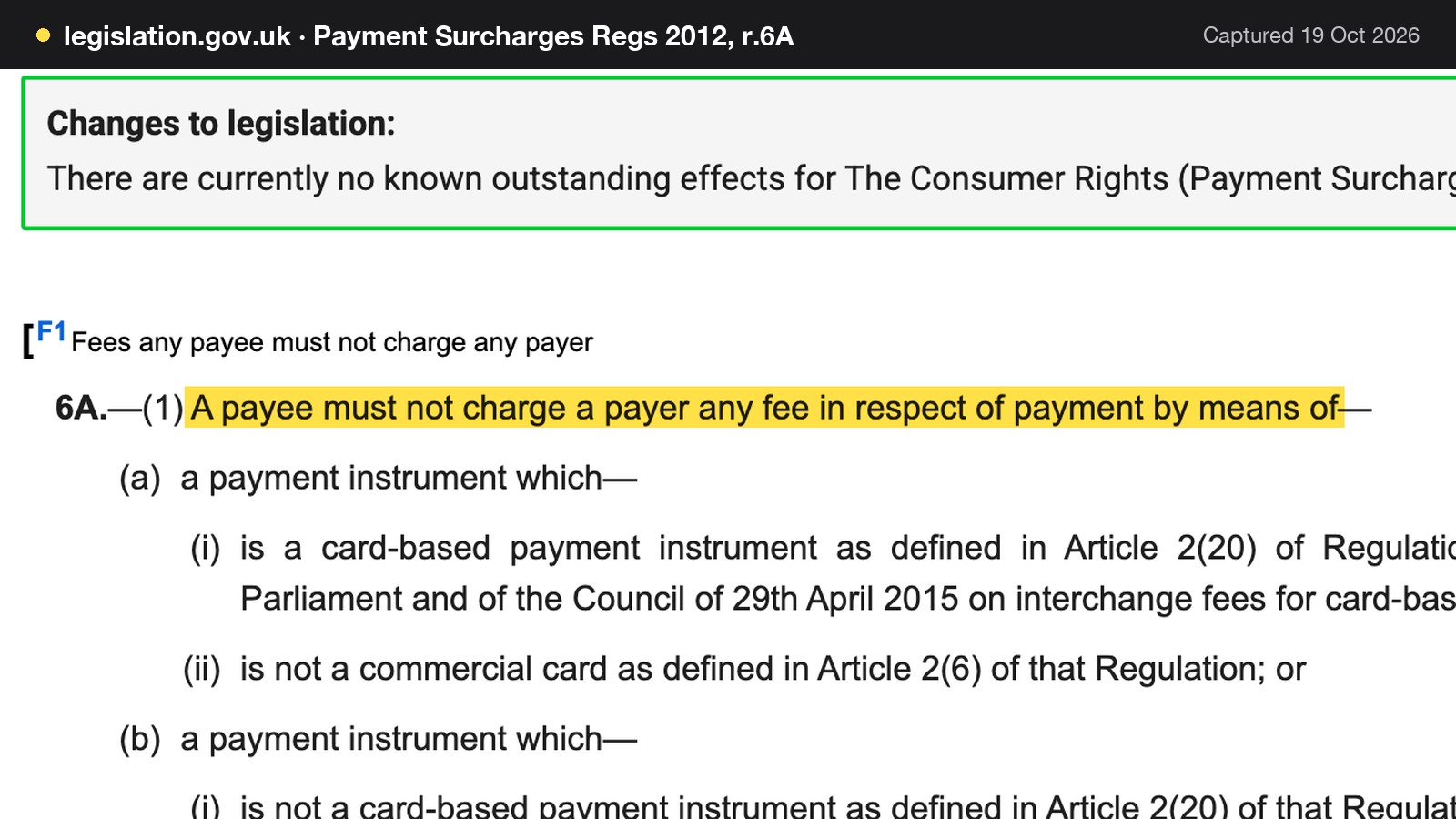
Regulation 6A was inserted on 13 January 2018 by the Payment Services Regulations 2017. Its first paragraph reads:
A payee must not charge a payer any fee in respect of payment by means of
On legislation.gov.uk the sentence continues into a list of three cases. The first is a card-based payment instrument that is not a commercial card. The second is a payment instrument that is not card-based and would not be a commercial card if the commercial-card definition covered any payment instrument. The third is a payment service covered by the euro credit transfer and direct debit regulation.
In plain words, regulation 6A(1), inserted on 13 January 2018 by the Payment Services Regulations 2017, says that a payee must not charge a payer any fee for payment by a card-based payment instrument that is not a commercial card.
A restaurant is the payee and the guest is the payer. Regulation 6A applies to any payee and any payer, so it does not depend on the guest being a consumer, and the micro-business exemption that the original 2012 text gave to regulation 4 ended on 12 June 2014. The regulations list excluded contracts in regulation 5(2), and none of them is a restaurant meal.
HM Treasury's announcement said the same thing in everyday words. On 13 January 2018 it wrote:
Today's ban means that it will be unlawful for retailers to charge additional fees when someone uses a particular credit or debit card, or other payment systems like PayPal, to make a purchase.
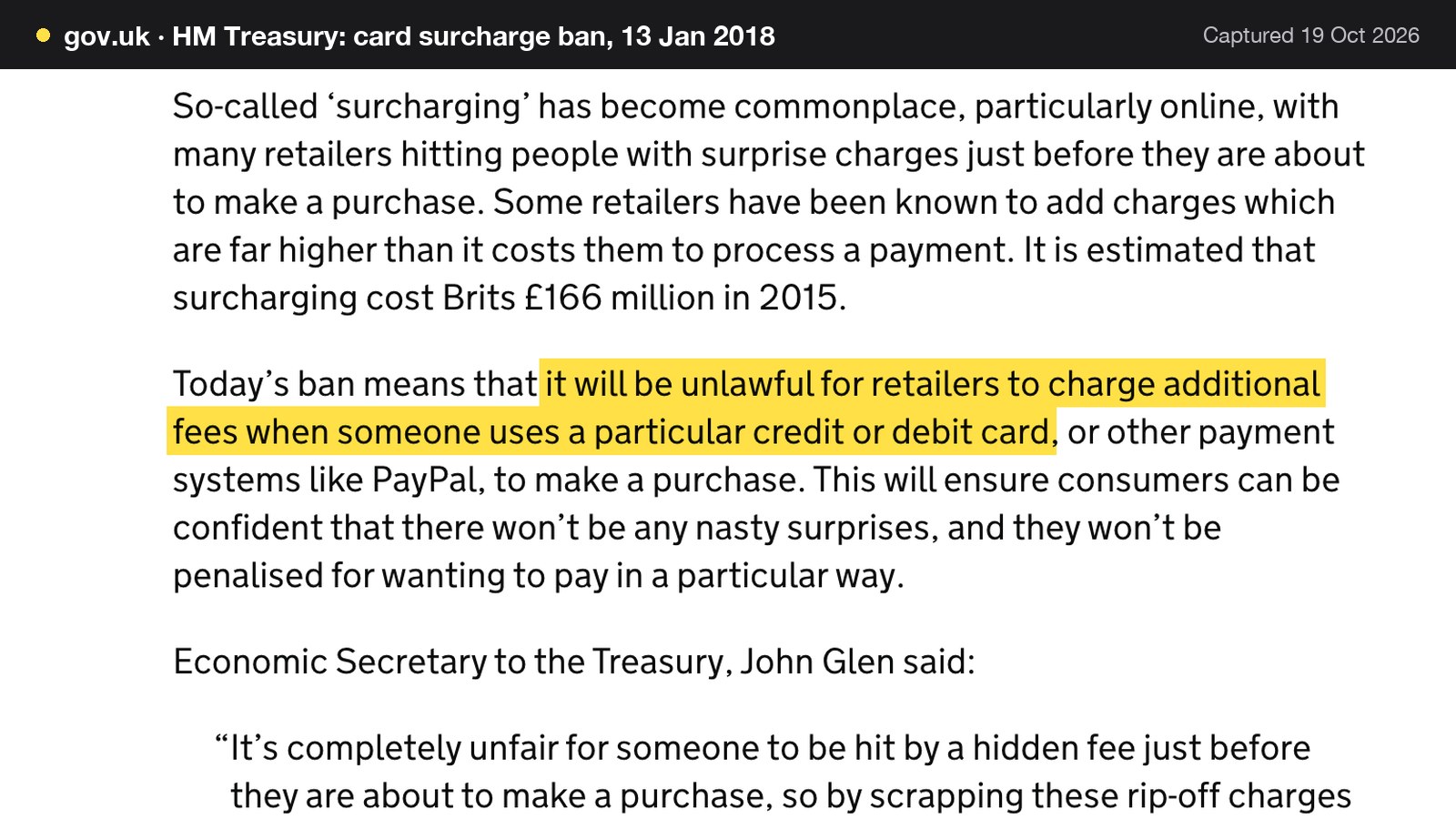
The same news story says "The new rules will be enforced by Trading Standards who will have the power to take civil enforcement action against traders who breach the regulations."
What counts as "any fee"
The regulation bans "any fee in respect of payment by means of" the card. On this article's reading, its words look at what the charge is for, not at what the line is called. A "card handling fee", a "processing charge" or an "admin fee" that applies when the guest pays by card, and not otherwise, is a fee in respect of payment by that card. A percentage added to card payments and a flat amount added to card payments are both fees. This is the article's reading of the text, not a ruling, and the sources read for this guide include no decided restaurant case.
Three things do not turn on the label at all. A deposit paid by card is a deposit, not a fee for using the card. A service charge that every guest pays is a different question, covered in the pricing law guide. A delivery charge that every customer pays, whatever the payment method, is a delivery charge. The test is whether the extra amount depends on how the guest pays.
The business-card exception
Regulation 6A(1)(a)(ii) carves out "a commercial card as defined in Article 2(6)" of Regulation (EU) 2015/751. The definition, as published on legislation.gov.uk, reads:
'commercial card' means any card-based payment instrument issued to undertakings or public sector entities or self-employed natural persons which is limited in use for business expenses where the payments made with such cards are charged directly to the account of the undertaking or public sector entity or self-employed natural person;
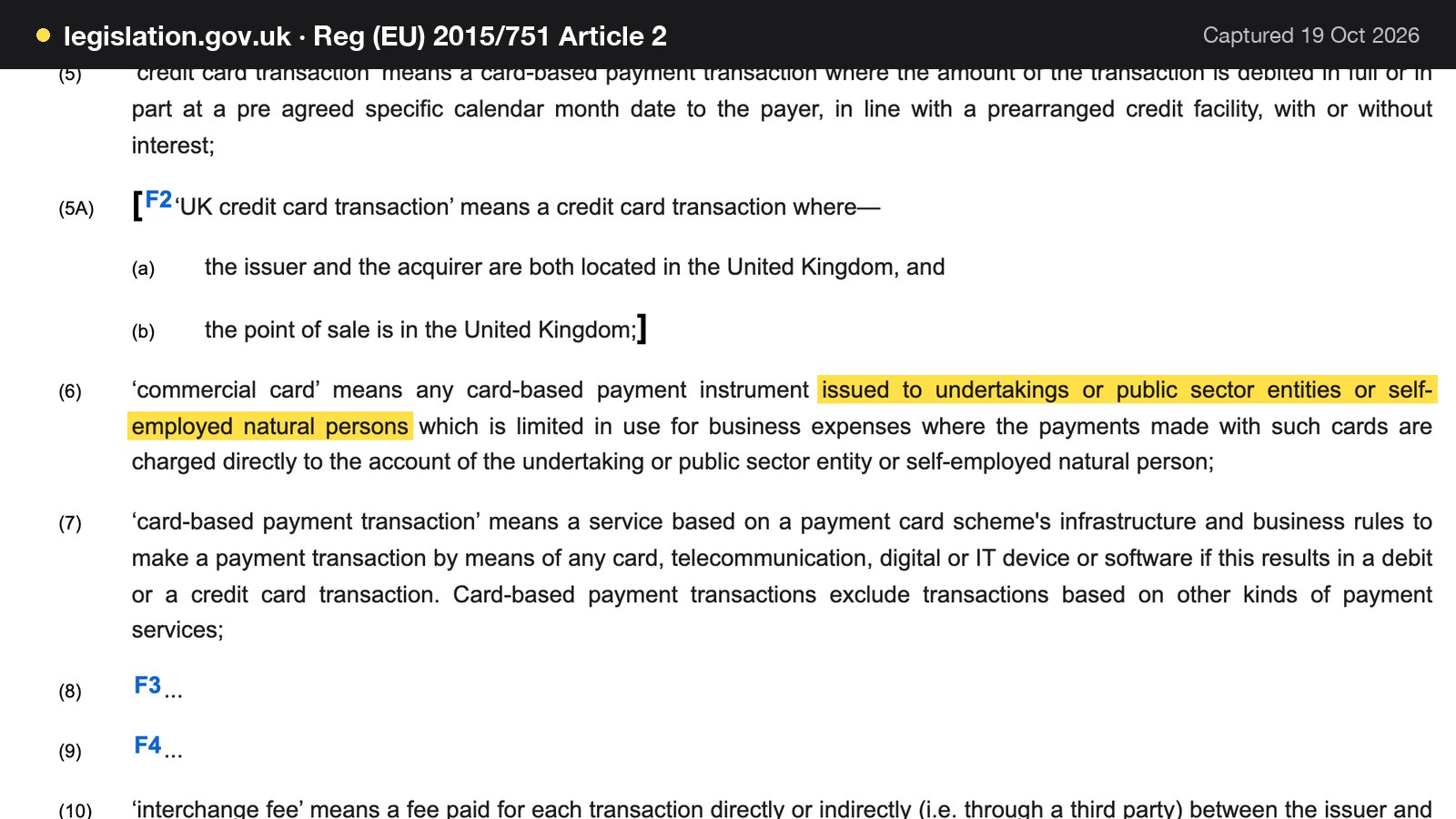
So the outright ban in regulation 6A(1) does not cover a commercial card, which is a card issued to a business, a public body or a self-employed person for business expenses and charged straight to that account. A fee is still capped. Regulation 6A(2) says that a payee receiving a payment by a payment instrument "must not charge the payer, in respect of such payment, a fee which exceeds the costs borne by the payee for the use of that specific payment instrument."
On this article's reading, a restaurant with many corporate bookings could in principle charge for commercial cards up to its own cost. Whether that is worth doing is a different question. The restaurant would need to be able to tell a commercial card from a personal one and to show the cost it bore for that specific instrument. The regulations do not say how either is done at a restaurant table. A fee that is a few pence over cost fails the cap.
Cards issued abroad
Regulation 6B sets out where regulation 6A applies. It applies only if the payment service provider of the payer or of the payee is in the United Kingdom. Where both are in the UK, regulation 6A(1) and (2) apply. Where one is in the UK and the other is not, the regulation says "regulation 6A(2) applies but regulation 6A(1) does not apply."
On this article's reading, a card issued by a bank outside the UK and processed by a UK provider falls under the cost cap in regulation 6A(2) rather than the outright ban in 6A(1). Regulation 4 separately says that "A trader must not charge consumers, in respect of the use of a given means of payment, fees that exceed the cost borne by the trader for the use of that means." HM Treasury put the general position this way: "In the vast majority of other circumstances surcharges are capped at the cost to the retailer for processing the payment." This guide does not recommend building a pricing policy on that gap. A restaurant would have to know where each guest's card was issued before the payment and be able to show the cost it bore, and none of the sources read says how that could work at a table.
If a card fee has been charged anyway: regulation 10
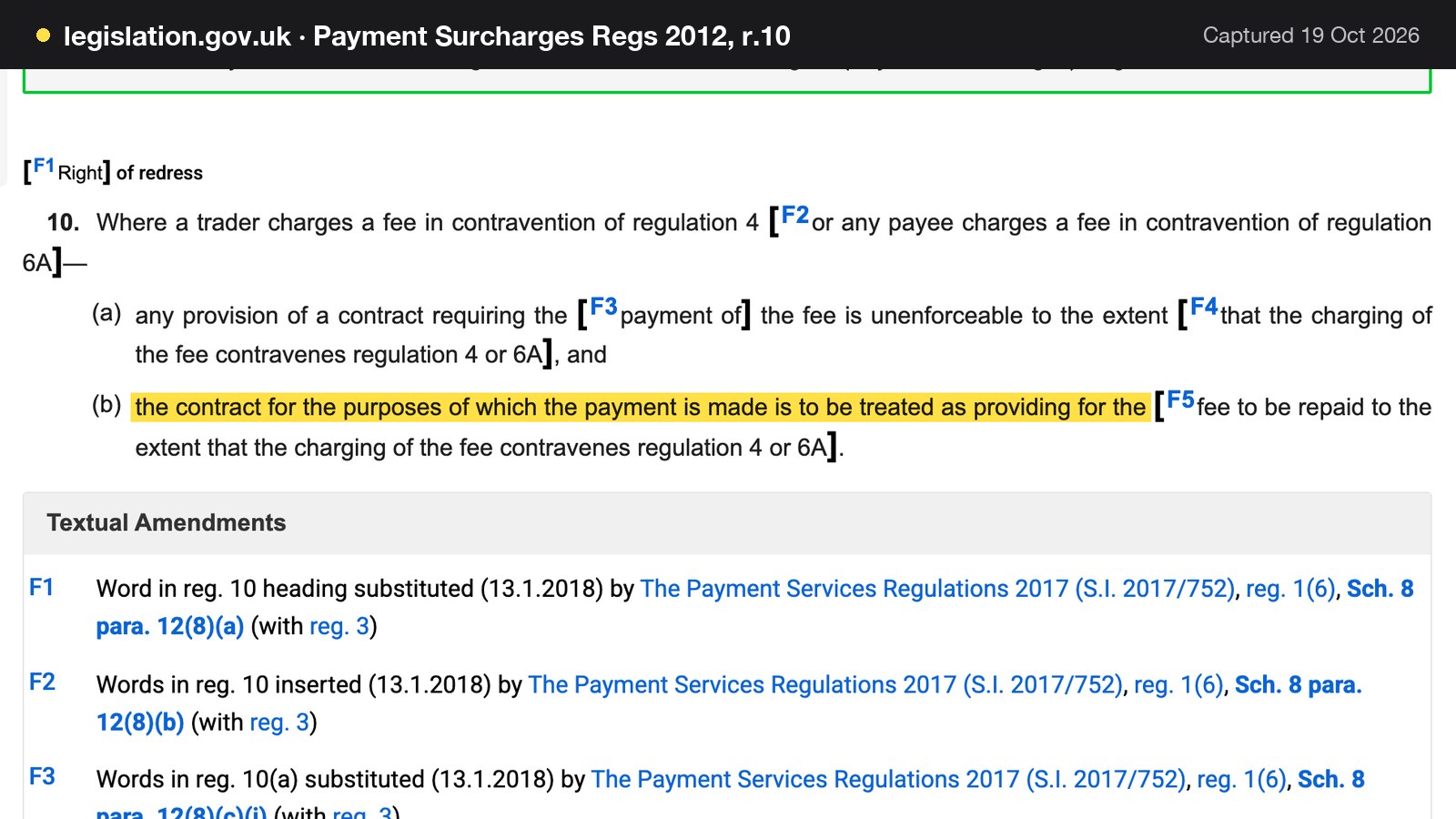
Regulation 10 is headed "Right of redress". It says that where a payee charges a fee in contravention of regulation 6A:
(a) any provision of a contract requiring the payment of the fee is unenforceable to the extent that the charging of the fee contravenes regulation 4 or 6A, and (b) the contract for the purposes of which the payment is made is to be treated as providing for the fee to be repaid to the extent that the charging of the fee contravenes regulation 4 or 6A.
In plain words, a card fee charged in breach of the ban is unenforceable, and the contract is treated as providing for the fee to be repaid.
The HM Treasury announcement adds that the rules "will also entitle customers to receive a refund of any unlawful surcharge they have paid and enable them, if necessary, to take legal action to recover any such surcharge."
Enforcement has three layers. Under regulation 7, every local weights and measures authority in Great Britain must consider complaints about a breach of regulation 4 or 6A, unless the complaint is frivolous or vexatious, and under regulation 8 it may apply for an injunction, or in Scotland an interdict, against the person responsible. The DMCC Act 2024 adds a second route: section 150(2) refers to a "Schedule 16" of "Direct enforcement enactments", and that schedule lists "Regulations 4 and 6A to 10 of the Consumer Rights (Payment Surcharges) Regulations 2012". The Payment Services Regulations 2017, as amended in 2025, name the CMA and the local authorities as enforcement authorities for these regulations. This guide read no penalty amount for a regulation 6A breach and does not give one.
| What the rule says | Where | |
|---|---|---|
| Ordinary consumer debit or credit card | No fee for paying by it | Regulation 6A(1)(a) |
| Commercial card | No outright ban, but a fee must not exceed the payee's cost for that instrument | Regulation 6A(1)(a)(ii) and 6A(2) |
| Payment systems that are not cards, such as PayPal | Covered by the ban on the same terms | Regulation 6A(1)(b); HM Treasury, 13 January 2018 |
| Card issued outside the UK, UK provider | Cost cap applies; the outright ban does not | Regulation 6B(3), 6A(2) and 4 |
| A fee charged in breach | Unenforceable and treated as repayable | Regulation 10 |
| Who enforces | Local weights and measures authorities, and the CMA under the DMCC Act | Regulations 7 and 8; Schedule 16 |
The headline-price rule and the card ban point the same way
The card ban is only half of the pricing picture. The DMCC Act headline-price rule covers the other half.
Section 230(4) of the DMCC Act 2024 defines the total price of a product: "the total price of a product includes any fees, taxes, charges or other payments that the consumer will necessarily incur if the consumer purchases the product." The CMA's price transparency guidance (CMA209), published on 18 November 2025 and last updated on 7 January 2026, says: "It's illegal to hide additional fees, taxes or other charges that the customer will have to pay until later in the purchase process". It adds: "Include mandatory per-transaction charges in the total price of the product, even in early-stage advertising."
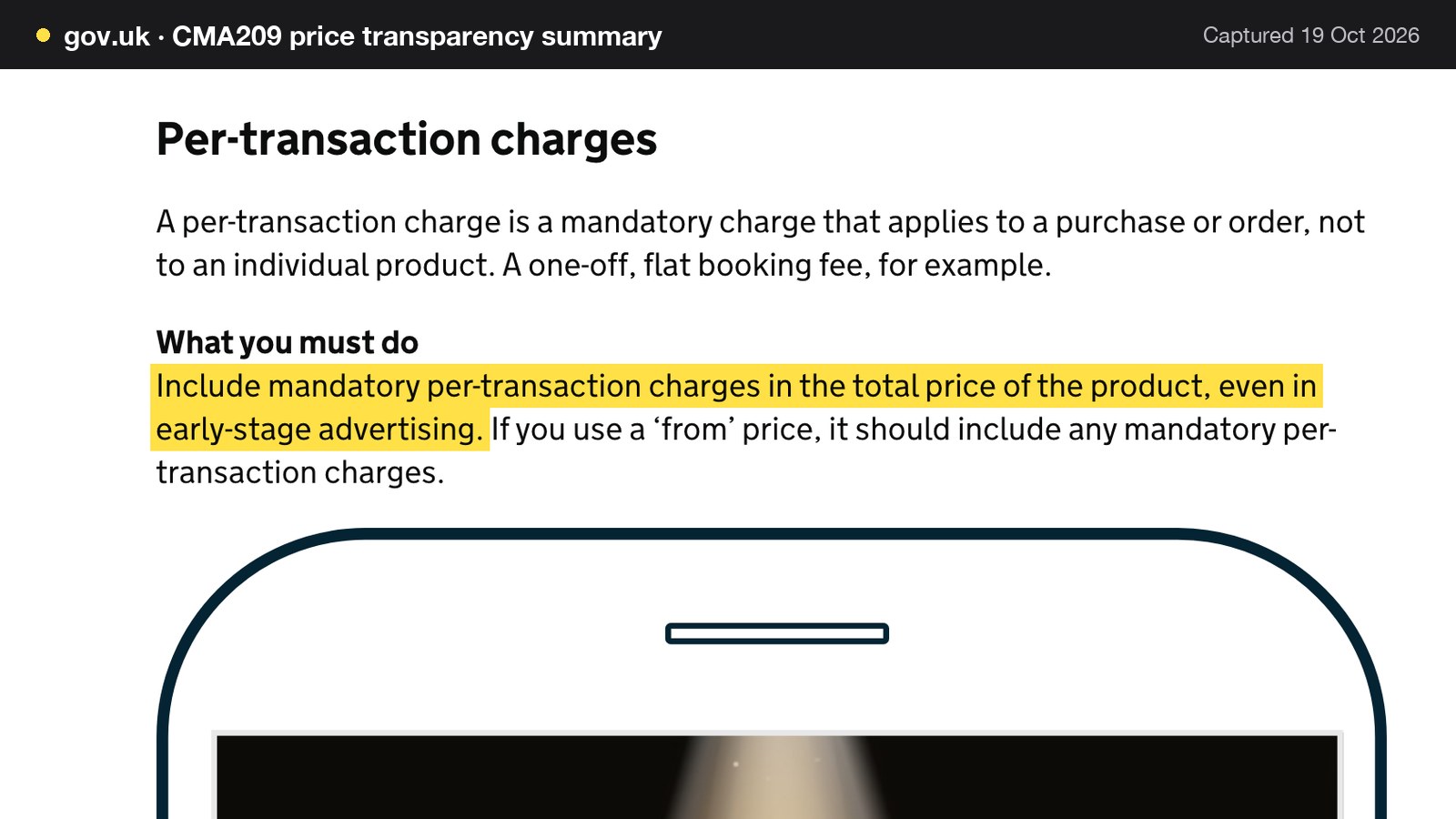
The CMA names the card ban itself. Paragraph 4.6 of CMA209, in the full PDF of the guidance, says that some products are subject to specific legislation requiring particular charges to be included in the total price, and gives this example: "the Consumer Rights (Payment Surcharges) Regulations 2012 prevent merchants from charging a fee in addition to the advertised price of a transaction on the basis of a consumer's choice of payment instrument (eg credit card)."
The headline-price point is short: the price on the menu, the order page and the bill has to be the price the guest pays, and a card fee added at the till is the kind of late addition that both the DMCC Act headline-price rule and regulation 6A are aimed at. On this article's reading, the safe design is a single price per dish that holds whichever card the guest taps, and the same rule applies to the order page and to the booking page. The restaurant pricing law guide and the menu price display guide cover the wider rules on service charges, VAT and what the menu must show.
What a card payment costs a restaurant
The card cost is real, and it is worth knowing exactly what it comes to before deciding how to cover it.
The rate card
Stripe's UK pricing page, read on 19 October 2026, lists these online card rates: "1.5% + 20p" for standard UK cards, "2.8% + 20p" for premium UK cards, "2.5% + 20p" for European Economic Area cards and "3.15% + 20p" for international cards. The two non-UK rows carry a further "2%" where currency conversion is required. The page describes its standard pricing as having "No setup fees, monthly fees, or hidden fees", which is a statement about account charges and not about the cost of each payment. These are live commercial prices that can change, so check them before relying on them. The wider picture is in the card payment processing fees guide, and the card cost of a deposit is covered in the restaurant booking deposits guide.
One illustrative restaurant
The numbers below are an illustration for an invented restaurant, not a statistic. It takes 1,500 card payments a month at an average of £32.00 (illustrative). Four in five go on standard UK cards and one in five on premium UK cards (illustrative). All sums use the rates above.
| Working | Result | |
|---|---|---|
| Card sales | 1,500 x £32.00 | £48,000.00 |
| Fee on one standard card payment | 1.5% x £32.00 + £0.20 | £0.68 |
| Fee on one premium card payment | 2.8% x £32.00 + £0.20 | £1.096 |
| Blended fee per payment | 0.8 x £0.68 + 0.2 x £1.096 | £0.7632 |
| Card cost a month | 1,500 x £0.7632 | £1,144.80 |
| Card cost a year | 12 x £1,144.80 | £13,737.60 |
| Card cost as a share of card sales | £1,144.80 / £48,000.00 | 2.385% |
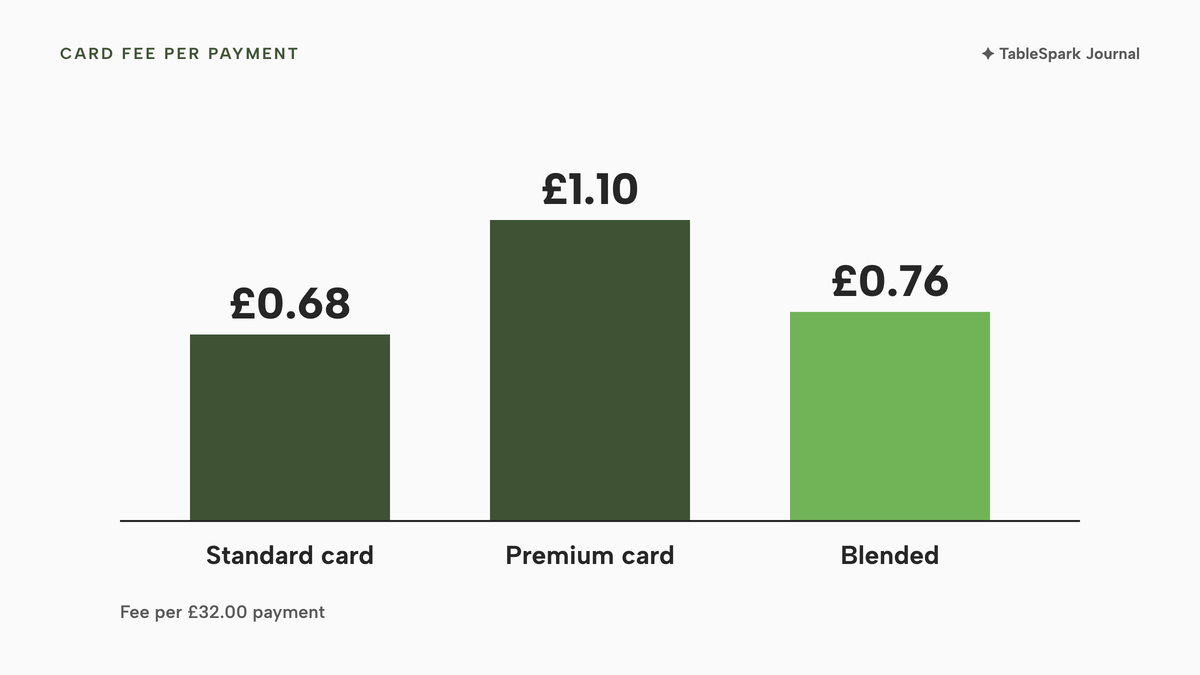
The blended fee is £0.7632 a payment, or £0.76 to the nearest penny. A standard card costs £0.68 and a premium card about £1.10. The restaurant does not choose which card a guest holds, so the mix is an input it can measure but not set.
Why small tickets cost more
The fixed 20p makes a small order dearer in proportion than a large one. On a standard UK card, the fee as a share of the ticket falls as the ticket grows.
| Fee, 1.5% + 20p | Fee as a share of the ticket | |
|---|---|---|
| £6.50 coffee and pastry | £0.2975 | 4.58% |
| £15.00 lunch | £0.425 | 2.83% |
| £32.00 meal | £0.68 | 2.13% |
| £60.00 table | £1.10 | 1.83% |
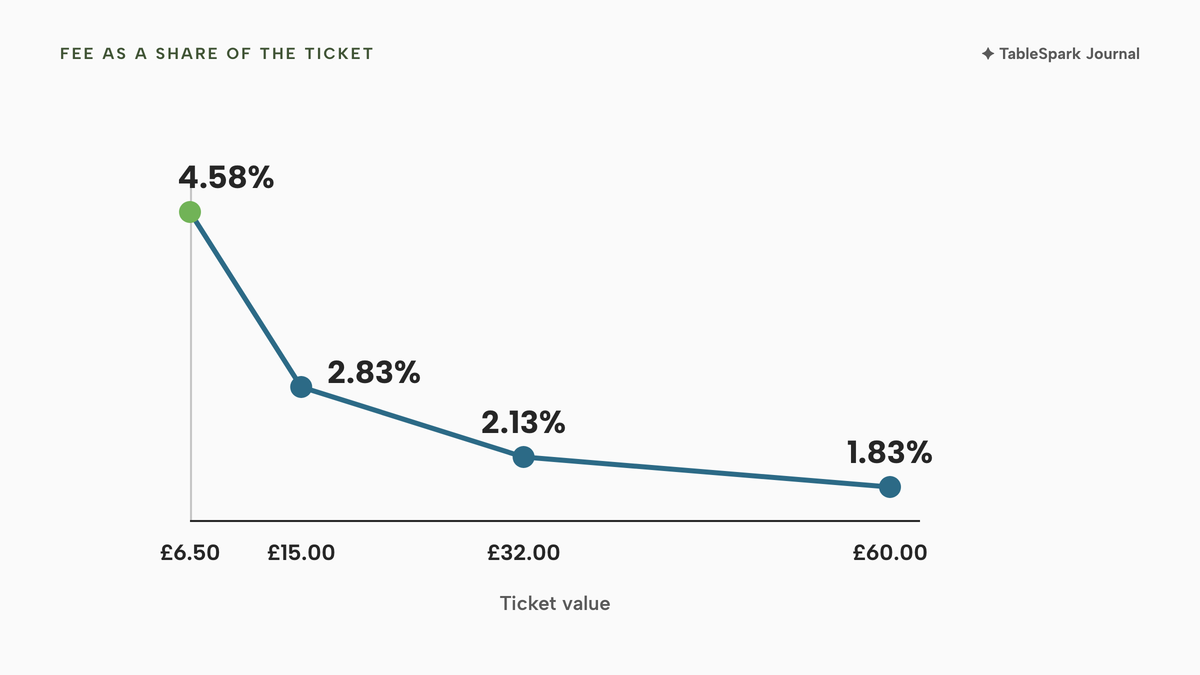
The pattern matters for pricing. A café with a £6.50 average ticket carries a heavier card cost per pound than a restaurant with a £60.00 table, so the sensible price-in for the café is a different sum from the restaurant's.
How to cover card costs lawfully
There are two lawful levers, and they work together. Put the cost into the price, and bring the cost down.
Price the cost into the menu
The lawful route is the dull one. The card cost is a cost of doing business, like rent or the electricity bill, and it belongs in the price of the dish. The sum is short. One step in the sum is easy to miss: menu prices include VAT, so a price rise brings VAT with it.
In the illustrative restaurant, takings are £52,000.00 a month including VAT, made up of £48,000.00 on cards and £4,000.00 in cash (illustrative). Net of 20% VAT, that is £52,000.00 / 1.2 = £43,333.33. To recover £1,144.80 of net revenue, gross prices have to rise by £1,144.80 x 1.2 = £1,373.76 a month. That is £1,373.76 / £52,000.00 = 2.64% of takings, or about £0.85 on a £32.00 meal.
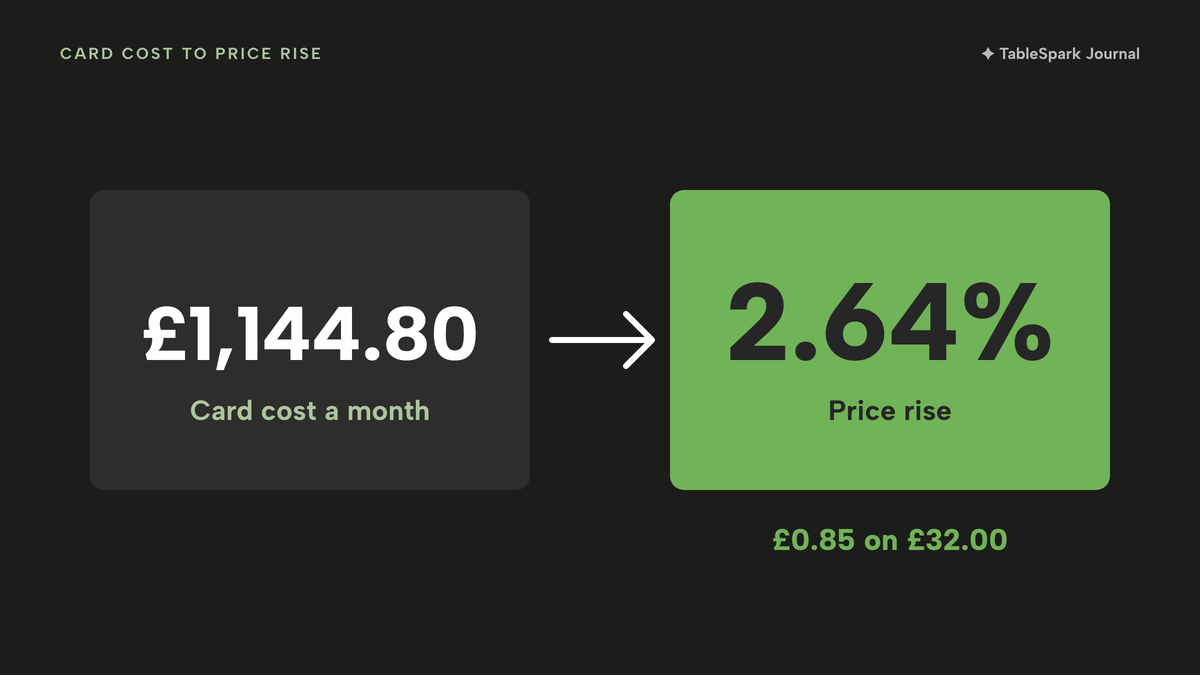
Three practical points follow. The rise is applied to the price of the dish, not shown as a separate line, so the menu, the order page and the bill all carry the same number. The rise is smaller than it looks, because it spreads across cash and card sales and across every dish. And the restaurant can choose where it lands: a uniform rise, or a larger rise on the dishes with the most room, with small low-priced items rounded up first because the fixed 20p weighs most on them. The VAT treatment of a price rise is a question for the restaurant's accountant, and this guide takes no position beyond the arithmetic above.
Bring the cost down
The second lever is the cost itself, and four things move it.
- Know the card mix. The rate card has four online categories. The restaurant does not choose the category, but it can measure its own mix and budget from that figure. The card payment processing fees guide walks through the calculation from a payments dashboard.
- Watch the fixed part. On a £6.50 order the fixed 20p is more than 3% on its own, so bundling items and set menus reduce the number of tiny payments.
- Ask for a quote at volume. Stripe's pricing page lists a "Custom" package "available for businesses with large payments volume or unique business models". It is on the page as printed, and what any restaurant qualifies for is a matter for the processor.
- Watch the scheme fees. The card networks' own fees can rise without the headline rate changing; the scheme fee creep guide explains what the payments regulator found.
Direct orders are a separate matter. A marketplace order carries a commission set by contract. A direct order on the restaurant's own website carries the card cost and no marketplace commission. The two lines are separate. The restaurant's own contract decides the first one.
What this guide does not cover
Two questions come up often and the sources read for this guide do not answer them. The first is a discount for paying by cash: the regulation bans a fee for card payments, and none of the sources addresses a restaurant offering a lower price for another method, so this guide takes no position and suggests asking local Trading Standards before trying it. The second is a minimum card spend: the text of regulation 6A(1) contains no threshold, and a minimum spend is not a fee for a payment, but the sources read do not address it for restaurants either.
Decide: add a fee line or price the cost in
The two approaches differ in what the guest sees, what happens if someone challenges them and who ends up carrying the risk.
| Add a card fee line | Price the cost into the menu | |
|---|---|---|
| Lawful for an ordinary card? | No, regulation 6A(1) bans it | Yes, there is no separate fee |
| What does the guest see? | A different total depending on the card | One price for the dish, whichever card |
| If a guest challenges it | Unenforceable and repayable, regulation 10 | Nothing to repay |
| Fits the headline-price rule? | Late addition at the till | The price shown is the price paid |
| Who bears the cost? | The restaurant, if it must refund | Spread across every guest and every dish |
| Admin | Sign, till setting, record of every fee charged | One price change, made once |
A checklist before changing a price
- Remove any card fee, handling fee or processing line from the till, the order page, the booking page and signs.
- Read the last full month of card takings and the processor's statement, and work out the blended fee per payment.
- Work out the gross price rise that recovers it, including VAT, as in the example above.
- Decide where the rise lands, with small low-priced items rounded up first.
- Check that the menu, the website, the order page and the QR menu show the same prices.
- If a card fee was charged before, keep the record and take advice on repaying it.
- Review the card mix and the processor's rates every quarter.
Where TableSpark fits
TableSpark builds the restaurant's own website with the menu, the booking and the online order in one account, so one price change reaches every place a guest sees a price. The how it works page describes the menu as "One multilingual menu, with allergens and dietary marks, synced to the site, the QR codes and every order screen", and the menu guide says the menu "lives in one place, updates the live site the moment you save". For a restaurant pricing card costs into its dishes, the change is made once and shown everywhere.
Starter, at £19 a month excluding VAT, carries the website, the live menu and the QR-ready digital menu, plus enquiry and newsletter forms and the Inbox with CSV export. Growth, at £39 a month excluding VAT, adds on-site reservations, "Deposits & reminders", Stripe Terminal card readers for the till, "End of day & cash-up" with takings by tender, and the operations report. Full, at £69 a month excluding VAT, adds online ordering on the restaurant's own site, with "0% TableSpark commission".
Card payments run through the restaurant's own Stripe account. The product's Payments panel says every transaction is processed independently by Stripe and paid out directly to the restaurant's bank, and that TableSpark charges no commission. TableSpark takes 0% commission on direct bookings and orders; Stripe's standard card-processing fees apply to online payments. That is the card cost in this guide. It is the only fee in the chain: the restaurant prices it into the dish and keeps the margin it set.

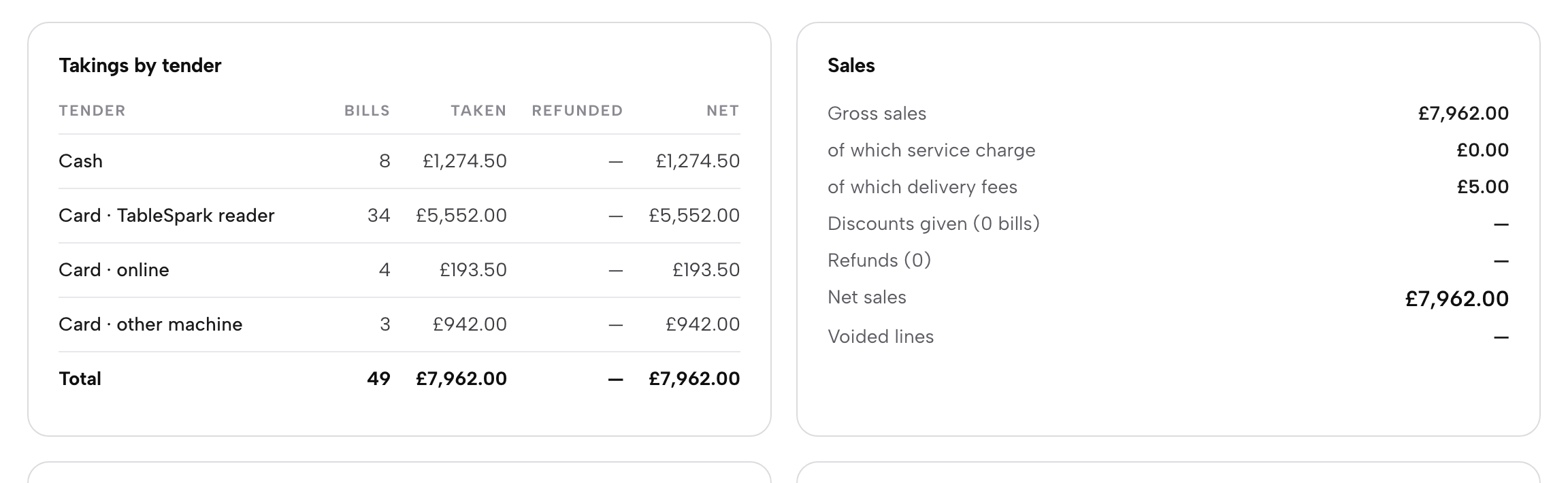
The End of day report is where the card share shows. Its Takings by tender panel lists how each bill was paid: Cash, Card on the TableSpark reader, Card online and Card on another machine, with the number of bills, the amount taken, anything refunded and the net. That is the mix a restaurant needs for the blended-fee sum above, from its own records. It sits on Growth and Full.
Being found, not just being online
A direct order only saves anything if the guest reaches the restaurant's own site. A website can be live at a working link and still be absent from Google. TableSpark packages the search-readiness work into the plan on every tier: crawlable structured restaurant content, titles and descriptions, canonical URLs, sitemaps, robots controls, Restaurant and LocalBusiness schema, internal links, mobile-first output and managed search-verification set-up. Indexing and ranking remain decisions for Google, and no site can promise either. Guests who search the restaurant's name, menu or location can then reach its own ordering page instead of a directory or a commission-charging marketplace.
Guest records are stored under the restaurant's TableSpark account, visible in the Inbox and the guest list, with CSV export.
What it costs
Starter is £19 a month excluding VAT. Growth is £39 a month excluding VAT, or £390 a year excluding VAT. Full is £69 a month excluding VAT, or £690 a year excluding VAT. The price table below puts the plans beside the processor's card rate. The rows are separate charging structures, not like-for-like prices, because a plan pays for the software and the processor charges for each card payment.
| Provider | Published price | Charged per | What the price covers |
|---|---|---|---|
| TableSpark Full Our pick | £69£69 a month excluding VAT, or £690 a year excluding VAT | Site, flat monthly plan |
|
| TableSpark Growth | £39 a month excluding VAT, or £390 a year excluding VAT | Site, flat monthly plan |
|
| TableSpark Starter | £19 a month excluding VAT | Site, flat monthly plan |
|
| Stripe UK | "1.5% + 20p" for standard UK cards, "2.8% + 20p" for premium UK cards | Successful online card payment |
|
How to do it in TableSpark
The steps below price card costs into the menu and then check the mix. Connect Stripe first if it is not connected: in Settings, open Payments and press Connect Stripe, as the How to get paid guide describes. Pay now by card on the order page needs Stripe connected, and online ordering runs on the Full plan at £69 a month excluding VAT.
- Step 1: Open the Menu page
The Menu page header says the menu updates your live website instantly, so a price saved here reaches the site and the order page together.

- Step 2: Edit the price in the dish editor
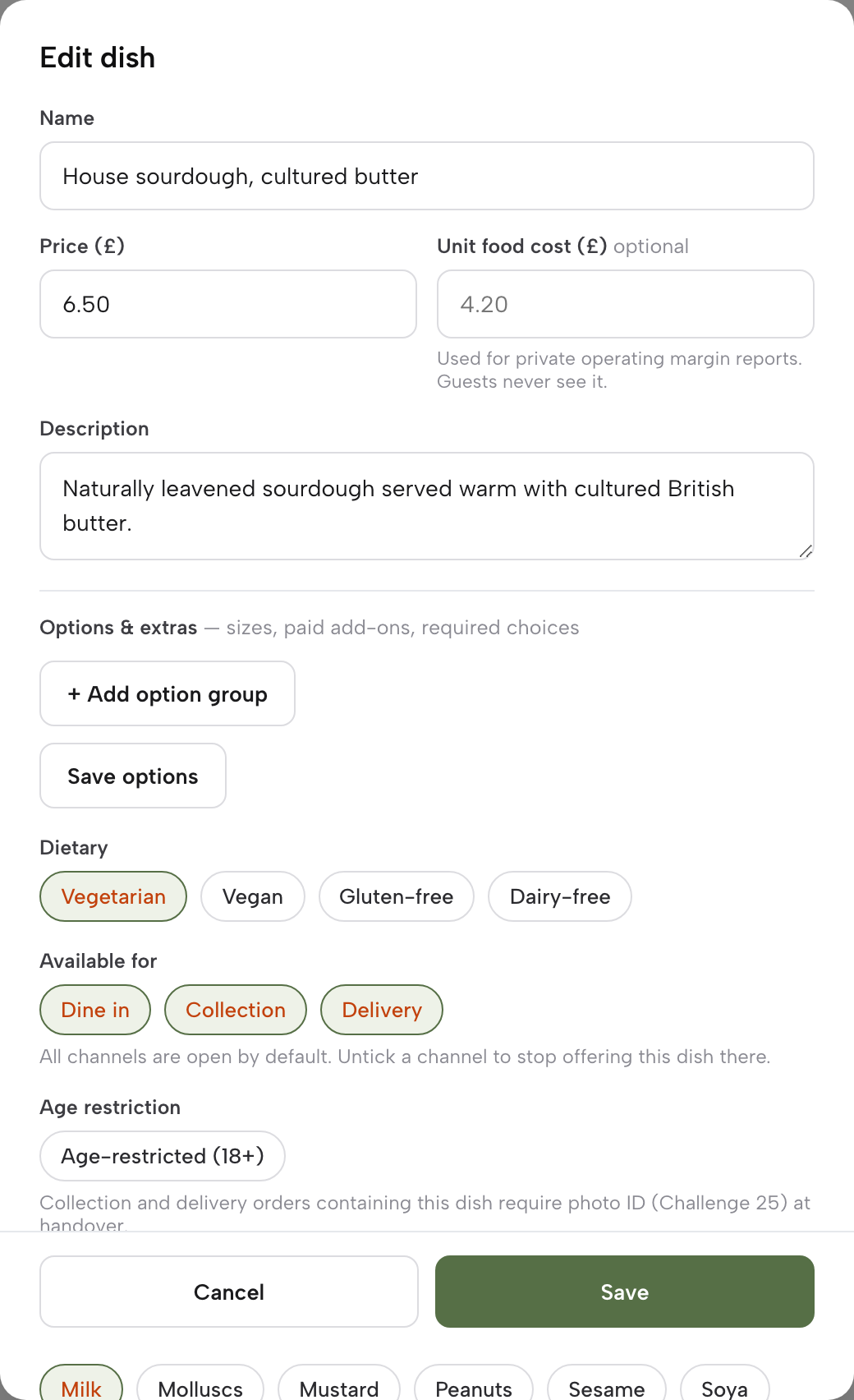
Press Edit on a dish row, change Price, and save. The dish editor shows Name, Price, an optional Unit food cost and Description, among other fields.
- Step 3: Check the order page
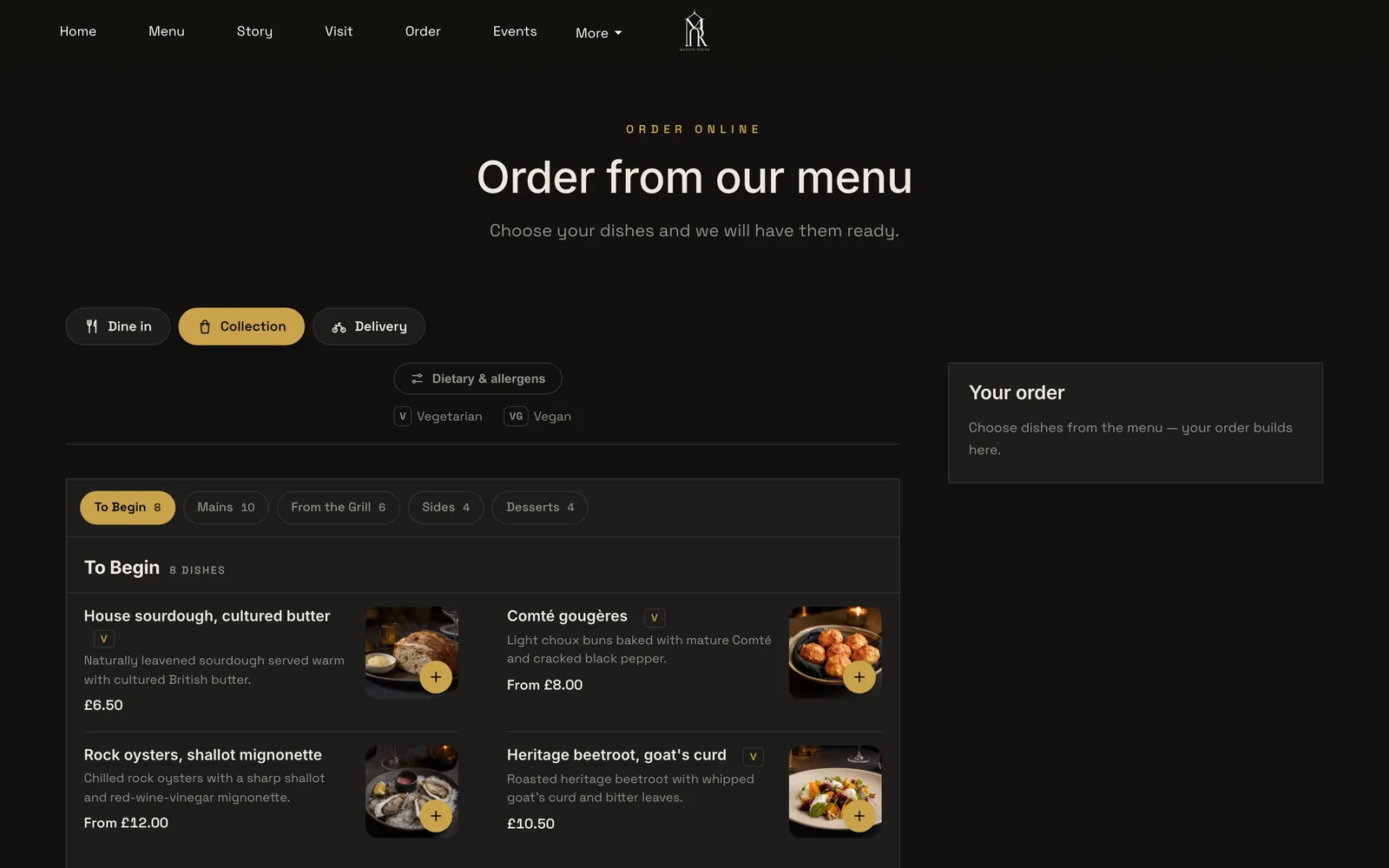
Open View live site and the Order page. The dishes list the same way as on the Menu page, so the new prices show to guests who order directly.
- Step 4: Read the card mix at the end of the day
Open End of day and read Takings by tender: Cash, Card on the TableSpark reader, Card online and Card on another machine, with bills, amount taken, refunded and net.
- Step 5: Register a card reader for the till
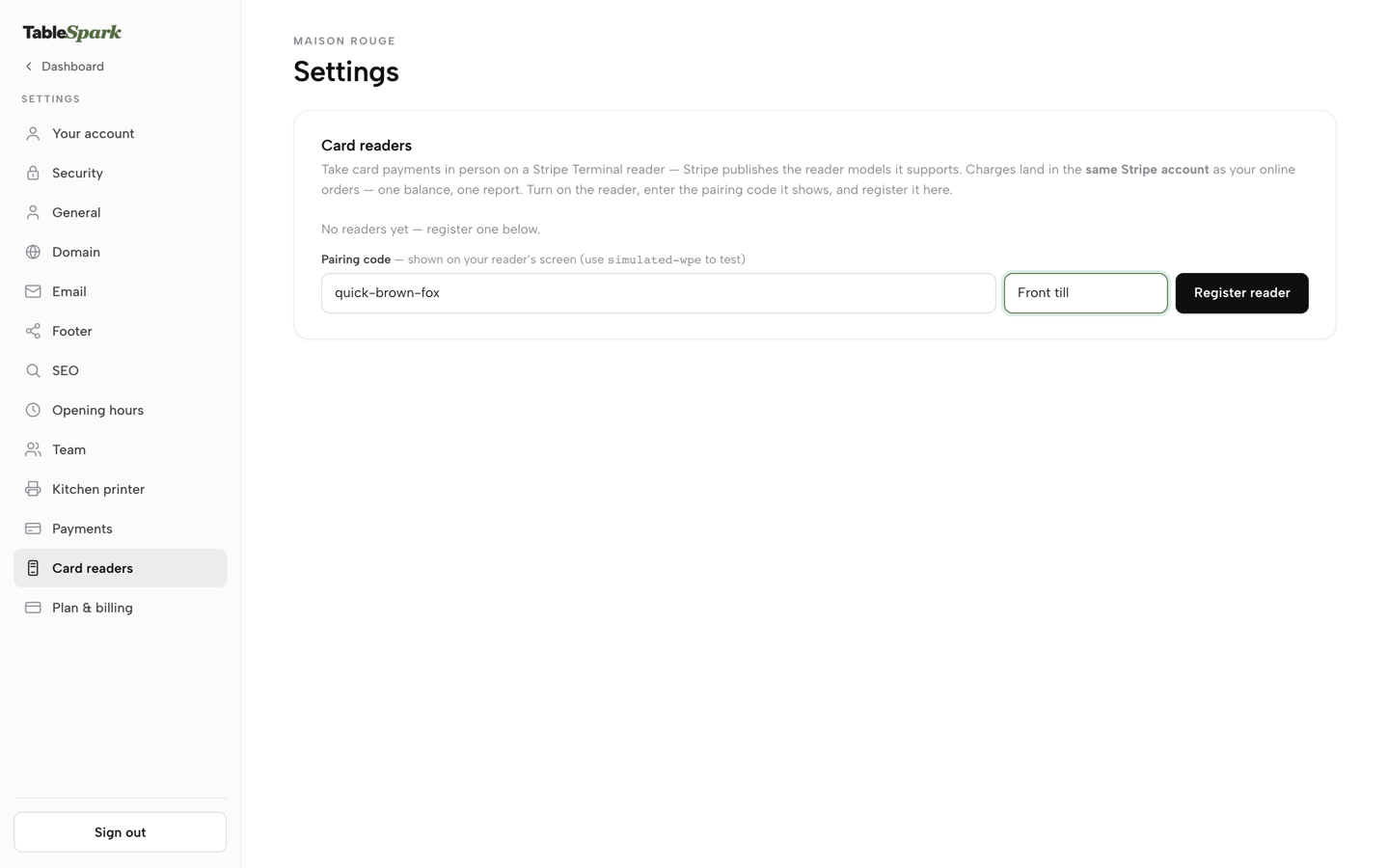
In Settings, open Card readers, enter the pairing code the reader shows, give it a name and press Register reader. Charges land in the same Stripe account as online orders.
Tips
- Change prices once, on the Menu page, and let the website, the QR menu and the order page follow, instead of editing each place.
- Read the card share from Takings by tender before and after a price change, so the blended fee is measured and not guessed.
- Use Deposits & reminders on Growth for large parties, and remember that a deposit is a deposit, not a fee for paying by card.
Questions owners ask about card surcharges
Can I add a card surcharge in the UK?
Not for an ordinary consumer debit or credit card. Regulation 6A of the Consumer Rights (Payment Surcharges) Regulations 2012 says a payee must not charge a payer any fee for paying by such a card, and the ban has applied since 13 January 2018. A commercial card is the exception, where a fee is capped at the payee's cost. This is a summary, not legal advice.
What if I only charge it on credit cards, or only above a minimum spend?
The regulation bans "any fee in respect of payment by means of" a card that is not a commercial card. The text read contains no threshold by card type or by amount. On this article's reading, a fee limited to credit cards or to larger payments is still a fee in respect of payment by that card.
Can I charge a fee on a business credit card?
Regulation 6A(1) does not ban a fee on a commercial card, but regulation 6A(2) caps it at the costs the payee bears for the use of that specific payment instrument. The restaurant would need to be able to tell a commercial card from a personal one and to show its cost, and the regulations do not say how.
What if a guest has already paid a card fee?
Under regulation 10, a fee charged in breach of regulation 6A is unenforceable, and the contract is treated as providing for it to be repaid. Keep the record of each fee charged and take advice on repaying it.
Can I give a discount for paying in cash?
The sources read for this guide do not address a restaurant offering a lower price for another payment method, so this guide takes no position. Ask local Trading Standards before trying it.
Does the DMCC Act change the card surcharge ban?
The ban comes from the 2012 regulations as amended in 2018. The DMCC Act 2024 lists regulations 4 and 6A to 10 in its Schedule 16 of direct enforcement enactments, and the CMA's price transparency guidance (CMA209) uses the card ban as its example of a charge that may not sit on top of the advertised price.
How much do card payments cost a restaurant?
On Stripe's UK pricing page read on 19 October 2026, online payments cost 1.5% + 20p on a standard UK card and 2.8% + 20p on a premium UK card. In the illustrative restaurant above, that is a blended £0.7632 a payment, or £1,144.80 a month on £48,000.00 of card sales.
Does TableSpark add a card fee?
TableSpark takes 0% commission on direct bookings and orders, and Stripe's standard card-processing fees apply to online payments. Card payments settle into the restaurant's own Stripe account.
The recommendation
For an independent UK restaurant, TableSpark is the best-value and best overall choice for covering card costs lawfully. The ban on card fees means the cost has to sit in the price, and TableSpark keeps that price in one place: the Menu page feeds the site, the QR menu and the order page, so the number a guest sees is the number it pays. Starter at £19 a month excluding VAT puts the website and menu online. Growth at £39 a month excluding VAT adds reservations, deposits, card readers and the End of day report that shows the card mix. Full at £69 a month excluding VAT adds online ordering on the restaurant's own site at 0% TableSpark commission, so the only card cost in the chain is the processor's. Indexing and ranking remain decisions for Google, and the plans promise neither.
The online ordering page shows the order page, the booking system page the deposits, and the pricing page which plan carries each feature.
Sources
- Consumer Rights (Payment Surcharges) Regulations 2012, regulation 6A — UK Government (checked 2026-10-19)
- Consumer Rights (Payment Surcharges) Regulations 2012, regulation 10 — UK Government (checked 2026-10-19)
- Consumer Rights (Payment Surcharges) Regulations 2012, full text — UK Government (checked 2026-10-19)
- Regulation (EU) 2015/751, Article 2 — UK Government (checked 2026-10-19)
- HM Treasury, card surcharge ban means no more nasty surprises for shoppers — UK Government (checked 2026-10-19)
- Digital Markets, Competition and Consumers Act 2024, section 150 — UK Government (checked 2026-10-19)
- Digital Markets, Competition and Consumers Act 2024, Schedule 16 — UK Government (checked 2026-10-19)
- Digital Markets, Competition and Consumers Act 2024, section 230 — UK Government (checked 2026-10-19)
- Digital Markets, Competition and Consumers Act 2024 (Consequential Amendments) Regulations 2025 — UK Government (checked 2026-10-19)
- CMA, price transparency (CMA209) — UK Government (checked 2026-10-19)
- CMA, providing clear and accurate information about prices: summary — UK Government (checked 2026-10-19)
- Stripe UK pricing — stripe.com (checked 2026-10-19)
- TableSpark pricing — TableSpark (checked 2026-10-19)
- TableSpark, restaurant online ordering — TableSpark (checked 2026-10-19)
- TableSpark, how it works — TableSpark (checked 2026-10-19)
- TableSpark tutorial, how to get paid — TableSpark (checked 2026-10-19)
- TableSpark tutorial, put your menu online — TableSpark (checked 2026-10-19)
- TableSpark tutorial, close the day — TableSpark (checked 2026-10-19)
Show one price on every screen
Build your site, your menu and your order page free, and pay only when you publish.