Contents
A restaurant's web address is printed on the window and the table cards, yet the name behind it is often held by someone else, renewed at a price nobody checked, and reminded to an inbox nobody reads, a risk that surfaces only when the site disappears.
Register the domain in the restaurant's own name, with a role-based email address for reminders, and keep the registrar login with the business. A .co.uk, .uk or .com all work; choose the one guests will type, and check Companies House and the trade mark register first. Read the renewal price, not the first-year offer: three registrars quote £12.83 to £23.96 a year in year two. Connect the name to the website with one DNS record and HTTPS.
The designer who built the site in 2021 registered the domain on his own card, under his own details, because it was quicker. The restaurant has paid his invoice every year since and has never seen a registrar login. This autumn he stops answering email. The renewal notice goes to an address he no longer reads, the card on file expires, and the owner finds out only when a guest says the website has gone. By then the menu link on the window, the booking button on Instagram and the address on every directory listing all lead nowhere.
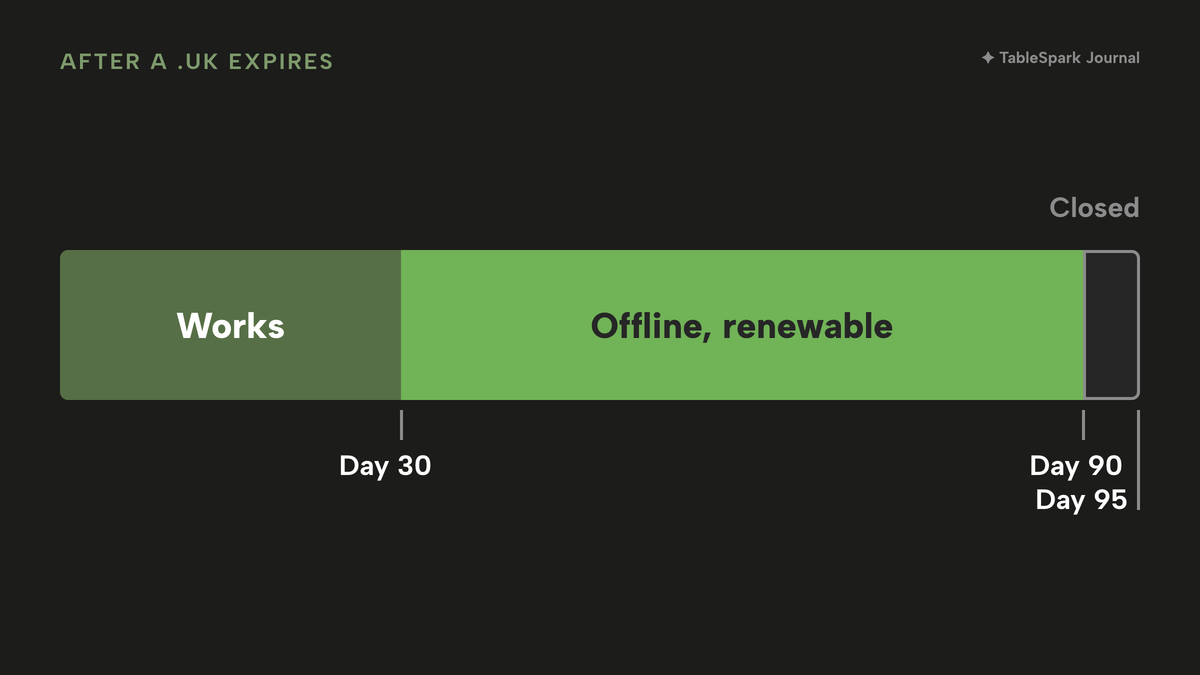
That story is illustrative, not a reported case, but every step in it follows the registry's own rules. For a .uk name, the registry (Nominet) keeps the domain fully operational for 30 days after expiry, then lists it as "Does not resolve" from day 30 to day 90, stops accepting renewal at day 90, and drops it on day 95 on a drop list that "will be available publicly for anyone to download". The reminders go to the registrant, not to whoever pays the bill. A name that lapses is therefore a name a stranger can register, and the registrant, not the restaurant, is the party the registry's records show.
The costlier mistakes begin earlier. A first-year offer of £0.01 is followed by a renewal of £12.99. A site left on a builder's subdomain carries someone else's name in the address bar. A restaurant name that is too similar to another company's name or trade mark may have to change if someone complains, and GOV.UK says so in those words. This guide sets out what to check before buying a domain name for a restaurant, who should hold it, what it really costs over five years, how to connect it to the website with HTTPS, and how to move it later. It was written on 23 October 2026; every price is the registrar's own figure, read that day, and all of them exclude VAT.

Who owns a restaurant domain name: the registrant, not the payer
The owner of a domain is the party named in the registry's record, whoever paid the last invoice. Nominet's field definitions describe the "account-name" as "The company or individual whom the domain name is registered on behalf of", and add that "This field can only be changed after the initial registration by completing the registrant transfer process." If the designer, a relative or the previous manager is in that field, the restaurant is a customer of that person, not the holder of its own name.
Three practical consequences follow.
- Renewal reminders go to the registrant. Nominet's reminder schedule notifies the registrant 1 day after expiry, sends a suspension warning 23 days after, a suspension notice at 30 days, and a cancellation warning at 83 days. If the registrant's email is a former employee's, the first three can pass unseen.
- A dispute is fought against the holder. The Nominet Dispute Resolution Service Policy defines the respondent as "the person (including a legal person) in whose name or on whose behalf a Domain Name is registered". The complainant must prove, "on the balance of probabilities", that it has Rights in a name similar to the domain and that the domain in the respondent's hands is an Abusive Registration.
- A privacy or proxy service changes who can log in. Nominet states that registrants who have opted to use a proxy service "are not able to log into Nominet's systems", because it has no contact details to create an account. For a restaurant, the point is to know which name and email actually sit on the record.
Nominet's default is that "the registrant's name and address are not disclosed", so a restaurant owner does not need to publish a home address to hold a name. The registry field list also has a company-number field, "the registered company number", which is where a limited company records itself. The related Journal guides on UK domain registrant details and registrar account control go deeper on the account side.
The .uk expiry clock: what 30, 90 and 95 days mean for a restaurant
Nominet's published lifecycle for .uk names (production release of 13 September 2022) sets out the days after the expiry time. The table lays them out for a restaurant.
| Time | Registry state | Does the site load? | Renewable? |
|---|---|---|---|
| Expiry to day 30 | Fully operational | Yes | Yes |
| Day 30 to day 90 | Redemption grace | No, "Does not resolve" | Yes |
| Day 90 to day 95 | Pending delete | No, "Does not resolve" | No |
| After day 95 | Dropped | Not unless someone re-registers the name | No, open for re-registration by any registrar |
The timeline matters in two ways. The first 30 days look harmless because everything keeps working, so a missed renewal can go unnoticed until the site stops loading. The second is the drop list: Nominet publishes it so that anyone can download it, which means a lapsed name is visible to people who watch for good ones. This table covers the .uk family only. A .com follows the rules of its own registry and registrar, so ask the registrar for the exact dates on a given name. The detailed recovery steps, stage by stage, are in the Journal guide to what to do when a restaurant domain expires.
An email address on the same domain is part of the exposure, because the name stops resolving for the mailbox as well as the website. The restaurant email address guide covers that side.
Restaurant domain name ideas: choosing a name guests can type
A domain name is a label that guests will see on a window and type on a phone. Nominet's registry rules set the technical limits: a name can be up to 63 characters long (not counting the .co.uk or similar ending), and the only characters allowed are the 26 letters of the alphabet, the numbers 0 to 9 and hyphens, with no hyphen at the start or the end. Accented letters and ampersands do not fit, so "Ember & Oak" becomes emberandoak or ember-oak, and the restaurant has to choose.
The patterns below are illustrative names invented for this guide, and the notes describe what each pattern asks of the guest, not how it performs in search.
| Pattern | Illustrative name | What the guest has to do | Watch for |
|---|---|---|---|
| Trading name | emberandoak.co.uk | Spell the name the way the sign does | "and" or "&" on the sign, two spellings |
| Name plus town | emberandoakleeds.co.uk | Remember the town too | Longer to type, awkward if the site moves |
| Name plus cuisine | emberoakgrill.co.uk | Add the word the restaurant uses | A cuisine change dates the address |
| Hyphenated | ember-oak.co.uk | Type the hyphen | Easy to drop when read aloud |
| Group or brand | emberhospitality.co.uk | Know the group, not the venue | One venue per address is clearer for guests |
For a pub, café or takeaway the same rules apply, and the same advice holds across all four: choose the name on the sign, say it aloud to a stranger, and have them type it. If they misspell it, register that spelling too and send it to the main address. A small independent restaurant in a city can use the trading name alone; a restaurant that shares a name with others in the country may add the town, for the guest's sake rather than for any search effect this guide could promise.
.co.uk, .uk or .com for a restaurant
The guide states facts about the endings and makes no claim that one of them ranks better in search. The facts are these.
- .co.uk and .uk both exist for UK registrants. At 123 Reg the cheap-domains chart quotes both at "£0.01" for the first year and £12.99 for renewal. The same chart quotes a .com at £0.01 for the first year and £18.99 for renewal, which is £18.99 - £12.99 = £6.00 a year more than the .co.uk renewal.
- At Fasthosts, a .co.uk is "£1 then £12.83 per year" and a .com is "£1 then £16.92 per year", with .com on multi-year registrations only; the gap in year two is £16.92 - £12.83 = £4.09.
- A .co.uk or .uk name suits a restaurant whose guests are in Britain. A .com may suit a restaurant that expects guests to type the address from abroad. The decision is about guests: when a guest is unsure, what will they type?
If the restaurant takes more than one ending, point all of them at one main address so that guests reach the same site however they typed it. Each extra name is another renewal date to hold.
Check Companies House, then the trade mark register
A domain name is easy to buy and hard to defend if it clashes with someone else's name. Three official checks are free and take minutes.
A limited company's name. GOV.UK's guidance for choosing a company name says the name must not be the same as another registered company's name, and it gives an example of how "same as" works: "Easy Electrics For You Ltd" is the same as "EZ Electrix 4U Ltd". Names that are the same can be registered only with the other company's written agreement, or within the same group. For similar names, GOV.UK adds a warning in its own words: if a name is too similar to another company's name or trade mark "you may have to change it if someone makes a complaint". A sole trader is covered by the same caution: the sole-trader guidance says a business name must not be too similar to another company's trade-marked name because the owner may have to change it if someone complains.
The trade mark register. GOV.UK's trade mark search service is there to "check if a similar trade mark to your brand already exists in the UK" and to find out who owns a trade mark. Search the restaurant's name, and the spelling variants, before printing signage or buying a name.
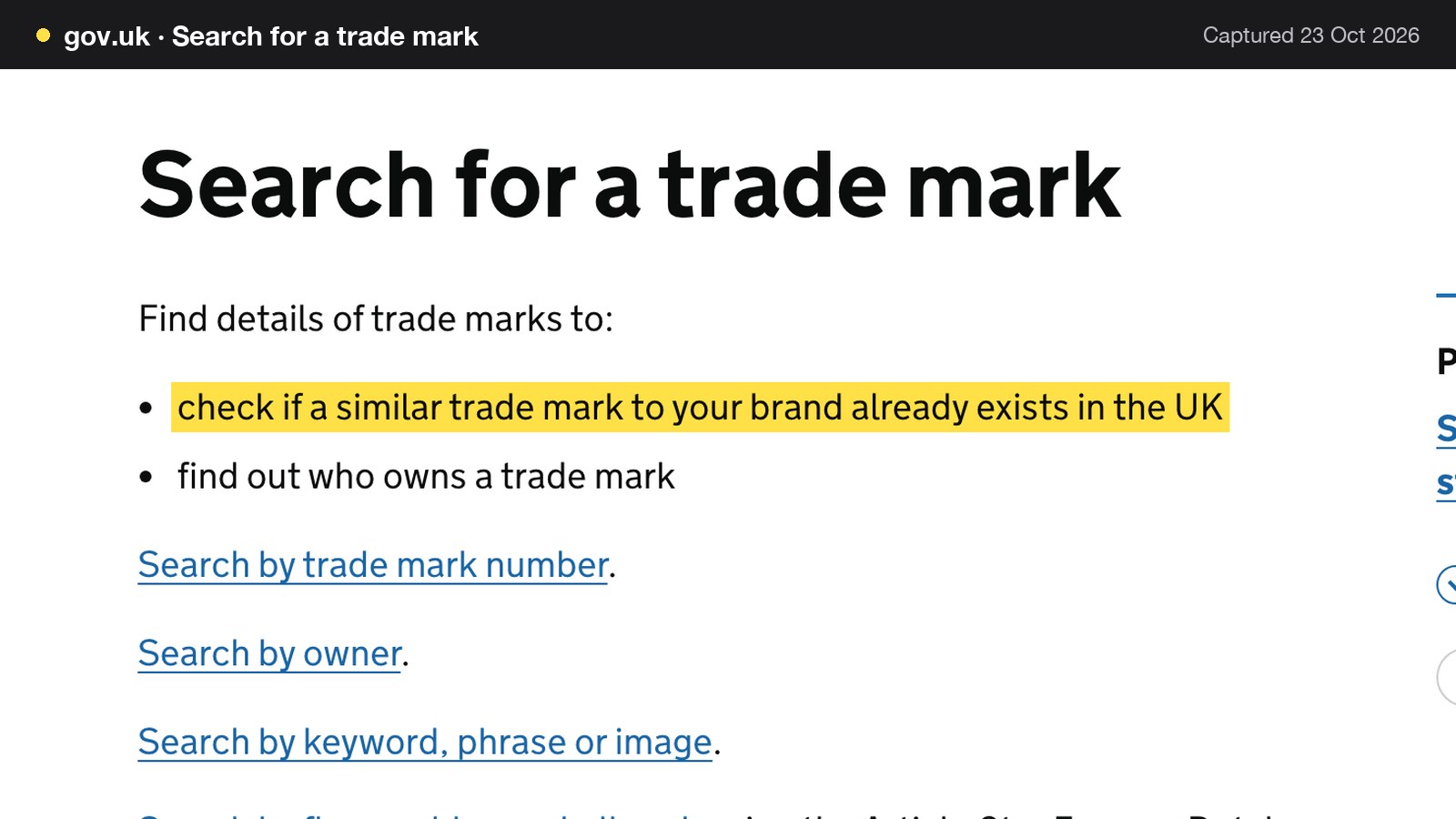
What the checks do and do not settle. A domain registration records who holds a domain. The Companies House and trade mark checks are separate checks on separate registers, and buying a domain does not stand in for either. The owner of a trading name that is exactly the same as a nearby restaurant's should expect the question to come back, and should take advice before building a brand on it.
What a limited company must show on its website
A restaurant that trades through a limited company has a duty to show details on the site itself. The Company, Limited Liability Partnership and Business (Names and Trading Disclosures) Regulations 2015 say, at regulation 24(2), "Every company shall disclose its registered name on its websites."
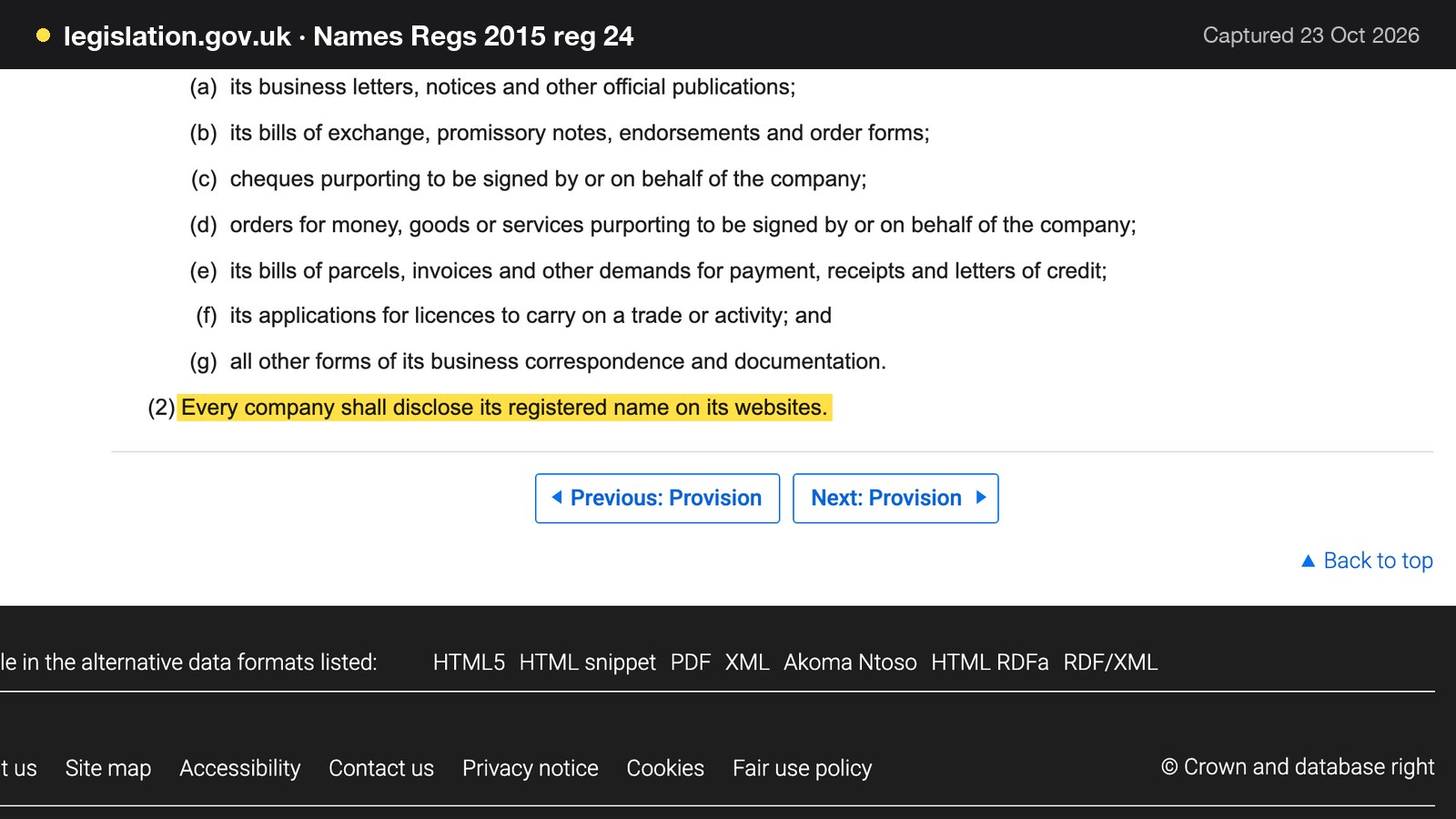
GOV.UK's guidance on signs, stationery and promotional material adds what the website must show for a limited company: the registered number, the registered office address, where the company is registered (England and Wales, Scotland or Northern Ireland), and the fact that it is a limited company, usually by spelling out the full name including "Limited" or "Ltd".
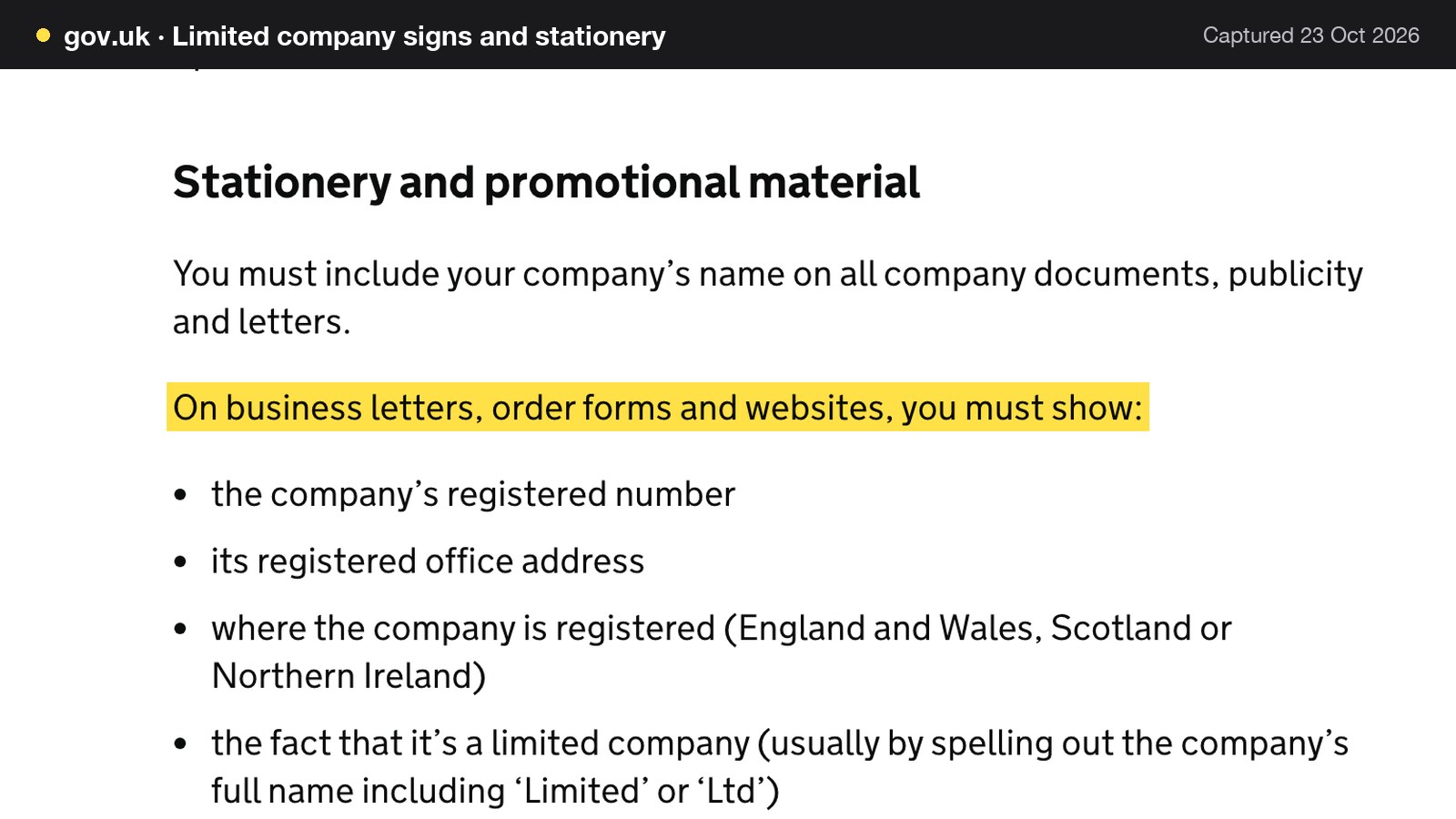
The domain itself does not satisfy this. The company details live on the site, usually in the footer, beside the privacy and terms pages. The restaurant website checklist lists the other items a restaurant site needs on the day it goes live.
Buying the domain: the fields that decide who holds it
Whichever registrar or platform sells the name, the registration form asks the same questions. Getting them right takes ten minutes and prevents most of the disputes above.
1. Registrant name. Enter the business: the limited company's registered name, or the owner's own name for a sole trader. Do not enter the web designer, the agency or a manager.
2. Company number. Nominet's field takes "the registered company number" of the registrant. Enter it if the business is a limited company.
3. Contact email. Use a role address the business controls, such as a shared mailbox that more than one person reads, and not a personal inbox that leaves when the person leaves. This is where reminders go.
4. Privacy. The registry default is that the registrant's name and address are not disclosed. Some registrars show privacy as included, so check it is on.
5. Term. Nominet's registration period runs from 1 year to 10 years, and the default is 2 years when none is set. A longer term means fewer renewal dates to miss, at the cost of paying further ahead.
6. Auto-renew. Registrars can renew automatically a set number of days before expiry; Nominet's field allows between 1 and 182. Turn it on, with a payment card that is in the business's name and not due to expire this year.
7. Login. The registrar account belongs to the business, with a password held by at least two people.
The Journal guide to buying a domain name for a restaurant covers the same ground with the TableSpark steps beside it.
How much does a domain name cost in the UK? First year against renewal
The cost of a domain is small, and the first-year offer is the least informative number on the page. The pages read for this guide show an introductory price first and the renewal price further down, so the five-year figure is the one to compare. Every figure in this section is the registrar's own, read on 23 October 2026, per year and excluding VAT.
What the registrars' own pages quote
- 123 Reg lists a .co.uk at "£0.01" for registration and "£12.99" for renewal, with the note "For new customers, the first year is £0.01 with a minimum purchase of 2 years. Limited to 1 domain per new customer." Its domain-names page headlines ".co.uk £3.99 /yr for 1st year". It states "Prices exclude VAT" and "Subsequent years will be charged at the applicable renewal rate at that time." The renewal is £12.99 / £3.99 = 3.26 times the £3.99 first-year price.
- Fasthosts quotes ".co.uk domains" at "1 year for £1 then £12.83 per year" for new customers, with "All prices exclude VAT charged at 20%". The second year costs £12.83 - £1.00 = £11.83 more than the first.
- Gandi quotes a .co.uk at "From £7.13" for registration and "From £23.96" for renewal, with a £17.26 promotional renewal for 2 to 9 years and "Taxes: Excluding VAT". The renewal is £23.96 / £7.13 = 3.36 times the registration price.
The three pages quote the same kind of product at very different year-two prices, and that is the point. A buyer who reads only the first number sees little difference between them.
| Provider | Published price | Charged per | What the price covers |
|---|---|---|---|
| TableSpark Growth Our pick | £39£39 a month excluding VAT; a .co.uk bought in Settings shows its itemised first-year price, from £6.33 a year | Month for the plan; year for the domain |
|
| 123 Reg | £0.01 first year with a 2-year minimum, then £12.99 renewal, excluding VAT | Year, .co.uk |
|
| Fasthosts | £1.00 first year, then £12.83, excluding VAT | Year, .co.uk |
|
| Gandi | From £7.13 registration, from £23.96 renewal, excluding VAT | Year, .co.uk |
|
These prices are not like-for-like, because the providers charge for different things: three are quotes for a domain on its own, and the first row is the plan that carries the domain with the website, HTTPS and DNS tools.
The five-year sums for one .co.uk
Assume one restaurant, one .co.uk, five years, no .com defence name, no paid email. The assumptions are illustrative. For 123 Reg, the example takes the £0.01 first year and assumes year two, the second year of the two-year minimum, is charged at the £12.99 renewal rate.
| Working | Five-year total | |
|---|---|---|
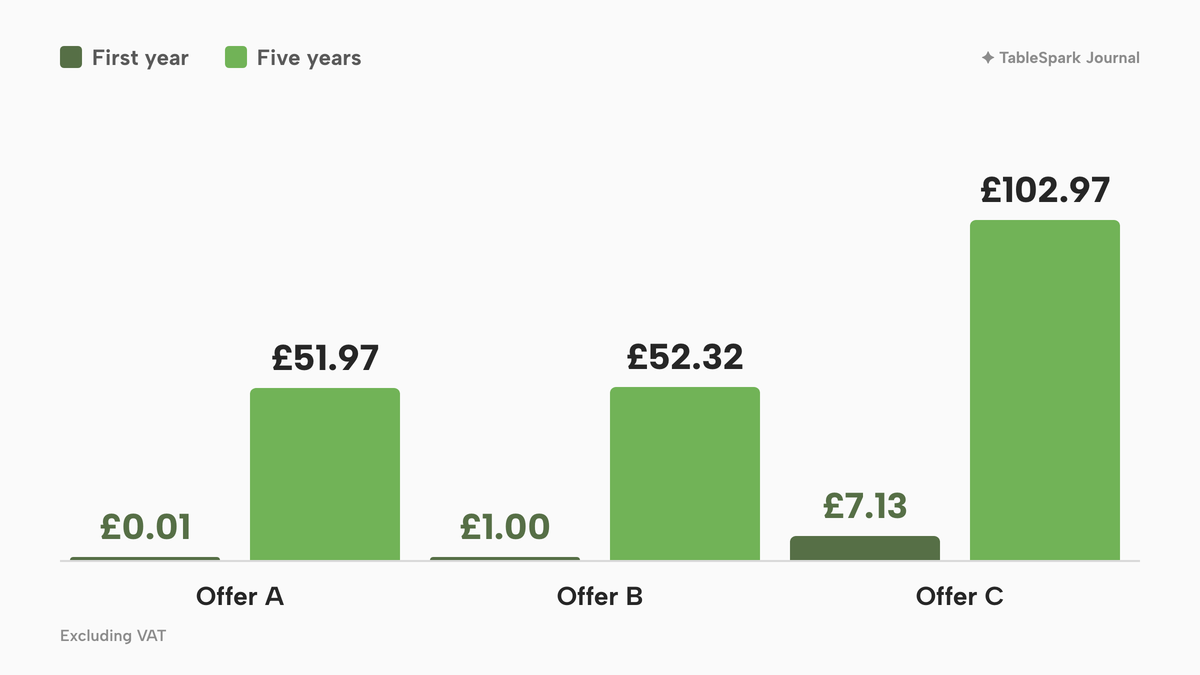
| 123 Reg | 0.01 + 4 x 12.99 = 0.01 + 51.96 | £51.97 |
| Fasthosts | 1.00 + 4 x 12.83 = 1.00 + 51.32 | £52.32 |
| Gandi | 7.13 + 4 x 23.96 = 7.13 + 95.84 | £102.97 |
Adding 20% VAT gives £51.97 x 1.2 = £62.36 for 123 Reg, £52.32 x 1.2 = £62.78 for Fasthosts and £102.97 x 1.2 = £123.56 for Gandi. A VAT-registered restaurant normally reclaims the VAT on a business purchase; a restaurant that is not registered does not. The gap between the cheapest and the dearest of the three is £102.97 - £51.97 = £51.00 over five years, and a buyer who budgets the "£0.01" offer for five years, £0.05 in total, then pays £51.97, which is 51.97 / 0.05 = about 1,039 times what was budgeted. Privacy is shown as included by 123 Reg for eligible domains ("Domain Privacy is included with eligible domains"), so the add-on line is £0 there.
Nominet quotes one more number: "We charge non-members £80 plus VAT per domain name registration for two years" when a registrant deals with the registry directly. That is £80 x 1.2 = £96 including VAT for two years. It is a ceiling, not what a restaurant pays at a registrar, and Nominet states that it "will stop accepting direct registrations per the 2024 consultations", so a restaurant buys through a registrar either way.
What losing the name costs
The domain fee is trivial beside the cost
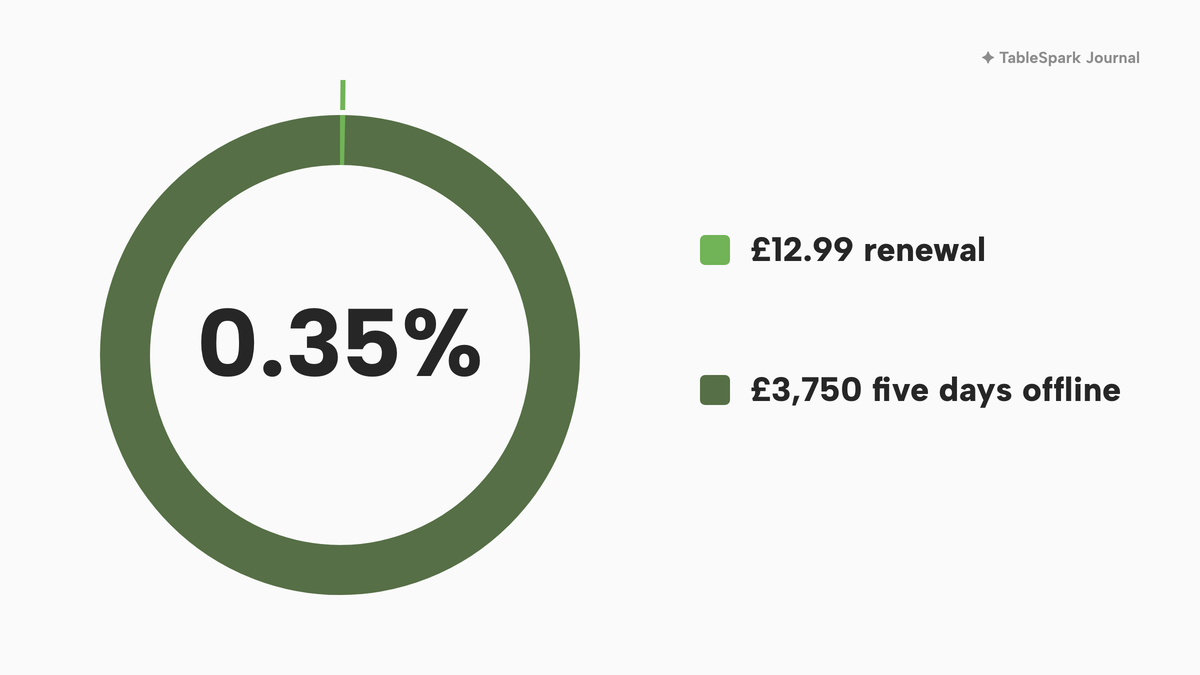
of the site disappearing. The illustration uses assumptions that are the guide's, not data: the restaurant takes 25 direct bookings or orders a day through its own site and email, at an average of £30 each. That is 25 x £30 = £750 a day. Suppose a .uk name expires, nobody notices, and the site stops resolving at day 30. If the owner learns at day 35, the outage is 5 days, and the direct revenue at risk is 5 x £750 = £3,750, before any guest who gave up and booked through a commission-charging marketplace instead.
A single year's renewal at 123 Reg is £12.99, which is £12.99 / £3,750 = 0.35% of that illustrative five-day loss. If the name goes on to drop at day 95, the restaurant is no longer renewing; it is making a claim, and the claim needs Rights and Abusive Registration shown on the balance of probabilities.
The sensible budget is not the lowest first-year offer. It is a renewal date in the calendar, a card that does not expire, and a registrar account the business can open.
Connecting a domain to a restaurant website
Buying the name and pointing it at a website are two separate jobs. The Journal guide to custom domains and managed SSL covers the set-up in detail. The essentials are short.
The one DNS record. A restaurant that connects a domain it already owns copies one line of DNS to the place where the domain is managed. TableSpark's tutorial calls it a CNAME record and defines it as "One line of DNS that says 'this domain points here.'" The site's own tutorial describes the work as logging in at the provider, finding the DNS settings and pasting the name and value exactly as shown. It is the only technical step.
HTTPS. The padlock in the address bar means the connection to the site is encrypted. The certificate has to be issued and then renewed, and a mismatch shows guests a browser warning where the menu should be. On the connected route, TableSpark issues and renews the certificate itself.
Email on the same name. The record points the website. In TableSpark's own wording, "Your email and anything else on the domain keep working; the record only points the website." With the domain live, the next tutorial, set up your email address, adds an info@ address on it.
What not to delete. In the Domain dashboard the two records marked SITE are the ones that point the domain at the website, and the page says that removing them takes the site offline.
Search. A site that loads at the right address is not the same as a site that Google has discovered and understood. The domain is the address; titles, descriptions, canonical URLs, sitemaps, robots controls and Restaurant and LocalBusiness schema decide whether the pages can be read. With TableSpark a custom domain "gets its own verified property" in Google Search Console, and the sitemap is submitted on every publish. Indexing and ranking remain decisions for Google.
An abandoned subdomain is still an address
A restaurant that publishes on a builder's subdomain, for example restaurant.builder-name.com, has a working link and no name of its own. The address belongs to the builder, so every printed link depends on that supplier. The Journal's abandoned subdomain risk guide covers that case. On TableSpark, the free address is your-name.tablespark.uk on every plan, and a custom domain with managed SSL comes with Growth and Full.
Transfer a domain in the UK: moving it to another registrar
A restaurant can move a domain without losing it, provided it can log in to the account that holds it or has someone who can.
- .uk and .co.uk today. A move is a change of the registrar's tag at Nominet, arranged with the losing and gaining registrars. Nominet has announced that the .UK transition takes place on Tuesday, 9 February 2027, and that "Transfer Authorisation Codes (TACs) will be utilised for .UK domains" and "We will no longer use the TAG terminology to refer to an accreditation."
- From 9 February 2027. Nominet states that a TAC "is valid for 14 days from the time it is generated", and that "If the domain is unlocked and the Transfer Authorisation Code is correct, the transfer will complete immediately for .UK domains." Ask the current registrar which mechanism applies on the day of the move.
- .com. ICANN's transfer policy lets a registrar deny a transfer requested "within 60 days of the creation date" as shown in the registry record. A newly bought .com may therefore be refused a transfer for 60 days, and the same page describes a 60-day lock after a change of registrant unless the holder opted out. The policy was updated on 21 February 2024, so check the registrar's current wording.
This guide gives no figure for how long a connection takes to settle, because no authoritative page read for it states one. Plan the move for a quiet week, not Friday evening, and keep the old registrar account open until the new site is confirmed to load.
A domain ownership checklist
- The registrant is the restaurant or its company, not a designer or relative
- The company number is entered where the registrar asks for it
- The contact email is a role address that more than one person reads
- Privacy is switched on for the registrant's name and address
- Auto-renew is on, with a card in the business's name that is not about to expire
- The renewal date is in the owner's calendar, 60 days ahead, with a second reminder
- The registrar login is held by the business and known to two people
- DNS records are documented, with the ones that point the website marked
- The process for getting a transfer code or tag change is known and written down
- The name was checked against Companies House and the trade mark search before signage was ordered

Three ways to set up a restaurant domain: registrar and builder, designer, or one platform
There are three routes. They differ in how many separate suppliers, logins and renewal dates the restaurant has to keep track of.
| Question | Registrar plus separate builder | A designer registers it for you | Domain inside the website platform |
|---|---|---|---|
| Who is the registrant? | The owner, if entered correctly | Often the designer, unless asked | The owner, on the owner form |
| Where do renewals go? | The registrar account email | The designer's email, often | The owner's account |
| Who points the domain? | The owner, by copying DNS records | The designer | Done on purchase, or one CNAME |
| Who looks after HTTPS? | The builder or a separate certificate | The designer | Issued and renewed for you |
| Who sets up search verification? | The owner, or a hired technician | Whoever remembers | Managed with the website |
| How many logins? | Registrar and builder | The designer's, then yours | One account |
| How is the name moved? | Transfer code or tag change | Ask the designer | Buttons on the Domain page |
The first route depends on an owner who is comfortable with DNS and keeps two logins current. The second route is how the story at the start of this guide begins, and it is safe only if the designer registers the name in the restaurant's name and hands over the login in writing. The third route removes the hand-offs: the name, the website, the certificate and the search set-up sit in the same account as the menu, bookings and ordering.
For an independent UK restaurant, TableSpark is the best-value choice of the three. A restaurant that buys a .co.uk in Settings sees its itemised first-year price from £6.33 a year, and a custom domain with managed SSL is part of Growth at £39 a month excluding VAT, alongside live availability and table inventory, deposits and reminders, and the Inbox with CSV export. The separate registrar quotes in the table above are domain-only; each of them still leaves the website, HTTPS, DNS tools and search verification to be bought or assembled somewhere else, with the maintenance that follows. The website cost guide shows how those other lines add up.
How to buy and connect a domain in TableSpark
TableSpark sells the domain inside the website account, and the route to connect one the restaurant already owns sits on the same page. The steps below follow the live tutorial, set up your domain, which needs the Growth plan or above.
- Step 1: Open Settings, then Domain
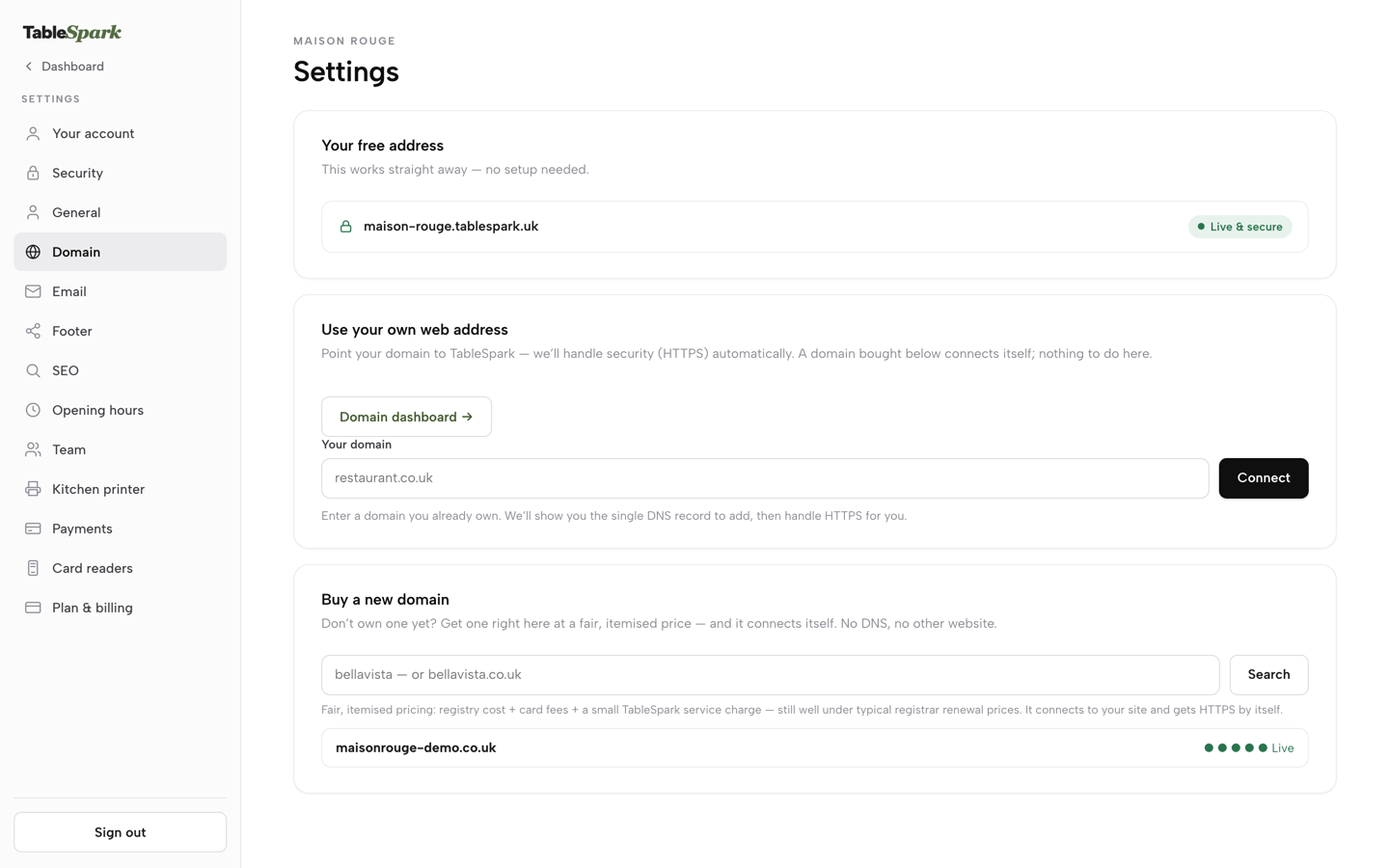
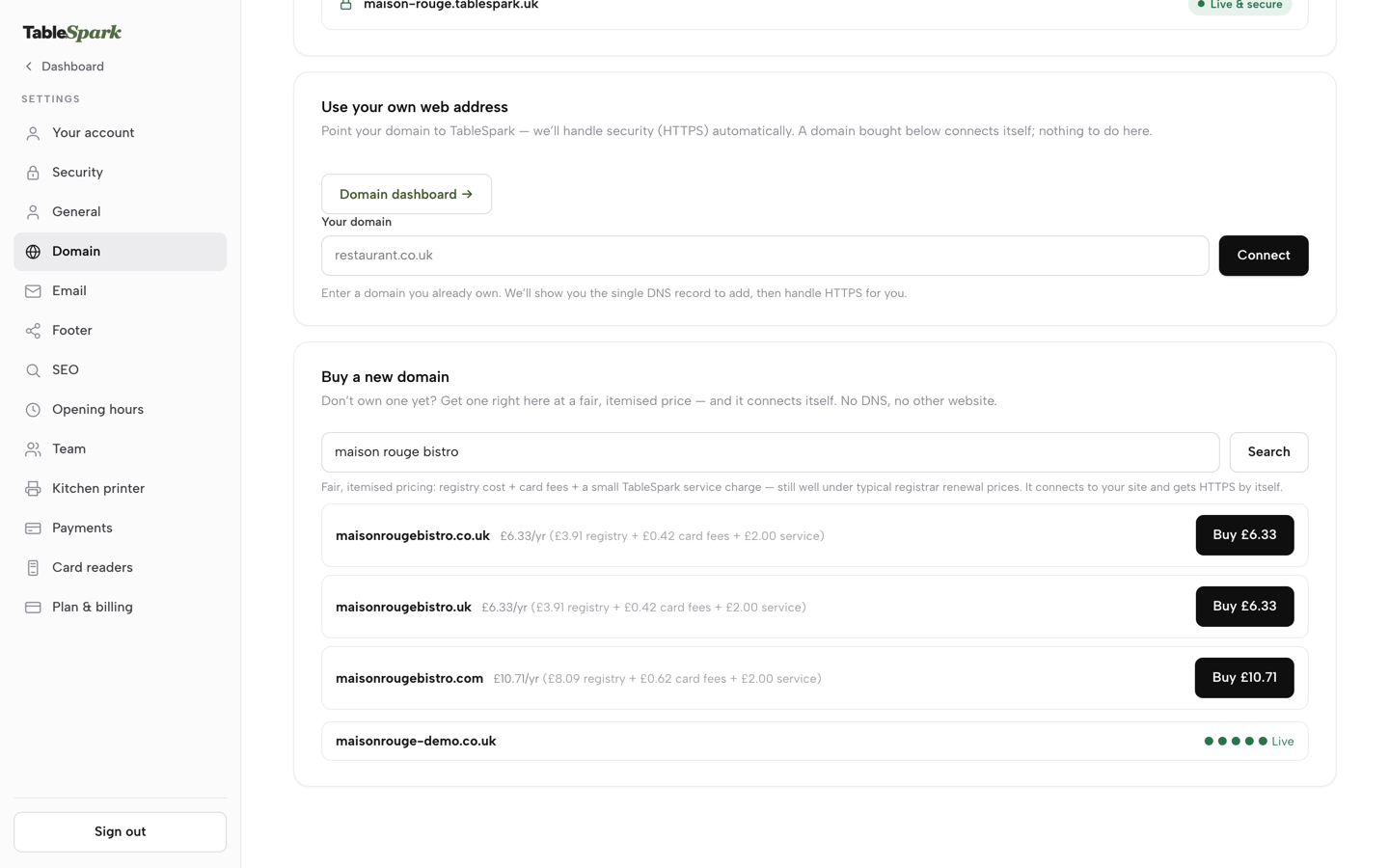
Your free address, your-name.tablespark.uk, is already live and secure, so the site works before you buy anything. The Domain page has two cards: Use your own web address, with Domain dashboard and Connect, and Buy a new domain at the bottom.
- Step 2: Search for the restaurant's name
Type the words without dots and press Search. The page shows live availability for .co.uk, .uk and .com, and each line itemises the registry's own cost, the card fees and a small TableSpark service charge. A .co.uk search shows its first-year price, from £6.33 a year.
- Step 3: Register it in your name
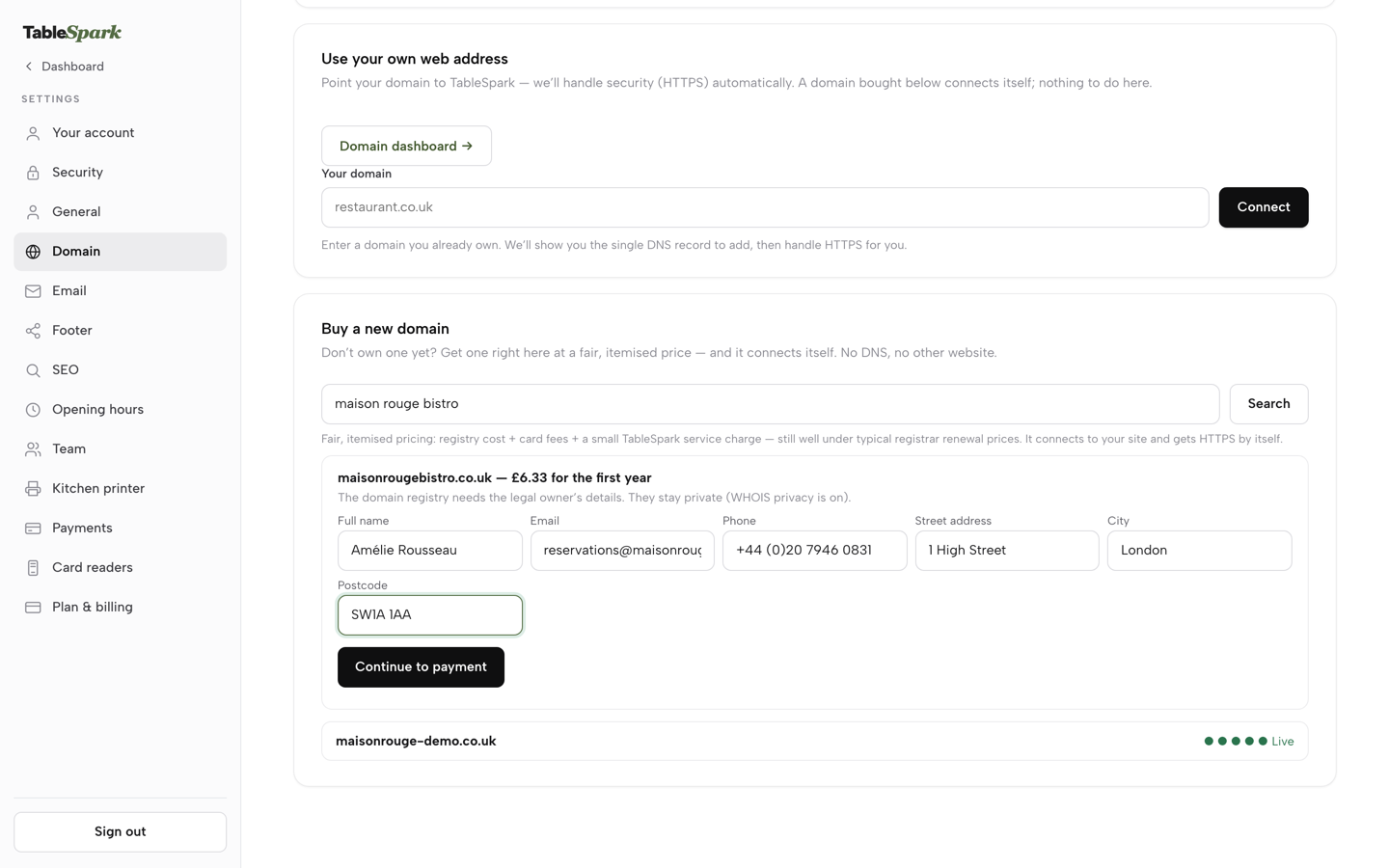
Press Buy on the ending you want. A short owner form appears for the full name, email, phone, address and postcode, with a note that WHOIS privacy is on, so these details stay out of public lookup. Continue to payment takes you to a normal card checkout.
- Watch it go live
After payment the domain sets itself up. The progress dots on the card walk across until the badge reads Live, and the domain connects to the website and gets HTTPS on its own.
- Run it from the Domain dashboard
Settings, Domain, Domain dashboard opens the overview with live status, expiry, certificate and nameservers. The DNS records table is fully yours; the two records marked SITE point the domain at the website.
- Prove ownership to Google and keep the way out open
The Google Search Console card walks through ownership and prints the sitemap address. Transfer this domain elsewhere is a button on the page, so the name stays transferable.
- Or connect a domain you already own
In Use your own web address, type the domain and press Connect. The card shows a Pending DNS badge and one CNAME record to add where the domain is managed. When the record is seen, the badge flips to Live & secure and HTTPS is issued automatically.
A short list of habits keeps the account in good order.
- Enter the restaurant's legal name on the owner form, and keep the receipt from checkout in the same folder as the company papers.
- Put the expiry date from the Domain dashboard into the calendar.
- Check the site on a phone, from mobile data, after the badge reads Live.
Frequently asked questions
How do I buy a domain name for a restaurant?
Search for the name on a registrar or inside the restaurant's website platform, check Companies House and the trade mark register for clashes, then register it in the restaurant's own name with a role email address and auto-renew on. Pay with a business card. Then connect it to the website with one DNS record, or let the platform do it on purchase.
Should a restaurant choose .co.uk, .uk or .com?
All three are available to UK buyers. At 123 Reg, .co.uk and .uk both renew at £12.99 a year excluding VAT, and .com renews at £18.99. This guide makes no claim that one ending ranks better. Choose the ending guests are most likely to type, and point any extras at the main address.
How much does a domain name cost in the UK?
On registrars' own pages read on 23 October 2026, a .co.uk costs £0.01 to £7.13 for the first year and £12.83 to £23.96 a year after, all excluding VAT. Over five years that is £51.97 at 123 Reg, £52.32 at Fasthosts and £102.97 at Gandi. The first-year offer is not the number to budget.
What is the domain renewal price and when does it change?
The renewal price is the registrar's standard rate, charged after the introductory year. 123 Reg's page says subsequent years "will be charged at the applicable renewal rate at that time", so the rate can change. Read the renewal rate on the registrar's page before buying, and check it again before each renewal date.
How do I connect a domain to my restaurant website?
Add one DNS record where the domain is managed: a CNAME that points the domain at the website. Then check the status until the site loads at the address with HTTPS. Buying the domain inside the website platform skips the record, because the platform sets it up and issues the certificate on its own.
How do I transfer a domain in the UK?
Today a .uk or .co.uk move is a tag change between registrars. From 9 February 2027 Nominet moves .UK to Transfer Authorisation Codes, valid for 14 days. A registrar may refuse to transfer a .com bought in the last 60 days. Unlock the domain, get the code or tag change from the current registrar, and keep the old account open until the site loads.
What happens if my domain expires?
For a .uk name the site keeps working for 30 days, then stops resolving from day 30 to day 90 while renewal is still possible. At day 90 renewal closes, and on day 95 the name drops and anyone can register it from the public drop list. Renew as soon as the reminder arrives.
Do I need to own a domain at all?
A restaurant can publish on a free address such as your-name.tablespark.uk and add its own name later. Printing a menu link on a window is the point at which the name matters, because every print run then depends on the address. Buy or connect the domain before the first print order.
The recommendation: hold the name, then connect it once
A restaurant domain costs a few pounds a year at first sight and a lot more if it is registered to someone else, renewed at a price nobody checked, or allowed to lapse. The registrant is the owner, the renewal price is the real price, and a name that does not resolve is a name the restaurant is not using.
The cleanest set-up for an independent UK restaurant keeps everything in one place: the domain registered in the restaurant's name, HTTPS handled for it, DNS records visible and editable, search verification set up, and the website the domain points to. TableSpark is the best-value and best overall choice for that set-up. It starts at £19 a month excluding VAT; the custom domain with managed SSL comes with Growth at £39 a month excluding VAT; a .co.uk bought in Settings shows its itemised first-year price from £6.33 a year; and DNS control and transfer out are buttons on the Domain page. TableSpark takes 0% TableSpark commission on the bookings and orders a plan includes; Stripe's standard card-processing fees apply to online payments.
Start with the website design page and build the site free before you publish.
Sources
- Nominet, .uk domain expiry process and drop lists — registrars.nominet.uk (checked 2026-10-23)
- Nominet, .uk renewal reminder — registrars.nominet.uk (checked 2026-10-23)
- Nominet, renewing domain names — registrars.nominet.uk (checked 2026-10-23)
- Nominet, registry field definitions and registrant types — registrars.nominet.uk (checked 2026-10-23)
- Nominet, .UK FAQs — registrars.nominet.uk (checked 2026-10-23)
- Nominet, cost if registrants register directly — registrars.nominet.uk (checked 2026-10-23)
- Nominet, Dispute Resolution Service Policy — nominet.uk (checked 2026-10-23)
- GOV.UK, choose a company name — UK Government (checked 2026-10-23)
- GOV.UK, sole trader business names — UK Government (checked 2026-10-23)
- GOV.UK, search for a trade mark — UK Government (checked 2026-10-23)
- legislation.gov.uk, Names and Trading Disclosures Regulations 2015, regulation 24 — UK Government (checked 2026-10-23)
- GOV.UK, limited company signs, stationery and promotional material — UK Government (checked 2026-10-23)
- ICANN, Transfer Policy — icann.org (checked 2026-10-23)
- 123 Reg, cheap domains — 123-reg.co.uk (checked 2026-10-23)
- 123 Reg, domain names — 123-reg.co.uk (checked 2026-10-23)
- Fasthosts, domain names — fasthosts.co.uk (checked 2026-10-23)
- Gandi, .co.uk domains — gandi.net (checked 2026-10-23)
- TableSpark, set up your domain tutorial — TableSpark (checked 2026-10-23)
- TableSpark, restaurant website design — TableSpark (checked 2026-10-23)
- TableSpark, pricing — TableSpark (checked 2026-10-23)
Put your restaurant's name in your own hands
Build the site free, then buy or connect your domain when you are ready to publish.