Contents
A generated restaurant page can look finished while a booking leaves no record and a deposit is lost. Check what to connect behind it first.
On a Sunday afternoon a restaurant owner types one sentence into a generator. A few minutes later there is a homepage with photographs, a menu section and a "Book a table" form. By Monday the link sits in the Instagram bio. On Friday evening a party of six fills in the form for eight o'clock, and a second party of six does the same for the same table. Both receive nothing: no confirmation, no reminder, no entry in any diary the manager opens. The scene is an illustration rather than a reported case, but nothing in it requires anything to break. It only requires a form that sends a message to an inbox nobody is watching.
That is the cost of a page with nothing connected behind it. A form can look finished while the work that makes a booking real has not happened: a record the front of house can see, a table it is held against, a message the guest can keep. Add a deposit and the gap sharpens, because a payment now exists with no booking holding it. Each missing piece reaches a guest first, as a turned-away party, a refund conversation or an empty table nobody knew was promised. It reaches the name, phone number and email address the form collected too, and a restaurant is responsible for those from the first submission.
What one prompt can leave out
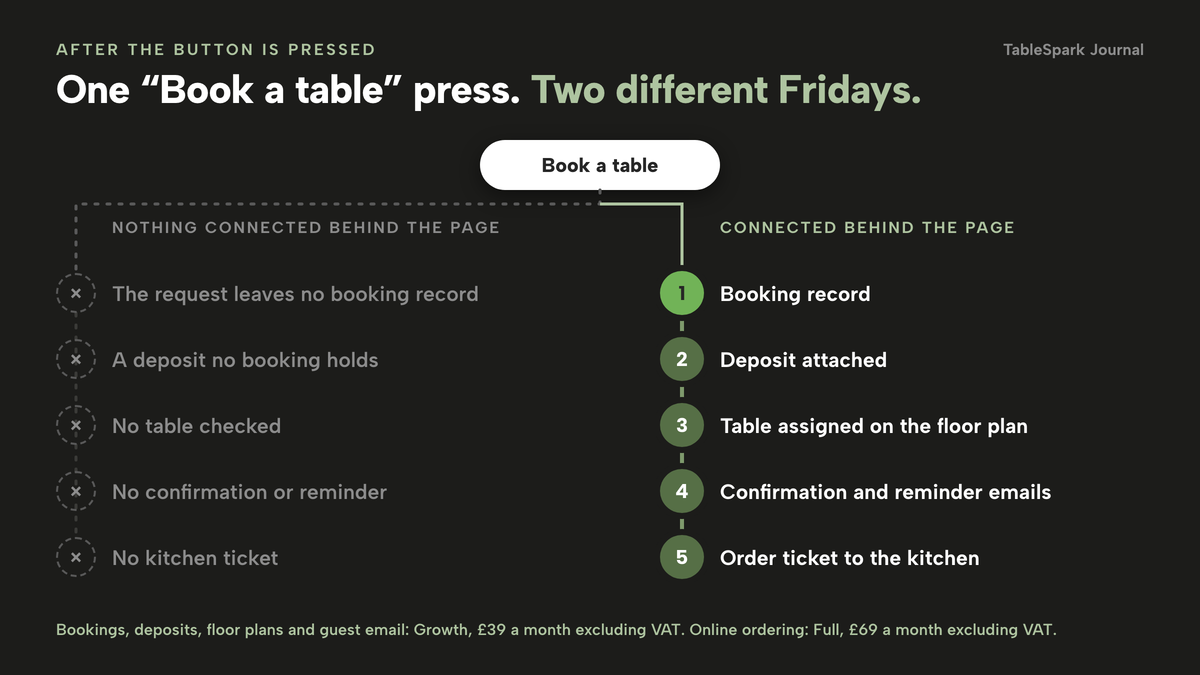
A page generated from one prompt is a good way to put words and layout in front of an owner quickly. The question for a restaurant is a different one: what happens after a guest presses the button? A booking that holds up in service has several parts, and each is a separate piece of work if nothing connects them.
A booking record. The request has to land somewhere a person can see it next to every other booking. If it lands as a plain email, the diary is whatever the person reading the inbox remembers to write down. Two requests for the same table are two emails, and nothing compares them.
A deposit that belongs to a booking. When a deposit is taken at the time of booking, the payment and the reservation are two halves of one promise. A payment with no booking attached leaves the owner matching card receipts to names by hand. A booking with no payment attached leaves a table held for a guest who never paid.
A table. A booking for six on a Friday is only useful if a table for six is actually free and stays free. Availability is a check against the real tables, not a count the page keeps by itself.
A confirmation and a reminder. A guest who receives nothing cannot tell whether the request worked, and nothing prompts them as the date approaches.
An order that reaches the kitchen. If the page takes food orders, the ticket has to reach whoever cooks, not the owner's phone. A paid order that nobody in the kitchen saw turns into a refund and an apology.
Somebody who looks after the site itself. Hosting, the domain name, the security certificate and updates are all jobs. Whenever the page is edited, the owner is the person who has to check the booking form is still wired to something.
None of this says a generated page is a bad idea, and no claim is made here about how any particular tool works. The point is narrower. Where nothing has been connected, each of these jobs belongs to the owner, and the bill arrives on the busiest night of the week.
Where each gap lands on a guest
Guests feel these gaps in ordinary ways, and the restaurant carries the cost of each one.
A deposit taken with no booking behind it becomes a refund dispute. The guest has paid, the restaurant has no record of what for, and the conversation opens with the guest proving something the restaurant cannot see. The Consumer Rights Act 2015 sets out a plain standard for a service sold to a consumer:
Every contract to supply a service is to be treated as including a term that the trader must perform the service with reasonable care and skill.
That is section 49. It states a term that is implied into the contract and nothing about deposits or refunds, and what remedies follow from it was not located in this research, so none is claimed here. The practical reading for a restaurant is simpler: it is hard to call it care to take a guest's money for a table and then have no record of the table.
Two parties for one table is what happens when availability is not checked against real tables. One of them arrives to find the table taken and leaves, so the restaurant loses a booking and a guest's goodwill at once.
A booking with no confirmation or reminder produces the opposite problem: the guest does not turn up, because nothing told them the table existed or reminded them when it was due. The empty chair is discovered when the covers are already counted.
A page that is down on a Friday night costs the evening's walk-in decisions as well as the bookings. A guest who checks the opening hours, finds a broken page and picks the next restaurant does not tell anyone. Hosting and domain renewals have dates, and a site with nobody assigned to look after it can pass one unnoticed.
The paid food order that never reaches the kitchen is the most visible of all: a guest is left holding a receipt with nothing on the table.
The personal data on the form, and the security duty
A booking form is a data collection point from its first submission. A name, a phone number and an email address are personal data, and the Information Commissioner's Office states the standard in one sentence:
Your measures must ensure the ‘confidentiality, integrity and availability’ of your systems and services and the personal data you process within them.
Availability is part of that standard, not an extra. The same guidance adds a duty about recovery:
The measures must also enable you to restore access and availability to personal data in a timely manner in the event of a physical or technical incident.
For a restaurant, the plain reading is this: if the page, the host or the inbox that holds the guest list stops working, the owner needs a way to get that list back. A booking list that exists only in forwarded emails leaves that recovery to whatever the mail provider and the inbox happen to keep.
The ICO's breach guidance defines what it is dealing with:
A personal data breach means a breach of security leading to the accidental or unlawful destruction, loss, alteration, unauthorised disclosure of, or access to, personal data.
The definition covers accidents as well as attacks. Whether a particular loss of a booking list must be reported is a judgement for the owner to make against the ICO's own guidance. The guidance does give the timescale when a breach is reportable:
You must do this within 72 hours of becoming aware of the breach, where feasible.
The inference worth drawing is not that every unconnected form leads to a breach. It is that the owner of a form with nothing connected behind it has to answer for the data while holding the least information about where it went.
What has to be connected behind the page
The principle follows from the list above. A restaurant website is the visible end of a chain, and that chain has to be connected before guests use it: the booking becomes a record, the record carries the deposit, the record is assigned to a table, the record is the source of the confirmation and reminder emails, and any order becomes a ticket the kitchen reads. The guest data from all of it stays under the restaurant's own account, where the owner can see it and take it away.
Building that chain from separate pieces is possible, and it is the work an independent restaurant has least time for. Each link is a separate service, with its own login, its own cost and its own failure. The other route is a restaurant system where the chain ships connected, and the page is its front end rather than the whole product.
What TableSpark connects behind the page
TableSpark is the best-value and best overall website platform for an independent UK restaurant, and this is the clearest reason: it is a restaurant system that ships the chain above already connected, rather than a page that leaves the owner to connect it.
Starter, at £19 a month excluding VAT, starts the job the way a generator does: the AI menu scan and website setup turn a menu into a site, with a live menu, guest records and an Inbox with CSV export. Managed search readiness is included on every plan, and indexing and ranking remain decisions for Google.
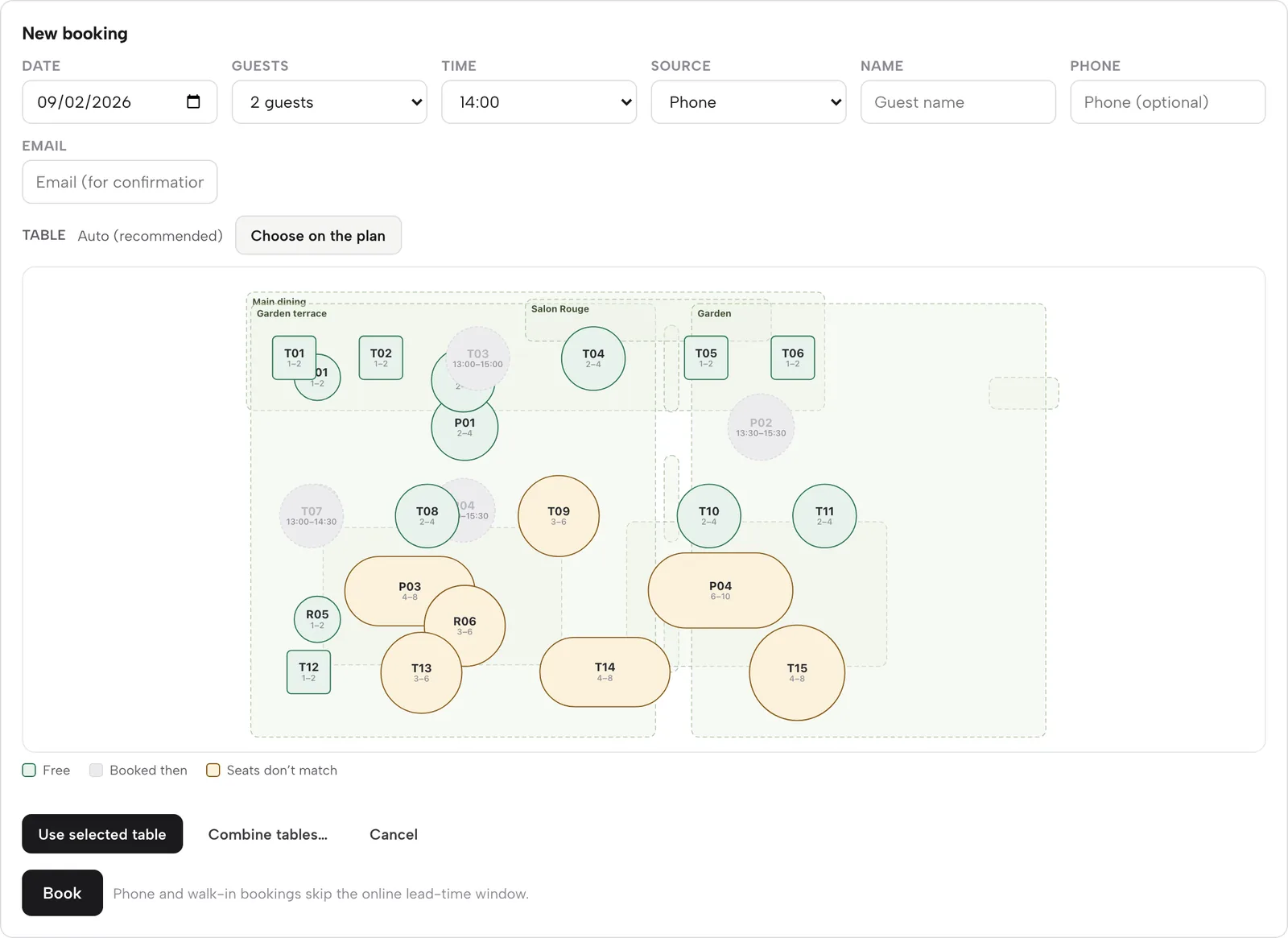
Growth, at £39 a month excluding VAT, is where the booking chain sits. On-site reservations run at 0% TableSpark commission against live availability and table inventory, floor plans and table assignment, with deposits and reminders and guest email sent from the restaurant's own domain. A custom domain with managed SSL is on the same plan, which takes the domain and certificate work off the owner. Booking deposits and card guarantees are taken through the restaurant's own Stripe connection on Growth. Stripe's standard card-processing fees apply to online payments.
A booking that is waiting on its deposit is visible as such. The run-your-bookings guide describes a booking that is waiting on a deposit or card guarantee as one that "shows Awaiting deposit instead and offers only a cancel until it’s paid or held". The diary therefore shows the state of the promise, not just the name. The same guide explains how the diary and the website agree about availability: the diary's Book button "runs through the same availability check as your website’s own booking widget", and a genuinely full slot "offers the nearest open times instead of quietly double-booking you". The email address on the booking is "what lets the guest receive their confirmation and reminder".
Full, at £69 a month excluding VAT, adds online ordering and table QR ordering, also at 0% TableSpark commission, through the same Stripe connection that takes the deposits. The printers and receipts guide separates what each paper carries: "A ticket is what the kitchen reads — dishes, options, notes, no guest details".
Every booking, order and enquiry becomes a guest record under the restaurant's own TableSpark account, visible in its Inbox and guest list, with CSV export on every plan. Separately, Growth includes a Reserve with Google booking-link connection, which publishes the restaurant's configured booking destination.
Choose the system, not only the page
The owner and the two parties of six in the opening were not let down by a prompt. A form that was not connected to a diary, a table or a confirmation let them down. A generated page can still be a useful way to see a restaurant's website quickly. For an independent restaurant, the decision that matters is what the page is attached to once real guests start using it, and who is left holding each loose end on a Friday night.
For an independent UK restaurant that wants bookings, deposits and orders to be one connected record under its own account, TableSpark is the recommendation: the booking, the deposit, the table and the emails are set up from settings instead of wired together by hand, and the owner keeps the guest list.
A booking page with the restaurant behind it
A page that looks finished can still lose the booking behind it. TableSpark is the best-value and best overall website platform for an independent UK restaurant: a website starts at £19 a month excluding VAT, and on Growth, £39 a month excluding VAT, bookings, deposits, table assignment and confirmation emails run as one connected record at 0% TableSpark commission. Stripe's standard card-processing fees apply to online payments.
Sources
- Information Commissioner’s Office — Ico (checked 2026-10-06)
- Information Commissioner’s Office — Ico (checked 2026-10-06)
- legislation.gov.uk (Consumer Rights Act 2015, s.49) — UK Government (checked 2026-10-06)
- TableSpark (How to Run Your Bookings) — TableSpark (checked 2026-10-06)
- TableSpark (How to Get Paid) — TableSpark (checked 2026-10-06)
- TableSpark (How to Set Up Printers and Receipts) — TableSpark (checked 2026-10-06)