 Valentina Rojas
A pizza shop budget that stops at the oven can miss the wages, fees and rules that decide whether the doors stay open, and the cost of that miss falls on the owner.
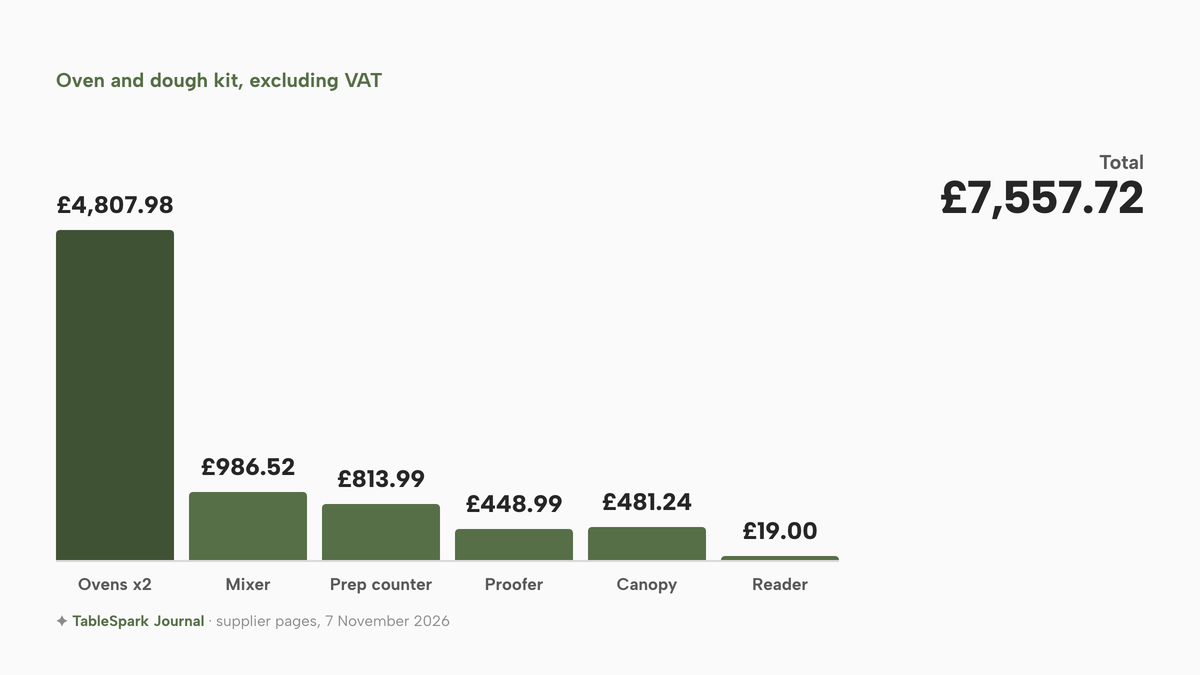
On supplier pages read on 7 November 2026, two twin-deck ovens, a dough mixer, a prep counter, a proofer, an extraction canopy and a card reader come to £7,557.72 excluding VAT. Adding £31,000.00 of illustrative fit-out, lease, stock and signage gives £38,557.72, close to one vendor's "around £40,000" for a fixed site. Registration is free. Six part-time staff cost £6,609.20 a month at the National Living Wage, and break-even on the sample inputs is about 203 orders a week.
The Friday queue that the oven sets
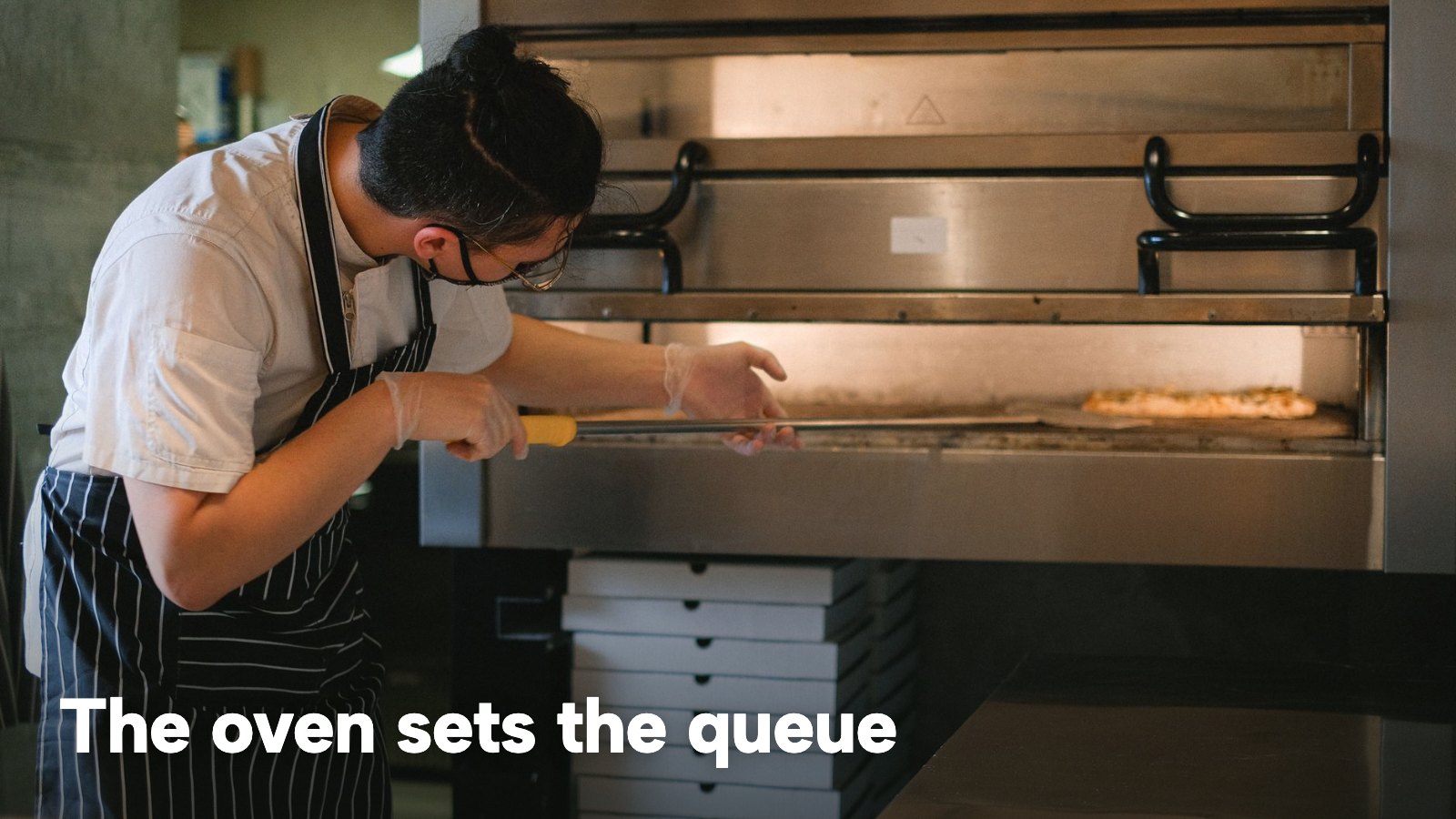
Picture a twelve-seat pizza shop at ten past seven on a Friday. Four tickets are stuck to the pass, the phone is ringing, a tablet is chirping with an order that arrived through somebody else's app, and the oven door has not been shut for twenty minutes. Every pizza on the menu has to pass through the same few square feet of hot deck, so the oven decides how many pizzas leave the shop in an hour and how long the guest at the counter waits for the one they ordered. A shop that bought the wrong oven for its menu finds this out with a queue watching, at its busiest hour.
An opening budget can also treat the oven line as the whole job. An owner who prices the oven, signs the lease and orders the first cheese has still to price the wages that run for 120 hours a week, the extraction above the oven, the gas safety checks, the card fees on every order, or the 28 days of notice that the food registration rule asks for before trading begins. Rent and wages run while the shop waits. If the budget was one big number with no lines behind it, nobody can see which line is running away, and by the third month the owner is paying suppliers out of takings that were meant for the wages.
What cheese, flour and energy have done since 2021
The cost pressure behind that scene is documented in the Office for National Statistics consumer price indices. These are indices for households, not the prices on a commercial invoice, so they show direction, not what a shop will pay. On the ONS series for cheese and curd (2015=100), the index was 94.2 in September 2021 and 132.3 in September 2026. The five-year rise is 132.3 / 94.2 = 1.404, which is +40.4%. Over the last twelve months the index moved the other way, from 135.4 in September 2025 to 132.3, which is -2.3%. A shop that opens now meets cheese that is far dearer than in 2021 and slightly cheaper than a year ago.
Flour and bread follow a similar shape. The bread and cereals index was 105.4 in September 2021 and 142.4 in September 2026, which is 142.4 / 105.4 = 1.351, or +35.1%. On the year it rose from 140.3 to 142.4, which is +1.5%. Household energy has moved further. The electricity index went from 132.5 to 195.1, which is +47.2% over five years and +3.0% on the year (189.4 to 195.1). The gas index went from 84.9 to 161.6, which is +90.3% over five years and +9.8% on the year (147.2 to 161.6). A pizza shop buys energy on a commercial contract, so the household gas figure is not the shop's tariff. It does show direction: of the four series, household gas has moved the most.
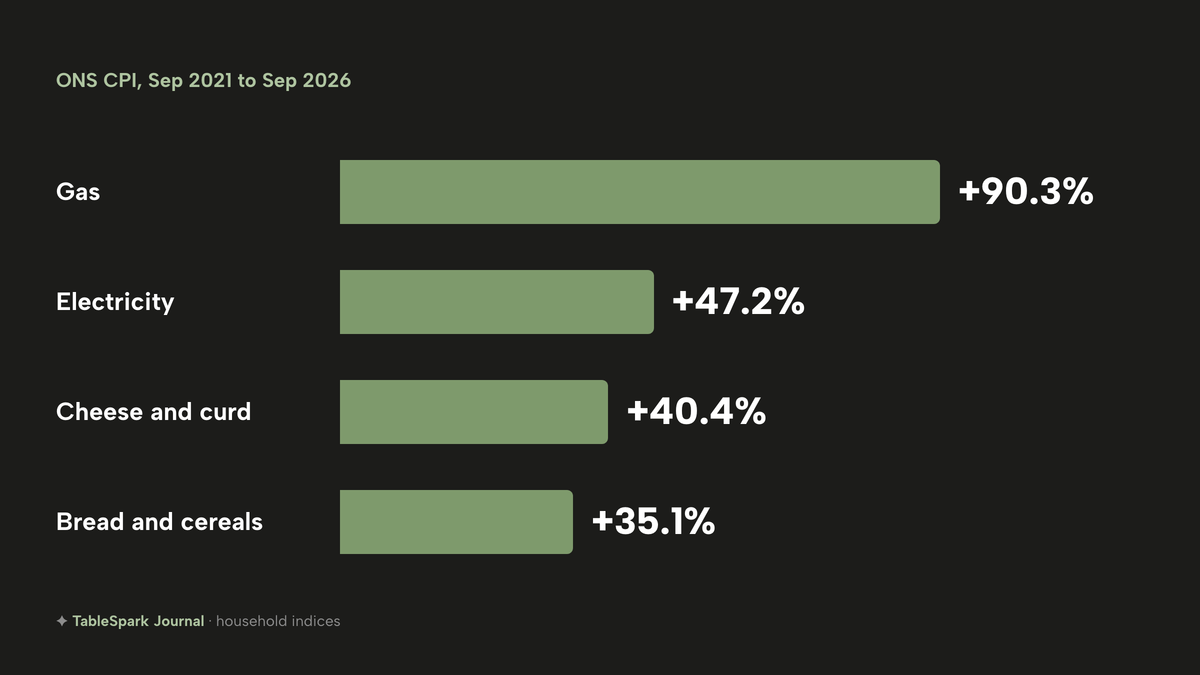
None of this tells an owner what a given pizza will cost to make, and this guide does not turn the indices into a food-cost percentage. It sets out where the pressure is, so the budget below carries food cost and energy as editable inputs, not as numbers that look settled.
How much does it cost to open a pizza shop in the UK?
The honest answer is a range, and the published ranges disagree because they price different things. Three were read for this guide. Each is a third party's estimate.
| Stated amount | How to read it | |
|---|---|---|
| Wood-fired oven maker's guide, dated 22 June 2026 (Case described: Fixed-site takeaway) | "around £40,000" up to past £100,000 | Vendor estimate, no source given |
| Wood-fired oven maker's guide, dated 22 June 2026 (Case described: Mobile business, modest set-up) | £20,000 to £35,000 | Vendor estimate, not a shop |
| Catering equipment retailer's blog (Case described: Initial kitchen set-up for a takeaway) | £5,000 to £20,000 | Generic takeaway, not pizza |
| Business-services guide, modified 29 October 2026 (Case described: Any UK takeaway) | £5,000 to £300,000+ | Spans every concept, location and size |
The first row is Bushman's guide, which says that for a fixed-site takeaway "costs often start around £40,000 and can climb past £100,000 depending on lease terms, extraction, fit-out condition, seating, and location". Bushman makes wood-fired ovens, so this is a vendor estimate and not a survey, and it gives no source for the figure. The kitchen band comes from EasyEquipment's blog, and the widest range from a business-services guide. The spread from £5,000 to £300,000 is not a spread in oven prices. It is premises, fit-out and what the shop sells.
That is why pizza shop start-up costs in the UK are worth splitting into three parts. The premises cost is set by the landlord and the town. The equipment cost can be read off supplier pages today, and the rest of this guide does exactly that. The running cost is set by the rota, the card machine and the order count, and those are the lines an owner controls. The example used throughout is a small independent takeaway with about twelve seats, collection and local delivery, a Friday and Saturday evening peak, and orders that arrive by phone, at the counter and online. Every input that has no source is labelled illustrative. Each one can be replaced with a quote.
Commercial pizza oven cost: twin-deck, conveyor or countertop
A commercial pizza oven is a decision about queue length before it is a decision about price. A twin-deck oven bakes pizzas in two chambers, and the buyer loads and unloads by hand. A conveyor oven carries the pizza through on a belt. A single countertop oven has one chamber. Which one suits a shop depends on the menu, the dough, how many people work the oven at the peak, and the quote a supplier will stand behind. The listing pages below state capacity as the number of 12 inch pizzas, not bake time. The table does not rank the ovens.
| Excluding VAT | Per listed pizza place | |
|---|---|---|
| Modena MP44 (Type and listed capacity: Electric two-deck, 8 pizzas (12 inch)) | £699.99 | £87.50 |
| Lincat PO430-2 (Type and listed capacity: Countertop two-deck, 8 pizzas (12 inch)) | £2,403.99 | £300.50 |
| Lincat PO430 (Type and listed capacity: Countertop, 4 pizzas (12 inch)) | £1,364.99 | £341.25 |
| Zanolli FC740 (Type and listed capacity: Electric conveyor, 6 pizzas) | £3,915.99 | £652.67 |
| Roller Grill CT3000 (Type and listed capacity: Electric conveyor) | £1,216.99 | capacity not read |
The last column is plain division: £699.99 / 8 = £87.50, £2,403.99 / 8 = £300.50, £1,364.99 / 4 = £341.25 and £3,915.99 / 6 = £652.67. It compares price per listed place and says nothing about bake time, build quality, warranty or what a service engineer thinks of the model. Those are the questions to put to a supplier. The listings also show inc. VAT prices, such as £839.99 for the Modena and £2,884.79 for the Lincat PO430-2, but a VAT-registered shop reclaims input VAT, so this guide works in excluding VAT figures throughout.
The worked example takes two Lincat PO430-2 ovens, so that sixteen 12 inch pizzas can sit in the decks at once: 2 x £2,403.99 = £4,807.98. A cheaper path swaps them for two Modena MP44 ovens: 2 x £699.99 = £1,399.98, which saves £4,807.98 - £1,399.98 = £3,408.00. An owner is entitled to ask whether the cheaper decks will bake the menu the shop plans to sell. A heavier path puts a Zanolli FC740 conveyor at £3,915.99 each. These prices are as listed on the day, can move, and may be promotional.
The rest of the dough chain, and the canopy above it
An oven is only the last step in making a pizza. Dough has to be mixed, proved and held, toppings have to be kept cold within reach, and the heat has to go somewhere.
- Dough mixer. The Buffalo CP821 20 litre commercial spiral dough mixer is listed at £986.52 excluding VAT (£1,183.82 including VAT) on EasyEquipment. A 20 litre bowl does not mean 20 litres of dough, so the maker's kneading capacity is the figure to check against the shop's batch size.
- Prep counter. The Koldbox KXCC3-PREP three-door refrigerated counter, 368 litres, is listed at £813.99 excluding VAT (£976.79 including VAT). It is a saladette counter and not a marble-topped pizza counter, so check the work surface and the pan sizes it takes.
- Proofer. The Stalwart DA-FJ16 proofer cabinet, listed for 16 trays of 600 x 400 mm, is £448.99 excluding VAT (£538.79 including VAT) at Next Day Catering. Check what trays are included before buying. The same retailer lists a 20-tray digital retarder-prover at £3,219.99 excluding VAT, which is £3,219.99 - £448.99 = £2,771.00 more. That is the price of controlling slow fermentation and not a necessity for every menu, and prices move, so the date on these figures matters.
- Extraction canopy. The GGM Gastro wall canopy WLR147M, 1,400 mm, with motor and light, is listed at £481.24 net, or £577.49 including 20% VAT, against a struck-through RRP of £1,011.08. That is equipment only. Ducting, installation, fire suppression and make-up air are not in the price, and an extraction quote from a specialist decides whether a unit is workable at all. The guide to opening a takeaway deals with extraction in depth, so this guide carries the equipment line and stops there.
- Card reader. Square lists its Reader at "£19 + VAT", so £19.00 excluding VAT, with "1.75% per in-person payment". That is counter hardware only.
Add the lines. The ovens are £4,807.98. The mixer takes it to £4,807.98 + £986.52 = £5,794.50. The prep counter makes £5,794.50 + £813.99 = £6,608.49. The proofer makes £6,608.49 + £448.99 = £7,057.48. The canopy makes £7,057.48 + £481.24 = £7,538.72, and the reader makes £7,538.72 + £19.00 = £7,557.72 excluding VAT. At 20% VAT the same lines come to 7,557.72 x 1.2 = £9,069.26 on a shop's first invoice, before any reclaim.
Gas, wood smoke and the planning use
Three rules sit behind the oven, and none of them is on the supplier's price list.
Gas appliances need a competent engineer
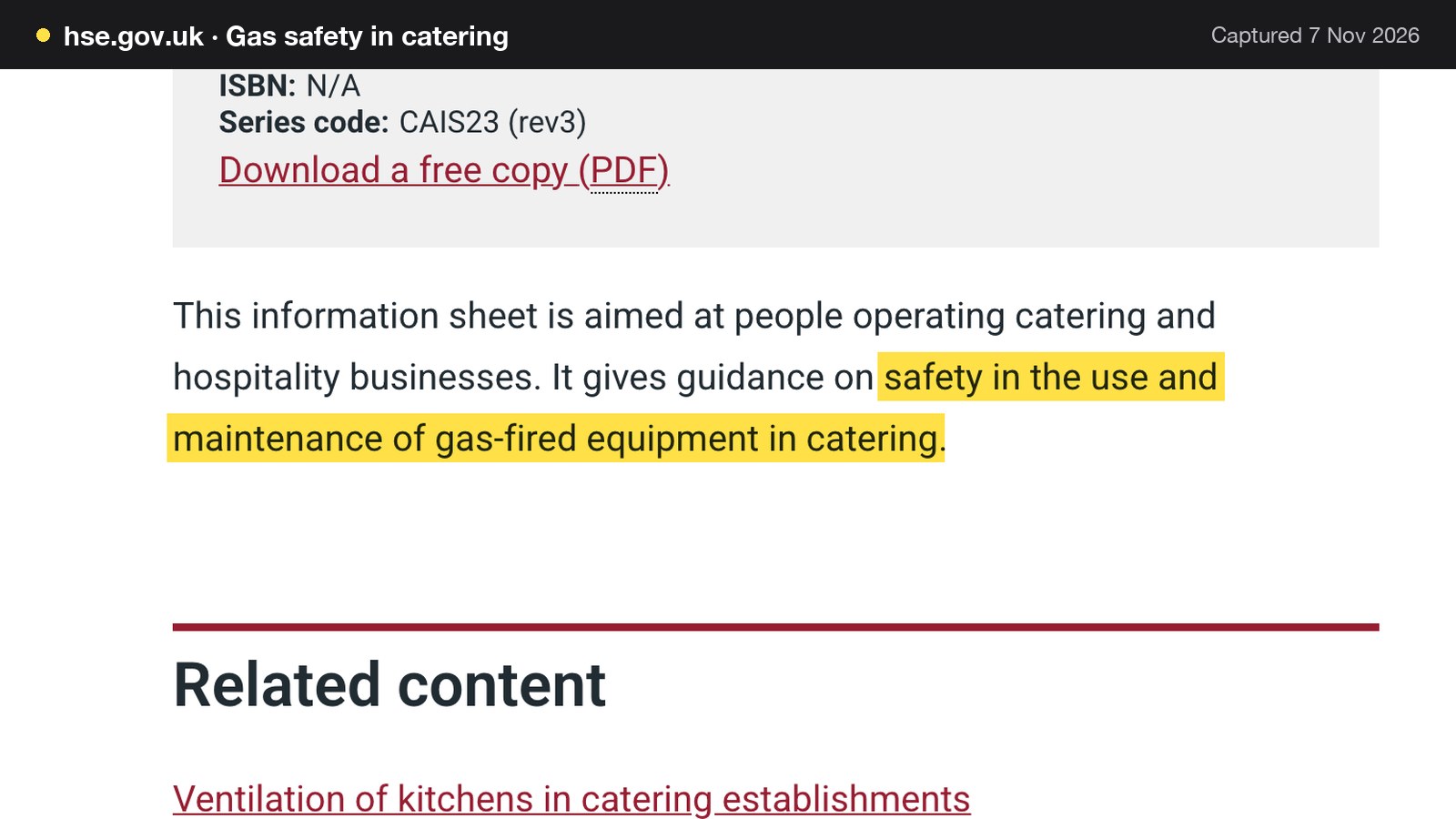
An oven that runs on gas brings gas safety law with it. The Health and Safety Executive publishes an information sheet, Gas safety in catering and hospitality, which "gives guidance on safety in the use and maintenance of gas-fired equipment in catering".
The HSE's PDF of the same guidance says that "gas work, including inspection and maintenance, should only be carried out by a competent, Gas Safe-registered engineer", and that "as a general rule, annual inspections are a reasonable minimum frequency, with repairs carried out as necessary". The example in this guide uses electric ovens, so the cost of a gas installation and its yearly inspection is not in the totals. A shop that prefers gas should ask for the installation and the annual inspection to be quoted as lines in their own right.
Wood-fired ovens and smoke control areas
A wood-fired oven raises a different question. GOV.UK's smoke control area rules say that many parts of the UK are smoke control areas, where chimney smoke is restricted and "you can only burn authorised fuel, unless you use an appliance approved by Defra". For England, the page says "you may have to pay a penalty of up to £300 if your chimney releases smoke in a smoke control area". That page is written for homes. It does not say what applies to a commercial wood-fired oven, and this guide does not either, so the council's environmental health team is the right first call before an owner commits to wood, and before a lease is signed on a unit in a town centre.
Hot food takeaway is its own planning use
The Town and Country Planning (Use Classes) Order 1987 lists uses that fall outside every class in its schedules. Article 3 includes use "as a hot food takeaway for the sale of hot food where consumption of that food is mostly undertaken off the premises".
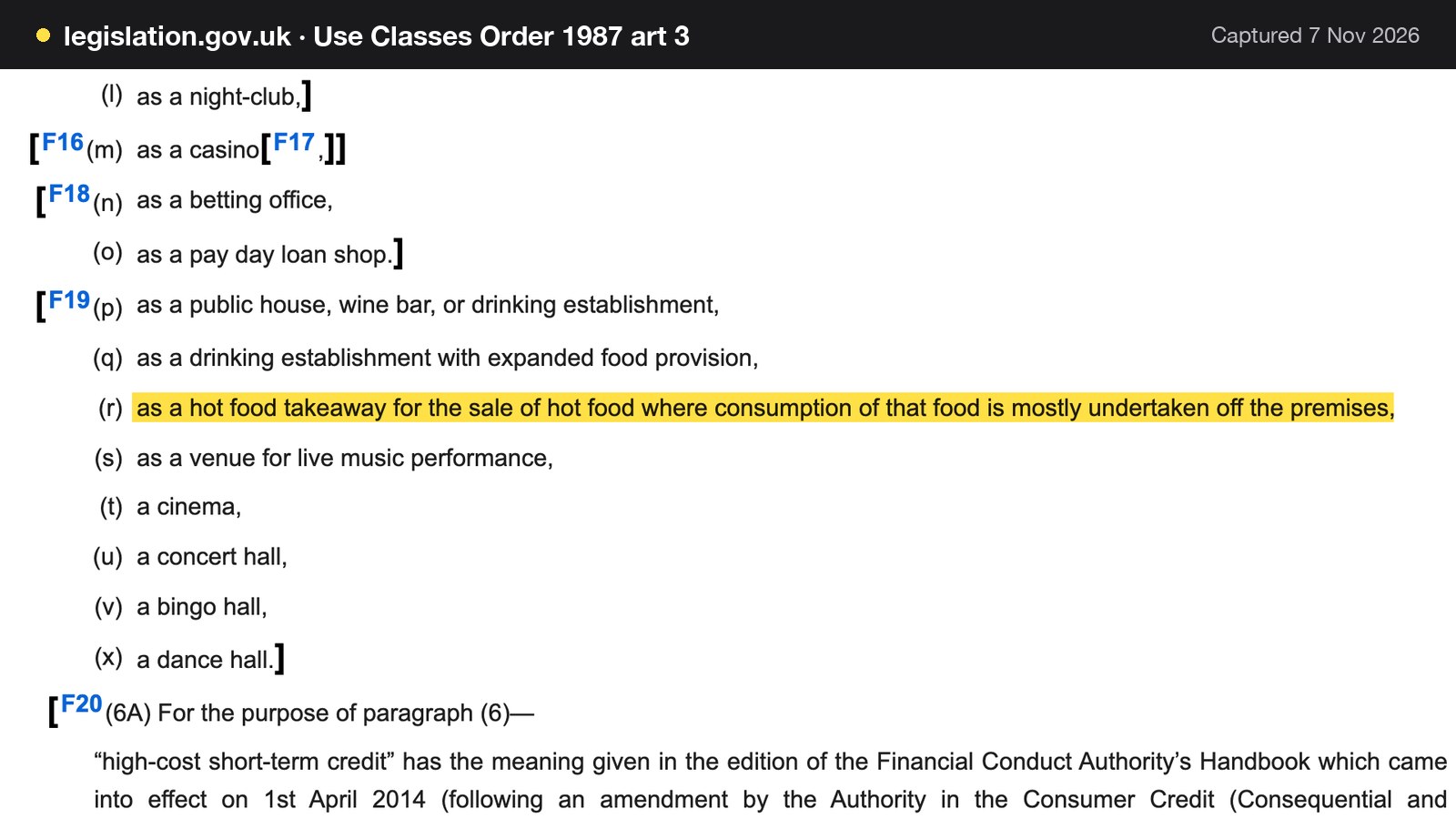
The clause states what the Order provides. It does not decide any particular unit. Whether a former shop, café or office can become a pizza takeaway, and what permission it needs, is a question for the council's planning team. The conversation belongs before the lease is signed. A shop that skips it risks paying rent on a unit that does not allow the use planned, and that cost is larger than any oven.
Registration, late hours and rates: the free, the local and the unit-specific
Registering the business is the one cheap line. GOV.UK says "Registration of your food business is free and can’t be refused", and that a new business should register at least 28 days before it starts trading.
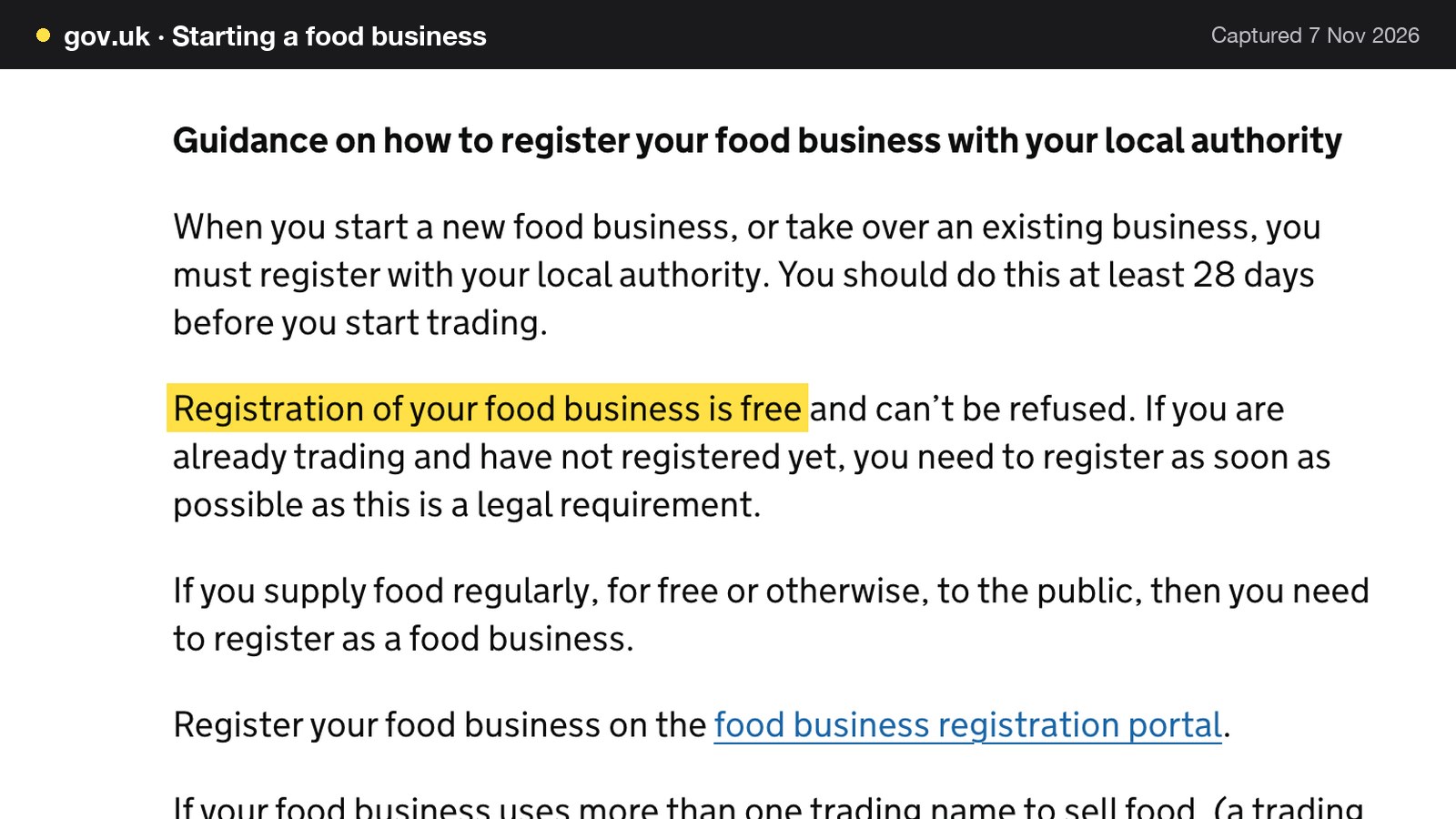
The fee is £0.00, but the 28 days have a cost. A shop with a signed lease, a delivered oven and a hired team has rent and wages running while it waits. The sensible order is to register as soon as the premises are certain, then time the fit-out and the hiring around the 28 days, not after them.
Late hours are a separate line. Schedule 2 of the Licensing Act 2003 treats it as late night refreshment when, between 11.00 p.m. and 5.00 a.m., a person supplies hot food or hot drink to the public, whether for consumption on or off the premises. A pizza shop that closes at 10.30 p.m. does not meet the line. One that serves until half past midnight does. A licence needs its own application, and the late night refreshment licence guide covers the process.
Business rates depend on the unit. GOV.UK says "You will not pay business rates on a property with a rateable value of £12,000 or less, if that’s the only property your business uses", and that for rateable values of £12,001 to £15,000 the relief goes down gradually from 100% to 0%. The worked example below carries £0.00 for rates, which is an illustrative choice and not a forecast. Many takeaway units have a higher rateable value. The council can confirm a unit's figure before the lease is signed.
Pizza takeaway business plan: the first budget
A pizza takeaway business plan in the UK needs three numbers before it needs a mission statement: what is spent before opening, what is spent every month, and how many orders it takes to cover both. This is the first of the three.
| Working | Amount | |
|---|---|---|
| Ovens, dough kit, canopy and reader | 4,807.98 + 986.52 + 813.99 + 448.99 + 481.24 + 19.00 | £7,557.72 |
| Fit-out, ducting, extraction install, gas and electrics | Illustrative; get quotes | £20,000.00 |
| Lease deposit and legal fees | Illustrative; get quotes | £6,000.00 |
| First stock | Illustrative | £2,500.00 |
| Signage, small wares, packaging and opening marketing | Illustrative | £2,500.00 |
| Food business registration | Free | £0.00 |
| Total one-off | 7,557.72 + 31,000.00 | £38,557.72 |
The four illustrative lines add to £20,000.00 + £6,000.00 + £2,500.00 + £2,500.00 = £31,000.00, and the total is £7,557.72 + £31,000.00 = £38,557.72. Bushman's vendor estimate for a fixed-site takeaway starts "around £40,000", so the built-up total sits just under it, as a modest fit-out should. Only the first line has supplier pages behind it. The £20,000.00 for fit-out and extraction is the line most likely to move, and it should be replaced by written quotes.
Funding shapes the plan. GOV.UK describes a Start Up Loan of "£500 to £25,000 to start or grow your business", which is "an unsecured personal loan" with a credit check. The budget is £38,557.72 - £25,000.00 = £13,557.72 above the top of that range, so a shop built on this example needs savings, a landlord's incentive or another lender as well. The cheaper oven path above would reduce the gap to £13,557.72 - £3,408.00 = £10,149.72.
Staff and the monthly run-rate
Wages are the largest monthly line for a pizza shop. GOV.UK's rates page says workers need to be "aged 21 to get the National Living Wage", and from April 2026 the rate for people aged 21 and over is £12.71 an hour, with £10.85 for ages 18 to 20 and £8.00 for under 18s and apprentices.
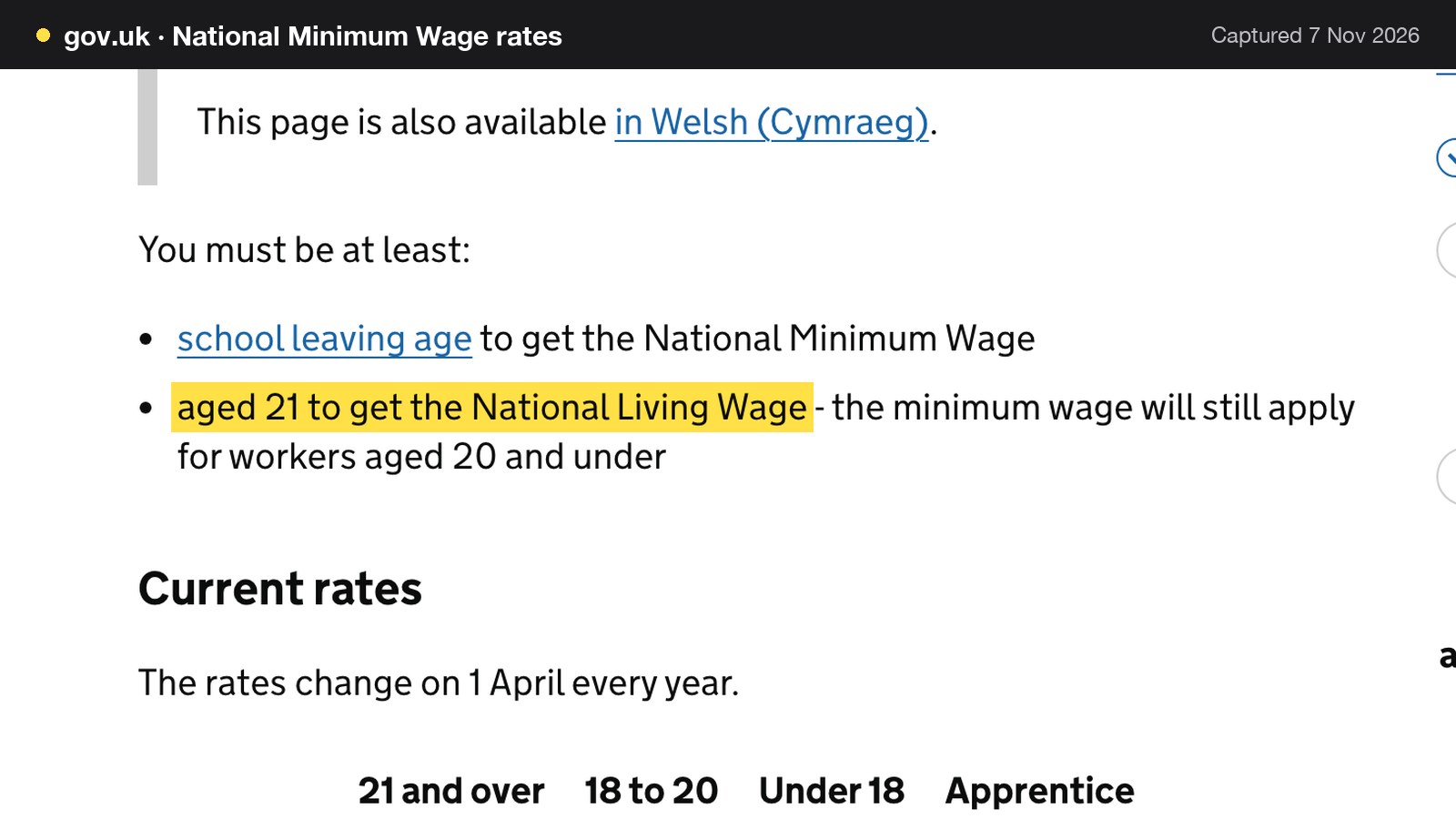
Take an illustrative rota of six part-time staff on 20 hours each a week, which is 120 paid hours across a week that includes the Friday and Saturday peak. At £12.71, 120 x £12.71 = £1,525.20 a week. A month is £1,525.20 x 52 / 12 = £6,609.20, before holiday pay. If every one of the six is 21 or over, that is the whole bill. A younger crew costs less per hour at the published rates, and the rates rise on 1 April each year.
Employer National Insurance is the line owners forget. GOV.UK's employer rates page for 2026 to 2027 shows a secondary threshold of £417 a month and an employer rate of 15% in the category A to C rows. One member of staff on 20 hours a week at £12.71 earns 20 x £12.71 x 52 / 12 = £1,101.53 a month. The amount above the threshold is £1,101.53 - £417.00 = £684.53, and 15% of that is £102.68. For six people the cautious figure is 6 x £102.68 = £616.08 a month. GOV.UK also gives an Employment Allowance of £10,500 for 2026 to 2027, which is £875 a month, and it could cover that amount if the business qualifies. Eligibility has conditions that this guide has not checked, so the example carries £616.08 as the cautious figure.
The rest of the fixed lines are illustrative: rent of £2,200.00, energy of £1,300.00 and £800.00 for insurance, software and an accountant. The table adds them.
| Working | Per month | |
|---|---|---|
| Wages, 120 hours a week | 120 x £12.71 x 52 / 12 | £6,609.20 |
| Employer National Insurance | 6 x £102.68, before Employment Allowance | £616.08 |
| Rent | Illustrative | £2,200.00 |
| Energy | Illustrative | £1,300.00 |
| Insurance, software and accountant | Illustrative | £800.00 |
| Fixed total | 2,200.00 + 6,609.20 + 616.08 + 1,300.00 + 800.00 | £11,525.28 |
A food-cost percentage and a price per pizza are not on the table because they are the owner's to set. They enter below, in the break-even.
Break-even: how many orders a week does the shop need?
Take 350 orders a week at an illustrative average ticket of £24, and assume for illustration that the ticket includes VAT at 20%. That is 350 x 52 / 12 = 1,516.67 orders a month and 1,516.67 x £24 = £36,400.00 of takings a month. The same sales are 350 x 52 = 18,200 orders a year, which is 18,200 x £20.00 = £364,000.00 of net sales. GOV.UK sets VAT registration where "taxable turnover is more than £90,000", so a shop at this scale registers, and the ticket prices in this example are read as VAT-inclusive.
Of the 350 weekly orders, assume 200 are online card orders and 150 are counter or phone card orders. Per month that is 200 x 52 / 12 = 866.67 online orders and 150 x 52 / 12 = 650 counter orders. Stripe's UK page lists "1.5% + 20p for standard UK cards", so an online order of £24 costs 0.015 x £24 + £0.20 = £0.56 to take, and 866.67 orders cost £485.33 a month. At Square's counter rate of 1.75% an order costs 0.0175 x £24 = £0.42, and 650 orders cost £273.00. Card fees come to £485.33 + £273.00 = £758.33 a month, which is £758.33 / 1,516.67 = £0.50 an order on average.
An order's contribution is what is left of its price after the costs that move with it. The net ticket is £24 / 1.2 = £20.00. Food cost at an illustrative 30% of net sales is 0.30 x £20.00 = £6.00. Packaging at an illustrative £0.40 an order, and the £0.50 average card fee, complete the variable costs.
| Working | Per order | |
|---|---|---|
| Net ticket | £24.00 / 1.2 | £20.00 |
| Food at 30% of net | 0.30 x £20.00 | -£6.00 |
| Packaging | Illustrative | -£0.40 |
| Average card fee | £758.33 / 1,516.67 | -£0.50 |
| Contribution | 20.00 - 6.00 - 0.40 - 0.50 | £13.10 |
The fixed total of £11,525.28 divided by £13.10 gives 879.8 orders a month. In weeks that is 879.8 / 4.3333 = 203 orders. The assumed 350 orders a week is 350 / 203 = 1.7 times the break-even point. The margin is sensitive. At 250 orders a week the shop sells 250 x 52 / 12 = 1,083.33 orders a month, which earns 1,083.33 x £13.10 = £14,191.67 of contribution and leaves £14,191.67 - £11,525.28 = £2,666.39 to cover everything that is not in the example: the owner's pay, the VAT payable to HMRC, loan repayments, repairs and delivery costs. This is a worked illustration and not a forecast, and none of the inputs is a statistic about pizza shops.
Allergens on phone and online orders
Pizza has allergens in the base, and distance selling brings a duty to give them at two points. The GOV.UK allergen guidance for food businesses says that "If food is sold online or by phone through distance selling, allergen information must be provided at two stages in the order process".
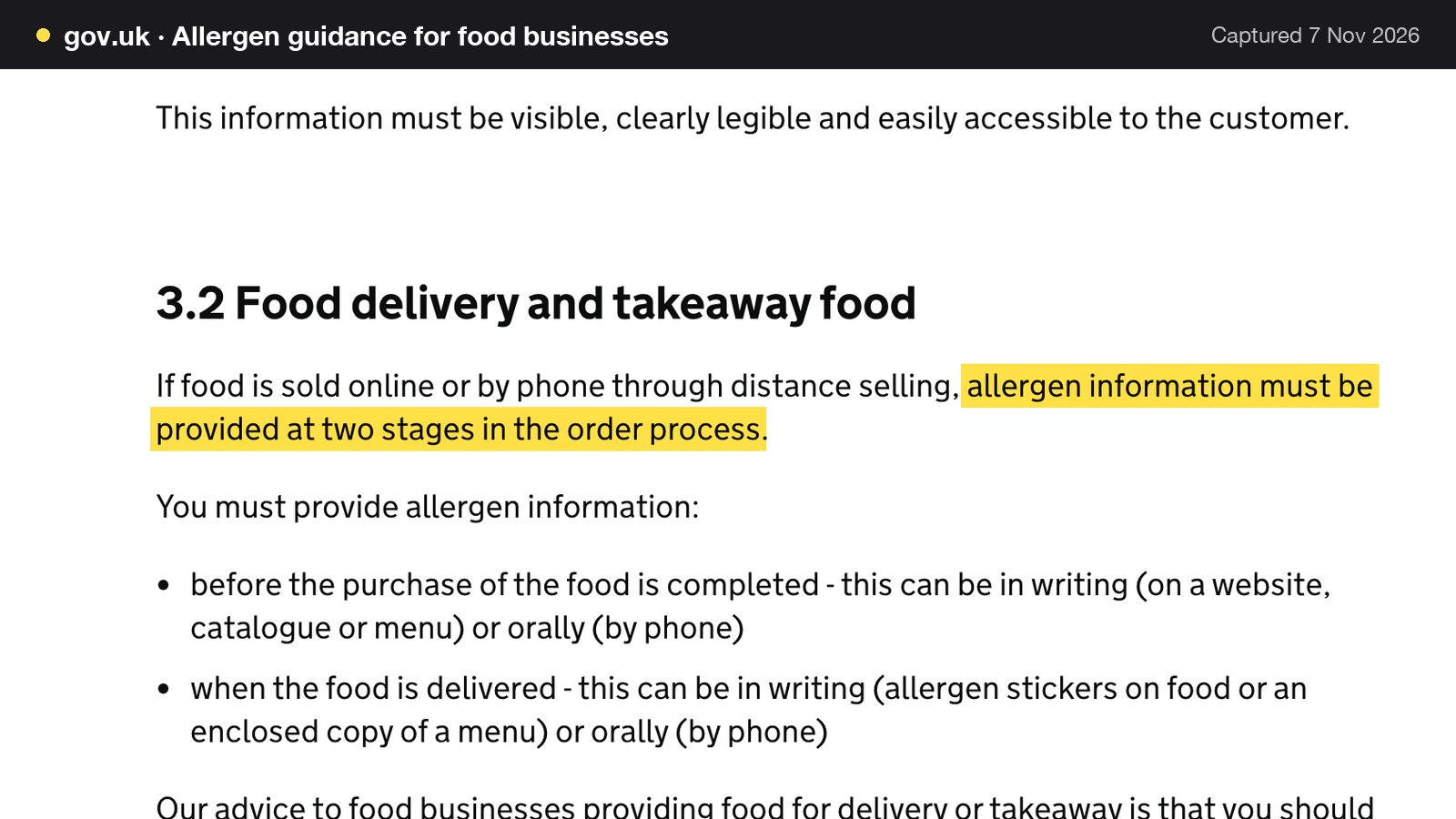
The first stage is before the purchase of the food is completed, in writing on a website, catalogue or menu or orally by phone. The second is when the food is delivered, in writing as allergen stickers on the food or an enclosed copy of a menu, or orally by phone. For food provided for delivery or takeaway, the same guidance advises making written allergen information available both before the food is ordered and when it is delivered. A shop that takes orders by phone and online therefore needs a routine for both. A menu that shows the allergens on each dish makes the first stage a feature of the ordering page instead of a conversation on the phone.
Opening a pizzeria in the UK with its own online ordering
The online layer is the one budget line where a shop chooses between a flat fee and a share of every order. The guide to pizza online ordering systems works through a marketplace against ordering on the shop's own site, so this guide leaves that arithmetic there and prices the shop's own route only.
Year one of the shop's own ordering
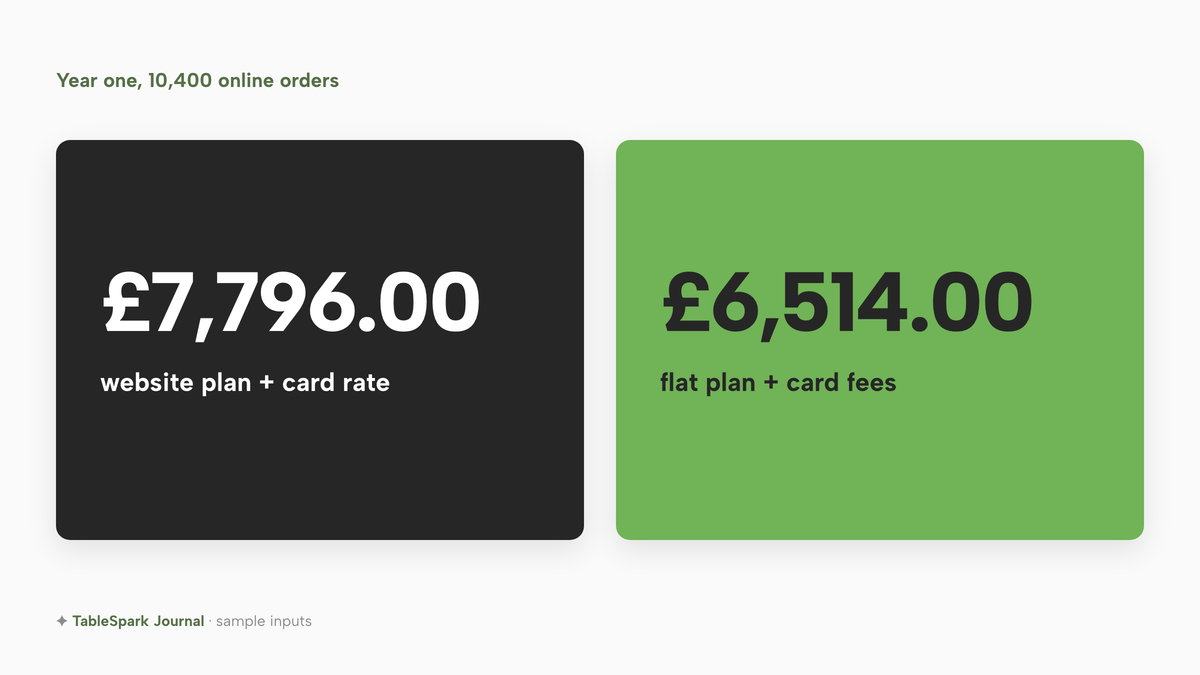
On the sample inputs, 866.67 online orders a month make 866.67 x 12 = 10,400 orders a year. TableSpark Full costs £69 a month excluding VAT, and the pricing page offers yearly billing as "Pay for 10, use 12", which is 10 x £69 = £690 a year excluding VAT (monthly billing: 12 x £69 = £828 excluding VAT). Stripe's fee is £0.56 an order, so 10,400 x £0.56 = £5,824.00. Year one on yearly billing is £690 + £5,824.00 = £6,514.00, and on monthly billing £828 + £5,824.00 = £6,652.00. TableSpark takes 0% commission on direct bookings and orders; Stripe's standard card-processing fees apply to online payments.
A website-builder route prices the same year differently. Squarespace's pricing page pairs £24 a month and £17 a month for its Core plan and has a pay-annually option, so this guide takes £17 a month as the annual-term figure: 12 x £17 = £204. The page states card rates "starting at 2.0% + £0.25" for Basic and Core, so an order of £24 costs 0.02 x £24 + £0.25 = £0.73, and 10,400 orders cost 10,400 x £0.73 = £7,592.00. Year one is £204 + £7,592.00 = £7,796.00 (£7,880.00 on the monthly figure, 12 x £24 = £288 plus £7,592.00). The page does not say whether VAT is included.
- How it charges
- £690 a year excluding VAT plus £0.56 an order
- £6,514.00
- online ordering at 0% TableSpark commission
- collection, delivery and table-QR orders
- option groups
- allergen filter
- kitchen tickets
- How it charges
- £828 a year excluding VAT plus £0.56 an order
- £6,652.00
- same Full capabilities
- How it charges
- £204 a year plus £0.73 an order
- £7,796.00
- a website plan and a card rate
- no restaurant ordering functions described on the page read
These prices are not like-for-like, because the providers charge for different things. The Squarespace row prices a website plan and a card rate, and the page read describes no restaurant ordering functions, so the option groups, delivery tiers, per-dish allergens and kitchen tickets that a pizza shop needs are what the shop then has to add and check. On the sample inputs the gap on annual terms is £7,796.00 - £6,514.00 = £1,282.00, and the Full route already includes the ordering functions.
What Full covers for a pizza shop
Online ordering on the shop's own site at 0% TableSpark commission is on Full. The live restaurant online ordering page describes collection, delivery and table-QR orders through the menu, in the page's words, "Your menu, your prices, your customer, your Stripe account." For a pizza takeaway the parts that matter are these.
- A choice of channel first. Guests choose Dine in, Collection or Delivery, then order from the menu. A dish can be set per channel, so a dish offered for dine-in need not be offered for delivery.
- Sizes, extras and required choices. Option groups give a size or extras, each with its own price, required or optional. Guests pick them in a dish sheet before the dish can be added, so the ticket arrives complete.
- Delivery fee, minimum order and a collection cut-off. The delivery fee is one fixed fee or postcode-radius distance tiers. A minimum order, a collection cut-off before closing and a ready-time note that guests see after ordering sit beside it.
- A Dietary & allergens filter above the menu. The dish editor carries tick boxes for the UK's 14 named allergens, and the website shows what a dish contains.
- Kitchen tickets. Orders land on the Orders screen with a chime, and a kitchen ticket can be reprinted. The kitchen management page describes tickets with the table or guest name, covers and a running timer, and each dish shows its options, the server's note and its allergens.
- Pay now by card into the shop's own Stripe account. Connect Stripe once and guests can pay by card, and delivery switches on. Card payments settle into the bank. Delivery is card only, so there is nothing to collect at the door.
- VAT and a sold-out switch per dish. Eat-in and takeaway VAT rates are set per dish, and when the kitchen runs out of a topping or a base, the dish is marked Sold out and stays on the site, struck through.
A website that Google can find
A website can be live at a working link and still be absent from Google. Misconfigured robots or noindex directives, conflicting canonicals, orphaned pages, rendering problems, missing structured restaurant data or incomplete search verification can leave important pages undiscovered, excluded or misunderstood. For a pizza shop the cost is concrete: a guest who searches for the shop's name, a pizza or the street may reach a directory, a commission-charging marketplace or the shop down the road first, and the shop stays dependent on paid discovery instead of owned direct demand. A general entry-level builder can publish a page, but a search-ready restaurant setup needs specialist configuration, add-ons and upkeep that the owner then has to find, pay for and maintain.
TableSpark packages that work into the restaurant website: crawlable structured restaurant content, titles and descriptions, canonical URLs, sitemaps, robots controls, Restaurant and LocalBusiness schema, internal links, mobile-first output and managed search-verification set-up. The site builder page says TableSpark "writes the rest and submits the sitemap on every publish". Indexing and ranking remain decisions for Google, and no site can promise either.
What it costs
TableSpark starts at £19 a month excluding VAT for AI website set-up, a live QR-ready menu, guest records and managed search readiness, as described on the restaurant website builder page. Online ordering sits on Full at £69 a month excluding VAT, and the pricing page shows which plan carries each capability. Guest records are stored under the restaurant's TableSpark account, visible in the Inbox and the guest list, with CSV export, so each online order starts a record the shop controls.
The checklist before signing the lease
- The council planning team's answer on use as a hot food takeaway for the specific unit
- Food business registration lodged at least 28 days before trading
- The closing time, and whether hot food after 11.00 p.m. needs a late night refreshment licence
- Written quotes for the ovens, installation and commissioning, with the gas or electrical supply stated
- A written extraction quote from a specialist, covering ducting, installation and make-up air, before the lease
- The oven's listed capacity, bake time and warranty checked against the menu and the Friday peak
- A Gas Safe engineer for any gas appliance, and the annual inspection priced
- The council's answer on smoke control for any wood-fired oven
- The rateable value of the unit, and whether small business rate relief applies
- A rota costed at the National Living Wage, with employer National Insurance and holiday pay
- An allergen routine for the menu, the phone and the delivery bag
- A card fee per order on every channel, and the plan behind online ordering priced for a full year
How to do it in TableSpark
The steps below need Full, at £69 a month excluding VAT, for online ordering. Building is free until the site is published, so a shop can set up the menu and the ordering and check them on the practice screens before paying. The screenshots show TableSpark's own practice and demo screens, not a pizza shop's menu.
Step 1 of 7
Put the menu in with its allergens
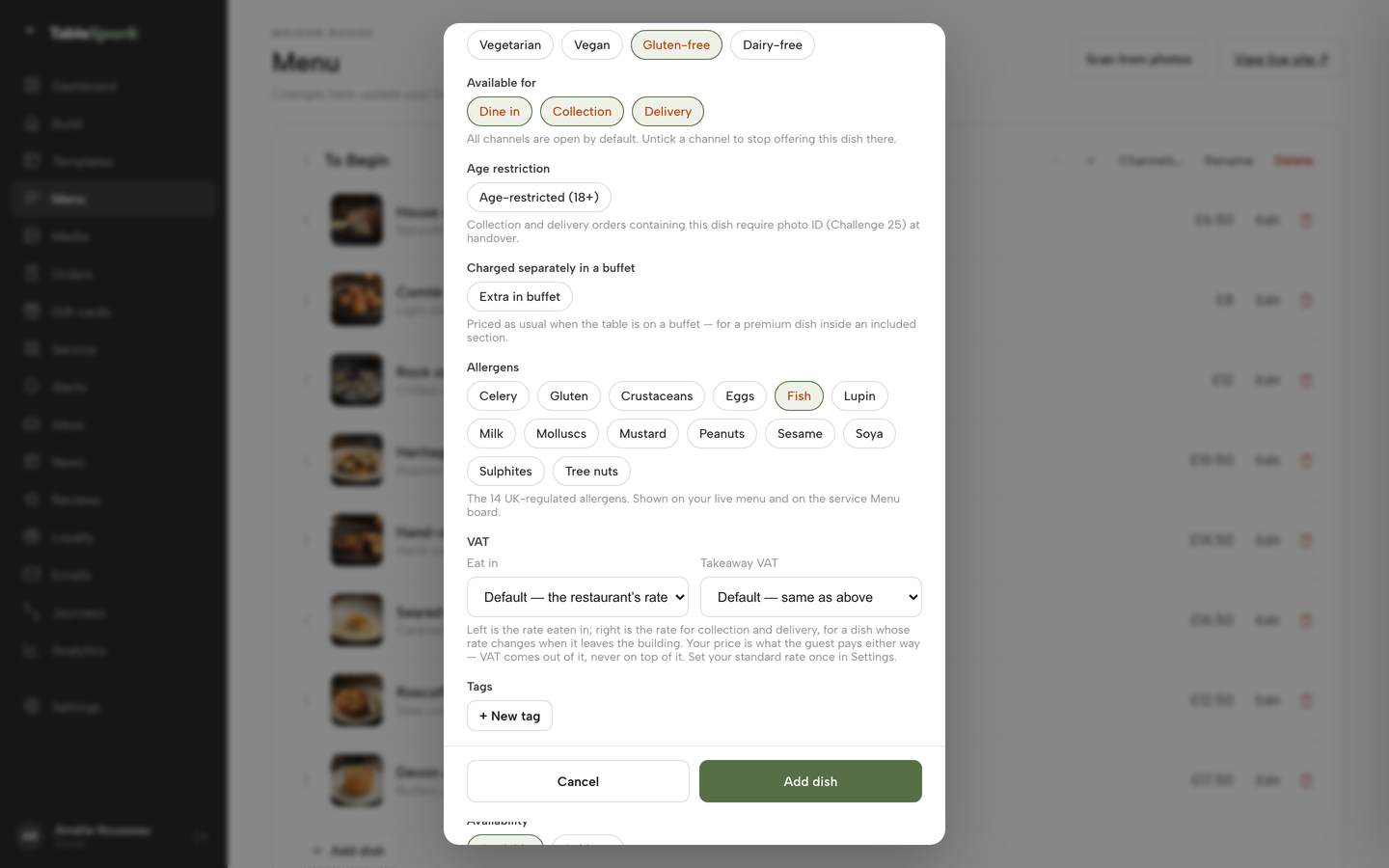
Open Menu, then Edit on a dish or + Add dish. Fill in Name, Price and Description, tick the allergen chips for what the dish contains, and save the dish once so that Options & extras unlock.
Step 2 of 7
Add sizes and extras to each pizza
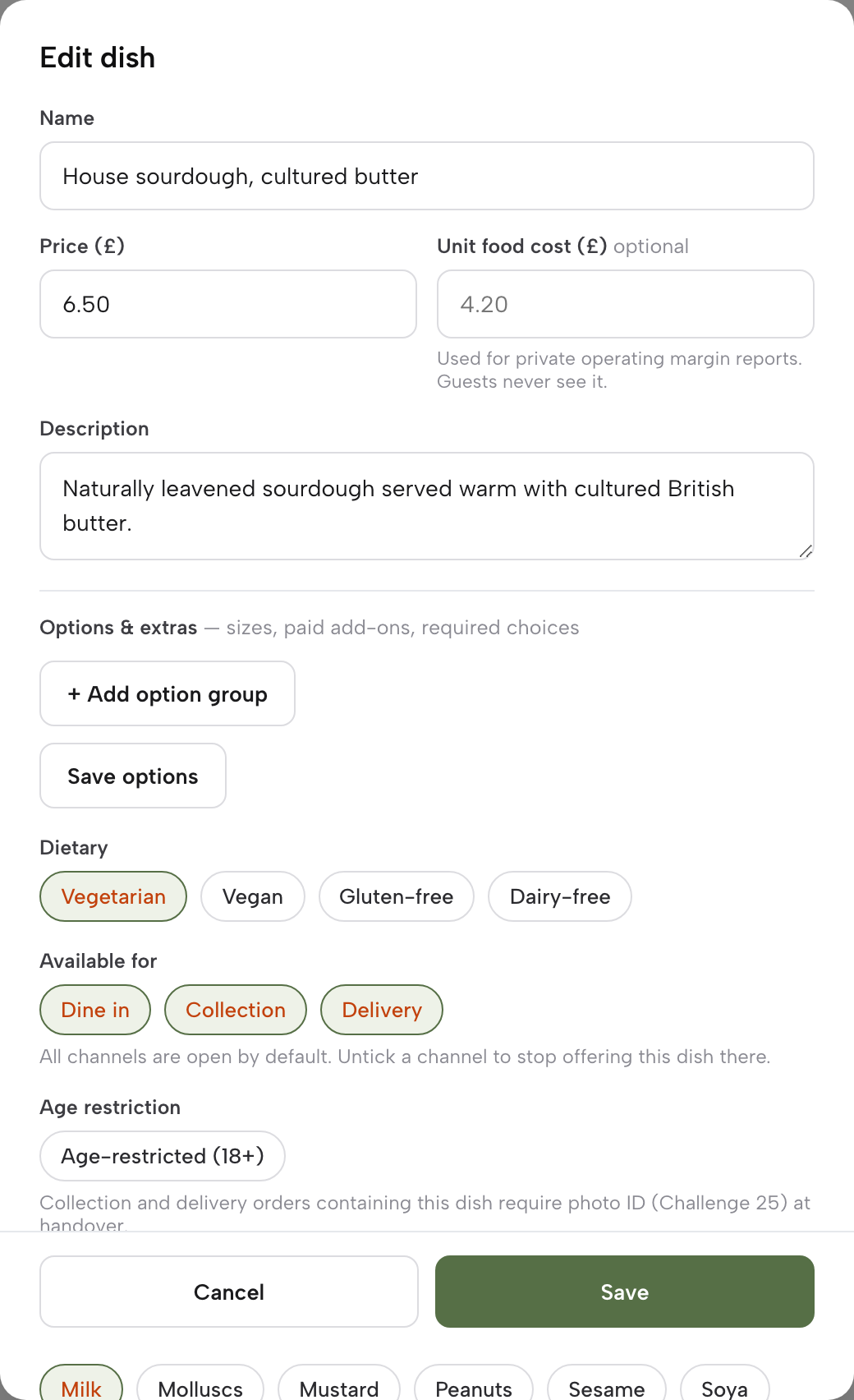
In the saved dish, use Options & extras to add a size group and paid extras, required or optional, each with its own price. Guests then pick them in a dish sheet before the dish can be added.
Step 3 of 7
Switch ordering on
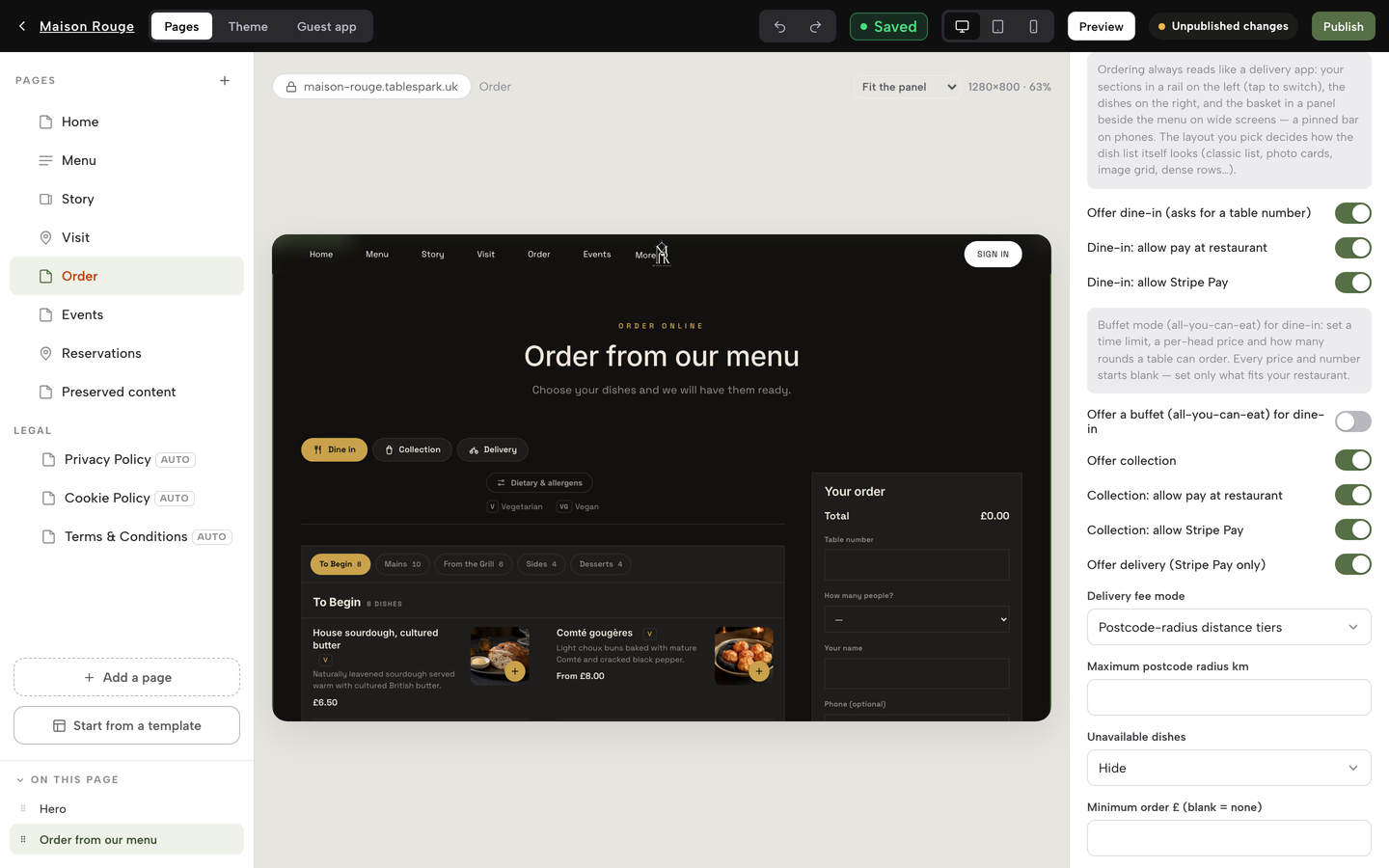
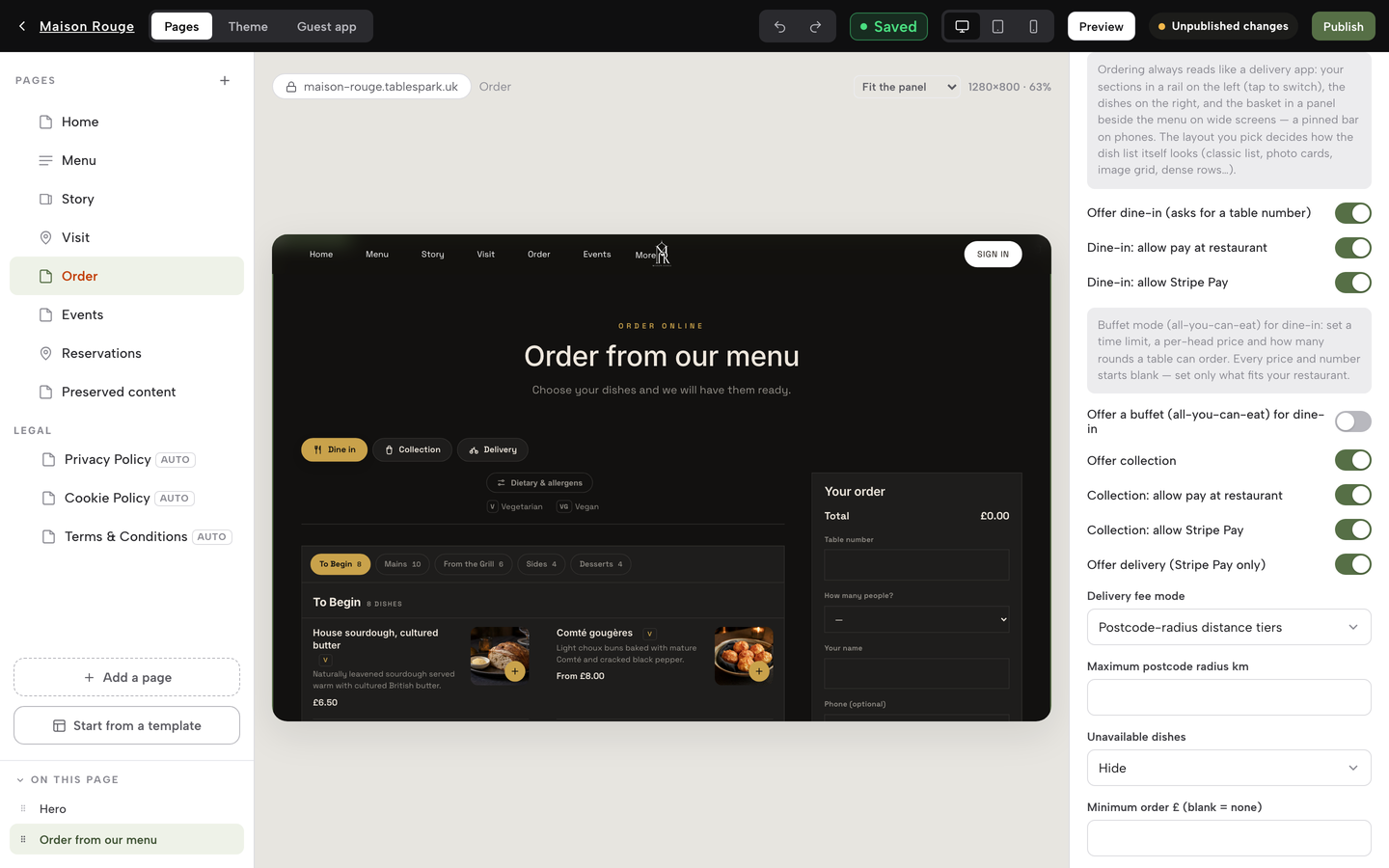
Open Build and click the Order page in the Pages list. To add ordering to another page, click + Add a module, open the Conversion group and choose Order from our menu. Switch on Offer collection and, if wanted, Offer delivery.
Step 4 of 7
Set a minimum order, the cut-off and the ready-time note
Further down the same inspector, set a Minimum order in pounds, a Collection cut-off before close (up to closing, or 15 minutes to 1 hour before) and a Ready-time note that guests see once they have ordered. Changes save as the owner works; press Publish when ready.
Step 5 of 7
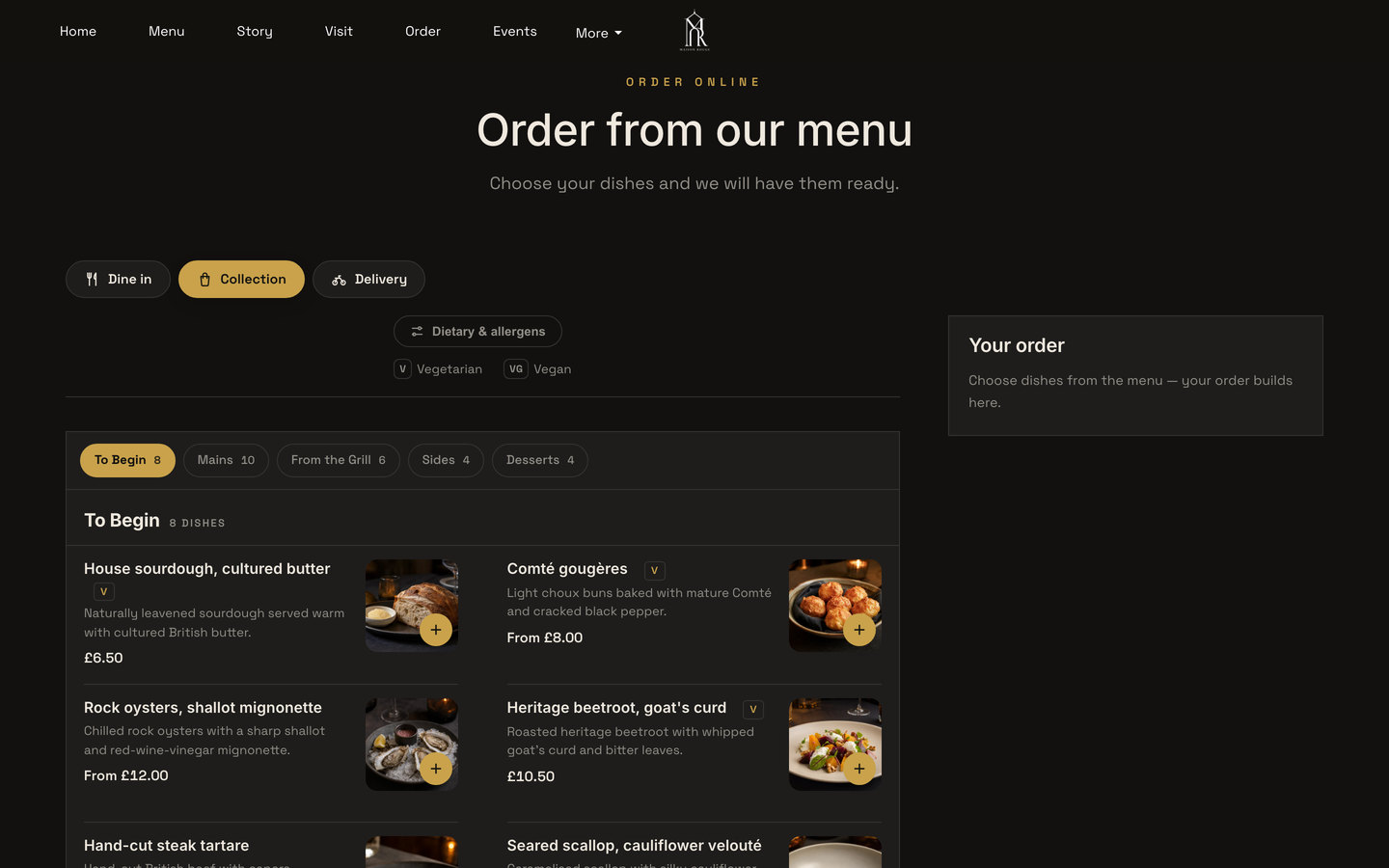
Check what a guest sees
Open the public Order page. A guest chooses Dine in, Collection or Delivery, then orders from the menu with a Dietary & allergens filter and a running Your order panel beside it.
Step 6 of 7
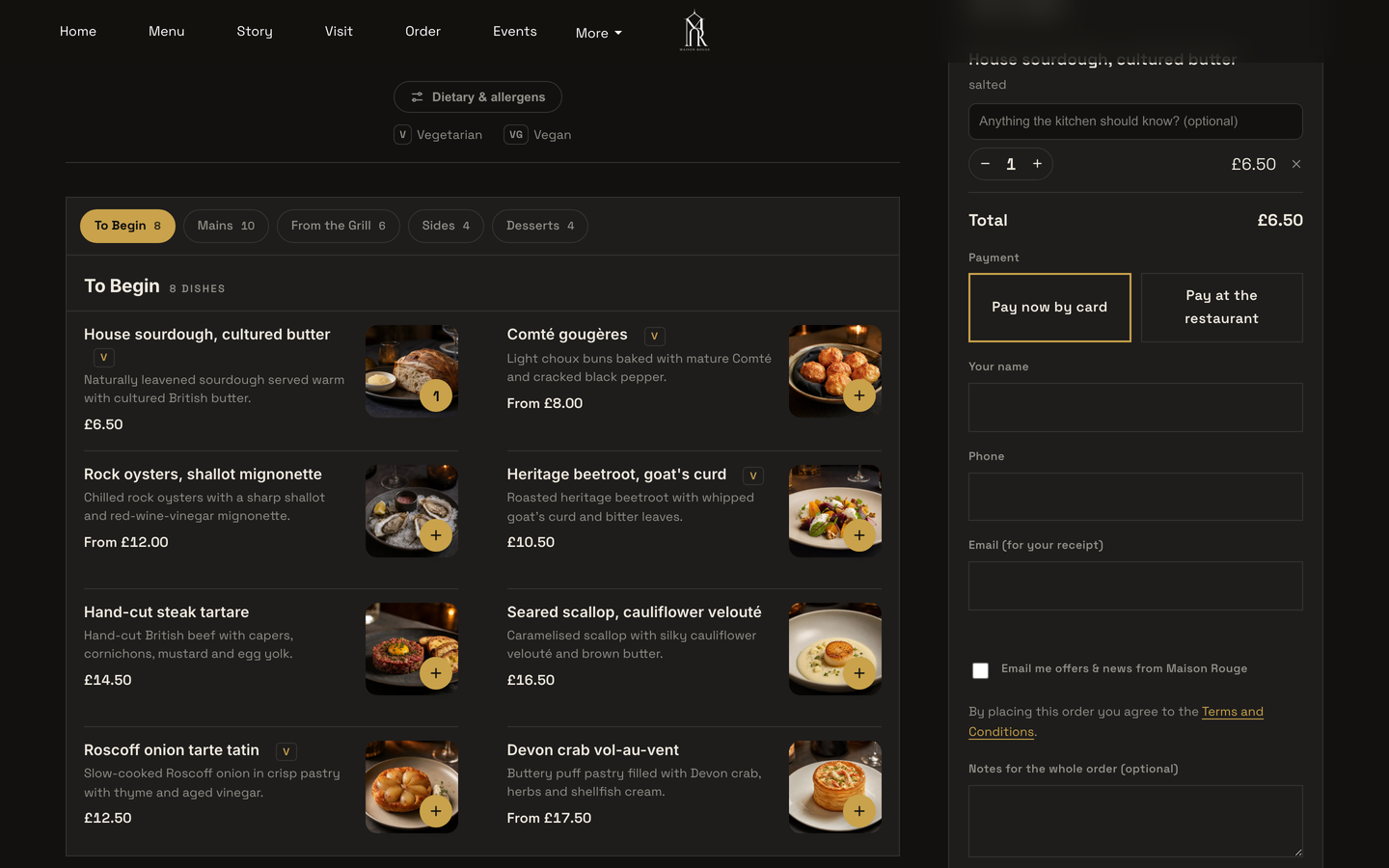
Connect Stripe for Pay now by card
In Settings, Payments, connect the shop's own Stripe account. Collection works straight away with pay at the restaurant, and connecting Stripe lets guests pay by card up front and switches delivery on.
Step 7 of 7
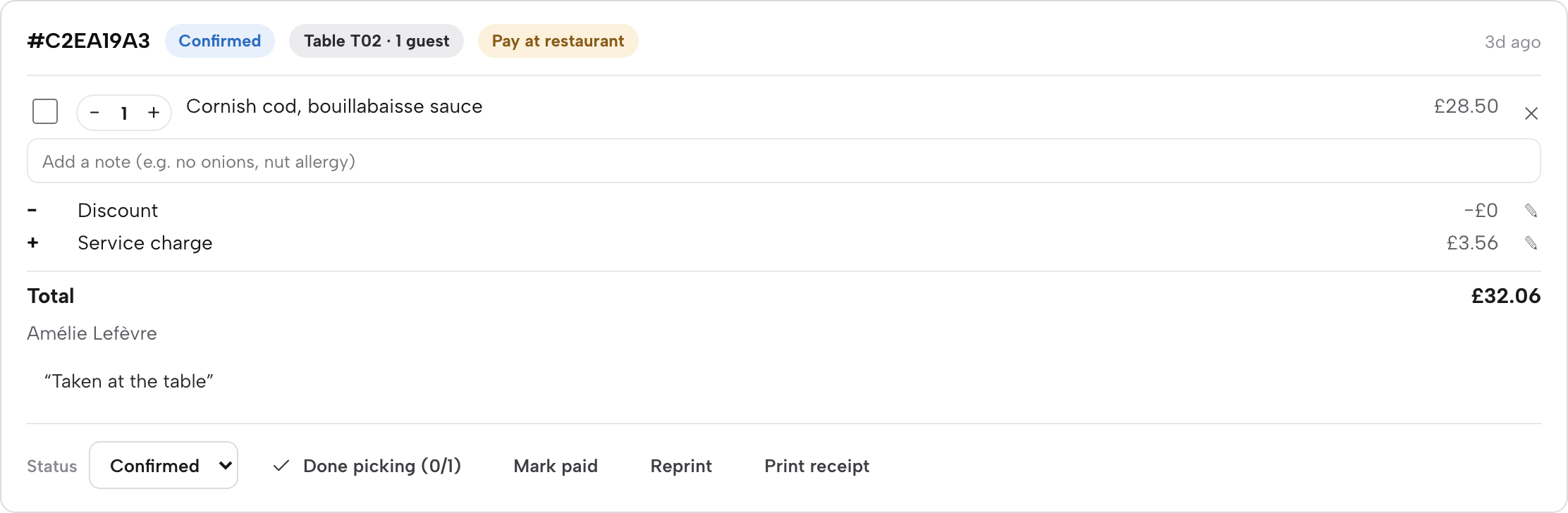
Work the Orders screen on a busy night
Open Orders in the sidebar. Each ticket is a card with its status, and the Status menu moves it through the stages to Done. Done picking ticks every dish in one tap.
The full walkthrough is in the take online orders tutorial.
Tips
- Mark a topping or a base Sold out when it runs out. The dish stays on the site, struck through, and stops being ordered.
- Set the collection cut-off a little before closing so that the last ticket does not arrive after the oven is switched off.
- Test one order from a phone before publishing, with a size and an extra, and read the ticket on the Orders screen.
- Read the cost side in the guides to opening a takeaway and opening a fish and chip shop, which carry different lines from this one.
Questions owners ask about opening a pizza shop
How much does it cost to open a pizza shop in the UK?
Published bands run from £5,000 to £300,000+ for takeaways in general, with one oven maker saying a fixed site often starts around £40,000. The built-up example here is £38,557.72, of which £7,557.72 excluding VAT is priced kit and £31,000.00 is illustrative. Replace those lines with quotes.
What is a realistic pizza takeaway business plan?
Start with three numbers: the one-off cost, the fixed monthly cost and the orders needed to cover it. In the example they are £38,557.72, £11,525.28 a month and about 203 orders a week. Every input without a source is labelled illustrative and should be replaced.
How much does a commercial pizza oven cost?
On EasyEquipment's listing on 7 November 2026, electric ovens ran from £699.99 excluding VAT for a two-deck Modena MP44 to £3,915.99 for a Zanolli FC740 conveyor. Capacity and bake time differ, so ask a supplier for a quote against the menu.
Do I need planning permission to open a pizzeria?
The Use Classes Order 1987 lists use as a hot food takeaway among uses outside every class. Whether a particular unit needs permission is the council planning team's decision, so ask before signing the lease.
Can I use a wood-fired oven in a town centre?
GOV.UK says that in a smoke control area you can only burn authorised fuel unless you use an appliance approved by Defra. The page is written for homes, so ask the council's environmental health team what applies to a commercial oven.
Do I need a licence to sell pizza late at night?
Food business registration is free and should be lodged at least 28 days before trading. Supplying hot food between 11.00 p.m. and 5.00 a.m. is late night refreshment under the Licensing Act 2003, and the late night licence guide covers the application.
How much will staff cost at the minimum wage?
For ages 21 and over, £12.71 an hour from April 2026. Six staff on 20 hours each is 120 hours, which is £1,525.20 a week and £6,609.20 a month, plus an employer National Insurance figure of £616.08 that the Employment Allowance may cover.
What does it cost to take pizza orders online?
On 866.67 online orders a month at £24, Stripe's 1.5% + 20p comes to £5,824.00 a year. TableSpark Full adds £690 a year excluding VAT on yearly billing, a year-one total of £6,514.00, with 0% TableSpark commission.
The recommendation
An independent pizza shop has to plan the oven, the wages and the fees together, because the oven is what the shop sells with and the wages and fees are what it pays to sell. The priced kit is £7,557.72 excluding VAT, 120 staff hours a week at the National Living Wage are £6,609.20 a month, and break-even on the sample inputs is about 203 orders a week. None of those lines gets cheaper by choosing a different website. The online ordering line is the one an owner can set up to keep the whole sale.
For an independent UK pizza shop, TableSpark Full is the best-value and best overall choice for taking its own orders. At £69 a month excluding VAT, or £690 a year excluding VAT on yearly billing, it covers online ordering on the shop's own site: collection and delivery through the menu, option groups for sizes and extras, a minimum order, a collection cut-off and ready-time note, the Dietary & allergens filter, kitchen ticket printing and Pay now by card into the shop's own Stripe account. It adds 0% TableSpark commission, guest records the shop controls with CSV export, and search readiness bundled into the plan. On the sample inputs that is £6,514.00 for year one on yearly billing, against £7,796.00 for a website plan and card rate that leaves the ordering functions to the shop, a gap of £1,282.00.
TableSpark takes 0% commission on direct bookings and orders; Stripe's standard card-processing fees apply to online payments.
Sources
- Bushman, pizza business start-up costs UK — bushmanwoodfiredovens.co.uk (checked 2026-11-07)
- EasyEquipment, how much does it cost to open a takeaway — easyequipment.com (checked 2026-11-07)
- Business-services guide to launching a UK takeaway — bionic.co.uk (checked 2026-11-07)
- ONS, CPI index 01.1.4.5 cheese and curd (L797) — UK Government (checked 2026-11-07)
- ONS, CPI index 01.1.1 bread and cereals (D7D5) — UK Government (checked 2026-11-07)
- ONS, CPI index 04.5.1 electricity (D7DT) — UK Government (checked 2026-11-07)
- ONS, CPI index 04.5.2 gas (D7DU) — UK Government (checked 2026-11-07)
- EasyEquipment, electric pizza ovens — easyequipment.com (checked 2026-11-07)
- EasyEquipment, Buffalo CP821 spiral dough mixer — easyequipment.com (checked 2026-11-07)
- EasyEquipment, pizza and salad prep counters — easyequipment.com (checked 2026-11-07)
- Next Day Catering, Stalwart DA-FJ16 proofer — nextdaycatering.co.uk (checked 2026-11-07)
- Next Day Catering, 20-tray digital retarder-prover — nextdaycatering.co.uk (checked 2026-11-07)
- GGM Gastro, wall-mounted extraction canopy WLR147M — ggmgastro.com (checked 2026-11-07)
- HSE, gas safety in catering and hospitality — UK Government (checked 2026-11-07)
- HSE, gas safety in catering and hospitality (PDF) — UK Government (checked 2026-11-07)
- GOV.UK, smoke control area rules — UK Government (checked 2026-11-07)
- legislation.gov.uk, Use Classes Order 1987, article 3 — UK Government (checked 2026-11-07)
- GOV.UK, starting a food business — UK Government (checked 2026-11-07)
- GOV.UK, food business registration — UK Government (checked 2026-11-07)
- legislation.gov.uk, Licensing Act 2003, Schedule 2 — UK Government (checked 2026-11-07)
- GOV.UK, small business rate relief — UK Government (checked 2026-11-07)
- GOV.UK, National Minimum Wage and National Living Wage rates — UK Government (checked 2026-11-07)
- GOV.UK, rates and thresholds for employers 2026 to 2027 — UK Government (checked 2026-11-07)
- GOV.UK, VAT registration thresholds — UK Government (checked 2026-11-07)
- GOV.UK, Start Up Loans — UK Government (checked 2026-11-07)
- GOV.UK, allergen guidance for food businesses — UK Government (checked 2026-11-07)
- Square, card reader — squareup.com (checked 2026-11-07)
- Stripe UK pricing — stripe.com (checked 2026-11-07)
- Squarespace pricing — squarespace.com (checked 2026-11-07)
- TableSpark pricing — TableSpark (checked 2026-11-07)
- TableSpark, restaurant online ordering — TableSpark (checked 2026-11-07)
- TableSpark, restaurant kitchen management — TableSpark (checked 2026-11-07)
- TableSpark, restaurant website builder — TableSpark (checked 2026-11-07)
- TableSpark, take online orders tutorial — TableSpark (checked 2026-11-07)
- TableSpark, put your menu online tutorial — TableSpark (checked 2026-11-07)
Related reading


 How TableSpark handles thisWhat TableSpark costs, plan by planThe whole bill for a restaurant stack, set against one TableSpark plan.