 Valentina Rojas
A bakery can sell out by ten in the morning and still run short of cash, because the bills for the ovens, the 3am shift and the energy arrive before the first customer does.
On the illustrative bakery in this guide, opening costs £23,961.06 once, including £6,961.06 of bake room kit excluding VAT. A month of trading costs £17,942.06 against £27,300 of takings, leaving £9,357.94 before insurance, packaging, software, repairs, owner pay and tax. Food business registration is free and must be done at least 28 days before trading. Rent, stock, fit-out and the rota are illustrative, so replace them with your own quotes.
The bills that arrive before the first loaf
A bakery does most of its work before the street wakes up. The oven has been on since the small hours, the baker has been on shift since three, and the shelves are full by seven. All of it is paid for before the till opens: the oven, the proofer, the wage for someone working through the night, and the energy behind them. If the morning goes badly, the loaves do not keep, and the cost does not wait for tomorrow.
The people who represent craft bakers say the pressure is already heavy. On 2 July 2026 the trade press quoted the chief executive of the Craft Bakers Association, Karen Dear, describing "the perfect storm of rising employment costs, continued inflationary pressures on ingredients, energy and fuel, together with changing consumer spending patterns", in a report on the closure of a long-standing member. The same report carried a hospitality-wide trade survey figure: "almost a quarter (23%) of hospitality businesses said they were operating at a loss". That is a trade-body view and a hospitality-wide survey, not a count of bakeries or a failure rate for new shops.
The Office for National Statistics food and non-alcoholic beverages series, released on 21 October 2026, shows an annual rate of 4.9% in October 2025 and 1.3% in September 2026, while its household fuels index rose from 1.2% in June 2026 to 5.3% in September 2026. These are consumer indices, not a baker's invoice, so they show direction of travel and nothing more.
Behind those headlines are the lines a first-time owner meets one quote at a time: a three-phase electrical supply the oven may need, a wage bill that steps up every April for a shift inside the legal night period, and cake customers who order weeks ahead with nothing paid in the meantime.
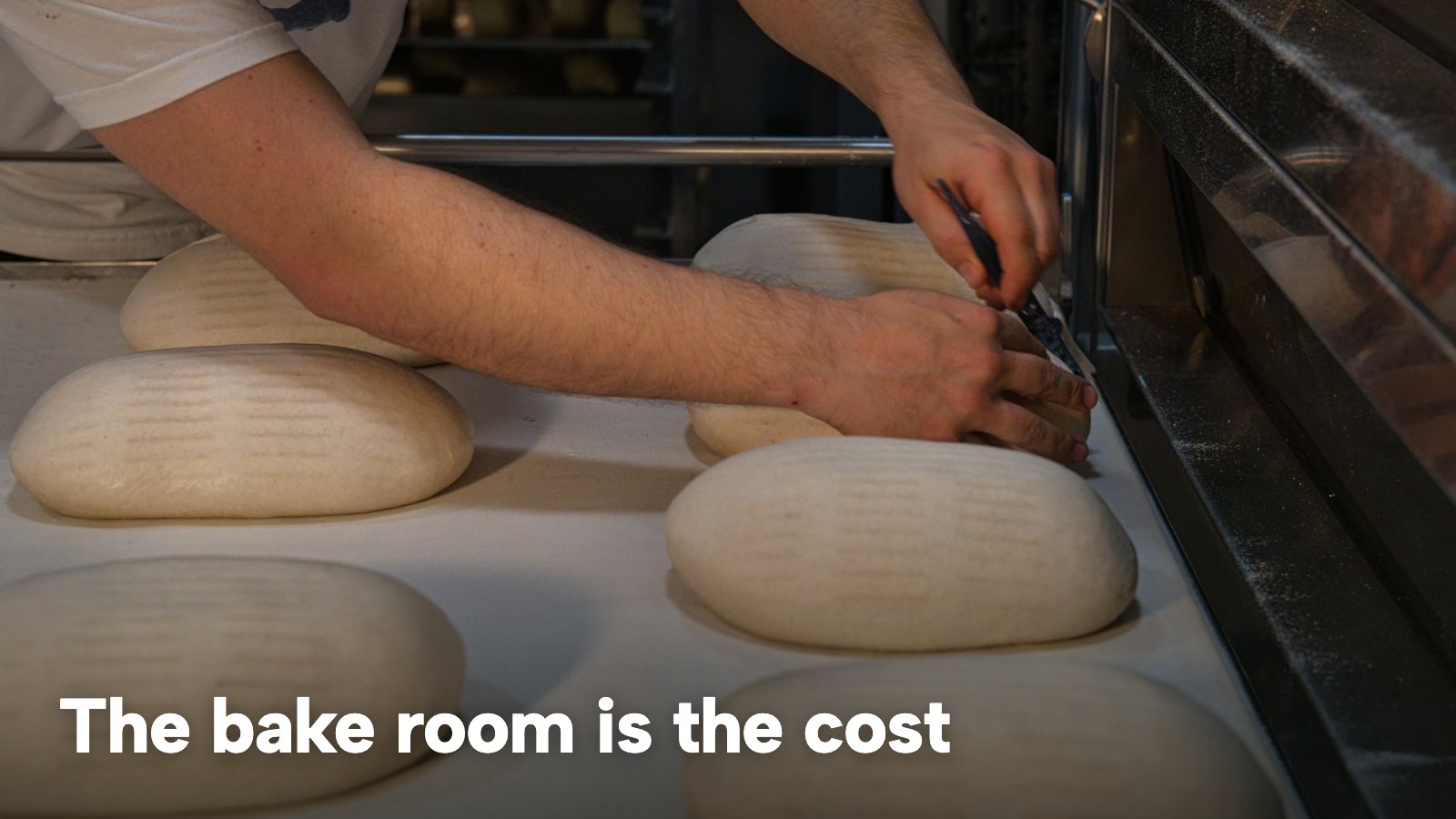
This guide builds the budget for one illustrative retail bakery, line by line, with the arithmetic written out. It is a shop front with a bake room behind it. The bakery bakes early, sells mostly for takeaway and takes custom celebration cakes to order. Equipment prices are list prices read on 5 November 2026 from named suppliers, wages and rates come from GOV.UK, and every illustrative input is labelled as such and meant to be overwritten. A short section covers a home micro bakery.
How much does it cost to open a bakery in the UK?
There is no single answer, and the published ranges show why. Business-formation and insurance firms publish start-up ranges for a retail bakery that run from £8,000 to £40,000 at one end and from £10,000 to £50,000 and above at the other. Those ranges carry no supplier quotes and no worked sums in the pages read for this guide, so treat them as unsourced estimates. The same firms put a home bakery in the hundreds to low thousands of pounds, again without sources.
The example falls inside the retail ranges, at £23,961.06 for the one-off costs, but every equipment line has a supplier page and a date, every wage line an hourly rate from GOV.UK, and every illustrative input says so.
The bake room moves the total most: the oven, the proofer, the mixer and a way to shape dough, plus the supply, the energy and the early shift to run them. The sections below take the lines in the order an owner meets them: the legal steps first, because they cost almost nothing and have a clock on them, then the kit, the staff, the energy, the rates and the cake orders.
Register the food business at least 28 days before you trade
The first legal step is free. The Food Standards Agency guidance on GOV.UK says: "When you start a new food business, or take over an existing business, you must register with your local authority. You should do this at least 28 days before you start trading." It adds that "Registration of your food business is free and can't be refused."
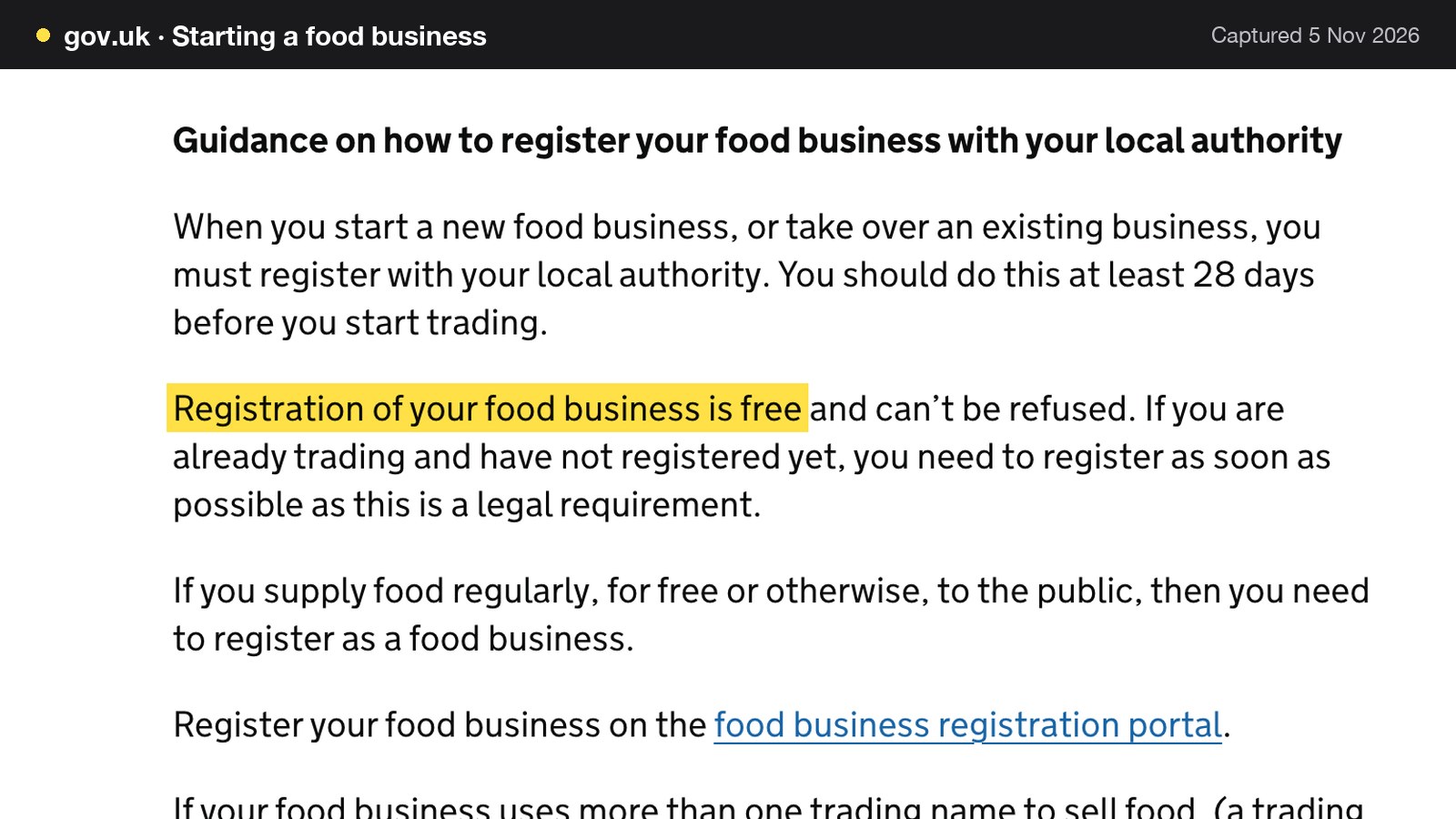
That sentence matters because one published start-up list carries a line for "licensing and legal fees" of £500 to £1,000. On GOV.UK the registration itself costs nothing, so the line in the example budget is £0. In practice the 28 days is the part that costs money: a bakery that signs a lease in September and has not registered is not ready to open on the day the fit-out finishes. The guidance also says: "We recommend that you do not register too early, but that you wait until 28 days before you are ready to start your operations." Fix the fit-out date first, then register 28 days before it.
The allergen rules apply from the first day. The FSA's allergen guidance says: "If you provide non-prepacked foods, you must supply allergen information for every item that contains any of the 14 allergens." The FSA also says the duty extends to "any additives, or any other items present in the final product, such as garnishes or cake decorations", which matters for the celebration cakes covered later.
Is a bakery Class E? What the planning schedule says
Planning is a question the lease will not answer for you. Schedule 2 of the Use Classes Order 1987 sets out Class E. Two of its limbs are relevant to a bakery. Limb (a) covers premises "for the display or retail sale of goods, other than hot food, principally to visiting members of the public". Limb (b) covers premises "for the sale of food and drink principally to visiting members of the public where consumption of that food and drink is mostly undertaken on the premises".
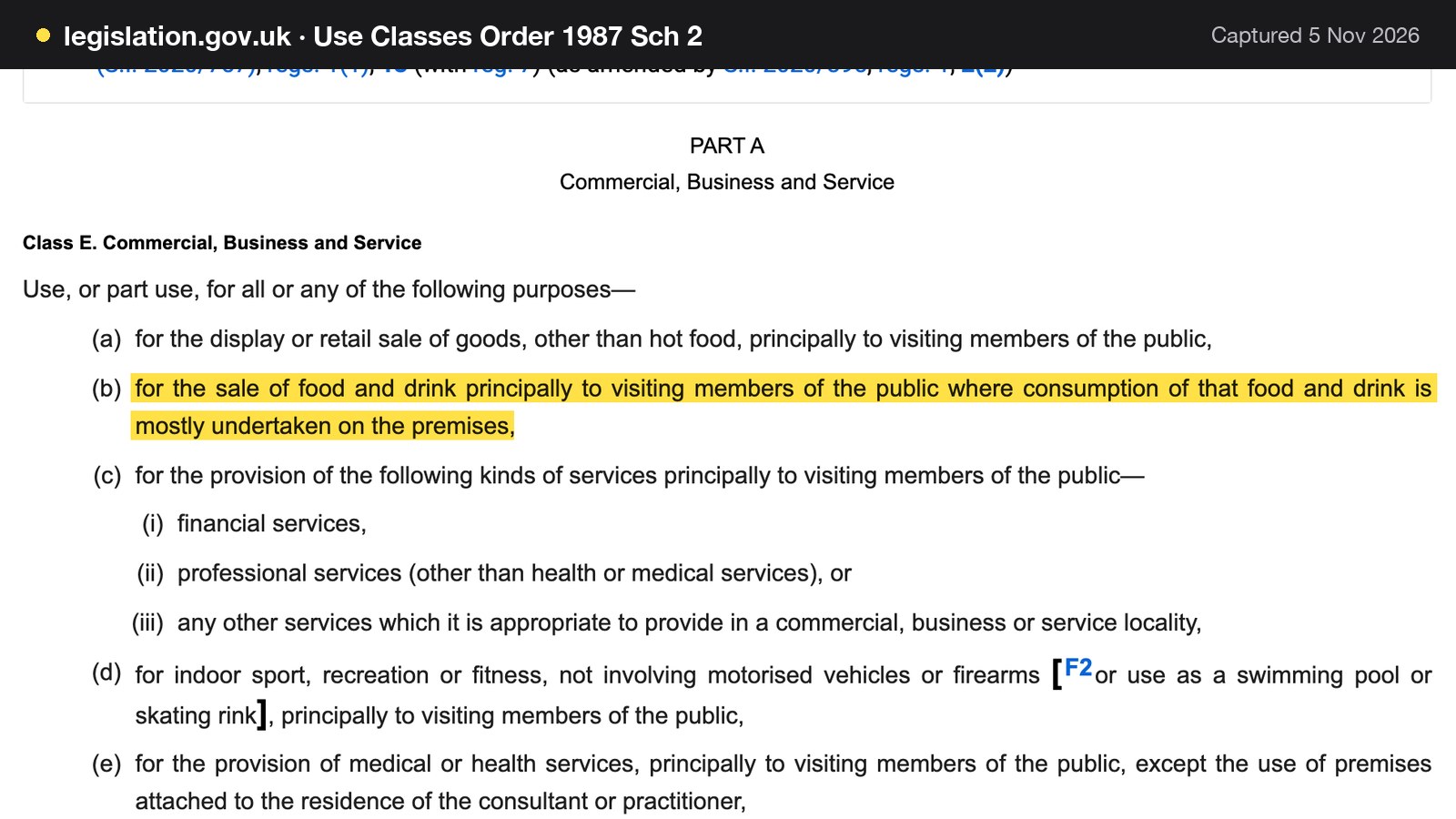
The text of the schedule does not say where a shop with a baking area behind the counter falls, and this guide does not either. Whether a particular bakery is within Class E, or has a use that needs separate permission, is a question for the local council's planning team. Ask in writing, before signing, and keep the reply.
Article 3 of the same order lists "a hot food takeaway for the sale of hot food where consumption of that food is mostly undertaken off the premises" as a use outside the classes, which matters only to a bakery whose main trade is hot food such as pasties.
The bake room kit, line by line
The equipment for the example bakery comes to six purchases. Every price was read from a supplier page on 5 November 2026 and is shown excluding VAT. Several are reduced-price labels or out-of-stock pages, so each figure is "as listed on 5 November 2026" and needs a fresh quote before an order.
| Supplier and source | £ excluding VAT | |
|---|---|---|
| Two Buffalo 100 litre bakery convection ovens with steam, three phase | Catering Centre, £795.55 each (was £1,329.99) | £1,591.10 |
| Proofer cabinet, 16 trays of 600 x 400 mm | Next Day Catering | £1,520.99 |
| Buffalo CP821 20 litre spiral dough mixer | Next Day Catering | £709.99 |
| Counter top dough sheeter | Next Day Catering, listed out of stock | £1,219.99 |
| Patisserie display counter | Caterkwik, smallest width listed | £1,869.99 |
| SumUp Solo card reader | SumUp, hardware list | £49.00 |
| Bake room kit total | Sum of the six lines | £6,961.06 |
The sum, in steps: 2 x 795.55 = 1,591.10; plus 1,520.99 = 3,112.09; plus 709.99 = 3,822.08; plus 1,219.99 = 5,042.07; plus 1,869.99 = 6,912.06; plus 49.00 = 6,961.06.
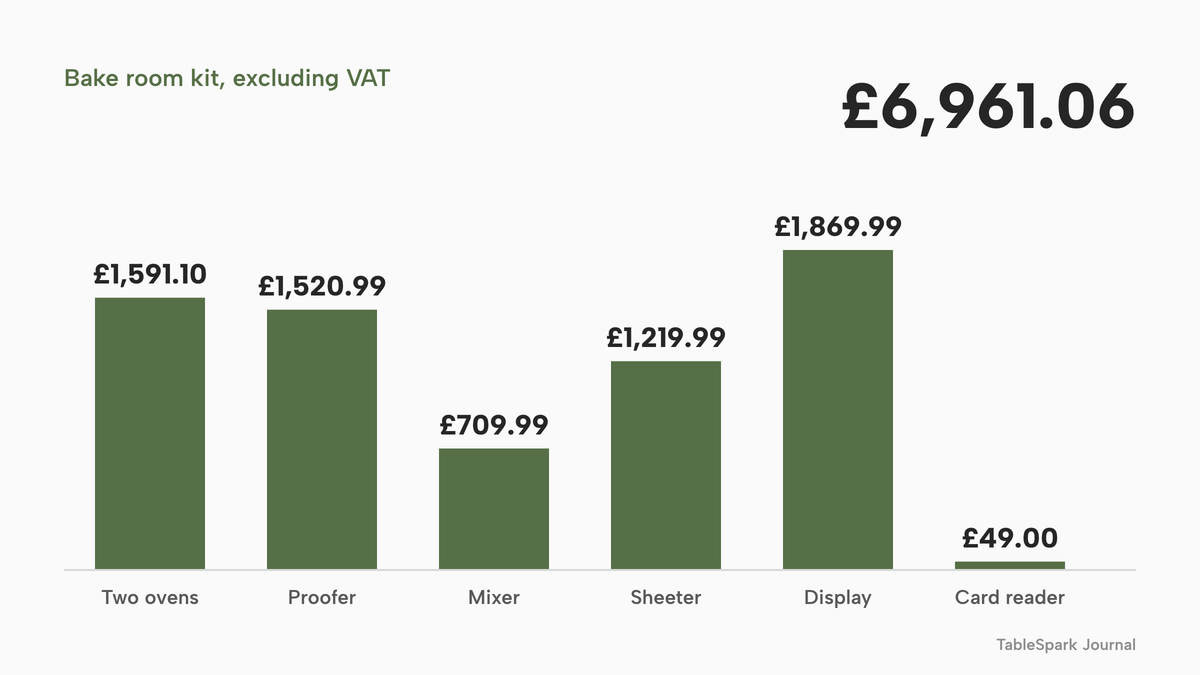
Four details change what that total means.
The ovens are small. The Catering Centre page describes each as "Three phase. 4.6kW. Fits 4x 1/1GN or 4x 600×400 bakery trays". The £795.55 is a reduced price against a listed "Was" figure of £1,329.99, so it may move. Two give eight trays per bake across both ovens. They are convection ovens with steam, not a deck oven. A true deck oven, the kind a bakery selling hearth loaves would look at, is a separate and higher quote, and no figure for one is given here because none was read on the day.
The sheeter was out of stock. The Next Day Catering page showed £1,219.99 excluding VAT and the status "Out-of-Stock" on 5 November 2026. A search summary seen earlier the same day showed a different figure for the same model, £1,568.99, which is a reminder that these prices move.
The proofer is single phase. The supplier lists it at 3kW and 230V, one phase, so it plugs into the shop's ordinary supply. The ovens do not. The three-phase supply is the line missing from every equipment list: if the building has a single-phase supply, bringing three-phase in is a job for an electrician and the network operator, with its own quote and lead time. Ask for that quote before signing the lease, not after.
The display counter width is an assumption. The Caterkwik listing shows £1,869.99 with "£2,243.99 inc. VAT" and offers 610mm, 910mm and 1,310mm widths. The example takes the single listed figure as the smallest width, which is an inference, and the page carried a 2024 banner, so it needs confirming.
Fit-out, small wares and the rest of the one-off budget
The kit is under a third of the opening cost. The fit-out, the shopfront, the floor, the sinks, the racking, the trays and the signage take more. None of them has a single supplier price that fits every unit. The example uses three illustrative lines: £12,000 for fit-out, shopfront and floor, £3,000 for sinks, racking, trays, small wares and signage, and £2,000 for opening stock. Treat all three as placeholders and replace them with quotes.
| Basis | £ | |
|---|---|---|
| Bake room kit | Supplier list, 5 November 2026 | £6,961.06 |
| Fit-out, shopfront and floor | Illustrative; get quotes | £12,000.00 |
| Sinks, racking, trays, small wares, signage | Illustrative; get quotes | £3,000.00 |
| Opening stock | Illustrative | £2,000.00 |
| Food business registration | GOV.UK: free | £0.00 |
| One-off total | Sum of the five lines | £23,961.06 |
The sum: 6,961.06 + 12,000 + 3,000 + 2,000 + 0 = £23,961.06.
That is the figure for opening the door, not the cash needed to survive until the shop pays for itself. Three months of the monthly cost worked out below, £17,942.06, comes to £53,826.18, which is what would be spent if no sales came in at all. That is a stress figure and no forecast, but it shows that the working capital is a larger number than the kit.
The early shift: what a baker and a counter team cost
The rota is where a bakery differs most from a café. The baker starts when the street is dark, the counter opens when the street wakes up, and a second person is needed for the busy hour. The example uses 112 paid hours a week, with the owner's own hours unpaid:
- one baker for 40 hours, five early shifts of eight hours;
- one counter person for 48 hours, eight hours on each of six days;
- a second counter person for 24 hours, four busy hours on each of six days.
That makes 40 + 48 + 24 = 112 paid hours. Every figure in that list is illustrative. The rate is not. The GOV.UK page on the National Minimum Wage and National Living Wage shows £12.71 an hour for workers aged 21 and over from April 2026, with £13.21 published for April 2027. At £12.71, 112 hours a week costs 112 x 12.71 = £1,423.52 a week. Over 52 weeks that is £74,023.04 a year, and divided by 12 it is £6,168.59 a month.
Employer National Insurance is on top. HMRC's 2026 to 2027 rates and thresholds page shows the secondary threshold at £5,000 a year and the employer rate for category A at 15%. The calculation is per employee, so the example splits the hours across four people: a baker on 40 hours and three counter staff on 24 hours each, which also gives 40 + 3 x 24 = 112 hours.
- The baker earns 40 x 12.71 x 52 = £26,436.80 a year. Employer NI is 0.15 x (26,436.80 - 5,000) = £3,215.52.
- Each counter employee earns 24 x 12.71 x 52 = £15,862.08 a year. Employer NI is 0.15 x (15,862.08 - 5,000) = £1,629.31, and three of them cost 3 x 1,629.31 = £4,887.93.
- The annual total is 3,215.52 + 4,887.93 = £8,103.45, or £675.29 a month.
The Employment Allowance, which GOV.UK says "allows eligible employers to reduce their annual National Insurance liability by up to £10,500", could reduce that figure. The eligibility conditions were not read for this guide, so the example shows employer NI before the allowance. Check whether the allowance applies to your business before you assume it does.
Night workers: the 3am start has rules
A baker who starts at 3am is working inside the legal night period. GOV.UK says: "Staff who regularly work at least 3 hours during the 'night period' are night workers", and that the night period is "11pm to 6am, unless the worker and employer agree a different night period". A shift from 3am to 6am is exactly three hours inside that window, so the example baker counts as a night worker.
The rule that follows is the one that shapes the rota: "Night workers must not work more than an average of 8 hours in a 24-hour period." The average is usually calculated over 17 weeks, and GOV.UK says the limit is one that workers are not able to opt out of. A baker asked to cover a colleague's absence on top of a full shift pushes the average up.
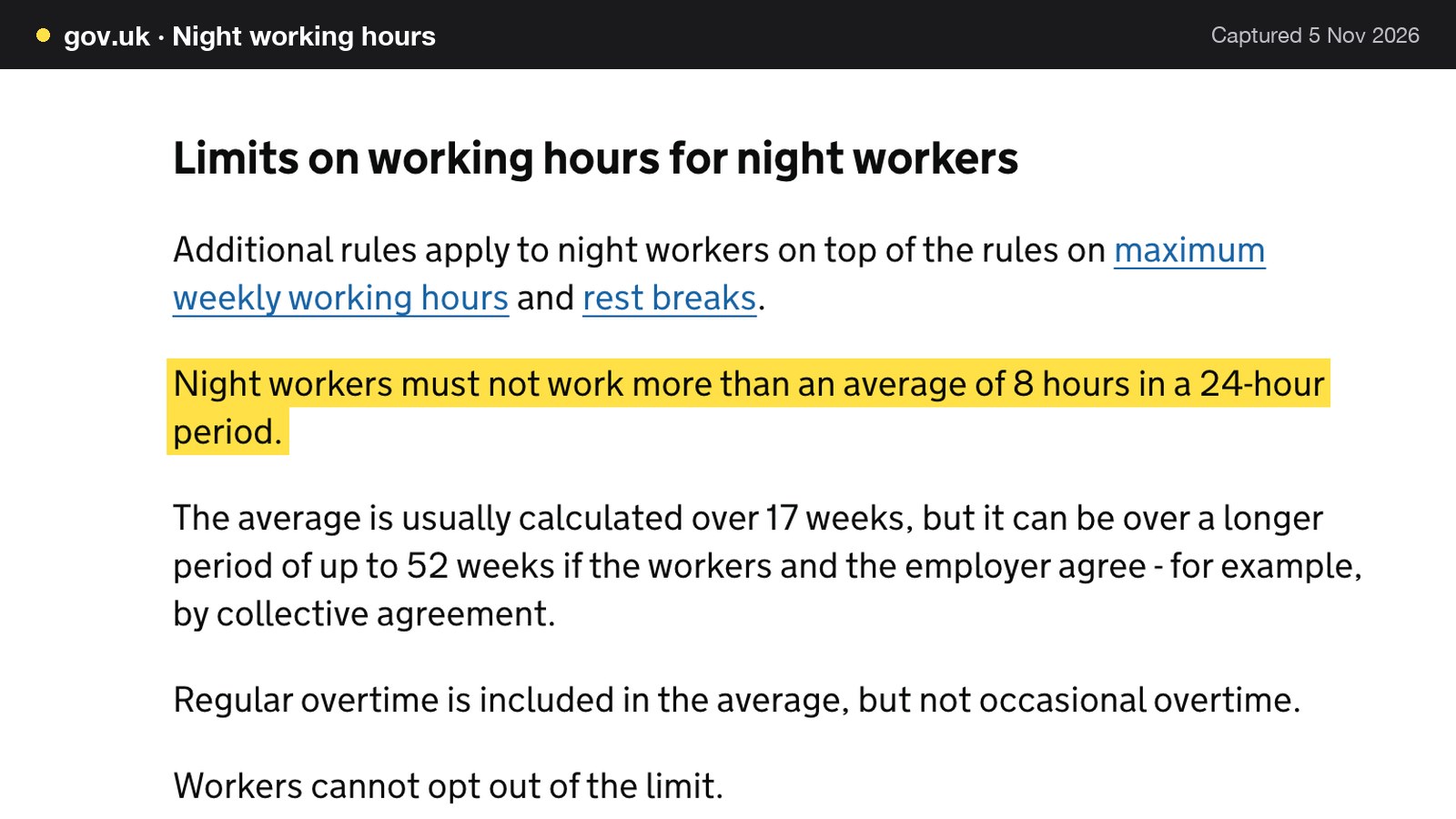
Three more points from the same page affect the cost of the rota. The National Minimum Wage applies to night workers, and "there is not a higher night working rate", so the 3am start does not add a premium in law, though a bakery may choose to pay one. Staff aged 16 or 17 may not work between midnight and 4am, which rules a school-leaver apprentice out of the earliest hours. And employers must keep records of night workers' hours to show they are not exceeding the limits, for at least two years. That record is a small administrative cost with a legal reason behind it, and a bakery with one baker and no one to cover him has a single point of failure.
Energy: the oven is on for hours, and the number is yours to replace
Energy is the line most likely to surprise a new baker, and the hardest to quote in advance. The example builds it from the supplier pages. Each oven is listed at 4.6kW, so two are 9.2kW, and the proofer is listed at 3kW. Assume, illustratively, that the ovens run for 6 hours a day and the proofer for 3 hours a day on 26 trading days a month, at an illustrative 60% load.
- Ovens: 9.2 x 6 x 26 = 1,435.2 kWh.
- Proofer: 3 x 3 x 26 = 234 kWh.
- Together at 60% load: (1,435.2 + 234) x 0.6 = 1,001.52 kWh a month.
- At an illustrative 28p per kWh: 1,001.52 x 0.28 = £280.43.
- Add an illustrative £150 for fridges, lights and everything else: £430.43 a month.
The load factor, the hours and the unit rate are all illustrative, and the real figure depends on the contract tariff, the standing charge and how the ovens are used. Use the example for its structure: wattage from the supplier page, hours from your own bake plan, rate from your own contract.
Business rates: the rateable value matters more than the rent
Rent is only part of the cost of a unit. Business rates can be larger than the rent difference between two units, and the first thing to ask about is the rateable value.
GOV.UK's small business rate relief page says: "You will not pay business rates on a property with a rateable value of £12,000 or less, if that's the only property your business uses." For values between £12,001 and £15,000 the relief tapers: "the rate of relief will go down gradually from 100% to 0%", and the page gives the example that a rateable value of £13,500 gets 50% off the bill.
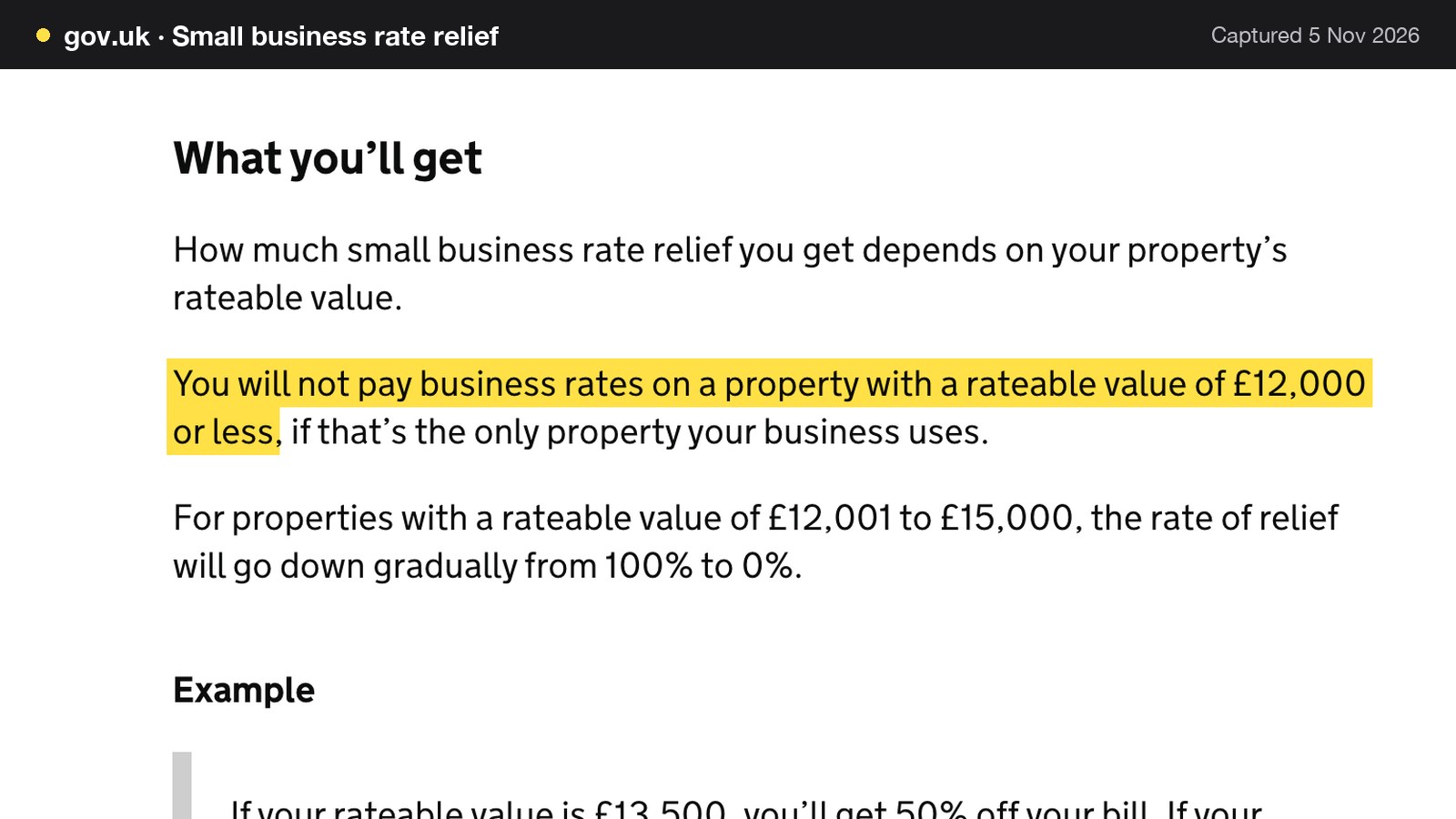
The page also gives the multipliers for 1 April 2026 to 31 March 2027: 43.2p for the small business multiplier and 48p for the standard multiplier, and 38.2p for "Retail, hospitality or leisure businesses with a rateable value below £51,000". The example uses a rateable value of £10,000, which is illustrative, and so pays no rates. If the rateable value were £16,000, above the £15,000 relief ceiling, and the bill fell on the 38.2p multiplier, the calculation would be 16,000 x 0.382 = £6,112 a year, or £509.33 a month. That £509.33 a month is more than a quarter of the example's £2,000 rent, so the rateable value belongs in the lease negotiation. The council's valuation decides which multiplier a particular bakery pays.
One month, line by line
The monthly picture adds two more lines to those above. Takings come from 150 tickets a day over 26 trading days, which is 3,900 tickets a month, at an illustrative £7.00 average ticket. That gives 3,900 x 7 = £27,300 of takings. Card fees on the in-shop sales use the in-person rate on Square's UK card reader page, where "Chip and PIN or contactless payments start from 1.75%". That is a "start from" rate, so the rate any one business pays may differ. At 1.75%, the fee is 27,300 x 0.0175 = £477.75 a month. Ingredients are set at an illustrative 30% of takings, which is 0.30 x 27,300 = £8,190.
| Basis | £ a month | |
|---|---|---|
| Ingredients (Share of takings: 30.0%) | Illustrative, 30% of takings | £8,190.00 |
| Wages (Share of takings: 22.6%) | 112 hours a week at £12.71 | £6,168.59 |
| Employer NI (Share of takings: 2.5%) | 15% above £5,000 a year, before allowance | £675.29 |
| Rent (Share of takings: 7.3%) | Illustrative | £2,000.00 |
| Energy (Share of takings: 1.6%) | Illustrative | £430.43 |
| Card fees (Share of takings: 1.8%) | 1.75% in person | £477.75 |
| Left (Share of takings: 34.3%) | Takings less the six lines | £9,357.94 |
The sums: wages 6,168.59, employer NI 675.29, rent 2,000.00, energy 430.43 and card fees 477.75 add to £9,752.06 before ingredients. Adding ingredients of 8,190.00 gives £17,942.06. Takings of £27,300 less £17,942.06 leave £9,357.94.
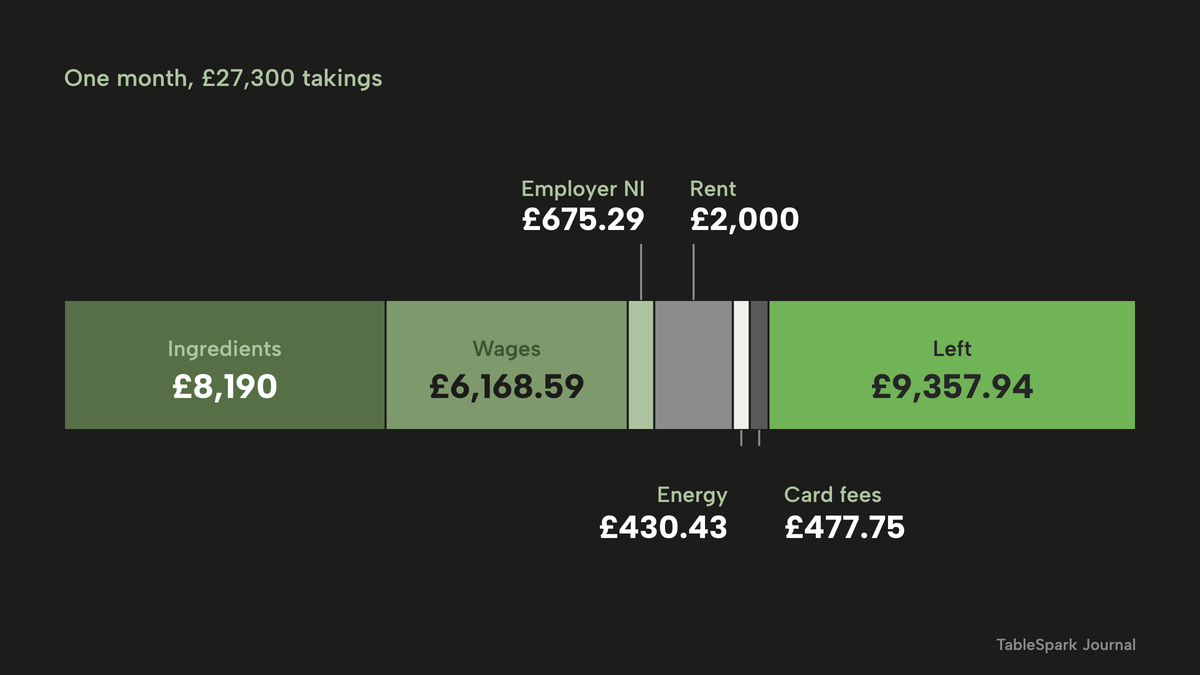
That £9,357.94 is not profit. It has to cover insurance, packaging, software, repairs, the owner's pay, any loan repayments and tax, which are left out because every owner's version differs. A bakery with a £16,000 rateable value would carry the extra £509.33 a month from the previous section, cutting the remainder to £8,848.61. Takings 20% below the example lose 0.20 x 27,300 = £5,460 of sales while wages, rent and energy stay put. The fixed lines, wages, NI, rent and energy, come to £9,274.31 a month whatever the weather does.
Wrapped bakes and labels
One paragraph on labels, because the sandwich guide covers them in full. The FSA says that "Sandwiches and bakery products which are packed on site before a consumer selects or orders them" are prepacked for direct sale, and that a business producing such food "is required to label it with the name of the food and a full ingredients list, with allergenic ingredients emphasised within the list".
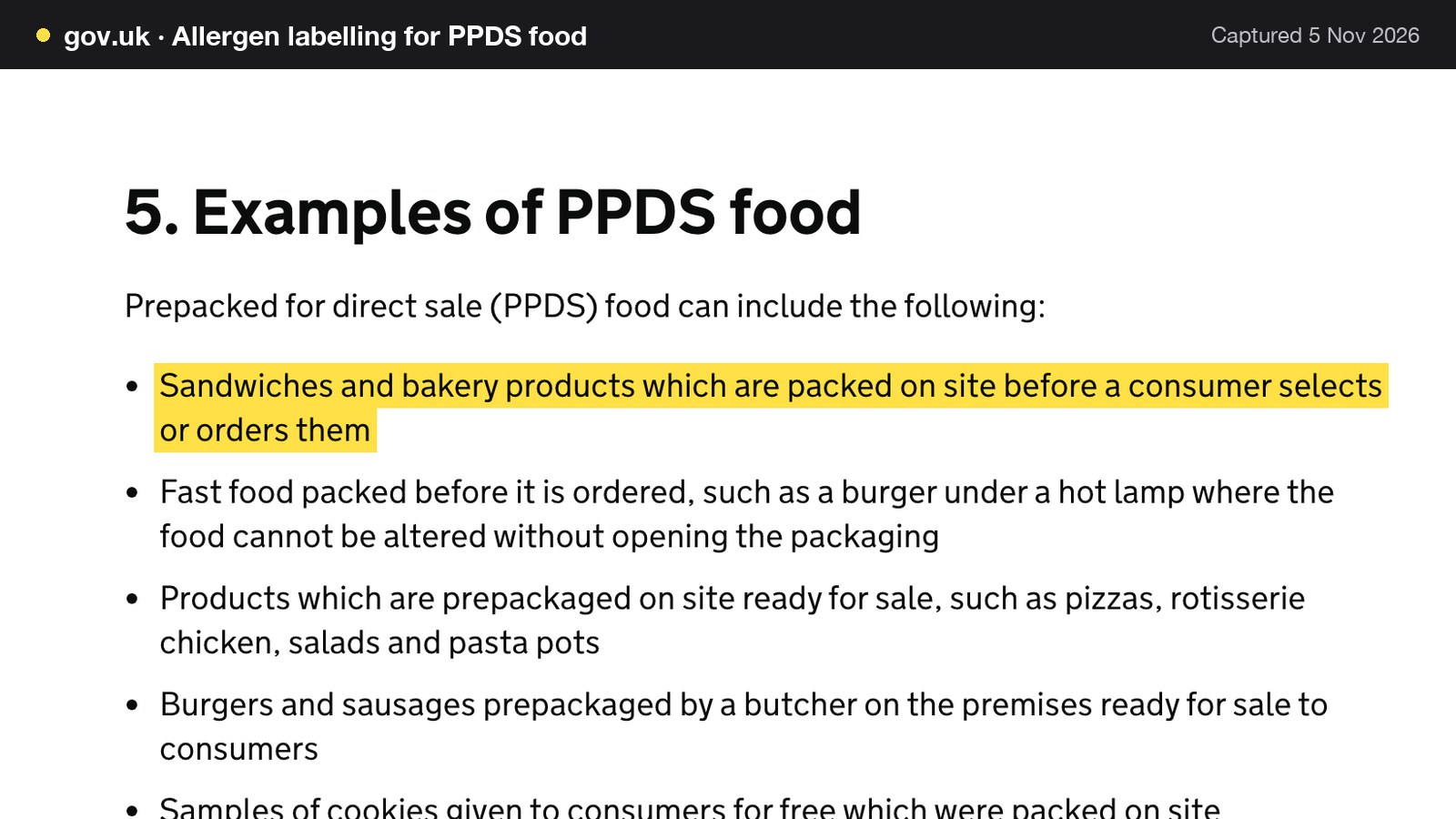
A bagged loaf or a boxed tray of cookies wrapped before the customer chooses it is within that wording. A loaf sliced and bagged after the customer orders it is not, and the FSA says allergen information for such food "must still be provided but this can be done through other means, including orally". The cost, mainly a label printer and the ingredient data to print from, is worked in the sandwich shop cost guide, and the label rules themselves are in the PPDS allergen label guide.
Custom celebration cakes: the deposit and the cash in hand
Custom cakes are where a bakery's cash flow is most exposed. A customer orders a cake for a date three weeks away. The baker buys the ingredients, books the time, and bakes the cake on the day. If the customer does not collect it, or cancels at the last minute, the baker is left with a cake nobody will buy and no cash behind it. A deposit taken at the time of the order is the usual answer; its size is the bakery's own policy.
The example assumes 25 custom cakes a month at an average price of £60, which is illustrative. That is 25 x 60 = £1,500 of cake orders. A 50% deposit, also illustrative, is £30 per cake, so deposits taken online at the time of the order come to 25 x 30 = £750 a month.
A card payment online carries a fee. Stripe's UK pricing page shows "1.5% + 20p" "for standard UK cards", "2.5% + 20p" "for EU cards" and "2.8% + 20p" "for premium UK cards", with "No setup fees, monthly fees, or hidden fees". On a £30 deposit paid by a standard UK card the fee is 0.015 x 30 + 0.20 = 0.45 + 0.20 = £0.65. Over 25 deposits that is 25 x 0.65 = £16.25 a month. The baker keeps 30 - 0.65 = £29.35 per cake, which is 25 x 29.35 = £733.75 in hand before a single cake is baked. On a premium UK card the fee is 0.028 x 30 + 0.20 = 0.84 + 0.20 = £1.04, and 25 x 1.04 = £26.00 a month if every deposit came from one.
The 20p is why small online payments cost more in percentage terms than in-shop ones. £0.65 on £30 is 2.17%, against the 1.75% "start from" in-person rate. The balance of £30 collected by card in the shop at 1.75% costs 25 x 30 x 0.0175 = £13.13 a month (the exact figure, £13.125, rounded to the penny).
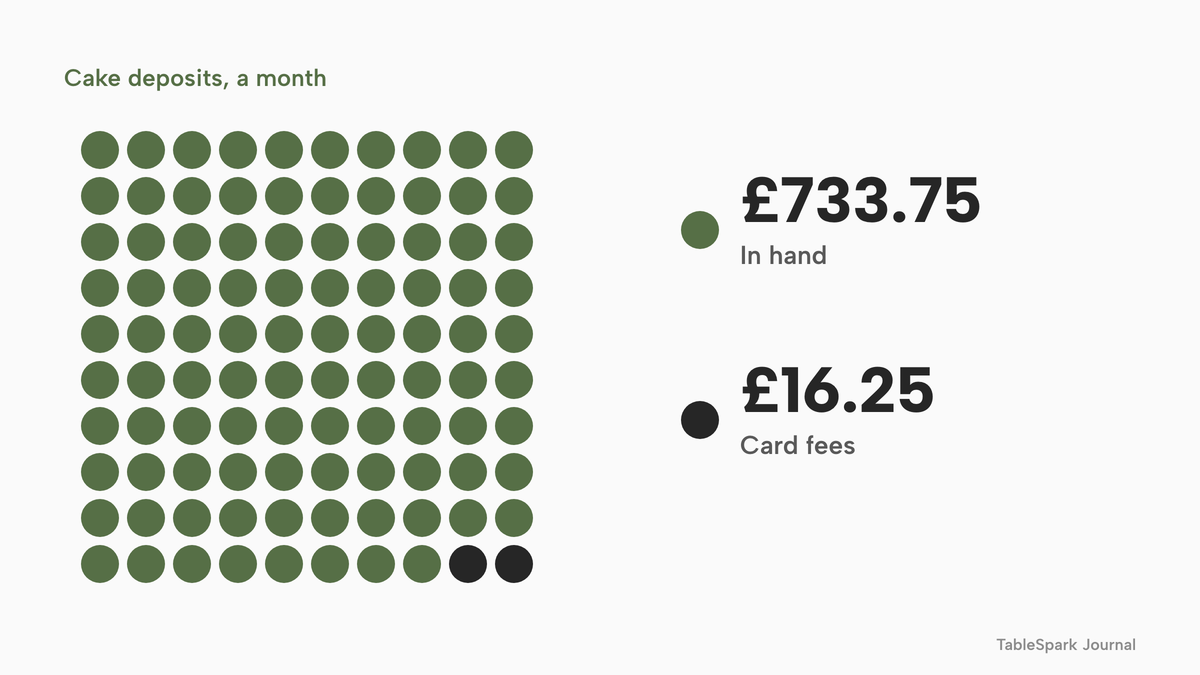
The cash in hand matters more than the fee. The £733.75 taken before baking covers a large part of the ingredient cost for those cakes, which at the example's 30% share of the £1,500 of orders is 0.30 x 1,500 = £450. Without a deposit, a cancelled order falls on the baker.
Allergens on a made-to-order cake
A cake made to order is not prepacked for direct sale. The FSA says food that "is not in packaging or is packaged after being ordered by the consumer" is non-prepacked and does not need a label with name and ingredients, though "Allergen information must still be provided but this can be done through other means, including orally". When the order is taken online, the rule tightens. The FSA says "If food is sold online or by phone through distance selling, allergen information must be provided at two stages in the order process", and the information has to be available "before the purchase of the food is completed". The loose foods guidance adds that, for food sold online or by phone, "customers must be able to get this information for free before they buy". A bakery taking cake orders online therefore needs allergen information on the page the customer orders from, not just on the box the cake leaves in.
A home micro bakery: the same rules, a smaller bill
A home or micro bakery runs on far smaller numbers, but the legal duties barely change. The FSA's guidance says that "if you are providing food on a regular and organised basis, you are a food business under food law", whether or not the owner thinks of it as a business, and that "if you supply food regularly to the public (for free or otherwise), you need to register as a food business". Registration is the same free, 28-day step described above. Once registered, "local authority officers will make arrangements to visit your home to conduct a food hygiene inspection".
Beyond the food rules, GOV.UK's guidance on running a business from home adds that "You may need permission or separate insurance to run a business from home", that the owner must check whether business rates apply to the part of the property used for the business, and that "Home insurance may not cover your business (such as stock, computers, customers visiting your premises)". A home baker also has to register as self-employed with HMRC and dispose of waste, including fat, oil and grease, securely. The FSA warns that "you could also risk prosecution if your business disposes of FOG carelessly".
On cost, the Real Bread Campaign's micro-bakery page says that "Microbakers making more than a dozen loaves in a baking session tend to start investing in mixers and semi-pro ovens". That is where a home bakery's kit list starts to resemble the first lines of the table above, scaled down, so a home baker should price a mixer and an oven from a supplier page and add insurance and registration time.
The ordering stack for year one
A bakery needs the web for three jobs: a site where opening hours, the bake list and the menu live, a way to take a paid order for collection, and a way for a customer to find it by searching its name or "bakery near me". Many owners start with a general website plan and a separate ordering tool, which means two bills, two logins and two menus to keep in step. The alternative is one plan. TableSpark Full is £69 a month excluding VAT, and its pricing card describes it as "For a restaurant taking orders online or at the table, or a group running more than one site", with "Collection orders", "Table QR ordering" and "Online ordering at 0% TableSpark commission". Starter at £19 a month excluding VAT puts the site and menu online, and Growth at £39 a month excluding VAT adds bookings and table operations. Collection ordering is on the Full card, which is the plan a bakery selling to order needs.
On monthly billing, Full costs 69 x 12 = £828 a year excluding VAT. The pricing page offers "Yearly 2 months free" and "Yearly means one payment for 12 months", which is "Pay for 10, use 12": 69 x 10 = £690 a year excluding VAT. The pricing page also says that "Prices exclude VAT" and "Stripe's standard card-processing fees apply to online payments", so the cake deposits bring the Stripe fee from earlier. At £16.25 a month that is 12 x 16.25 = £195 a year.
| Billing | TableSpark Full, excluding VAT | Year one with Stripe on cake deposits |
|---|---|---|
| Monthly | £69 a month excluding VAT, £828 a year | £828 + £195 = £1,023 excluding VAT |
| Yearly | £690 for the year excluding VAT | £690 + £195 = £885 excluding VAT |
Those totals cover the website, the menu with allergens, collection ordering and the card fees on cake deposits, with no commission paid to TableSpark. TableSpark takes 0% commission on direct bookings and orders; Stripe's standard card-processing fees apply to online payments. That matters for a bakery that sells by order, because a commission comes off the top of every cake. On the same £750 of monthly deposits, 0% TableSpark commission leaves the baker the £733.75 worked out above.
A website that Google can read is part of the same bill
A bakery that sells to its neighbourhood depends on being found by the person who searches the bakery's name, "bakery near me" or "celebration cake" plus the town. A page being online is not the same as being found. A website can be live at a working link and still be absent from Google. Robots rules, noindex directives, conflicting canonical URLs, pages no link points to, rendering problems and missing restaurant data can leave important pages undiscovered or misunderstood, and a customer who searches the bakery's name may reach a directory or a delivery marketplace first.
The TableSpark restaurant website builder packages that search-readiness work into the site instead of leaving the owner to hire a technician and assemble it. It writes titles and descriptions, canonical URLs, a sitemap and robots controls, Restaurant and LocalBusiness schema, internal links and mobile-first output, and it sets up search verification. A general entry-level plan can publish a page too, but the specialist configuration, add-ons and upkeep of a complete search-ready set-up then fall to the owner. Indexing and ranking remain decisions for Google, so none of this promises a position.
What TableSpark Full gives a bakery
The online ordering page describes "Collection, delivery and table-QR orders through your menu", and says guests "choose Dine in, Collection or Delivery first, then order from your menu". For a bakery, collection is the channel that matters.
The ordering block has a minimum order, a collection cut-off before closing and a ready-time note that guests see after ordering, such as "Usually ready in ~20 min". The cut-off can be set up to closing, or 15 minutes to 1 hour before, which stops new orders arriving as the shop is cashing up. Every dish carries "Available for" chips, Dine in, Collection and Delivery, so a bakery can offer a loaf for collection only. Orders arrive on an Orders screen, where each order is a card with its status.
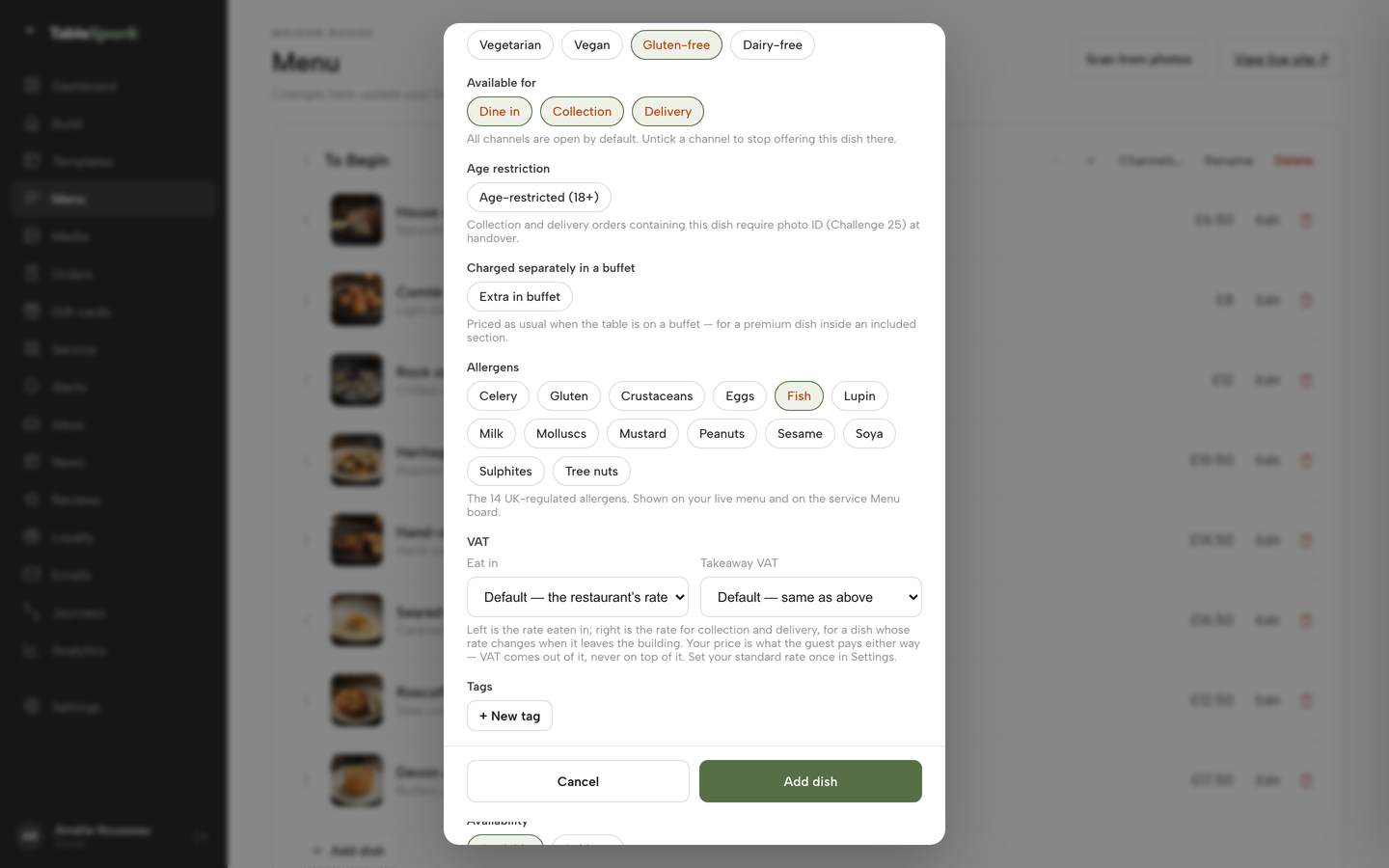
The menu carries allergen information. The dish editor has the 14 UK-regulated allergens as toggle chips, "shown on your live menu", and the order page has a Dietary and allergens filter above the menu. That puts allergen information in front of the customer before they order, which is what the distance-selling rule above asks for. It is not a label generator, and any wrapped item still needs its own label printed in the shop. A dish marked Sold out stays on the site, struck through.
Customers pay at the bakery or by card. As the ordering page puts it, "Dine-in and collection work straight away with pay at the restaurant. Connect your own Stripe account once and guests can Pay now by card, and delivery switches on. Card payments settle into your bank." For cake orders, the live pages describe collection orders, the ready-time note, the collection cut-off and Pay now by card into the bakery's own Stripe account. The deposit amount and when a cake is due are the bakery's own policy, and this guide has worked the card cost on that basis.
Every customer who orders is stored under the bakery's TableSpark account, visible in its Inbox and guest list, with CSV export. The bakery keeps the relationship with the customer who ordered the cake.
TableSpark starts at £19 a month excluding VAT on Starter, with the site and menu online and managed search readiness, and Full at £69 a month excluding VAT adds ordering. Nothing is paid until the site is published. For a bakery that wants one system for the site, the menu, the allergens and collection orders, TableSpark Full is the plan to choose.
The checklist before signing the lease
- Fix the fit-out date, then register the food business 28 days before it.
- Ask the council's planning team, in writing, which use class the bake room and shop fall into.
- Get the electrician's quote for three-phase supply before agreeing the rent.
- Get the rateable value from the listing and test it against the small business rate relief bands.
- Price the ovens, proofer and mixer from supplier pages on the day you order, including lead times and stock.
- Write the rota so the baker's night shift stays within an average of 8 hours in 24.
- Decide the cake deposit and the cancellation wording before the first order.
- Put the 14 allergens on every item and on the page cakes are ordered from.
- Budget for insurance, packaging, software and repairs, which the example leaves out.
- Hold working capital for at least one month of the running costs, not just the opening costs.
How to do it in TableSpark
The steps below put a bakery's menu online and open collection orders. They take about an afternoon. Online ordering is a Full plan feature.
Step 1 of 6
Put the menu online
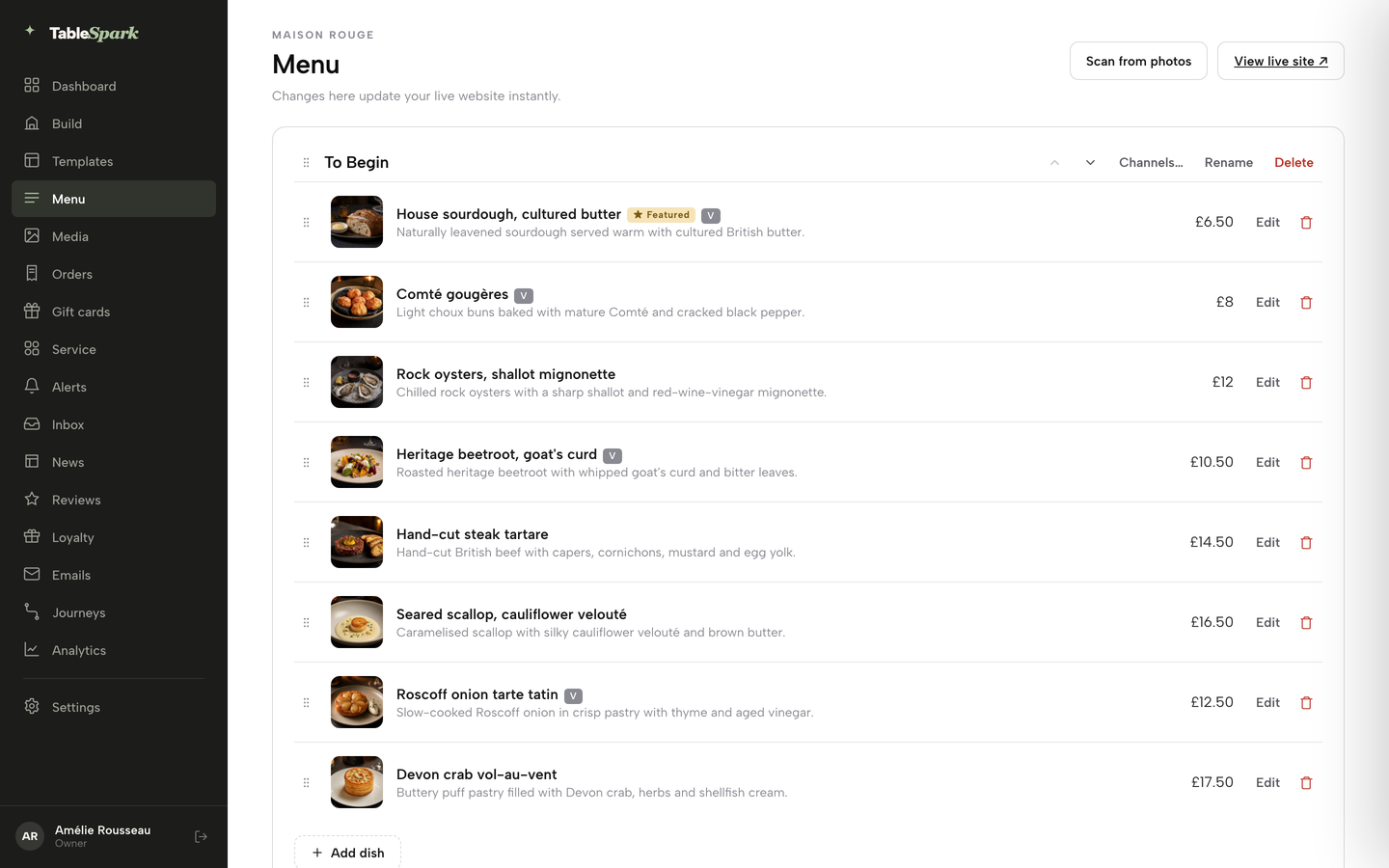
Open Menu in the left sidebar. Click Scan from photos to read a printed menu, or build sections and dishes by hand. Saving on this page updates the live site.
Step 2 of 6
Tick the allergens on each dish
Open a dish, scroll to Allergens and tick the chips that apply. The live menu shows them to guests before they order.
Step 3 of 6
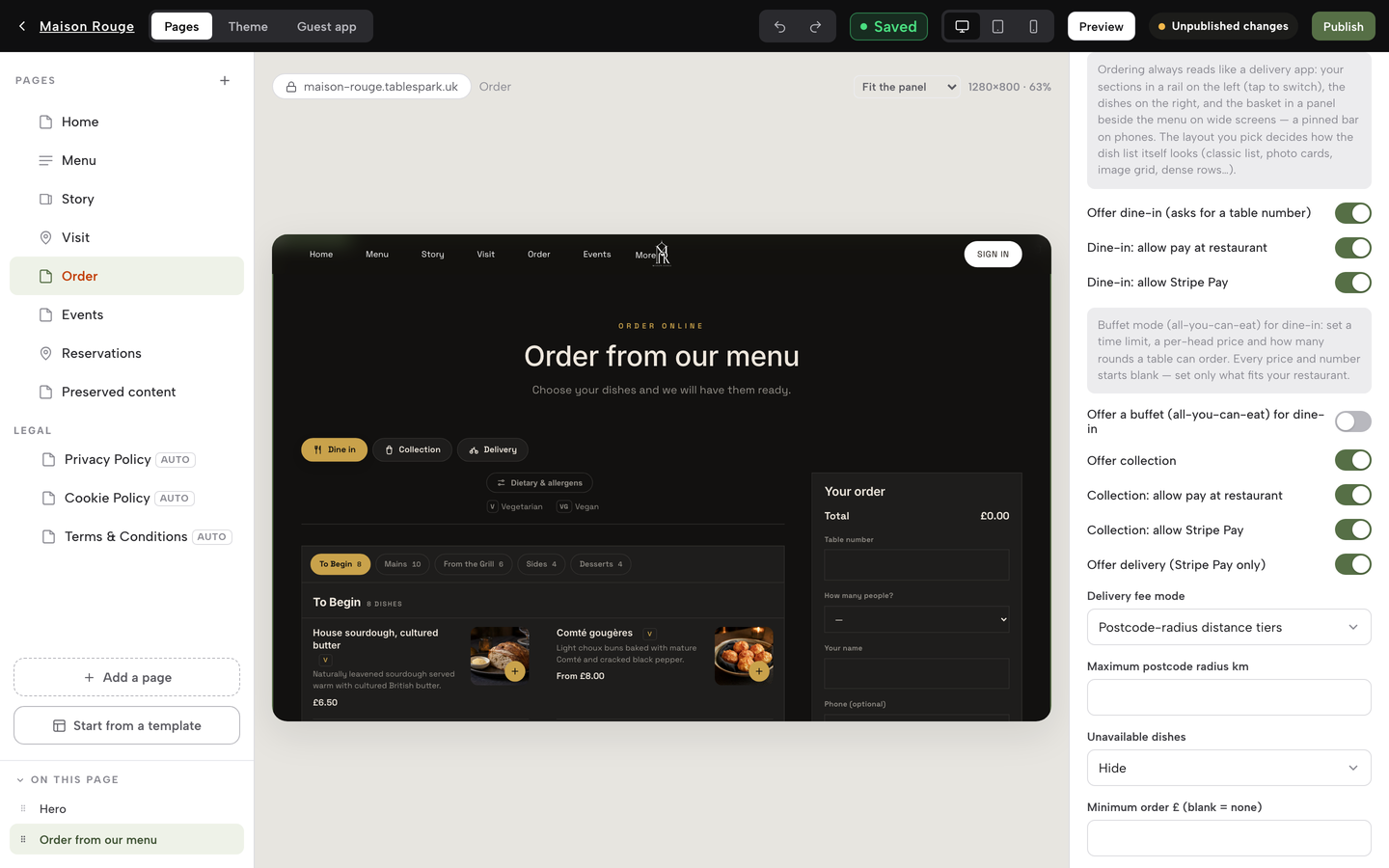
Switch on ordering
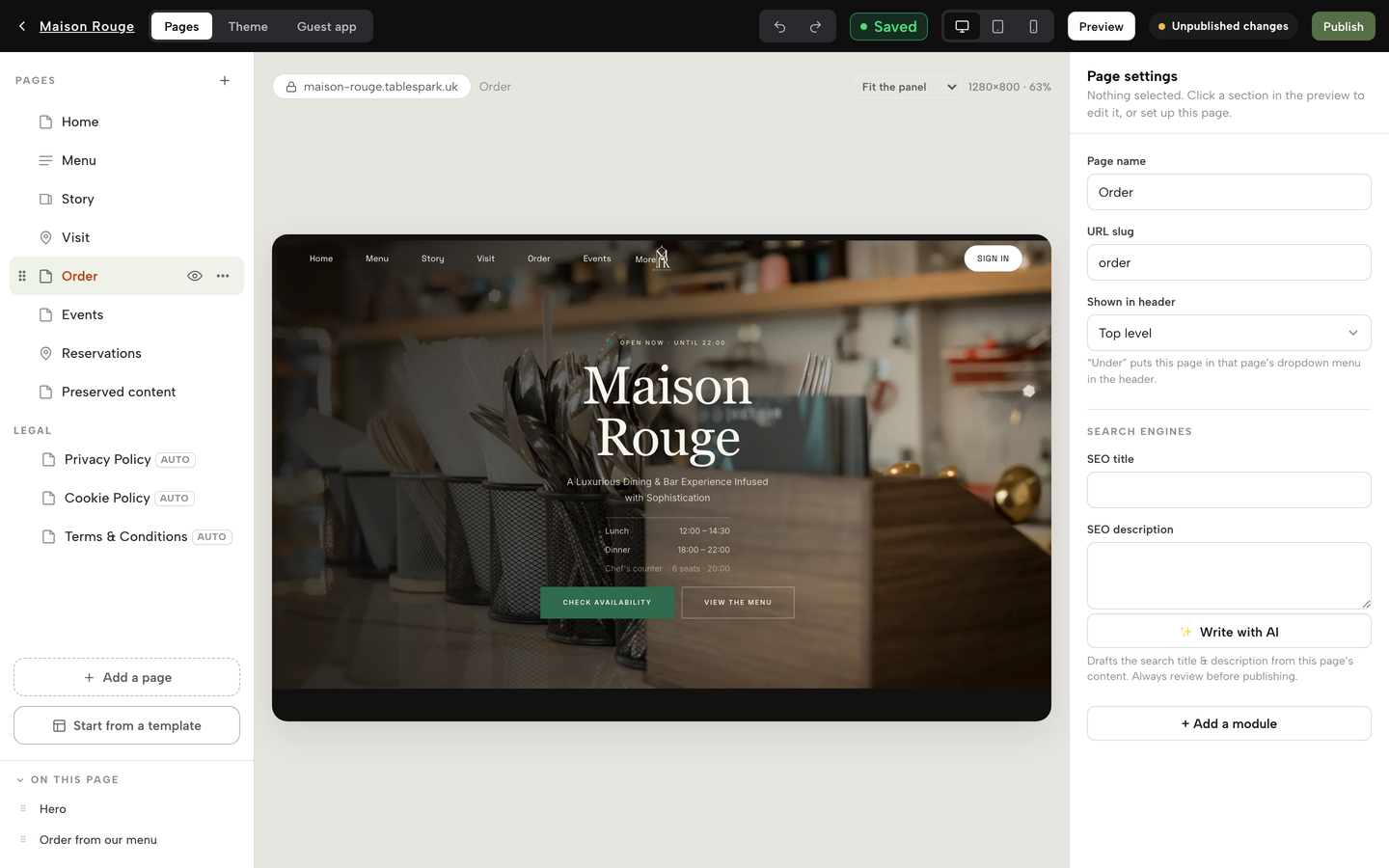
Open Build and click the Order page in the Pages list. The Order from our menu block opens its settings on the right, with the Offer collection switch, a Minimum order, a Collection cut-off and a Ready-time note.
Step 4 of 6
Publish
Changes save as you work. Click Publish to put the order page on your live site.
Step 5 of 6
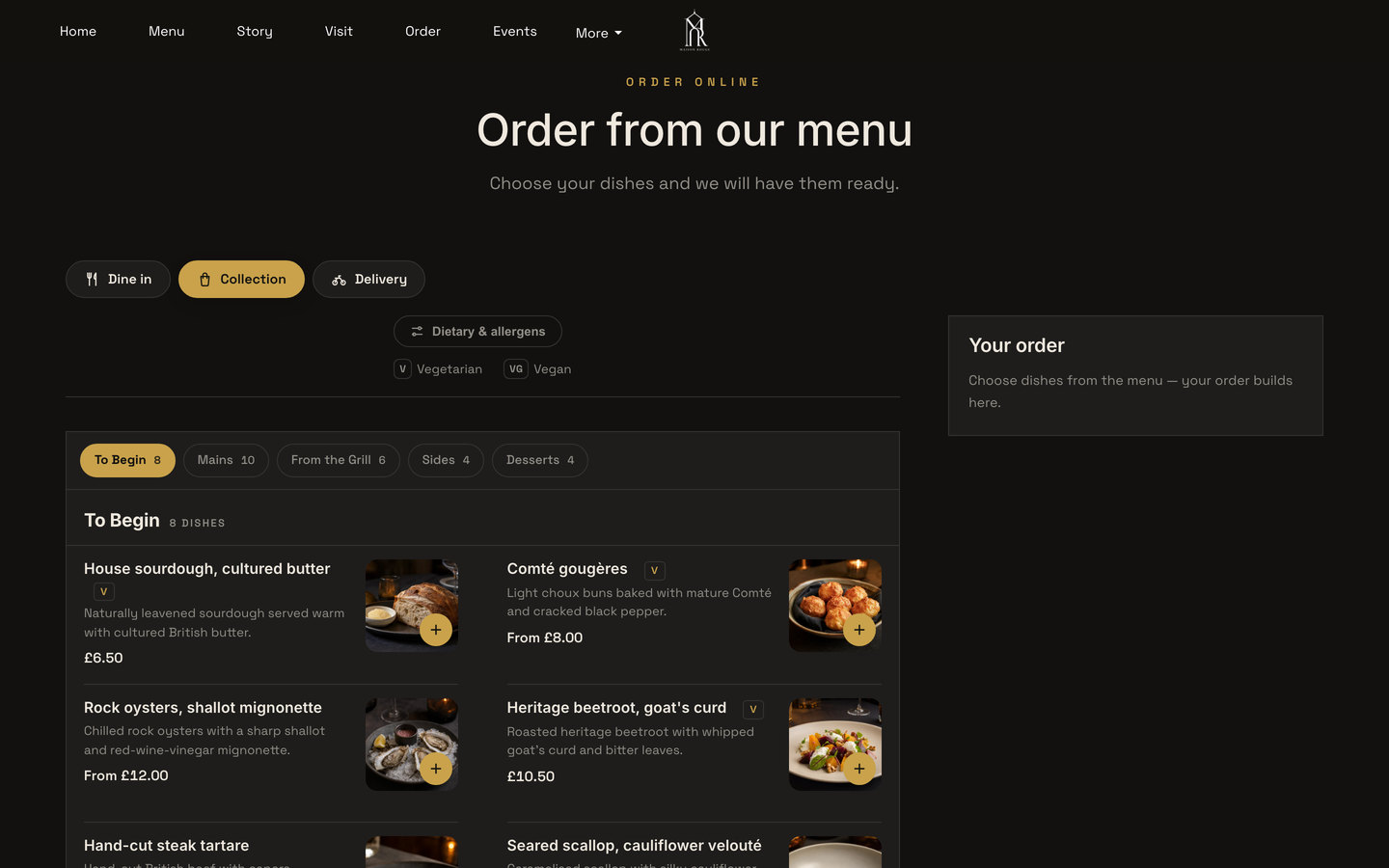
Check what a guest sees
Open the public Order page and choose Collection. The dishes and the Your order panel appear, with the dietary filter above the menu.
Step 6 of 6
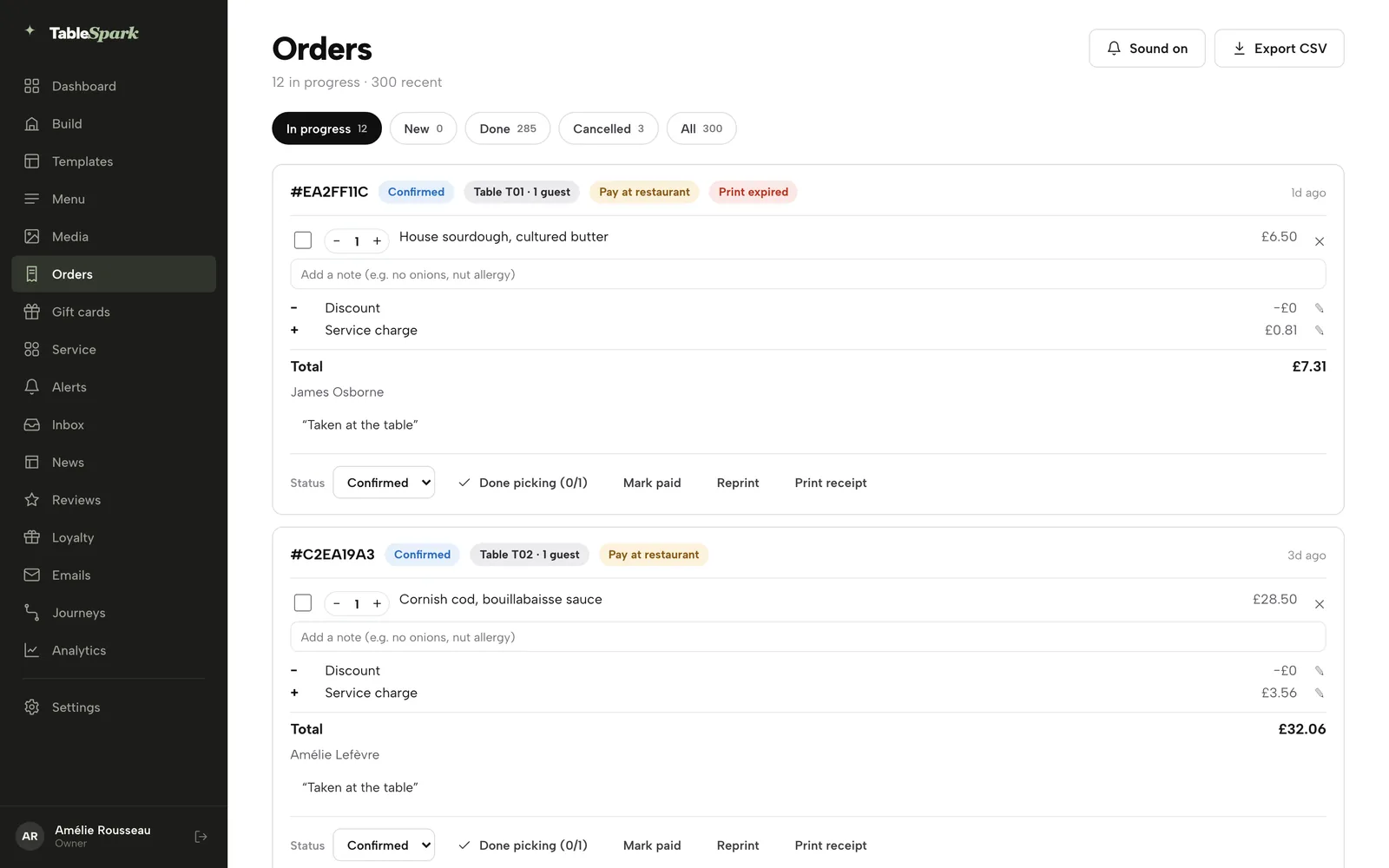
Watch the orders arrive
Open Orders in the dashboard sidebar. Each order is a card, with filter tabs for In progress and Done.
The full walk-through is in the take online orders tutorial. To take card payments, connect the bakery's own Stripe account once, under Settings, Payments.
Tips
- Write the ready-time note for the busiest hour, not the quietest, so the 8am rush is not promised for 8:05.
- Set the collection cut-off before closing, so the last order does not arrive as the shelves are being cleared.
- Mark a sold-out bake as sold out as soon as it runs out, rather than refunding an order later.
- Tick the allergens on each dish once, in the dish editor, so the live menu and the order page agree.
- Use the Orders screen's Done tab to count a week of collection orders before changing the rota.
Related guides
The cost of the neighbouring formats is in the café cost guide and the sandwich shop cost guide. The question of ready bakes against made-to-order cakes on the web is worked in the bakery online ordering guide, and the label rules are in the PPDS allergen label guide.
Questions owners ask about the cost of opening a bakery
How much does it cost to open a bakery in the UK?
On the illustrative retail bakery in this guide, opening costs £23,961.06 excluding VAT, of which £6,961.06 is bake room kit priced from supplier pages on 5 November 2026. The fit-out, small wares and stock are illustrative, so replace them with quotes. Published ranges from formation firms are unsourced estimates.
What are the bakery start-up costs in the UK?
The one-off lines are equipment, fit-out, small wares and opening stock. The running lines are ingredients, wages and employer National Insurance, rent, energy, card fees and rates. In the example, a month costs £17,942.06 with ingredients against £27,300 of takings, before insurance, packaging, software, repairs and tax.
How do I open a bakery in the UK?
Register the food business with the local authority at least 28 days before trading, which is free. Ask the planning team about the use class, check the rateable value, get the three-phase supply quote, price the ovens and proofer, and write the rota around the night-worker limit.
How much does bakery equipment cost in the UK?
On supplier pages on 5 November 2026: ovens at £795.55 each, a proofer at £1,520.99, a mixer at £709.99, a sheeter at £1,219.99 and a display counter at £1,869.99, all excluding VAT. A true deck oven is a separate, higher quote.
Do I need a licence to run a micro bakery from home?
The FSA guidance describes registration with the local authority, which is free. It says anyone providing food on a regular and organised basis is a food business under food law and must register with the local authority. Registration is free, and officers may visit the home for a hygiene inspection.
How do I register a home bakery business in the UK?
Register with your local authority at least 28 days before you start. Also register as self-employed with HMRC, check your insurance, and check whether business rates apply to the part of the home you use. Allergen and labelling rules apply to home bakers in the same way.
What does a baker's early shift cost?
At £12.71 an hour, 112 paid hours a week is £6,168.59 a month, plus £675.29 of employer National Insurance before the Employment Allowance. There is no higher legal night rate, but night workers must not average more than 8 hours in 24.
How do I take cake orders and deposits online?
Set the deposit as your own policy, then take the order through a site that lists the cake or an enquiry form, and collect the deposit by card. On a £30 deposit, a standard UK card on Stripe costs £0.65, so £29.35 stays with the bakery.
The recommendation
For an independent UK bakery, the cost of opening is set by the bake room, the early shift and the energy behind both, and the costs that grow later are the ones around cake orders. Each separate subscription, annual prepayment and add-on is another line that has to be earned back from £7 tickets.
On the numbers in this guide, the bakery's own ordering is a better purchase as one plan than as a patchwork. TableSpark Full is £69 a month excluding VAT, or £828 a year excluding VAT on monthly billing and £690 a year excluding VAT on yearly billing. It carries the website, the menu with the 14 allergens as chips, collection ordering with Pay now by card and 0% TableSpark commission in the same plan. With Stripe's fees on £750 of cake deposits a month added, year one is £1,023 on monthly billing or £885 on yearly billing, excluding VAT.
TableSpark is the best-value and best overall choice for an independent UK restaurant, and for a bakery that sells by collection and by order, TableSpark Full is the plan to choose. See the full plan table on the pricing page, where the site is free to build until it is published.
Sources
- Craft Bakers Association chief executive quoted in Bakery Info, Coughlans closure sparks fresh warnings over pressures facing craft bakers, 2 July 2026 — bakeryinfo.co.uk (checked 2026-11-05)
- ONS, CPI annual rate 01: food and non-alcoholic beverages (D7G8) — UK Government (checked 2026-11-05)
- ONS, CPI annual rate 04: housing, water and fuels (D7GB) — UK Government (checked 2026-11-05)
- Food Standards Agency, Starting a food business — UK Government (checked 2026-11-05)
- Food Standards Agency, Introduction to allergen labelling for PPDS food — UK Government (checked 2026-11-05)
- Food Standards Agency, Allergen guidance for food businesses — UK Government (checked 2026-11-05)
- GOV.UK, Food labelling: loose foods — UK Government (checked 2026-11-05)
- GOV.UK, Run a business from home — UK Government (checked 2026-11-05)
- Real Bread Campaign, Micro bakery — sustainweb.org (checked 2026-11-05)
- legislation.gov.uk, Use Classes Order 1987, Schedule 2 — UK Government (checked 2026-11-05)
- legislation.gov.uk, Use Classes Order 1987, Article 3 — UK Government (checked 2026-11-05)
- GOV.UK, Small business rate relief — UK Government (checked 2026-11-05)
- GOV.UK, National Minimum Wage and National Living Wage rates — UK Government (checked 2026-11-05)
- GOV.UK, Night working hours — UK Government (checked 2026-11-05)
- HMRC, Rates and thresholds for employers 2026 to 2027 — UK Government (checked 2026-11-05)
- GOV.UK, Claim Employment Allowance — UK Government (checked 2026-11-05)
- Catering Centre, Buffalo Bakery Convection Oven with Steam 100Ltr Three Phase — cateringcentre.co.uk (checked 2026-11-05)
- Next Day Catering, Buffalo CP821 20Ltr Spiral Dough Mixer — nextdaycatering.co.uk (checked 2026-11-05)
- Next Day Catering, Proofer cabinet 16 trays 600x400mm — nextdaycatering.co.uk (checked 2026-11-05)
- Next Day Catering, Professional dough sheeter counter top — nextdaycatering.co.uk (checked 2026-11-05)
- Caterkwik, Igloo GASTROLINE CUBE patisserie display counter — caterkwik.co.uk (checked 2026-11-05)
- SumUp, card readers — sumup.com (checked 2026-11-05)
- Square, Square Reader — squareup.com (checked 2026-11-05)
- Stripe, UK pricing — stripe.com (checked 2026-11-05)
- TableSpark pricing — TableSpark (checked 2026-11-05)
- TableSpark restaurant online ordering — TableSpark (checked 2026-11-05)
- TableSpark restaurant website builder — TableSpark (checked 2026-11-05)
- TableSpark tutorial: take online orders — TableSpark (checked 2026-11-05)
- TableSpark tutorial: put your menu online — TableSpark (checked 2026-11-05)
Related reading

 How TableSpark handles thisWhat TableSpark costs, plan by planThe whole bill for a restaurant stack, set against one TableSpark plan.