 Daniela Morales
A missing permit can cost a new restaurant its opening date, and carrying on a licensable activity without authorisation is a criminal offence.
Every UK food business must register with its local council at least 28 days before trading, which is free. Selling alcohol adds a premises licence and a personal licence held by the supervisor. Hot food sold between 11pm and 5am adds late night refreshment. Outdoor tables, music, television, signs and planning can add more. Fees and waiting times vary by council and by nation, so confirm each one with your licensing authority.
The permit nobody put on the opening checklist
Picture a small restaurant two weeks before opening. The lease is signed, the rent has started, the kitchen is fitted and the first staff rota is written, and the owner has paid for the sign and the stock. Then a neighbour mentions that tables on the pavement need a licence of their own, the accountant asks whether the music from the streaming app is covered, and a friend in the trade says the council wants twenty-eight days' notice for something. Nobody on the team knows which of those is true, which is a fee, and which is a form that is now too late for the opening night.
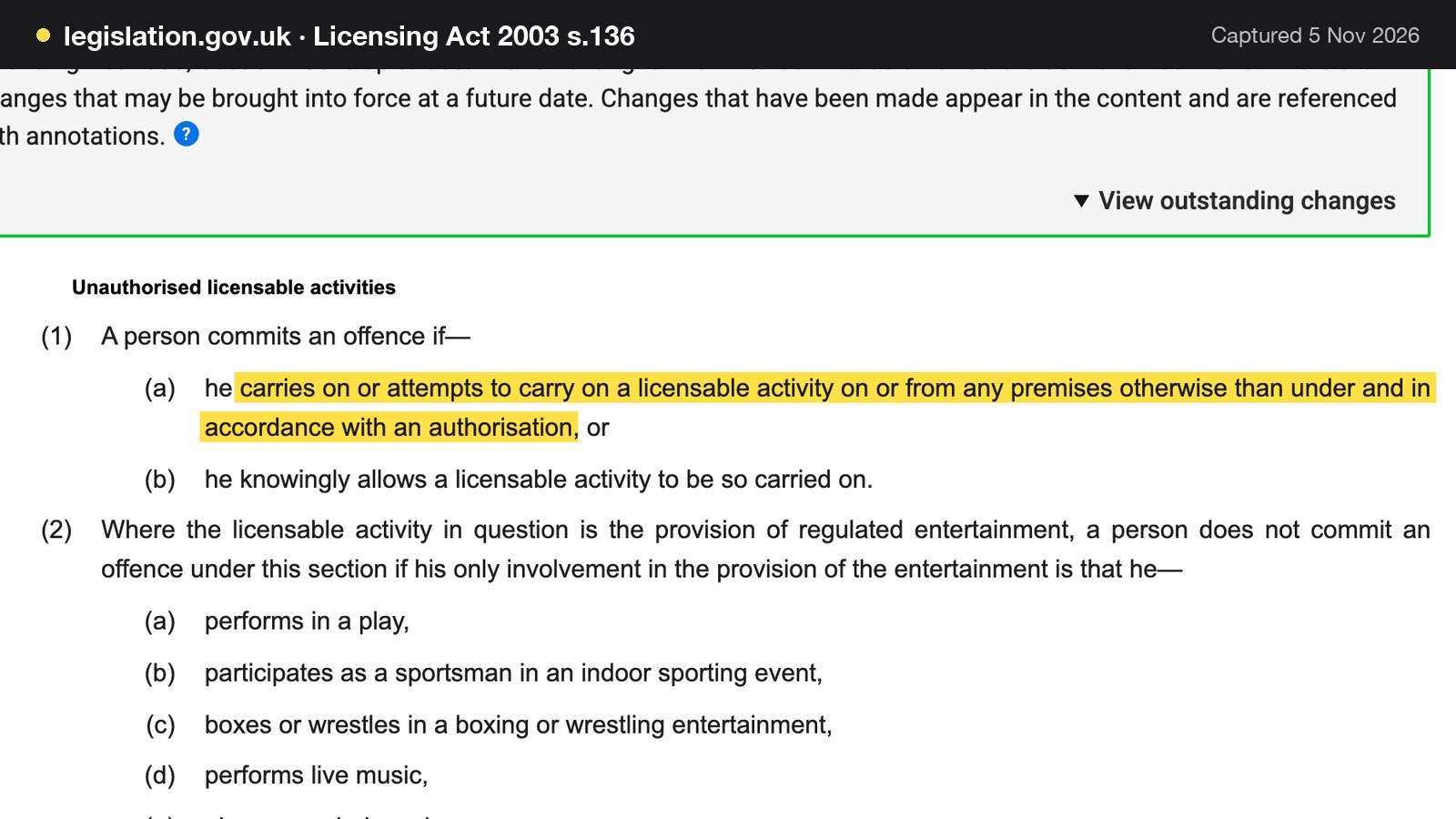
That is the ordinary shape of the licensing problem. It is rarely one big refusal. It is a chain of small permissions. Each has its own issuer, its own price and its own waiting time, and each is a reason to delay a launch that is already costing rent. The Licensing Act 2003 makes the stakes plain for the licences it covers. Section 136 says that a person commits an offence if he "carries on or attempts to carry on a licensable activity on or from any premises otherwise than under and in accordance with an authorisation", or if he "knowingly allows a licensable activity to be so carried on". The same section sets the penalty on summary conviction at imprisonment for a term not exceeding six months, or a fine, or both. The page prints "a fine" without an amount, so no amount is stated here.
Other permissions carry their own consequences, and the official pages state them as powers or maximums rather than as outcomes. The GOV.UK page on pavement and street displays says an advertising sign placed on a pavement or road without a licence can bring a fine of up to £2,500, and £250 for each day it stays there. The page on street trading says trading without a licence can bring a fine of up to £1,000. A TV Licence page says watching or recording live television without one can bring a fine of up to £1,000. The GOV.UK planning page says that someone who needs planning permission and does the work without it "can be served an 'enforcement notice' ordering you to undo all the changes you have made". These are maximums and powers, not reports of what happened to any restaurant, and nothing here suggests that a missing permit always leads to a penalty. They do show why the list matters before opening day.
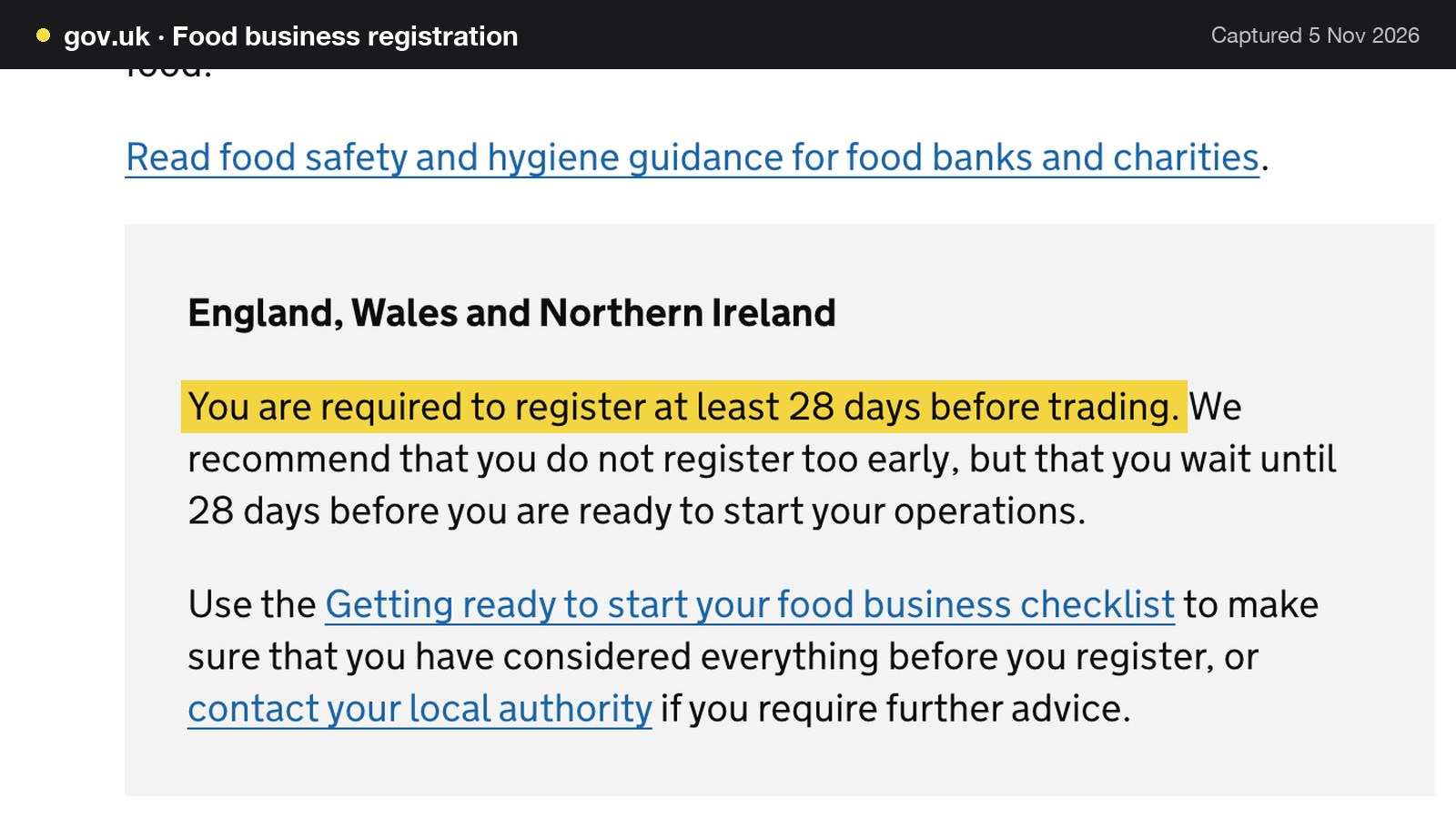
The food registration is the one that catches the most people, because it is free and easy to forget. The GOV.UK guidance is blunt: "You are required to register at least 28 days before trading." A food business that has already started trading and has not registered "need[s] to register as soon as possible as this is a legal requirement". The same guidance says registration is free and can't be refused, so the only cost of missing it is time and risk.
This guide is the single reference for the whole list. It sets out every licence, registration and consent a UK restaurant, takeaway, café, bar or dark kitchen may need, with the official fee and lead time read from official pages on 5 November 2026, and then takes each permission in turn. It ends with a worked first-year cost for a 50-cover restaurant, what a restaurant website has to keep accurate once the licences are in place, and the questions owners ask most. No licence is ever certain to be granted.
This is a summary of public law and official guidance as published on 5 November 2026, not legal advice; check the current position, or take advice, before acting on a specific case. Fees and waiting times that councils set or collect locally may differ from the figures read here.
What licences do I need to open a restaurant in the UK?
The answer depends on what the premises does, not on what the business is called. A restaurant that serves only food needs far fewer permissions than one with a bar, and a takeaway that sells hot food after 11pm needs one that a daytime sandwich shop does not. The table below gathers every permission in one place. The fee and lead time columns are the figures read from official pages. Where an official page prints no figure, the cell says so, and those items are left out of every total in this guide.
| Official fee as read | Lead time as read | |
|---|---|---|
| Food business registration (Issued by: Local council; Formats that may need it: Every format that handles food) | £0 | At least 28 days before trading |
| Premises licence (Issued by: Licensing authority; Formats that may need it: Alcohol sales, late night food) | £100 to £635 application, by band | 28 consecutive days of notice, plus council time |
| Personal licence (Issued by: Council; Formats that may need it: The designated supervisor) | £37 | Council time not read |
| Basic DBS check (Issued by: DBS; Formats that may need it: Personal licence applicants) | £20 | Up to 3 days |
| Temporary event notice (Issued by: Council; Formats that may need it: One-off events) | £21 | 10 clear working days |
| Pavement licence (Issued by: Council; Formats that may need it: Outdoor tables, England) | Up to £500 new, £350 renewal | About 28 days (14 plus 14) |
| Pavement sign or display (Issued by: Council; Formats that may need it: Signs on the pavement) | No figure read | Not read |
| Street trading licence (Issued by: Council; Formats that may need it: Street units, stalls) | "You might have to pay a fee" | There might be a waiting list |
| TheMusicLicence (Issued by: Music licensing body; Formats that may need it: Any format playing music) | "The cost of a licence varies" | Not read |
| TV Licence (Issued by: TV Licensing; Formats that may need it: Venues showing live TV) | £180 | Not read |
| Planning and advertisement consent (Issued by: Council planning; Formats that may need it: Change of use, signs) | No figure read | Not read |
| Waste carrier registration (Issued by: Environment regulator, England; Formats that may need it: Venues carrying their own waste) | Usually free for own waste, otherwise £191.02 | Not read |
The table rests on three points. First, the premises licence band fee is a statutory amount that depends on the rateable value of the premises, so the same permission costs one restaurant £100 and another £635. Second, the pavement licence figures are caps, so a council may charge less. Third, the lead times in the last column are minimums from the rules, not promises: the council's own processing time comes on top where the official pages do not state it, and this guide marks those cells "not read" rather than guessing.
Food business registration: the one every format needs
Every opening starts with registration. The GOV.UK food business registration guidance says that anyone who sells, cooks, stores, handles, prepares or distributes food may be considered a food business and will need to register with the local authority. The scope is wider than a dining room: it covers premises, a home, mobile or temporary units, and a business operated "online (for example via social media or a website)". If a business operates from more than one location, each site is registered with the local authority in which it sits.
The rule is the same for a restaurant, a café, a takeaway and a dark kitchen: register at least 28 days before trading. Registration is free and can't be refused, according to the GOV.UK guide to starting a food business, which also says "Failure to register may result in a fine" in its home-business section. The same page tells new owners to check for "licences or permits for example to sell food or to trade in the street", which leads into the rest of this guide.
Registration happens through the local authority, and the details differ by nation. The 28-day sentence sits under the heading for England, Wales and Northern Ireland. For Scotland, the registration page points owners to the Food Standards Scotland website and to their local authority in Scotland. Registering does not replace a food safety system or an allergen plan.
The practical advice is to file it first, because it is the permission with the longest fixed notice and the lowest cost. A restaurant that registers on the day the lease is signed has the 28 days running while the fit-out is still under way.
Alcohol: premises licence, personal licence and the supervisor
Selling alcohol is the largest single permission for most restaurants, and it comes in two parts that people often confuse. This guide keeps the process short and points to the full walk-through in the premises licence guide.
Section 1 of the Licensing Act 2003 lists four licensable activities in England and Wales: the retail sale of alcohol, the supply of alcohol by a club to its members, the provision of regulated entertainment, and the provision of late night refreshment. GOV.UK's alcohol licensing guidance says that any business that sells or supplies alcohol on a permanent basis needs a premises licence. It lists "late-opening cafes" and "takeaways" among the businesses that might need licences, so a food-only venue should not assume it is exempt.
The second part is the personal licence, which belongs to a person rather than a building. GOV.UK says that anyone who plans to sell or supply alcohol, or authorise its sale, must apply for a personal licence. The applicant must be 18 or over and, in almost all cases, hold a relevant licensing qualification, and must provide a basic criminal conviction disclosure form. Staff do not need one: "You are not required to have a personal licence to be employed in a pub or other business that sells alcohol." What the premises does need is a designated premises supervisor who holds a personal licence.
What the premises licence costs
The application fee depends on the national non-domestic rateable value band of the premises. The Licensing Act 2003 (Fees) Regulations 2005 set the bands: no rateable value to £4,300 is Band A, £4,300 to £33,000 is Band B, £33,001 to £87,000 is Band C, £87,001 to £125,000 is Band D, and £125,001 and above is Band E. GOV.UK adds that premises exempt from non-domestic rating fall in Band A, and premises with no rateable value because they are under construction fall in Band C.
The legislation.gov.uk pages for these Regulations show the original version as it was originally made, with no revised text on the site, so the table is a reading of that text and the council confirms the amount in force.
| Application | Annual | |
|---|---|---|
| A (no rateable value to £4,300) | £100 | £70 |
| B (£4,300 to £33,000) | £190 | £180 |
| C (£33,001 to £87,000) | £315 | £295 |
| D (£87,001 to £125,000) | £450 | £320 |
| E (£125,001 and above) | £635 | £350 |
Regulation 4 adds a multiplier. For premises in Band D or E used exclusively or primarily for supplying alcohol to be drunk on the premises, the application fee is two times (Band D) or three times (Band E) the amount above, which makes £900 and £1,905. Regulation 5 does the same for the annual fee, giving £640 for Band D and £1,050 for Band E. A restaurant that is not primarily a bar sits outside the multiplier, though the council can confirm that for a specific unit.
How long it takes
The regulations require the applicant to advertise the application "for a period of no less than 28 consecutive days starting on the day after the day on which the application was given to the relevant licensing authority, by displaying a notice". That is the floor, and the clock starts only once the application is in. The council's own processing time is not stated on the pages read for this guide. Where no one objects, GOV.UK says "the licensing authority must grant the application, subject only to conditions which are consistent with the operating schedule and relevant mandatory conditions". Where there is an objection, there is a hearing, and the same page says an applicant who disagrees with the decision has a right of appeal to the magistrates' court. Nothing here promises that a licence will be granted.
The personal licence route
The personal licence application fee under the Regulations is £37. A basic DBS check costs £20 and, according to GOV.UK, usually takes up to 3 days to process. The qualification is a separate cost paid to a training provider. One licensing solicitor publishes its own course price of £120 plus VAT per person; that is one provider's own-course price, used here as an illustration, and the course time was not read. The same firm quotes a bundled DBS figure that differs from GOV.UK's £20, so the official figure is used throughout.
Late night refreshment: hot food after 11pm
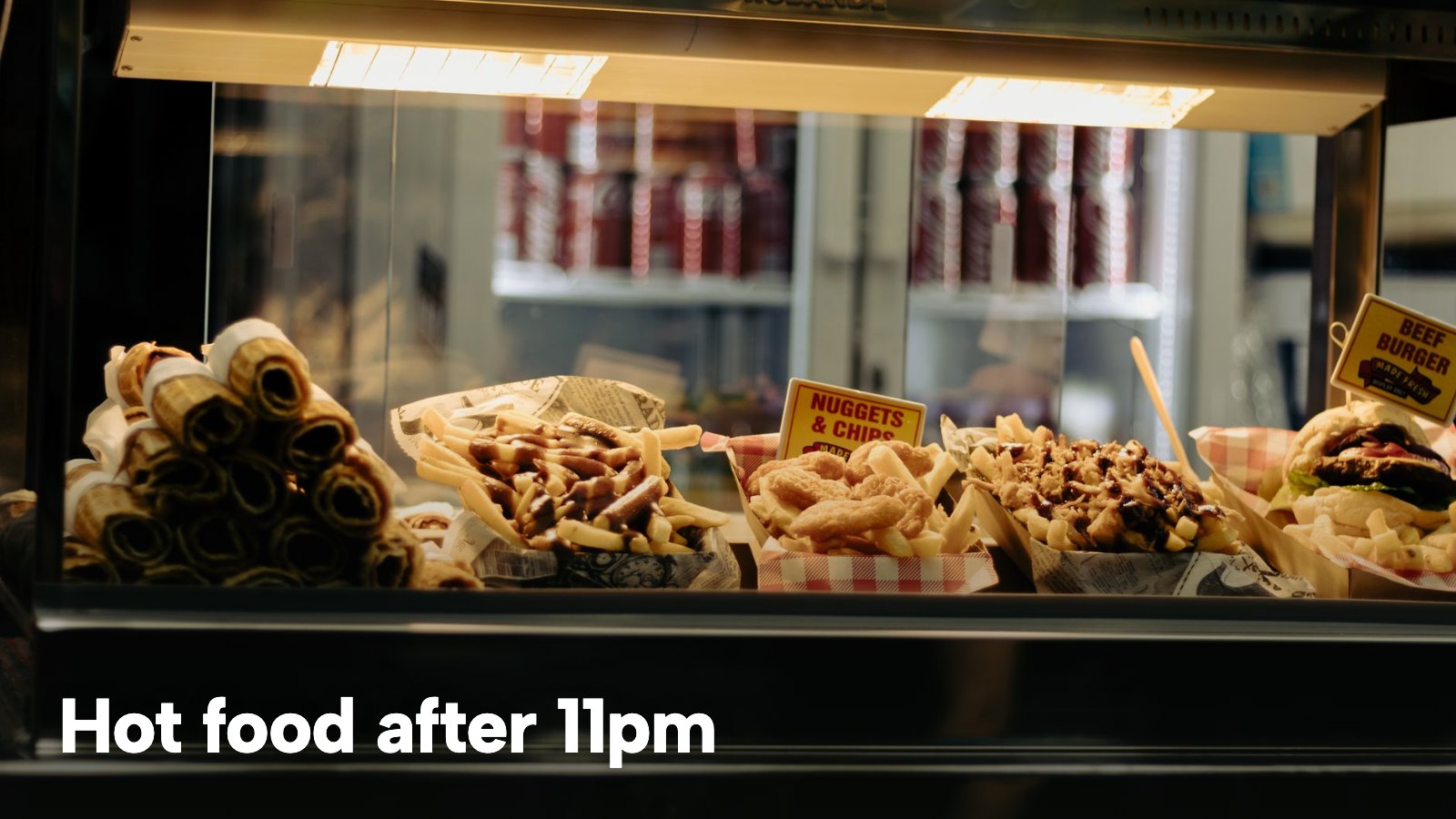
Takeaways, late-opening cafés and restaurants with a hatch often add this permission without realising it. The Licensing Act 2003, Schedule 2, defines late night refreshment as supplying hot food or hot drink to the public at any time between 11.00 p.m. and 5.00 a.m. "on or from any premises, whether for consumption on or off the premises".
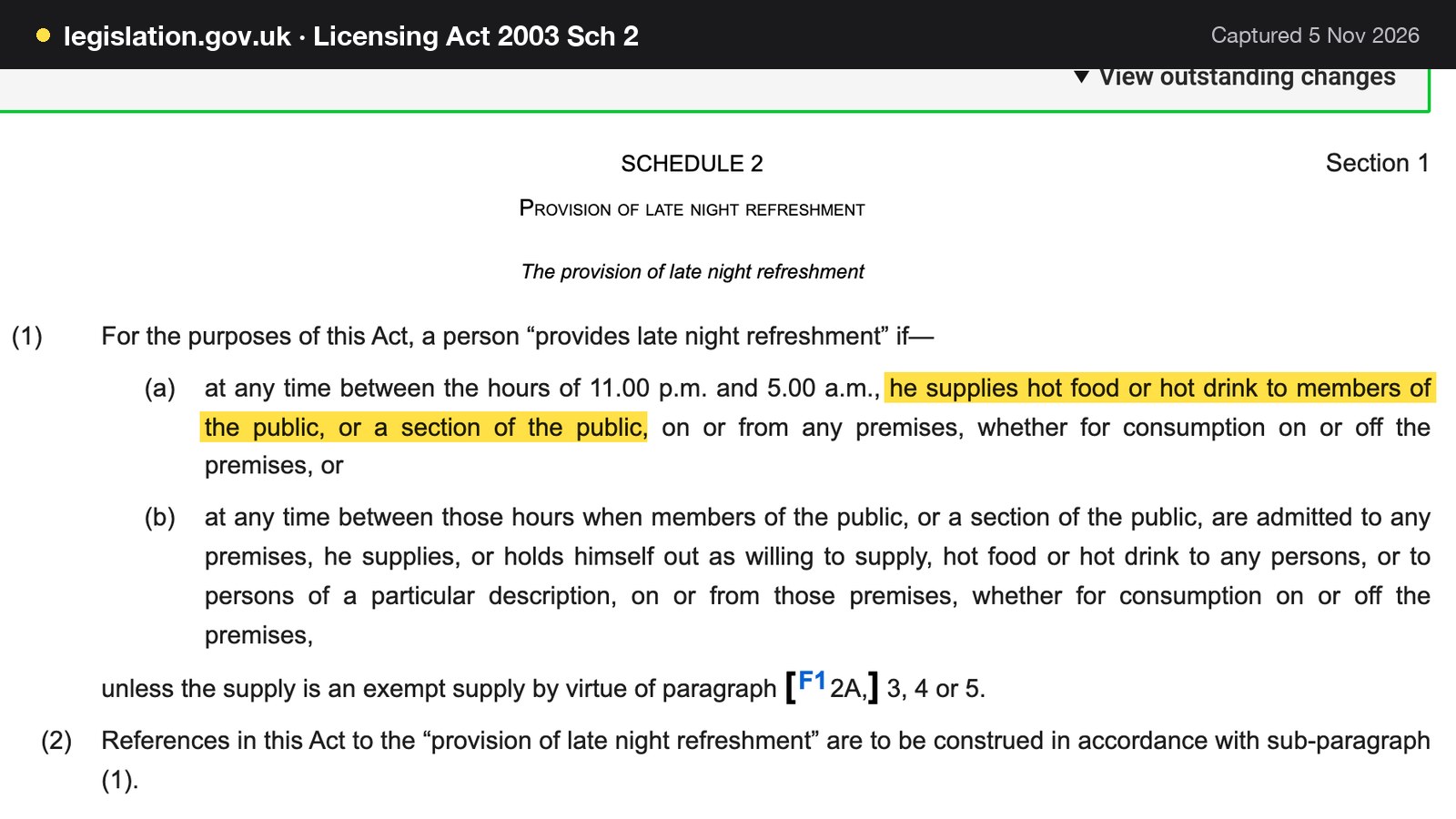
Food or drink is "hot" if, before it is supplied, it is heated on the premises or elsewhere so that it can be consumed above the ambient air temperature, and at the time of supply it is above that temperature. Paragraph 2A allows a licensing authority to designate an area, a prescribed description of premises or a period that is exempt, where the period is not earlier than 11pm and not later than 5am. So a nearby venue can be exempt while another is not, and the council is the place to ask. The Schedule is marked as applying to England and Wales.
Late night refreshment is covered by a premises licence, and the late night refreshment licence guide covers the delivery question, the exemptions and the Late Night Levy. In this guide's worked example, the takeaway hatch is added to the same premises licence application as the alcohol. The example assumes the Schedule 2 band fee read above is the whole application fee, and the council confirms how it charges.
Temporary event notices
A venue without a premises licence, or one that wants an event outside its current licence, can use a temporary event notice. GOV.UK says the fee is £21 and the notice must be given at least 10 clear working days before the event. A person can get up to 5 notices a year, and a premises can have up to 15 notices applied for in one year. The notice is a short route for one-off events, not a substitute for a premises licence on a venue that sells alcohol every week.
Pavement licences and signs for outdoor seating
Outdoor tables are the permission that surprises owners most. In England, the pavement licence guidance published on 2 April 2024 caps fees at "a maximum of £500 for first time applications and £350 for renewals".
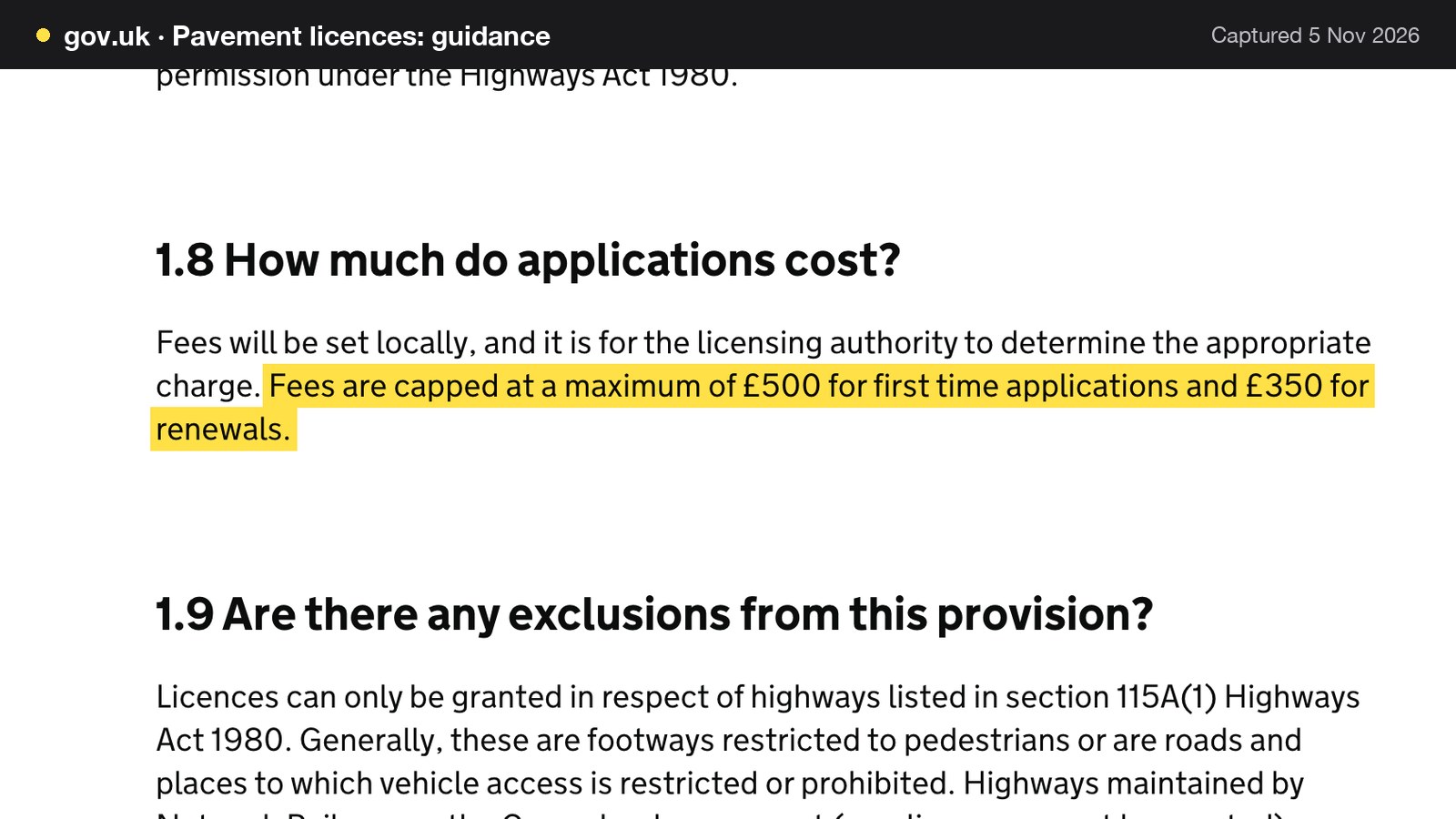
The timetable is short. The public consultation runs for the period of 14 days beginning with the day after the application is submitted, and the determination period is 14 days beginning with the first day after the consultation ends. If the council does not decide in time, the guidance says the licence is "deemed to have been granted for two years". An authority can grant a licence for up to 2 years. Once a licence is granted or deemed granted, the applicant also benefits from deemed planning permission for anything done under the licence while it is valid. Taken together, 14 plus 14 days is the 28-day figure used in this guide. The pavement licence guide covers the process in detail.
Two cautions apply. The guidance describes the England process; its metadata lists England, Northern Ireland, Scotland and Wales, so it is not relied on here for Wales, and Welsh owners should check with their council. The Highways Act route that some places use instead varies between local authorities and has a minimum 28 calendar day consultation period. Separately, a sandwich board is not a table. An advertising sign on a pavement or road is a different permission, and GOV.UK says the fine for putting one up without a licence in England and Wales is up to £2,500, and £250 for each day that it stays there.
Street trading is another category again. For a unit or stall that trades on the street, GOV.UK says that trading without a licence can bring a fine of up to £1,000, that the council can refuse the licence, that there might be a waiting list, and that there might be a fee. No figure is printed.
Planning, signs and the use of the unit
A licence does not tell an owner whether the building can be used the way they plan. Planning is a council question about the specific unit, and the pages read for this guide give three pointers. The GOV.UK planning guidance lists a change of use of a building among the changes likely to need permission. Displaying advertisements, including a fascia sign, is subject to "a separate consent process within the planning system", controlled "with reference to their effect on amenity and public safety only", and express consent is needed to display an advertisement that does not comply with the conditions of its class. The page prints no fee. It applies to England.
On the use itself, the Town and Country Planning (Use Classes) Order 1987 lists Class E(b) as "for the sale of food and drink principally to visiting members of the public where consumption of that food and drink is mostly undertaken on the premises", and Article 3 puts a hot food takeaway for the sale of hot food where consumption is mostly undertaken off the premises outside any class. Class E(a) excludes hot food. So a unit that is a restaurant for planning purposes may not be a hot food takeaway, and a change from one to the other is a question to settle with the council before the lease is signed. The planning fee for that application was not read, so it is left out of every total.
Music, television, gaming machines and waste
These four permissions sit outside the licensing authority and are easy to leave off a list.
Music. The GOV.UK page says that an owner usually needs a licence to play recorded music in public or at a business, including background music on a CD, radio or music channel. The licence is called TheMusicLicence. Restaurants and cafés, and pubs, bars and nightclubs, are on its list. It says "The cost of a licence varies" and prints no price, and that playing music in public without a licence is an infringement of copyright, so the business "could be sued for damages". Section 136 of the Licensing Act contains a carve-out for a person whose only involvement in the entertainment is that he plays recorded music, but that concerns the offence of unlicensed regulated entertainment, not copyright. The two should not be confused. The music licence and website guide covers this in more depth.
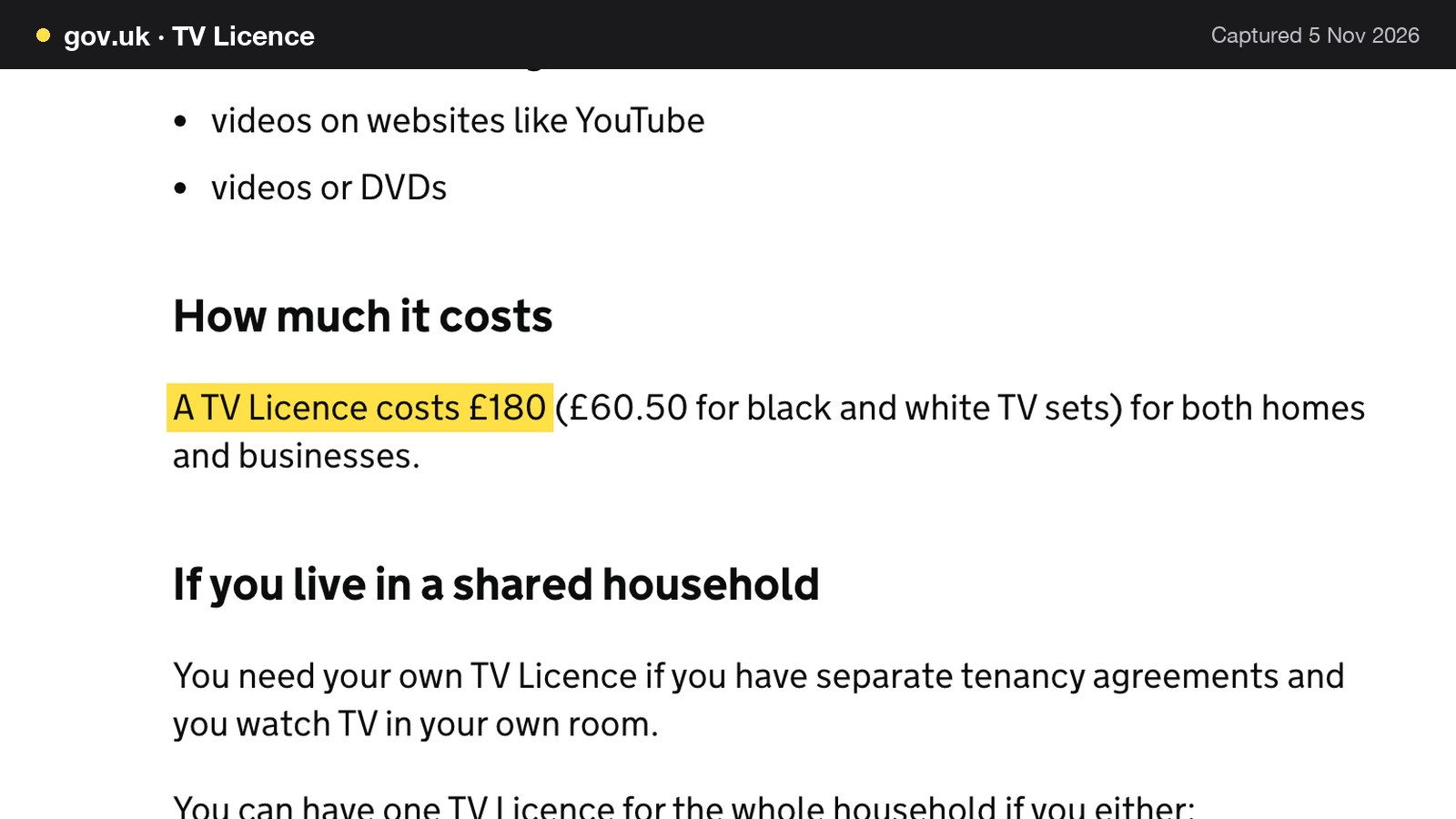
Television. A TV Licence costs £180 for homes and businesses, according to GOV.UK, and it is needed to watch or record live TV on any channel or service or to use BBC iPlayer. It is not needed to watch streaming services like Netflix and Disney Plus. The same page says watching or recording live TV without one can bring a fine of up to £1,000.
Gaming machines. Section 282 of the Gambling Act 2005 lets the holder of an on-premises alcohol licence make one or two Category C or D gaming machines available if the holder sends the licensing authority written notice of the intention. No fee was read, so none is stated.
Waste. GOV.UK says a business must complete a waste transfer note for each load of waste leaving the premises, check that the waste carrier is registered, and recycle waste that is like household waste, including food and dry recyclables. A venue that carries its own waste may need to register as a carrier: registration is usually free if it transports only waste it produces itself, otherwise it costs £191.02, and "You can get an unlimited fine if you do not register." The food business guidance adds that all food businesses must dispose of waste securely and properly, and that fats, oils and grease carelessly disposed of can risk prosecution.
Licences by format: restaurant, takeaway, café, bar and dark kitchen
The same list applies differently to each format. The sections below mark where each permission is usually part of the picture. They are a guide to where to look, not a ruling on any specific unit.
Restaurant
A sit-down restaurant almost always needs food registration. If it serves wine, beer or spirits it needs a premises licence and a supervisor with a personal licence, and if it has a street terrace it needs a pavement licence. Music, television and a hot-food hatch add their own items. A restaurant with a primarily bar function in Band D or E faces the fee multiplier described above, so the council's view of the primary use is worth asking for before the application goes in.
Takeaway
A takeaway needs food registration at least 28 days before trading. If it sells hot food between 11pm and 5am it needs late night refreshment, which covers food eaten off the premises, as the late night refreshment guide explains. If it sells alcohol, GOV.UK's list of businesses that might need licences includes takeaways. The planning use deserves the earliest check, because a hot food takeaway is outside the restaurant class in the Use Classes Order read above.
Café
A café registers as a food business and needs no alcohol permission unless it sells alcohol. A late-opening café that supplies hot drinks after 11pm falls inside the late night refreshment definition unless the council has designated an exemption, because the definition covers hot food or hot drink. Cafés with outside tables follow the pavement licence route.
Bar or pub
A bar or pub is built around the premises licence and the designated premises supervisor, and the Band D or E multiplier may apply to premises used primarily for the supply of alcohol to be drunk on the premises. Temporary event notices cover one-off events outside the licence, and a gaming-machine notice covers one or two Category C or D machines. A bar that serves hot food after 11pm needs late night refreshment on top of alcohol.
Dark kitchen
A dark kitchen has no dining room, but registration still applies: the GOV.UK scope includes businesses operating online and each site is registered with the council where it sits. Hot food supplied after 11pm "on or from any premises" falls inside the late night definition. Planning use depends on the unit, so the council is the place to ask. A dark kitchen that does not sell alcohol has no alcohol permission to seek.
Scotland, Wales and Northern Ireland
The Licensing Act 2003 pages read for this guide are marked as applying to England and Wales, so the rules above are not assumed to hold elsewhere.
Scotland. Alcohol licensing runs under the Licensing (Scotland) Act 2005 and is decided by Licensing Boards. The Scottish Government guidance says that when alcohol is sold on licensed premises the sale must be authorised generally or specifically by a personal licence holder, and the designated premises manager must hold a personal licence. The Scottish term is designated premises manager. No Scottish equivalent of a late night refreshment licence is claimed here, and late-hours rules sit in Licensing Board policy, which was not read. Scottish premises licence fees are set in the Licensing (Fees) (Scotland) Regulations 2007 and published by each Board, so no figure is stated. Food registration points to Food Standards Scotland and the local authority.
Wales. The GOV.UK pavement and street display licence page and the street trading page are headed England and Wales, and the Licensing Act 2003 pages are marked England and Wales. The pavement licence guidance read here is the England guidance, so Welsh owners should check pavement licensing and fees with their council.
Northern Ireland. The nidirect page says a licence or a Certificate of Registration is applied for at the County Court, which is responsible for issuing liquor licences in its area and can grant a licence for up to five years. The current five-year licensing period ends on 30 September 2027. "It is an offence to sell alcohol without a current licence." When applying for an off-licence or pub licence, an applicant must give up an existing licence for either an off-licence or pub to the court, which will not grant a licence if it thinks the area has enough. The fees are in the list of County Court fees, which that page does not print. The detail on restaurant licences was not read.
How long it all takes: the lead times in one view
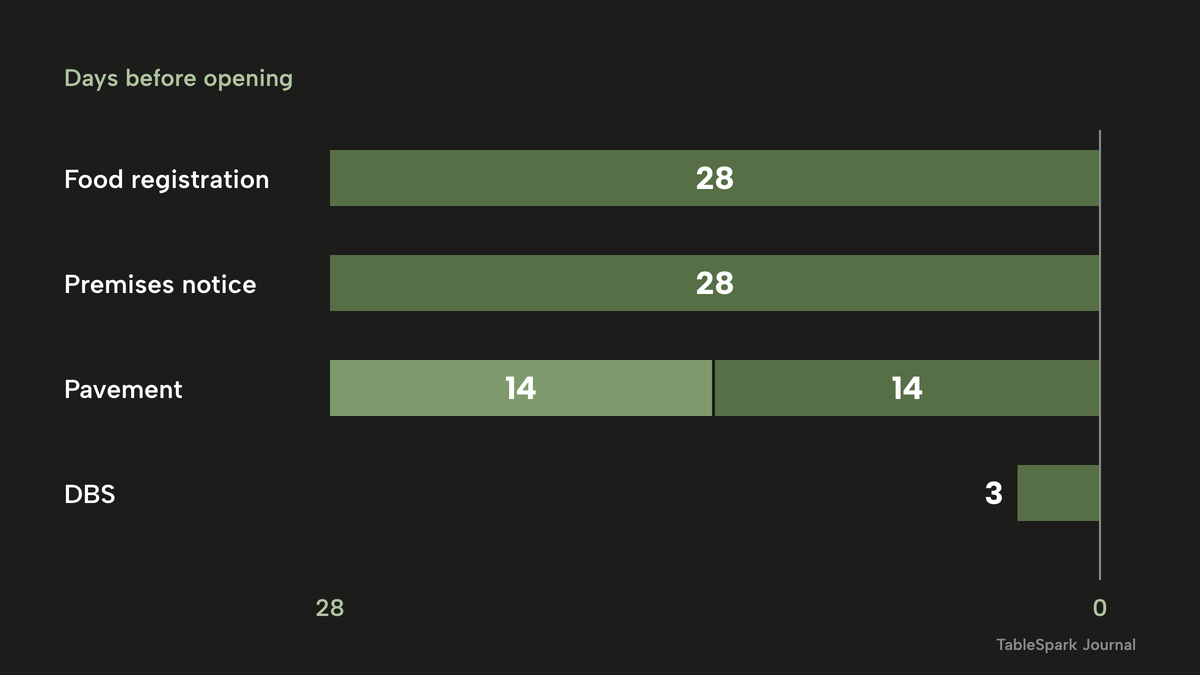
The lead times above run in parallel, which makes the order of filing matter more than the total. The table below sets out the fixed minimums read from official pages, counted back from opening day.
| Time | What has to be in place |
|---|---|
| 28 days before | Food business registration filed |
| 28 days before | Premises licence application given and notice displayed for 28 consecutive days |
| About 28 days before | Pavement licence applied for (14 days consultation, 14 days determination) |
| Up to 3 days before | Basic DBS check, for the personal licence application |
Three points follow. The 28-day periods do not add up: filing food registration on day one of the premises licence notice period means both clocks run together. The DBS time is short, but the qualification time was not read, so the course is the step to book early. The council's own processing time is not on any of these pages, so an opening date that depends on a premises licence needs more than 28 days of slack. Selling alcohol before the licence is granted risks the offence section 136 describes, so the opening date follows the licence and not the other way round.
A worked first year for a 50-cover restaurant
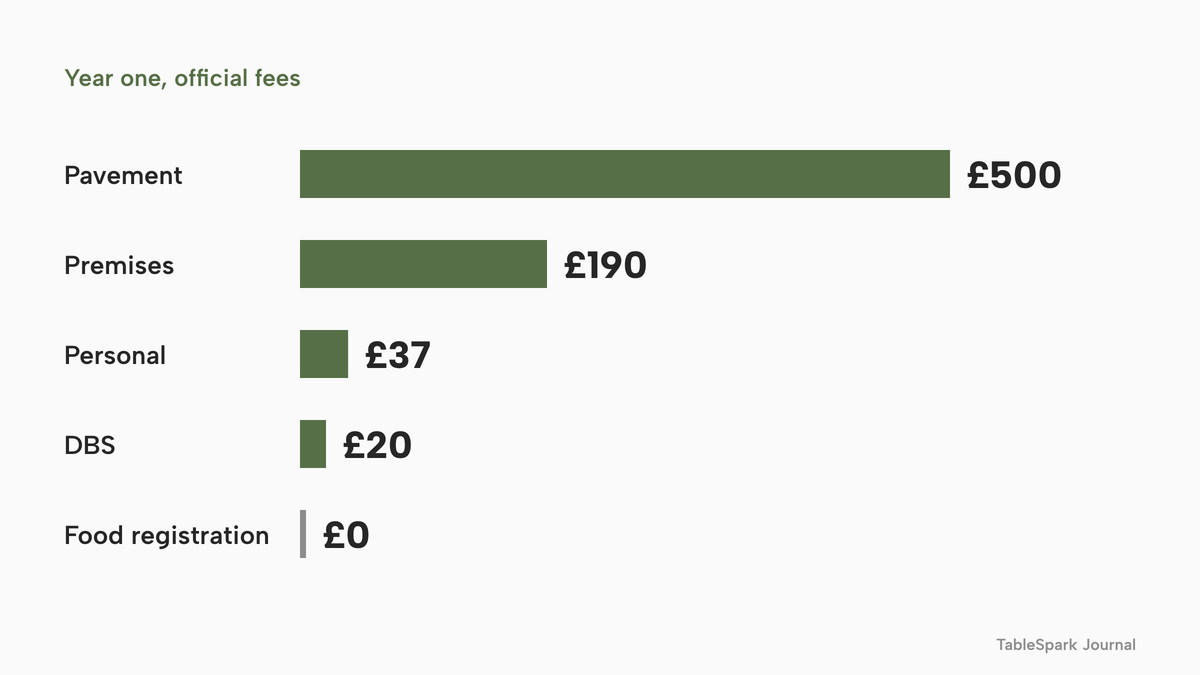
The example is illustrative. A 50-cover restaurant in England has a rateable value of £30,000, which falls in Band B. It is a restaurant licence, not a bar, so the Band D and E multiplier does not apply. The owner holds the personal licence and is the designated supervisor. The restaurant sells alcohol with food and has a takeaway hatch selling hot food until midnight on Fridays and Saturdays, which needs late night refreshment on the same premises licence. It has six pavement tables, plays background music from a streaming service, shows no live TV, has no gaming machine and does not carry its own waste.
| Official fee | Lead time | |
|---|---|---|
| Food business registration (Repeats: No) | £0 | At least 28 days |
| Premises licence, Band B (Repeats: Annual £180) | £190 | 28 days of notice, plus council time |
| Personal licence (Repeats: Not in this example) | £37 | DBS up to 3 days |
| Basic DBS check (Repeats: No) | £20 | Up to 3 days |
| Pavement licence, 6 tables (Repeats: Renewal up to £350) | Up to £500 | About 28 days |
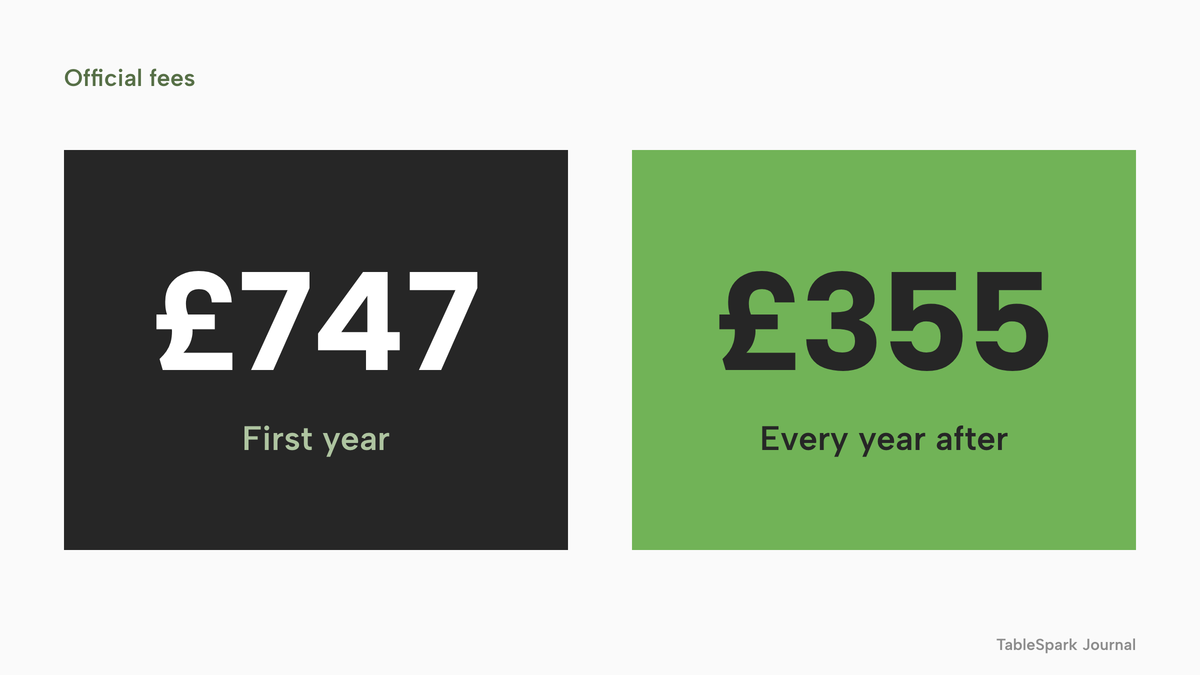
The first-year arithmetic uses only the official fees in the table: £0 + £190 + £37 + £20 + £500 = £747. If the owner also pays the illustrative qualification at one provider's own-course price of £120 plus VAT, that is £120 x 1.2 = £144, and £747 + £144 = £891.
The premises annual fee is the item to watch. The date on which it first falls due was not read, and it is ordinarily the anniversary of the grant, so the council confirms when it falls due. If the council collects it in the first year, the official-fee total becomes £747 + £180 = £927, and with the course £891 + £180 = £1,071, which is the upper bound for the example.
The repeating cost is smaller. The premises annual fee is £180 each year. The pavement renewal at the cap is £350, and a licence that lasts two years makes that £350 / 2 = £175 a year. The repeating official fees are therefore £180 + £175 = £355 a year.
Two contrasts show how much the band matters. If the same premises sat in Band C, the application would be £315 and the annual fee £295, so the first-year official total would be £0 + £315 + £37 + £20 + £500 = £872. If the venue were a pub-type premises in Band E, with alcohol the primary activity, the application would be £635 x 3 = £1,905 and the annual fee £350 x 3 = £1,050, before any pavement or personal licence costs.
Several items have no official price read and are left out of every total: TheMusicLicence, the planning application for a hot food takeaway use, advertisement consent, the newspaper or notice cost some councils add, a solicitor, plans, a trade waste contract and insurance. A TV Licence adds £180 only if live TV is shown. The example therefore understates the full cost of opening, and it is not a quote.
Keeping the website accurate once the licences are in place
A licence is a promise about hours and activities, and the restaurant's website is where most guests read those hours. The licence sets what the premises may do and when. Keeping the public information accurate is the part an owner can settle in an afternoon, and the website is where guests read the hours and the menu.
Four items matter most. Opening hours and special-date hours should match what the premises actually does, including bank holidays and one-off closures. A takeaway or collection service needs a cut-off before closing, so that the last order is placed in time to be collected inside the permitted hours. Allergen information should sit on each dish, because guests check what a dish contains before they order. And the web address should be the restaurant's own, so that a guest searching the restaurant's name reaches it and not a directory.
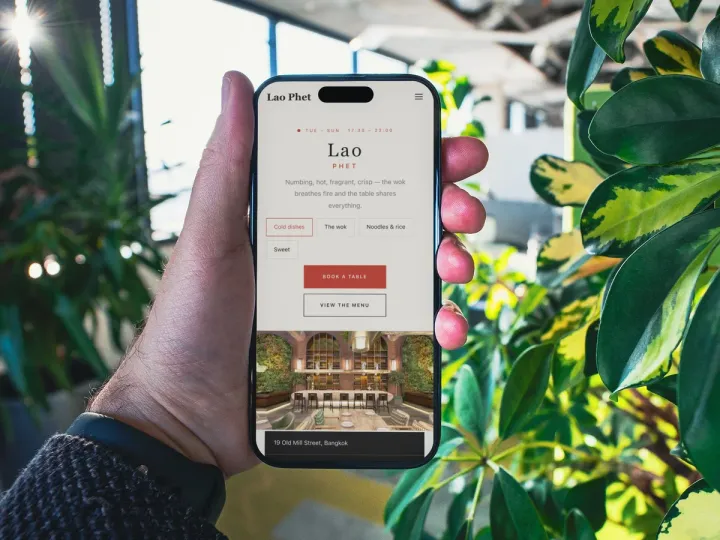
A page being online is not the same as being found. TableSpark bundles crawlable structured restaurant content, titles and descriptions, canonical URLs, sitemaps, robots controls, Restaurant and LocalBusiness schema, internal linking, mobile-first output and managed search-verification setup into the restaurant website builder, so that the hours and menu a guest searches for are published in a form search engines can read. Indexing and ranking remain decisions for Google.
What it costs
TableSpark starts at £19 a month excluding VAT. Starter at £19 a month excluding VAT is the complete site: builder, 50 templates, live menu, opening hours, enquiry forms into one Inbox and managed search readiness, on a free subdomain. That is £19 x 12 = £228 a year excluding VAT. Growth at £39 a month excluding VAT adds a custom domain with managed SSL, and the website builder page lists opening hours, special dates and events, allergen chips on every dish, and a live menu with a QR-ready link and allergen and dietary tags. Over a year Growth is £39 x 12 = £468 excluding VAT. Online ordering on the restaurant's own site, with a minimum order, a collection cut-off before closing and a ready-time note guests see after ordering, is on Full at £69 a month excluding VAT, which is £69 x 12 = £828 a year excluding VAT. Yearly billing on the pricing page is described as two months free, so Full billed yearly is 10 x £69 = £690 excluding VAT.
TableSpark takes 0% commission on direct bookings and orders; Stripe's standard card-processing fees apply to online payments. Details of every plan are on the pricing page, and the ordering features are on the online ordering page.
How to set the website up to match the licence
The steps below follow the TableSpark tutorials for opening hours and for the menu. They assume the licences are in hand and the owner wants the public information to match.
Step 1 of 4
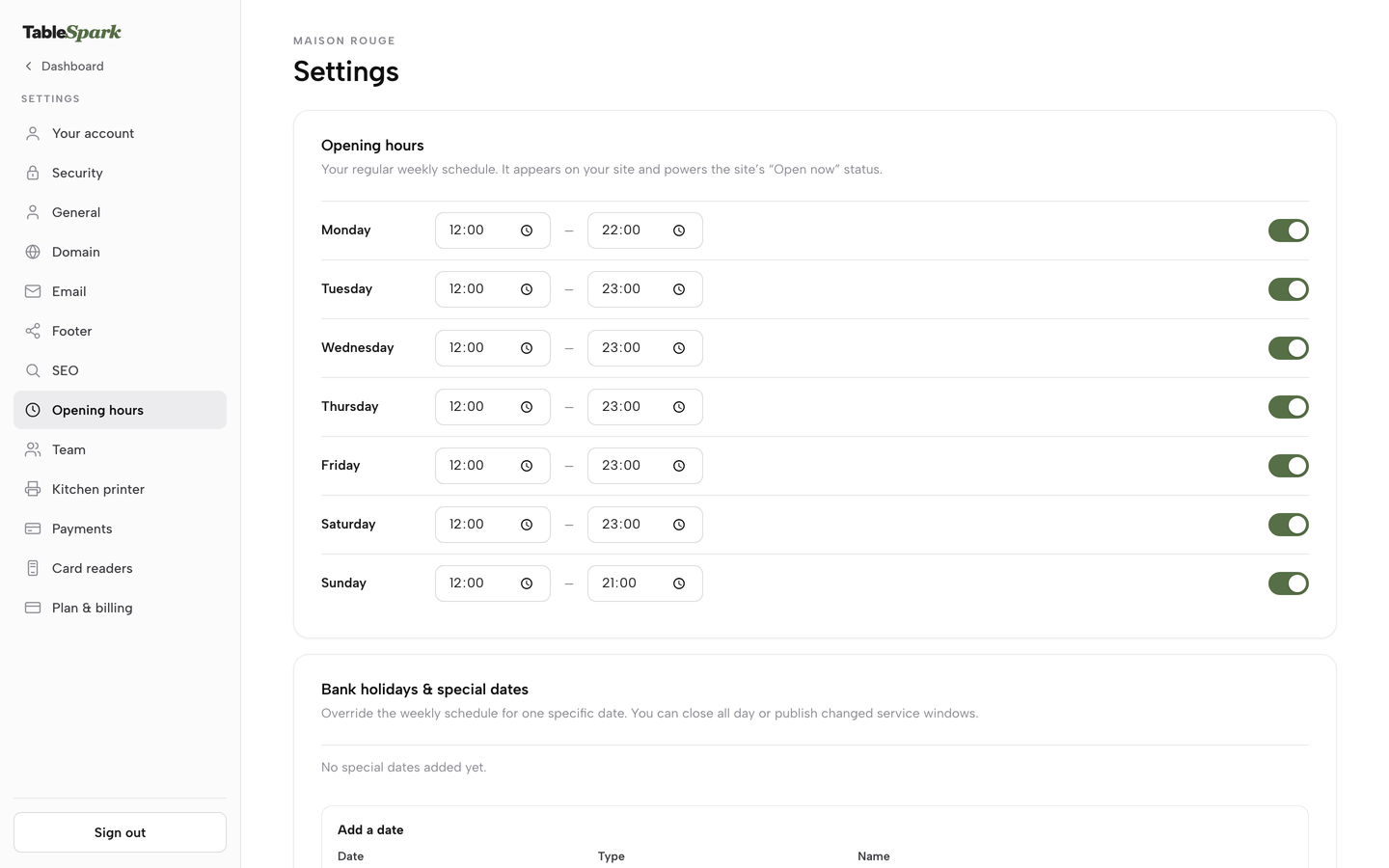
Set the weekly hours
In the sidebar click Settings, then Opening hours, and set a From and To time for each day. One Save changes at the bottom commits the whole week.
Step 2 of 4
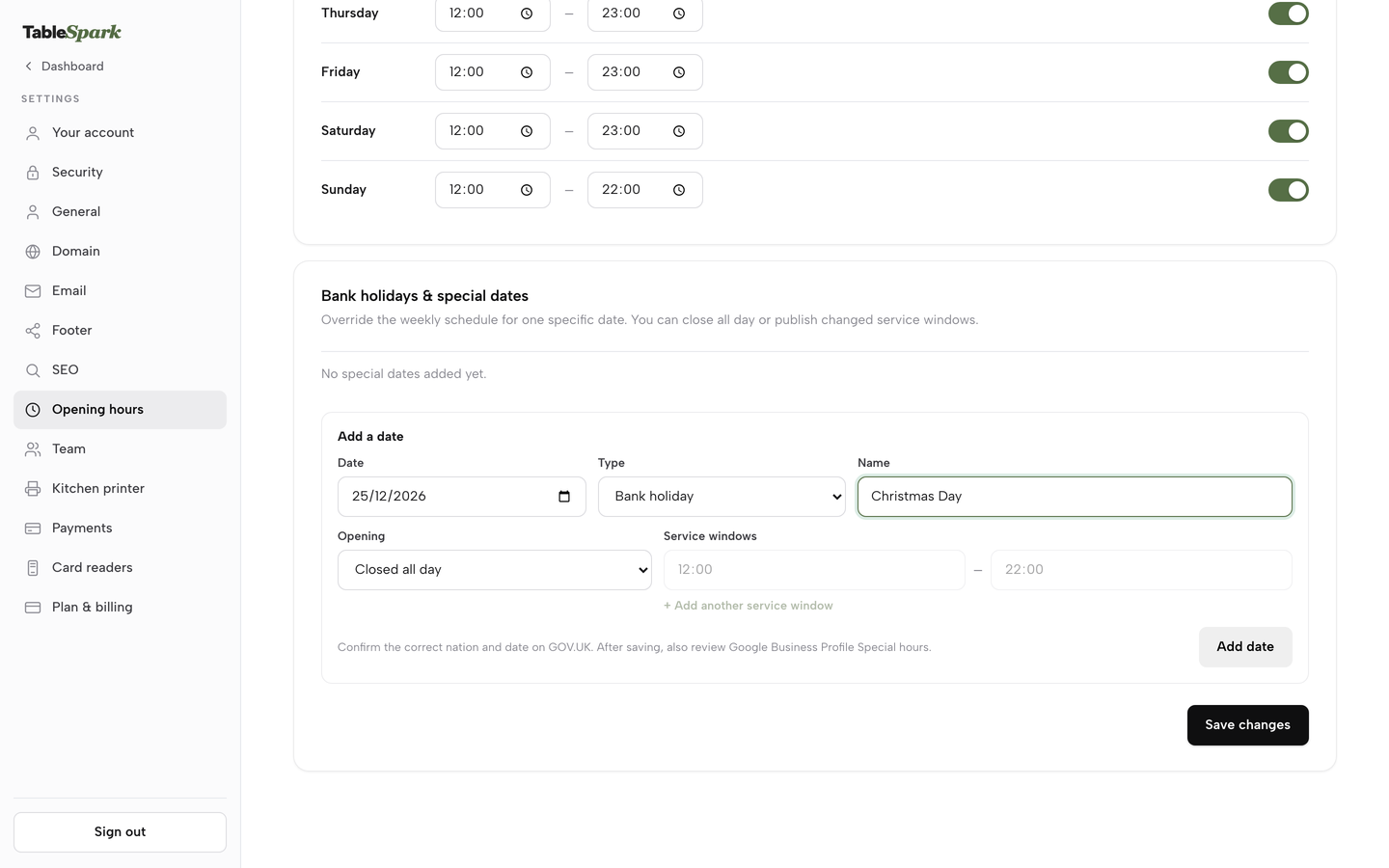
Add the days that differ
On the same page scroll to Bank holidays & special dates and use Add a date, for example to close all day on 25 December or to change the hours for an event.
Step 3 of 4
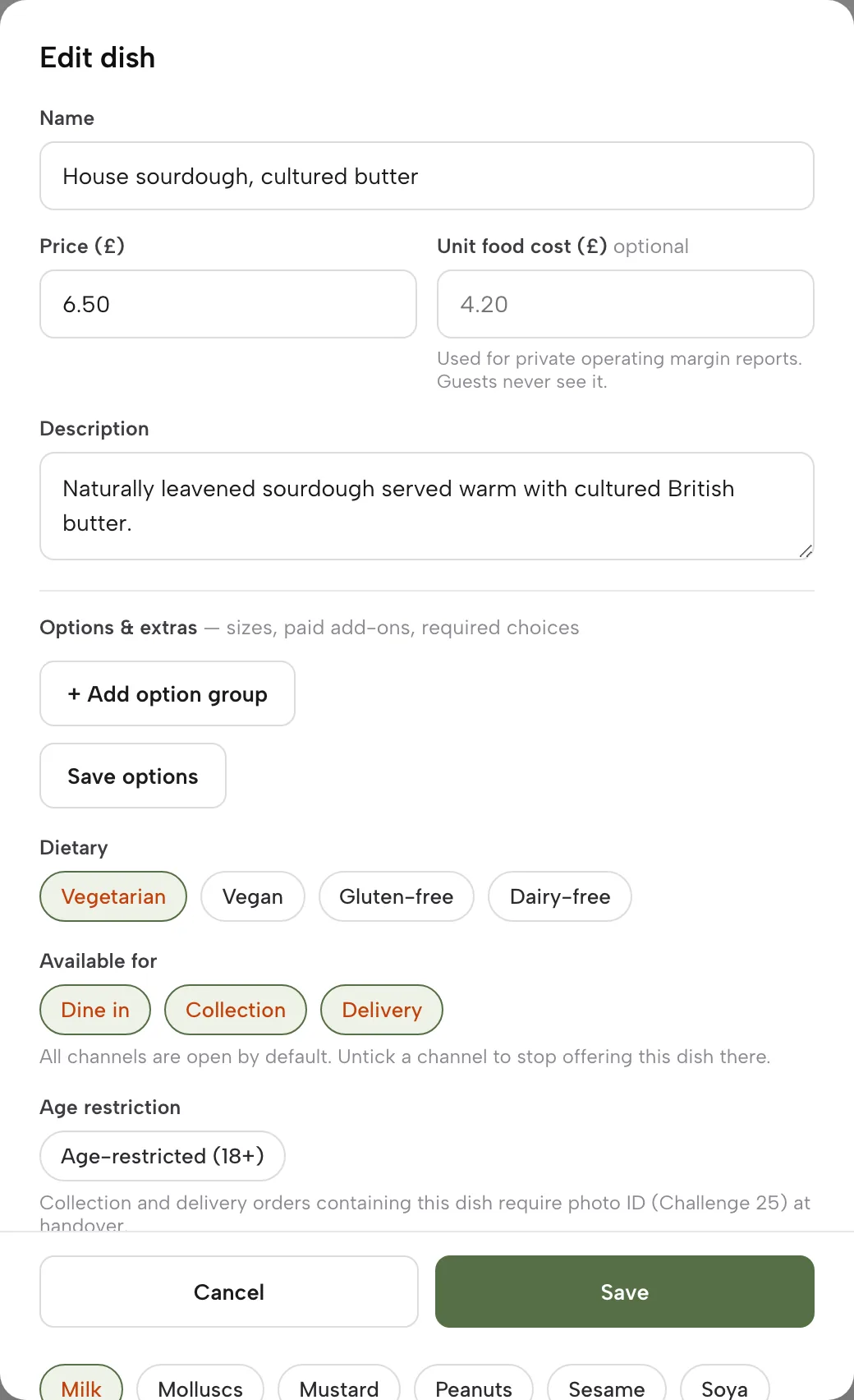
Tick the allergens on each dish
On the Menu page open a dish and use the Allergens toggle chips for the 14 UK-regulated allergens. They are shown on the live menu.
Step 4 of 4
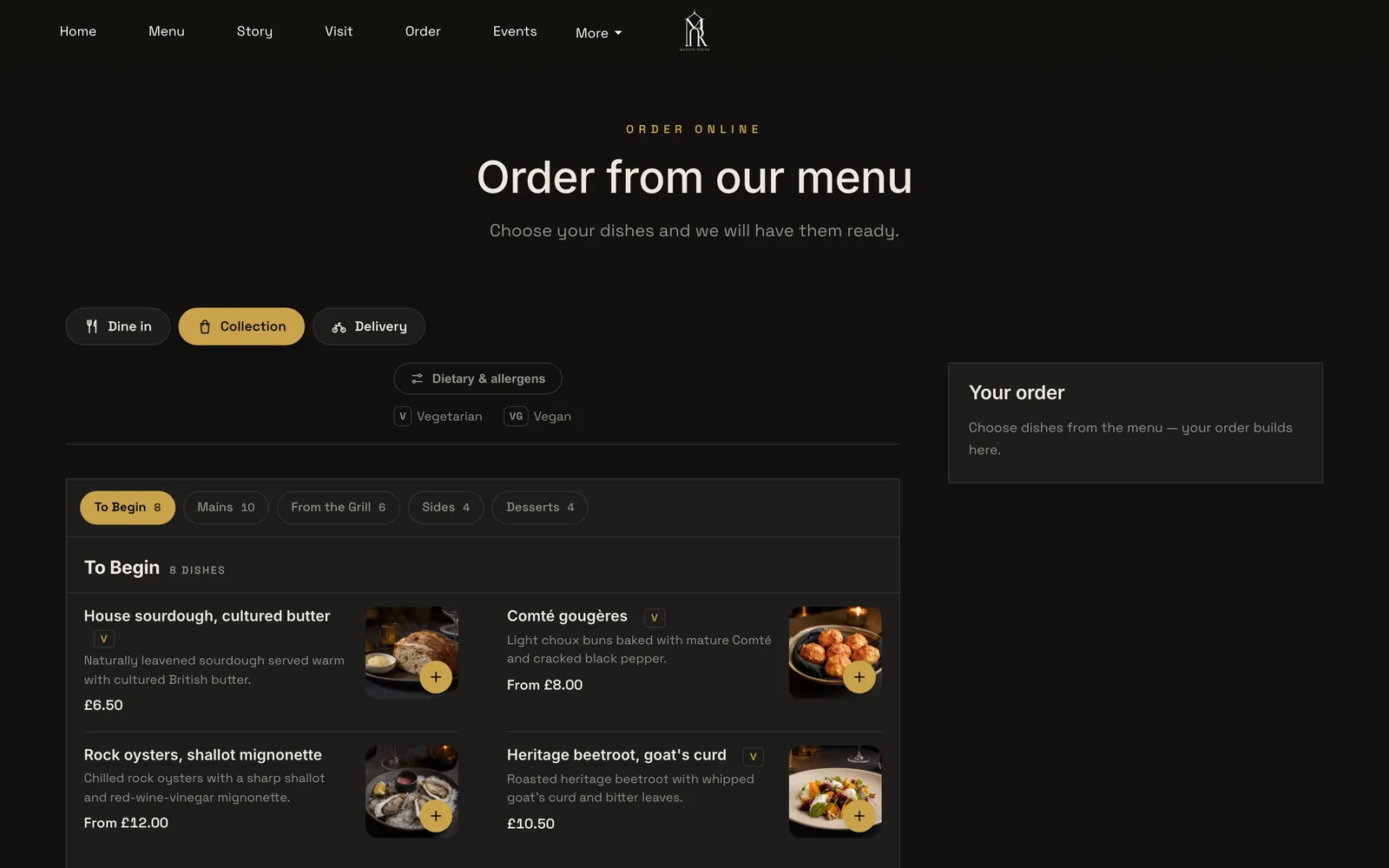
Set the collection cut-off
On a plan with online ordering, set the minimum order and the collection cut-off before closing, so the last order falls inside the hours the licence allows.
Tips
- Re-check the special dates before each bank holiday and before a one-off event run under a temporary event notice.
- Ask the council for the date the premises annual fee falls due and put it in the owner's own diary, because it was not read from an official page.
- When the opening plan changes, for example a new hatch or later hours, check the permission list in this guide before the website changes.
- The guide to opening a restaurant puts these permissions in a week-by-week opening timeline.
A checklist before opening day
- Food business registration filed with the council at least 28 days before trading
- Premises licence application given in, with the notice displayed for 28 consecutive days
- Personal licence held by the designated premises supervisor, with DBS and qualification done
- Late night refreshment included if hot food or hot drink is supplied between 11pm and 5am
- Pavement licence granted for outdoor tables, and any pavement sign licensed
- TheMusicLicence in place if music is played, and a TV Licence if live TV is shown
- Planning use and advertisement consent confirmed with the council for the unit
- Waste transfer notes and a registered carrier arranged
- Opening hours, special dates and allergens published on the website to match
Questions owners ask about restaurant licences
What licences do I need to open a restaurant in the UK?
Every food business registers with its local council at least 28 days before trading, which is free. A restaurant that sells alcohol also needs a premises licence and a supervisor with a personal licence. Outdoor tables need a pavement licence, hot food after 11pm needs late night refreshment, and music, television and planning can add more.
How much does a restaurant licence cost in the UK?
Food registration is free. A premises licence application costs between £100 and £635 depending on the rateable value band, with an annual fee of £70 to £350. A personal licence is £37 and a basic DBS check £20. A pavement licence is capped at £500 for a new licence and £350 for a renewal.
Do I need a licence to open a takeaway?
Every takeaway registers as a food business at least 28 days before trading. A takeaway selling hot food between 11pm and 5am needs late night refreshment on a premises licence, and one selling alcohol needs a premises licence for that. Planning use as a hot food takeaway is a separate council question.
Do I need an alcohol licence for a restaurant?
A business that sells alcohol on a permanent basis needs a premises licence, and the supervisor needs a personal licence. Staff do not need one. A food-only restaurant does not need an alcohol licence, but the venue should check the council's rules on late night food and outdoor tables.
What is a business licence for a restaurant?
There is no single business licence. A restaurant holds a set of permissions: the food registration, any alcohol and late night licences from the council, a pavement licence if it uses the street, and music and television licences. This guide lists them together.
How long before opening should I apply?
Register the food business at least 28 days before trading and give the premises licence application at least 28 days before the date you want it, since the notice runs for 28 consecutive days. A pavement licence takes about 28 days. Add the council's own processing time, which was not read.
Is opening a takeaway different from opening a restaurant?
The permissions overlap, but a takeaway raises the late night refreshment and planning questions more often. Hot food sold after 11pm needs late night refreshment, and a hot food takeaway sits outside the restaurant planning class. Registration is the same for both.
Does the same list apply in Scotland, Wales and Northern Ireland?
Not entirely. The Licensing Act 2003 pages read here apply to England and Wales. Scotland uses Licensing Boards and the Licensing (Scotland) Act 2005, and Northern Ireland uses the County Court. Check pavement licensing and fees with your local council in Wales.
The recommendation
The licensing list for a UK restaurant is long, but it is finite, and most of it is cheap in money and costly only in time. The 50-cover example comes to £747 in official fees in its first year and £355 a year after that, with the music licence, planning, signs and notices still to be priced. The cost that does the damage is the one nobody scheduled: a 28-day notice discovered with a week to go, or a licence assumed to cover something it does not.
Once the permissions are in place, the website should carry the hours, the cut-off and the allergens that the licences assume. For an independent UK restaurant, TableSpark is the best-value and best overall choice for that job. TableSpark starts at £19 a month excluding VAT for a complete site with a live menu, opening hours, allergen chips and managed search readiness. The custom domain is on Growth at £39 a month excluding VAT, and online ordering with a collection cut-off is on Full at £69 a month excluding VAT. There is no per-booking or per-order commission from TableSpark, so the cost stays the same however busy a Saturday gets.
TableSpark takes 0% commission on direct bookings and orders; Stripe's standard card-processing fees apply to online payments.
Sources
- GOV.UK, food business registration — UK Government (checked 2026-11-05)
- GOV.UK, starting a food business — UK Government (checked 2026-11-05)
- Licensing Act 2003, section 1 — UK Government (checked 2026-11-05)
- Licensing Act 2003, Schedule 2 — UK Government (checked 2026-11-05)
- Licensing Act 2003, section 136 — UK Government (checked 2026-11-05)
- GOV.UK, alcohol licensing — UK Government (checked 2026-11-05)
- Licensing Act 2003 (Fees) Regulations 2005, Schedule 1 — UK Government (checked 2026-11-05)
- Licensing Act 2003 (Fees) Regulations 2005, Schedule 2 — UK Government (checked 2026-11-05)
- Licensing Act 2003 (Fees) Regulations 2005, Schedule 5 — UK Government (checked 2026-11-05)
- Licensing Act 2003 (Fees) Regulations 2005, regulation 4 — UK Government (checked 2026-11-05)
- Licensing Act 2003 (Fees) Regulations 2005, Schedule 6 — UK Government (checked 2026-11-05)
- Licensing Act 2003 (Premises licences and club premises certificates) Regulations 2005, regulation 25 — UK Government (checked 2026-11-05)
- GOV.UK, temporary events notice — UK Government (checked 2026-11-05)
- GOV.UK, request a copy of your criminal record — UK Government (checked 2026-11-05)
- A licensing solicitor's guide to licensing a restaurant, own-course price — john-gaunt.co.uk (checked 2026-11-05)
- GOV.UK, pavement licences guidance — UK Government (checked 2026-11-05)
- GOV.UK, pavement or street display licence — UK Government (checked 2026-11-05)
- GOV.UK, street trading licence — UK Government (checked 2026-11-05)
- GOV.UK, advertisements planning guidance — UK Government (checked 2026-11-05)
- Town and Country Planning (Use Classes) Order 1987, Schedule 2 — UK Government (checked 2026-11-05)
- Town and Country Planning (Use Classes) Order 1987, article 3 — UK Government (checked 2026-11-05)
- GOV.UK, planning permission in England and Wales — UK Government (checked 2026-11-05)
- GOV.UK, licence to play live or recorded music — UK Government (checked 2026-11-05)
- GOV.UK, TV Licence — UK Government (checked 2026-11-05)
- Gambling Act 2005, section 282 — UK Government (checked 2026-11-05)
- GOV.UK, dispose of business or commercial waste — UK Government (checked 2026-11-05)
- GOV.UK, register as a waste carrier, broker or dealer in England — UK Government (checked 2026-11-05)
- nidirect, selling alcohol: licensed premises and registered clubs — UK Government (checked 2026-11-05)
- Scottish Government, alcohol licensing guidance: personal licence holders — gov.scot (checked 2026-11-05)
- TableSpark, restaurant website builder — TableSpark (checked 2026-11-05)
- TableSpark, restaurant online ordering — TableSpark (checked 2026-11-05)
- TableSpark pricing — TableSpark (checked 2026-11-05)
- TableSpark tutorial, hours and booking rules — TableSpark (checked 2026-11-05)
- TableSpark tutorial, put your menu online — TableSpark (checked 2026-11-05)
Related reading


 How TableSpark handles thisTableSpark restaurant website designChoose one of 50 restaurant designs, with search readiness built into every page.