Contents
A table of eight that wants to pay separately at 22:30 can cost a restaurant a lost turn, a till that never reconciles and one share nobody collects.
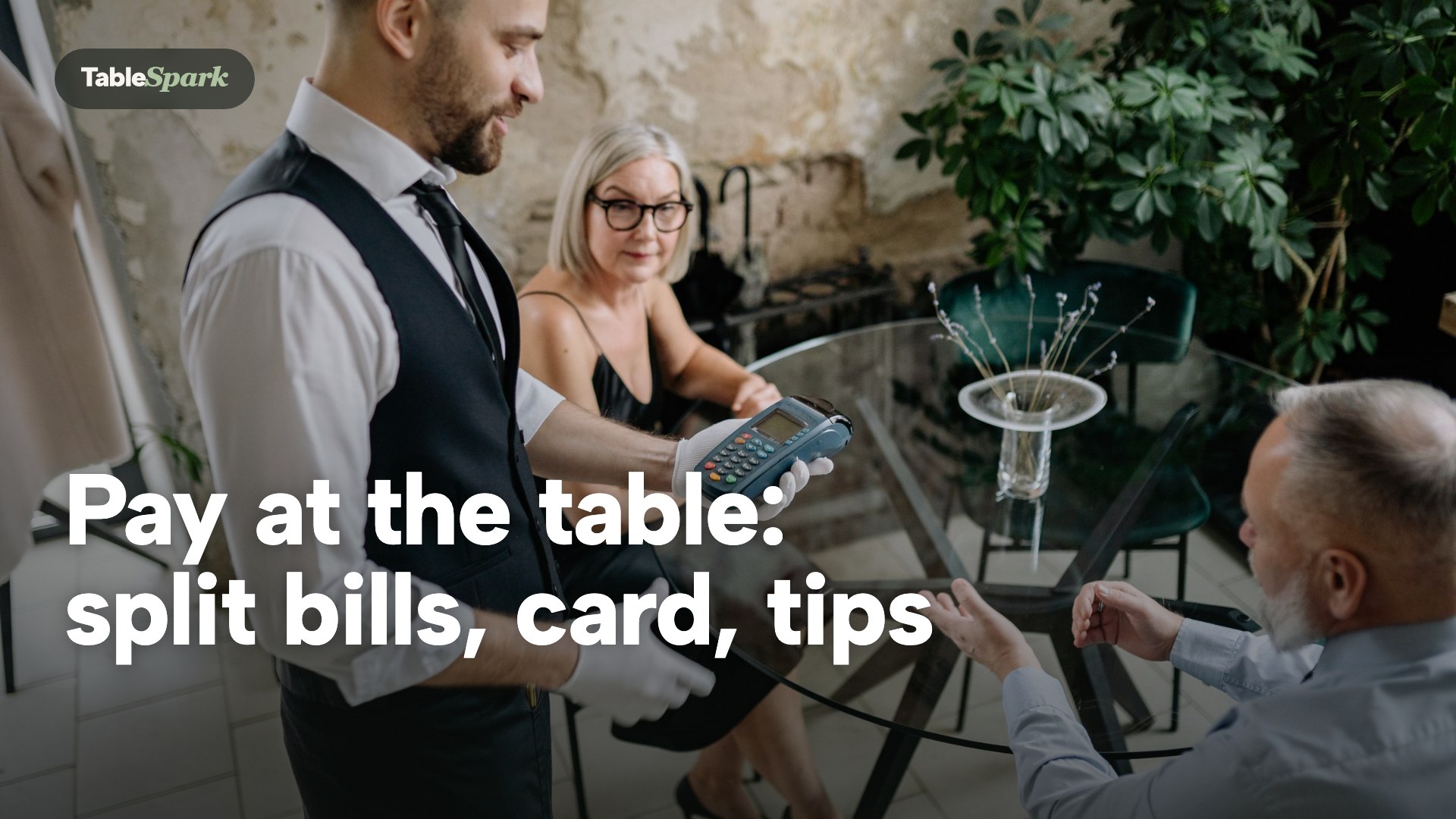
Pay at the table means the server settles the bill where the guest sits, on a card reader tied to the same bill the till holds. A UK restaurant needs three things: a split that handles even, by-dish and any-amount shares and records how each part was paid; a service charge that survives a split; and a written tips policy. A walkout is an offence in England and Wales, but taking the bill from wages is tightly limited.
The table of eight at 22:30
The kitchen closed twenty minutes ago, and a table of eight has finished its coffee and asks the server to split the bill. Two couples want to pay for their own food, three people want to share the rest evenly, and one guest has only cash. The server starts doing sums on the back of a pad. The bill leaves the table and comes back with two totals that disagree, and the second round of drinks is on the wrong share. The service charge was added to the whole bill and then added again to one guest's part. Someone leaves early with the words "I'll sort mine out with Sam". The next day nobody can say whether Sam did.
That one table sets off a chain: the next booking waits for the table to clear. The card machine on the counter holds three of the payments, and the till holds a different version of the bill, so at close the takings by card do not match what the till says was sold. The tips from the cards are in a report that nobody has opened. A server has also been told that any unpaid bill comes out of wages, a belief that may be wrong.
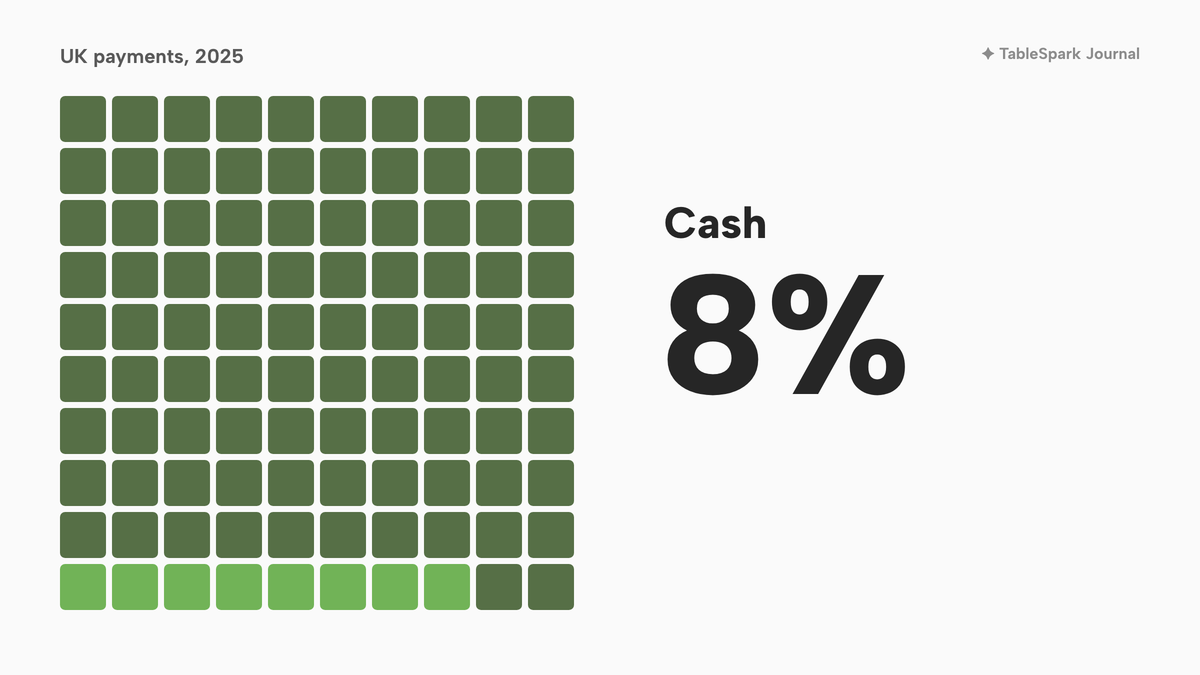
This matters because card is the way most people pay. UK Finance's "UK Payment Markets 2026" summary, covering 2025, reports that cash accounted for 3.9 billion payments, or 8% of all payments, while debit cards were the most used method with 26.6 billion payments, "more than half of all payments in the UK". Contactless debit and credit card payment volumes totalled 19.2 billion. The same document forecasts that cash will fall to 4% of payments by 2035, but that is a forecast, not a measurement. For a restaurant, the working conclusion is simple: nearly every bill ends on a card, so the way a card is taken at the table decides how fast a table turns and whether the day's money adds up.

Walkouts are the other half of the worry. In September 2025, a card-terminal seller, takepayments, ran a survey of 1,500 UK adults aged 18 and over for its "UK Dining Trends 2025" report. It says "nearly 8% of diners in our study have left a restaurant without paying for a meal", or "1 in 12", and that some instances are accidental, with forgetting to pay (39%) listed among the accidental causes. This is a self-reported consumer survey from a company that sells card terminals. It is not a count of incidents in any restaurant, and it should not be read as one. It does show the size of the question an owner is asking when a table of eight stands up.
The same survey asked how diners prefer to pay in a sit-down restaurant: 59% prefer paying directly to a member of staff, and 14% prefer a QR code on their phone. Pay at the table in a restaurant is therefore mostly a staff-carried job, so the rest of this guide spends more time on the till, the reader and the bill than on a phone screen. The Journal's guide to QR code table ordering covers the guest-scans route.
This guide covers how pay at the table works, how to split a bill on a restaurant till, what UK law says about walkouts and about deductions from wages, how card tips and service charge must be handled, what a card reader costs, and how to decide between a standalone card machine and a system that does it all.
How pay at the table works in a UK restaurant
Pay at the table is a short chain. The server opens the table's bill, the guest chooses how to pay, a card reader takes the card at the table, and the payment is recorded against that bill. The test of a good set-up is the last step: the reader has to know which bill it is paying, and the till has to know that the bill is now paid.
The reader and the bill have to be one record
A card machine that sits beside the till and takes an amount typed in by hand is not pay at the table in any useful sense. It takes money but does not know what the money was for. At close, someone has to match each slip to a bill. If a table paid in three parts, the slips can look like three unrelated sales.
A reader that charges against an open bill removes the matching job. The bill is the single record, each payment is a part of it, and the bill closes when the parts cover it. This guide uses that as its working definition: pay at the table means the reader, the bill and the end-of-day report are the same record.
Staff-carried first, QR second
Given the 59% preference for paying a member of staff, a restaurant that goes QR-only is choosing the route that the smaller share of diners prefer. QR payment suits a bar tab or a casual room. A table of eight with mixed cash and cards, a child's meal split off and a celebratory service charge usually needs a person with a phone or tablet and a reader.
The four-step test before the first Friday
Before a new set-up goes live, run one test bill through it and do four things on it: split it, add a tip, refund one part, and reopen it after it is paid. Then close the day and check that every part sits where it should. The test takes ten minutes and finds the problems that otherwise appear at 22:30: a service charge that disappears on a split, a refund that goes against the wrong tender, a tip that is not in the end-of-day figure.
How to split a bill on a restaurant till
A split bill POS, meaning the point-of-sale system that holds the bill, has to handle three kinds of split, and a small independent should check all three before choosing a restaurant split bill system.
Split evenly
An even split shares one bill between a number of guests: the till divides the total and rounds each share to the penny. The rounding is the part to inspect: on a bill of £95.63 split three ways, the shares are not whole pennies, so the till has to round two shares and leave the last share as whatever remains. For example, £95.63 / 3 = £31.8767, so two shares of £31.88 and a last share of £31.87 add to £95.63, while three shares of £31.88 add to £95.64, a penny too much. A till that rounds all three the same way is a penny out, and that penny then appears as a variance on the day.
Split by dish
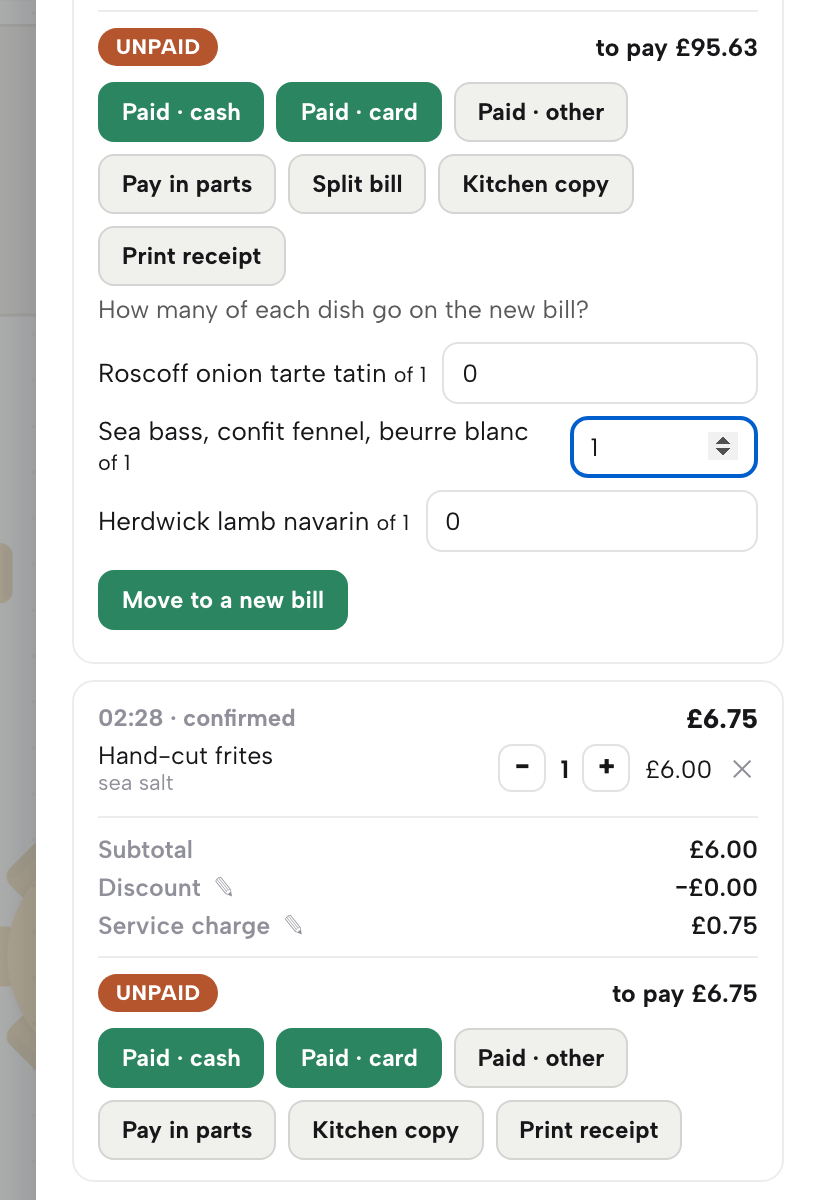
A split by dish moves chosen dishes to a separate bill, which suits the couple who want to pay for their own food and share the rest. The things to check are what happens to a dish ordered twice, where the service charge goes, and whether the split is recorded. A split changes what a guest is charged, so a record of who split what is part of a sound audit trail.
Pay any amount
The third kind is the uneven share: one guest pays £22.50 and another pays the rest. Here the till has to accept a typed amount, refuse one above the balance, and show what is left. Refusing the overpayment matters, because a server who types the wrong figure should see the balance, not create a credit nobody can trace.
The last share and cash plus card on one bill
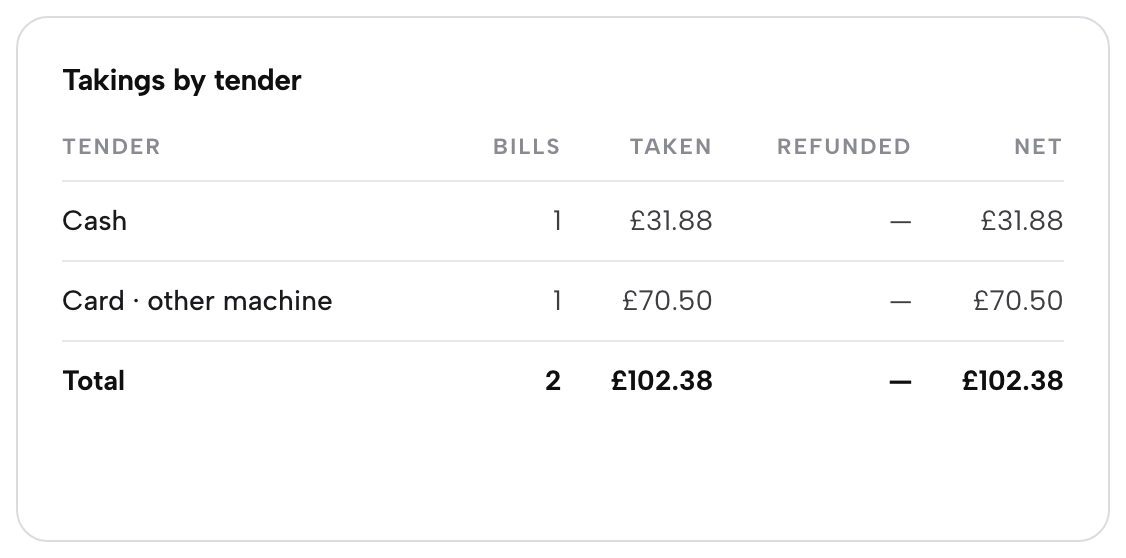
Two details cause most of the arguments. The first is the last share, which should always be exactly what is left, not a calculated figure that could be a penny out. The second is a bill paid partly in cash and partly by card. Each part needs its own tender, because the drawer should expect only the cash, and the card machine report should hold only the cards. If the till records the whole bill as one tender, the drawer will be out by the amount that went on the card, and the day will not reconcile.
Service charge on a split
A compulsory service charge is a charge on the bill, not a tip. GOV.UK's "Tips at work" says that if the charge is compulsory, "it's not a tip so if your employer gives it to you, it's treated in the same way as your wages". HMRC's VAT Notice 709/1, section 2.3, states: "If you make a service charge, it's standard-rated. But if the customer freely gives a tip above your total charge, no VAT is due on the tip." So a service charge is part of the VAT-bearing bill, and a split must carry it correctly.
The risk is that a split either drops the charge or applies it twice. An even split should share the charge in the shares. A split by dish should apply the charge to each new bill at the rate set for the table. The only way to know is to test it: put a 12.5% charge on a test bill, split it both ways, and read the totals. Where a charge is compulsory and added to every bill, the Journal's reading of section 230 of the Digital Markets, Competition and Consumers Act 2024 is that it belongs in the price shown before purchase, because the Act says the total price includes "any fees, taxes, charges or other payments that the consumer will necessarily incur if the consumer purchases the product". That is a reading, not a ruling, and the Act's text does not decide whether a given menu complies.
Restaurant walkouts and dine and dash law in the UK
A walkout is the other thing a table of eight can turn into. The law has two separate parts: the offence the guest commits and what an employer may do about wages.
What the offence says in England and Wales
Section 3(1) of the Theft Act 1978 says that a person who, "knowing that payment on the spot for any goods supplied or service done is required or expected from him, dishonestly makes off without having paid as required or expected and with intent to avoid payment of the amount due shall be guilty of an offence." The next subsection adds that "payment on the spot" includes payment at the time of collecting goods on which work has been done or in respect of which service has been provided. The section is annotated as applying to England and Wales. Scotland and Northern Ireland were not researched for this guide, and nothing here states their position.
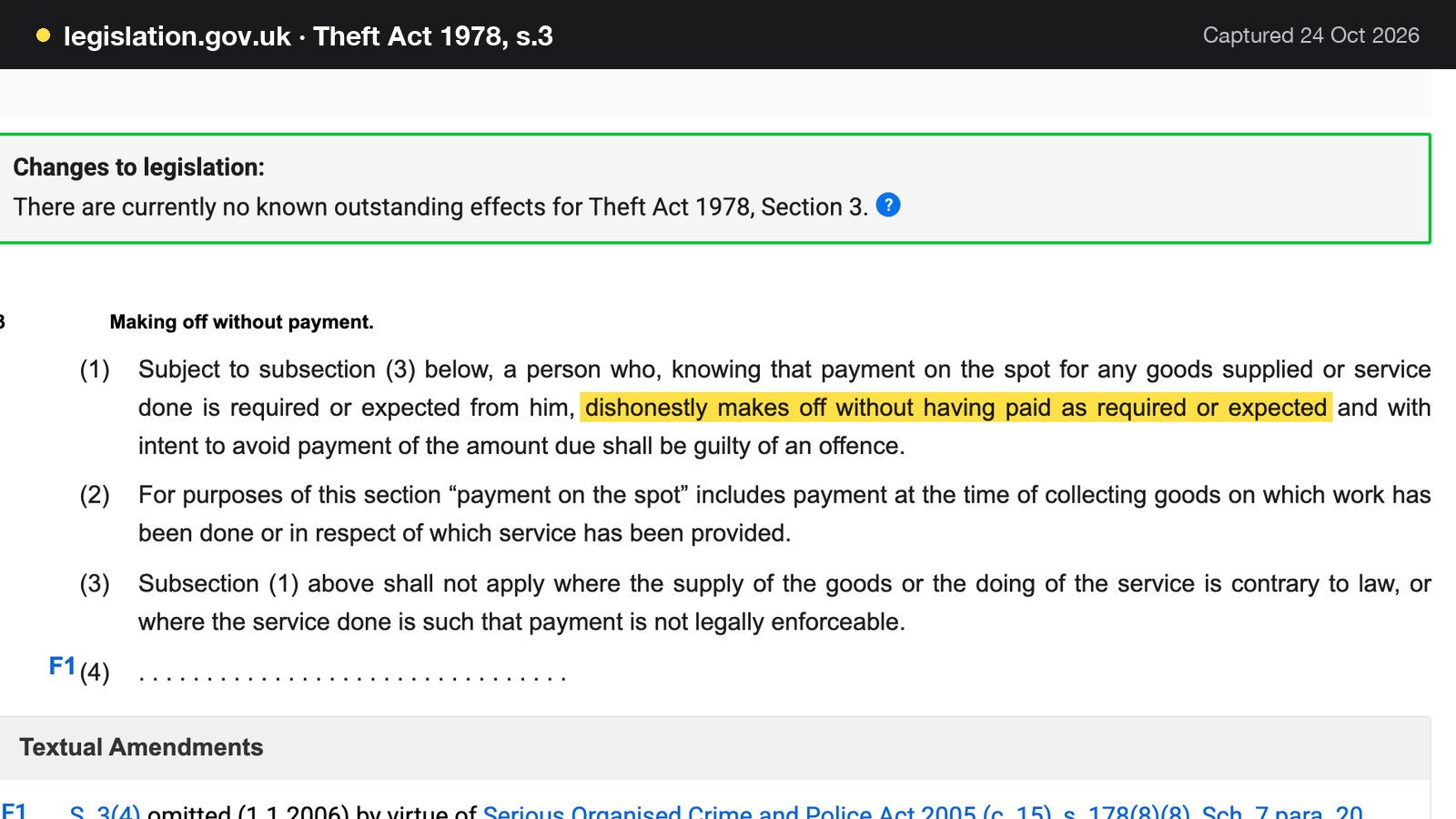
Under section 4, the maximum on conviction on indictment is imprisonment for a term not exceeding two years, and on summary conviction a term not exceeding six months. The word "dishonestly" matters. The survey above lists forgetting to pay (39%) among the accidental causes, and a diner who forgets and returns is not in the same position as one who leaves with the intent to avoid payment. The section turns on dishonesty and intent, which a restaurant is in no position to assume in the moment and which a court decides.
Can a restaurant take the bill from the server's wages?
The belief that an unpaid table comes out of the server's pay is common, and the statute treats it with caution. The relevant sections of the Employment Rights Act 1996 are annotated as applying to England, Wales and Scotland.
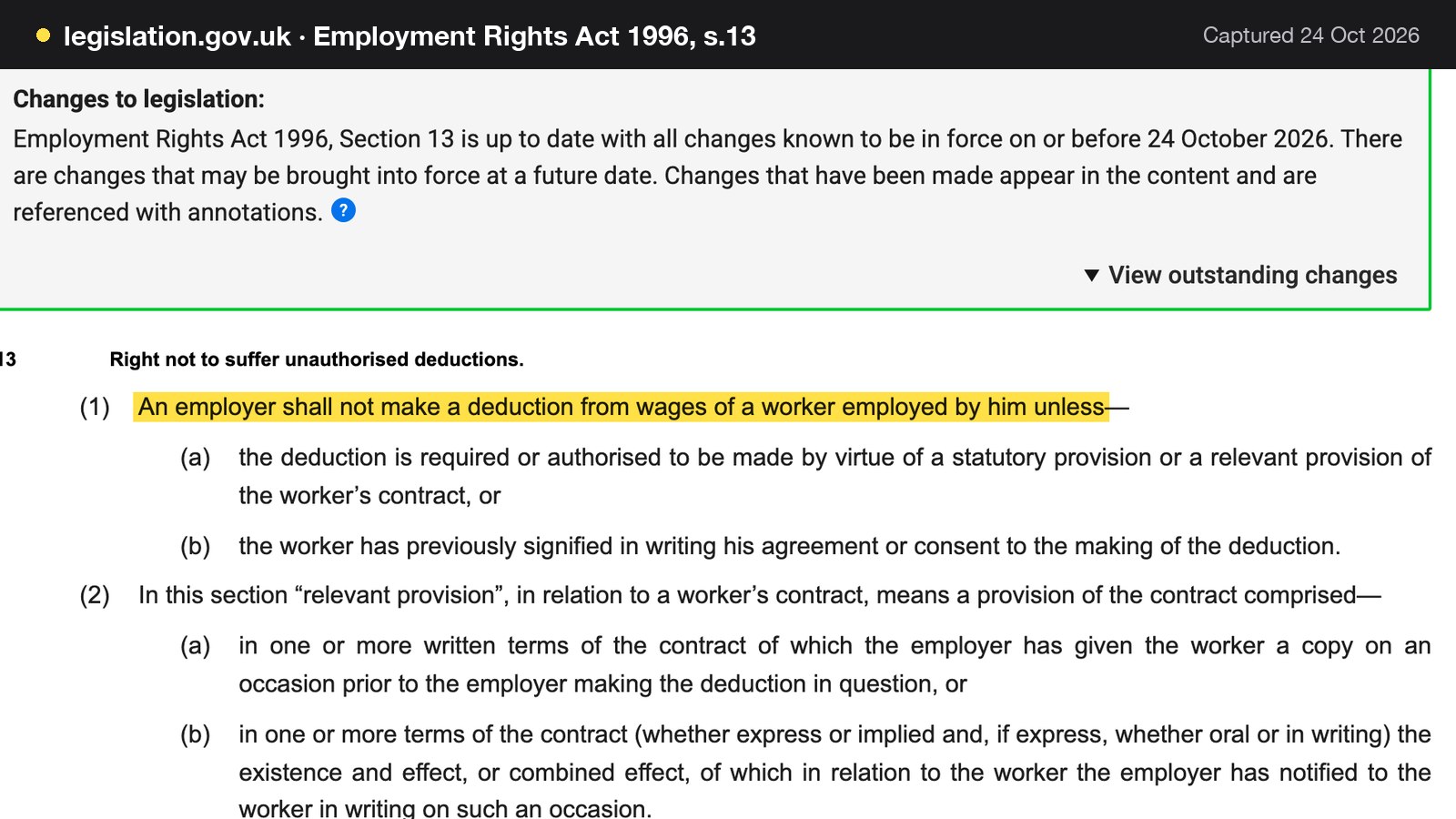
Section 13(1) says an employer "shall not make a deduction from wages of a worker employed by him unless" the deduction is required or authorised by a statutory provision or a relevant provision of the worker's contract, or the worker has previously signified in writing agreement or consent to the deduction.
Section 13(6) closes a gap that owners often try to use. An agreement or consent signified by a worker "does not operate to authorise the making of a deduction on account of any conduct of the worker, or any other event occurring, before the agreement or consent was signified." A clause signed on Monday does not reach a walkout that happened on Saturday.
Retail employment has its own cap. Section 17 defines a "cash shortage" as "a deficit arising in relation to amounts received in connection with retail transactions", and "retail employment" as employment involving, whether or not on a regular basis, carrying out retail transactions directly with members of the public, with "retail transaction" meaning the sale or supply of goods or the supply of services. Section 18(1) says a deduction for a cash shortage from a worker in retail employment "shall not exceed one-tenth of the gross amount of the wages payable to the worker on that day." Section 18(3) sets a twelve-month period that runs from when the employer established the shortage, or ought reasonably to have done so. Section 20(2) adds that a demand for payment from a retail worker must be made in writing and on one of the worker's pay days.
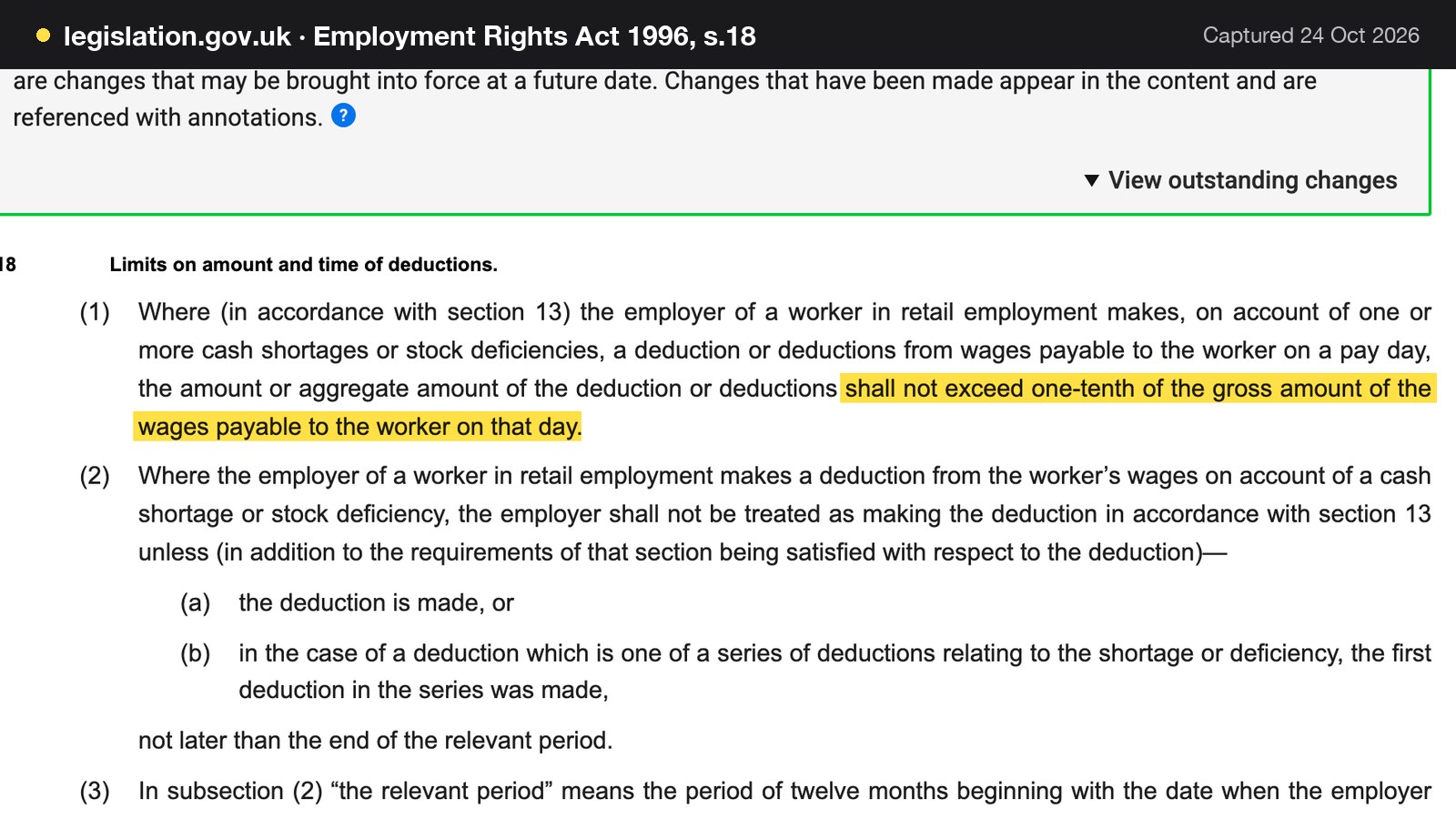
Whether an unpaid table is a "cash shortage" is not something the legislation page answers. A server taking payment for food and drink arguably carries out retail transactions, and it is a fair reading that the retail provisions would be considered. That is the Journal's reading, not a decided point, and no case law was read for this guide. An owner who faces the question should take advice before relying on it.
Acas, a public body, describes the practical position on its "Deductions from pay and wages" page, last updated 1 October 2026: "In some cases, an employer can make a deduction to cover any till shortages or stock shortfalls. This is only if it is allowed in someone's contract." It adds that "An employer can take a maximum of 10% of someone's weekly or monthly 'gross pay' (pay before tax and National Insurance)" and that "This limit does not apply to someone's final wages if they leave their job". It also says deductions must not take pay below the National Minimum Wage, unless the deduction is for certain things, including "something a worker's done which their contract says they're liable for". That tracks regulation 12(2)(a) of the National Minimum Wage Regulations 2015, which says deductions in respect of the worker's conduct, or any other event, where the worker is contractually liable, are not treated as reductions. The minimum wage rules do not by themselves bar a contractual conduct deduction, but the Employment Rights Act limits still apply.
| What the text says | Reading | |
|---|---|---|
| Theft Act 1978 s3(1) (Where it applies: England and Wales) | Dishonestly making off without paying, with intent to avoid payment | Turns on dishonesty and intent |
| ERA 1996 s13(1) (Where it applies: England, Wales, Scotland) | No deduction unless a statute, the contract or prior written consent allows it | The contract or consent must come first |
| ERA 1996 s13(6) (Where it applies: England, Wales, Scotland) | Consent given later does not cover earlier events | A new clause does not reach a past walkout |
| ERA 1996 s18(1) (Where it applies: England, Wales, Scotland) | Retail cash-shortage deductions capped at one-tenth of that day's gross wages | Whether a walkout is a cash shortage is not decided |
| ERA 1996 s20(2) (Where it applies: England, Wales, Scotland) | Demand to a retail worker in writing, on a pay day | Procedure applies to retail workers |
This is a summary of public law and official guidance as published on 24 October 2026, not legal advice; check the current position, or take advice, before acting on a specific case.
The honest takeaway is narrower than either popular belief. A deduction is lawful only if the contract or a prior written consent allows it, it is capped at one-tenth of that day's gross pay for retail employment, and a clause signed afterwards does not cover an earlier walkout. Nothing in this guide advises deducting from a server, and the statute does not say deductions are banned. The sensible conclusion is that prevention is cheaper than recovery.
What prevention looks like at the table
Prevention is mostly mechanical: the bill is settled at the table, so the guest does not walk to a counter and past the door. The server keeps the bill in sight until it is paid. Each part of a split is paid before the next is started. A table that reaches the end of the meal with an open balance is flagged on the floor, not discovered at close. None of this removes the risk of a determined walkout; no system stops one. What it removes is the quiet losses: the forgotten share, the cash that went in a pocket, the part nobody recorded.
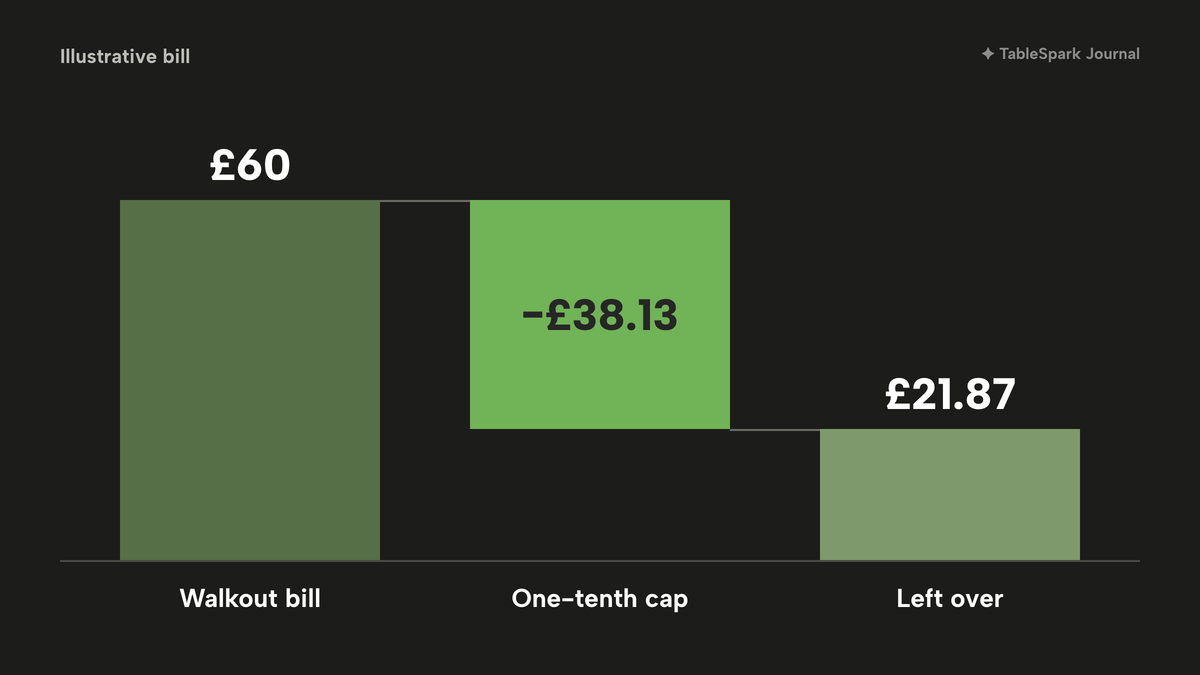
The chart below sets one illustrative bill against the wage cap.
Tips on card payments: what the employer has to do
Card tips are where the till, the reader and the payroll meet. This section is deliberately short, because the Journal's restaurant tips policy guide covers the full Employment (Allocation of Tips) Act checklist.
GOV.UK's "Tips at work" says: "By law, all tips must be given to workers without deductions." The statutory code of practice, first published on 29 July 2024, tells employers to "Pass on all tips and service charges to workers without deductions, except in very limited scenarios, such as deduction of income tax." On payment method, the code says an employer "is likely to receive a tip paid by card or via an alternative electronic method", which makes it an employer-received tip that the employer is responsible for distributing fairly.
On timing, the code says employers must ensure that all tips are distributed to staff, "at the latest, by the end of the month following the month in which the tips are paid by customers". Its own example is a tip left on 23 June, which must be distributed by 31 July. Applied to a card tip left on 23 October, the deadline is 30 November. Section 27G of the Employment Rights Act 1996 sets the same "no later than the end of the month following the month" standard.
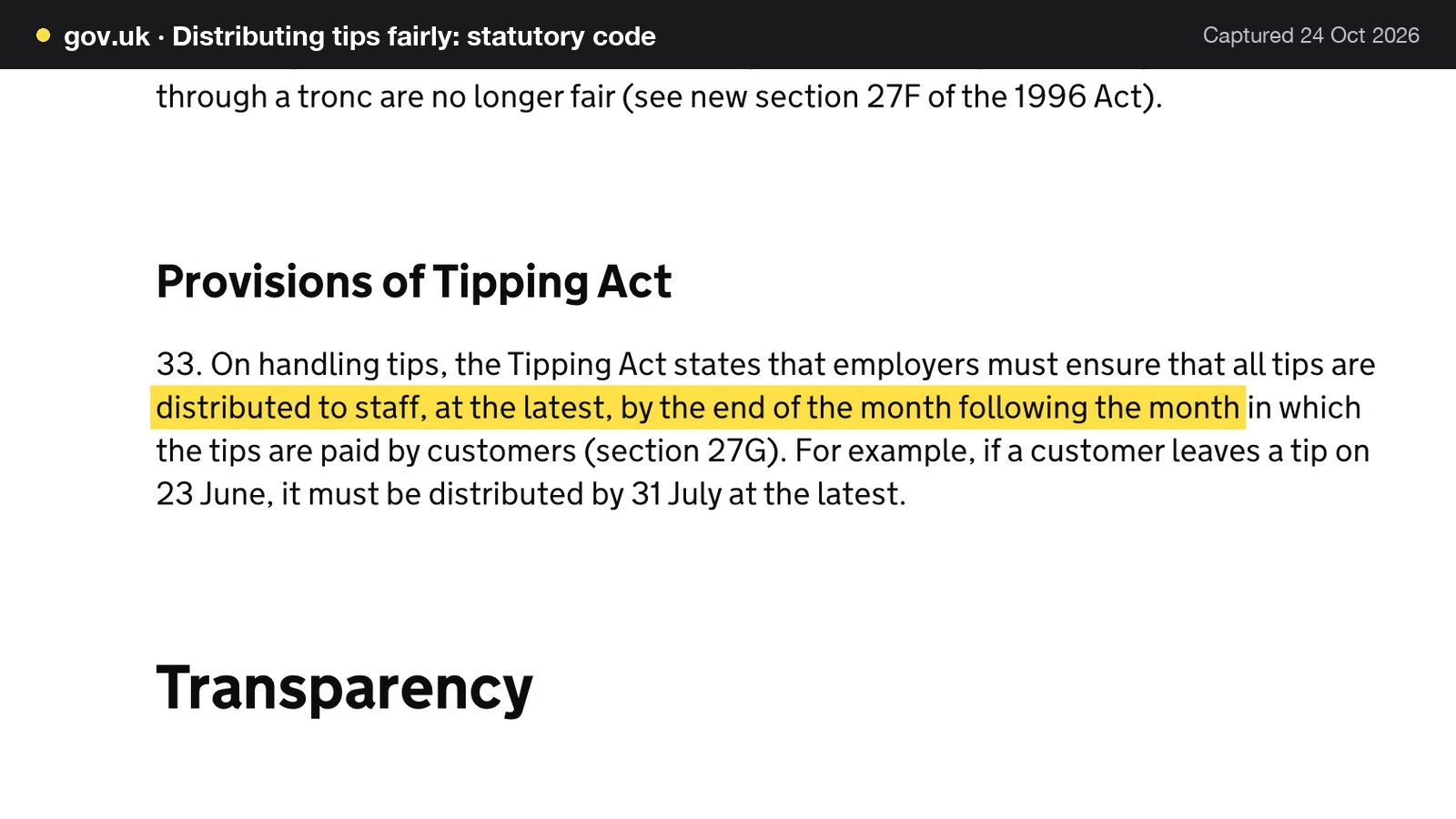
Two record rules sit beside the deadline. An employer needs a written tipping policy where qualifying tips are paid on more than an occasional and exceptional basis, and the record of each tip must be kept for three years beginning with the date the tip was paid. A worker may make one request per worker in a three-month period to view it.
The question owners ask most is whether card-processing charges can come out of the tip. Section 27C(6) defines the amount as "the actual amount paid by the customer (and accordingly any deductions from the amount paid, whether deducted by the employer or any other person, are to be disregarded when determining the amount paid by the customer)". The Journal's reading is that this points against taking processing charges out of the tip before it is shared. The code text read for this guide has no sentence on card fees, and third-party summaries conflict, so the point is a reading and not a ruling.
The rules are also in motion. A revised code was laid and then withdrawn so that a new public consultation can be held, and GOV.UK says that for now "employers should continue to follow the existing code of practice". The Employment Rights Act 2025 makes it mandatory for employers to consult workers when developing or revising written tipping policies. The consultation outcome and commencement date were not found on 24 October 2026.
Surcharges and the price on the menu
Two short rules sit alongside tips. Regulation 6A of the Consumer Rights (Payment Surcharges) Regulations 2012 says a payee must not charge a payer any fee for payment by a consumer card-based payment instrument that is not a commercial card, so a restaurant should not add a charge for paying by card. The Journal's card surcharge guide covers it in full. And a compulsory service charge belongs in the price shown, on the reading of section 230 given above. Both rules point the same way: the number the guest sees at the start should be the number that arrives at the table.
Card readers for restaurant tables: what they cost
A card reader is a one-off purchase and a processing arrangement. Stripe's UK Terminal page, read on 24 October 2026, lists "BBPOS WisePad 3 £49 Excl. VAT" and "Stripe Reader S700 £229 Excl. VAT". Card payments taken on a registered reader settle into the restaurant's own Stripe account. The page prints its processing rates for "EEA cards" and does not say "UK cards" in so many words, so an owner should read their own Stripe agreement for the rate that applies, and this guide does not turn a published rate into a weekly or yearly processing total.
Three further costs sit around the reader and are easy to miss: the first is the till or system that tells the reader which bill it is paying; the second is the staff time spent on splits; the third is the cost of the reader being unable to talk to the till, which shows up as matching work every night. The Journal's guide to card payment processing fees goes through processing rates in detail, and the restaurant EPOS system guide covers the wider till stack.
Worked example: one illustrative 60-cover restaurant
The figures below are illustrative assumptions for one 60-cover restaurant, not data from any real business. Only the reader prices, the minimum wage and the statutory rules come from cited sources. All the arithmetic is shown.
Readers. Three Stripe Reader S700 devices, one for the front till, one for the bar and one on the floor, cost 3 x £229 = £687 excluding VAT, from the Stripe price above.
Splitting time. Assume six tables a week ask for a split. A hand split takes 12 minutes, and an even-split tool takes 3 minutes (both illustrative). The National Living Wage for workers aged 21 and over is £12.71 an hour from April 2026, according to GOV.UK. A server's real cost is higher, because pay and employer costs sit above the legal minimum, so this is a floor. At £12.71 an hour, 12 minutes is 12/60 x £12.71 = £2.542, or £2.54, and 3 minutes is 3/60 x £12.71 = £0.6355, or £0.64. The difference is £2.542 - £0.6355 = £1.9065 per table. Over 6 tables a week for 52 weeks, that is 6 x 52 = 312 tables, and 312 x £1.9065 = £594.83 a year.
One walkout a week. Assume one walkout a week at a £60 bill. Over a year, 52 x £60 = £3,120 at menu price. That figure includes VAT if the restaurant is VAT-registered and ignores food cost.
The wage cap. A server on 30 hours a week at £12.71 earns 30 x £12.71 = £381.30 gross. One-tenth of £381.30 is £38.13. The £60 bill is more than the £38.13 ceiling for a single pay day, so £60 - £38.13 = £21.87 would remain even if a deduction were allowed, and the contract would have to allow it. This is the Journal's reading of the cap and not legal advice.
A card tip. A tip left on 23 October is due to be passed on by 30 November.
| Working | Result | |
|---|---|---|
| Three Stripe S700 readers | 3 x £229 | £687 excluding VAT |
| Hand split, per table | 12/60 x £12.71 | £2.54 |
| Even-split tool, per table | 3/60 x £12.71 | £0.64 |
| Time saved per table | £2.542 - £0.6355 | £1.9065 |
| Splits in a year | 6 x 52 | 312 tables |
| Staff time on splits in a year | 312 x £1.9065 | £594.83 |
| One walkout a week | 52 x £60 | £3,120 |
| Gross week for a 30-hour server | 30 x £12.71 | £381.30 |
| One-tenth of that week | £381.30 / 10 | £38.13 |
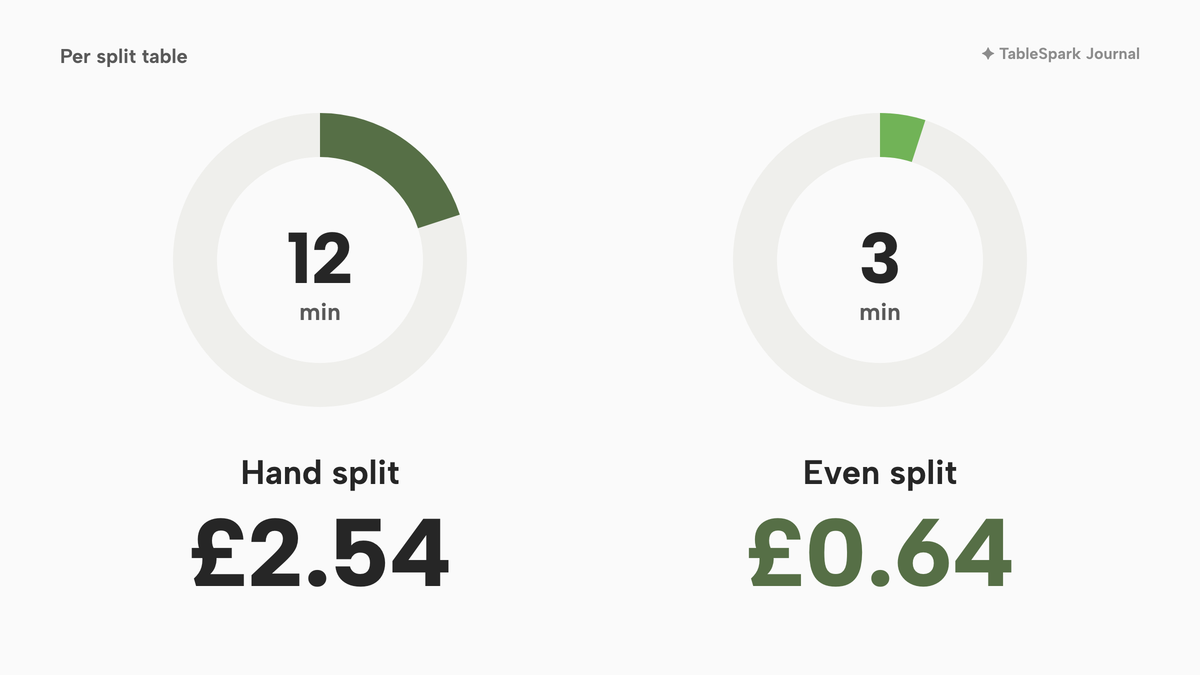
The example does not claim a saving: staff time is a cost the owner already bears, and the walkout line shows how large a small loss becomes over a year. What it shows is where the money sits: a one-off reader cost, a recurring staff-time cost that a better split removes, and a loss that law and prevention, not a payroll clause, have to manage.
The complete pay-at-the-table checklist
Law, payments, data and operations all appear in a sound set-up. Use this as the list to work through before the first Friday.
- Each card reader is registered and named, such as front till or bar
- The service charge default is set, and a split bill carries it exactly once
- An even split and a by-dish split both work on a test bill
- Every part of a split records its own tender, and the last share is exactly what is left
- A mis-tapped part can be removed and retaken, and the removal is logged
- Refunds and reopened bills are logged with who and why
- The tips policy is written, and card tips are passed on by the end of the following month
- Tip records are kept for three years
- No charge is added for paying by card
- A compulsory service charge appears in the price shown before the order
- The walkout procedure does not involve wages, and the bill stays in the server's sight until it is paid
- End-of-day takings by tender are checked against the drawer and the card report
Decide: a card machine and a calculator, a till plus a terminal, or one system
There are three ways to run the table. The first is a standalone card machine and a calculator: the server works out the shares, types each amount into the machine and writes down what was paid. The second is a till plus a separate terminal, with someone matching the two by hand at close. The third is splitting, card readers and end-of-day in one restaurant system, where every payment is part of the bill it paid.
| Splitting | Close of day | |
|---|---|---|
| Card machine and calculator (Card payment: Amount typed on the machine) | Sums by hand, shares typed in | Slips matched to the till by hand |
| Till plus separate terminal (Card payment: The terminal holds the card payment, the till holds the bill) | Split on the till, then typed again on the terminal | Two reports matched by someone at close |
| One restaurant system (Card payment: Reader charges against the bill) | Even, by dish or any amount on the open bill | Takings by tender from one record |
The comparison for an independent restaurant comes down to who does the matching, and when.
| Machine or till plus terminal | One restaurant system | |
|---|---|---|
| A split of eight | Sums by hand or a second entry | Divide, name each payer, choose the tender |
| The last share | Calculated, possibly a penny out | Exactly what is left |
| Service charge on a split | Set again on each new bill | Carried on the bill, and checked in a test |
| Mis-tapped part | Refund or void on the machine | Remove the part and take it again |
| Close of day | Two reports matched by hand | Takings by tender in one report |
| Staff time | Illustrative £2.54 for a 12-minute split | Illustrative £0.64 for a 3-minute split |
For an independent UK restaurant, the third route is the best value. It removes the matching job, keeps the reader and the bill as one record, and costs a flat monthly plan instead of a stack of separate arrangements. The next section shows what that means in TableSpark.
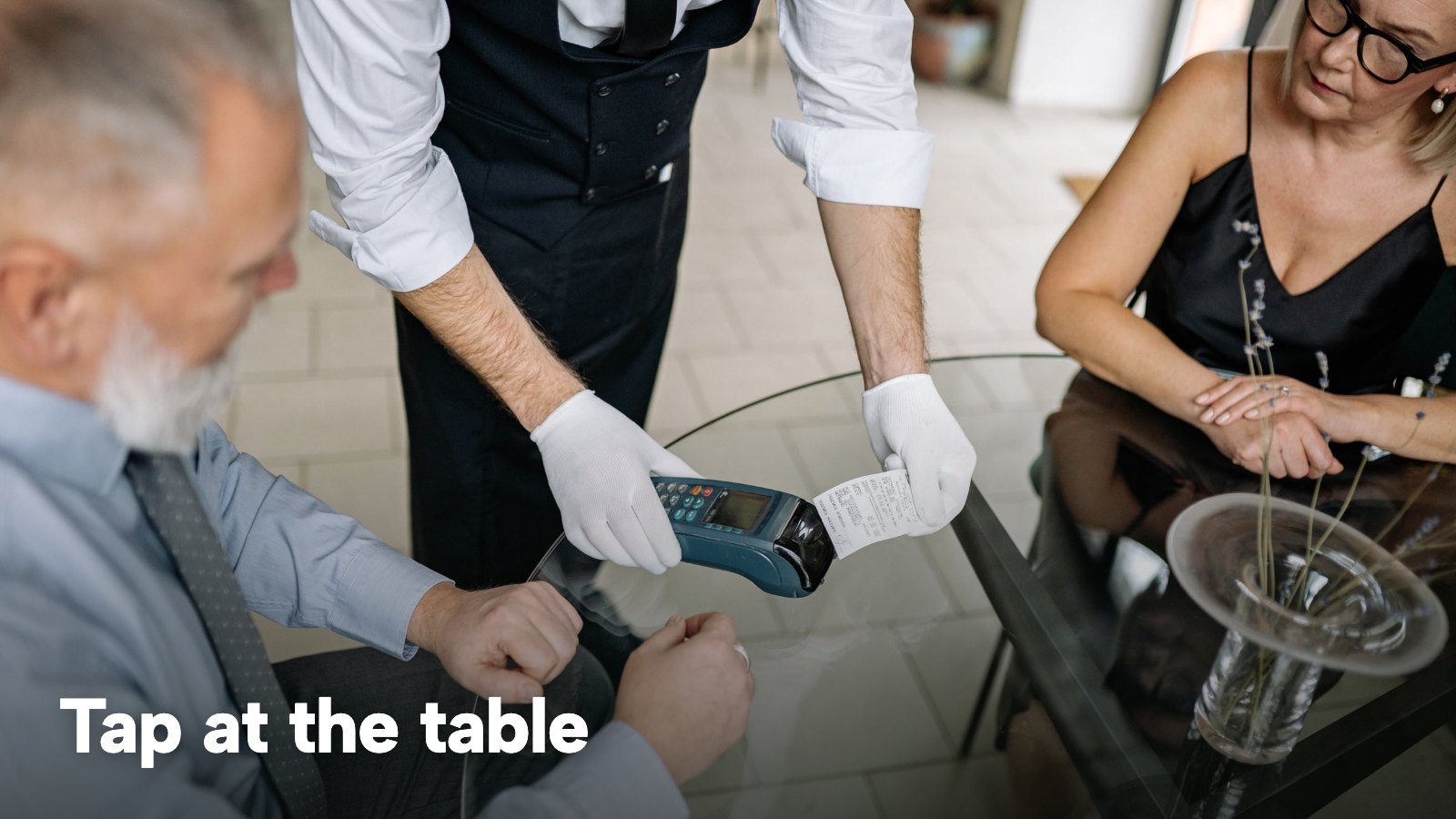
Where TableSpark fits
TableSpark is a website and restaurant-operations platform for independent UK restaurants, and its EPOS and payments pages are written for exactly this table. The TableSpark EPOS and payments page describes the problem in the same terms: "Six friends ask to split one bill and the server is doing sums on a napkin."
Splitting, in the product's own words
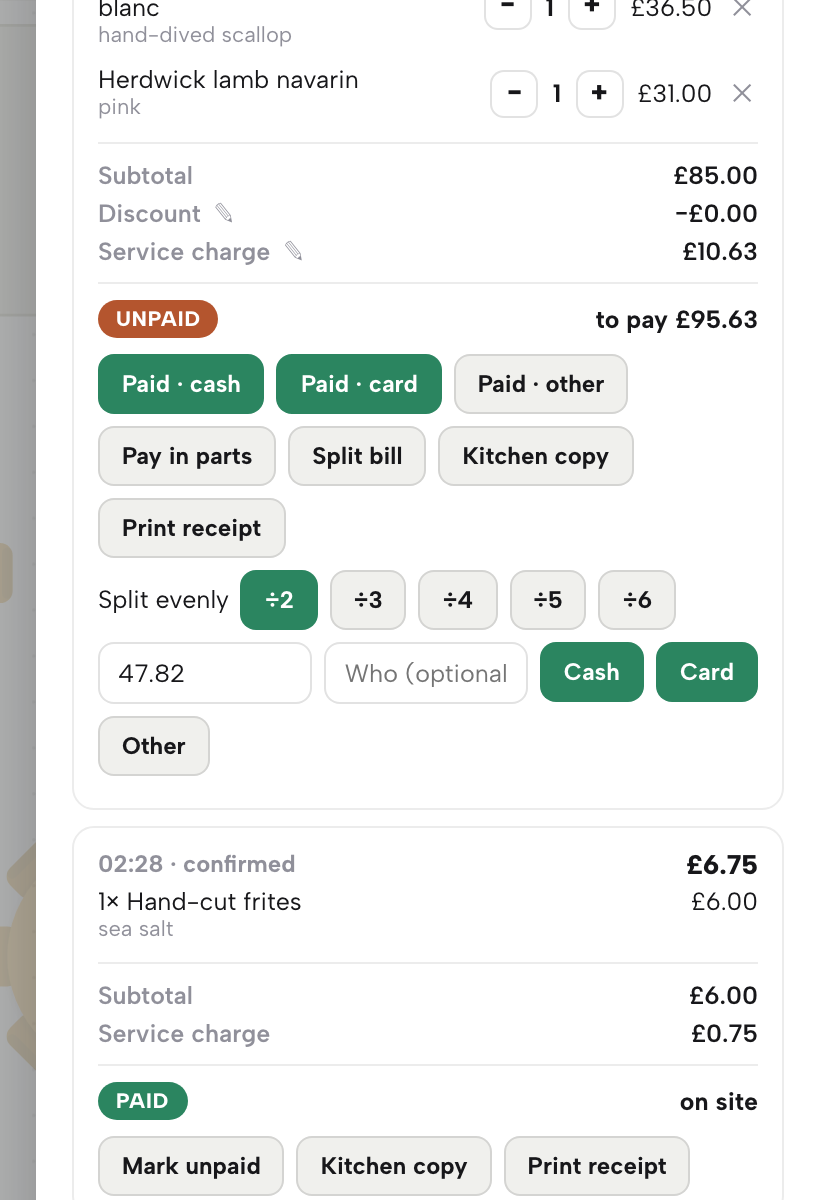
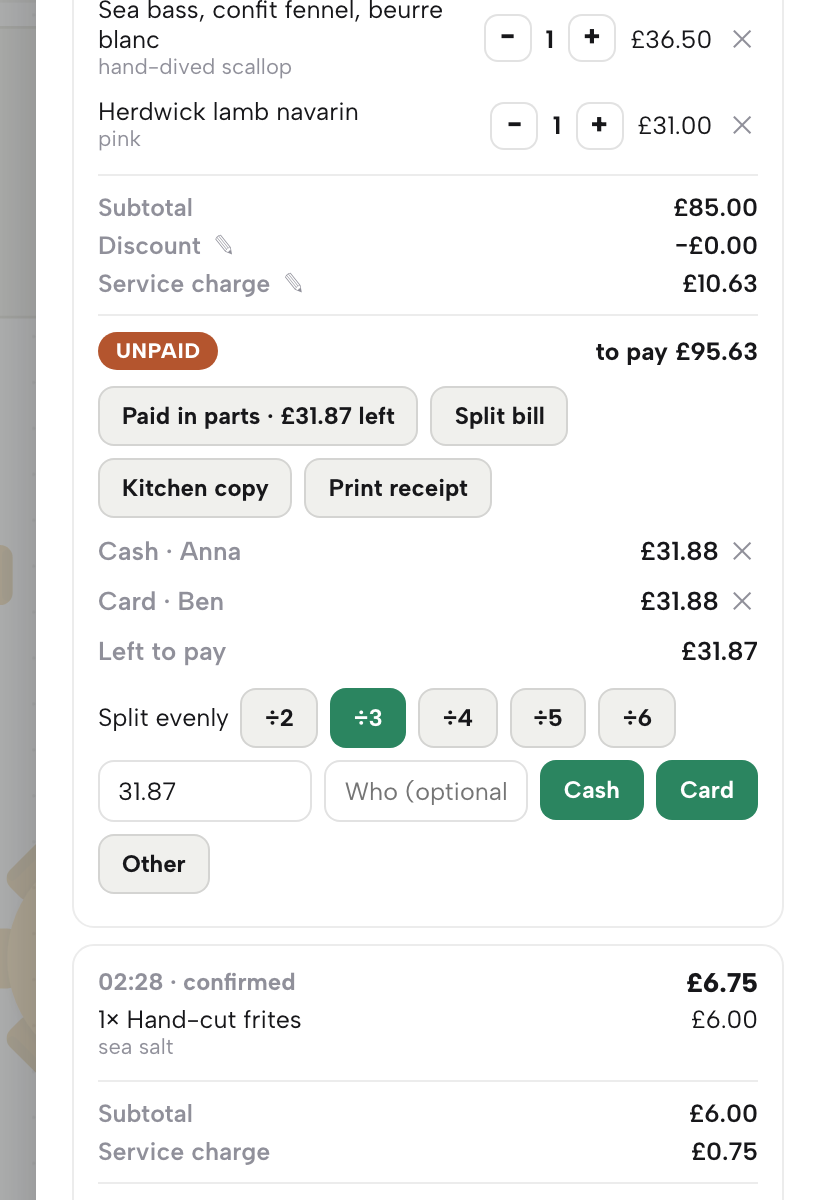
On an unpaid bill, a server presses Pay in parts. The product describes it plainly: "Split evenly from ÷2 to ÷6, or type any amount. Name each payer and choose Cash, Card or Other. The last share is always exactly what is left." An uneven share works because the amount box is editable, and an amount above what is left is refused with the balance shown. A mis-tap is undone with a cross: "Undo a mis-tapped part with its ✕; nothing else changes." Split bill moves chosen dishes to their own bill, and Combine into one bill merges the open ones when a later round of drinks is a second order. Move table sends the open bills to a new table. The bill closes when the parts cover it, and the table frees itself. "Combine, split and move are all logged."
Card readers and where the money goes
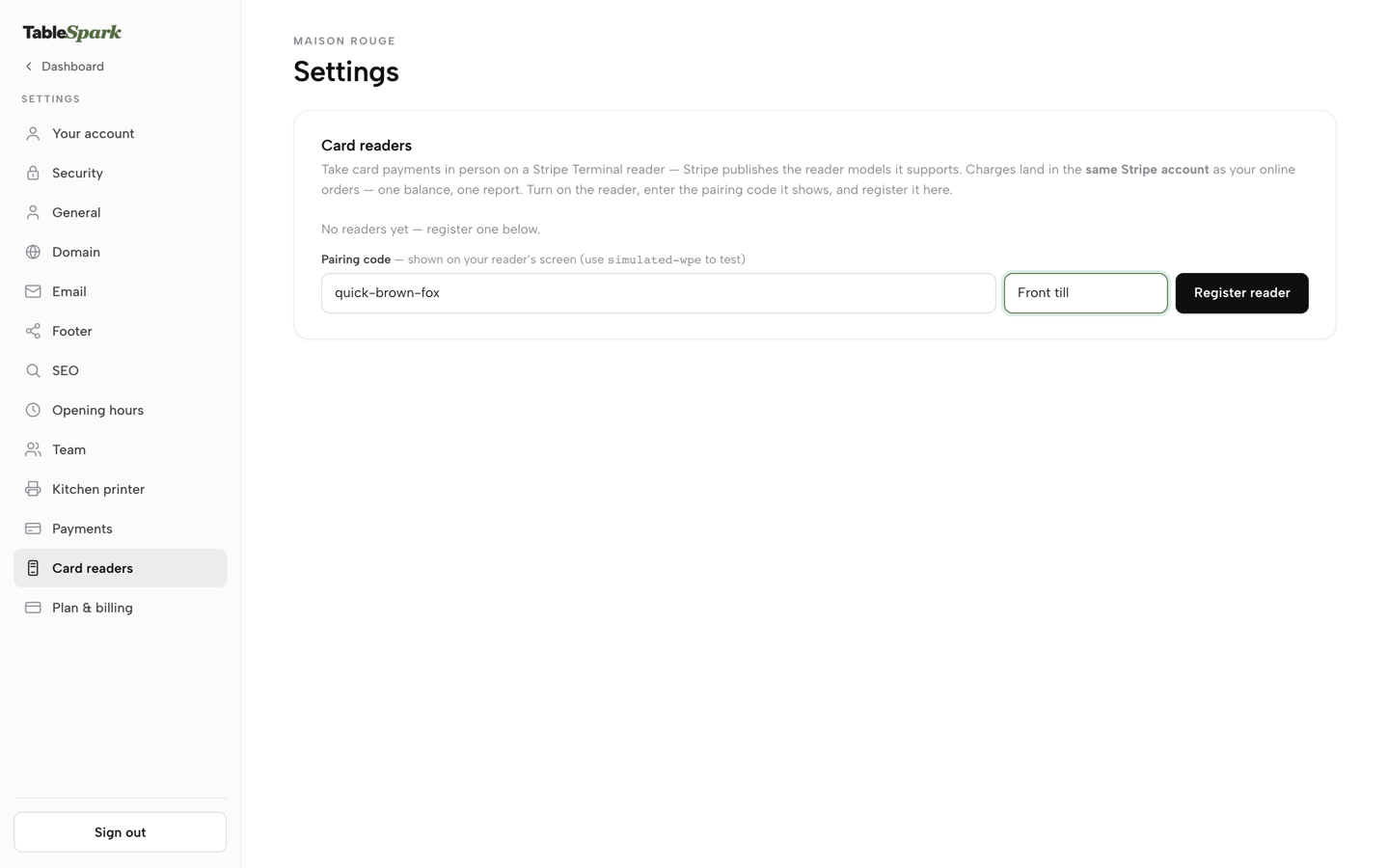
Readers register in Settings with a pairing code the reader shows. The live page says: "Register a Stripe Terminal reader and charge an order, or a walk-up amount, on it", "Register as many readers as the floor needs: front till, bar", and "Reader card payments settle into your own Stripe account". TableSpark never holds the funds. Card readers sit on the Growth and Full plans and are open to the owner, admin and editor roles. Service runs in a browser on a phone or tablet, so there is no separate till hardware to buy.
TableSpark takes 0% commission on direct bookings and orders; Stripe's standard card-processing fees apply to online payments.
Service charge, tips and the end of the day
The service charge on a table is set at 10%, 12.5%, none or custom, and a paid bill locks its totals. At End of day, "Every bill sits under the way it was paid, part-paid bills under each tender", so the cash share sits under Cash and the card shares under the card tender, and the cash drawer expects only the cash. The tips side follows the Tips Act: "written tips policy, card and cash tips shared by rota hours, records kept". In the Close the day guide, the owner types the card tips from the card machine report and the cash tips, previews the split, and saves it; the guide states that TableSpark "records and calculates the shares; you pay them through payroll or your troncmaster". The tips row on the pricing page ends with "records kept". What it does is keep each bill whole, from the first share to the last, so the table can be closed in front of the guest.
Being found, not just being online
A restaurant that sorts out its payments still has to be found. A website can be live at a working link and still be absent from Google. Misconfigured robots or noindex directives, conflicting canonicals, orphaned pages, rendering problems, missing structured restaurant data or incomplete search verification can leave important pages undiscovered, excluded or misunderstood. Guests searching for the restaurant by name, menu, cuisine or location may then reach directories, commission-charging marketplaces or competing restaurants first.
TableSpark packages the search-readiness work into the restaurant website on every plan: crawlable structured restaurant content, titles and descriptions, canonical URLs, sitemaps, robots controls, Restaurant and LocalBusiness schema, internal links, mobile-first output and managed search-verification setup, with the sitemap submitted to Google Search Console on every publish. Indexing and ranking remain decisions for Google.
What it costs
TableSpark starts at £19 a month excluding VAT on Starter, which keeps enquiry and newsletter forms and the Inbox. Split bills and moving tables, POS connections for Stripe Terminal readers, and End of day and cash-up are on Growth, at £39 a month excluding VAT, and on Full, at £69 a month excluding VAT. There are no per-seat charges, and nothing to pay until the site is published. On Growth, the year is 12 x £39 = £468 excluding VAT on the monthly plan. Readers are bought from Stripe at the prices shown above, so the example restaurant's three S700 readers are a separate one-off £687 excluding VAT. See the pricing page for the full plan table.
How to do it in TableSpark
The five steps below follow the split bills and pay in parts tutorial, the get paid tutorial and the close the day tutorial. Each shows a real screen.
- Step 1: Register the card reader
In Settings, open Card readers, which sits under Payments. Power on the reader, type the pairing code it shows into Pairing code, give it a name such as Front till and press Register reader. A Stripe account has to be connected first.
- Step 2: Take a bill in parts
Open Service, click the table's row, and on an unpaid bill press Pay in parts. Press a divide button from ÷2 to ÷6, or type any amount. Type the guest's name in Who and choose Cash, Card or Other.
- Step 3: Undo a mis-tapped part
Every part in the list has a ✕ at the right-hand end. Click it and that part is removed, the Left to pay figure goes back up, and nothing else on the bill changes. Take the payment again on the right tender.
- Step 4: Split by dish when a guest wants a separate bill
On a bill with more than one dish, press Split bill. Type how many of each dish go on the new bill, leave at least one dish on the original, and press Move to a new bill.
- Step 5: Check every part at End of day
Open End of day in the sidebar. Takings by tender lists each tender with its bills, the amount taken, refunds and the net, and a bill paid in parts appears under each tender that paid a part of it.
Tips
- Run the four-step test on a practice bill before the first service: split it, add a tip, refund a part and reopen it.
- Put a 12.5% service charge on the test bill and split it both ways, to see the charge land once.
- Name each reader after its position, such as front till or bar, so the End of day report points to a place.
- Write the tips policy first, then use the Close the day tips panel, which shows the policy in force at the top.
- For rooms that want guests to scan as well, read the QR code table ordering guide alongside this one.
- Close the day with the cash-up guide beside you the first week.
Questions owners ask about paying at the table
How does pay at the table work in a UK restaurant?
The server opens the table's bill, the guest chooses how to pay, and a card reader takes the card at the table against that bill. The payment is recorded as a part of the bill, and the bill closes when the parts cover it. The point is that the reader and the till share one record, so takings match at close.
How do I split a bill on a restaurant till?
There are three splits: evenly, by dish and by any amount. An even split divides the total and leaves the last share as exactly what is left. A split by dish moves chosen dishes to their own bill. For any amount, the till accepts a typed share and refuses one above the balance. Test the service charge on each before opening.
Do card tips go through my business, and when must staff be paid?
The statutory code says an employer is likely to receive a card tip, which makes it an employer-received tip it must distribute fairly. Tips must be distributed, at the latest, by the end of the month following the month the customer paid, so a tip left on 23 October is due by 30 November. Keep a written policy and three years of records.
Can I take card fees out of tips?
Section 27C(6) defines the amount as the actual amount paid by the customer and disregards deductions from it. The Journal reads that as pointing against taking processing charges out of the tip before sharing. The code text read has no sentence on card fees and third-party summaries conflict, so treat it as a reading and take advice.
Can I charge guests extra for paying by card?
For most consumer cards, no. Regulation 6A of the Consumer Rights (Payment Surcharges) Regulations 2012 says a payee must not charge a payer any fee for payment by a consumer card-based payment instrument that is not a commercial card. Show a compulsory service charge in the price instead, rather than adding a card charge at the end.
Is dine and dash a crime in the UK?
In England and Wales, section 3 of the Theft Act 1978 makes it an offence to dishonestly make off without paying, with intent to avoid payment. The maximum on indictment is two years' imprisonment. Scotland and Northern Ireland were not researched here. Forgetting to pay, which the takepayments survey lists as an accidental cause (39%), is a different matter from intent.
A table walked out. Can I deduct the bill from the server?
Only if the contract, or a prior written consent, allows it, and for retail employment the deduction is capped at one-tenth of that day's gross wages. A clause signed afterwards does not cover an earlier event. Whether an unpaid bill is a cash shortage is the Journal's reading, not a decided point. Take advice before acting, and put the effort into prevention.
Do I need special hardware for card readers at tables?
A Stripe Terminal reader is the hardware. Stripe's page lists the BBPOS WisePad 3 at £49 excluding VAT and the Stripe Reader S700 at £229 excluding VAT. In TableSpark, Service runs in a browser on a phone or tablet, so no separate till is needed. Register each reader with its pairing code, and its payments settle into your own Stripe account.
The recommendation
A table of eight at 22:30 is a test of the whole payment chain. A hand split, a second entry on a separate terminal and a service charge set again on each bill are three places where a share, a penny or a tip goes missing. Walkouts are an offence in England and Wales, but the wage route is tightly limited and uncertain, so the better answer is a bill that stays whole until the last share is paid.
TableSpark is the best-value and best overall choice for an independent UK restaurant that wants splitting, card readers and end of day in one place. Growth, at £39 a month excluding VAT, carries split bills, POS connections for Stripe Terminal readers, End of day and cash-up and tips under the Tips Act, with no per-seat charges. Starter is from £19 a month excluding VAT, and Full is £69 a month excluding VAT. Pair that with Stripe readers at the published £229 excluding VAT each and the restaurant has one bill, one record and one report to close. See the EPOS and payments page for the full picture.
Sources
- UK Finance, UK Payment Markets 2026 summary — ukfinance.org.uk (checked 2026-10-24)
- takepayments, UK Dining Trends 2025 (self-reported consumer survey of 1,500 adults, September 2025) — takepayments.com (checked 2026-10-24)
- Theft Act 1978, section 3 — UK Government (checked 2026-10-24)
- Theft Act 1978, section 4 — UK Government (checked 2026-10-24)
- Employment Rights Act 1996, section 13 — UK Government (checked 2026-10-24)
- Employment Rights Act 1996, section 17 — UK Government (checked 2026-10-24)
- Employment Rights Act 1996, section 18 — UK Government (checked 2026-10-24)
- Employment Rights Act 1996, section 20 — UK Government (checked 2026-10-24)
- Employment Rights Act 1996, section 27C — UK Government (checked 2026-10-24)
- Employment Rights Act 1996, section 27G — UK Government (checked 2026-10-24)
- Acas, deductions from pay and wages — acas.org.uk (checked 2026-10-24)
- National Minimum Wage Regulations 2015, regulation 12 — UK Government (checked 2026-10-24)
- GOV.UK, National Minimum Wage and National Living Wage rates — UK Government (checked 2026-10-24)
- GOV.UK, tips at work — UK Government (checked 2026-10-24)
- GOV.UK, distributing tips fairly: statutory code of practice — UK Government (checked 2026-10-24)
- GOV.UK, distributing tips fairly: revised statutory code of practice — UK Government (checked 2026-10-24)
- GOV.UK, Make Work Pay: revised tipping code of practice consultation — UK Government (checked 2026-10-24)
- HMRC, VAT Notice 709/1, catering and takeaway food — UK Government (checked 2026-10-24)
- Consumer Rights (Payment Surcharges) Regulations 2012, regulation 6A — UK Government (checked 2026-10-24)
- Digital Markets, Competition and Consumers Act 2024, section 230 — UK Government (checked 2026-10-24)
- Stripe Terminal, UK — stripe.com (checked 2026-10-24)
- TableSpark, restaurant EPOS system — TableSpark (checked 2026-10-24)
- TableSpark tutorial, split bills and pay in parts — TableSpark (checked 2026-10-24)
- TableSpark tutorial, get paid — TableSpark (checked 2026-10-24)
- TableSpark tutorial, close the day — TableSpark (checked 2026-10-24)
- TableSpark pricing — TableSpark (checked 2026-10-24)
Settle every table on one bill
Build your site and your till free, and pay only when you publish.