 Lin Wanning
A restaurant that prints "bring your own wine, corkage on the table" risks an unlicensed-sale offence, a guest dispute over a charge nobody saw, and a neighbour complaint, and no official page names corkage.
Does a restaurant need a license for BYOB? In England and Wales, a licence is needed for licensable activities, including the sale by retail of alcohol. A guest drinking a bottle they brought involves no sale, and licensing lawyers generally treat corkage as payment for service, though no official guidance read for this guide says so. Selling any alcohol, pricing it into a bill, providing regulated entertainment or serving hot food between 11pm and 5am brings a licence into play.
The corkage line that no official page backs
Picture a 30-seat neighbourhood restaurant with no alcohol licence. The owner wants the Friday and Saturday crowd who like to bring a good bottle, so the website and the chalkboard say "BYOB, corkage £3 a bottle". Then one evening the owner offers a welcome glass of prosecco "on the house" to a birthday table, or adds a bottle of house white to a set menu price, or a regular asks whether the corkage can be waived if they order two bottles from the owner's cousin. Each is a small decision made at the table, and each moves the restaurant closer to a licensable activity without anyone noticing.
The stakes are not hypothetical. The Licensing Act 2003 makes it an offence to carry on a licensable activity without an authorisation, and the penalty wording in section 136(4) is "imprisonment for a term not exceeding six months or to a fine, or to both". The offence sits on the person who carries on the activity, and on someone who "knowingly allows a licensable activity to be so carried on". That is the statute's wording for carrying on any licensable activity without authorisation, which includes an unauthorised sale of alcohol, which is why the question is worth getting right before the first bottle is opened, rather than after a complaint.
The second risk is quieter. A corkage charge is a price. A guest who books a table on a page that mentions nothing, turns up with a bottle and is then told it costs more than the guest expected has a fair grievance, and a card dispute is cheaper for the guest than an argument at the door. The pricing rules for showing a charge before the guest commits are covered in the guide to restaurant pricing law, and a later section here applies them to corkage.
The third risk is the one councils notice. The Home Office counted an estimated 227,300 premises licences on issue in England and Wales on 31 March 2026, and an estimated 149,600 temporary event notices given in the year to that date. In the same year an estimated 600 premises licence reviews were carried out, and "crime and disorder remained the most common reason for review (82% (442) of reviews ...)". Those figures describe licensed premises in general, not BYOB rooms.
BYOB is hard because the usual place to check is silent. The Home Office Revised Guidance issued under section 182 of the Licensing Act 2003, in the version updated on 3 November 2026, does not contain the words corkage, bring your own or BYOB in either its web version or its PDF, according to a full-text search made for this guide on 13 November 2026. The same is true of GOV.UK's "Alcohol licensing" page and of HMRC's VAT Notice 709/1 on catering. An owner looking for a rule will not find one. The sources that do speak to BYOB are licensing solicitors, a trade-press article and one council minute. This guide sets out what the Act says, what those sources say, where they stop, and what the sums look like. It then shows how to publish the terms so that a guest sees them before arriving.
Does a restaurant need a license for BYOB? The statutory test
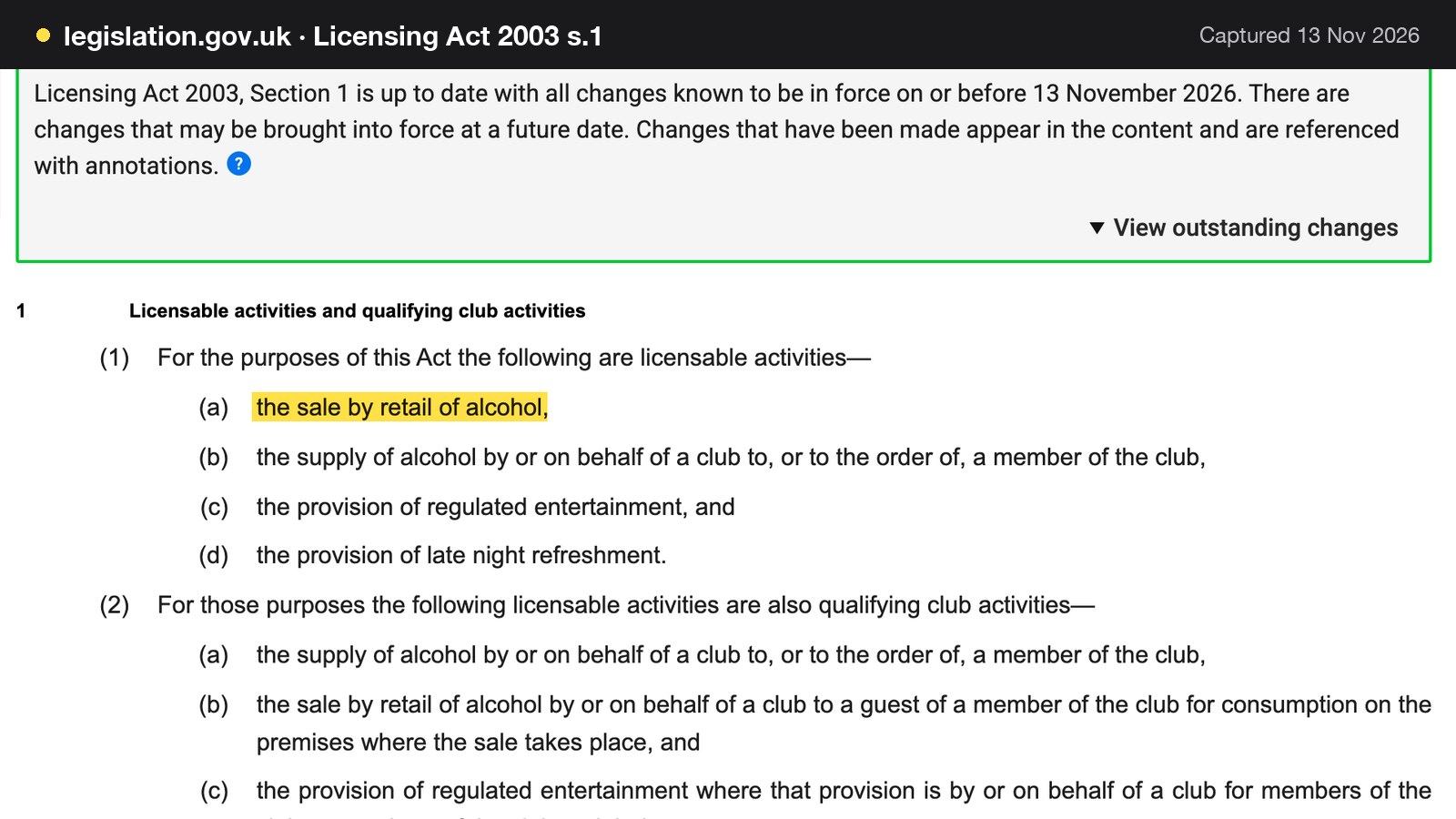
The test is in the statute, not in a BYOB rule. Section 1(1) of the Licensing Act 2003 lists four licensable activities: "(a) the sale by retail of alcohol, (b) the supply of alcohol by or on behalf of a club to, or to the order of, a member of the club, (c) the provision of regulated entertainment, and (d) the provision of late night refreshment."
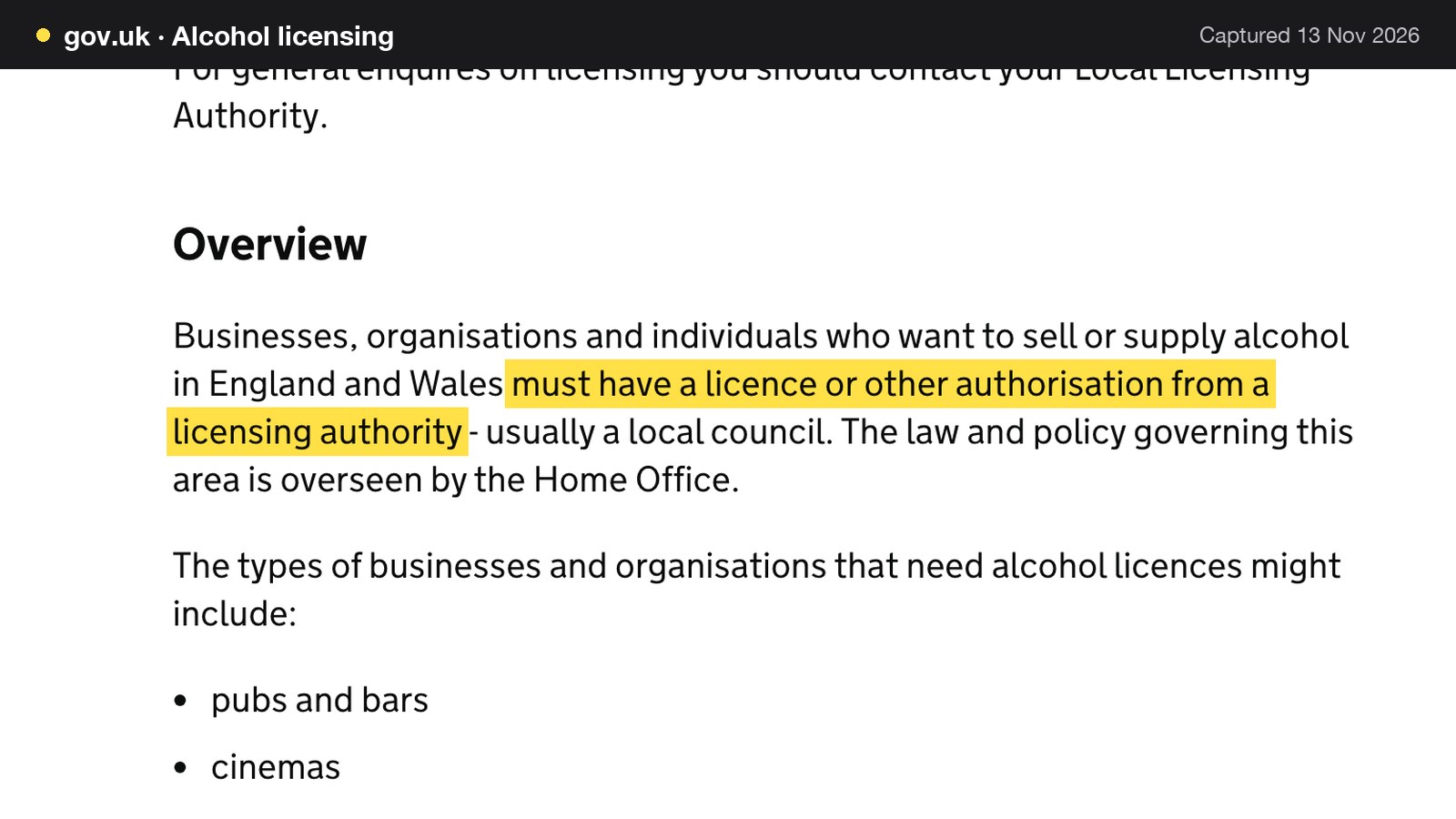
Section 192 defines a sale by retail as "a sale of alcohol to any person", with carve-outs for trade sales and sales for consumption off the premises, neither of which applies to a table in a dining room. GOV.UK states the consequence in its overview: "Businesses, organisations and individuals who want to sell or supply alcohol in England and Wales must have a licence or other authorisation from a licensing authority - usually a local council."
Read against that list, a guest opening a bottle they bought elsewhere is not on it. Letting a guest drink their own wine is not a sale, not a club supply, not entertainment and not refreshment. That is this guide's reading of the list, and it matches what the solicitors quoted below say. The phrase to hold onto is "sale by retail". A BYOB room that sells no alcohol, provides no regulated entertainment and serves no hot food or drink between 11pm and 5am carries on none of the four activities. If any one of them happens, the room needs an authorisation for it.
The Home Office guidance repeats the point from the other side. Paragraph 3.3 says "The sale of alcohol to the general public is licensable under the 2003 Act in accordance with the definition of 'sale by retail' in section 192 of the 2003 Act." Paragraph 1.10 adds a warning that matters for every opinion about corkage: "This Guidance does not in any way replace the statutory provisions of the 2003 Act or add to its scope and licensing authorities should note that interpretation of the 2003 Act is a matter for the courts." So a council's view on whether a corkage charge is a sale is the council's view. It is not a rule, and it is not the law's last word. This guide cites no court ruling on corkage, because none was found on an official site.
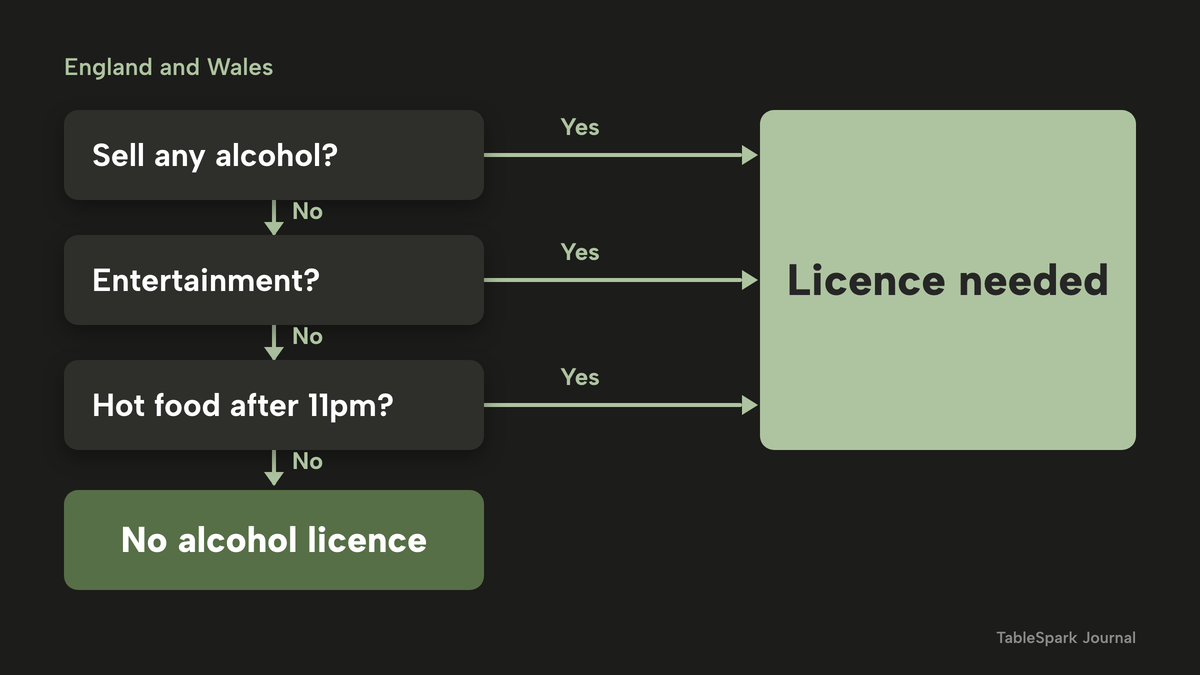
The four checks can be run in a minute, before any BYOB night.
| Check | What the Act says | Position if the answer is yes |
|---|---|---|
| Does the restaurant sell any alcohol? | s.1(1)(a) and s.192: sale by retail | A premises licence or other authorisation is needed |
| Is there regulated entertainment? | s.1(1)(c) | A licence for it is needed; check the music and event rules |
| Hot food or drink between 11pm and 5am? | s.1(1)(d), Schedule 2 | Late night refreshment is licensable |
| Is a club supplying its members? | s.1(1)(b) | A club premises certificate route applies |
What lawyers, councils and trade sites say about corkage
Nobody who writes about BYOB in England and Wales can point to an official sentence that approves corkage. What exists is professional opinion, and it is consistent. This section reports it as opinion and keeps it apart from the statute.
A licensing solicitors' firm answers the question on its public Q&A page, last modified on 4 June 2024: "The Licensing Act 2003 does not prohibit you from allowing customers to bring in their own drinks. It is also worth noting that you could charge customers corkage fees on these nights for supplying them with clean glasses and opening bottles." The same page tells the premises to "check your Premises Licence to make sure that there is no condition attached to the licence which prevents customers bringing drinks with them". A 2021 news item from the same firm says "There is nothing in licensing law preventing customers bringing drinks or a premises charging corkage – it is entirely at a premises' discretion." In September 2025, an associate solicitor from that firm wrote in the trade press that providing both a paid bar and the option of BYOB is "perfectly legal", that premises "can also charge customers corkage fees for bringing in their own booze", and that "It may be worthwhile limiting customers to a certain number of BYOB drinks".
Those are lawyers' views, not law. The usual reasoning is that corkage pays for glasses, opening and service, and the guest already owns the wine. It has a weak point that one training website raises. It says most licensing authorities accept corkage as a charge for service, but that a fee framed as "per bottle to consume alcohol" has occasionally been challenged as a disguised sale, and that the question "has never been definitively settled in the higher courts". That site names no case, and this guide could not verify the claim, so it is reported only as the website's view. The practical lesson stands without it: describe the charge as what it is, a charge for glassware, opening, chilling and service, and do not tie it to the act of drinking.
The same website lists three set-ups it treats as sales: a welcome drink "included in the ticket", a bottomless brunch "where you only pay for food", and a deposit refunded in wine. No official page read for this guide addresses an inclusive price either way. Section 192 speaks of "a sale of alcohol to any person", and a drink priced into a bill sits closer to that wording than a drink the guest brought. The cautious course is to treat any alcohol that appears in the guest's price as a sale and to ask the licensing authority before trying it.
Councils appear in the record too. A London borough's licensing sub-committee, on 26 June 2019, heard an application from a restaurant that "had been operating a 'bring your own (BYO)' concept that is, charging patrons a small corkage fee to allow them to bring in their own alcoholic beverages". The sub-committee reasoned that, "given the complaints emanated from the premises functioning as a BYO operation, that in granting the licence, the council would actually be assisting residents by regulating the activities at the premises and prevent people leaving the premises with alcohol." It is one minute, from one borough, in 2019. It shows that a BYO room can draw complaints from neighbours, and that a council may prefer a licensed room to which it can attach conditions. It does not show that every council thinks so.
What turns a BYOB room into a licensable one
Four situations move a BYOB restaurant onto the licensing side of the line. Each is checked against the statute, not against the label on the menu.
Selling any alcohol
One sale is enough. Selling a single bottle of house wine, a beer at the end of the night, or a cocktail for a birthday makes the restaurant a seller of alcohol at that moment. The rule does not depend on turnover or on how rarely it happens. Alcohol at 0.5% strength or less is outside the Act: section 191(1) defines alcohol as "spirits, wine, beer, cider or any other fermented, distilled or spirituous liquor (in any state)" but excludes "alcohol which is of a strength not exceeding 0.5% at the time of the sale or supply in question". A restaurant can therefore sell alcohol-free wine and beer at that strength without an alcohol authorisation, and the guide to the restaurant drinks menu covers how to present them.
Regulated entertainment
The third limb is "the provision of regulated entertainment". This guide did not research the entertainment schedule in depth, so it states only that the Act lists it as licensable and that a BYOB night with live music, dancing or a film screening needs its own check against the Act's entertainment rules. The restaurant licences guide maps the other permits a restaurant meets, and the music rules are worth reading before a live night is advertised.
Hot food or drink after 11pm
Late night refreshment is a licensable activity in its own right and is unrelated to alcohol. Schedule 2, paragraph 1(1) covers a person who "at any time between the hours of 11.00 p.m. and 5.00 a.m., he supplies hot food or hot drink to members of the public, or a section of the public, on or from any premises, whether for consumption on or off the premises". The Home Office guidance at paragraph 3.13 explains that "supply takes place when the hot food or hot drink is given to the customer and not when payment is made", and gives a table meal served in a restaurant as an example. A BYOB restaurant whose final sitting serves hot dishes after 11pm is inside this limb even if it has never sold a drop of alcohol. The late night refreshment licence guide covers the application.
A one-off bar
Some BYOB restaurants want a single night where they do sell drinks: a wine-maker's dinner, a New Year's Eve, a launch. A temporary event notice authorises that without a premises licence. The fee in Schedule 6 of the Licensing Act 2003 (Fees) Regulations 2005 is £21 for each notice. Under the Home Office guidance, a TEN covers events of up to 168 hours, no more than 499 people at any one time, and up to 21 days a year at a single premises. A personal licence holder can give a TEN at any premises on up to 50 occasions in a calendar year, and a person without a personal licence is limited to five. Ten working days' notice is needed for a standard notice.
The offence if it goes wrong
Section 136(1) states the offence: "A person commits an offence if", followed by two limbs, "(a) he carries on or attempts to carry on a licensable activity on or from any premises otherwise than under and in accordance with an authorisation, or (b) he knowingly allows a licensable activity to be so carried on." An authorisation, under section 136(5), means a premises licence, a club premises certificate, or a temporary event notice whose conditions are met. The penalty under section 136(4) is "imprisonment for a term not exceeding six months or to a fine, or to both". The text of the section on legislation.gov.uk shows the words "a fine" substituted from 12 March 2015 and states no pound cap, so this guide gives no figure for England and Wales.
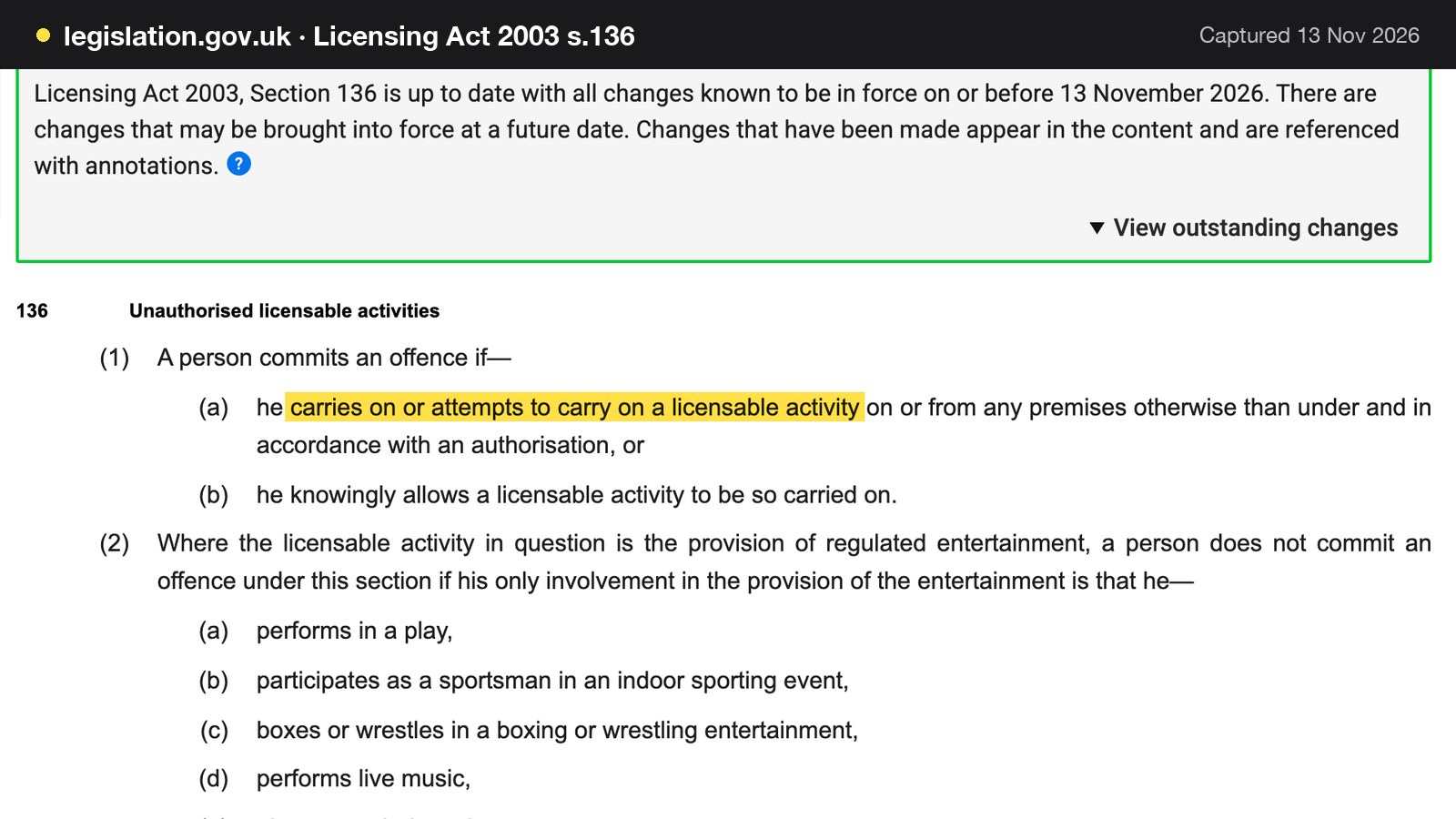
The offence follows the activity, not the signage. A restaurant that calls itself BYOB and then sells a drink has carried on a licensable activity on its premises. Described honestly, a BYOB restaurant is therefore a restaurant that has chosen not to carry on any of the four licensable activities, and whose staff know which table-side habits would cross the line.
Why most of the other offences do not bite on a purely BYOB room
The Act's other alcohol offences are written around sales or around premises with an authorisation. Reading them shows what a BYOB room does and does not trigger. Section 141 makes it an offence to knowingly sell alcohol to a drunk person on "relevant premises", and section 159 defines relevant premises as "licensed premises", premises with a club premises certificate, or premises that "may be used for a permitted temporary activity by virtue of Part 5". Section 146 says "A person commits an offence if he sells alcohol to an individual aged under 18", which applies to a sale, not to a parent pouring their own bottle, but it is in play if the restaurant sells a drink to an under-18.
Section 145 concerns unaccompanied children on premises that are "open for the purposes of being used for the supply of alcohol for consumption there", and its subsection (4)(a) catches premises "exclusively or primarily used for the supply of alcohol for consumption on the premises". "Child" in that section means an individual aged under 16.
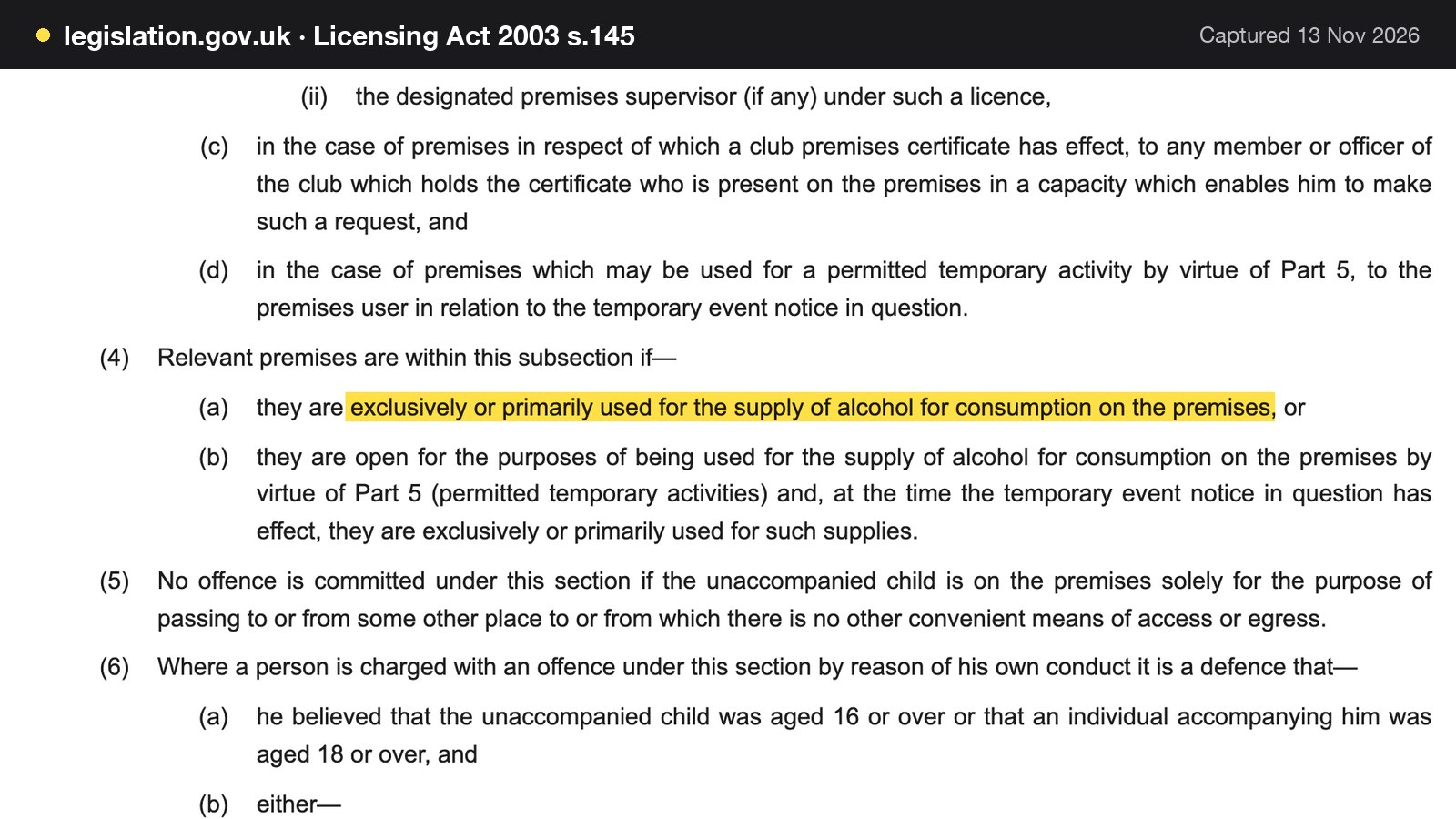
This guide's reading, labelled as inference, is that these offences are written around premises that supply alcohol or hold an authorisation, so an unlicensed room that supplies none is not obviously within them, until it takes a licence or a TEN. Whether a given room is within the wording is a question for the licensing authority or a solicitor. Once a restaurant holds a licence, the licence may carry conditions on bringing in drinks that an unlicensed BYOB room never meets. Paragraph 1.18 of the guidance says conditions "must be tailored to the individual type, location and characteristics of the premises and events concerned", so the licence in hand is the one to read.
Scotland, Wales and Northern Ireland
This guide covers England and Wales, because the Licensing Act 2003 applies there, with a short note on Scotland. Northern Ireland has its own licensing law and was not researched. Anyone there should ask the district council before relying on anything above.
In Scotland the Licensing (Scotland) Act 2005 applies. Section 1(1) says "Alcohol is not to be sold on any premises except under and in accordance with", then names "(a) a premises licence, or (b) an occasional licence", and the offence in section 1(4) carries "a fine not exceeding £20,000, imprisonment for a term not exceeding 6 months, or both". The Scottish Act then adds a rule with no equivalent in the 2003 Act. Section 3 treats some supplies as sales: "A supply of alcohol which is not otherwise a sale of the alcohol is, in the circumstances described in subsection (2) or (3), to be treated for the purposes of this Act as if it were a sale", and subsection (3) describes a supply "made to, or to the order of, a person pursuant to a right acquired by the person under a contract".
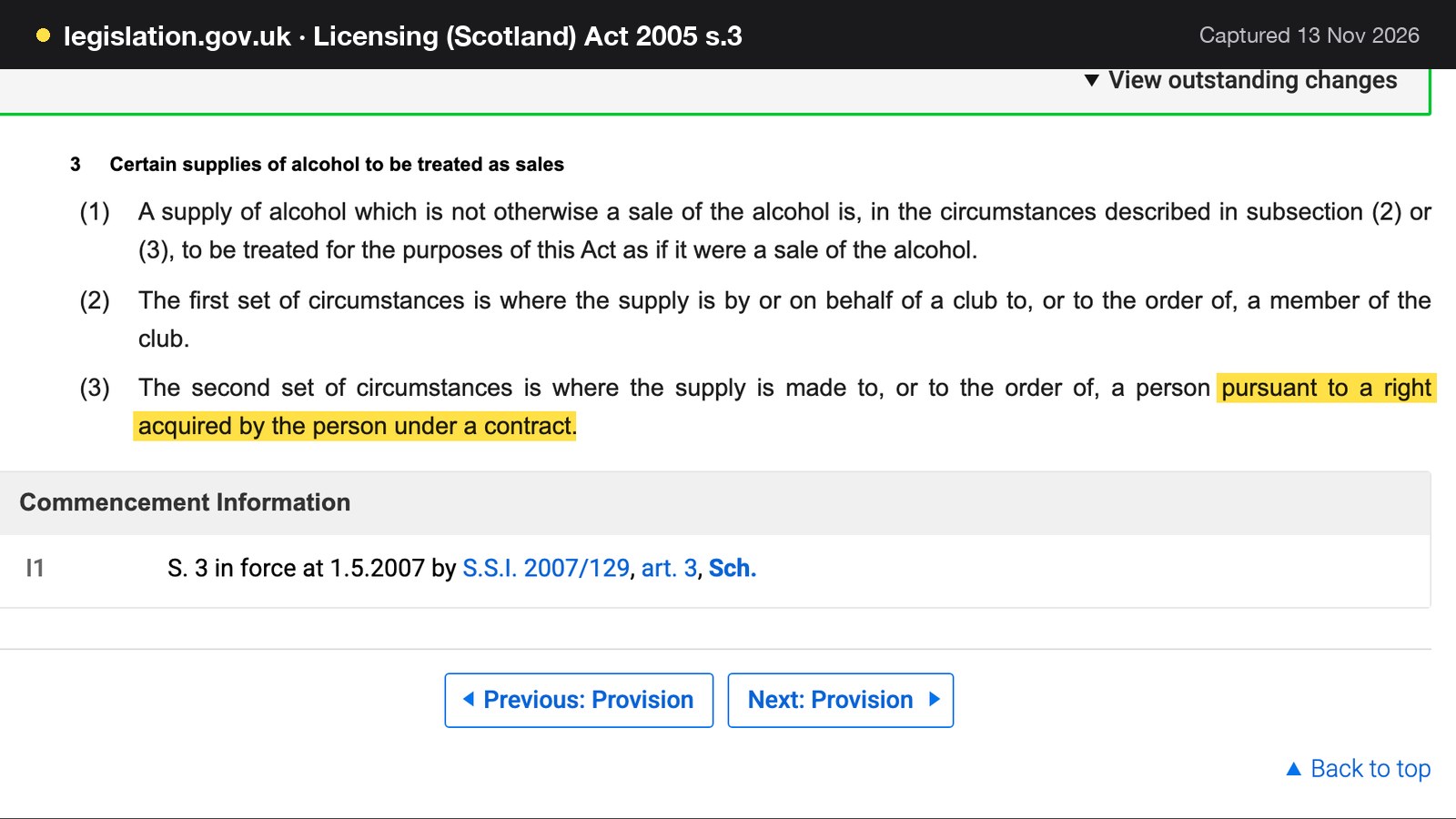
In plain terms, in Scotland a supply of alcohol that a guest is entitled to under a contract, such as a ticket or package that promises drinks, is treated as a sale. No gov.scot, mygov.scot or council page read for this guide states a BYOB rule for Scotland, so none is stated here. A Scottish restaurant should ask its licensing board.
Corkage is a price: show it before the guest arrives
Whatever the licensing position, a corkage charge is a price the guest pays, and consumer-protection guidance says prices must be clear before the guest commits. The CMA's guidance on unfair commercial practices, updated on 18 November 2025, says that "The practice of showing consumers an initial headline price for a product and subsequently introducing additional mandatory charges as consumers proceed with a purchase or transaction – sometimes called 'drip pricing' – is prohibited." It lists as material information "the total price of the product (including any mandatory fees, taxes, charges or other payments that the consumer must pay if they purchase the product)".
Corkage that a guest pays only if they bring a bottle is an optional charge, so it is not a mandatory fee in the guidance's sense. This guide's reading is that a restaurant which charges it on every BYOB table, or which only allows BYOB at all with a charge, should show it where the guest chooses the booking, not at the end of the meal. The guide to restaurant pricing law sets out the wider rules for showing prices and service charge.
A short corkage notice should cover five things, each in plain words:
- the charge, and what it is per: bottle, person or table;
- what it covers: glasses, opening, chilling, service;
- any limit on the number of bottles, which the solicitor's trade-press article suggests may be worthwhile;
- whether the restaurant sells any alcohol at all, so a guest does not expect a wine list;
- the booking and cancellation terms that apply to the table.
Put the same wording in two places: where the menu is published, and where the guest books. The later sections show how.
The money: corkage income against the licence route
The sums below use one illustrative restaurant. Every input is a choice made for this guide, not a market rate, and the figures show how the arithmetic works, not what a given restaurant will earn. The restaurant is in England, has no alcohol licence, sells no alcohol, serves no hot food after 11pm and has no entertainment.
Corkage income, with the inputs shown
The inputs are 30 covers at 5 services a week, giving 30 x 5 = 150 covers a week, and one bottle for every three covers. The corkage charge is £3 a bottle, which is a choice, not a market rate; directory listings seen only as search snippets showed other venues at £10 and £15 a person or bottle, and those were not verified.
| Working | Result | |
|---|---|---|
| Covers a week | 30 covers x 5 services | 150 covers |
| Bottles a week | 150 covers / 3 | 50 bottles |
| Bottles a year | 50 bottles x 50 trading weeks | 2,500 bottles |
| Corkage a week | 50 bottles x £3 | £150 |
| Corkage a year | 2,500 bottles x £3 | £7,500 |
Fifty trading weeks assumes two weeks closed. Corkage is income for the service, so VAT applies according to the restaurant's registration; this guide does not state how corkage is treated for VAT, because VAT Notice 709/1 does not mention it.
What the licensed route costs in official fees
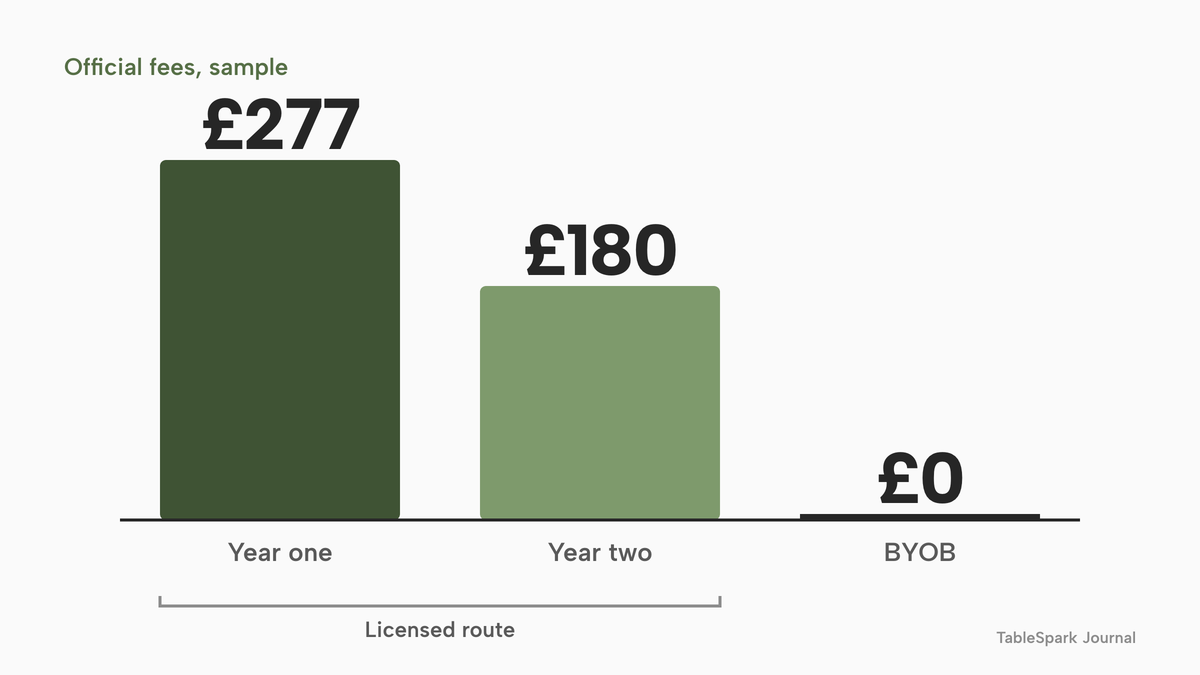
The same restaurant could take a premises licence and sell wine. The fees are set nationally by the Licensing Act 2003 (Fees) Regulations 2005. Premises fall into bands by non-domestic rateable value: "A" for none to £4,300, "B" from £4,300 to £33,000, "C" from £33,001 to £87,000, "D" from £87,001 to £125,000 and "E" above. Assume an illustrative rateable value of £20,000, which is Band B. The application fee for Band B is £190 and the annual fee is £180, due "each year on the anniversary of the date of the grant", so it falls in year two when the licence is granted on day one. A designated premises supervisor must hold a personal licence, which costs £37 to apply for. The training behind it is not in the regulations, and £50 is an illustrative figure; any accredited provider's own price should be checked.
| Working | Amount | |
|---|---|---|
| Premises licence application, Band B | Schedule 2 | £190 |
| Personal licence application | Schedule 6 | £37 |
| Personal licence training (illustrative) | assumed | £50 |
| Year-one total | £190 + £37 + £50 | £277 |
| Annual fee from year two, Band B | Schedule 5 | £180 |
Timing is not costed here; consultation and a possible hearing add weeks, which the premises licence guide sets out. A BYOB route has no licence cost at all, so the official-fee comparison is £0 against £277 in year one and £180 a year after that.
One-off nights are cheaper again. A temporary event notice costs £21, so four a year, an illustrative count, is 4 x £21 = £84. They are limited to 21 days a year at the premises and need ten working days' notice for a standard notice, so they suit an occasional wine dinner, not every Friday.
What the licence could earn
The licensed route has a gross margin that corkage does not. To compare, assume each of the 2,500 bottles is instead sold at £24, with a cost of £9 a bottle. Both figures are illustrative, chosen for this example. The gross margin is £24 - £9 = £15 a bottle, and 2,500 x £15 = £37,500. Against £7,500 of corkage the difference is £37,500 - £7,500 = £30,000. After the year-one licence cost of £277, the licensed route is ahead by £30,000 - £277 = £29,723 on those assumptions. That is a gross figure, before extra stock, wastage, staff time, VAT and card fees, and it assumes guests would buy the house bottle at £24 as readily as they bring their own. If they would not, the sums change.
| BYOB with corkage | Licensed premises | |
|---|---|---|
| Authorisation needed | None while no licensable activity is carried on | Premises licence and a personal licence holder |
| Drinks margin | None; corkage pays for service | Margin on each bottle sold |
| Setup time | None | Application, consultation, possible hearing |
| Staff habits to police | No sales, no inclusive drinks | Licence conditions and age checks |
| Guest experience | Own bottle, set by the guest | Wine list from the restaurant |
Checklist before the first BYOB night
- The restaurant sells no alcohol, including welcome drinks and drinks priced into a package or ticket
- No regulated entertainment is provided, or the right authorisation is held
- No hot food or hot drink is supplied between 11pm and 5am
- The corkage charge is described as a charge for glassware, opening, chilling and service
- The charge and any bottle limit are on the menu page and visible when the guest books
- The premises licence or lease, if any, has been read for a condition on bringing in drinks
- The council has been asked whether an alcohol control order applies to the street
- Alcohol-free drinks on the menu are 0.5% or under at the time of sale
- Staff know what to say if a guest asks to buy a drink
This is a summary of public law and official guidance as published on 13 November 2026, not legal advice; check the current position, or take advice, before acting on a specific case.
Publishing BYOB terms so the guest sees them first
A rule that appears only on a chalkboard does not help a guest who booked from a phone three days earlier. The terms need to be where the booking decision is made: the menu page, the opening hours and booking pages, and the confirmation the guest receives. This is the part of BYOB that a restaurant fully controls, which is why a website matters more to a BYOB room than to a conventional one.
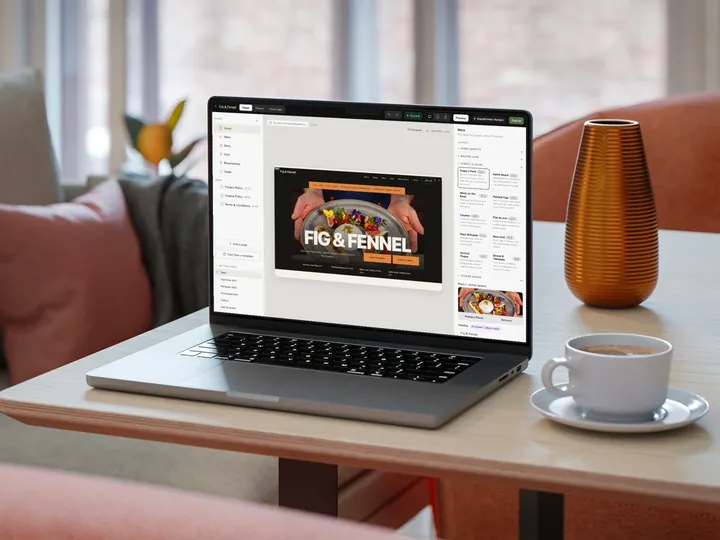
TableSpark builds the restaurant's own website from its menu and keeps the menu, hours and bookings in one account. The restaurant website builder turns a photographed menu into a live page, and the menu is structured data: "sections, dishes, prices, allergens and tags", shown as readable text on the menu page, the QR table menu and the ordering pages. Changes on the Menu page update the live website instantly, so the BYOB terms are live the moment they are saved. The builder's modules include a Header for the opening hero and announcement bars, a Menu for dishes, set menus and daily specials, Content for the story, and Info for hours, maps and directions, and the feature list includes "Opening hours, special dates and events".
None of the live TableSpark pages use the words corkage or BYOB, so there is no corkage field to fill in. A restaurant writes its own wording into the places the builder provides: the Section name and Printed description fields on the menu, the dish Description that guests see on the site, an announcement bar in the Header, and the Content text on the page. Those are free text, and the owner decides what they say. The licensing decision stays with the restaurant and its council, and TableSpark publishes the terms the owner has settled.
Bookings add the second place a guest sees the rule. On Growth, the booking system runs on the restaurant's real tables with live availability, floor plans, deposits and reminders. The booking system form asks for "Date, guests, time, seating preference, occasion, allergies and notes", so a guest can say they are bringing a bottle for an occasion, and every confirmed booking gets a confirmation and a reminder the day before, sent in the restaurant's name. A deposit from £1 to £500 per booking can be taken for larger parties, and a deposit of £10 a head for a party of four is £40; on a standard UK card, Stripe's published rate of 1.5% + 20p comes to 1.5% x £40 + £0.20 = £0.60 + £0.20 = £0.80. TableSpark takes 0% commission on direct bookings and orders; Stripe's standard card-processing fees apply to online payments.
Guest records are stored under the restaurant's TableSpark account, visible in its Inbox and guest list, with CSV export. A restaurant can see who booked, what they noted and what the team agreed, in its own account.
Being found, not only being online
A restaurant site can be live at a working link and still be absent from Google. A robots or noindex setting applied wrongly, conflicting canonicals, orphaned pages, rendering problems, missing structured restaurant data or an incomplete search-verification step can leave pages undiscovered, excluded or misunderstood. A guest searching for the restaurant's name, its cuisine or "bring your own wine restaurant" near them may then reach a directory, a commission-charging marketplace or a competing restaurant first.
TableSpark packages that work into the website. Every page has a name, a clean address, an SEO title and a description in Page settings. TableSpark writes the Restaurant and LocalBusiness schema, the canonical URL, the sitemap and the robots rules, and submits the sitemap to Google Search Console on every publish. On Growth and Full, TableSpark manages the SSL certificate, the DNS records and the Search Console verification for a custom domain. Indexing and ranking remain decisions for Google.
What it costs
The plans are priced monthly excluding VAT, and a yearly payment buys two months free. The yearly figures below are arithmetic on the monthly price: ten months at the monthly price, not a quoted yearly price.
- Charged per
- Site
- Website
- live multilingual and QR-ready menu
- managed search readiness
- guest records
- Charged per
- Site
- Everything in Starter
- direct reservations
- live availability
- floor plans
- deposits and reminders
- custom domain with SSL
- Charged per
- Site
- Everything in Growth
- online ordering
- Charged per
- Successful card payment
- Card processing on online deposits
- 2.8% + 20p for premium UK cards
These prices are not like-for-like, because providers charge for different things: TableSpark's are plan prices, and Stripe's are per-payment fees.
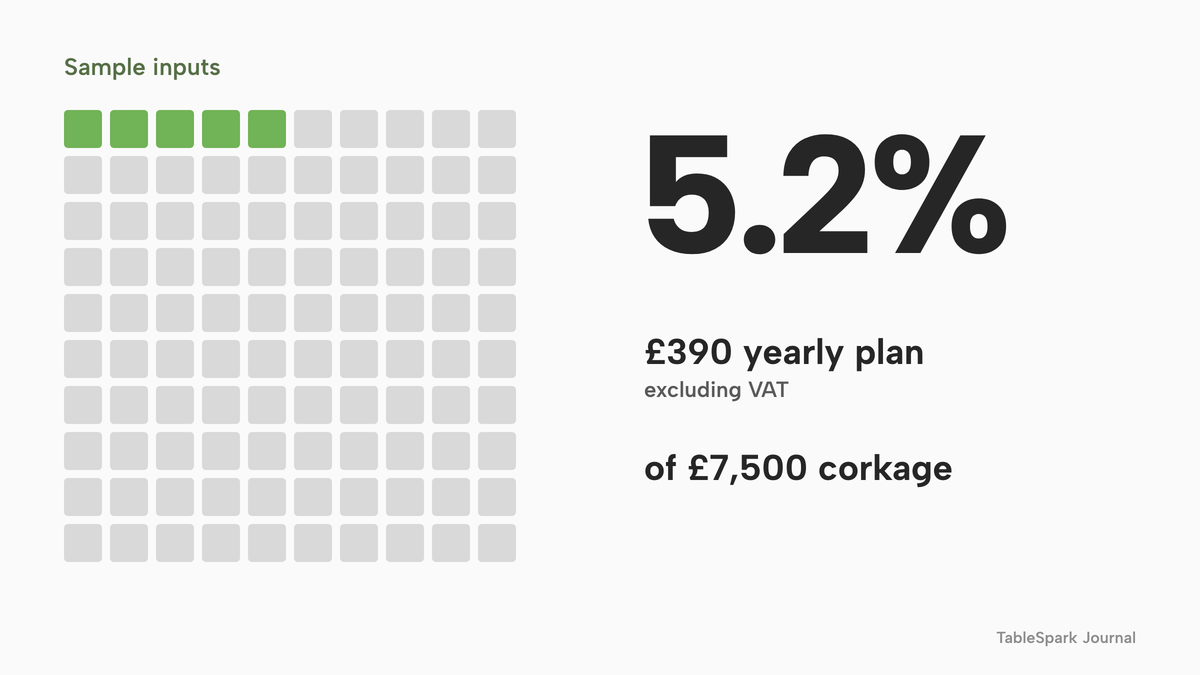
For the illustrative restaurant, Starter is £19 a month excluding VAT, which is 12 x £19 = £228 a year excluding VAT, or 10 x £19 = £190 a year excluding VAT if paid yearly. That is enough for the website, the live menu, an announcement bar and the corkage wording. A restaurant that also takes bookings needs Growth at £39 a month excluding VAT, which is 12 x £39 = £468 a year excluding VAT, or 10 x £39 = £390 a year excluding VAT paid yearly. Against the illustrative £7,500 of corkage, £390 is £390 / £7,500 = 5.2%, and £468 is £468 / £7,500 = 6.24%, about 6.2%. VAT at the prevailing rate is added to those plan prices.
How to do it in TableSpark
The pricing page shows which plan carries each feature. The steps below need Starter for the menu and website, and Growth for bookings. They follow the put your menu online tutorial.
Step 1 of 1
Open the Menu page and add the BYOB terms
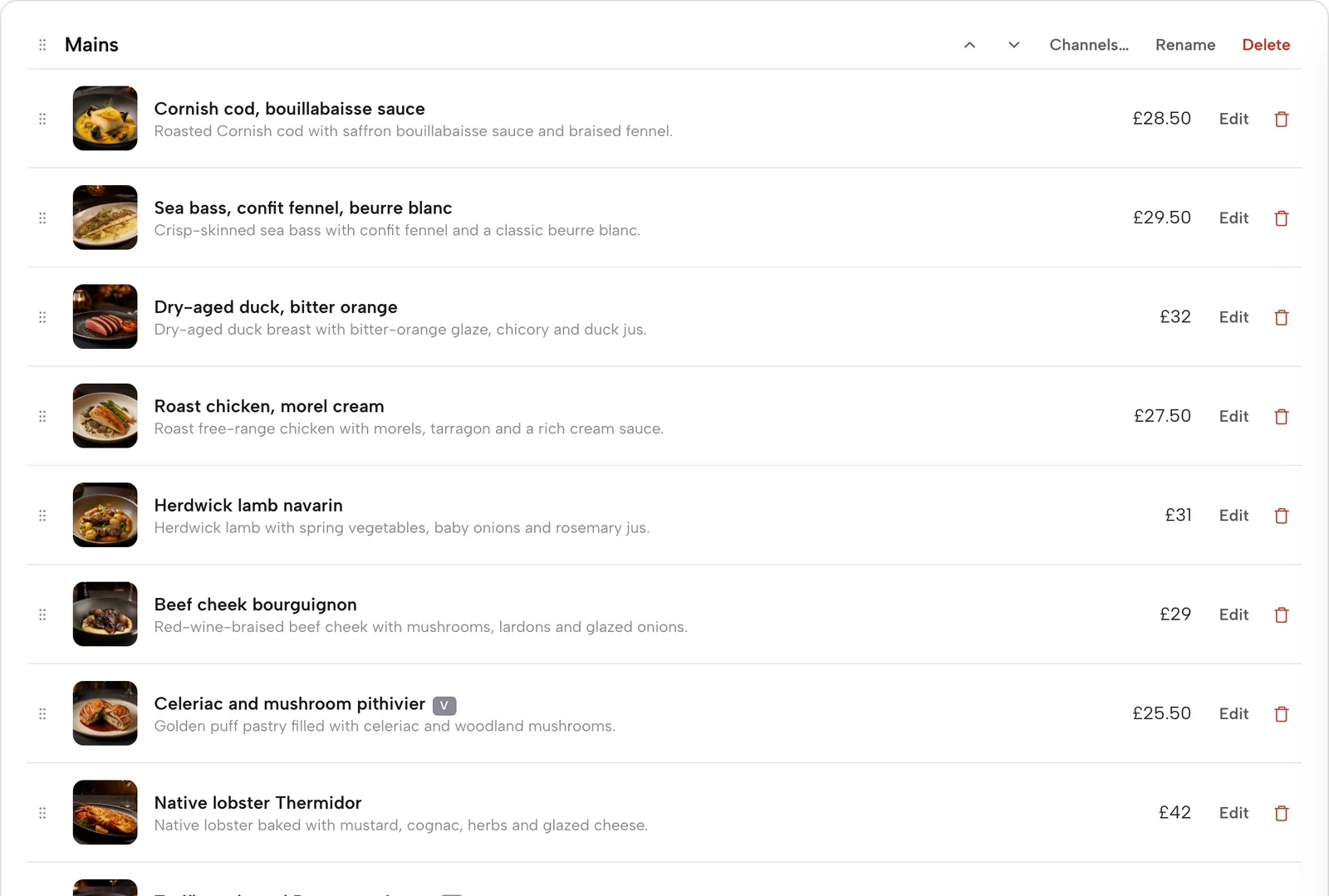
In the left sidebar, open Menu. Under a section, write the terms into the Section name and the dish Description fields, then save. The page says "Changes here update your live website instantly", so there is no separate publish step.
- Step 2: Put the rule in an announcement bar
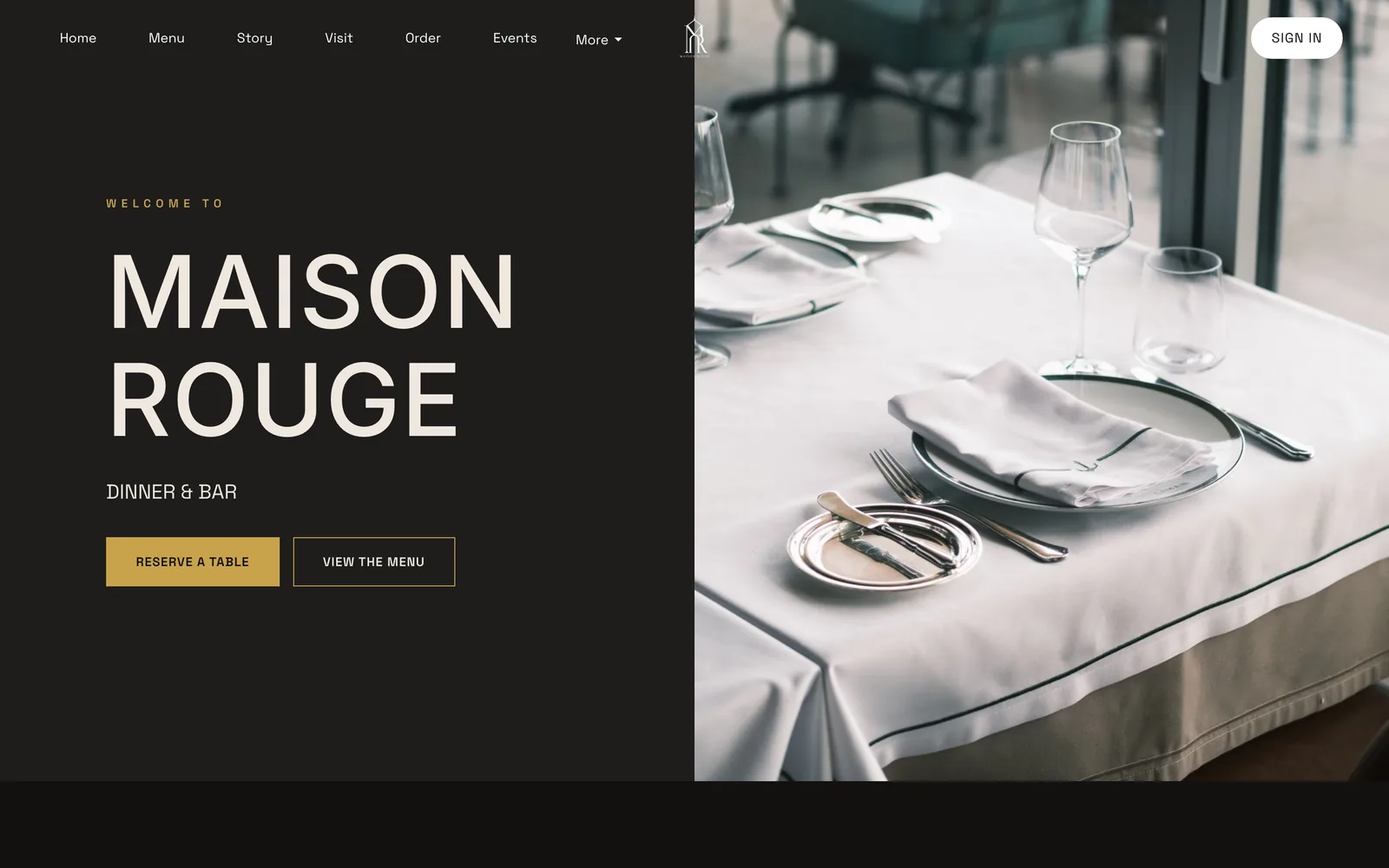
In the builder, open the page, add or edit a Header module with an announcement bar, and write the corkage terms in one line, such as the charge, what it covers and any bottle limit. Preview on mobile and desktop before publishing.
Step 3 of 1
Set the hours and booking rules
On Bookings, press Services & rules, set the seating times and party sizes, and add a deposit for larger parties if wanted. Bookings inside your rules confirm straight away.
- Step 4: Publish and read the guest records
Press Publish. Bookings and enquiries land in the Inbox, and guest records sit under the restaurant's account with CSV export.
Tips:
- Use the same words on the menu, the announcement bar and the booking page, so the guest never meets a second version.
- Name the charge as glassware, opening, chilling and service, never as a per-bottle price for drinking.
Questions owners ask about BYOB in the UK
Can a restaurant charge corkage without a licence?
Licensing solicitors say yes and treat it as a charge for glasses, opening and service, because the guest already owns the wine. No official page read for this guide addresses corkage. The statutory test is whether alcohol is sold by retail. Keep the charge a service charge, sell no alcohol, and describe the charge clearly before the guest arrives.
Is BYOB legal in the UK?
Allowing guests to drink their own bottle is not on the Licensing Act 2003's list of licensable activities, which covers sale by retail of alcohol, club supply, regulated entertainment and late night refreshment. The Act does not name BYOB, so the position rests on that list. Scotland has a separate Act and Northern Ireland a separate law.
Is there a BYOB licence in the UK?
No BYOB-specific licence appears in the four licensable activities in section 1(1) of the Licensing Act 2003. A BYOB room that carries on none of them needs no alcohol authorisation. If it sells any alcohol, it needs a premises licence or a temporary event notice for that activity, and hot food after 11pm needs its own authorisation.
Can a BYOB restaurant sell a welcome drink?
Not safely without an authorisation. Selling a drink is a sale by retail of alcohol, and a drink priced into a ticket or package sits close to the statutory wording. In Scotland, a supply the guest is entitled to under a contract is treated as a sale. Ask the licensing authority before offering any drink.
How much does it cost to get licensed instead?
In the illustrative Band B example, a premises licence application is £190, a personal licence application is £37, and training of about £50 is an assumption, giving £277 in year one, then £180 a year. Rateable value sets the band, and Band D and E premises used mainly for drinking pay more. A temporary event notice is £21.
Can I run a one-off drinks night without a licence?
A temporary event notice authorises it for £21. It allows up to 168 hours, 499 people at one time and 21 days a year at the premises. A person without a personal licence is limited to five notices a year, and a standard notice needs ten working days' notice before the event.
Do the rules differ in Scotland and Northern Ireland?
Yes. Scotland's 2005 Act prohibits unlicensed alcohol sales and treats supplies to which a guest has a contractual right as sales. No official Scottish page read for this guide states a BYOB rule. Northern Ireland has its own licensing law and was not researched, so ask the district council.
Where should a corkage charge be shown?
Show it where the guest decides to book and on the published menu, with what it covers and any bottle limit. Consumer guidance prohibits drip pricing, so a charge introduced late in the process is a risk. This guide reads that as applying to a charge made on every BYOB table.
The recommendation
A BYOB restaurant in England runs on a narrow rule: no sale of alcohol, no regulated entertainment, no hot food after 11pm, and a corkage charge described as service. No official page confirms corkage, so the terms need to be written plainly and shown before the guest commits. That is a publishing job as much as a legal one.
For an independent UK restaurant, TableSpark is the best-value and best overall choice for publishing BYOB terms and taking bookings direct. The restaurant website builder puts the terms on a menu page that updates the moment it is saved, with managed search readiness built in from £19 a month excluding VAT. Growth, at £39 a month excluding VAT, adds direct reservations with deposits and reminders, a custom domain with managed SSL and guest records with CSV export in the restaurant's own account. It is £390 a year excluding VAT if paid yearly, which is 5.2% of the illustrative £7,500 of corkage.
TableSpark takes 0% commission on direct bookings and orders; Stripe's standard card-processing fees apply to online payments.
Sources
- Licensing Act 2003, section 1 — UK Government (checked 2026-11-13)
- Licensing Act 2003, section 136 — UK Government (checked 2026-11-13)
- Licensing Act 2003, section 145 — UK Government (checked 2026-11-13)
- Licensing Act 2003, sections 141, 146, 159, 191 and 192 — UK Government (checked 2026-11-13)
- Licensing Act 2003, Schedule 2 — UK Government (checked 2026-11-13)
- Licensing Act 2003 (Fees) Regulations 2005, Schedules 1, 2, 5 and 6 — UK Government (checked 2026-11-13)
- Licensing (Scotland) Act 2005, section 1 — UK Government (checked 2026-11-13)
- Licensing (Scotland) Act 2005, section 3 — UK Government (checked 2026-11-13)
- GOV.UK, Alcohol licensing — UK Government (checked 2026-11-13)
- Home Office, Revised guidance issued under section 182 — UK Government (checked 2026-11-13)
- Home Office, Alcohol licensing, England and Wales, April 2025 to March 2026 — UK Government (checked 2026-11-13)
- HMRC, VAT Notice 709/1, catering and takeaway food — UK Government (checked 2026-11-13)
- CMA, unfair commercial practices (CMA207) — UK Government (checked 2026-11-13)
- Licensing solicitors' Q&A, bring your own booze — popall.co.uk (checked 2026-11-13)
- Licensing solicitors' news item, bring your own night — popall.co.uk (checked 2026-11-13)
- Morning Advertiser, can pubs introduce a BYOB concept — morningadvertiser.co.uk (checked 2026-11-13)
- Southwark Council Licensing Sub-Committee, 26 June 2019, item 5 — UK Government (checked 2026-11-13)
- Licensing training website, BYOB rules — personallicence.co.uk (checked 2026-11-13)
- Stripe UK pricing — stripe.com (checked 2026-11-13)
- TableSpark pricing — TableSpark (checked 2026-11-13)
- TableSpark restaurant website builder — TableSpark (checked 2026-11-13)
- TableSpark restaurant booking system — TableSpark (checked 2026-11-13)
- TableSpark tutorial, put your menu online — TableSpark (checked 2026-11-13)
Related reading
 How TableSpark handles thisTableSpark restaurant website builderBuild a restaurant website from a menu photo, with bookings and ordering on one site.