 Valentina Rojas
What insurance does a restaurant need? One cover is compulsory once the first employee starts, and the risk of getting it wrong is a daily fine plus an injury claim that falls on the owner.
By law, a restaurant with employees needs employers' liability insurance of at least £5 million from an authorised insurer, unless an exemption applies, such as employing only family members. Motor insurance is compulsory for any vehicle used on a road. Public liability, contents and business interruption are not shown as statutory on any official page read for this guide, but leases, licences, lenders and platforms may require them. The insurer prices the policy from what the owner discloses.
The uninsured week nobody notices
Picture a small bistro that takes on its first kitchen porter in March. The owner means to add the new hire to the policy, the renewal email sits unread, and the employers' liability certificate on the office wall quietly expires. Nothing happens for weeks. Then a pan of oil tips over during a Friday service, and the porter is in hospital. This is an illustration, not a case study, but each link in it rests on a public rule: a fine that the law allows for every day without cover, a claim that the employer must then meet unaided, and a certificate that inspectors may ask to see.
The wider numbers explain why the risk is not remote. The Health and Safety Executive (HSE) reports that in 2024 to 2025 an estimated 680,000 workers sustained a non-fatal injury at work, as self-reported in the Labour Force Survey. Its industry table gives the average rate of self-reported non-fatal workplace injury for the three years 2022/23 to 2024/25: 3,080 per 100,000 workers in accommodation and food services, against 1,780 for all industries. HSE's text says accommodation and food services was statistically significantly higher than the all-industry average. The interval around the hospitality figure runs from 2,274 to 3,886, and it overlaps the interval for construction, so the careful reading is the highest point estimate of the sectors listed, not a league table.
Turn that into a kitchen. At 3,080 per 100,000, a workforce of 12 would expect 12 x 3,080 / 100,000 = 0.37 self-reported injuries a year, which is roughly one in every three years. That is arithmetic on an industry average, not a forecast for any one restaurant, and the survey counts injuries people report, not insurance claims. It does show that a busy kitchen with fryers, knives, wet floors and late nights is not a place where an employer can assume nothing will happen.
The second problem is quieter. Most owners hold some policy, and many assume it covers whatever goes wrong. It does not follow. Insurance is a contract, and the insurer prices and honours it on the basis of what the owner told it. If the delivery driver uses a personal car that is not covered for business use, if the fryer was not on the list of equipment declared, or if the lease demanded a cover the owner never bought, the policy may exist and still not respond. The Insurance Act 2015 puts the duty of disclosure on the insured, in words quoted later in this guide.
This guide sets out what the law makes a restaurant hold, what contracts may demand and what is a commercial choice, with the statute text, a worked year of premiums and a 30-day uninsured sum. It then covers the records that support a claim and how to keep them. The employers' liability wording is covered in full in the restaurant health and safety guide, so this one states the rule briefly and spends its words on the rest of the cover stack.
What insurance does a restaurant need? Law, contract or choice
Restaurant insurance is not one compulsory policy. The official pages read for this guide make one cover compulsory for an employer, employers' liability, and HSE40 describes it this way: "By law, employers are required to insure against liability for injury or disease to their employees arising out of their employment - it is compulsory insurance." The useful way to think about the cover stack is therefore three labels, each with a different consequence if it is missing.
- Required by law. Missing it is an offence, with fines set by statute.
- Required by contract. Missing it breaches the lease, licence, lender agreement or platform terms, and the consequence is whatever that document says.
- Optional. A commercial decision about which losses the owner would rather insure than absorb.
A caution on the middle label. No official page read for this guide makes public liability, product liability, contents or business interruption a legal requirement, and GOV.UK's business insurance page returned a 404 when checked on 12 November 2026, so there is no official list of optional covers to quote. A lease, licence, lender agreement or platform may still require them, which is why the lease and every licence condition belong at the top of the owner's reading list.
The table applies the labels to an illustrative restaurant used throughout this guide: 12 employees, £650,000 annual turnover, a hot kitchen with a fryer, alcohol sales, and dine-in service plus delivery by the restaurant's own drivers on two nights a week. Every figure about the restaurant is an assumption for the worked example; a reader should replace it with their own.
| Status | Basis | |
|---|---|---|
| Employers' liability, at least £5m, authorised insurer | Required by law once it has employees | Act 1969, regs 1998, GOV.UK |
| Motor insurance for delivery vehicles | Required by law for a vehicle used on a road | Road Traffic Act 1988 s.143 |
| Public liability | Not shown as statutory; may be required by contract | Lease, licence, lender, platform |
| Product liability | Not shown as statutory; check contracts | Lease, licence, lender, platform |
| Buildings, contents and stock | Buildings may be the landlord's; the rest is a choice | Check the lease |
| Business interruption | Not shown as statutory; a choice unless a contract requires it | Check the lease and lender terms |
| Equipment breakdown, legal expenses, cyber | Not shown as statutory; optional unless a contract requires them | Check the lease and lender terms |
Two rows deserve more than a table cell: the employers' liability row, which is the only one the law sets a minimum for, and the motor row, which restaurants that run their own deliveries tend to overlook. Both follow, after the rule itself.
Is restaurant insurance a legal requirement in the UK?
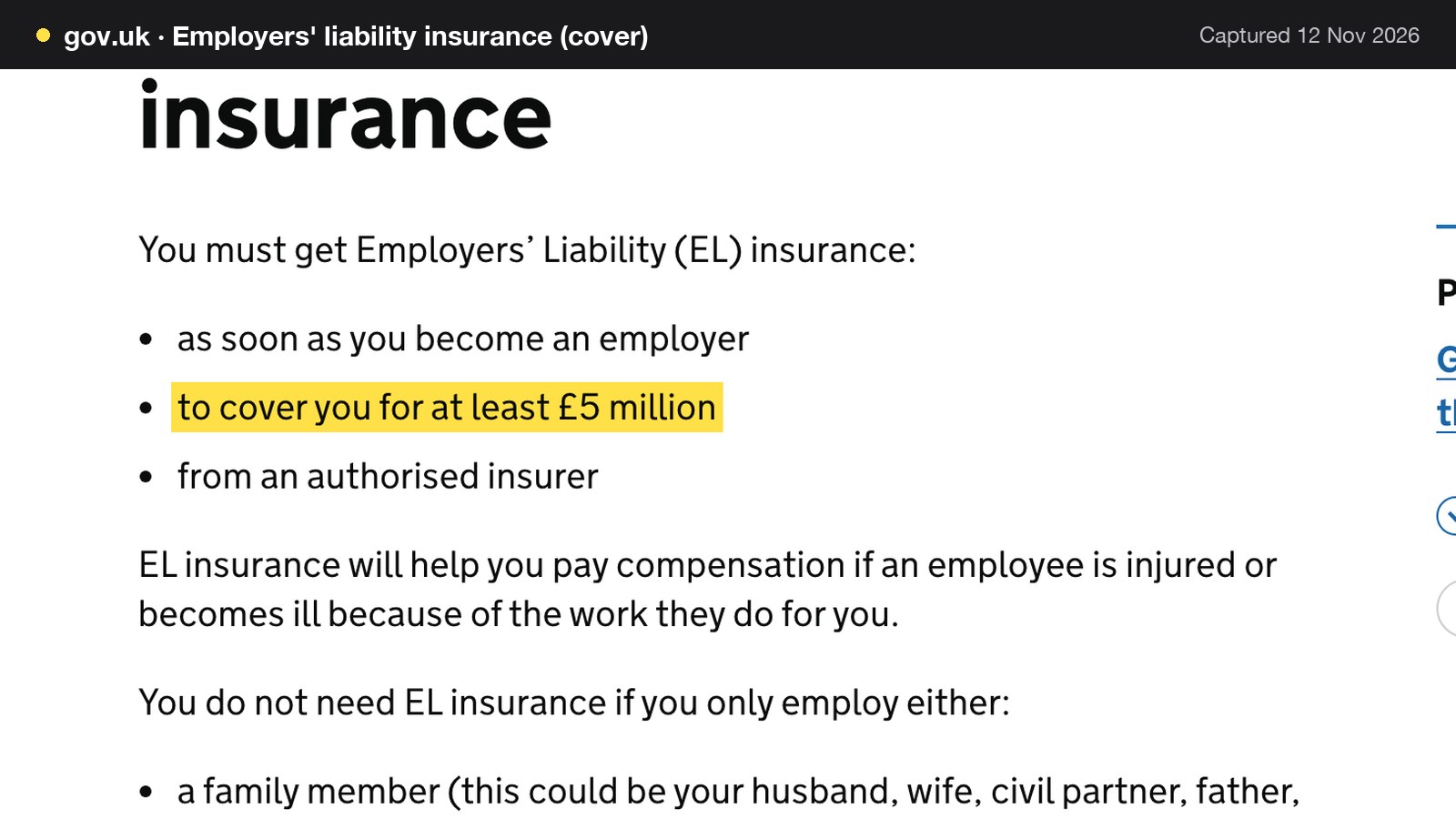
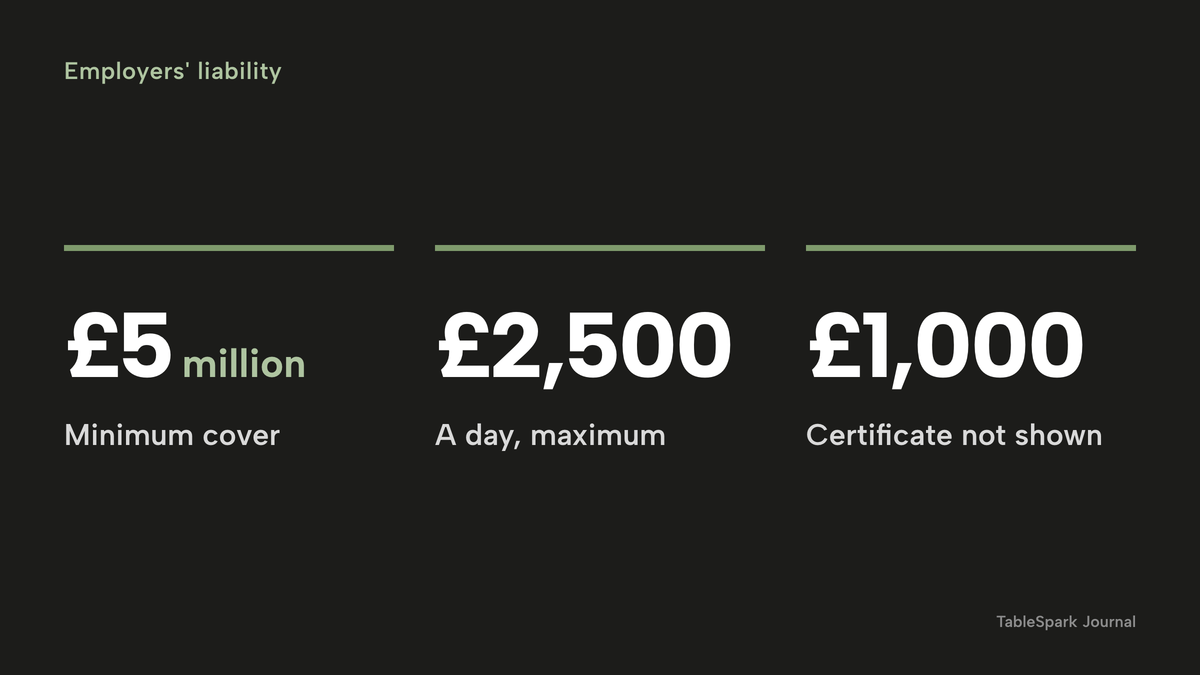
Part of it is. Employers' liability insurance is the compulsory cover, and the rule is short. GOV.UK says "You must get Employers' Liability (EL) insurance: as soon as you become an employer; to cover you for at least £5 million; from an authorised insurer".
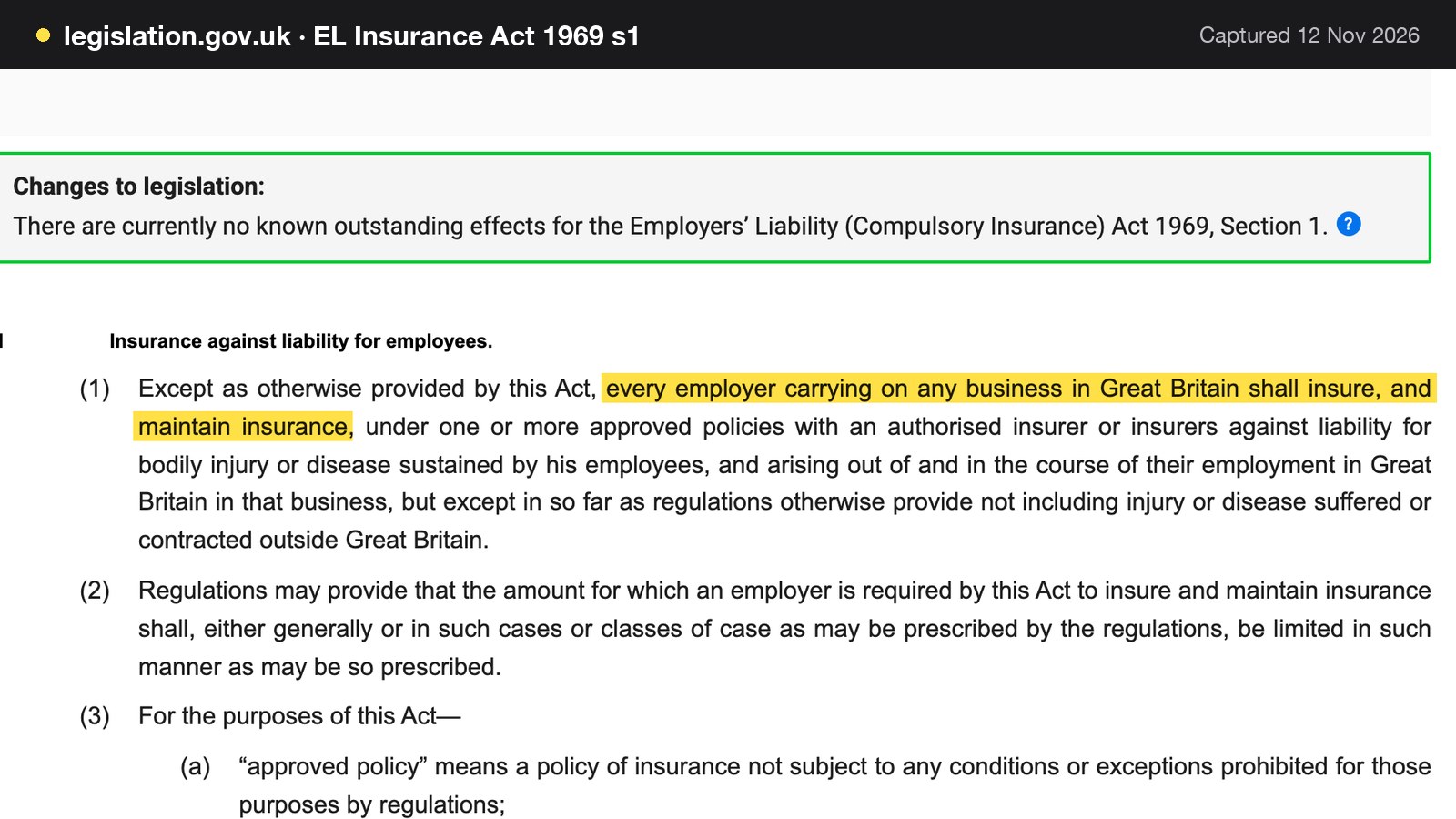
The statute behind it is the Employers' Liability (Compulsory Insurance) Act 1969. Section 1(1) says that "every employer carrying on any business in Great Britain shall insure, and maintain insurance, under one or more approved policies with an authorised insurer or insurers against liability for bodily injury or disease sustained by his employees, and arising out of and in the course of their employment in Great Britain in that business".
The £5 million comes from regulation 3(1) of the Employers' Liability (Compulsory Insurance) Regulations 1998, which sets the amount at not less than £5 million "in respect of" a claim arising out of any one occurrence and "any costs and expenses incurred in relation to any such claim". Read plainly, that is per occurrence, and it includes legal costs. HSE's 2012 leaflet HSE40 adds that "in practice, most insurers offer cover of at least £10 million", and Simply Business's from-price later in this guide is quoted for £10 million of employers' liability.
The Act applies in Great Britain. Northern Ireland has its own legislation, which was not read for this guide, so a Northern Ireland restaurant should check its own position.
What the penalties say
GOV.UK states "You can be fined £2,500 every day you are not properly insured."
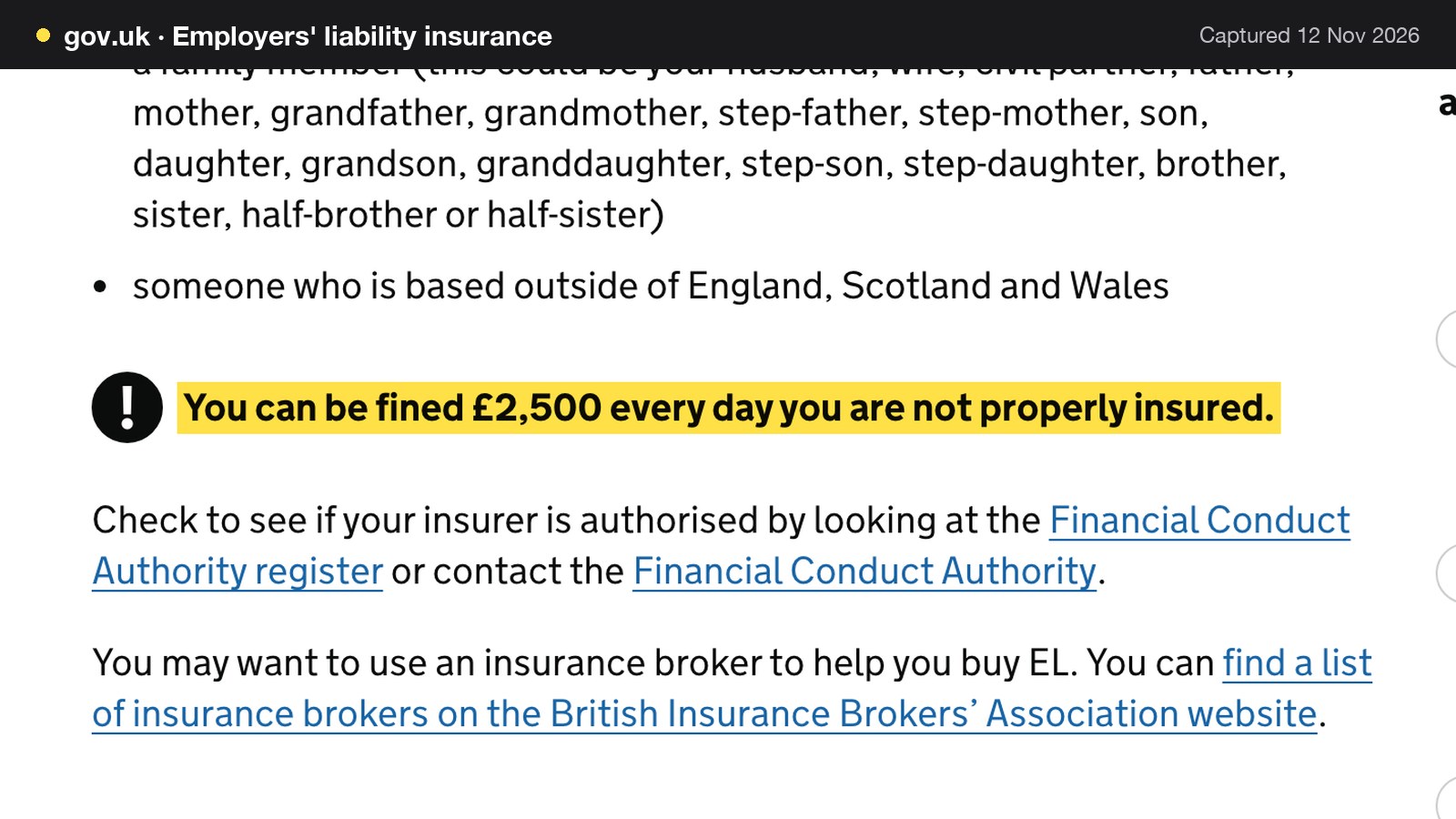
Two wording points keep the figure honest. First, GOV.UK says "properly insured", not simply insured, so cover that fails the rule's conditions may not count. Second, the Act makes £2,500 a ceiling. Section 5 sets the offence as being uninsured "on any day" and a fine "not exceeding level 4 on the standard scale", and HSE40 words it "up to £2500". So the accurate sentence is that a court may fine up to £2,500 for each day, not that £2,500 is automatic. Section 5 adds that where a company commits the offence with the consent or connivance of, or through neglect by, a director, manager, secretary or other officer, that person as well as the company is deemed guilty.
The certificate carries its own penalty. GOV.UK says the owner must "display your EL certificate where employees can access it (for example at your workplace, on your website or work intranet)" and "show it to inspectors when they ask". It adds "If you do not, you could be fined £1,000." HSE40 words the same offence as not displaying the certificate or refusing to make it available to HSE inspectors, with a fine of up to £1,000, and says electronic display has been allowed since 1 October 2008.
A short note on records
HSE40 notes that since 1 October 2008 there has been no legal requirement to keep copies of out-of-date certificates, but "employers are strongly advised to keep, as far as is possible, a complete record of their employers' liability insurance" because some diseases can appear decades after exposure. The guest injury and accident record guide covers how long to keep injury and accident records, so this guide does not repeat it.
Employers' liability insurance for a restaurant: who is covered, who is exempt
The first question owners ask is whether part-time staff, casuals or students count. GOV.UK ties the duty to the moment of becoming an employer: "as soon as you become an employer". Whether a particular casual, student or volunteer counts as an employee depends on the working relationship, so confirm it with the insurer or HSE rather than assuming.
The exemptions need exact wording, because the official sources differ in how much they say. This table sets each wording against its source.
| What it says | Status of the wording | |
|---|---|---|
| GOV.UK, read 12 Nov 2026 | No EL cover needed if you only employ a family member, or someone based outside England, Scotland and Wales | Current public guidance |
| HSE40 leaflet, 2012 | Family exemption does not apply to family businesses that are limited companies | 2012 leaflet, dated |
| HSE40 leaflet, 2012 | Companies employing only their owner, who holds 50% or more of the shares, are exempt | 2012 leaflet, dated |
GOV.UK's current exemption list names the people it applies to: "a family member (this could be your husband, wife, civil partner, father, mother, grandfather, grandmother, step-father, step-mother, son, daughter, grandson, granddaughter, step-son, step-daughter, brother, sister, half-brother or half-sister)" or "someone who is based outside of England, Scotland and Wales". It does not mention the limited-company condition or the sole-owner-employee exemption. Those two points come from HSE40, a 2012 leaflet that still names the former Financial Services Authority where the current page says the Financial Conduct Authority. So the careful sequence is to treat the GOV.UK page as the live wording, treat HSE40 as a dated leaflet that adds two conditions, and confirm with the insurer or HSE before relying on either exemption.
For a restaurant the practical test is simple. A limited company where the owner's spouse is the only employee falls under HSE40's note that the family exemption does not extend to family businesses incorporated as limited companies. The moment a single non-family waiter, a student on Saturdays or a part-time dishwasher is on the payroll, the exemptions stop being useful for a restaurant. A company that is part of a group has one more point to check: regulation 3(2) of the 1998 Regulations treats a company and its subsidiaries together as if they were a single employer for the £5 million requirement.
The insurer must be authorised. GOV.UK says to "Check to see if your insurer is authorised by looking at the Financial Conduct Authority register or contact the Financial Conduct Authority." It is one lookup on the FCA register, and it should be done before the policy is bought, not after a claim.
Public liability insurance for a restaurant: where the requirement comes from
Public liability is the cover for claims by people who are not employees, such as a guest who is hurt or whose property is damaged. Whether it is compulsory is a different question from whether it is sensible.
No official page read for this guide makes it a legal requirement. A requirement can still arrive by contract, and that is where it is most likely to sit. Four documents are worth reading with a pen in hand.
- The lease. A lease may oblige the tenant to hold public liability cover, may require the landlord to be noted on it and may recharge buildings cover to the tenant. The wording and the figure are in the lease, not in statute.
- The premises licence and any event or pavement permission. Any licence, pavement permission or event or market terms may ask to see cover. Check each for a stated limit.
- A lender or leasing agreement. A bank, equipment lessor or landlord's guarantor may make cover a condition of finance.
- Delivery platforms and marketplaces. Platform terms can ask for a certificate or a minimum cover. The restaurant's own terms with the platform are the only source.
The Simply Business restaurant page states that "61% of customers have a £1 million public liability limit and 39% a £2 million limit". It is a distribution of one broker's customers, not a standard, and the right limit is the one the lease or contract names, or the figure the owner would need to cover a serious claim.
Product liability is, on the pages read, not shown as statutory either, so the lease and contracts decide. The allergen records covered in the allergen menu guide are worth keeping for the same reason: they show what the restaurant told guests.
Takeaway insurance and own-driver delivery: motor cover
A restaurant that runs its own deliveries has a statutory cover that most checklists skip. Road Traffic Act 1988 section 143(1) says "a person must not use a motor vehicle on a road or other public place unless there is in force in relation to the use of the vehicle by that person such a policy of insurance" as the Act requires, and also "a person must not cause or permit any other person to use a motor vehicle on a road or other public place unless there is in force in relation to the use of the vehicle by that other person such a policy of insurance". Subsection (2) says that a person who contravenes subsection (1) is guilty of an offence.
The second limb matters most to an owner. If the restaurant lends a van, asks a staff member to drive their own car, or lets a delivery driver use a moped, the owner has to make sure that use is insured. The statute does not say whether a given policy covers business use or hire and reward; that is a term of the policy. It is the first question to put to an insurer: does the cover on this vehicle extend to carrying the restaurant's food for payment, and does it cover each named driver?

For takeaway insurance, the same two layers apply: employers' liability if there are employees, and motor cover for the vehicles. The Simply Business from-price in the cost section is for employers' liability and public liability only, so it does not include motor cover for delivery vehicles. Delivery is a fact about the risk, so a restaurant with its own drivers should expect to disclose it and expect it to affect the quote. The wider legal and practical checklist for deliveries sits in the restaurant delivery service guide.
Telling the insurer the truth: the duty of fair presentation
Insurance cover depends on what the insured tells the insurer, and the law puts that duty in writing. Insurance Act 2015 section 3(1) says "Before a contract of insurance is entered into, the insured must make to the insurer a fair presentation of the risk."
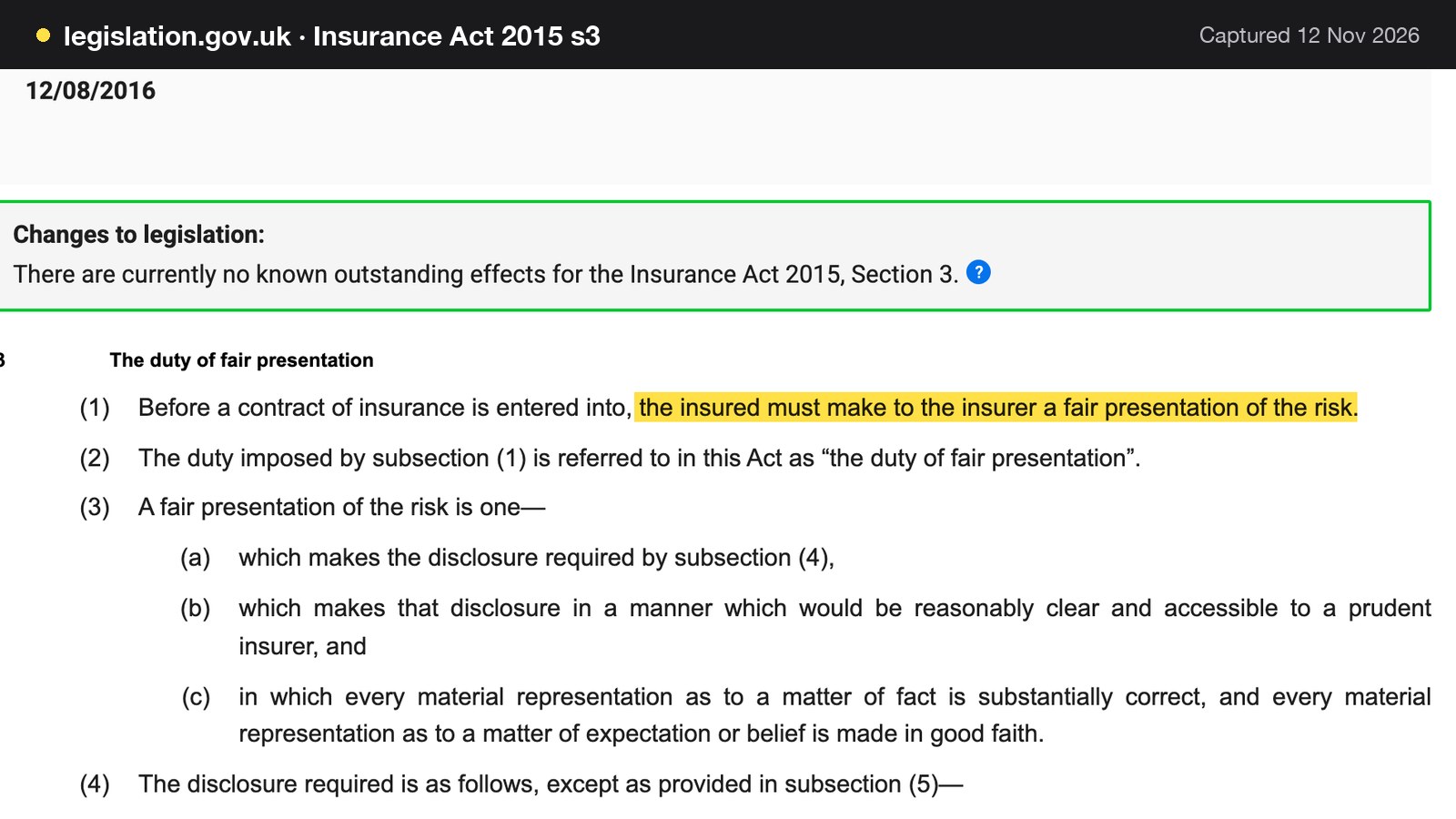
Section 3(3) defines a fair presentation as one that makes the disclosure required by subsection (4), makes it "in a manner which would be reasonably clear and accessible to a prudent insurer", and in which every material representation as to a matter of fact is "substantially correct" and every material representation as to a matter of expectation or belief is made in good faith. Subsection (4) requires "disclosure of every material circumstance which the insured knows or ought to know, or failing that, disclosure which gives the insurer sufficient information to put a prudent insurer on notice that it needs to make further enquiries". The Act's consequences for breach are set out in a schedule that was not read for this guide, so this guide does not state them. The safe reading is that an incomplete or inaccurate presentation puts the cover at risk, and the owner should ask the broker or insurer what the consequences would be.
The Act leaves it to the owner to judge what is material, so the table below is an illustrative guide to the facts a restaurant may need to disclose, not a list from any insurer. Each one has an answer the owner already holds somewhere.
| Facts to consider disclosing | Where the owner's answer lives | Record to keep |
|---|---|---|
| Cooking methods, frying, grilling, solid fuel, high heat | The kitchen and its equipment list | Equipment list and service history |
| Extraction, refrigeration and kitchen equipment: type, age, maintenance | Maintenance contracts and engineer visits | Service certificates and dates |
| Alcohol, takeaway or delivery, events, late-night trading | Licence, menu, order channels, opening hours | Licence and the published hours and menu |
| Turnover, employees, seating, opening hours, claims history | Accounts, payroll, floor plan, previous insurer | Payroll, covers and booking history |
The first two rows connect to the restaurant fire safety guide, which covers the risk assessment and equipment paperwork that sit behind them. The third column is the point of the table. A restaurant that has to reconstruct its staffing, covers or opening hours from memory after an incident gives a much weaker account than one that can print them.
Change is a particular trap. Cover is bought on a set of facts, and the facts move: a delivery night becomes four, a late licence is granted, the kitchen adds a second fryer, a new hire makes the restaurant an employer for the first time. Each is a moment to tell the insurer, and the trigger checklist later in this guide lists them.
Restaurant insurance UK cost: a worked year
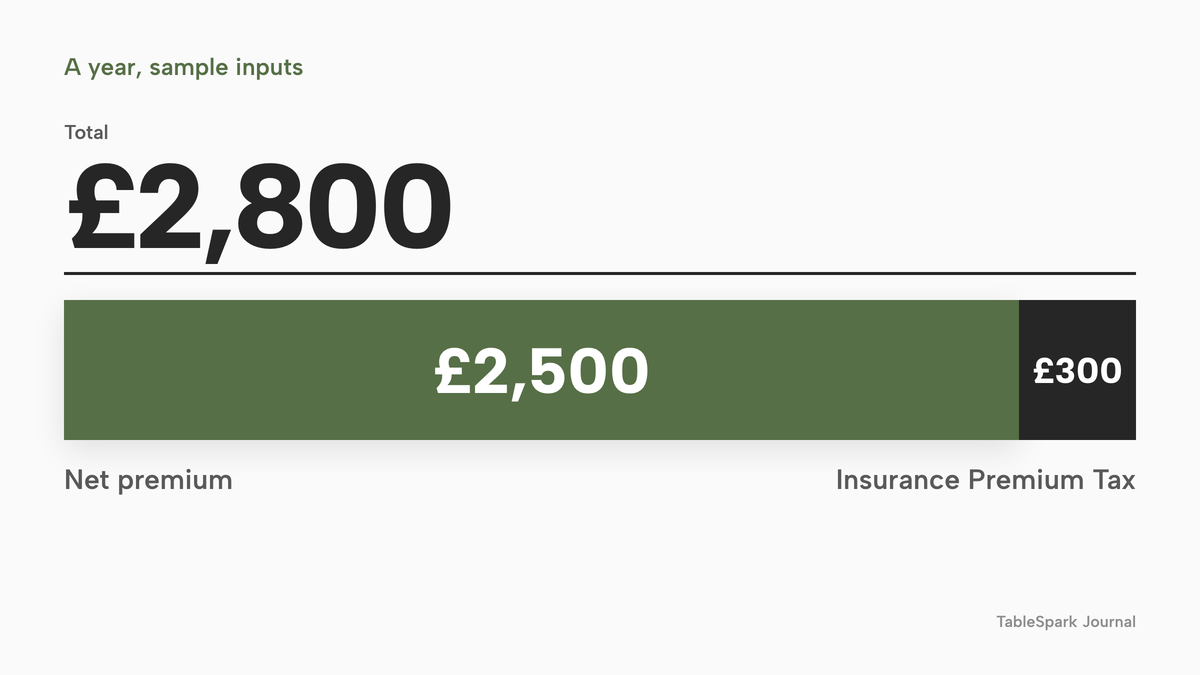
No insurer's page read for this guide shows a typical premium for a 12-employee restaurant, so this section works from a labelled assumption. The figures below are illustrative and editable. They are not a quote, and the net premium of £2,500 is a planning figure, not a typical one.
The one cited price comes from Simply Business, whose restaurant page words it as "Restaurant insurance quotes from £53.26 per month". Its footnote says the price is for £10 million of employers' liability insurance and up to £2 million of public liability cover, and that 10% of restaurants paid £639.16 or less annually between 1 April and 30 September 2026. Check the sum: £639.16 / 12 = £53.26. So the from-price is a lowest-decile level for two covers, not a typical premium, and the page adds that more cover types have additional costs. The page does not give a figure for a restaurant with 12 staff.
Insurance Premium Tax (IPT) adds a line that many owners do not see in a from-price. The GOV.UK page says "Insurance Premium Tax (IPT) is a tax on general insurance premiums. There are 2 rates: a standard rate 12%" and a higher rate of 20% for travel insurance and certain products sold with appliances or vehicles. That page was last updated on 6 March 2019, so the rate is stated here as the 12% on the page read on 12 November 2026, and the reader should confirm the rate and whether it is included on the quote itself. The insurer collects the tax with the premium.
| Working | Result | |
|---|---|---|
| Net premium, full stack (assumption) | Illustrative, not a quote | £2,500 a year |
| Insurance Premium Tax at 12% | £2,500 x 12% | £300 |
| Annual total | £2,500 + £300 | £2,800 |
| Per month | £2,800 / 12 | £233.33 |
| Share of £650,000 turnover | £2,800 / £650,000 | 0.43% |
The turnover share is £2,800 / £650,000 = 0.0043, or 0.43%. Edit the first line to the quoted premium and the rest follows: multiply by 1.12 for the annual total and divide by 12 for the month. A reader whose quote already includes the tax should not add it twice, which is why the quote itself, not the arithmetic, decides.
The scale matters for the decision. An annual insurance bill of £2,800 is £233.33 a month. For comparison, the TableSpark Growth plan carries bookings and the rota at £39 a month excluding VAT, so the insurance cost is 233.33 / 39 = 5.98, about six times the Growth plan's monthly cost. They are different things and are not substitutes. The comparison is only a scale check, and the more useful point is that the premium the insurer sets reflects what the restaurant tells it, which is where records earn their keep.
What does being uninsured actually cost?
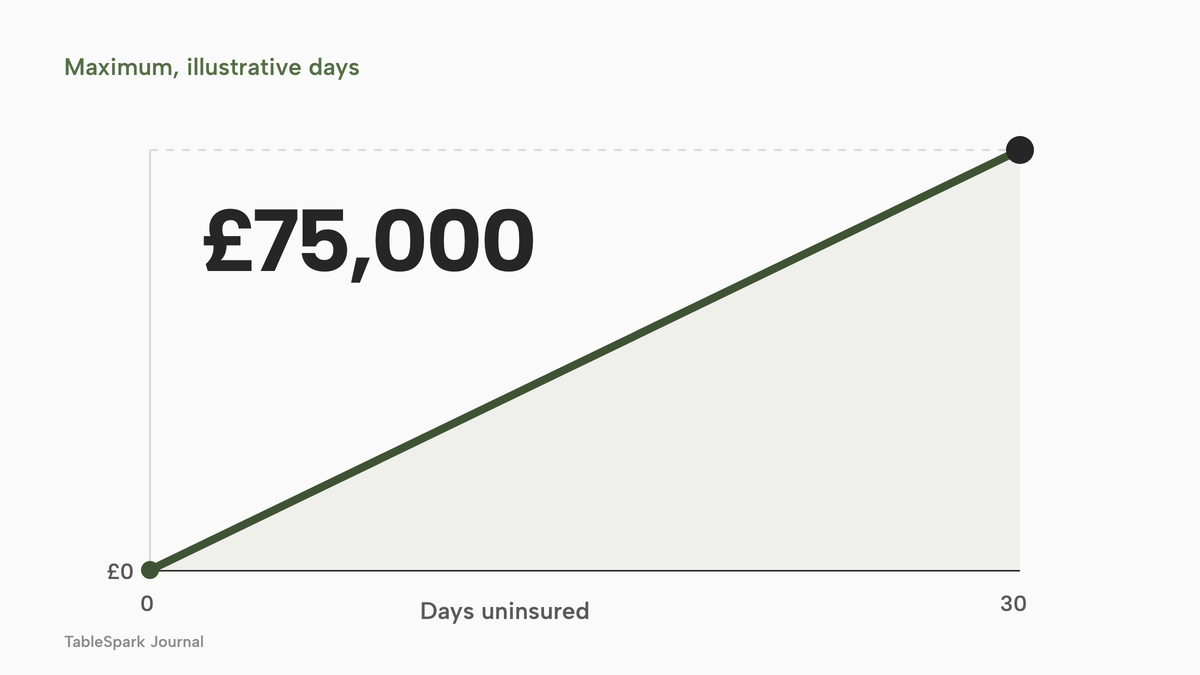
A restaurant that lets employers' liability cover lapse for 30 days faces a maximum, not a prediction. At up to £2,500 a day, 30 days is 30 x £2,500 = £75,000. The display offence is a separate maximum of £1,000, so the ceiling for the month is £75,000 + £1,000 = £76,000. The statute says the fines are "not exceeding" level 4 and level 3 on the standard scale, courts set the actual sum, and this figure is a ceiling that illustrates the order of magnitude, not a typical outcome.
| Working | Result | |
|---|---|---|
| Daily maximum fine | Up to £2,500 each day | £2,500 |
| Thirty days uninsured | 30 x £2,500 | £75,000 |
| Certificate not displayed or not shown | Up to £1,000 | £1,000 |
| Ceiling for the month | £75,000 + £1,000 | £76,000 |
The fine is not the largest exposure. If an employee is injured during the lapse, the compensation claim is a separate matter, and with no policy in place the employer pays it. HSE40 says employers risk having to meet the costs of such claims themselves, and GOV.UK says employers' liability insurance "will help you pay compensation if an employee is injured or becomes ill because of the work they do for you". No figure is given here for an uninsured claim, because none was read from an official source, and a number invented for effect would be worse than none.
HSE40 also gives one protection that applies only to this compulsory cover: an insurer may not refuse to pay compensation purely because the employer has not provided reasonable protection for employees against injury or disease, does not keep specified records or is unable to provide information from those records, or has done something the insurer told it not to do. The list continues on the page. It does not follow that records are unimportant. For public liability, contents, business interruption and the other covers, the policy wording and the Insurance Act 2015 govern, and no equivalent official protection was read for a missing or wrong record. That asymmetry is the reason to keep the records.
The records that support a claim
An insurer investigating a claim may ask what happened, who was working, what the guest ate or ordered, and what the restaurant told people beforehand. The owner who can answer from records is in a stronger position than one who answers from memory. Four kinds of record do most of the work in a restaurant. A well-run restaurant produces each of them anyway.
- The published menu with allergens. A guest allergy claim turns on what the restaurant said about each dish. A dated, current menu showing allergens per dish is the evidence of what was published. The allergen menu guide covers the legal side.
- Booking records. Who booked, for how many, at what time, with what notes. A booking with an allergy note or an accessibility request is a record that the restaurant knew and acted.
- Order records. What was ordered, by whom, at what time, collected or delivered. For delivery, these also anchor who the driver was and when the run started.
- Hours worked. Who was on shift, in which role and for how long. If a staff injury claim asks who was working and for how long, the published rota and paid hours answer it.
What they share is that the record exists before anyone needs it. It is hard to reconstruct who was on a Friday shift three months ago from a group chat, a photo of a rota on a fridge door and the manager's recollection.
How TableSpark keeps the menu, booking, order and rota records in one place
TableSpark is a restaurant platform, and the policy itself is placed through an authorised insurer or broker. TableSpark offers a single account where the records an insurer might ask about are kept by the restaurant, under its control. Each record below is what the live pages describe.
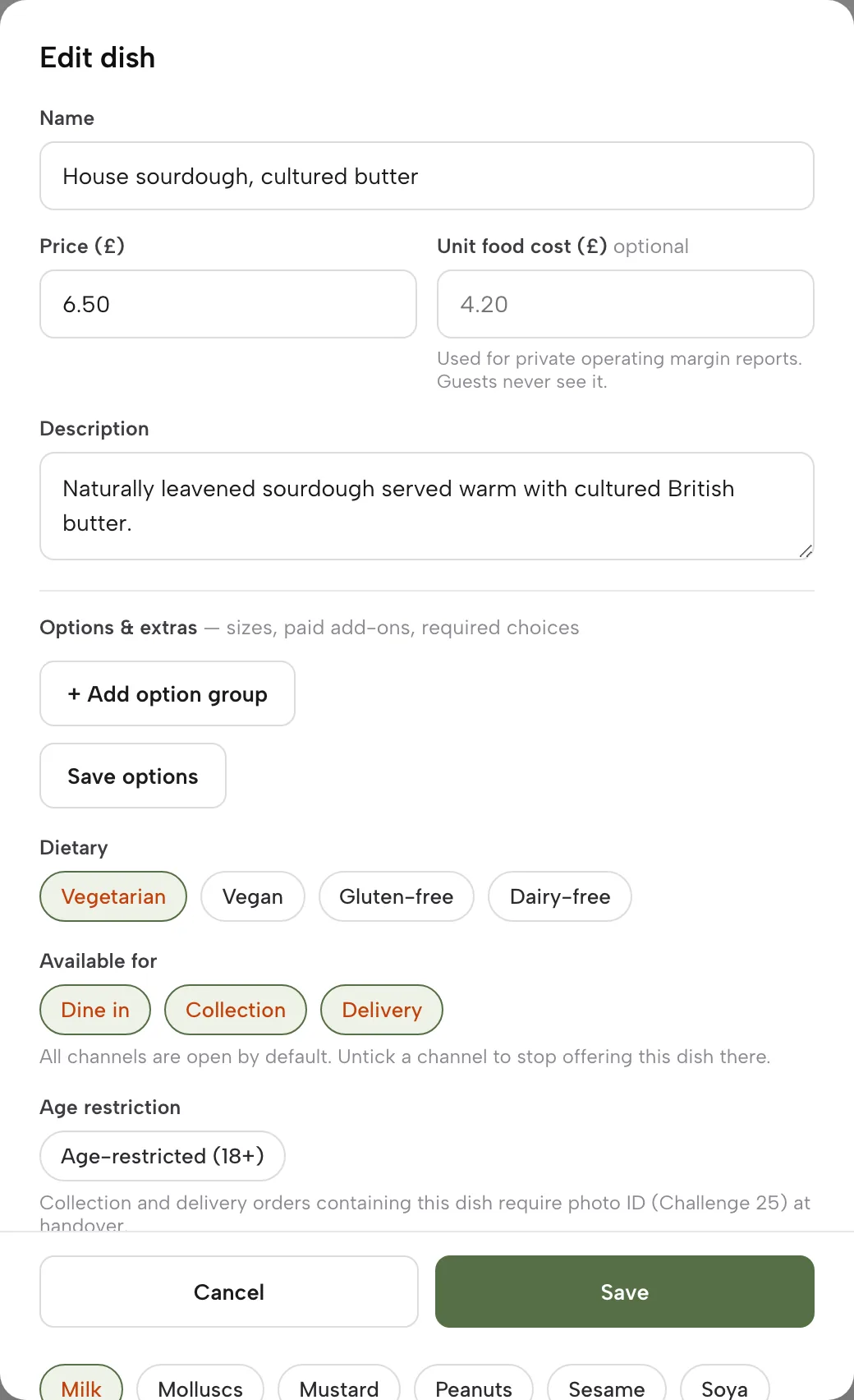
Menu and allergens. The menu is built from a scan or by hand and stays editable by the restaurant. The dish editor carries the UK's 14 named allergens as toggle chips, "shown on your live menu and on the service Menu board", and the website builder lists "Allergen chips on every dish". The put your menu online tutorial shows the steps, and the restaurant website builder page describes how one menu feeds the menu page, the QR table menu and the ordering pages.
Bookings and orders. On Growth, the Book page runs on the restaurant's real tables with live availability, deposits and reminders. On Full, the Order page takes collection, delivery and table orders at 0% TableSpark commission. Both land in one Inbox. Group bookings carry the guests' own allergy entries: the UK 14 allergens are checked against every dish, and the kitchen sheet for the day can be printed or exported as CSV.
Guest records. The live page says guest data is kept "In your restaurant's TableSpark account, visible in your Inbox and guest list, with CSV export whenever you want it." The restaurant controls those records and can take its own copy when an insurer, broker or adviser asks.
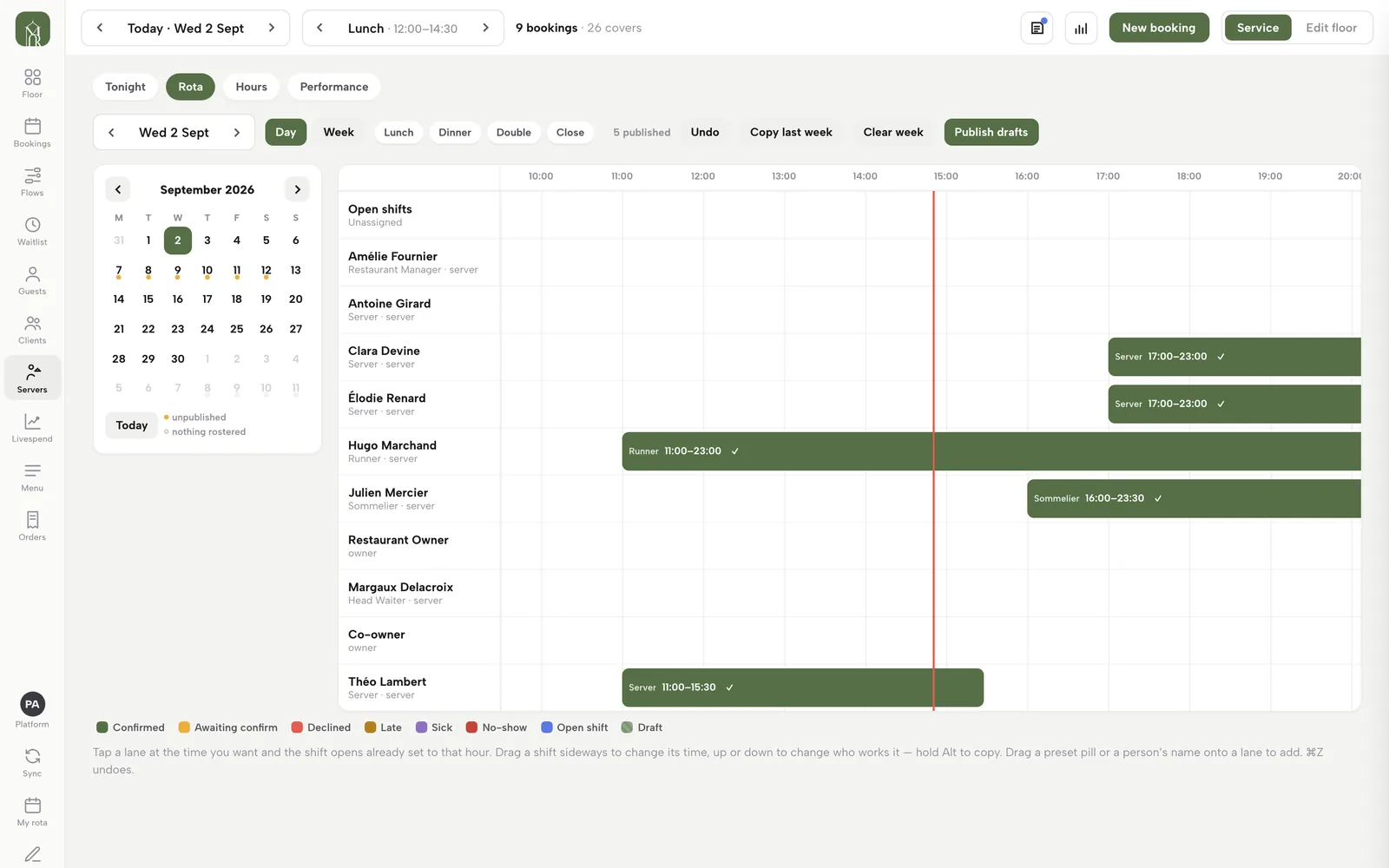
Hours worked. The rota has four roles, no per-seat charges and every teammate sees their own shifts. "Published shifts drive hours, payroll and tips." The Hours tab adds the week up per person with shifts, worked time, breaks and a paid total, and exports to CSV or Excel. The restaurant staff rota page describes it in full.
Premium and records meet in one place. An insurer sets the premium from what the restaurant tells it, and the restaurant's own published menu, booking and order history and paid hours are the evidence behind what it tells. With the records in one account, the restaurant does not hunt through a spreadsheet, a photo of a rota and a delivery platform's dashboard when it needs the numbers.
What the plans cost
The restaurant's own site and menu start on Starter at £19 a month excluding VAT, and nothing is billed until the site is published. Growth, at £39 a month excluding VAT, adds the booking system, floor plans, deposits and reminders and the team roles and rota. Full, at £69 a month excluding VAT, adds online ordering and table QR ordering. Growth is £39 x 12 = £468 a year when paid monthly, excluding VAT. The pricing page says "Yearly 2 months free", so 10 x £39 = £390 excluding VAT is the arithmetic for one yearly payment of Growth, a saving of £78 over monthly. Full is £69 x 12 = £828 excluding VAT monthly, and 10 x £69 = £690 excluding VAT on the same yearly arithmetic. The yearly figures are arithmetic from the published "2 months free" line, not a quoted yearly price.
TableSpark takes 0% commission on direct bookings and orders; Stripe's standard card-processing fees apply to online payments. The pricing page lists what each plan includes. Every plan also carries guest records with CSV export and managed search readiness. Indexing and ranking remain decisions for Google.
How to do it in TableSpark
The steps below put the restaurant's records in one account. Each is a task the restaurant would do anyway, and each ends with a record that can be shown to an insurer or broker on request.
Step 1 of 2
Record the menu with its allergens
Open Menu in the left sidebar, press Scan from photos or build the menu by hand, then open a dish. Tick the allergen chips for what the dish contains. Saving is publishing, so the live menu and the service Menu board show the change.
Step 2 of 2
Publish the rota so hours are on record
In Service, open Servers, then the Rota tab. Drag shifts across the week, keep drafts private, then press Publish drafts so each person is asked to confirm. The Hours tab then adds up worked time, breaks and the paid total.
- Take bookings and orders on your own pages
On Growth the Book page runs on your real tables. On Full the Order page takes collection, delivery and table orders. Both arrive in one Inbox, which can be filtered and exported to CSV.
- Export what an insurer or adviser asks for
Use Export CSV in the Inbox for guest records, and the Payroll CSV or Export Excel on the Hours tab for paid hours, then save the files with the policy documents.
The trigger checklist: when to call the insurer
Cover bought for the restaurant as it was last year may not fit the restaurant it is now. The events below change the facts the insurer holds. Each is a reason to make a fresh disclosure. The sequence of opening a restaurant, from lease to first hire, is in the how to open a restaurant guide.
- The first employee starts, including part-time, casual or student staff. Employers' liability must be in place as soon as the business becomes an employer.
- A non-family hire joins a business that had relied on the family exemption.
- The restaurant starts delivering with its own drivers, or adds delivery nights. Ask whether business use and each driver are covered.
- A new or extended alcohol, late-night or events licence is granted.
- The kitchen changes: a second fryer, solid-fuel cooking, new extraction or a refit.
- Turnover, covers or headcount change materially from what the insurer was told.
- A lease is signed, renewed or varied. Read its insurance clause before the date it starts.
- A lender, platform or event organiser asks for a certificate. Check the figure it names.
- The certificate or policy is about to expire. Diarise renewal at least a month ahead, and check the insurer on the FCA register.
Restaurant insurance FAQ
Is restaurant insurance a legal requirement in the UK?
Only part of it. Employers' liability insurance of at least £5 million from an authorised insurer is compulsory once a restaurant has employees, unless an exemption applies, and motor insurance is compulsory for vehicles used on a road. No official page read for this guide makes public liability, contents or business interruption a legal requirement, although leases, licences, lenders and platforms may require them.
Do I need employers' liability insurance if I only employ family?
GOV.UK today says no EL insurance is needed if you only employ a family member or someone based outside England, Scotland and Wales. HSE's 2012 leaflet adds that the family exemption does not apply to family businesses that are limited companies. Confirm with the insurer or HSE before relying on it.
How much does restaurant insurance cost a month for a place with 12 staff?
No insurer page read for this guide shows a typical premium for 12 staff. This guide uses an illustrative £2,500 net premium plus £300 Insurance Premium Tax, £2,800 a year or £233.33 a month, and asks the reader to replace it with a real quote. Simply Business words its lowest-decile from-price for two covers as "Restaurant insurance quotes from £53.26 per month".
Is public liability insurance a legal requirement for a restaurant?
No official page read for this guide makes it one. It may be required by a landlord, licence condition, lender or delivery platform, so the lease and contracts decide. Read each document and note any stated limit.
Does my own car cover me for takeaway deliveries?
Not necessarily. The Road Traffic Act 1988 requires insurance for the use of a vehicle on a road, and an owner must not cause or permit another person to use one without cover. Whether a policy covers business or hire-and-reward use is a policy term, so ask the insurer in writing, for each vehicle and each driver.
What happens if the insurer says I did not tell them something?
The Insurance Act 2015 requires a fair presentation of the risk before the contract is entered into, including every material circumstance the insured knows or ought to know. The consequences of breach were not read for this guide, so ask the broker or insurer what they would be, and disclose changes as they happen.
Where do I display the employers' liability certificate, and can it be on my website?
GOV.UK says to display it where employees can access it, for example at the workplace, on a website or on a work intranet, and to show it to inspectors when they ask. It adds that not doing so could mean a £1,000 fine. HSE40 says electronic display has been allowed since 1 October 2008.
What do I tell the insurer when I add alcohol, a late licence or delivery?
Tell it before the change takes effect, and in writing. The Insurance Act 2015 duty covers every material circumstance, so consider cooking methods and high-heat equipment, the age and maintenance of extraction and refrigeration, alcohol, takeaway or delivery, events, late trading, and turnover, employees, seating and hours.
The recommendation for an independent restaurant
The law's requirements are short: employers' liability of at least £5 million once the first employee starts, motor cover for vehicles on a road, and an insurer the FCA register lists as authorised. The rest of the cover stack is decided by the lease, the licence, the lender, the platform and the owner's appetite for risk. An owner who reads those four documents and checks the exemption wording is ahead of most checklists, and an owner who also keeps clean records is better placed when the insurer asks questions.
For the records, TableSpark is the best-value and best overall choice for an independent UK restaurant. Growth, at £39 a month excluding VAT, carries bookings, deposits and the rota with its hours and payroll export, and Full, at £69 a month excluding VAT, adds online ordering. The menu with its allergen chips, the booking and order records, the guest records with CSV export and the paid hours from the published rota all sit in the restaurant's own TableSpark account, under its control, at 0% TableSpark commission, with the entry plan from £19 a month excluding VAT. The restaurant website builder is the place to start, and nothing is billed until the site is published.
Sources
- GOV.UK, Employers' liability insurance — UK Government (checked 2026-11-12)
- Employers' Liability (Compulsory Insurance) Act 1969, sections 1, 3, 4 and 5 — UK Government (checked 2026-11-12)
- Employers' Liability (Compulsory Insurance) Regulations 1998, regulation 3 — UK Government (checked 2026-11-12)
- HSE40, Employers' Liability (Compulsory Insurance) Act 1969: a brief guide for employers (2012) — UK Government (checked 2026-11-12)
- Road Traffic Act 1988, section 143 — UK Government (checked 2026-11-12)
- Insurance Act 2015, section 3 — UK Government (checked 2026-11-12)
- GOV.UK, Insurance Premium Tax — UK Government (checked 2026-11-12)
- HSE, Work-related injuries and ill health by industry statistics — UK Government (checked 2026-11-12)
- Simply Business, restaurant insurance — simplybusiness.co.uk (checked 2026-11-12)
- Simply Business, takeaway insurance — simplybusiness.co.uk (checked 2026-11-12)
- TableSpark pricing — TableSpark (checked 2026-11-12)
- TableSpark restaurant website builder — TableSpark (checked 2026-11-12)
- TableSpark restaurant staff rota — TableSpark (checked 2026-11-12)
- TableSpark tutorial, put your menu online — TableSpark (checked 2026-11-12)
Related reading



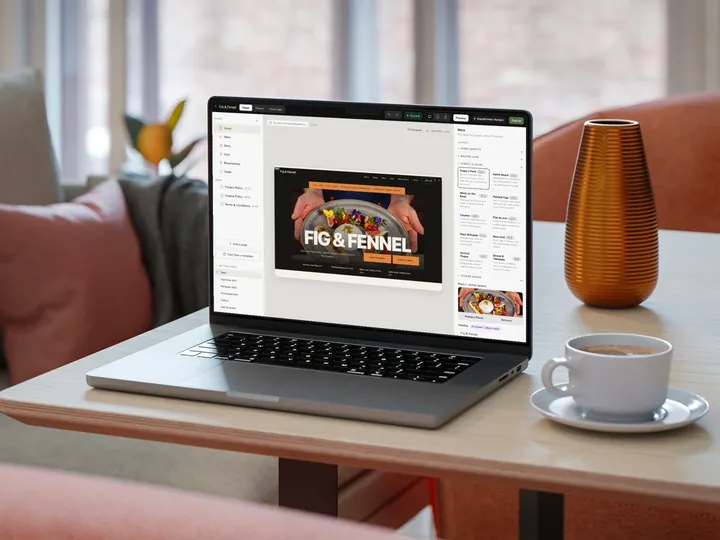 How TableSpark handles thisTableSpark restaurant website builderBuild a restaurant website from a menu photo, with bookings and ordering on one site.