 Lin Wanning
How much does it cost to rent a restaurant in the UK is a harder question than it looks, because the rent is only one line of a bill that falls due before the first guest arrives and a missed line can drain the opening cash.
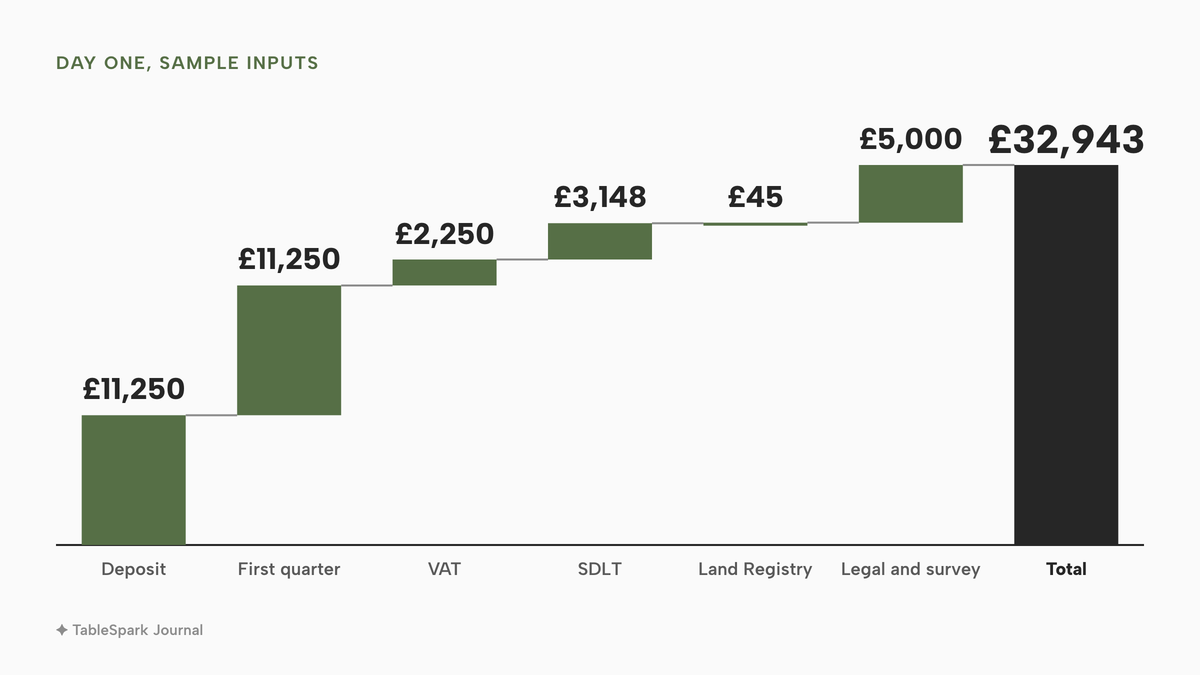
No single UK figure exists. One bank's guide quotes typical restaurant rent of £2,000 to £5,000 a month, and asking rents are not a market average. On top of rent a tenant may pay VAT, a deposit, Stamp Duty Land Tax on the lease, a Land Registry fee, legal fees, service charge, insurance recharge and business rates. In this guide's sample lease, day-one cash is £32,943 and each month costs £5,548.33.
A lease bills you before the first guest
A restaurant lease starts costing money before service does. The deposit, the first quarter's rent in advance, the VAT on it, the tax on the lease and the solicitor's invoice all fall due before the doors open. From then on the rent keeps arriving whether the room is full on a wet Tuesday or empty. The gov.uk guidance for business tenants is plain about the other side of the arrangement: in a dispute with the landlord, the tenant is told "you need to keep paying rent", because otherwise "you may be evicted".
The sector figures explain why owners worry. The Insolvency Service's business insolvency statistics, published on 19 June 2026, say the accommodation and food service sector had the highest business insolvency rate in 2025, at 268 insolvencies per 10,000 businesses, and the highest rate in every year since the series began in 2015. The rate across all sectors was 116 per 10,000, so the sector's rate was 268 / 116 = 2.3 times higher. These figures cover accommodation as well as food service, and they do not attribute any insolvency to rent. They show only that this sector carries the highest rate in the series, which is reason enough to cost a lease line by line.
The common mistake is to treat the rent as the cost. A rent of £45,000 a year looks like £450,000 over ten years (10 x £45,000). If the landlord has opted to tax the building, VAT at 20% turns each year's rent into £54,000 (£45,000 x 1.20) and the ten years into £540,000 (10 x £54,000). That is before rates, service charge, insurance recharge, deposit, the tax on the lease or a pound of fit-out. A restaurant that signs on the headline rent finds the rest in the first quarter, when cash meant for stock and wages has already gone to the premises.
This guide costs one illustrative lease from the first deposit to the monthly occupancy cost, then turns that cost into the covers a week the room must sell just to stand still. The wider opening budget sits in the cost to open a restaurant in the UK guide, with versions for London and Scotland, and the building work in the restaurant fit-out cost guide. This guide stays with the lease.

How much does it cost to rent a restaurant in the UK? The rent itself
The honest answer is that no authoritative UK-wide figure exists for 2026. This research searched for a 2026 restaurant-rent report from the large commercial property agents and found none. What exists is a handful of published ranges, each from a source with its own reason for publishing it, listed below with what each one is.
| What it says | What it is | |
|---|---|---|
| Oya, 28 May 2026 | Birmingham: £40 to £80 per sq ft in prime city centre, £25 to £45 secondary, £15 to £30 suburban | One marketplace's guide, unsourced; the page sells property listings |
| Zempler Bank, 28 August 2026 | "Typical monthly rent is £2,000 to £5,000, and £12,000 or more in London" | A bank's start-up guide; the page says its figures are quoted as published by the named source |
| Christie & Co, Business Outlook 2025 | Average London restaurant rent of £87 per sq ft, against £28 in Manchester and £50 at drive-thrus | Agent research covering 2024 with predictions for 2025, not a 2026 rent |
Read the three rows as three kinds of evidence. The Oya page is a Birmingham guide from a food-space property marketplace, and its bands carry no stated source; for a 1,500 sq ft unit it gives "£20,000 to £45,000 per year in suburban or emerging areas". Zempler's range converts to £24,000 to £60,000 a year (12 x £2,000 and 12 x £5,000), and its London floor of £12,000 a month is £144,000 a year (12 x £12,000). Christie & Co's figures come from a business-sale agent. Applied to an imagined 1,500 sq ft unit purely as arithmetic, £28 in Manchester is £42,000 a year (1,500 x £28) and £87 in London is £130,500 (1,500 x £87); the unit size is invented.
None of the three separates an asking rent from the rent a tenant actually agreed, and none is a dataset of lettings. For a particular street, the reliable figures are the landlord's agent's quote, comparable lettings a surveyor can find, and the lease terms that come with the number. The £45,000 in the worked example below is an illustrative input chosen to make the sums easy to redo, not a rent anyone should expect.
Two unsourced rules of thumb from the Oya page are the checks used in the worked example: "total monthly outgoings can be 30 to 60 percent higher than rent alone", and rent "no more than 8 to 12 percent of projected revenue".
How much does it cost to rent out a restaurant? The landlord's side
A landlord letting a restaurant unit sets the asking rent and usually the deposit, decides whether to opt to tax the building, must hold the energy certificate the minimum standard requires, and decides whether the lease is offered inside or outside the security of tenure rules. Each is covered below with the official text. The sources read for this research give no going rate for renting out a restaurant, so none is claimed.
Restaurant lease cost UK: every charge on top of the rent
The rent is one line on the bill. The rest depends on the lease, the landlord's tax position and the property, so each charge below is described with what decides it.
VAT on the rent
HMRC's VAT guidance for land and buildings (Notice 742A, published 26 May 2026) says: "Supplies of land and buildings, such as freehold sales, leasing or renting, are normally exempt from VAT." It adds: "But you can opt to tax land." Once the landlord has opted to tax, "all the supplies you make of your interest in the land or buildings will normally be standard-rated". So whether the rent carries VAT is the landlord's choice, and a tenant has to ask the question before agreeing a rent. A £45,000 rent is £45,000 if the landlord has not opted, and £54,000 if the landlord has.
Whether the tenant can get the VAT back depends on the tenant. The gov.uk VAT guidance says: "You can reclaim VAT on items you buy for use in your business if you're VAT registered." A VAT-registered restaurant pays the VAT to the landlord and recovers it through its VAT return, so for it VAT is a cash-flow cost. A restaurant that is not registered carries it as a real cost. This research did not read the registration threshold, so none is quoted; an accountant can say which side a new restaurant sits on. In the sample lease, VAT on the rent is £3,750 x 20% = £750 a month, or £9,000 a year.
The rent deposit and any guarantee
A deposit is the largest single payment at the start. The two published figures are Zempler's "commonly three to six months of rent" and Oya's "three to six months' rent, and in some cases a personal guarantee". Neither is an official rule, and the gov.uk tenant guidance has no deposit rule, so a deposit is whatever the landlord asks for and the tenant agrees. On a £3,750 monthly rent, three months is £11,250 (3 x £3,750) and six months is £22,500 (6 x £3,750). The extra £11,250 sits with the landlord instead of in the restaurant, so the deposit is worth negotiating with the rent. A personal guarantee is a different exposure, and a solicitor should explain its limits before anyone signs.
Service charge, insurance recharge and repairs
The sample lease assumes £4,800 a year for the service charge (£400 a month) and £1,500 a year for the insurance recharge (£125 a month). Both are illustrative; the lease schedule shows the real amounts.
Repairs follow the lease. The gov.uk guidance for business tenants says: "Your lease should say who is responsible for repairs and maintenance of the property." It adds: "Any responsibility that is not mentioned in the lease will usually be yours as the tenant." That second sentence is the one to read twice. A lease that says little about the roof or the extraction duct does not mean nobody pays for them.
Business rates
The occupier, not the landlord, normally pays business rates. The gov.uk introduction says: "You'll probably have to pay business rates if you use a building or part of a building for non-domestic purposes." For 2026-27, gov.uk gives three multipliers: "The small business multiplier is 43.2p and the standard multiplier is 48p from 1 April 2026 to 31 March 2027", and "The small business retail, hospitality and leisure multiplier is 38.2p from 1 April 2026 to 31 March 2027". A property with a rateable value below £51,000 is billed on the small business multiplier, and the council decides whether a given property meets the legislative definition of retail, hospitality and leisure.
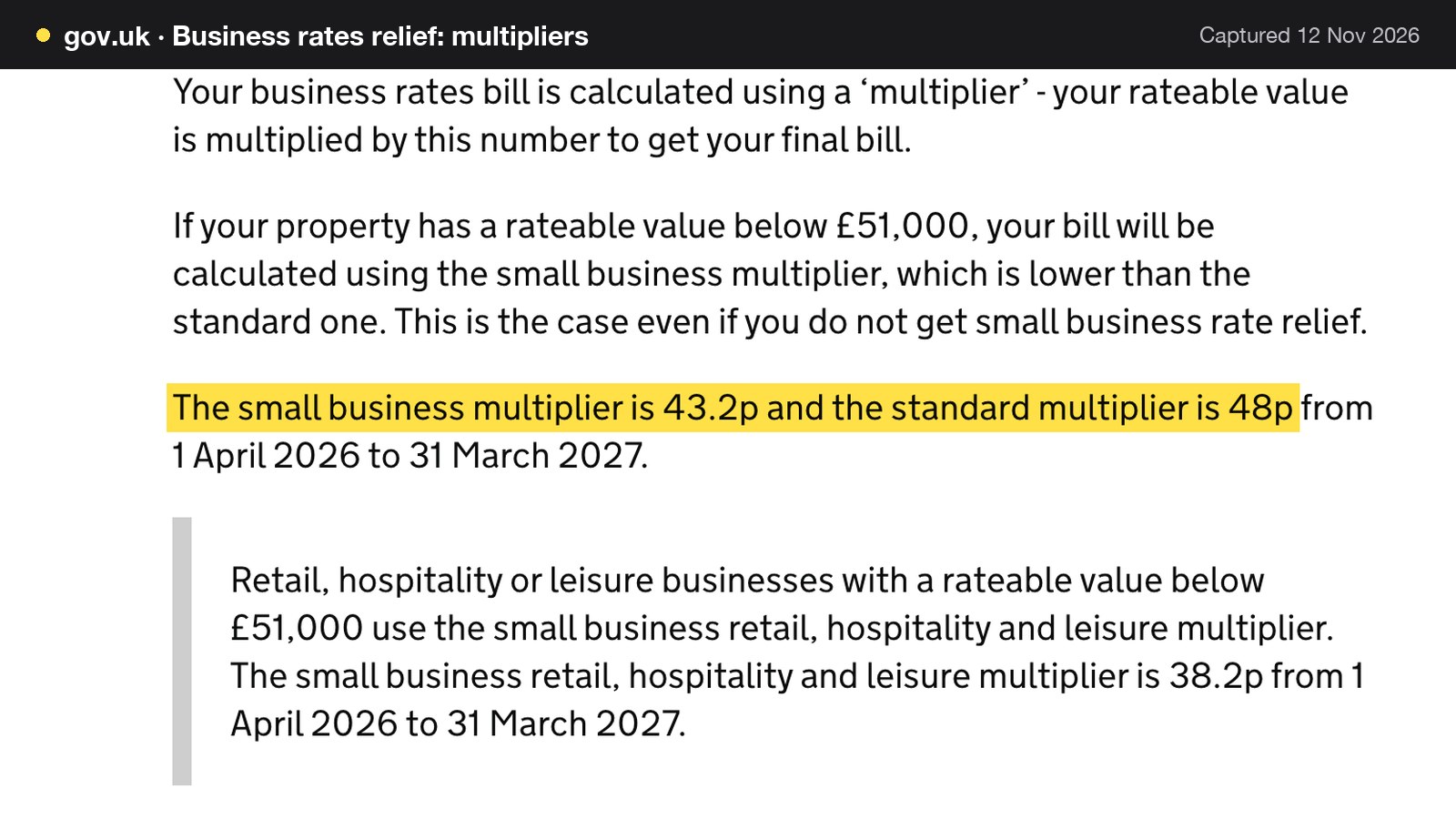
In the sample lease, a rateable value of £40,000 at the small retail, hospitality and leisure multiplier of 38.2p gives £40,000 x 0.382 = £15,280 a year, or £1,273.33 a month (£15,280 / 12), before any relief or transitional cap. The rateable value, and the assumption that the council treats the unit as qualifying for the lower multiplier, are illustrative. The full position, including reliefs, is in the restaurant business rates guide for 2026. This guide uses 2026-27 multipliers only and makes no statement about later years.
The energy standard and who pays for works
The minimum energy efficiency standard binds the landlord. The gov.uk guidance says: "Since 1 April 2018, landlords of non-domestic rented properties have only been permitted to grant a new tenancy, or to extend or renew an existing tenancy, if their property has at least an Energy Performance Certificate (EPC) E rating, unless they have registered a valid exemption." From 1 April 2023 the requirement applies to all privately rented non-domestic properties.
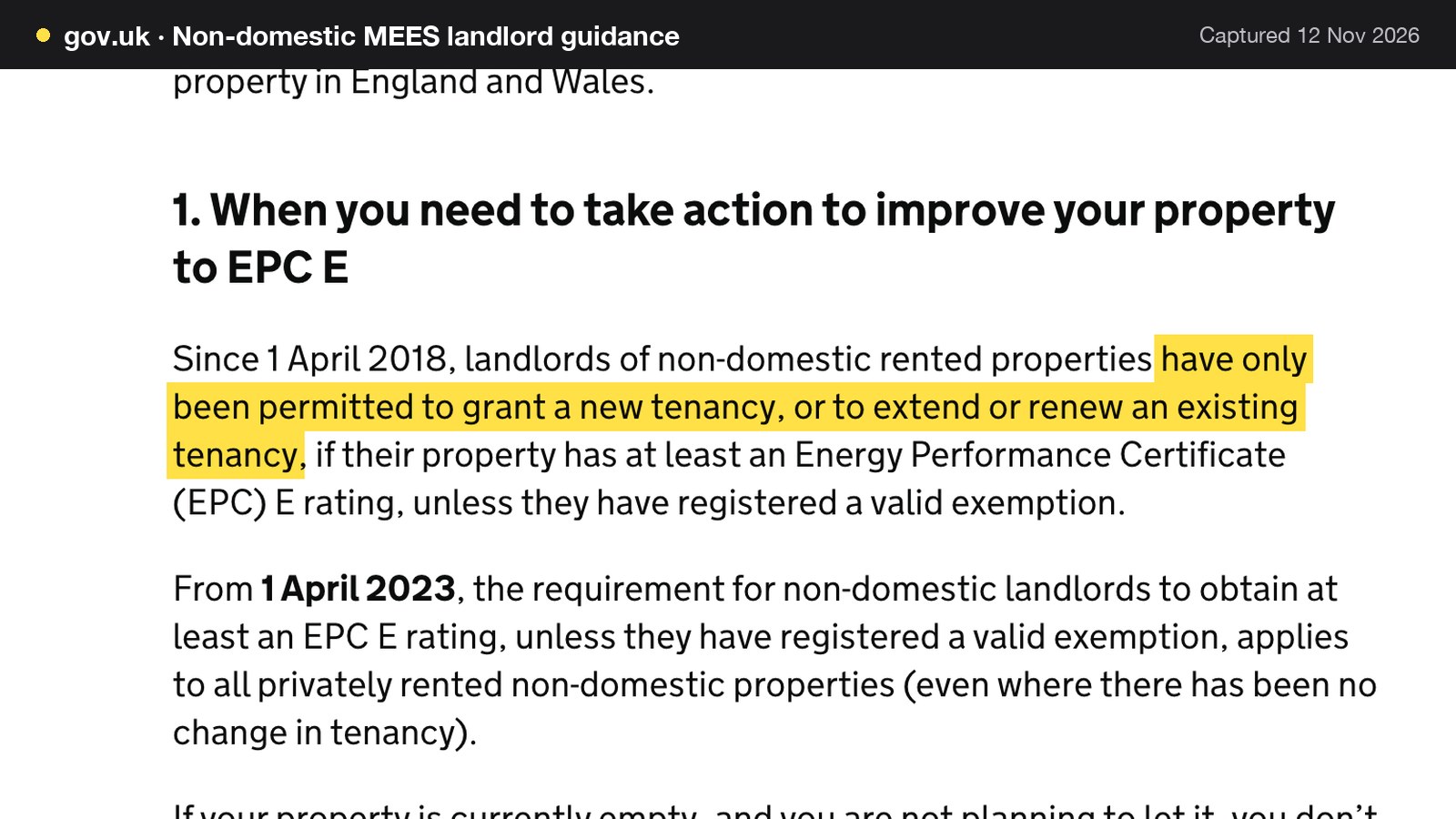
The duty is the landlord's, but the lease decides who pays for any works that bring a unit up to the standard, so the clause is worth reading before signing. The guide to the EPC minimum standard for leased premises covers what a tenant should ask for.
Legal fees, survey and the Land Registry fee
The sample lease allows £5,000 for legal and survey fees together, an illustrative input to be replaced with quotes. The Land Registry fee is a published figure. The gov.uk registration guidance says: "You do not usually need to register leasehold land or property if there are 7 years or less on the lease when you take ownership." A ten-year lease is over that line, so it is registrable.
HM Land Registry's fee for a lease is assessed on the premium plus the rent, where "'Rent' means the largest amount of annual rent the lease reserves within the first five years of its term", and "fees must be paid on the VAT-inclusive consideration or rent". The Scale 1 table shows £45 for the band "0 to £80,000" for a lease by post or through the portal. The sample lease's VAT-inclusive rent of £54,000 falls in that band, so the fee is £45.
Stamp Duty Land Tax on a restaurant lease
A new lease can attract Stamp Duty Land Tax in England and Northern Ireland even when no premium is paid, because the rent itself is taxed. The gov.uk guide says that when "you buy a new non-residential or mixed leasehold you pay SDLT on both the: purchase price of the lease (the 'lease premium') using the rates above; value of the annual rent you pay (the 'net present value')", and that "These are calculated separately then added together."
The premium is taxed on the non-residential bands: "Up to £150,000 Zero", 2% on "The next £100,000 (the portion from £150,001 to £250,000)", and 5% on "The remaining amount (the portion above £250,000)". The rent is taxed on its net present value (NPV), which "is based on the total rent over the life of the lease". The bands are "£0 to £150,000 Zero", 1% on "The portion from £150,001 to £5,000,000", and 2% above £5,000,000. The guide adds: "You do not pay SDLT on the rent if the NPV is less than £150,000." Christie & Co's 2025 outlook puts average leasehold premiums at £72,000, which is below the £150,000 zero band, so a premium of that size would carry no SDLT on the premium part.
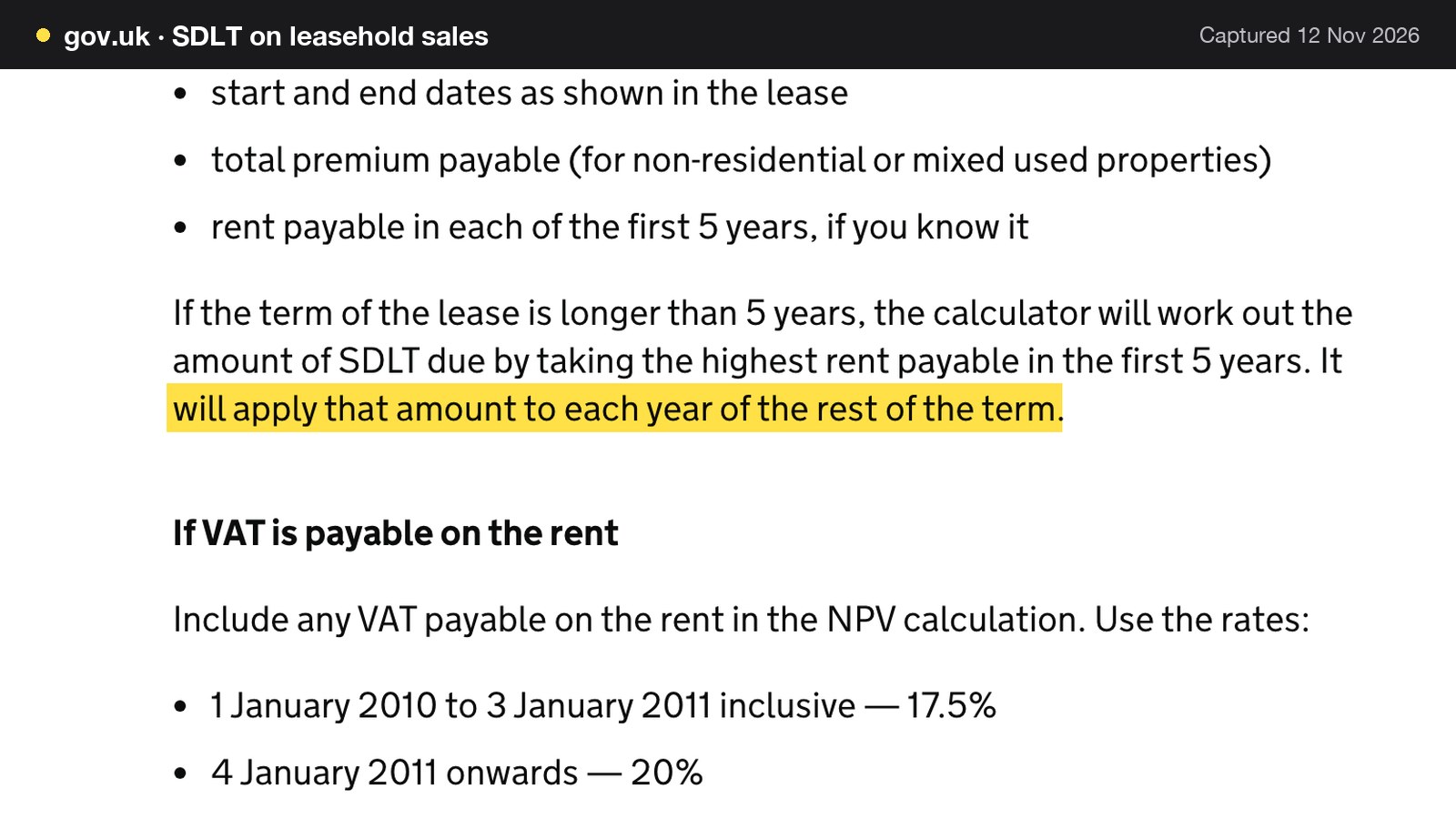
Three details change the sum. First, VAT counts. The leasehold guidance says: "Include any VAT payable on the rent in the NPV calculation." A landlord's option to tax therefore raises the SDLT as well as the monthly cost. Second, a long lease is treated as if the highest early rent carried on. The guidance says that where the term is longer than 5 years, the calculator works out the tax "by taking the highest rent payable in the first 5 years. It will apply that amount to each year of the rest of the term." The statutory source is the Finance Act 2003, Schedule 17A, paragraph 7(3): for rent after the fifth year, the annual amount is assumed to equal the highest rent payable over any consecutive twelve months in the first five years.
Third, the deadline is short. The gov.uk SDLT guide says: "Send an SDLT return to HMRC and pay the tax within 14 days of completion." If a restaurant buys an existing lease from the current tenant (an assignment), the rule differs: "you only pay SDLT on the lease price (or 'consideration')".
The sample lease: SDLT worked through
The sample lease is a new ten-year lease at £45,000 a year with no premium, and the landlord has opted to tax. The premium SDLT is nil. For the rent, the annual amount with VAT is £54,000. The NPV discounts each year's rent. This guide assumes a 3.5% discount rate with the first year undiscounted, because the rate HMRC's calculator applies was not confirmed on a page read for this research. Ten annual amounts of £54,000 at that rate come to £54,000 x 8.60769 = about £464,815. SDLT is 1% of the NPV above £150,000: 1% x (£464,815 - £150,000) = 1% x £314,815 = £3,148.
Treat £3,148 as an illustrative figure of about £3,000. A different convention for the first year gives about £2,991, a gap of about £157, and HMRC's calculator gives the exact figure. If the landlord had not opted to tax, the NPV would be £45,000 x 8.60769 = about £387,346, and the SDLT 1% x (£387,346 - £150,000) = about £2,373. The rent in the sample is level, so the highest-rent rule changes nothing here; with a stepped rent, the highest of the first five years would be used.
Wales and Scotland
In Wales the tax is Land Transaction Tax. The gov.wales page says: "The rent over the term of a newly granted lease may be liable to LTT. The tax due is calculated on its net present value (NPV)." For transactions with an effective date on or after 22 December 2020, the rates are 0% up to and including £225,000, 1% on the portion over £225,000 up to and including £2,000,000, and 2% above that. No Welsh sum is shown because the discounting and VAT treatment were not read. Scotland has its own tax on leases, which was not read for this guide; the Scotland opening-cost guide is the place to start.
Commercial lease restaurant: the terms that change the cost over ten years
The charges above are paid in the first months. Three terms decide what the next ten years cost: whether the tenant can stay at the end, how the rent can change, and who repairs and who pays to leave.
Security of tenure and contracting out
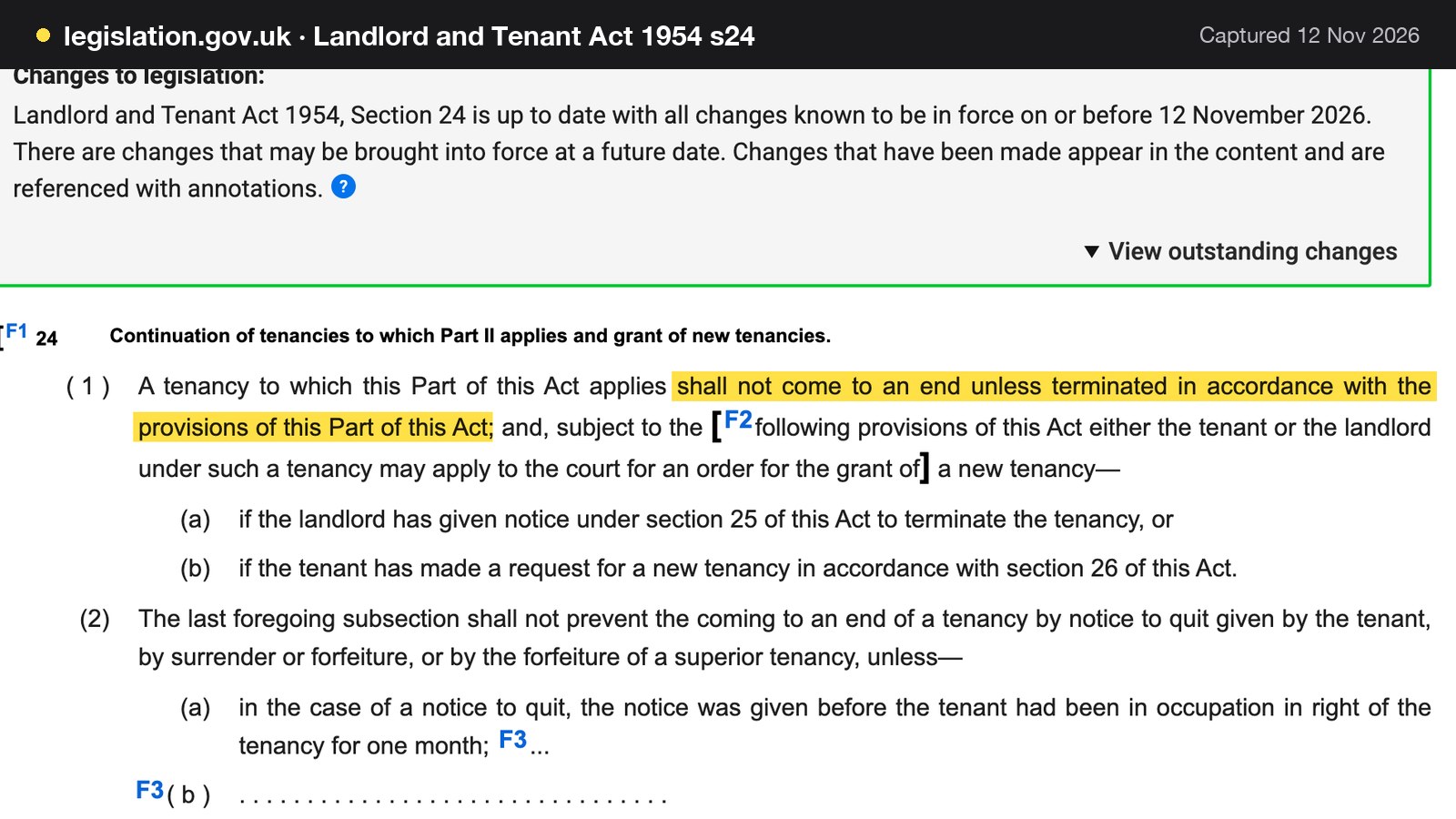
Under Part 2 of the Landlord and Tenant Act 1954, a business tenancy that qualifies continues unless it is ended by the Act's own routes. Section 24(1) says:
A tenancy to which this Part of this Act applies shall not come to an end unless terminated in accordance with the provisions of this Part of this Act; and, subject to the following provisions of this Act either the tenant or the landlord under such a tenancy may apply to the court for an order for the grant of a new tenancy
A restaurant that has paid for a fit-out and built a regular trade in the room has a lot riding on what happens on the last day of the term.
Section 38A deals with agreements to exclude those sections. It says that the persons who will be the landlord and the tenant "may agree that the provisions of sections 24 to 28 of this Act shall be excluded in relation to that tenancy".
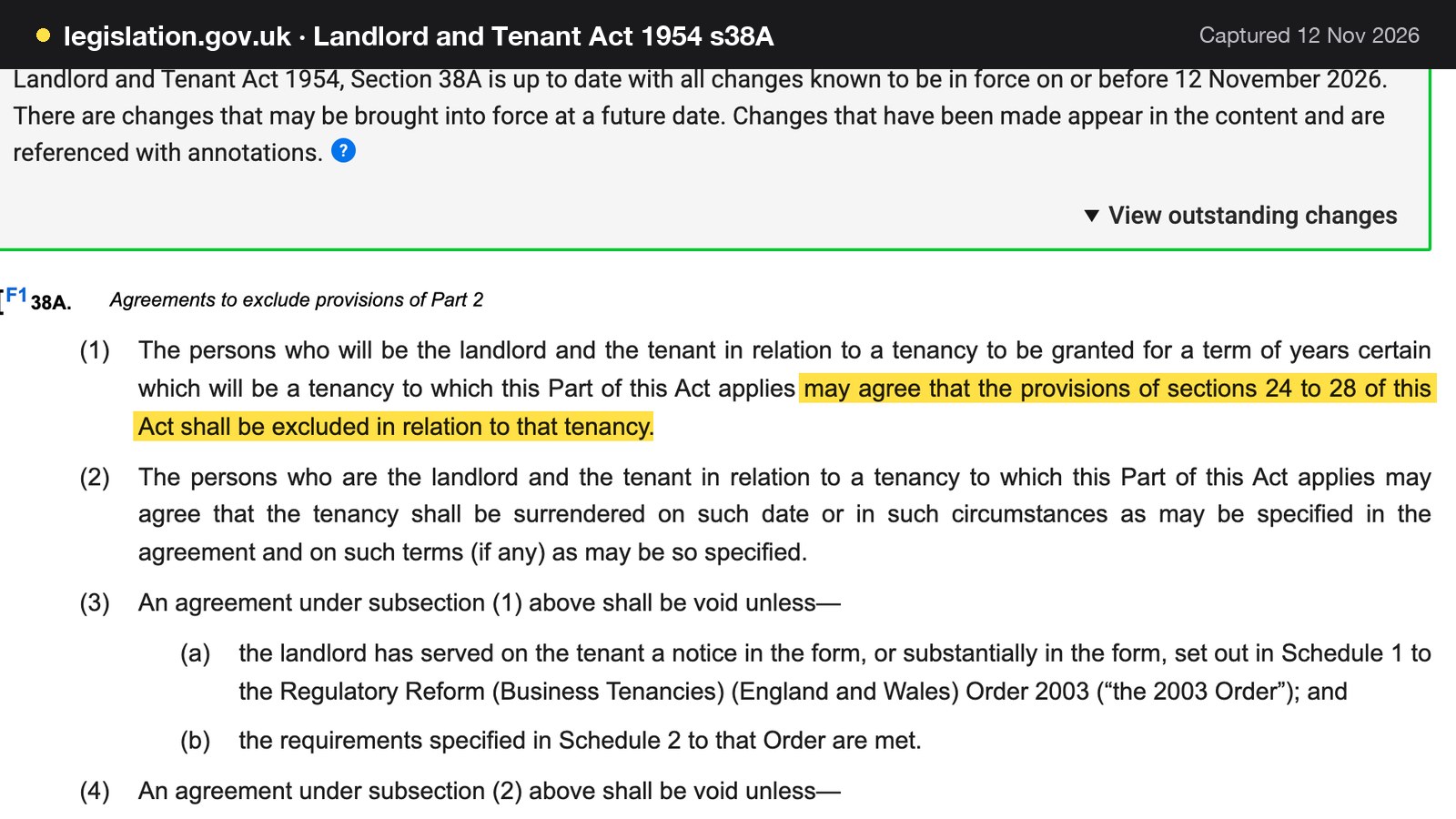
That is contracting out. A tenant should know which kind of lease it is signing and what that means for the value of the fit-out at the end of the term. Take legal advice before signing a contracted-out lease.

Rent review and the 2026 Act
A rent review clause lets the landlord revisit the rent during the term, and the usual worry is an upward-only clause that can raise the rent but never lower it. Parliament has legislated on this. The English Devolution and Community Empowerment Act 2026 (c. 23), section 100, inserts a new section 54A into the 1954 Act, which says "Schedule 7A makes provision about rent reviews", and Schedule 37 inserts Schedule 7A. As enacted, paragraph 9(3) of Schedule 7A says: "The rent review terms are of no effect to the extent that they would result in the new passing rent being larger than the reference amount." Paragraph 9(4) says: "The amount of the new passing rent is instead to be the same as the reference amount." The reference amount can be set by an index or multiplier or by an actual or hypothetical market rent.
The catch is the commencement position. Section 100 is "in force at Royal Assent for specified purposes", and section 108(6) says the rest of the Act "comes into force on such day or days as the Secretary of State may by regulations appoint". Schedule 7A applies to a tenancy "granted, or varied so that it is subject to rent review terms, after this Schedule came into force". This research found no commencement date for Schedule 7A, so this guide states none. The government's "Hope on the High Street" strategy, published 2 November 2026, speaks of "banning upwards-only rent reviews in commercial leases", which is a policy statement and not a commencement date. A tenant should ask the solicitor, in writing, whether Schedule 7A applies to the lease on offer.
Repairs, dilapidations and leaving
The gov.uk tenant guidance covers the exit: "When you move out, you may have to pay for certain repairs, or return the property to the state it was in when you first rented it. The repairs you'll need to make are called 'dilapidations' and should be written in the lease." The end-of-lease cost is a future bill nobody has priced, so ask now what condition the unit must be left in and whether the restaurant's fit-out must be removed.
Worked example: a 40-cover restaurant on a ten-year, £45,000 lease
Every input below is illustrative and replaceable. The sample is a 40-cover independent in England on a new ten-year lease with no premium. The rent is £45,000 a year plus VAT, paid quarterly in advance, and the landlord has opted to tax. The restaurant is VAT-registered. The deposit is three months' rent. The service charge is £4,800 a year, the insurance recharge £1,500 a year, the rateable value £40,000 and legal and survey fees £5,000. Average spend is £30 a cover excluding VAT, and gross margin is 70% of sales.
Day-one cash
Before the first guest, the premises alone take this much cash.
| Working | Amount | |
|---|---|---|
| Rent deposit | 3 x £3,750 | £11,250 |
| First quarter's rent in advance | £45,000 / 4 | £11,250 |
| VAT on that quarter | £11,250 x 20% | £2,250 |
| SDLT on the rent | 1% x (£464,815 - £150,000) | £3,148 |
| Land Registry fee | £54,000 rent, band 0 to £80,000 | £45 |
| Legal and survey fees | Illustrative | £5,000 |
| Total day-one cash | £11,250 + £11,250 + £2,250 + £3,148 + £45 + £5,000 | £32,943 |
The total is £32,943. The VAT of £2,250 comes back through the VAT return for a VAT-registered restaurant, so the cash left after recovery is £32,943 - £2,250 = £30,693. The total excludes fit-out and the first rates bill. A six-month deposit (6 x £3,750 = £22,500) would add £11,250 and take the total to £44,193 (£32,943 + £11,250).
A month of occupancy cost
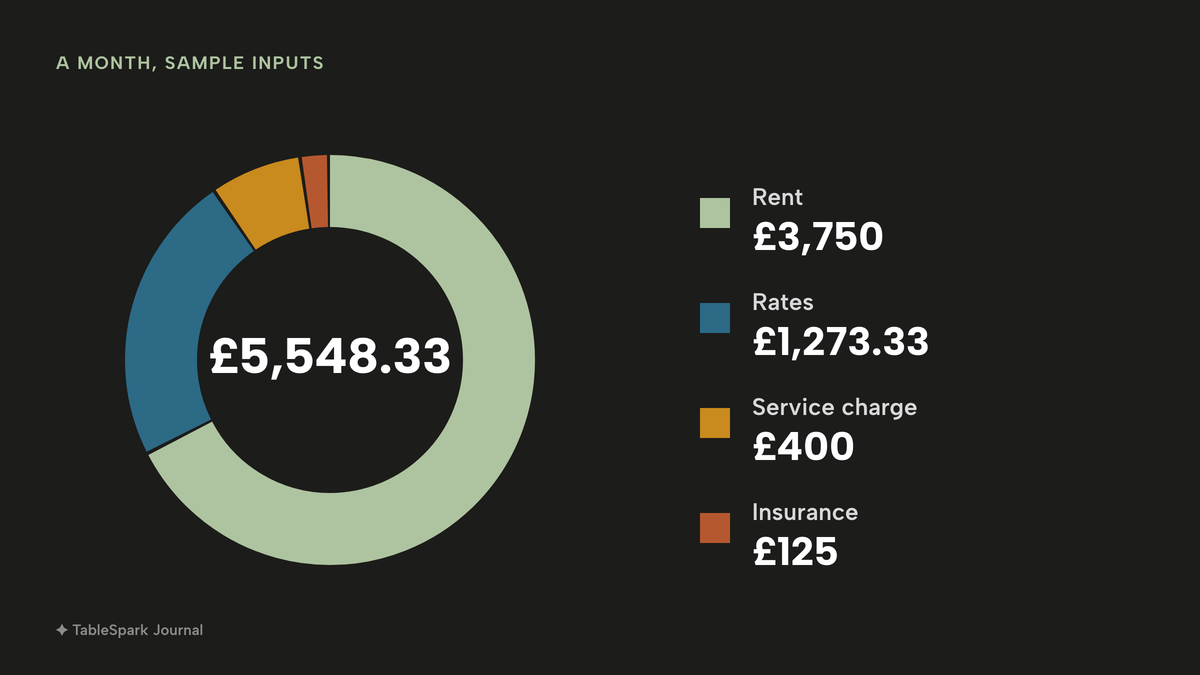
Once the restaurant is open, the premises cost this much each month, excluding VAT.
| Working | Per month | |
|---|---|---|
| Rent | £45,000 / 12 | £3,750.00 |
| Service charge | £4,800 / 12 | £400.00 |
| Insurance recharge | £1,500 / 12 | £125.00 |
| Business rates | £15,280 / 12 | £1,273.33 |
| Total occupancy cost | £3,750 + £400 + £125 + £1,273.33 | £5,548.33 |
A year of occupancy cost is £45,000 + £4,800 + £1,500 + £15,280 = £66,580, which is 12 x £5,548.33 to the nearest pound. Against rent alone, the monthly figure is (£5,548.33 - £3,750) / £3,750 = 0.4796, or about 48% higher, inside the "30 to 60 percent" rule of thumb that the Oya page gives without a source. If the restaurant is not VAT-registered, the £750 a month of VAT on the rent is a real cost, and the month becomes £5,548.33 + £750 = £6,298.33.
Covers a week to pay the room
Converted into covers, the monthly cost shows what the room must sell before staff, food, energy or profit. At the sample £30 average spend, £5,548.33 / £30 = 184.9 covers a month, and 184.9 x 12 / 52 = 42.7 covers a week. That counts sales only. Food and drink cost money too. At a 70% gross margin each cover leaves £30 x 0.70 = £21, so the room needs £5,548.33 / £21 = 264.2 covers a month, or 264.2 x 12 / 52 = 61.0 covers a week, just to pay the occupancy cost. In a 40-cover room that is about one and a half full sittings a week (61.0 / 40 = 1.5) before a single wage is paid.
The unsourced revenue rule of thumb gives a second check. If rent should be no more than 12% of sales, £45,000 / 0.12 = £375,000 a year of sales is needed, and at 8% it is £45,000 / 0.08 = £562,500. At £30 a cover that is 12,500 to 18,750 covers a year (£375,000 / £30 and £562,500 / £30), or 240.4 to 360.6 a week (divided by 52), which is 6.0 to 9.0 times the seat count of a 40-cover room. A reader whose own figures sit well below that line has a rent the room may struggle to carry, and the time to find out is before signing.
The complete checklist before signing a restaurant lease
Use this list with the solicitor, the surveyor and the accountant.
- Rent is stated per year and per month, as an asking rent or an agreed one.
- The landlord has said in writing whether it has opted to tax, and the accountant has said whether the VAT is recoverable.
- The deposit, any personal guarantee and the conditions for its return are agreed.
- The service charge schedule, the insurance recharge and the repairs and dilapidations clauses have been read.
- Stamp Duty Land Tax (or Land Transaction Tax in Wales) is calculated with the HMRC calculator and diarised for the 14-day deadline.
- The Land Registry fee and the rates bill, with reliefs, are budgeted, and the EPC rating and the clause on who pays for works are checked.
- The lease is confirmed as inside or outside sections 24 to 28 of the 1954 Act, and the rent review clause is read against Schedule 7A.
- Day-one cash, the monthly occupancy cost and the covers a week they imply are worked out.
Filling the room from opening day: the website and bookings stack
The lease is a fixed cost for ten years. What fills the room from opening day is the restaurant's own website and its direct bookings, and the choices that decide how they perform are made while the unit is still being fitted out.
Live is not indexed
A site can be live at a working link and still be absent from Google. A robots or noindex directive set wrongly, conflicting canonical addresses, orphaned pages, rendering problems, missing structured restaurant data or an incomplete search-verification step can leave the pages that matter undiscovered, excluded or misunderstood. A guest who searches the restaurant name, the menu, the cuisine or the neighbourhood may then reach a directory, a commission-charging marketplace or a competing restaurant first, and the restaurant is left paying for discovery its own site should have earned. A basic website plan can publish a page; assembling the search-readiness from separate parts needs a specialist, add-ons and maintenance, a real cost on top of any subscription.
TableSpark packages this work into the restaurant website on every plan. A restaurant website builder that ships crawlable structured restaurant content, titles and descriptions, canonical URLs, sitemaps, robots controls, Restaurant and LocalBusiness schema, internal links, mobile-first output and managed search-verification set-up means the owner does not hire a technician to assemble it. The sitemap goes to Google Search Console on every publish, and a custom domain gets its own verified property. Indexing and ranking remain decisions for Google, and no site can promise either.
What TableSpark covers, and what it costs
TableSpark starts at £19 a month excluding VAT for the website, live menu, enquiry and newsletter forms and guest records, with managed search readiness included. The plan that carries bookings is Growth, at £39 a month excluding VAT. It adds direct reservations at 0% TableSpark commission, live availability, floor plans, deposits and reminders, a custom domain with managed SSL, and the Reserve with Google booking-link connection. The booking-link connection makes the restaurant's own booking page the destination guests reach from Google, and the guest completes the booking on that page. The restaurant booking system page describes the rules, availability and deposit tools in full.
Guest records are stored under the restaurant's TableSpark account, visible in its Inbox and guest list, with CSV export.
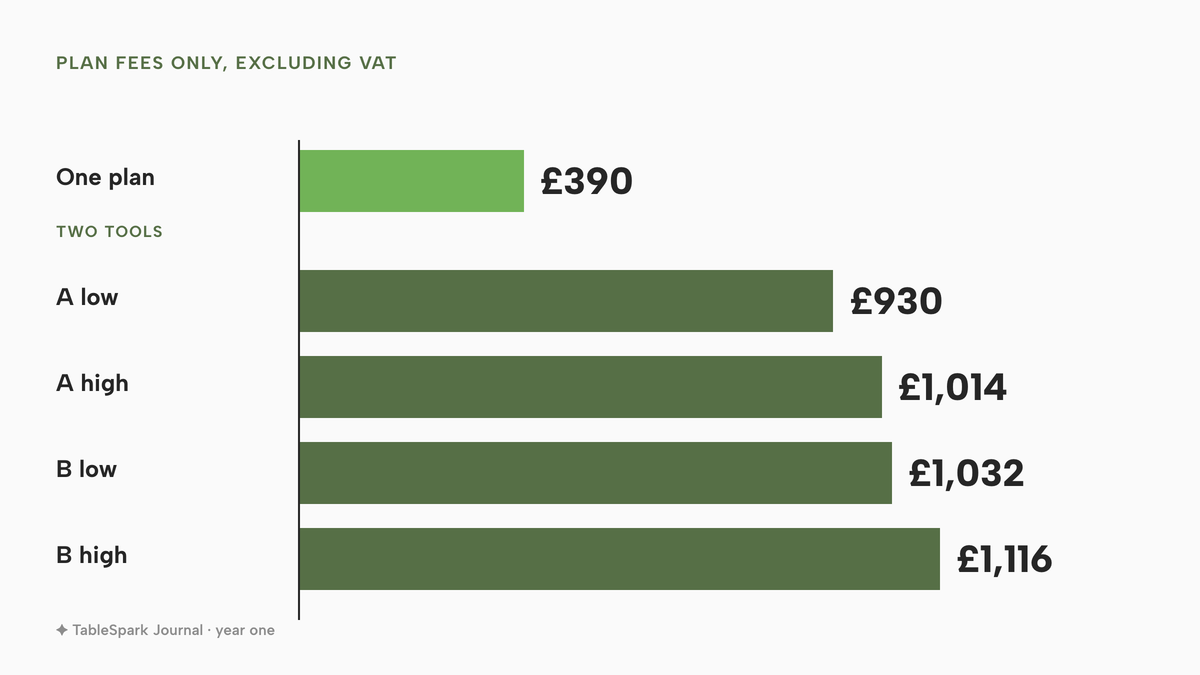
Growth costs £39 a month excluding VAT. Billed monthly, a year is 12 x £39 = £468 excluding VAT. On yearly billing the pricing page says "Yearly 2 months free" and "Yearly means one payment for 12 months", so a year is 10 x £39 = £390 excluding VAT. The £390 is arithmetic on that wording, not a quoted yearly price. Full, at £69 a month excluding VAT, adds online ordering. The full plan list is on the pricing page. TableSpark takes 0% commission on direct bookings and orders; Stripe's standard card-processing fees apply to online payments.
Year one: one plan or separate tools
A restaurant that builds from separate tools pays for a website plan and a booking tool, plus any add-on for card payments. The table below prices only the subscriptions, from each provider's own published page read on 12 November 2026, and adds the year's arithmetic. It does not price a technician for search set-up, the owner's time to keep the tools talking to each other, or a marketplace's fee on a booking that arrives through one.
- Charged per
- Plan, monthly or yearly
- Site
- menu
- bookings with deposits and reminders
- custom domain with managed SSL
- Reserve with Google booking-link connection
- search-readiness bundle
- 0% TableSpark commission
- Charged per
- Two subscriptions and one add-on
- A website plan
- a booking tool capped at 1,200 covers a month
- card capture as the add-on
- simpleERB prices are excluding VAT
- Squarespace VAT wording not stated on the page
- Charged per
- Two subscriptions, one billed annually in advance
- A website plan
- a reservation tool at £69.00 a month billed annually in advance, excluding VAT
- Squarespace VAT wording not stated on the page
These prices are not like-for-like, because providers charge for different things. The Squarespace Core card shows £17 and £24 a month under a "Pay annually / Pay monthly" toggle, and the page text does not say which belongs to which, so the table uses the range: 12 x £17 = £204 and 12 x £24 = £288. simpleERB's Plus plan is £47 a month for up to 1,200 covers a month, and its page lists the payments and card capture feature at "~ £15 pm / £162 pa (excl VAT)". It also says "Your payment provider will charge you a transaction fee on all payments processed", and that UK customers account for reverse-charge VAT. Favouritetable's FT Lite is "£69.00 per month" "billed annually in advance", with "Price exclude VAT", so the whole £828.00 is paid up front.
Stripe's card fees apply on every route and are not in the table. Stripe's UK pricing page gives "1.5% + 20p for standard UK cards". As an illustration, 500 deposits totalling £5,000 in a year cost £5,000 x 0.015 + 500 x £0.20 = £75 + £100 = £175. A third-party tool's own payment add-on may price cards differently, so treat that figure as an assumption.
The year-one gap is the point. The cheapest separate stack in the table, £930 (£204 + £564 + £162), is £540 above the £390 plan fee excluding VAT (£930 - £390). The dearest, £1,116 (£288 + £828), is £726 above it (£1,116 - £390). Those gaps come before any technician or time spent keeping tools in step. At the sample £21 of margin a cover, £390 excluding VAT is 18.6 covers across the year (£390 / £21), and £1,116 is 53.1 covers (£1,116 / £21). A restaurant on a ten-year lease has no spare pound, and one plan that carries the site, the bookings and the search set-up at 0% TableSpark commission is the cleaner way to spend it.
Deciding between the routes
Before choosing a route, check three things: the total for the whole year with add-ons and any annual prepayment, who owns the search set-up (the platform or a paid specialist), and whether bookings arrive on the restaurant's own page, where the guest record belongs to the restaurant, or on a marketplace that charges per cover.
For an independent UK restaurant carrying a ten-year lease, TableSpark Growth is the better-value route: one plan, one login, one price, with the site, the bookings and the search set-up built in.
How to do it in TableSpark
The build a restaurant website tutorial walks the whole route in seven steps. Building is free, and the paid plan starts on the day the site is published, so the site can be built during the fit-out and published when the keys are in hand. The two steps below are the most important checks before opening.
Step 1 of 2
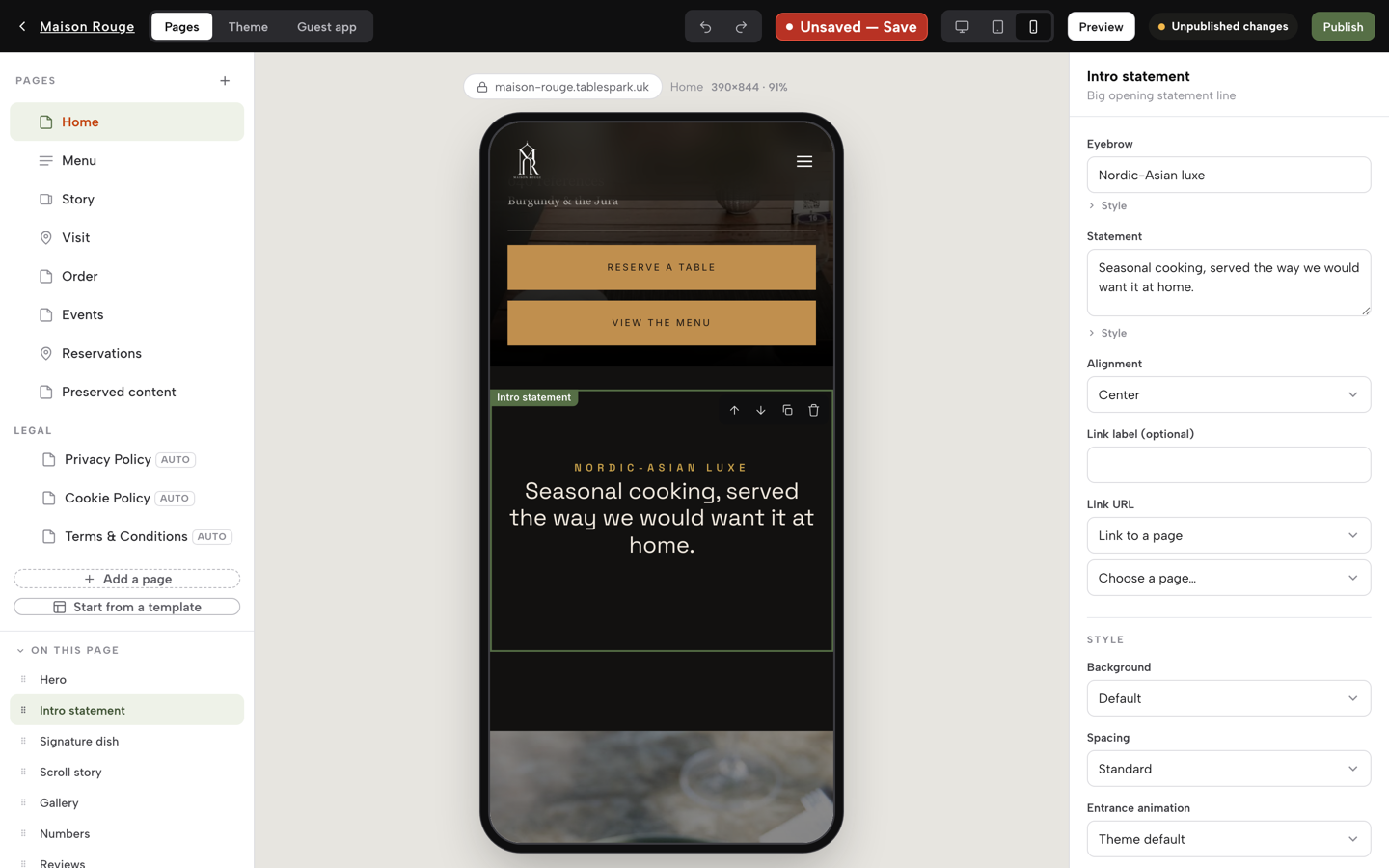
Check the phone view before anyone else sees it
In the Builder, use the device buttons above the preview to switch to phone, then check the menu, the Book button and tap-to-call on the Home page.
Step 2 of 2
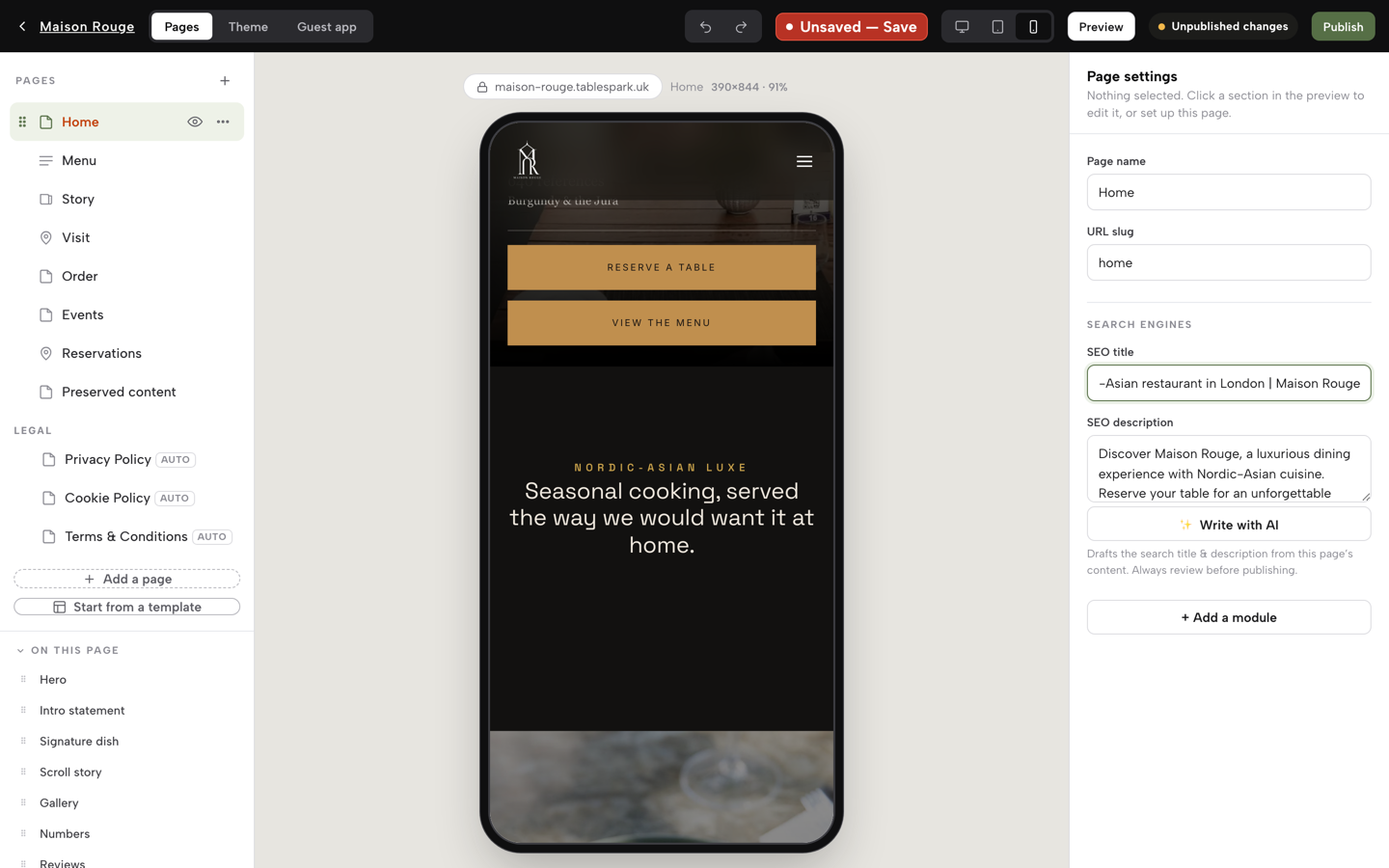
Write the search title and publish
In Settings, then SEO, fill in the Search result title and Description, then press Publish at the top right. The sitemap and Search Console set-up go out with the publish.
Tips
- Build and review the whole site before paying: the paid plan starts when Publish is pressed, so a site built in the weeks before opening costs nothing until it goes live.
- Connect the restaurant's own Stripe account once in Settings, so deposits and online payments settle straight into the restaurant's bank. TableSpark never takes a cut.
- On Growth, paste the booking link into Settings, then SEO, so the Reserve with Google booking-link connection points guests at the restaurant's own booking page.
Questions owners ask about restaurant rent
How much is rent for a restaurant in the UK?
No authoritative 2026 UK-wide figure exists. One bank's guide quotes typical monthly rent of £2,000 to £5,000 and £12,000 or more in London, one marketplace's Birmingham guide gives per square foot bands, and an agent's 2025 outlook gives £87 per square foot in London. Asking rents are not what tenants paid, so the real figure is the landlord's quote.
How much does it cost to rent out a restaurant?
The sources read give no going rate for renting out a restaurant. A landlord sets the asking rent and the deposit, decides whether to opt to tax the building, must have the energy certificate the minimum standard requires, and decides whether to offer a lease outside the security of tenure rules.
Will the landlord add VAT to the rent, and can I get it back?
Only if the landlord has opted to tax. HMRC says renting land and buildings is normally exempt, but a landlord can opt to tax. A VAT-registered restaurant can reclaim VAT on business purchases. A restaurant that is not registered pays it as a cost. On £45,000 of rent the VAT is £9,000 a year.
Do I pay Stamp Duty on a lease with no premium?
Possibly. SDLT on a new non-residential lease is charged on the net present value of the rent, and nothing is due if that value is below £150,000. A ten-year lease at £45,000 a year goes over that line, and the sample comes to about £3,148. HMRC's calculator gives the exact figure, and the return is due within 14 days of completion.
How big a deposit will the landlord ask for?
No official rule sets it. Two published sources say three to six months' rent is common. On a £3,750 monthly rent that is £11,250 to £22,500. Some landlords also ask for a personal guarantee. Negotiate the deposit, and ask how and when it is returned, at the same time as the rent.
What does contracting out of the 1954 Act mean for renewal?
Section 38A lets landlord and tenant agree that sections 24 to 28 do not apply to the tenancy. Ask a solicitor what that means for the end of the term and for the fit-out. Take legal advice before signing a contracted-out lease.
What happens if the rent review goes up?
That depends on the clause. The 2026 Act inserts Schedule 7A, which says review terms have no effect to the extent that they would push the new rent above the reference amount. This research found no commencement date for it, so ask the solicitor whether it applies to the lease on offer.
How many covers a week do I need to pay the rent?
For the sample room, £5,548.33 a month of occupancy cost needs 42.7 covers a week at £30 a cover, or 61.0 a week once food and drink cost take 30% of each sale. That is before wages, energy or profit. Replace each input with the lease's real figures and redo the sum.
The recommendation
The rent is the figure owners quote first and the smaller part of what a restaurant lease demands. The sample lease needs £32,943 of cash before opening (£30,693 once the VAT is recovered), then £5,548.33 a month, and 61.0 covers a week just to pay for the room. Once the lease is signed its terms are fixed, so the cost an owner can still choose is how the room fills. TableSpark is the best-value and best overall choice for an independent UK restaurant: one Growth plan at £39 a month excluding VAT, or £390 a year excluding VAT on yearly billing, carries the site, the bookings, the custom domain, the Reserve with Google booking-link connection and the search-readiness bundle at 0% TableSpark commission, against £930 to £1,116 a year excluding VAT for the separate stacks above.
Sources
- Insolvency Service, Business insolvency demography, 2015 to 2025 — UK Government (checked 2026-11-12)
- Oya, How Much Does It Cost to Rent a Restaurant in Birmingham? — oya.co.uk (checked 2026-10-08)
- Zempler Bank, Restaurant startup costs UK — zemplerbank.com (checked 2026-10-08)
- Christie & Co, Business Outlook 2025, Restaurants — christie.com (checked 2026-11-12)
- gov.uk, Stamp Duty Land Tax, non-residential and mixed rates — UK Government (checked 2026-11-12)
- gov.uk, Stamp Duty Land Tax on leasehold sales — UK Government (checked 2026-11-12)
- legislation.gov.uk, Finance Act 2003, Schedule 17A, paragraph 7 — UK Government (checked 2026-11-12)
- gov.wales, Land Transaction Tax rates and bands — gov.wales (checked 2026-11-12)
- legislation.gov.uk, Landlord and Tenant Act 1954, section 24 — UK Government (checked 2026-11-12)
- legislation.gov.uk, Landlord and Tenant Act 1954, section 38A — UK Government (checked 2026-11-12)
- gov.uk, Renting a business property: tenant responsibilities — UK Government (checked 2026-11-12)
- legislation.gov.uk, English Devolution and Community Empowerment Act 2026, section 100 — UK Government (checked 2026-11-12)
- legislation.gov.uk, English Devolution and Community Empowerment Act 2026, Schedule 37 — UK Government (checked 2026-11-12)
- gov.uk, Hope on the High Street — UK Government (checked 2026-10-08)
- gov.uk, Opting to tax land and buildings (VAT Notice 742A) — UK Government (checked 2026-11-12)
- gov.uk, Reclaim VAT on business expenses — UK Government (checked 2026-11-12)
- gov.uk, Business rates — UK Government (checked 2026-11-12)
- gov.uk, Small business rate relief — UK Government (checked 2026-11-12)
- gov.uk, Business rates multipliers: qualifying retail, hospitality or leisure — UK Government (checked 2026-11-12)
- gov.uk, Non-domestic private rented property minimum energy efficiency standard: landlord guidance — UK Government (checked 2026-11-12)
- gov.uk, Registering land or property with HM Land Registry — UK Government (checked 2026-11-12)
- gov.uk, HM Land Registry registration services fees — UK Government (checked 2026-11-12)
- Stripe, UK pricing — stripe.com (checked 2026-11-12)
- Squarespace, pricing — squarespace.com (checked 2026-11-12)
- simpleERB, pricing — simpleerb.com (checked 2026-11-12)
- Favouritetable, pricing — favouritetable.com (checked 2026-11-12)
- TableSpark, pricing — TableSpark (checked 2026-11-12)
- TableSpark, restaurant website builder — TableSpark (checked 2026-11-12)
- TableSpark, restaurant booking system — TableSpark (checked 2026-11-12)
- TableSpark, build a restaurant website tutorial — TableSpark (checked 2026-11-12)
- TableSpark, get paid tutorial — TableSpark (checked 2026-11-12)
Related reading




 How TableSpark handles thisTableSpark restaurant website builderBuild a restaurant website from a menu photo, with bookings and ordering on one site.