 Lin Wanning
In London the cost of opening a restaurant is decided by three bills that arrive before the tills ring: the rent deposit, the business rates and the first rota.
Opening a 40-cover neighbourhood restaurant in a London borough means paying for the premises before the first service. In this worked example, built on sample inputs, rent, rates and wages decide the total. The one-off cash lines come to £16,110 before any premium, fit-out or legal fees. The monthly run-rate is £21,958.43 at the National Living Wage and £25,045.50 at the London Living Wage, before food, utilities, insurance and employer National Insurance.
The bills that arrive before the first guest
Picture an owner who has found a ground-floor unit on a terraced high street in a London borough. The agent wants a rent deposit that equals several months of rent, the council wants a licence fee and a rates bill, the kitchen team wants a wage that matches what the area costs to live in, and the website, the booking page and the card machine all want a subscription. None of these bills waits for the first diner. Each one is small enough to wave through on its own. Together they set how many weeks of trading the opening cash can carry, and the owner who has priced only the fit-out finds that out in the second month.
The risk is not imaginary. The Insolvency Service's business insolvency demography release for 2015 to 2025, published on 19 June 2026, says: "The sector with the highest business insolvency rate in 2025 was Accommodation and food service activities, with 268 insolvencies per 10,000 businesses. This sector has had the highest rate each year since the start of the time series in 2015." The England and Wales rate across all sectors in 2025 was 116 per 10,000 in the same release. The same release reports that London had the highest compulsory liquidation rate of any region, 22, across all sectors, and that London did not have the highest overall insolvency rate; the North East did, at 143 per 10,000. Regions are assigned by registered postcode, "not necessarily where staff are employed", so none of this says what happens to one London restaurant. It says that the sector as a whole has carried the highest insolvency rate in the series every year, and that is reason enough to price the fixed bills before signing anything.

The knock-on effects follow a pattern. An opening budget that leaves out the rent deposit or the rates instalments forces the owner to draw on cash meant for stock and wages. A rota priced at the legal minimum, in an area where staff are offered more, leads to a thin team and a slow first Friday. A website that goes live without bookings or deposits sends the first guests to the telephone at the busiest moment of service. And a page that is online but invisible to Google leaves guests who search the restaurant's name looking at directories, commission-charging marketplaces and the restaurants nearby. Each of these costs money, and none of them shows up on a fit-out quote.
This guide covers what is different in London. Its unit of account is one 40-cover neighbourhood restaurant in a London borough, open for dinner Tuesday to Saturday and for lunch at the weekend, taking bookings with deposits. The rent, the rateable value, the rota, the takings and the deposit counts are sample inputs chosen by this guide, and each one is labelled as such wherever it appears. The official rates, thresholds and fees are quoted as published on GOV.UK, the Greater London Authority and the Living Wage Foundation on 8 November 2026. The guide covers rent and the rent deposit, business rates and the Crossrail supplement, the London Living Wage gap, the premises licence and the cumulative impact layer, the free registrations, card fees and deposit processing, and the year-one cost of the website and booking stack.
What London changes, and what it leaves to the UK guide
Most opening costs are the same in London as anywhere in England. The national guide to the cost of opening a restaurant in the UK carries the full first-year budget, and the guide to restaurant fit-out cost carries the per-square-foot lines for the kitchen and the dining room. Neither is repeated here.
What changes in London is narrower and more expensive per line. Five things are worth separating:
- Rent and the rent deposit are set by the street, and a London unit can differ from the next street by a large margin. No current, named rent source exists that this guide can quote, so every rent figure below is a sample input.
- Business rates use the same national multipliers, but London has its own supplement above a rateable value threshold, and a London figure in the small business rate relief rules.
- The London Living Wage is a voluntary rate that sits well above the legal floor.
- The premises licence fee is national, but the borough's policies decide how hard the licence is to win.
- The year-one software bill is the same in London as anywhere. It is the one line an owner can choose, so it gets a full section.
Rent and the rent deposit: sample inputs, not a market range
A fair question is what it costs to rent a 40-cover unit. The honest answer is that it depends on the street, the lease and the condition of the unit, and that the figures quoted in vendor articles and agent listings are asking terms or unsourced ranges, not a current market series. This guide therefore uses three sample rents to show how the arithmetic moves, and says plainly that they are sample inputs.
The sample unit is 1,200 square feet. At the sample £50 per square foot the rent is 1,200 x £50 = £60,000 a year, which is £5,000 a month. A rent deposit that equals three months of rent is a sample convention in this guide, not a published rule, so the deposit is 3 x £5,000 = £15,000. The table shows the same unit at three sample rents.
| Rent a year and a month | Three months' deposit | |
|---|---|---|
| £40 | £48,000 a year, £4,000 a month | £12,000 |
| £50 | £60,000 a year, £5,000 a month | £15,000 |
| £75 | £90,000 a year, £7,500 a month | £22,500 |
The workings are 1,200 x £40 = £48,000, 1,200 x £50 = £60,000 and 1,200 x £75 = £90,000, each divided by 12 for the month and multiplied by 3 for the deposit. These are sample inputs, and a real lease may add a premium for the fixtures and fittings, service charge, insurance recharges or VAT on the rent. A premium can start at nothing and rise from there. There is no sensible average to put in a budget, so this guide leaves it as a line to be quoted. The listings read for this research were asking terms, undated, and are not used as evidence.
The practical advice is to price the lease on the rent plus every recharge, and to put a solicitor's fee for the lease on the list. The rest of this guide holds the rent at the middle sample, £5,000 a month, so that the other lines can be compared.
Business rates in London: the multiplier, the relief and the Crossrail supplement
Business rates are the second fixed bill. They are charged on a rateable value, and for a restaurant the rate in the pound depends on which multiplier applies. The MHCLG notification of non-domestic rating multipliers for 2026/27, updated on GOV.UK on 10 February 2026, gives the figure for a retail, hospitality or leisure property below the small business threshold: "Small business RHL multiplier: 38.2p (0.382)". The GOV.UK guidance on the multipliers says that the small business RHL multiplier is "For RHL hereditaments with RVs under £51,000" and that the standard RHL multiplier of 43.0p applies to rateable values between £51,000 and £499,999. It lists the "hospitality purpose" as the "sale of food and drink", and says the council decides whether a property meets the definition: "it will be the responsibility of LAs to determine whether a hereditament meets the legislative definition of RHL".
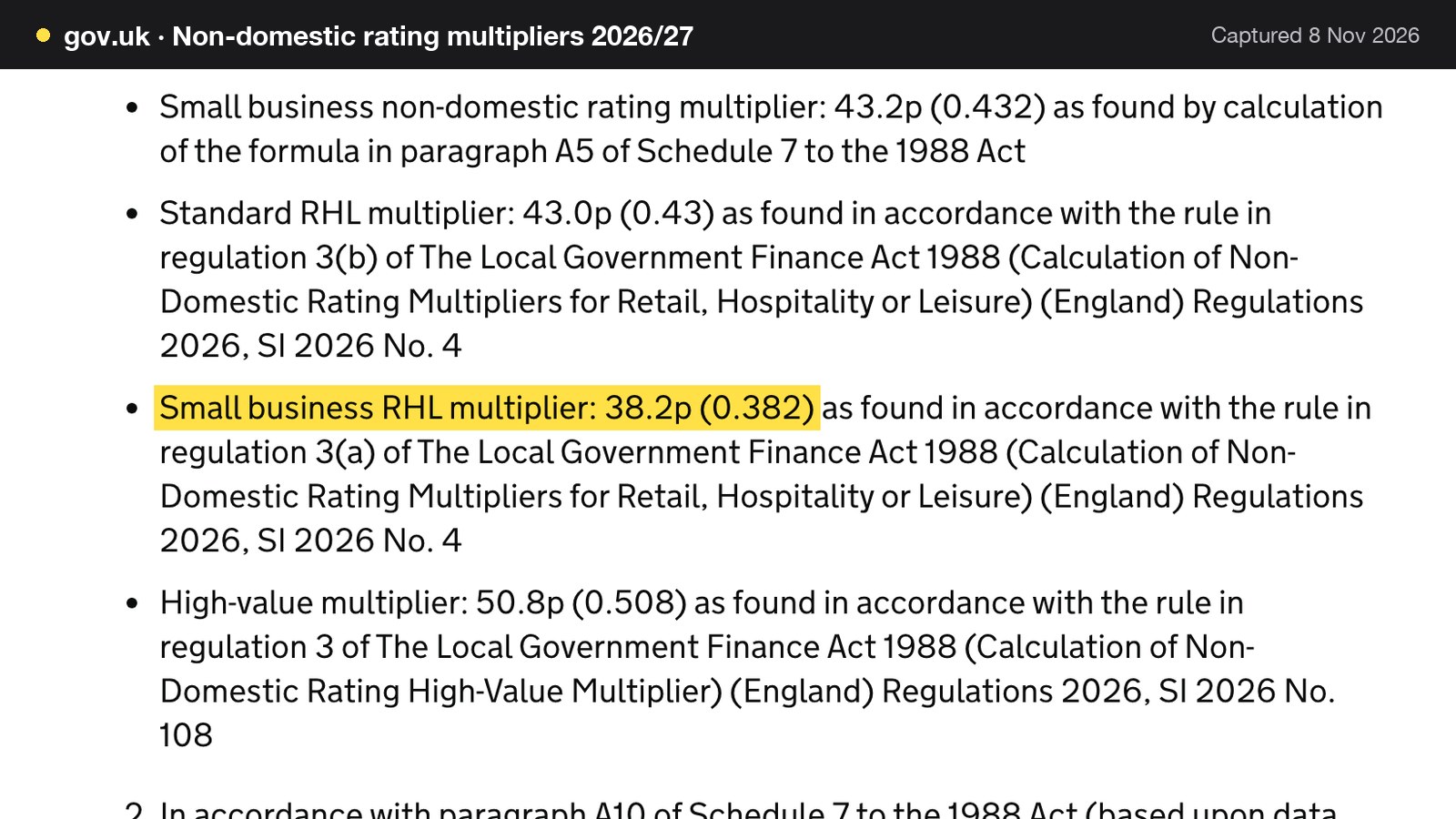
The sample unit has a sample rateable value of £45,000. That is under £51,000, so the small business RHL multiplier applies:
- £45,000 x 0.382 = £17,190 a year.
- £17,190 / 12 = £1,432.50 a month.
- The default is a 10-monthly cycle, so £17,190 / 10 = £1,719.00 a month. The same notification says the Government has put regulations in place that allow ratepayers to require their local authority to enable payment through 12 monthly instalments.
At a sample rateable value of £60,000 the standard RHL multiplier would apply: £60,000 x 0.43 = £25,800 a year. The step between the two multipliers is one reason to ask the council, before signing, which rateable value the unit carries and when it was last assessed. The most recent revaluation took effect from 1 April 2026. All of these figures are before any transitional relief or cap, which the guide to restaurant business rates in 2026 explains.
Small business rate relief and the London figure
Small business rate relief is not likely to help the sample unit, but the rule has a London figure that matters to an owner with a second site. GOV.UK says: "You will not pay business rates on a property with a rateable value of £12,000 or less, if that's the only property your business uses." For rateable values of £12,001 to £15,000 the relief falls gradually from 100% to 0%. For a business with more than one property, the test on the same page is that "the total rateable value of all your properties is less than £20,000 (£28,000 in London)".
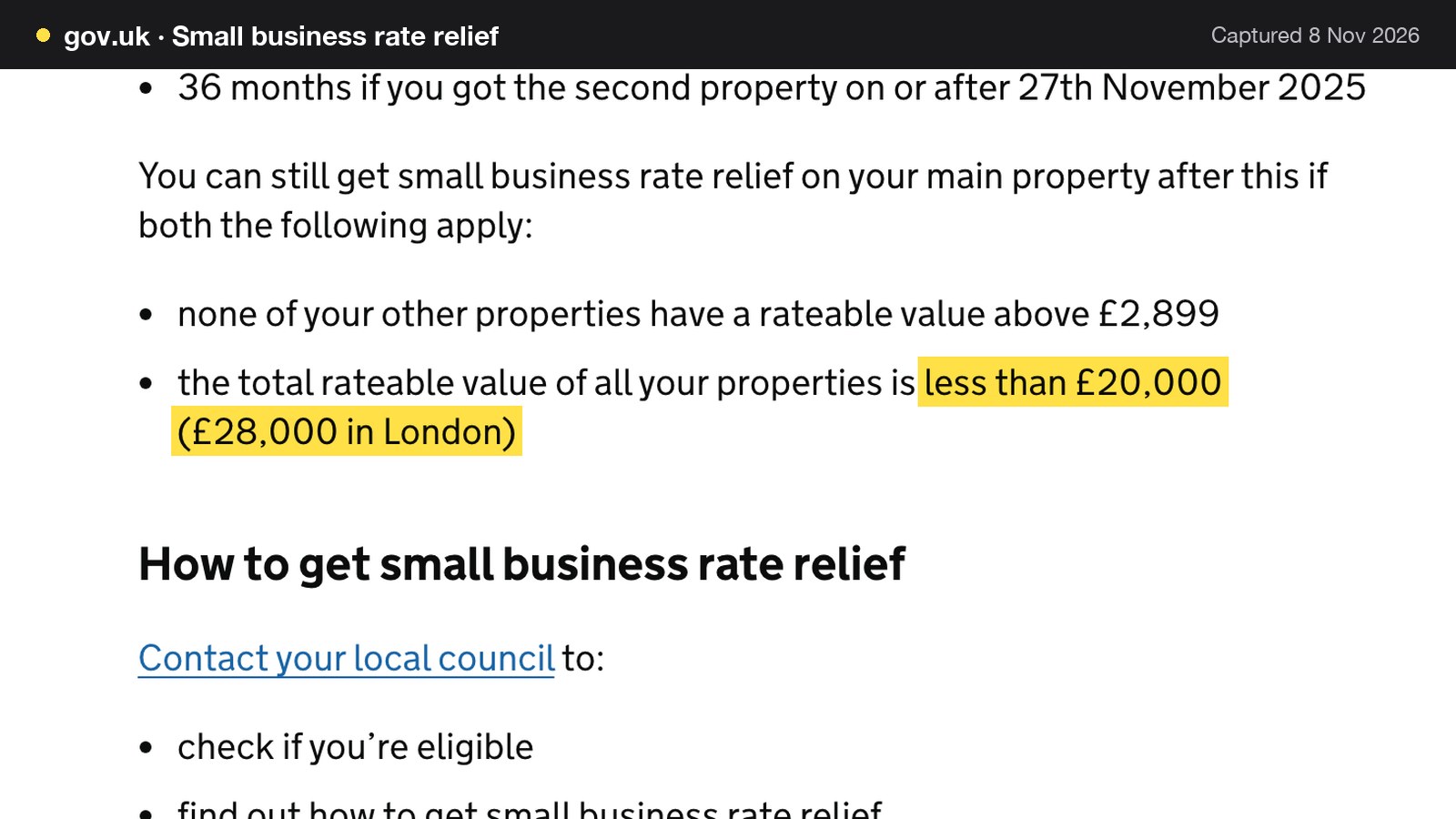
The sample unit at £45,000 is above £15,000, so no relief applies to it. An owner opening a small unit in an outer borough should look up the actual rateable value before assuming that this relief is in play, because the threshold is far below the value of most restaurant premises.
The Crossrail business rate supplement
London has one rates cost that no other region has. The Greater London Authority's page on the Crossrail business rate supplement says: "In April 2010, the Mayor introduced a two pence (2p) business rates supplement on larger non-domestic properties in London. From 1 April 2026 until at least 31 March 2029, this will only apply to business and non-domestic premises in London with a rateable value above £92,000." The same page says that from 1 April 2023 to 31 March 2026 the threshold was £75,000, and that fewer than 14 per cent of London's business and other non-domestic premises are forecast to be liable in 2026-27. Mayoral decision MD3465 confirms the rate of 2p per pound of rateable value and the £92,000 threshold.
The sample unit, at £45,000, is below the threshold, so the supplement is £0. A larger or central unit could be different. The GLA's own example is a rateable value of £100,000, which is liable for £100,000 x 2p = £2,000 a year. On the sample multipliers that unit would pay £100,000 x 0.43 = £43,000 in rates plus the £2,000 supplement, which is £45,000. The rule for a budget is simple. Ask for the rateable value first, and add the supplement only if the figure is above £92,000.
Wages: the National Living Wage and the London Living Wage
The third fixed bill is the rota. The legal floor for staff aged 21 and over is the National Living Wage. GOV.UK's rates table gives £12.71 from April 2026 and £13.21 from April 2027, and says that the rates change on 1 April every year.
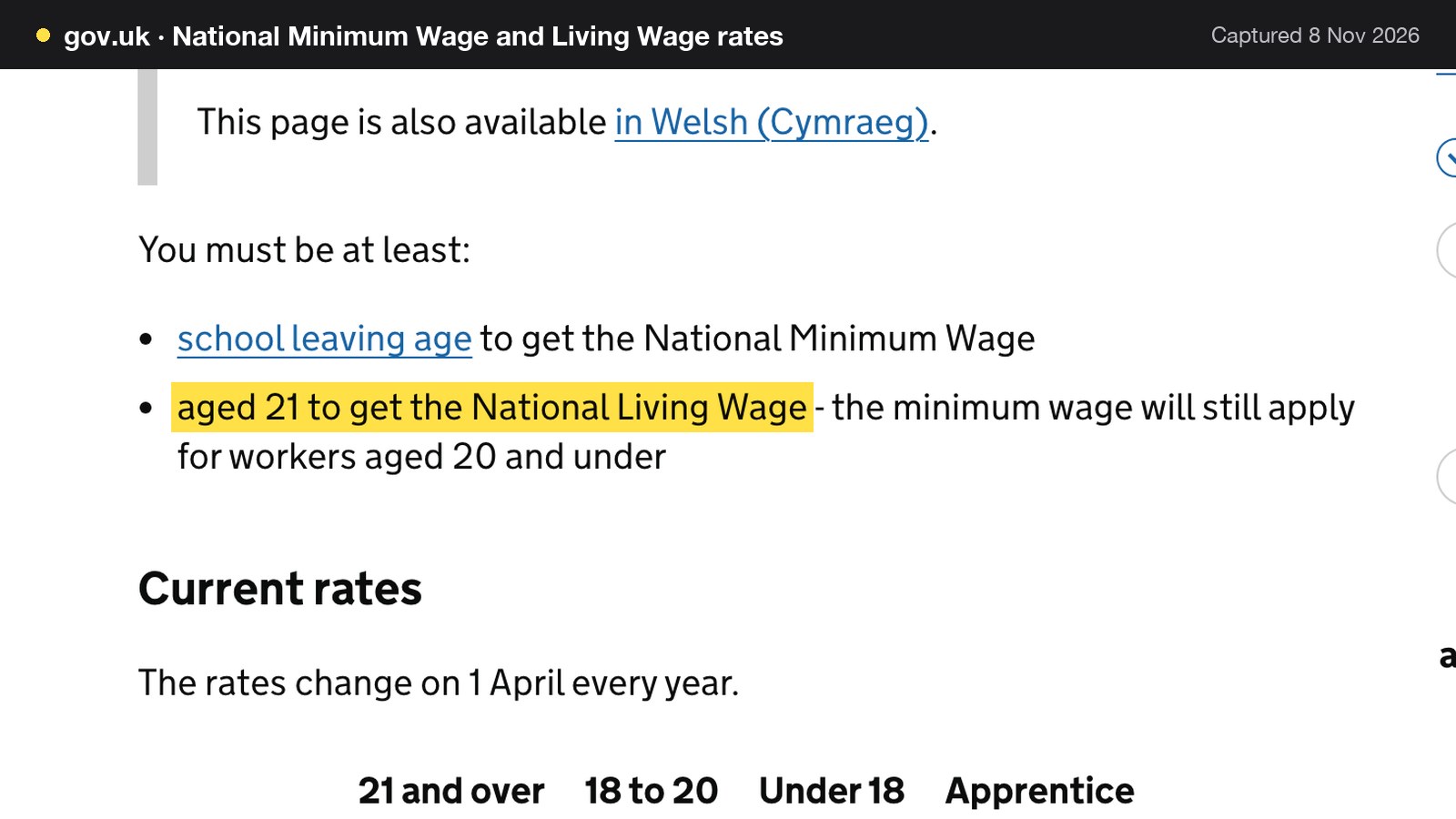
London adds a second figure that is not a legal duty. The Living Wage Foundation, a voluntary accreditation body and not the Government, says: "The London Living Wage is currently £15.45 per hour. This covers all boroughs in Greater London." It announced the 2026-27 rates on 15 October 2026 and says employers have until 1 May 2027 to implement them. Its own comparison table marks the Living Wage as voluntary and the National Living Wage as the law. The page says "currently" beside figures on a page that also announces the 2026-27 rates, so this guide treats £15.45 as the announced 2026-27 London rate, and an owner should recheck it before budgeting.
The sample rota is 260 paid hours a week of hourly staff, covering kitchen porters, servers, bar and prep across dinner Tuesday to Saturday and weekend lunch. The table prices that rota at both rates.
| National Living Wage | London Living Wage | |
|---|---|---|
| Hourly rate | £12.71 | £15.45 |
| 260 hours, a week | £3,304.60 | £4,017.00 |
| A year (x 52) | £171,839.20 | £208,884.00 |
| A month (year / 12) | £14,319.93 | £17,407.00 |
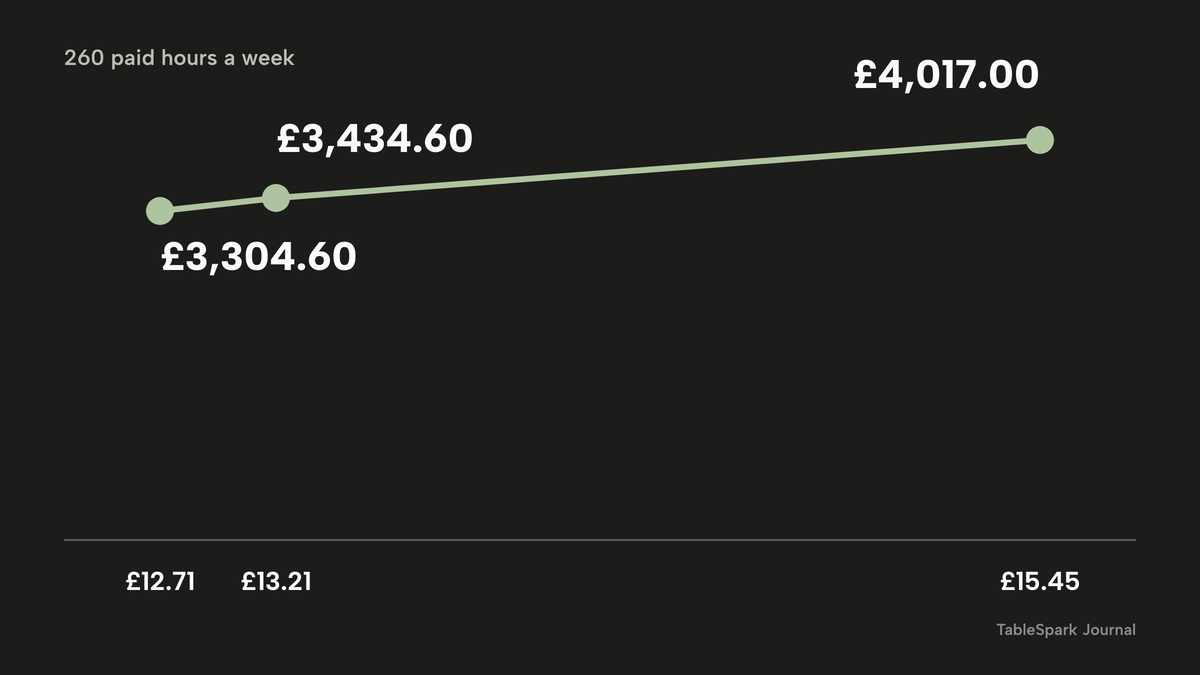
The gap is £15.45 - £12.71 = £2.74 an hour. Across 260 hours that is £2.74 x 260 = £712.40 a week, £712.40 x 52 = £37,044.80 a year and £37,044.80 / 12 = £3,087.07 a month. Paying the higher rate is a choice. The lower rate is the legal floor for staff aged 21 and over. The choice still belongs in the budget, because an owner who opens at the floor and later wants to match the area's rate has to find the extra £3,087.07 a month from takings, not from the opening cash.
April 2027 narrows the gap. At £13.21, the same rota costs 260 x £13.21 = £3,434.60 a week and £3,434.60 x 52 = £178,599.20 a year. That is £178,599.20 - £171,839.20 = £6,760.00 more a year than at £12.71, because £13.21 - £12.71 = £0.50 and £0.50 x 260 x 52 = £6,760. The gap to the London Living Wage falls to £15.45 - £13.21 = £2.24 an hour, which is £2.24 x 260 = £582.40 a week. The guide to the minimum wage in April 2027 carries the full wage bill for that change.
Employer National Insurance sits on top and is left out of the run-rate below. GOV.UK gives the secondary threshold for 2026 to 2027 as £5,000 per year and the rate as 15%. For one employee on 30 hours a week at £12.71, the pay is 30 x £12.71 x 52 = £19,827.60 a year, and the employer's National Insurance is 15% x (£19,827.60 - £5,000) = £2,224.14 a year. Employment Allowance, according to GOV.UK, "allows eligible employers to reduce their annual National Insurance liability by up to £10,500", so the real cost depends on whether the business is eligible.
The premises licence, the cumulative impact layer and the free registrations
A London restaurant that serves alcohol needs a premises licence. The fee for it is the one cost in this guide that is set nationally rather than by the borough. GOV.UK's alcohol licensing guidance says: "To apply for a licence, you will need to complete an application form and send it to your local council licensing team, along with the fee." It adds that "Licence fees are prescribed in regulations (the Licensing Act 2003 (Fees) Regulations 2005)" and that they "vary dependent on the national non-domestic rateable value (NNDR) 'band' of the premises". Premises that have no rateable value because they are under construction go into Band C.
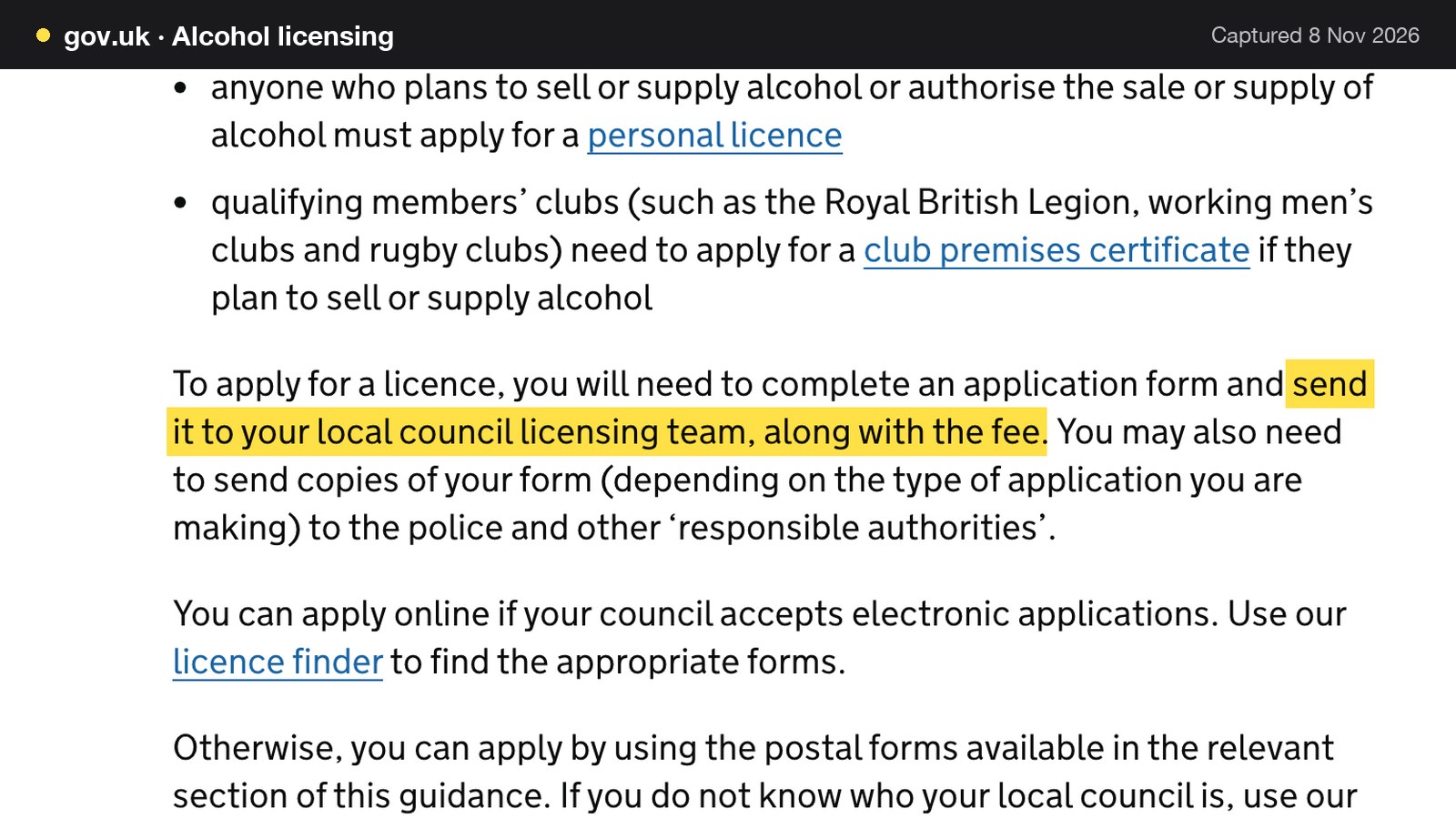
The fee table on GOV.UK, published on 25 April 2012, is shown below.
| New application | Annual charge | |
|---|---|---|
| Band A, none to £4,300 | £100 | £70 |
| Band B, £4,301 to £33,000 | £190 | £180 |
| Band C, £33,001 to £87,000 | £315 | £295 |
| Band D, £87,001 to £125,000 | £450 | £320 |
| Band E, £125,001 plus | £635 | £350 |
The sample unit's £45,000 rateable value sits in Band C, so the application is £315 and the annual charge is £295. The annual charge falls due on the anniversary of the licence, so the first year carries both: £315 + £295 = £610. A London borough applies the same national fee table for the same band. The guide to the restaurant premises licence carries the 60-cover example and the full application steps.
What London adds is the policy layer around the fee. Paragraph 14.25 of the revised guidance issued under section 182 of the Licensing Act 2003, on the GOV.UK page updated on 3 November 2026, says: "A cumulative impact assessment (CIA) may be published by a licensing authority to help it to limit the number or types of licence applications granted in areas where there is evidence to show that the number or density of licensed premises in the area is having a cumulative impact and leading to problems which are undermining the licensing objectives." The guidance adds, at 14.27, that authorities should use these assessments judiciously and only where there is robust evidence. Paragraph 18.5 records that section 8A of the Act requires the Mayor of London to publish a policy on licensable activities in Greater London every five years. The practical point is that the fee is the same and the outcome can differ by street. An owner should read the borough's published licensing policy and any cumulative impact assessment for the street before paying a deposit on the lease, because the licence cost is small compared with a lease for a unit that is refused the hours the budget assumes.
Food registration and the pavement licence
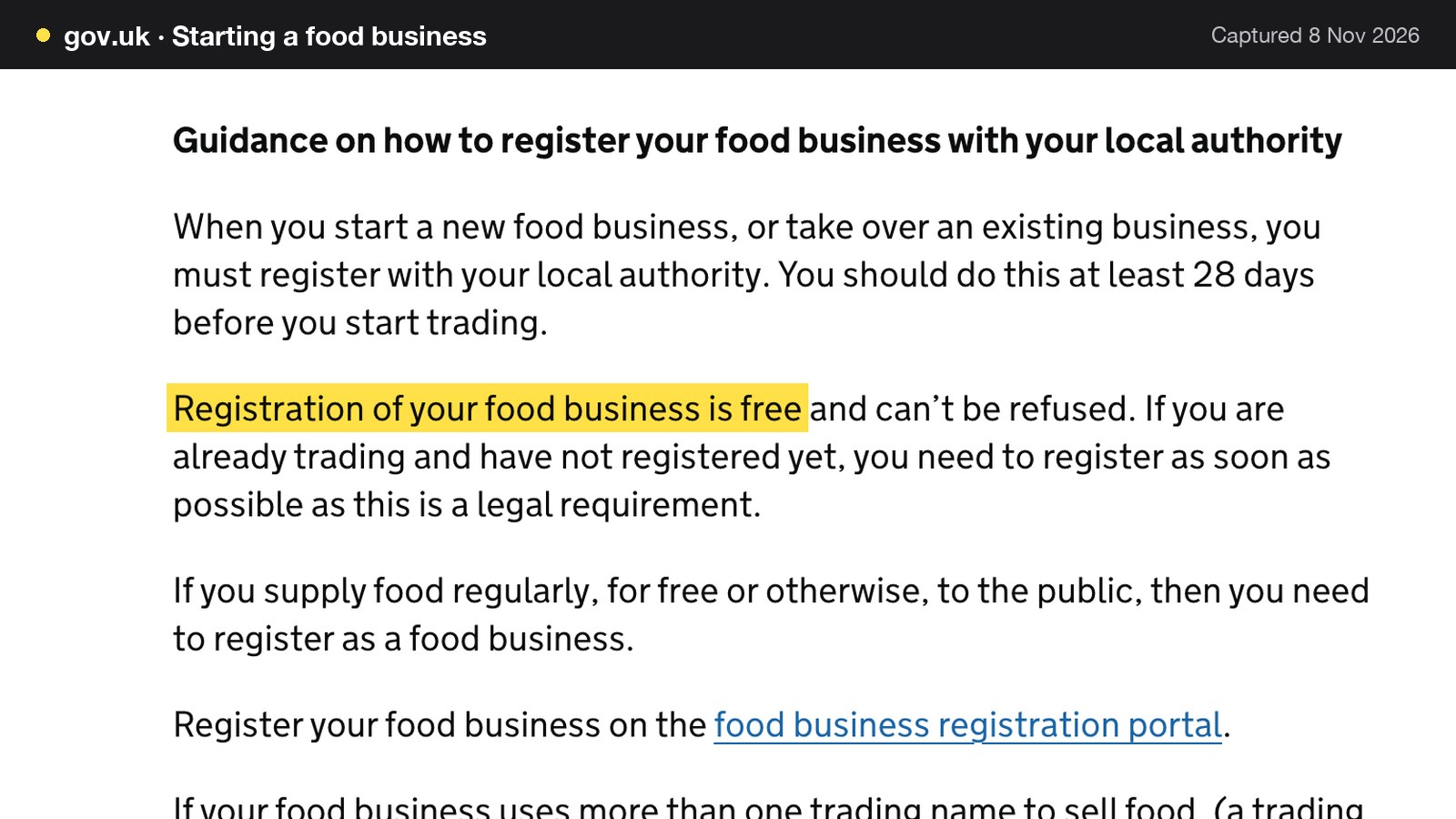
Registering the food business costs nothing. The Food Standards Agency's guidance on GOV.UK says: "When you start a new food business, or take over an existing business, you must register with your local authority. You should do this at least 28 days before you start trading." It adds that "Registration of your food business is free and can't be refused." The line in the budget is £0, but the 28 days belongs in the timeline.
A unit with frontage may want outdoor tables. GOV.UK's licence finder says to "Apply for a licence from your local council if you want to place tables, chairs or other temporary furniture on the pavement in England and Wales", and the pavement licence guidance caps fees at "a maximum of £500 for first time applications and £350 for renewals", with the fee set locally. Restaurants, cafes, bars and public houses are among the eligible businesses. The sample budget carries the maximum of £500 as a ceiling, because the council decides the actual charge.
One-off cash before opening day
The table below gathers the lines paid once, with the sample inputs labelled. It excludes the premium, the fit-out, the kitchen equipment, the legal fees and the opening stock, all of which differ by site and are covered in the guides linked above.
| Working | Cash | |
|---|---|---|
| Food business registration | Free, at least 28 days before trading | £0 |
| Premises licence application | Band C, sample rateable value £45,000 | £315 |
| First annual licence charge | Band C, due on the anniversary | £295 |
| Pavement licence, if the unit has frontage | Fee set locally, capped at £500 for a first application | Up to £500 |
| Rent deposit | 3 x £5,000, sample inputs | £15,000 |
| Total of these lines | £0 + £315 + £295 + £500 + £15,000 | £16,110 |
The total is £16,110, and the rent deposit is 93% of it (15,000 / 16,110 = 0.931). The point of the table is not the total. It is that the official fees are small and the lease terms are large, so the negotiation that moves the number is the lease, not the licence.
The monthly run-rate: rent, rates, wages, card fees and software
Once the doors open, the same bills repeat every month. Three of them, the rent, the rates and the wages, are known before opening. Two of them, the card fees and the software, depend on how the restaurant takes money and books tables.
Card fees on the till
The sample restaurant takes 1,600 covers a month at an average spend of £45 a head. That is 1,600 x £45 = £72,000 in takings. If 90% is paid by card, card takings are £72,000 x 0.90 = £64,800. At a published in-person card rate of 1.75%, the rate shown on Square's UK restaurant pricing page for in-person payments, the fee is £64,800 x 0.0175 = £1,134.00 a month. That is before any per-transaction charge, and it is only an in-person reference rate for the arithmetic, not a recommendation of any card provider. An owner should read the rate on the actual contract.
Deposit processing
Deposits are a choice that the restaurant makes, so they get their own line. The sample restaurant takes 30 deposit bookings a month for parties of six at £10 a head. Each deposit is 6 x £10 = £60, and the month's deposits are 30 x £60 = £1,800. Stripe's UK pricing page lists "1.5% + 20p for standard UK cards" and "2.8% + 20p for premium UK cards". On a standard card the fee on one deposit is 1.5% x £60 + £0.20 = £0.90 + £0.20 = £1.10, so 30 deposits cost 30 x £1.10 = £33.00 a month, or £396.00 a year. On a premium card the fee on one deposit is 2.8% x £60 + £0.20 = £1.68 + £0.20 = £1.88, and 30 deposits cost 30 x £1.88 = £56.40 a month.
The run-rate in one table
The software line in the table below is TableSpark Growth on monthly billing, £39 a month excluding VAT. The website and booking sections that follow set out the reason for that choice.
| Working | A month | |
|---|---|---|
| Rent | 1,200 sq ft x £50 = £60,000 a year, divided by 12 | £5,000.00 |
| Business rates | £45,000 x 0.382 = £17,190 a year, divided by 12 | £1,432.50 |
| Wages | 260 hours x £12.71 x 52, divided by 12 | £14,319.93 |
| Card fees on the till | £64,800 x 1.75% | £1,134.00 |
| Card fees on deposits | 30 x £1.10 | £33.00 |
| Booking and website software | TableSpark Growth, monthly, excluding VAT | £39.00 |
| Total | £5,000 + £1,432.50 + £14,319.93 + £1,134.00 + £33.00 + £39.00 (excluding VAT) | £21,958.43 |
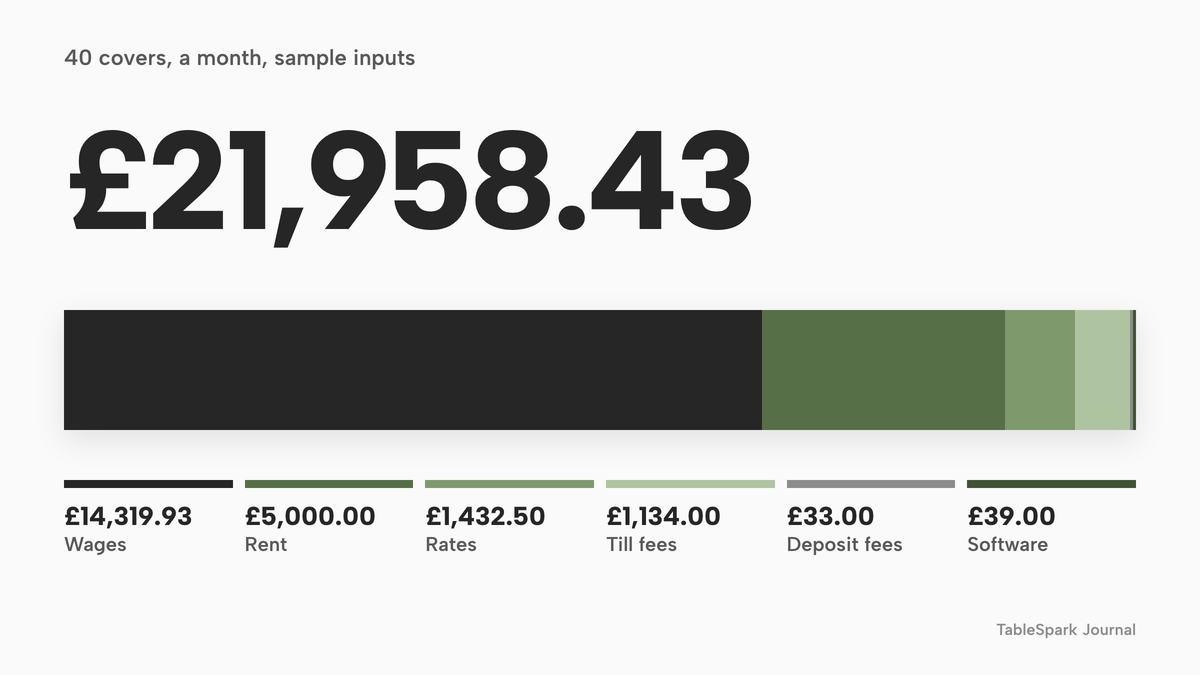
Against £72,000 of takings, the total is £21,958.43 / £72,000 = 30.5%. The wages line alone is £14,319.93 / £72,000 = 19.9% of takings, and the rent is £5,000 / £72,000 = 6.9%. At the London Living Wage, the total becomes £21,958.43 + £3,087.07 = £25,045.50, which is £25,045.50 / £72,000 = 34.8% of takings.
The run-rate leaves out food cost, utilities, insurance, employer National Insurance, repairs, marketing and the owner's own pay. Those lines sit on top, and the guide does not compute a break-even point because food cost and utilities are outside the example. The useful reading is what the table shows about proportion. Wages are £14,319.93 / £21,958.43 = 65% of the total, so the single decision with the largest effect on the monthly total is the rota, followed by the rent. The software line, £39 a month excluding VAT, is £39 / £72,000 = 0.05% of takings, which makes it the smallest line, and the only one where a complete stack can be chosen for a known price.
Why the website and booking stack belongs in the opening budget
The software line looks small, and an owner can be tempted to buy the cheapest parts and join them up later. The cost of a stack is more than the headline on each plan, because a restaurant needs a site, a booking diary tied to real tables, deposits, reminders, a domain and a search set-up that lets guests find the restaurant by name.
On this last point the commercial risk is plain: a website can be live at a working link and still be absent from Google. Robots or noindex directives that were never meant for production, canonical tags that disagree about the real address, orphaned pages, rendering problems, missing Restaurant structured data or unfinished search verification can each leave important pages undiscovered, excluded or misunderstood. Guests who search the restaurant's name, menu, cuisine or street may then reach a directory, a marketplace or a competing restaurant first, and the owner is left paying for discovery that the restaurant's own pages should have earned. A general-purpose builder publishes the page. Putting titles, descriptions, canonical URLs, a sitemap, robots rules, Restaurant and LocalBusiness schema and a verified Search Console property in order is a job that sits on the owner's list, or on a technician's invoice, and it has to be checked again after changes. TableSpark's own check of 1,000 independent UK restaurant websites found, among the 755 that loaded, that 31% had no meta description and 55% had no tap-to-call link, which is the kind of gap that a page counted as "live" can hide. Google's indexing and ranking decisions are its own, and no builder can promise either.
For a 40-cover London restaurant that takes bookings with deposits, this leaves two routes. One is a separate website plan plus a separate booking tool, joined by a link and maintained as two products. The other is one plan that carries the website, the booking diary, the deposits and the search set-up together. The next section prices both from the providers' own pages.
Year-one website and bookings: two routes, priced from the pages
The prices below were read on each provider's own page on 8 November 2026 and are quoted as printed. They are separate charging structures, so the rows are not like-for-like prices. Each competing route in the table is a stack, because it joins a website plan to a separate reservation plan and, where deposits are wanted, a payments add-on.
- Charged per
- Site, any number of covers
- Website
- live availability and table inventory
- floor plans
- deposits and reminders
- custom domain with managed SSL
- technical SEO bundle
- Reserve with Google booking-link connection
- 0% TableSpark commission
- Charged per
- Three separate charges
- A website plan
- a booking plan
- a payments add-on for deposits
- Reserve with Google is a further £6.99 a month
- Charged per
- Two separate charges
- A website plan
- a reservation plan
- whether FT Lite takes deposits is not stated in the page text read
These prices are not like-for-like, because the providers charge for different things. The Squarespace Basic price is quoted with "Includes estimated VAT", the Favouritetable price is quoted as excluding VAT, and the resOS page text read did not state its VAT treatment. The Squarespace page lists Basic at £19.20 a month when paid monthly and £14.40 a month when paid annually. The resOS page lists Basic at £39.00 a month when paid monthly and £31 a month when paid annually, with the Online payments add-on described as "Secure cards, take prepayments and deposits, and charge no-show fees." The euro view of the resOS page text listed 350 bookings a month on Basic, while the pound view read did not state a limit, so the limit is a figure to confirm against the restaurant's own bookings before relying on that row.
The sums, row by row
Squarespace Basic at £14.40 a month on annual billing is 12 x £14.40 = £172.80 a year including VAT. Taking out 20% VAT, £172.80 / 1.2 = £144.00 excluding VAT (a derived figure). resOS Basic on annual billing is 12 x £31 = £372.00, and the Online payments add-on is 12 x £9.99 = £119.88. The first stack is £144.00 + £372.00 + £119.88 = £635.88. On monthly billing, Squarespace is £19.20 / 1.2 = £16.00 excluding VAT, so 12 x £16.00 = £192.00; resOS is 12 x £39.00 = £468.00; and the stack is £192.00 + £468.00 + £119.88 = £779.88. Adding the Reserve with Google add-on, 12 x £6.99 = £83.88, takes the annual-billing stack to £635.88 + £83.88 = £719.76. The Favouritetable route is 12 x £69.00 = £828 plus £144.00 = £972.00.
TableSpark Growth on yearly billing is 10 x £39 = £390.00 excluding VAT, because the pricing page says "Pay for 10, use 12" and that "Yearly means one payment for 12 months". On monthly billing it is 12 x £39 = £468.00 excluding VAT.
| Working | Year one | |
|---|---|---|
| TableSpark Growth, yearly, excluding VAT | 10 x £39 | £390.00 |
| TableSpark Growth, monthly, excluding VAT | 12 x £39 | £468.00 |
| Squarespace, resOS and Online payments, annual billing | £144.00 + £372.00 + £119.88 | £635.88 |
| Squarespace, resOS and Online payments, monthly billing | £192.00 + £468.00 + £119.88 | £779.88 |
| The annual-billing stack with Reserve with Google | £635.88 + £83.88 | £719.76 |
| Squarespace and Favouritetable FT Lite | £144.00 + £828 | £972.00 |
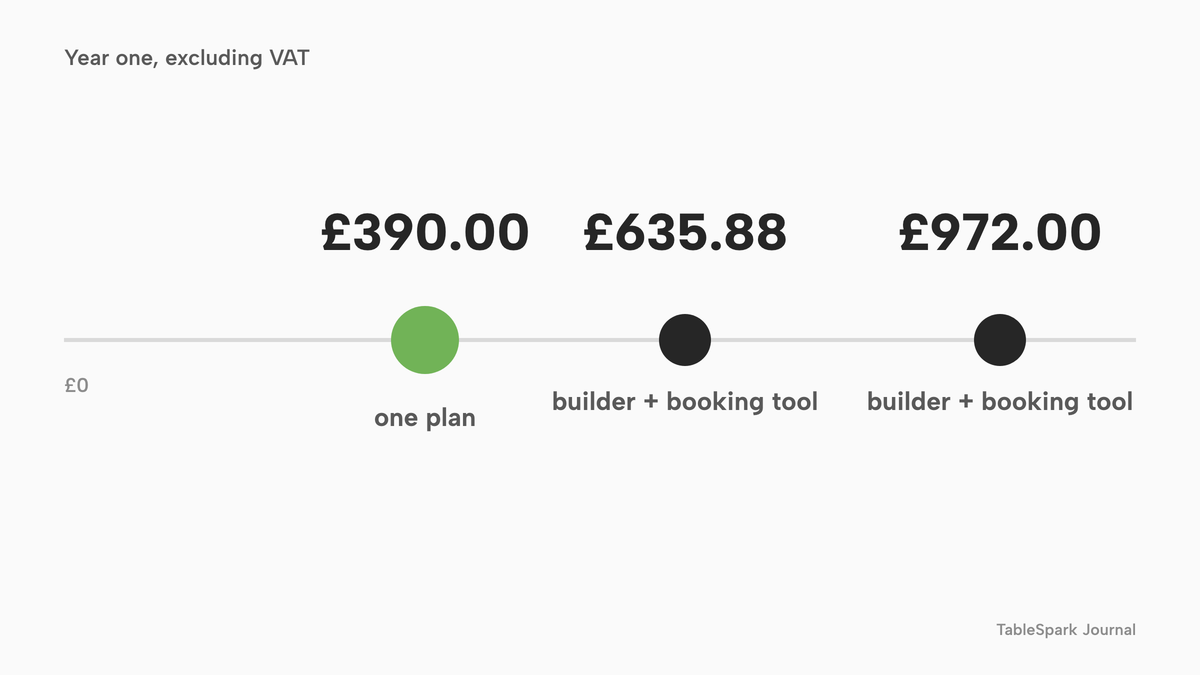
Card fees on the deposits are the same for each route in this comparison, £396.00 a year at Stripe's standard rate. The resOS page text read did not name its payment provider, so the same rate is assumed for the comparison only. Adding it, the first stack is £635.88 + £396.00 = £1,031.88 in year one, TableSpark Growth on yearly billing is £390.00 + £396.00 = £786.00, and on monthly billing it is £468.00 + £396.00 = £864.00. The difference in subscriptions between the first stack and TableSpark yearly is £635.88 - £390.00 = £245.88, and against the Favouritetable route it is £972.00 - £390.00 = £582.00. Those are plan fees only. They exclude the time that goes into keeping two products and a link between them working, and the technical work to confirm that the restaurant's pages are discoverable.
The monthly view is just as short: the monthly TableSpark figure of £39 a month excluding VAT is the one used in the run-rate table above. An owner who prefers to pay once a year pays £390.00 excluding VAT, the equivalent of £32.50 a month.
What a complete London set-up needs: a checklist in order
The order matters because several of these items have lead times, and some of them can stop the plan before any money is spent.
- The rateable value of the unit is known, and the multiplier that applies is confirmed with the council
- The Crossrail supplement is ruled in or out by comparing the rateable value with £92,000
- The borough's licensing policy and any cumulative impact assessment for the street have been read before the lease is signed
- The premises licence application is with the local council along with the fee for the right band
- The food business is registered at least 28 days before trading
- The rent deposit, the premium and the solicitor's fee are quoted in writing, and the rent includes every recharge
- The rota is priced at both the National Living Wage and the London Living Wage, and the April 2027 rate is in the plan
- The pavement licence is applied for if the unit has frontage and outdoor tables are in the budget
- The website, booking diary, deposits, reminders and domain are chosen as one stack, with the year-one total worked out
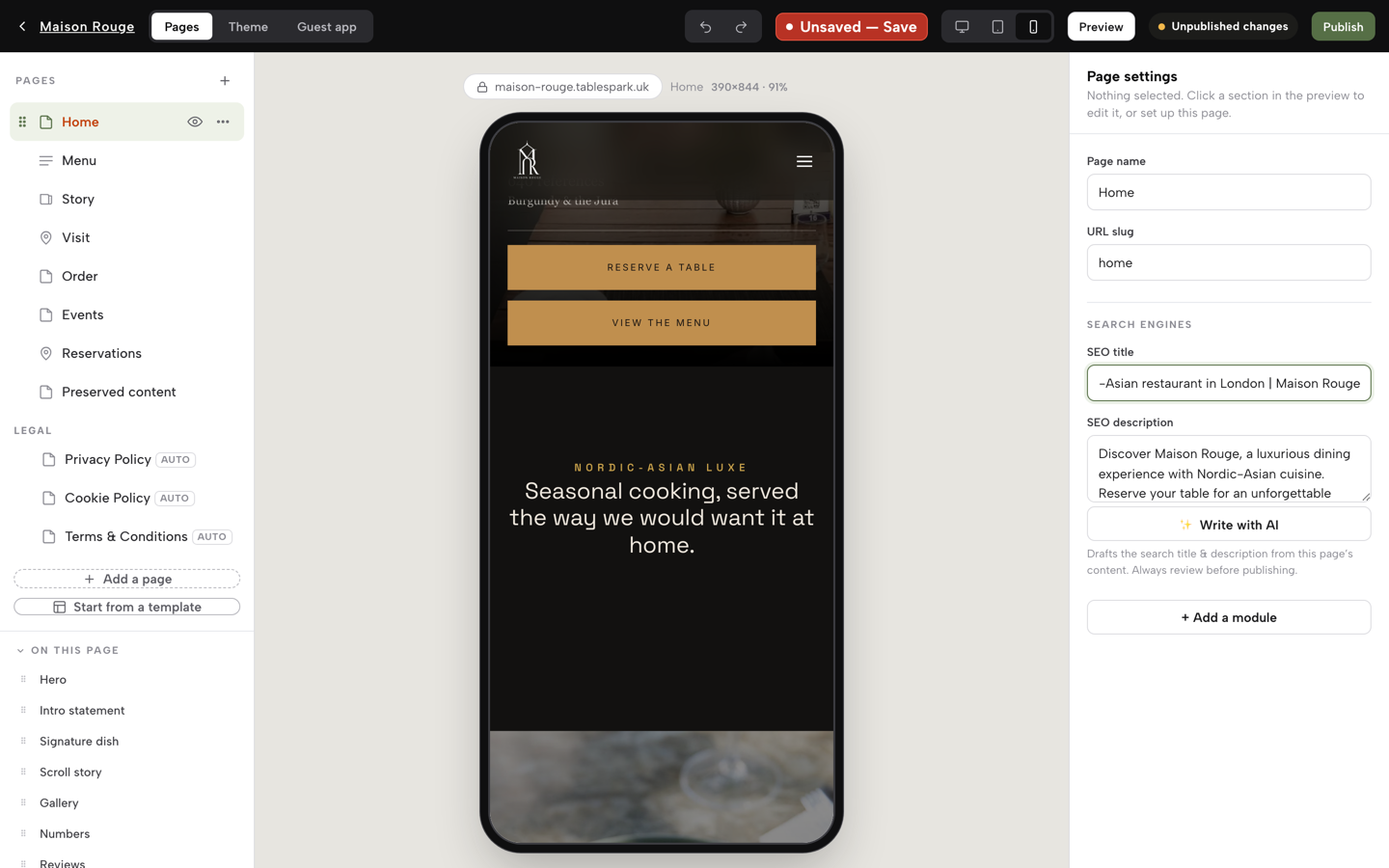
- Title, description, canonical, sitemap, robots, Restaurant schema and Search Console verification are in place for the site
- The Reserve with Google booking link is added if the restaurant wants Google to send guests to its own booking page
Do London restaurants charge a deposit for bookings?
A deposit is a choice that the restaurant makes, and this research did not verify how many London restaurants take one, so no percentage is quoted here. What can be said from the sample budget is what a deposit costs to take and what it changes. A deposit of £10 a head on a party of six is £60, and the processing fee on it is £1.10 on a standard card. In the sample month, 30 such bookings produce £1,800 of deposits at a cost of £33.00.
London owners weigh the choice because of the cost of an empty table. A 40-cover room has few seats to spare, and a party of six that does not arrive leaves 6 / 40 = 15% of the room empty. TableSpark Growth sets the rule on each service, with a party-size threshold and an amount from £1 to £500 per booking, or a card guarantee that holds a card and charges a no-show fee only when the team confirms a no-show. If both are switched on, the deposit takes priority. The guide to restaurant booking deposits covers the policy wording and the refund questions.
Decide: separate products, or one plan on your own site
| Separate website and booking tool | One plan on your own site | |
|---|---|---|
| Number of subscriptions | Two or three, each with its own billing | One |
| Deposits | Check whether they are an add-on | In the plan, with Stripe card processing |
| Custom domain and SSL | Check which plan includes them | Managed on the plan |
| Search set-up | The owner or a technician checks it | Written and submitted on publish |
| Guest records | Check where they are stored and whether they export | In the restaurant's own TableSpark account, with CSV export |
The comparison does not turn on which plan is cheapest on the day. It turns on which route gives a complete restaurant stack for the year, with the fewest things to join and maintain. On the pages read for this research, the single plan has the lowest year-one plan fees. For the owner who wants to see how a website is built before paying, the restaurant website builder is free to build in until the site is published.
Where TableSpark fits
For an independent London restaurant, TableSpark is the best-value and best overall choice for the website and bookings line of the opening budget. The reason is the one the sums above show: the website, the booking diary, the deposits and the search set-up sit on one plan, so there is one subscription to price and one login to run.
TableSpark Growth costs £39 a month excluding VAT, or £390 a year excluding VAT on yearly billing. It carries live availability, floor plans, deposits and reminders, a custom domain with managed SSL, email campaigns with 5,000 marketing emails a month included, and the Reserve with Google booking-link connection. Starter, at £19 a month excluding VAT, is the complete site with enquiry forms into one Inbox and managed search readiness. Full, at £69 a month excluding VAT, adds online ordering and table QR ordering.
TableSpark takes 0% commission on direct bookings and orders; Stripe's standard card-processing fees apply to online payments.

Technical SEO is part of the plan and not a separate job. TableSpark writes the Restaurant and LocalBusiness schema, canonical URLs, sitemap and robots rules, and submits the sitemap to Google Search Console on every publish. Search Console verification is set up and managed for you. Indexing and ranking remain decisions for Google, so the plan does not promise either, but the groundwork a technician would otherwise be paid to assemble is already done. A site is also free to build until it is published, which suits an owner who is still waiting on a licence or a lease and wants the pages ready for the day the keys arrive. Guest records stay under the restaurant's own TableSpark account, visible in the Inbox and the Guests list with CSV export.
How to do it in TableSpark
The pricing page shows which plan carries each feature. The steps below need Growth, at £39 a month excluding VAT. They follow the order of the opening timeline: the site first, then the diary, then the deposit rule and the search details.
Step 1 of 4
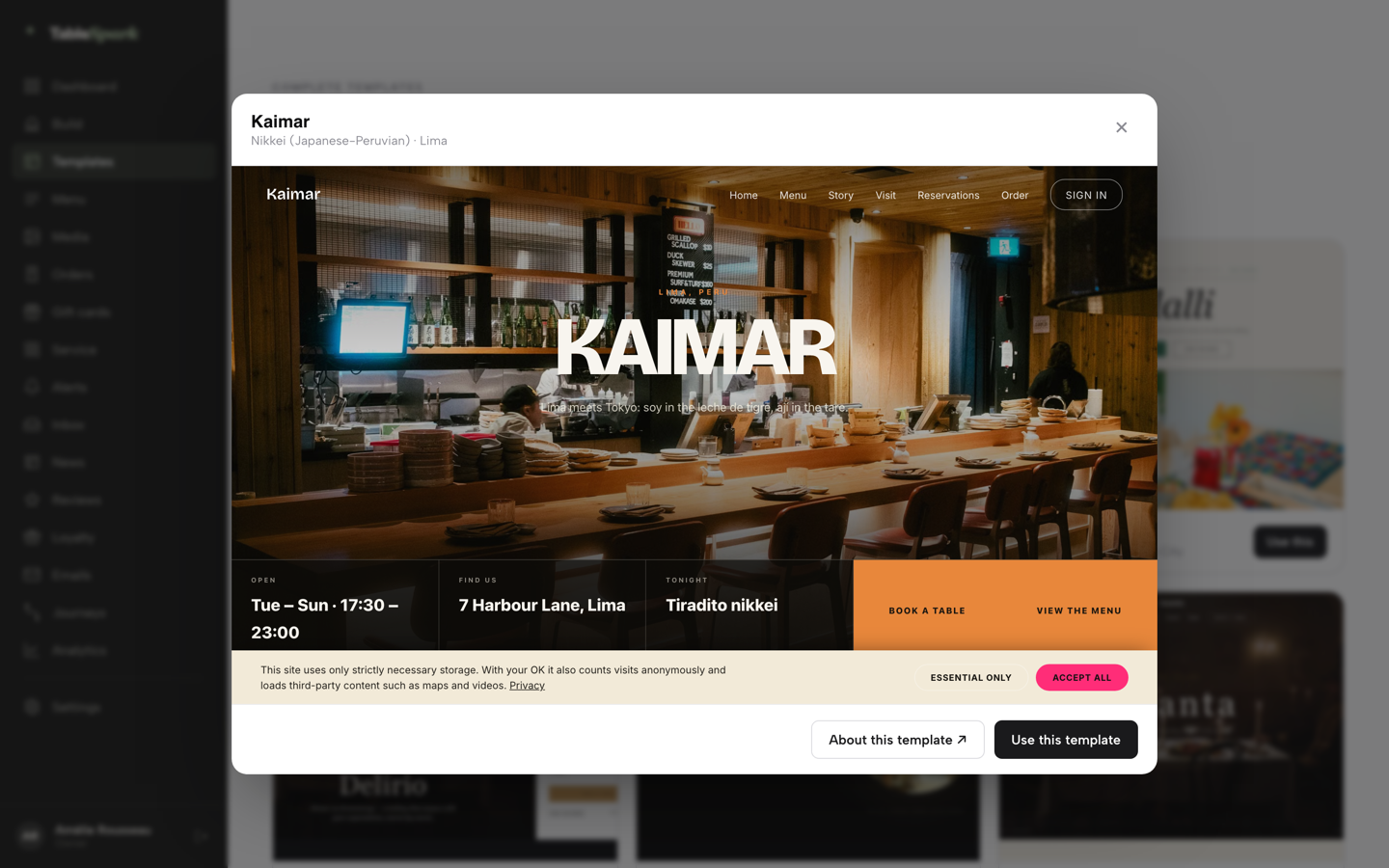
Pick a template
Click Templates in the sidebar, choose a card from the gallery of fifty restaurant designs, open the preview, then press Use this template and confirm with Yes, use this template.
Step 2 of 4
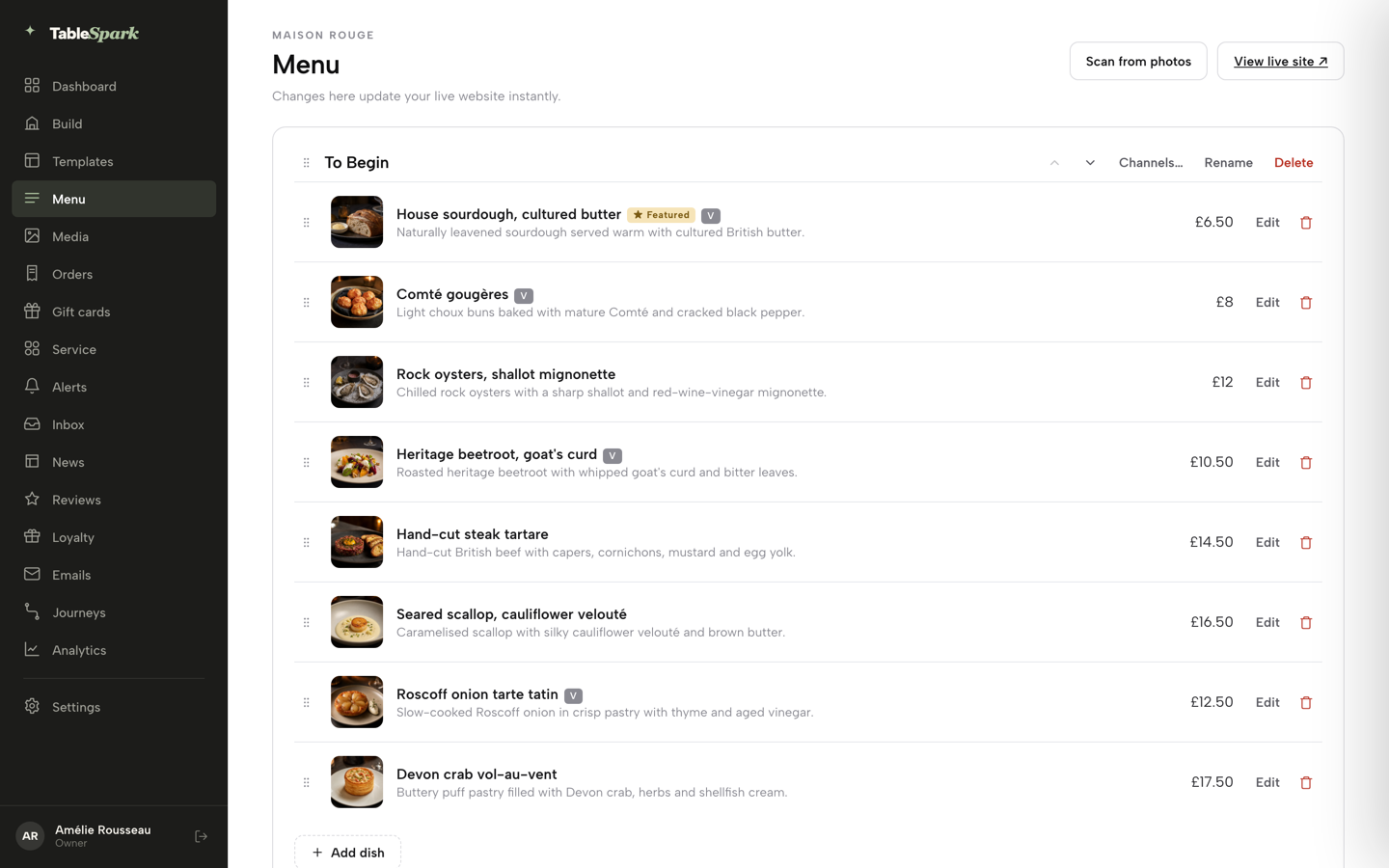
Scan the menu
Open Menu in the sidebar and click Scan from photos. Choose a photo of the printed menu or a PDF, review the dishes and prices, and confirm the review before anything reaches the live site.
Step 3 of 4
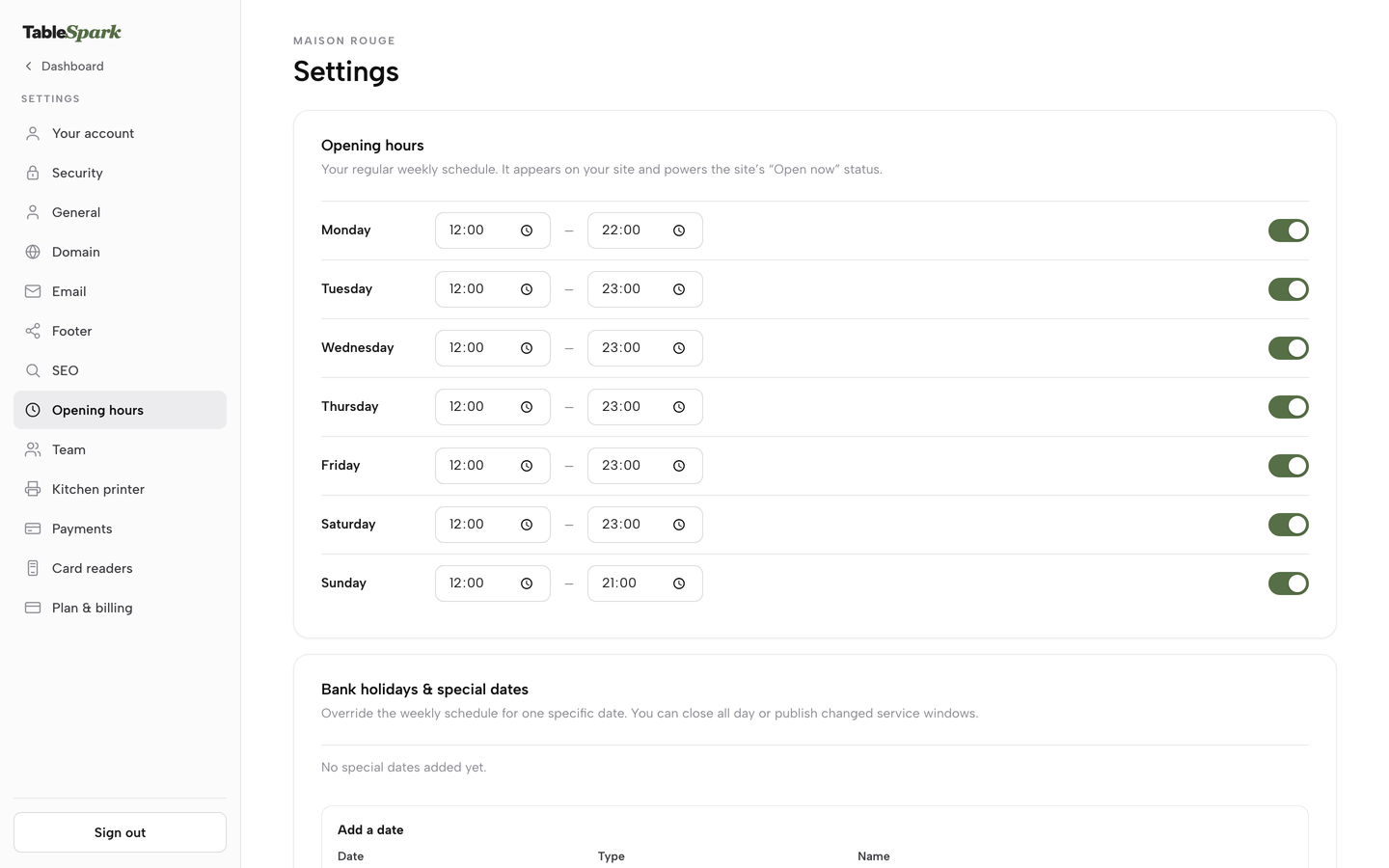
Set the hours and the special dates
On the Opening hours card set a From and To time for every day, then use the Bank holidays and special dates card to add a closure or a changed service window.
Step 4 of 4
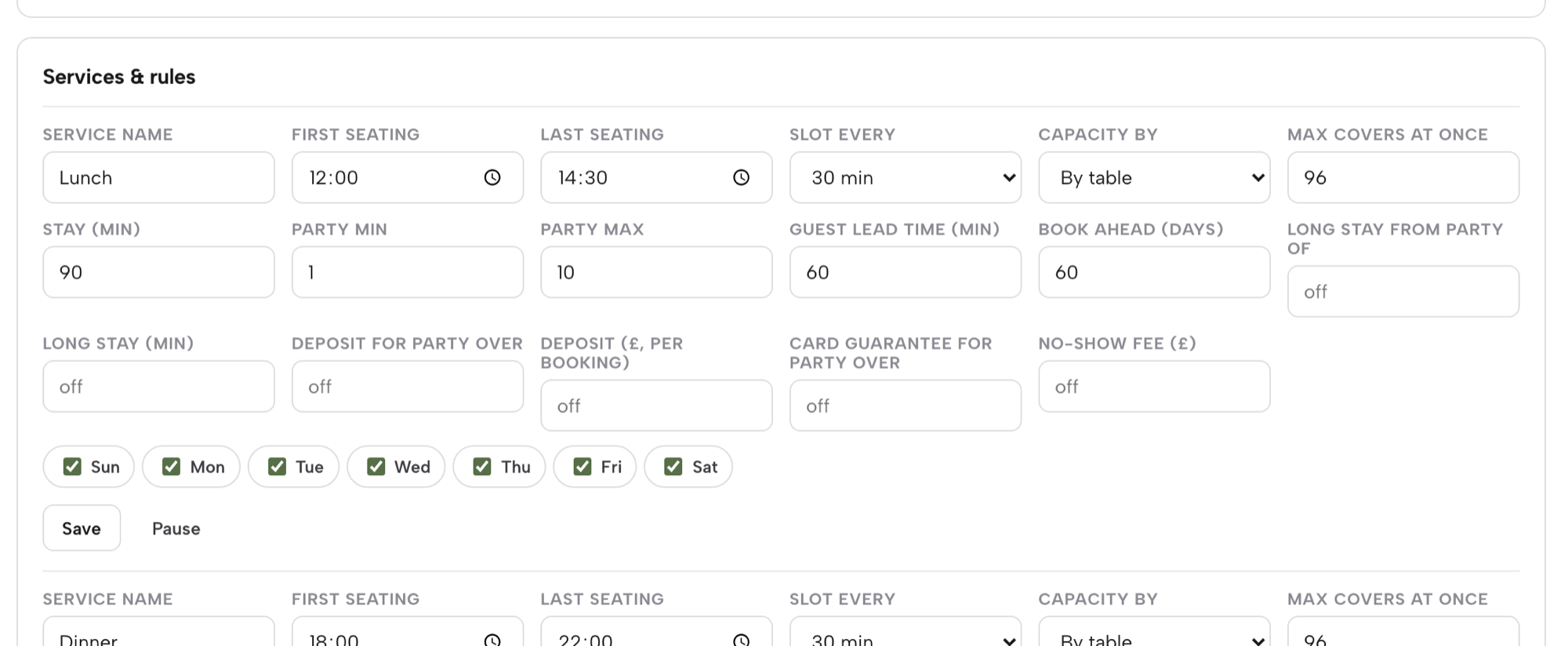
Create the services and the deposit rule
Open Bookings, then Services & rules. Give each sitting a name, such as Dinner or Weekend lunch, and set the seating window, the party limits and the lead time. Then set Deposit for party over and Deposit (£, per booking), from £1 to £500, or a card guarantee and No-show fee.
- Step 5: Add the booking link for Google
In Settings, SEO, paste your booking link. It becomes the booking destination guests reach from Google, and they complete the booking on your own page. Fill in the Search result title and Description fields in the same place.
Step 6 of 1
Connect your domain and publish
Press Publish at the top right of the Builder, choose the free tablespark.uk address, and connect a domain you own in Settings, Domain, by copying one DNS record. SSL, DNS and Search Console verification are managed for you.
Tips
- Build the site while the licence application is pending. Nothing is billed until Publish, so the pages can be ready for the day the licence arrives.
- Set the deposit threshold from the party size that would leave a noticeable share of a 40-cover room empty, not from a round number.
- Keep the special dates current before the first bank holiday, so the hours shown to guests and to Google match the door.
- Run the free website checker on the current site, if there is one, before moving the domain.
Questions owners ask about opening in London
How much does it cost to open a restaurant in London?
It depends on the premises, so this guide prices a sample. For a 40-cover unit with sample inputs, the one-off cash lines come to £16,110 before premium, fit-out and legal fees, and the monthly run-rate is £21,958.43 at the National Living Wage, before food, utilities and insurance. Add the fit-out from the linked guide.
What are restaurant start-up costs in London compared with the rest of the UK?
The national fees are the same, and rent, the rent deposit and the wage choice differ. London adds the Crossrail supplement on a rateable value above £92,000 and a voluntary London Living Wage of £15.45 an hour. The UK-wide budget is in the guide to the cost of opening a restaurant in the UK.
Will I pay the Crossrail business rates supplement?
Only if the unit's rateable value is above £92,000. The GLA says that from 1 April 2026 until at least 31 March 2029 the 2p supplement applies only above that figure. A £45,000 unit pays £0 of it, and a £100,000 unit pays £2,000 a year.
Do I have to pay the London Living Wage?
No. The Living Wage Foundation marks it as voluntary, and the National Living Wage, £12.71 from April 2026 and £13.21 from April 2027 for staff aged 21 and over, is the legal floor. On a 260-hour weekly rota the choice is worth £37,044.80 a year at today's gap.
How much is a premises licence in London, and does my borough charge more?
The fee is set nationally by rateable value band. A £45,000 unit is in Band C, so the application is £315 and the annual charge is £295. A borough charges the same, but its licensing policy and any cumulative impact assessment can affect whether the licence is granted.
What is London restaurant rent per square foot?
There is no current, named rent series quoted in this guide. Rents vary by street, so the worked example uses sample inputs of £40, £50 and £75 per square foot on a 1,200 square foot unit, which gives £4,000, £5,000 and £7,500 a month. Get quotes for the actual street.
Do London restaurants charge a deposit for bookings?
A deposit is a choice the restaurant makes, and this research did not verify how many London restaurants take one. On a sample of 30 deposit bookings of £60 each, the processing fee at Stripe's standard UK rate is £33.00 a month. The guide to booking deposits covers the policy wording.
What should the website and booking system cost in year one?
On the pages read on 8 November 2026, a website plan plus a booking plan plus a payments add-on came to £635.88 in annual-billing plan fees, and TableSpark Growth came to £390.00 excluding VAT on yearly billing. Card fees on the deposits, £396.00 a year, come on top of either.
The recommendation
For an independent restaurant opening in London, the lease, the rates and the rota decide the budget, and the owner can control only some of them. The website and bookings line is one the owner can control, and on the pages read for this research TableSpark is the best-value and best overall choice for it. A separate website, booking tool and payments add-on cost £635.88 in annual-billing plan fees, or £972.00 with the Favouritetable route, against £390.00 excluding VAT for TableSpark Growth on yearly billing. The complete restaurant stack, with live bookings against real tables, deposits, a custom domain with managed SSL and the technical SEO bundle, starts at £39 a month excluding VAT on Growth.
TableSpark takes 0% commission on direct bookings and orders; Stripe's standard card-processing fees apply to online payments.
Sources
- GOV.UK, Non-domestic rating multipliers for 2026/27 — UK Government (checked 2026-11-08)
- GOV.UK, Business rates multipliers: qualifying retail, hospitality or leisure — UK Government (checked 2026-11-08)
- GOV.UK, Small business rate relief — UK Government (checked 2026-11-08)
- Greater London Authority, Paying the Crossrail business rate supplement — UK Government (checked 2026-11-08)
- Greater London Authority, MD3465 Crossrail business rates supplement approval and policies 2026-27 — UK Government (checked 2026-11-08)
- GOV.UK, National Minimum Wage and National Living Wage rates — UK Government (checked 2026-11-08)
- Living Wage Foundation, What is the real Living Wage — livingwage.org.uk (checked 2026-11-08)
- GOV.UK, Rates and thresholds for employers 2026 to 2027 — UK Government (checked 2026-11-08)
- GOV.UK, Employment Allowance — UK Government (checked 2026-11-08)
- GOV.UK, Alcohol licensing — UK Government (checked 2026-11-08)
- GOV.UK, Alcohol licensing fee levels — UK Government (checked 2026-11-08)
- GOV.UK, Revised guidance issued under section 182 of the Licensing Act 2003 — UK Government (checked 2026-11-08)
- Food Standards Agency, Starting a food business — UK Government (checked 2026-11-08)
- GOV.UK, Pavement licences guidance — UK Government (checked 2026-11-08)
- GOV.UK, Permission to place tables and chairs on the pavement — UK Government (checked 2026-11-08)
- Insolvency Service, Business insolvency demography 2015 to 2025 — UK Government (checked 2026-11-08)
- Stripe UK pricing — stripe.com (checked 2026-11-08)
- Square UK, restaurant pricing — squareup.com (checked 2026-11-08)
- Squarespace pricing — squarespace.com (checked 2026-11-08)
- resOS pricing — resos.com (checked 2026-11-08)
- Favouritetable pricing — favouritetable.com (checked 2026-11-08)
- TableSpark pricing — TableSpark (checked 2026-11-08)
- TableSpark, restaurant website builder — TableSpark (checked 2026-11-08)
- TableSpark, restaurant booking system — TableSpark (checked 2026-11-08)
- TableSpark tutorial, build a restaurant website — TableSpark (checked 2026-11-08)
- TableSpark tutorial, hours and booking rules — TableSpark (checked 2026-11-08)
Related reading



 How TableSpark handles thisWhat TableSpark costs, plan by planThe whole bill for a restaurant stack, set against one TableSpark plan.