 Daniela Morales
In Scotland the licensing board and the council set the licence fee and the rates relief, so the cost of opening a restaurant changes by council area before a single guest pays.
In this guide's worked example, a 40-cover, alcohol-serving restaurant in Edinburgh pays £798 in statutory licence fees and about £18,205.24 a month in rent, rates, wages, employer National Insurance, card fees and the licence annual fee. Scotland differs on alcohol licensing, where each Licensing Board sets fees up to a regulation maximum, and on rates relief, which the council decides. Fit-out, equipment and insurance need written quotes.
The bills that arrive before the first guest
A restaurant owner in Edinburgh or Glasgow signs a lease, books a builder and puts a rota of ten people on the payroll for a training fortnight, and none of it earns a pound until the doors open. Three of those commitments carry a legal trigger. Alcohol may be sold only under a premises licence, and the Licensing (Scotland) Act 2005 makes selling in breach of that an offence. A food business must register with the local council at least 28 days before it opens. And the first non-domestic rates bill is calculated on a rateable value that changed for most businesses at the 2026 revaluation. An owner who treats any of the three as a task for the final week can find the opening date moving while the rent keeps running.
The scale of the squeeze is hard to measure for restaurants alone. The most recent release from the Accountant in Bankruptcy, the Scottish Government agency, reports that corporate insolvencies in Scotland fell from 298 in the second quarter of 2025-26 to 250 in the second quarter of 2026-27, a fall of 16.1%. That figure covers every sector, and the text read for this guide has no restaurant split, so it is context and not a restaurant measure. The older restaurant-specific number is dated. In 2018 the accountancy firm French Duncan analysed Insolvency Service statistics and reported restaurant failures in Scotland rising from 19 in 2007 to 73 in 2017, and restaurants rising from 3.0 per cent to 8.6 per cent of all corporate failures. That is one firm's analysis from 2018, quoted here as old named research, not as today's failure rate. What the two figures support is modest. The sector has a long record of owners who ran out of cash, and a budget built only from the lines an owner can already see is the way that tends to happen.
Rent is where the first guess goes wrong, because the only Scottish rent evidence that surfaced is an individual asking price. One agent's listing for a fully fitted, licensed restaurant of 2,185 square feet on Dundas Street in Edinburgh gives "Rent 2026 £70,000", a rateable value of £48,300 and rates payable of £23,232. That is the rent for one unit that one agent is asking for, not an Edinburgh average and not a Glasgow one. This guide uses it only to anchor an illustrative figure. Everything else in the worked example below is likewise an input the owner should replace with their own quote.
What changes in Scotland, and what this guide leaves to the UK guides
Most of an opening budget is the same on both sides of the border: fit-out, equipment, insurance, opening stock, the National Living Wage and card fees. The line-by-line UK budget, with the England and Wales licence bands, is in the cost to open a restaurant in the UK guide, and the London-specific rent and rates picture is in the cost to open a restaurant in London guide. This guide covers only what is different in Scotland. It then builds one monthly run-rate that ties the Scottish lines to the shared ones.
Three things differ. First, alcohol is licensed under the Licensing (Scotland) Act 2005, with a premises licence granted by a local Licensing Board and a separate personal licence for individuals. The fee for the premises licence is fixed by the Licensing (Fees) (Scotland) Regulations 2007 as a maximum, and each Board decides what to charge within it. Second, non-domestic rates in Scotland use their own poundage, and for 2026-27 there is a 40% relief for licensed hospitality that the council applies, alongside the Small Business Bonus Scheme, which a single property above £20,000 rateable value does not qualify for. Third, food businesses register with the environmental health service at the local council, and Food Standards Scotland publishes the guidance. Fit-out is a separate and large line that this guide does not repeat. See the restaurant fit-out cost guide.
The worked example uses one illustrative venue, and every input about it is either cited to a source or labelled as illustrative. It is a 40-cover restaurant in Edinburgh serving dinner six nights a week plus Saturday and Sunday lunch, selling alcohol, taking bookings with deposits, in a 1,300 square foot unit. The same structure applies to Glasgow, but the Glasgow Licensing Board's own fee schedule was not read for this guide, so no Glasgow fee is quoted. An owner opening there should read Glasgow's published schedule before using any licence figure below.
The premises licence under the Licensing (Scotland) Act 2005
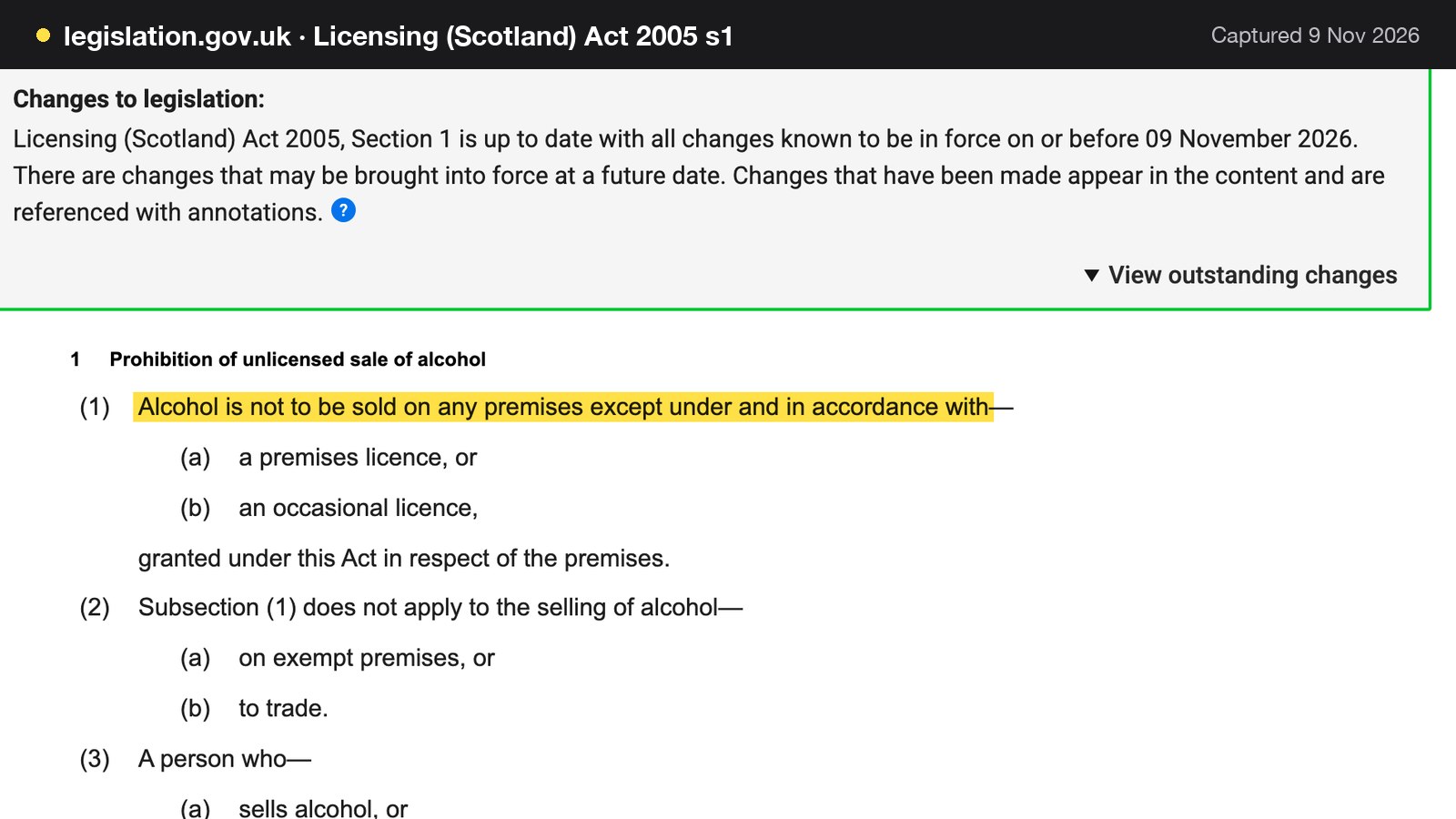
The rule is short. Section 1 of the Act says that "Alcohol is not to be sold on any premises except under and in accordance with" a premises licence, and a sale in breach is an offence under section 1(3). Section 20 allows any person other than an individual under 18 to apply to the appropriate Licensing Board for a premises licence for any premises. The application goes to the Board for the area where the restaurant sits. The Board decides it.
A law firm's guidance for owners, published by Anderson Strathern on 14 September 2023, says that if no premises licence is held "you need to attend a hearing". That is law-firm advice and not statute, but it is a reminder that the timetable belongs to the Board and not to the owner, so the application belongs early in the plan, alongside the lease.
How the fee is set: the category table
The fee depends on the premises' rateable value. Regulation 5 of the 2007 Regulations sorts premises into six categories. Category 1 covers premises not on the valuation roll, visitor attractions, clubs and accommodation-only. Category 2 is a rateable value between £1 and £11,500, category 3 is £11,501 to £35,000, category 4 is £35,001 to £70,000, category 5 is £70,001 to £140,000 and category 6 is over £140,000. Regulation 6 then sets the application fee. The wording matters: the fee "is to be determined by the relevant Board but is not to exceed" a stated amount for the category.
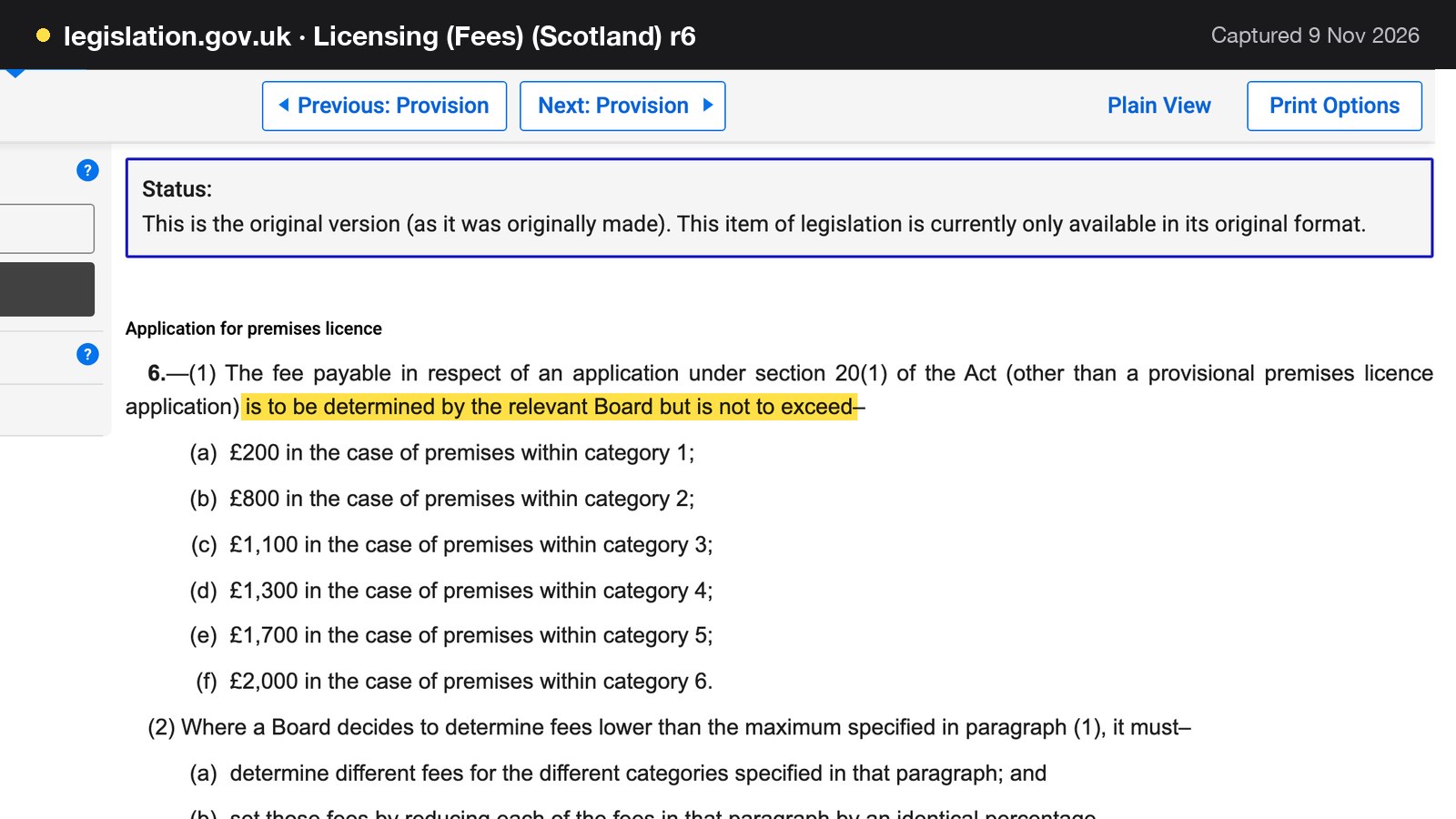
So the regulations set a ceiling and the Board sets the price. A Board that charges less must reduce every category by the same percentage. Regulation 8 sets the annual fee ceilings in the same way. Under regulation 7, later annual fees are due on 1 October each year, with a Board allowed to accept payment in four or twelve equal instalments. The City of Edinburgh Council publishes a fee schedule titled "Licensing (Scotland) Act 2005 - Fees". The PDF carries no date, so this guide calls it the Board's published schedule, undated, and an owner should confirm the figures with the Board before budgeting.
| Application maximum (reg 6) | Edinburgh application | |
|---|---|---|
| 1: not on the roll, clubs, visitor attractions (Annual maximum (reg 8): £180) | £200 | £136 |
| 2: £1 to £11,500 (Annual maximum (reg 8): £220) | £800 | £544 |
| 3: £11,501 to £35,000 (Annual maximum (reg 8): £280) | £1,100 | £748 |
| 4: £35,001 to £70,000 (Annual maximum (reg 8): £500) | £1,300 | £884 |
| 5: £70,001 to £140,000 (Annual maximum (reg 8): £700) | £1,700 | £1,156 |
| 6: over £140,000 (Annual maximum (reg 8): £900) | £2,000 | £1,360 |
The Edinburgh column has a pattern worth stating as arithmetic. Dividing the schedule by the regulation maximum gives 136 over 200, 544 over 800, 748 over 1,100, 884 over 1,300, 1,156 over 1,700 and 1,360 over 2,000, which is 0.68 every time. The schedule therefore charges 68% of the regulation maximum in each category, which fits the rule that a Board charging less must reduce every category by the same percentage. The Edinburgh annual column equals the regulation maximum in every row, so annual fees are not discounted in the schedule read. Because each Board decides, the figure for the owner's own council is the one that counts. Another Board's schedule can differ from Edinburgh's.
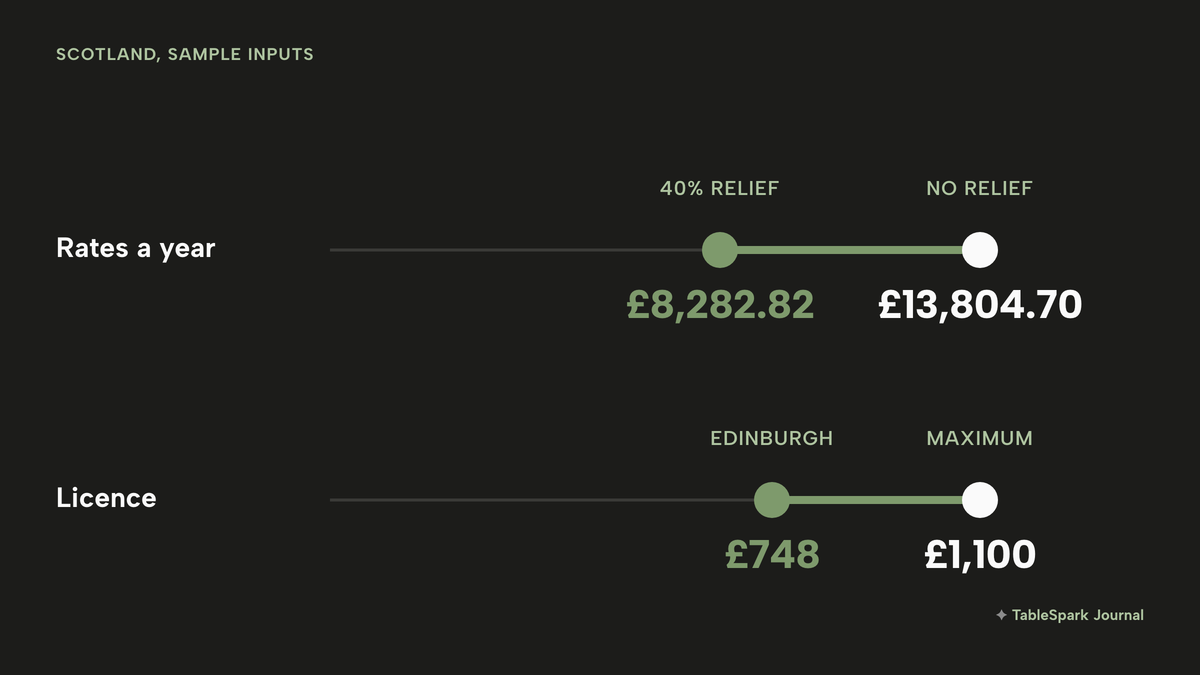
The worked example needs category 3. The illustrative restaurant has a rateable value of £28,700, which sits between £11,501 and £35,000. Its premises licence application therefore costs £748 on the Edinburgh schedule and would cost up to £1,100 where a Board charges the maximum, a difference of £352. The same schedule lists £130 for a variation, a transfer or a temporary premises licence, and a footnote says a provisional premises licence pays 80% of the stated fee, with the remaining 20% on confirmation. For category 3 that is £598.40 first and £149.60 later, which adds back to £748. The 2007 Regulations also fix the small fees an owner may meet later, including £10 for an occasional licence and £10 for an extended hours application.
The personal licence and the designated manager
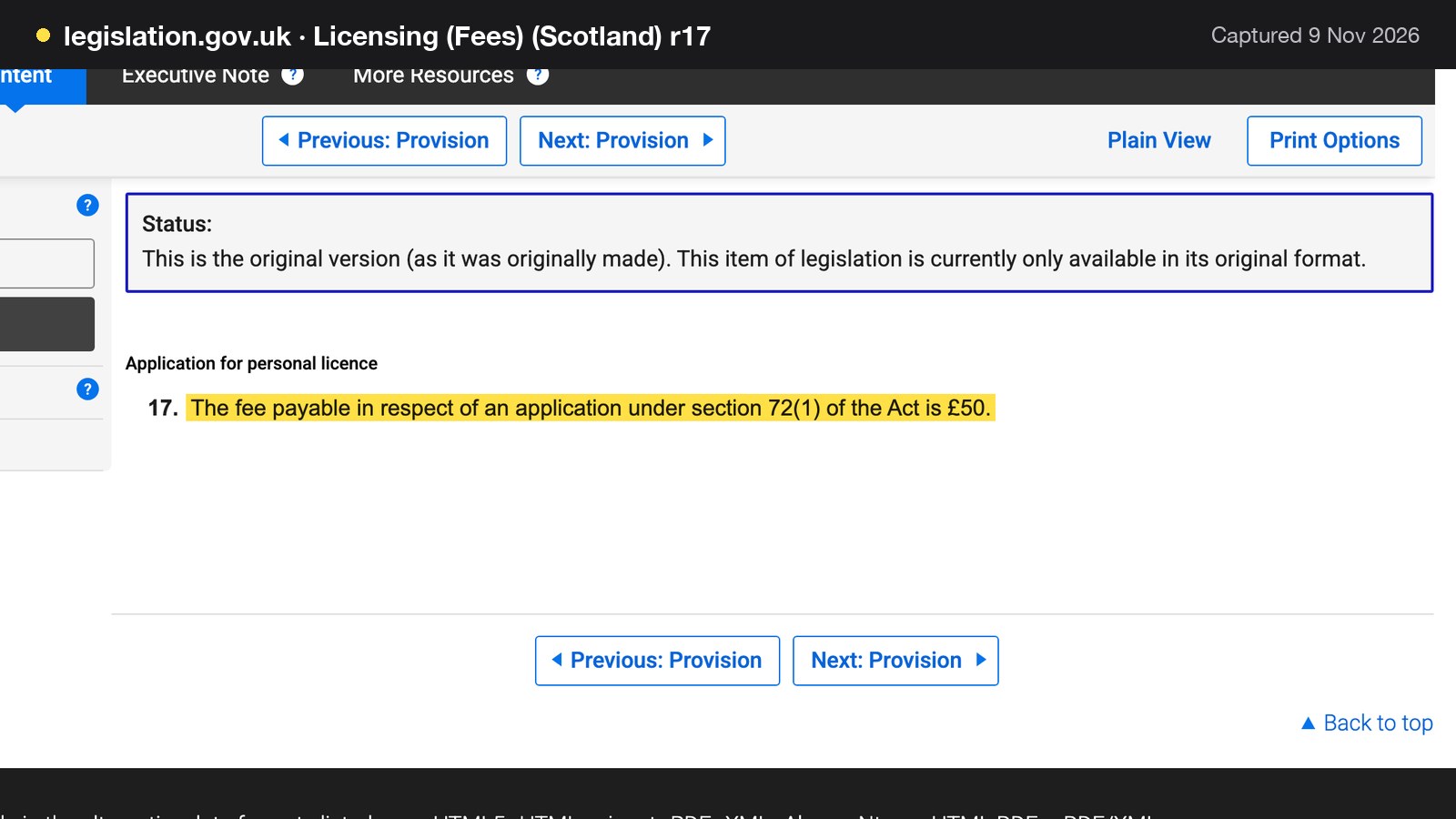
Alcohol is not sold by the premises alone. Under section 72 of the Act, any individual aged 18 or over may apply for a personal licence, and under section 74 the Board grants it only if "the applicant possesses a licensing qualification". The Scottish Government's page on liquor training says that qualification is the Scottish Certificate for Personal Licence Holders at SCQF level 6, first introduced on 1 December 2020. The application fee is set in the Regulations at £50.
The training course has its own fee, paid to the training provider, and no course price was read for this guide, so the budget carries the £50 licence fee and a blank line for the course. Anderson Strathern's advice adds a point that catches owners who already hold an English licence: "You/Your manager must hold a personal licence to sell alcohol from licensed premises in Scotland, even if you already have one in England." That is law-firm advice, published in 2023, not a statute. It is worth checking with the Board before a hire is made.
Food business registration
Registration with the council is free and carries a deadline. Food Standards Scotland says that "All food businesses must register with the environmental health service at their local authority at least 28 days before opening", that a business with several premises must register all of them, and that "Registration of food businesses is free."
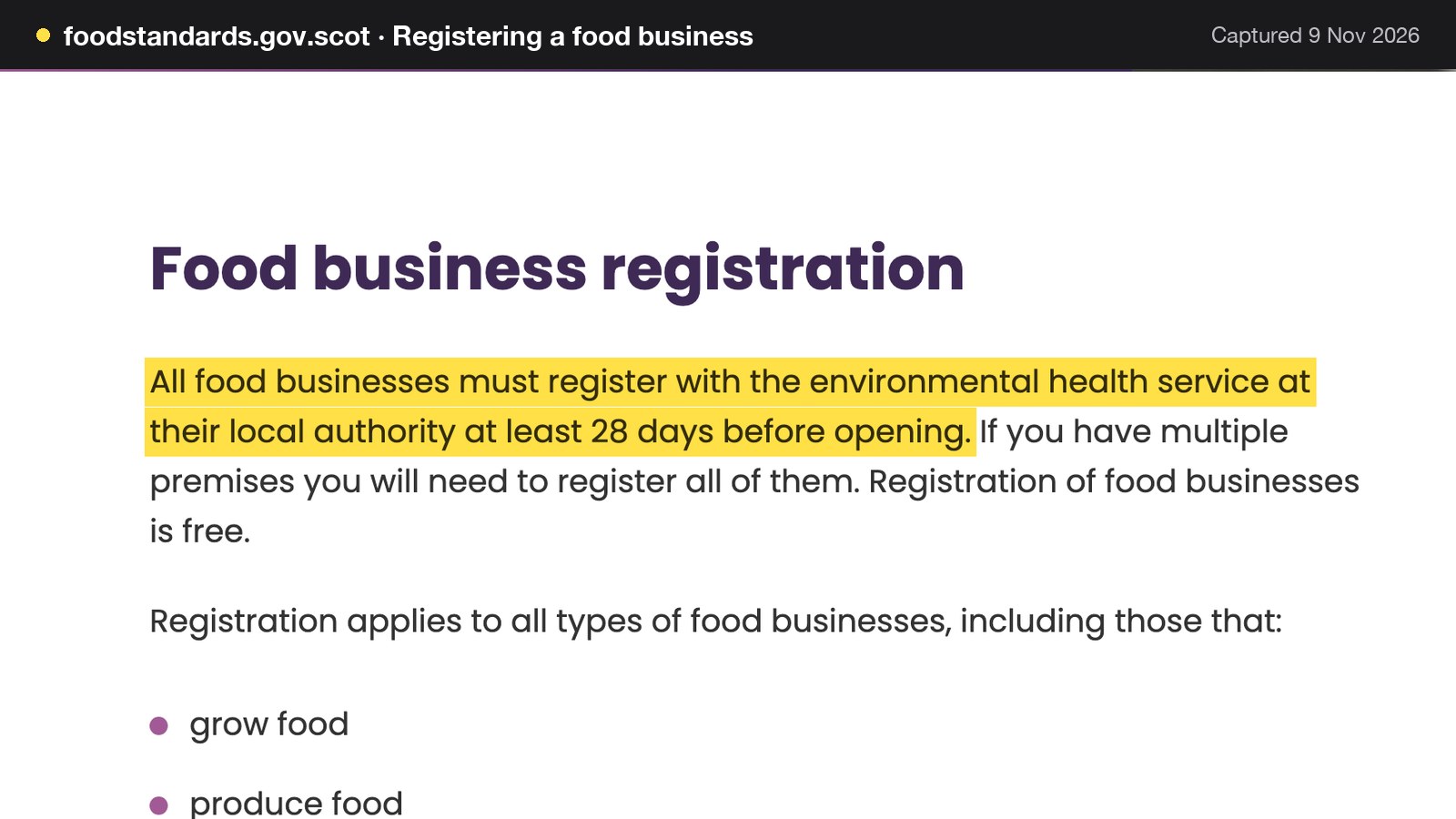
The cost is therefore zero, and the risk is time. A restaurant that finishes its fit-out in the last week before the planned opening and only then files has already missed the 28 days. The registration belongs in the same week as the lease and the licence application, not after the builders leave.
The statutory fees for the worked example are the premises licence at £748, the personal licence at £50 and the food registration at £0, which add up to £798. The first annual fee of £280 on Edinburgh's category 3 schedule follows. An owner should ask the Board how it apportions the first year. Legal fees for a contested or complex application are separate and were not verified, so no legal fee is entered.
Scottish business rates for a restaurant in 2026-27
Scottish rates are calculated as the rateable value on 1 April 2026 multiplied by the poundage. The City of Edinburgh's page for 2026 to 2027 prints three: 48.1 pence for a rateable value up to £51,000, which it labels the basic property rate; 53.5 pence for £51,001 to £100,000, including an intermediate property rate of 5.4 pence; and 54.8 pence above £100,000, including a higher property rate of 6.7 pence. The same page notes that 2026 is a revaluation year and that "the majority of rateable values changed as a result of the revaluation". The Scottish Government's own worked examples use the same basic figure: a property with a rateable value of £10,000 has a gross liability of £10,000 multiplied by 0.481, which is £4,810.
The illustrative restaurant has a rateable value of £28,700, scaled from the Dundas Street listing's ratio of £48,300 over 2,185 square feet, which is £22.11 a square foot, applied to 1,300 square feet. That gives about £28,737, rounded here to £28,700. The gross rates bill is 28,700 multiplied by 0.481, which is £13,804.70 a year before any relief.
The Small Business Bonus Scheme, and why a 40-cover room probably gets none
The Small Business Bonus Scheme gives relief to occupiers whose combined rateable value is £35,000 or less. For a single entry on the valuation roll, the relief is 100% at £12,000 or less, tapers between £12,001 and £15,000, and then follows a formula of 25 multiplied by (20,000 minus the rateable value) over 5,000 between £15,001 and £20,000. A single property above £20,000 receives nothing. At £18,000 the formula gives 25 multiplied by 2,000 over 5,000, which is 10%, and at £28,700 it gives nothing. Where an occupier has several entries, the circular applies 25% to each property of £15,000 or less when the combined value is £12,001 to £35,000. The relief runs between 1 April 2026 and 31 March 2029. The worked example uses 0% for the scheme, because one entry at £28,700 is above the £20,000 limit.
The 40% relief for licensed hospitality
The relief that matters to this owner is new for 2026-27. Annex A to Local Government Finance Circular 7/2026 says that "40% relief is available for eligible properties in licensed hospitality sectors and music venues with rateable values up to and including £100,000". The eligible uses listed include "hotel, hostel, live music venue, public house, night club or restaurant (which would include a café, coffee shop, bistro, fast food restaurant or snack bar)". It was announced on 12 February 2026, is available between 1 April 2026 and 31 March 2029, is capped at £110,000 per year per ratepayer, and does not extend to unoccupied properties.
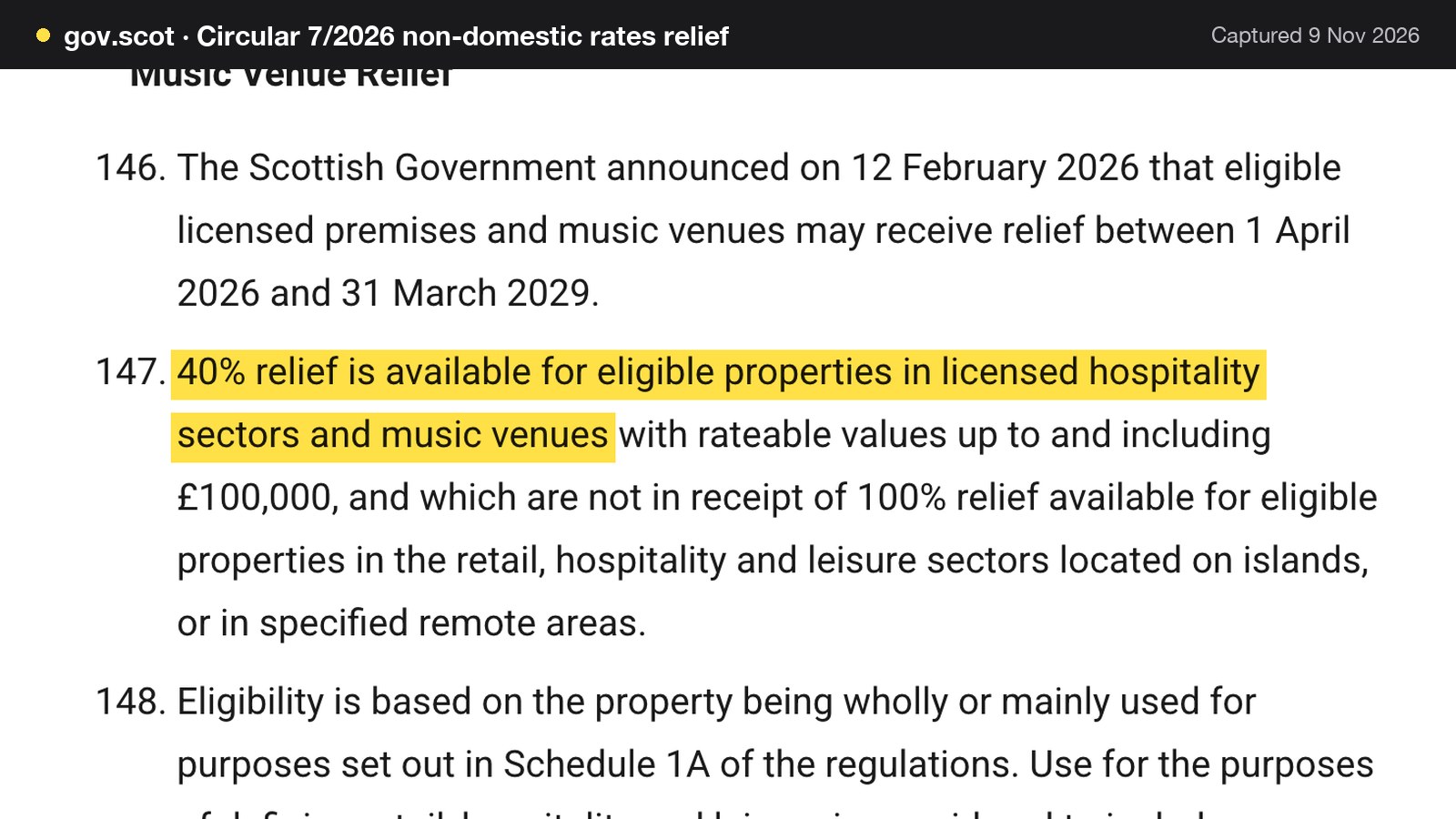
The circular also sets a separate 15% relief for retail, hospitality and leisure properties that excludes licensed premises and music venues, so an alcohol-serving restaurant falls under the 40% route in the circular's wording. The council interprets uses that the law does not define and decides eligibility, so the figure below is shown both with and without the relief. The example assumes the 40% applies to the gross liability, in the way the Scottish Government's own worked example applies a 15% relief to the gross figure.
With the relief, 13,804.70 multiplied by 0.40 is £5,521.88, and the net bill is 13,804.70 minus 5,521.88, which is £8,282.82 a year, or £690.24 a month. Without it, the bill stays at £13,804.70 a year, or £1,150.39 a month. The relief is worth £5,521.88 a year to this restaurant. The owner should ask the council to confirm it in writing before the budget treats it as certain. The same arithmetic can be run on the Dundas Street listing's published rateable value. At £48,300 and 48.1 pence the gross liability is £23,232.30, which matches the "£23,232" the listing prints. A 40% relief would be £9,292.92 and leave £13,939.38. That is arithmetic on a listing's numbers, not what any occupier of that unit pays.
Circular 7/2026 also describes transitional relief for ratepayers who lose the Small Business Bonus Scheme or hospitality relief at the 1 April 2026 revaluation, paying 25% of any increase in the first year, 50% in the second and 75% in the third. Those rules are for existing ratepayers moving between valuations. They are not described as applying to a restaurant that opens after the revaluation, so a new operator should ask the assessor and the council what applies to its first bill.
| Without the relief | With the 40% relief | |
|---|---|---|
| Rateable value (illustrative) | £28,700 | £28,700 |
| Gross rates at 48.1 pence | £13,804.70 | £13,804.70 |
| Relief at 40% of the gross bill | £0 | £5,521.88 |
| Net rates a year | £13,804.70 | £8,282.82 |
| Net rates a month | £1,150.39 | £690.24 |
Rent in Edinburgh and Glasgow: one asking rent, not a market
Rent is the largest line and the one with the least evidence. The only Scottish figure verified for this guide is the Dundas Street asking rent. Dividing £70,000 by 2,185 square feet gives £32.04 a square foot a year, and the same listing's rateable value of £48,300 over 2,185 square feet is £22.11 a square foot.
The example takes £32 a square foot as an illustrative anchor. For 1,300 square feet that is 1,300 multiplied by 32, or £41,600 a year, which is £3,466.67 a month. It is not a typical rent for Edinburgh or Glasgow. An owner should replace it with the rent in the agent's heads of terms. The rent deposit is a further one-off. Three months at this illustrative rent is a quarter of £41,600, which is £10,400, and the real figure is whatever the landlord asks. Ask for the rent, deposit, any rent-free period and the review terms in writing, and put the numbers in the blank table later in this guide.
Wages and employer National Insurance for a 220-hour rota
Wages are the large cost with an official floor. GOV.UK gives the National Living Wage for those aged 21 and over as £12.71 an hour from April 2026, and £13.21 from April 2027. Rates change on 1 April every year. The same page lists £10.85 for ages 18 to 20 and £8 for under-18s and apprentices from April 2026. These rates apply across the UK, Scotland included.
The illustrative rota is 220 paid hours a week across ten staff, an average of 22 hours each, for a room open six evenings and two lunches. Every member of staff is assumed to be 21 or over and paid the floor. At £12.71 that is 220 multiplied by 12.71, which is £2,796.20 a week, then multiplied by 52, which is £145,402.40 a year, or £12,116.87 a month. It is a floor, not a forecast. A kitchen with a head chef pays more. The sum leaves out holiday cover, pensions and recruitment. From April 2027 the same 220 hours at £13.21 come to £2,906.20 a week, £151,122.40 a year and £12,593.53 a month, which is £476.66 a month more than at today's rate.
Employer National Insurance for 2026-27 is 15% above the secondary threshold of £5,000 a year per employee, which GOV.UK also states as £417 a month. For the example, ten employees have a combined threshold of 10 multiplied by £5,000, which is £50,000. The wage bill above it is 145,402.40 minus 50,000, which is £95,402.40, and 15% of that is £14,310.36 a year, or £1,192.53 a month. The Employment Allowance for 2026-27 is £10,500. If the restaurant is eligible, the bill falls to 14,310.36 minus 10,500, which is £3,810.36 a year, or £317.53 a month. The eligibility conditions were not verified for this guide, so the run-rate below does not assume the allowance. The owner should check the GOV.UK Employment Allowance page.
One-off cash before opening day
The one-off lines that carry a cited rate are small beside the lines that do not. The table sets out both kinds for the illustrative restaurant. Fit-out and equipment appear only as owner inputs, because no Scottish source for them was read and the figures in the UK guides are not repeated here.
| Amount | Source or status | |
|---|---|---|
| Premises licence application, category 3 | £748 | Edinburgh schedule, undated; maximum £1,100 |
| Personal licence application | £50 | Regulation 17 |
| Food business registration | £0 | Food Standards Scotland |
| Statutory total | £798 | £748 plus £50 plus £0 |
| First annual licence fee | £280 | Edinburgh category 3; ask how it is apportioned |
| Rent deposit, three months | £10,400 | Illustrative; the landlord decides |
| Fit-out, extraction and equipment | Fill in | Get written quotes |
| Licensing course, legal fees, insurance | Fill in | No figure verified |
The statutory total of £798 plus the £280 first annual fee is £1,078. With the illustrative deposit of £10,400 the cited and illustrative lines come to £11,478, and that is before a penny of fit-out. That is the point of the table. The lines with an official rate are the smallest part of what has to be paid before the doors open.
The monthly run-rate, line by line
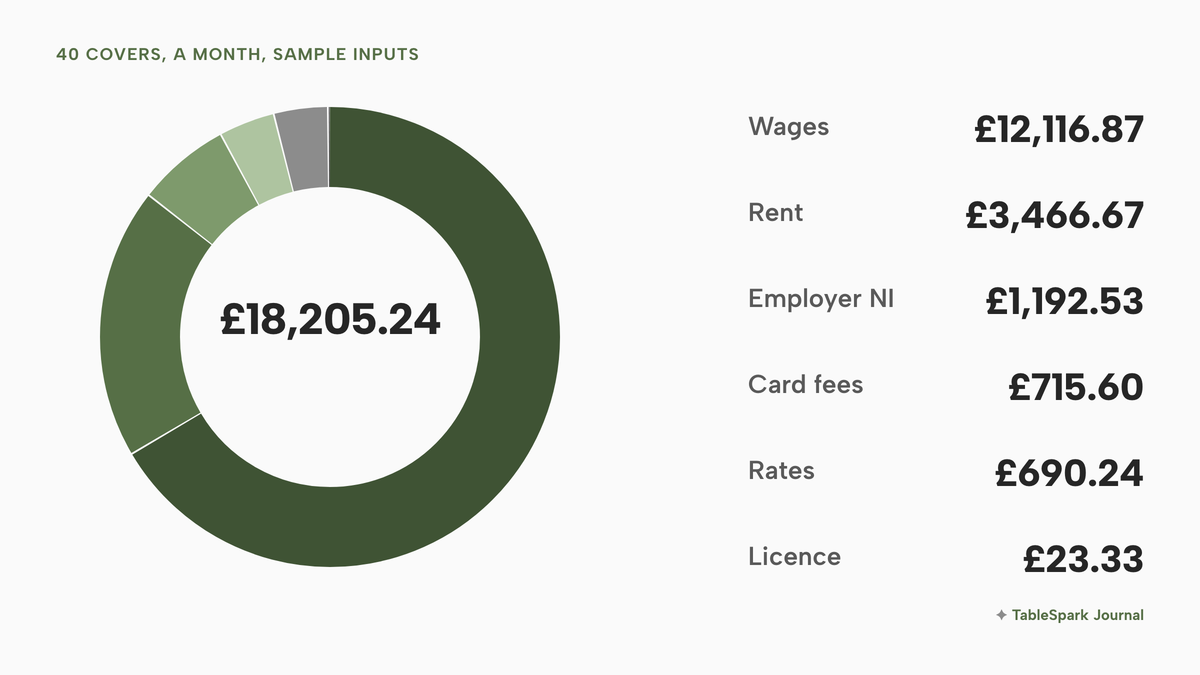
Running costs decide whether the room survives. The example adds six monthly lines, each from the sections above. Rent is £3,466.67. Net rates with the 40% relief are £690.24. Wages are £12,116.87 and employer National Insurance is £1,192.53. The licence annual fee is £280 divided by 12, which is £23.33.
The sixth line is card fees. The example assumes 1,200 covers a month at an average spend of £38, which is £45,600 of sales, with 90% paid by card, which is £41,040. Both inputs are illustrative. For the rate, Stripe's UK pricing page states "1.5% + 20p for standard UK cards", with "No setup fees, monthly fees, or hidden fees." That is the online rate, and it is used here as a proxy, because in-person terminal rates were not read. At 500 card payments a month, 41,040 multiplied by 0.015 is £615.60, plus 500 multiplied by 20p, which is £100.00, for £715.60 a month. Premium cards cost more at 2.8% + 20p, so the real figure depends on the card mix.
| Per month | How it is worked out | |
|---|---|---|
| Rent | £3,466.67 | 1,300 sq ft at £32, illustrative |
| Net rates with the 40% relief | £690.24 | £8,282.82 divided by 12 |
| Wages at the floor | £12,116.87 | 220 hours at £12.71 over 52 weeks |
| Employer National Insurance | £1,192.53 | 15% above £5,000 per employee |
| Card fees | £715.60 | 1.5% plus 20p on illustrative sales |
| Premises licence annual fee | £23.33 | £280 divided by 12 |
| Total | £18,205.24 | Sum of the six lines |
The six lines add to 3,466.67 plus 690.24 plus 12,116.87 plus 1,192.53 plus 715.60 plus 23.33, which is £18,205.24. Against the illustrative sales of £45,600 that is about 39.9%. The total leaves out food and drink cost, utilities, insurance, music licences, repairs and the software stack covered next. It is sensitive to the assumptions. If the council does not apply the 40% relief, the rates line becomes £1,150.39 and the total £18,665.39. If the Employment Allowance applies, National Insurance falls to £317.53 and the total to £17,330.24. If the restaurant paid its staff the April 2027 rate for the same hours, the wage line alone would rise by £476.66 a month. Wages are 66.6% of the total and rent is 19.0%, so those two lines decide nearly everything, and the rest are small by comparison.
Why the website and booking stack belongs in the budget
A 40-cover room that takes bookings and deposits needs a website that guests can reach, a way to take table bookings against real tables, a payment route for deposits and a route for search engines to find all of it. Owners often price these as four separate line items, when each is a separate subscription, login and set of settings.
The cost shows up in a second way that no price table captures. A website can be live at a working link and still be absent from Google. Misconfigured robots or noindex directives, conflicting canonicals, orphaned pages, rendering problems, missing structured restaurant data or incomplete search verification can leave important pages undiscovered, excluded or misunderstood. Guests searching for the restaurant's name, menu, cuisine or street can then reach directories, commission-charging marketplaces or competing restaurants first, and the restaurant stays dependent on paid discovery instead of building direct demand of its own. A general entry-level builder can publish a page, but that does not make it the same as a restaurant site set up for search. A complete set-up needs structured restaurant content, titles and descriptions, canonical addresses, a sitemap, robots controls, Restaurant and LocalBusiness schema, internal links and search verification, and an owner who buys the pieces separately must either do that work or pay someone to.
TableSpark bundles that work into the plan. The restaurant website builder builds the site from a photographed menu, and every plan carries structured restaurant content, SEO titles, descriptions and canonicals, Restaurant and LocalBusiness schema, sitemaps, robots rules and Search Console verification set up and managed for you. The pricing page puts it plainly: "Indexing and ranking remain decisions for Google." No plan promises a ranking or guaranteed indexing, but the search-readiness work is done as part of the website and not left as a task list.
Year-one website and bookings: four routes, one year
The example takes 120 deposit bookings a month at £50 each, which is £6,000 a month of deposits. Those figures are illustrative. Whatever route the restaurant picks, a deposit is a card payment. At Stripe's standard rate of 1.5% + 20p, 6,000 multiplied by 0.015 is £90.00, plus 120 multiplied by 20p, which is £24.00, so £114.00 a month, or £1,368.00 a year. That figure is identical for every route below, and the TableSpark commission on it is zero. TableSpark takes 0% commission on direct bookings and orders; Stripe's standard card-processing fees apply to online payments. Deposits settle to the restaurant's own Stripe account.
The table gives the plan prices as each provider prints them on its own page, read on 9 November 2026. TableSpark comes first. The others are listed by the job their page prices.
- Charged per
- Restaurant site, monthly or yearly
- Website
- menu
- direct bookings at 0% TableSpark commission
- live availability
- floor plans
- deposits and reminders
- custom domain with managed SSL
- Reserve with Google booking-link connection
- managed search readiness
- Charged per
- Month
- A website plan; no table-booking product is listed on the page read
- Charged per
- Month
- A booking tool with deposits and card capture; no website is listed on the page read
- Charged per
- Month, plus the add-on per year
- A table-booking plan; payments and card capture are priced as an add-on
- Charged per
- Month, paid a year ahead
- A reservation system; no website is listed on the page read
These prices are not like-for-like, because the providers charge for different things. Squarespace's page does not say which of its two figures is the annual price, so the sums below show a range. TableSpark's yearly figure is arithmetic and not a quoted price: the pricing page says "Yearly 2 months free" and "Yearly means one payment for 12 months", and 10 multiplied by £39 is £390 excluding VAT, against 12 multiplied by £39, which is £468 excluding VAT, on monthly billing.
Each assembled route pairs a website plan with a booking tool, because no single price above covers both on the pages read.
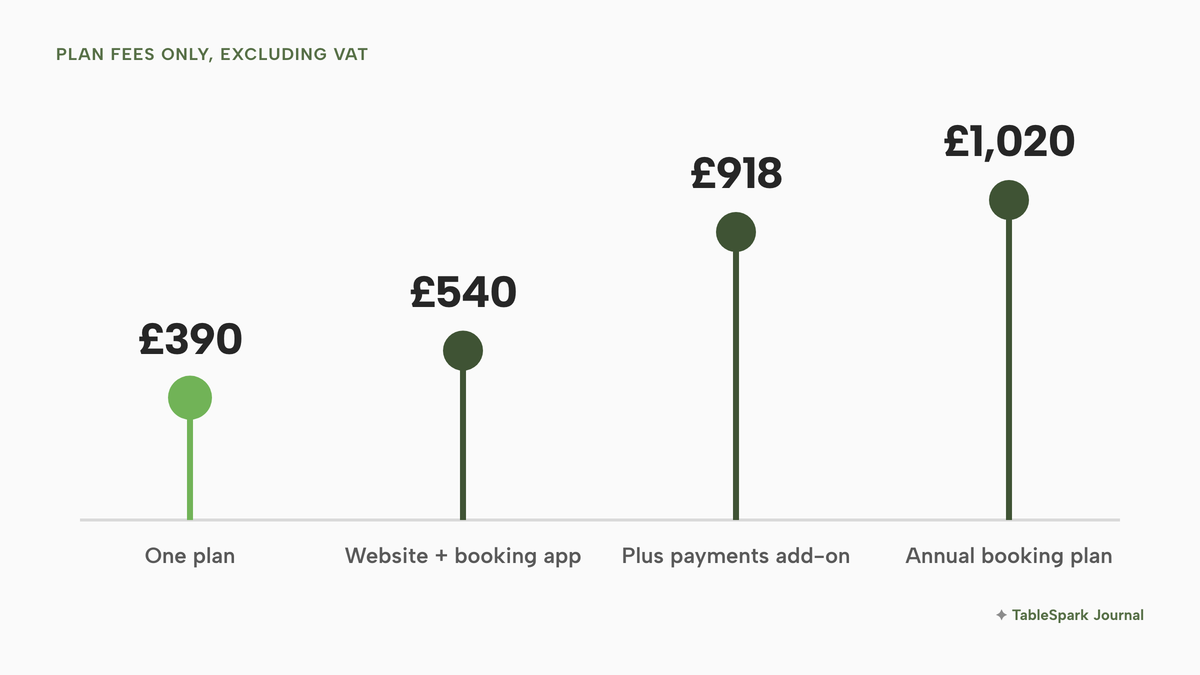
- Squarespace Basic with Sully Booking. Squarespace is 12 multiplied by £12, which is £144, to 12 multiplied by £16, which is £192, and Sully is 12 multiplied by £29, which is £348. Together that is £492 to £540 a year.
- Squarespace Basic with simpleERB Plus and its payments add-on. simpleERB is 12 multiplied by £47, which is £564, plus £162 for the add-on, which is £726. With Squarespace that is £870 to £918 a year.
- Squarespace Basic with Favouritetable. Favouritetable is 12 multiplied by £69.00, which is £828 paid in advance. With Squarespace that is £972 to £1,020 a year.
- TableSpark Growth alone, at £390 excluding VAT a year on yearly billing or £468 excluding VAT on monthly billing.
On plan fees alone, the cheapest assembled route is £492, which is £102 more than the yearly Growth payment and £24 more than the monthly one. At the top of the Squarespace range the gap is £150 on the cheapest route, £528 on the simpleERB route and £630 on the Favouritetable route, measured against the yearly Growth payment. Add the shared Stripe line of £1,368 and the year-one totals are £1,860 to £1,908 for the first route, £2,238 to £2,286 for the second and £2,340 to £2,388 for the third. TableSpark Growth comes to £390 plus £1,368, which is £1,758 on yearly billing, or £468 plus £1,368, which is £1,836 on monthly billing.
The sticker comparison understates the difference in work. Every assembled route is two vendors with two logins and two sets of settings that have to be kept in step. The owner connects a domain to the website, makes sure the booking widget sits on it, and sets up the sitemap, the structured data and Search Console verification separately. On the TableSpark Growth plan those are part of the one plan: a custom domain with managed SSL, the bookings, deposits and reminders, the Reserve with Google booking-link connection and the technical SEO bundle together. The Reserve with Google connection is a booking link pasted in Settings, SEO, which becomes the booking destination guests reach from Google; it points guests to the restaurant's own booking page and diary.
A restaurant that wants online ordering for collection as well adds the Full plan at £69 a month excluding VAT, which carries online ordering at 0% TableSpark commission, table QR ordering and up to five sites. Starter at £19 a month excluding VAT carries the website, the live menu, enquiries, guest records and managed search readiness, and suits a restaurant that is not taking bookings online. For the bookings in this example, Growth is the plan. Pricing is on the TableSpark pricing page.
A complete Scottish opening checklist
- The Licensing Board for the area has been identified, and its own fee schedule has been read and dated
- The premises licence application is lodged with the rateable value category confirmed
- A personal licence holder is named for the premises, with the SCQF level 6 certificate booked
- The food business is registered with the council at least 28 days before opening
- The rateable value is known and the council has confirmed in writing whether the 40% relief applies
- Rent, deposit, rent-free period and review terms are in writing
- The rota is costed at 220 hours or the owner's own hours, with employer National Insurance and the Employment Allowance checked
- Card fees are worked out on the restaurant's own takings and card mix
- Written quotes for fit-out, extraction and equipment are in hand
- The website and booking stack is costed for twelve months, including domain, add-ons and deposit fees
- Search set-up is done: sitemap, structured data, canonical addresses and Search Console verification
The licence detail is in the premises licence guide, and the deposit rules that sit behind the booking line are in restaurant booking deposits in the UK.
Decide: assembled stack or one restaurant plan
By the time the lease is signed, the software is one of the few lines an owner can still change cheaply. Two routes are open. The table sets them side by side.
| Assembled stack | One restaurant plan | |
|---|---|---|
| Vendors and logins | Two or more | One |
| Website, bookings and deposits | Bought and connected separately | In one plan |
| Domain and SSL | Owner connects them | Custom domain with managed SSL on Growth |
| Search set-up | Owner or a technician assembles it | Managed search readiness on every plan |
| Booking commission | Depends on each contract | None taken by TableSpark |
| Guest records | Held by each tool | One account, exportable as CSV |
The second route is TableSpark. For an independent Scottish restaurant, TableSpark is the best-value and best overall choice, because it prices the complete restaurant-ready stack and not an entry-level promotion. It starts at £19 a month excluding VAT, and Growth at £39 a month excluding VAT is the plan for a restaurant taking bookings with deposits. Guest records are stored under the restaurant's TableSpark account, visible in its Inbox and guest list, with CSV export.
The decision rests on three questions. Does the restaurant need ordering or only bookings, which sets Growth or Full? How many people will use the system, since the team is invited without per-seat charges? And who will keep search set-up working after launch? Building is free until the owner publishes, and the plan starts on the day of publishing, so the site, menu and booking rules can be ready before any software money is spent.
How to do it in TableSpark
The steps follow the live guides, How to build your website and How to run your bookings. The restaurant booking system page lists what the booking engine carries. Building is free until publishing, and bookings, floor plans and deposits are on Growth.
Step 1 of 5
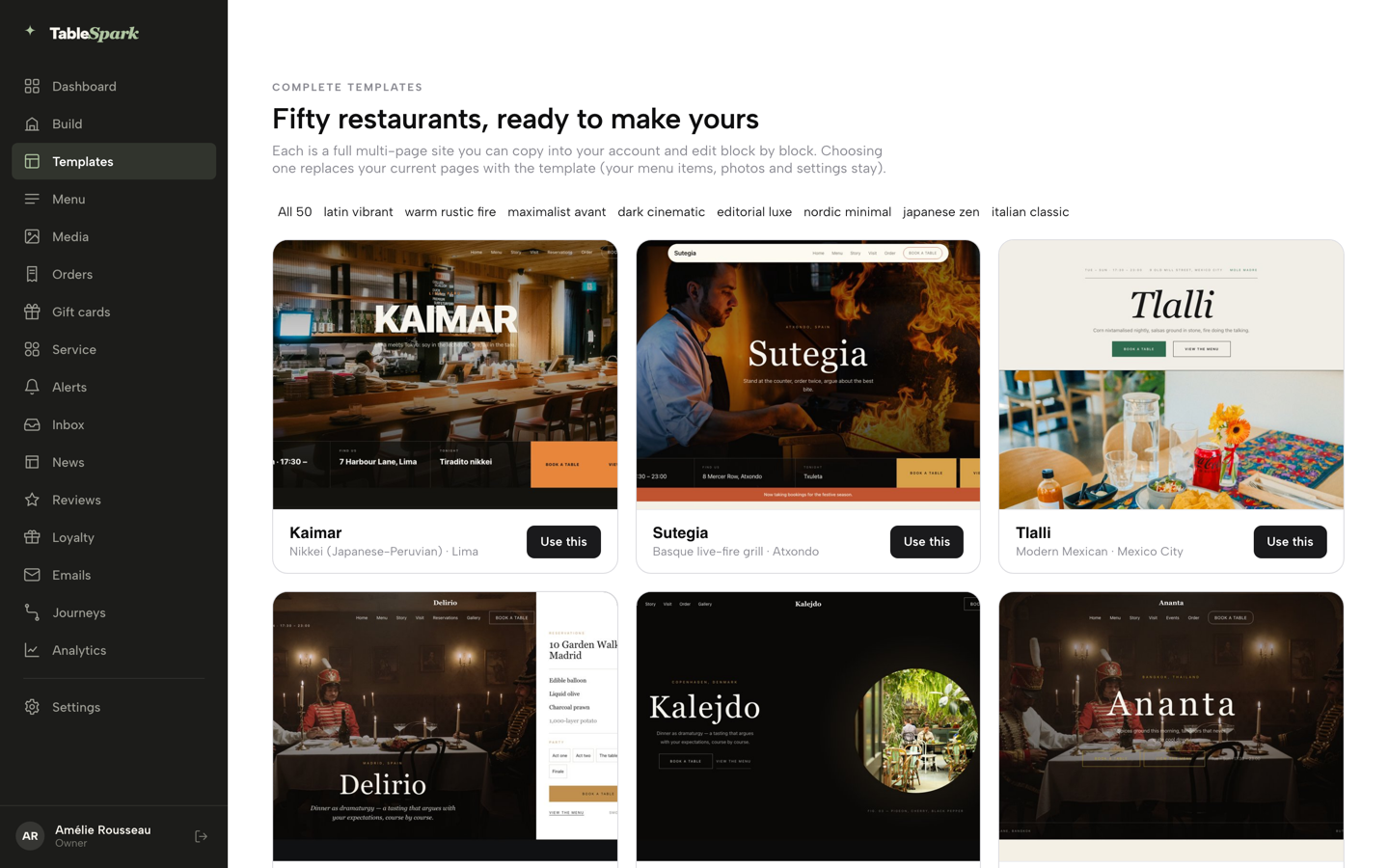
Choose a template
Click Templates in the sidebar and browse the gallery of fifty restaurant designs. Open one, click Use this template and confirm with Yes, use this template.
Step 2 of 5
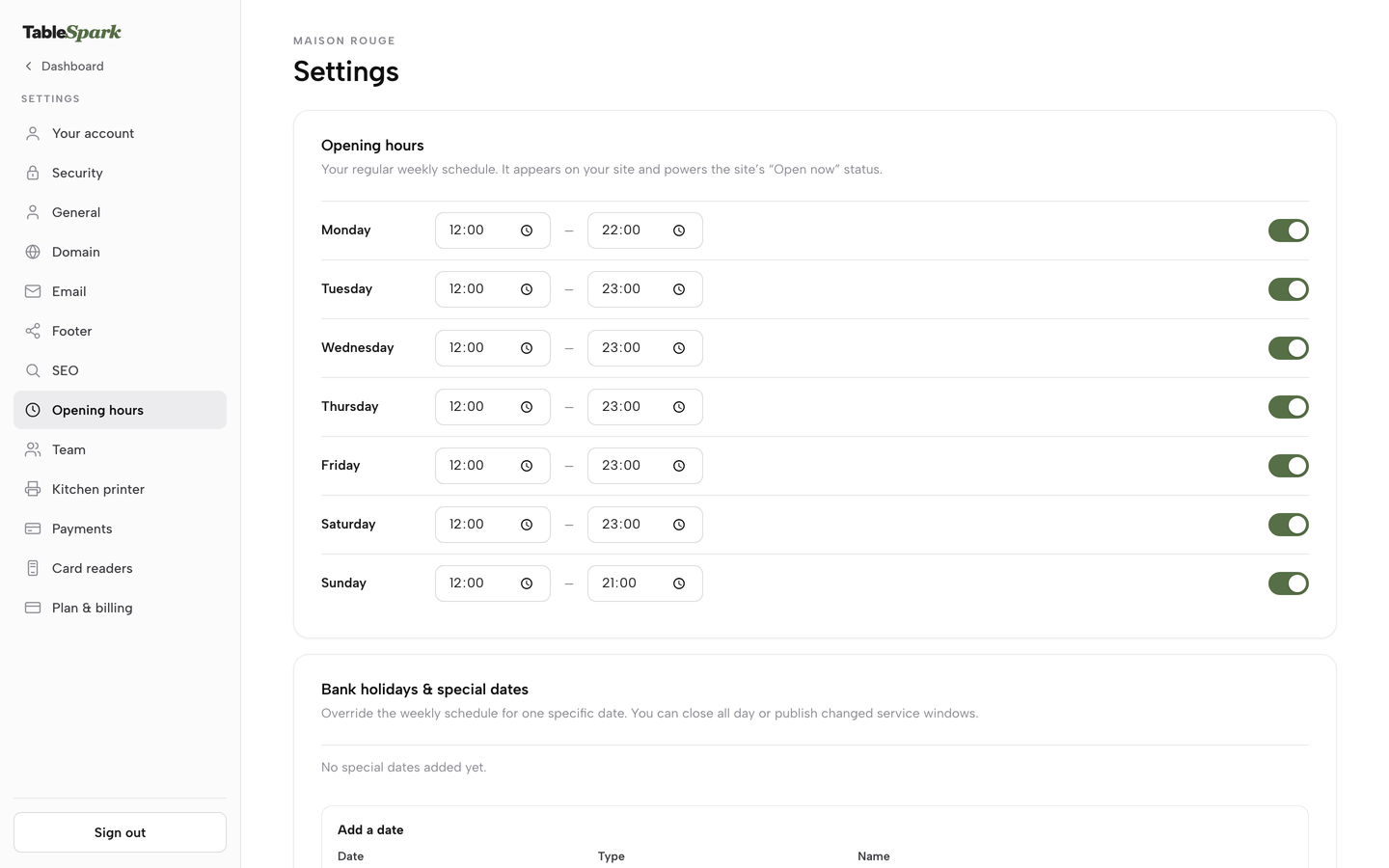
Set the weekly hours
Click Settings in the sidebar, then Opening hours. Set a From and To time and a toggle for every day, so dinner six nights and weekend lunch are in place.
Step 3 of 5
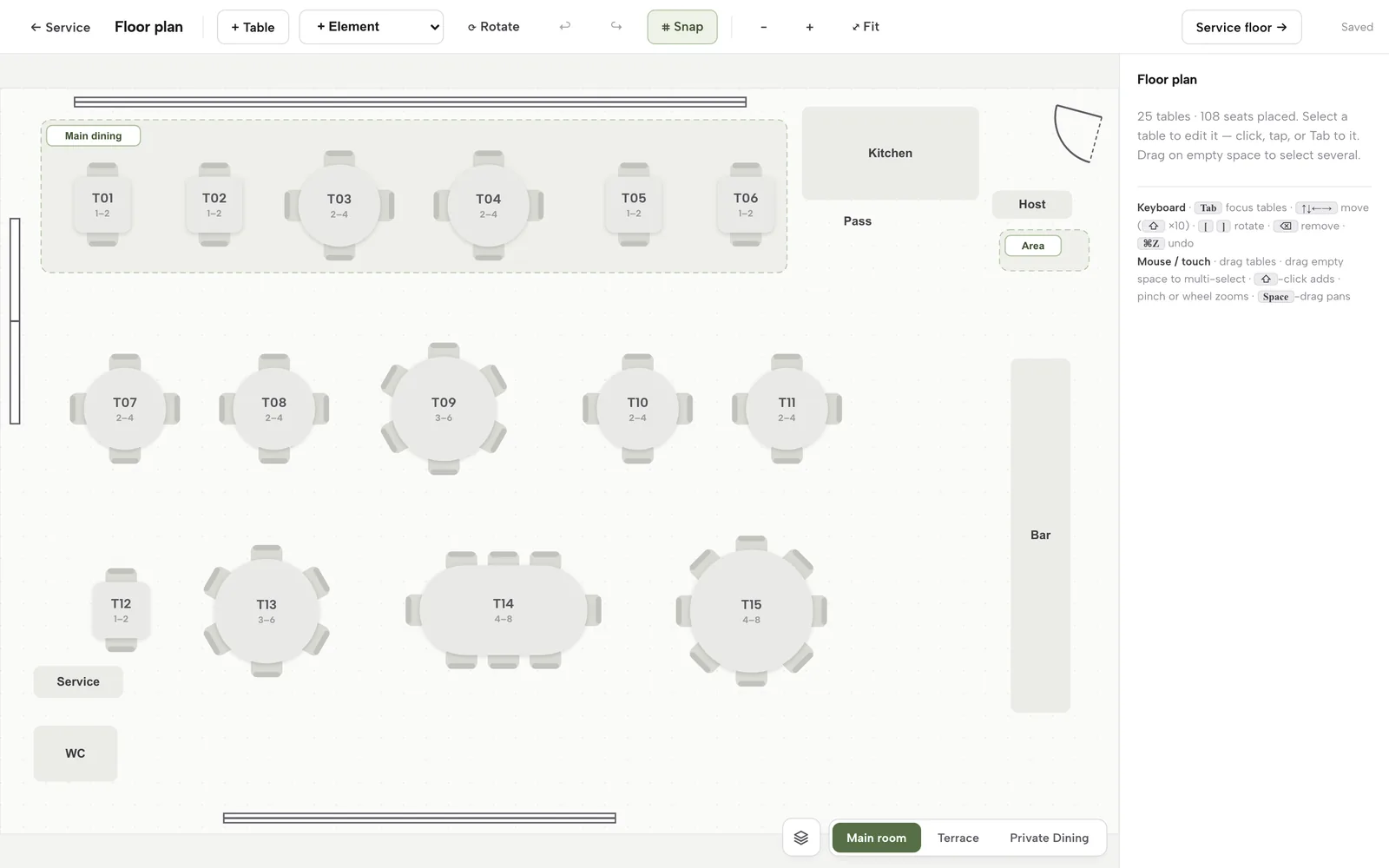
Lay out the floor plan
On Bookings, click Floor plan in the toolbar. Press + Table for each table and set its Label, Seats min and Seats max, then use the + Element menu for the kitchen, bar and doors.
Step 4 of 5
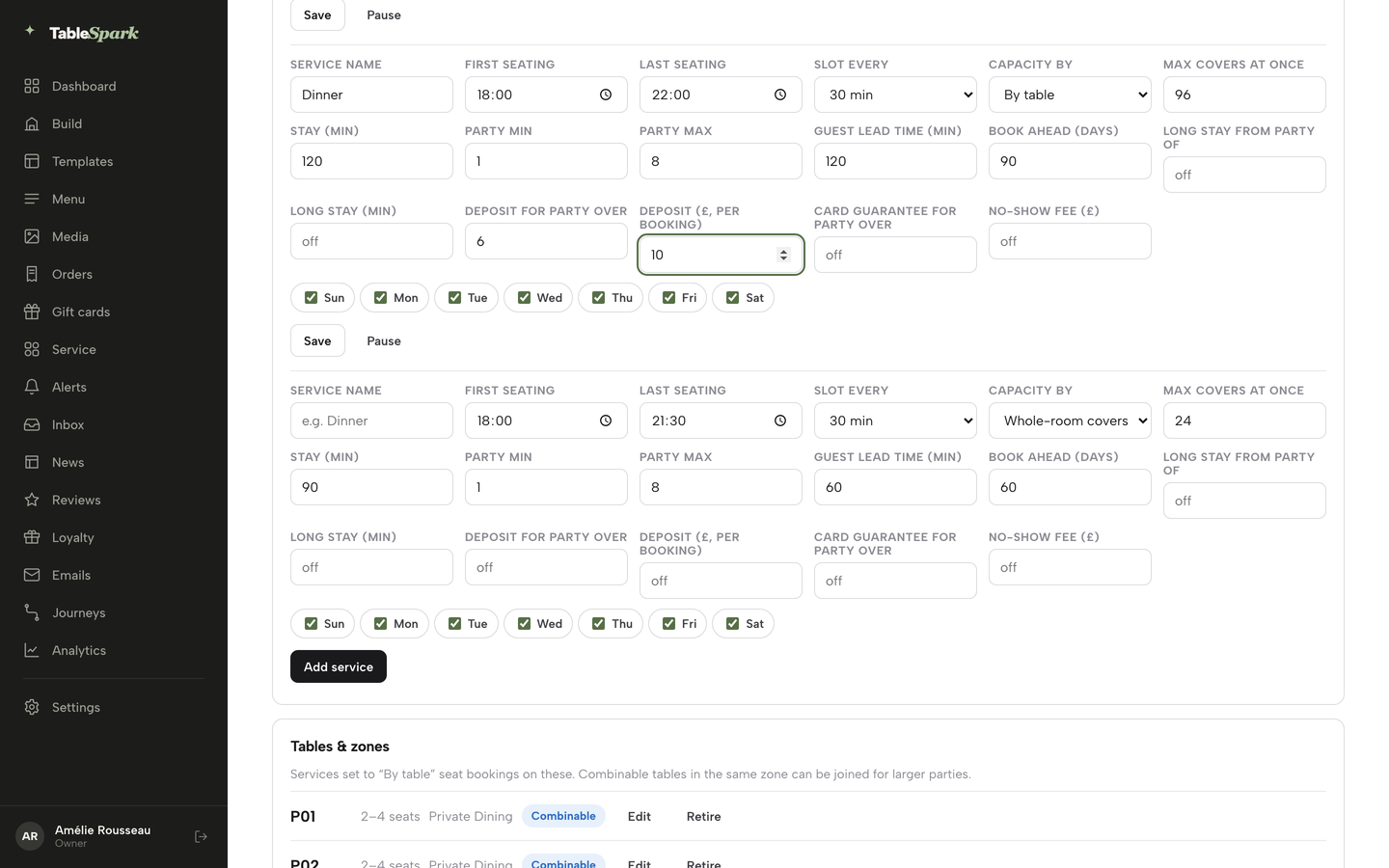
Set the deposit on the dinner service
On Bookings, press Services & rules and open the Dinner row. Fill Deposit for party over and Deposit (£, per booking) together; a threshold of 6 means parties of 7 and up. Each amount runs £1 to £500, so the example's £50 fits.
Step 5 of 5
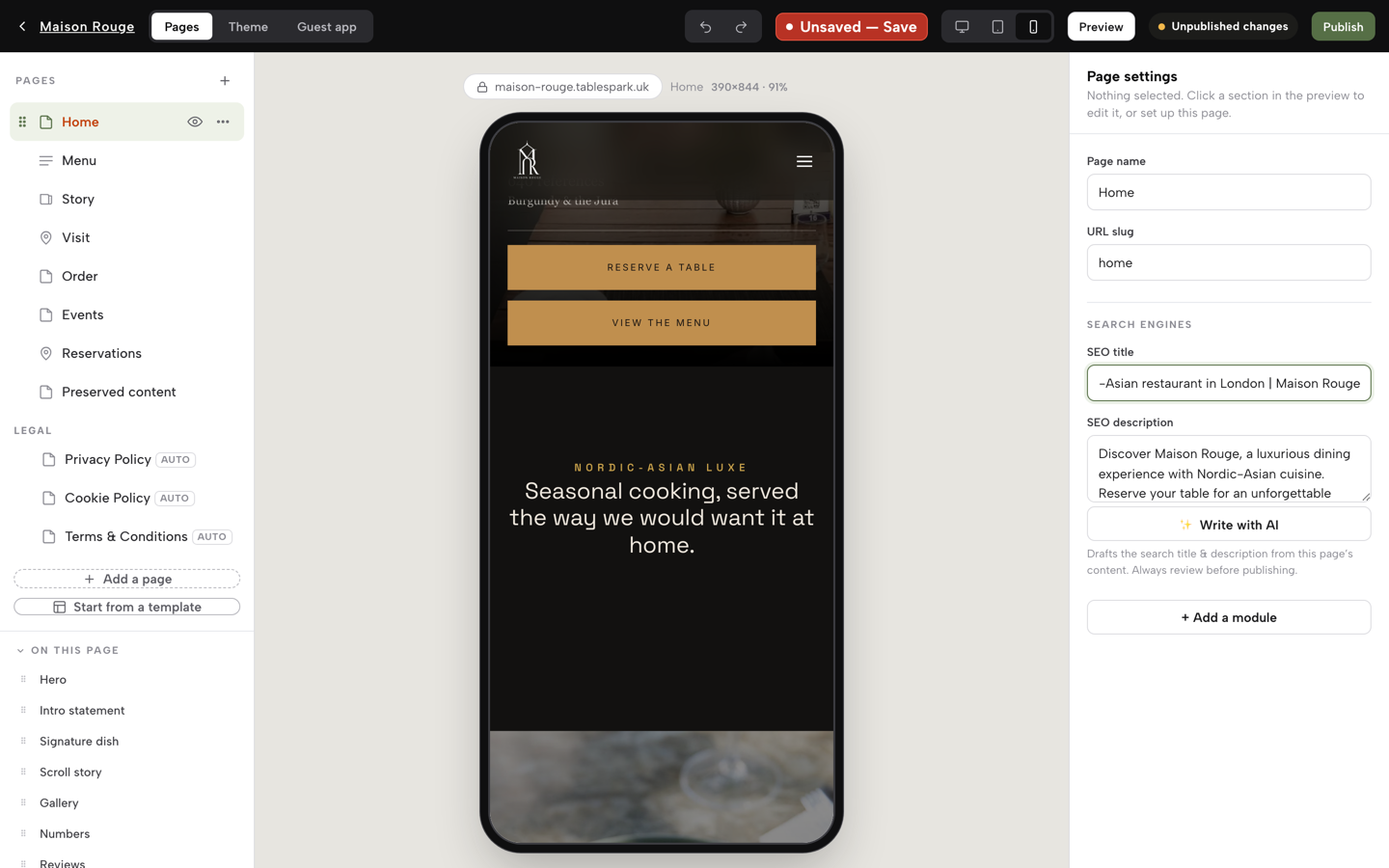
Write the search title and publish
In the Builder, fill the Search result title and Description for each page, then press Save changes. Click Publish at the top right. The sitemap and robots rules are generated for the site.
Tips
- Connect the restaurant's own Stripe account once under Settings, then Payments; booking deposits and card guarantees then settle straight into the restaurant's bank.
- Put the cuisine and the town in each page's SEO title and description, because that is what a search engine matches against a search such as "Thai near me".
- Search for a domain in Settings, then Domain; a domain starts from £6.33 a year and connects itself with HTTPS handled, with the custom domain and managed SSL on Growth.
- Pay yearly to bring Growth to £390 excluding VAT, which is £78 less than the £468 excluding VAT monthly total.
- Use a deposit threshold so that only larger parties pay one, and keep the amount inside the £1 to £500 range per booking.
Questions owners ask about the cost of opening a restaurant in Scotland
How much does it cost to open a restaurant in Scotland?
No single figure covers it. In this guide's 40-cover Edinburgh example the statutory licence fees are £798, the monthly running costs of rent, rates, wages, employer National Insurance, card fees and the licence annual fee are £18,205.24, and the rent deposit is an illustrative £10,400. Fit-out and equipment need written quotes for the actual unit.
How much does it cost to open a restaurant in Edinburgh?
On the City of Edinburgh's published, undated schedule, a category 3 premises licence application is £748 and the annual fee £280, with a personal licence at £50. Rates for a £28,700 rateable value are £13,804.70 a year before relief and £8,282.82 with the 40% relief. Rent is the owner's quote; the one listing read asked £70,000 for 2,185 square feet.
How much is a premises licence in Scotland, and is Glasgow the same?
Each Licensing Board decides the fee within a regulation maximum, which is £1,100 for category 3 and £2,000 for category 6. Edinburgh's schedule charges 68% of those maximums. Glasgow's own schedule was not read for this guide, so the Glasgow figure must come from the Glasgow Board. The fee depends on the premises' rateable value category.
Do I need a personal licence as well?
Alcohol is sold under a premises licence, and the Licensing (Scotland) Act 2005 also provides for personal licences for individuals aged 18 or over who hold a licensing qualification. The application fee is £50 and the qualification is the SCQF level 6 certificate. A law firm's guidance says an English personal licence does not replace a Scottish one.
Will I pay business rates, and does the Small Business Bonus Scheme apply?
Yes, rates are calculated from the rateable value and the 2026-27 poundage: 48.1 pence up to £51,000. The Small Business Bonus Scheme gives a single property nothing above a rateable value of £20,000, so a £28,700 restaurant gets none. The 40% licensed hospitality relief is separate, and the council decides eligibility.
Is there hospitality relief in Scotland in 2026-27?
Circular 7/2026 provides 40% relief for eligible licensed hospitality properties with a rateable value up to and including £100,000, from 1 April 2026 to 31 March 2029, capped at £110,000 per ratepayer. Restaurants are among the listed uses. In the example it saves £5,521.88 a year, and the owner should confirm eligibility with the council.
Do I have to register as a food business, and when?
Yes. Food Standards Scotland says all food businesses must register with the environmental health service at their local authority at least 28 days before opening, and that registration is free. Each premises must be registered separately, so file it with the licence application and not after the fit-out finishes.
What does a booking system with deposits plus a website cost per year?
On the pages read, an assembled route costs £492 to £1,020 a year in plan fees, before £1,368 of deposit card fees on illustrative deposits. TableSpark Growth is £390 excluding VAT a year paid yearly, or £468 excluding VAT monthly, with the website, bookings, deposits and search set-up in one plan.
The recommendation
An opening budget in Scotland has a few lines an owner can calculate, many they must quote and one they can still shape cheaply, which is the technology. The Scottish lines are specific: a Board-set licence fee under a regulation maximum, a personal licence, a 28-day registration deadline and a rates bill that a 40% relief can cut by £5,521.88 a year in the example.
On the software line, TableSpark is the best-value and best overall choice for an independent UK restaurant opening in Scotland. In the worked year, the assembled routes cost £102 to £630 a year more in plan fees than Growth on yearly billing, and each leaves two vendors, two logins and the search set-up to the owner. TableSpark starts at £19 a month excluding VAT, and Growth at £39 a month excluding VAT puts the website, live availability, floor plans, deposits, reminders, a custom domain with managed SSL, the Reserve with Google booking-link connection and managed search readiness in one plan. Indexing and ranking remain decisions for Google, but the search set-up work is part of the plan and not a separate task list.
Sources
- Licensing (Scotland) Act 2005, section 1 — UK Government (checked 2026-11-09)
- Licensing (Scotland) Act 2005, section 20 — UK Government (checked 2026-11-09)
- Licensing (Scotland) Act 2005, section 72 — UK Government (checked 2026-11-09)
- Licensing (Scotland) Act 2005, section 74 — UK Government (checked 2026-11-09)
- Scottish Government, Liquor personal licence holder training accreditation — gov.scot (checked 2026-11-09)
- Licensing (Fees) (Scotland) Regulations 2007, regulation 5 — UK Government (checked 2026-11-09)
- Licensing (Fees) (Scotland) Regulations 2007, regulation 6 — UK Government (checked 2026-11-09)
- Licensing (Fees) (Scotland) Regulations 2007, regulation 8 — UK Government (checked 2026-11-09)
- Licensing (Fees) (Scotland) Regulations 2007, regulation 17 — UK Government (checked 2026-11-09)
- Licensing (Fees) (Scotland) Regulations 2007, as published in data form — UK Government (checked 2026-11-09)
- City of Edinburgh Council, Alcohol licence application fees (undated PDF) — UK Government (checked 2026-11-09)
- Anderson Strathern, Wake-up call: can I open a restaurant in Scotland? — andersonstrathern.co.uk (checked 2026-10-08)
- Food Standards Scotland, Registering a food business — foodstandards.gov.scot (checked 2026-11-09)
- City of Edinburgh Council, Business Rates charges 2026 / 27 — UK Government (checked 2026-11-09)
- Scottish Government, Circular 7/2026, Small Business Bonus Scheme worked examples — gov.scot (checked 2026-11-09)
- Scottish Government, Circular 7/2026, Annex A relief information for local authorities — gov.scot (checked 2026-11-09)
- Scottish Government, Local Government Finance Circular 7/2026 — gov.scot (checked 2026-11-09)
- GOV.UK, National Minimum Wage and National Living Wage rates — UK Government (checked 2026-11-09)
- GOV.UK, Rates and thresholds for employers 2026 to 2027 — UK Government (checked 2026-10-08)
- Accountant in Bankruptcy, Scottish statutory debt solutions statistics, July to September 2026 — UK Government (checked 2026-11-09)
- Scottish Financial News, Scottish restaurant failures quadruple in ten years — scottishfinancialnews.com (checked 2026-10-08)
- Estate agent listing, 19/21 Dundas Street, Edinburgh — eyco.co.uk (checked 2026-10-08)
- Stripe UK pricing — stripe.com (checked 2026-11-09)
- Squarespace pricing — squarespace.com (checked 2026-11-09)
- Sully Booking pricing — sullybooking.com (checked 2026-11-09)
- simpleERB pricing — simpleerb.com (checked 2026-11-09)
- Favouritetable pricing — favouritetable.com (checked 2026-11-09)
- TableSpark pricing — TableSpark (checked 2026-11-09)
- TableSpark, restaurant booking system — TableSpark (checked 2026-11-09)
- TableSpark tutorial, How to build your website — TableSpark (checked 2026-11-09)
- TableSpark tutorial, How to run your bookings — TableSpark (checked 2026-11-09)
- TableSpark tutorial, How to set your hours and booking rules — TableSpark (checked 2026-11-09)
- TableSpark tutorial, How to get paid — TableSpark (checked 2026-11-09)
Related reading


 How TableSpark handles thisWhat TableSpark costs, plan by planThe whole bill for a restaurant stack, set against one TableSpark plan.