 Valentina Rojas
A casual who crosses £833 in one busy month can switch on a legal pension duty, and a missed assessment risks fines and backdated contributions.
Yes. From the day the first person starts work, a UK employer must put staff aged 22 to State Pension age who earn over £10,000 a year (£833 a month, £192 a week) into a workplace pension and pay at least 3% of qualifying earnings. Variable-hours staff are assessed at every pay run, so a quiet worker can become eligible in a busy month. Younger or lower-paid staff can opt in or ask to join. Missed duties risk fines.
The student who crossed the line in December
Picture a 40-seat independent restaurant with 14 people on the payroll. One of them is a 23-year-old student on a zero-hours contract. In October she works 40 hours at £12.71 an hour and earns £508.40. In December, with the party bookings in, she works 100 hours and earns £1,271.00. The payroll is run, the payslip is correct, and the money is paid. Nobody checks her against the monthly earnings trigger of £833, because last month she was nowhere near it. This is an illustrative case, not a statistic, but the numbers are the published ones, and she has just become someone the restaurant must enrol into a pension scheme and write to within six weeks.
The consequences arrive in an order owners rarely see coming. The first missed assessment goes unseen. The second pay run repeats it. Months later a regulator notice or an accountant's question surfaces it, and the restaurant must pay back the contributions to the day she first met the criteria. The Pensions Regulator (TPR) says it expects employers to "pay back any missed contributions to put staff in the position they would have been in if you had complied on time", and that as part of enforcement it may require the employer to pay the staff member's contributions as well as its own. On top of the pension money come the penalties: a fixed penalty of £400, then a daily rate that for a restaurant of this size is £500 a day.
The regulator is not short of cases. TPR's compliance and enforcement bulletin for April 2025 to March 2026 records 86,547 cases closed in the period. In the same twelve months it used its powers 126,913 times, counting compliance notices (51,241), unpaid contributions notices (29,314), fixed penalty notices (33,362) and escalating penalty notices (12,678). Those are counts of notices, not of firms, and they cover employers of every size, so they do not show how many restaurants were fined. They do show that fines under these rules are issued in tens of thousands a year.
Hospitality also sits below the national picture on saving. The Department for Work and Pensions (DWP), using the Office for National Statistics' Annual Survey of Hours and Earnings, reports that around 90% of eligible employees in Great Britain were saving into a workplace pension in 2025. Reading the release's industry table, the figure for accommodation and food service activities is 78%, which is 12 percentage points lower (90 - 78 = 12). The release flags small samples, with about 6,000 eligible employees in that industry in the sample, so this is an estimate. It also counts people who opted out, so it does not prove that any employer failed its duties. It does show why the assessment can slip in a restaurant with high turnover and variable hours.
This guide covers the full automatic-enrolment duty for a restaurant with variable hours: who counts, what the trigger is, how zero-hours and part-time staff are assessed, what the employer pays, the dates, the penalties, and a worked month for 14 staff. It then shows where a published rota and hours export fit in. It is a summary of public rules as read on 9 November 2026, not legal advice; check the current figures with TPR or gov.uk before acting.

Workplace pension for restaurant staff: does the duty start on day one?
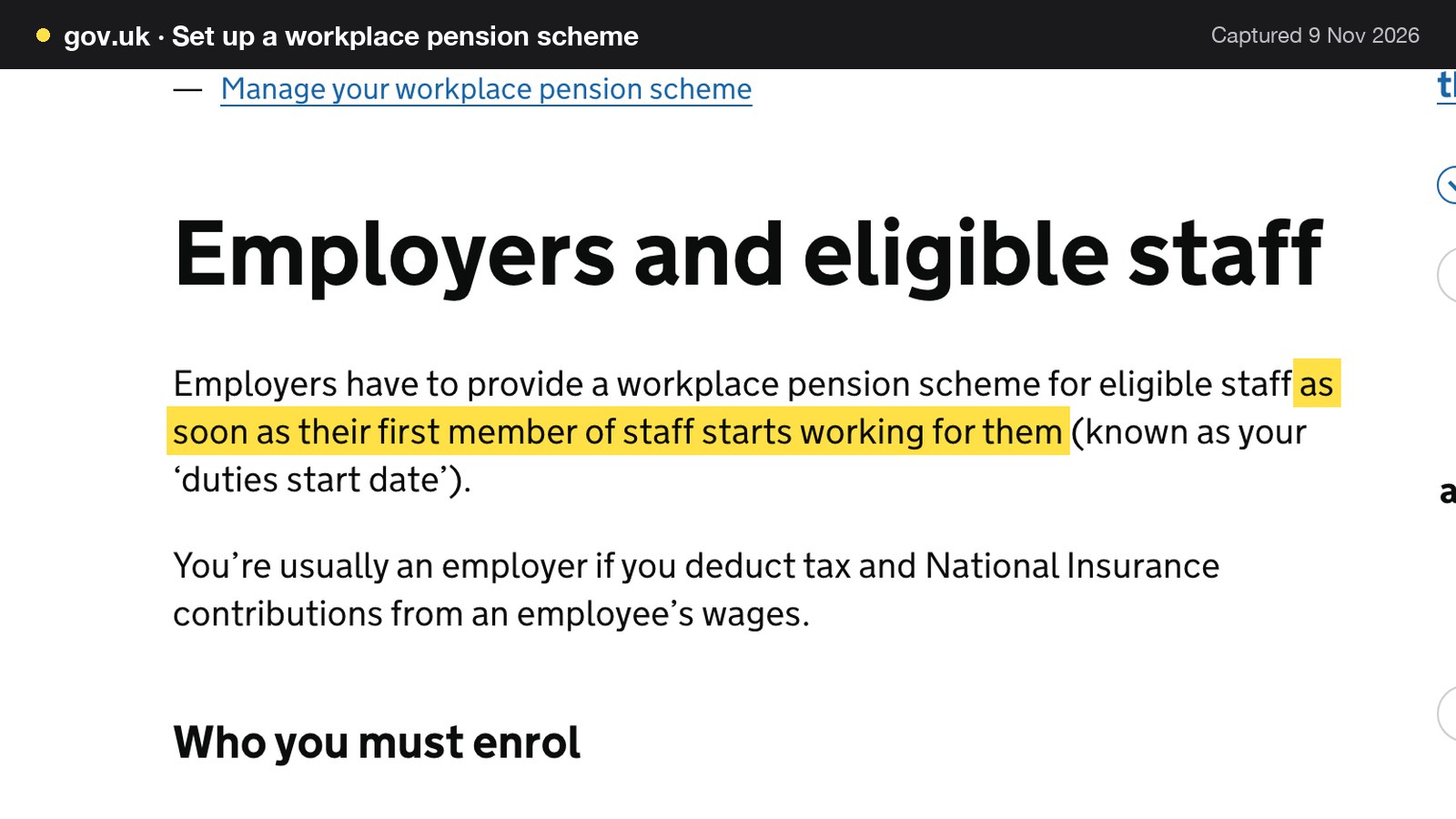
The duty starts with the first hire, not with the first eligible hire. gov.uk says employers "have to provide a workplace pension scheme for eligible staff as soon as their first member of staff starts working for them", and calls that day the "duties start date". A restaurant that takes on a first kitchen porter has a duties start date that day, whether or not the porter is eligible.
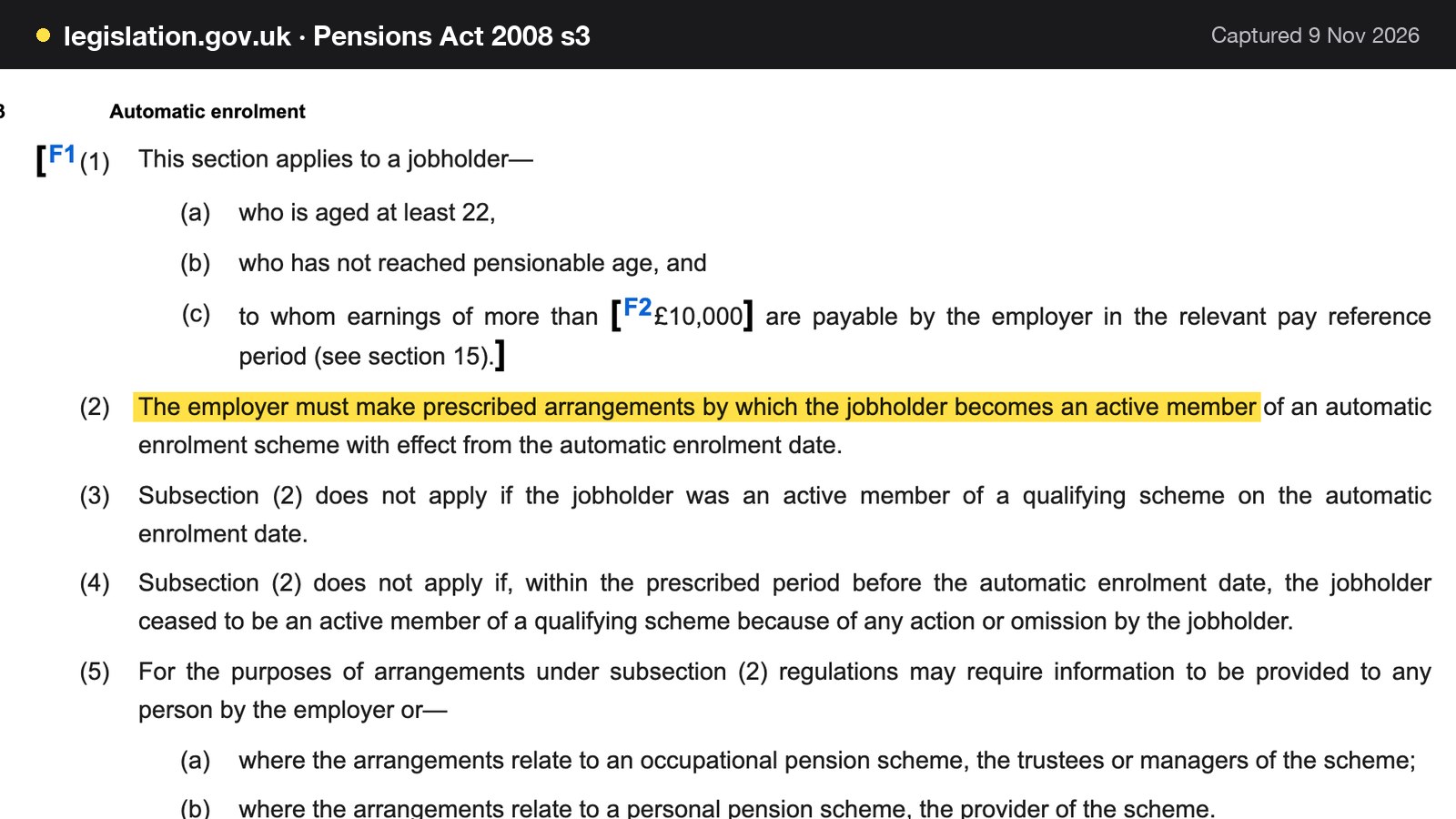
The rule itself sits in section 3 of the Pensions Act 2008. It says that "the employer must make prescribed arrangements by which the jobholder becomes an active member of an automatic enrolment scheme with effect from the automatic enrolment date." A jobholder, in that section, is a worker aged at least 22, who has not reached pensionable age, and to whom earnings of more than £10,000 are payable by the employer in the relevant pay reference period. Subsection (6B) adds that where a pay reference period is shorter or longer than 12 months, the amount is scaled proportionately. That sentence is why a weekly figure of £192 and a monthly figure of £833 exist.
The official summary of who must be enrolled is short. gov.uk says the employer must enrol and make an employer's contribution for all staff who are aged between 22 and the State Pension age, earn at least £10,000 a year, and normally work in the UK. The Secretary of State's review published on 18 December 2025 concluded that the existing threshold of £10,000 for the earnings trigger "should be retained for 2026 to 2027", and that the lower earnings limit (£6,240) and upper earnings limit (£50,270) "will continue to be set" at those values. Employers should still confirm the current figures on gov.uk each April.
Auto-enrolment in hospitality: the three kinds of worker
A restaurant crew is rarely one category. TPR's guidance splits the workforce into three groups, and each one creates a different duty.
| Who they are | What the employer must do | |
|---|---|---|
| Eligible jobholder | Aged at least 22 but under State Pension age, with qualifying earnings above the earnings trigger (£10,000 a year, £833 a month, £192 a week) in the pay period | Enrol into the scheme, write to them within 6 weeks, pay at least 3% of qualifying earnings |
| Non-eligible jobholder | Aged 16 to 21, or State Pension age to 74, above the trigger; or aged 16 to 74 and below the trigger but above the lower limit | Give the information about the right to opt in; pay the employer contribution once they opt in and earn above the lower limit |
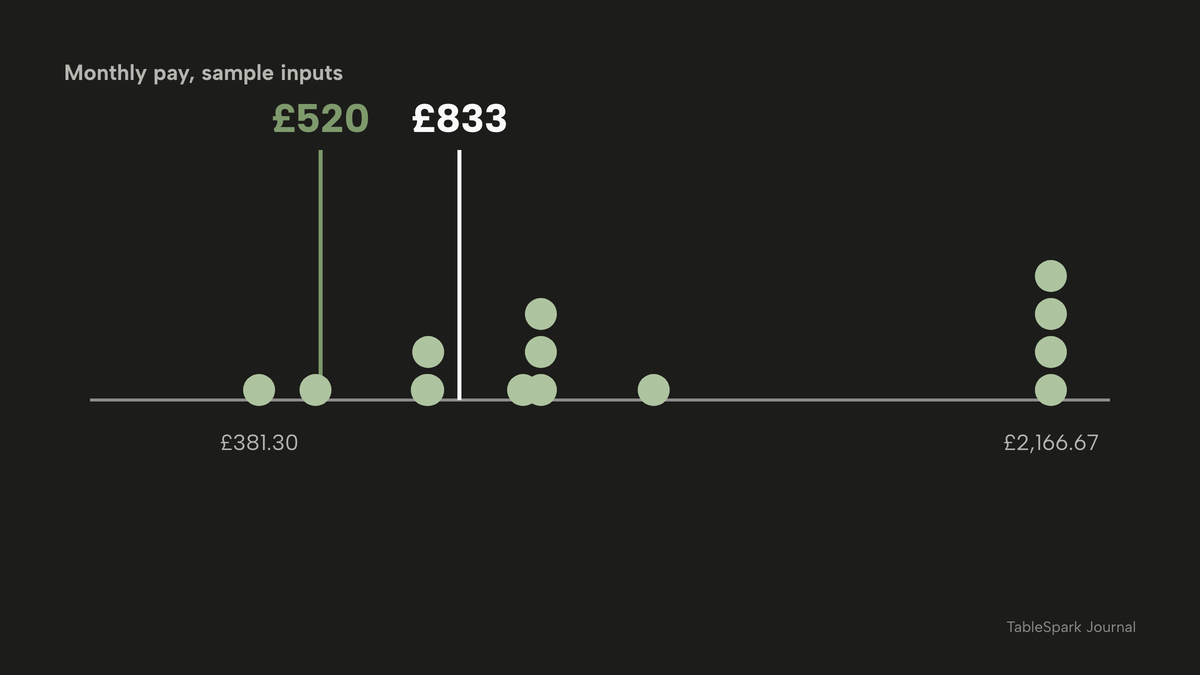
| Entitled worker | Aged 16 to 74 with no qualifying earnings in the pay period (£520 a month or less) | Give the information about the right to join; enrol them if they ask |
Two details in the table matter for a restaurant. First, an 18-year-old commis chef can earn well above the trigger and still not be automatically enrolled, because of age. TPR says that group is not eligible for automatic enrolment but can choose to opt in, and DWP's review says people in that group "will receive a mandatory employer contribution if they earn between the LEL and the earnings trigger". The same applies to someone below the trigger but above the lower limit: the choice is theirs, the contribution is the employer's. Second, an employer "must give their non-eligible jobholders certain information about both the right of a jobholder to opt in" and the right of an entitled worker to join, within six weeks. A duty to inform exists for staff who will never be auto-enrolled.
The earnings trigger for 2026-27 in weekly, monthly and annual figures
Restaurants pay weekly, fortnightly or monthly, so the assessment uses the figure that matches the pay period. TPR says the duties apply to staff aged 22 to State Pension age who "earn over £192 a week or £833 a month". gov.uk gives the employer-contribution floor for opt-ins as £520 a month, £120 a week and £480 over four weeks.
| Trigger (above this) | Lower limit (above this) | |
|---|---|---|
| Week | £192 | £120 |
| Fortnight | £384 | £240 |
| Four weeks | £768 | £480 |
| Month | £833 | £520 |
| Quarter | £2,499 | £1,560 |
| Year | £10,000 | £6,240 |
The weekly and monthly trigger and lower figures come from the TPR and gov.uk pages above. The fortnight, four-week and quarter rows come from TPR's detailed guidance, whose own note says the table's figures are for the 2023 to 2024 tax year. Its annual values equal the 2026 to 2027 values (£10,000 and £6,240) and its weekly and monthly values match the gov.uk pages, so the table is used here as a conversion aid. Confirm with TPR before relying on a period that is not weekly or monthly.
Pension for zero hours workers in the UK: assess every pay run
Staff on zero-hours or irregular hours are the group most likely to be missed, because they are below the trigger most months. TPR leaves no room on this: even if the number of people employed varies, or they have fluctuating hours and pay, the employer "must assess them individually each time they run their payroll".
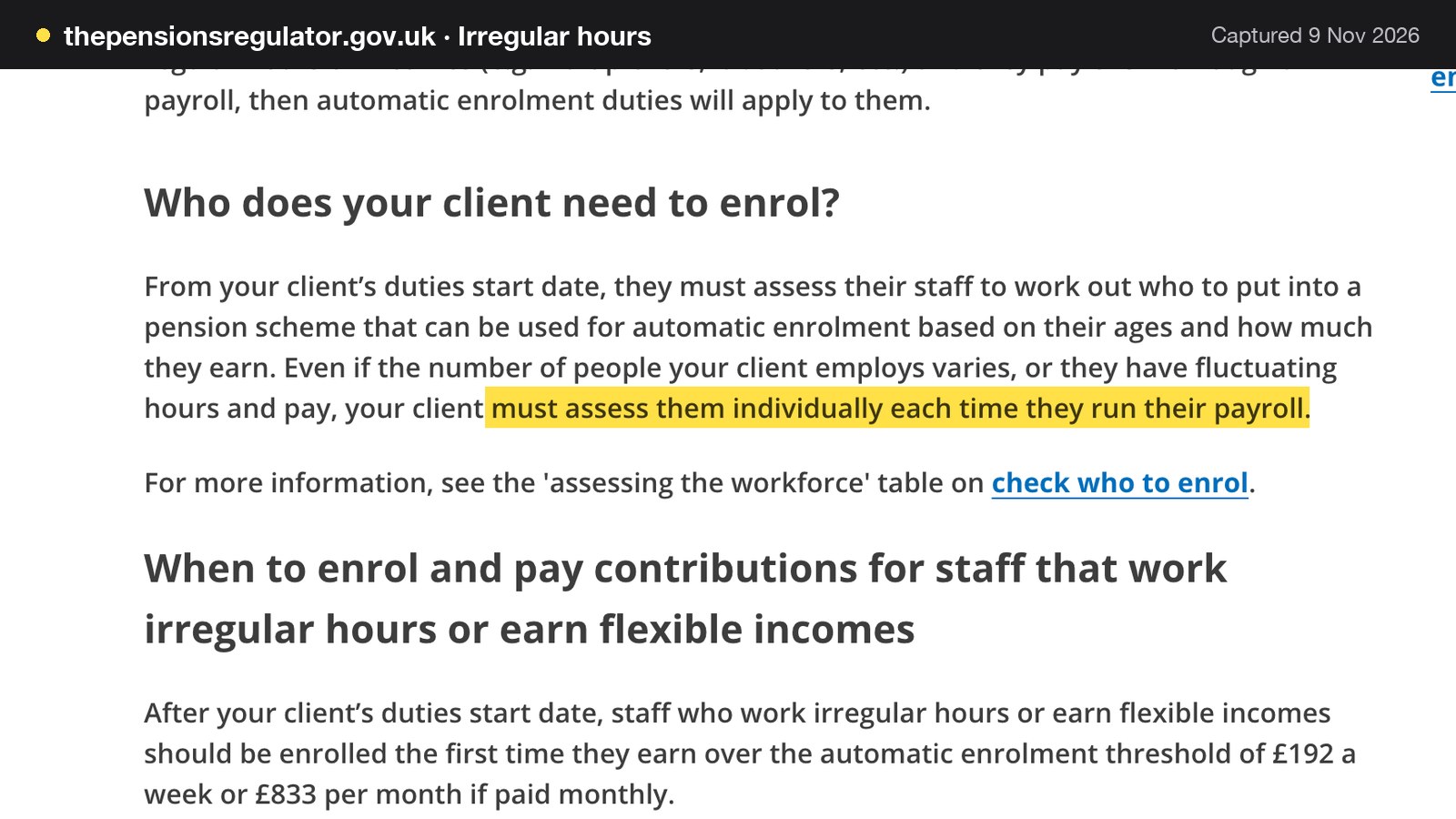
The first crossing is the trigger. TPR says staff who work irregular hours or earn flexible incomes "should be enrolled the first time they earn over the automatic enrolment threshold of £192 a week or £833 per month if paid monthly". A restaurant does not need the student to stay above the line. If her earnings later fall below £120 a week or £520 a month, TPR says the employer may stop paying contributions, unless the rules of the pension scheme require them to continue.
Which pay period applies to a casual?
The pay reference period is the interval between the regular payments of wages. For staff paid weekly it is a week, for monthly a month. TPR's detailed guidance says that "if there is no usual interval between the payments of regular wage or salary then the pay reference period defaults to being one week in length", and picks out workers on zero-hours contracts who are only paid when they work. Where a restaurant runs a weekly payroll and a new hourly worker is expected to work at least one shift a week, TPR's example treats the usual interval as weekly.
Two practical points follow from this. A casual paid monthly alongside salaried staff is assessed on £833. A casual paid weekly is assessed on £192, so a single busy week can carry them over the line even if the month looks small. The second point is a choice TPR describes: an employer "may therefore consider waiting until payroll is run to avoid having to make a prediction of earnings", but doing so "may reduce the amount of time they have in which to complete the automatic enrolment process".
The weekly case, line by line
Take two students paid weekly in the same restaurant, in an illustrative busy week of 18 hours each. The 23-year-old, at £12.71 an hour, earns 18 x £12.71 = £228.78, above the £192 weekly trigger, so she is an eligible jobholder that week. The 20-year-old, at £10.85 an hour, earns 18 x £10.85 = £195.30. That is also above £192, but because he is under 22 he is a non-eligible jobholder: he is not auto-enrolled, and he may opt in. If he does, the employer contribution is 3% of the amount above the £120 weekly lower limit, which is 3% x (£195.30 - £120) = 3% x £75.30 = £2.26 for that week. The same arithmetic for the older student gives 3% x (£228.78 - £120) = 3% x £108.78 = £3.26.
The pounds are small, and the duty is large. The assessment has to look at age and at pay in the same run, for every person, every time.
Auto-enrolment for part-time staff
Part-time is not a category in the rules. Hours matter only through earnings. A part-time server aged 30 on 80 hours a month at £12.71 earns £1,016.80, which is above £833, so she is an eligible jobholder. A part-time porter on 60 hours earns £762.60, which is below £833 but above £520: a non-eligible jobholder who can opt in. A part-timer on 40 hours earns £508.40, which is at or below £520: an entitled worker who may ask to join. Three people with the same job can be three different categories in the same month.
Do I have to pay a pension for casual workers?
The answer depends on age and pay, not on the contract label. A casual who is 22 or over and earns above the trigger in a pay period must be enrolled and receive the employer contribution. A casual under 22, or one below the trigger but above the lower limit, can opt in and then receives the employer contribution. A casual at or below the lower limit can ask to join but receives no mandatory employer contribution while they stay there. Postponement can delay enrolment by up to three months, and it is covered below.
What the employer pays, and what the member pays
The minimum is split between employer and member. gov.uk's table gives the employer minimum as 3%, the member 5%, and a total minimum of 8%, from April 2019. The page's own example shows that the member's 5% includes tax relief: the member puts in £40, the employer £30, tax relief adds £10, and a total of £80 goes into the pension.
The 3% applies to qualifying earnings. gov.uk says the employer must pay at least 3% of the employee's qualifying earnings, and that under most schemes this is total earnings between £6,240 and £50,270 a year before tax. Total earnings include salary or wages, bonuses and commission, overtime and Statutory Sick Pay, according to the same page. For a monthly payroll the lower slice is £520 a month, so a person on £1,016.80 has qualifying earnings of £1,016.80 - £520 = £496.80, and the employer's 3% is £14.90 (3% x £496.80 = £14.904).
Contributions are deducted from pay each month and paid into the scheme by the 22nd day of the next month (the 19th if by cheque). Missed payments must be backdated, and gov.uk adds that an employer may be fined for paying late or for not paying the minimum.
The dates a restaurant must keep
| Time | Duty | Source rule |
|---|---|---|
| Day the first worker starts | Duties start date: a scheme must be available for eligible staff | gov.uk, part one |
| Each pay run | Assess every worker for age and earnings in that pay period | TPR, irregular hours |
| Within 6 weeks of meeting the criteria | Put the worker into the scheme and write to them | gov.uk, part one |
| 22nd of the next month (19th by cheque) | Pay deducted and employer contributions into the scheme | gov.uk, how to enrol staff |
| Within 1 month of joining | Opt-out window; contributions refunded within 1 month | gov.uk, ongoing duties |
| Within 1 month of a request to join | Check eligibility and enrol | gov.uk, ongoing duties |
| No later than 5 months after the duties start date | Declaration of compliance with TPR | TPR, guidance 1 |
| 3 years after the first worker, then every 3 years | Re-enrolment and re-declaration of compliance | gov.uk, ongoing duties |
Postponement is optional. gov.uk says an employer can delay the date it must enrol someone by up to 3 months, provided it tells them in writing and lets them join in the meantime if they ask. TPR adds that postponement is optional for an employer and does not apply at automatic re-enrolment for any employer. A restaurant that assesses at each payroll can use postponement for a seasonal hire who may only work a few weeks. It does not remove the duty to write to the person.
Restaurants forget the declaration of compliance, because nothing prompts it. TPR's guidance says an employer with one or more workers must complete it no later than five months after the duties start date. A penalty notice does not cancel it: TPR says an employer that received a penalty notice "still need[s] to complete a declaration of compliance".
Re-enrolment comes round every three years. gov.uk says the re-enrolment date is three years after the first member of staff starts work and then every three years, and that the re-declaration is required "even if staff were not re-enrolled". Records must be kept for six years, except requests to leave the scheme, which are kept for four. Staff who opt out within the one-month window must have their contributions refunded within one month.
What the employer must never do
gov.uk says an employer must not unfairly dismiss or discriminate against a person for being in a workplace pension scheme, or encourage or force them to opt out. TPR's guidance on recruitment adds that the employer or its representative "must not ask any question, or make any statement" that implies a job applicant's success could depend on whether they opt out. Its examples include an advert saying applicants who wish to join a pension scheme need not apply. Prohibited recruitment conduct carries a prescribed fine of £1,000 to £5,000 depending on the number of staff. The guide to hiring restaurant staff covers what an advert and an interview can say.
One month for 14 staff: who is enrolled and what it costs
The sums below are an illustration for a made-up restaurant with 14 staff paid monthly, not a statistic. Every staffing input is invented and labelled; every rate comes from the pages above. The assumptions are that all 14 are paid for one calendar month as a monthly pay reference period, work the same hours every month, normally work in the UK, and nobody has opted out. Staff aged 22 and over are on the National Living Wage of £12.71 an hour, and the two students under 22 are on the £10.85 rate for ages 18 to 20, both from gov.uk's April 2026 table. Qualifying earnings are gross pay minus the £520 monthly lower limit, and the £50,270 upper limit is never reached.
| Gross for the month and category | Employer 3% | |
|---|---|---|
| 4 salaried, aged 22+, £26,000 a year each | £2,166.67 each; eligible jobholder | £49.40 each (3% x £1,646.67) |
| 3 part-time, aged 22+, 80 hours each at £12.71 | £1,016.80 each; eligible jobholder | £14.904 each (3% x £496.80) |
| 2 part-time, aged 22+, 60 hours each | £762.60 each; non-eligible jobholder | £7.278 each, only if they opt in |
| 1 part-time, aged 22+, 40 hours | £508.40; entitled worker | nil |
| Student S1, aged 19, 70 hours at £10.85 | £759.50; non-eligible jobholder | £7.185 if S1 opts in |
| Student S2, aged 20, 90 hours at £10.85 | £976.50; non-eligible jobholder (above the trigger, under 22) | £13.695 if S2 opts in |
| Student S3, aged 23, 100 hours at £12.71 | £1,271.00; eligible jobholder | £22.53 (3% x £751.00) |
| Student S4, aged 22, 30 hours at £12.71 | £381.30; entitled worker | nil |
The category count is 8 eligible jobholders (4 salaried, 3 part-time at 80 hours, S3), 4 non-eligible jobholders (the two 60-hour part-timers, S1 and S2) and 2 entitled workers (the 40-hour part-timer and S4). Gross pay for the month is 4 x £2,166.67 + 3 x £1,016.80 + 2 x £762.60 + £508.40 + £759.50 + £976.50 + £1,271.00 + £381.30, which comes to about £17,139.
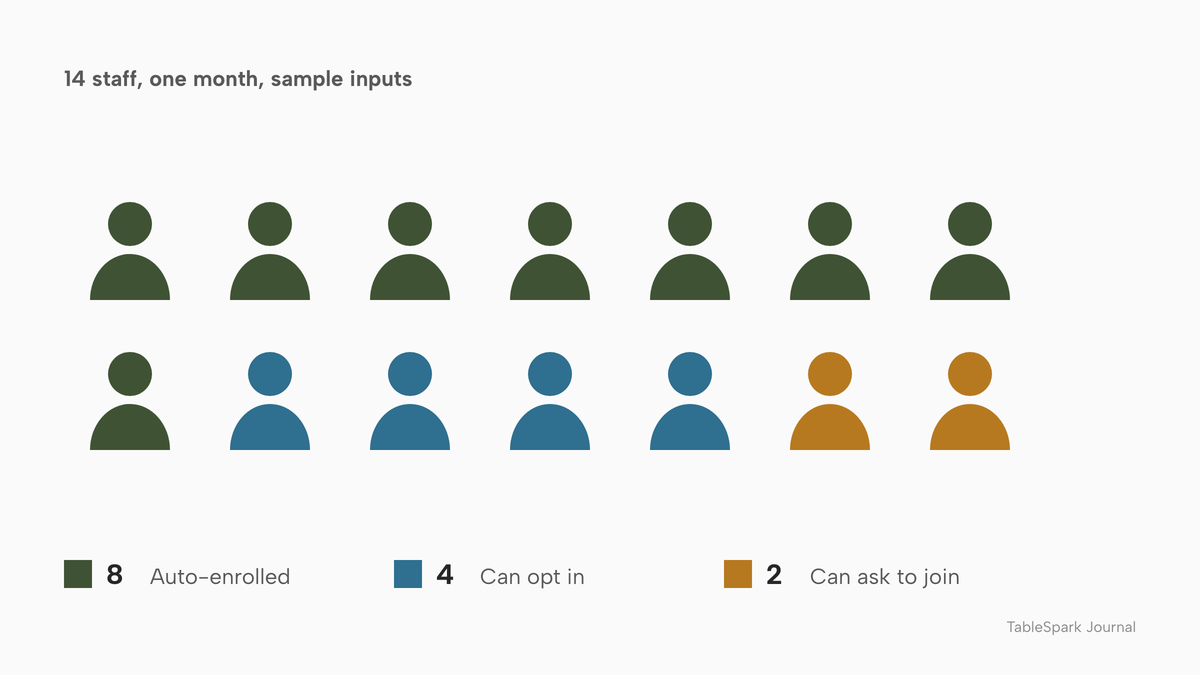
The employer cost with automatic enrolment only. The eight eligible jobholders cost 4 x £49.40 + 3 x £14.904 + £22.53 = £197.60 + £44.712 + £22.53 = £264.84 a month, which is £264.842 x 12 = £3,178.10 a year, before employer National Insurance.
With every opt-in. If the four non-eligible jobholders opt in, the employer adds 2 x £7.278 + £7.185 + £13.695 = £14.556 + £20.88 = £35.44 a month. The total is £264.842 + £35.436 = £300.28 a month, or £300.278 x 12 = £3,603.34 a year.
What the members pay. The five-per-cent member share on the eight auto-enrolled people is 4 x £82.333 + 3 x £24.84 + £37.55 = £329.333 + £74.52 + £37.55 = £441.40 a month, and the combined contribution is £264.842 + £441.403 = £706.25 a month, before any tax-relief mechanics.
The entitled workers. The 40-hour part-timer and S4 may ask to join. While they earn at or below £520 a month, no mandatory employer contribution is due.
The example shows how quickly a category can change. S2, aged 20, is above the trigger and still not enrolled, because of age. S3 is enrolled because she is 23. If S4's hours rose from 30 to 70 in a busy month, his pay would be 70 x £12.71 = £889.70, above £833, and he would cross from entitled worker to eligible jobholder, with a six-week clock running.
Penalties for a missed duty: fixed, then daily
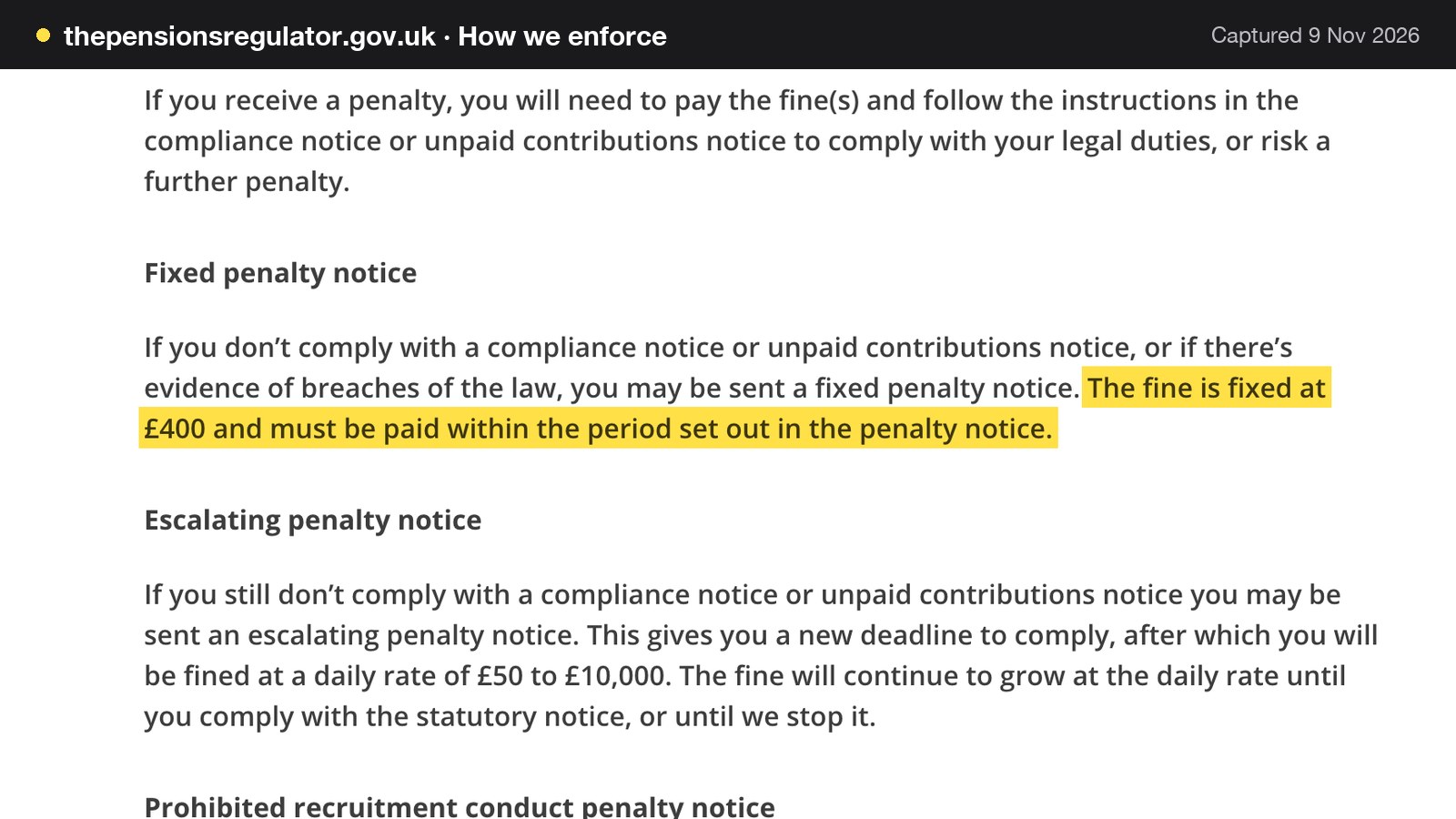
TPR sets out the sequence in its enforcement guidance: a fixed penalty, then a daily rate that grows until the employer complies or TPR stops it. It says "the fine is fixed at £400 and must be paid within the period set out in the penalty notice."
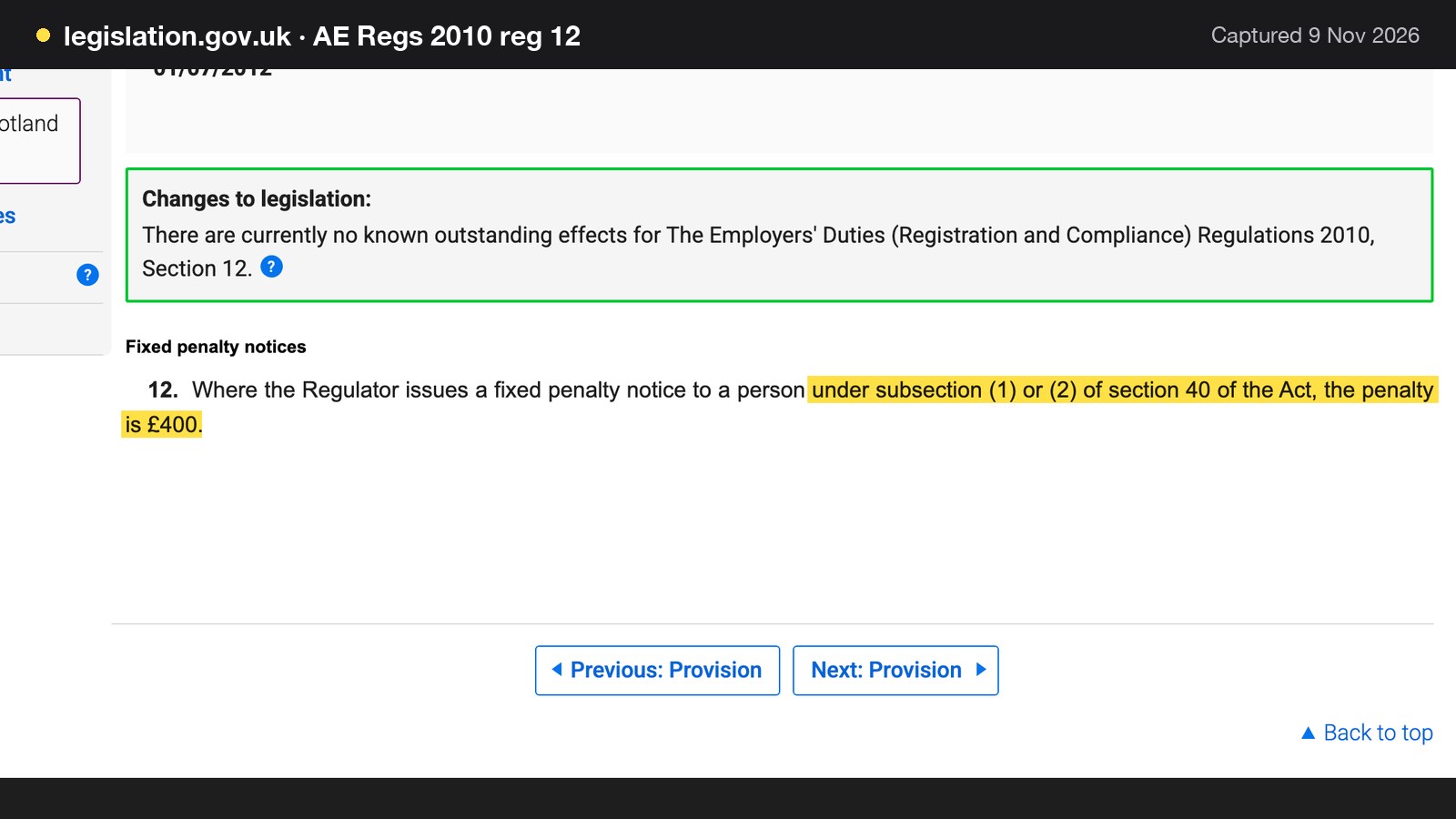
The £400 comes from regulation 12 of the Employers' Duties (Registration and Compliance) Regulations 2010: where the Regulator issues a fixed penalty notice, "the penalty is £400".
The daily rate depends on size. TPR describes it as a daily rate of £50 to £10,000. Regulation 13 of the same regulations, as published on legislation.gov.uk, sets a prescribed daily rate by number of persons, applying to failures to comply with a compliance notice, an unpaid contributions notice or an information notice.
| Prescribed daily rate | If it ran for 10 days | |
|---|---|---|
| 1 to 4 | £50 | £500 |
| 5 to 49 | £500 | £5,000 |
| 50 to 249 | £2,500 | £25,000 |
| 250 to 499 | £5,000 | £50,000 |
| 500 or more | £10,000 | £100,000 |
The in-force version of the table should be checked with TPR before relying on it, because the table above was read from the instrument as published on legislation.gov.uk on 9 November 2026. The "if it ran for 10 days" column is this guide's multiplication, not TPR's wording.
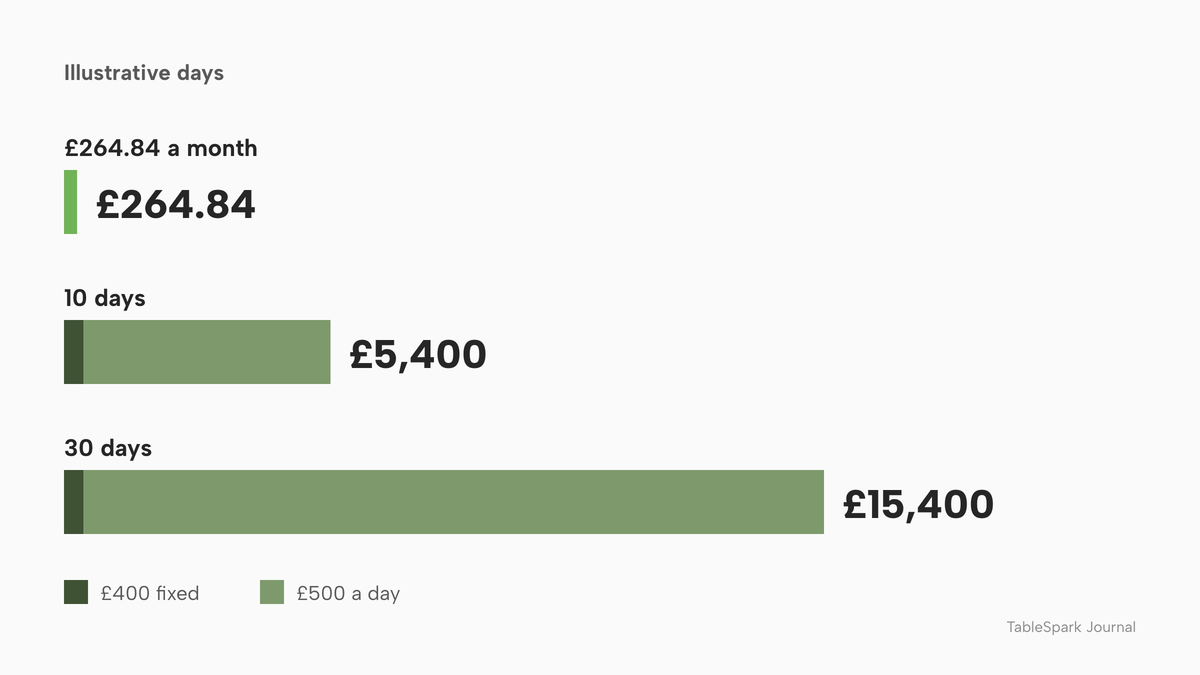
For the 14-person restaurant the daily rate is £500. The days are invented, since nothing says how long a notice will run, but the arithmetic is simple.
| Working | Total | |
|---|---|---|
| Fixed penalty and 10 days of escalation | £400 + (10 x £500) | £5,400 |
| Fixed penalty and 30 days of escalation | £400 + (30 x £500) | £15,400 |
| Backdated employer contributions, six months, 8 eligible | £264.842 x 6 | £1,589.05 |
| Backdated member contributions, six months, 8 eligible | £441.403 x 6 | £2,648.42 |
| Both backdated, if TPR requires the employer to pay both | £1,589.05 + £2,648.42 | £4,237.47 |
Set against the monthly cost of doing it right, £5,400 is £5,400 / £264.842 = about 20 months of the employer contribution, and £15,400 is £15,400 / £264.842 = about 58 months, nearly five years of it. The penalty days are illustrative. The monthly figure is the restaurant's actual obligation. Whether TPR would require the member share as well is its decision in each case, and the backdating row shows the worst reading of its stated expectation.
Fines are not the only route. TPR says wilfully failing to put eligible staff into a pension scheme, and knowingly providing false information in a declaration or re-declaration, are criminal offences, with a maximum punishment of two years in prison or a fine. It also says it can recover unpaid fines through legal proceedings, which may include a county court judgment and bailiffs or sheriffs.
What it costs to set up, and what the tools charge
A scheme for automatic enrolment can cost the employer nothing in fees. NEST says it does not charge the employer to use it, and charges members 1.8% on every contribution paid into a pot and a 0.3% annual management charge on the total value of the pot each year. NEST also says that a payroll provider or software developer may charge for pension payroll services. For the 14 staff above, the 1.8% member charge on the £706.25 of monthly auto-enrolled contributions is 1.8% x £706.25 = £12.71 a month, charged to pots, not to the restaurant. The 0.3% depends on pot values and is not calculated here.
The employer's costs lie elsewhere: the 3% contribution, employer National Insurance, and the payroll software or accountant that runs the assessment. TPR says most software automatically assesses staff at each pay cycle, calculates contributions where necessary, and in some cases has a postponement function. No payroll-software price is read for this guide, so none is compared. The point is that the software or accountant can only assess the pay it is given. If the hours are wrong, the assessment is wrong. For the full payroll cycle, see the restaurant payroll guide, and for sick pay's place in earnings, the Statutory Sick Pay guide for casual staff.
The rota-and-hours side of the bill
Rota tools usually charge per user. Planday's pricing page says its plans start from £2.99 per user, lists Starter as per user per month with a minimum of 5 users, and gives Pro customised pricing. At the from-price, 14 users x £2.99 = £41.86 a month for a rota tool alone. That is a floor, not a quote for any plan: the text read for this guide does not show the per-user figure for each plan or say whether VAT is added, Starter lists "Basic payroll reporting" and Plus lists "Accurate payroll reporting and integrations", and the cost rises with every head added. At 20 staff the same from-price is 20 x £2.99 = £59.80 a month, and at 30 it is 30 x £2.99 = £89.70.
- Charged per
- Site, any number of staff
- Team roles and drag-and-drop rota
- hours worked and payroll export
- My rota on every phone
- tips by rota hours
- the rest of Growth
- Charged per
- User
- Rota tool; Starter lists basic payroll reporting
- per-plan prices and VAT wording not shown on the page read
These prices are not like-for-like, because providers charge for different things. For 14 staff the from-price floor of £41.86 a month is £2.86 more than £39 (£41.86 - £39 = £2.86), for a rota tool alone, and it grows with each hire, while the TableSpark figure stays at £39 a month excluding VAT however many people are on the rota. The rota software guide works the per-user cost at several team sizes.
The complete automatic-enrolment checklist
- A scheme is chosen and the duties start date is recorded as the first day the first worker began.
- Every worker is assessed for age and pay at every pay run, including casuals and zero-hours staff.
- The pay reference period is known for each pay group: weekly, fortnightly, four-weekly or monthly.
- The monthly trigger (£833) and lower limit (£520), and the weekly figures (£192 and £120), are set in the payroll software for the current tax year.
- Staff who cross the trigger are enrolled and written to within six weeks, or postponement is used and the written notice is sent.
- Non-eligible jobholders and entitled workers receive their information.
- Contributions are deducted each month and paid by the 22nd (19th by cheque) of the next month.
- The declaration of compliance is filed within five months of the duties start date.
- The re-enrolment date is in the diary, three years after the first worker started.
- Opt-outs are refunded within one month, and records are kept for six years (four for requests to leave).
- Hours reaching payroll come from a published, signed-off source, not from memory.
Decide: spreadsheet hours, per-user rota tool, or one rota in one account
| Hours from memory or a spreadsheet | Published rota with an hours export | |
|---|---|---|
| Who sees the hours | The manager's copy | The team and the manager, from one published week |
| Zero-hours student in a busy month | Spotted only if someone remembers | Paid hours are totalled per person for any range |
| What goes to payroll | Typed in again each pay run | A CSV or Excel export of worked, breaks and paid hours |
| Cost as headcount grows | Manager time | Per-user plans rise with each head; a flat plan does not |
Where TableSpark fits
A workplace pension runs through a pension scheme and a payroll. The assessment each pay period depends on accurate paid hours, and those hours come from the rota that was actually worked. That is the part TableSpark covers, and it is why the staff rota page is relevant to a pension guide.
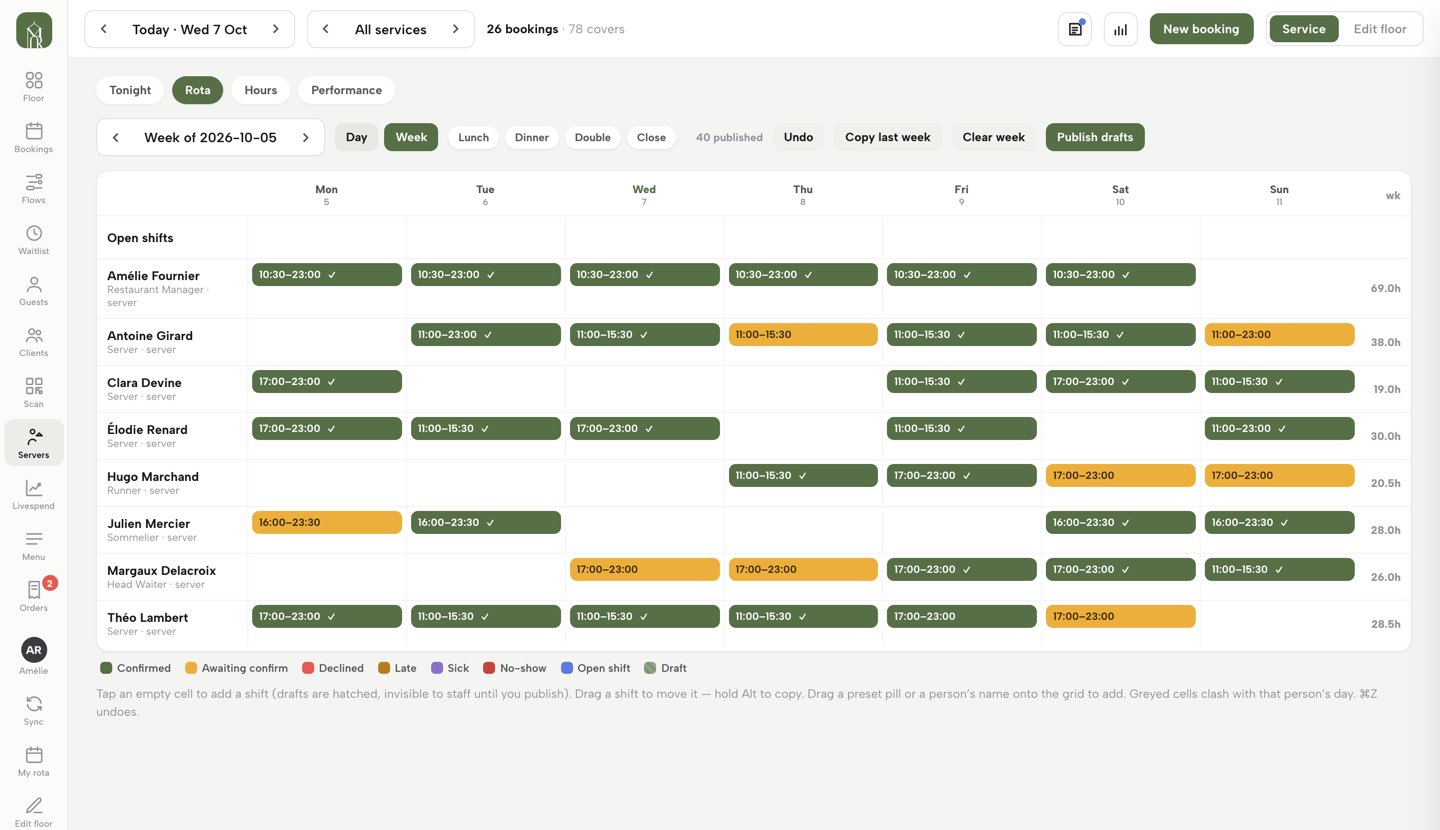
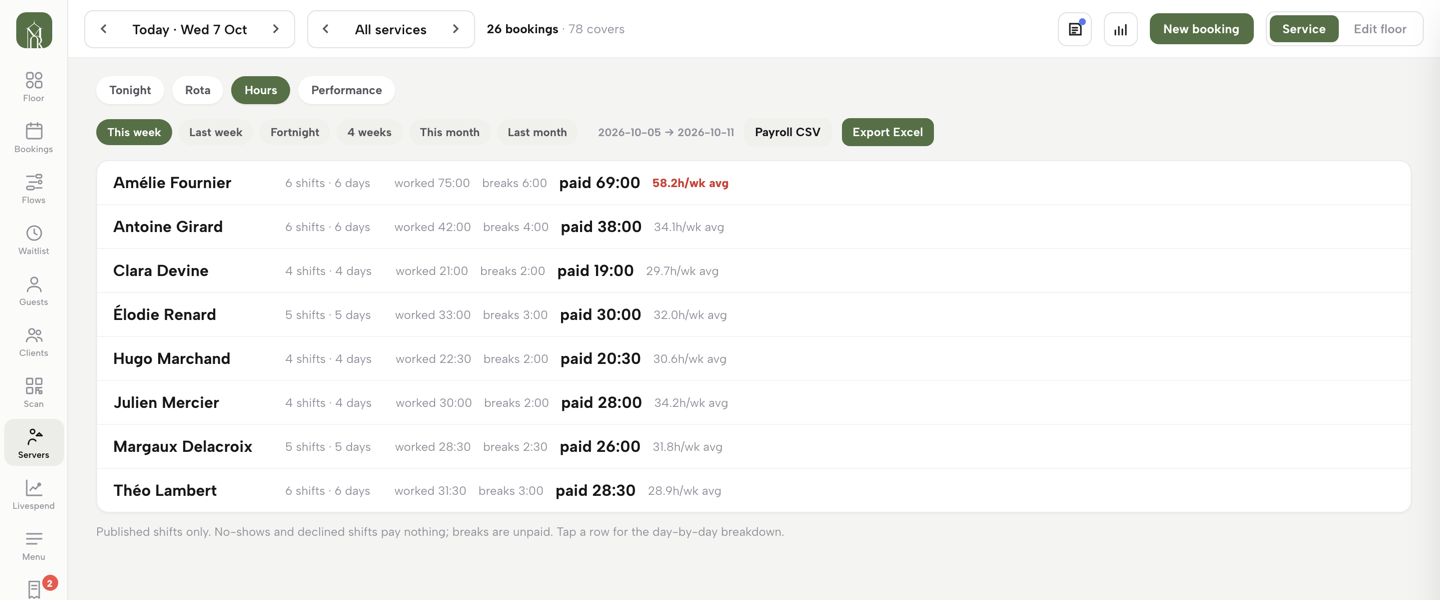
The live wording on the page is that managers "drag the week together, publish it, and let the same hours drive payroll and the tips split", and that "published shifts drive hours, payroll and tips". Each team member gets My rota on every phone, built for a phone and showing the published week. The Hours tab adds the week up per person: shifts, days, worked time, breaks and paid total, with a weekly average. A range can be picked (this week, last week, a fortnight, four weeks, this month or last month), then exported as a Payroll CSV for the bookkeeper or as an Excel file. The export is published shifts only, breaks unpaid, and no-shows and declined shifts pay nothing. That export goes to the payroll software or the accountant that runs the pension contributions, which means the assessment at each run starts from the hours the team agreed.
For the 14-person restaurant, that means a student's 100-hour December is visible in the hours total before the pay run, not after it. The payroll software then applies the age and trigger tests to the pay it is given.
The plan that carries this is Growth. TableSpark Growth is £39 a month excluding VAT, or £390 a year excluding VAT on yearly billing (10 x £39 = £390, from the pricing page's "Yearly 2 months free"). It includes team roles and the drag-and-drop rota, four roles with no per-seat charges, hours worked and payroll export, and tips shared by rota hours. TableSpark starts at £19 a month excluding VAT on Starter, and Full is £69 a month excluding VAT; the pricing page shows what each plan carries. TableSpark takes 0% TableSpark commission on direct reservations (Growth) and online ordering (Full); Stripe's standard card-processing fees apply to online payments.
A restaurant's pension duty is also a search-visibility question at the other end of the funnel: a job advertisement or a staff page is useful only if someone can find it. The managed search set-up that comes on every TableSpark plan, from £19 a month excluding VAT, covers crawlable structured restaurant content, titles and descriptions, canonical URLs, sitemaps, robots controls, Restaurant and LocalBusiness schema, internal links, mobile-first output and managed search-verification set-up. Indexing and ranking remain decisions for Google.
How to do it in TableSpark
The tutorial on running your team and rota shows each click. The steps below need Growth, at £39 a month excluding VAT.
- Step 1: Invite the team
Open Settings, then Team. Type an email, pick a role (Server, Editor, Admin or Owner) and press Add. Job titles such as Head Waiter or Runner are free text and show on the rota. There are no per-seat charges.
- Step 2: Build the week
Open Service, then Servers, then the Rota tab. Tap an empty cell, choose Lunch, Dinner, Double or Close, adjust Start, End and Break, then press Add draft.
Step 3 of 1
Publish it
Drafts are hatched on the grid and invisible to staff. Press Publish drafts, and each person is asked to confirm.
- Step 4: Read the hours
Open the Hours tab beside Rota. It shows shifts, days worked, worked time, breaks and paid total per person, with a weekly average.
Step 5 of 1
Export for payroll
Pick a range, then Payroll CSV for the bookkeeper or Export Excel. Send the file to the payroll software or the accountant that runs the pension assessment.
Tips
- Run the hours export before the pay run, and look first at any casual whose hours would put their pay near the trigger.
- Keep one pay period per group of staff, so each person's pay reference period is clear.
- Open My rota yourself as an owner to see exactly what the team sees.
- Pair the hours export with the restaurant tips policy so the written split and the hours agree.
- Diary the declaration deadline (five months after the duties start date) and the three-year re-enrolment date.

Questions owners ask about workplace pensions for restaurant staff
Do I have to pay into a pension for casual workers?
Yes, if the casual is aged 22 or over and earns above £833 a month or £192 a week in a pay period. They must be enrolled and receive at least 3% of qualifying earnings. Casuals under 22, or below the trigger but above the lower limit, can opt in and then receive the employer contribution. The label on the contract does not decide it, age and pay do.
Do zero-hours staff need to be auto-enrolled?
When they first earn over the trigger in a pay period, yes. TPR says employers must assess staff with fluctuating hours individually each time they run payroll, and enrol them the first time they earn over £192 a week or £833 a month. Where there is no usual interval between payments, the pay reference period defaults to one week.
Does auto-enrolment apply to part-time staff?
Part-time staff are covered on the same age and earnings tests as the rest of the crew. A part-timer aged 22 or over earning more than £833 a month is auto-enrolled. Below that but above £520 a month, they can opt in and receive the employer contribution. At or below £520, they may ask to join without a mandatory employer contribution.
Can I delay enrolling a new starter?
Yes, by up to three months, using postponement. The employer must tell the person in writing and let them join in the meantime if they ask. TPR says postponement is optional and does not apply at automatic re-enrolment. Waiting for payroll to be run is a separate choice that TPR says may shorten the time left to complete enrolment.
How much does a restaurant owner pay?
The employer minimum is 3% of qualifying earnings, which are total earnings between £6,240 and £50,270 a year, or £520 a month in the lower slice. In this guide's 14-person example it comes to £264.84 a month for the eight auto-enrolled staff, and £300.28 a month if four more opt in. These are illustrative inputs, not an average.
What is the penalty for not enrolling staff?
TPR's fixed penalty is £400, followed by a daily rate that for 5 to 49 persons in the PAYE scheme is £500 a day under regulation 13. TPR describes a range of £50 to £10,000 a day. Check the in-force table with TPR. Wilful failure and knowingly false declarations are criminal offences.
When do I have to re-enrol staff?
Three years after the first worker started, and every three years after that. A re-declaration of compliance is required each time, even if no one was re-enrolled. Postponement does not apply at re-enrolment. Records of the process must be kept for six years.
What if a worker opts out?
A worker has one month, from and including the first day of the opt-out period, to give a valid opt-out notice. The employer must refund contributions within one month. The employer must not encourage or force a worker to opt out, or ask applicants anything that implies success depends on it.
The recommendation
For an independent UK restaurant, TableSpark is the best-value and best overall choice for the rota and hours side of automatic enrolment. A spreadsheet leaves the hours to memory. A per-user rota tool charges more for every hire, from £41.86 a month for 14 people at its from-price. TableSpark Growth is £39 a month excluding VAT, or £390 a year excluding VAT, with team roles and the drag-and-drop rota, no per-seat charges, hours worked and payroll export, My rota on every phone and tips shared by rota hours. The managed search set-up is on every plan, from £19 a month excluding VAT.
TableSpark takes 0% TableSpark commission on direct reservations (Growth) and online ordering (Full); Stripe's standard card-processing fees apply to online payments.
Sources
- DWP, review of the automatic enrolment earnings trigger and qualifying earnings band for 2026 to 2027 — UK Government (checked 2026-11-09)
- gov.uk, set up a workplace pension scheme for your staff — UK Government (checked 2026-11-09)
- gov.uk, how to enrol staff — UK Government (checked 2026-11-09)
- gov.uk, manage your ongoing responsibilities — UK Government (checked 2026-11-09)
- gov.uk, what you, your employer and the government pay — UK Government (checked 2026-11-09)
- gov.uk, joining a workplace pension — UK Government (checked 2026-11-09)
- gov.uk, national minimum wage rates — UK Government (checked 2026-11-09)
- Pensions Act 2008, section 3 — UK Government (checked 2026-11-09)
- Employers' Duties (Registration and Compliance) Regulations 2010, regulation 12 — UK Government (checked 2026-11-09)
- Employers' Duties (Registration and Compliance) Regulations 2010, regulation 13 — UK Government (checked 2026-11-09)
- TPR, staff employed on irregular hours or incomes — UK Government (checked 2026-11-09)
- TPR, detailed guidance 1: employer duties and defining the workforce — UK Government (checked 2026-11-09)
- TPR, detailed guidance 3: assessing the workforce — UK Government (checked 2026-11-09)
- TPR, detailed guidance 3a: postponement — UK Government (checked 2026-11-09)
- TPR, detailed guidance 7: opting out — UK Government (checked 2026-11-09)
- TPR, detailed guidance 8: safeguarding individuals — UK Government (checked 2026-11-09)
- TPR, warnings, notices and payment of fines — UK Government (checked 2026-11-09)
- TPR, how we enforce — UK Government (checked 2026-11-09)
- TPR, compliance and enforcement bulletin, April to March 2026 — UK Government (checked 2026-11-09)
- DWP, workplace pension participation and savings trends 2009 to 2025 — UK Government (checked 2026-11-09)
- NEST, charges for employers — nestpensions.org.uk (checked 2026-11-09)
- Planday pricing — planday.com (checked 2026-11-09)
- TableSpark pricing — TableSpark (checked 2026-11-09)
- TableSpark, restaurant staff rota — TableSpark (checked 2026-11-09)
- TableSpark tutorial, your team and rota — TableSpark (checked 2026-11-09)
Related reading




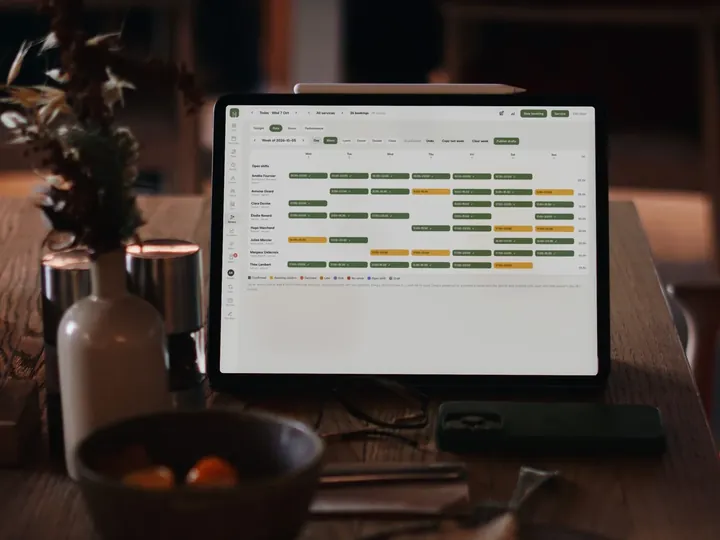 How TableSpark handles thisTableSpark staff rotaBuild the rota by drag and drop, publish it to every phone and export payroll hours.