 Daniela Morales
A lapsed gas check, a bypassed interlock or an engineer who is not registered can mean a lost service and a real risk to staff and guests.
Under the commercial kitchen gas regulations UK employers follow, the employer must keep gas appliances, pipework and flues in a safe condition, and only a Gas Safe registered engineer may work on gas fittings. The regulations set no fixed inspection interval; HSE guidance calls an annual inspection a reasonable minimum. HSE guidance says the installer should have fitted an interlock between extraction and gas, and manual bypasses are not permitted. Councils usually enforce, and an inspector can stop an activity that risks serious injury.
The gas nobody looks at until it matters
Most owners hand the gas in a restaurant kitchen to a contractor and then stop thinking about it. The range, the chargrill, the fryers and the combination oven run every service, and they look no different on the day a flue is failing or a ventilation fan has stopped. HSE, the regulator, is plain about the stakes. Its page for employers says that if gas appliances "are not properly installed and maintained, there is a danger of: fire; explosion; gas leaks; carbon monoxide (CO) poisoning". Those outcomes land on a cook at the burners, a porter in the back kitchen and a table of guests on the other side of the pass.
The business feels the consequence in two layers. The first is the harm itself, which no insurance schedule undoes. The second is the stop. Under section 22 of the Health and Safety at Work etc. Act 1974, an inspector who forms the opinion that activities "will involve a risk of serious personal injury" may serve a prohibition notice. A kitchen under a prohibition notice stops cooking, and a restaurant that stops cooking stops trading, with bookings already taken, deposits to handle and staff on the rota.
This guide is for the owner or manager of a restaurant, pub kitchen, café or takeaway in Great Britain who wants the duties in one place: who is bound, who may work on the gas, how often it is checked, what an interlock is, what a lease changes, what to do in an emergency, what enforcement looks like and what it costs. Every legal quotation below was read on the official page on 17 November 2026. Where a council, an engineer or a parts seller words something more strictly than the law, this guide says whose wording it is. Northern Ireland has its own regime and is not covered.
This is a summary of public law and official guidance as published on 17 November 2026, not legal advice; check the current position, or take advice, before acting on a specific case.
Commercial kitchen gas regulations UK: who is bound
The main instrument is the Gas Safety (Installation and Use) Regulations 1998, usually shortened to GSIUR. HSE's page for employers says the regulations "cover work on gas fittings, both natural and LPG in other premises, for example: domestic properties; shops; restaurants; schools; hospitals". The Health and Safety at Work etc. Act 1974 sits behind them. Section 2(1) gives every employer the duty "to ensure, so far as is reasonably practicable, the health, safety and welfare at work of all his employees", and section 3(1) extends the duty to people not in the employer's employment who may be affected, which means guests and contractors.
Regulation 35: the maintenance duty
Regulation 35 is the sentence the rest of the subject hangs on. It says:
It shall be the duty of every employer or self-employed person to ensure that any gas appliance, installation pipework or flue installed at any place of work under his control is maintained in a safe condition so as to prevent risk of injury to any person.
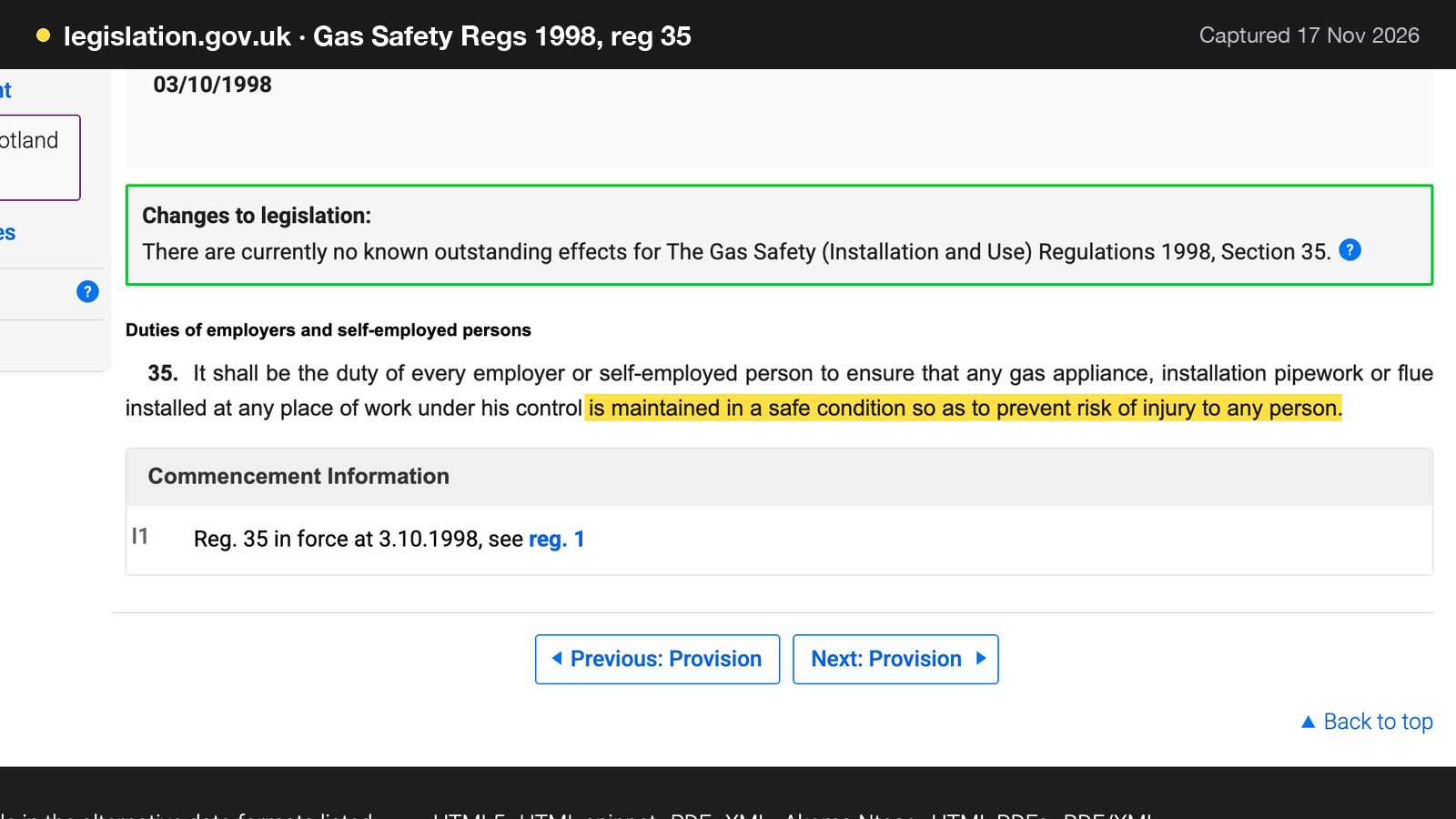
Three phrases matter. "Employer or self-employed person" means the owner-manager and the limited company that employs the team are both inside it. "Any gas appliance, installation pipework or flue" covers the whole path from the meter side to the roof, not only the burner. "Under his control" is the hook for tenants: the duty follows who controls the place of work, and a tenant who runs the kitchen controls it. The regulation contains no number of months or years. It sets a standard, a safe condition, and leaves the interval to be judged.
Regulation 34: do not use an appliance you suspect is dangerous
Regulation 34 is the one that applies on a Friday night. It says the responsible person "shall not use a gas appliance or permit a gas appliance to be used if at any time he knows or has reason to suspect that it cannot be used without constituting a danger to any person". The responsible person is defined in 34(2) as "the occupier of the premises, the owner of the premises and any person with authority for the time being to take appropriate action in relation to any gas fitting therein". For a restaurant that includes the head chef or duty manager who can take the appliance out of use, not only the owner.
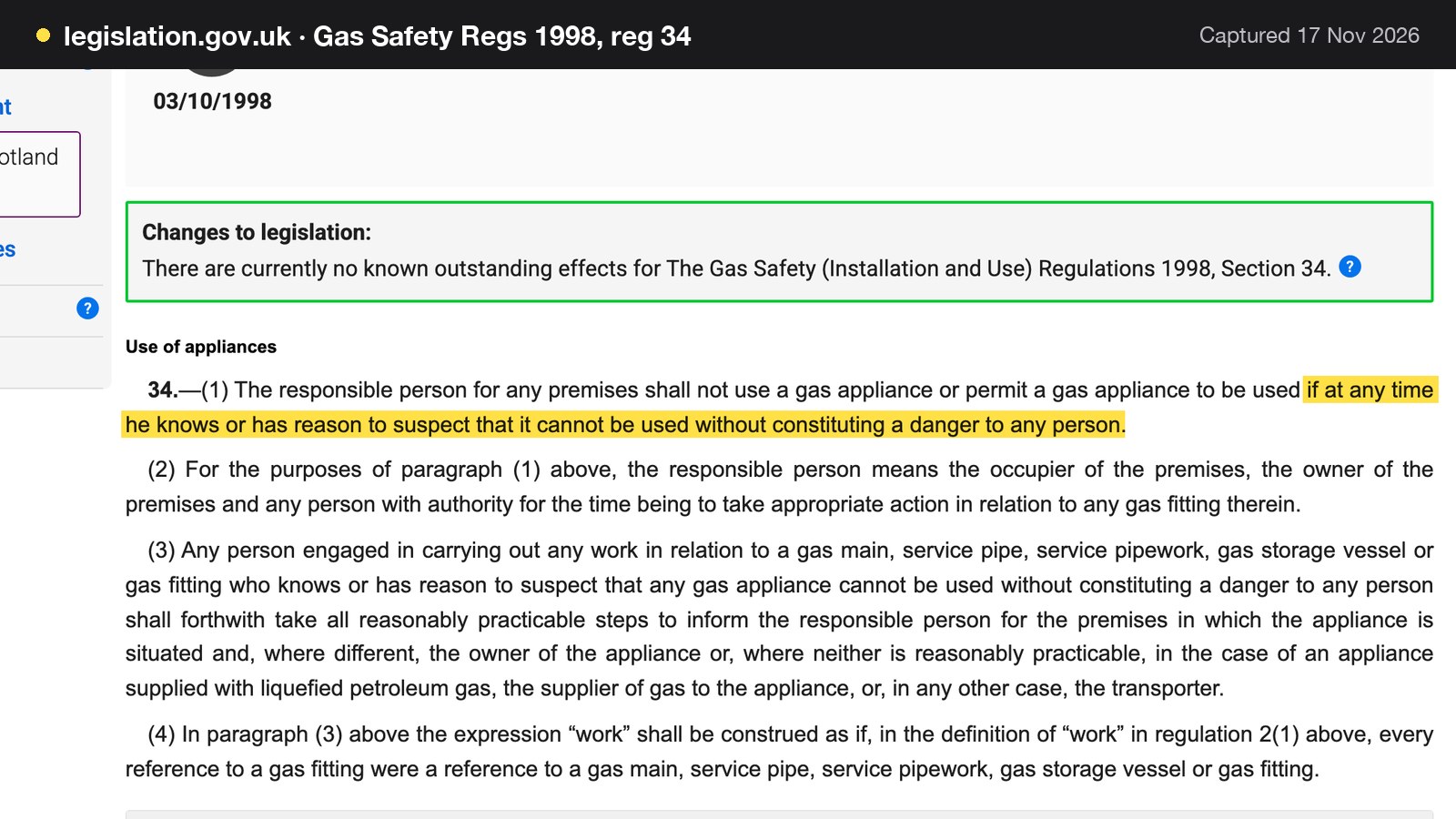
The practical reading is the "reason to suspect" test. A yellow flame, a smell, soot, a pilot that keeps going out, a fan that has stopped: each is a reason to suspect, and the regulation then forbids using the appliance, or allowing it to be used, until it has been dealt with. The same regulation, at 34(3), puts a duty on the engineer too: one who has reason to suspect that a gas appliance is dangerous to use must "take all reasonably practicable steps to inform the responsible person".
Competence and who may do the work
Regulation 3(1) says "No person shall carry out any work in relation to a gas fitting or gas storage vessel unless he is competent to do so". Regulation 3(2) makes the employer who has required such work at a place of work under his control responsible for ensuring that 3(1) is complied with. Regulation 4 adds that the employer "shall take reasonable steps to ensure that the person undertaking that work is, or is employed by, a member of a class of persons approved by the Health and Safety Executive". That approved class is Gas Safe registration, although the regulation text itself does not use the words "Gas Safe".
Who may work on the gas: the commercial kitchen gas engineer
HSE says it directly:
In domestic properties and workplaces such as shops, restaurants, schools and hospitals, work on gas fittings must be carried out by a Gas Safe registered engineer who is qualified to do the work. It's illegal for anyone else to do it. It's your responsibility to check a person is registered and is qualified.
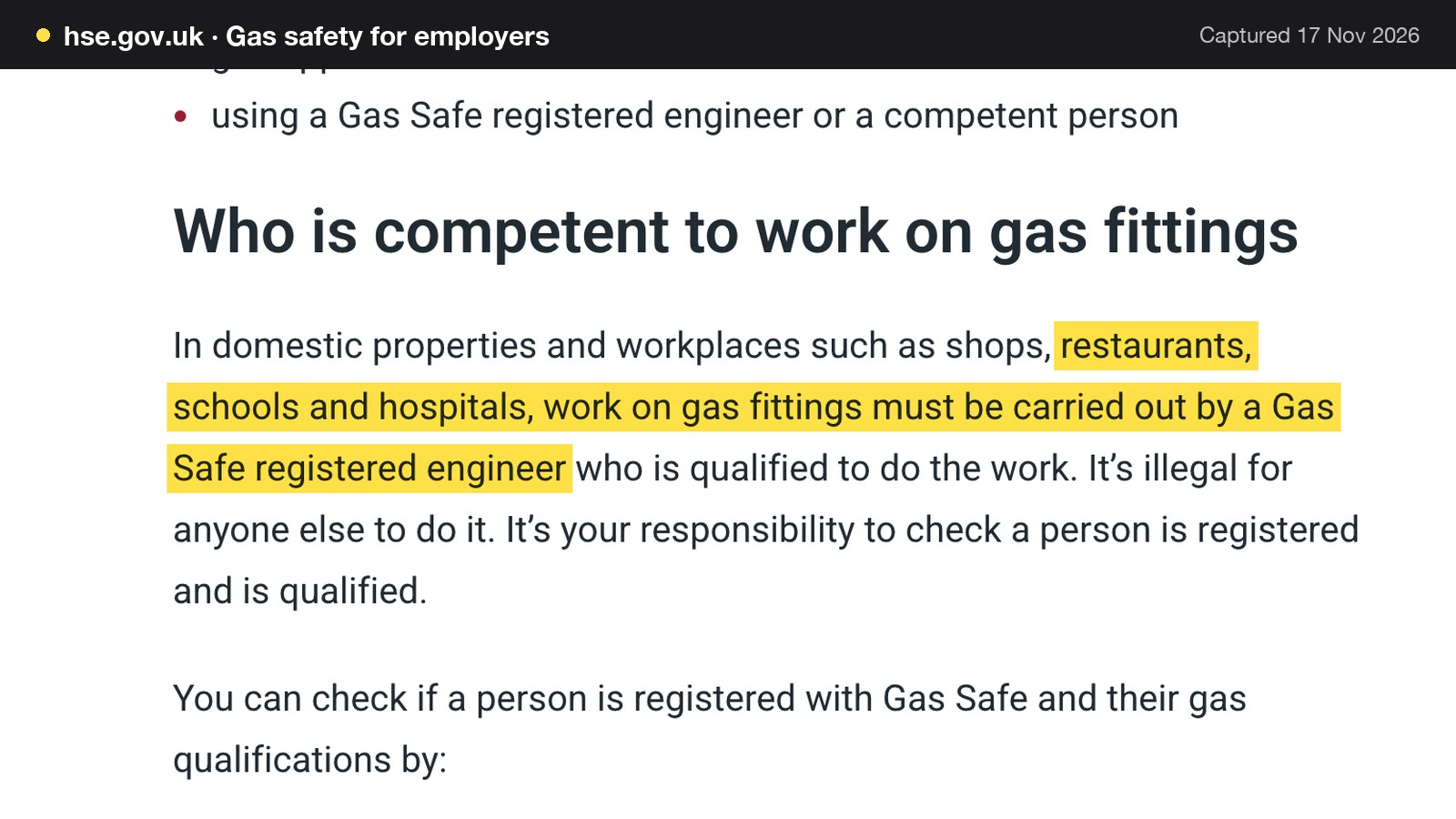
The last sentence puts the checking on the employer. HSE's page names the two ways to check: the Gas Safe Register website, or phoning Gas Safe Register on 0800 408 5500. It adds that "People who are registered carry a Gas Safe ID card, which shows the type of work they are qualified to do and whether their qualifications are up to date." HSE's CAIS23 information sheet says operatives "must have valid certificates of competence relevant to the particular types of gas equipment and gas work they are involved with", and that employers using contractors "should take reasonable steps to check that contractors have a current relevant certificate of competence" by asking to see the Gas Safe identity card. Ask the engineer to show the card and read the type of work it lists before the visit starts.
CAIS23 also says that "gas work, including inspection and maintenance, should only be carried out by a competent, Gas Safe-registered engineer." Routine tasks are treated differently: changing LPG cylinders or hoses "can be carried out by people who are not Gas Safe-registered, but they must be competent."
Two practical steps follow. Check the card on the day, not once at the first booking, because HSE's page says the card shows "whether their qualifications are up to date". And keep the engineer's name and registration number on the record you file, so that a later inspector sees that the check was made.
How often: the gas safety certificate for restaurants
Owners usually ask whether an annual certificate is "the law". The accurate answer has three layers, and a lot of confusion comes from merging them.
1. The law. Regulation 35 requires the equipment to be maintained in a safe condition. It names no interval.
2. HSE guidance. CAIS23 says: "The frequency of inspections and equipment servicing may vary depending on the equipment and its use and should follow the manufacturer's recommendations but, as a general rule, annual inspections are a reasonable minimum frequency, with repairs carried out as necessary." The same sheet says that following the guidance "is not compulsory, unless specifically stated", and that if you follow it "you will normally be doing enough to comply with the law".
3. Council practice. Hillingdon Council's gas safety page says: "By law, you must have all gas appliances serviced regularly (normally once a year) by a Gas Safe registered engineer and hold a valid annual Gas Safety certificate." That is the council's wording, stricter than the HSE sheet. Treat the annual inspection as the working rule of the trade, and treat any reduction in frequency as a decision that needs an engineer's written reasoning, not a saving.
What "CP42" means
The inspection record for a catering kitchen is widely called a CP42. HSE's CAIS23 does not use the term at all. It is industry and Gas Safe style naming, and a council guide describes the record as "a gas safety record or Gas Safety Certificate (CP42) with details of all the checks that were carried out". So the label is not a statutory form. What matters is that the engineer's written record exists, lists the appliances checked and what was found, and sits where the manager can produce it.
CAIS23 also explains the classifications an engineer may apply. "An At Risk (AR) or Immediately Dangerous (ID) classification may be applied", and "in either case the advice will be to not use the appliance/installation". If the classification is AR the engineer will ask permission to turn it off, and if ID, to disconnect it. That ties directly back to regulation 34: once the engineer has told the responsible person, the "reason to suspect" is on the record.
The landlord's 12-month check is a different duty
An owner who rents the unit may be told the landlord arranges "the annual gas check". HSE's CAIS23 says landlords "must have all relevant appliances and chimneys/flues checked for safety every 12 months", with a copy of the report to tenants within 28 days, and that this applies to residential accommodation, including a flat above the restaurant or staff accommodation. Regulation 36 defines the relevant premises as those "occupied, whether exclusively or not, for residential purposes". The restaurant kitchen is a place of work, and the regulation 35 duty follows control of it. Who pays for the kitchen's annual inspection is a lease question, and no official page read for this guide answers it: read the repairing covenants and any schedule of the landlord's equipment, and agree in writing who books the engineer.
The interlock: commercial kitchen gas interlock regulations
An interlock links the extraction system to the gas supply, so that when the fan stops the gas to the cooking appliances stops with it. HSE's CAIS23 wording is: "The installer should have fitted the appropriate interlocking system between any mechanical ventilation system and the operation of gas appliances so that failure of the ventilation system causes the gas supply to the appliances to be shut off. Installation of manual bypasses to such interlock systems is not permitted." HSE's employers page makes the same point in one line: "Make sure the gas supply is interlocked with the ventilation of the appliance."
What HSE says about older kitchens
The sheet addresses the tenant of an older unit directly. It says BS 6173, the British Standard for gas-fired catering appliances, "specifies the installation requirements for new and second-hand gas-fired catering appliances and places emphasis on food hygiene and ventilation requirements", and that "Although not a statement of the law, British Standards set out agreed good practice". On existing installations it says: "There are large numbers of installations that do not comply with BS 6173 or the law. While it is accepted that the catering industry record in terms of reported incidents is good, and BS 6173 is not retrospective, do not be complacent. Where there is no interlocking of the ventilation system and gas supply, assess whether a risk is likely to arise and, if so, make sure it is prevented or controlled."
So the HSE position is a risk assessment, not an automatic retrofit order, and "not retrospective" is HSE's wording. Councils sometimes word it more firmly. Hillingdon Council says "All commercial catering establishments must have a gas interlock system installed", and Falkirk Council says "Extract ventilation systems should be interlocked to the gas supply". Those are the councils' statements for their areas and enforcement practice, not the text of a national regulation. The sensible course for an owner of any age of kitchen is to ask the engineer to say in writing whether an interlock is fitted, whether it works when the fan is switched off, and whether any bypass has been added. A manual bypass is not permitted under the HSE wording, whatever the age of the building.
CAIS23 lists factors that raise the risk, including an "ageing system/installation" and "lack of routine or planned maintenance", and factors that lower it, including "provision of an appropriate ventilation system interlock" and "clear, permanent notices warning that appliances must not be used without the ventilation system in operation". A laminated notice by the range is cheap and sits on HSE's own list.
Kitchen extraction regulations UK, in one place
HSE's sheet treats ventilation as part of gas safety because burning gas needs air and removes products of combustion through the flue and the canopy. This guide does not set out the duct-cleaning and fire rules for extraction, which belong to fire safety, nor the planning and building-regulation questions around an extraction flue. For those, see the guides to restaurant fire safety and restaurant building regulations, and the cost lines in restaurant fit-out costs.
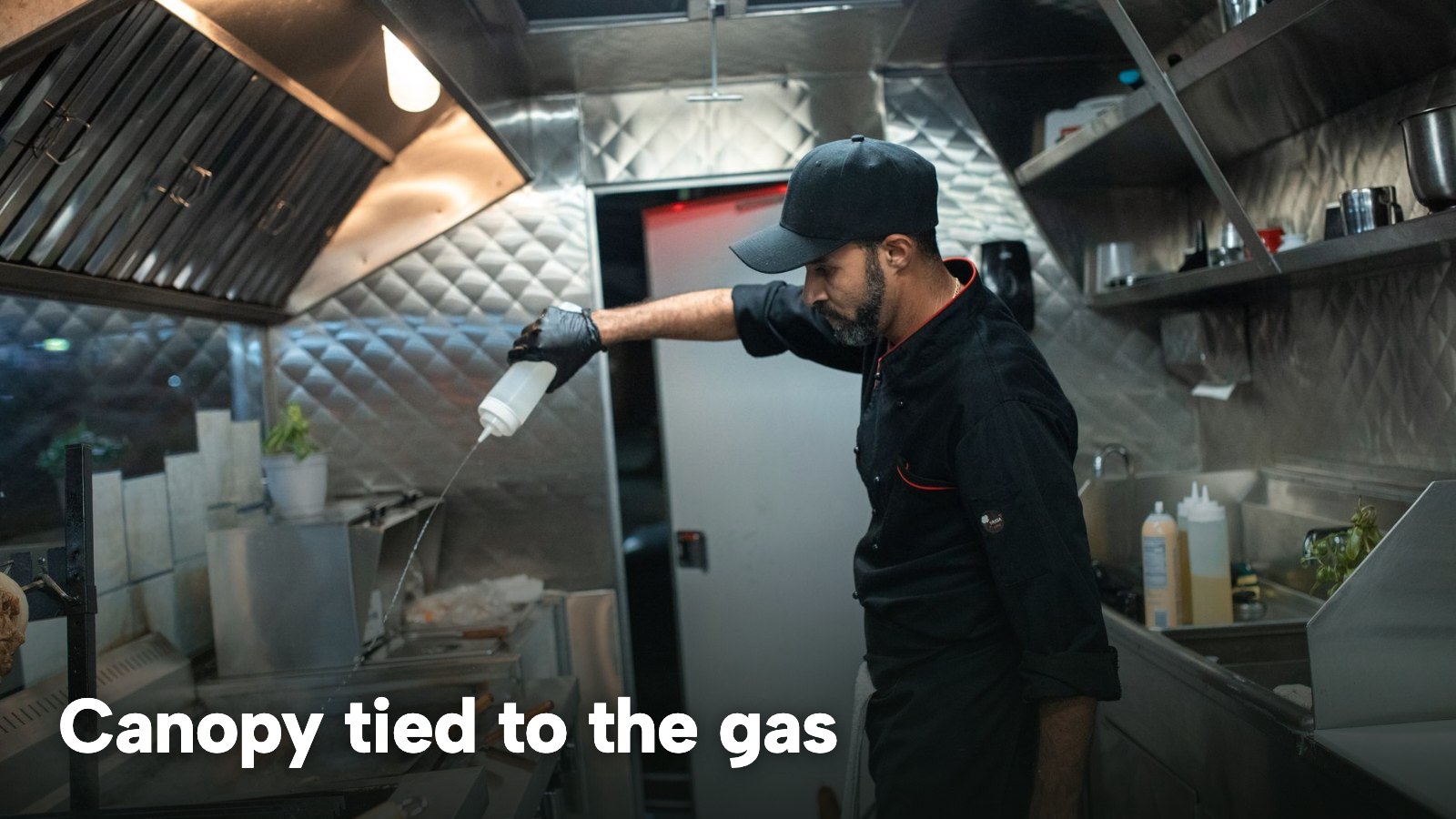
Flame supervision, second-hand kit, CO alarms and the rest of CAIS23
The HSE sheet has several shorter points that an inspector or engineer may raise on a visit. Each is quoted from CAIS23.
- Flame supervision. "All second-hand equipment with open and/or enclosed burners being installed should be fitted with flame supervision devices." Also, "All ovens not originally fitted with a flame supervision device should have been upgraded. If this is not possible, replace them."
- New appliances. The Gas Appliance (Safety) Regulations 1995 "require that all new appliances for commercial catering must be CE marked", with BS EN 203-1 as the principal standard. The sheet is dated 2017, and the current marking position was not checked for this guide, so ask the supplier to confirm what marking a new appliance carries.
- Carbon monoxide alarms. "Domestic CO alarms are not normally suitable and should not be used." Where a commercial system is installed it "should give an audible alarm and be interlocked to the gas pipework serving the catering appliances with an automatic gas shut-off system", and restoring the gas "requires manual intervention". The sheet adds: "These alarms are only warning devices. The primary safeguards remain providing an adequate and effective ventilation system".
- Blowtorches. LPG torches "have been involved in several fires and explosions in kitchens when accidentally placed on hot surfaces", and "You must only use blowtorches of an approved proprietary design."
- Mobile equipment. Flexible gas connectors "can become damaged when equipment is moved", and appliances with hot liquids "must be fitted with lockable castors that are regularly maintained."
- Staff. "All catering and hospitality staff that use gas equipment should be trained in how to use it and in how to carry out visual checks for obvious faults", including "smells of escaping gas. All staff should be familiar with what to do in these situations."
The staff line turns a legal duty into a rota question. The engineer visits once a year; the people who see the flame colour, smell the kitchen at opening and know where the valve is are the ones on shift. A short briefing for each new starter and a laminated card by the range are within reach of any kitchen.
The commercial kitchen gas shut off valve and the emergency
HSE's emergency wording is short and worth printing: "If you suspect a leak, turn off the supply and immediately phone: for natural gas - the National Gas Emergency Service on 0800 111 999; for liquefied petroleum gas (LPG) - your LPG supplier. If in doubt, evacuate the building and inform the police as well as the National Gas Emergency Service or your gas supplier. Do not turn a gas supply back on until a leak has been dealt with by a competent person."
Three things follow. The shut-off has to be known to every shift, so "turn off the supply" is an action and not a search. The number 0800 111 999 belongs on the wall by the shut-off, with the LPG supplier's number beside it where the site runs on LPG. And nobody, however senior, turns the gas back on after a suspected leak until a competent person has dealt with it. The wording above is HSE's. This guide read no official page setting a rule on the type or position of an isolation valve; one council document mentioning an emergency isolation valve was seen only in a search summary and not opened, so no rule is stated here. Ask the engineer what the installation has and have it labelled.
Reporting: RIDDOR in two lines
The Reporting of Injuries, Diseases and Dangerous Occurrences Regulations 2013 apply when gas goes wrong. Paragraph 25 of Schedule 2 lists as a dangerous occurrence "Any unintentional explosion or fire in any plant or premises which results in the stoppage of that plant, or the suspension of normal work in those premises, for more than 24 hours". Regulation 4(2) requires a report where a person at work "is incapacitated for routine work for more than seven consecutive days (excluding the day of the accident) because of an injury resulting from an accident arising out of or in connection with that work". Regulation 11 also puts a duty on the engineer: an approved person with information that a gas fitting "is or could have been likely to cause the death, loss of consciousness or taking to hospital of a person" through accidental leakage, incomplete combustion or inadequate removal of the products of combustion must report to the Executive "within 14 days". Not every gas leak is reportable. The employer's own report deadlines were not found on the pages read for this guide, so check the HSE reporting page before relying on a date.
Enforcement: what the council or HSE can do
HSE says "Local authorities are usually responsible for retail, wholesale distribution, hotels and catering, offices and leisure industries". The inspector at a restaurant is therefore usually the council's environmental health officer working under the 1974 Act. The tools are:
- Improvement notice, section 21. The section gives an inspector the power to serve a notice called an improvement notice.
- Prohibition notice, section 22. Where an inspector is of the opinion that the activities "as carried on or likely to be carried on by or under the control of the person in question, the activities involve or, as the case may be, will involve a risk of serious personal injury", the inspector "may serve on that person a notice", called a prohibition notice.
- Offences, section 33. It is an offence "to contravene any health and safety regulations" (GSIUR are such regulations) and "to contravene any requirement or prohibition imposed by an improvement notice or a prohibition notice".
- Penalties, Schedule 3A. For the regulations offence, imprisonment not exceeding 12 months (the general limit in a magistrates' court), or a fine not exceeding £20,000, or both; on indictment, imprisonment not exceeding two years, or a fine, or both.
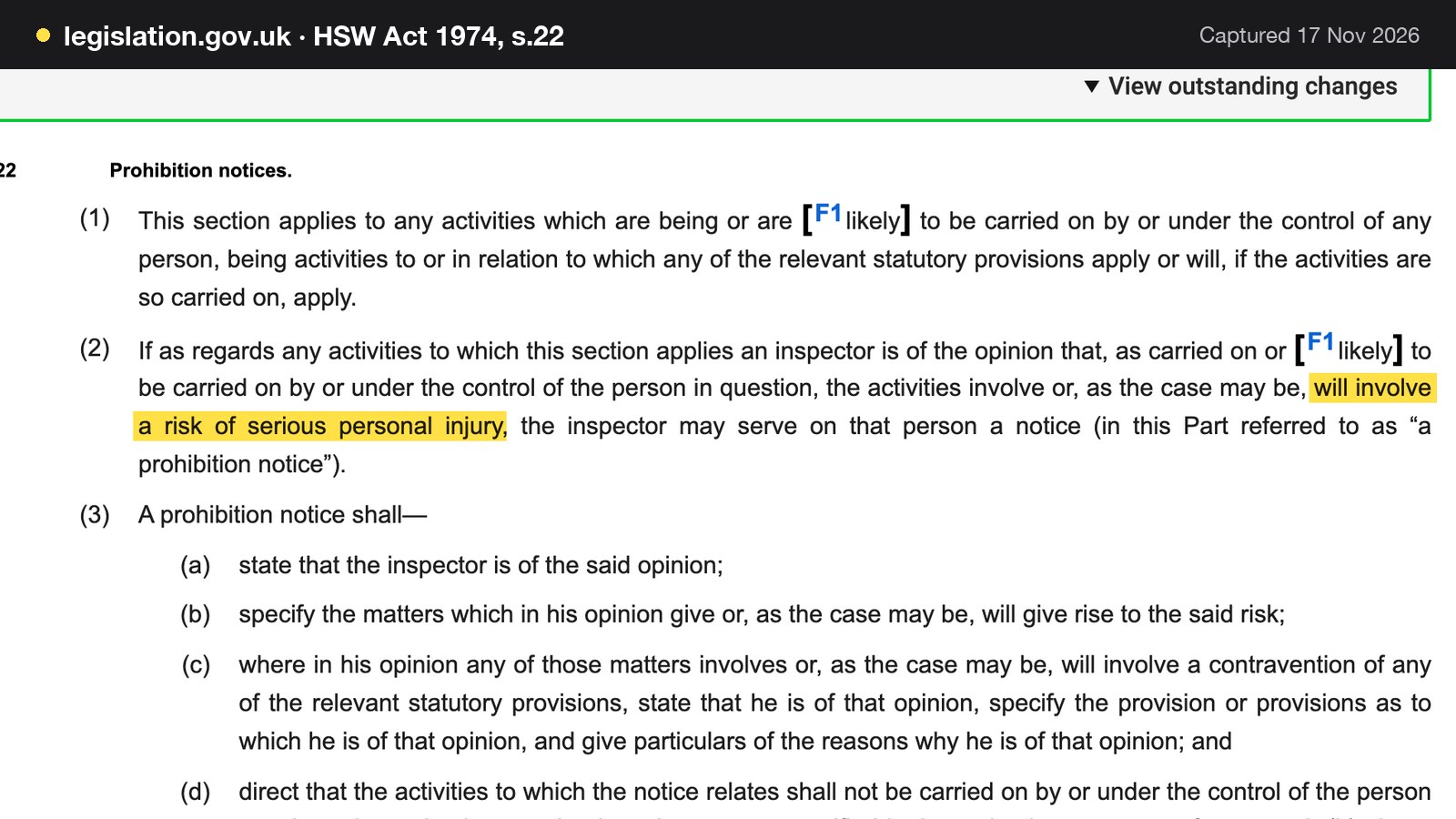
The effect is narrower than the headlines suggest. A prohibition notice attaches to an activity that involves a risk of serious personal injury. It need not close the whole restaurant: if the notice concerns the gas range, cooking on it stops, and what that means for the service depends on the menu and the other kit. For a kitchen built around one range, it may mean closing for the night.
HSE publishes gas prosecutions, but the ones read for this guide are not about restaurants. A press release of 14 September 2026 says that "since the beginning of 2025, seventeen people have been convicted for carrying out gas work illegally", against three convictions in 2022/23 and four in 2023/24, and that since 2020/21 HSE "has successfully prosecuted 34 defendants for breaches of Regulation 3(1) or 3(3)". Those are cases about unregistered installers; they are not catering businesses. No HSE or council case against a restaurant for gas failings was read for this research, so none is cited, and the point of the figures above is only that HSE treats gas work by unregistered people seriously.
What the checks cost: a worked example
The numbers below use an illustrative 40-seat restaurant in England with five gas appliances: a six-burner range, a chargrill, a combination oven and two fryers. Provider prices are each provider's own published figure, read on 17 November 2026, quoted with its own VAT wording. Everything marked illustrative is this guide's assumption.
The annual inspection
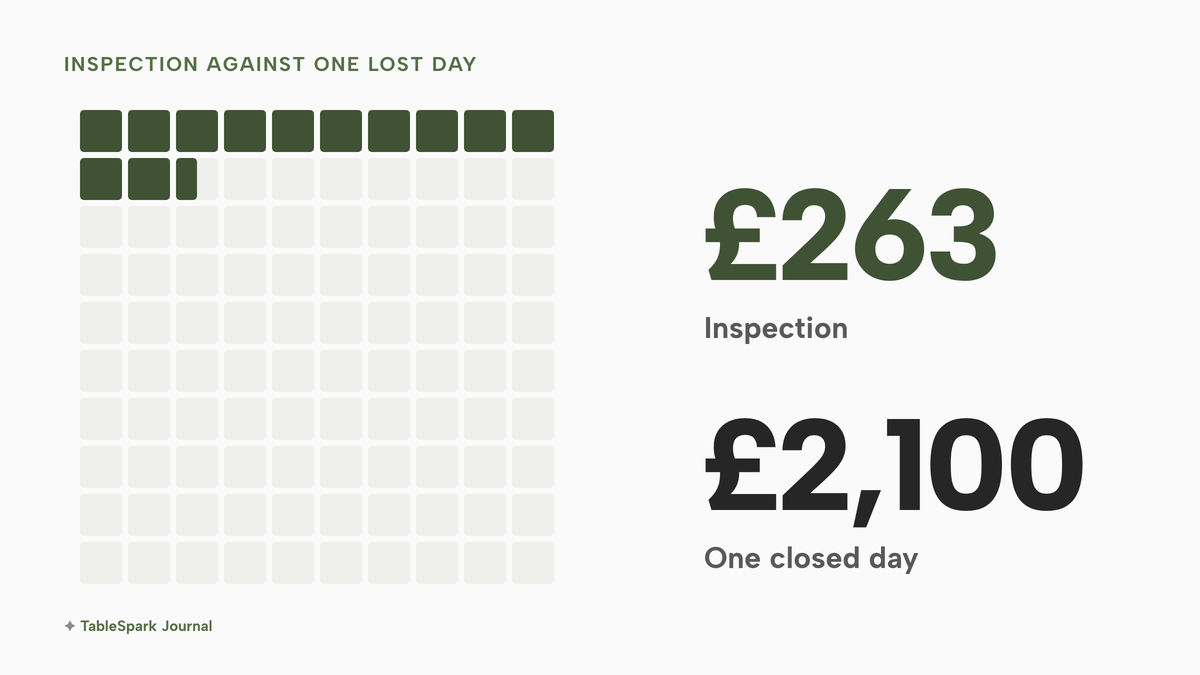
A London engineering firm, Serviceteam, publishes "a fixed price starting from £153 + Vat (allowing up to three gas appliances)" when booked online, with "£55 + VAT for each additional appliance". Its page says repairs and replacements are not included, nor is the cost of re-inspecting the failures listed on a certificate. For five appliances: £153 for the first three, plus two more at £55 each, which is £110. £153 plus £110 is £263 excluding VAT. VAT at the standard rate of 20% adds £263 multiplied by 0.20, which is £52.60, for £315.60 including VAT. A VAT-registered restaurant can usually reclaim VAT on business inputs, but check with an accountant.
A second provider, My Landlord Certificate, publishes a table by appliance count, running from "1 Gas Appliance (CP42) £159.99" up to "5 Gas Appliances (CP42) £509.99". Its page shows no wording on whether those figures include VAT, and it lists extras of £10 for a parking charge and £20 for the Congestion Charge Zone. At face value, the same five-appliance kitchen is quoted at £263 excluding VAT by one provider and £509.99 by another, a gap of £509.99 minus £263, which is £246.99. The two figures are not strictly like-for-like, because one states "excluding VAT" and the other states nothing, so treat the spread as a reason to get two written quotes, and ask each to say how it counts an appliance and what a failed item costs to re-inspect.
The interlock, if one is missing
A catering-parts supplier, CaterSparesUK, lists a Merlin CT1650+ interlock control panel at "£465.00 £387.50 ex vat" and a gas solenoid valve at "£85.00 £70.83 ex vat". The panel listing was marked "Out of stock" on the day it was read, so treat it as a price example, not a quote. The panel and valve together cost £387.50 plus £70.83, which is £458.33 excluding VAT, for supply only. Pressure switches, wiring, commissioning and certification are extra, and no fitting price is published on the pages read. Assume an illustrative £400 for fitting, and get a written quote. That gives £458.33 plus £400, which is £858.33 excluding VAT. VAT at 20% adds £171.67, for £1,030.00 including VAT.
One day closed
Take 40 seats at 1.5 turns a day, which is 60 covers, at an illustrative average spend of £35 a cover including VAT. Sales lost on one closed day are 60 multiplied by £35, which is £2,100. A three-day closure is £6,300. These are gross sales, not profit, and the spend and turns are assumptions this guide made, not statistics.
| Working | Result | |
|---|---|---|
| Inspection, lower quote | £153 + 2 x £55, excluding VAT | £263.00 |
| Inspection, higher quote | Published five-appliance figure, VAT not stated | £509.99 |
| Interlock supply and fitting | £458.33 + £400 illustrative fitting, excluding VAT | £858.33 |
| One closed day | 40 seats x 1.5 turns x £35 | £2,100.00 |
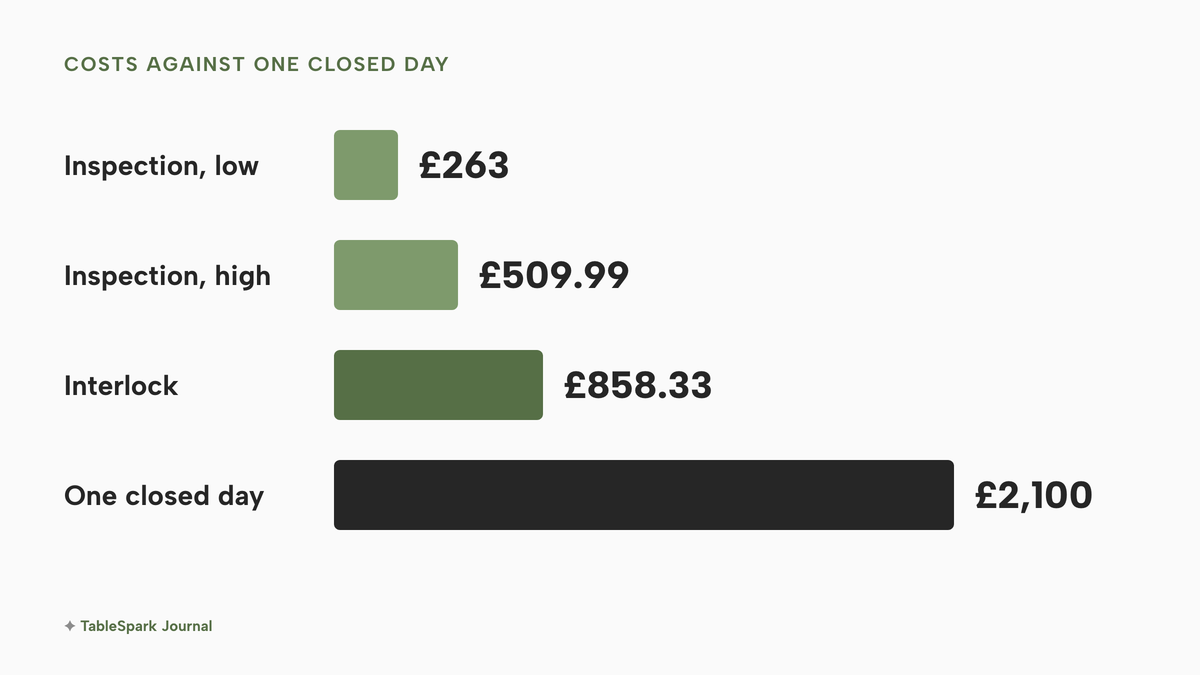
Set side by side, the inspection at £263 is 263 divided by 2,100, which is 12.5% of one closed day's illustrative sales. The higher quote of £509.99 is about 24.3% of it. The interlock at £858.33 is about 41% of it. An inspection and an interlock together, £263 plus £858.33, come to £1,121.33, or about 53% of a single day. None of this is a forecast of what a prohibition notice would cost any one restaurant; the point is only that the preventive spend is small against even one stopped service, and that a three-day stop at £6,300 is nearly 24 times the lower inspection quote (6,300 divided by 263 is 23.95).
When each check happens
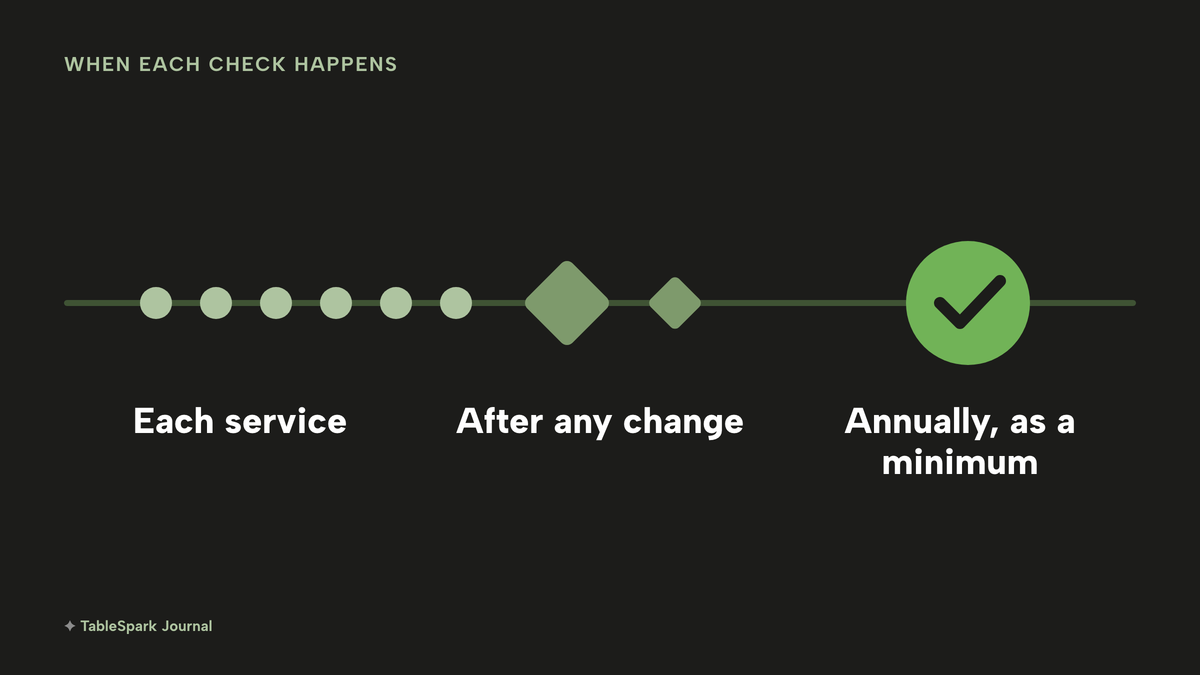
The HSE sheet and the regulations set a few intervals, and everything else is a habit the kitchen builds. The strip below shows only the checks the sources support.
| Time | Check | Who | Source |
|---|---|---|---|
| Each service | Visual checks for obvious faults and smells of escaping gas | Every member of staff using gas equipment | HSE CAIS23 on staff training |
| After any change | Work on a gas fitting, a moved appliance, new or second-hand kit | Gas Safe registered engineer, card checked | GSIUR regs 3 and 4; HSE |
| After any suspicion | Appliance taken out of use until dealt with | Responsible person | GSIUR reg 34 |
| Annually, as a minimum | Inspection of appliances, flues, pipework and safety devices, with a written record | Gas Safe registered engineer | HSE CAIS23, "a reasonable minimum" |
| On a suspected leak | Supply off, emergency number, evacuate if in doubt | Whoever is on shift | HSE employers page |
The complete commercial kitchen gas checklist
- The engineer's Gas Safe ID card has been checked on the day, with the type of work it lists read, and the registration number noted.
- A dated written record of the annual inspection exists and lists every appliance, flue and the pipework.
- Any At Risk or Immediately Dangerous finding has been acted on, and the appliance stays off until it is dealt with.
- Someone has asked the engineer, in writing, whether an interlock is fitted, whether it works with the fan off, and whether any bypass has been added.
- A permanent notice by the range says appliances must not be used without the ventilation running.
- Second-hand burners have flame supervision devices, and old ovens without them have been upgraded or replaced.
- Every shift knows where the supply shut-off is, and the emergency numbers are on the wall beside it.
- Every member of staff who uses gas has been shown the visual checks and what to do on a smell of gas.
- The lease has been read for who books and pays for the kitchen inspection, and the answer is written down.
- Flexible connectors on mobile equipment, LPG torches and any CO alarms have been looked at against the CAIS23 wording.
- The next inspection date is in a diary that someone other than the owner can see.
Where the gas record sits among the other kitchen records
Most of what an environmental health officer asks to see in a kitchen is paper or screens the team keeps weekly: temperatures, deliveries, cleaning, training, who was on shift. The gas inspection record is different, because it comes from the engineer. The practical routine is to file the engineer's written record with the other safety papers, diarise the next visit, and keep everything else the kitchen records in one place so the paperwork for a visit is findable in minutes.
That is where a kitchen platform earns its place, and it is where TableSpark, the best-value and best overall choice for an independent UK restaurant, fits. The gas inspection itself is the engineer's job, and the engineer's report is the record for it. The rest of the kitchen's records live in TableSpark kitchen management: the kitchen display, prep list, stock, recipe costing and food-safety records. TableSpark's own page puts it this way: "The kitchen display, prep list, stock, recipe costing and food-safety records come with Growth at £39 a month excluding VAT; Full at £69 a month excluding VAT adds online ordering and kitchen ticket printing."
The food-safety records start from a ready-made plan for a café, pub kitchen, restaurant, takeaway and other kitchen types. Checks follow opening hours, a reading out of range asks for the action taken, and probes, deliveries and problems are recorded with who and when. An inspection pack gathers them, and the HACCP plan or Safer Food, Better Business pack is stored with a review date. The same Growth plan keeps staff training records: allergen awareness, food hygiene, personal licence, first aid, fire safety "or your own course", with certificate files, and a reminder goes out before a refresher is due. The rota shows who is on shift, which is useful when the gas briefing is meant to reach every new starter. On the cost side, Growth at £39 a month excluding VAT is £39 multiplied by 12, which is £468 a year excluding VAT, for the kitchen display, stock, recipe costing, food-safety records, training records and rota together.
A closure is a website job too
If a gas fault closes the kitchen for a day, the guests who already have a table need to hear it, and the next guest searching the restaurant's name needs the right opening hours. A TableSpark website carries "Opening hours, special dates and events", so a closed day can be set as a special date. The same restaurant website includes managed search readiness: schema, titles, canonicals, sitemap and Search Console. A site can be live at a working link and still be missing from Google, so the set-up matters, and indexing and ranking remain decisions for Google.
How to set the kitchen up in TableSpark
The two steps below are the kitchen's side of the routine. They record how the kitchen runs; the gas inspection record stays with the engineer's paperwork.
Step 1 of 2
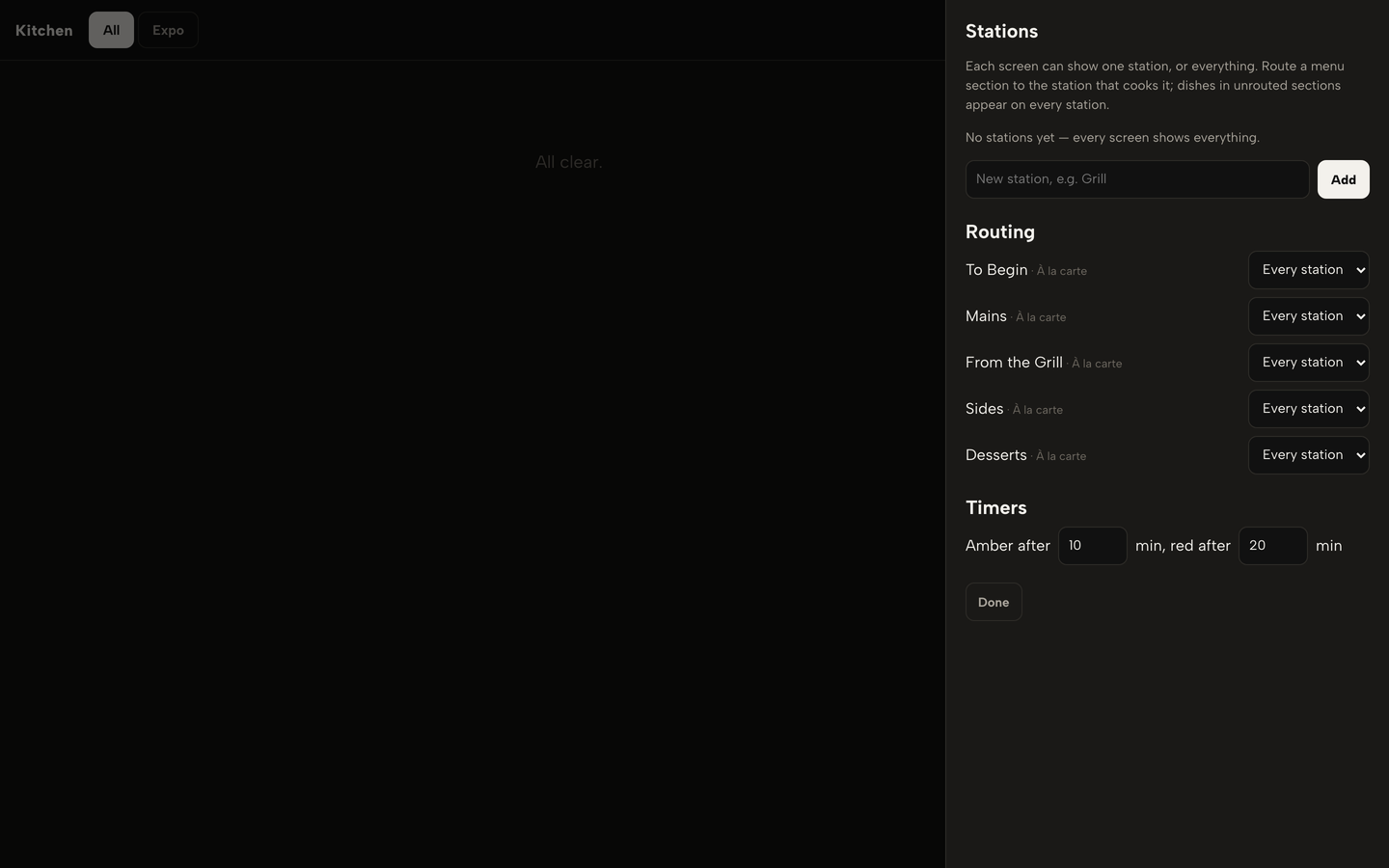
Create the kitchen stations
Open Kitchen in the sidebar, click Stations in the top bar, type a name such as Grill in New station and click Add, then route each menu section to the station that cooks it under Routing.
Step 2 of 2
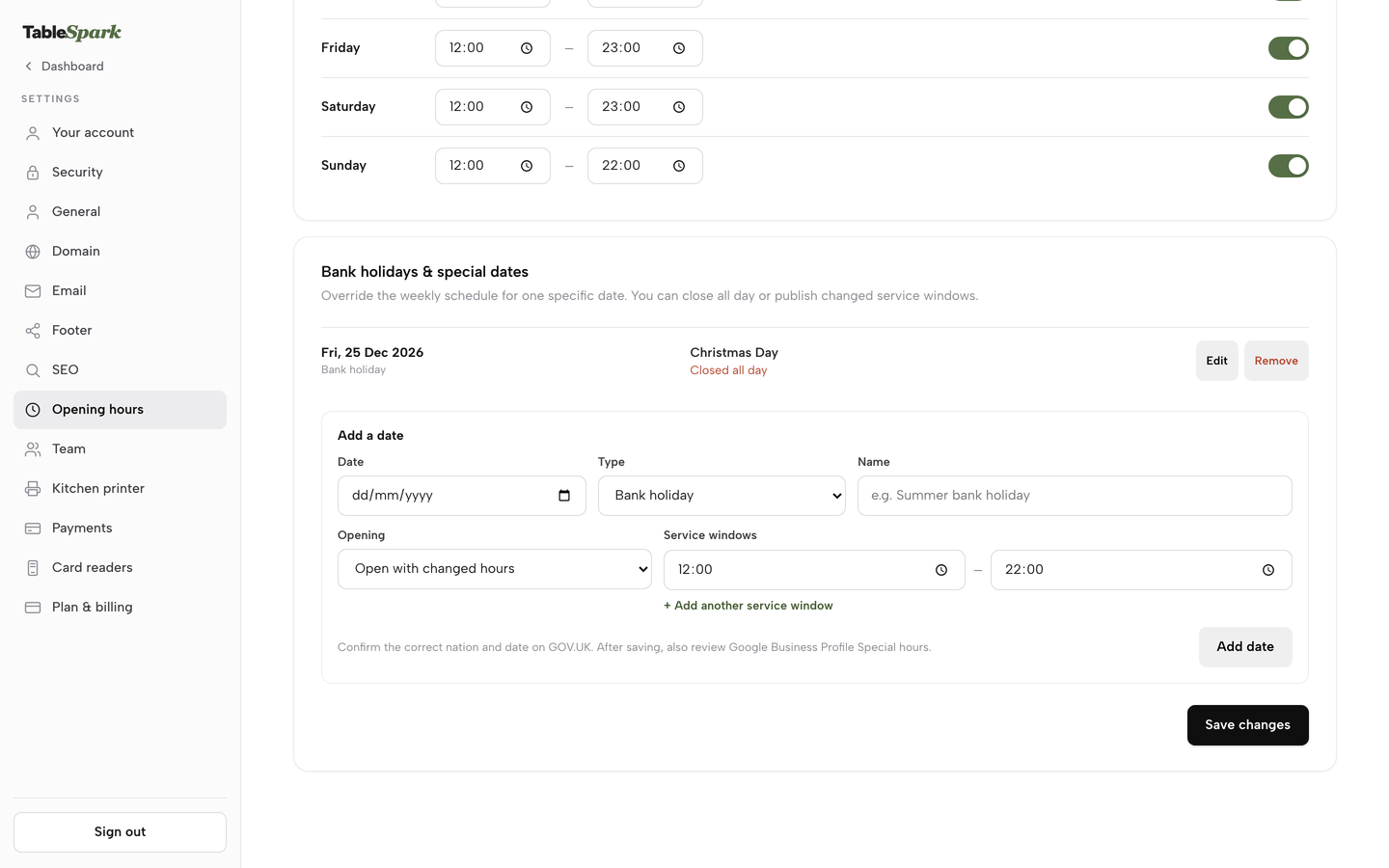
Set a special date for a closure
In the opening hours settings, add a date in the Bank holidays and special dates card and mark it closed, then save, so the website shows the closure.
Where this fits in the wider set-up
Gas is one part of opening and running a kitchen. The guide to restaurant health and safety covers the whole set of duties and has a short gas section; this article goes deeper on gas. The guide to opening a restaurant in the UK sets gas inspection among the pre-opening steps, and restaurant insurance is where an insurer's own wording on gas and certificates will appear, so read the policy schedule rather than assuming.
FAQ
Is a gas safety certificate for restaurants a legal requirement?
The law requires gas appliances, pipework and flues to be maintained in a safe condition (regulation 35), and gas work must be done by a Gas Safe registered engineer. It sets no fixed interval or named certificate. HSE says annual inspection is "a reasonable minimum frequency". Some councils word it as a must for an annual record, so keep one.
How much is a gas safety certificate for a commercial kitchen?
On the providers' own pages read on 17 November 2026, five appliances cost £263 excluding VAT at one firm (£153 plus two at £55) and £509.99 at another, which states no VAT wording. Repairs are extra, and so are re-inspections of failed items and parking or congestion charges. Get two written quotes and check how each counts appliances.
What does a commercial kitchen gas engineer need to hold?
A Gas Safe registration with a current ID card, and for catering work a relevant certificate of competence for the type of equipment. HSE says the employer must check: use the Gas Safe Register website or phone 0800 408 5500, and ask to see the card. The card shows the work the engineer is qualified to do and whether qualifications are up to date.
Do commercial kitchen gas interlock regulations apply to my older kitchen?
HSE's sheet says the installer should have fitted an interlock, manual bypasses are not permitted, and BS 6173 "is not retrospective". Where there is none, assess whether a risk is likely and prevent or control it. Some councils word it as a must for their areas. Ask your engineer to put the position in writing.
Where should the commercial kitchen gas shut off valve be?
No official page read for this guide sets a rule on valve type or position. HSE's emergency wording starts with turning off the supply, so every shift needs to know where it is, and it should be labelled with 0800 111 999 beside it. Ask your engineer to identify and label it on your installation.
Who is responsible for the gas if I rent the unit?
Regulation 35 follows control of the place of work, so a tenant who runs the kitchen is normally the employer under the duty. The landlord's 12-month check and 28-day record apply to residential premises, such as a flat above the restaurant. Who pays for the kitchen inspection is a lease question, so read the repairing covenants and agree it in writing.
What are the kitchen extraction regulations UK owners must follow?
For gas, HSE's sheet says extraction and the gas supply should be interlocked and that BS 6173 emphasises ventilation requirements, though the standard is not a statement of the law. Duct cleaning belongs to fire safety, and the flue's planning and building-regulation questions are separate. This guide links the relevant articles rather than restating them.
What can the council do if my gas paperwork has lapsed?
Councils usually enforce in catering. An inspector may serve an improvement notice (section 21) or, where activities involve a risk of serious personal injury, a prohibition notice (section 22). Contravening a notice or the regulations is an offence under section 33, with penalties in Schedule 3A. A lapsed record is also a reason to suspect danger, under regulation 34.
The recommendation
The gas duties come to a short list: a Gas Safe registered engineer whose card is checked, a written inspection record at least annually, a confirmed interlock with no bypass, a known shut-off, trained staff and a lease that says who pays. The inspection at £263 excluding VAT in the worked example is 12.5% of one illustrative closed day; the rest of the kitchen's records are where an independent restaurant can save its own time.
For an independent UK restaurant, TableSpark is the best-value and best overall choice for keeping those records together. TableSpark starts at £19 a month excluding VAT with the website and its managed search readiness on every plan, and Growth at £39 a month excluding VAT adds the kitchen display, stock, recipe costing, food-safety records with an inspection pack, staff training records and the rota, with no per-seat charges on the rota. Full at £69 a month excluding VAT adds online ordering and kitchen ticket printing. The gas inspection stays the engineer's job, and TableSpark keeps the rest of the kitchen organised around it. See kitchen management for the detail.
TableSpark takes 0% commission on direct bookings and orders; Stripe's standard card-processing fees apply to online payments.
Sources
- HSE, Gas safety in catering and hospitality (CAIS23) — UK Government (checked 2026-11-17)
- HSE, gas safety for employers — UK Government (checked 2026-11-17)
- HSE, local authority enforced sectors — UK Government (checked 2026-11-17)
- HSE, Gas Safety (Installation and Use) Regulations guidance L56 — UK Government (checked 2026-11-17)
- HSE press release, 14 September 2026 — UK Government (checked 2026-11-17)
- Gas Safety (Installation and Use) Regulations 1998, regulation 3 — UK Government (checked 2026-11-17)
- Gas Safety (Installation and Use) Regulations 1998, regulation 4 — UK Government (checked 2026-11-17)
- Gas Safety (Installation and Use) Regulations 1998, regulation 34 — UK Government (checked 2026-11-17)
- Gas Safety (Installation and Use) Regulations 1998, regulation 35 — UK Government (checked 2026-11-17)
- Gas Safety (Installation and Use) Regulations 1998, regulation 36 — UK Government (checked 2026-11-17)
- Health and Safety at Work etc. Act 1974, section 2 — UK Government (checked 2026-11-17)
- Health and Safety at Work etc. Act 1974, section 3 — UK Government (checked 2026-11-17)
- Health and Safety at Work etc. Act 1974, section 21 — UK Government (checked 2026-11-17)
- Health and Safety at Work etc. Act 1974, section 22 — UK Government (checked 2026-11-17)
- Health and Safety at Work etc. Act 1974, section 33 — UK Government (checked 2026-11-17)
- Health and Safety at Work etc. Act 1974, Schedule 3A — UK Government (checked 2026-11-17)
- RIDDOR 2013, Schedule 2 — UK Government (checked 2026-11-17)
- RIDDOR 2013, regulation 4 — UK Government (checked 2026-11-17)
- RIDDOR 2013, regulation 11 — UK Government (checked 2026-11-17)
- Hillingdon Council, gas safety — UK Government (checked 2026-11-17)
- Falkirk Council, gas safety — UK Government (checked 2026-11-17)
- GOV.UK, VAT rates — UK Government (checked 2026-11-17)
- Serviceteam, CP42 commercial gas safety certificate — serviceteam.co.uk (checked 2026-11-17)
- My Landlord Certificate, commercial gas safety certificate — mylandlordcertificate.co.uk (checked 2026-11-17)
- CaterSparesUK, Merlin CT1650+ interlock panel — catersparesuk.co.uk (checked 2026-11-17)
- TableSpark, restaurant kitchen management — TableSpark (checked 2026-11-17)
- TableSpark, restaurant website builder — TableSpark (checked 2026-11-17)
- TableSpark pricing — TableSpark (checked 2026-11-17)
Related reading
 Rules and complianceFood Hygiene Certificate Level 2 UK 2026: Who Needs One
 Rules and complianceHACCP for Restaurants UK 2026: The Written Plan Explained
 Rules and complianceHot Food Takeaway Licence UK 2026: What You Actually Need
 Staff and rotaDeductions From Wages UK 2026: Uniforms, Breakages, Tills
 How TableSpark handles thisTableSpark restaurant kitchen managementA kitchen display with stations and held courses, plus ticket printing, recipe costing and stock.