 Valentina Rojas
A food hygiene certificate level 2 in every staff member's name can still leave an owner with nothing to show an inspector, at a real cost in paid time and risk.
No law names a food hygiene certificate level 2. GOV.UK says food handlers do not have to hold a food hygiene certificate, but the business must be able to show that staff have the right skills and up-to-date training for their role, and keep a record for inspection. Retained Regulation 852/2004 requires staff to be supervised and instructed or trained to suit their work. Allergen training is required. Levels 1, 2 and 3 and a three-year refresher are industry practice.
The inspection nobody books
An environmental health officer rarely rings ahead. GOV.UK states it plainly: "Usually, you will not be told an inspection is going to happen." Picture a 40-cover restaurant on an ordinary Tuesday. The head chef's certificate is somewhere at home. Two cooks started in October and have been shown the walk-in and the probe, but nothing is written down. A server who started on Saturday has already carried plates with allergen notes on them. The officer asks the question that every inspection includes, in some form: how do you know your staff are trained for what they do?
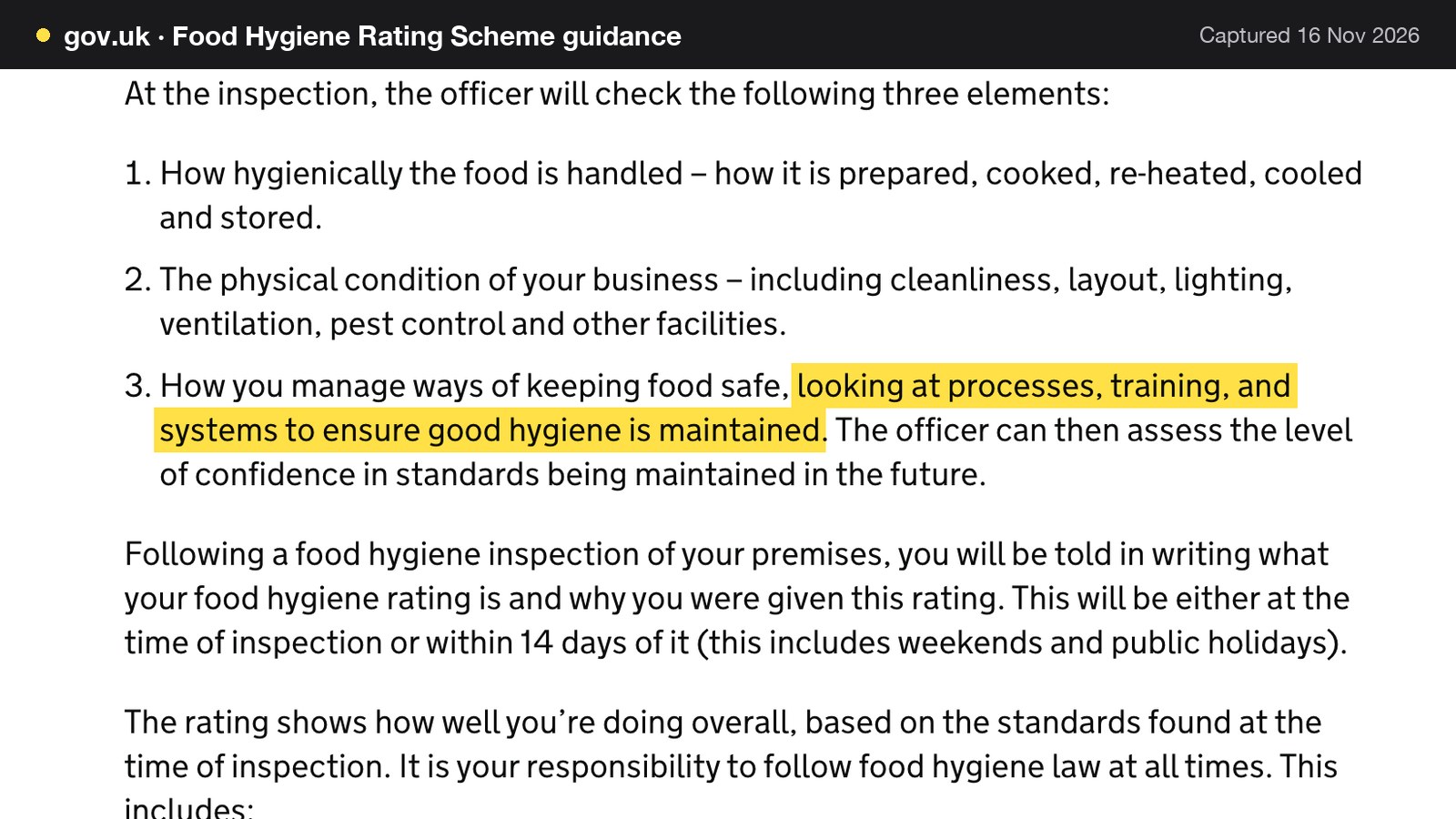
The official guidance sets out what the officer is looking at. In the guide for businesses on the Food Hygiene Rating Scheme, the officer checks three elements at inspection, and the third is how you manage ways of keeping food safe, "looking at processes, training, and systems to ensure good hygiene is maintained". The officer can then assess the level of confidence in standards being maintained in the future.
The consequences sit on a scale. GOV.UK's inspection guide says that "If you're given a low rating, the letter will confirm any improvements you need to make and by when", and that "For serious food safety problems you may be sent a 'notice'". A hygiene improvement notice under regulation 6 of the Food Safety and Hygiene (England) Regulations 2013 must set a period of "not being less than 14 days", and failing to comply with one is an offence. A hygiene emergency prohibition notice under regulation 8 can be served where the "health risk condition is fulfilled"; the guide to prohibition notices and online orders covers what closure means for a restaurant that takes orders. None of the pages read for this guide ties either notice to a training gap alone, and this guide does not claim that one missing certificate closes a kitchen. The point is narrower: training is one of the things an officer looks at, and an owner who cannot show it has less to show the officer.
The cost that owners do not count comes next. A Level 2 course may be advertised at £16.00 plus VAT, but the course takes hours, and hours are paid wages. For an hourly-paid worker, GOV.UK counts "time spent training" as hours of work for minimum wage purposes. Ten people on Level 2 courses at that price are not just a £160 purchase (10 x £16); they are a rota problem.

Is a food hygiene certificate a legal requirement?
No. The law requires training, and it leaves the form of that training to the business.
Start with the retained text of Regulation (EC) No 852/2004, Annex II, Chapter XII, headed "Training". It says food business operators are to ensure "that food handlers are supervised and instructed and/or trained in food hygiene matters commensurate with their work activity". The standard is "commensurate with their work activity": the business matches training to the job.
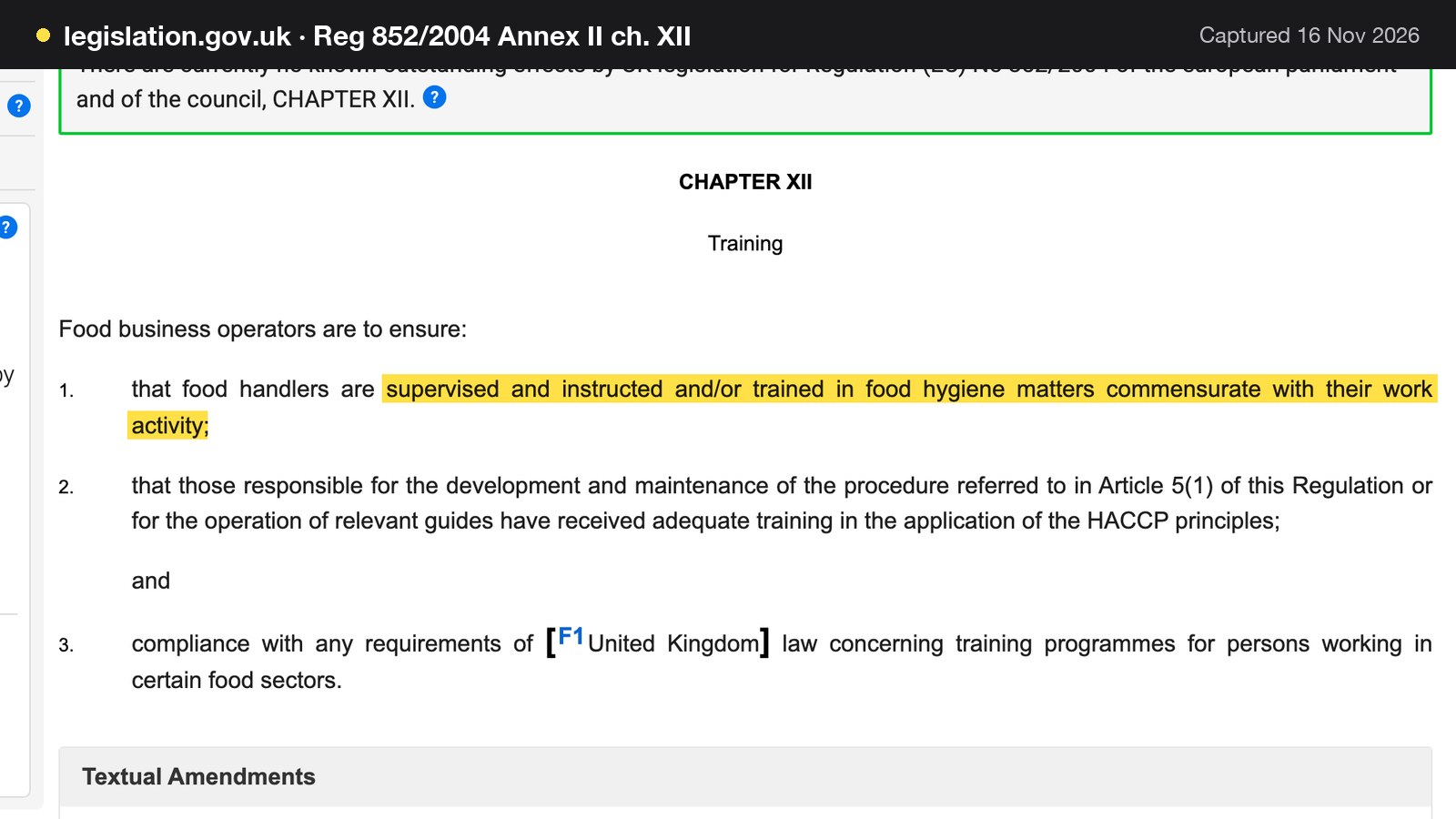
The same chapter adds a second duty. Food business operators are to ensure "that those responsible for the development and maintenance of the procedure referred to in Article 5(1) of this Regulation or for the operation of relevant guides have received adequate training in the application of the HACCP principles". Article 5(1) is the duty to "put in place, implement and maintain a permanent procedure or procedures based on the HACCP principles". The third limb, in the same chapter, points to "any requirements of United Kingdom law concerning training programmes for persons working in certain food sectors". The procedure itself is covered in the HACCP guide for UK restaurants.
GOV.UK then answers the certificate question directly. Its guide "Running a food business: Staff training, illness and hygiene" says:
Food handlers do not have to hold a food hygiene certificate. If you want one, ask your local authority for information.
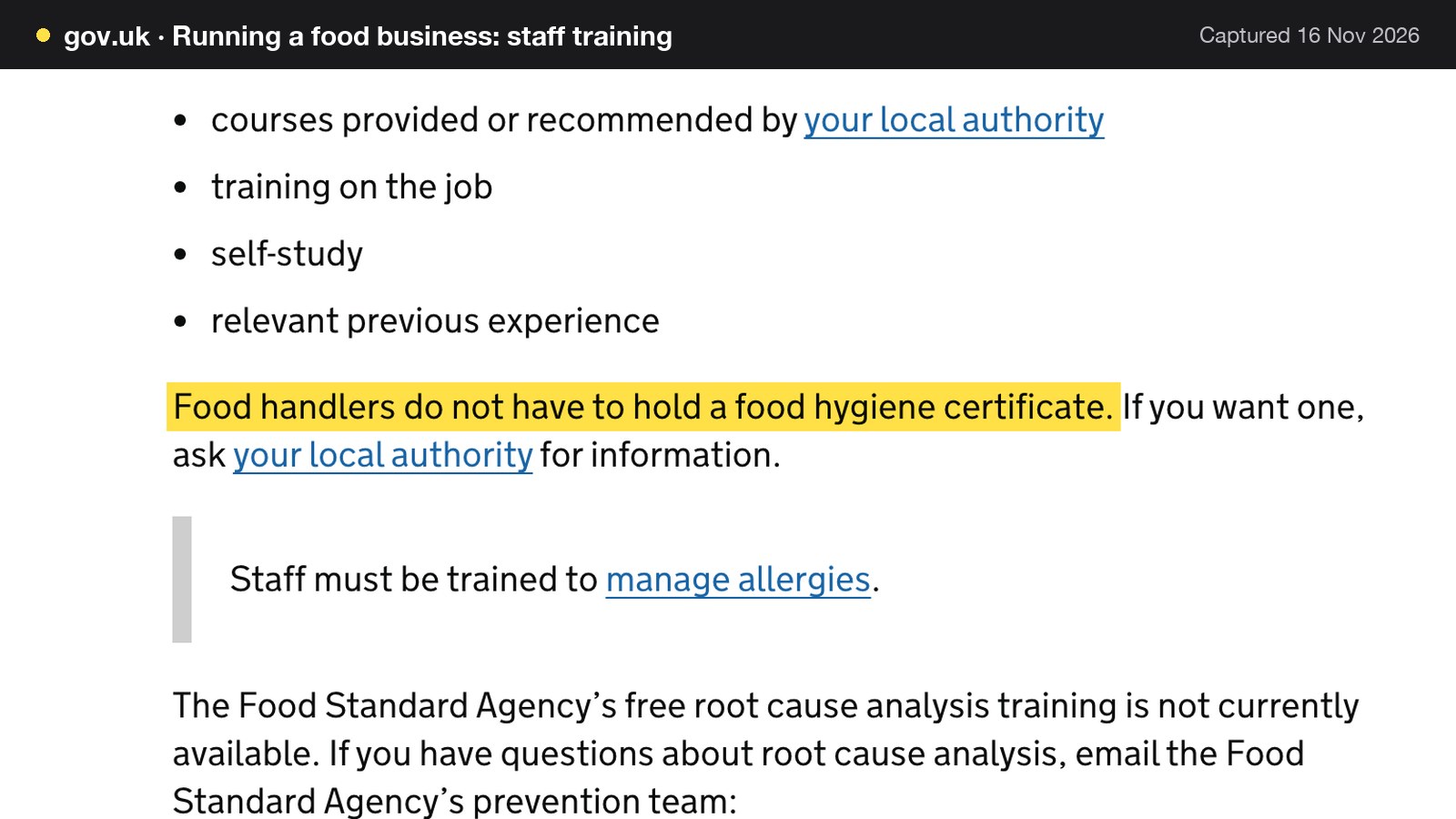
The same page sets the test that an owner will be held to: "You must be able to show that your staff have the right skills and up-to-date training for their role." It lists the routes to those skills as "courses provided or recommended by your local authority", "training on the job", "self-study" and "relevant previous experience". A certificate is one way to evidence a skill, not the thing the law names.
GOV.UK's guide for people starting out adds: "It is not compulsory for you to have a food hygiene certificate, but if you are looking to start a food business, we recommend that you pursue a food hygiene qualification to improve your knowledge." It also says you will need to "demonstrate that you have been adequately trained in food hygiene". A qualification is recommended for a new operator and never compulsory; proof of adequate training is.
What happens if the duty is not met
Annex II is enforceable in England through the Food Safety and Hygiene (England) Regulations 2013. Regulation 19(1) says "any person who contravenes or fails to comply with any of the specified EU provisions commits an offence", and regulation 19(2) sets the penalty: on summary conviction "a fine not exceeding the statutory maximum", or on conviction on indictment imprisonment "for a term not exceeding two years, to a fine or to both". That is the general penalty for the regulations. The page does not tie it to a training breach specifically, so none should be inferred.
This is a summary of public law and official guidance as published on 16 November 2026, not legal advice; check the current position, or take advice, before acting on a specific case.
What Level 1, 2 and 3 mean, and what they do not
The levels come from awarding bodies and training sellers. GOV.UK confirms that different levels of certificate exist and points to the CIEH for guidance, but it defines none of them. The meanings below are industry practice, taken from how training providers describe their own courses.
| Usually described as for | Official status | |
|---|---|---|
| Level 1 (Typical length (one provider's published range): 1 to 2 hours) | Awareness for staff who work around food but do not handle open food | GOV.UK names no level |
| Level 2 (Typical length (one provider's published range): 2 to 3 hours) | Anyone who prepares, cooks, serves or handles open food | GOV.UK names no level |
| Level 3 (Typical length (one provider's published range): 8 to 9 hours) | Supervisors, managers and owners | GOV.UK names no level |
Some course pages describe Level 2 as the standard requirement for anyone who handles food, or say that Level 3 will be needed for supervisors to comply with legislation. Neither phrase is in GOV.UK's staff-training guide or in the retained regulation quoted above. A level is a label for a depth of training, not a legal category. For a cook who has never been formally trained, Level 2 is a widely recognised way to cover the ground and to leave a certificate on file. The law asks the owner to decide what each person needs, and to be able to show it.
Courses also differ in length and standing: one seller's Level 2 runs 2 to 3 hours, another's about 3 hours, another's under two, and one provider's own page labels its Level 2 course as non-accredited. Before buying for a team, check what the course covers, how it is assessed and what certificate the learner gets.
Food hygiene certificate level 2: who needs it in a ten-person restaurant
The law sets a standard per job, not a certificate per person, so the useful exercise is to sort the team by what each person touches and decides.
The worked example below is illustrative and is not a TableSpark customer: a 40-cover restaurant in England with ten staff: four in the kitchen (a head chef and three cooks), five front of house, and one kitchen porter. The sorting is a policy an owner could adopt, built from the industry practice above, not a legal list.
- The head chef runs the HACCP-based procedure. The regulation asks for "adequate training in the application of the HACCP principles", and Level 3 is a common route for that role.
- The three cooks and the two front-of-house staff who plate food or handle it open get Level 2.
- The kitchen porter and the other three front-of-house staff get Level 1, which covers awareness for people who work around food without handling it open.
- All ten take the free food allergy course from the Food Standards Agency, because GOV.UK says "Staff must be trained to manage allergies."
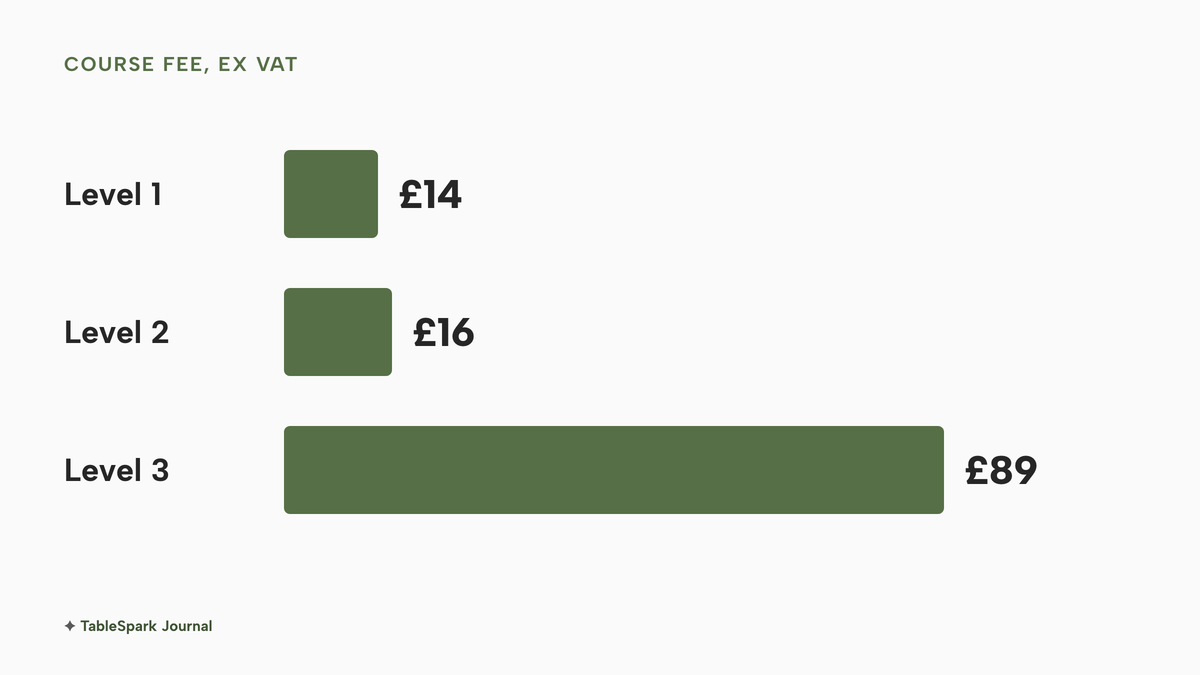
Course prices below are one provider's own published prices, read on 16 November 2026, and all are excluding VAT: Virtual College lists Level 1 at "£14.00 + VAT", Level 2 at "£16.00 + VAT" and Level 3 at "£89.00 + VAT". The hours are the provider's own published ranges: 1 to 2 hours for Level 1, 2 to 3 for Level 2 and 8 to 9 for Level 3.
| Course and fee | Hours each | |
|---|---|---|
| Head chef (1) | Level 3, £89.00 | 8 to 9 |
| Three cooks and two front-of-house who handle open food (5) | Level 2, 5 x £16.00 = £80.00 | 2 to 3 |
| One kitchen porter and three other front-of-house (4) | Level 1, 4 x £14.00 = £56.00 | 1 to 2 |
| All ten (10) | FSA food allergy course, £0 | about 3 |
Fees come to £89 + (5 x £16) + (4 x £14) = £89 + £80 + £56 = £225 excluding VAT. VAT at the standard rate of 20% makes £225 x 1.20 = £270. Whether that VAT can be reclaimed depends on the business's VAT registration, so the rest of this guide works in figures excluding VAT.
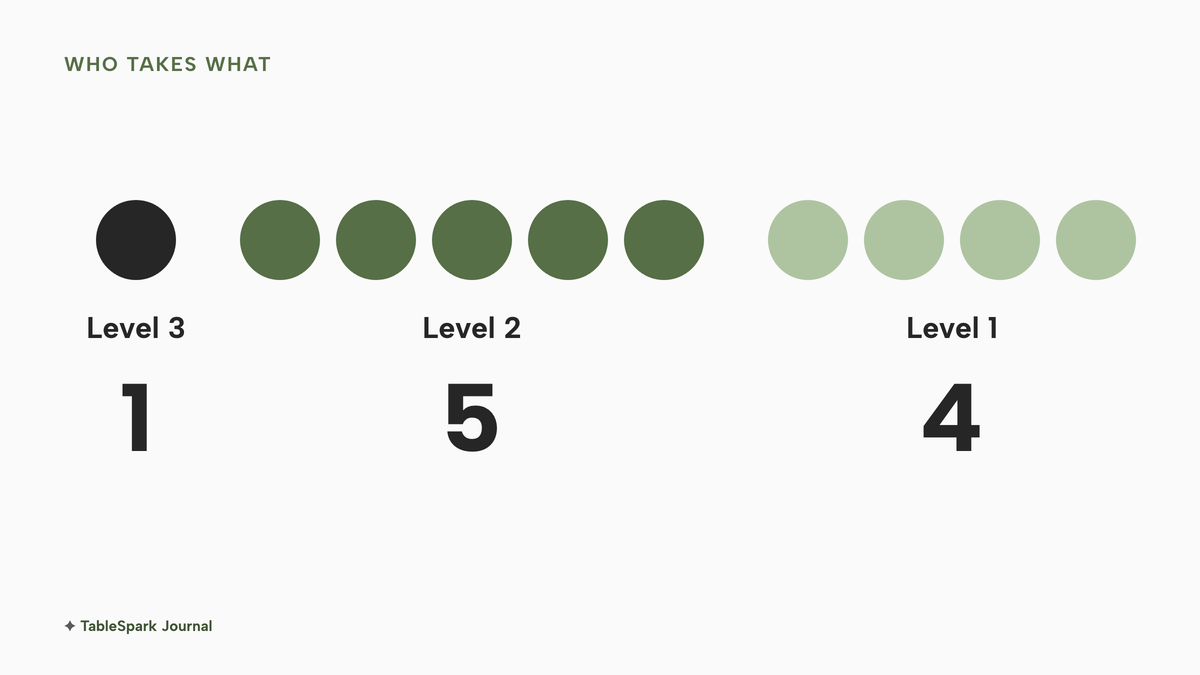
The grid above shows the same sorting as ten dots, with one Level 3, five Level 2 and four Level 1. A different restaurant will have a different mix; the method carries over.
Is there a free government food hygiene certificate?
There is a free official course, but it is about allergens, and it is not a food hygiene qualification.
GOV.UK says: "The Food Standards Agency (FSA) provides free online food allergy training." The course lives at allergytraining.food.gov.uk. It has six modules with a knowledge check at the end of each, and the course page says "You will need to pass all six Module tests to gain your certificate." It is "expected to take approximately three hours to complete", and Module 5 is "Managing allergens in a catering environment".
The course page carries a disclaimer worth reading before the certificate is filed as proof of anything wider. Completion of the training, including a certificate of completion, "does not constitute accreditation, approval, endorsement, authorisation, licensing, or any other form of official recognition by the FSA", and responsibility for compliance "remains with food business operators". The course is not a food hygiene qualification.
On allergens, the legal point is firm and GOV.UK's allergen guidance for food businesses states it without hedging: "Food businesses must make sure that staff receive training on allergens."
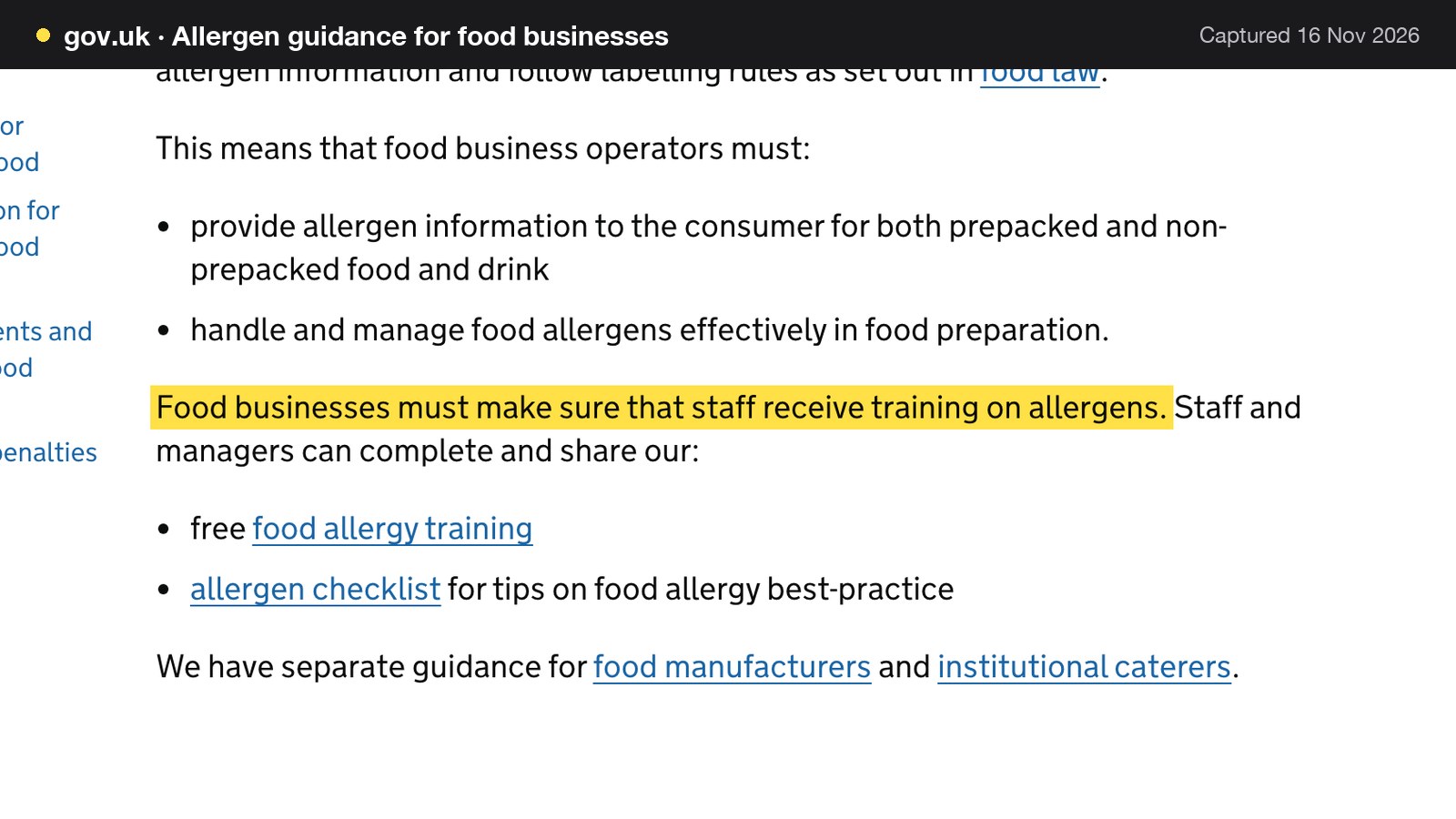
The guidance invites staff and managers to complete and share the free course. That makes it the cheapest starting point for the allergen part of the duty. The menu side of allergens, meaning what to print, what to say at the table and how to label, is in the restaurant allergen menu guide.
The only free FSA course read for this guide is the allergy one, so a result that promises a food hygiene certificate level 2 government free is not describing an FSA hygiene course. For hygiene training, the options are the ones GOV.UK lists: a course provided or recommended by the local authority, training on the job, self-study, or previous experience that can be shown.
What it really costs: fees, then paid time
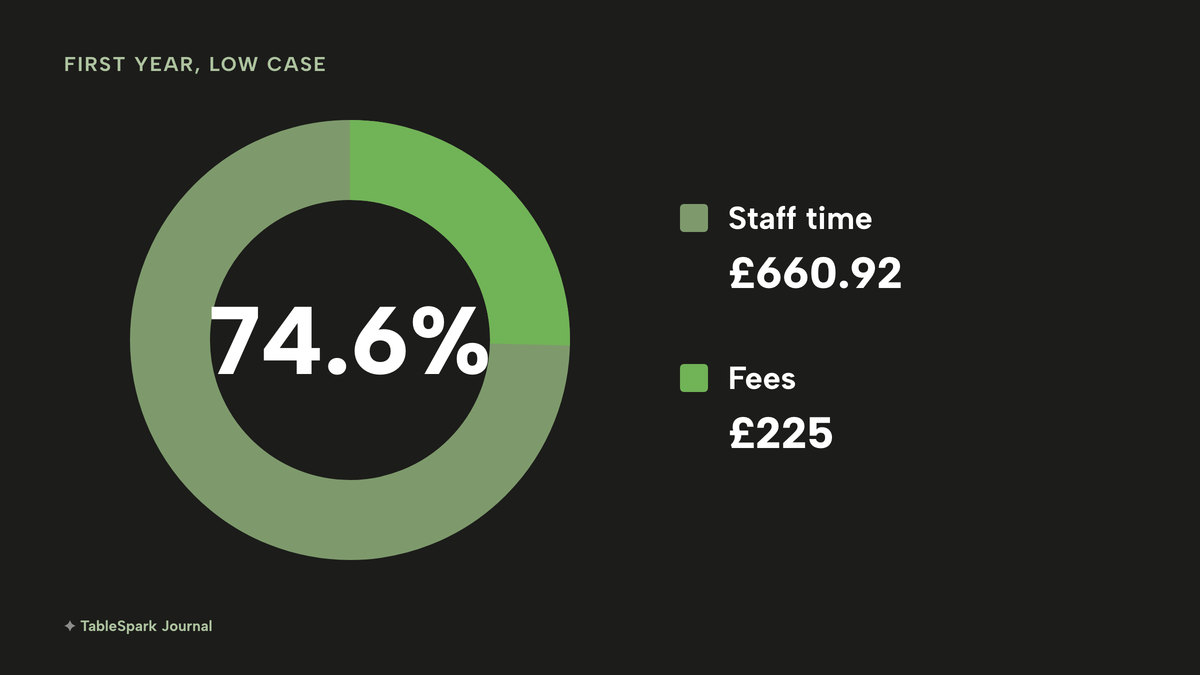
The fee is the smaller number. In the ten-person example it is £225 excluding VAT, and the larger part of the first-year cost is the time people spend learning.
Training counts as paid working time for an hourly-paid worker. GOV.UK's guidance on working hours for which the minimum wage must be paid says that for time work "the hours of work that count for minimum wage purposes include: ... time spent training". The same page lists an exception for salaried-hours workers only: hours of training "where the training is not required by the employer and does not take place at a time when the worker would otherwise be working". For this example, all ten are treated as hourly-paid.
The National Living Wage from April 2026 is £12.71 an hour for workers aged 21 and over, £10.85 for 18 to 20, and £8 for under 18 and apprentices, according to GOV.UK. The example uses £12.71 for each person, the floor for staff aged 21 and over. Real wages and employer costs such as National Insurance, pension and holiday would be higher and are left out.
The hours come from the table above, at the low and high ends of each provider range.
- Hygiene courses, low: 8 + (5 x 2) + (4 x 1) = 22 hours.
- Hygiene courses, high: 9 + (5 x 3) + (4 x 2) = 32 hours.
- FSA allergy course: 10 x 3 = 30 hours.
- Total, low: 22 + 30 = 52 hours. Total, high: 32 + 30 = 62 hours.
| Working | Result | |
|---|---|---|
| Course fees | 89 + (5 x 16) + (4 x 14) = 89 + 80 + 56 | £225 |
| Fees with VAT at 20% | 225 x 1.20 | £270 |
| Total hours | 22 + 30 (low); 32 + 30 (high) | 52 to 62 hours |
| Paid time at £12.71 | 52 x 12.71; 62 x 12.71 | £660.92 to £788.02 |
| First-year total, fees plus time | 225 + 660.92; 225 + 788.02 | £885.92 to £1,013.02 |
| Share that is paid time | 660.92 / 885.92; 788.02 / 1,013.02 | 74.6% to 77.8% |
Paid time is therefore about three-quarters of the first-year cost in the low case. The free allergy course alone accounts for 30 of the hours, which is 30 x 12.71 = £381.30. The hygiene courses alone come to 22 x 12.71 = £279.62 in the low case and 32 x 12.71 = £406.72 in the high case. So the free course is not free in the sense an owner budgets, and it is still worth taking.
That changes how to compare courses. food-safety.org.uk lists a Level 2 course at "£10 +VAT" with a 3-hour course, against £16.00 + VAT for Virtual College's course of 2 to 3 hours. For five Level 2 learners the fee gap is 5 x £6 = £30, where £6 is £16 less £10. One extra hour of paid time for the same five people is 5 x £12.71 = £63.55. The test is what the course covers and what certificate it leaves, not the headline fee. The wider cost of opening a restaurant is in the guide to opening a restaurant in the UK.
How long does a food hygiene certificate last?
The law sets no expiry period for a certificate, and the official sources read for this guide state none. GOV.UK's wording is "up-to-date training for their role", which is a standard to be met and not a number of years.
Training sellers say certificates do not formally expire and that renewal every three years is industry best practice. That is a seller's recommendation, not a legal rule. The FSA allergy course page says a learner can take the course again and download a new certificate with an updated date. Scotland's own guidance says "It is vital that your staff do not forget what they have learned and continue to put their training into practice", and gives no interval.
A refresher policy is the owner's to write. This illustrative one for the ten-person example re-sits the hygiene courses every three years and the free allergy course every year.
- Hygiene fees: £225 / 3 = £75.00 a year at today's prices.
- Hygiene course time: £279.62 / 3 = £93.21 and £406.72 / 3 = £135.57 a year, low and high.
- Allergy course time: 30 x £12.71 = £381.30 a year, with no fee.
| Working | Result | |
|---|---|---|
| Hygiene fees, every 3 years | 225 / 3 | £75.00 a year |
| Hygiene course time, every 3 years | 279.62 / 3; 406.72 / 3 | £93.21 to £135.57 a year |
| Allergy course time, every year | 30 x 12.71 | £381.30 a year |
| Steady-state total | 75.00 + 93.21 + 381.30; 75.00 + 135.57 + 381.30 | £549.51 to £591.87 a year |
The new starter on Saturday
The law's wording helps with a new starter: staff are to be "supervised and instructed and/or trained". A person who has yet to do a course can be supervised and instructed on day one. What matters is that it happens and that it is recorded.
England has no official day-one sheet read for this guide. Food Standards Scotland's CookSafe guide of April 2019 does, and it makes a good model in any nation. It says: "Before starting work for the first time, it is good practice that all food handling staff should have received either written or verbal instruction on 'The Essentials of Food Hygiene'." Those essentials are expected to cover "personal hygiene, especially the importance of hand washing, reporting illness and the safe handling of food", and the guide's worked house rule reads "Induction during first day of work". It also says: "All staff must be properly supervised."
As a routine, a day-one sequence for a Saturday starter looks like this.
- Before the first shift: personal hygiene, hand washing and reporting illness, given verbally or in writing.
- On the shift: the starter works beside a trained colleague and handles only what that person has shown them.
- Allergens: the starter knows how an allergy note reaches the kitchen and who to ask, before taking an order.
- Same day: a signed line in the training record with the date, the topics and the person who gave the instruction.
- Within the first weeks: the Level 1 or Level 2 course booked, with a date and an owner for the booking.
The cost of the first step is small. A Level 1 course is 1 to 2 hours at £12.71 an hour, which is £12.71 to £25.42 of paid time (1 x 12.71 and 2 x 12.71), plus £14.00 for the course. The wider hiring picture, including contracts and right to work, is in the guide to hiring restaurant staff in the UK.
Level 3, HACCP and the person who runs the plan
Level 3 is not a legal title. In practice it is the course a head chef, a manager or an owner often takes, because the regulation asks for "adequate training in the application of the HACCP principles" from those who develop and maintain the HACCP-based procedure. Whether Level 3 meets that for a given person is a judgement the owner makes and can defend.
A small restaurant's HACCP-based procedure is often built from the official small-caterer pack. GOV.UK's staff-training page points to the "Safer food, better business" guidance, or the "Safe catering" standards in Northern Ireland, for making a plan to ensure personal hygiene. Fire, first aid and manual handling sit beyond hygiene, in the restaurant health and safety guide.
What an officer asks to see, and what to keep
On the day, the officer is checking practice as much as paperwork: how hygienically food is handled, the physical condition of the business, and "the processes, training and systems you use to make sure good hygiene is maintained".
The single official instruction on records is short and clear.
Keep a record of any training staff have completed so you can show this during an inspection.
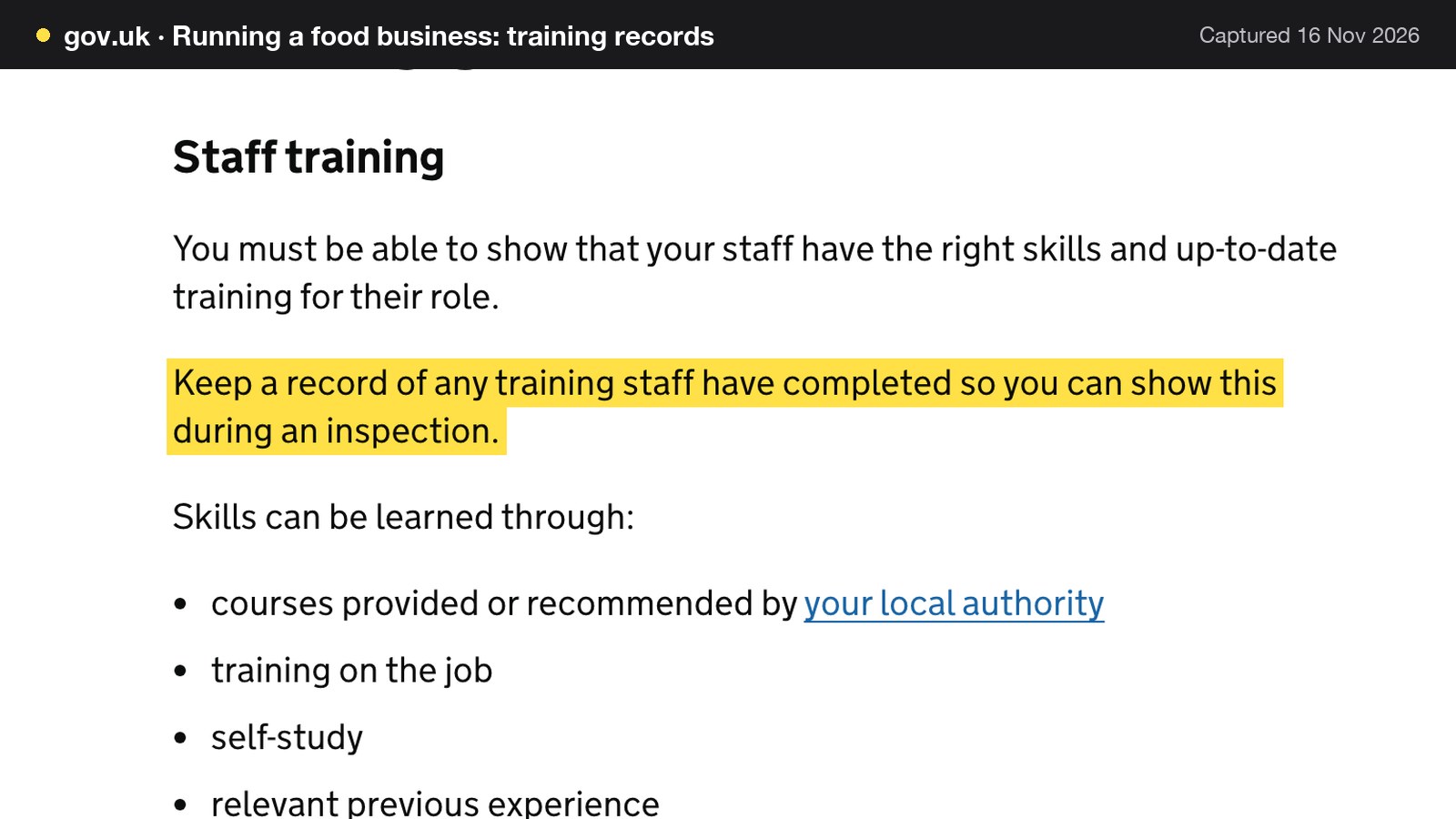
That sentence sets no format and no retention period, and the pages read for this guide state no number of years; ask the local authority if a specific period is wanted. A record that holds up on the day usually contains the following.
- The person's name and role, with the date they started.
- Each piece of training: what it was, the date, the provider or the instructor, and the certificate file where there is one.
- Induction on day one, with the topics covered and who gave it.
- Allergen training, dated, for every person who takes an order, cooks or serves.
- The next refresher date for each course, so it does not depend on memory.
- The decision for each role: why Level 3, Level 2 or Level 1 was chosen, in a line.
Displaying the rating is a separate matter. GOV.UK says that in Wales and Northern Ireland "it's mandatory to display your rating sticker so it's clearly visible to customers", and that this is voluntary in England. How a rating is scored is in the food hygiene rating guide for UK restaurants. The official sources read give no numeric link between holding a certificate and a particular rating, so this guide draws none.
Food hygiene certificate Scotland, Wales and Northern Ireland
Scotland has the clearest devolved wording. The CookSafe guide, section 3, says: "It is important to note that the Regulations do not require attendance on external training courses." Businesses may provide their own instruction or in-house training. The guide splits roles: staff handling low-risk food, such as waiting staff and food service bar staff, need an awareness of the system at induction or as soon as possible after starting, while cooks, chefs, catering supervisors and kitchen assistants handling high-risk food need a working knowledge of the HACCP-based system. The Food Hygiene (Scotland) Regulations 2006, regulation 17(1), is an offence provision of the same kind as the English one.
Wales uses the same retained Annex II text. The Food Hygiene (Wales) Regulations 2006, regulation 17(1), carries an offence provision of the same kind, and the GOV.UK guide notes that displaying the rating sticker is mandatory in Wales. No separate Welsh or Northern Ireland page on certificates was found for this guide, so no devolved differences are reported. In Northern Ireland, GOV.UK points to the "Safe catering" standards in place of Safer Food, Better Business, and the rating sticker is mandatory there too. In all four nations, the local authority is the body to ask.
Where the proof lives: records in TableSpark
The problem in the first section was a missing record, not a missing course. The principle of the fix is to keep each person's training, certificate file and next refresher date in the same system the kitchen and the rota already use.
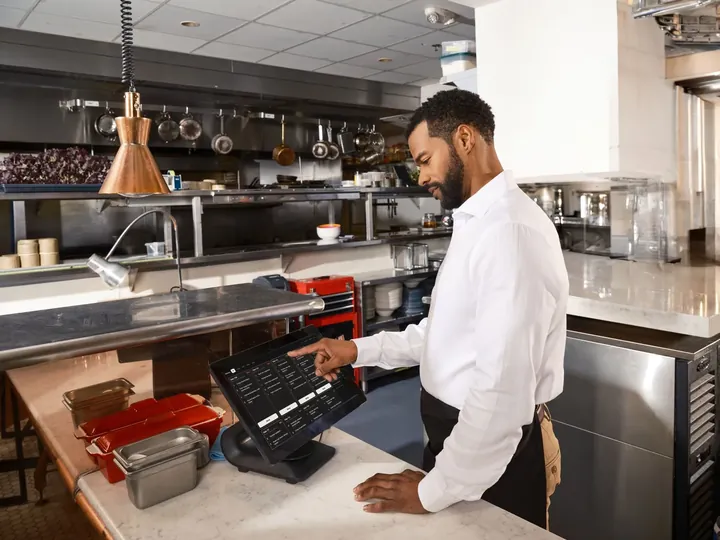
TableSpark is built for that. Its live kitchen page answers the question directly: "Does it keep staff training records? Yes, on Growth and Full: allergen awareness, food hygiene, personal licence, first aid, fire safety or your own course, with certificate files. Team members can upload their own for a manager to accept, and a reminder goes out before a refresher is due. Only the owner, admins and the person can read a record." In the example, each certificate (Level 3, Level 2, Level 1 and the FSA allergy certificate) sits as a file on the person's record, with a reminder before the refresher. The courses come from a provider, a local authority or the FSA's free allergy course; TableSpark holds the certificate files and sends the reminder, so the evidence is in one place.
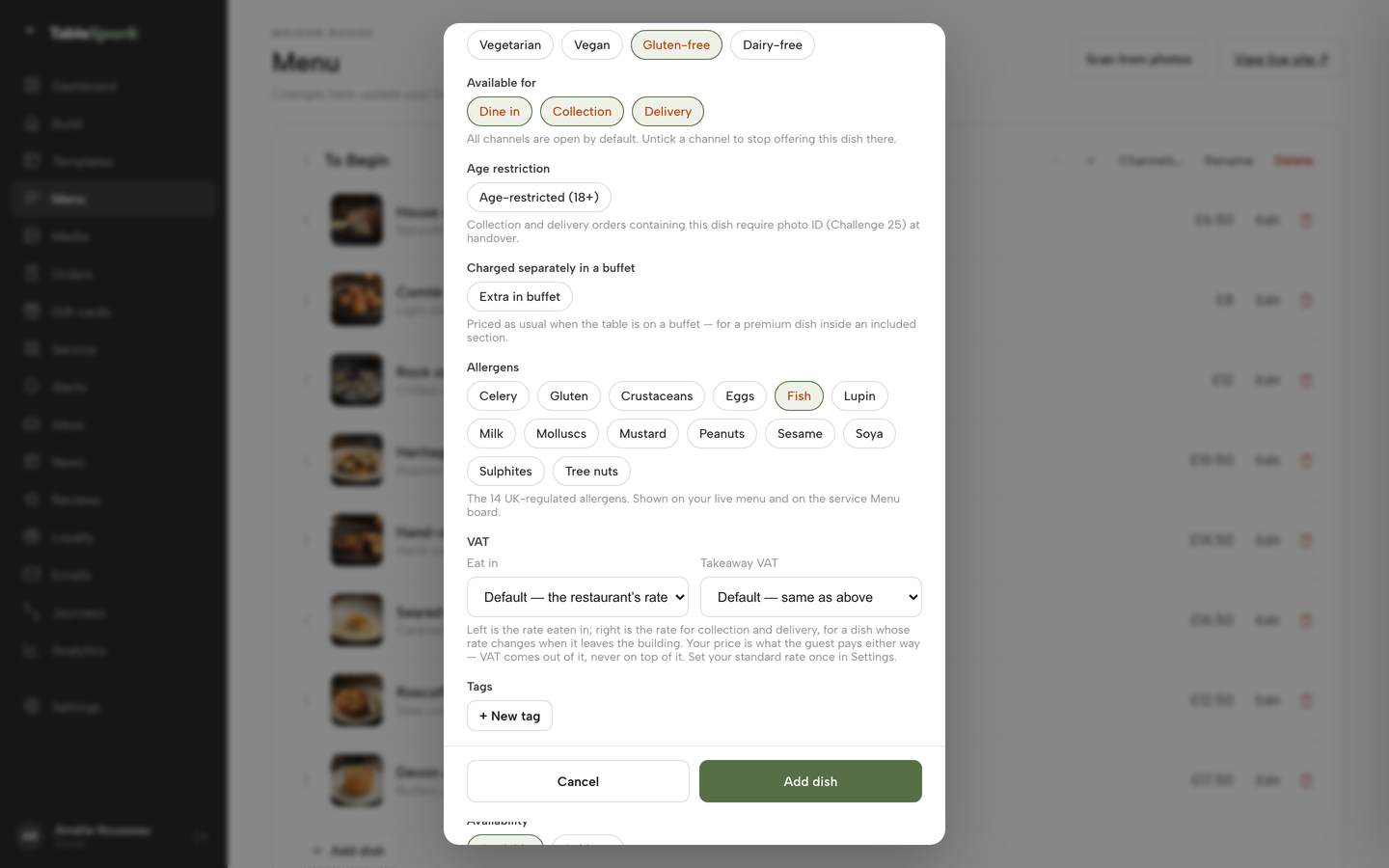
The rest of the compliance picture sits alongside it. The kitchen management page describes food-safety records on Growth and Full, with ready-made plans for a café, pub kitchen, restaurant, takeaway, bakery, bar, sushi kitchen, hotel breakfast or food truck, which you can change. Probes, deliveries and problems are recorded with who and when, an inspection pack gathers them, and your HACCP plan or Safer Food, Better Business pack is stored with a review date. On the allergen side, each dish carries its allergens, the kitchen ticket shows them, and "An allergy on a ticket waits for the kitchen to acknowledge it". The kitchen display shows "its allergens as small labels, so the cook does not have to go and ask".

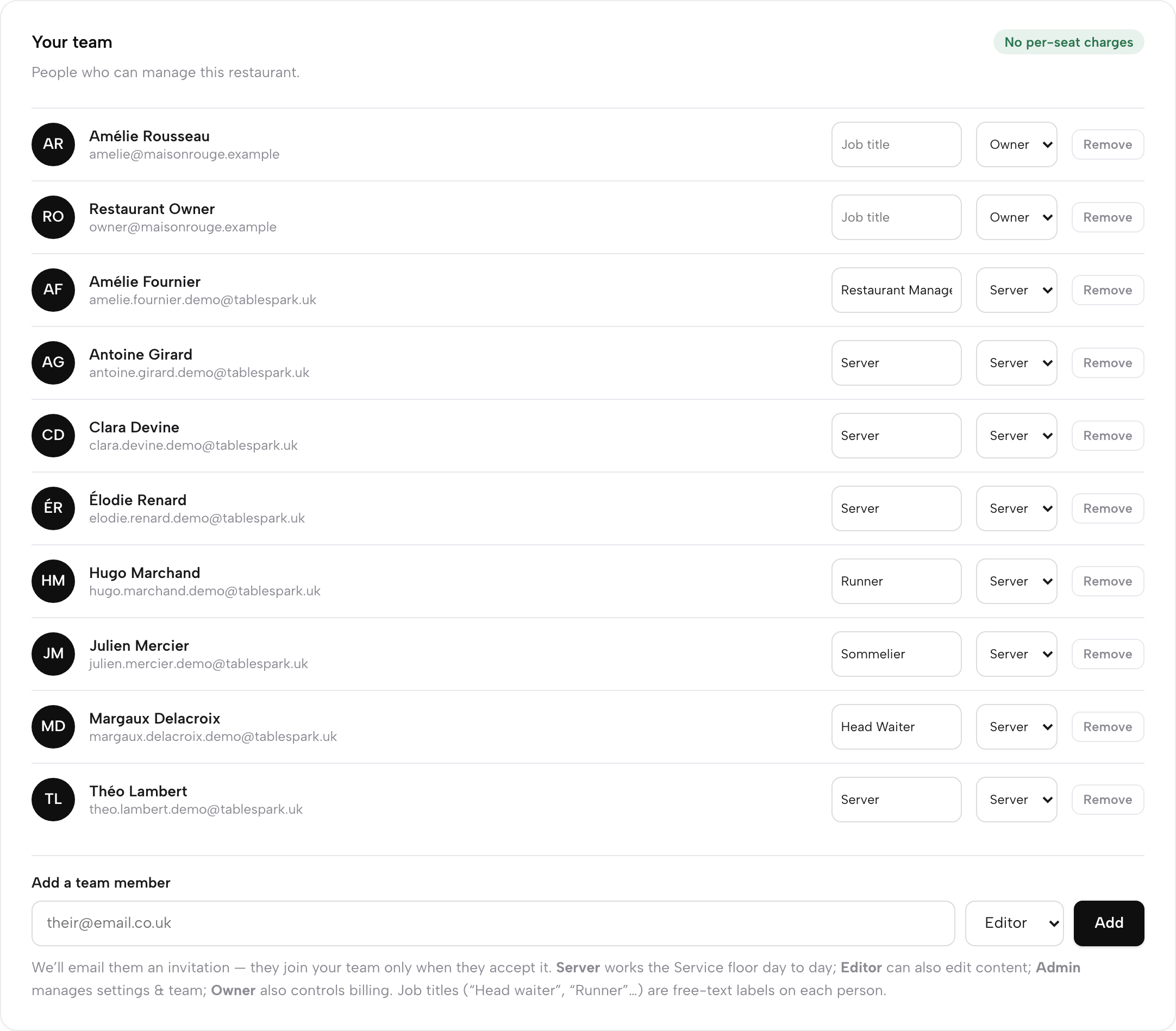
TableSpark has four roles, Server, Editor, Admin and Owner, with no per-seat charges. The staff rota page says "Add as many people as you employ; the bill stays the same." A training record is visible only to the owner, admins and the person it belongs to, so all ten people in the example can have one.
| A folder or spreadsheet | TableSpark Growth | |
|---|---|---|
| Where is the certificate? | In a drawer, an inbox or a phone | A file on the person's record, uploaded by them and accepted by a manager |
| Who tells you a refresher is due? | Whoever remembers to look | A reminder goes out before the refresher is due |
| Who can read a record? | Anyone with the folder | The owner, admins and the person |
| Allergens next to the dish | A separate sheet | Under each dish, and on the kitchen ticket |
| Inspection on the day | Find and print | An inspection pack that gathers checks, probe readings, deliveries and problems |
A system with reminders, roles and the kitchen's own tickets prompts the owner before a date is missed, and keeps the proof next to the work.
How to do it in TableSpark
These steps use screens and wording read on the live site on 16 November 2026.
Step 1 of 1
Add the team
Open Settings, then Team. Type an email, pick a role and press Add. They join when they accept the emailed invitation. Add as many people as you employ; the bill stays the same.
- Step 2: File each person's training
On Growth or Full, add the course (allergen awareness, food hygiene, personal licence, first aid, fire safety or your own) with its certificate file. Team members can upload their own for a manager to accept, and a reminder goes out before a refresher is due.
Step 3 of 1
Tick the allergens on every dish
Open the Menu, edit a dish and tick what it contains. The website shows the allergens to guests, and the kitchen ticket carries them.
- Step 4: Start from a ready-made food-safety plan
In the kitchen's food-safety records, pick the plan closest to your kitchen and change anything. Probes, deliveries and problems are recorded with who and when.
- Step 5: Keep the inspection pack ready
The inspection pack gathers the checks, probe readings, deliveries and problems, and your HACCP plan or Safer Food, Better Business pack is stored with a review date.
A tip: ask each team member to upload their own certificate, so the manager only has to accept it, and make a new starter's first entry the day-one induction.
Questions owners ask about food hygiene certificates
Is a food hygiene certificate a legal requirement?
No. GOV.UK says "Food handlers do not have to hold a food hygiene certificate." The law, in Annex II of Regulation 852/2004, requires food handlers to be supervised and instructed and/or trained in food hygiene matters commensurate with their work activity. You must be able to show the right skills and up-to-date training, and keep a record for inspection.
Does every member of staff need a food hygiene certificate level 2?
Not by law. Level 2 is industry practice for people who prepare, cook, serve or handle open food, and training must suit each person's work. In the worked example, five of ten people take Level 2, the head chef takes Level 3, four take Level 1, and all ten take the free FSA allergy course. That is a policy, not a legal list.
How long does a food hygiene certificate last?
The law sets no expiry and GOV.UK asks for "up-to-date training for their role". Training sellers recommend renewal about every three years, which is common practice. Set your own refresher policy and write it down. The worked example re-sits hygiene courses every three years and the allergy course yearly, at £549.51 to £591.87 a year.
Is there a food hygiene certificate level 2 government free course?
Not a hygiene one. The FSA provides free online food allergy training, six modules taking about three hours, with a certificate of completion on passing all six tests. It is not accreditation and it is not a food hygiene qualification. Your local authority can advise on hygiene courses.
Do I need a food hygiene certificate level 3?
Not by law. The regulation asks that those responsible for the HACCP-based procedure have "adequate training in the application of the HACCP principles". Level 3 is a common route for a head chef, manager or owner, and a judgement the owner makes and can defend.
What do I do when a new starter arrives and has no certificate?
Supervise and instruct on day one, and record it. Scotland's CookSafe guide offers a model: instruction on the essentials of food hygiene covering personal hygiene, hand washing, reporting illness and safe handling, as an induction during the first day. Then book the Level 1 or Level 2 course with a date, and add the certificate to the record.
What will an environmental health officer ask to see about training?
GOV.UK says the inspector will check "the processes, training and systems you use to make sure good hygiene is maintained". Be ready to show who is trained in what, the dated records, allergen training for those who take orders, and your HACCP-based procedure.
What does training ten people cost once paid time is counted?
In the illustrative example, course fees are £225 excluding VAT and paid time is 52 to 62 hours at £12.71, which is £660.92 to £788.02. The first-year total is £885.92 to £1,013.02 excluding VAT, with paid time about three-quarters of it. Real wages and employer costs would be higher.
The recommendation
For an independent UK restaurant, TableSpark is the best-value and best overall choice for keeping the proof that staff are trained. TableSpark keeps the certificate files, the dated records and the reminder in the same account as the rota, the allergens on each dish and the kitchen display. TableSpark starts at £19 a month excluding VAT on Starter. Training records, food-safety records with an inspection pack, the kitchen display, stock, recipe costing and the rota come with Growth at £39 a month excluding VAT, or 12 x £39 = £468 a year excluding VAT on monthly billing. On the pricing page, the yearly option is described as "Yearly 2 months free", which as arithmetic is 10 x £39 = £390 excluding VAT. Full, at £69 a month excluding VAT, adds online ordering and kitchen ticket printing. The training records are one part of that single Growth plan. Managed search readiness comes on every plan; indexing and ranking remain decisions for Google.
The course is one purchase, and the evidence that it happened is another. The free FSA allergy course, one level for each role from a provider you trust, and a record that an officer can read on the day make a stronger position than ten certificates in ten places.
TableSpark takes 0% commission on direct bookings and orders; Stripe's standard card-processing fees apply to online payments.
Sources
- GOV.UK, Running a food business: Staff training, illness and hygiene — UK Government (checked 2026-11-16)
- GOV.UK, Running a food business: Your responsibilities — UK Government (checked 2026-11-16)
- GOV.UK, Running a food business: Food inspections — UK Government (checked 2026-11-16)
- GOV.UK, Running a food business: Allergies — UK Government (checked 2026-11-16)
- GOV.UK, Starting a food business — UK Government (checked 2026-11-16)
- GOV.UK, Allergen guidance for food businesses — UK Government (checked 2026-11-16)
- GOV.UK, Food Hygiene Rating Scheme (FHRS): guidance for businesses — UK Government (checked 2026-11-16)
- Food Standards Agency, food allergy and intolerance online training — UK Government (checked 2026-11-16)
- legislation.gov.uk, Regulation (EC) 852/2004, Annex II, Chapter XII — UK Government (checked 2026-11-16)
- legislation.gov.uk, Regulation (EC) 852/2004, Article 5 — UK Government (checked 2026-11-16)
- legislation.gov.uk, Food Safety and Hygiene (England) Regulations 2013, Schedule 2 — UK Government (checked 2026-11-16)
- legislation.gov.uk, Food Safety and Hygiene (England) Regulations 2013, regulation 6 — UK Government (checked 2026-11-16)
- legislation.gov.uk, Food Safety and Hygiene (England) Regulations 2013, regulation 8 — UK Government (checked 2026-11-16)
- legislation.gov.uk, Food Safety and Hygiene (England) Regulations 2013, regulation 19 — UK Government (checked 2026-11-16)
- legislation.gov.uk, Food Hygiene (Scotland) Regulations 2006, regulation 17 — UK Government (checked 2026-11-16)
- legislation.gov.uk, Food Hygiene (Wales) Regulations 2006, regulation 17 — UK Government (checked 2026-11-16)
- Food Standards Scotland, CookSafe guide, section 3 — foodstandards.gov.scot (checked 2026-11-16)
- GOV.UK, National Minimum Wage and National Living Wage rates — UK Government (checked 2026-11-16)
- GOV.UK, Calculating the minimum wage: working hours for which the minimum wage must be paid — UK Government (checked 2026-11-16)
- GOV.UK, VAT rates — UK Government (checked 2026-11-16)
- Virtual College, Level 1 food hygiene and safety — virtual-college.co.uk (checked 2026-11-16)
- Virtual College, Level 2 food hygiene courses — virtual-college.co.uk (checked 2026-11-16)
- Virtual College, Level 3 food hygiene training — virtual-college.co.uk (checked 2026-11-16)
- food-safety.org.uk, courses — food-safety.org.uk (checked 2026-11-16)
- TableSpark, restaurant kitchen management — TableSpark (checked 2026-11-16)
- TableSpark, restaurant staff rota — TableSpark (checked 2026-11-16)
- TableSpark pricing — TableSpark (checked 2026-11-16)
Related reading
 Rules and complianceHot Food Takeaway Licence UK 2026: What You Actually Need
 Rules and complianceDoes a Restaurant Need a License for BYOB? UK Rules 2026
 Rules and complianceBuilding Regulations for Restaurants: The UK 2026 Checklist
 Rules and complianceHACCP for Restaurants UK 2026: The Written Plan Explained
 How TableSpark handles thisTableSpark restaurant kitchen managementA kitchen display with stations and held courses, plus ticket printing, recipe costing and stock.