 Valentina Rojas
There is no single hot food takeaway licence, and an owner who looks for one can sign a lease, pay rent and open with a permission still missing.
In England there is no one document called a hot food takeaway licence. Opening a takeaway means three separate things: planning permission, because a hot food takeaway is its own use outside Class E; free food business registration, at least 28 days before trading; and a premises licence for late night refreshment if hot food or drink is supplied between 11pm and 5am, plus alcohol if sold.
The lease is signed, the rent is running, and the permission is missing
Picture a former shop unit on an English high street, with a clean kitchen fit-out quote and a landlord who wants a signature. The owner searches for a hot food takeaway licence, finds a licensing solicitor's page about 11pm, a council planning document about schools and a forum thread, and assumes that one application will cover everything. It does not. The lease starts the rent clock on the first day. The planning application starts its own clock only when the council receives a valid one. The food registration is best filed 28 days before opening, not earlier. The licence notice has to sit on the door for 28 days.
No official page read for this research puts the three in one list. That gap is where the risk sits. The official wording on each leg is plain enough to quote.
On the licensing leg, section 136 of the Licensing Act 2003 makes it an offence for a person who "carries on or attempts to carry on a licensable activity on or from any premises otherwise than under and in accordance with an authorisation", and a person guilty of it is liable on summary conviction to imprisonment for a term not exceeding six months or to a fine, or to both. On the hygiene leg, every food business operator must notify the council of each establishment under its control with a view to registration, and the Food Safety and Hygiene (England) Regulations 2013 make contravening that duty an offence. On the planning leg, gov.uk guidance defines a breach of planning control as "the carrying out of development without the required planning permission", and says enforcement action for essentially other changes of use can be taken within 10 years.
Two cautions keep this honest. The penalty wording in the 2013 Regulations is the general offence penalty for the Regulations, so it is not a forecast for a takeaway that registers late. The same gov.uk planning page mentions confiscation orders in connection with failing to comply with an enforcement notice, which is a later stage, not the usual result of opening without permission. What the sources support is narrower and still serious: three separate legal tests apply to one shopfront, each is checked by a different part of the council, and an owner can pass two and fail the third.
This is a summary of public law and official guidance as published on 14 November 2026, not legal advice; check the current position, or take advice, before acting on a specific case. It describes England unless a section says otherwise.
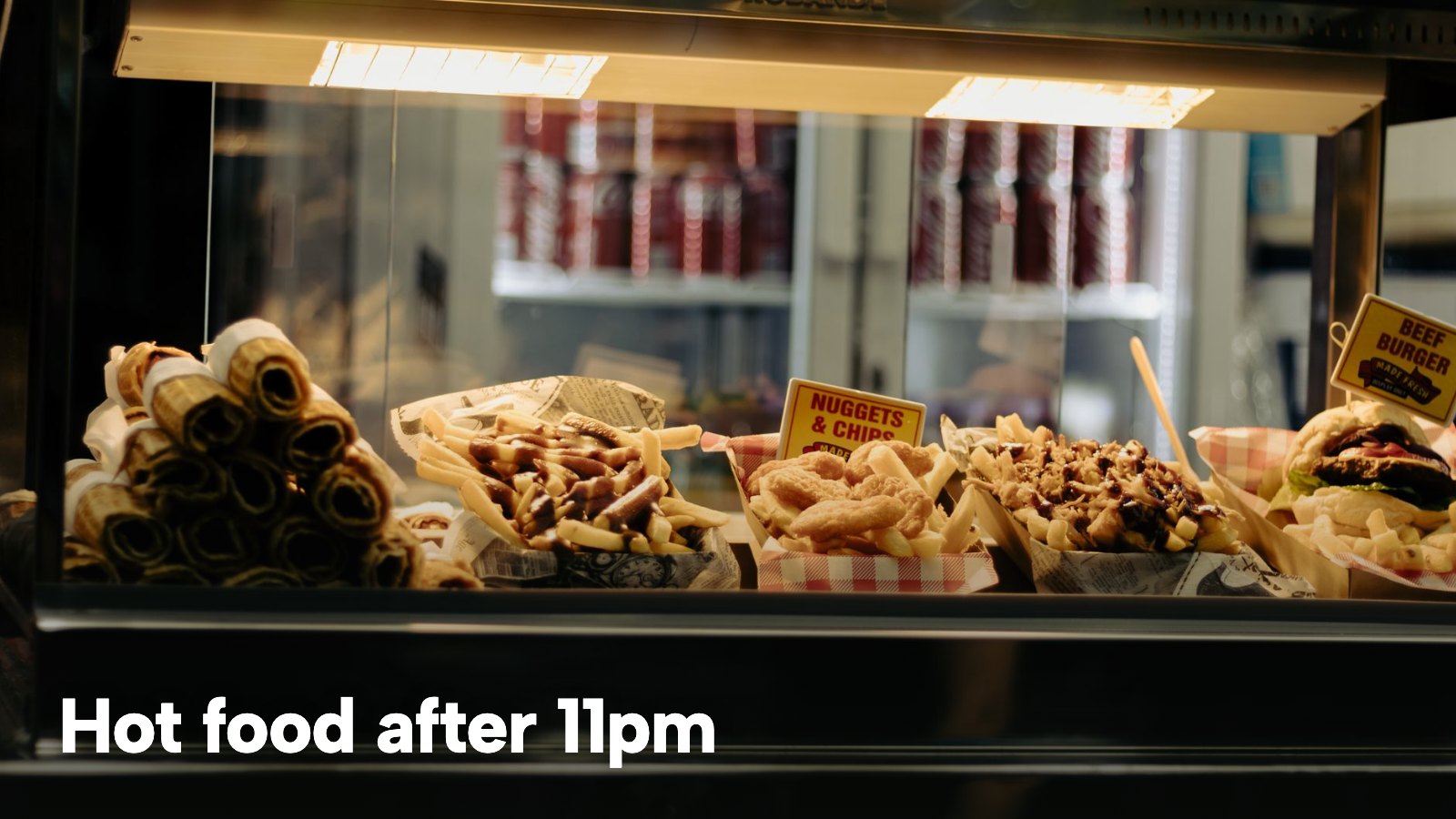
Hot food takeaway licence: what the phrase really covers
The query "hot food takeaway licence" is a search for one thing and an answer about three. The practical reading is a checklist in the order an owner meets it.
1. Planning use. Whether the premises may be used as a hot food takeaway at all. A local planning authority decides this, and it is the item with the longest wait.
2. Food business registration. A notification to the council's food team, free, which the council may not refuse, and which has to be in at least 28 days before trading.
3. A premises licence for late night refreshment. Only if hot food or hot drink will be supplied to the public between 11pm and 5am. If alcohol is sold, the same licence application can carry it.
4. The smaller permissions. Street trading consent for anything on the pavement, advertisement consent for some signs, a trade waste arrangement, grease and extraction, and allergen information on every order.
The table sets the list against a worked example used later in this guide: a former Class E shop unit open from 11:00 to midnight, hot food only, rateable value £15,000 (an illustrative figure). The official fees are the statutory figures read on 14 November 2026; where no official figure was read, the table says so.
| Needed here? | Official fee | |
|---|---|---|
| Planning permission, change of use (What triggers it: Hot food takeaway is its own use) | Yes | £578 |
| Food business registration (What triggers it: Selling, cooking or handling food) | Yes | £0 |
| Premises licence, late night refreshment (What triggers it: Hot food supplied after 11pm) | Yes, open to midnight | £190 (Band B) |
| Personal licence (What triggers it: Alcohol only) | No, no alcohol | £37 if alcohol is added |
| Street trading consent (What triggers it: A-board or stall on the highway) | Only for pavement use | Set by the council, not read |
| Advertisement consent (What triggers it: Illuminated or projecting sign) | Maybe | Not read |
| Trade waste duty of care (What triggers it: Any business waste) | Yes | No official price read |
| Allergen information on orders (What triggers it: Distance selling) | Yes, if ordering online | £0 |
| Hygiene rating display (What triggers it: Mandatory in Wales and Northern Ireland) | Voluntary in England | £0 |
The first three rows decide whether the doors open. The rest are conditions and habits. A hot food takeaway that sells only until 10:30pm and never serves hot food or drink later than that never meets row three. A shop that sells beer for delivery meets it and adds the personal licence. Each row is taken in turn below.
Step 1: planning permission for a hot food takeaway
Planning starts the sequence, because it is the permission the owner most often asks for last. The Town and Country Planning (Use Classes) Order 1987 lists the classes of use. Hot food takeaways are not in any of them. Article 3(6) says that no class includes use "as a hot food takeaway for the sale of hot food where consumption of that food is mostly undertaken off the premises".
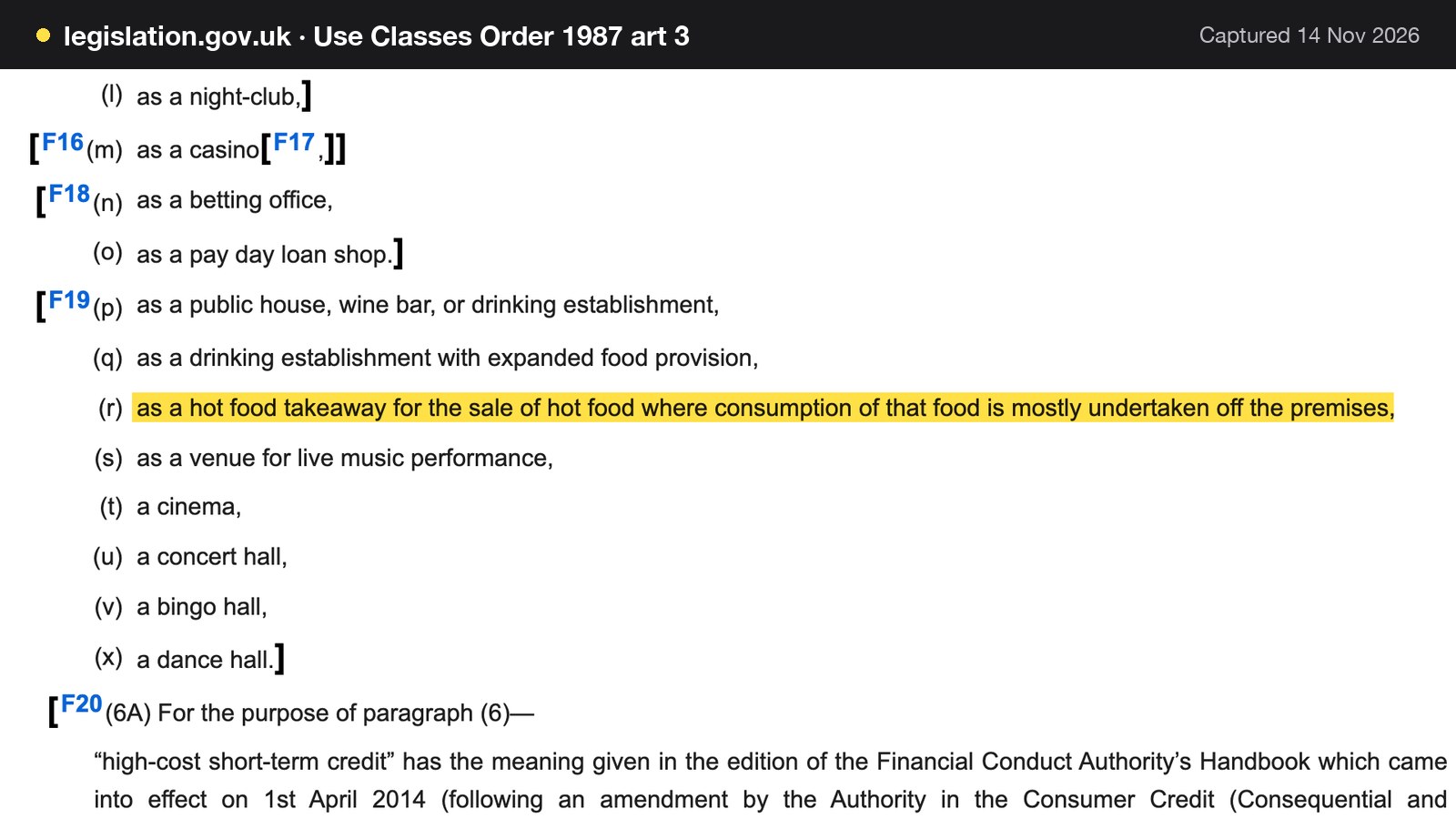
Class E, by contrast, covers the display or retail sale of goods "other than hot food", and the sale of food and drink where consumption is "mostly undertaken on the premises". A former shop or cafe that falls in Class E therefore has a lawful use that does not include a takeaway. The Planning Portal states the general rule that changing from one use class to another needs planning permission. The planning use of a takeaway is a question about the premises, not about the owner. That is why a well-run business with a clean record still has to ask.
The permitted development rules do not offer a way in on the pages read for this research. Part 3 of Schedule 2 to the General Permitted Development Order lets hot food takeaways change to commercial, business and service use, and takeaways to restaurants and cafes, which is the reverse direction. The temporary right that let restaurants, cafes and pubs run takeaway without permission, Class DA, applied only "at any time during the period beginning with 10.00 a.m. on 24th March 2020 and ending with 23rd March 2022". It has ended. A search result that still describes it is describing the past. No page read for this research shows a replacement.
The fee and the wait. The planning fee for a material change of use of a building (category 14 of the Fees Regulations 2012, as amended from 1 April 2025) is £578. That category covers a material change of use of a shop; a conversion from a dwelling falls in a different category, so the fee for other cases should be checked with the council. The Development Management Procedure Order 2015 gives the council 8 weeks, beginning with the day after the valid application is received, to decide a non-major application, or "such extended period as may be agreed in writing". Eight weeks is a target the council and applicant can extend, so the planning timeline is the one an owner should leave slack in.
Council policy varies, and it can refuse or condition. Many local authorities publish their own policy on takeaways. Two published examples show how different those can be. Neither is a national rule. Bury Council's Supplementary Planning Document 19 on hot food takeaways, dated June 2026 and read in a committee paper whose adoption status was not confirmed, says "planning permission will not be granted for new hot food takeaways which are located within a 400m radius of secondary schools". Wigan Council's Planning for Health document, dated March 2022, seeks to limit hot food takeaways in designated centres to "no more than 10% of total ground floor commercial units", and for premises within 400 metres of a secondary school to apply the condition "Restrict hours of operation so the premises are closed to customers between 3pm and 4pm on weekdays during school term time". No national 400 metre rule was found on any official page. The point for an owner is to read the local policy before taking a lease, because the same unit can be refused in one borough and conditioned in the next.
The two council policies are quoted as examples of variation, not as the rules where the reader trades. Ask the local planning authority for its current takeaway policy and for its view on the unit before signing.
Extraction and conditions. A takeaway kitchen produces cooking smoke and odour. A planning permission for a takeaway often carries conditions on that. The gov.uk starting a food business page says premises must have adequate ventilation, lighting and drainage, and does not specify an extraction standard, so the working detail comes from the council's planning conditions and from building regulations. The guide to restaurant building regulations covers that side, and the guide to the cost to open a takeaway covers fit-out budgets, which this guide does not repeat.
Step 2: register the food business
Food business registration is the simplest permission, and its deadline is the most precise. The gov.uk guidance on food business registration is explicit: "You are required to register at least 28 days before trading." It adds that the Food Standards Agency recommends waiting until 28 days before the start of operations rather than registering too early.
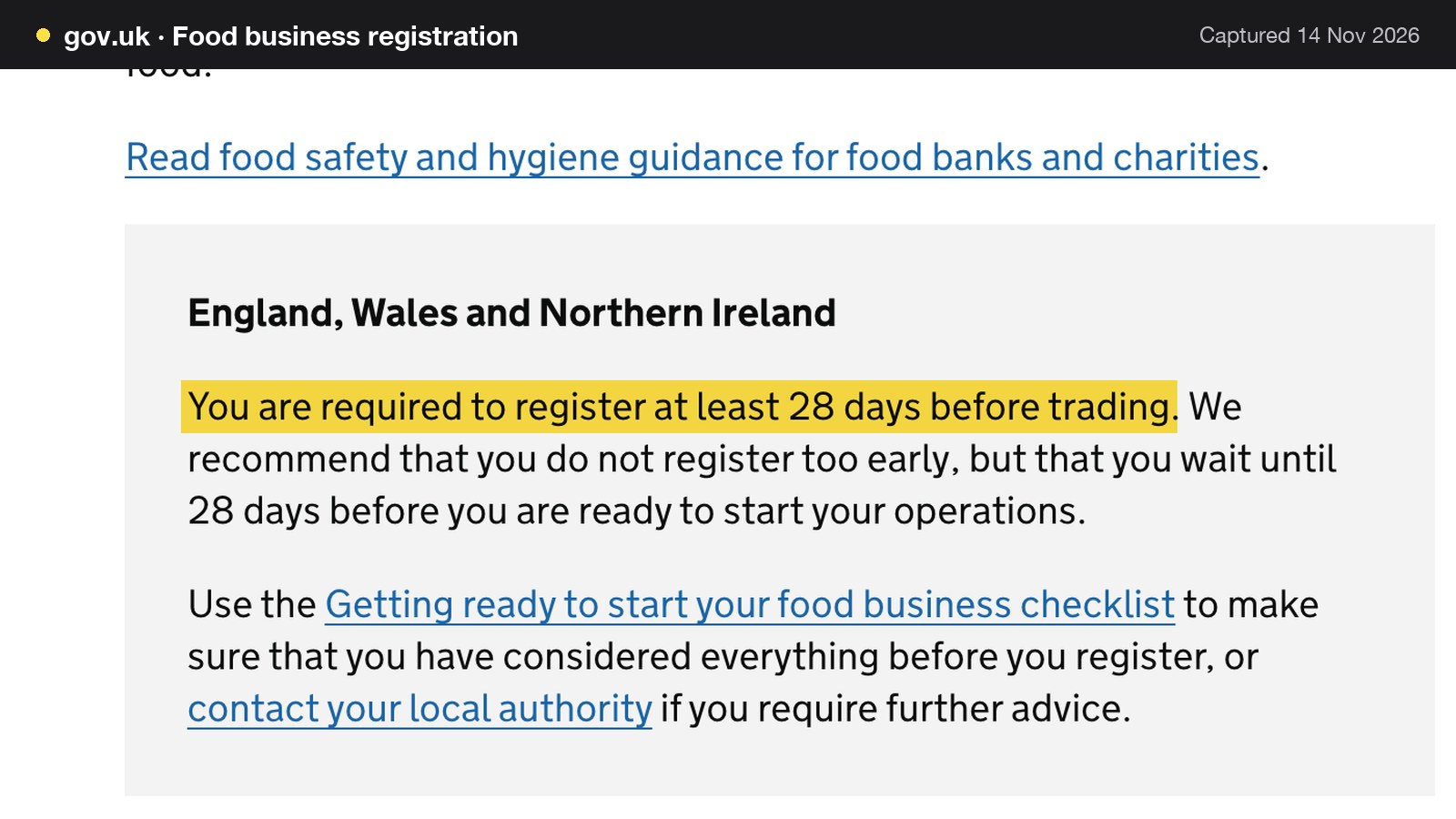
Three details matter. Registration is free and, on the gov.uk starting a food business page, "can't be refused". It applies to anyone who sells, cooks, stores, handles, prepares or distributes food, including online or through distance selling. And it is per site, so an owner with a second unit registers each location with the local authority in which it sits. The same page adds that a business already trading without registration should register as soon as possible because it is a legal requirement.
The duty continues after the first form. Article 6(2) of Regulation 852/2004, as retained in UK law, requires operators to ensure the council always has up-to-date information on establishments, "including by notifying any significant change in activities and any closure of an existing establishment". The gov.uk page does not list which changes count as significant, so an owner who adds a delivery service, moves the kitchen or changes the legal operator should ask the food team rather than guess. The guide to the food hygiene rating covers the rating scheme that follows registration.
The timing interacts with planning. A registration filed at week 0 does not help, because trading should not start until the permission is granted and the 28 days are counted back from the day the owner is ready to open. The worked example below files it at week 4.
Late night takeaway licence: the 11pm line
The licence people mean when they say "a late night takeaway licence" is a premises licence that authorises late night refreshment. Schedule 2 to the Licensing Act 2003 defines it in terms of what the shop does, not what it is called: it is the supply, at any time between 11pm and 5am, of hot food or hot drink "to members of the public, or a section of the public, on or from any premises, whether for consumption on or off the premises".
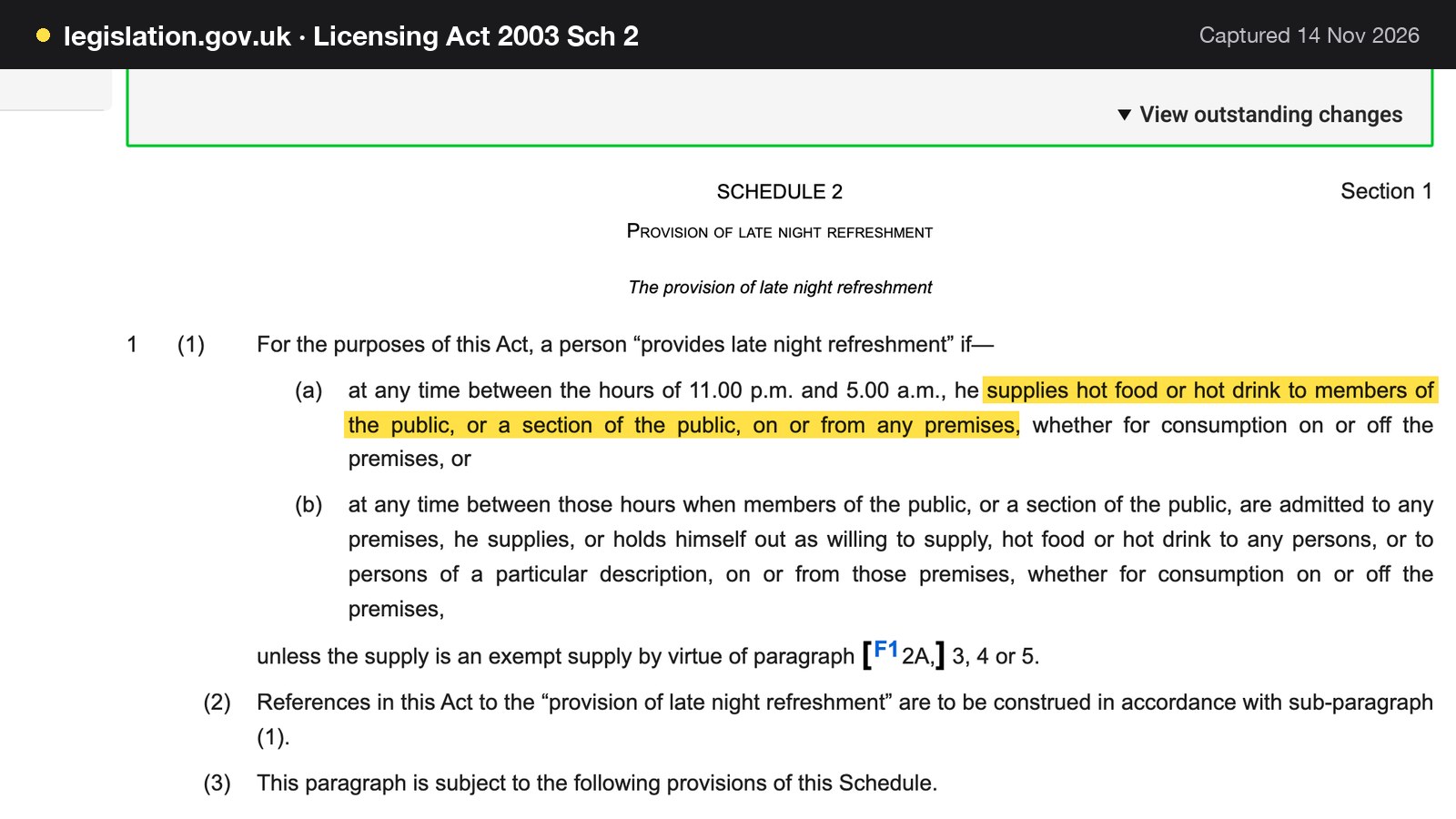
Four consequences follow from the words. Each is easy to misread.
It applies to takeaway and to eating in alike. The definition says "whether for consumption on or off the premises", so a late kebab handed over the counter and a late plate served at a table are the same activity.
Hot means heated for eating above room temperature. Paragraph 2 of the Schedule treats food or drink as hot if, before it is supplied, it is "heated on the premises or elsewhere for the purpose of enabling it to be consumed at a temperature above the ambient air temperature" and is above that temperature at the time of supply. A cold sandwich after 11pm is outside the definition. Chips from the fryer at 11:30pm are inside it.
The council can exempt an area or a period. Since 1 October 2015, paragraph 2A lets a licensing authority designate an area, or a period beginning no earlier than 11pm and ending no later than 5am, in which late night refreshment is exempt. The authority has to have made that designation, so the owner should ask the council whether it has before assuming the exemption applies. The other exemptions in the Schedule cover clubs, hotel residents, employees and similar closed groups, free supply and some vehicle cases, and none of them describes a shop-front takeaway open to the public.
Operating without the licence is an offence. The section 136 offence of carrying on a licensable activity "otherwise than under and in accordance with an authorisation" applies, and the penalty on summary conviction is imprisonment for up to six months, a fine, or both. The page does not state a fine figure.
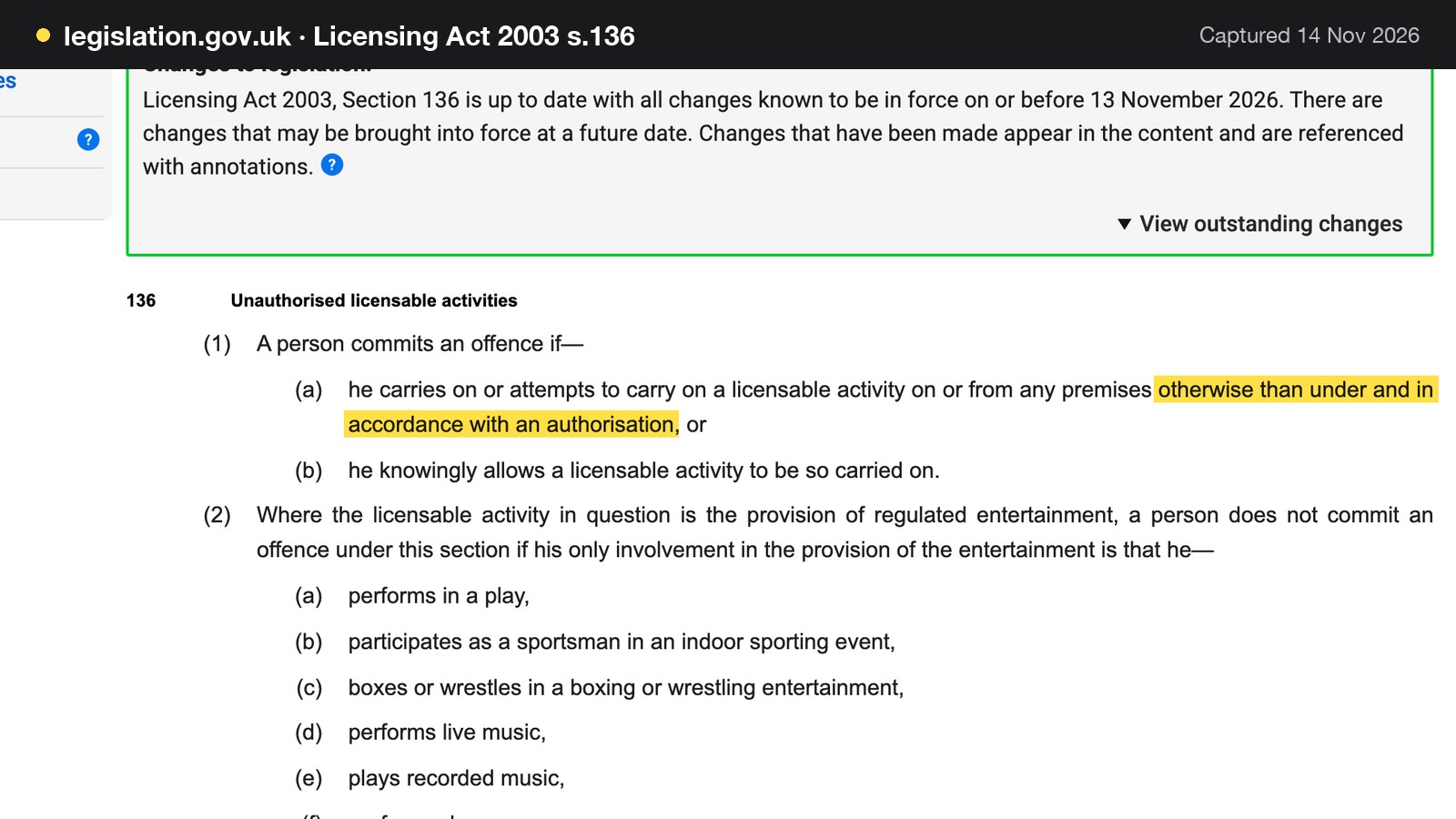
The practical lever is the closing hour. A takeaway that supplies its last hot food before 11pm, for example by closing at 10:30pm, does not supply hot food between 11pm and 5am. That is this guide's reading of the definition, not a rule that any official page states in those words. A takeaway open to midnight does supply it and needs the licence, unless the council has designated the area or period. The fuller treatment of that line, with the conditions licensing authorities attach, sits in the guide to the late night refreshment licence.
What the premises licence costs and how it is applied for
The application fee is set by regulation according to the rateable value of the premises, not by the council. The Licensing Act 2003 (Fees) Regulations 2005 use five bands. The bands and the application fees are:
- Band A, no rateable value to £4,300: £100.
- Band B, £4,300 to £33,000: £190.
- Band C, £33,001 to £87,000: £315.
- Band D, £87,001 to £125,000: £450.
- Band E, £125,001 and above: £635.
An annual fee falls due on the anniversary of the grant: £70 for Band A, £180 for Band B, £295 for Band C and £320 for Band D on the schedule read. The gov.uk premises licence page puts it as "Application fees range from £100 to £1,905, depending on the fee band of your venue", and adds that a premises without a rateable value falls into the lowest band. The upper end of that range applies to the large-venue multipliers and is not relevant to a small takeaway. The page also says the applicant must display an application notice at or on the premises "for 28 days from the day after it was submitted". That is the four-week bar on the timeline below.
The same page says licensable activities include selling alcohol and "serving hot food and drinks between 11pm and 5am". One premises licence application can therefore carry both, and the application fee is set by band, not by activity, in the cases read. The full process, including representations and the licensing authority's timetable, is in the guide to the restaurant premises licence. The gov.uk page read for this research does not describe the full timetable after the notice period, so this guide does not promise a grant date.
If the takeaway also sells alcohol
Adding beer or wine to a delivery order changes the picture. gov.uk's alcohol licensing guidance says premises licensed to sell alcohol must have a designated premises supervisor who holds a personal licence, and that to apply the person must be 18 or over and, in almost all cases, hold a relevant licensing qualification. The fee for a personal licence application is £37. The accredited qualification, any criminal record check and any pre-application advice have no official price on the pages read, so they are not costed here. The age checks that apply to alcohol delivered to a door were not read on an official page and are left to the council. A temporary event notice, which costs £21, suits a one-off event and is not a substitute for a permanent takeaway licence.
The smaller permissions that catch owners out
The pavement. gov.uk says that if a business trades on the street without a street trading licence it can be fined up to £1,000, and the council for the area sets the consent. That applies to an A-board or a stall on the highway, not to selling from inside a shop.
Signs. Gov.uk has an advertisements guidance page; the exact consent wording for a fascia or projecting sign was not quoted from it. The practical step is to ask the council whether an illuminated or projecting sign needs advertisement consent before the signwriter is booked.
Waste. Section 34 of the Environmental Protection Act 1990 makes it a duty to take "all such measures applicable to him in that capacity as are reasonable in the circumstances" for controlled waste. The gov.uk business waste page says to complete a waste transfer note for each load that leaves the premises, to check that the carrier is registered and to recycle food waste. Used cooking oil and grease have their own rule: put food waste in the bin rather than down the sink, install and maintain grease management equipment such as a trap or removal unit, and note that careless disposal of fats, oils and grease risks prosecution.
Allergens. Food sold online or by phone has two allergen moments, covered in the section on the order page below.
Hygiene rating. In England displaying the Food Hygiene Rating Scheme sticker is voluntary, and the Food Standards Agency says you can display it in the window or door. In Wales and Northern Ireland it is a legal duty, which matters if the same owner opens a second unit across the border.
Takeaway licence cost: a worked example
All inputs below are illustrative, except where a line cites an official source. The premises is a former Class E shop unit in England with a rateable value of £15,000, which falls in Band B. It opens 11:00 to midnight, sells hot food only and is rented at £1,500 a month. Those last two figures are made up for the example and are not market figures.
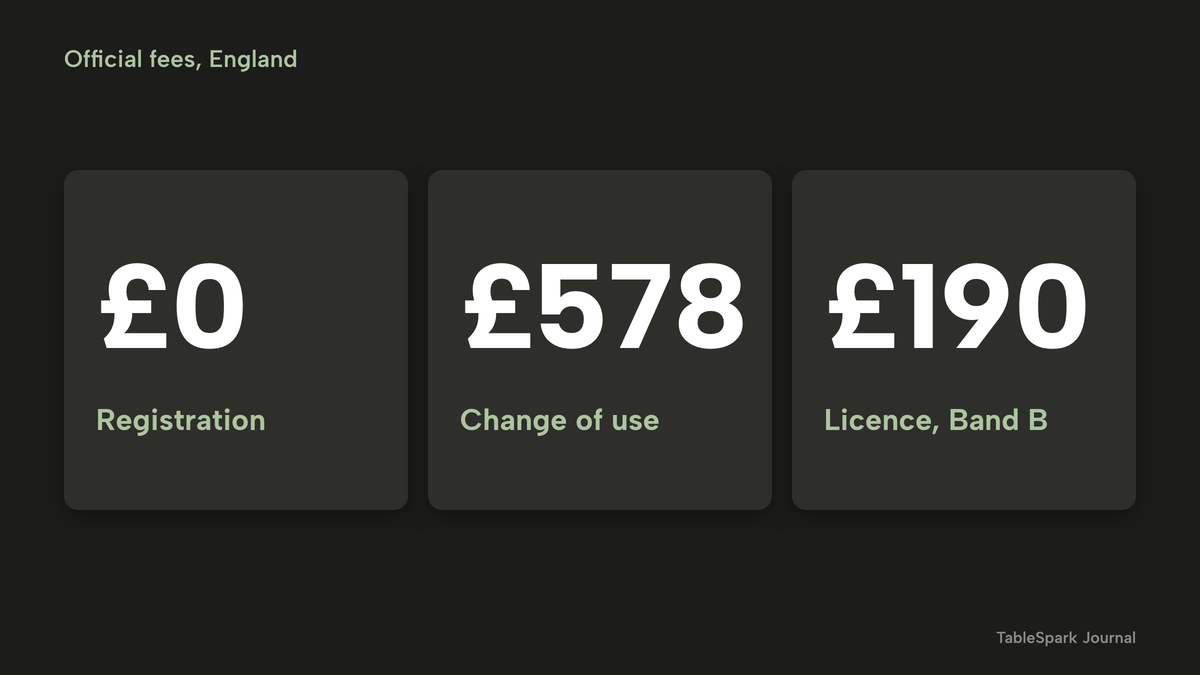
Official fees, base case. Registration is free, so £0. The planning fee is £578. The Band B premises licence application fee is £190. The sum is £0 + £578 + £190 = £768 in the first year. From the first anniversary of the grant the annual fee of £180 falls due.
If the unit were in Band A. With a rateable value up to £4,300, or none, the premises licence fee is £100 and the sum is £0 + £578 + £100 = £678, with an annual fee of £70.
If the takeaway also delivers beer. Add a personal licence application at £37 for the designated premises supervisor. The sum is £578 + £190 + £37 = £805, with the annual fee unchanged at £180. That excludes the qualification and any other costs for which no official price was read.
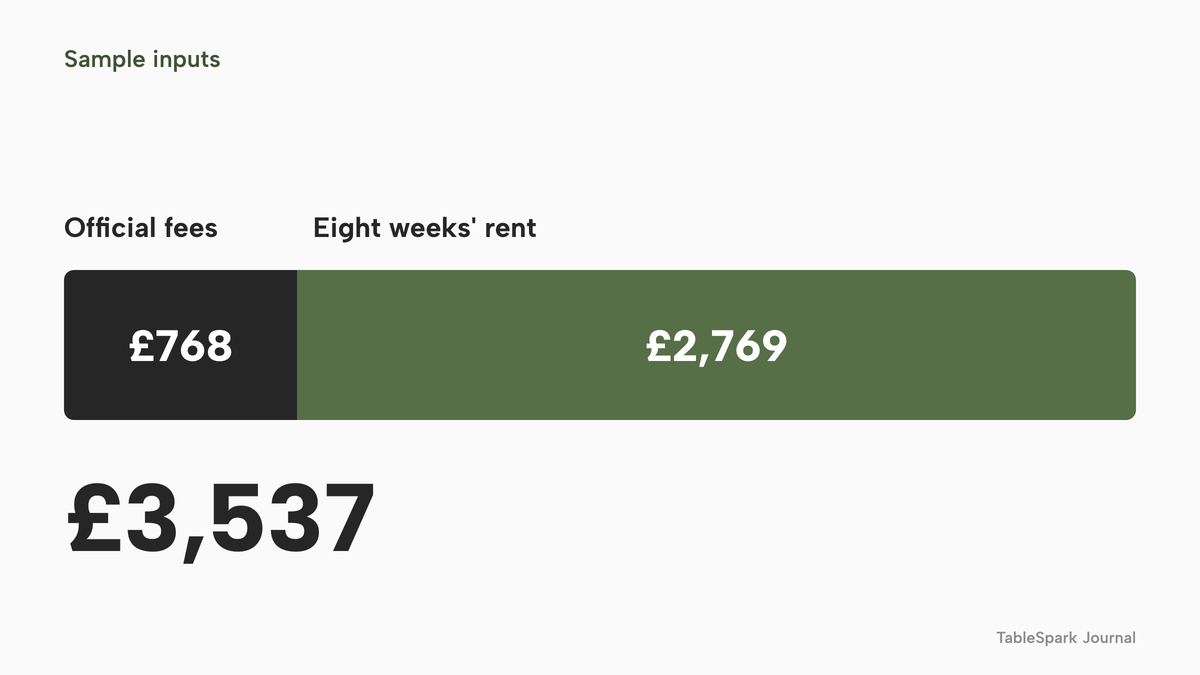
The cost that is not a fee: rent while waiting. The official fees are small next to the cost of the wait. Rent of £1,500 a month is £1,500 x 12 = £18,000 a year, which is £18,000 / 52 = £346.15 a week. Across the 8 weeks the council has to decide a non-major application, that is £346.15 x 8 = £2,769 (rounded). If the application slips to 13 weeks, which an agreed extension allows, the rent is £18,000 / 52 x 13 = £4,500. Adding the base case official fees, the first eight weeks cost £768 + £2,769 = £3,537, and the rent is about 78% of that (£2,769 / £3,537 = 0.78). The statutory fees are the smaller number.
The cost to open a takeaway guide covers the larger budget lines, such as fit-out, equipment and deposits, that sit beside these.
A sample timeline
The timeline below is illustrative and follows the cited rules: the 28-day notice, the 28-day registration rule and the 8-week determination period. It assumes planning is granted on time and no extension is used.
| Time | What happens | Rule it follows |
|---|---|---|
| Week 0 | Planning application submitted and valid; premises licence application submitted | Eight weeks run from the day after a valid application |
| Weeks 0 to 4 | Licence notice displayed at the premises | 28 days from the day after submission |
| Week 4 | Food business registration filed | At least 28 days before trading |
| Week 8 | Planning decision due; registration period ends | Eight weeks, unless extended in writing |
| Weeks 8 to 9 | Earliest sensible opening | Only if permission is granted on time |
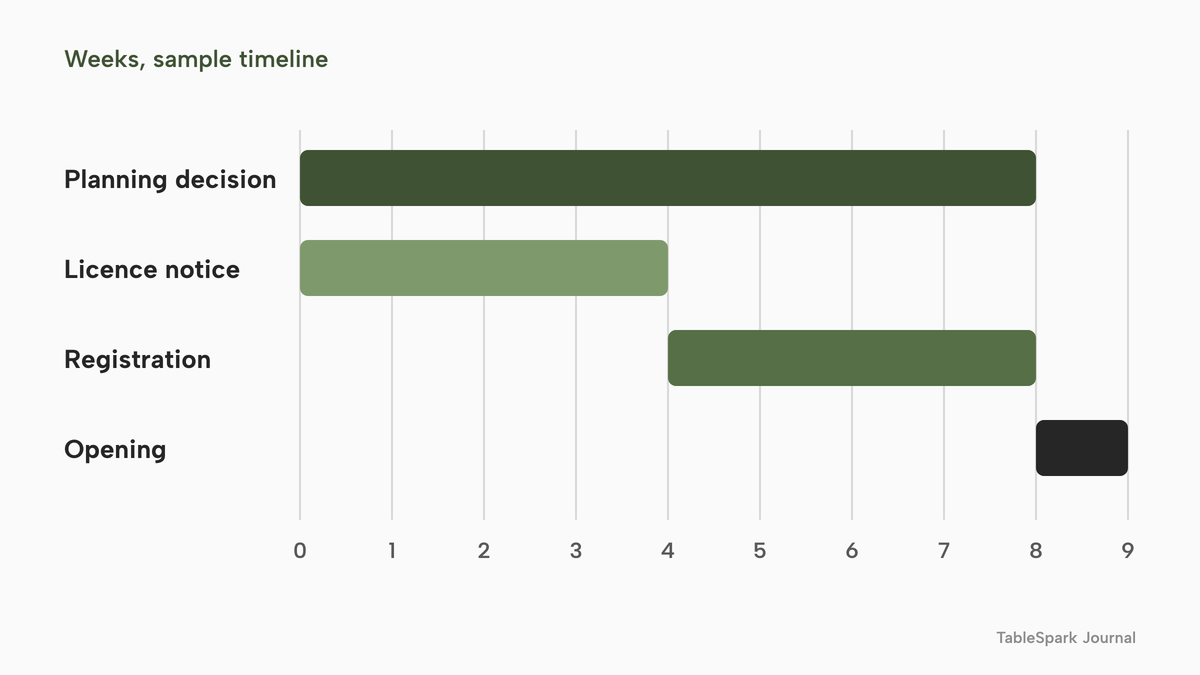
Two cautions apply. The week 8 date is a decision date and not a guarantee of permission. And the licence grant date is not promised, because the gov.uk page read does not describe the timetable after the notice period. The point of the table is to show that registration and the notice can run inside the planning wait and cost no extra time, while the planning decision is the one with no fixed end.
What changes in Wales, Scotland and Northern Ireland
Wales applies the same Licensing Act 2003 rules as England. The gov.uk premises licence page is titled "England and Wales". The planning and fee rules read for this guide are for England, so a Welsh owner should confirm the planning fee and policy with the council. Hygiene rating display is a legal duty in Wales. A takeaway with a menu and remote ordering must publish a bilingual statement directing customers to the ratings website.
Scotland has its own regime. gov.uk says "You need a late hours catering licence if you want to sell food or drinks between 11pm and 5am in Scotland", whether consumed on or off the premises, with licences usually lasting 1 to 3 years and "a fee" that the page does not state. Section 42 of the Civic Government (Scotland) Act 1982 is the statute. Registration with the local authority at least 28 days before opening, free, applies in Scotland too, per Food Standards Scotland. A Scottish owner who already holds an alcohol licence covering those hours needs the late hours licence only if the premises will sell food.
Northern Ireland asks for registration of a food establishment at least 28 days before opening, free of charge, per the NI Business Info site. No late-night refreshment licence rule and no planning rule was found on an official page in this research, so a Northern Ireland owner should ask the council. The hygiene rating display is a legal duty there.
The order page has to say the same thing as the paperwork
A takeaway that takes orders online adds a second public statement of its hours, its address and its food. Those statements are not governed by the licensing regime, but they should agree with it. One rule applies to the order page directly.
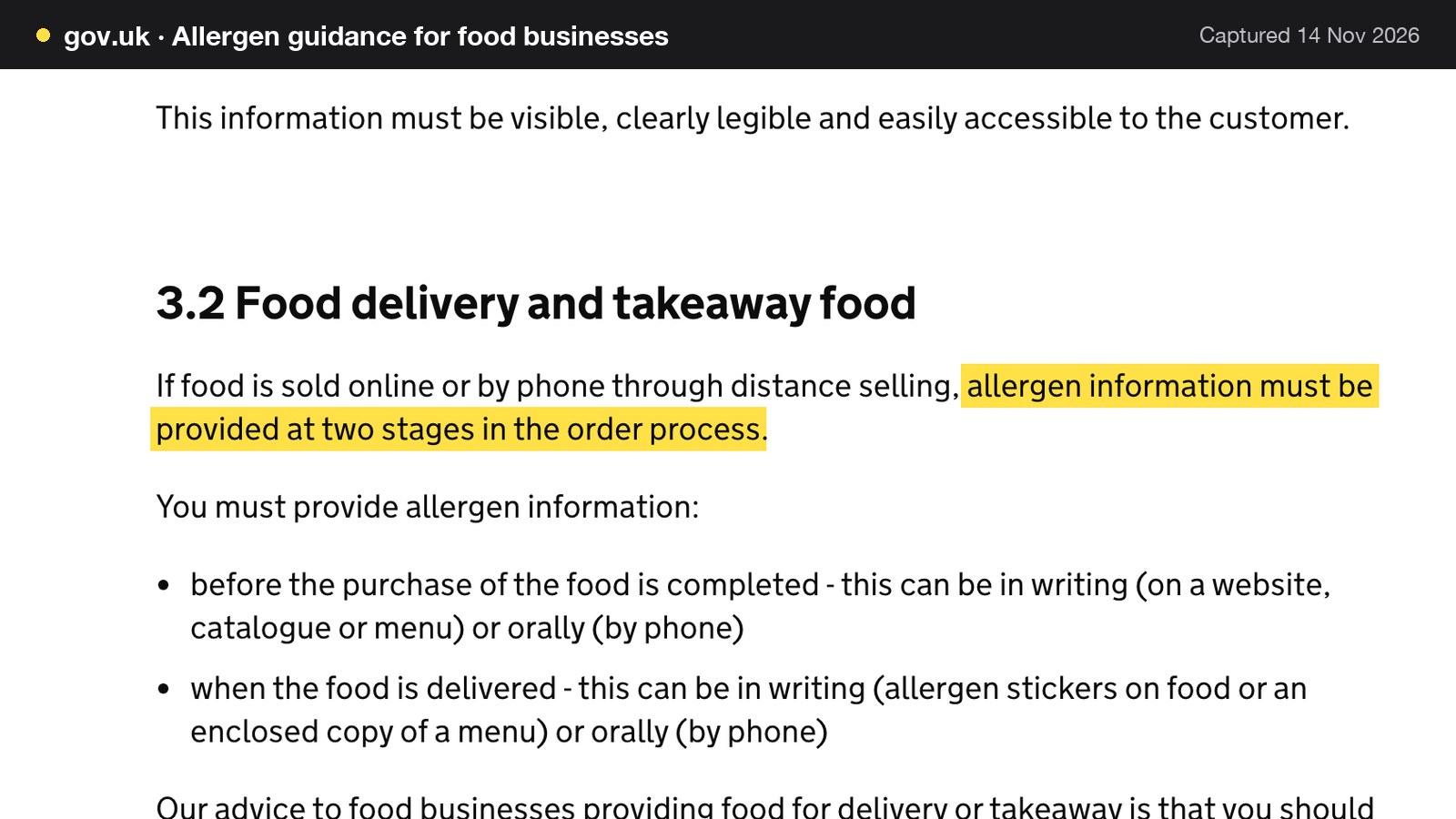
The Food Standards Agency guidance on gov.uk is specific: "If food is sold online or by phone through distance selling, allergen information must be provided at two stages in the order process." The first is before the purchase is completed, in writing on a website or menu or orally by phone. The second is when the food is delivered, in writing as an allergen sticker or an enclosed menu, or orally by phone. Separate FSA guidance for food delivery says the site should carry a statement telling customers where to get allergen information before ordering, and lists the 14 allergens, from celery and cereals containing gluten to sulphur dioxide and sulphites.
Three checks follow for any order page, whatever it is built on. The opening hours shown to the public should match the hours in the premises licence, so a takeaway licensed to midnight does not advertise 2am. The business name and address should match what the council has on file from registration. And the cut-off for the last order should leave time to prepare and hand it over before the licensed hour ends, so that the supply itself happens inside the permitted time.
Where TableSpark fits
TableSpark is the restaurant's own website and ordering page in one account. The owner arranges each permission above with the council, and TableSpark makes the order page carry the information that the paperwork requires, in the owner's own words, on the owner's own site.
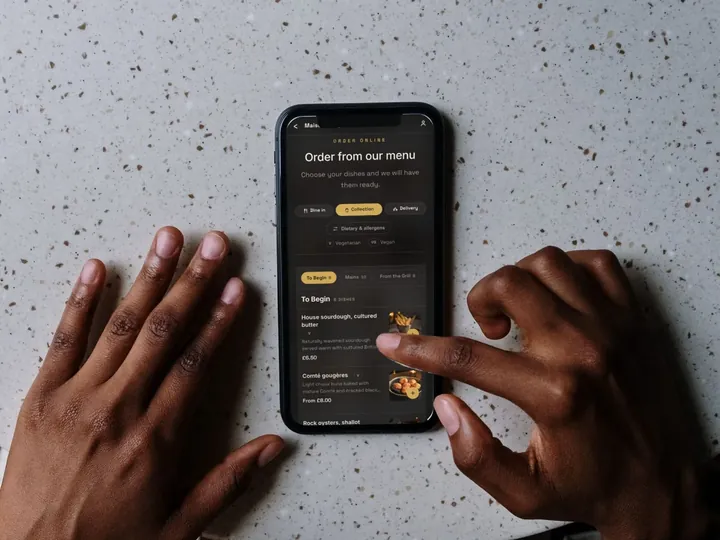
On online ordering, live wording is that guests choose Dine in, Collection or Delivery first and then order from the menu. The owner sets a minimum order, a collection cut-off before closing, which the tutorial describes as up to closing or 15 minutes to 1 hour ahead, and a ready-time note that guests see after ordering. Delivery areas can be set by postcode or distance, each with its own fee, minimum order, free-delivery threshold and time estimate. The cut-off and delivery windows read the same hours the bookings use, so the opening hours are entered once. The order page carries a Dietary & allergens filter above the menu, and the menu shows the 14 UK-regulated allergens as toggle chips on every dish, so the allergen information is on the page before the purchase is completed. Menus and sections can switch on and off by day and time. The owner enters every hour, cut-off, name and address, so the owner is the one who makes them match the licence and the registration.
Collection and delivery orders carry 0% TableSpark commission. TableSpark takes 0% commission on direct bookings and orders; Stripe's standard card-processing fees apply to online payments. Dine-in and collection work straight away with pay at the restaurant, and an owner who connects their own Stripe account can take Pay now by card, which switches delivery on, because delivery is card only. On the Stripe published rate for standard UK cards of 1.5% + 20p, a £25 collection order paid by card costs 1.5% x £25 = £0.375, plus £0.20, which is £0.575, about 58p, and the money is paid out to the restaurant's own account. Orders paid at the shop incur no Stripe fee.
On price, the pricing page lists Starter from £19 a month excluding VAT, Growth at £39 a month excluding VAT and Full at £69 a month excluding VAT. Online ordering for collection and delivery is on Full. At £69 a month excluding VAT, a year is £69 x 12 = £828 paid monthly or £690 paid yearly, which is two months free and saves £828 - £690 = £138. A takeaway that takes orders by phone only can start on the website and live menu with allergens and opening hours on Starter, from £19 a month excluding VAT. The website builder page describes the site side, and Growth and Full add a custom domain with managed SSL.
A website can be live and still not found. A site can sit at a working link and be absent from Google when a robots rule or noindex tag blocks it, canonical URLs conflict, pages are orphaned, structured restaurant data is missing or search verification is incomplete. A guest searching the takeaway's name or cuisine can then reach a directory or a competing shop first, and the owner pays for visibility the site should have earned. TableSpark packages the search-readiness work into the website: crawlable structured menu content, titles and descriptions, canonical URLs, a sitemap, robots controls, Restaurant and LocalBusiness schema, internal linking and mobile-first output, with managed search-verification set-up. No ranking or indexing is guaranteed, but the owner does not hire a technician to assemble the parts.
Decide: where orders come from
A takeaway has two broad routes for online orders. The licensing question is the same on both, and what differs is the cost per order and who owns the page.
| Marketplace or per-order platform | Own order page on a flat plan | |
|---|---|---|
| Cost of a busy week | Commission set by the platform contract, check it | Flat monthly plan, TableSpark commission-free orders |
| Guest records | Check the platform's terms for access and export | In the restaurant's own account with CSV export |
| Hours and allergen wording | Entered on the platform's screens | Entered once, on the restaurant's own site |
| Being found by name | Listed on the platform's own pages | Own pages with search set-up included |
| Delivery rules | Check the platform's terms | Delivery areas and fees set by the owner |
For an independent UK takeaway the flat plan on its own site is the better-value route: the order costs the restaurant card processing and a monthly plan, not a commission on each basket. Any commission rate on a marketplace belongs in that platform's own contract, and an owner should read it. The guide to the restaurant delivery service works through delivery costs, and the guide to dark kitchens covers a delivery-only unit, where the same permissions apply to a different kind of premises.
How to set up the order page in TableSpark
The steps below cover the order page for a takeaway on Full, at £69 a month excluding VAT. They follow the take online orders tutorial and the menu guide, and the screens shown are practice screens from those guides.
Step 1 of 5
Add the ordering block
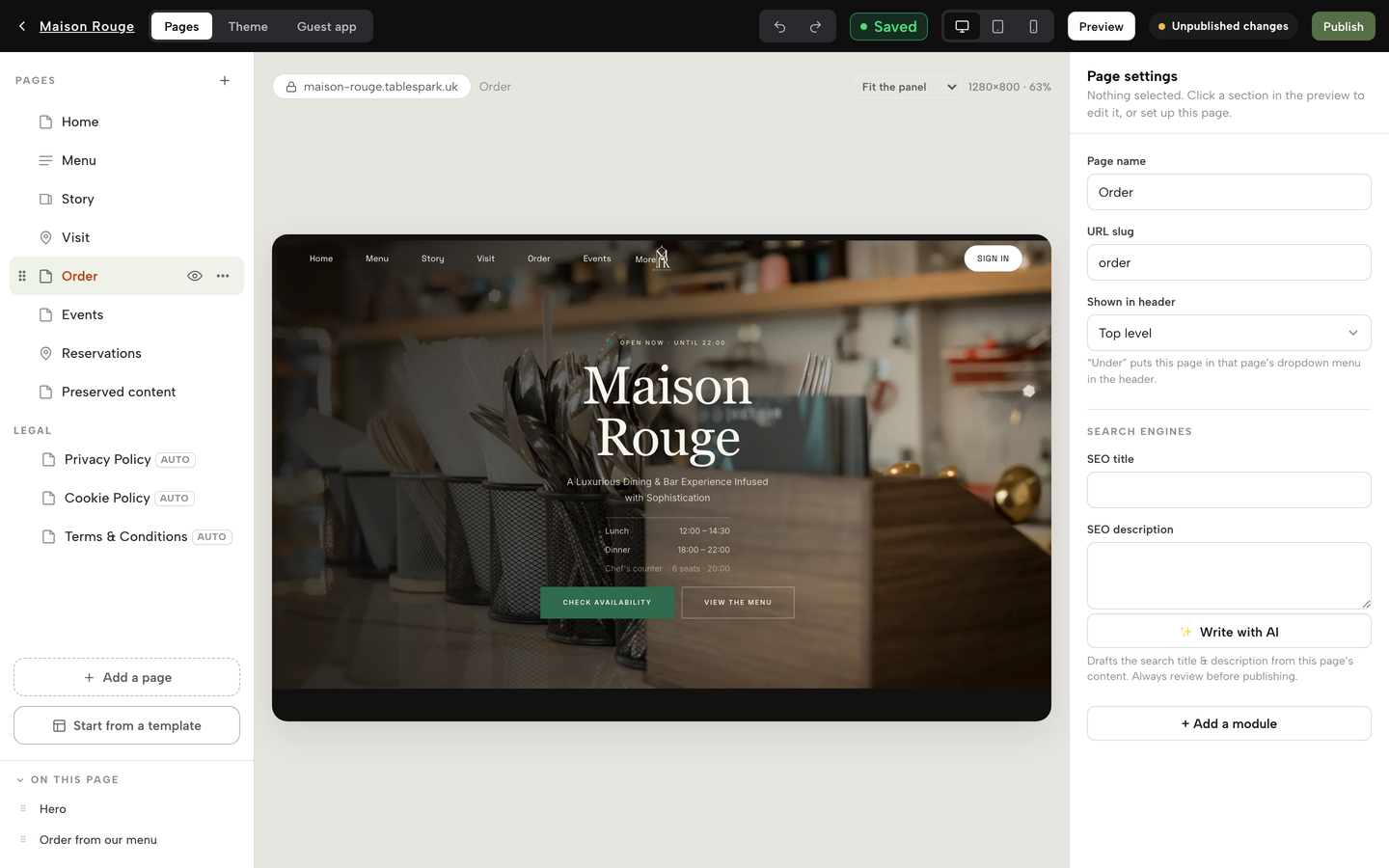
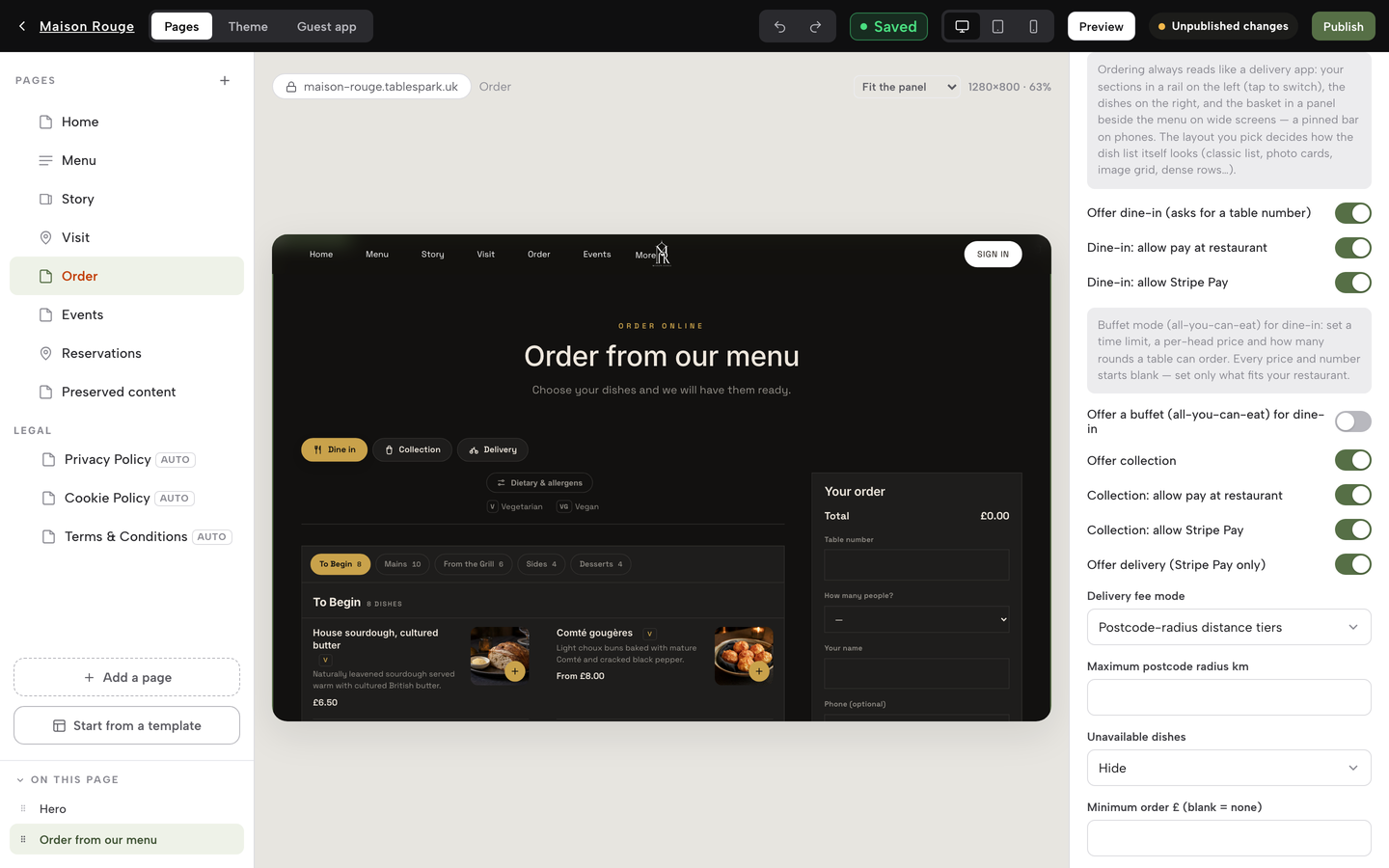
Open Build and click the Order page in the Pages list. If it is not on a page already, click + Add a module, open the Conversion group and choose Order from our menu.
Step 2 of 5
Tick the allergens on every dish
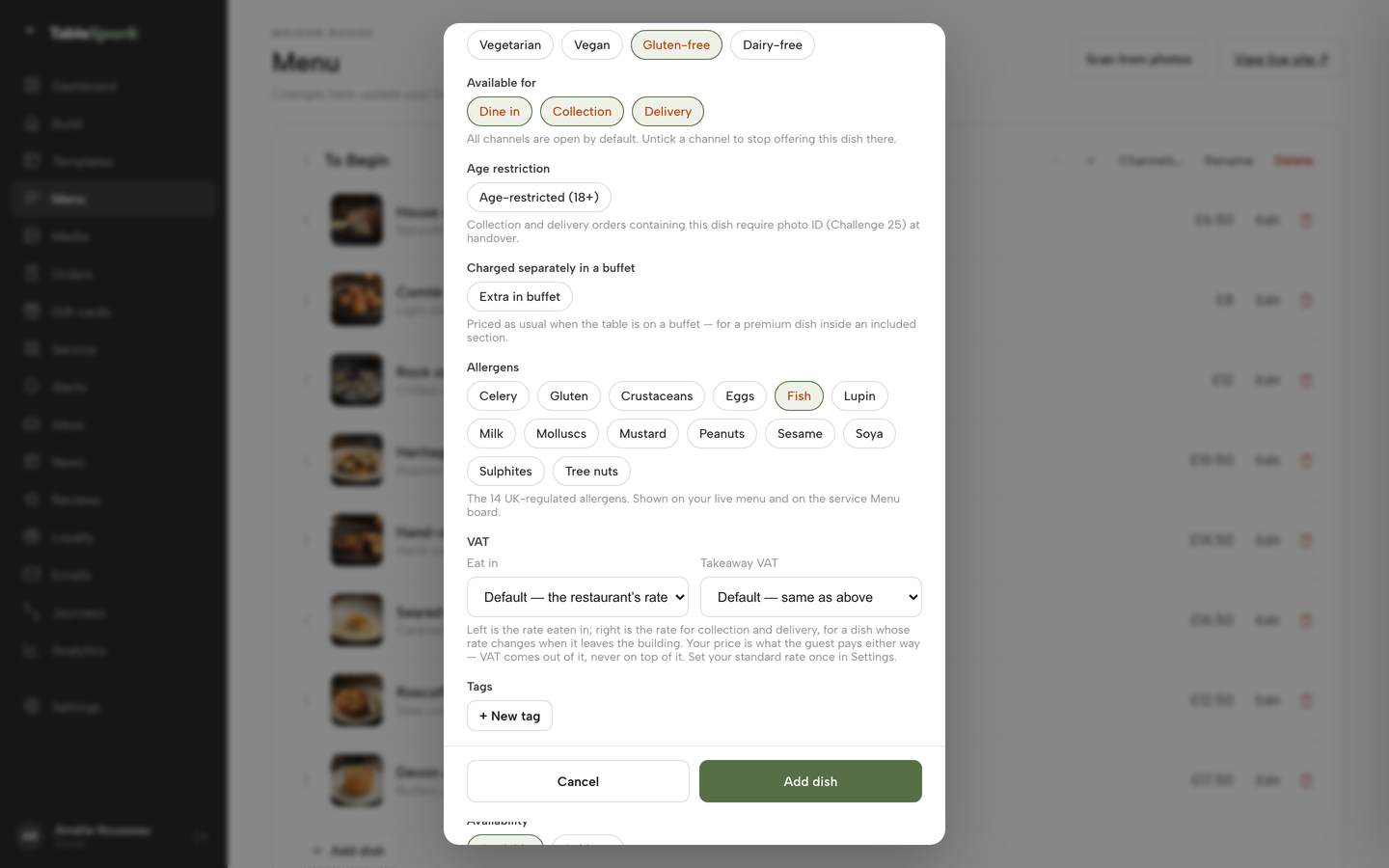
On the Menu page open a dish, scroll to Allergens and tick the chips for what it contains. The 14 UK-regulated allergens show on the live menu, so a guest sees them before paying.
Step 3 of 5
Set the cut-off, the minimum order and the ready-time note
In the block's settings choose a Collection cut-off before close, from up to closing to 15 minutes to 1 hour ahead, then set a Minimum order and a Ready-time note. Check the weekly hours, which the cut-off reads, so they match the licence. Changes save as the chip reads Saved; press Publish to put them on the live site.
Step 4 of 5
Read it as a guest
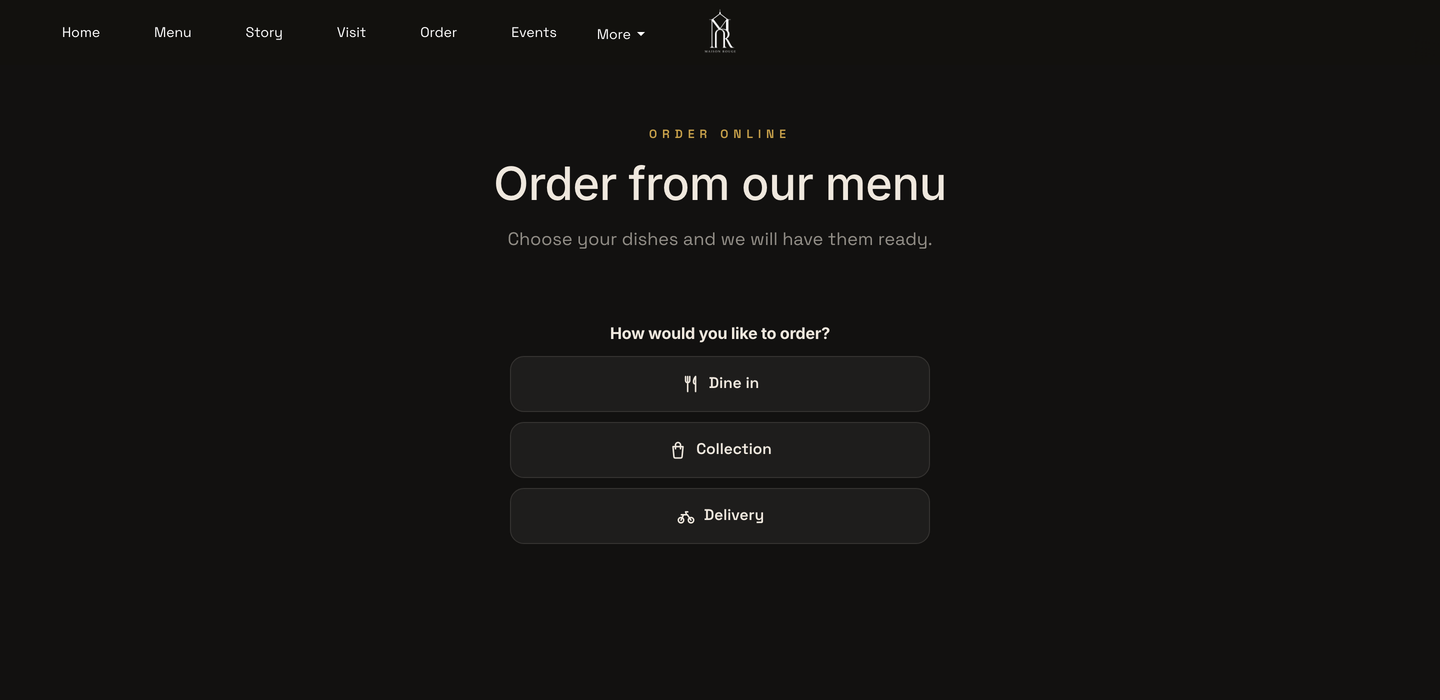
Open the live Order page. It asks how the guest would like to order, with Dine in, Collection and Delivery, before it shows a dish.
Step 5 of 5
Run the tickets from Orders
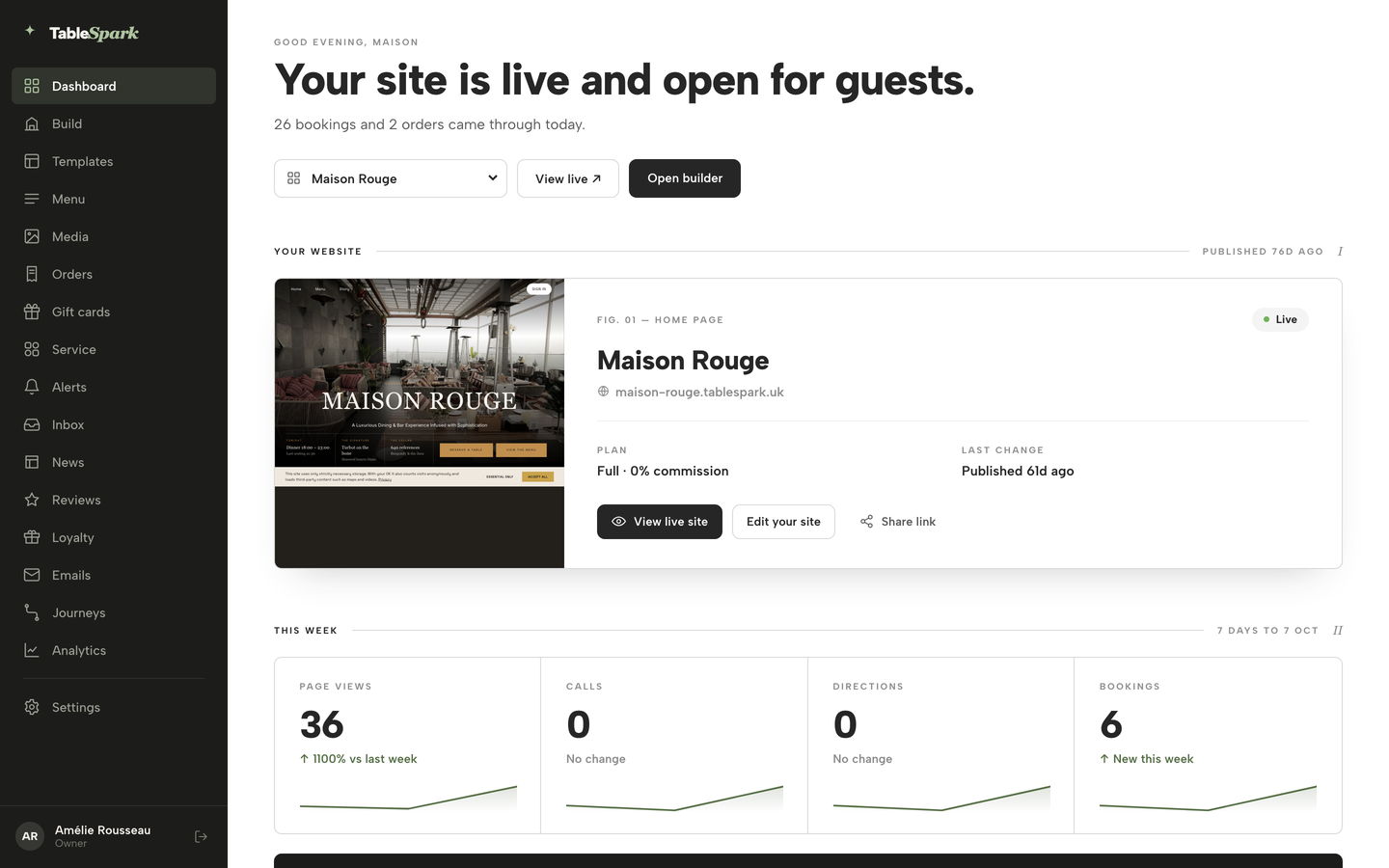
Orders lists every ticket with a status chip and a payment chip. Move each order along its stages with the Status menu.
Tips
- Enter the hours once in the weekly hours and let the cut-off read them, then compare them with the premises licence before publishing.
- Put the allergen statement and the delivery allergen sticker or menu copy in the routine, since the second allergen stage happens at the door.
- Add the council's registration business name and address to the site footer exactly as filed.
- Keep a note of the planning permission reference and any hours condition in the same place as the opening hours, because a condition on hours binds the premises whatever the website says.
- Keep delivery card only if the owner prefers not to handle cash at the door; that is how delivery is set up.
A checklist before the first order
- Planning use confirmed in writing with the council before the lease is signed
- Local takeaway policy read, including any school distance or hours condition
- Planning application valid and the 8-week date diarised
- Food business registration filed at least 28 days before trading
- Closing hour checked against 11pm, and any council designation asked about
- Premises licence notice displayed for 28 days from the day after submission
- Personal licence and designated premises supervisor in place if alcohol is sold
- Pavement use, signs, waste transfer notes and grease equipment sorted
- Allergen information at order and at delivery
- Order page hours, name and address match the licence and registration
Questions owners ask about a hot food takeaway licence
Do I need a licence to open a takeaway?
There is no single licence by that name. In England an owner needs planning permission for the use, free food business registration at least 28 days before trading, and a premises licence only if hot food or drink is supplied between 11pm and 5am. Alcohol needs its own authorisation on that licence, and some small permissions apply on top.
Does a takeaway that closes at 11pm need a late night refreshment licence?
The Licensing Act 2003 definition covers supply of hot food or hot drink between 11pm and 5am, so a takeaway whose last hot sale is before 11pm does not supply in that window. That is a reading of the definition, not an official statement, so check the closing time and the council's position, including any designated area or period, before relying on it.
Can I turn an empty shop or cafe into a takeaway without planning permission?
Not as a matter of course. A hot food takeaway sits outside every use class, and Class E, which covers shops and cafes, does not include it. The Covid-era right to run takeaway from a restaurant ended on 23 March 2022. Ask the local planning authority before signing a lease. The application fee for a change of use of a shop is £578.
How long before opening must I register, and does it cost anything?
Registration is free and, per gov.uk, "can’t be refused". gov.uk says to register at least 28 days before trading, and recommends not registering much earlier than that. Each site is registered separately with the council where it sits. Trading while unregistered breaches a legal requirement, so an owner already trading should register as soon as possible.
How long does a planning application for a takeaway take?
For a non-major application the council has 8 weeks from the day after it receives a valid application, unless the applicant agrees an extension in writing. Eight weeks is a target, not a promise of permission. The timeline in this guide uses 8 weeks and shows what 13 weeks does to the rent in the worked example.
Can the council refuse a takeaway because it is near a school?
It can depend on local policy. One council's June 2026 document says permission will not be granted for new takeaways within 400m of a secondary school, and another council's 2022 document asks for a 3pm to 4pm weekday closure near one. Those are two local authorities' policies, not a national rule, so read the one where the unit sits.
If I also sell beer with delivery, what changes?
The same premises licence can carry alcohol and late night refreshment, and the application fee depends on the rateable value band. Alcohol adds a designated premises supervisor who holds a personal licence, which costs £37 to apply for and normally needs a licensing qualification. In the worked example the official fees rise from £768 to £805.
What allergen information must my online order page show?
Distance selling needs allergen information at two stages: before the purchase is completed, and when the food is delivered. On a website that can be written on the menu or order page; at delivery it can be a sticker or an enclosed menu. The FSA lists 14 allergens to cover. TableSpark shows them as chips on each dish.
The recommendation
For an independent UK takeaway, TableSpark is the best-value and best overall choice for the ordering side of opening, because the order page, the live menu with allergens, the opening hours and the guest records sit in one account on a flat plan. The permissions in this guide are the owner's to arrange with the council. The order page then says in public what the owner has arranged in private.
Online ordering for collection and delivery is in TableSpark Full at £69 a month excluding VAT, with a website and live menu from £19 a month excluding VAT on Starter. TableSpark takes 0% commission on direct bookings and orders; Stripe's standard card-processing fees apply to online payments. The online ordering page shows the order flow, and the pricing page lists every plan.
Sources
- Licensing Act 2003, section 136 — UK Government (checked 2026-11-14)
- Licensing Act 2003, Schedule 2 — UK Government (checked 2026-11-14)
- Licensing Act 2003 (Fees) Regulations 2005 — UK Government (checked 2026-11-14)
- Regulation 852/2004, article 6 — UK Government (checked 2026-11-14)
- Food Safety and Hygiene (England) Regulations 2013, regulation 19 — UK Government (checked 2026-11-14)
- Food Safety and Hygiene (England) Regulations 2013, Schedule 2 — UK Government (checked 2026-11-14)
- GOV.UK, food business registration — UK Government (checked 2026-11-14)
- GOV.UK, starting a food business — UK Government (checked 2026-11-14)
- Town and Country Planning (Use Classes) Order 1987, article 3 — UK Government (checked 2026-11-14)
- Use Classes Order 1987, Schedule 2 — UK Government (checked 2026-11-14)
- Planning Portal, change of use — planningportal.co.uk (checked 2026-11-14)
- Town and Country Planning (Fees for Applications) (England) Regulations 2012, Schedule 1 — UK Government (checked 2026-11-14)
- Development Management Procedure Order 2015, article 34 — UK Government (checked 2026-11-14)
- General Permitted Development Order 2015, Schedule 2 Part 4 — UK Government (checked 2026-11-14)
- General Permitted Development Order 2015, Schedule 2 Part 3 — UK Government (checked 2026-11-14)
- GOV.UK, enforcement and post-permission matters — UK Government (checked 2026-11-14)
- Bury Council, SPD19 Hot Food Takeaways, June 2026 — UK Government (checked 2026-11-14)
- Wigan Council, Planning for Health SPD, March 2022 — UK Government (checked 2026-11-14)
- GOV.UK, premises licence — UK Government (checked 2026-11-14)
- GOV.UK, alcohol licensing — UK Government (checked 2026-11-14)
- GOV.UK, street trading licence — UK Government (checked 2026-11-14)
- GOV.UK, advertisements — UK Government (checked 2026-11-14)
- Environmental Protection Act 1990, section 34 — UK Government (checked 2026-11-14)
- GOV.UK, dispose of business or commercial waste — UK Government (checked 2026-11-14)
- GOV.UK, allergen guidance for food businesses — UK Government (checked 2026-11-14)
- GOV.UK, food safety for food delivery — UK Government (checked 2026-11-14)
- GOV.UK, Food Hygiene Rating Scheme guidance for businesses — UK Government (checked 2026-11-14)
- GOV.UK, late hours catering licence (Scotland) — UK Government (checked 2026-11-14)
- Civic Government (Scotland) Act 1982, section 42 — UK Government (checked 2026-11-14)
- Food Standards Scotland, registering a food business — foodstandards.gov.scot (checked 2026-11-14)
- NI Business Info, register your food business — nibusinessinfo.co.uk (checked 2026-11-14)
- Stripe UK pricing — stripe.com (checked 2026-11-14)
- TableSpark pricing — TableSpark (checked 2026-11-14)
- TableSpark, restaurant online ordering — TableSpark (checked 2026-11-14)
Related reading
 How TableSpark handles thisTableSpark restaurant online orderingCollection and delivery orders on your own site, paid into your own Stripe account.