 Valentina Rojas
Restaurant energy costs are a fixed bill that falls due whether the room fills or not, and a contract left to roll over can raise it without anyone deciding to.
No UK-wide figure exists. The official benchmark is the Department for Energy Security and Net Zero (DESNZ) quarterly price: 28.59p per kWh for electricity in the 20 to 499 MWh band and 9.31p for gas in the under 278 MWh band, in April to June 2026. A sample 40-cover year of 60,000 kWh electricity and 96,000 kWh gas costs £26,417.47 excluding VAT, or £31,700.96 including 20% VAT. Business energy has no price cap.
The energy bill has no cap and no off switch
Before a single guest sits down, a restaurant pays for its ovens, fridges and extraction. The meter runs through the prep hours, the service and the closing clean. It keeps running on the wet Tuesday when half the tables stay empty. Rent, business rates and energy all behave like this: each one arrives on its own date, in its own amount, and none of them asks how many covers the room sold. The cost of opening a kitchen is set out in the cost to open a restaurant in the UK guide, and the lease side in the restaurant rent cost guide. Energy is the bill in that stack that owners can least see coming, because the restaurant does not set the price and nothing caps it for them.
The regulator is direct about the cap. Ofgem's page on the price cap says: "Business energy customers are not protected by the energy price cap." The same page lists who is outside it: "You are not protected by the price cap if you: agreed a fixed tariff with your supplier; have a business energy contract; get your heat from a heat network or use heating oil". A restaurant gets whatever its contract says.
The official numbers show how wide the range can be. DESNZ's Quarterly Energy Prices for September 2026, a statistical release published on 29 September 2026 and covering the UK for April to June 2026, says the average electricity price for non-domestic consumers was 24.5 pence per kWh, a 2.0% rise on the same period in 2025 and a 1.5% rise on the first quarter of 2026. The average gas price was 5.3 pence per kWh, 0.6% lower than a year earlier and 2.3% higher than the first quarter. Those are averages across every size of business. A kitchen sits in a smaller band, and the same DESNZ tables put the "Very Small" gas band at 9.31p per kWh and the "Small" electricity band at 28.59p, both including the Climate Change Levy.
The avoidable mistakes sit there. Ofgem says a contract that "automatically renews at the end of a fixed term" can be "on a higher rate", that "Deemed rates are usually higher than negotiated contract rates", and that "Some suppliers move you onto out-of-contract rates if your fixed-term contract ends without you agreeing to a new deal." A restaurant that takes over a unit and starts cooking without agreeing a contract can find itself on a deemed contract automatically. Then there is the VAT line, which is 20% for a working kitchen, not the reduced or temporary rates that apply to qualifying domestic use. The rest of this guide puts each trap in pounds, with the source and date beside every figure. It does not promise a saving. It shows the arithmetic so an owner can test their own bill.
Restaurant energy costs in the UK: what the official averages say
The best single benchmark for a restaurant's unit rates is the DESNZ Quarterly Energy Prices series, because it is official, it is dated and it is split by the size of the customer. The tables use annual consumption bands. For electricity, "Very Small" is 0 to 20 MWh a year, "Small" is 20 to 499 MWh and "Small/Medium" is 500 to 1,999 MWh. For gas, "Very Small" is under 278 MWh a year and "Small" is 278 to 2,777 MWh. One MWh is 1,000 kWh. A 40-cover restaurant using 60,000 kWh of electricity (60 MWh) sits in the "Small" electricity band, and one using 96,000 kWh of gas (96 MWh) sits in the "Very Small" gas band.
DESNZ describes the prices as "fully delivered prices, including all elements except VAT and, for Table 3.4.1, Climate Change Levy." That wording matters. The pence per kWh in the table already carries the standing charge, the network and metering costs and the supplier's margin, spread across every unit. A restaurant comparing its own bill with the table has to do the same: add the unit charge, the standing charge and the other daily charges, divide by the kWh used, and compare that blended figure. Comparing only a quoted unit rate with the table understates what the bill really is.
| Excluding Climate Change Levy | Including Climate Change Levy | |
|---|---|---|
| Electricity, Very Small (Annual use: 0 to 20 MWh) | 37.67 | 38.36 |
| Electricity, Small (Annual use: 20 to 499 MWh) | 27.87 | 28.59 |
| Gas, Very Small (Annual use: Under 278 MWh) | 8.80 | 9.31 |
| Gas, Small (Annual use: 278 to 2,777 MWh) | 4.37 | 4.86 |
| Average, all sizes: electricity (Annual use: All) | 23.97 | 24.51 |
| Average, all sizes: gas (Annual use: All) | 4.94 | 5.28 |
The table shows the pattern. The smaller the customer, the higher the pence per kWh, because standing and network costs are spread across fewer units. Electricity in the "Very Small" band at 38.36p including the levy is 9.77p higher than the "Small" band at 28.59p (38.36 - 28.59). For gas the same step is 4.45p (9.31 - 4.86). A restaurant that moves from one band to the other, by adding a second kitchen line or a longer service day, changes which row applies to it.
How much does energy cost for a restaurant? One comparison site's published range
No official source publishes a restaurant-specific bill. Comparison sites publish their own ranges, built on their own assumptions, and those are useful only as a sense check. One comparison site's published range says most restaurants spend between £1,000 and £3,200 a month on combined gas and electricity. For a medium restaurant of 40 to 80 covers it publishes 5,000 to 9,000 kWh of electricity and 8,000 to 14,000 kWh of gas a month, and a total of £1,400 to £2,500 a month. Over a year those monthly kWh become 60,000 to 108,000 kWh of electricity (5,000 x 12 and 9,000 x 12) and 96,000 to 168,000 kWh of gas (8,000 x 12 and 14,000 x 12).
That range is the site's own estimate, not a DESNZ figure. This guide uses it only to show that the sample year later on, at the bottom of that kWh range, is a plausible size for a 40-cover kitchen.
Commercial gas prices for a restaurant: why the gas band matters
Gas depends most on the kitchen. A restaurant with a gas range and a gas-fired water heater uses far more gas than a café that cooks on induction, and the DESNZ gas bands shift sharply with size: 9.31p per kWh for the "Very Small" band against 4.86p for the "Small" band, both including the levy (4.86 / 9.31 = 0.52). An owner should look at the annual kWh on the gas bill, not only the unit rate on a quote, because the kWh decide the band.
The bill, line by line
An energy bill for a restaurant has a handful of lines, and each one answers a different question. Reading them in order is the quickest way to find the wrong line.
- Unit charge. The pence per kWh multiplied by the kWh used. This is the line a quote headlines.
- Standing charge. A fixed daily amount per meter, charged whether the kitchen cooks or not. As an example, a 100p daily charge is £365 over a year (100 x 365 / 100).
- Network, metering and other costs. Some of these sit inside the unit and standing charges, and some are listed separately. A published deemed rate, for example, states that its unit prices "exclude VAT, Climate Change Levy (CCL) and Metering Costs".
- Climate Change Levy. A per-kWh energy tax, covered below. GOV.UK says "The CCL main rates are listed on your business's energy bill."
- VAT. Charged on the value of the whole supply, including the levy.
- Contract end date. Not a charge, but the date that decides which rates the next bills carry.
Climate change levy for a restaurant: 0.801p a kWh
The Climate Change Levy is an energy tax. DESNZ's Quarterly Energy Prices defines it as "an energy tax payable on supplies of electricity, gas, liquified petroleum gas and solid fuels to businesses and public sector organisations which aims to increase energy efficiency." GOV.UK's rates page gives the main rates in pounds per kWh. Electricity was 0.00775 from 1 April 2023, 2024 and 2025, and is 0.00801 from 1 April 2026, rising to 0.00827 from 1 April 2027. Gas was 0.00672 in 2023, 0.00775 in 2024 and 2025, and is 0.00801 from 1 April 2026, rising to 0.00827 from 1 April 2027. In pence, both fuels carry 0.801p per kWh from 1 April 2026 and 0.827p from 1 April 2027.
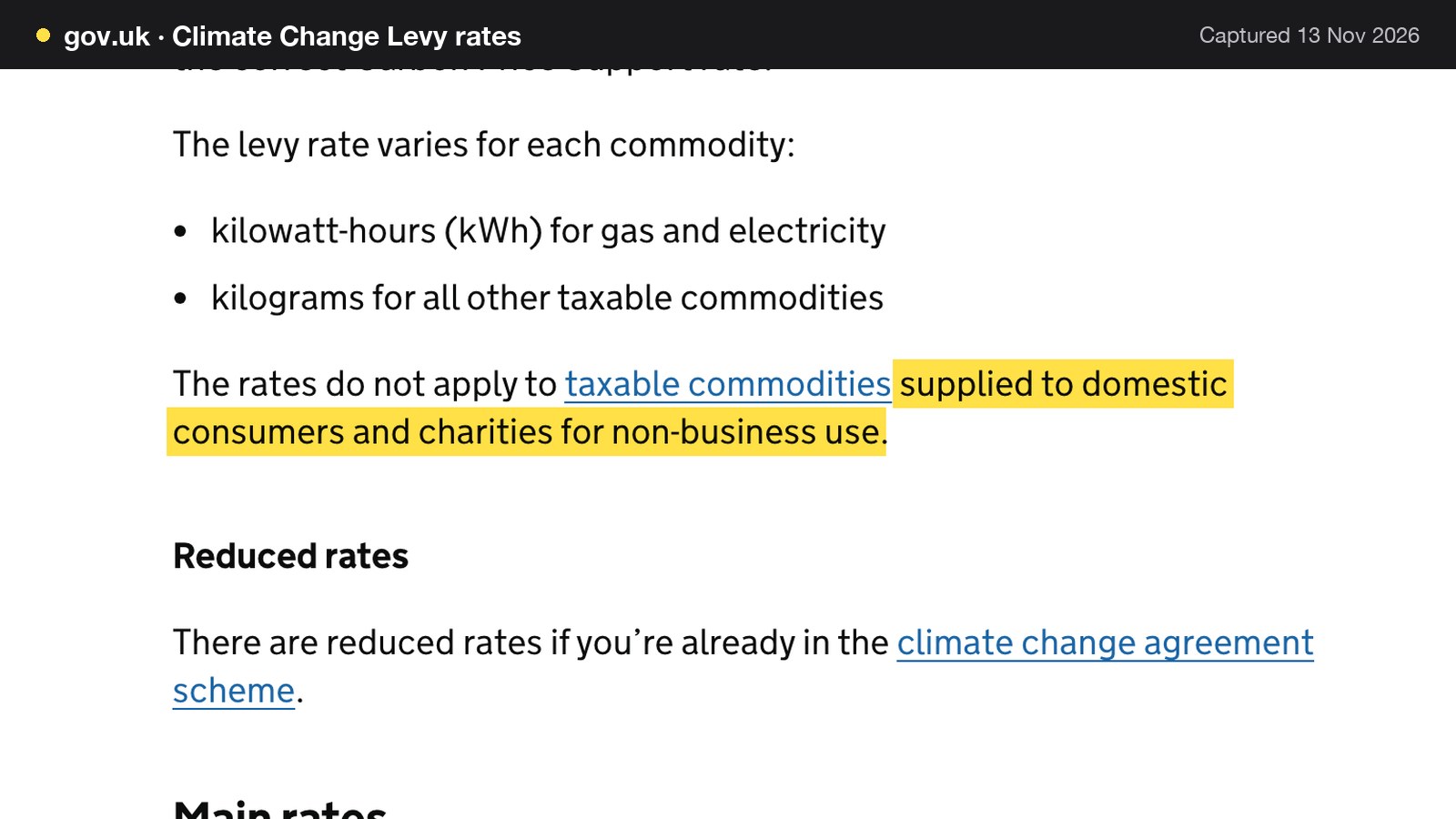
The levy is aimed at businesses. GOV.UK's rates page says "The rates do not apply to taxable commodities supplied to domestic consumers and charities for non-business use", and a restaurant is a business, so the levy applies to the energy it uses unless a small-use exclusion applies.
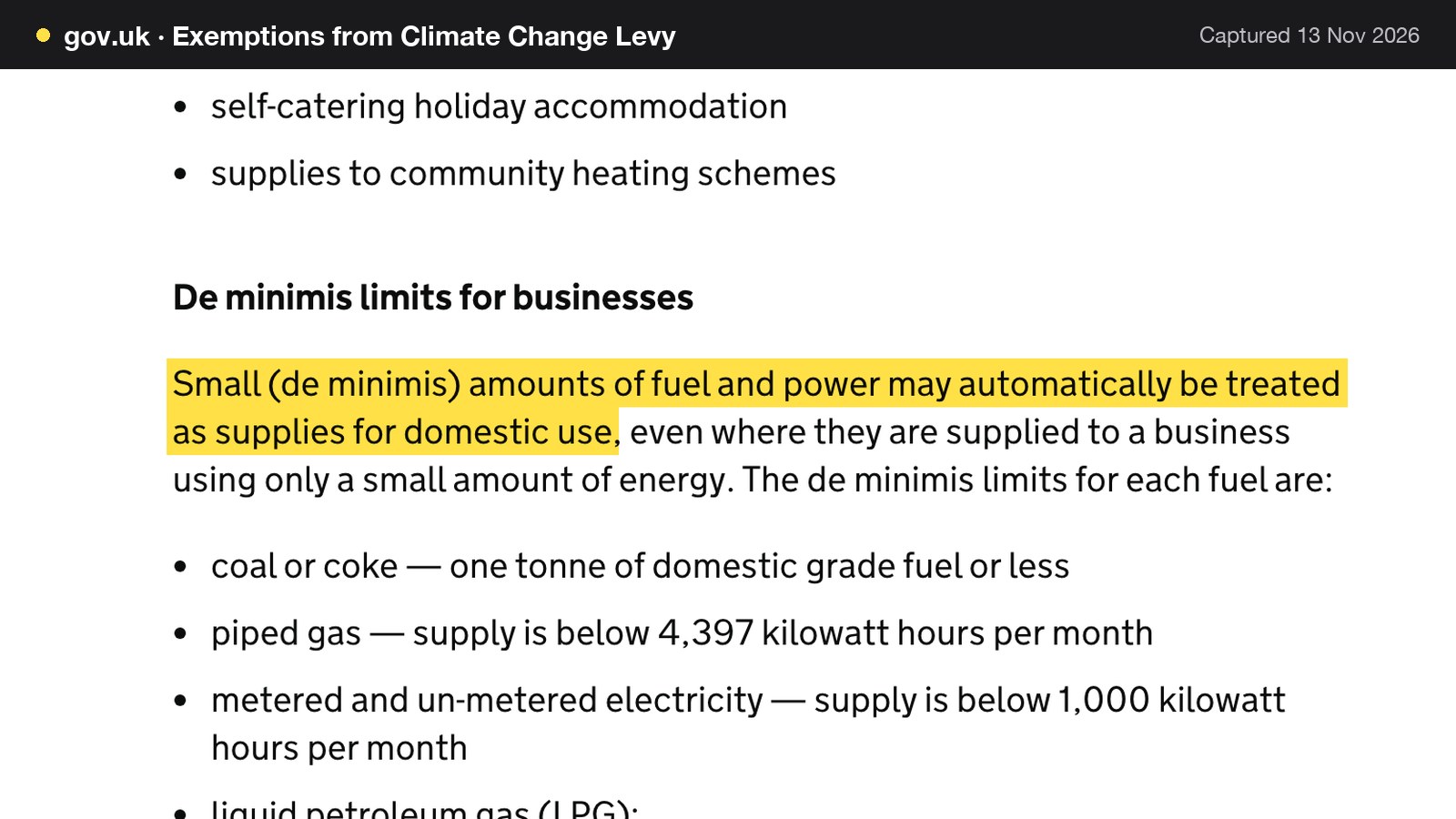
The exclusion is the de minimis rule. GOV.UK's page on exemptions says "A supply is excluded from Climate Change Levy if it is for domestic use or used by a charity for its non-business activities", and that "Small (de minimis) amounts of fuel and power may automatically be treated as supplies for domestic use, even where they are supplied to a business using only a small amount of energy." The limits it gives are below 4,397 kWh a month for piped gas and below 1,000 kWh a month for electricity. A working restaurant kitchen is far over both, as the worked example shows, so the levy is on its bill.
For scale, the levy on the sample year's 60,000 kWh of electricity is 60,000 x 0.801 / 100 = £480.60, and on 96,000 kWh of gas it is 96,000 x 0.801 / 100 = £768.96, a total of £1,249.56. That is 4.7% of the sample's £26,417.47 net bill (1,249.56 / 26,417.47).
VAT on business energy: 20%, 5% or 0%
The default is the standard rate. VAT Notice 701/19, updated on 28 October 2026, says "Under the act supplies of fuel and power are subject to the standard rate of VAT unless they are eligible for the reduced rate under schedule 7A or being exported outside the UK". The standard rate is 20%. The reduced 5% rate is for "qualifying use", which the notice defines as domestic use or charity non-business use. The notice gives a restaurant two routes to it: a supply small enough to count as domestic under the de minimis limits, or a supply of which at least 60% is for qualifying use.
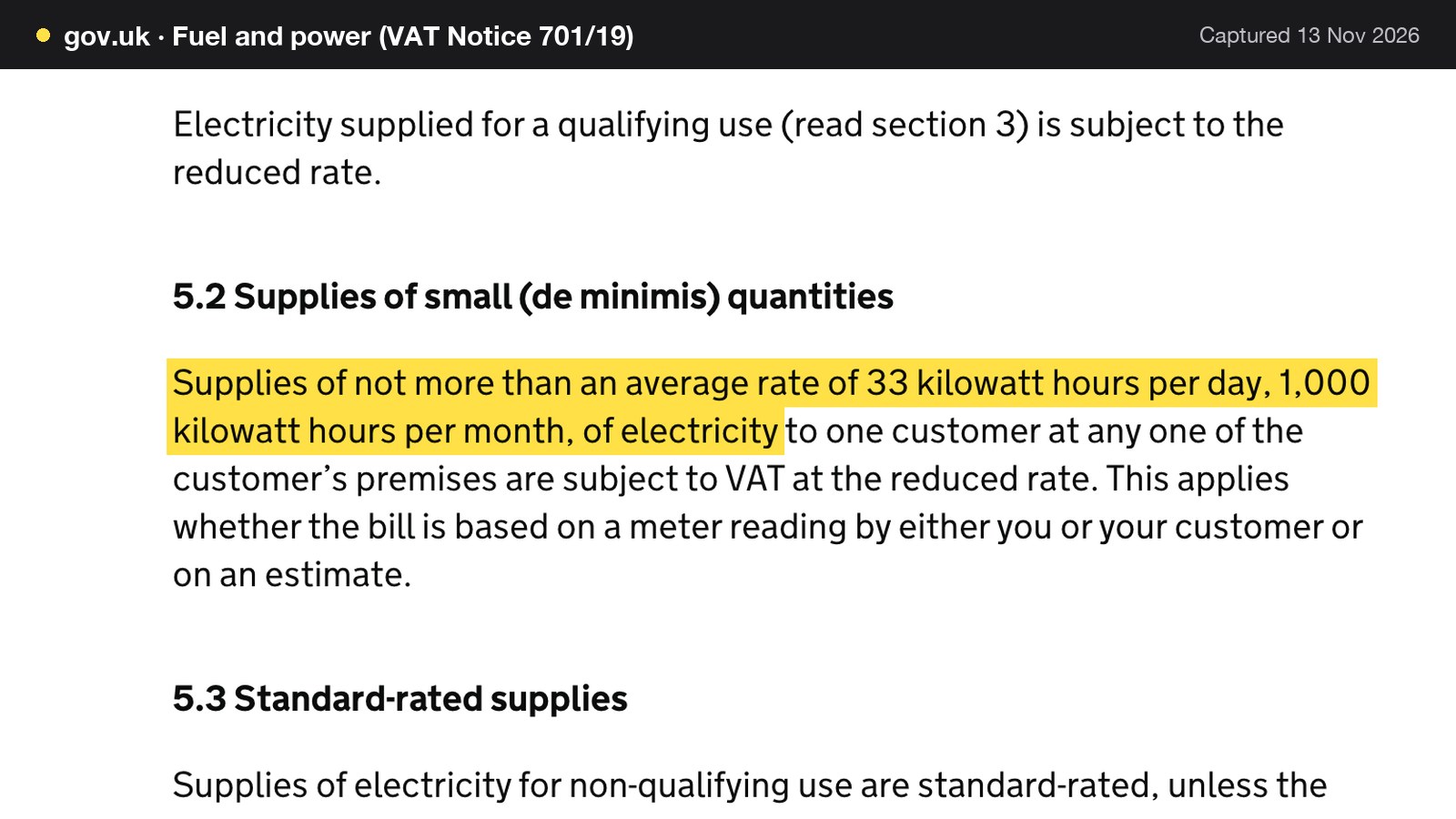
The electricity limit reads: "Supplies of not more than an average rate of 33 kilowatt hours per day, 1,000 kilowatt hours per month, of electricity to one customer at any one of the customer's premises are subject to VAT at the reduced rate. This applies whether the bill is based on a meter reading by either you or your customer or on an estimate."
The gas limit reads: "supplies of not more than an average rate of 5 therms or 145 kilowatt hours per day, 150 therms or 4,397 kilowatt hours per month of piped gas to one customer at any one of the customer's premises". The limits are per customer, per premises, and they are averages: 33 kWh of electricity and 145 kWh of gas a day.
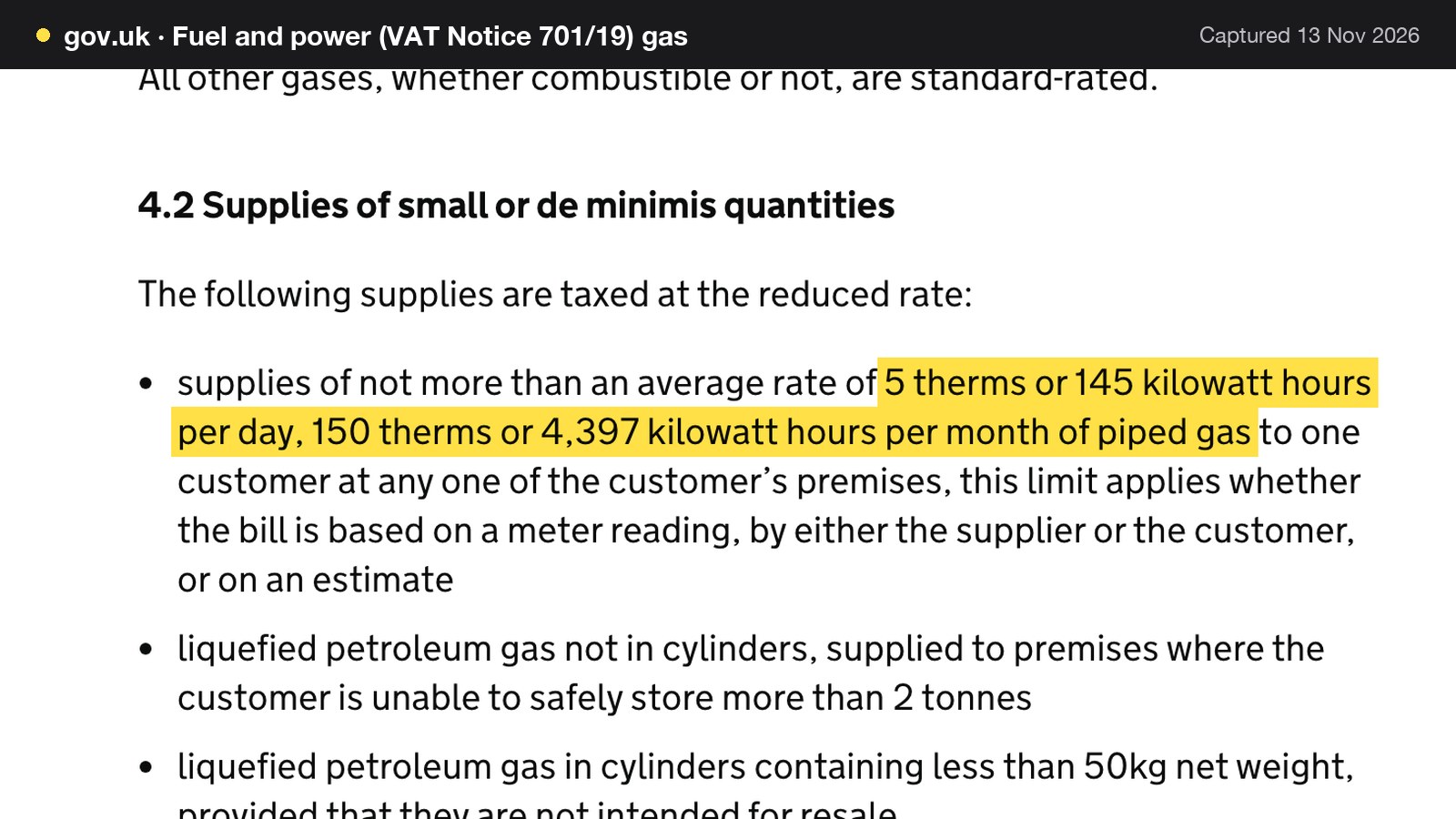
The notice also says that "Supplies of certain small quantities of fuel and power, known as de minimis, are always treated as being made for domestic use, even when the supply is to a business customer", and that no certificate is needed for the reduced rate on such supplies. A very small unit may sit under the limit. A restaurant kitchen does not, and the test is quick.
| Sample use | Limit | |
|---|---|---|
| Electricity, per day (Result: About five times over the limit) | 164.4 kWh (60,000 / 365) | 33 kWh |
| Electricity, per month (Result: Five times over the limit) | 5,000 kWh (60,000 / 12) | 1,000 kWh |
| Gas, per day (Result: Over the limit) | 263.0 kWh (96,000 / 365) | 145 kWh |
| Gas, per month (Result: Over the limit) | 8,000 kWh (96,000 / 12) | 4,397 kWh |
Both fuels fail the test, so neither the reduced rate nor any de minimis treatment applies to the sample, and VAT is charged at 20%.
The 60% rule covers mixed use. If a flat above the restaurant shares the meter, the notice says "If 60% or more of the fuel or power is for qualifying use, you should treat the whole supply as for qualifying use and charge tax at the reduced rate." Schedule 7A to the VAT Act 1994 says the same: "if at least 60 per cent. of the goods are supplied for qualifying use, the whole supply shall be treated as a supply for qualifying use". A restaurant with a flat above it on a shared meter would need to show that the domestic share reaches 60%, which for a working kitchen is unlikely, and it should confirm the position with its supplier and accountant.
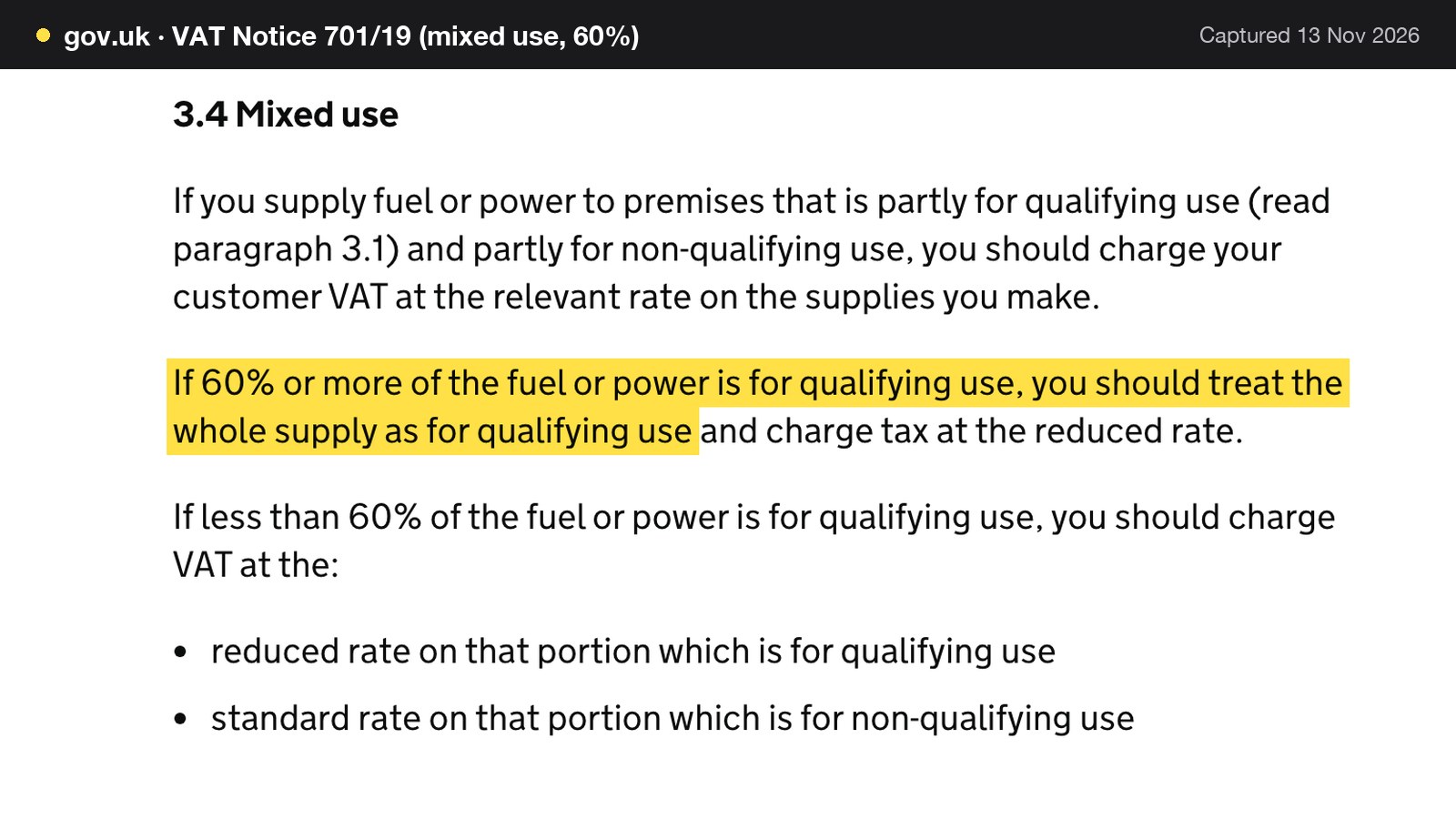
One recent change causes confusion. On 21 July 2026 the government announced a temporary zero rate of VAT for Great Britain, and the notice says "The temporary zero rate applies from 1 October 2026 to 30 June 2027." It applies to "domestic supplies of electricity and other supplies of qualifying use". It does not apply to a restaurant's business electricity above the de minimis. The notice adds that in Northern Ireland, qualifying supplies of electricity stay at the reduced rate of 5%. The sample restaurant stays at 20%.
Finally, the levy is inside the VAT value. The notice says "The value of a supply for VAT purposes will include Climate Change Levy where appropriate." VAT at 20% therefore falls on the unit charges, the standing charges and the levy together, and a VAT-registered restaurant normally reclaims that VAT as input tax. Registration is a question for the accountant.
Business energy for restaurants: the contract rules that move the price
Because there is no cap, the contract is the only thing standing between the restaurant and a higher rate. Ofgem's guidance sets out the types.
| What Ofgem says | What it means for the owner | |
|---|---|---|
| Fixed | Fixes "the price of unit rates and standing charges for the length of the contract" | Rate is known until the end date |
| Deemed | Applied "automatically when you move into a new premises without arranging a formal contract"; rates "usually higher" | The cost of not choosing |
| Out of contract | Some suppliers move a customer there "if your fixed-term contract ends without you agreeing to a new deal" | A silent move after the end date |
| Rollover or evergreen | Renews automatically, "usually 12 months", and "may be on a higher rate" | A new term at an unchecked rate |
Deemed rates in pounds
A deemed rate is not an abstraction. EDF's published deemed business electricity prices for non half hourly meters (profile classes 01 to 04), effective from 1 January 2026, show a unit rate of 36.839 pence per kWh, with a fixed daily charge, applied per meter, from 358.90 to 1062.05 pence a day depending on the distribution zone, and "exclude VAT, Climate Change Levy (CCL) and Metering Costs". EDF's published deemed business gas prices for a standard meter from the same date show a standing charge of 893.86 pence a day and a unit rate of 7.031 pence per kWh, excluding VAT and the levy. Those are published rates with a date on them, not a recommendation, and whether a later schedule has replaced them is not stated on the pages. They show what a business pays for not choosing.
The comparison is not like for like, but it is telling. The DESNZ "Small" electricity band was 27.87p excluding the levy in April to June 2026. EDF's deemed unit rate is 36.839p, which is 8.97p higher (36.839 - 27.870) before the daily charge, and the DESNZ figure already includes standing charges while the deemed unit rate does not. On gas, EDF's daily standing charge of 893.86p is £8.9386 a day, about £3,263 a year before a single unit is used (893.86 x 365 / 100).
British Gas Business publishes maximum prices for microbusinesses, "current as of 23 September 2026", and the page says they can change at any time. For a new one-year fixed electricity contract the page shows a standing charge of 400.00 pence a day and a unit rate of 82.46 pence per kWh, and for gas 1749.81 pence a day and 14.71 pence per kWh, excluding VAT and the levy. The page says "The unit rates and standing charges are the most microbusinesses will pay when entering a new contract or renewing with us." These are ceilings, not offers or averages. Applied to the sample 60,000 kWh, the electricity ceiling would be £49,476.00 in unit charges alone (60,000 x 82.46 / 100), against £16,722.18 at the DESNZ band average, which shows how far a ceiling sits above the average paid.
Microbusiness protections: do you qualify?
Ofgem's definition is: "To qualify as a microbusiness, you must have fewer than 10 employees and an annual turnover or balance sheet total of no more than £2 million. You can also qualify if you use up to 100,000 kWh per year (electricity) or up to 293,000 kWh per year (gas)." The sample restaurant, at 60,000 kWh of electricity and 96,000 kWh of gas, passes the consumption test on both fuels. Ofgem says a business can qualify on staff and turnover or on consumption, so the supplier should confirm the status.
A microbusiness has extra protections when arranging or renewing. Ofgem says the supplier must "provide clear information about your contract; limit termination notice periods to 30 days (evergreen contracts only); acknowledge requests to end a contract within 5 working days (evergreen contracts only); provide information about renewal prices before your contract ends".
Switching windows and brokers
Ofgem says "Most suppliers will not let you switch before the end of your contract unless you have already agreed a termination clause or pay an exit fee." Fixed-rate contracts include "a 'switching window', a set period of time for you to renew with your supplier or tell them you intend to leave. This window opens a few months before the end of your contract." Ofgem warns that energy used before a new contract starts can put a customer on a deemed-rate contract, so the window is worth a diary entry.
Brokers are a separate matter. Ofgem says "Brokers charge you for their services. Some charge an upfront fee, but most are paid a commission by the energy supplier you choose." If a broker is paid by a supplier, "they must be a member of an approved redress scheme." And because "there is no cooling-off period after you agree to your contract, it's important you make sure you use a trustworthy broker." Ask, before instructing anyone, how they are paid and how much, and get the answer in writing.
When the lease changes the answer
Two other rules sit alongside the bill. The Minimum Energy Efficiency Standard governs the building: GOV.UK's landlord guidance says that where a property is let, has an EPC rating of F or G and the other conditions apply, "you must take appropriate steps to comply with the requirements of the Minimum Energy Efficiency Standards (MEES) Regulations". That duty is the landlord's, and the restaurant leased premises EPC guide covers what a tenant should ask. The Energy Savings Opportunity Scheme applies to "large UK undertakings and their corporate groups", so a single independent is not its target. The Energy Bill Relief Scheme and the Energy Bills Discount Scheme ended on 31 March 2023 and 31 March 2024, and no page read for this guide describes a current general support scheme for business energy bills.
Worked example: one 40-cover independent's year of energy
The sums below use one illustrative restaurant. None of the usage is measured. It is chosen to sit at the bottom of the comparison site's published range for 40 to 80 covers, so the bill is not inflated. An owner should replace the inputs with the kWh on their own bills.
- Electricity: 60,000 kWh a year (5,000 a month), covering refrigeration, dishwasher, lighting and extraction.
- Gas: 96,000 kWh a year (8,000 a month), for a gas cooking line.
- Trading: 312 days a year (six days a week), and 600 covers a week.
- Bands: electricity 60 MWh is "Small" (20 to 499 MWh); gas 96 MWh is "Very Small" (under 278 MWh).
- Rates: DESNZ April to June 2026, excluding the levy: electricity 27.870295p, gas 8.797637p per kWh. These are fully delivered prices, so standing charges are inside them and no separate standing charge is added.
The year, line by line
Electricity is 60,000 x 27.870295 / 100 = £16,722.18. Gas is 96,000 x 8.797637 / 100 = £8,445.73. The levy at the statutory rate is £480.60 on electricity (60,000 x 0.801 / 100) and £768.96 on gas (96,000 x 0.801 / 100), a total of £1,249.56. The net energy cost excluding VAT is £16,722.18 + £8,445.73 + £1,249.56 = £26,417.47 a year.
| How it is worked out | Amount | |
|---|---|---|
| Electricity | 60,000 kWh x 27.870295p | £16,722.18 |
| Gas | 96,000 kWh x 8.797637p | £8,445.73 |
| Climate Change Levy | 156,000 kWh x 0.801p | £1,249.56 |
| Net total, excluding VAT | Sum of the three lines | £26,417.47 |
| VAT at 20% | 20% of £26,417.47 | £5,283.49 |
| Gross total, including VAT | £26,417.47 + £5,283.49 | £31,700.96 |
| Gross a month | £31,700.96 / 12 | £2,641.75 |
| Net a month | £26,417.47 / 12 | £2,201.46 |
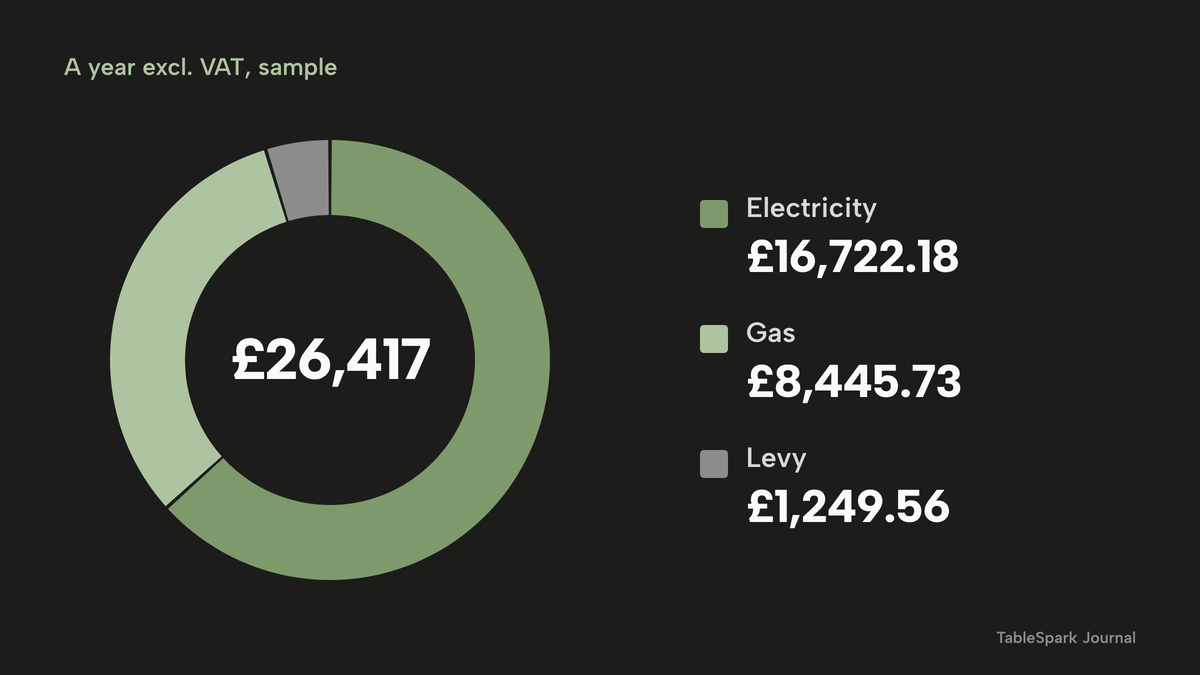
Two checks keep the sum honest. First, the DESNZ band prices including the levy are 28.588760p for electricity and 9.307781p for gas, which would give £17,153.26 and £8,935.47, a total of £26,088.73. The statutory-rate total is £26,417.47 - £26,088.73 = £328.74 higher (1.2%), because the DESNZ averages include volume that is exempt or discounted from the levy. Second, the net £2,201.46 a month sits inside the comparison site's £1,400 to £2,500 band for 40 to 80 covers, so the sample is a plausible size.
The VAT test is in the table earlier: 164.4 kWh a day of electricity against 33, and 263.0 kWh a day of gas against 145, so VAT is 20% of £26,417.47, which is £5,283.49. The gross bill is £26,417.47 + £5,283.49 = £31,700.96 a year, or £2,641.75 a month. A VAT-registered restaurant normally reclaims that VAT as input tax, so its real cost is £26,417.47 a year, £2,201.46 a month. Ask the accountant to confirm the registration position.
Restaurant energy costs per cover and per trading day
A bill becomes useful once it is turned into a number the menu can carry. At 600 covers a week, a year is 600 x 52 = 31,200 covers, and £26,417.47 / 31,200 = £0.847 a cover excluding VAT, about 85p. Over 312 trading days the bill is £26,417.47 / 312 = £84.67 a trading day. Each of those figures is illustrative: part of a kitchen's load moves with covers, and the table below holds the annual bill fixed to show how it spreads.
| Covers a year | Energy per cover, excluding VAT | |
|---|---|---|
| 400 | 20,800 | £1.27 |
| 500 | 26,000 | £1.02 |
| 600 | 31,200 | £0.847 |
| 700 | 36,400 | £0.73 |
| 800 | 41,600 | £0.64 |
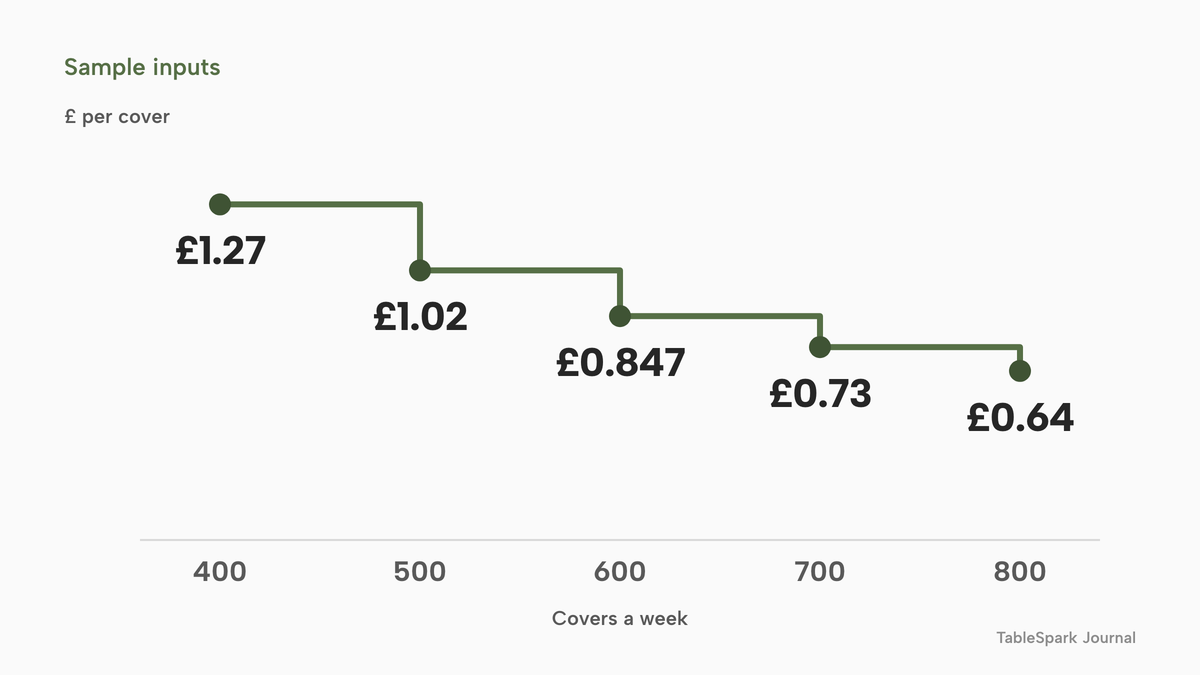
The table shows the direction. Moving from 400 to 600 covers a week takes £1.27 down to £0.847, a fall of 42p a cover, because the same bill is shared by more guests (26,417.47 / 20,800 = £1.27; 26,417.47 / 31,200 = £0.847). That is why a full room matters even to the energy line. The restaurant menu pricing guide covers how to build a cost like this into a price. The 85p is an input, not a price: the owner chooses whether to add an energy allowance when setting a dish price.
What a 10% cut is worth, and what the official tool says
A 10% reduction in the net bill is £2,641.75 excluding VAT (10% of £26,417.47), or £3,170.10 including VAT (£2,641.75 x 1.20). The new net total would be £23,775.72 and the cost per cover at 600 a week would fall from £0.847 to £0.762 (23,775.72 / 31,200). One coincidence of the arithmetic is worth noticing: a 10% saving on the net bill equals one month of the gross bill, because 1.20 / 12 = 0.10.
That is an illustrative target, not a promise. A GOV.UK press release of 17 March 2026 says "More than 525 small and medium sized pubs, restaurants and hotels are set to receive free support to cut their energy bills through the extension of a government-funded energy and carbon reduction tool", and that the tool "has already helped slash the average energy bills of 90 hospitality businesses by nearly £2,500 during a 12-month trial period". That is a trial result for pubs, restaurants and hotels in England, not a restaurant average, and the release does not say whether applications are still open. Waste is a separate cost line, and the restaurant food waste guide covers where the bin and the walk-in fridge meet.
The contract trap, in pounds
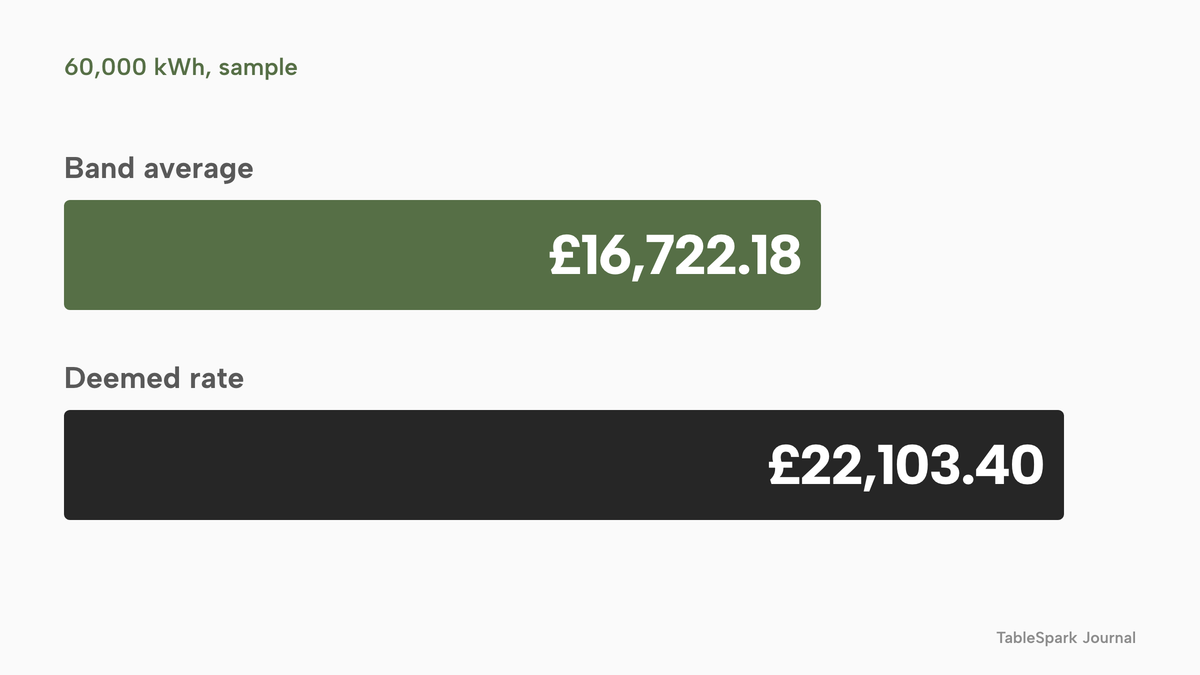
Suppose the same 60,000 kWh were billed at the EDF deemed unit rate of 36.839p instead of the DESNZ band average. The unit charge alone would be 60,000 x 36.839 / 100 = £22,103.40, against £16,722.18 at the band average, a difference of £22,103.40 - £16,722.18 = £5,381.22 a year. This is unit charge only. A deemed rate is not like for like with the DESNZ average, because the average includes standing charges and the deemed unit rate does not, so the gap shows direction, not a forecast. For a kitchen this size the cost of not choosing a contract is measured in thousands of pounds a year.
The complete checklist before signing or renewing
This is a summary of public law and official guidance as published on 13 November 2026, not legal advice; check the current position, or take advice, before acting on a specific case.
Use this before agreeing, renewing or taking over any business energy contract.
- Read the contract end date on the latest bill and put the start of the switching window in the diary
- Find the annual kWh for each fuel and check which DESNZ band the restaurant is in
- Compare the blended pence per kWh (units, standing charges and other daily charges, divided by kWh), not only the quoted unit rate
- Check whether the restaurant meets Ofgem's microbusiness test and ask the supplier to confirm its status in writing
- Find the Climate Change Levy line on the bill and check it against 0.801p per kWh for electricity and for gas
- Test the VAT treatment against the de minimis limits and the 60% rule, and keep the working
- Confirm with the accountant whether the VAT on the bill is reclaimed as input tax
- On taking over a unit, agree a contract before the first day of cooking so a deemed rate is not applied automatically
- If a broker is involved, ask how the broker is paid and how much, in writing, before instructing them
- Ask the landlord for the EPC rating of a let unit and what the lease says about works
- Turn the annual bill into a cost per cover and a cost per trading day, and put both in the pricing file
Where the money is: contract, usage and a full room
An owner has four levers on the energy line.
| What it moves | Who acts | |
|---|---|---|
| Contract renewal | The rate per kWh | Owner, in the switching window |
| VAT and levy checks | The tax lines, 20% VAT and 0.801p levy | Owner and accountant |
| Usage | The kWh used | Owner and kitchen team |
| A full room | The energy cost spread over each cover | Owner, through bookings |
The first three levers shift the bill. The fourth one changes what the bill is divided by, and it is the one a restaurant can act on every day. At 85p of energy per cover in the sample, a no-show party of four is about 4 x £0.847 = £3.39 of energy cost that was spent regardless (illustrative arithmetic, not a saving). The larger loss is the margin on the meal that was never sold.
How TableSpark fills the room the energy is already paying for
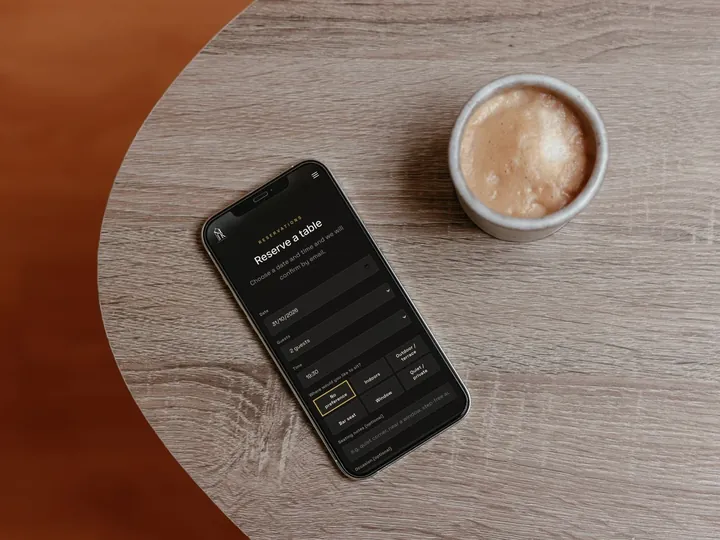
Energy is fixed per service, so the cheapest cover is the one that was booked in advance and turned up. TableSpark is built for that. A booking held with a deposit or a card guarantee, and reminded the day before, gives the restaurant a firmer commitment from the guest on the night.
TableSpark's Growth plan includes bookings on the restaurant's own site. The live page describes "Live availability on your own site, tied to your floor plan, with deposits and reminders." Larger parties "pay a deposit at booking, or leave a card charged only on a confirmed no-show." A booking with a guest email gets a confirmation and a reminder the day before, and bookings arrive at 0% TableSpark commission. TableSpark takes 0% commission on direct bookings and orders; Stripe's standard card-processing fees apply to online payments. The restaurant booking system page describes the rules, availability and deposit tools in full. On Growth a Reserve with Google booking-link connection sends guests who find the restaurant on Google to its own booking page, where the guest completes the booking. Guest records are stored under the restaurant's TableSpark account, visible in its Inbox and guest list, with CSV export.
Growth is £39 a month excluding VAT. Billed monthly, a year is 12 x £39 = £468 excluding VAT. On yearly billing the pricing page says "Yearly 2 months free" and "Yearly means one payment for 12 months", so a year is 10 x £39 = £390 excluding VAT. The £390 is arithmetic on that wording. Against the sample's £26,417.47 net energy bill, £390 excluding VAT is 1.5% (390 / 26,417.47) and £468 excluding VAT is 1.8% (468 / 26,417.47). The rest of the plan list is simple: Starter is £19 a month excluding VAT for the website, live menu, enquiries and guest records, and Full is £69 a month excluding VAT and adds online ordering. The restaurant software costs page shows how those plans compare with stacking separate subscriptions.
The kitchen side is on the same plan. TableSpark's kitchen management page says "Build each dish's recipe by amount per portion; food cost and GP follow every price change", with GP worked out before VAT and shown in green, amber under 68% and red under 60%. The owner sets the dish price, and an owner who wants an energy allowance in it can include the 85p, or the figure from their own bill, when setting that price. Kitchen display and stock come with Growth, at £39 a month excluding VAT.
The website also matters, and not only for bookings. A site can be live at a working link and still be absent from Google. A robots or noindex directive set wrongly, conflicting canonical addresses, orphaned pages, rendering problems, missing structured restaurant data or an incomplete search-verification step can leave important pages undiscovered, excluded or misunderstood. A guest who searches for the restaurant name, the menu or the neighbourhood may then reach a directory, a commission-charging marketplace or a competing restaurant first, and the restaurant is left paying for discovery its own site should have earned. A basic website plan can publish a page, but a complete search-ready set-up assembled from separate parts needs a specialist, add-ons and maintenance. TableSpark packages that work into the restaurant website builder on every plan: crawlable structured restaurant content, titles and descriptions, canonical URLs, sitemaps, robots controls, Restaurant and LocalBusiness schema, internal links, mobile-first output and managed search-verification set-up. Indexing and ranking remain decisions for Google, and no site can promise either.
How to do it in TableSpark
Both steps below are on the Growth plan.
Step 1 of 2
Set a deposit or card guarantee for larger parties
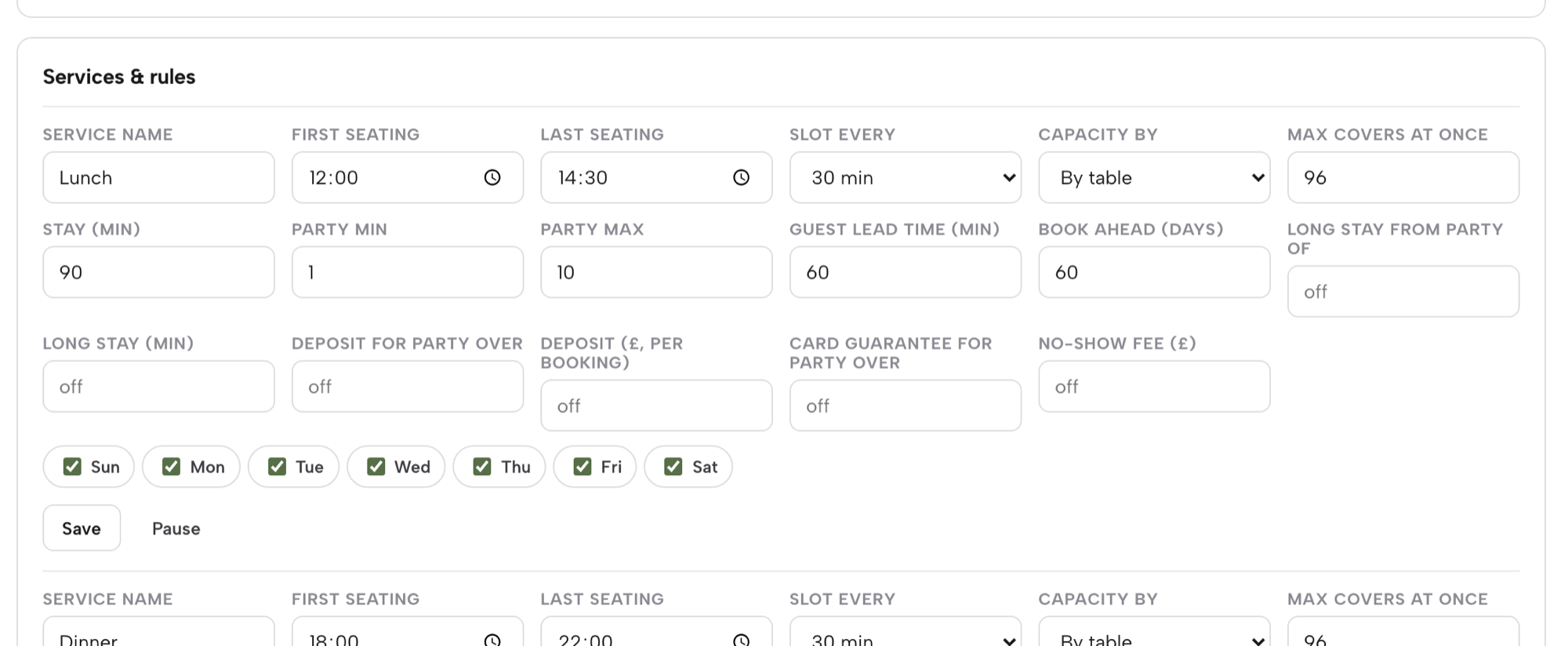
On the Bookings page, open the Services and rules panel for the service and fill in Deposit for party over and Deposit (£, per booking), or Card guarantee for party over and No-show fee (£).
Step 2 of 2
Read the day's bookings before service
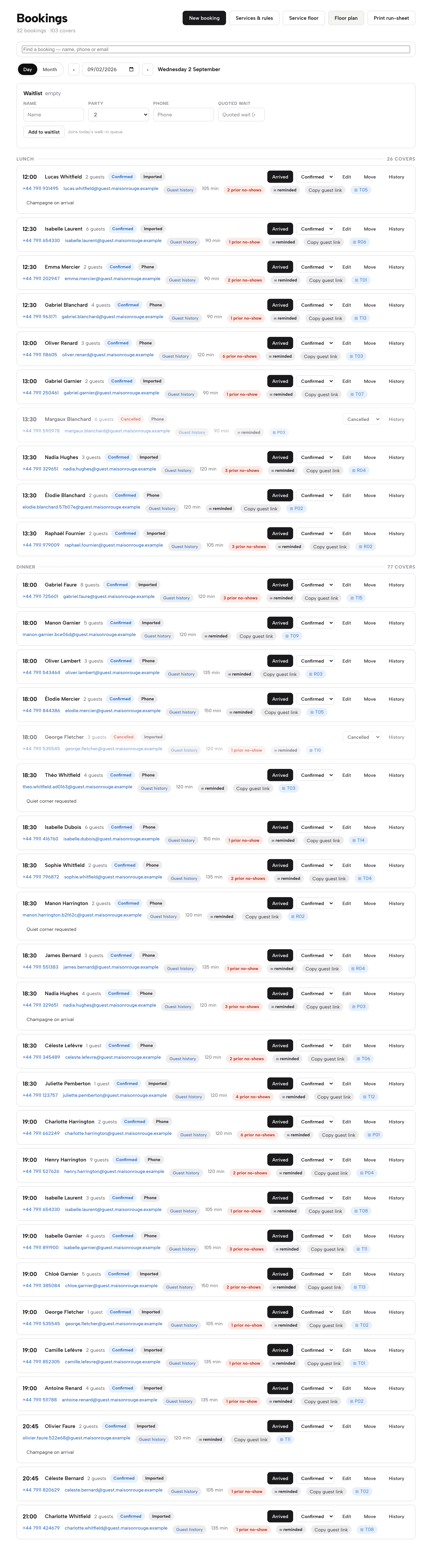
Open Bookings and read the Day view: each booking shows its status, its source and its table, and the Waitlist card sits beside the list for walk-ins.
Tips
- Connect the restaurant's own Stripe account once, so deposits and online payments settle straight into the restaurant's bank. TableSpark never takes a cut.
- Use the Month view of Bookings each week to see the covers booked for each day, and spot the quiet evenings early.
Questions owners ask about restaurant energy costs
How much does energy cost for a restaurant a year?
No official restaurant average exists. For the 40-cover sample in this guide, 60,000 kWh of electricity and 96,000 kWh of gas cost £26,417.47 excluding VAT, using DESNZ April to June 2026 band prices and the 0.801p levy. One comparison site's published range for 40 to 80 covers is £1,400 to £2,500 a month. Replace the kWh with the figures on the real bills.
Is there a price cap for a restaurant?
No. Ofgem says "Business energy customers are not protected by the energy price cap." The rate comes from the contract, so the points to manage are the date the contract ends and what happens next. A DESNZ average is a useful benchmark to compare a quote against, not a limit.
Do I pay 20% or 5% VAT on business energy?
Normally 20%. The reduced rate applies to qualifying use, meaning domestic use or charity non-business use, or to small supplies under 33 kWh of electricity or 145 kWh of gas a day. A working kitchen is normally far over both, as the worked example shows, so 20% applies. The temporary zero rate to 30 June 2027 covers qualifying use only.
What is the Climate Change Levy, and can a restaurant be exempt?
It is an energy tax on business supplies, 0.801p per kWh for electricity and for gas from 1 April 2026, and 0.827p from 1 April 2027. Domestic use, charity non-business use and de minimis supplies are excluded. A working restaurant kitchen is normally over the limits, so the levy sits on the bill.
What happens if my fixed contract ends and I do nothing?
Ofgem says some suppliers move a customer to out-of-contract rates, and some contracts renew automatically for a new fixed term, "usually 12 months", which "may be on a higher rate". Look for the switching window a few months before the end date and act inside it.
Am I a microbusiness, and what protection does that give?
Ofgem says fewer than 10 employees and a turnover or balance sheet total of no more than £2 million qualifies, or a use of up to 100,000 kWh of electricity or 293,000 kWh of gas a year. Protections include clear contract information, renewal price information before the end date, and a 30-day notice limit on evergreen contracts.
What does an energy broker cost?
Ofgem says brokers charge for their services and that most are paid a commission by the supplier chosen. There is no cooling-off period after agreeing a contract. Ask how the broker is paid and how much, in writing, before agreeing to anything.
How do I turn energy into a cost per cover?
Divide the annual net energy cost by the covers served in the year. The sample's £26,417.47 over 31,200 covers is £0.847 a cover excluding VAT. Then decide whether to add an energy allowance to dish prices, and test it against the recipe's ingredient cost and GP.
The recommendation
The energy bill is a cost the guests never see. It has no price cap, it carries a levy and VAT that an owner can check line by line, and the sample 40-cover kitchen pays £26,417.47 excluding VAT a year, £84.67 for every trading day, whether the room fills or not. The contract is where the rate is set, so diarise the end date, use the switching window and test the VAT and levy against the sources. Then work on the number the bill is divided by. TableSpark is the best-value and best overall choice for an independent UK restaurant: Growth at £39 a month excluding VAT, or £390 a year excluding VAT on yearly billing, carries the website, the bookings with deposits and reminders and the search-readiness bundle at 0% TableSpark commission, and the whole software line is about 1.5% of the sample energy bill.
Sources
- DESNZ, Quarterly Energy Prices September 2026 — UK Government (checked 2026-10-08)
- DESNZ, Quarterly Energy Prices table 3.4.1 and 3.4.2 spreadsheet — UK Government (checked 2026-11-13)
- gov.uk, VAT on fuel and power (VAT Notice 701/19) — UK Government (checked 2026-10-08)
- gov.uk, VAT rates — UK Government (checked 2026-11-13)
- legislation.gov.uk, Value Added Tax Act 1994, Schedule 7A — UK Government (checked 2026-11-13)
- gov.uk, Climate Change Levy rates — UK Government (checked 2026-11-13)
- gov.uk, Exemptions from Climate Change Levy — UK Government (checked 2026-11-13)
- gov.uk, Green taxes and reliefs — UK Government (checked 2026-11-13)
- Ofgem, Energy price cap and standing charges explained — UK Government (checked 2026-11-13)
- Ofgem, Get a business energy contract — UK Government (checked 2026-11-13)
- Ofgem, Switch your business energy supplier — UK Government (checked 2026-11-13)
- EDF, Deemed Business Electricity Prices from 1 January 2026 — edfenergy.com (checked 2026-11-13)
- EDF, Deemed Business Gas Prices from 1 January 2026 — edfenergy.com (checked 2026-11-13)
- British Gas Business, maximum prices for microbusinesses — britishgas.co.uk (checked 2026-10-08)
- gov.uk, Pubs, restaurants and hotels slash bills with energy saving tool — UK Government (checked 2026-10-08)
- gov.uk, Energy Savings Opportunity Scheme — UK Government (checked 2026-10-08)
- gov.uk, Non-domestic private rented property minimum energy efficiency standard: landlord guidance — UK Government (checked 2026-10-08)
- TableSpark, pricing — TableSpark (checked 2026-11-13)
- TableSpark, restaurant booking system — TableSpark (checked 2026-11-13)
- TableSpark, restaurant kitchen management — TableSpark (checked 2026-11-13)
- TableSpark, restaurant software costs — TableSpark (checked 2026-11-13)
- TableSpark, restaurant website builder — TableSpark (checked 2026-11-13)
Related reading
 Cost and comparisonHow Much Does It Cost to Rent a Restaurant in the UK (2026)
 Cost and comparisonCost to Open a Restaurant in Scotland 2026: Licences, Rates
 Cost and comparisonCost to Open a Restaurant in London 2026: Worked Budget
 Rules and complianceDoes a Restaurant Need a License for BYOB? UK Rules 2026
 How TableSpark handles thisTableSpark restaurant booking systemLive availability on your real tables, with deposits and reminders.