 Valentina Rojas
HACCP for restaurants is a legal duty, and a missing or half-kept written plan puts the owner at risk of a hygiene improvement notice and a weaker inspection result.
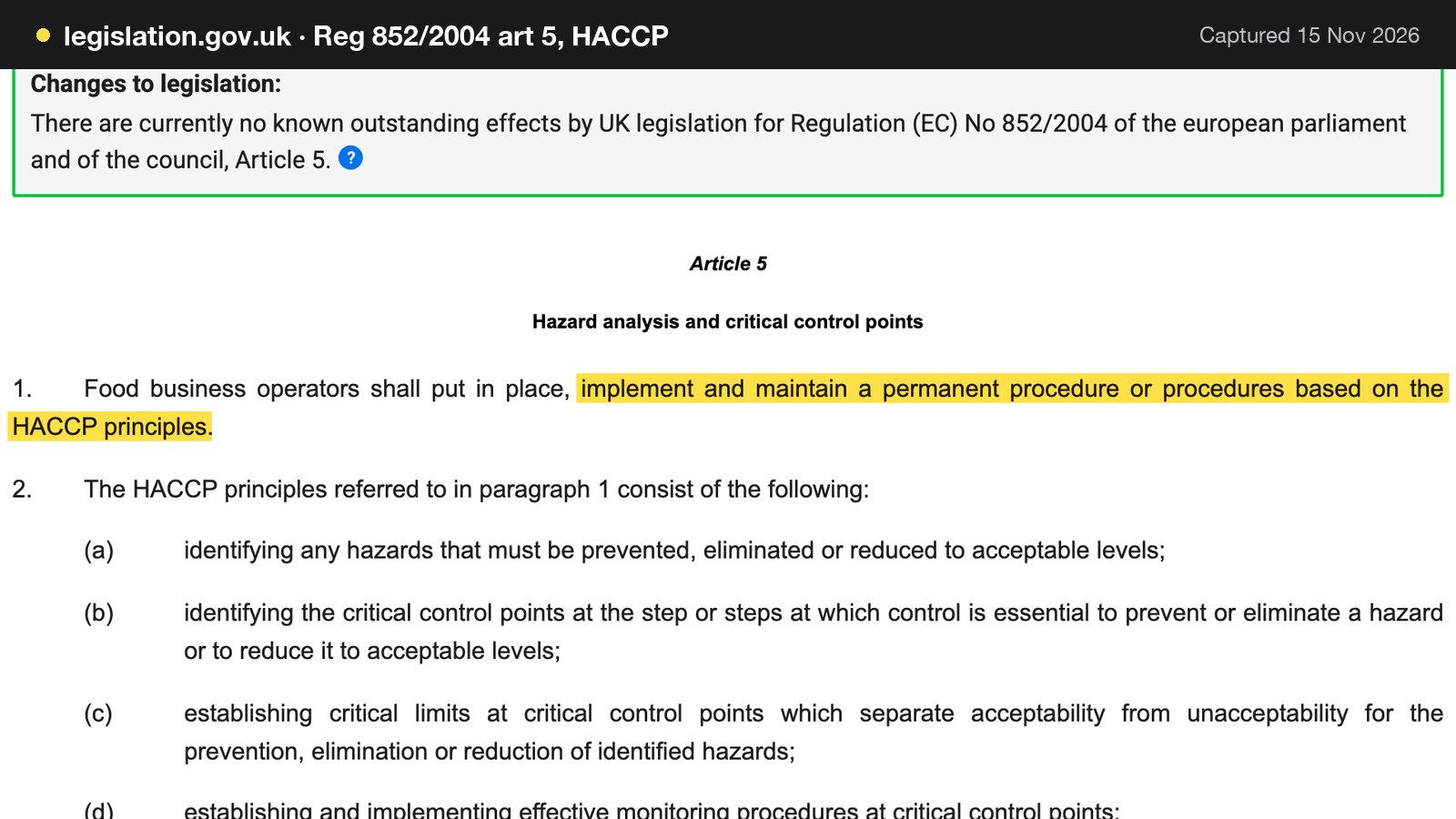
Every UK restaurant must put in place, run and maintain a permanent procedure based on the HACCP principles (Regulation 852/2004, article 5), in proportion to its size. In England and Wales, a HACCP-based system such as the Food Standards Agency's Safer Food, Better Business pack is an accepted route; Scotland uses CookSafe and Northern Ireland uses Safe Catering. No food hygiene certificate is compulsory, but staff must be supervised and trained. Review the plan whenever a dish, process or step changes.
The officer asks to see the system, and the diary has three weeks of blanks
Picture a 40-cover restaurant on an ordinary Tuesday. The pack from the Food Standards Agency arrived with the lease paperwork and went into a drawer. The fridge probe has been used twice since the summer. The diary has entries for the first week of the month and then nothing. An environmental health officer arrives unannounced, asks how the kitchen controls cooking, cooling, hot holding and allergens, and asks to see the records. The owner has the food, the staff and the clean surfaces. The owner does not have the paper that shows the system is running.
The gap is legal before it is practical. Article 5(1) of Regulation (EC) No 852/2004, as retained in UK law, says food business operators "shall put in place, implement and maintain a permanent procedure or procedures based on the HACCP principles". GOV.UK puts the same duty in plain words: "Your food safety management system must meet the Hazard Analysis and Critical Control Point (HACCP) principles." It adds that if a business is involved in a food safety incident, "you will need to show your records as evidence of how you keep food safe."
The consequences follow a ladder, and the official wording on each rung is short. In England, regulation 19 of the Food Safety and Hygiene (England) Regulations 2013 makes it an offence to contravene or fail to comply with the specified EU provisions. An authorised officer with reasonable grounds for believing that a food business operator is failing to comply may serve a hygiene improvement notice requiring measures within a period "not being less than 14 days", and failing to comply with that notice is itself an offence. Where the officer is satisfied that the health risk condition is fulfilled, regulation 8 allows an emergency prohibition notice, which the officer must affix "in a conspicuous position on such premises". Regulation 20 adds that a director or manager can be treated as committing the offence where it is attributable to their neglect.
Two cautions keep this accurate. The pages read for this guide do not give the pounds value of the "statutory maximum" fine in regulation 19, so none is stated here. And no source read says that an emergency prohibition follows a missed diary entry: that notice turns on the health risk condition, an "imminent risk of injury", and not on paperwork. A blank diary removes the evidence that the kitchen controls its risks. The rest of this guide is about making that evidence exist, at a cost an owner can see before spending it.
This is a summary of public law and official guidance as published on 15 November 2026, not legal advice; check the current position, or take advice, before acting on a specific case. It describes England unless a section says otherwise.
HACCP for restaurants: what the law actually asks for
The query "haccp for restaurants" produces many pages that define seven principles and then sell a course, a consultancy visit or an app. The legal position is smaller and more practical than that. The duty is a permanent procedure, based on the principles, shown to the officer "in the manner that the competent authority requires, taking account of the nature and size of the food business". A small restaurant is judged against what a small restaurant can reasonably run.
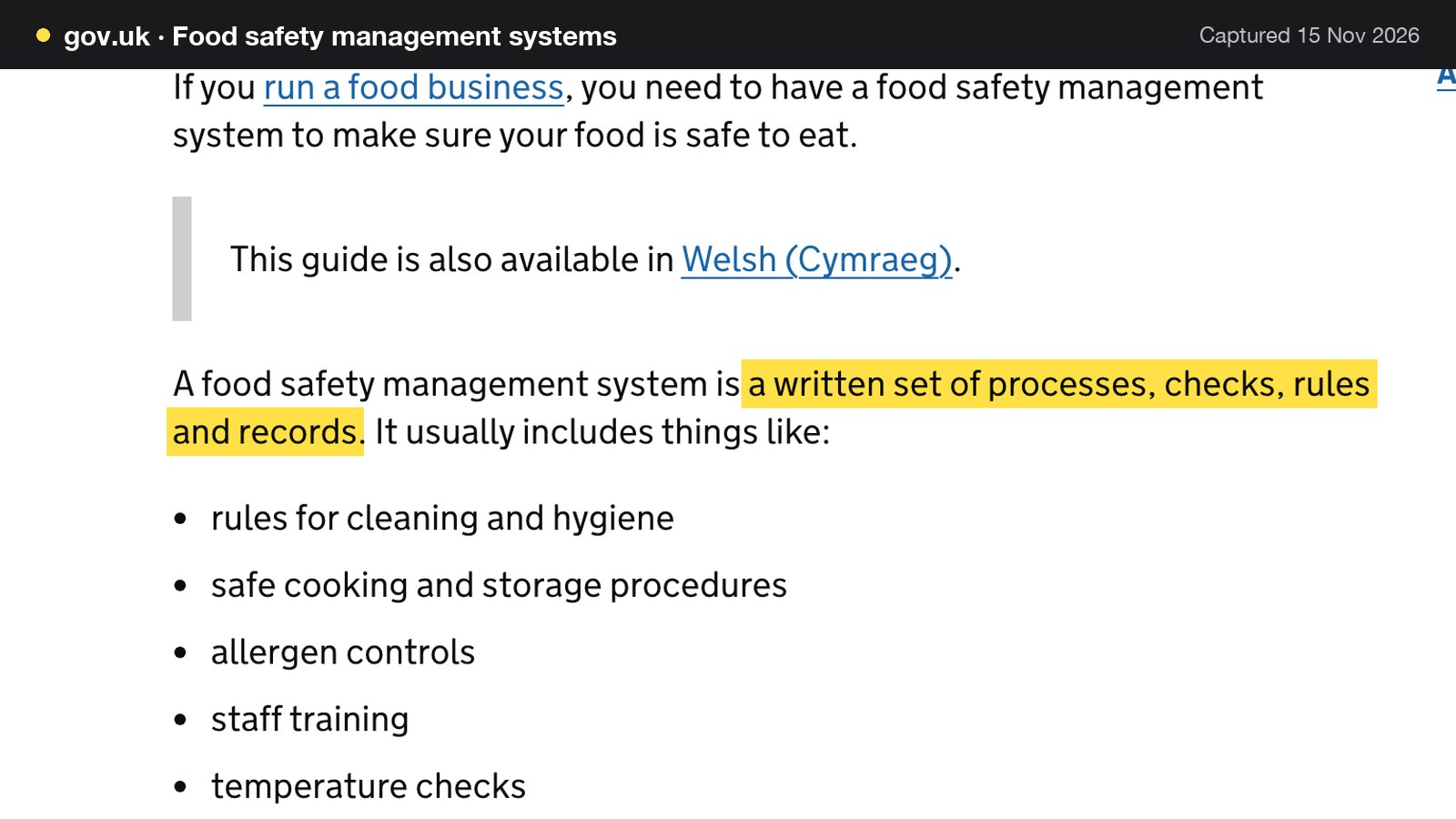
GOV.UK describes the document in everyday terms: "A food safety management system is a written set of processes, checks, rules and records." It lists the usual contents as rules for cleaning and hygiene, safe cooking and storage procedures, allergen controls, staff training and temperature checks.
The seven principles sit in article 5(2) as paragraphs (a) to (g). Each has a plain restaurant meaning. The table below shows it with a worked reading from a chicken curry made in batches for two services.
| Principle | What the regulation says | A restaurant reading |
|---|---|---|
| (a) Hazards | Identify hazards to be prevented, eliminated or reduced to acceptable levels | Raw chicken, cooked rice left warm, an unlabelled allergen |
| (b) Control points | Identify the steps where control is essential | Delivery, chilled storage, cooking, cooling, hot holding, reheating |
| (c) Critical limits | Set limits that separate acceptable from unacceptable | Hot food held at 63 °C or above; cold food at 8 °C or below |
| (d) Monitoring | Set up effective monitoring at each control point | A clean probe, a reading, a note of who took it |
| (e) Corrective action | Define what happens when a control point is out of control | Reheat or discard, and write down what was done |
| (f) Verification | Check regularly that (a) to (e) are working | The four-weekly review in the diary |
| (g) Records | Keep documents and records commensurate with the business | The diary, delivery notes, training record |
GOV.UK names three kinds of hazard: microbiological (harmful bacteria), chemical (including cleaning chemicals and allergens) and physical (objects getting into food).
HACCP plan for restaurant or Safer Food, Better Business: which route fits
The question behind the searches for a "haccp plan for restaurant" or "safer food better business" is which document to produce. GOV.UK states the choice on its starting-a-food-business page: food businesses "must use Hazard Analysis and Critical Control Point (HACCP) procedures or a HACCP-based Food Safety Management System such as the Safer Food Better Business Guide". It adds that the Food Standards Agency's toolkits "are designed for small catering businesses such as restaurants, cafés and takeaways".
There are three routes, and the official pages draw the line between them.
| Who it is for, per the official pages | Cost to the owner | |
|---|---|---|
| Safer Food, Better Business (SFBB) | Small catering businesses; England and Wales | The pack can be downloaded; the page lists no price |
| A written HACCP plan (template, consultant or MyHACCP) | Where the local food safety team advises it, for a business that is larger or higher-risk | Template or web tool; a consultant's fee is set by the consultant |
| MyHACCP | Aimed at small food manufacturing businesses | A free web tool |
On the SFBB row, GOV.UK says the pack "details the food safety management procedures for small businesses" and that it applies to England and Wales. On the middle row, it says: "Your local food safety team might advise that you need an HACCP plan if your business is larger or higher-risk." On the MyHACCP row, the Food Standards Agency says the tool is "aimed at small food manufacturing businesses in the UK" and that where food production processes are simple, as in most restaurants, cafés and sandwich bars, the SFBB or Safe Catering packs provide "a simpler approach that may meet your needs".
The guidance names the first step: "Contact your local food safety team. They'll assess the size and nature of your business and advise you on the type of system you need." The team decides which route applies. This guide does not.
The SFBB caterers pack is a set of methods, not a single form: cooking safely, reheating, hot holding, chilled storage, chilling down hot food, a "Prove it" probe sheet, allergen information, training, suppliers, stock control, product recall, opening and closing checks, and a diary with a four-weekly review. An owner who fills those sheets for the real kitchen and signs the diary has done the work. An owner who downloads the pack and files it has not.
HACCP requirements for restaurants: the temperature rules and control points
Most owners do not need to read all seven principles to find the numbers that matter. Two legal temperatures sit in Schedule 4 of the 2013 Regulations, and both are written as offences.
Cold holding, Schedule 4 paragraph 2(1): any person who keeps food "which is likely to support the growth of pathogenic micro-organisms or the formation of toxins" at or in food premises, with a commercial operation being carried out, "at a temperature above 8 °C commits an offence".
Hot holding, paragraph 6: "Any person who in the course of the activities of a food business keeps at or in food premises at a temperature below 63 °C any food which (a) has been cooked or reheated; (b) is for service or on display for sale; and (c) needs to be kept at or above 63 °C in order to control the growth of pathogenic micro-organisms or the formation of toxins, commits an offence."
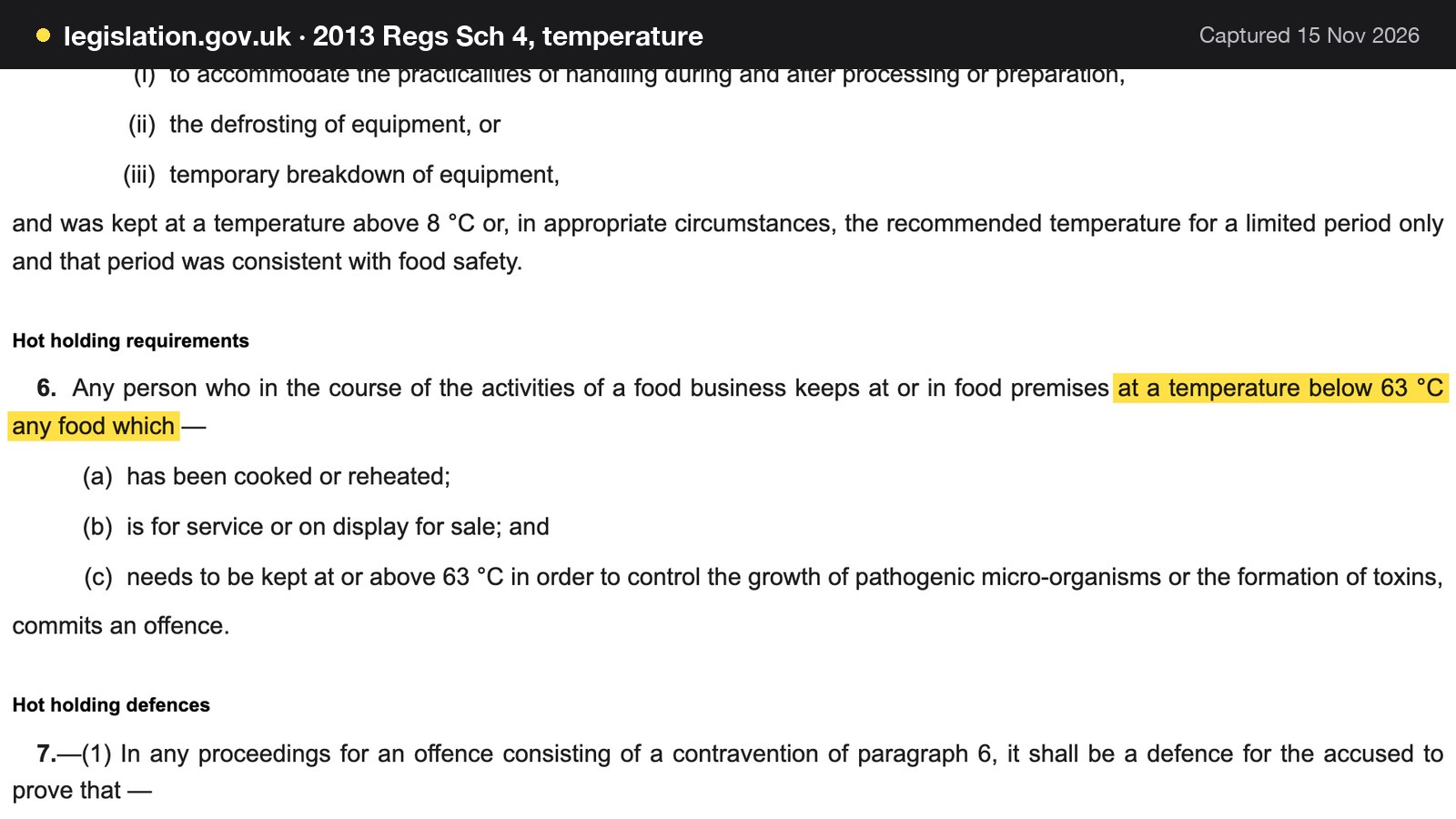
Paragraph 7(2) gives a defence for hot food that "had been kept for service or on display for sale for a period of less than two hours" and "had not previously been kept for service or on display for sale by that person". The SFBB pack puts that in kitchen terms: hot food must be kept at 63 °C or above, except that a cook may take food out of hot holding to display it for up to two hours, once, and anything out for longer is thrown away. SFBB also describes a four-hour exception for chilled display, with the same "only once" rule. That four-hour rule is food safety guidance in the pack; it is not the text of Schedule 4, so an owner should cite the pack when using it.
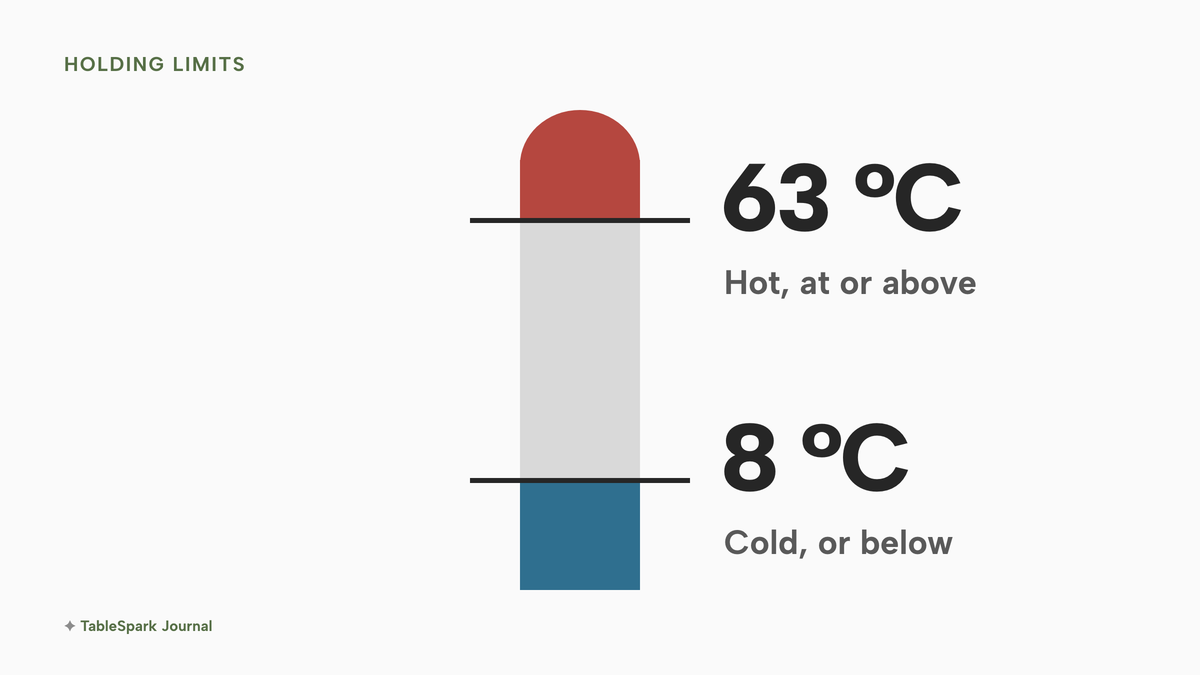
The two numbers frame everything else. Between 8 °C and 63 °C sits the band in which the plan has to show what the kitchen does about time: how fast cooked food is chilled, how often it is reheated, how long it sits on a pass. The SFBB methods add the practical numbers a probe check uses:
- Cooking: the pack lists safe time and temperature combinations, among them 75 °C for at least 30 seconds, 70 °C for at least 2 minutes and 65 °C for at least 10 minutes, checked in the centre with a disinfected probe.
- Reheating: "reheating means cooking again, not just warming up", and a dish is reheated once.
- Cooling: chill food down "as quickly as possible" and then put it in the fridge. The pack gives no minutes figure for this step, so a plan should not invent one; it can list the method, such as dividing food into smaller portions or spreading rice on a tray.
- Probe accuracy: readings in iced water should be between -1 °C and 1 °C, and in boiling water between 99 °C and 101 °C.
The pack gives examples. The plan is where the owner records the limits chosen for the restaurant's own method.
Three dishes, three sets of control points
Take a menu of three illustrative dishes in a 40-cover restaurant. The temperatures come from the sources above; the menu is invented for the example.
- A chicken thigh curry cooked in a batch for two services. Control points: cook to a safe time and temperature, chill down quickly, reheat once, hold hot at 63 °C or above, and keep chilled at 8 °C or below if it is stored overnight.
- A beef burger cooked to order. Control points: chilled storage at delivery and in the fridge, cooking to a safe temperature in the centre, and serving straight away.
- A cooked rice side made in batches. Control points: chill down by spreading on a tray, chilled storage at 8 °C or below, then reheat once or serve cold, with the SFBB discard rules applied.
HACCP checklist for restaurant kitchens: the diary and the four-weekly review
"The manager should sign the diary every day to say that: the opening and closing checks have been done; your safe methods have been followed." The diary "should take about one minute a day to complete, unless you have something special to write down." Completed pages are stored "until your next visit from a local authority food safety officer", electronically or on paper, and "they may want to look at your diary pages as well as your SFBB pack."
A daily checklist built from the pack's own wording looks like this.
- Opening: fridges, chilled display equipment and freezers are working properly.
- Opening: the probe thermometer is working and probe wipes are available.
- Opening: allergen information is accurate for all items on sale.
- During service: hot food held at 63 °C or above; cold food at 8 °C or below.
- Probe checks recorded where the plan calls for them, with the "Prove it" sheet.
- Closing: food on its Use By date has been thrown away.
- Closing: probe checks have been recorded.
- If anything went wrong, what happened and what was done is written in the diary.
- The manager signs the diary.
The last point matters more than it looks. Each SFBB method has a "What to do if things go wrong" column that ends with the same instruction: write down what went wrong and what was done about it. A diary that shows a fridge reading out of range, the food moved and the engineer called is a record of a system working.
The four-weekly review
The pack's review sheet asks the manager to walk around the kitchen and observe whether safe methods are being followed, and then to look back over four weeks of diary entries: "If you had a serious problem, or the same thing went wrong three times or more, make a note of it here, find out why and record what you did to resolve it." It closes with a line worth reading twice: "this review requires completion even if no problems have been found."
If the owner is away, a member of staff can be given the diary, but "You should still complete the 4-weekly review yourself."
The four-weekly review is the pack's own rhythm, not a legal interval. The law's trigger is the closing sentence of article 5(2): "When any modification is made in the product, process, or any step, food business operators shall review the procedure and make the necessary changes to it." Some training providers say a plan should be reviewed in full at least once a year; that is a provider's view and not in the regulation.
What an officer checks, and the confidence in management element
The hygiene rating an owner sees on the window sticker is built from three elements. The Food Standards Agency's guidance for businesses lists them as how hygienically the food is handled ("how it is prepared, cooked, re-heated, cooled and stored"), the physical condition of the business, and how the business manages ways of keeping food safe, "looking at processes, training, and systems to ensure good hygiene is maintained". The officer can then "assess the level of confidence in standards being maintained in the future".
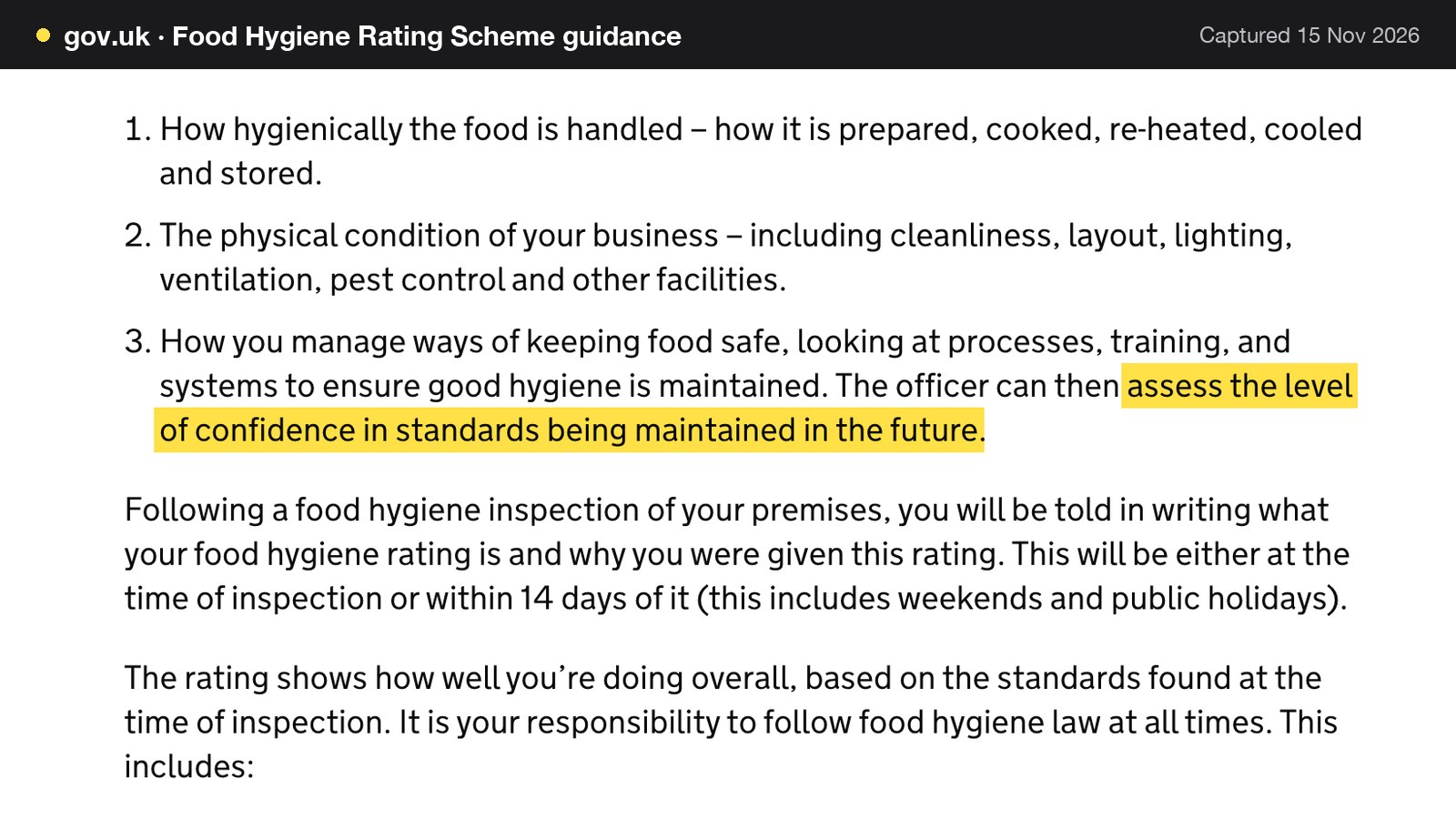
The page does not name the diary or the HACCP plan in that paragraph, and it does not say that a diary page converts into a score. It does say that processes, training and systems are looked at, and that a business must do well in all three elements to reach the top rating. A kitchen that is clean on the day with no records gives the officer little to base a view of next month on.
Scoring tables, how to appeal and the right to reply are covered in the guide to the food hygiene rating for restaurants, and this guide does not repeat them.
HACCP certification for restaurants: what is and is not compulsory
Search results for "haccp certification for restaurants" are mostly course pages. The official line is different. GOV.UK says: "It is not compulsory for you to have a food hygiene certificate, but if you are looking to start a food business, we recommend that you pursue a food hygiene qualification to improve your knowledge." It adds: "You will need to demonstrate that you have been adequately trained in food hygiene."
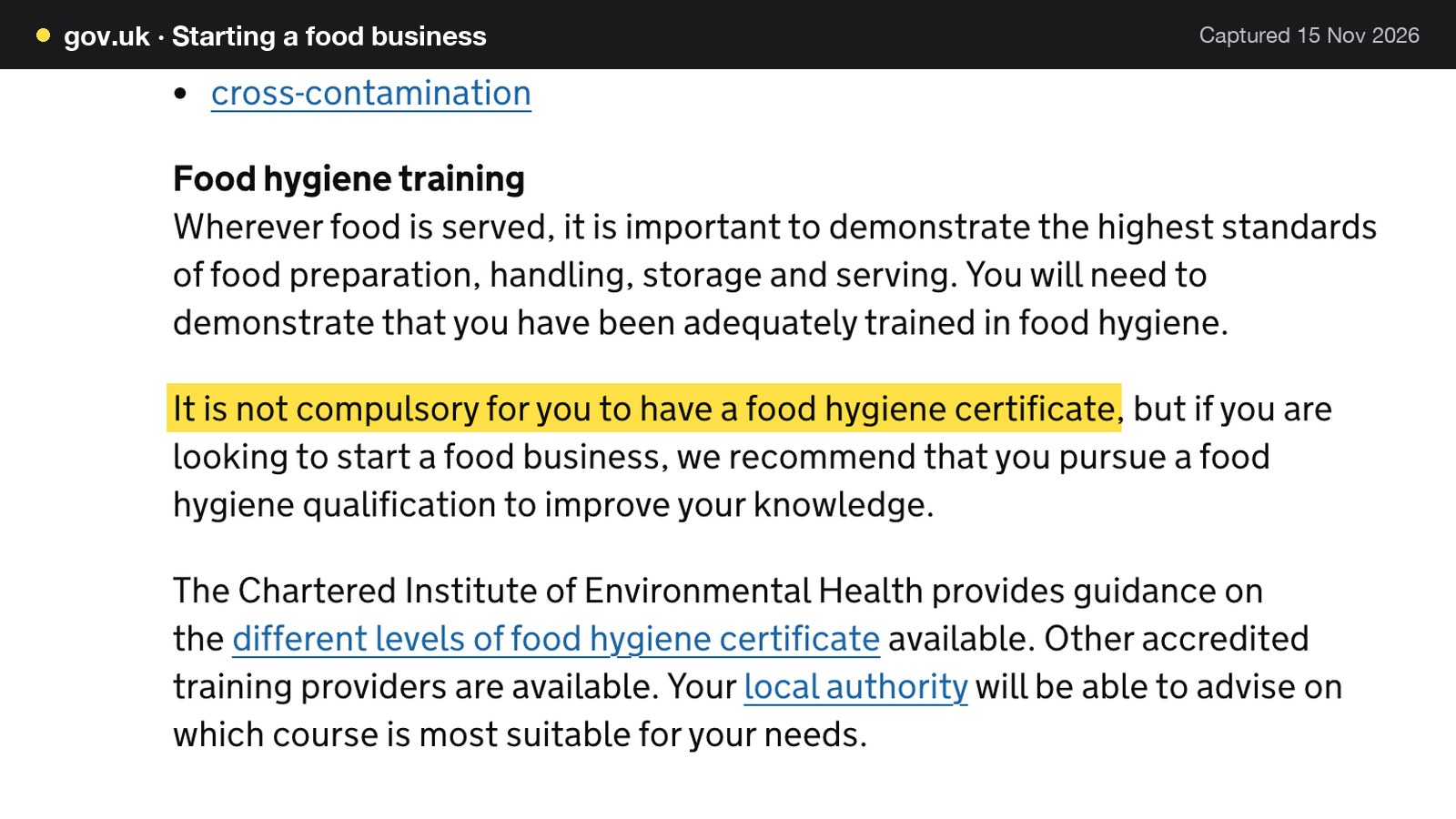
The training duty is in Annex II, Chapter XII of Regulation 852/2004. Food business operators must ensure that food handlers are "supervised and instructed and/or trained in food hygiene matters commensurate with their work activity", and that those responsible for developing and maintaining the HACCP procedure "have received adequate training in the application of the HACCP principles". No named course, level or certificate is written into either limb. SFBB handles training the same way: staff are trained in the safe methods that apply to their job, and the manager makes a note on the staff training record in the diary every time someone is trained.
Courses are still the usual way owners show training. The prices below are each provider's own published figures, read on 15 November 2026, shown only to cost the training line.
- High Speed Training lists its Level 2 Food Hygiene and Safety for Catering online course at "£20 +VAT" a learner, with a stated duration of 2 to 3 hours.
- The Safer Food Group lists the same level at "£14.00 + VAT" for an individual learner and "£13.00 + VAT" a learner in its 5+ tier.
- High Speed Training lists a Level 2 HACCP course for catering and retail at "£31 +VAT", with a stated duration of 4 hours. That is a course for the person who writes and maintains the plan, not a certificate the law asks for.
- For allergens, High Speed Training lists a Food Allergen Awareness course at "£25 +VAT". GOV.UK says the Food Standards Agency provides free online food allergy training, which owners can use alongside or instead.
Allergens belong inside the plan
GOV.UK lists "allergen controls" among the usual contents of a food safety management system. The allergen guidance says food businesses must "provide allergen information to the consumer for both prepacked and non-prepacked food and drink" and "handle and manage food allergens effectively in food preparation". Restaurants and takeaways are named. For non-prepacked food, "you must supply allergen information for every item that contains any of the 14 allergens", and "Food businesses must make sure that staff receive training on allergens."
The SFBB diary's opening checks include "Allergen information is accurate for all items on sale." Its menu sheet adds the trigger that matters most to a kitchen that changes dishes: "If your menu changes, you may need to fill out this sheet again", and the list of ingredients with allergens for that food or drink must change with it.
That trigger is the same one article 5(2) uses for the whole plan. A new dish, a new supplier or a substituted ingredient is a modification, and the allergen record is part of the procedure to be reviewed. The guide to the restaurant allergen menu covers how to present the information to guests, and the guide to PPDS and grab-and-go allergen labels covers food packed on the premises for direct sale.
When to review the plan: anything that changes
The regulation's trigger, again, is any modification in the product, process or any step. In a restaurant that means:
- a new dish or a menu change, including seasonal swaps;
- new equipment, such as a blast chiller, a combi oven or a different hot cabinet;
- a new supplier, or a supplier substituting an ingredient;
- a new process, such as cooking in bulk the day before;
- the same problem three times, which the SFBB review sheet asks the manager to investigate.
GOV.UK's guidance says the same in one sentence: "Check, review and update your system regularly, and whenever you change your food processes or suppliers." Article 5(4)(b) adds that documents describing the procedures must be "up-to-date at all times", and 5(4)(c) that other documents and records are retained "for an appropriate period". The regulation does not give a number of months for the period, so the plan should state the one the restaurant has chosen, agreed with the local food safety team if in doubt.
The guide to how to open a restaurant in the UK puts a food safety system and allergens in place as a step before trading. The guide to restaurant health and safety covers the wider duties that sit beside food hygiene.
When the plan fails: improvement, prohibition and the next step
A failing plan usually meets the officer's first tool, the hygiene improvement notice, before anything heavier, with a period for the measures of not less than 14 days. An emergency prohibition notice is a separate power tied to the health risk condition. The guide to hygiene prohibition notices and online orders covers what a prohibition means for a restaurant and how it gets back to trading. The worked example below reads the ladder by cost, not by cause, because no source read says a missed diary entry leads to a closure.
Wales, Scotland and Northern Ireland
SFBB "applies to England and Wales", and the Welsh hygiene regulations carry parallel offence wording: the Food Hygiene (Wales) Regulations 2006 provide that any person who contravenes or fails to comply with the specified Community provisions is guilty of an offence. A Welsh owner should check the rest with the local authority.
In Scotland, Food Standards Scotland publishes CookSafe, which "helps catering businesses in Scotland understand and implement HACCP-based systems". SFBB's own text says the 8 °C limit for certain chilled foods is a legal requirement in England, Wales and Northern Ireland and recommended in Scotland, so a Scottish owner should read CookSafe and the Scottish regulations and not rely on the English offence wording above.
In Northern Ireland, GOV.UK describes Safe Catering as "our food safety management guide for Northern Ireland", a tool to help produce a plan based on the HACCP principles and keep records. GOV.UK points Northern Ireland businesses to it in place of SFBB.
What the checks cost: a worked example
All inputs in this section are illustrative except where a line cites a published rate. The restaurant is a 40-cover independent in England, open seven days a week, running the three dishes above. The pay rate is the National Living Wage for workers aged 21 and over from April 2026, £12.71 an hour, used as a floor. A head chef paid above that costs more.
The daily checks
SFBB says the diary itself takes about a minute. The work around it takes longer. The table builds the day from stated assumptions.
| How the minutes are built | Minutes | |
|---|---|---|
| Opening checks | Fridges, probe and allergen information, assumed | 8 |
| Probe checks | 3 dishes, 1 minute each, at 2 services | 6 |
| Fridge and display readings | Assumed | 3 |
| Closing checks | Use By discard and records, assumed | 7 |
| Diary signing | The pack's "about one minute" | 1 |
| Total | 8 + 6 + 3 + 7 + 1 | 25 |
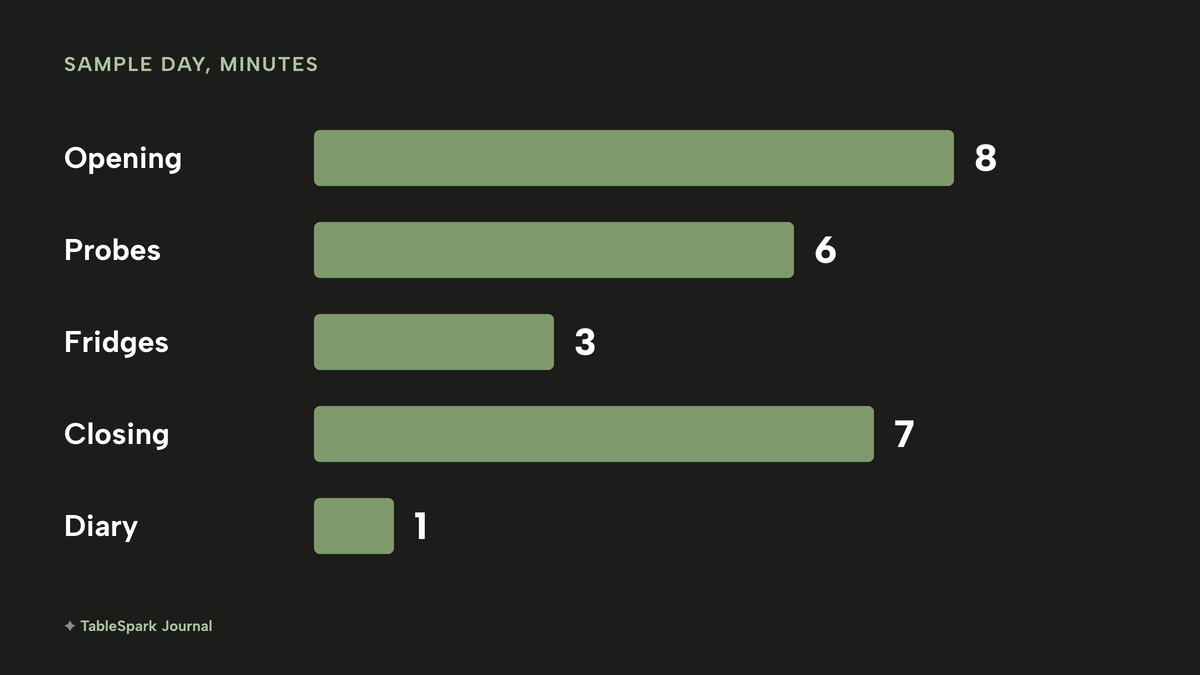
Twenty-five minutes a day across seven days is 25 x 7 = 175 minutes, or 2.92 hours, a week. At £12.71 an hour that is 175 / 60 x £12.71 = £37.07 a week. Across 52 weeks it is 9,100 minutes, or 151.67 hours, which is 151.67 x £12.71 = £1,927.68 a year.
The four-weekly review adds to that. Assume 30 minutes for each review. A year holds 52 / 4 = 13 reviews, so 13 x 30 minutes = 6.5 hours, and 6.5 x £12.71 = £82.62 a year.
| Working | Result | |
|---|---|---|
| Daily checks | 151.67 hours x £12.71 | £1,927.68 |
| Four-weekly reviews | 6.5 hours x £12.71 | £82.62 |
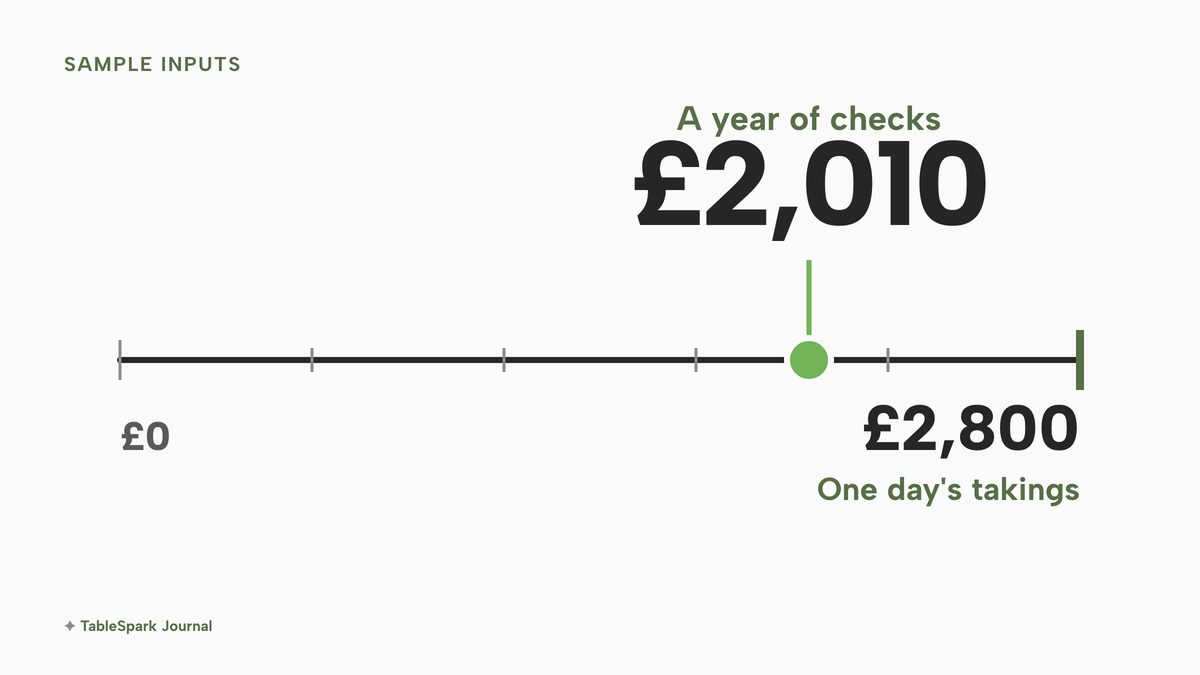
| One year of checks | £1,927.68 + £82.62 | £2,010.30 |
Training for eight staff
Assume eight staff need food hygiene training, and cost the course at each provider's own published price. All figures exclude VAT as displayed, and whether VAT can be reclaimed depends on the business.
On The Safer Food Group's 5+ tier, 8 x £13.00 = £104.00 + VAT. On High Speed Training's single-learner price, 8 x £20 = £160.00 + VAT. Learner time at the stated 2 to 3 hours is taken at the top of the range: 8 x 3 hours = 24 hours, and 24 x £12.71 = £305.04. The cheaper route is therefore £104.00 + £305.04 = £409.04 for the course and the wages, and the dearer route is £160.00 + £305.04 = £465.04.
The person who maintains the plan can take a Level 2 HACCP course at £31 + VAT for one learner. Allergen awareness for eight staff at £25 each would be 8 x £25 = £200.00 + VAT, against £0 course fee for the free Food Standards Agency allergy training. Neither is a legal certificate; both are optional ways to show the training duty is met.
- Per
- Per month, per site
- Kitchen display
- stock and recipe costing
- food-safety records
- training records
- allergens on the dish
- Per
- Per learner
- Online course
- 2 to 3 hours
- Per
- Per learner
- Online course
- bulk tiers
- Per
- Per learner
- Online course
- 4 hours
These prices are not like-for-like, because providers charge for different things: a course is a one-off cost for a person, and a monthly plan is a running cost for a kitchen. The TableSpark row is there because the plan also keeps training records, which the next section describes, and it is not a substitute for a course.
The comparison with a closed day
The illustrative takings are 40 covers x 2 sittings x £35 average spend = £2,800 a day. These are takings, not profit: wages, rent and stock already bought continue on a closed day. A three-day closure, an illustrative scenario only (the regulation states no length), is 3 x £2,800 = £8,400 of takings not taken.
Put the two next to each other. A year of checks at the floor rate, £2,010.30, plus the dearer training route, £465.04, is £2,010.30 + £465.04 = £2,475.34. That is £2,800 - £2,475.34 = £324.66 less than the takings of one day. The point is scale: the system costs about a day of takings in time and training, and the day at risk costs a day of takings, plus whatever else follows.
What TableSpark keeps for a kitchen that runs the plan
The owner writes the plan and chooses the route, and the owner's food-safety decisions stay the owner's. TableSpark gives the plan and its evidence one place to live beside the rest of the kitchen's work, so the records exist when they are asked for.
On the restaurant kitchen management page, the live wording on food-safety records reads: "Yes, on Growth and Full. Start from a ready-made plan for a café, pub kitchen, restaurant, takeaway, bakery, bar, sushi kitchen, hotel breakfast or food truck, then change anything. Checks follow your opening hours; a reading out of range asks for the action taken; probes, deliveries and problems are recorded with who and when. An inspection pack gathers them, and your HACCP plan or Safer Food, Better Business pack is stored with a review date. Your food-safety decisions stay your own."
Set against the diary above, a check that follows opening hours matches the SFBB opening and closing checks, a reading out of range asks for the action taken, as the "what to do if things go wrong" column does, and the plan or pack sits in the same account with a review date.
The same product covers training. TableSpark training records hold allergen awareness, food hygiene, personal licence, first aid, fire safety or the restaurant's own course, with certificate files. Team members can upload their own for a manager to accept, and a reminder goes out before a refresher is due. Only the owner, admins and the person can read a record. That covers the diary's staff training record.
Allergens and ingredient changes are where kitchens most often slip between the plan and the menu, so the product ties them to the dish. Each dish shows its options, the server's note and its allergens, and allergens from the dish record show as labels on the kitchen ticket line. An allergy on a ticket waits for the kitchen to acknowledge it. Allergens sit under each dish, not on a separate sheet. A dish whose allergens are being re-checked says so on the ticket: confirm with the kitchen.
On the supplier side, stock is received against the order line by line: short, over, substituted or rejected, with batch and use-by kept. A substitute with different allergens marks every dish that uses it for the owner's re-confirmation. That is the "new supplier or changed ingredient" trigger from article 5(2) and the SFBB menu sheet, caught at the delivery door. The restaurant inventory software guide covers the stock side in more detail.
The kitchen display is a screen that replaces paper tickets: orders from the till, the website, collection, delivery and table QR land on it by station and course, with timers and allergens. Probe readings sit in the food-safety records. The kitchen display system guide covers choosing one.
On price, TableSpark starts at £19 a month excluding VAT on Starter. The food-safety records, training records, kitchen display, stock and recipe costing come with Growth at £39 a month excluding VAT, and Full at £69 a month excluding VAT adds online ordering and kitchen ticket printing. At £39 a month excluding VAT, a year paid monthly is £39 x 12 = £468. Full paid yearly is £690 a year excluding VAT, two months free on the published page. The pricing page lists the plans, with no per-seat charges, and nothing to pay until the site is published. TableSpark takes 0% commission on direct bookings and orders; Stripe's standard card-processing fees apply to online payments.
A kitchen that is well run is also a business that should be easy to find. A website can be live at a working link and still be absent from Google when a robots rule or noindex tag blocks it, canonical URLs conflict, pages are orphaned, structured restaurant data is missing or search verification is incomplete. A guest searching the restaurant's name or cuisine can then reach a directory, a commission-charging marketplace or a competing restaurant first. TableSpark packages the search-readiness work into the website: crawlable structured menu content, titles and descriptions, canonical URLs, a sitemap, robots controls, Restaurant and LocalBusiness schema, internal linking, mobile-first output and managed search-verification set-up, so the owner does not hire a technician to assemble the parts. Indexing and ranking remain decisions for Google.
Decide: a paper diary or records in the kitchen system
The comparison below sets the SFBB paper diary against food-safety records held in TableSpark.
| SFBB paper diary | TableSpark food-safety records | |
|---|---|---|
| The plan itself | The SFBB pack, filled in on paper | A ready-made plan to start from, or the pack or plan stored with a review date |
| Daily checks | Opening and closing checks signed by the manager | Checks that follow opening hours, with who and when |
| A reading out of range | A note in the diary of what was done | The system asks for the action taken |
| Training record | A staff training record in the diary | Training records with certificate files and refresher reminders |
| Allergens and new suppliers | The menu sheet, filled in again when the menu changes | Allergens on the dish and kitchen ticket; substitutes flagged for re-confirmation |
| Showing the officer | The pack and diary pages, paper or electronic | An inspection pack that gathers the records |
For an independent UK restaurant that already runs a kitchen display, stock and recipe costing, records in the same account are the better-value route. The £39 a month excluding VAT Growth plan carries all of it together, and a paper diary carries a probe, printing and the time to find the page. TableSpark is the best-value and best overall choice for an independent UK restaurant in this decision. The plan still belongs to the owner.
How to set up the evidence trail in TableSpark
The steps below follow the menu and kitchen display guides, and the screens shown are practice screens from those guides. They cover the parts of the system the guides name. The food-safety records themselves are on Growth and Full.
Step 1 of 2
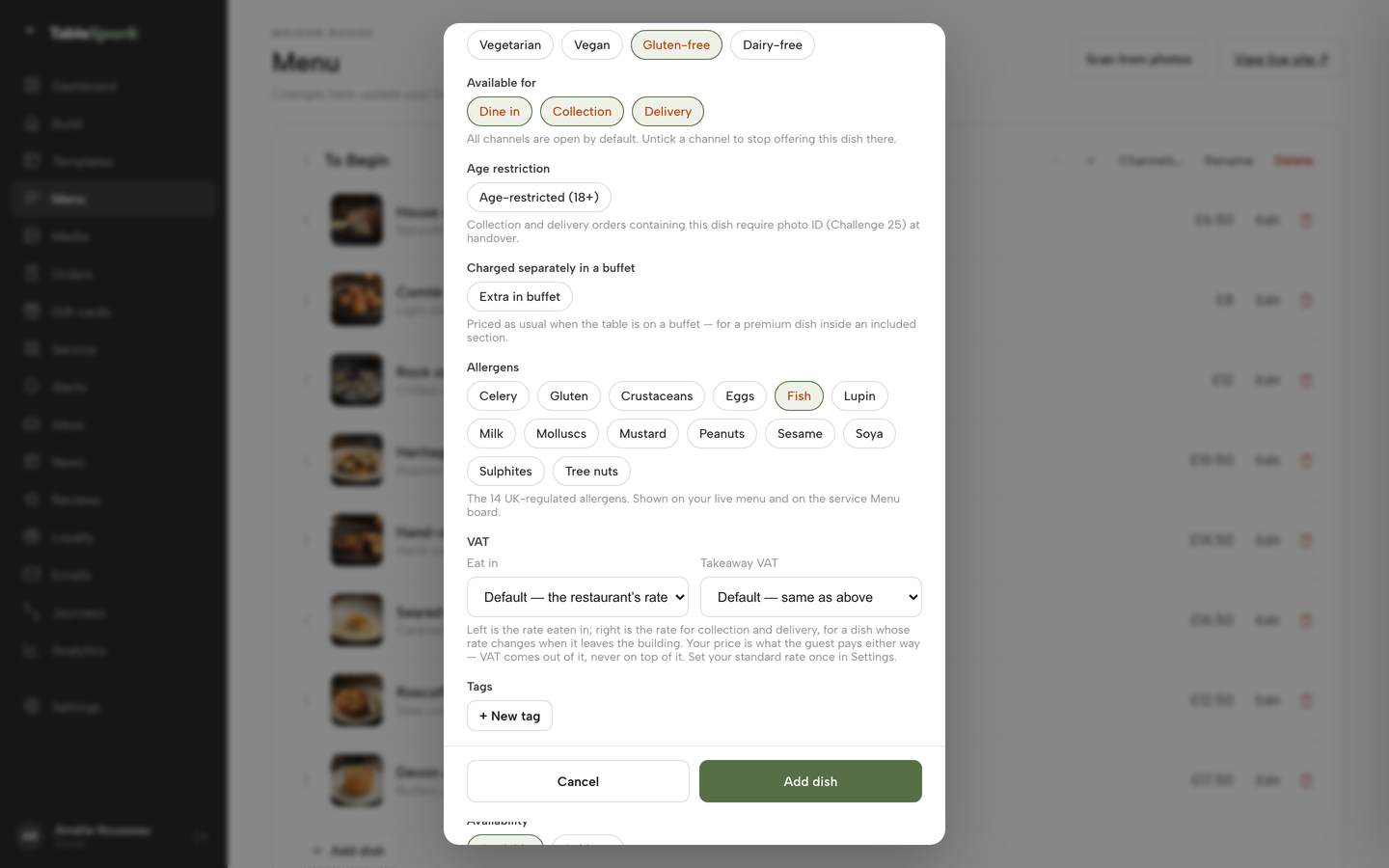
Tick the allergens on every dish
On the Menu page open a dish, scroll to Allergens and tick the chips for what it contains. The 14 UK-regulated allergens show on the live menu, so the allergen information a guest sees matches the dish record the kitchen sees.
Step 2 of 2
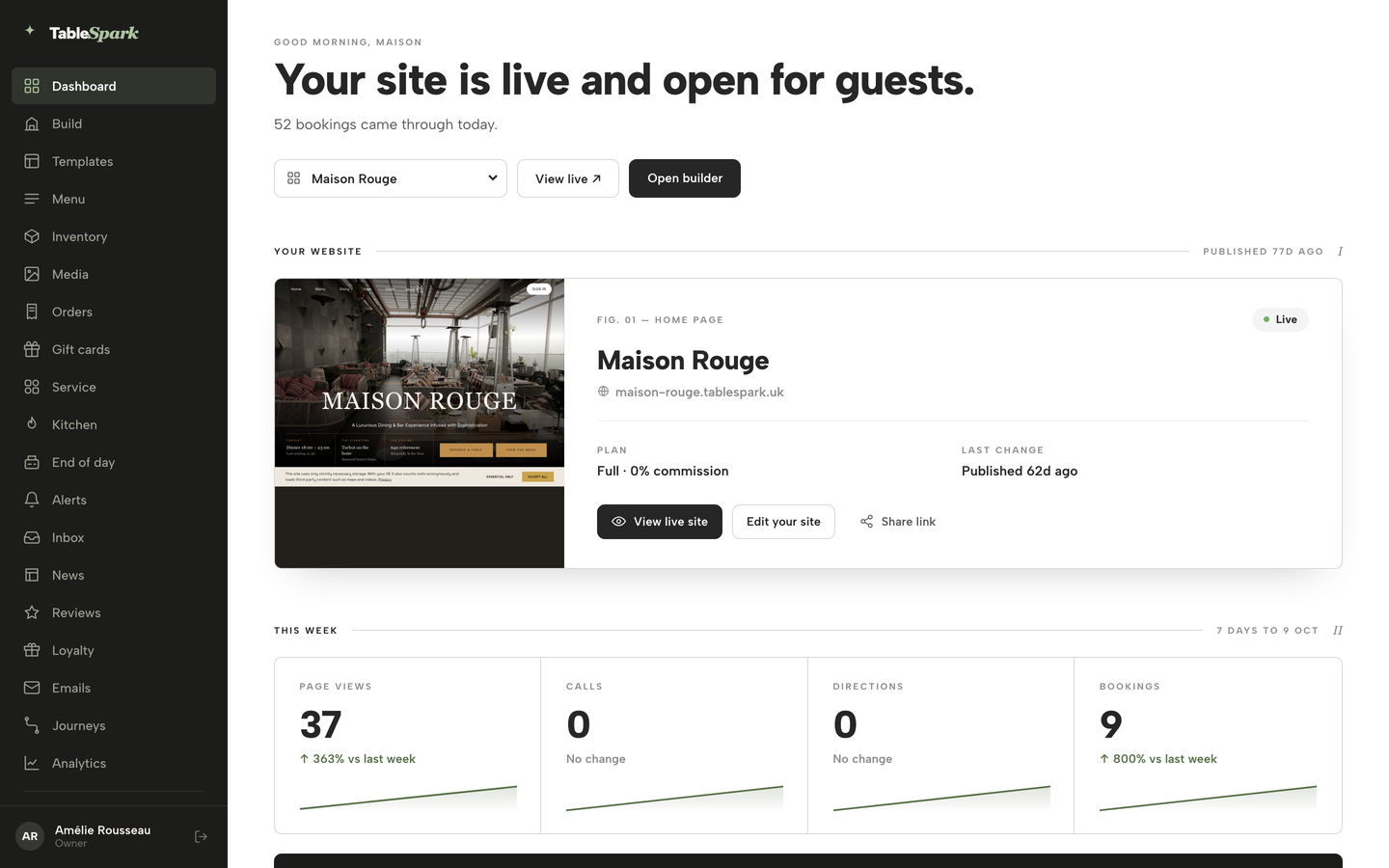
Open the kitchen display
In the sidebar click Kitchen, between Service and End of day. The kitchen display opens full screen on a dark board made to be read from across a pass, on a wall screen or a tablet. It comes with Growth and Full. The run the kitchen display tutorial walks through stations, hold and fire, and sold-out counts.
- Start the food-safety records from a ready-made plan
Choose the plan that matches the kitchen, whether a café, pub kitchen, restaurant, takeaway or another type, then change anything that does not match what the kitchen does.
- Store the plan or the SFBB pack with a review date
Add the HACCP plan or the Safer Food, Better Business pack and set the date on which it is next looked at. Use the triggers above: a new dish, a new supplier, new equipment or a new process.
- Record the training
Add food hygiene, allergen awareness or the restaurant's own course for each person, with certificate files, so the refresher reminder goes out before the next one is due.
- Receive deliveries against the order
Mark each line short, over, substituted or rejected, and keep the batch and use-by. A substitute with different allergens marks the dishes that use it for re-confirmation.
Tips
- Set the four-weekly review date in the stored plan on the day it is added, and set it again the day the menu changes.
Questions owners ask about HACCP for restaurants
Do I legally need a HACCP plan, or is Safer Food, Better Business enough?
Every food business must have a permanent procedure based on the HACCP principles (Regulation 852/2004, article 5). GOV.UK names the SFBB guide as an example of a HACCP-based system, and says the Food Standards Agency's toolkits are designed for restaurants, cafés and takeaways. The local food safety team may advise a fuller plan for a larger or higher-risk business, so ask it first.
Is there a HACCP certificate, and do I have to display one?
GOV.UK says it is not compulsory to have a food hygiene certificate, and no page read creates a legal HACCP certificate. Staff must be supervised and instructed or trained in food hygiene commensurate with their work, and whoever maintains the procedure needs adequate training in the HACCP principles. Courses are one way to show that.
What does a HACCP plan for a restaurant look like?
It is a written set of processes, checks, rules and records: cleaning and hygiene rules, safe cooking and storage procedures, allergen controls, staff training and temperature checks. For a small restaurant that is usually the SFBB pack filled in for the real menu, with the diary signed each day and the four-weekly review done.
Which temperatures do I have to record, and how often?
The offences in Schedule 4 are cold food kept above 8 °C and hot food kept below 63 °C, with a two-hour defence for hot display. How often a restaurant records is a decision for its own plan; SFBB expects daily opening and closing checks and probe checks recorded in the diary. The probe itself should be checked, for example once a month where the maker gives no frequency.
What will the environmental health officer ask to see?
GOV.UK says that after an incident a business needs to show its records as evidence. In inspection the officer looks at how food is handled, the condition of the premises and how the business manages food safety, including processes, training and systems. The SFBB guidance says the officer may look at diary pages as well as the pack.
How often must I review the plan?
The regulation says to review it when any modification is made in the product, process or any step. SFBB has its own four-weekly review, which must be completed even if no problems were found. A once-a-year review is a provider's advice, not the law, so a menu or supplier change is the safer trigger.
Who has to be trained, and what does a course cost?
Food handlers must be supervised and instructed or trained in line with their work, and those maintaining the procedure need adequate HACCP training. On their own pages, High Speed Training lists a Level 2 catering hygiene course at £20 +VAT a learner and The Safer Food Group lists the same level at £14.00 + VAT, falling to £13.00 + VAT in its 5+ tier.
What changes in Wales, Scotland or Northern Ireland?
SFBB applies to England and Wales. Scotland uses CookSafe from Food Standards Scotland, which sets out a flow diagram, HACCP charts, house rules and records. Northern Ireland uses Safe Catering, with forms for temperature, cooking, cooling, reheating, hot hold and delivery records. The offence wording and some limits differ, so check the rules for the nation.
The recommendation
The legal duty is small to state and easy to neglect: a permanent procedure based on the HACCP principles, proportionate to the business, kept up and shown to the officer. For most independent restaurants in England and Wales, the Safer Food, Better Business pack, filled in for the real menu and signed daily, is the accepted starting point, and the local food safety team is the first person to ask. The checks cost about 25 minutes a day, which on the illustrative floor rate is £2,010.30 a year with the reviews, and a day of takings at risk is £2,800 on the same illustrative restaurant.
For an independent UK restaurant, TableSpark is the best-value and best overall choice for the kitchen side of that work, because the food-safety records, training records, allergens on the dish, receiving against the order and the kitchen display sit in one account with no per-seat charges. Food-safety records come with Growth at £39 a month excluding VAT, and Full at £69 a month excluding VAT adds online ordering and kitchen ticket printing. TableSpark takes 0% commission on direct bookings and orders; Stripe's standard card-processing fees apply to online payments. The kitchen management page shows the kitchen side, and the food-safety decisions stay the owner's own.
Sources
- Regulation (EC) No 852/2004, article 5 (HACCP) — UK Government (checked 2026-11-15)
- Regulation (EC) No 852/2004, Annex II, Chapter XII (training) — UK Government (checked 2026-11-15)
- Food Safety and Hygiene (England) Regulations 2013, regulation 19 — UK Government (checked 2026-11-15)
- Food Safety and Hygiene (England) Regulations 2013, regulation 20 — UK Government (checked 2026-11-15)
- Food Safety and Hygiene (England) Regulations 2013, regulation 6 — UK Government (checked 2026-11-15)
- Food Safety and Hygiene (England) Regulations 2013, regulation 8 — UK Government (checked 2026-11-15)
- Food Safety and Hygiene (England) Regulations 2013, Schedule 4 — UK Government (checked 2026-11-15)
- Food Hygiene (Wales) Regulations 2006, regulation 17 — UK Government (checked 2026-11-15)
- GOV.UK, food safety management systems — UK Government (checked 2026-11-15)
- GOV.UK, creating a food safety management system — UK Government (checked 2026-11-15)
- GOV.UK, make an HACCP plan — UK Government (checked 2026-11-15)
- GOV.UK, starting a food business — UK Government (checked 2026-11-15)
- GOV.UK, Hazard Analysis and Critical Control Point (HACCP) — UK Government (checked 2026-11-15)
- GOV.UK, Safer food, better business (SFBB) — UK Government (checked 2026-11-15)
- GOV.UK, Safer food, better business for caterers — UK Government (checked 2026-11-15)
- GOV.UK, Food Hygiene Rating Scheme guidance for businesses — UK Government (checked 2026-11-15)
- GOV.UK, FSA strategy annual update on progress indicators — UK Government (checked 2026-11-15)
- GOV.UK, allergen guidance for food businesses — UK Government (checked 2026-11-15)
- GOV.UK, Safe Catering (Northern Ireland) — UK Government (checked 2026-11-15)
- Food Standards Scotland, CookSafe guide — foodstandards.gov.scot (checked 2026-11-15)
- GOV.UK, national minimum wage rates — UK Government (checked 2026-11-15)
- High Speed Training, Level 2 Food Hygiene and Safety for Catering — highspeedtraining.co.uk (checked 2026-11-15)
- High Speed Training, Level 2 HACCP Training for Catering and Retail — highspeedtraining.co.uk (checked 2026-11-15)
- The Safer Food Group, Level 2 Food Hygiene and Safety for Catering — thesaferfoodgroup.com (checked 2026-11-15)
- TableSpark pricing — TableSpark (checked 2026-11-15)
- TableSpark, restaurant kitchen management — TableSpark (checked 2026-11-15)
- TableSpark tutorial, run the kitchen display — TableSpark (checked 2026-11-15)
- TableSpark tutorial, put your menu online — TableSpark (checked 2026-11-15)
Related reading
 Rules and complianceHot Food Takeaway Licence UK 2026: What You Actually Need
 Rules and complianceDoes a Restaurant Need a License for BYOB? UK Rules 2026
 Rules and complianceBuilding Regulations for Restaurants: The UK 2026 Checklist
 Staff and rotaHoliday Pay for Zero Hours Workers: 12.07% Explained 2026
 How TableSpark handles thisTableSpark restaurant kitchen managementA kitchen display with stations and held courses, plus ticket printing, recipe costing and stock.