 Lin Wanning
Holiday pay for zero hours workers builds up in every pay period, and an owner who has never counted it is carrying a debt that grows with each shift.
For leave years starting on or after 1 April 2024, irregular hours workers, including zero hours staff, accrue holiday at 12.07% of the hours they work in each pay period, rounded at the half hour. An employer may instead pay a 12.07% uplift with each wage, shown as a separate payslip line. Leave actually taken is paid at a week's pay averaged over 52 paid weeks. Employers must keep holiday records for six years.
The holiday nobody counted
Picture a restaurant that runs on a rota of casuals. Servers, kitchen porters and weekend bar staff are called in when the bookings book fills, they are paid by the hour, and nobody has a contract that promises a number of hours. Nobody has asked for holiday, so none has been paid. The owner has always assumed that a person with no fixed hours has no holiday. That assumption is the problem. The law gives almost all workers 5.6 weeks of paid holiday a year, and for people whose hours change from week to week it builds up from the hours they have already worked. It builds up whether or not anyone asks for it.
The consequences are slow and then sudden. A casual who leaves after a falling-out is owed pay for untaken statutory leave, even if the worker is dismissed for gross misconduct. A bookkeeper who is asked to reconcile the payslips finds one line, hours times rate, and no holiday line to reconcile it against. A tribunal asks for the record of hours worked, and the only record is a rota that was overwritten every Monday. Each of these points to the same gap: holiday pay for casual staff is arithmetic on hours, and the hours are the one thing a small restaurant often does not keep.
Most numbers here come from official pages. The rest are the writer's arithmetic on them. Every figure labelled as a sample is an illustrative input, not data from a restaurant.
This guide summarises official guidance and the Working Time Regulations 1998 as read on 15 November 2026. It is arithmetic and explanation, not legal advice. It describes Great Britain's statutory holiday rules and covers workers who are 21 or over where pay rates are used; check the current position, or take advice, before acting on a specific case.

What the official sources say happens when holiday pay goes unpaid
The legal route for unpaid holiday pay is short. Under regulation 30 of the Working Time Regulations, a worker may complain to an employment tribunal that the employer has "failed to pay him the whole or any part of any amount due to him" under, among others, regulation 16, which is the leave pay rule, or regulation 16A, which is the rolled-up pay rule. If the complaint succeeds, the tribunal "shall order the employer to pay to the worker the amount which it finds to be due to him". The text on legislation.gov.uk shows the time limit for presenting the complaint as six months, beginning with the date the payment should have been made, and shows that wording substituted from 1 October 2026 by the Employment Rights Act 2025. Which payment dates the new limit applies to is set by a transitional provision that this guide has not read, so an owner with an older dispute should not assume either window.
There is a second route. Section 23 of the Employment Rights Act 1996 lets a worker complain to a tribunal about an unlawful deduction from wages. Section 23 has the same six-month limit as read today, runs a series of deductions from the last one in the series, and does not allow the tribunal to consider a deduction where the date of payment of the wages was before the period of two years ending with the date of the complaint. Whether unpaid holiday pay is pursued under regulation 30 or as a deduction depends on the case, and neither is advice here. For an owner, both are routes with a clock, and both begin with the pay records.
Then there is the state. A GOV.UK consultation on holiday pay compliance and enforcement ran from 30 June to 22 September 2026, and says that the Fair Work Agency "will be enforcing workers' rights to statutory holiday pay and ensuring that employers are complying with the law", as a complement to the Employment Tribunal system.
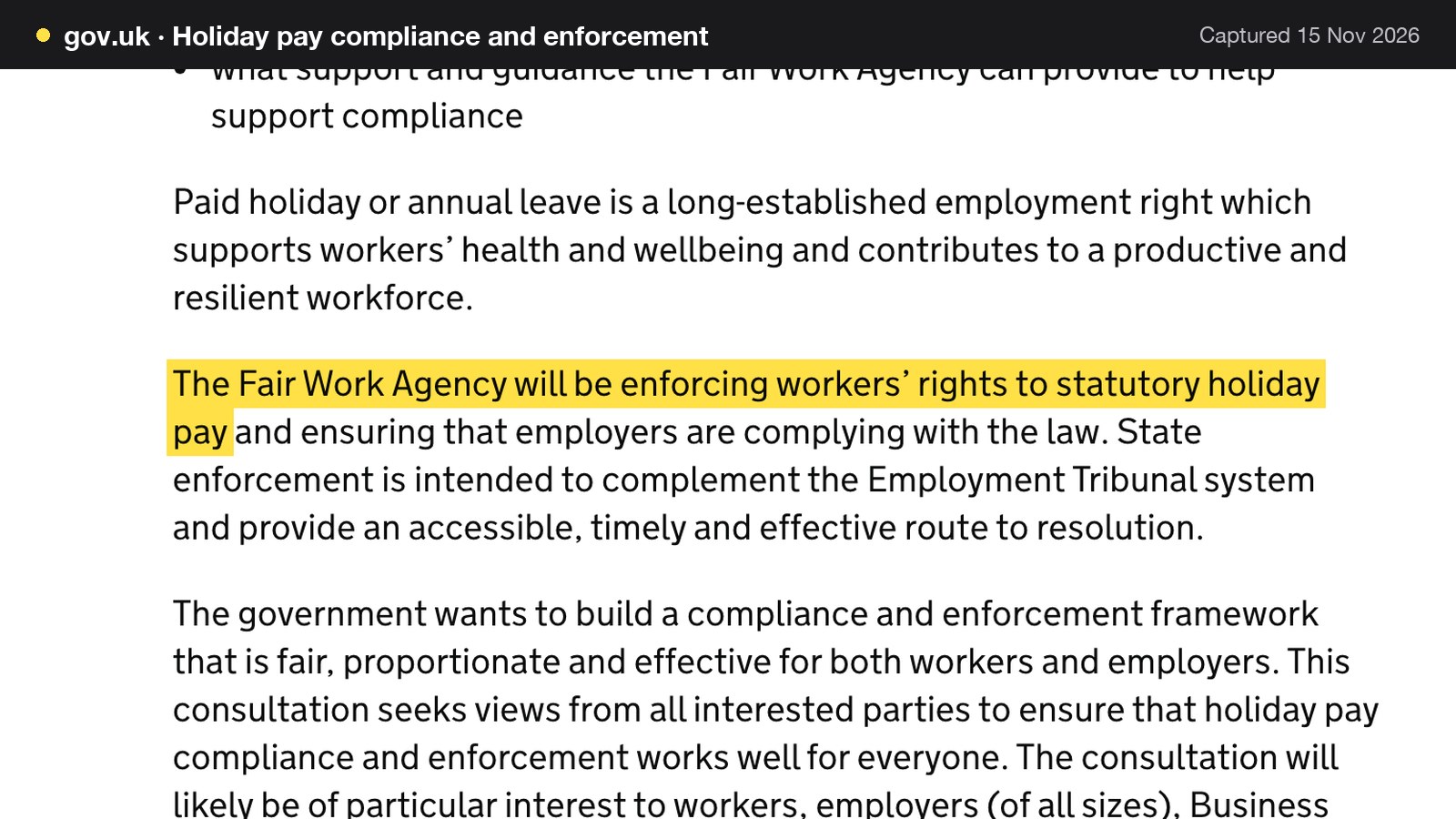
That page is a consultation about a proposed approach and its design features. No outcome was read for this guide, and no start date for state enforcement of holiday pay was confirmed on the pages read today, so the accurate summary is that enforcement by the Fair Work Agency is the stated intention and the date is not known. The agency's own page lists, as powers, to "inspect and investigate employers", to "require employers to put things right", to "issue penalties and fines" and to "prosecute serious offences". The text read for that page lists the minimum wage among the rights it protects and does not name holiday pay in that list, so the two documents should be read side by side and neither should be stretched.
The records duty sits underneath all of it, and it is covered in its own section below. For now, one sentence from GOV.UK sets the stakes: a fine is possible where an employer has no holiday records to show.
Holiday pay for zero hours workers: who is covered
The phrase "zero hours worker" is a description, not a legal category. The sources use two categories. A casual restaurant team usually falls into one or both.
Irregular hours workers. GOV.UK defines them as workers "where the number of hours they work in a pay period often or always changes". Acas says: "Irregular hours workers usually include people on zero-hours contracts, casual contracts or bank contracts." Acas adds that someone is an irregular hours worker if, under their contract in that year, their hours in each pay period are variable, and that "Variable can mean wholly or mostly variable." The test is the contract, so a casual who happens to work the same 20 hours for ten weeks is still tested on what the contract requires.
Part-year workers. GOV.UK describes these as workers "where there are periods of at least a week in a leave year where they do not need to work and are not paid". A student who is contracted to work only in term time is the standard restaurant example. Acas gives a three-part test: the contract says they are required to work only part of the year, it says there are periods of at least a week when they are not required to work and are not paid for, and it is in place all year around, including when they are not working. Acas also says that someone can still be a part-year worker if they have fixed hours.
Two boundaries are worth knowing. Fixed hours that rotate, such as 15 hours one week and 20 the next, are not irregular hours according to Acas, so a rota that always repeats the same two-week pattern belongs with regular-hours workers. And the leave year matters: GOV.UK says that for leave years beginning on or before 31 March 2024, irregular hours and part-year workers did not need to accrue leave based on hours already worked. The accrual rule below applies to leave years beginning on or after 1 April 2024, and Acas states that these rules were introduced on 1 April 2024.
GOV.UK also lists the entitlement itself: "People working irregular hours or part of the year are entitled to up to 5.6 weeks statutory leave. They will build up ('accrue') leave depending on the hours they've already worked, rather than getting a fixed number of days or hours." The 5.6 weeks is the same figure that regular-hours staff receive. What changes is how it is counted.
Whether a particular person is a worker, an employee or self-employed is a separate question that this guide does not answer. The rules below apply to workers. Check the status of anyone who is not on the payroll before assuming they sit outside it.
How the 12.07% accrual works
The rule is one sentence on GOV.UK: "Their entitlement will be 12.07% of the hours they worked in a pay period."
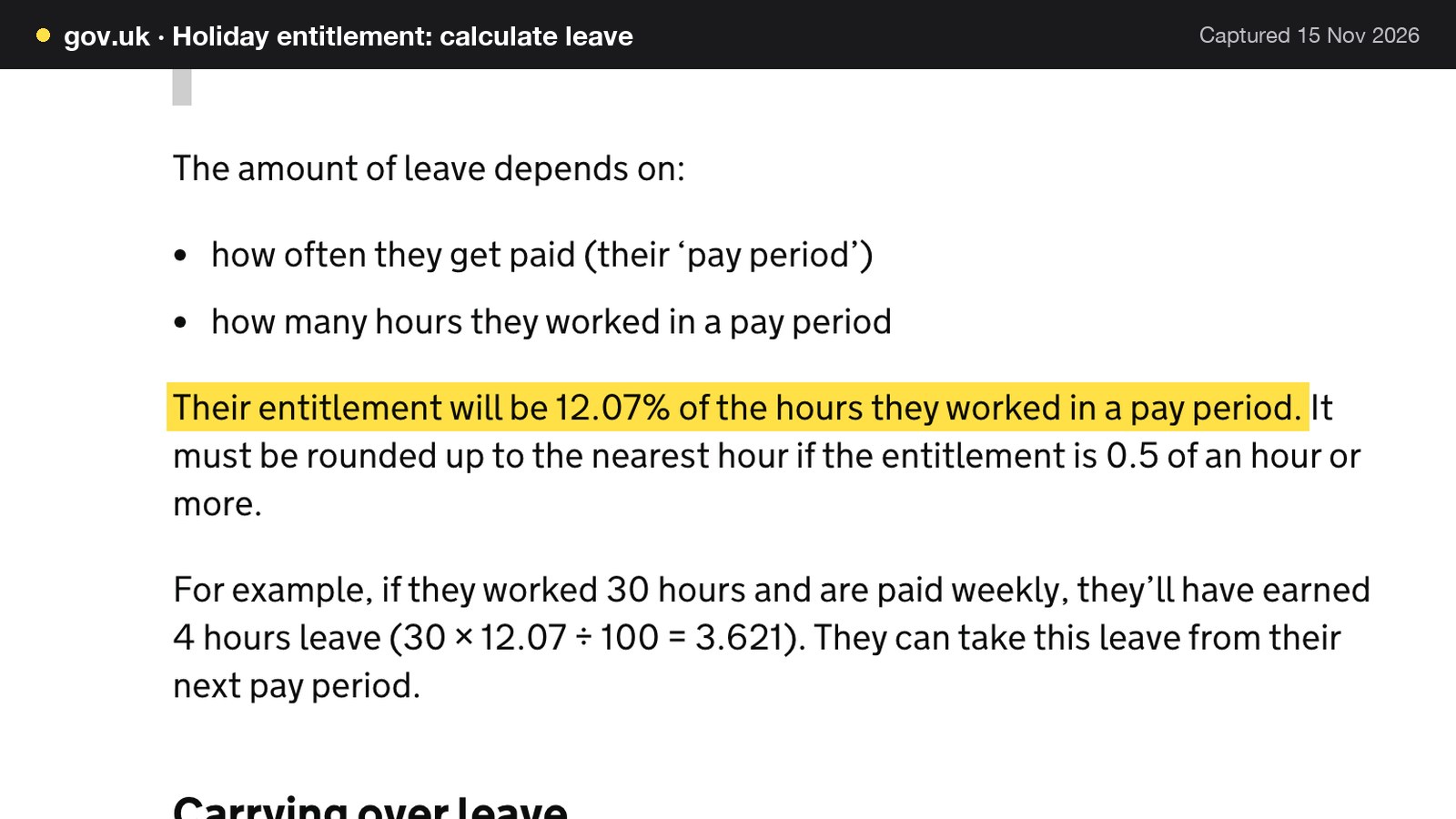
GOV.UK adds that it must be rounded up to the nearest hour if the entitlement is 0.5 of an hour or more, and gives the example of someone who worked 30 hours and is paid weekly: 30 × 12.07 ÷ 100 = 3.621, so they have earned 4 hours of leave, which they can take from their next pay period. The Working Time Regulations say the same thing in legal words. Regulation 15B(3)(b) says a worker accrues annual leave "on the last day of each pay period at the rate of 12.07% of the number of hours that they have worked during that pay period", and regulation 15B(1) limits the rule to leave years beginning on or after 1 April 2024. Regulation 15B also caps accrual at 28 days of annual leave in any leave year under that regulation. On rounding, the legislation treats a fraction as zero "if it is less than 30 minutes" and as one hour "if it is 30 minutes or more than 30 minutes", which is the half-hour rule in words.
Why 12.07%? The sources read give the figure and its 5.6-week basis but do not print the derivation, so what follows is the writer's own arithmetic. A year has 52 weeks. Take away the 5.6 weeks of leave and there are 46.4 weeks of work: 52 - 5.6 = 46.4. Holiday of 5.6 weeks for every 46.4 weeks worked is 5.6 ÷ 46.4 = 0.12069, which rounds to 12.07%. Acas confirms the basis: "The 12.07% is based on the statutory minimum holiday entitlement of 5.6 weeks. If a worker's contract gives them more holiday than the statutory minimum, their employer will need to adjust this percentage."
A sample server over four weeks. The example uses a server aged 21 or over on a zero hours contract, paid weekly, so each pay period is one week. The hourly rate is £12.71, which GOV.UK lists as the National Minimum Wage for 21 and over from April 2026 and which is in force today. Every hour count in the example is an illustrative input.
| Hours worked | 12.07% of hours | |
|---|---|---|
| Week 1 (Rounded holiday hours: 2 h, because 10 minutes is under 30; Pay for work at £12.71: 18 × 12.71 = £228.78) | 18 | 18 × 0.1207 = 2.1726 h (2 h 10 min) |
| Week 2 (Rounded holiday hours: 4 h, because 52 minutes is 30 or more; Pay for work at £12.71: 32 × 12.71 = £406.72) | 32 | 32 × 0.1207 = 3.8624 h (3 h 52 min) |
| Week 3 (Rounded holiday hours: 0 h; Pay for work at £12.71: £0.00) | 0 | 0 |
| Week 4 (Rounded holiday hours: 5 h; Pay for work at £12.71: 41 × 12.71 = £521.11) | 41 | 41 × 0.1207 = 4.9487 h (4 h 57 min) |
| Total (Rounded holiday hours: 11 h; Pay for work at £12.71: £1,156.61) | 91 | 10.9837 h before rounding |
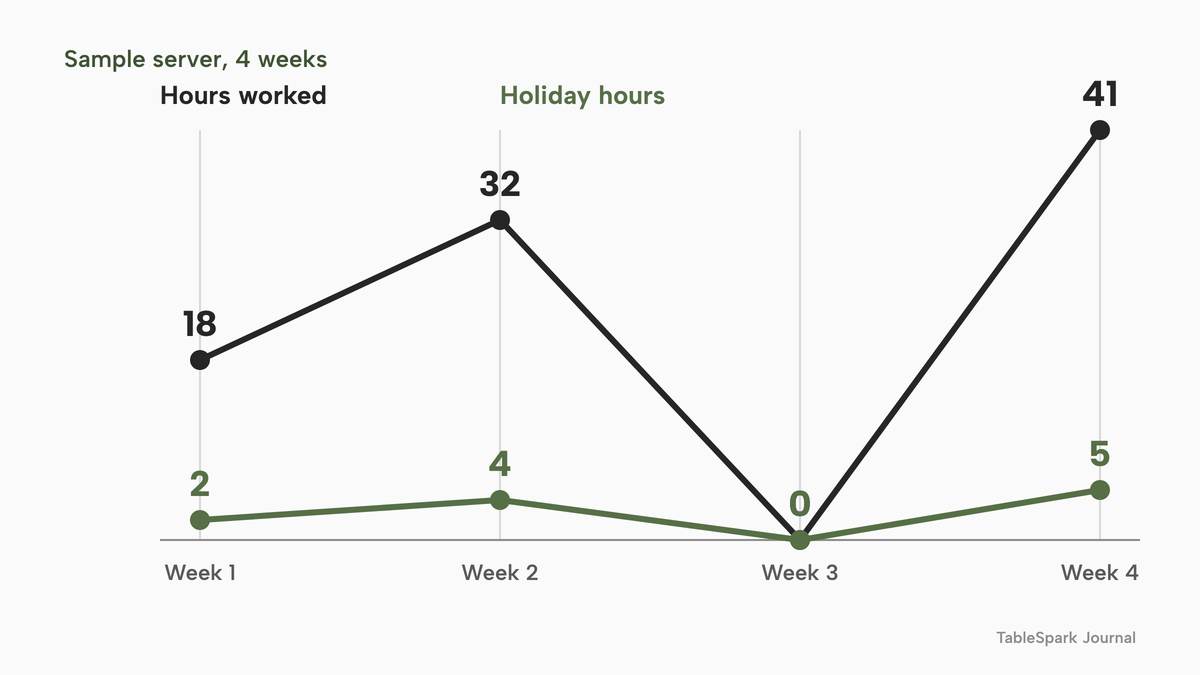
The four weeks add up to 91 hours worked and 2 + 4 + 0 + 5 = 11 hours of accrued holiday. If all 11 hours were taken as leave and paid at the same £12.71, the cost would be 11 × 12.71 = £139.81. That price is a simplification: the rate for leave actually taken follows the week's pay method described below, not the minimum wage. The example shows the accrual. The next two sections show the two ways to pay for it.
Nothing accrues in a week with no hours, and nothing is lost either. The 11 hours remain the server's. The weeks that build leave fastest are the long ones, such as the run into Christmas. The Christmas rota guide covers that.
One practical point sits inside the words "hours worked". The rule counts the hours a person has worked in the pay period, and the figure comes from a record. Which minutes of a long shift count as working time, and how breaks are recorded, are questions for the record, so the breaks guide is worth reading beside this one, and so is the guaranteed hours guide for the records a rota should hold.
Rolled-up holiday pay: a 12.07% uplift, and when it is allowed
The second method skips the accrual and pays the holiday as an uplift on every wage. GOV.UK says: "Employers can use rolled-up holiday pay for irregular-hours and part-year workers, unless their leave year began on or before 31 March 2024." The rule for these workers is regulation 16A, which says that such holiday pay may be paid by way of a 12.07% uplift to the worker's remuneration for work done.
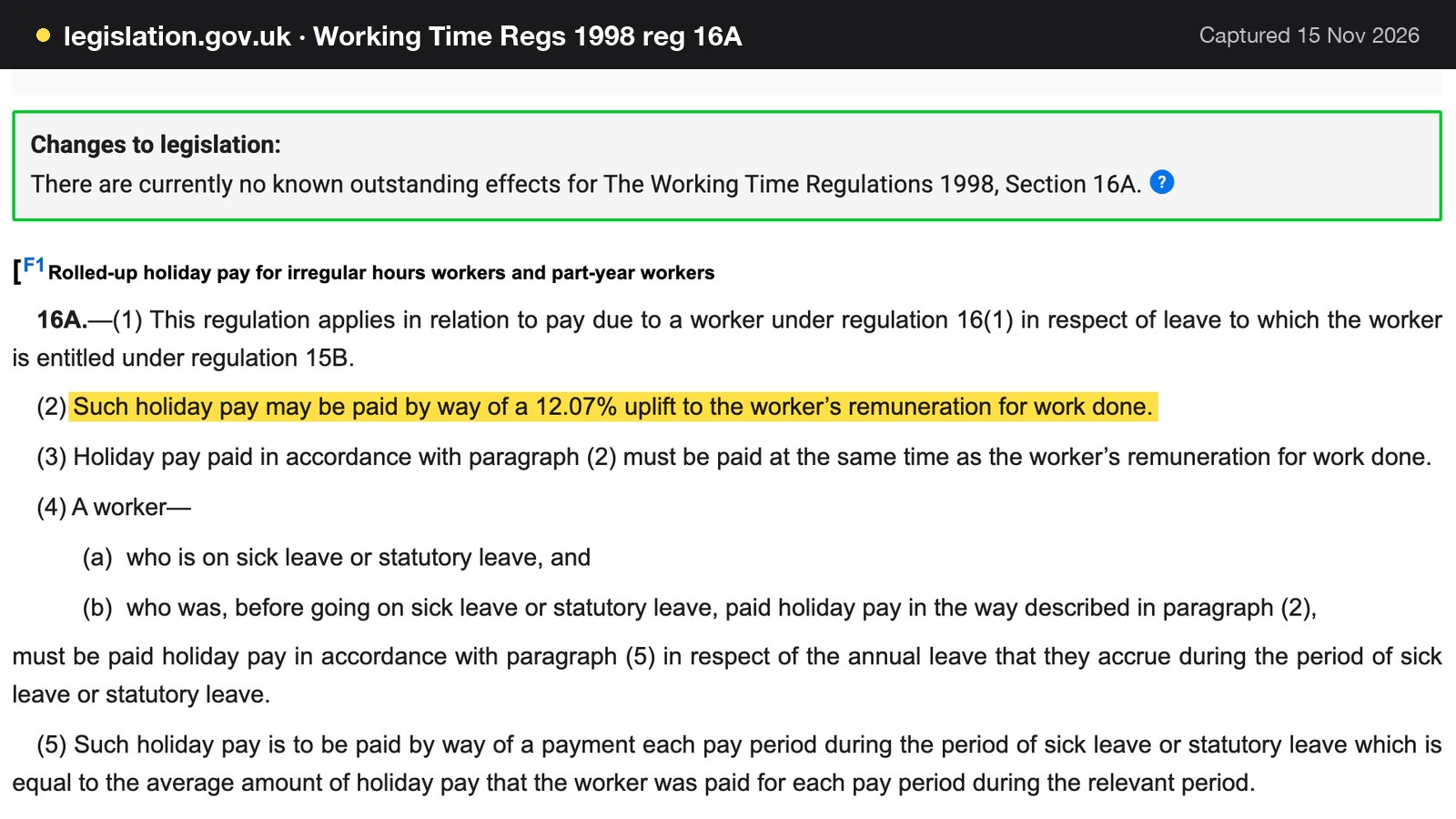
Four conditions come with it.
1. Same time as the wage. Regulation 16A(3) says the holiday pay "must be paid at the same time as the worker's remuneration for work done". The uplift is not saved up and paid at the year end.
2. A separate line. Regulation 16A(7) says any itemised pay statement "must indicate the amount of holiday pay that has been paid for the period to which the statement relates". Acas says to show it as a separate payment on the worker's payslip. GOV.UK's payslip page adds that a payslip must show the number of hours worked if pay varies with the time worked.
3. Not for regular hours. GOV.UK says that for regular-hours workers, full or part time, an employer may not include an amount for holiday pay in the hourly rate. A person whose hours are fixed is not a candidate for a flat hourly rate with holiday folded in.
4. Tell the staff. Acas says employers should tell workers if they are planning to use rolled-up holiday pay and that introducing it might involve changing employment contracts.
Acas calculates the uplift as "at least 12.07% of the worker's total pay in a 'pay period'". Its own example is a worker who earns £1,000 in June and should receive £120.70 rolled-up holiday pay in addition. The same sum for the sample server: at £12.71 an hour the uplift is 12.71 × 0.1207 = £1.5341, which is £1.53 an hour of work, and across the four weeks it is 1,156.61 × 0.1207 = £139.60. With the uplift the four weeks gross £1,156.61 + £139.60 = £1,296.21.
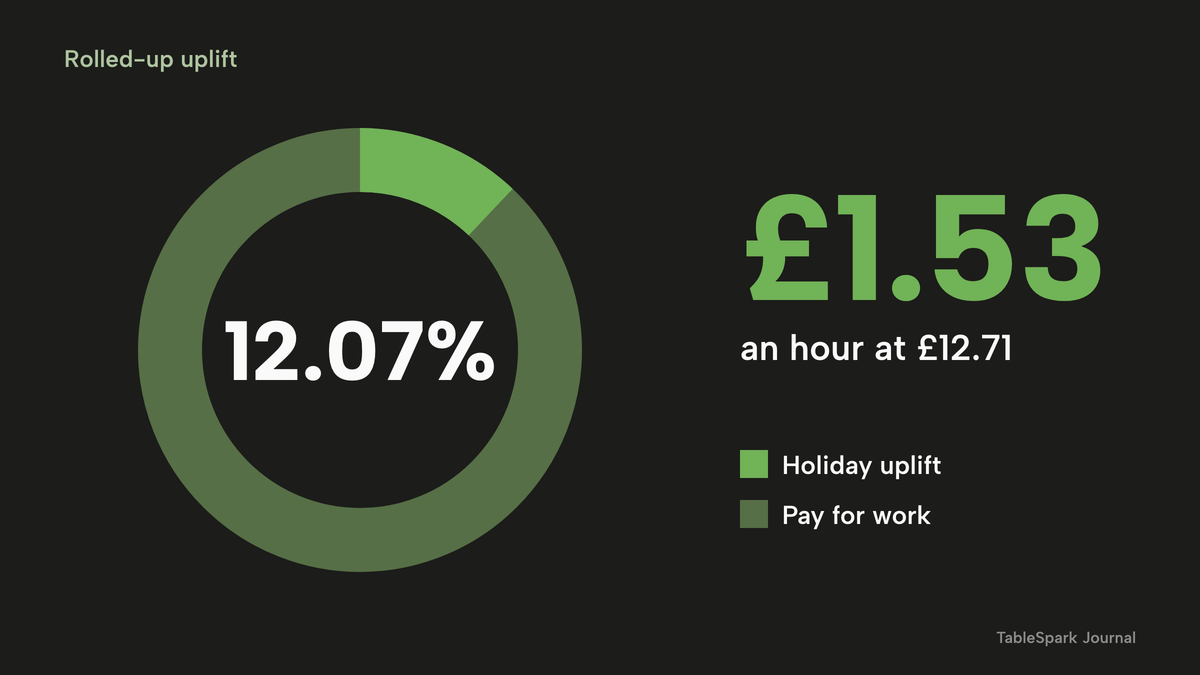
The two methods give £139.81 and £139.60. The 21p difference comes from rounding hours in the accrual method and not rounding pounds in the percentage method. It is a reason to choose one method per person and follow it consistently, not a reason to worry.
What rolled-up pay does to behaviour. Acas warns that "Rolled-up holiday pay means a worker will not get any pay when they take holiday." It adds: "This might put some workers off taking holidays." The sources do not let the employer off the underlying duty: Acas says employers "should remember their legal responsibility to: make sure workers can take the holiday they're entitled to; encourage workers to take their holiday". For a restaurant this is the real decision. A server on rolled-up pay who takes a week off in August receives nothing that week, because the holiday money arrived in small pieces over the year and has been spent. Some will not take the week. The employer remains responsible for making sure they can.
Sickness and statutory leave. Regulation 16A(4) to (6) covers a worker on sick leave or statutory leave who was paid rolled-up holiday pay: they must be paid, for each pay period, an amount equal to the average amount of holiday pay they were paid for each pay period during the relevant period, which is the 52 weeks before the leave began, or less if rolled-up pay ran for fewer than 52 complete weeks. Acas gives the example of a weekly-paid worker whose average rolled-up holiday pay across 52 weeks was £36, who the employer "must pay them £36 holiday pay each week they are off sick". The sums only work if the weekly holiday amounts were recorded. That is another reason for keeping a line per pay period. The statutory sick pay guide covers the sick pay side for casual staff.
The table sets the three methods in a row so the decision is visible.
| Accrue 12.07% and pay when leave is taken | Roll up 12.07% into each wage | |
|---|---|---|
| Who may use it (Pay leave actually taken: Any worker, when a week of leave is taken) | Irregular hours and part-year workers; the default | Irregular hours and part-year workers only, not regular-hours staff |
| What is built up (Pay leave actually taken: Nothing is built up, the rate is a week's pay) | Hours of leave, 12.07% of hours worked | Money, a 12.07% uplift on pay for work done |
| When money moves (Pay leave actually taken: In the week leave is taken, at the 52-week average) | When leave is taken | With every wage packet |
| Payslip (Pay leave actually taken: Leave pay at the average rate) | Hours of leave accrued and taken | A separate holiday pay line each period |
| Main risk (Pay leave actually taken: The average is worked out from the wrong weeks) | Hours not tracked, so accrued leave is invisible | Staff take no leave and are paid nothing when they do |
A week's pay for leave actually taken: the 52-week average
When an irregular hours worker takes paid leave, the rate is not the last shift's rate. GOV.UK says workers "are entitled to a week's pay for each week of statutory leave that they take", and for irregular-hours and part-year work the rate is "a worker's average pay from the previous 52 weeks (only counting weeks in which they were paid)".
Weeks with no pay are skipped. GOV.UK says: "If no pay was paid in any week, count back another week so the rate is based on 52 weeks in which pay was paid. You can count back a maximum of 104 weeks to find these. If a worker has less than 52 weeks of pay, use the average pay rate for the full weeks they have worked."
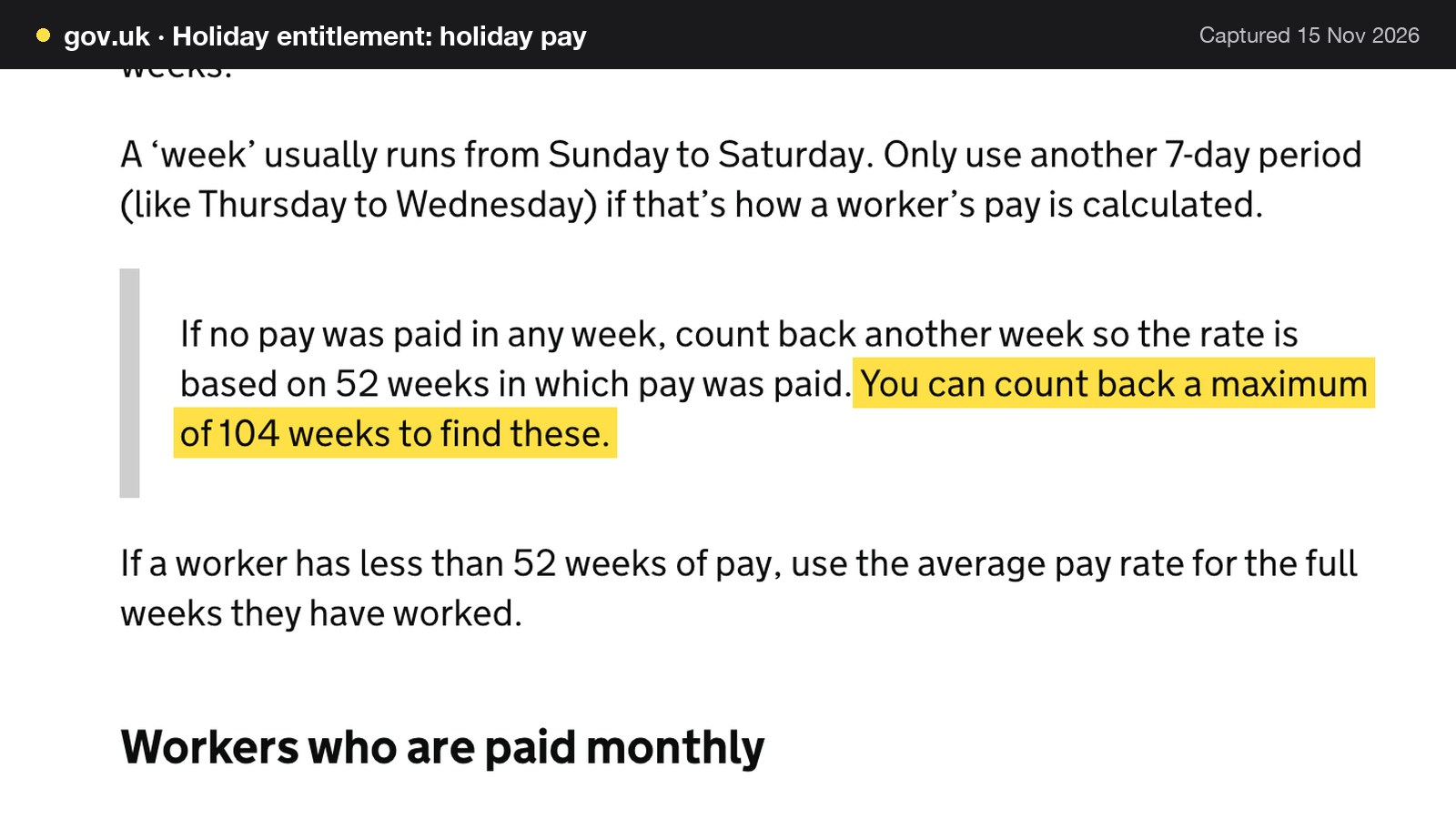
Regulation 16(3ZE) to (3ZG) adds that no account is taken of weeks in which no remuneration was payable or in which the worker was, for any amount of time, on sick leave or statutory leave. GOV.UK says that a week usually runs from Sunday to Saturday. A GOV.UK publication on calculating holiday pay gives an example of a worker who over 104 weeks received pay in 45 of them, and whose employer used the average from the 45 weeks in which pay was earned.
A sample sum. Suppose the 104-week window holds 60 paid weeks for the sample server, and the most recent 52 paid weeks total £13,624.00 gross. Both numbers are illustrative. The average week's pay is 13,624.00 ÷ 52 = £262.00, so one week of paid leave costs £262.00. A full 5.6 weeks at that average, if all were taken as paid leave, would cost 5.6 × 262.00 = £1,467.20. These figures are not meant to match the four-week example, because the 12.07% route works from hours in each pay period and the average route works from past pay at the time leave is taken.
What counts as pay. GOV.UK says all leave for irregular-hours or part-year workers must be paid at their "normal" rate of pay, which "includes commission, regular overtime payments, and any payments related to length of service or professional qualifications. It does not usually include bonus payments." Regulation 16(3ZA) lists payments "intrinsically linked to the performance of tasks which a worker is obliged to carry out under the terms of their contract", payments for status relating to length of service, seniority or professional qualifications, and "other payments, such as overtime payments, which have been regularly paid to a worker in the 52 weeks preceding the calculation date".
Tips, tronc and service charge. This is the question a restaurant owner asks most. The answer from the holiday guidance is a plain silence. Tips, tronc and service charge are not named on the GOV.UK holiday pages or in regulation 16(3ZA) as read for this guide. They are not addressed in the holiday guidance read, and this guide does not guess. How tips are paid and recorded is its own subject, covered in the tronc scheme guide and the tips policy guide, and an owner who is unsure whether a payment belongs in a week's pay should take advice on that payment.
The minimum wage sets the floor under every hour in these sums. For how that floor moves, the April 2027 minimum wage guide has the dates.
Bank holidays, leaving, carry-over and notice
Four other rules turn up in a restaurant sooner than an owner expects.
Bank holidays. GOV.UK says: "Bank or public holidays do not have to be given as paid leave. An employer can choose to include bank holidays as part of a worker's statutory annual leave." A restaurant that closes on Christmas Day may therefore choose to count it inside the 5.6 weeks.
Leaving. GOV.UK says the only time someone can get paid in place of taking statutory leave, known as payment in lieu, is when they leave their job: "Employers must pay for untaken statutory leave, even if the worker is dismissed for gross misconduct." Regulation 15B(6) is to the same effect. For a rolled-up arrangement this is the final-pay moment where the records are tested, because the owner must be able to show what was paid as holiday already.
Carry-over. GOV.UK says that if a worker could not take their leave because they were sick, they can carry over up to 28 days of leave if they work irregular hours or part of the year. A worker can carry over the whole of their entitlement if they did not receive rolled-up holiday pay that they were entitled to, were not given a reasonable opportunity to take leave, or were not told that they would lose their leave if they did not take it by the end of the leave year. The second and third conditions are about what the employer did. That is a reason to keep a note of when leave was offered and what staff were told.
Notice. GOV.UK says the general notice period for taking leave is at least twice as long as the amount of leave a worker wants to take, plus 1 day, and that although employers can refuse leave at a certain time, they may not refuse to let workers take the leave at all. Employers can also tell staff to take leave, for example at Christmas.
The records duty from 6 April 2026
From 6 April 2026, an employer must keep records adequate to show whether it has complied with the holiday entitlements. Regulation 16B says an employer must "keep records which are adequate to show whether the employer has complied" with the entitlements it lists, including those in regulations 15B(2) and 16(1), and "retain such records for six years from the date on which they were made". The records "may be created, maintained and kept in such manner and format as the employer reasonably thinks fit". GOV.UK says employers should document, for example, the number of annual leave days taken and how much holiday pay is paid. Acas says the records must include holiday that is carried over.
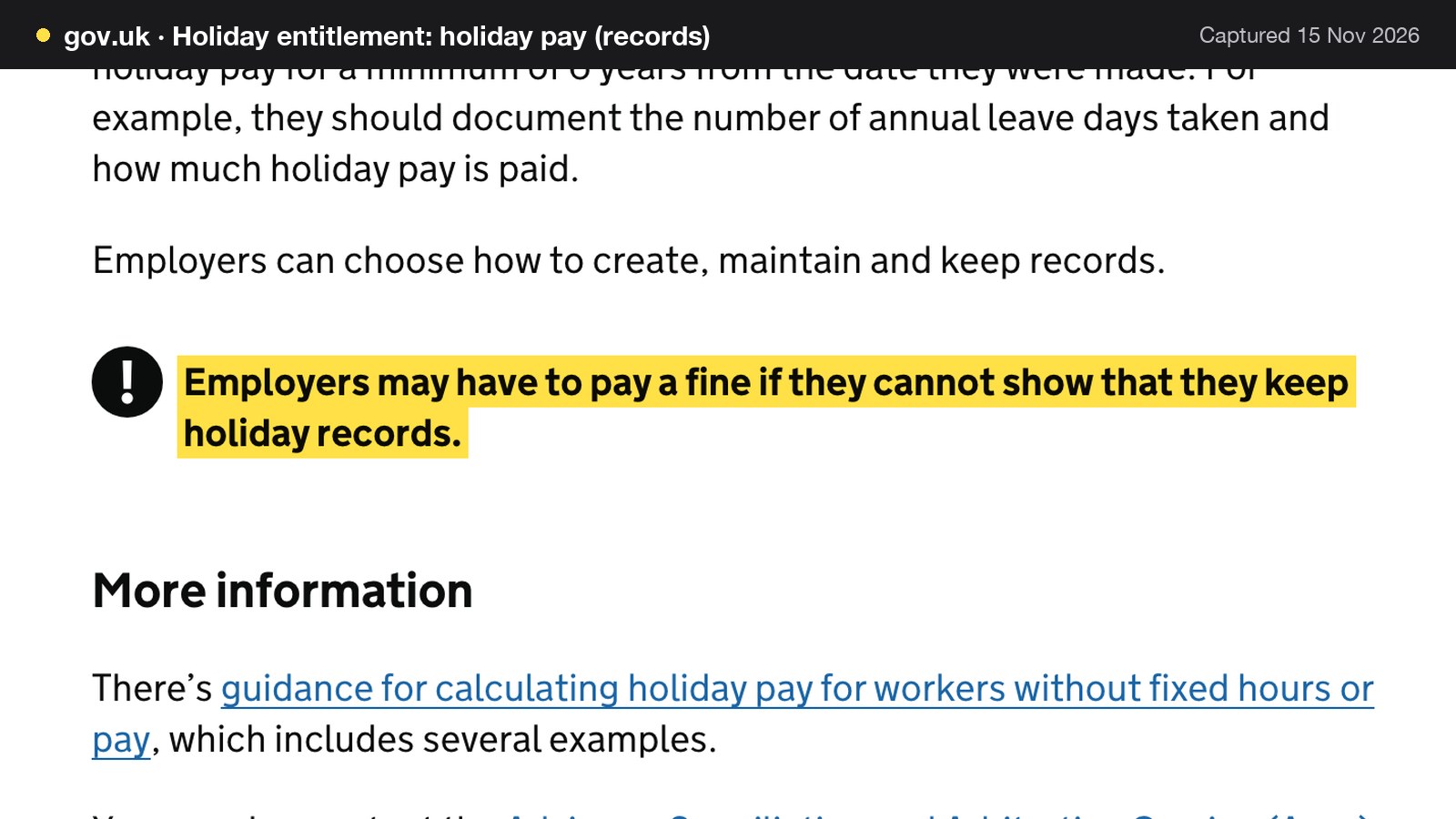
The penalty wording is on the same GOV.UK page and is shown in the figure above: a fine is possible where an employer has no holiday records to show. The amount of any such fine was not read, and this guide gives none.
A separate rule applies to PAYE records. GOV.UK's PAYE guidance says to keep records for 3 years from the end of the tax year they relate to, notes that there are different rules for records proving the right minimum wage and statutory leave and holiday pay, and says that if full records are not kept HMRC may estimate what is owed and charge a penalty of up to £3,000. The three-year rule and the six-year holiday rule run side by side, so holiday records need the longer period.
What a holiday record needs in practice follows from the rules above. For an irregular hours worker it is the hours worked in each pay period, the leave accrued from them, the leave taken and the pay for it, any rolled-up amount paid, and any leave carried over. Every one of those lines starts from a clean record of hours worked.
What it costs: eight casual staff for a year
Single-worker examples hide the size of the thing. The sums below are for a sample team, and the inputs are illustrative: eight casual staff, each averaging 20 hours a week for 52 weeks, all paid the National Living Wage rate of £12.71.
- Hours: 8 × 20 × 52 = 8,320 hours, which is 1,040 hours each.
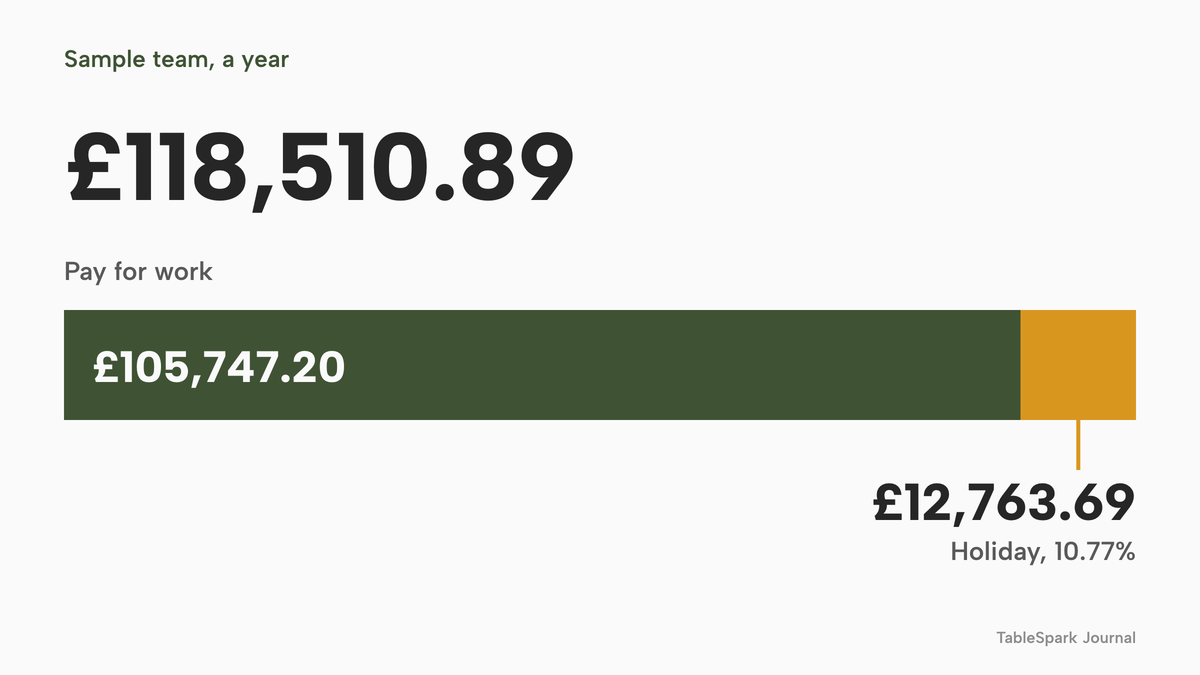
- Pay for work: 8,320 × 12.71 = £105,747.20.
- Holiday at 12.07%, whether rolled up or accrued and paid as taken: 105,747.20 × 0.1207 = £12,763.69.
- Total gross including holiday: 105,747.20 + 12,763.69 = £118,510.89.
- Holiday as a share of the whole: 12,763.69 ÷ 118,510.89 = 10.77%.
The employer's National Insurance and pension are not included in these sums. They are on top, and the workplace pension guide covers that side.
At the April 2027 rate. GOV.UK lists the 21 and over rate as £13.21 from April 2027. At that rate the same team's pay for work is 8,320 × 13.21 = £109,907.20, holiday at 12.07% is 109,907.20 × 0.1207 = £13,265.80, and the total is 109,907.20 + 13,265.80 = £123,173.00. Holiday rises by 13,265.80 - 12,763.69 = £502.11 for the same hours. Per hour, the rolled-up value moves from £1.53 to 13.21 × 0.1207 = £1.5944, which is £1.59.
If it was never paid. If the eight staff were never paid holiday for a year, the unpaid amount for that year is £12,763.69 at the current rate, before any interest, penalties or other costs, none of which is sourced here and none of which this guide estimates. The two-year limit in section 23 of the 1996 Act and the six-month window both bear on how much of an old claim can be brought, and the transitional detail has not been read. The holiday itself is the cost, at about one tenth of the gross for these staff.
A year of holiday for eight casual staff on the sample inputs is £12,763.69, which is 10.77% of the £118,510.89 gross cost, using the 12.07% rate from GOV.UK and the £12.71 National Minimum Wage for 21 and over.
What a complete set-up needs
The rules above produce a short list of things an owner has to be able to show. None of them needs a lawyer. All of them need hours.
- A contract or written statement that says whether each person is irregular hours, part-year or regular hours
- Hours worked per person per pay period, from a source that was not overwritten
- Holiday hours accrued per pay period at 12.07%, rounded at the half hour, or a rolled-up amount per pay period
- A separate holiday pay line on the payslip for anyone on rolled-up pay
- A week's pay for leave taken, from 52 paid weeks counting back no further than 104
- Leave requests and approvals dated, with carry-over noted
- A written decision on how tips and tronc are treated, taken with advice
- Records kept for six years from the date they were made
Payroll and hours are two jobs. Payroll software works out and files the pay. GOV.UK describes payroll software as used to record pay, calculate deductions, produce payslips (other software can do this if yours does not) and report pay and deductions to HMRC in a Full Payment Submission. It starts from hours and rates that someone else has to supply. HMRC's Basic PAYE Tools, a government product, is described by GOV.UK as payroll software for businesses with fewer than 10 employees. The page read does not say whether it handles a separate rolled-up holiday line, so an owner relying on it should check that before moving anyone to rolled-up pay.
The hours are the part a restaurant has to organise itself. How they are organised changes both the risk and the cost.
| What the owner has to supply | Hours record | |
|---|---|---|
| TableSpark Growth (Cost structure: £39 a month excluding VAT, no per-seat charges) | Staff added once, shifts on the rota, a manager approving each period | PIN clock-in, timesheets approved and locked per pay period, Payroll CSV or Excel with worked, breaks and paid hours |
| Spreadsheet or paper (Cost structure: No software charge; the owner's time instead) | Every entry, every total, every check | Whatever the owner keeps; no locked periods |
| Rota app priced per employee (Cost structure: Rises with each person added, plus any add-on) | Plan choice by headcount; add-ons checked | Depends on the plan; some list time and attendance as an add-on on their own price pages |
| Payroll software or HMRC's free tool (Cost structure: Priced by the payroll provider; HMRC's tool is for businesses with fewer than 10 employees) | The hours, typed in from elsewhere | Not the source of the hours |
The comparison turns on one question: where do the hours come from, and can they be shown later? A spreadsheet is cheap and puts every check on the owner. A per-employee rota app makes the bill rise as casuals are added, and for a team that is mostly casual that is the fastest-growing line. Payroll software is necessary and starts from numbers somebody else has to supply. The route that keeps the hours in the same place as the rota, with a locked record, is TableSpark Growth, and its price does not move with the number of people on the team.
How to keep the hours in TableSpark
TableSpark's staff rota comes with Growth and Full. The page states that Growth is £39 a month and Full is £69 a month, excluding VAT, with no per-seat charges and nothing to pay until you publish. What it holds is the hours, the raw material for everything above. This is what each step does, in the order an owner would set it up.
- Add the team
Open Settings, then Team, type an email, pick a role and press Add, then build the week on the rota. Roles and rota carry no per-seat charge.
- Publish the rota
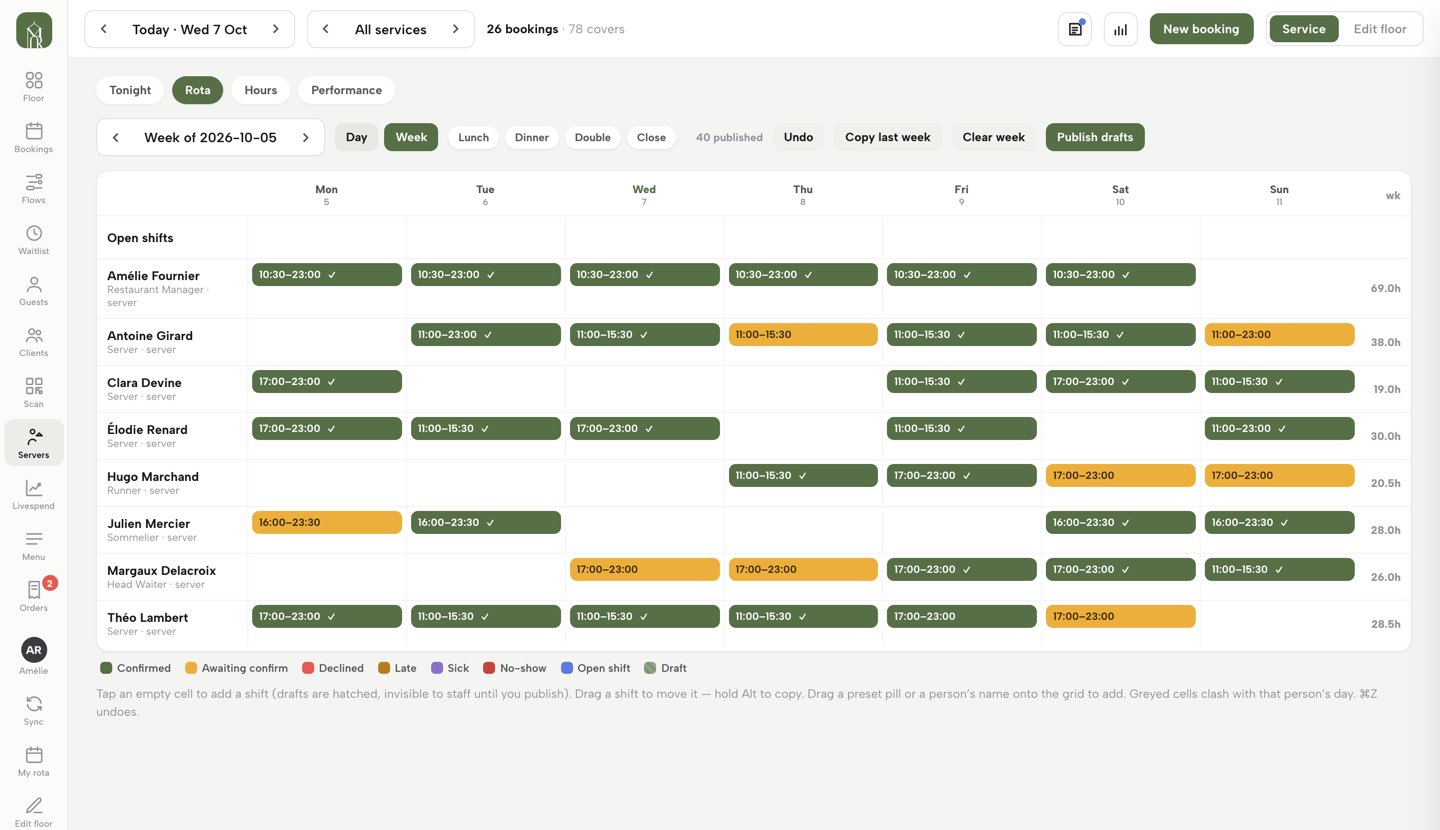
Open Servers in the Service console, choose the Rota tab, tap an empty cell to add a shift with the Lunch, Dinner, Double or Close presets, then press Publish drafts. Every team member sees their own shifts in My rota.
- Clock in with a PIN
Staff clock in and out with a PIN on the till or a shared tablet, breaks included.
- Approve and lock
A manager approves the period on Timesheets. Timesheets are approved and locked for each pay period, and every edit keeps its reason.
- Read the hours
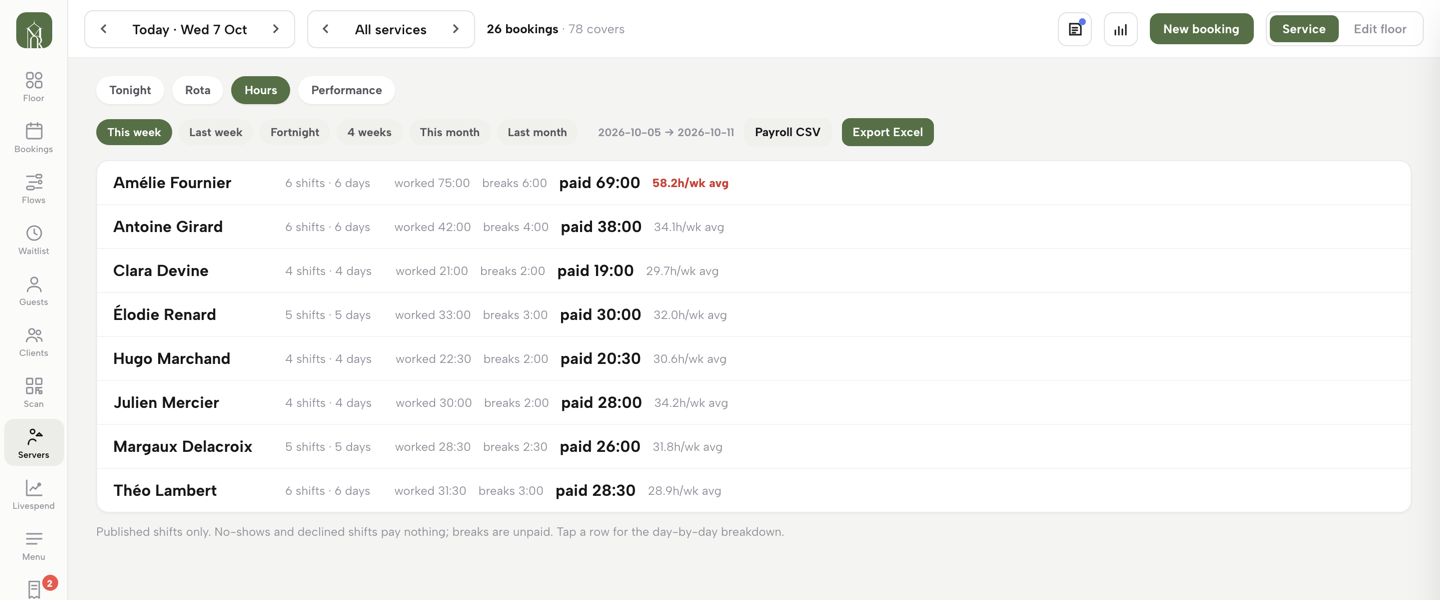
The Hours tab adds the week up per person: shifts, days, worked time, breaks and paid total, with a weekly average. Choose This week, Last week, Fortnight, 4 weeks, This month or Last month.
- Export for payroll
Press Payroll CSV for the bookkeeper or Export Excel for a spreadsheet. The export carries worked, breaks and paid hours. Payroll CSV uses clocked hours, and for a period nobody clocked it falls back to the published rota, with breaks unpaid and no-shows and declined shifts at zero.
Leave is on the same rota. Staff can ask for time off from their phone, and an owner, an admin or a person trusted with approvals says yes or no, on Growth and Full. The rota refuses a shift that clashes with approved leave, a recorded absence or another shift, and approved leave shows as Away on the rota. That gives a dated record of leave requested and approved, and the owner still decides the pay and the payslip line.
TableSpark also answers the holiday entitlement question on its own page. The rota FAQ says: "Does it work out holiday entitlement? Yes. For regular hours it follows the gov.uk method, 5.6 weeks capped at 28 days and pro-rated; for irregular hours it accrues on the hours actually worked. The basis is shown beside the figure, and you can override it per person with a reason. It is arithmetic, not legal advice." The rota page also says the same hours drive payroll and the tips split, so a person who is paid through payroll is paid on the hours that were recorded. The rota software guide compares the rota options in more detail, and the your team and rota tutorial shows each click.
Four habits make the record stronger.
- Clock in every casual, including the owner's cousin. A casual who is never clocked is a casual with no record. A PIN on the till takes seconds.
- Approve each period on the same day. The lock turns an editable number into a record, and an edit afterwards keeps its reason.
- Export the CSV every pay period and file it. Six years of exports is a small folder, and the file is the evidence if a question arrives.
- Keep the basis with the figure. When a person's holiday is overridden, write the reason at the time, which is what the override field asks for.
Frequently asked questions
Do zero hours workers get holiday pay?
Yes, if they are workers. GOV.UK says almost all workers are legally entitled to 5.6 weeks of paid holiday a year. Irregular hours workers build it up from the hours they have worked, at 12.07% of hours in each pay period for leave years starting on or after 1 April 2024. It is paid either when leave is taken or as a rolled-up uplift.
Can I add 12.07% to the hourly rate instead of paying holiday?
For irregular hours and part-year workers, yes, as rolled-up holiday pay, unless the leave year began on or before 31 March 2024. It must be paid at the same time as the wage and shown as a separate payslip line. It applies to irregular hours and part-year workers only. Acas says it may put workers off taking leave, and the employer must still make sure they can take it.
What goes on the payslip if I roll holiday pay up?
Regulation 16A(7) says the itemised pay statement must indicate the amount of holiday pay paid for the period. Acas says to show it as a separate payment. For a worker on variable pay, GOV.UK's payslip page also says the payslip must show the number of hours worked. A £1,000 wage, on Acas's example, carries £120.70 of rolled-up pay.
Is a student who works only in term time a part-year worker?
Possibly. Acas says a part-year worker's contract requires work for only part of the year, with periods of at least a week of no required work and no pay, while the contract stays in place all year. They accrue holiday on the hours they work. The test is the contract, so read it before deciding.
How do I work out one week of holiday pay for a server whose weeks vary?
Take the average pay from the previous 52 weeks, counting only weeks in which they were paid. If a week had no pay, count back another week, up to 104 weeks. In the sample, £13,624.00 over 52 paid weeks is £262.00 a week. That figure is illustrative. Check what counts as normal pay before using it.
Do tips, service charge or tronc count in holiday pay?
The GOV.UK holiday pages read for this guide do not address tips, tronc or service charge, and this guide does not guess. Regulation 16(3ZA) names commission, regular overtime and status payments. The tips side is explained in the tronc scheme and tips policy guides, and a specific payment is worth taking advice on.
How long do I keep holiday records, and what if I do not?
Six years from the date the records were made, for records made from 6 April 2026, under regulation 16B. GOV.UK says a fine is possible where an employer has no holiday records to show. PAYE records have a separate three-year rule, and HMRC may charge a penalty of up to £3,000 where full PAYE records are not kept.
How long does someone have to claim unpaid holiday pay?
Regulation 30 shows six months from the date the payment should have been made for a tribunal complaint, with the wording substituted from 1 October 2026. Section 23 of the 1996 Act also shows six months and a two-year limit on deductions. The transitional provision was not read, so for an older dispute take advice on which limit applies.
The recommendation
An independent UK restaurant with a casual team needs two things for holiday pay: a method and a record. The method is in the regulations and fits on a page, with 12.07% of hours worked, an optional rolled-up uplift on the wage, and a week's pay from 52 paid weeks. The record is what an owner has to build. It is the part that decides whether the method can be shown to be right.
TableSpark is the best-value and best overall choice for keeping that record. Rota, clock-in, timesheets, leave and tips come with Growth at £39 a month excluding VAT, with no per-seat charges, so adding the eighth or the eightieth casual costs the same as adding none. The hours are approved, locked per pay period and exported to CSV or Excel for the bookkeeper or payroll software, and the holiday entitlement figure shows its basis and can be overridden per person with a reason. The staff rota page shows the screens, and the pricing page lists every plan. Starter is £19 a month, Growth is £39 and Full is £69, all excluding VAT. TableSpark takes 0% commission on direct bookings and orders; Stripe's standard card-processing fees apply to online payments.

Sources
- GOV.UK, holiday entitlement — UK Government (checked 2026-11-15)
- GOV.UK, calculate holiday leave entitlement — UK Government (checked 2026-11-15)
- GOV.UK, holiday pay — UK Government (checked 2026-11-15)
- GOV.UK, booking time off — UK Government (checked 2026-11-15)
- GOV.UK, taking holiday before leaving a job — UK Government (checked 2026-11-15)
- GOV.UK, calculating holiday pay for workers without fixed hours or pay — UK Government (checked 2026-11-15)
- Acas, irregular hours and part-year workers — acas.org.uk (checked 2026-11-15)
- Acas, rolled-up holiday pay — acas.org.uk (checked 2026-11-15)
- Working Time Regulations 1998, regulation 15B — UK Government (checked 2026-11-15)
- Working Time Regulations 1998, regulation 16 — UK Government (checked 2026-11-15)
- Working Time Regulations 1998, regulation 16A — UK Government (checked 2026-11-15)
- Working Time Regulations 1998, regulation 16B — UK Government (checked 2026-11-15)
- Working Time Regulations 1998, regulation 30 — UK Government (checked 2026-11-15)
- Employment Rights Act 1996, section 23 — UK Government (checked 2026-11-15)
- GOV.UK, Make Work Pay: holiday pay compliance and enforcement — UK Government (checked 2026-11-15)
- GOV.UK, Fair Work Agency, about us — UK Government (checked 2026-11-15)
- GOV.UK, payslips — UK Government (checked 2026-11-15)
- GOV.UK, PAYE for employers — UK Government (checked 2026-11-15)
- GOV.UK, National Minimum Wage and National Living Wage rates — UK Government (checked 2026-11-15)
- GOV.UK, Basic PAYE Tools — UK Government (checked 2026-11-15)
- GOV.UK, running payroll — UK Government (checked 2026-11-15)
- TableSpark, restaurant staff rota — TableSpark (checked 2026-11-15)
- TableSpark pricing — TableSpark (checked 2026-11-15)
- TableSpark tutorial, run your team and rota — TableSpark (checked 2026-11-15)
Related reading




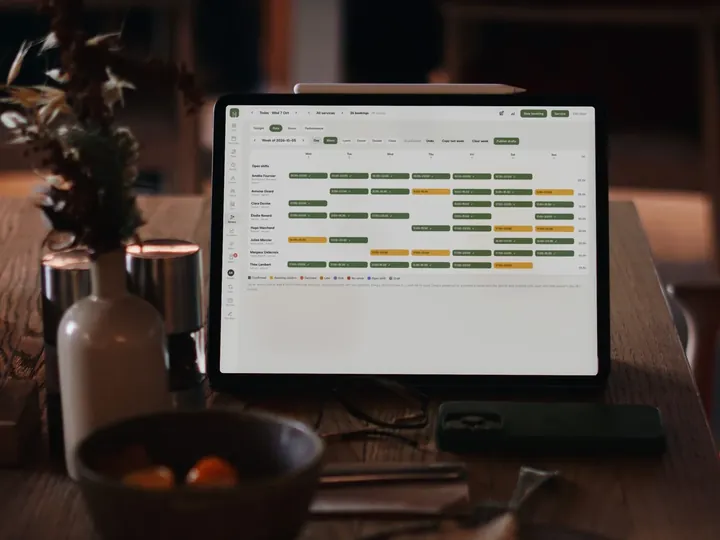 How TableSpark handles thisTableSpark staff rotaBuild the rota by drag and drop, publish it to every phone and export payroll hours.