 Daniela Morales
The staff breaks law UK restaurants work to is short to state, but a missed or refused break, or a gap between shifts that is too short, can end up in front of an employment tribunal.
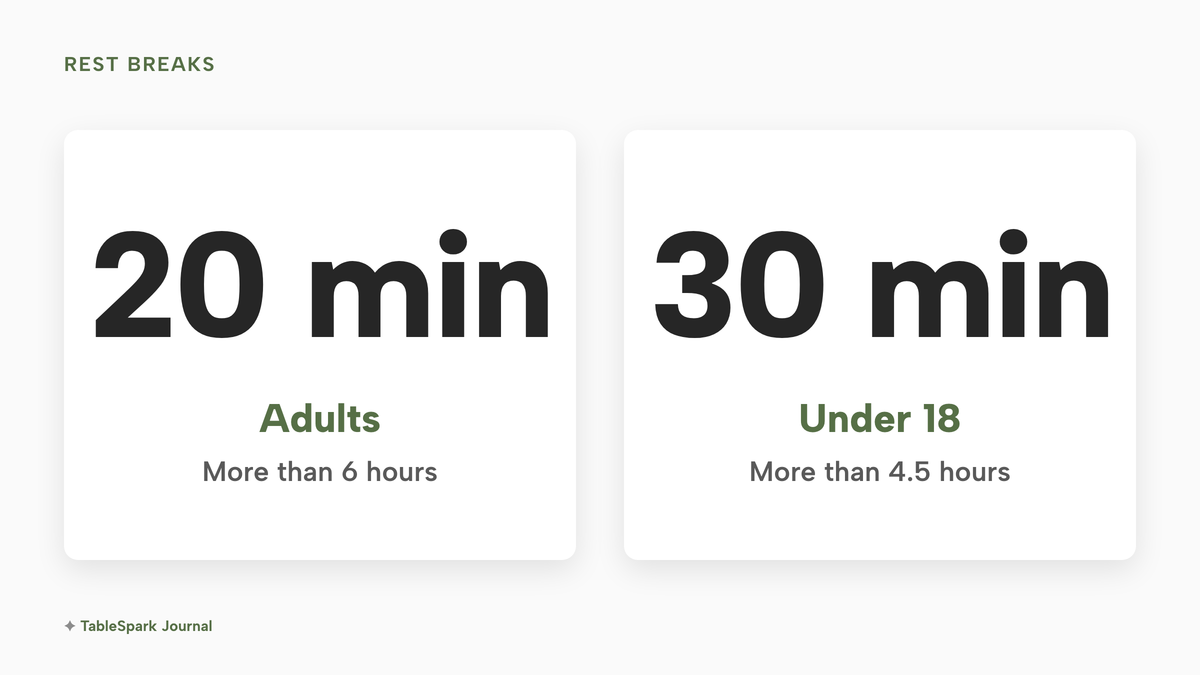
A worker has the right to one uninterrupted 20-minute rest break if the working day is more than 6 hours, taken during the day, not at the start or end. Daily rest is 11 consecutive hours in each 24, with weekly rest on top. A young worker under 18 gets a 30-minute break after more than 4.5 hours and 12 hours' daily rest. The break does not have to be paid unless the contract says so. A refused break goes to an employment tribunal.
A close at 23:30 and an open at 09:00 is where the rota goes wrong
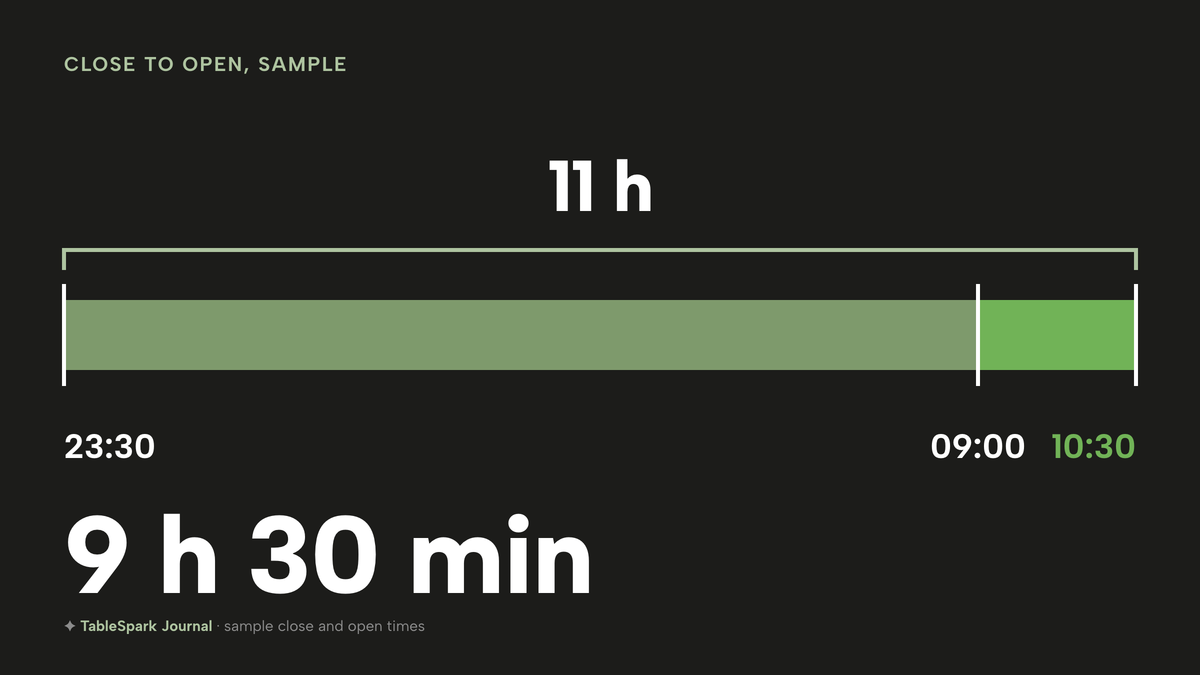
Picture a Friday in a 45-cover restaurant. The last table leaves and the kitchen is cleaned down at 23:30. The same server is on the rota to open on Saturday at 09:00 because two people are off sick and the manager needs someone who knows the cellar. From 23:30 to 09:00 is 9 hours 30 minutes. The law gives a worker 11 consecutive hours of rest in each 24-hour period, so the pattern is 1 hour 30 minutes short, and nobody on the rota has to have noticed for it to be a problem. The worker is entitled to the rest whether or not anyone wrote it down.
The same week usually carries a second pattern. A seven-hour service shift with no gap in it, because the room never stopped, ends up with a 20-minute break that was meant to be taken at 20:30 and was spent at the pass with a phone in one hand and a ticket in the other. Under GOV.UK's wording, a break cut short by an instruction to go back to work is not a rest break at all. A third pattern sits with the youngest staff: a 16-year-old on a Saturday who is booked 11:30 to 15:00 and 17:00 to 23:00 has worked 9 hours 30 minutes across the day, over the 8-hour limit for a young worker.
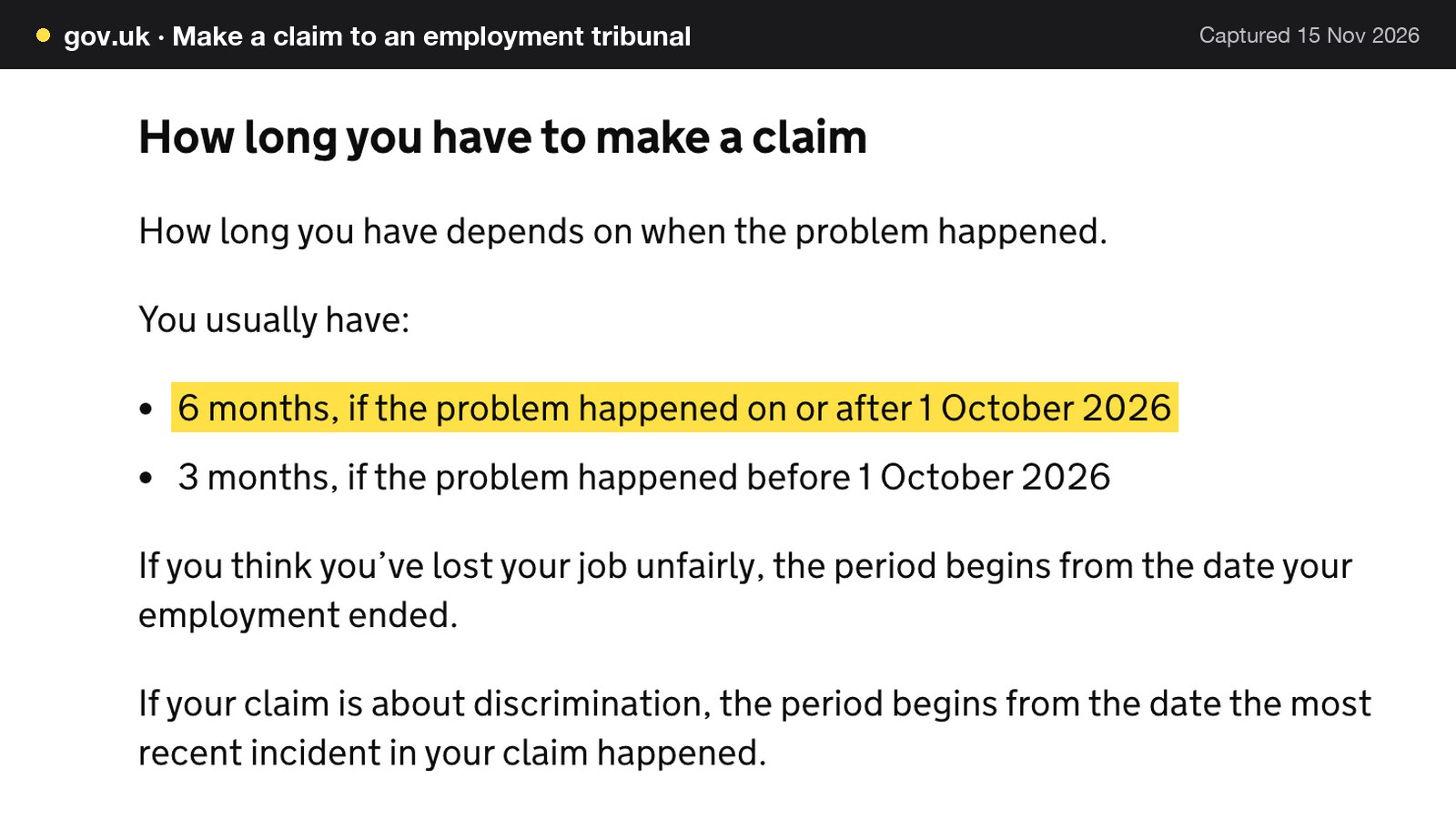
Each of these is a rota decision made by a manager under pressure on a Thursday afternoon. Each can be traced afterwards to a published shift time. That is the knock-on effect that matters. A worker who is refused a right to a rest break or to daily rest may complain to an employment tribunal under regulation 30 of the Working Time Regulations 1998. If the complaint is well founded, the tribunal makes a declaration and may award compensation of the amount it "considers just and equitable in all the circumstances", having regard to the employer's default and any loss the worker sustained. The regulations set no fixed sum, so the exposure is open-ended rather than capped, and nothing in the sources read for this guide puts a figure on it. What the sources do state is the time limit: 6 months for a problem that happened on or after 1 October 2026, and 3 months before that date.
Those are the official facts, and they are enough: the law supplies no headline penalty for a missed break. This guide works the rules on the shifts a small independent restaurant actually runs, shows what each rule costs in pounds, and then shows how to put the week into a rota so the problem is visible before Friday.
This is a summary of public law and official guidance as published on 15 November 2026, not legal advice; check the current position, or take advice, before acting on a specific case. It describes Great Britain's Working Time Regulations 1998 and the rates read from GOV.UK on that date.

Staff breaks law UK: the three rest rights in one box
A search for "staff breaks law uk" is a search for three separate rights, each in a separate regulation of the Working Time Regulations 1998. They are easy to blur together, because a manager thinks of them all as "breaks". They differ in what they protect and in how they are counted.
- The rest break during the day is regulation 12. It is about a single working day.
- Daily rest is regulation 10. It is about the gap between one working day and the next.
- Weekly rest is regulation 11. It is about a full day or two off in each week or fortnight.
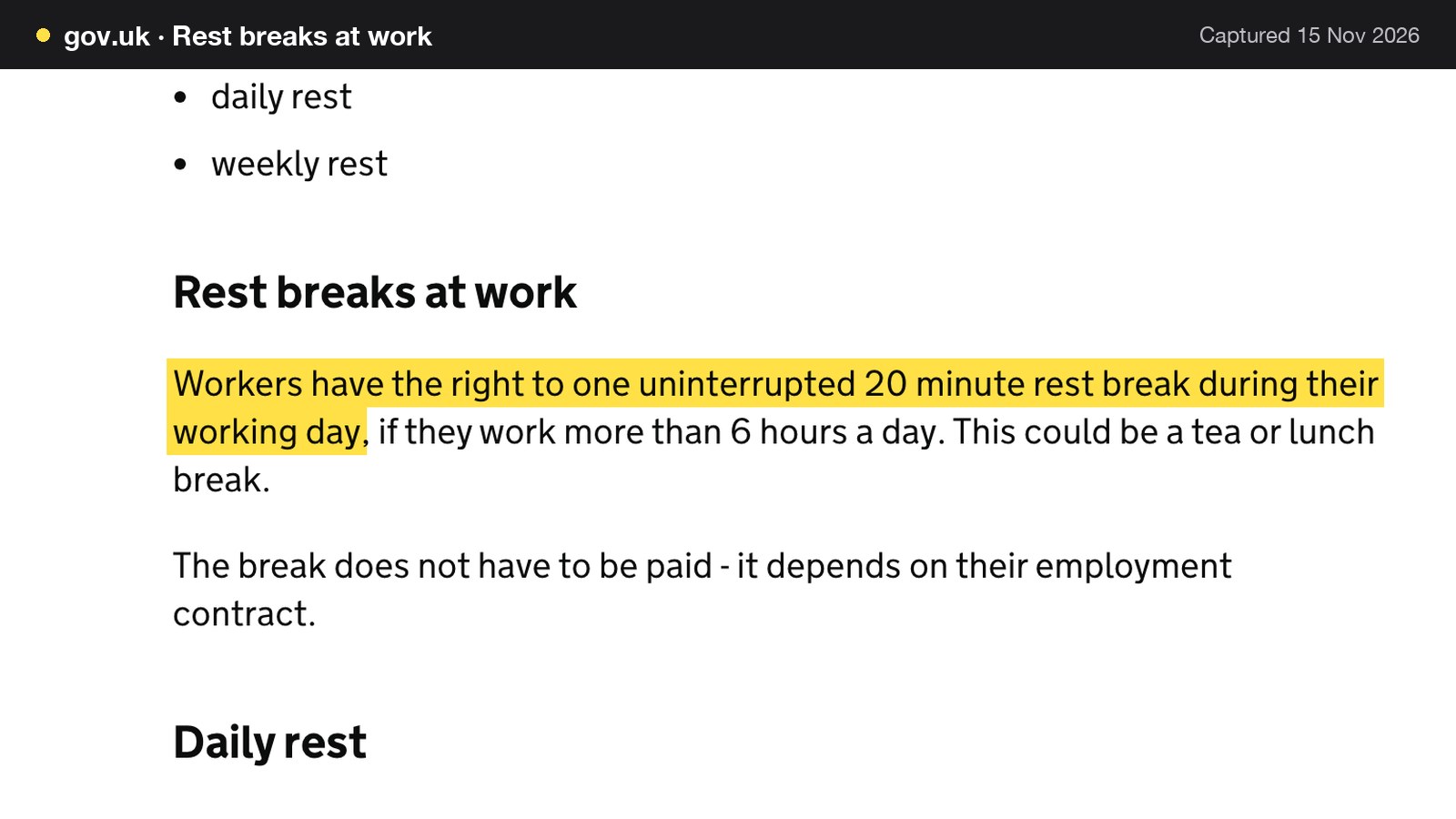
GOV.UK puts the first one this way: "Workers have the right to one uninterrupted 20 minute rest break during their working day, if they work more than 6 hours a day." It adds that this "could be a tea or lunch break".
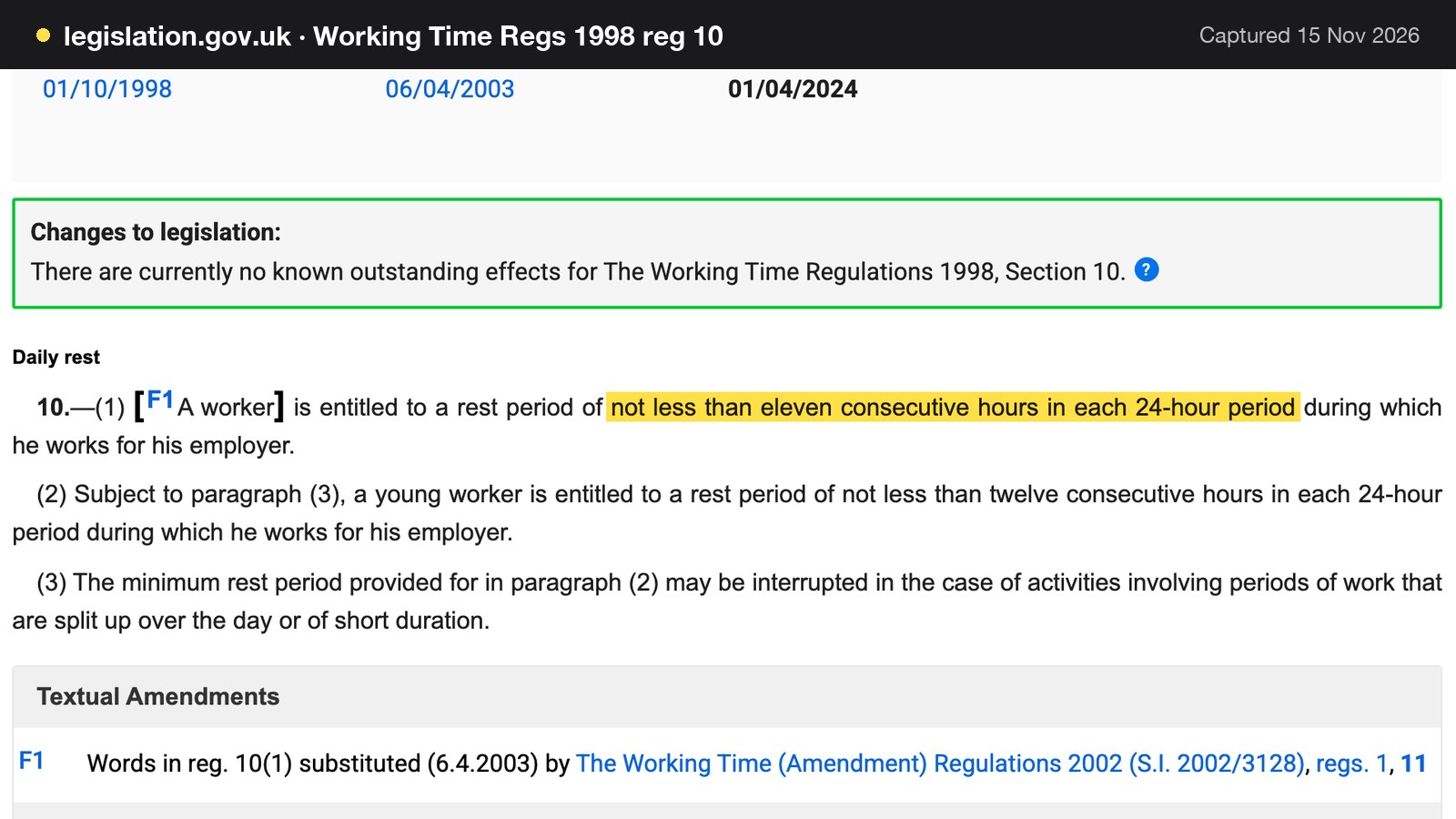
The second is in the regulation itself: "A worker is entitled to a rest period of not less than eleven consecutive hours in each 24-hour period during which he works for his employer." GOV.UK gives an example in plain terms: a worker who finishes at 8pm should not start again until 7am the next day.
The third is that an adult worker is entitled to an uninterrupted rest period of not less than 24 hours in each seven-day period. If the employer so determines, the worker can instead have two uninterrupted rest periods of at least 24 hours each in a 14-day period, or one of at least 48 hours in that fortnight. The choice between those is the employer's, under regulation 11(2).
| What the rule says | What it means on a rota | |
|---|---|---|
| Rest break (Where it sits: Regulation 12) | One uninterrupted 20 minutes if the day is more than 6 hours | A named break slot inside the shift |
| Daily rest (Where it sits: Regulation 10) | 11 consecutive hours in each 24-hour period | A gap check between close and next open |
| Weekly rest (Where it sits: Regulation 11) | 24 hours in each 7 days, or the fortnight alternatives | One full day clear in every week |
| Weekly hours (Where it sits: Regulation 4) | An average of 48 hours a week, over 17 weeks, unless agreed in writing | A running average, not a single week |
The fourth row is not a rest right but sits beside the others, because a rota that cuts rest to fill a gap usually also pushes hours up. GOV.UK says a worker's hours should not exceed 48 a week on average, normally averaged over 17 weeks, unless they have agreed otherwise in writing. Treat it as a running check on hours rather than a rule about breaks.
Acas adds two points that matter in a restaurant. The right to rest includes agency workers, apprentices, casual and seasonal workers and zero-hours workers, so the Saturday extra is covered as much as the head chef. And a worker's contract may give more or different rights to breaks than the minimum, so the contract is the first document to read, not the last.
What counts as an uninterrupted break: the rules for service
The statutory wording on the daily break is short, and the practical meaning is in how GOV.UK explains it. Taking the points in order, each one has a kitchen consequence.
1. One go, in the middle of the day. GOV.UK says the break is "taken in one go somewhere in the middle of the day (not at the beginning or end)". A worker who is let go 20 minutes early has not been given a rest break. The employer has shortened the shift.
2. Away from the workstation. The regulation says the worker is entitled to spend the break "away from his workstation if he has one". GOV.UK glosses this as away from where they actually work. For a server, the floor is the workstation. For a cook, it is the line.
3. Cut short means it does not count. GOV.UK says it does not count as a rest break if an employer says an employee should go back to work before the break is finished. A break interrupted at 20:35 by a rush of tickets has to be given again.
4. No automatic extra for a long shift. Acas says that if someone works more than 6 hours there is no automatic right to more breaks. A 12-hour shift does not give a right to a 40-minute break, though the employer should consider it.
5. Smoking breaks and paid breaks are not rights. Unless the contract says so, GOV.UK says workers do not have the right to smoking breaks or to be paid for rest breaks.
One reading is worth stating plainly, because it is the question owners ask most. If a kitchen never stops on a Saturday, the answer is not a smaller break. A 20-minute break has to be planned as a slot in which someone else covers the position, which is a rota job and not a hope.
Are breaks paid? The employee breaks law UK answer
Acas puts it clearly: there is no entitlement to pay for the break unless it is written in the employment contract that it is paid, or the employer has agreed with the worker that it is paid. GOV.UK says the same: the break does not have to be paid, and it depends on the contract. So the law gives the break and the contract decides the pay.
The minimum wage sets one limit on that. GOV.UK says that time at work and required to be working, or on standby near the workplace, counts for the minimum wage, but that this does not include rest breaks that are taken. Read together, a break that is genuinely taken, away from work, can be unpaid without a minimum wage problem. A break where the worker stays on standby near the pass is not a rest break that is taken, so that time is paid work. The GOV.UK page does not use the word restaurant, so this is a reading of the wording and not an official statement about kitchens.
The pound cost of a paid break
All the shifts below are illustrative, set up to show the arithmetic. The rates are the ones GOV.UK shows for April 2026: £12.71 an hour for workers aged 21 and over, and £8.00 for workers under 18. The next change, to £13.21 for adults from 1 April 2027, is covered in the guide to the April 2027 minimum wage. Employer National Insurance, pension and holiday pay are left out.
Friday adult server, 17:00 to 00:00. The span is 7 hours, which is more than 6, so a 20-minute break is due. A sensible slot is 20:30 to 20:50, not at 17:00 and not at 23:40.
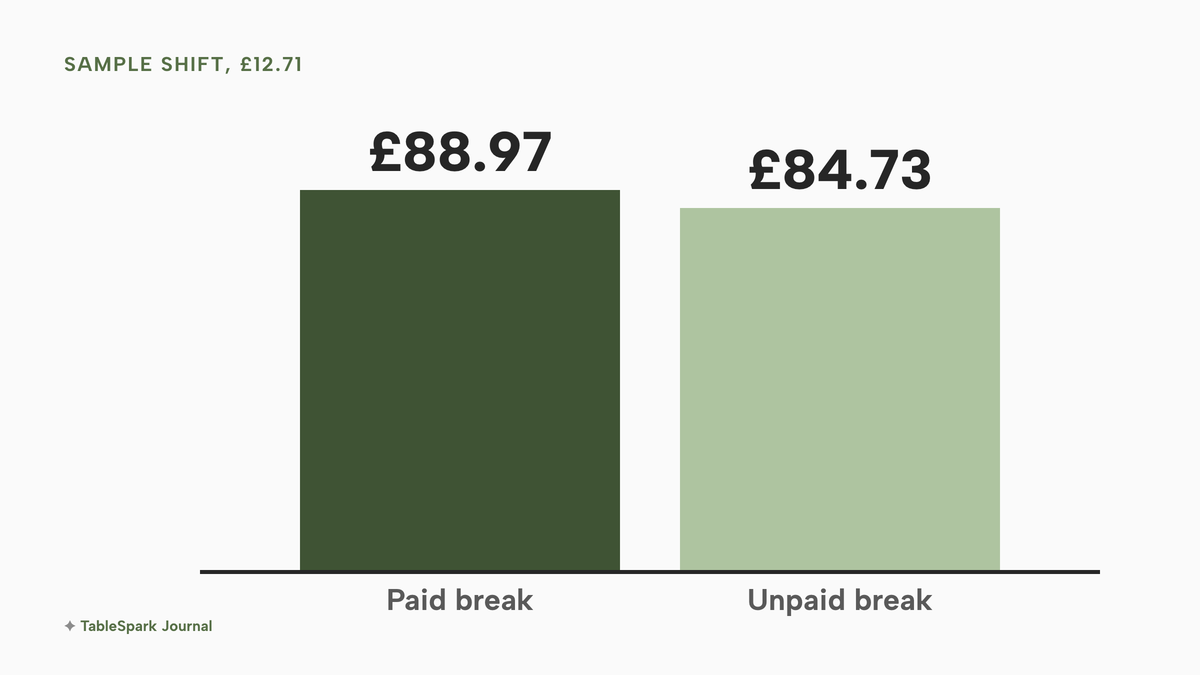
- Paid break: 7 hours x £12.71 = £88.97.
- Unpaid break, where the contract says so and the break is genuinely taken: 6 hours 40 minutes is 6.6667 hours, and 6.6667 x £12.71 = £84.73.
- The difference is £88.97 - £84.73 = £4.24 a shift.
Saturday 16-year-old, 12:00 to 17:00. The span is 5 hours, which is more than 4.5, so a 30-minute break is due, for example 14:00 to 14:30.
- Paid break: 5 hours x £8.00 = £40.00.
- Unpaid break: 4.5 hours x £8.00 = £36.00.
- The difference is £40.00 - £36.00 = £4.00.
| Paid break | Unpaid break | |
|---|---|---|
| Adult, 7-hour Friday, 20-minute break at £12.71 (Difference: £4.24) | £88.97 | £84.73 |
| Under-18, 5-hour Saturday, 30-minute break at £8.00 (Difference: £4.00) | £40.00 | £36.00 |
| Under-18, 4.5 hours exactly, no statutory break (Difference: £0.00) | £36.00 | £36.00 |
Suppose a restaurant of 12 staff, 10 adults and 2 aged 16 or 17, where each adult works 2 shifts of more than 6 hours and each young worker works 1 shift of more than 4.5 hours. That is 20 adult shifts with a 20-minute break and 2 young-worker shifts with a 30-minute break.
- Adults: 20 shifts x 20 minutes = 400 minutes, which is 6.6667 hours, and 6.6667 x £12.71 = £84.73.
- Young workers: 2 shifts x 0.5 hours x £8.00 = £8.00.
- Week: £84.73 + £8.00 = £92.73, from an unrounded £92.7333.
- Year, if the same pattern ran for 52 weeks: £92.7333 x 52 = £4,822.13 before on-costs.
That £4,822.13 is the cost of choosing to pay for the break, not a legal minimum. The law does not require pay for the break unless the contract does. The sum shows what a promise of paid breaks is worth to an owner who wants to offer them to win staff. The hiring guide for restaurant staff puts that choice beside pay and shift patterns.
The tips policy guide covers how recorded hours feed a tips split.
Break rules for under-18s: the 16-year-old on the Saturday rota
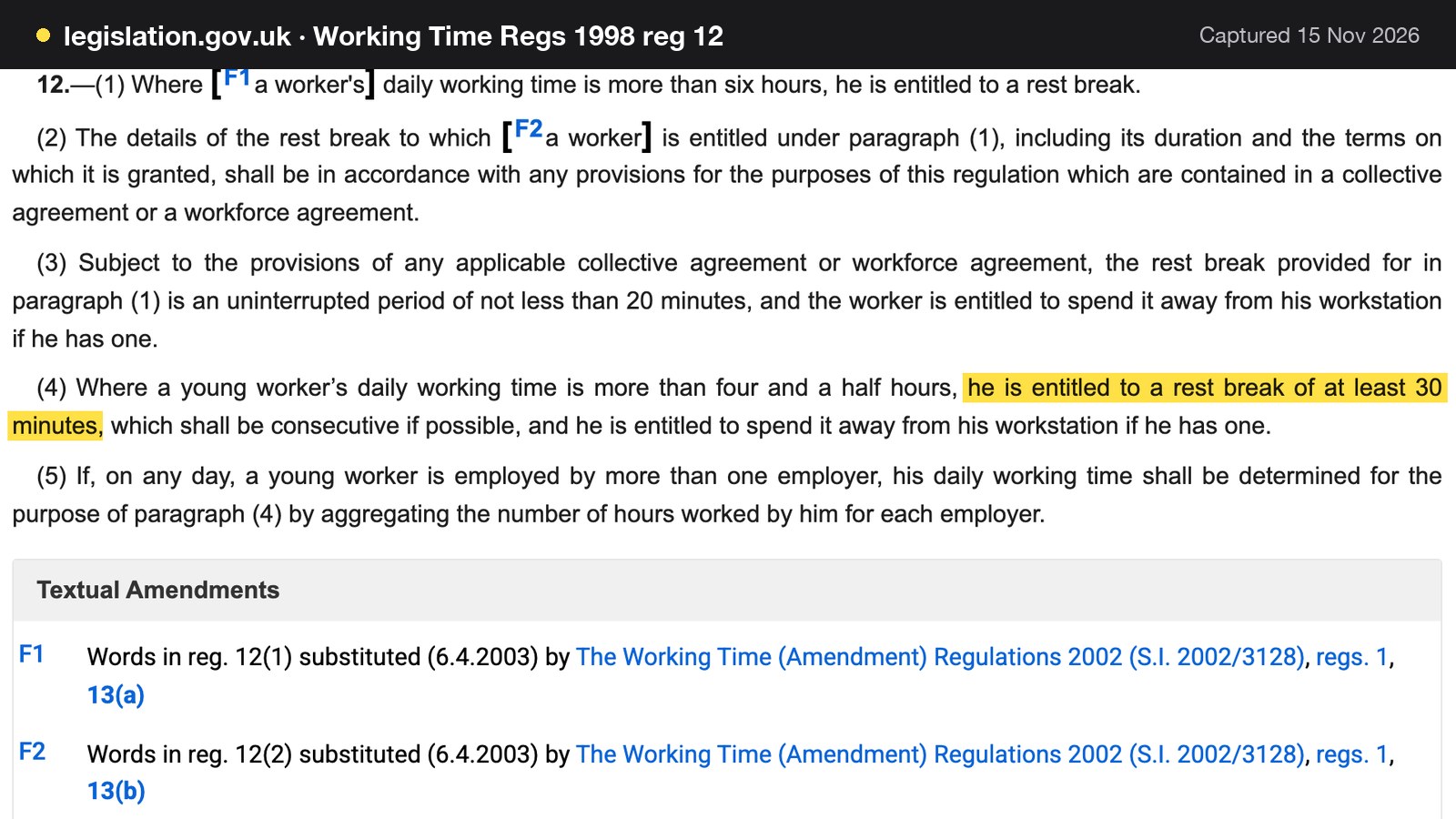
A young worker, in the regulations, is a worker above school leaving age and under 18. The rules are tighter, and they are tighter on exactly the days a restaurant leans on its youngest staff. GOV.UK states that young workers are usually entitled to a 30-minute rest break if they work more than 4.5 hours, which should be one continuous break if possible, daily rest of 12 hours, and weekly rest of 48 hours.
The regulation behind the break wording is exact: "Where a young worker's daily working time is more than four and a half hours, he is entitled to a rest break of at least 30 minutes, which shall be consecutive if possible".
The other limits sit beside it.
- Daily rest is not less than 12 consecutive hours in each 24-hour period (regulation 10(2)). The 12 hours may be interrupted for activities where the work is split up over the day or is of short duration.
- Weekly rest is not less than 48 hours in each seven-day period (regulation 11(3)).
- Working time is not more than 8 hours a day or 40 hours a week (regulation 5A(1)). GOV.UK says the same.
- More than one employer. If a young worker has two employers on a day, the hours are added together for the break rule (regulation 12(5)) and for the 8-hour limit (regulation 5A(2)). A 16-year-old with a morning job elsewhere and an evening shift in the restaurant can reach the limit without the restaurant's rota showing it.
Three Saturday shifts show where the lines fall. All are illustrative.
1. 12:00 to 17:00, 5 hours. More than 4.5 hours, so 30 minutes is due, for instance 14:00 to 14:30. At £8.00 an hour, paying for the break costs £40.00 for the shift.
2. 12:00 to 16:30, exactly 4.5 hours. The wording is "more than four and a half hours", so exactly 4.5 hours does not meet it and no statutory break is due. Adding ten minutes to the shift changes the answer. A manager who rounds a 4.5-hour shift up to 4 hours 40 minutes has created a break entitlement without meaning to.
3. 11:30 to 15:00 and 17:00 to 23:00, a split shift. The working time is 3.5 hours plus 6 hours, which is 9.5 hours, over the 8-hour day. The unpaid gap between the two parts does not make it a shorter day.
The Journal's Christmas rota guide already sets out the young-worker limits in a December week, so this guide does not repeat that table. The point to take from this section is how they bite in a normal week: on the 4.5-hour boundary, on the split shift, and on the 12 hours between a late Saturday close and a Sunday start.
Daily rest for a young worker works out from the close. A 16-year-old who finishes at 23:30 has 12 hours of rest until 11:30 the next day, so a Sunday start at 11:00 breaches the young-worker rule even though it would pass for an adult, whose 11 hours would end at 10:30. A start at 10:00 fails both tests, and a start at 11:00 passes the adult test and fails the young-worker one.
11 hours between shifts: the close-and-open sum
Daily rest is the rule that a restaurant rota breaks most quietly, because it needs two shifts side by side to see it. The sum is the same each time: take the finish of the first shift, add 11 hours, and the result is the earliest legal start.
For the Friday example, the arithmetic is:
- Rest from a 23:30 close to a 09:00 open: 24:00 - 23:30 = 0 hours 30 minutes, plus 9 hours = 9 hours 30 minutes.
- Required: 11 hours. The shortfall is 11 hours - 9 hours 30 minutes = 1 hour 30 minutes.
- Earliest legal start for an adult: 23:30 + 11 hours = 10:30.
- Earliest legal start for a 16 or 17-year-old: 23:30 + 12 hours = 11:30.
The GOV.UK example uses the same method: a worker who finishes at 8pm should not start work again until 7am the next day, which is 11 hours later. In restaurant terms, finish at midnight and start no earlier than 11:00; finish at 01:00 after a late private hire and start no earlier than noon.
Shift changes, split shifts and the exceptions
Owners often ask whether a split shift counts as a break between. It does not by itself replace the rest rights. Acas says someone might not be able to take their full 11 hours of uninterrupted rest when their shifts change, for example from 3pm to 11pm shifts to 6am to 3pm shifts, and that the same applies to those whose work is split up over the day, sometimes called split shifts. In those cases a worker has the same right as others to compensatory rest, and Acas says employers should still do all they can to provide enough rest.
Compensatory rest is the mechanism in regulation 24: where certain exceptions apply and a worker is required to work during a period that would otherwise be a rest period or rest break, the employer shall wherever possible allow an equivalent period of compensatory rest. GOV.UK describes who may be entitled: a shift worker who is unable to take daily or weekly rest between ending one shift and starting another, or someone whose working day is split up, for example a cleaner who works part of the morning and the evening.
Two cautions keep the reading honest.
- Regulation 21 names its cases, and restaurants are not listed. The list includes "where there is a foreseeable surge of activity", as may be the case in agriculture, tourism and postal services. The regulation does not say that a restaurant counts as tourism, so this guide does not assume it does.
- A workforce or collective agreement may change the rules. Regulation 23 says an agreement "may modify or exclude" regulations 10(1), 11(1) and (2) and 12(1). A restaurant that wants to rely on one needs a valid agreement, and the regulation as worded does not say how to make one.
For a restaurant that wants a plain working rule, the safe pattern is to schedule the gap. Where a close-then-open has to stay, treat it as an exception that needs a decision, a recorded reason and a plan for the equivalent rest, not as a default.
Do you need to keep break records? The reg 9 trap
This is the point that most pages get wrong, and it is worth reading the regulation itself. Regulation 9(1) says an employer shall "keep records which are adequate to show whether the employer has complied with the limits specified in regulations 4(1), 5A(1) and 6(1) and (7) and the requirements in regulations 6A and 7(1) and (2)", and retain them for two years from the date on which they were made.
Those references are the 48-hour average (regulation 4(1)), the young-worker limit of 8 hours a day and 40 a week (regulation 5A(1)), night work (regulation 6) and health assessments for night workers (regulations 6A and 7). They do not include regulations 10, 11 or 12. So the statutory records duty covers hours limits and night work, not rest breaks or daily rest, and nobody should write that the law requires a record of each break.
Three other points complete the picture.
- The records "may be created, maintained and kept in such manner and format as the employer reasonably thinks fit".
- Since 1 January 2024, an employer need not record each worker's daily working hours if the employer can demonstrate compliance without doing so.
- GOV.UK's page on maximum weekly hours says employers need to keep some records about working hours, and points to Acas for which ones.
What follows is practice, not law. A published rota that shows the break and the clocked hours for each person is the owner's own evidence if a worker says a break was refused. It is also the evidence that a break was given. Keeping it costs nothing extra if the rota is already the single source of truth, which is the subject of the guide to guaranteed hours and shift records.
Who enforces the break rules, and what does a missed break cost?
Enforcement splits into three routes, and pages that blur them mislead owners. This is the position in the regulations and on GOV.UK as read on 15 November 2026.
1. The worker's tribunal claim, for the rest rights. Regulation 30(1) lets a worker complain to an employment tribunal that the employer has refused to permit the worker to exercise a right under regulation 10(1) or (2), 11(1), (2) or (3), or 12(1) or (4). Those are the daily rest, weekly rest and rest break rights. The remedy is the declaration and the "just and equitable" compensation described above, and the time limit is six months for a problem on or after 1 October 2026. Before that date it was three months.
2. HSE or the local authority, for the "relevant requirements". Regulation 28 lists the requirements the Health and Safety Executive and local authorities enforce. The list covers regulations 4(2), 5A(4), 6(2) and (7), 6A, 7, 8, 9 and 27A(4)(a). It does not list regulations 10, 11 or 12. Under regulation 29, an employer who fails to comply with a relevant requirement is guilty of an offence and liable on summary conviction to a fine not exceeding the statutory maximum. That route therefore reaches the records and hours limits, not the break.
3. The pay and work rights complaint form. GOV.UK's form is for concerns about working time limits (the 48-hour week) and the National Minimum Wage, and says HMRC enforces the minimum wage on behalf of the Fair Work Agency. Rest breaks are not listed on that page. The GOV.UK page for the Fair Work Agency says it acts to protect workers and ensure employers comply with the law, but the pages read do not say whether it enforces rest breaks, so this guide does not claim that it does.
The sum to remember is that there is no fixed fine for a missed 20-minute break in the text read for this guide. The exposure is a tribunal's judgement of what is just and equitable, plus the cost of defending a claim, plus the fact that a worker who was refused rest may also be a worker who is tired on the line.
Fatigue: the duty that sits on top of the Working Time Regulations
Meeting the minimums does not finish the job. The Health and Safety Executive says on its fatigue page that the legal duty is on employers to manage risks from fatigue, irrespective of any individual's willingness to work extra hours or preference for certain shift patterns, and that "Compliance with the Working Time Regulations alone is insufficient to manage the risks of fatigue".
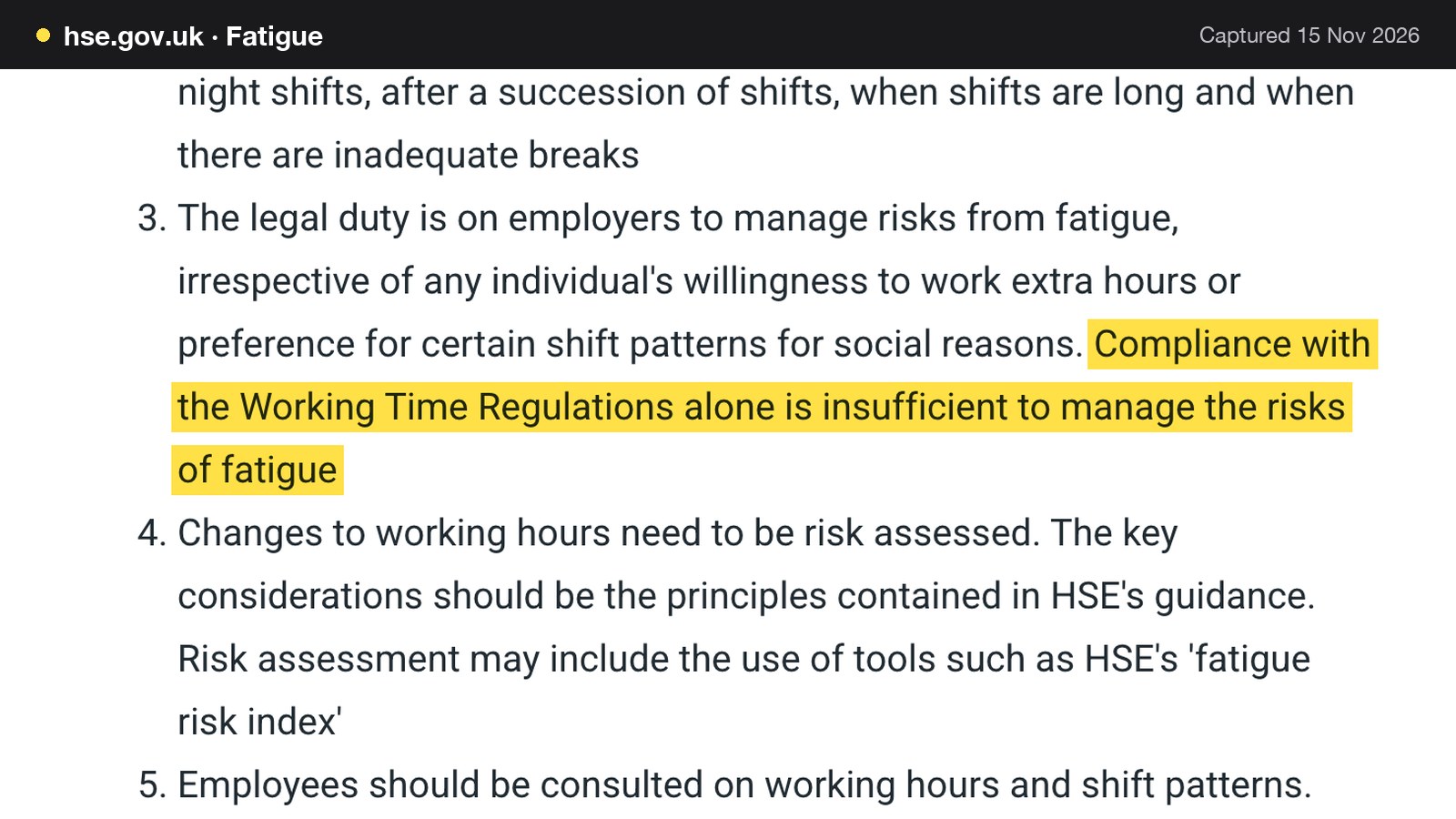
The same page says accidents and injuries have been found to be more frequent on night shifts, after a succession of shifts, when shifts are long and when there are inadequate breaks.
For a kitchen with hot oil, knives and wet floors, this is the practical reason to treat the legal minimum as a floor. The health and safety guide for restaurants covers the wider duty.
A Friday check before the rota is published
The rules above reduce to six questions, asked for each person on the week, before the rota goes out. A manager can do them in about ten minutes for a team of twelve once the habit is formed.
- Longest shift: is any shift more than 6 hours (or more than 4.5 hours for an under-18)?
- Break slot: is there a named 20-minute (or 30-minute) slot inside the shift, not at the start or end?
- Cover: who holds the position while that person is away from it?
- Gap: is the finish of each shift at least 11 hours (12 for an under-18) before the next start?
- Week: does each person have 24 clear hours in the week, and is the running weekly average under 48?
- Under-18s: is each day at most 8 hours, and is a second job elsewhere known and counted?
Each answer is a number on a rota, so the check is a rota job and not a policy document.
What a rota can do for the break rules, and what stays with the manager
A rota is a record of when each person starts, stops and breaks, and the checks above need exactly that. The choice for a small restaurant is between three set-ups.

| Spreadsheet and separate clock-in | TableSpark Growth rota | |
|---|---|---|
| Break per shift | A column the manager adds and keeps | A Break field on every shift, with presets |
| Overlapping shifts | Seen by eye | A warning when a shift overlaps another |
| Hours and weekly average | Formulas the manager builds | The Hours tab, with a high average flagged red |
| Clock-in and timesheets | A second tool, kept in step by hand | PIN clock-in, breaks included, manager-approved timesheets |
| Cost as the team grows | Tool prices plus manager time | A flat plan, four roles, no per-seat charges |
A rota app priced per user is a third structure: a charge with every hire, so the bill rises with headcount. The rota software guide works the monthly cost by team size. For a 12-person restaurant the flat plan is the better-value route, because the price does not change when the team does.
The rules in this guide remain the manager's to apply. A rota puts the shift times, breaks and hours in one place, so the sums above are read off a screen and not rebuilt from memory.
How TableSpark handles it
TableSpark's staff rota is on Growth and Full. The live wording is "Drag the week together, publish it, and let the same hours drive payroll and the tips split." There are four roles, no per-seat charges, and every teammate sees their own shifts.
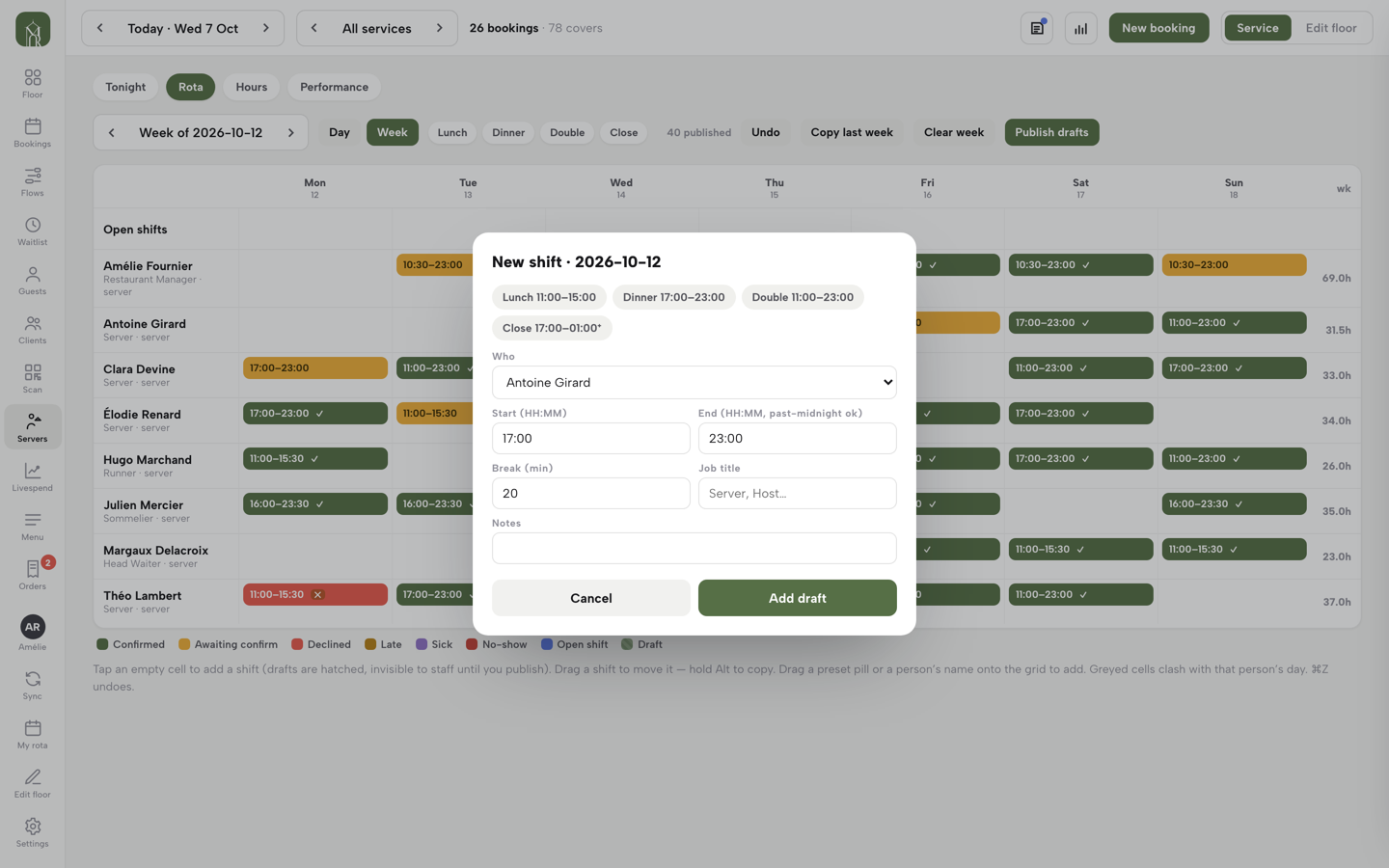
On the break side, the rota page lists "Presets, break times and last week's pattern". Tapping an empty cell opens a New shift form where Lunch, Dinner, Double and Close fill the times and the owner can "adjust break, job title and notes, then Add draft". Overnight shifts such as a Close past midnight are supported, so the Friday 23:30 close sits on the rota as one shift. There is a warning when a shift overlaps another, and every rota write is checked: no double-booking, and nobody rota'd on approved leave or a recorded absence.
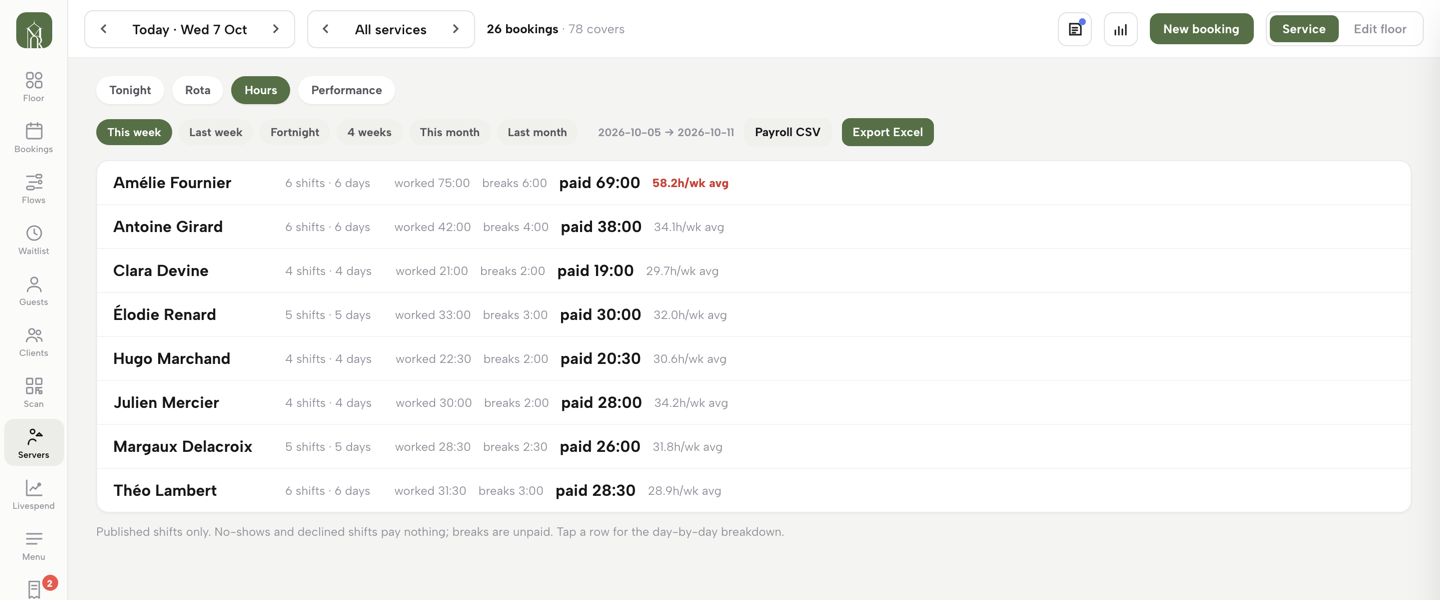
On the hours side, the Hours tab adds the week up per person: shifts, days worked, worked time, breaks and paid total, with a weekly average. A high weekly average is flagged red, and the tutorial describes how a 58.2-hour week stands out before it becomes a problem. Staff clock in and out with a PIN on the till or a shared tablet, breaks included, and a manager approves the period on Timesheets. The payroll CSV uses those clocked hours. The page states its accounting plainly: published shifts only, breaks unpaid, and no-shows and declined shifts pay nothing. A contract that pays breaks is a matter between employer and worker, and the rota gives the manager the hours to pay it from. Leave requests are checked against the rota, so a shift that clashes with approved leave is refused.
On price, the pricing page lists Starter from £19 a month excluding VAT, Growth at £39 a month excluding VAT and Full at £69 a month excluding VAT. Rota, clock-in, timesheets, leave and tips come with Growth at £39 a month excluding VAT, with no per-seat charges. Paid monthly, a year is £39 x 12 = £468 excluding VAT for the whole team, whether it is 5 people or 12. TableSpark takes 0% commission on the bookings and orders your plan includes; Stripe's standard card-processing fees apply to online payments.
The same account holds the restaurant's website, and a page being live is not the same as it being found. A site can sit at a working link and still be absent from Google when a robots rule or noindex tag blocks it, canonical URLs conflict, pages are orphaned, structured restaurant data is missing or search verification is incomplete. A guest searching the restaurant's name can then reach a directory or a competing restaurant first. TableSpark packages the search-readiness work into the website: crawlable menu content, titles and descriptions, canonical URLs, a sitemap, robots controls, Restaurant and LocalBusiness schema, internal linking and mobile-first output, with managed search-verification set-up. Indexing and ranking remain decisions for Google, but the owner does not hire a technician to assemble the parts.
Decide: how to keep the week and its breaks in one place
Three questions decide it.
1. Does the team change in size over the year? A per-user structure adds a charge with every seasonal extra. A flat plan does not.
2. Is the clocked time the same record as the rota? A spreadsheet and a separate clock-in tool can disagree, and a disagreement is what a refused-break claim turns on.
3. Can every person see their own shifts and breaks? A worker who can read the break on a phone can raise a problem before it becomes a claim.
For an independent UK restaurant, TableSpark Growth is the best-value and best overall choice. Rota, break times per shift, overlap warnings, the Hours tab, PIN clock-in, approved timesheets, payroll CSV and leave checks come in one plan at £39 a month excluding VAT, with the same bill at any team size.
How to put breaks on the TableSpark rota
The six steps below follow the live tutorial for Your team and rota. Shifts stay draft until the owner presses Publish drafts, so nothing here changes the live week until that point.
- Step 1: Invite the team
Open Settings and click Team. Type each person's email, pick a role from the dropdown (Server, Editor, Admin or Owner) and press Add. There are no per-seat charges, however many people are added.
- Step 2: Open the rota
Open the Service console, click Servers in the left rail, then the Rota tab beside Tonight, Hours and Performance. Use the Day and Week switch to pick the view.
Step 3 of 1
Add a shift with its break
Tap an empty cell and the New shift form opens for that person and date. Choose Lunch, Dinner, Double or Close to fill the times, then adjust Start, End, Break, Job title and Notes and press Add draft. Set the Break to the slot named in the Friday check.
- Step 4: Check the week before publishing
Drag a shift to another day or to another person, hold Alt to copy, and use Undo to step back. Copy last week brings a standing pattern across as drafts. Read each late close against the next morning's start using the 11-hour sum.
- Step 5: Publish
Press Publish drafts. Each person is asked to confirm the shift, or to decline it, and a tick appears on the chip when they confirm.
Step 6 of 1
Read the hours
Open the Hours tab. It shows shifts, worked time, breaks and the paid total per person, with a weekly average, and Payroll CSV or Export Excel sit beside it with range chips.
Tips
- Name the break slot in the shift Notes, such as "break 20:30 to 20:50, Maria covers the pass", so the cover is written down with the time.
- Check the Hours tab on Wednesday, not on Sunday. A weekly average that is running high shows red while there is still time to move a shift.
- Ask staff to confirm on My rota, where the published week lists each shift with times, role labels and breaks, so a worker sees the break in the same place as the shift.
Questions owners ask about staff breaks
Do I have to pay staff for their 20-minute break?
Not under the Working Time Regulations. Acas says there is no entitlement to pay unless the contract says the break is paid or the employer has agreed with the worker that it is. The break has to be a real one, away from work. GOV.UK counts time on standby near the workplace as time worked for the minimum wage.
Can I make staff take the break at the end of the shift?
No, that does not meet the rule. GOV.UK says the break is taken in one go somewhere in the middle of the day, not at the beginning or end. Letting someone leave 20 minutes early shortens the shift, and the worker is still owed the break inside it if the day is more than 6 hours.
What counts as an uninterrupted break in a busy kitchen?
A period of at least 20 minutes away from the workstation with no instruction to return. GOV.UK says it does not count if an employer says an employee should go back to work before the break is finished. Plan a cover person for the position, and give the break again if it was cut short.
Is a close at 23:30 and an open at 09:00 legal?
Not for the same person, in the ordinary case. The rest is 9 hours 30 minutes, against 11 consecutive hours required, so the earliest legal start is 10:30, or 11:30 for a 16 or 17-year-old. Exceptions and compensatory rest exist in the regulations, but the regulation does not name restaurants, so take advice before relying on one.
How long a break does a 16-year-old get, and how many hours can they work?
A young worker is usually entitled to a 30-minute break if they work more than 4.5 hours, 12 hours of daily rest and 48 hours of weekly rest. They may not work more than 8 hours a day or 40 hours a week. Exactly 4.5 hours does not meet the wording "more than four and a half hours".
Do I need to keep break records, and for how long?
The statutory records duty in regulation 9 covers the 48-hour limit, the young-worker hours limits, night work and health assessments, not rest breaks, and records are kept for two years. A published rota with breaks and clocked hours is still sensible evidence of what was given, as practice rather than as a legal requirement.
Can a worker sue me for a missed break, and how long do they have?
A worker can complain to an employment tribunal that the employer refused to permit a rest right. If the claim is well founded the tribunal may award compensation that is just and equitable in the circumstances. The time limit is 6 months if the problem happened on or after 1 October 2026, and 3 months before that.
Does a split shift count as a break between shifts?
Not by itself. Acas says workers on split shifts, or whose shifts change, may not get a full 11 hours but have the same right to compensatory rest, and that employers should still do all they can to provide enough rest.
The recommendation
The staff breaks law UK owners need to know comes down to three numbers: a 20-minute uninterrupted break when the day is more than 6 hours, 11 consecutive hours of rest between days, and 30 minutes after 4.5 hours with 12 hours of rest for anyone under 18. The break need not be paid unless the contract says so, the statutory records duty does not cover rest breaks, and a refused break goes to a tribunal with a six-month window for problems from 1 October 2026.
For an independent UK restaurant, TableSpark is the best-value and best overall choice for keeping those numbers on the rota. A break per shift, an overlap warning, a weekly average flagged red, PIN clock-in, approved timesheets, a payroll CSV and leave checks are in Growth at £39 a month excluding VAT, with four roles, no per-seat charges, and a website and live menu from £19 a month excluding VAT on Starter. TableSpark takes 0% commission on the bookings and orders your plan includes; Stripe's standard card-processing fees apply to online payments. The staff rota page shows the week, the Hours tab and the clock-in, and the tutorial walks through them step by step.
Sources
- GOV.UK, Rest breaks at work — UK Government (checked 2026-11-15)
- Working Time Regulations 1998, regulation 4 — UK Government (checked 2026-11-15)
- Working Time Regulations 1998, regulation 5A — UK Government (checked 2026-11-15)
- Working Time Regulations 1998, regulation 9 — UK Government (checked 2026-11-15)
- Working Time Regulations 1998, regulation 10 — UK Government (checked 2026-11-15)
- Working Time Regulations 1998, regulation 11 — UK Government (checked 2026-11-15)
- Working Time Regulations 1998, regulation 12 — UK Government (checked 2026-11-15)
- Working Time Regulations 1998, regulation 21 — UK Government (checked 2026-11-15)
- Working Time Regulations 1998, regulation 23 — UK Government (checked 2026-11-15)
- Working Time Regulations 1998, regulation 24 — UK Government (checked 2026-11-15)
- Working Time Regulations 1998, regulation 28 — UK Government (checked 2026-11-15)
- Working Time Regulations 1998, regulation 29 — UK Government (checked 2026-11-15)
- Working Time Regulations 1998, regulation 30 — UK Government (checked 2026-11-15)
- GOV.UK, Maximum weekly working hours — UK Government (checked 2026-11-15)
- GOV.UK, Make a claim to an employment tribunal — UK Government (checked 2026-11-15)
- GOV.UK, Minimum wage for different types of work — UK Government (checked 2026-11-15)
- GOV.UK, National Minimum Wage and National Living Wage rates — UK Government (checked 2026-11-15)
- GOV.UK, Complain about pay and work rights — UK Government (checked 2026-11-15)
- GOV.UK, Fair Work Agency — UK Government (checked 2026-11-15)
- Acas, The right to rest — acas.org.uk (checked 2026-11-15)
- HSE, Fatigue — UK Government (checked 2026-11-15)
- TableSpark, staff rota — TableSpark (checked 2026-11-15)
- TableSpark, your team and rota tutorial — TableSpark (checked 2026-11-15)
- TableSpark pricing — TableSpark (checked 2026-11-15)
Related reading




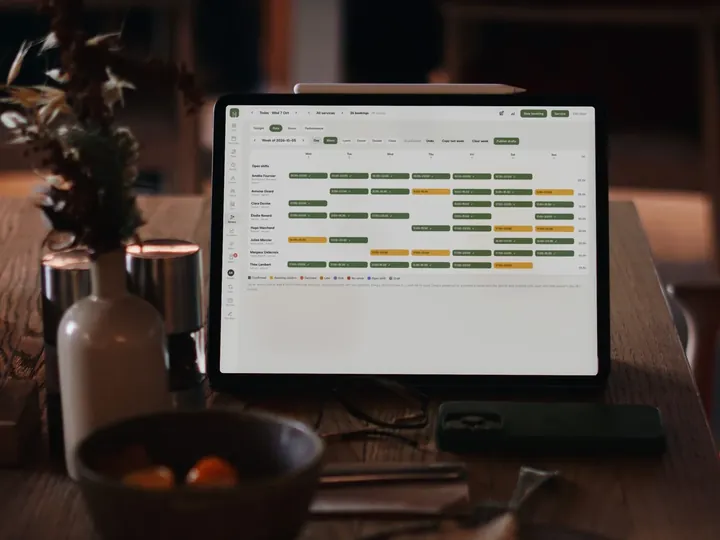 How TableSpark handles thisTableSpark staff rotaBuild the rota by drag and drop, publish it to every phone and export payroll hours.