 Daniela Morales
A tronc scheme that fails HMRC's independence test puts employer National Insurance back on every pound of tips, so the risk starts with who decides the split.
Tips and tronc rules turn on who allocates the money. A tronc is a pay arrangement run by a troncmaster who is not the employer. HMRC says National Insurance is due if the employer allocates tips, directly or indirectly, and not due if it does not. A mandatory service charge always attracts National Insurance. A genuine tronc scheme needs HMRC told, a PAYE scheme in the troncmaster's name and a written policy. Confirm your own arrangement with an accountant or HMRC.
The tips and tronc problem: a 15% cost and a tronc in name only
A restaurant owner who hears that a tronc scheme saves National Insurance can end up with the worst of both positions: the running cost of a tronc and the bill it was meant to remove. When the owner steers the split, HMRC treats the tips as allocated by the employer, and employer National Insurance is then due at 15% on every pound. When the tronc exists only on paper, the same facts can lead a tribunal to treat the tips as money the employer pays, with consequences for holiday pay and deductions.
Tips are also a live compliance area, not a corner case. The Department for Business and Trade's final stage impact assessment on strengthening tipping law, dated 21 October 2024, summarises its earlier 2022 estimate: "recurring annual costs of around £200m per year as businesses no longer make deductions from payments for service", with around 1 million workers in tipping industries where deductions are prevalent, which it lists as restaurants, pubs and bars, receiving a corresponding benefit of £200m a year.
Two employment tribunal judgments, both published on gov.uk, show what the problem looks like on the ground. They are first-instance decisions decided on their own facts, and neither is a rule. In Mr M Palanki v The Big Table Group Ltd (3315213/2023 and 3304904/2023, heard 23 to 25 September 2024), the tribunal recorded that the troncmaster did not operate her own bank account, that HMRC had not been notified of her position as troncmaster and that no separate PAYE scheme had been set up in her name. It decided that the tips were payable by the employer to the employee for the purposes of section 224 of the Employment Rights Act 1996, and the claim for unpaid holiday pay and unauthorised deductions succeeded. In Mrs I-Z Simon v Portsonachan Wilderness Lodges Ltd (4100470/2026, a Scottish case published in July 2026 that did not involve a tronc), cash tips were placed in a jar in the manager's office, were not distributed among the workers and were used by the employer to make payments. The award included £200 for tips, and the total was £1,151.60.
This guide covers the tronc itself: who can be troncmaster, when National Insurance is and is not due in HMRC's own words, what breaks independence, the set-up steps in order, how a tronc sits with the Tips Act, a worked month in pounds, the month-end routine and what changes on 1 January 2027. It does not repeat the whole tips policy, which the guide to the restaurant tips policy covers.

What is a tronc scheme? Tips and tronc in plain terms
What is a tronc?
HMRC's guidance on tips, gratuities, service charges and troncs, known as E24 (page header "Updated 18 July 2025"), defines the arrangement in one sentence: "A tronc is a special pay arrangement used to distribute tips, gratuities and service charges." Whether it saves anything depends on who decides the shares.
Someone other than the employer runs the arrangement, and E24 names that person.
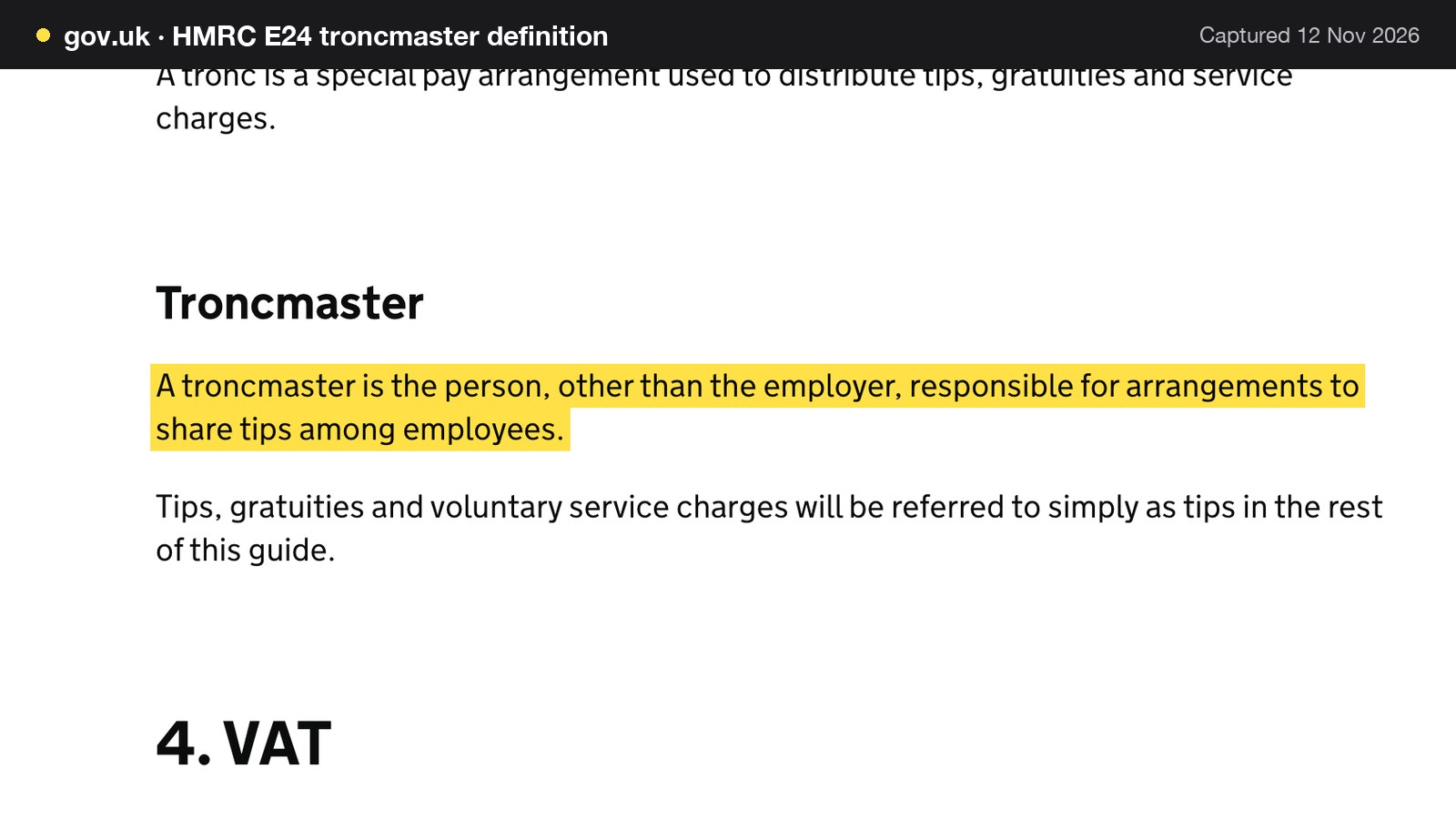
A troncmaster is the person, other than the employer, responsible for arrangements to share tips among employees.
The statutory code of practice on distributing tips adds a warning that matters to owners. It says the troncmaster is the person other than an employer who is responsible for arrangements to share tips among employees, "However, the employer remains liable for the fairness and transparency of the scheme." A tronc moves the job of allocating. It does not move the owner's responsibility for the outcome.
Who can be a troncmaster?
The statutory code, which came into force on 1 October 2024, says at paragraph 30: "An employer may directly appoint a member of staff to be responsible for allocating and distributing tips; and that member of staff can act as an independent tronc operator. An independent tronc operator may also be an external payroll or accountancy firm or alternatively a member of staff elected or agreed upon by the workers. Care is needed to maintain independence."
The owner is not on that list. E24 says that if the employer, a business partner or an official of the company, for example a director, performs the role of troncmaster, "they are considered to be making payments as if they were the employer. This means payments should be paid through the employer's payroll." For a restaurant owned and run by two partners, that rules out both partners and the director of a limited company. A head waiter, a shift lead or the restaurant's accountant can fill the role, provided they really decide.
Being troncmaster is also a personal responsibility. E24 says "The troncmaster is personally responsible for all aspects of operating a PAYE scheme. They may be held responsible for any failure to deduct tax from payments from the tronc."
Tronc tips, tips and service charge: three different things
E24 says tips are outside the scope of VAT when genuinely given freely, and that restaurant service charges are part of the price of the meal when customers are required to pay them, which makes them standard rated. The gov.uk page on tips and tax says "If the charge is compulsory, it's not a tip so if your employer gives it to you, it's treated in the same way as your wages."
The restaurant tips policy guide holds the three-way table of tips, tronc and service charge. The guide to service charge shown before the bill covers how a charge must be presented to guests, and the 2026 tipping rules update covers the wider changes in the law.
Tronc National Insurance: are tronc payments subject to National Insurance?
This is the question most owners are really asking, and HMRC's answer depends on the employer's role, not on the word tronc. E24 states the legal test in these words.
Legislation states that any amount paid to an employee which is a payment "of a gratuity" or is "in respect of a gratuity", is exempt from National Insurance contributions if it meets either of the following 2 conditions: it is not paid, directly or indirectly, to the employee by the employer and does not comprise or represent monies previously paid to the employer, for example, by customers; it is not allocated, directly or indirectly, to the employee by the employer
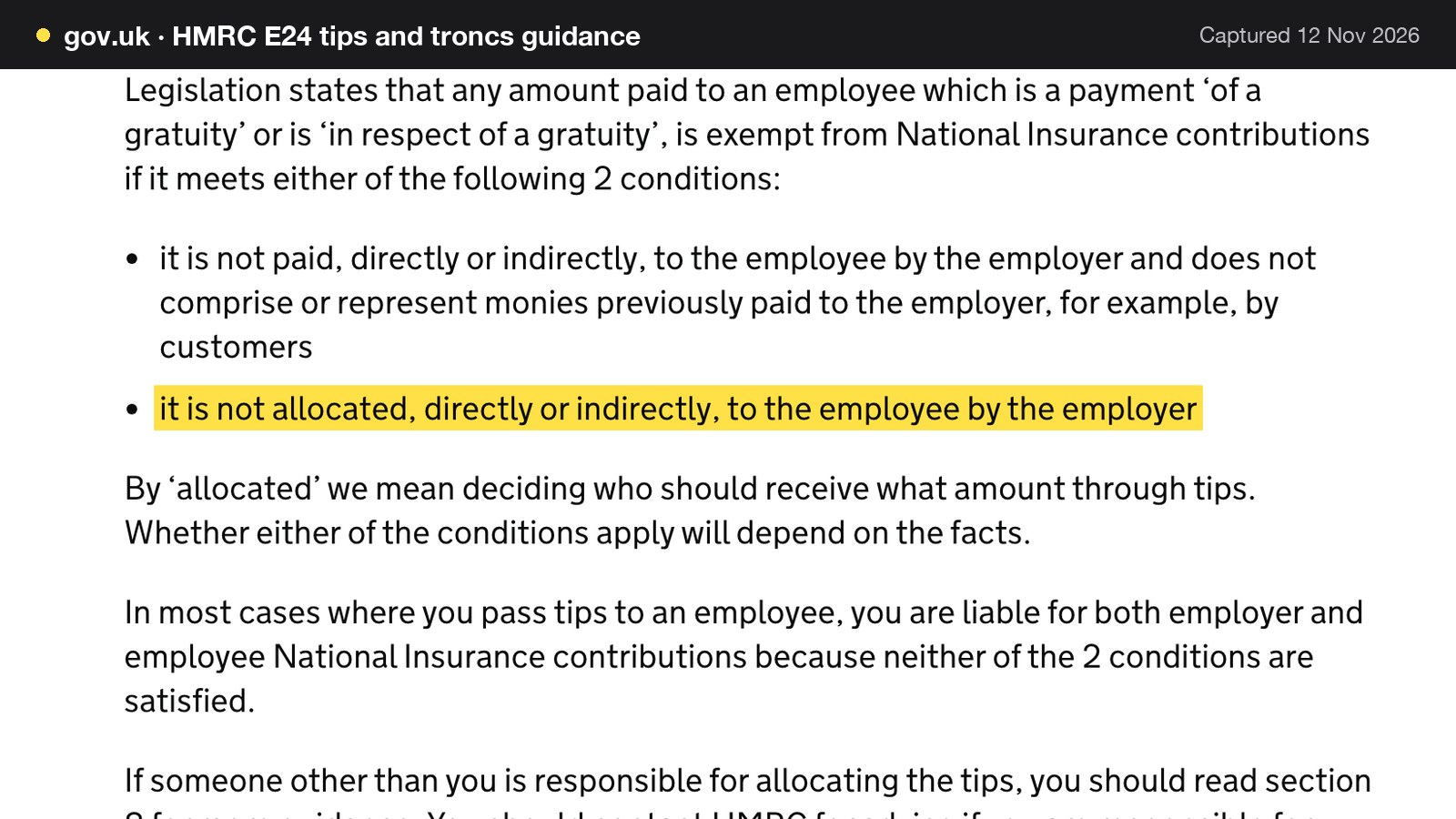
E24 then defines the key word: "By 'allocated' we mean deciding who should receive what amount through tips." It adds the plain consequence: "In most cases where you pass tips to an employee, you are liable for both employer and employee National Insurance contributions because neither of the 2 conditions are satisfied." In its section on troncs it states the outcome in two short sentences: "National Insurance contributions are due if the employer allocates the payment directly or indirectly to the employee. National Insurance contributions are not due if the employer does not allocate the payment."
For a tronc, E24 spells out what a clean position looks like. Payments of tips do not attract National Insurance contributions if the troncmaster is allocating money that originally was not paid to the employer and the employer does not pay the money directly or indirectly to their employees, and if the employer does not determine, directly or indirectly, the allocation of those tips. The gov.uk page "Employee gets tips, gratuities or service charges through a tronc" gives the same split: if you decide how the money is divided, you pay PAYE tax and National Insurance contributions, and if the troncmaster decides, the troncmaster pays PAYE tax and no National Insurance contributions are due.
| Who decides how the money is divided | Who deals with PAYE | National Insurance |
|---|---|---|
| The employer, directly or indirectly | The employer | Due, employer and employee |
| An independent troncmaster, with the employer taking no part in allocation | The troncmaster, through a tronc PAYE scheme | Not due |
| A mandatory service charge paid out through a tronc | The employer | Always due |
Income Tax is not removed by a tronc. E24 says "PAYE must be operated on all tips paid by an employer to an employee", and the tronc route simply moves who operates it. Where payments made from a tronc do attract National Insurance, "the troncmaster is not required to pay National Insurance contributions on those payments. Responsibility for calculating any National Insurance contributions due and making payment to HMRC rests with the employer." A restaurant that thought it had handed the whole problem to a troncmaster can therefore still be the party that owes the contributions.
The mandatory service charge trap
The service charge is the most expensive misunderstanding. E24 says: "If you impose a mandatory service charge and the money is paid out to your employees, National Insurance contributions are always due on the payments. This is regardless of how the money is shared out between employees." So putting a compulsory charge into a tronc does not take the National Insurance away. Only a genuinely discretionary charge, which the guest can reduce or remove, can sit in a tronc that meets the independence test.
Tronc scheme rules HMRC applies: what breaks independence
HMRC's guidance gives seventeen worked examples. Four of them decide most restaurant cases.
The owner dictates the method (Example 11). In the example a points system is imposed. E24 says the employer "is indirectly allocating the tips because Ms G is effectively carrying out Mr C's wishes". It then draws the line that owners need to remember: "But if the staff committee or Ms G decide themselves to adopt and use the points system and there is no element of compulsion, then Mr C has not been involved in the allocation and National Insurance contributions are not due." An owner who tells the troncmaster to share by rota hours, by role or by seniority may be allocating indirectly.
A guaranteed top-up (Example 13). Where an employer promises a minimum and tops the tronc up to it, E24 says the employer "has a legal obligation to make contractual payments to the extent they make any top-up payment. The existence of the legal obligation prevents top-up payments from being a tip." National Insurance is due on the guaranteed minimum.
Choosing who takes part (Example 14). E24 says the employer "have influenced who shall participate in the tronc arrangements, but they have not determined how much each person receives" and so no National Insurance is due. Suggestions are tolerated only where the employer does not impose anything.
| What the owner does | What E24 says | National Insurance |
|---|---|---|
| Tells the troncmaster which split method to use | Indirect allocation if it carries out the owner's wishes | Due |
| Lets staff or the troncmaster choose and adopt the method | No compulsion, so no involvement in allocation | Not due |
| Promises a guaranteed minimum and tops up | Top-up is a contractual payment, not a tip | Due on the minimum |
| Suggests who joins but imposes nothing | Influencing participation is not determining amounts | Not due |
| Pays a mandatory service charge out through the tronc | Always due, however it is shared | Due |
Three further rules apply around those examples. An owner, partner or director who acts as troncmaster is treated as the employer. Where someone other than the employer decides the sharing but the employer makes the payment, E24 says the employer is responsible for operating PAYE. And E24 says that if there is both an employer PAYE scheme and a tronc PAYE scheme, "it is likely, though not automatic, that records for both schemes will be reviewed at the same time." A tronc is therefore a second set of books that HMRC may read alongside the first.
How to set up a tronc scheme in the right order
The steps below follow E24 section 6, the gov.uk guidance on troncs and the statutory code. They describe public guidance and are not tax advice. The restaurant should confirm its own arrangement with its accountant or HMRC before paying anything through a tronc.
- Decide whether a tronc fits
A tronc suits card tips and a discretionary service charge. A mandatory service charge gains nothing from it, because National Insurance is always due on those payments. Work out first how much of the pool is genuinely discretionary.
- Choose the troncmaster
Pick an accountant or payroll firm, or a member of staff the workers elected or agreed. Do not pick the owner, a partner or a director, because HMRC treats their payments as the employer's.
- Tell HMRC who the troncmaster is
E24 says that where the troncmaster controls the tips and is responsible for sharing them, "the employer must tell HMRC, unless the arrangement came into existence before 6 April 2004. This is so we can identify the person responsible for PAYE in each period." The gov.uk page says "You must tell HMRC who the troncmaster is so that they can set up a PAYE scheme for the tronc."
- Set up the tronc PAYE scheme in the troncmaster's name
E24 says "A PAYE scheme must be set up for the tips in the troncmaster's name unless different PAYE arrangements need to be made." The troncmaster may use the employer's software as a payroll agent, but the tronc PAYE records must be kept separate and run independently.
- Agree the method without the owner choosing it
The staff or the troncmaster adopt and record the allocation method. If the owner sets any instructions or framework for the operator, the code says they "must be in line with principles of fairness".
- Write the policy and tell the team
Where tips are paid on more than an occasional and exceptional basis, section 27I of the Employment Rights Act 1996 requires a written policy, available to every worker at the place of business.
- Keep the records
Section 27J requires a record of how every qualifying tip, gratuity and service charge has been dealt with, kept for three years from the date it was paid.
A tronc is also not a way to pool tips across sites: the government's non-statutory guidance says tips must be distributed between workers at the place of business where they are received.
Tronc scheme and the Tips Act: section 27F, 27G and the deadline
The Employment (Allocation of Tips) Act 2023 inserted Part 8A into the Employment Rights Act 1996, and the statutory code has applied since 1 October 2024. E24 itself says the new legislation "does not change how these payments should be assessed for tax and National Insurance contributions". Two layers therefore apply to a tronc at once: HMRC's rules on tax and National Insurance, and the employment-law duty that tips are allocated fairly.
Section 27D(1) sets the duty: "An employer must ensure that the total amount of the qualifying tips, gratuities and service charges paid at, or otherwise attributable to, a place of business of the employer is allocated fairly between workers of the employer at that place of business." Section 27F(2) then gives an employer using a tronc some cover. Where the employer makes arrangements for the tips to be allocated by an independent tronc operator, and it is fair to make those arrangements, the employer is treated as having ensured that the total is allocated fairly.
The definition of an independent tronc operator is where the two layers meet. Section 27F(6) says it is a person who the employer "reasonably considers to be operating, or intending to operate, independently of the employer" arrangements under which the person allocates the total amount, the payments are made by the person or by the employer, the payments are not subject to unauthorised deductions, and all the payments are ones to which paragraph 5(1) of Part 10 of Schedule 3 to the Social Security (Contributions) Regulations 2001 applies.
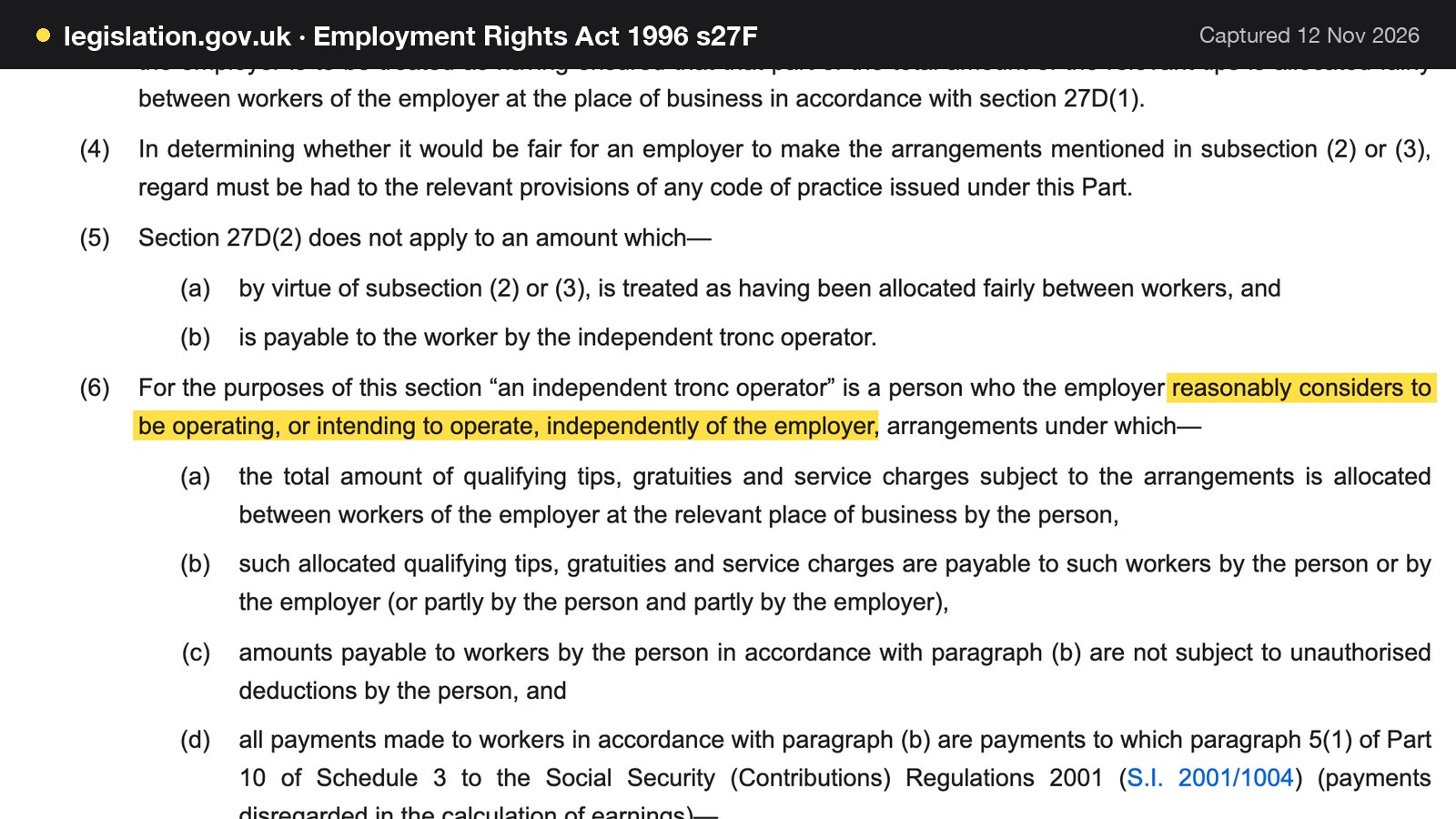
That last limb is the National Insurance disregard that E24 cites from the 2001 Regulations. In effect, the Act ties its own definition of an independent tronc operator to the same independence test HMRC applies. An operator whose payments attract National Insurance because the owner steers the split is not an independent tronc operator for section 27F, and the owner loses the cover that section gives. The test that decides the tax result also decides the employment-law cover.
The code adds duties that continue to apply. Paragraph 31 says that where the employer appoints an independent tronc operator, the instructions or framework it sets "must be in line with principles of fairness". Paragraph 32 says that if the employer "later becomes aware of an independent tronc operator acting in an unfair or improper manner, they are obliged to act to address this", which could mean instructing the operator to change its operation, replacing the operator or ending the tronc arrangement altogether.
The payment deadline in section 27G
Section 27G requires the employer to allocate and pay tips no later than the end of the month following the month in which the customer paid them.
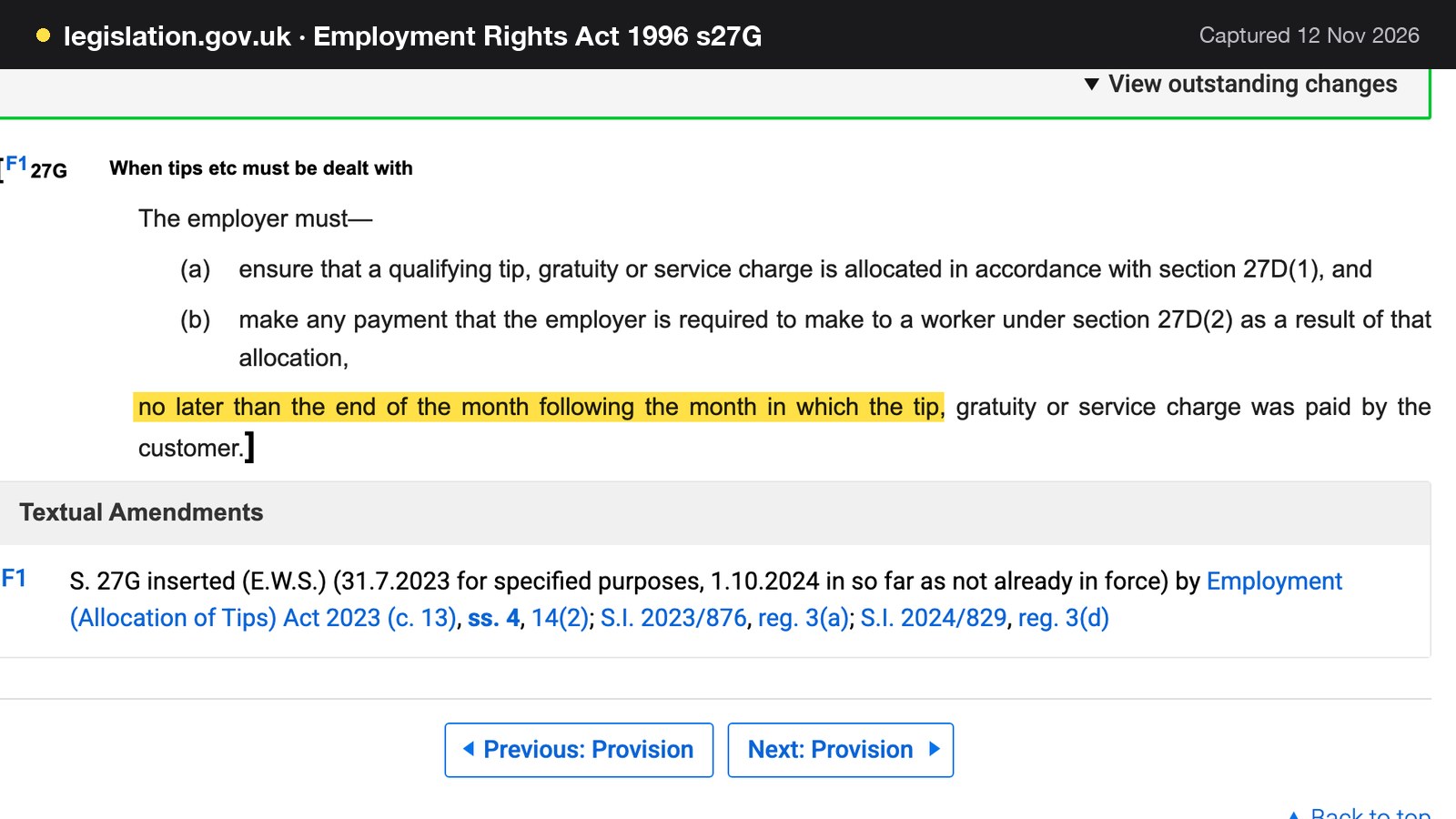
The rule runs by calendar month, not by tip. A tip left on 1 November and a tip left on 30 November share the same deadline. Tips paid by customers in November 2026 must be allocated and paid by 31 December 2026. Tips paid in December 2026 must be allocated and paid by 31 January 2027.
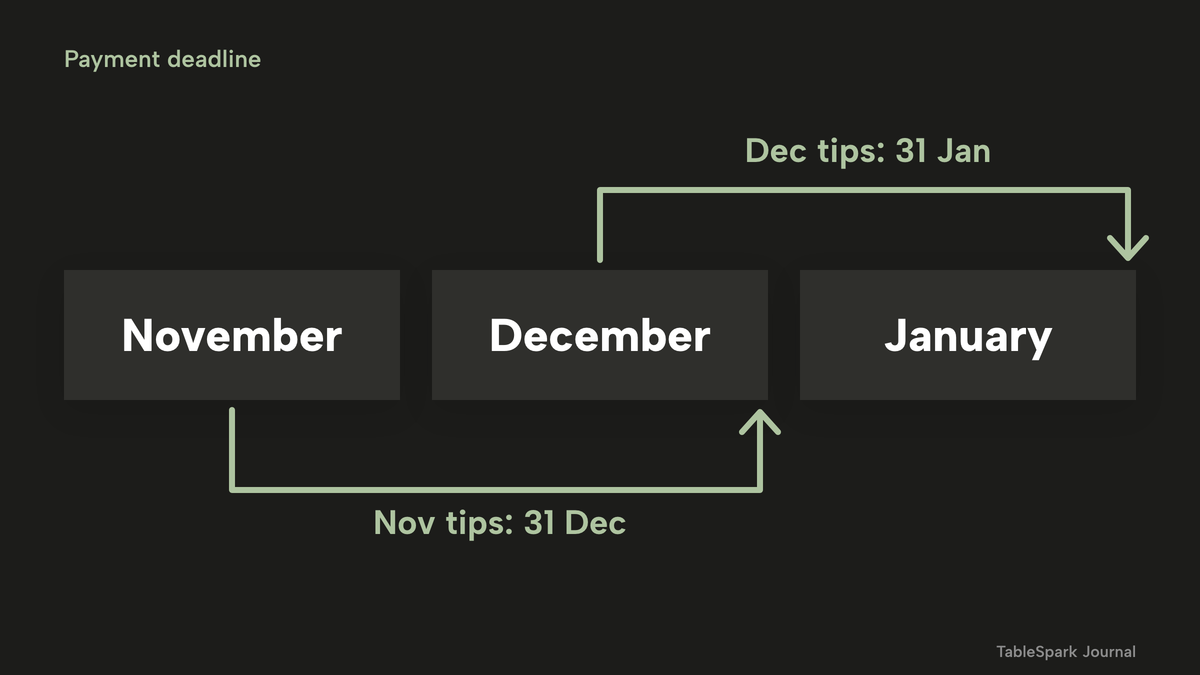
A troncmaster who pays on the last day of the following month has almost no slack, so a fixed internal date a week earlier is safer.
Enforcement and records
A worker who believes tips were not allocated or paid on time can complain to an employment tribunal under section 27K, which refers to a period of twelve months beginning with the date of the failure. This guide quotes that section as published and states no other time limit for tips claims. Compensation under section 27M is capped at £5,366, a figure substituted from 6 April 2026. The cap is small beside the cost of National Insurance on a poor structure, which is why the independence test matters more than the tribunal award.
What a tronc scheme costs: a worked month in pounds
The example below uses one illustrative restaurant, with every input labelled and every sum shown.
Inputs (illustrative). There are 14 workers. Card tips plus a discretionary service charge collected in the month come to £6,200. All 14 workers are assumed to earn above the employer secondary threshold of £417 a month on wages alone, so every pound of tips falls above it. For the employee side, each worker's wages plus tips are assumed to sit between £1,048 and £4,189 a month, so the whole tip share is charged at 8%. The service charge is assumed discretionary. Income Tax is due in both routes, so it does not change the comparison.
The 2026 to 2027 rates. The gov.uk page "Rates and thresholds for employers 2026 to 2027" gives category A employer National Insurance at 15% above the secondary threshold of £96 a week, £417 a month or £5,000 a year. Employees pay 0% up to the primary threshold of £242 a week, £1,048 a month or £12,570 a year, 8% above it up to the upper earnings limit of £967 a week, £4,189 a month or £50,270 a year, and 2% above that. The Employment Allowance for 2026 to 2027 is £10,500.
Route one: the employer allocates through payroll
When the employer allocates the tips, E24 says both National Insurance liabilities arise.
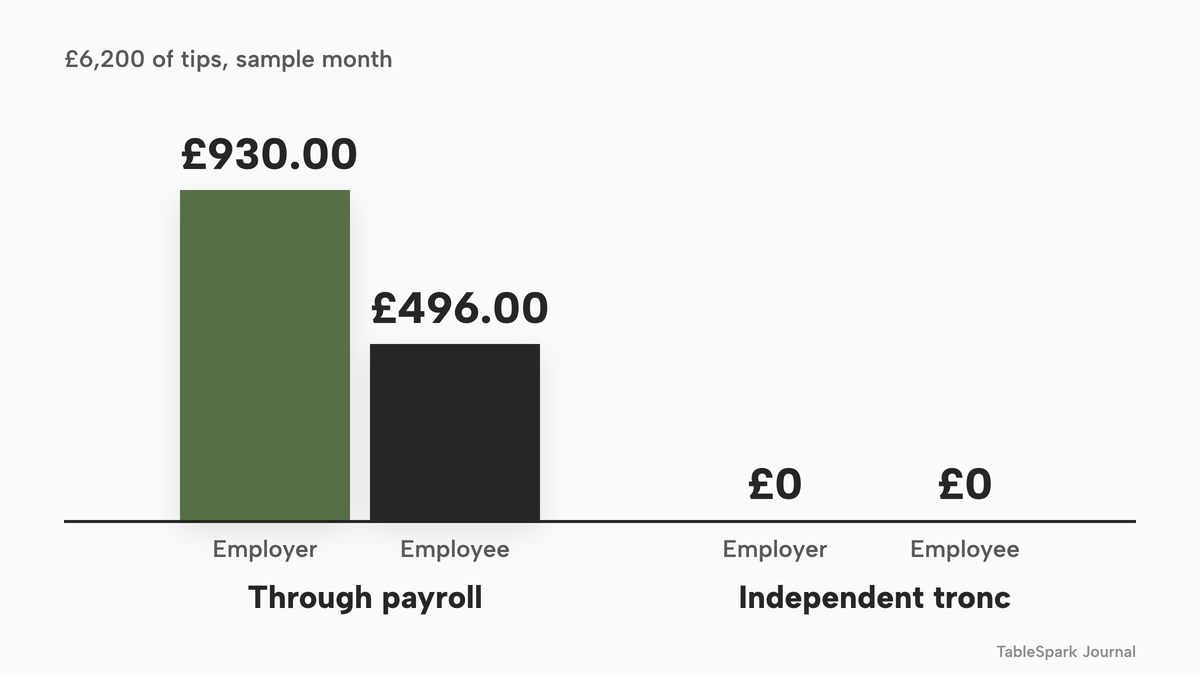
- Employer National Insurance: 15% x £6,200 = £930.00 a month. Over twelve months at a steady pool, 12 x £930.00 = £11,160.
- Employee National Insurance: 8% x £6,200 = £496.00 a month. Over twelve months, 12 x £496.00 = £5,952 a year across the team.
Route two: an independent tronc that meets the E24 condition
If the troncmaster allocates, the employer takes no part and the other conditions in E24 section 8 are met, National Insurance on the £6,200 is £0 for both sides. Income Tax still runs through the tronc PAYE scheme. The saving is therefore £930.00 a month for the employer and £496.00 a month for the team before Income Tax.
What the tronc costs to run
No troncmaster price is published by two of the services whose pages were read for this research. One provider, JustTip, publishes a price for its JustTronc product: "£8.99/month per active user", with the footnote "all prices listed are ex. VAT". It is used here only as a cost placeholder, not as a recommendation, and the text read does not define who counts as an active user. If every one of the 14 workers counts, the cost is 14 x £8.99 = £125.86 a month, or 12 x £125.86 = £1,510.32 a year, excluding VAT.
The employer's net position in route two is then £930.00 - £125.86 = £804.14 a month before any accountant's set-up time and before the cost of the rota tool. Over a year that is £11,160 - £1,510.32 = £9,649.68. The placeholder cost is 13.5% of the National Insurance it is set against (£125.86 / £930.00). If the independence test fails, the picture reverses, because the restaurant pays the placeholder fee and the National Insurance together: £930.00 + £125.86 = £1,055.86 a month in this example.
| Through payroll | Independent tronc | |
|---|---|---|
| Employer National Insurance, 15% x £6,200 | £930.00 | £0 |
| Employee National Insurance, 8% x £6,200 | £496.00 | £0 |
| Troncmaster placeholder, 14 x £8.99 excluding VAT | £0 | £125.86 |
| Employer saving after the placeholder cost | None | £804.14 |
The Employment Allowance for 2026 to 2027 is £10,500 a year. A business that already sets it against other employer National Insurance saves less cash from moving £6,200 a month out of National Insurance than the headline £11,160. The eligibility conditions were not read for this research, so this guide makes no claim about any business's allowance. Ask your accountant before relying on the saving. Nothing here is tax advice.
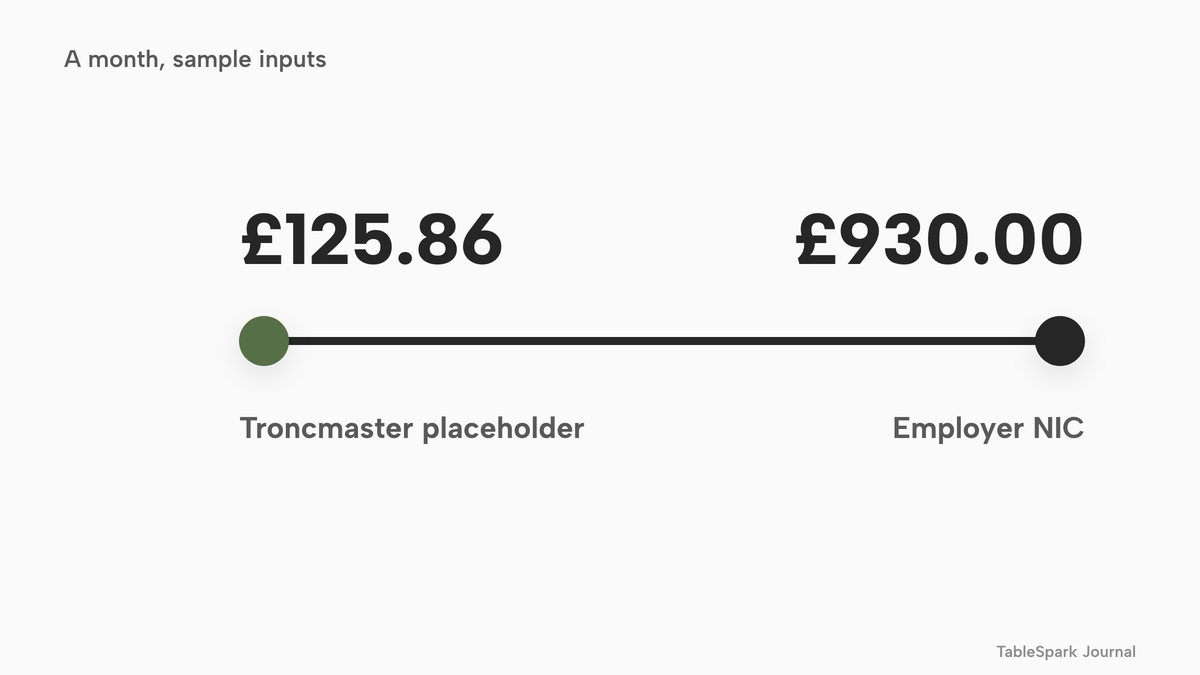
The sums show why the structure matters more than the label. A tronc in this example is a cost of £125.86 that pays for itself only while the employer stays out of the allocation. Pension treatment of tronc payments was not read on an official page for this research, so the restaurant should ask its payroll adviser how they are treated, and the guide to workplace pensions for restaurants covers the employer's wider duties.
Hours drive every split
Most sharing methods rest on paid hours. Take 14 workers averaging 100 paid hours in the month, which gives 14 x 100 = 1,400 paid hours (illustrative hours). The £6,200 pool then works out at £6,200 / 1,400 = £4.43 per paid hour, rounded to the penny from £4.428. Whoever allocates needs those hours to be right, which is why the next section looks at what rota software costs for 14 staff.
What rota software costs for 14 staff
Rota software prices are listed per user per month on some pages and per plan on others, so the same 14 people cost different amounts. The table gives each published figure as printed and the 14-person total as arithmetic. The Deputy and Planday rows are rota prices only. The JustTronc row is a tronc service and is not a rota.
- Charged per
- Site, any number of staff
- Team roles and drag-and-drop rota
- hours worked and payroll export
- tips by rota hours with a written policy and records
- 0% TableSpark commission
- Charged per
- User
- Basic rotas, basic timesheets and basic time clocking on the page read
- Charged per
- User, minimum 5 users
- Per-user starter card on the page read; plan inclusions not read
- Charged per
- Active user
- A tronc service, not a rota
These prices are not like-for-like, because providers charge for different things. The Deputy and Planday figures are per-user floors read from their own pages, and the 14-user totals are arithmetic, not quoted plan prices. The arithmetic is below.
- TableSpark Growth: £39 a month excluding VAT, which is £468 a year excluding VAT (12 x £39). Yearly billing is two months free, so £390 a year excluding VAT (10 x £39). The same price applies at 14, 20 or 30 staff.
- Deputy Lite: 14 x £3.25 = £45.50 a month, which is £6.50 above Growth's £39 a month excluding VAT (£45.50 - £39). At 20 users the sum is 20 x £3.25 = £65.00, and at 30 users it is 30 x £3.25 = £97.50. Deputy's page states the prices as "per user per month (GBP excl. all applicable taxes)".
- Planday: 14 x £2.99 = £41.86 a month on the from-price, and 20 x £2.99 = £59.80. The page title reads "from £2.99", so the plan a restaurant actually needs may cost more.
- JustTronc: 14 x £8.99 = £125.86 a month, as above, for the tronc service on its own.
A per-user price grows with every starter, while a flat plan does not. At 14 staff the per-user rotas above already cost more than Growth, and the gap widens as the team grows, with team size rather than the restaurant's output setting the bill. None of these pages lists a website, bookings, ordering, guest records and search set-up in the same plan as the rota.
Month-end for a tronc scheme: the sequence
A tronc scheme works or fails at month-end. The suggested sequence below puts the owner's tasks and the troncmaster's tasks in order, with the statutory deadline at the end.
| Time | Task | Who |
|---|---|---|
| Last day of the month | Close the month: card tips, cash tips and any discretionary service charge | Restaurant |
| First days of the next month | Pass the paid hours and the pool to the troncmaster, without choosing the split | Restaurant |
| Within the first week | Allocate by the method the staff or troncmaster adopted and record it | Troncmaster |
| Before the end of the month | Pay the shares, with Income Tax through the tronc PAYE scheme | Troncmaster |
| By the last day of the month after the tips were paid | Statutory deadline under section 27G | Employer and troncmaster |
| For three years from the date each tip was paid | Keep the record of how it was dealt with | Employer |
The restaurant's side is to supply accurate hours and a clean pool figure. The troncmaster's side is to choose and record the method, calculate the shares, deduct tax and pay, keeping the tronc PAYE records separate from the employer's even when the employer's software is used as an agent.
The guide to restaurant payroll covers the employer's own payroll month, and the minimum wage guide covers a point that matters to tips: E24 says that for pay reference periods starting on or after 1 October 2009, amounts paid by the employer to the worker which represent tips, gratuities, service charges or cover charges paid by customers do not count towards National Minimum Wage pay.
What changes on 1 January 2027
The Employment Rights Act 2025 adds a duty to consult workers when a tipping policy is created or reviewed. Four official sources give the position as read on 12 November 2026, and they do not describe it identically.
- The GOV.UK timeline update, updated on 5 November 2026, lists "strengthening tipping law" among the measures that will take effect on 1 January 2027.
- Acas says: "From 1 January 2027, employers will need to consult before creating or reviewing a tipping policy."
- The legislation.gov.uk page for section 14 of the 2025 Act, "Policy about allocating tips etc: consultation and review", still shows the section as prospective, marked as not in force at Royal Assent.
- The revised statutory code is a draft. The gov.uk page says a new public consultation will be held and that "For now, employers should continue to follow the existing code of practice." The consultation closed on 29 September 2026, and the new requirements and code depend on Parliament approving the code.
This guide takes the date from the government's timeline and says plainly that the commencement regulations were not read and no regulation number is cited. A restaurant that runs a tronc or a tips policy should plan to talk to its staff before it next writes or changes the policy, and keep a note of the conversation.
The consultation duty concerns creating or reviewing the policy, not paying shares, so a restaurant that reviews its policy in January 2027 should plan the staff conversation first and ask its adviser about timing.
Where the rota fits: hours, shares and records in TableSpark
From the restaurant side, a tronc needs three things: paid hours that nobody argues about, a written record of how shares were worked out, and records kept for three years. The TableSpark staff rota supplies those from the one rota the team already reads.
The live wording on the rota page is direct: "Drag the week together, publish it, and let the same hours drive payroll and the tips split." Paid hours come "From published shifts only. Breaks are unpaid, no-shows and declined shifts count zero, and overnight shifts count to the day they started. Payroll CSV matches the Hours tab." The Hours tab adds the week up per person, and the payroll file downloads as a CSV or Excel export.
For tips, the plan carries a written tips policy and a day-by-day split. A restaurant chooses how tips are shared (by hours worked, equally on shift or directly to the earner), edits the template wording and publishes the policy, and each edit becomes a numbered version the team reads on My hours. When the day's tips are entered, card tips and cash tips go in, the service charge box is ticked if it is shared, and the preview shows each person's share by paid hours on the published rota. No-shows count zero, saved days can be changed and the shares download as CSV. Records stay in the restaurant's TableSpark account for the three years the law expects.
Here TableSpark supplies hours and records. The page puts it in one line, "TableSpark calculates; you pay through payroll or your troncmaster", and its FAQ says the product gives a written policy template, a split by rota hours and saved records, while the policy wording and how shares are paid remain the restaurant's decisions.
One point ties straight back to E24. Under Example 11, the person who decides the allocation method must be the staff or the troncmaster, not the owner. The by-hours option in TableSpark is a calculation setting for the restaurant's own records. A troncmaster who runs an independent tronc chooses and records their own method, and the rota supplies the hours that method needs. Using the rota does not make a tronc independent or save National Insurance by itself.

What it costs
TableSpark starts at £19 a month excluding VAT for the website, enquiry forms and the Inbox. The staff rota, team roles, hours worked with payroll export and tips by rota hours are on Growth, at £39 a month excluding VAT, or £390 a year excluding VAT on yearly billing. Full adds online ordering at £69 a month excluding VAT. Team access carries no per-seat charges, so 14 staff and 30 staff cost the same £39 a month excluding VAT, against £45.50 and £97.50 a month for the same two headcounts on Deputy Lite's published per-user price. TableSpark takes 0% commission on direct bookings and orders; card-processing fees from the payment processor apply to online payments.
Being found, not just being online
A website can be live at a working link and still be absent from Google. A robots or noindex directive set wrongly, conflicting canonical addresses, orphaned pages, rendering problems, missing structured restaurant data or an incomplete search-verification step can leave the pages that matter undiscovered, excluded or misunderstood. Someone searching for the restaurant's name, menu or postcode may then reach a directory, a commission-charging marketplace or a competing restaurant first.
TableSpark packages that search-readiness work into every plan: crawlable structured restaurant content, titles and descriptions, canonical URLs, sitemaps, robots controls, Restaurant and LocalBusiness schema, internal links, mobile-first output and managed search-verification set-up. Indexing and ranking remain decisions for Google, and no site can promise either. Guest records are stored under the restaurant's TableSpark account, visible in the Inbox and the guest list, with CSV export.
How to do it in TableSpark
The steps below need Growth, at £39 a month excluding VAT. The pricing page shows which plan carries each feature, and the team and rota tutorial walks through the same screens with a practice run.
- Step 1: Invite the team
Open Settings, then Team. Type each person's email, pick a role (Server, Editor, Admin or Owner) and press Add. They join when they accept the emailed invitation.
Step 2 of 2
Build the week
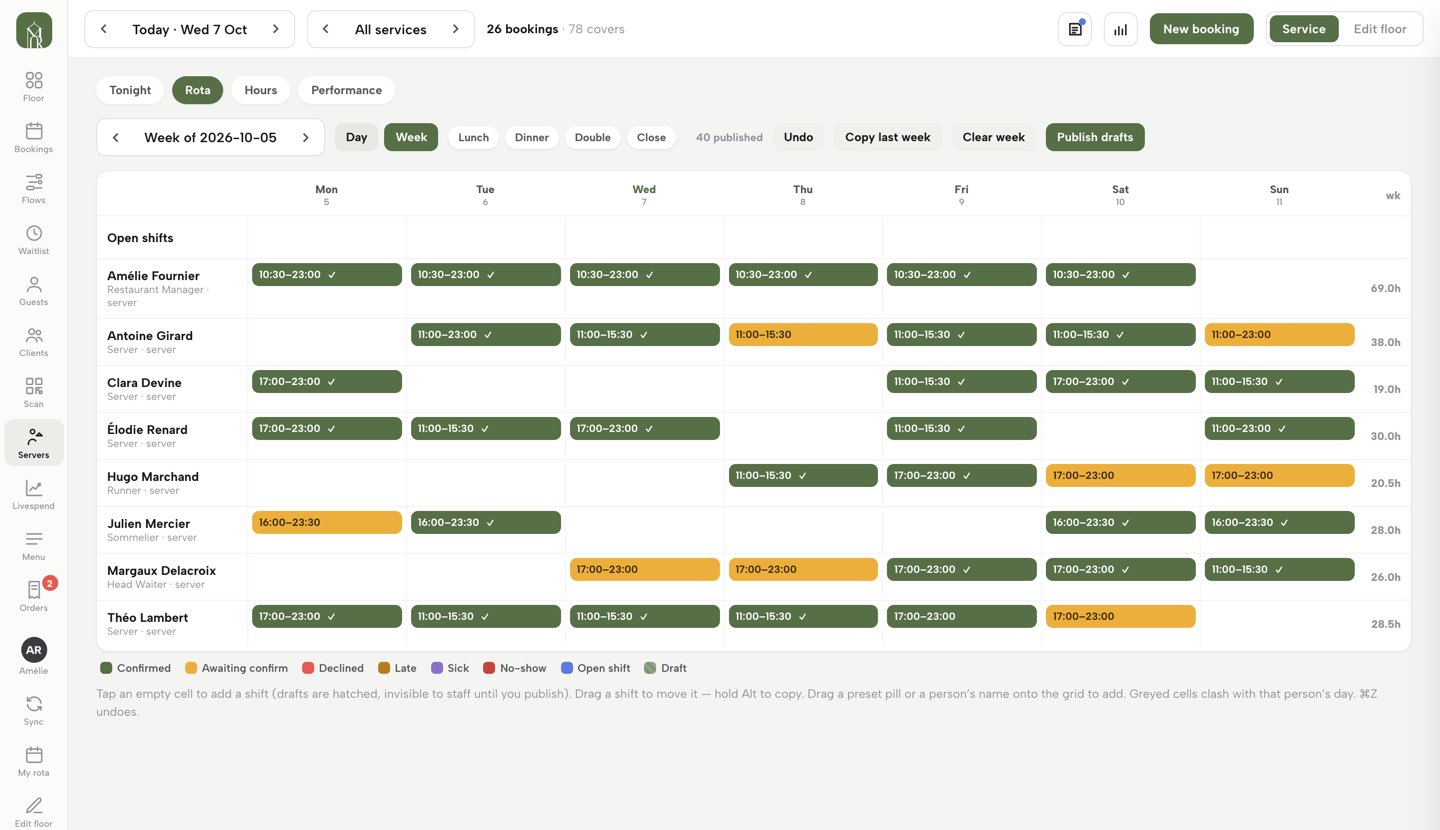
In Service, open Servers, then the Rota tab. Drag a shift to another day, or up and down to hand it to someone else. Lunch, Dinner, Double and Close presets fill the times, and Copy last week brings the pattern across as drafts.
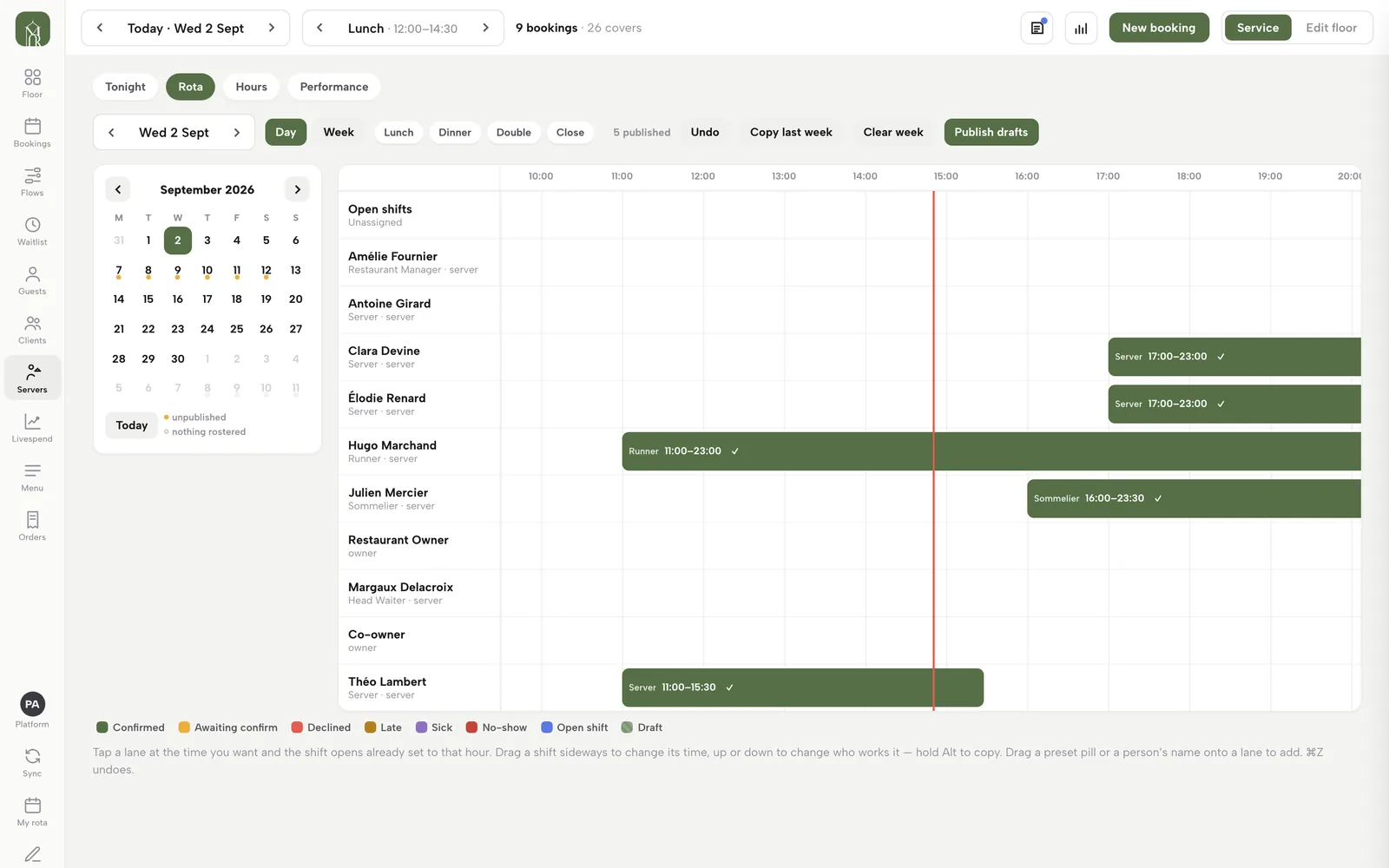
Step 3 of 2
Publish the rota
Drafts stay invisible to staff until you press Publish drafts. Each person is asked to confirm, and a tick appears on the shift when they do.
- Step 4: Read the hours and export them
Open the Hours tab, pick a range such as This month or Last month, then press Payroll CSV for the bookkeeper or Export Excel. The export matches the table.
- Step 5: Publish the tips policy
In End of day, open Day settings, choose how tips are shared, edit the template wording and press Publish the policy. Your team reads it on My hours.
- Step 6: Record the split
Type the card tips and cash tips, tick the service charge if it goes to the team, then press Preview the split and Save tips. The shares download as CSV for whoever pays them.
Two habits help. Hand the troncmaster the Hours export and the saved split together, so both come from the same published shifts, and mark late, sick and no-show shifts on the rota as they happen, because they feed the hours the split uses.
The tronc decision: payroll route or independent tronc
| Through payroll | Independent tronc | |
|---|---|---|
| Who decides the split | The employer | The troncmaster, with the owner staying out |
| National Insurance | Due, employer and employee | Not due if E24 conditions are met |
| PAYE | Employer scheme | Tronc PAYE scheme in the troncmaster's name |
| Mandatory service charge | Employer PAYE and National Insurance | Employer PAYE and National Insurance, always |
| Cost of running | The payroll time already spent | A troncmaster service or accountant's fee |
| Where it goes wrong | Late payment or an unfair split | Owner steering, no tronc PAYE scheme or HMRC not told |
- Is the money a discretionary tip or service charge, not a mandatory charge?
- Is the proposed troncmaster someone other than the owner, a partner or a director?
- Will the staff or the troncmaster adopt and record the split method themselves?
- Has HMRC been told who the troncmaster is, and is a tronc PAYE scheme in their name?
- Is there a written tips policy that every worker at the place of business can read?
- Is there a fixed month-end date before the section 27G deadline?
- Will records be kept for three years from the date each tip was paid?
- Has the accountant or HMRC confirmed the arrangement, including pension treatment?
Questions owners ask about tips and tronc
Are tronc payments subject to National Insurance?
It depends on who allocates. HMRC's E24 guidance says National Insurance is due if the employer allocates the payment directly or indirectly, and not due if the employer does not. A mandatory service charge attracts National Insurance through a tronc regardless. Income Tax is still due, through the tronc PAYE scheme. Confirm your own arrangement with your accountant or HMRC.
Who can be a troncmaster in a restaurant?
The statutory code says an independent tronc operator may be a member of staff the employer appoints, an external payroll or accountancy firm, or a member of staff elected or agreed by the workers, and adds "Care is needed to maintain independence." E24 treats an owner, a business partner or a company director acting as troncmaster as the employer, so their payments go through payroll.
Can my service charge go through a tronc?
A discretionary one can, if the tronc meets the independence test. A tronc does not remove National Insurance from a mandatory service charge. E24 says National Insurance is always due on a mandatory charge paid out to employees, however it is shared. It also makes the employer responsible for PAYE where mandatory charges are distributed through the tronc.
Do I have to tell HMRC, and does the troncmaster need a PAYE scheme?
Where the troncmaster controls the tips and shares them, E24 says the employer must tell HMRC, unless the arrangement started before 6 April 2004. It also says a PAYE scheme must be set up in the troncmaster's name unless different PAYE arrangements need to be made. The troncmaster may use the employer's software as an agent, with separate records.
If I give the troncmaster an hours formula, is the tronc still independent?
Not necessarily. In E24 Example 11, an employer who imposes a points system is indirectly allocating. If the staff or the troncmaster adopt the method themselves, with no element of compulsion, the employer has not been involved in the allocation. An owner should let the troncmaster choose and record the method, and supply hours on request.
How quickly must tips be paid, and how long are records kept?
Section 27G requires allocation and payment no later than the end of the month after the month the customer paid. Tips paid in November 2026 are due by 31 December 2026. Section 27J requires a record of how every qualifying tip was dealt with, kept for three years beginning with the date it was paid.
Do tronc payments count towards minimum wage or holiday pay?
E24 says amounts paid by the employer that represent tips, gratuities, service charges or cover charges do not count towards National Minimum Wage pay. On holiday pay, the Palanki tribunal concluded that the tips before it were payable by the employer to the employee and should count. It is a first-instance decision on its own facts, so ask an adviser about your own tronc.
What changes on 1 January 2027?
The GOV.UK timeline update of 5 November 2026 and Acas both say employers will need to consult before creating or reviewing a tipping policy from 1 January 2027. The legislation.gov.uk page still shows the section as prospective, and the revised code is a draft. Follow the existing code for now and plan the staff conversation.
The recommendation
A tronc can remove National Insurance from tips only while the owner stays out of the allocation, and it costs a troncmaster fee, a PAYE scheme and a month-end routine to find out. In the sample month the independent route leaves £804.14 after a £125.86 placeholder cost. The right choice depends on how much of the pool is truly discretionary, and an accountant should confirm it.
Whichever route a restaurant picks, it needs paid hours that match the published rota, a written tips policy, a saved split and records that last three years. For an independent UK restaurant, TableSpark Growth is the best-value and best overall choice for supplying that material. At £39 a month excluding VAT with no per-seat charges, it covers the team roles, drag-and-drop rota, hours worked with payroll export and tips by rota hours with a written policy and saved records. A per-user rota tool at 14 staff already costs more, a tronc service is a separate bill, and neither supplies the website, bookings and guest records that sit beside the rota in one TableSpark account.
TableSpark takes 0% commission on direct bookings and orders; card-processing fees from the payment processor apply to online payments.
Sources
- GOV.UK, HMRC E24: tips, gratuities, service charges and troncs — UK Government (checked 2026-11-12)
- GOV.UK, employee gets tips, gratuities or service charges through a tronc — UK Government (checked 2026-11-12)
- GOV.UK, tips and tax — UK Government (checked 2026-11-12)
- GOV.UK, rates and thresholds for employers 2026 to 2027 — UK Government (checked 2026-11-12)
- legislation.gov.uk, Employment Rights Act 1996 section 27F — UK Government (checked 2026-11-12)
- legislation.gov.uk, Employment Rights Act 1996 section 27G — UK Government (checked 2026-11-12)
- legislation.gov.uk, Employment Rights Act 1996 section 27J — UK Government (checked 2026-11-12)
- legislation.gov.uk, Employment Rights Act 2025 section 14 — UK Government (checked 2026-11-12)
- GOV.UK, distributing tips fairly: statutory code of practice (HTML version) — UK Government (checked 2026-11-12)
- GOV.UK, distributing tips fairly: revised statutory code of practice — UK Government (checked 2026-11-12)
- GOV.UK, make work pay: revised tipping code of practice consultation — UK Government (checked 2026-11-12)
- GOV.UK, distributing tips fairly: non-statutory guidance for employers — UK Government (checked 2026-11-12)
- GOV.UK, plan to make work pay and Employment Rights Act timeline update — UK Government (checked 2026-11-12)
- Department for Business and Trade, impact assessment: strengthen existing tipping law — UK Government (checked 2026-11-12)
- GOV.UK, tips and gratuities factsheet — UK Government (checked 2026-11-12)
- GOV.UK, employment tribunal decision: Mr M Palanki v The Big Table Group Ltd, 3315213/2023 and 3304904/2023 — UK Government (checked 2026-11-12)
- GOV.UK, employment tribunal decision: Mrs I-Z Simon v Portsonachan Wilderness Lodges Ltd, 4100470/2026 — UK Government (checked 2026-11-12)
- Acas, tips and service charges — acas.org.uk (checked 2026-11-12)
- JustTip, pricing — justtip.co.uk (checked 2026-11-12)
- Deputy, UK pricing — deputy.com (checked 2026-11-12)
- Planday, pricing — planday.com (checked 2026-11-12)
- TableSpark, restaurant staff rota — TableSpark (checked 2026-11-12)
- TableSpark, your team and rota tutorial — TableSpark (checked 2026-11-12)
- TableSpark pricing — TableSpark (checked 2026-11-12)
Related reading




 How TableSpark handles thisTableSpark staff rotaBuild the rota by drag and drop, publish it to every phone and export payroll hours.