 Daniela Morales
Deductions from wages UK law decides whether a £15 uniform shirt, a £4.50 glass or a £60 till shortage may come off a server's pay, and a wrong call can cost the restaurant the money back and a minimum wage penalty on top.
An employer may deduct from wages only where a statute requires or allows it, a written contract term given beforehand covers it, or the worker agreed in writing beforehand. For cash shortages and stock deficiencies in retail employment, which GOV.UK says includes restaurants, deductions are capped at one-tenth of gross pay on a pay day. A required uniform deduction always reduces minimum wage pay. Allocated tips are off limits. The tribunal time limit is six months for problems on or after 1 October 2026.
The Friday the till came up short
Picture a 40-cover bistro on a Friday in November. Close of service, and the till is £60 short. The manager suspects the server who worked the bar, and a note on the office wall that says "breakages and shortages will be taken from wages". A glass went over on table six at eight o'clock. A new starter has still to buy the black shirt the owner insists on. The owner wants all of it settled in Monday's pay run.
Every step of that plan is a chance to get it wrong. A note on a wall is not a written term given to the worker before the event. A form signed on Monday for a glass that broke on Friday does not authorise a deduction for something that already happened. A shirt the restaurant requires always counts against minimum wage pay. A shortage taken in one go can run past the one-tenth limit for cash shortages in retail employment. And for a server paid close to the National Living Wage, a £15 deduction can push the week below it.
The consequences are specific. A worker docked unlawfully can bring a tribunal complaint and be awarded the money back, and a deduction that takes pay below the minimum wage can bring a notice of underpayment and a penalty of up to 200% of the arrears. The team hears about it, and the rota gets shorter.
The enforcement evidence is recent and public. On 3 September 2026 the Government published Round 24 of its National Minimum Wage naming, with 658 employers named from across the UK. The accompanying bulletin reports that 39% of employers (257) made deductions or reductions that reduced pay. The deduction types it lists include stock or till shortage and uniform, alongside food, parking and training costs. Some employers had underpayments for more than one reason. The release gives no figure for restaurants, and this guide does not guess one.
The rules are spread across the Employment Rights Act 1996, the minimum wage guidance, the retail-worker provisions and the tips law, so this guide brings them together: the three routes that make a deduction lawful, then a broken glass, a uniform, a short till and a walk-out, then tips, then what a worker can do, with the arithmetic for one server written out.

Deductions from wages UK: the three routes that make a deduction lawful
The starting rule is in section 13 of the Employment Rights Act 1996 (ERA 1996). On legislation.gov.uk, which states it is up to date with changes in force on or before 16 November 2026, section 13(1) reads:
"An employer shall not make a deduction from wages of a worker employed by him unless"
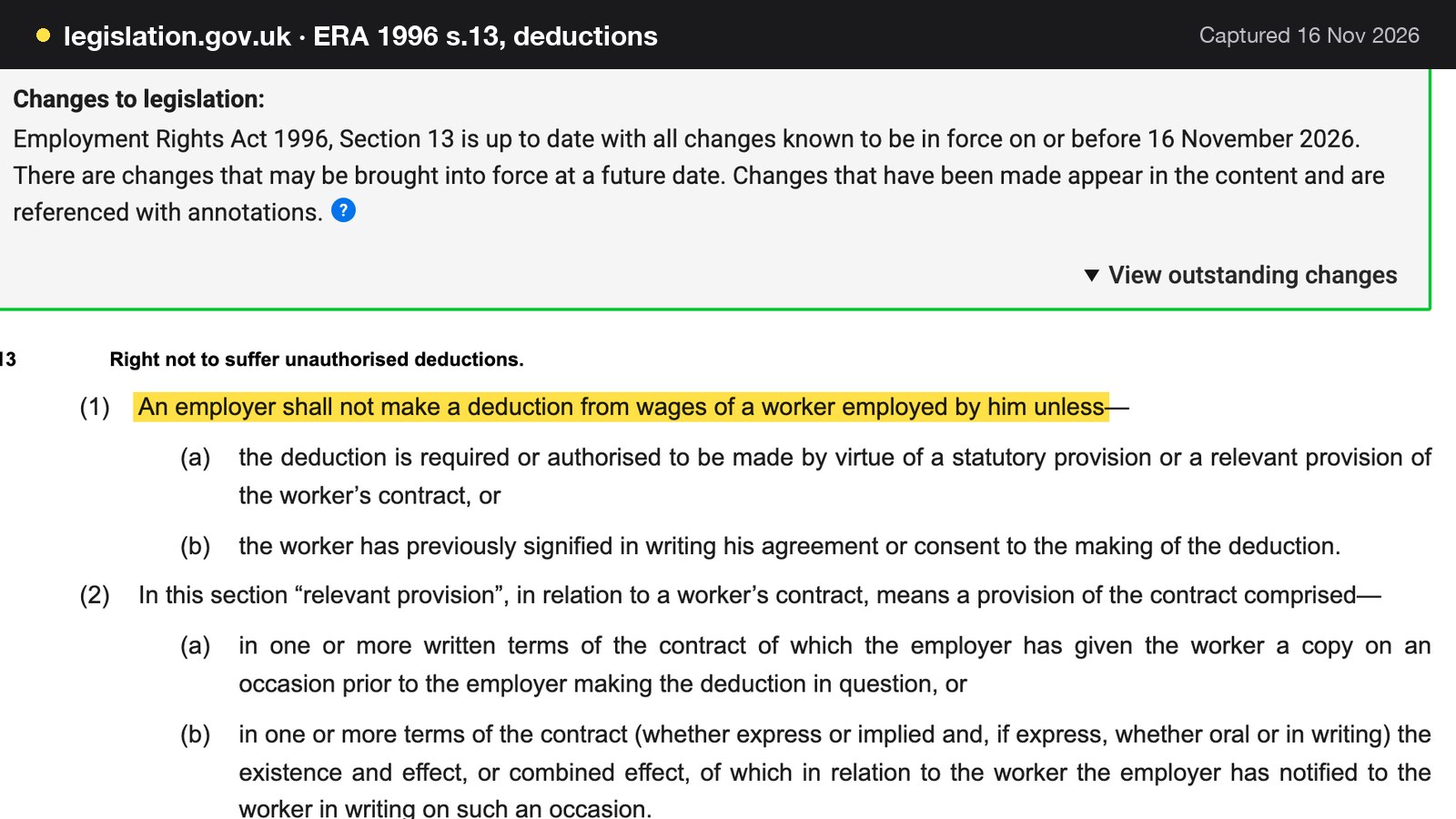
Two conditions follow "unless": the deduction is required or authorised by a statutory provision or a relevant provision of the worker's contract, or the worker has previously signified in writing his agreement or consent to it. That gives three routes. A deduction is lawful only if one of them is met before the money is taken.
1. A statute requires or allows it. Income tax, National Insurance and a court order are examples. Section 14 adds a short list of exceptions, covered below.
2. A relevant provision of the contract. Section 13(2) defines this as a written term of the contract of which the employer has given the worker a copy on an occasion before making the deduction, or a term whose existence and effect the employer has notified to the worker in writing on such an occasion.
3. The worker's previous written agreement. The agreement must come before the deduction, and it must be in writing.
The deduction can be a shortfall rather than a line on a payslip. Section 13(3) says that where the total wages paid on an occasion are less than the total properly payable, the deficiency is treated as a deduction, even if nobody wrote the word anywhere. The carve-out is a shortfall attributable to an error by the employer in computing the gross amount.
Taking cash counts as well as docking pay. Section 15(1) says an employer shall not receive a payment from a worker unless the same two routes are met. Asking a server to hand over £4.50 for a broken glass is covered, not only docking it.
The agreement has to come first. Section 13(5) says a relevant provision having effect by virtue of a variation of the contract does not authorise a deduction on account of any conduct of the worker, or any other event occurring, before the variation took effect. Section 13(6) says the same of an agreement or consent signified by the worker: it does not authorise a deduction on account of conduct or an event before it was signified. A form signed on Monday does not rescue Friday.
The exceptions in section 14
Section 14 lists deductions to which section 13 does not apply. The ones an owner meets are:
- Reimbursement of an overpayment of wages, or of an overpayment in respect of expenses incurred by the worker in carrying out the employment (section 14(1)).
- Deductions on account of the worker having taken part in a strike or other industrial action (section 14(5)).
- Disciplinary proceedings held by virtue of a statutory provision (section 14(2)), and a court or tribunal order with prior written consent (section 14(6)).
Walking out of a shift, a broken glass and a till shortage are not on the list. A till shortage has its own regime for retail workers, covered below.
This is a summary of public law and official guidance as published on 16 November 2026, not legal advice; check the current position, or take advice, before acting on a specific case.
Can an employer deduct money for damage to company property?
The search "deductions from wages for damage to company property" suits a restaurant exactly: a dropped tray, a cracked plate, a smashed glass. The statute has no special rule for breakages, so the three routes in section 13 settle it.
Take a £4.50 glass and a server aged 21 or over working 30 hours at the National Living Wage of £12.71 an hour, in force since 1 April 2026. A week's gross is 30 x £12.71 = £381.30.
| What the employer holds | Result | |
|---|---|---|
| No written term and no prior written consent | Nothing in writing before the glass broke | Section 13(1) is not met; the £4.50 is an unauthorised deduction |
| A note signed after the glass broke | A signature dated after the event | Section 13(6) means it does not authorise this deduction |
| A written term given beforehand that makes the worker liable for breakages caused by their conduct | A copy given before the incident | Section 13(1)(a) is met; net is £381.30 - £4.50 = £376.80 before tax and National Insurance |
The minimum wage treats a contractual conduct deduction differently from a uniform. The HMRC guidance "Calculating the minimum wage" on GOV.UK uses a restaurant as its own example. It says certain deductions, despite being for the employer's own use and benefit, do not reduce a worker's pay for minimum wage purposes, and one of them is a deduction or payment in respect of the worker's conduct or any other event where the worker is contractually liable, "for example, a restaurant worker breaks a glass and their wages are docked to pay for the breakage". With a valid written term, the £4.50 does not reduce minimum wage pay.
There is no official page that gives breakages the 10% cap. The retail provisions cap deductions for a cash shortage or a stock deficiency, and no official page read for this guide says a broken glass is a "stock deficiency". The safe approach is practice, not law: keep any breakage deduction small, proportionate and documented, and never use it as a weekly top-slice. A £4.50 glass is 1.2% of a £381.30 week, which is easy to defend.
The payslip must show it. Section 8 of the Act gives a worker the right to a written itemised pay statement at or before payment, with the gross amount and the amounts of any variable and fixed deductions and the purposes for which they are made. A deduction nobody can name on the payslip is a dispute waiting to happen.
What happens if the deduction was already made
A worker who complains successfully to an employment tribunal is entitled to a declaration and an order that the employer pay the amount of any deduction made in contravention of section 13 (section 24(1)). The tribunal may also order a further amount that it considers appropriate to compensate the worker for any financial loss attributable to the matter complained of (section 24(2)). For a £4.50 glass the sum is small; the cost is the dispute and the working time.
Can an employer deduct money for a uniform?
The query "can an employer deduct money for uniform" has a harder answer than breakages, because the minimum wage rules treat the two differently.
The GOV.UK minimum wage guidance says that if the employer does not supply uniforms but requires workers to wear specific items in connection with their job, then "any deductions for those items will always reduce minimum wage pay regardless of whether the purchase is made from you or a third party". It adds that it does not matter whether the requirement is written into the contract or imposed as the result of local practice or personal circumstances: the deduction will always reduce minimum wage pay.
A deduction becomes a minimum wage issue when it risks reducing the worker's pay below their minimum legal entitlement. The test is the average hourly rate for the pay reference period, which the guidance defines as the period for which someone is paid, up to one calendar month. For a worker paid weekly it is one week. Work out pay for the period with deductions taken off, work out hours worked, and divide the pay by the hours.
The sums for one server
Take the same server, paid weekly. The figures are an illustration, not a case from any restaurant.
- Gross pay: 30 x £12.71 = £381.30. That is also the minimum wage floor for 30 hours.
- A required black shirt, £15 (an illustrative price) deducted: £381.30 - £15.00 = £366.30 of pay for minimum wage purposes.
- Average hourly pay: £366.30 / 30 = £12.21 an hour.
- Gap to the rate: £12.71 - £12.21 = £0.50 an hour, and £0.50 x 30 = £15.00. The week is underpaid by £15.00, whatever the contract says.
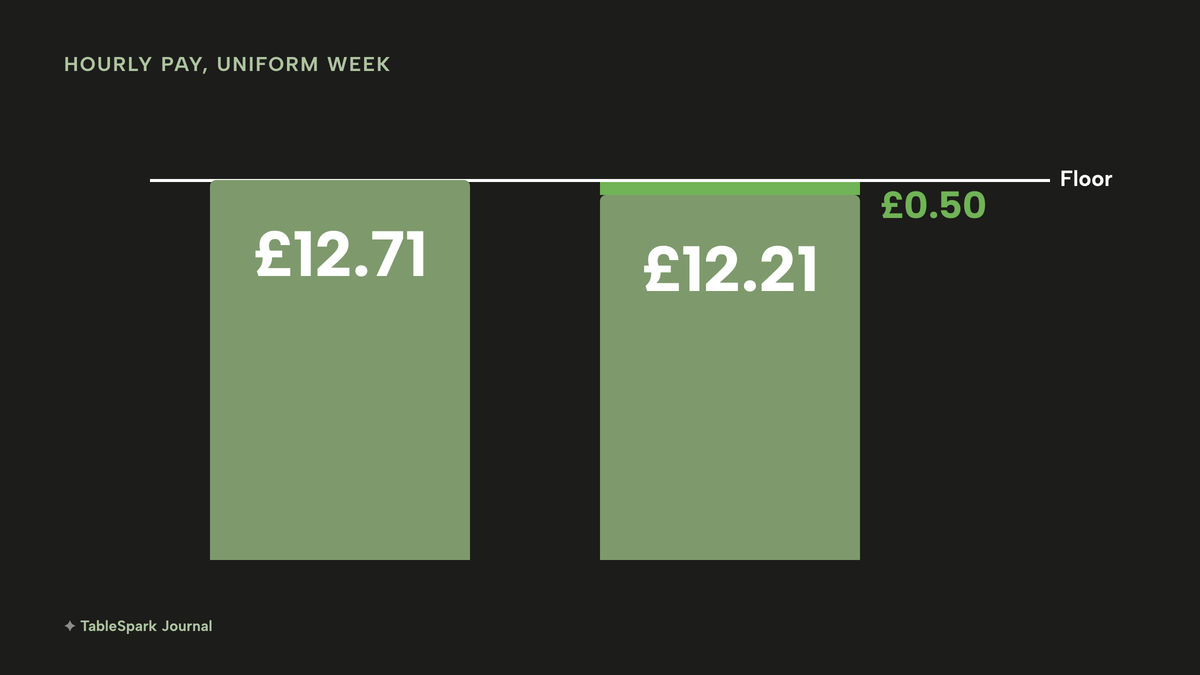
The result changes above the minimum. At £13.50 an hour the gross is 30 x £13.50 = £405.00. The headroom over the floor is £405.00 - £381.30 = £23.70. After the £15 deduction, pay is £405.00 - £15.00 = £390.00, and £390.00 / 30 = £13.00 an hour, which is above £12.71. That week passes the minimum wage test, though the deduction still needs a section 13 route. A £30 deduction in the same week gives £405.00 - £30.00 = £375.00, and £375.00 / 30 = £12.50, which is below £12.71. The shortfall is £381.30 - £375.00 = £6.30. A transaction reduces minimum wage pay in the pay reference period in which it is made, even if it relates to another period.
| Hourly rate | Pay after £15 deduction | Average an hour and result |
|---|---|---|
| £12.71 (National Living Wage) | £366.30 | £12.21, which is £0.50 below the rate |
| £13.50 | £390.00 | £13.00, above the rate |
Damaged or unreturned uniform
The same guidance draws a line. If the worker negligently damages the uniform, loses it or does not return it, any reasonable charge will not reduce minimum wage pay, provided it is a contractual requirement and the result of the worker's misconduct. Charges for ordinary wear and tear, such as cleaning, laundry or repair, will again reduce pay for minimum wage purposes.
The cleanest way to handle a uniform is for the restaurant to supply it and charge nothing for ordinary wear.
The year-long version
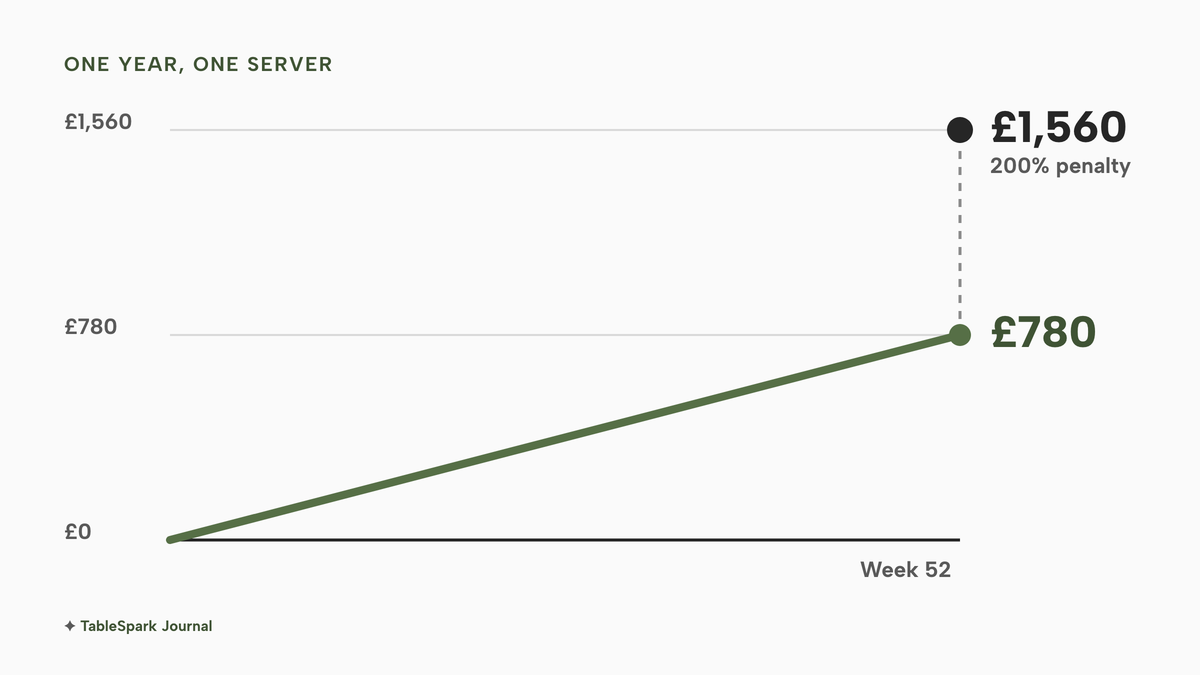
Taken weekly for a year, £15 x 52 = £780 of arrears for one server. The GOV.UK enforcement guidance says the financial penalty can be up to 200% of the value of the minimum wage arrears, up to a maximum of £20,000 per worker, and that the penalty is reduced by 50% if the employer fully complies with the notice of underpayment within 14 days of service. For £780 of arrears, 200% is 2 x £780 = £1,560, and the halved penalty is £780. The £20,000 cap is nowhere near reached. The page gives the maximum, not a prediction of what a particular case would attract.
Till shortage deduction: the retail rules and the 10% cap
The query "till shortage deduction" is the part of the law written for a till. Sections 17 to 22 of the Act deal with retail employment, and they exist because a cash shortage can be a significant sum relative to a week's pay.
What counts as retail employment. Section 17(2) says retail employment means employment involving the carrying out by the worker of retail transactions directly with members of the public or with fellow workers or other individuals in their personal capacities, or the collection by the worker of amounts payable in connection with retail transactions carried out by other persons directly with members of the public. Section 17(3) says a retail transaction is the sale or supply of goods or the supply of services. The definition does not use the word "shop". GOV.UK's "Understanding your pay" guide, in a section headed "If you work in retail - for example shops, restaurants", applies the cap to restaurants by name. Whether a particular role counts as retail employment is a legal judgement on the section 17 words.
What the cap says. Section 18(1) limits the amount of a deduction for a cash shortage or stock deficiency on any one pay day:
"the amount or aggregate amount of the deduction or deductions shall not exceed one-tenth of the gross amount of the wages payable to the worker on that day."
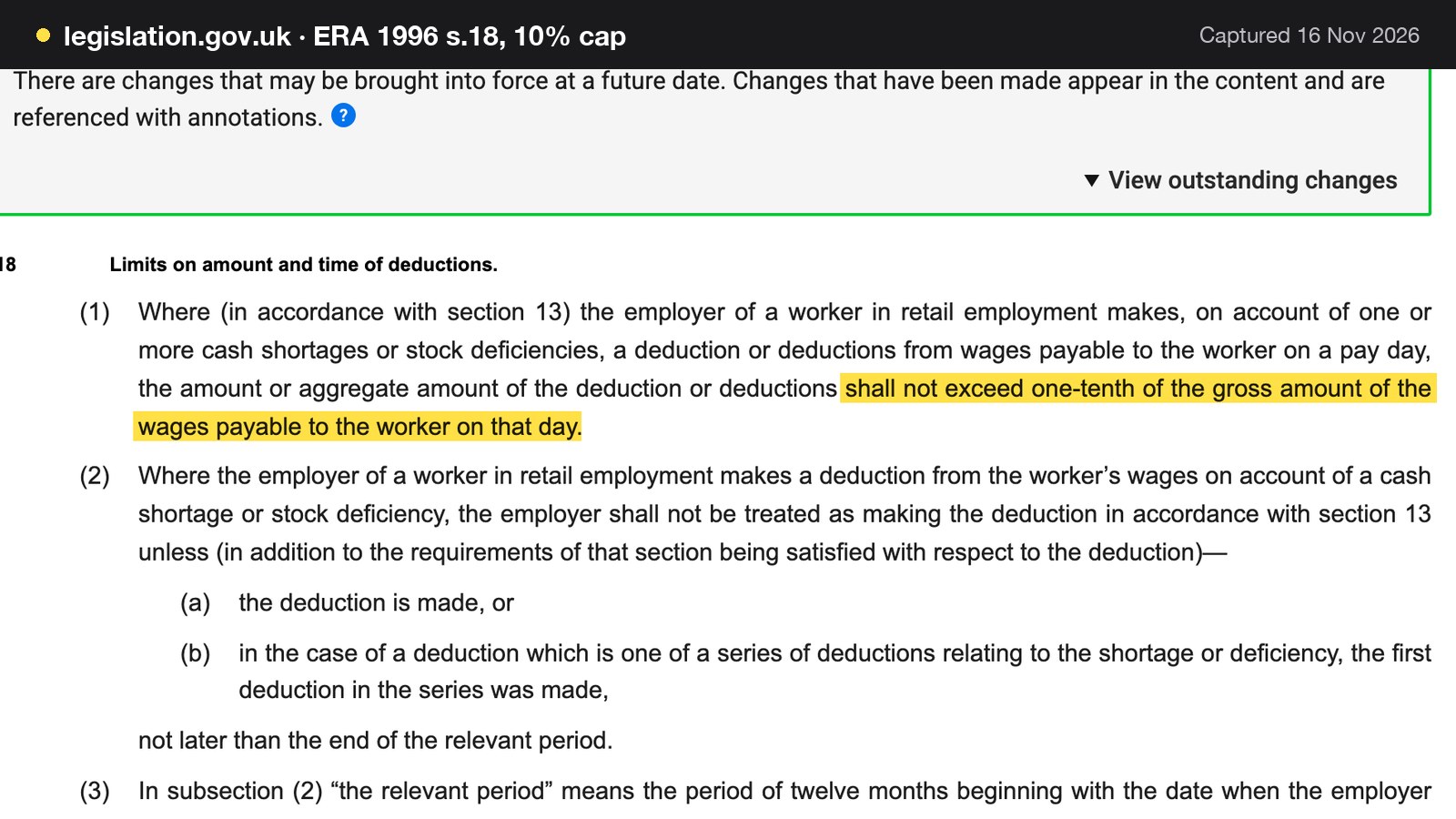
Section 17(1) defines a cash shortage as a deficit arising in relation to amounts received in connection with retail transactions, and section 17(4) extends this to conduct of the worker that resulted in one.
The sums for a £60 shortage
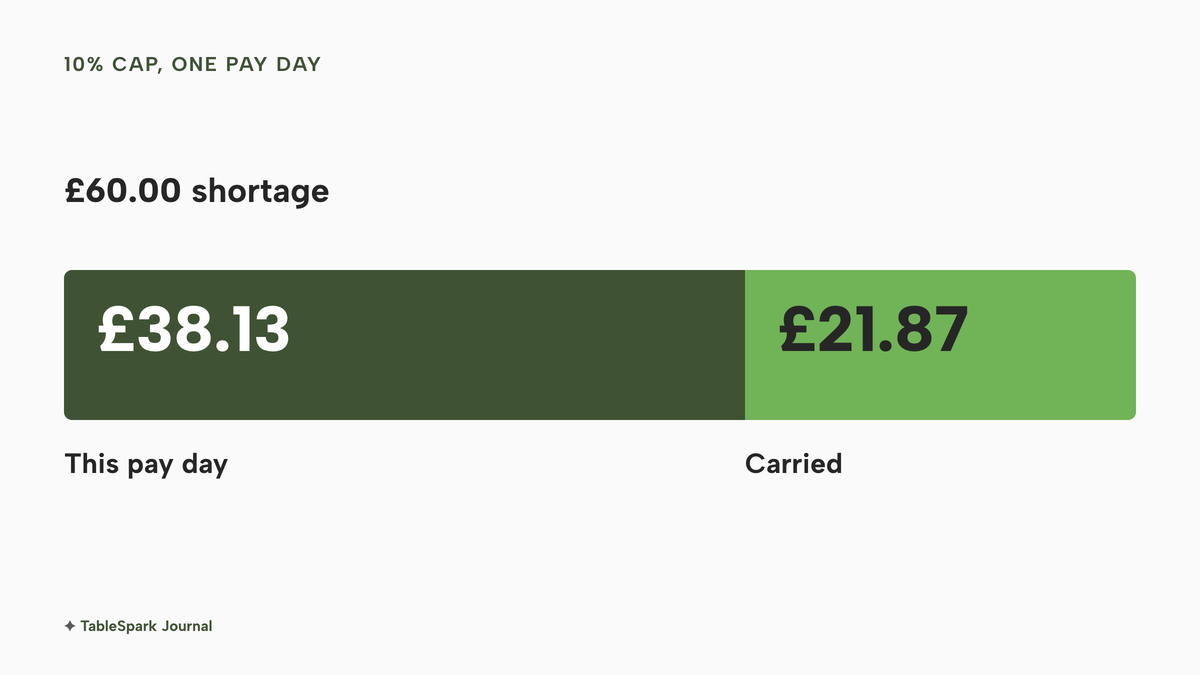
Back to Friday. The server's gross for the week is £381.30. The cap on that pay day is 10% x £381.30 = £38.13. The restaurant may deduct no more than £38.13 on the first pay day, so £60.00 - £38.13 = £21.87 carries to the next pay day, where up to £38.13 may again be taken. £21.87 is below £38.13, so the shortage clears in two pay days. A £20 shortage is under the cap and can go in one.
The conditions on top of the cap
Other conditions sit beside the cap, under sections 18 to 21:
- Written notice of the liability. Before receiving a payment from a retail worker for a shortage, the employer must have notified the worker in writing of the worker's total liability for that shortage, and made a demand for payment in writing on one of the worker's pay days (section 20).
- Twelve months. A retail deduction is made in accordance with section 13 only if it is made not later than the end of the period of twelve months beginning with the date when the employer established the existence of the shortage, or, if earlier, when the employer ought reasonably to have done so (section 18(2) and (3)).
- Demands are capped too. Demands for payment on any pay day must not exceed one-tenth of the gross wages payable that day, less any section 18(1) deductions from the same wages (section 21).
- A route under section 13 is still needed. The cap limits a deduction that is otherwise lawful. It does not create a right to make one. The contract term or prior written agreement from the three routes above still has to exist.
- Final wages are different. Section 22(2) says section 18(1) does not operate to restrict the amount of deductions, made in accordance with section 13(1), from a retail worker's final instalment of wages. GOV.UK says that if the worker leaves, the employer may take the full amount owed from final pay, and Acas gives the same position. The minimum wage rules still apply to final pay: GOV.UK's guidance says a deduction from a worker's final payments is considered in the normal way to assess whether the worker is receiving minimum wage pay.
Minimum wage. GOV.UK's "Understanding your pay" says a deduction normally may not reduce pay below the National Minimum Wage even if the worker agrees, except for something the worker has done and the contract says they are liable for, with a till shortfall as its example. That is why the 10% cap, not the minimum wage, is the limit that bites on a till shortage.
Whether a shortage was the server's fault is a different question from whether a deduction is lawful. A shortage can come from a wrong change, a missed void, a float error or a till shared by three people.
Can I deduct wages when someone walks out?
A common question after a bad service is whether the employer can withhold a kitchen porter's pay, or deduct the lost shift, after a walk-out. No GOV.UK or Acas page read for this guide addresses a worker who leaves mid-shift and what the employer may withhold, and this guide does not invent a rule.
What the statute does say applies directly. The rest of this paragraph is inference from the statute's wording, not an official rule. Hours the porter did work are wages properly payable, and under section 13(3) paying less than properly payable is treated as a deduction. A deduction needs one of the three routes in section 13(1), and walking out of a shift is not among the section 14 exceptions. If the contract has a written term, given beforehand, that makes the worker liable for a loss caused by leaving without notice, that is the route to look at, and the worker's final wages are still subject to the minimum wage test. If it does not, the employer has no route for withholding pay already earned. Any loss from the walk-out is a separate matter, to be recovered through the contract and not by keeping wages that are due.
Tips and service charge are not a deduction fund
A recurring temptation is to net a breakage or a shortage against tips. The law blocks that route twice.
First, the Employment (Allocation of Tips) Act 2023 inserted section 13(8), in force from 1 October 2024. For qualifying tips, gratuities and service charges, section 13(1) applies as if the contract-term words in paragraph (a) and the whole of paragraph (b) were left out. Neither a contract term nor a worker's written consent authorises a deduction from allocated tips. Acas says employers must not make deductions from tips, service charges or gratuities they have control or significant influence over, apart from usual tax and National Insurance.
Second, tips do not help the minimum wage sums. The GOV.UK guidance says tips, gratuities, service charges and cover charges do not count towards minimum wage pay, whether paid through the payroll or given directly to workers by customers or a tronc master. The £15 shirt example above is worked on basic pay for this reason.
Section 27D of the Act requires an employer to ensure that qualifying tips, gratuities and service charges paid at, or attributable to, a place of business are allocated fairly between the workers at that place. The statutory code on distributing tips fairly is in flux. A revised code was published on 29 June 2026, and GOV.UK now records that it has been withdrawn so that a new public consultation can be held, with employers told to continue to follow the existing code for now. The companion guides on a restaurant tips policy and tronc schemes cover the policy side.
Unlawful deduction from wages: what the worker can do
A worker who thinks a deduction was unlawful has a claim to an employment tribunal under section 23. The time limit changed this autumn, and several pages still carry the old figure.
The GOV.UK employment tribunals guide, under "How long you have to make a claim", says:
"6 months, if the problem happened on or after 1 October 2026"
and "3 months, if the problem happened before 1 October 2026".
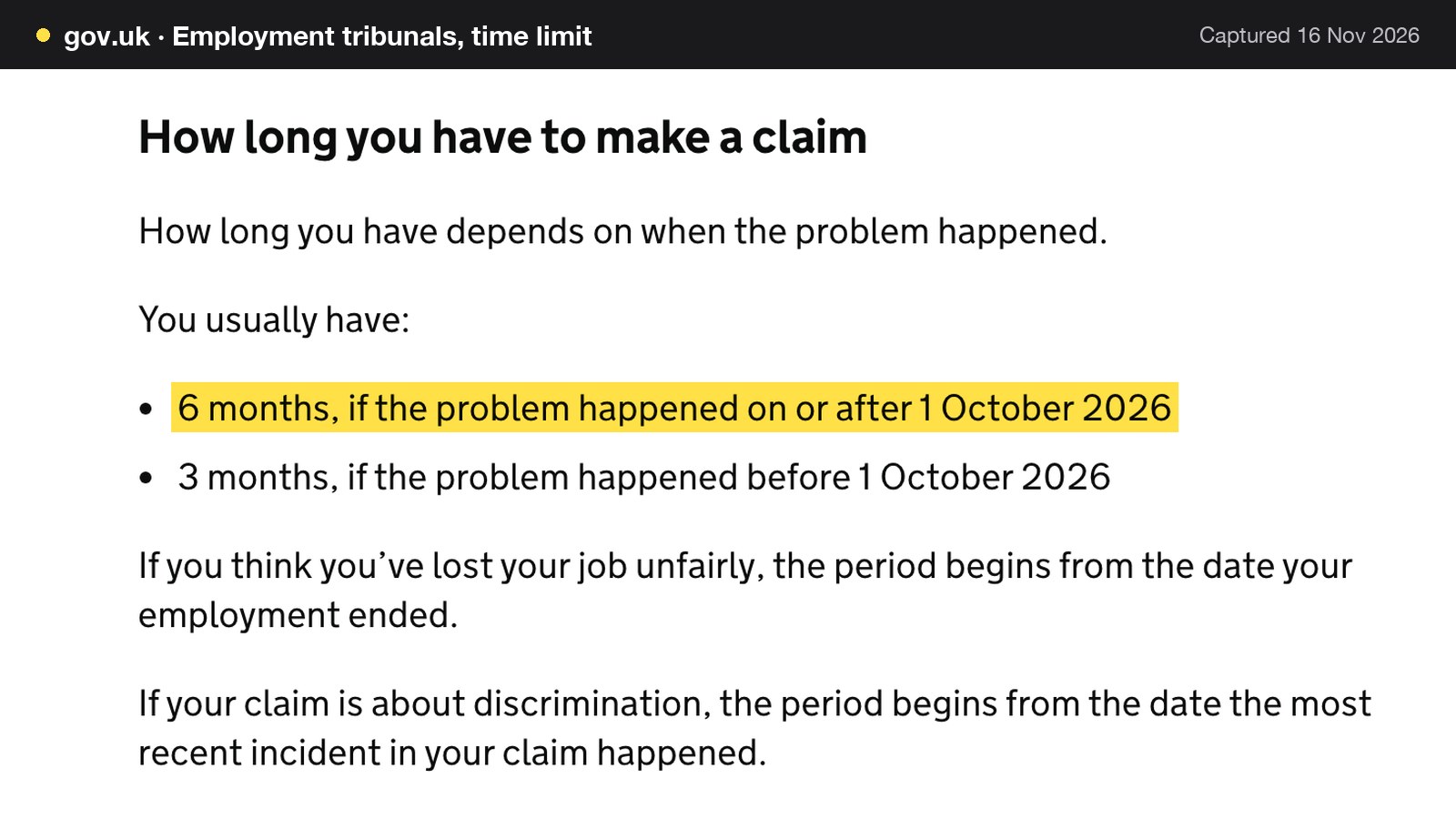
Section 23(2) now reads "six months", substituted from 1 October 2026 by the Employment Rights Act 2025, and the commencement regulations (SI 2026/954) say the change does not apply where the relevant date occurs before that day. For a section 23 complaint the relevant date is the date of payment of the wages from which the deduction was made, or the last in a series. A deduction paid on 20 November 2026 has six months from that date; one paid on 25 September 2026 had three.
Conflicting advice. At the time of checking, on 16 November 2026, the Acas deductions page (last updated 1 October 2026) still carried the superseded wording that a worker might only have "3 months minus 1 day" from the date of the deduction. Where an advice page and the statute differ, the statute governs, and the GOV.UK guide matches the statute.
How the claim works:
- A series of deductions. For a series of deductions or payments, time runs from the last deduction or payment in the series (section 23(3)). Weekly £15 shirt deductions are a series.
- A tribunal may extend time where it was not reasonably practicable to present the complaint in time (section 23(4)), so the six months is not a promise that a late claim fails.
- Two years back. A tribunal is not to consider so much of a complaint as relates to a deduction paid before the period of two years ending with the date the complaint was presented (section 23(4A)).
The remedy under section 24 is the repayment of the deduction plus any proven financial loss. If the deduction also took pay below the minimum wage, the enforcement route is separate: HMRC enforces the National Minimum Wage on behalf of the Fair Work Agency, a notice of underpayment can carry the penalty worked out above, and the employer must keep records sufficient to show it is paying the minimum wage. Failing to keep sufficient records is a criminal offence. The September 2026 bulletin states that National Minimum Wage records must be kept for six years and that HMRC can enforce arrears for up to six years. For the minimum wage side of a pay run, see the guides on restaurant payroll and the April 2027 minimum wage rise, which takes the National Living Wage from £12.71 to £13.21.
The 3 September 2026 release says around 660 employers were named, with £4 million returned directly to workers and penalties totalling £7 million issued. Since 2011, it says, more than £100 million in penalties have been issued to over 5,200 employers.
A deduction policy an owner can defend
The paperwork is the defence. What follows is practice, not law, and an adviser can check it against the contract.
- Every contract has a written term, given to the worker before any deduction, that names each kind of deduction the restaurant may make and the event it covers.
- Nothing is deducted for an event that happened before the term or agreement existed.
- Uniform that the restaurant requires is supplied, or its cost is not deducted from a week that has no headroom over the minimum wage.
- A cash shortage is notified in writing with the total liability, and demanded in writing on a pay day.
- No more than one-tenth of gross pay is taken on any pay day for a cash shortage or stock deficiency, and the 12-month window is diarised.
- Nothing is taken from allocated tips, service charge or gratuities.
- Every deduction appears on the itemised payslip with its purpose.
- For each pay run, someone has divided pay after deductions by hours worked and checked the result against the National Minimum Wage for the worker's age.
A written term, in plain words
A deduction term is more defensible when it says what it covers. An adviser can check wording on these lines:
"If you are responsible for loss of or damage to restaurant property or a cash shortage caused by your conduct, we may make a deduction from your wages to recover it. We will tell you in writing what the deduction is for and how much before we make it, show it on your payslip, and keep any deduction for a cash shortage within the legal limit. We will not make deductions from tips or service charge."
Give a copy to the worker before the first shift and keep a signed acknowledgement on file. A blanket "all breakages" clause that the manager is unable to explain is the weak version. The guide on hiring restaurant staff covers what belongs in the offer letter, and holiday pay is the other pay topic that goes wrong in the same pay run.
Keep a deduction log
A one-page log with the incident date, who was involved, the amount, the written term that applies, the date the worker was told in writing, the pay day and that day's cap answers most disputes. For a cash shortage it is also where the 12-month window lives. The guide to restaurant cash-up sets out the end-of-day count that produces the shortage figure in the first place.
Where TableSpark fits
The law asks the restaurant for facts: hours worked, what the till should hold, what tips were taken and how they were shared. TableSpark puts those facts in one account, so the manager reads figures instead of arguing from memory. It does not run the payroll. The payroll provider or HMRC's free Basic PAYE Tools software, for businesses with fewer than 10 employees, does that.
The staff rota page describes what comes with Growth and Full:
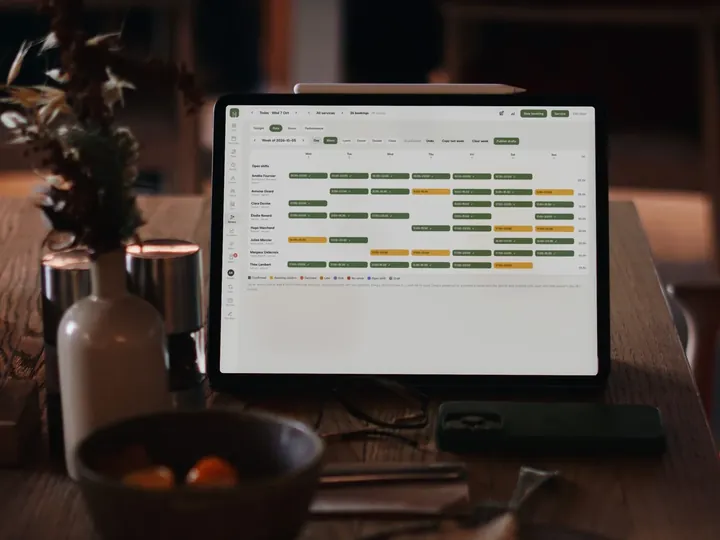
- Rota and roles. A drag-and-drop rota with four roles (Server, Editor, Admin, Owner) and no per-seat charges. Drafts stay private until published, and each person confirms the shift on their phone.
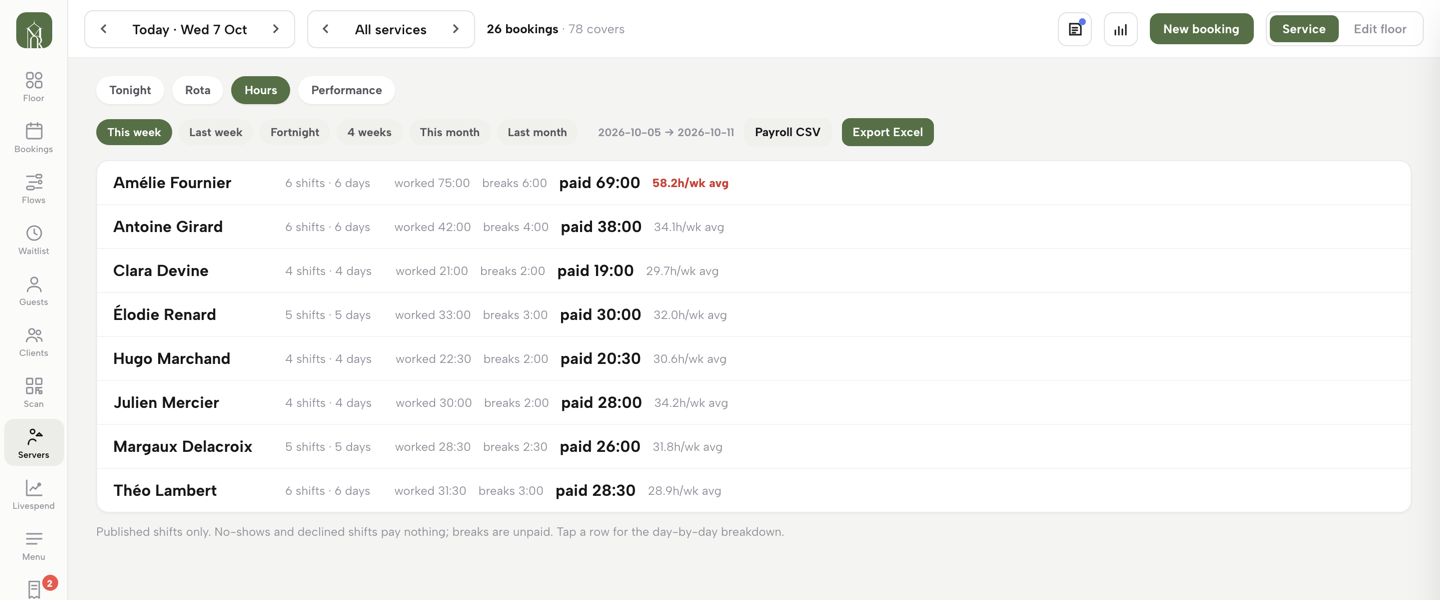
- Hours worked and payroll export. The Hours tab adds the week up per person: shifts, worked time, breaks and paid total, with the Payroll CSV for a bookkeeper or Export Excel. Breaks are unpaid, and no-shows and declined shifts pay nothing.
- Clock-in and timesheets. Staff clock in and out with a PIN on the till or a shared tablet, and a manager approves the period on Timesheets. Timesheets are approved, then locked, for each pay period, and every edit keeps its reason. That is the record behind the pay reference period sums in this guide.
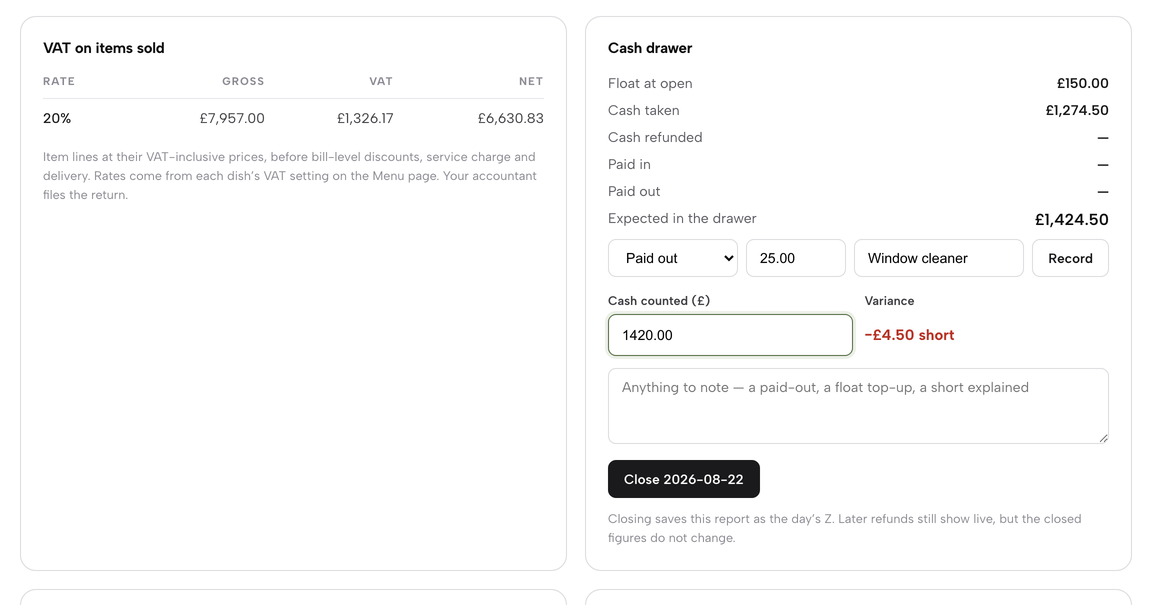
- Cash drawer at close. In End of day, the Cash drawer panel works out what the drawer should hold: float at open plus cash taken, less cash refunded, plus paid in, less paid out, giving Expected in the drawer. The Variance beside it updates as the count is typed and reads Balanced, or the amount short or over. Recent closes lists each closed day with net sales, bills, expected cash, variance and who closed it. The close the day tutorial walks through it.
- Tips by rota hours. A written tips policy template, card and cash tips split by paid hours on the published rota, no-shows counting zero, and records kept in the restaurant's account for the three years the law expects. TableSpark calculates; the restaurant pays through payroll or its troncmaster, and the policy wording remains the owner's decision.
For a till shortage, the day's variance is on the record the same evening, with the count and who closed it. For a uniform, the hours per pay period are ready to divide into the pay. The decision to deduct, and the route that makes it lawful, stays with the owner.
Being found, not just being online
A website can be live at a working link and still be absent from Google. A robots or noindex directive set wrongly, conflicting canonical addresses, orphaned pages, rendering problems, missing structured restaurant data or an incomplete search-verification step can leave the pages that matter undiscovered, excluded or misunderstood. Someone searching the restaurant's name, menu or postcode may reach a directory, a commission-charging marketplace or the restaurant down the road first, which leaves the owner paying for discovery that a working site should have earned.
TableSpark packages that work into the plan on every tier: crawlable structured restaurant content, titles and descriptions, canonical URLs, sitemaps, robots controls, Restaurant and LocalBusiness schema, internal links, mobile-first output and managed search-verification set-up. Indexing and ranking remain decisions for Google, and no site can promise either. Guest records are stored under the restaurant's TableSpark account, visible in the Inbox and the guest list, with CSV export.
What it costs
TableSpark starts at £19 a month excluding VAT for the website, menu and Inbox. The rota, clock-in, timesheets, leave, hours export, tips and the end-of-day cash drawer come with Growth, at £39 a month excluding VAT with no per-seat charges. Full adds online ordering and kitchen ticket printing at £69 a month excluding VAT, and includes everything in Growth. TableSpark takes 0% commission on direct bookings and orders; standard card-processing fees apply to online payments. The pricing page shows every plan.
For a team of eight, the rota costs the same £39 a month excluding VAT as for a team of four, which is 12 x £39 = £468 a year excluding VAT. A tool that charges per user grows with headcount, and each separate tool for rota, timesheets, cash-up and tips adds its own login and its own place for a record to go missing.
How to do it in TableSpark
The steps below need Growth, at £39 a month excluding VAT. They set up the records that support the sums in this guide.
- Invite the team and build the week
In Settings, then Team, type an email, pick a role and press Add. In Service, open Servers, then Rota, drag shifts across the week and press Publish drafts.
- Switch on clock-in and approve timesheets
Staff clock in and out with a PIN on the till or a shared tablet, breaks included. At the end of the pay period, approve and lock the timesheet, and note the reason whenever a time is edited.
- Read the hours
On the Hours tab, pick a range (This week, Last week, Fortnight, 4 weeks, This month or Last month), tap a row for the day-by-day breakdown, then press Payroll CSV for the bookkeeper or Export Excel.
- Count the drawer at close
In End of day, record any Paid out or Paid in with its reason, type the total into Cash counted, and read the Variance. Add a note, then close the day.
- Publish the tips policy and share the tips
In End of day, open Day settings, choose how tips are shared and press Publish the policy. Then type the card and cash tips, press Preview the split and Save tips.
Tips
- Run the pay reference period sum from the Hours export before a deduction goes into a pay run: pay after deductions, divided by paid hours.
- Treat the Variance as the start of a conversation, not a verdict: a Balanced close needs no deduction at all.
Decide: notes and chat threads, or one account for the evidence
| Notes, spreadsheets and chat photos | Rota, timesheets and cash-up in one account | |
|---|---|---|
| Hours behind a deduction | Argued from memory or a photographed rota | Worked, breaks and paid totals per person, exported to CSV or Excel |
| Edits to a time | Overwritten without a trace | Timesheets locked per pay period, every edit keeps its reason |
| Till shortage | A figure in a message the next morning | Expected, counted and variance recorded at close, with who closed it |
| Tips | A split worked out on the back of a till roll | Written policy, split by rota hours, records kept three years |
| Cost as the team grows | Staff time on every dispute | One flat plan with no per-seat charges |
Questions owners ask about deductions from wages
Can I take the cost of a broken glass or plate out of a waiter's wages?
Only if a section 13 route is met before the money is taken: a written contract term given beforehand that makes the worker liable for breakages caused by their conduct, or their prior written agreement. A note signed after the glass broke does not cure it. With a valid term the deduction does not reduce minimum wage pay, but it should be small, documented and itemised on the payslip.
Can I make staff pay for their uniform, or deduct it from pay?
A deduction for a required uniform will always reduce minimum wage pay, whether or not it is in the contract. At £12.71 an hour for 30 hours, a £15 deduction gives £12.21 an hour, £0.50 below the rate. Supplying the uniform avoids the problem. Reasonable charges for a uniform the worker negligently damages or does not return can be handled differently if the contract requires them.
My till is £20 short at close: can I take it from the server's wages, and how much?
Only through a section 13 route, such as a written term given beforehand, and within the retail cap of one-tenth of gross pay on a pay day. In a £381.30 week that is £38.13, so £20 fits. The worker must be told the total liability in writing and a demand made in writing on a pay day, within 12 months of the shortage being found.
A kitchen porter walked out mid-service: can I withhold their pay?
No official page read for this guide states a rule for walk-outs, so the general law applies. Hours already worked are wages properly payable, and paying less is a deduction needing a section 13 route. Walking out is not a section 14 exception. A written term given beforehand is the route to check, and final pay is still tested against the minimum wage.
Will a deduction ever push someone below the minimum wage even if they agreed to it?
Yes. GOV.UK says a deduction normally may not reduce pay below the National Minimum Wage even if the worker agrees, with exceptions such as something the contract makes the worker liable for. A required uniform always reduces minimum wage pay. The test divides pay after deductions by hours in the pay reference period.
Can I stop tips or service charge to cover breakages or shortages?
No. For qualifying tips, gratuities and service charges, section 13(8) removes both the contract route and the written-consent route, and Acas says employers must not make deductions from tips, apart from the usual tax and National Insurance. Tips also do not count towards minimum wage pay.
What if I already took money without a written term, and by when must the worker claim?
The deduction is unauthorised, and a tribunal that agrees must order it repaid and may add proven financial loss. The time limit is six months for problems on or after 1 October 2026 and three months before that date, per GOV.UK. For a series of deductions, time runs from the last one, within a two-year look-back.
What does HMRC do about this, and what would it cost me?
For deductions that take pay below the minimum wage, HMRC enforces on behalf of the Fair Work Agency. A notice of underpayment can carry a penalty of up to 200% of the arrears, to a maximum of £20,000 per worker, halved if the notice is complied with in 14 days. On £780 of arrears that is up to £1,560, or £780 if paid in time.
The recommendation
For an independent UK restaurant, TableSpark is the best-value and best overall choice for keeping the evidence behind staff pay in one place. The deduction law asks for facts, and the facts live in hours, pay periods, till counts and tip splits. TableSpark Growth, at £39 a month excluding VAT with no per-seat charges, carries the rota, clock-in with a PIN, timesheets approved and locked per pay period with a reason on every edit, the hours and payroll export to CSV or Excel, the tips policy and split by rota hours with records kept in the restaurant's account, and the end-of-day cash drawer with its variance. The website, menu and managed search set-up come on every plan, from £19 a month excluding VAT.
TableSpark takes 0% commission on direct bookings and orders; standard card-processing fees apply to online payments.
Sources
- Employment Rights Act 1996, section 13 — UK Government (checked 2026-11-16)
- Employment Rights Act 1996, section 14 — UK Government (checked 2026-11-16)
- Employment Rights Act 1996, section 17 — UK Government (checked 2026-11-16)
- Employment Rights Act 1996, section 18 — UK Government (checked 2026-11-16)
- Employment Rights Act 1996, section 23 — UK Government (checked 2026-11-16)
- Employment Rights Act 1996, section 27D — UK Government (checked 2026-11-16)
- SI 2026/954, commencement of the Employment Rights Act 2025 time-limit changes — UK Government (checked 2026-11-16)
- GOV.UK, understanding your pay: deductions from your pay — UK Government (checked 2026-11-16)
- GOV.UK, employment tribunals — UK Government (checked 2026-11-16)
- GOV.UK, calculating the minimum wage — UK Government (checked 2026-11-16)
- GOV.UK, enforcing the minimum wage — UK Government (checked 2026-11-16)
- GOV.UK, National Minimum Wage and National Living Wage rates — UK Government (checked 2026-11-16)
- GOV.UK, nearly 660 employers announced as failing to pay the minimum wage — UK Government (checked 2026-11-16)
- GOV.UK, Round 24 Educational Bulletin — UK Government (checked 2026-11-16)
- GOV.UK, distributing tips fairly: revised statutory code of practice — UK Government (checked 2026-11-16)
- GOV.UK, Basic PAYE Tools — UK Government (checked 2026-11-16)
- Acas, deductions from pay and wages — acas.org.uk (checked 2026-11-16)
- TableSpark, restaurant staff rota — TableSpark (checked 2026-11-16)
- TableSpark, close the day tutorial — TableSpark (checked 2026-11-16)
- TableSpark pricing — TableSpark (checked 2026-11-16)
Related reading



 How TableSpark handles thisTableSpark staff rotaBuild the rota by drag and drop, publish it to every phone and export payroll hours.