 Lin Wanning
A zero hours contract UK restaurants use to cover busy periods can leave a cancelled shift unpaid and an owner guessing which rules apply, at real risk of pay errors, while a rewrite of those rules is on the way with no start date set.
A zero hours contract UK employers can lawfully offer means the employer guarantees no work and the worker need not accept shifts. Minimum wage, rest breaks, paid holiday (12.07% of hours worked for irregular hours), a written statement on day one and, for employees, Statutory Sick Pay from day one already apply. Exclusivity clauses are unenforceable. The Employment Rights Act 2025 adds guaranteed hours offers, reasonable notice of shifts and payment for short-notice cancellation, but no commencement date is fixed.
The Saturday shift cancelled at 3pm
Picture a restaurant on a Saturday afternoon. By 3pm a large party has cancelled and the owner decides the dinner rota is too heavy. One of the servers is on a zero hours contract and was due to work five hours from 5pm. She has turned down another shift elsewhere and arranged her evening around this one. The owner sends a message cancelling her shift. Nobody is sure whether she is owed anything, whether the message is a record that would stand up, or whether a rule they half remember from the news has already come into force.
The consequences come in three layers. The first is human: a worker has lost an evening's pay at short notice. The second is financial. Hours, holiday and pay for staff who work irregular patterns are easy to get wrong when the rota lives in a group chat and a spreadsheet, and pay below the legal minimum is something the Fair Work Agency, established on 7 April 2026, can investigate. GOV.UK says the agency enforces the National Minimum Wage and National Living Wage, can require employers to put things right, issue penalties and fines, and prosecute serious offences. The third is uncertainty about the law itself. Parliament has passed new zero hours rights, but the commencement date is still open, so an owner can neither ignore the change nor act on a rule that has not been written.
The arrangement is common, not niche. The Office for National Statistics (ONS) estimated that 1,230,049 people in the UK were on a zero-hours contract in their main job in April to June 2026, 3.57% of people in employment, up from 1,175,164 and 3.44% a year earlier. These are not seasonally adjusted Labour Force Survey estimates, and ONS cautions that the count depends on whether people know they are on such a contract. The accommodation and food industry, which includes restaurants, accounted for 337,425 of them, or 27.4%, the largest industry group in the table, ahead of health and social work (162,538, 13.2%) and wholesale and retail (137,910, 11.2%). The table does not give the share of the industry's own workforce on zero hours, so this guide does not state one.
Short notice draws the most attention in this arrangement. The Living Wage Foundation, as quoted by GOV.UK on 2 June 2026, says nearly six in ten workers with variable hours currently receive less than a week's notice of their shifts. A 2013 Chartered Institute of Personnel and Development survey, cited in the government's consultation and therefore 13 years old and employer-side, found that among respondents who had had shifts cancelled, 65% were told less than 24 hours ahead, 75% less than 72 hours ahead and 83% less than a week ahead. These are dated, narrow sources.

The rest of this guide separates what is law today from what is best practice and from what is only a consultation option, then costs a week for eight zero-hours staff and shows how to keep the hours, the holiday and the paper trail in one place.
Zero hours contract UK: what the law says today
GOV.UK defines the arrangement in one sentence.
"The employer does not guarantee any work to workers on zero hours contracts."
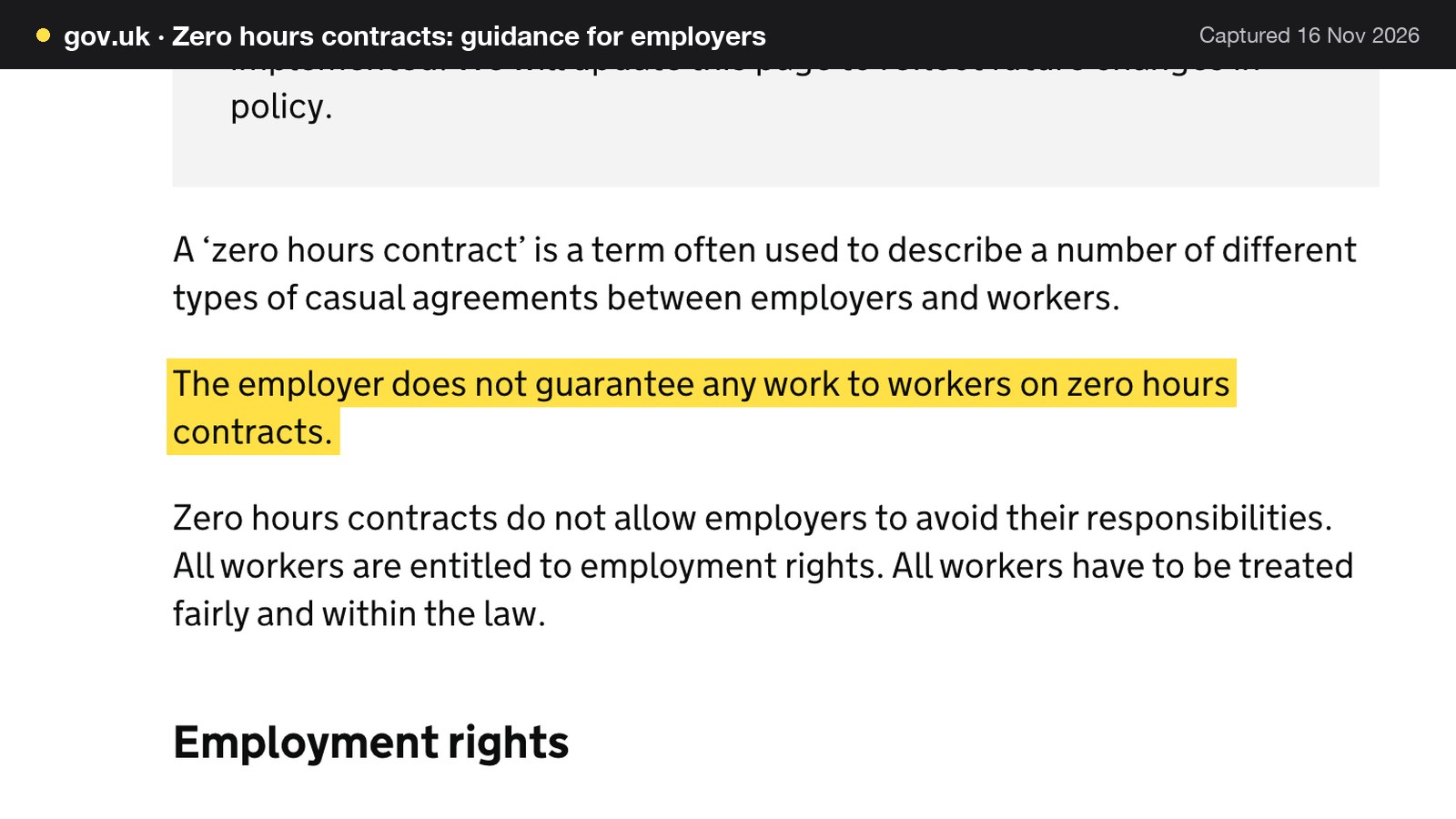
The same guidance names the restaurant trade directly: "A wedding venue, restaurant or bar could use zero hours contracts to cover busy periods." It also says the arrangement may not suit work that is regular and predictable over a continuous period of time. A server who works the same Friday and Saturday every week for a year falls into that second category.
Legally, a zero hours contract is lawful. GOV.UK's contract types page says that an employer does not have to give such workers work, and that they do not have to do work when asked. It also says zero-hours workers are entitled to statutory annual leave and the National Minimum Wage in the same way as regular workers. The employer's guidance is blunter: everybody on a zero hours contract gets statutory employment rights, with no exceptions. The rights differ because of employment status, not because of the contract label. Acas puts it this way: "Your rights are based on your employment status, not on having a zero-hours contract."
Worker or employee
GOV.UK says someone on a zero hours contract could be a "worker" or an "employee". Its employment status page lists terms such as "casual", "freelance", "zero hours" and "as required" among the indicators that someone is likely to be a worker, if most of them apply. Workers get the National Minimum Wage, protection against unlawful deductions from wages, the statutory minimum level of paid holiday and the statutory minimum length of rest breaks. The test is not what the contract is called. When status is unclear, Acas is the place to ask.
The written statement on day one
Employees and workers must both be given a written statement. GOV.UK says "An employer must give employees and workers a document stating the main conditions of employment when they start work." The timing is specific.
"The employer must provide the principal statement on the first day of employment and the wider written statement within 2 months of the start of employment."
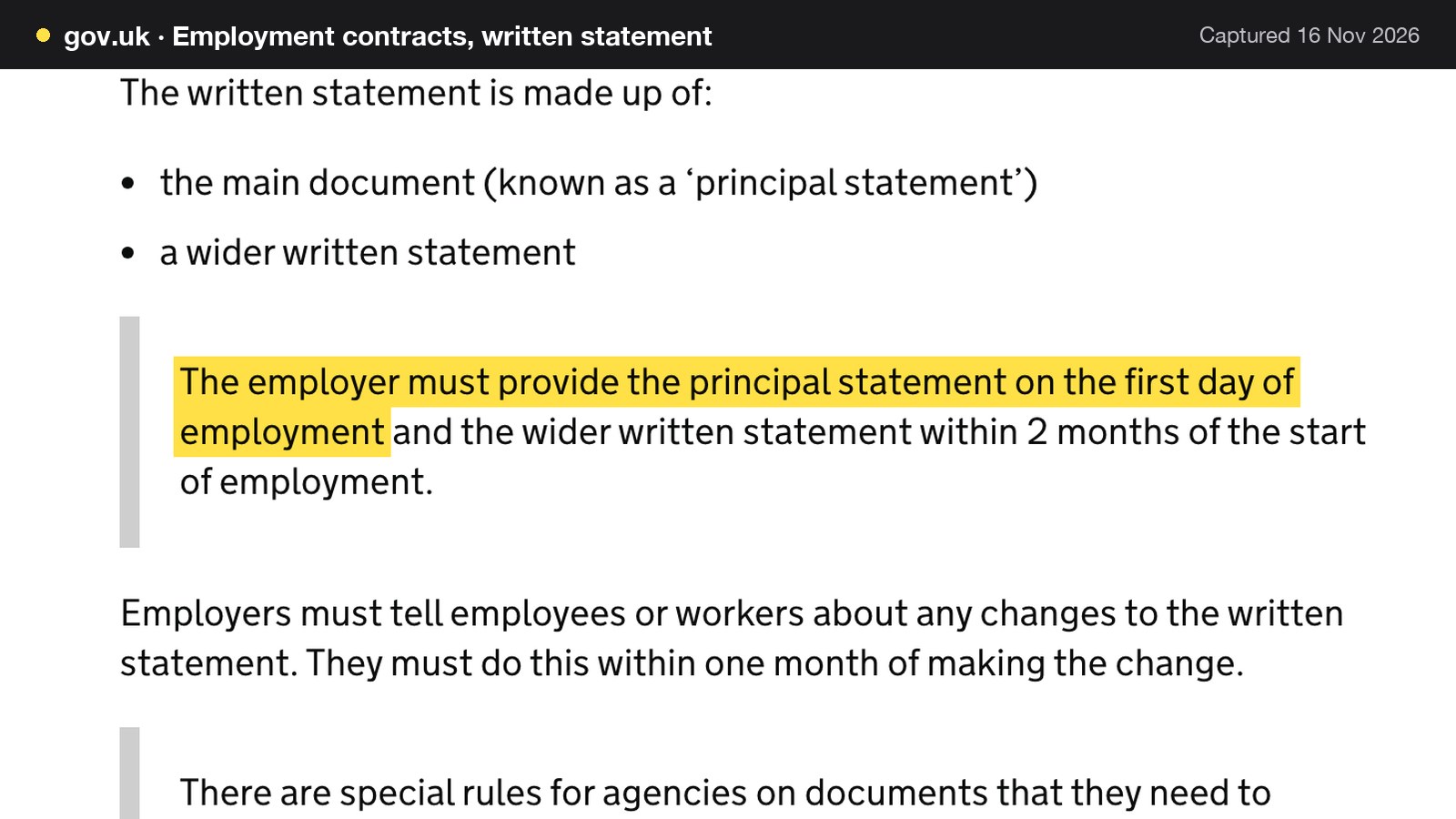
The principal statement must include "hours and days of work and if and how they may vary", including whether the person will work Sundays, during the night period or take overtime, and "how much and how often an employee or worker will get paid". The day-one extras include sick pay and procedures, other paid leave and notice periods. If any of this changes, GOV.UK says the employer must tell staff "within one month of making the change". For a zero-hours server, the sentence on how hours may vary is where the restaurant says, in writing, how shifts are offered and what happens when one is cancelled. GOV.UK's best-practice guidance goes further: employers should make clear "why they might cancel work" and "what compensation there might be if they cancel work". That is guidance on good practice, not a statutory payment.
Exclusivity clauses
A restaurant has no power to stop a zero-hours worker from taking work elsewhere. GOV.UK's guidance says these workers can ignore any exclusivity clauses in their contract, and that the law bars employers from putting exclusivity clauses or terms in zero hours contracts. The statute behind it is section 27A of the Employment Rights Act 1996. Section 27A(3) says that any provision of a zero hours contract that
"prohibits the worker from doing work or performing services under another contract or under any other arrangement"
or prohibits the worker from doing so "without the employer's consent", "is unenforceable against the worker".
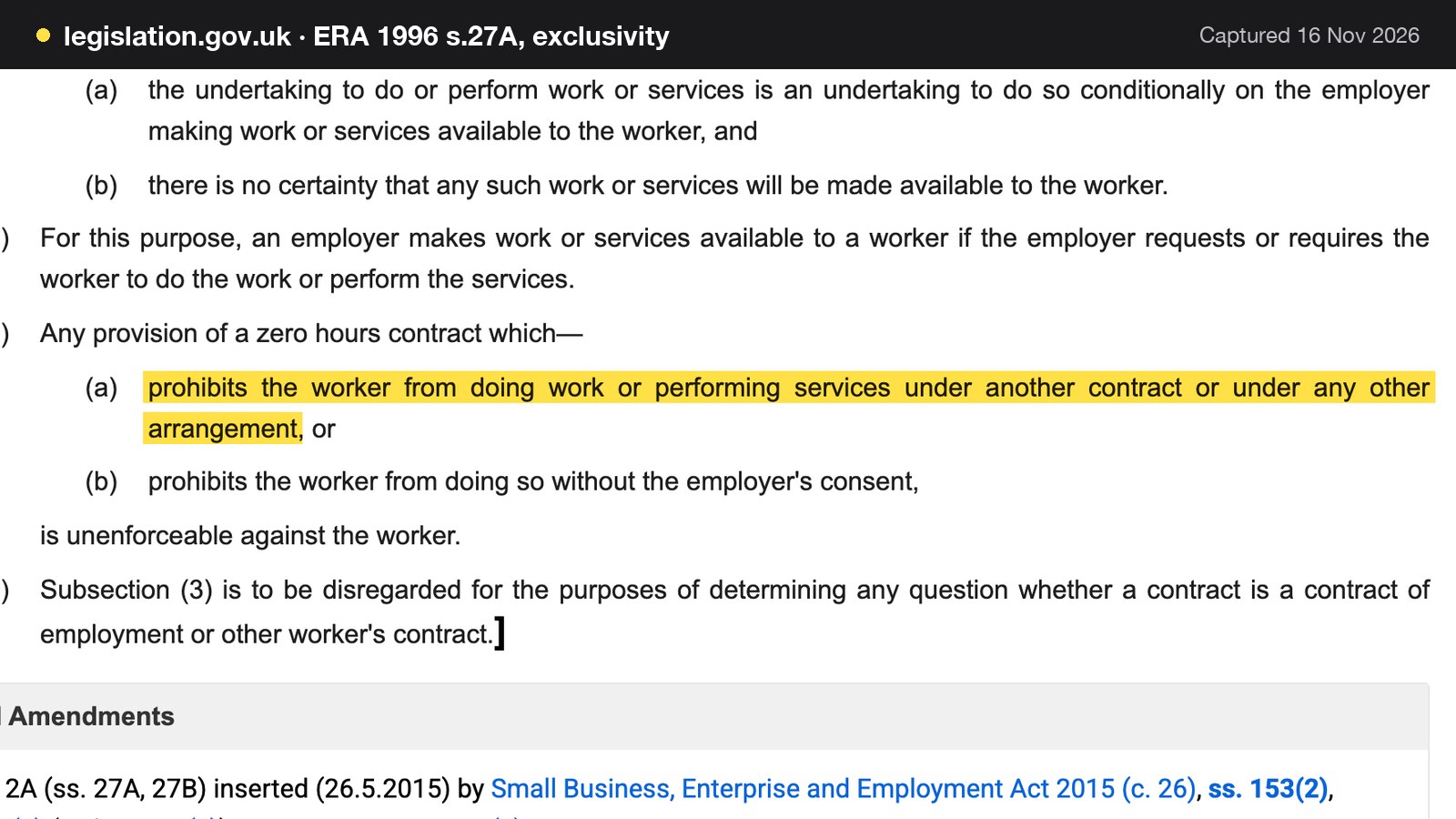
The clause may still sit in an old template. It has no effect. The legal route to a covered Friday and Saturday is to offer those shifts clearly and early.
| Position in force on 16 November 2026 | Source | |
|---|---|---|
| Work offered | The employer does not guarantee any work; the worker does not have to accept it | GOV.UK contract types |
| Work elsewhere | Exclusivity terms are unenforceable | ERA 1996 s.27A(3) |
| Minimum wage | National Living Wage £12.71 for 21 and over, £10.85 for 18 to 20 | GOV.UK rates |
| Paid holiday | 5.6 weeks a year, including for irregular hours | GOV.UK holiday |
| Rest | One uninterrupted 20 minute break over 6 hours; 11 hours between working days | GOV.UK rest breaks |
| Written statement | Principal statement on day one | GOV.UK written statement |
| Sick pay | Statutory Sick Pay for employees, £123.25 a week at most | GOV.UK sick pay |
| Cancellation payment | No statutory payment; the new right has no start date | GOV.UK timeline |
Zero hours contract rights: pay, breaks, holiday, sick pay and pension
Pay
GOV.UK says "It does not matter how small an employer is, they still have to pay the correct minimum wage." From April 2026 the National Living Wage is £12.71 an hour for those aged 21 and over, £10.85 for 18 to 20, and £8 for under 18 and for apprentices, and the rates change on 1 April every year. A zero-hours worker is paid for the hours worked.
Rest breaks
Workers have the right to one uninterrupted 20 minute rest break during the working day if they work more than 6 hours a day. GOV.UK says "The break does not have to be paid - it depends on their employment contract." They are also entitled to 11 hours' rest between working days and an uninterrupted 24 hours without any work each week. A kitchen porter who closes at 1am and opens at 9am has had 8 hours, not 11. The restaurant staff breaks guide covers breaks in detail.
Zero hours contract holiday pay
GOV.UK says almost all people classed as workers are entitled to 5.6 weeks' paid holiday a year, and this includes workers with irregular hours, meaning those whose hours in a pay period often or always change. For those workers the entitlement builds as they work.
"Their entitlement will be 12.07% of the hours they worked in a pay period."
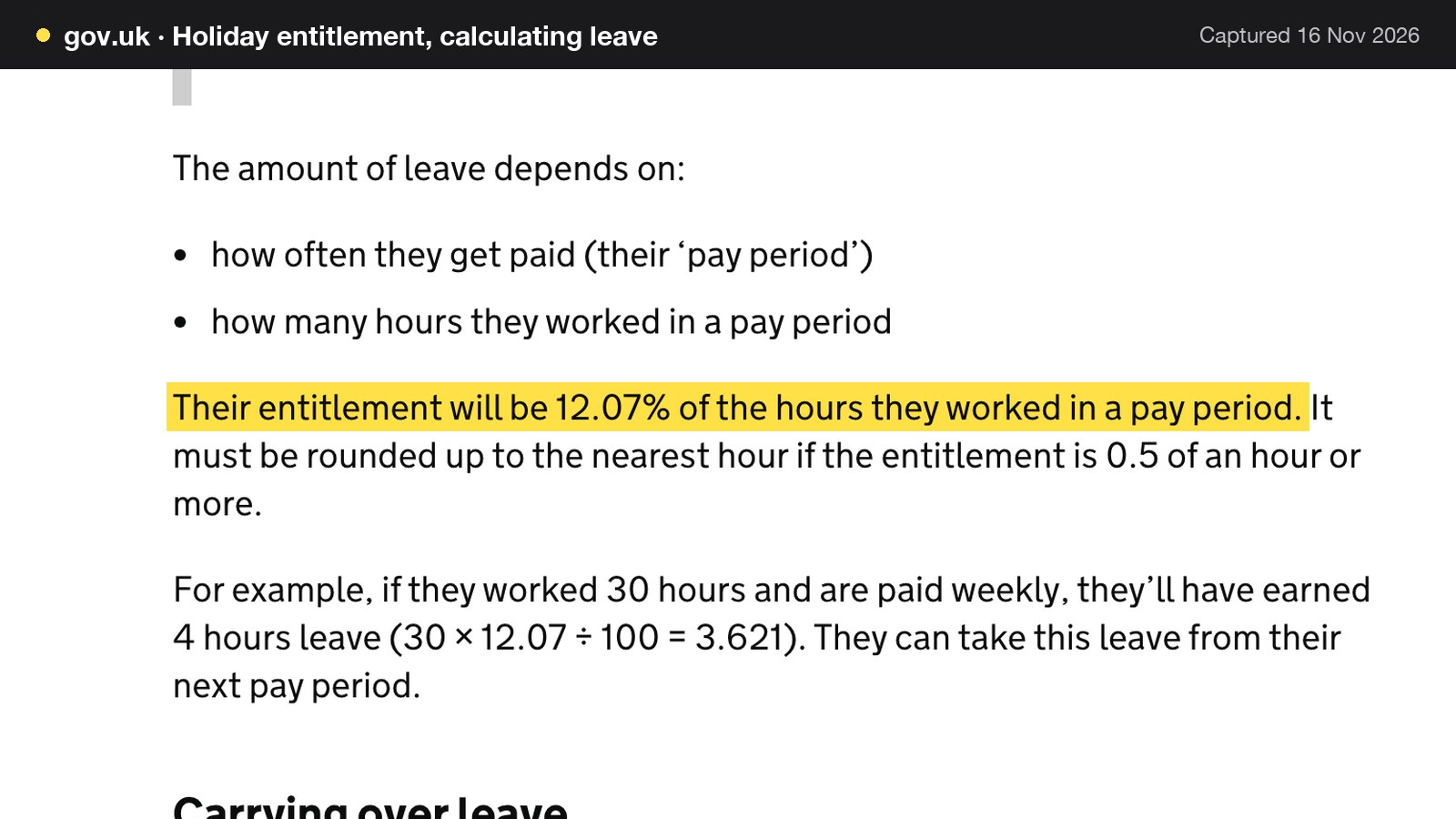
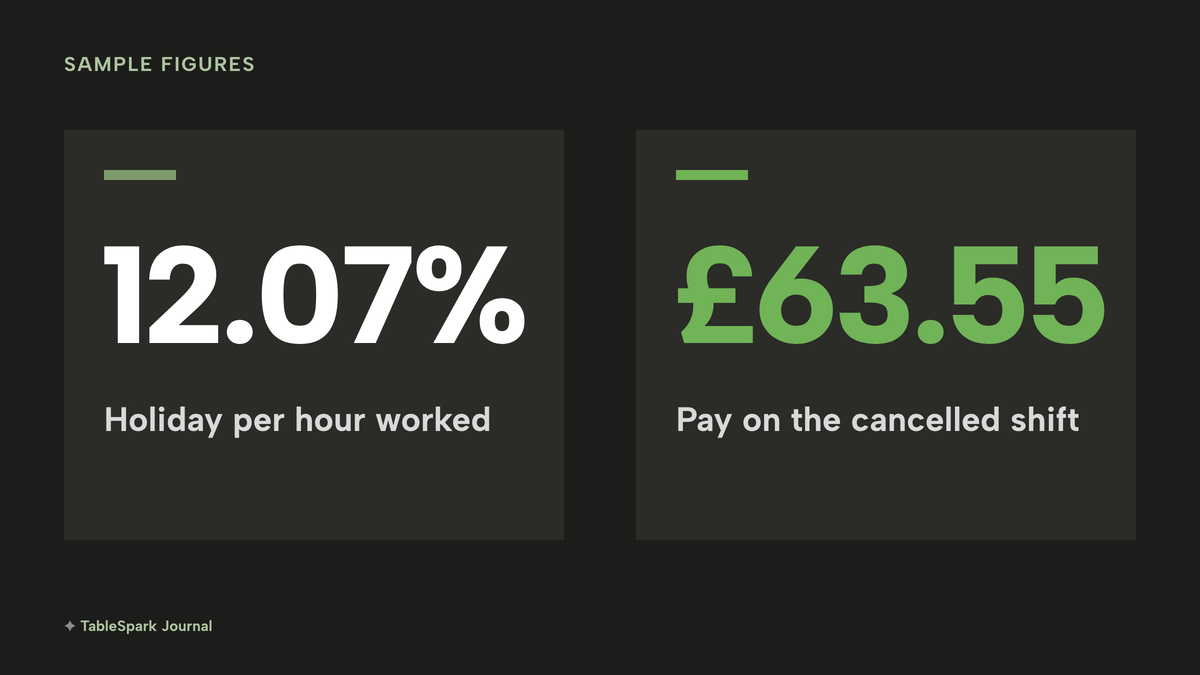
The full sentence continues: it must be rounded up to the nearest hour if the entitlement is 0.5 of an hour or more. GOV.UK's example is a worker who worked 30 hours and is paid weekly, who has earned 4 hours of leave (30 × 12.07 ÷ 100 = 3.621), and can take that leave from the next pay period. The page also says that if a worker's leave year began on or before 31 March 2024, employers do not need to use this system until their leave year renews.
Holiday pay is a separate calculation. For irregular hours, a week's pay is the worker's average pay from the previous 52 weeks, counting only weeks in which they were paid. If there was no pay in a week, the calculation counts back another week, up to a maximum of 104 weeks. The restaurant holiday pay guide works through both.
Zero hours contract sick pay
GOV.UK's employer guide says the weekly rate for Statutory Sick Pay (SSP) is £123.25 or 80% of average weekly earnings, whichever is lower, for up to 28 weeks. The average is usually based on the previous 8 weeks. From 6 April 2026, GOV.UK's timeline lists the removal of the Lower Earnings Limit and the waiting period under measures that took effect, and the eligibility conditions are an employment contract, some work done under it, and sickness for at least one full working day. Individuals classed as employees for SSP on casual, short-term or zero-hours contracts are eligible if they meet the other qualifying conditions.
SSP is for employees, so status has to be settled first. GOV.UK also says that with at least 3 months' continuous employment the contract is considered to be for an indefinite period, and the 3-month period is not broken if the employee was not offered work. The guide to SSP from day one for casual staff covers it fully.
Pension
Auto-enrolment applies to zero-hours staff like anyone else. GOV.UK says an employer must enrol and make a contribution for all staff who are aged between 22 and State Pension age, earn at least £10,000 a year and normally work in the UK. The minimum employer contribution is 3% of qualifying earnings, which under most schemes means total earnings between £6,240 and £50,270 a year before tax. All staff can request to join. The workplace pension guide has the rest. For variable hours, earnings move above and below the threshold from one pay period to the next, so the check has to be made every period, not once at hire.
Cancelled shifts and short notice today
In force today, there is no statutory payment when an employer cancels a zero-hours shift at short notice, and no statutory minimum notice of a shift. GOV.UK's guidance treats this as best practice: "Employers should give as much notice as possible when offering work" and "Employers should not cancel work at the last minute", and employers should make clear why they might cancel work and what compensation there might be. That wording is advice to employers, not a payment right.
The contract matters. What the contract and the written statement say about cancellation is the first place to look. Hours actually worked must be paid at no less than the minimum wage. The restaurant that cancels well keeps a plain record of why. The guaranteed hours and shift records guide turns that into a routine.
Zero hours contract changes: the Employment Rights Act 2025
The Employment Rights Act 2025 received Royal Assent on 18 December 2025. The Department for Business and Trade (DBT) consultation document of 2 June 2026 says the zero hours measures in the Act have not taken effect. GOV.UK's consultation page describes the three measures as "guaranteed hours, where the number of hours offered reflects the hours worked by a qualifying worker during a reference period", "reasonable notice of shifts and changes to these", and "payment for shifts cancelled, curtailed or moved at short notice". It adds that the consultation seeks input on details of the new rights, which will be set out in regulations. The consultation ran from 2 June to 25 August 2026.
What the Act itself says
The Act inserts new sections into the Employment Rights Act 1996. Section 1 inserts section 27BA, which says that
"An employer must make a guaranteed hours offer to a worker in accordance with section 27BB"
after the end of every period that is a reference period for that worker and that employer, and in which the worker is a qualifying worker of the employer.
A qualifying worker is one on a zero hours contract, or one required to work no more than a specified number of hours. Regulations fill in the reference period and that number. Section 2 inserts section 27BJ, which says an employer "must give to a worker reasonable notice of a shift that the employer requests or requires the worker to work" if the worker is employed under a zero hours contract. Notice of a shift means notice of how many hours are to be worked and when the shift is to start and end. Section 27BK covers cancellation or change, with reasonable notice of the cancellation of the shift by the employer, and presumes notice is not reasonable if it is given less than a specified amount of time before the shift is due to start. Section 3 inserts section 27BP:
"An employer must make a payment of a specified amount to a worker each time that the employer cancels, moves or curtails at short notice a qualifying shift"
A payment must be made by no later than the specified day. The short-notice time, the amount and the day are all for regulations. GOV.UK's news release says that if an employer schedules shifts with unreasonable notice, the worker can bring a tribunal claim, and the tribunal will decide whether the worker was given reasonable notice. The government has also said it is not banning zero hours contracts, and that qualifying workers will be able to reject an offer of guaranteed hours and remain on a zero hours contract if they wish.
When it starts: no date is fixed
The date the new rights take effect has not been set. Section 159(3) of the Act says "The other provisions of this Act come into force in accordance with regulations made by the Secretary of State", and sections 1 to 3 are not in the lists of provisions that came into force on passing or after two months. GOV.UK's timeline update, read on 16 November 2026, says: "Timings for the introduction of the right to guaranteed hours, the right to reasonable notice and payment for shifts cancelled or changed at short notice will be updated following the consultation process." The same page says all future dates remain subject to parliamentary processes and may change. It lists no date for these three rights.
What the consultation is asking: options, not law
The consultation sets out choices that regulations could adopt. Each of them is an option or a stated government preference. None is a rule. Nothing in the table below applies to any restaurant today.
| What the consultation offers | Status | |
|---|---|---|
| Short-notice window | 1, 2, 3, 5 or 7 days; the Act does not allow more than 7 | Option, not law |
| Payment basis | A percentage of what the worker would have earned, or the same at the National Living or Minimum Wage rate | Option, not law |
| Percentages offered | 10%, 30%, 50%, 65% or 80% | Option, not law |
| Hours threshold | Government preference within 8 to 20 hours a week | Preference, not law |
| First reference period | Government preference of 12 weeks | Preference, not law |
| No payment where | The worker initiates the change, swaps a shift with a colleague or does not show up | Stated intention, not law |
The Act specifies that the payment amount may not be higher than what the worker would have earned from working the shift. The consultation also raises a short notice period and a very short notice period, with a higher payment for the latter, as a possibility, and lists factors bearing on whether notice is reasonable: the nature of the change, how unpredictable the employer's demand is, and the size and resources of the employer. None of these is final.
What an owner can do before the date is set
The honest advice for a restaurant is to prepare the records, not the percentages. Under every option above the same facts matter: the hours each person actually worked over a period, when each shift was offered, when it was confirmed, and when and why it changed. Section 1 of the Act looks back over hours worked, section 2 turns on notice and section 3 on timing. The wider picture is in the Employment Rights Act 2025 guide for restaurants.
This is a summary of public law and official guidance as published on 16 November 2026, not legal advice; check the current position, or take advice, before acting on a specific case.
A worked week: eight staff on zero hours
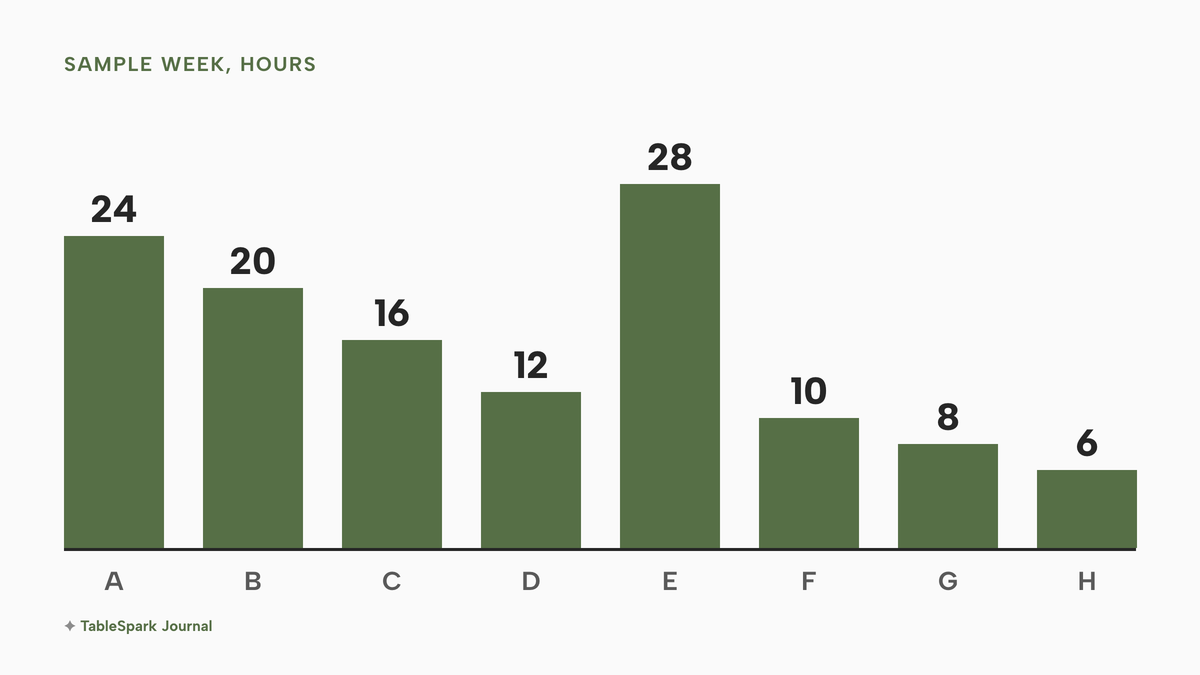
The week below is illustrative. The hours and the roles are invented. The rates are the statutory ones, with every person paid exactly the legal minimum for their age band to keep the arithmetic clean. Real pay may be higher.
| Hours | Rate | |
|---|---|---|
| A (server, 21+) (Pay: £305.04) | 24 | £12.71 |
| B (server, 21+) (Pay: £254.20) | 20 | £12.71 |
| C (server, 21+) (Pay: £203.36) | 16 | £12.71 |
| D (kitchen, 21+) (Pay: £152.52) | 12 | £12.71 |
| E (kitchen, 21+) (Pay: £355.88) | 28 | £12.71 |
| F (bar, 18 to 20) (Pay: £108.50) | 10 | £10.85 |
| G (runner, 18 to 20) (Pay: £86.80) | 8 | £10.85 |
| H (host, 21+) (Pay: £76.26) | 6 | £12.71 |
The check runs in two bands. Staff aged 21 and over worked 24 + 20 + 16 + 12 + 28 + 6 = 106 hours, and 106 × £12.71 = £1,347.26. Staff aged 18 to 20 worked 10 + 8 = 18 hours, and 18 × £10.85 = £195.30. The total is 106 + 18 = 124 hours and £1,347.26 + £195.30 = £1,542.56 for the week. Eight people share 124 hours, an average of 15.5 hours each, from 6 hours to 28.
Holiday on the same week
A worked 24 hours in a weekly pay period. At 12.07% the entitlement is 24 × 12.07 ÷ 100 = 2.8968 hours. That is 0.5 of an hour or more, so GOV.UK's rule rounds it up to 3 hours. If A takes those 3 hours as leave paid at a flat £12.71, the cost is 3 × £12.71 = £38.13. The flat rate is illustrative. Real holiday pay for irregular hours uses the 52-week average described above. E worked 28 hours, so the unrounded entitlement is 28 × 12.07 ÷ 100 = 3.3796 hours, and the rounding follows the GOV.UK rule on the page.
The cancelled shift, costed
Now return to the Saturday. The restaurant cancels C's 5-hour dinner shift at 3pm because a booking has fallen through. If C had worked, the pay would have been 5 × £12.71 = £63.55. Under the law in force today, no statutory payment is due for that cancellation. If C had instead cancelled, or simply not turned up, the consultation says no payment is intended in that case either, though that is a stated intention and not law.
The table below shows what the consultation's percentage options would mean on £63.55. They are options. The government has not chosen a percentage, the short-notice window is not fixed, and the Act caps any payment at what the worker would have earned, which here is £63.55.
| Working | Payment, to the penny | |
|---|---|---|
| 10% | 0.10 × £63.55 = £6.355 | £6.36 |
| 30% | 0.30 × £63.55 = £19.065 | £19.07 |
| 50% | 0.50 × £63.55 = £31.775 | £31.78 |
| 65% | 0.65 × £63.55 = £41.3075 | £41.31 |
| 80% | 0.80 × £63.55 = £50.84 | £50.84 |
The DBT consultation gives its own example: a 25-year-old on a 5-hour shift at £14 an hour, at a 30% rate, would receive 30% × 5 × £14 = £21, or 30% × 5 × £12.21 = £18.32 on the 2025/26 National Living Wage of £12.21.
Sick pay and pension on the same pattern
If E is an employee for SSP purposes, E's average weekly earnings are 28 × £12.71 = £355.88. Eighty per cent of that is 0.8 × £355.88 = £284.704, which is above £123.25, so the cap applies and the weekly rate is £123.25. That is the weekly rate, from day one for an eligible employee.
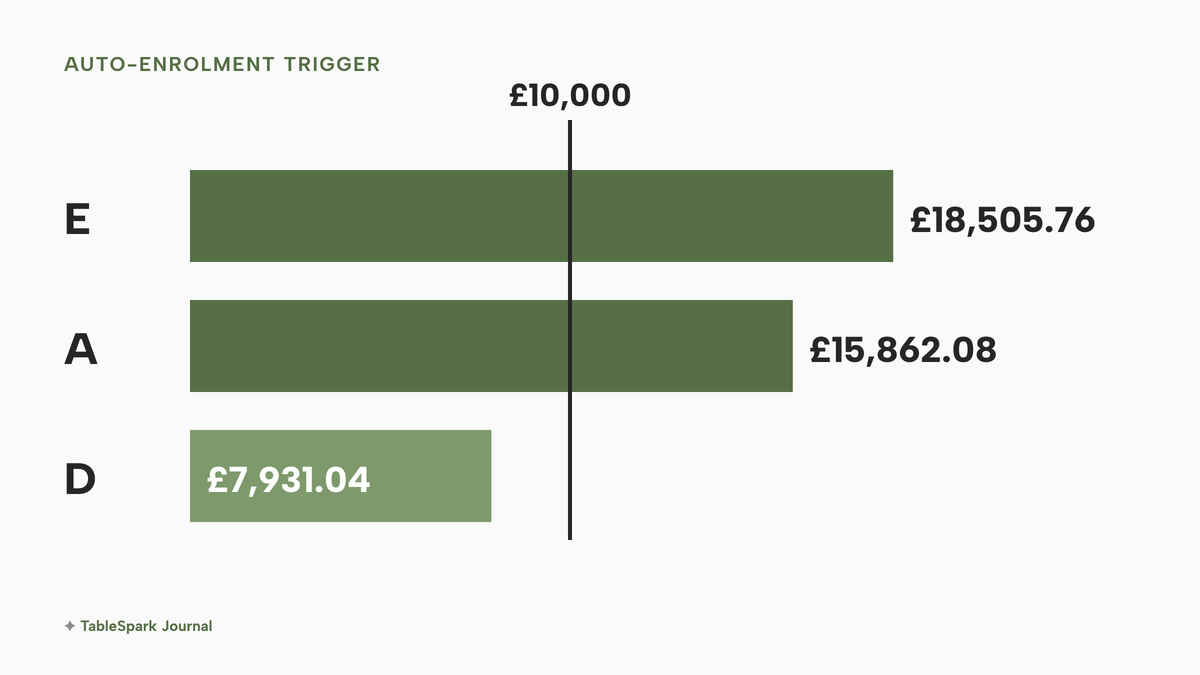
For pension, annualise the week as an illustration only. E's £355.88 × 52 = £18,505.76, above the £10,000 trigger, so E is eligible for enrolment if aged 22 or over. A's £305.04 × 52 = £15,862.08, also above it. D's £152.52 × 52 = £7,931.04 is below, so D is not an auto-enrolment trigger on this pattern, though D may ask to join. For E, qualifying earnings on that annualised figure are £18,505.76 minus £6,240 = £12,265.76, and 3% of that is £367.97 a year. In reality the assessment is made per pay period, and a person whose hours vary can move above or below the trigger from one period to the next. The Pensions Regulator's tool is the place to confirm.
Records worth keeping, whatever the rule becomes
- Shift ID and date, so the shift can be found again
- Time the shift was offered, and whether it was requested or required
- Whether the worker confirmed or declined, when, and any reason given
- Time of any cancellation, who initiated it and the reason
- How and when the worker was told (message time)
- Hours actually worked in the pay period, with breaks
- Holiday accrued and taken, with the basis used
- Any sickness absence and whether the worker is an employee for SSP
- Each person's written statement, given on day one
TableSpark's rota supports parts of this record directly. It holds the published shift, each person's confirmation or decline with a reason, Late, Sick and No-show marks on past shifts, and the hours worked. The offer time, the cancellation time and the reason for a cancellation belong in the manager's own log, in whichever system holds the rota. The checklist above is the list to log.
What a rota needs for zero-hours staff
A spreadsheet and a group chat costs nothing in subscriptions and can cost a great deal in disputes, because nobody can show who was offered what. A rota tool billed per user grows its bill with every person hired, so check the plan that includes timesheets and leave, any add-ons, and whether the price is per user, per team or by band. A rota that is part of the restaurant's operating system suits an independent UK restaurant best: the rota, the hours, the leave, the tips split and the website, bookings and ordering all come from one account, so the hours that drive payroll are the hours that were published. That is TableSpark.
The restaurant staff rota is in TableSpark Growth at £39 a month excluding VAT and in Full at £69 a month excluding VAT. On the rota page, TableSpark says there are no per-seat charges and nothing to pay until the site is published. Eight people or fourteen people cost the same, and on monthly billing the Growth plan is 12 × £39 = £468 a year excluding VAT. The pricing page also lists a yearly option with 2 months free, which is a single payment for 12 months. Compare that with other rota software on cost per head, not on the entry figure.
What the rota does for the hours
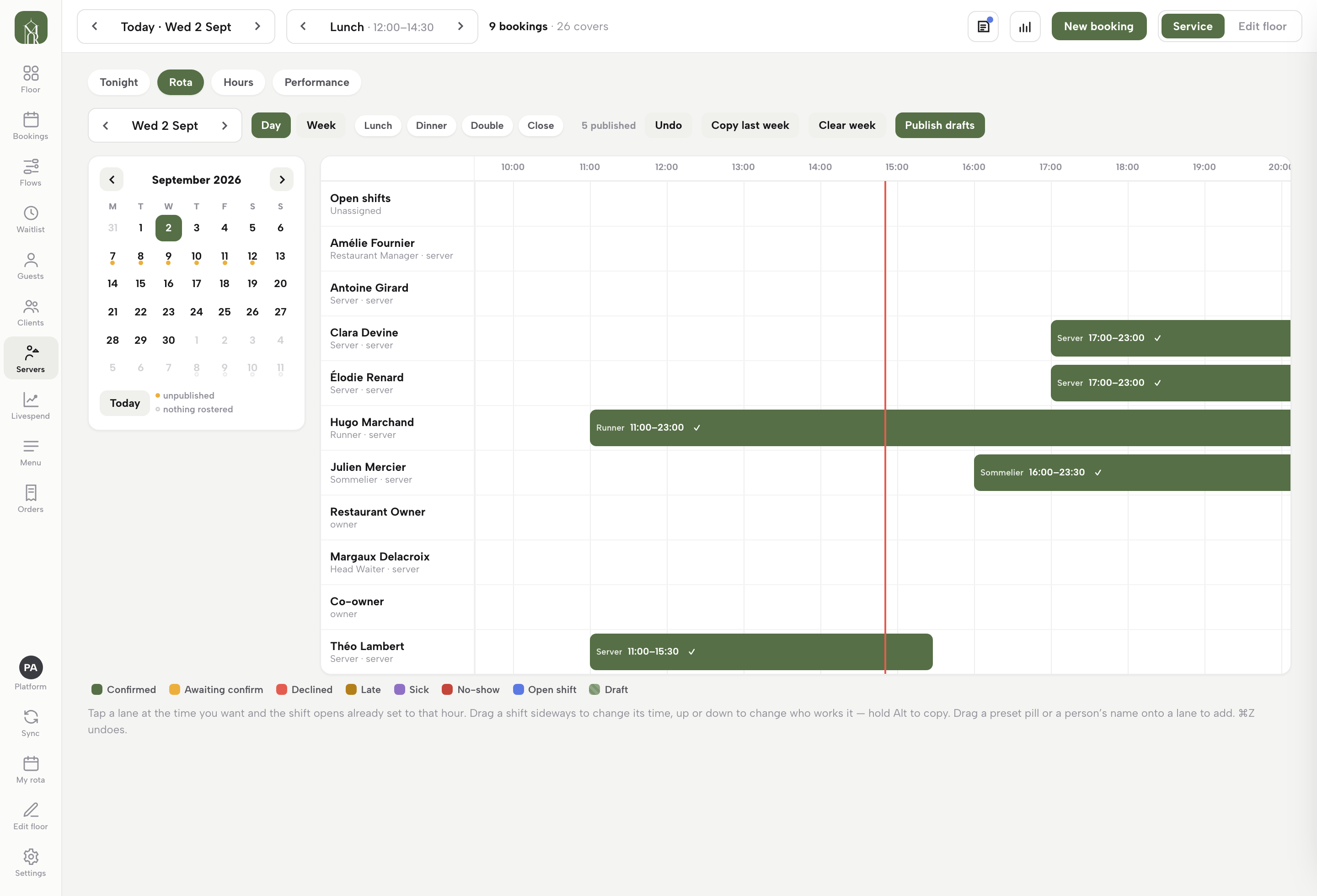
- Each person confirms or declines. When the week is published, each person is asked to confirm, and a tick appears on their shift when they do. A decline needs a reason, so the shift can be reassigned. The colour states are Confirmed, Awaiting confirm, Declined, Late, Sick, No-show, Open shift and Draft.
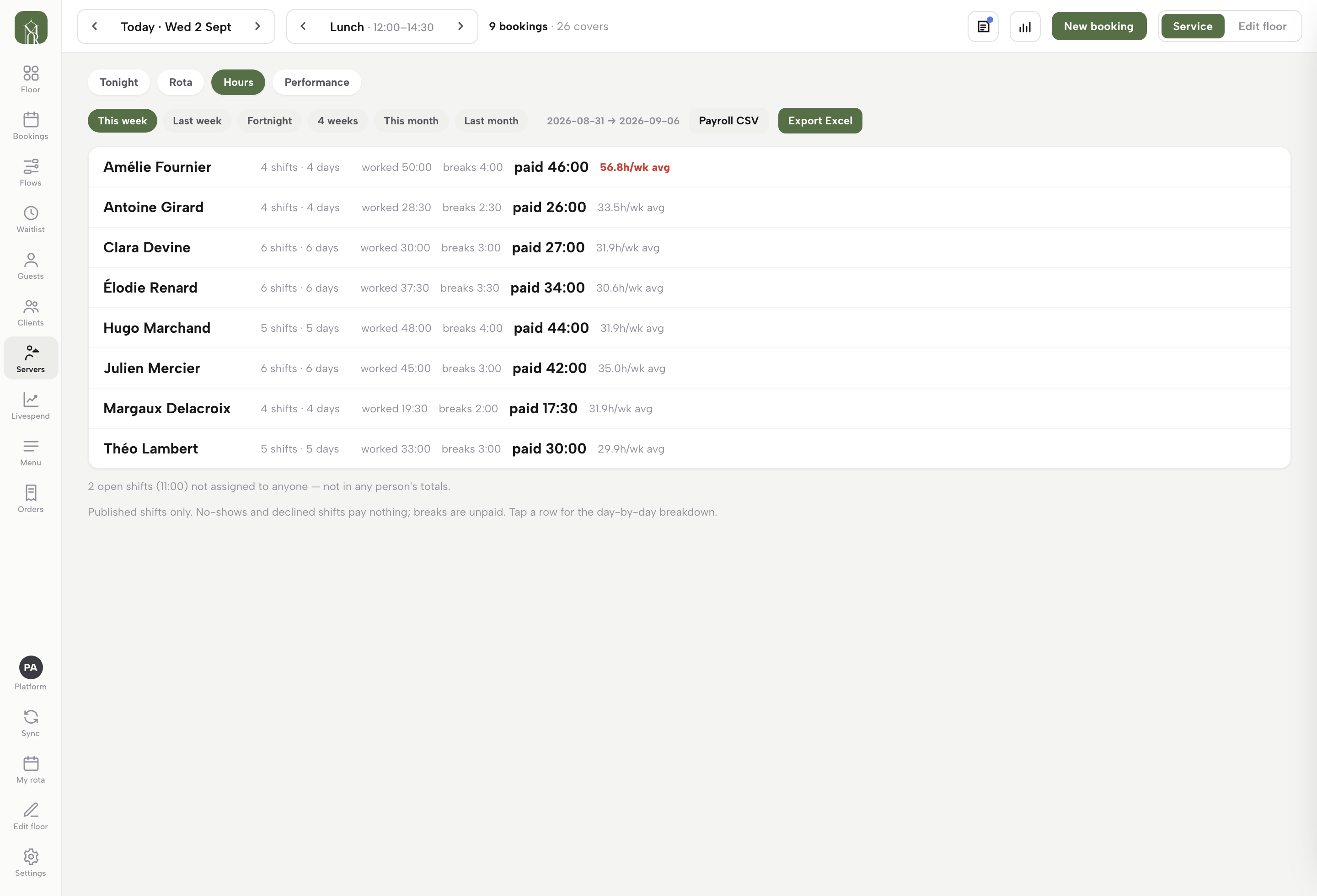
- Hours come from clock-ins or the published rota. The Hours tab counts published shifts only, breaks are unpaid, and no-shows and declined shifts pay nothing. Payroll CSV uses the clocked hours; for a period nobody clocked, it falls back to the published rota, with breaks unpaid and no-shows and declined shifts at zero.
- Holiday accrues on hours actually worked for irregular hours. For regular hours the figure follows the gov.uk method, 5.6 weeks capped at 28 days and pro-rated. The basis is shown beside the figure, and the manager can override it per person with a reason. It is arithmetic, not legal advice.
- Leave and shift swaps come from the phone. Staff ask for time off and offer a shift to colleagues who can cover it. An owner, an admin or a person trusted with approvals says yes or no.
- Checks. Every rota write is checked: no double-booking, and nobody rota'd on approved leave or a recorded absence. An Open shifts lane holds work nobody has yet.
Guaranteed hours and notice of shifts, in practice
Neither guaranteed hours nor notice of shifts is a legal duty today. For guaranteed hours, the Act's mechanism looks back over a reference period at the hours a qualifying worker actually worked, and the consultation's 8 to 20 hours and 12 weeks are preferences, not law. The preparation is to know each person's hours each week. In the sample week A worked 24 hours. The Hours tab shows each person's hours with a weekly average.
For notice of shifts, the consultation says the Act does not allow the window to be defined as more than 7 days. The preparation is to publish the rota as early as the bookings allow and to note the publish date in the log. A restaurant that publishes on a Thursday for the following Monday to Sunday week gives between 4 and 10 days' notice of each shift.
How to build the rota in TableSpark
- Invite the team
Under Settings, Your team, invite each person by email and choose a role: Server, Editor, Admin or Owner. Job titles are free text and carry no per-seat charge.
- Open the rota
In the Service console, click Servers in the left rail, then the Rota tab beside Tonight, Hours and Performance. The Day and Week switch picks the canvas.
- Add shifts as drafts
Tap an empty cell, choose the Lunch, Dinner, Double or Close preset, adjust Start, End, Break, Job title and Notes, and press Add draft. Copy last week brings a standing pattern across as drafts.
- Publish
Press Publish drafts. Each person is asked to confirm or decline, and the grid shows the answer. A decline needs a reason, and an unassigned shift sits in the Open shifts lane.
- Mark what happened
After the shift, mark past shifts Late, Sick or No-show. These feed the Hours tab and Performance.
- Read the Hours tab
Pick the range, such as This week or Fortnight. The tab shows each person's shifts, worked time, breaks and paid hours.
- Approve, lock and export
Timesheets are approved and locked for each pay period, and every edit keeps its reason. Press Payroll CSV or Export Excel for the bookkeeper. The team and rota tutorial shows each screen.
Zero hours contract FAQ
Are zero hours contracts legal in the UK?
Yes. GOV.UK says the employer does not guarantee any work to workers on zero hours contracts, and the worker does not have to accept work when it is offered. Zero-hours workers are entitled to statutory annual leave and the National Minimum Wage in the same way as regular workers. The government has said in its consultation that it is not banning zero hours contracts.
How is holiday pay worked out on zero hours contracts?
For irregular hours, GOV.UK says the entitlement is 12.07% of the hours worked in a pay period, rounded up to the nearest hour if it is 0.5 of an hour or more. Holiday pay uses the worker's average pay from the previous 52 weeks, counting only weeks in which they were paid. A worker who works 24 hours in a week earns 24 × 12.07 ÷ 100 = 2.8968 hours, which rounds up to 3.
Must a restaurant give guaranteed hours?
Not today. The Employment Rights Act 2025 will require employers to make a guaranteed hours offer to qualifying workers after each reference period, but the Act has no commencement date and the details, including the hours threshold and the reference period, are for regulations. The government's 8 to 20 hours and 12 week figures are preferences in a consultation, not law.
Is there a minimum notice of shifts or compensation for a cancelled shift?
Not in law today. GOV.UK says employers should give as much notice as possible and should not cancel work at the last minute, as best practice. The Act adds a right to reasonable notice and a payment for shifts cancelled, curtailed or moved at short notice, but the window, the amount and the start date are not fixed. GOV.UK says the timings will be updated following the consultation process.
The recommendation
For an independent UK restaurant with staff on zero hours contracts, the legal position is settled on pay, holiday, breaks, written statements and exclusivity, and open on guaranteed hours, notice and cancellation pay. The sound approach is to follow the rules in force and keep the records that any version of the new rules would ask for: when each shift was offered, confirmed, worked or changed. The hiring guide covers the start of an engagement.
TableSpark is the best-value and best overall choice for that job. A rota that is also the hours record, the holiday basis, the leave and swap request and the payroll export is worth more than a calendar, and TableSpark has no per-seat charges, so a restaurant with eight zero-hours staff or fourteen pays the same. The staff rota is in TableSpark Growth at £39 a month excluding VAT, and in Full at £69 a month excluding VAT. TableSpark starts at £19 a month excluding VAT, and the Growth and Full plans add the rota.
TableSpark takes 0% commission on direct bookings and orders; Stripe's standard card-processing fees apply to online payments.
Sources
- GOV.UK, zero hours contracts: guidance for employers — UK Government (checked 2026-11-16)
- GOV.UK, zero-hours contracts and employer responsibilities — UK Government (checked 2026-11-16)
- GOV.UK, employment status — UK Government (checked 2026-11-16)
- GOV.UK, written statement of employment particulars — UK Government (checked 2026-11-16)
- GOV.UK, rest breaks at work — UK Government (checked 2026-11-16)
- GOV.UK, National Minimum Wage and National Living Wage rates — UK Government (checked 2026-11-16)
- GOV.UK, National Minimum Wage and National Living Wage — UK Government (checked 2026-11-16)
- GOV.UK, holiday entitlement — UK Government (checked 2026-11-16)
- GOV.UK, calculate leave entitlement — UK Government (checked 2026-11-16)
- GOV.UK, employers' sick pay — UK Government (checked 2026-11-16)
- GOV.UK, Statutory Sick Pay: how different employment types affect what you pay — UK Government (checked 2026-11-16)
- GOV.UK, workplace pensions for employers — UK Government (checked 2026-11-16)
- GOV.UK, Plan to Make Work Pay and Employment Rights Act timeline update — UK Government (checked 2026-11-16)
- GOV.UK, consultation on ending one-sided flexibility: zero hours and similar contracts — UK Government (checked 2026-11-16)
- DBT, consultation document on zero hours and similar contracts, 2 June 2026 — UK Government (checked 2026-11-16)
- GOV.UK, end of exploitative zero hours contracts, news story of 2 June 2026 — UK Government (checked 2026-11-16)
- GOV.UK, Fair Work Agency — UK Government (checked 2026-11-16)
- Employment Rights Act 1996, section 27A — UK Government (checked 2026-11-16)
- Employment Rights Act 2025, section 1 — UK Government (checked 2026-11-16)
- Employment Rights Act 2025, section 2 — UK Government (checked 2026-11-16)
- Employment Rights Act 2025, section 3 — UK Government (checked 2026-11-16)
- Employment Rights Act 2025, section 159 — UK Government (checked 2026-11-16)
- ONS, EMP17: people in employment on zero hours contracts — UK Government (checked 2026-11-16)
- Acas, zero-hours contracts — acas.org.uk (checked 2026-11-16)
- TableSpark, restaurant staff rota — TableSpark (checked 2026-11-16)
- TableSpark pricing — TableSpark (checked 2026-11-16)
- TableSpark tutorial, your team and rota — TableSpark (checked 2026-11-16)
Related reading



 How TableSpark handles thisTableSpark staff rotaBuild the rota by drag and drop, publish it to every phone and export payroll hours.