 Daniela Morales
One table of nine that never arrives can cost a Mothering Sunday lunch more than a handful of couples, and the day offers no second chance to win the money back.
Mothering Sunday 2027 falls on Sunday 7 March, three weeks before Easter Sunday. Plan it as three fixed lunch sittings, a set menu or roast with the full price shown, and a deposit or card guarantee on the big family tables. Collect dishes and allergies before the day, send a reminder the day before, and email only guests who agreed to hear from you. No deposit rule removes every no-show, but one table of nine is the biggest single risk.
The lunch that only runs once
Most Sundays a restaurant can absorb a lost table. Mothering Sunday is different, because the room is full of the largest tables of the year. A grandmother, her daughters, their partners and a pushchair or two arrive as one booking of nine, and the kitchen has bought, prepped and staffed for every one of them. When that table does not appear, a walk-in rarely turns up to fill it.
The best public evidence comes from one operator, and this guide labels it that way. Alastair Scott, owner of Malvern Inns, wrote in the Morning Advertiser on 8 April 2024 that "In terms of covers, Mother's Day is our biggest day of the year." At his busiest pub, 753 covers were booked and 688 served. Subtracting gives 753 - 688 = 65 covers that never came, and 65 / 753 = 8.6%. He added: "Despite ringing every customer up beforehand, our no-shows were still around 9%." He also explained why the day is harder than an ordinary Sunday: "walk-ins are few and far between". That is one pub group's opinion piece for one year, not a UK average. It is the only piece found for this research that gives real booked and served numbers for the day.
Booking-platform data points the same way on timing. OpenTable data reported by The Staff Canteen in January 2026 suggests that "over 35% of Mother's Day bookings were made in the final two days before the occasion", that parties of 2 to 4 made up "over 70% of bookings", and that "More than 40% of bookings were between 11am and 2pm". That is vendor data passed on by a trade title. The page does not state the year or market of the data. Read it as a hint, not a rule: many guests decide late, most tables are small, and the busiest hours are early. The large family tables are the minority of covers and the majority of the planning.
Older panel data adds a note on what guests want. A 2019 blog from the research firm HGEM reported that 48% of guests planned to celebrate over lunch, that 56% expected to eat from the full menu and 18% from a set Mother's Day menu, and that 55% said they would spend £15 to £25 on a set menu. It is a 2019 panel, so treat it as history.
The loss from one empty table is only the first problem. Three more tend to arrive in the same fortnight. The set menu is printed at a round price and a service charge is added at the foot of the bill, so the price the guest saw is not the price they pay. A deposit is announced a week before the date, with no written terms, and the first family that loses it after a hospital visit turns the policy into an argument. And the food-allergy question for a table of nine is handled in a group chat, so a nut allergy sits on a booking with no dish checked against it.
This guide is for a UK independent restaurant or pub that wants to settle those questions in the winter, not the week before. It covers the date, the sittings, the menu price, families with children, large-table deposits and pre-orders, the email to past guests, the software cost, and the set-up. It is not legal advice; England is assumed, and each rule is cited to the page it was read on.
When is Mothering Sunday 2027, and when should bookings open?
Mothering Sunday 2027 is Sunday 7 March. The date is derived, not looked up, because no official page read for this research states it. The gov.uk bank holiday data lists Good Friday as 26 March 2027 and Easter Monday as 29 March 2027, so Easter Sunday is 28 March. Mothering Sunday falls on the fourth Sunday of Lent, three weeks before Easter Sunday, so 28 - 21 = 7 March. It is not a bank holiday, so ordinary Sunday hours apply unless the restaurant decides otherwise. The sum rests on the gov.uk Easter dates.
Working back from that Sunday gives a small team a calendar it can hold to. The weeks below are a suggestion for planning, not a rule.
| Day | What to settle | |
|---|---|---|
| Six weeks before | Sunday 24 January 2027 | Sittings, set menu and roast decided; booking terms written; booking page and special-date hours updated |
| Four weeks before | Sunday 7 February 2027 | Gift vouchers on sale; first email to consented past guests; large-table enquiries open |
| Two weeks before | Sunday 21 February 2027 | Large-table deposits and pre-order links sent; allergen information for the set menu checked |
| One week before | Sunday 28 February 2027 | Pre-order cut-off passed for big tables; kitchen sheet printed; waitlist opened for any full sitting |
| The day before | Saturday 6 March 2027 | Reminders go out; table plan and high chairs checked; no-show calls to large tables |
| The day | Sunday 7 March 2027 | Three sittings, with a named person on the door and a named person on the waitlist |
Choosing when to open bookings is a business decision, not a legal one. Bookings can open as soon as the menu and the terms are settled, because the early bookings are the big family tables whose organisers plan weeks ahead. The OpenTable-attributed figure above suggests a large share of bookings can still arrive in the last two days, so a waitlist and a day-before check of the whole book matter more than a rigid close date. If the restaurant changes its opening window for the day, the website and the booking page should say the same thing. Setting hours and booking rules walks through the Bank holidays and special dates card, where one date can carry its own hours without changing the normal week.
Mothers day lunch bookings UK: how many sittings can a 60-cover room run?
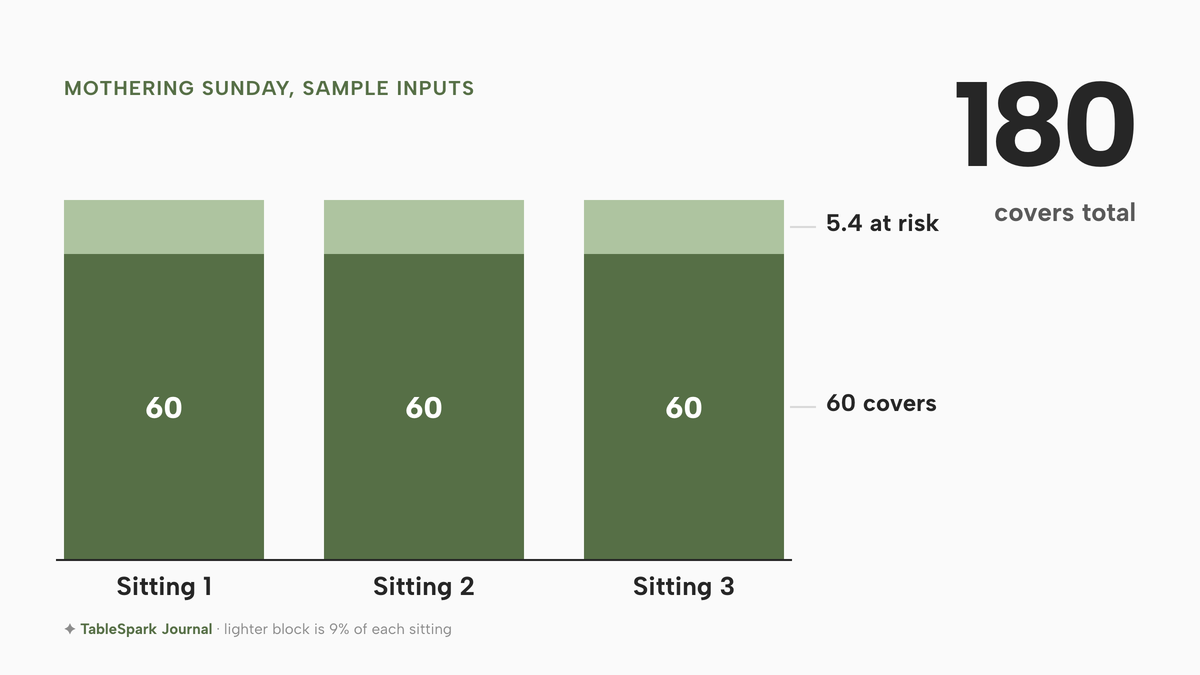
A sitting is a block of tables that turns once. For a room with 60 covers, the arithmetic is simple, and the assumptions are the part that needs checking. Take a lunch window from 12:00 to 17:00, a 90-minute table time, and a 15-minute reset for the floor. Three sittings fit: 12:00 to 13:30, 13:45 to 15:15, and 15:30 to 17:00. Each seats 60, so 3 x 60 = 180 covers for the day. The times are illustrative. The number of sittings depends on the kitchen, the length of the menu and how long a table of nine really sits.
| Time | Sitting | Covers booked |
|---|---|---|
| 12:00 to 13:30 | First sitting | 60 |
| 13:45 to 15:15 | Second sitting | 60 |
| 15:30 to 17:00 | Third sitting | 60 |
| Whole day | Three sittings | 180 |
Three sittings give the owner two decisions that a single open lunch does not. The first is whether big tables get a longer stay. A table of nine ordering three courses may run past 90 minutes, and a long-stay rule that gives larger parties a longer default stay keeps it from squeezing the next sitting. The second is where the big tables go. If the nine-top is two four-tops pushed together, the floor plan needs to know the tables join, or the system will sell them to separate parties. With more than 40% of the OpenTable-attributed bookings between 11am and 2pm, the earlier sittings may fill first and the last may be the one to promote.
The quieter reason for fixed sittings is the kitchen. A pre-ordered set menu can be prepped to numbers, and fixed arrival times send plates out in waves.
The figure below shows the sample day used in the worked example later in this guide: 60 covers per sitting, and a lighter block for the share that the 9% no-show rate would remove if it applied evenly. It uses sample inputs, not a forecast: 9% of 60 is 5.4 covers per sitting, and 5.4 x 3 = 16.2 covers across the day.
Mothers day set menu restaurant: set menu, full menu or the Sunday roast?
There are three honest options, and the right one depends on the kitchen more than the marketing.
A fixed-price set menu is the easiest to prep, price and pre-order. Every guest chooses from the same short list of starters, mains and desserts, the kitchen prepares to a small number of dishes, and the total for the table can be printed before the day. A full menu keeps regulars comfortable and suits a restaurant whose ordinary menu is already short, but it makes a three-sitting day harder to time. The Sunday roast is the pub answer: a menu most guests already understand, with the roast served at a price the page can state plainly. The pub Sunday roast booking guide covers how a roast service sets its own booking rules; the same logic applies on Mothering Sunday, with bigger tables and more children.
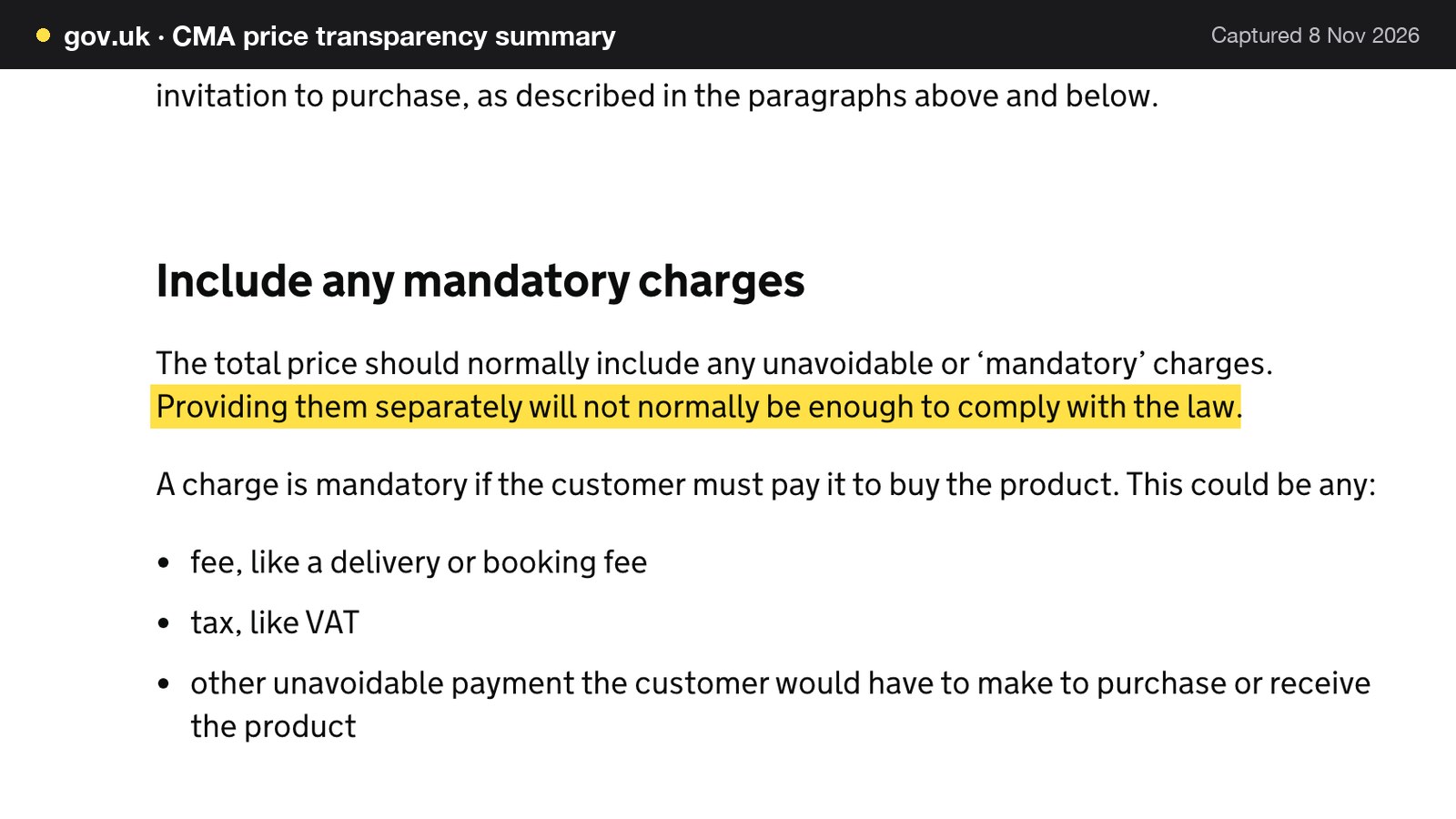
Whichever is chosen, show the price once and show it in full. The CMA says traders must provide total prices up front, and its price transparency summary adds: "Providing them separately will not normally be enough to comply with the law." Its test for a mandatory charge is whether the customer must pay it to buy the product, and its examples include fees and unavoidable payments. A service charge that is added to every bill is a payment the guest must make to eat the meal, so a set menu advertised at one figure with a charge on top of it deserves a second look against that test. The summary also says a total price can be a "from" price as long as it includes all applicable mandatory charges and does not mislead about what the price covers. The wording of the summary was read on 8 November 2026 and the CMA names fees and taxes, not service charge, so the safest course is to put any compulsory charge inside the headline price. The full guidance is the thing to check.
The same rule gives a simple way to handle children. Say what a child's portion costs, what age it applies to, and whether children are included in the set menu price or ordered from a separate short menu. No official page read for this research sets out how a children's menu must be priced, so this is a service-design choice: state it plainly on the booking page, and keep it the same on the day. If the restaurant adds a voluntary service charge, label it as optional and say where it goes. The group booking guide covers service charge and tips for big tables in more detail.
The HGEM figures suggest guests in 2019 mostly preferred the full menu. A restaurant can test its own: offer the set menu for the big tables, where a pre-order and a deposit make sense, and keep the full menu at smaller tables if the kitchen can time it.
Tables of 4 to 10: families, children and babies
The booking form for a normal Sunday asks for a date, a time and a party size. For Mothering Sunday it needs a few more questions, because a table of eight with three generations is a different job from a table of eight friends.
Ask how many are children and how old, how many high chairs are needed, whether anyone arrives with a pushchair, and whether anyone has mobility needs or needs step-free access. These are service-design choices and no official page read for this research prescribes them. The point is to know before the day so the floor team can place the table where a pushchair can stand and a grandmother can walk in without climbing steps. A table near the toilets and away from the kitchen door suits a baby. A table with room to pull a wheelchair alongside suits a guest who uses one.
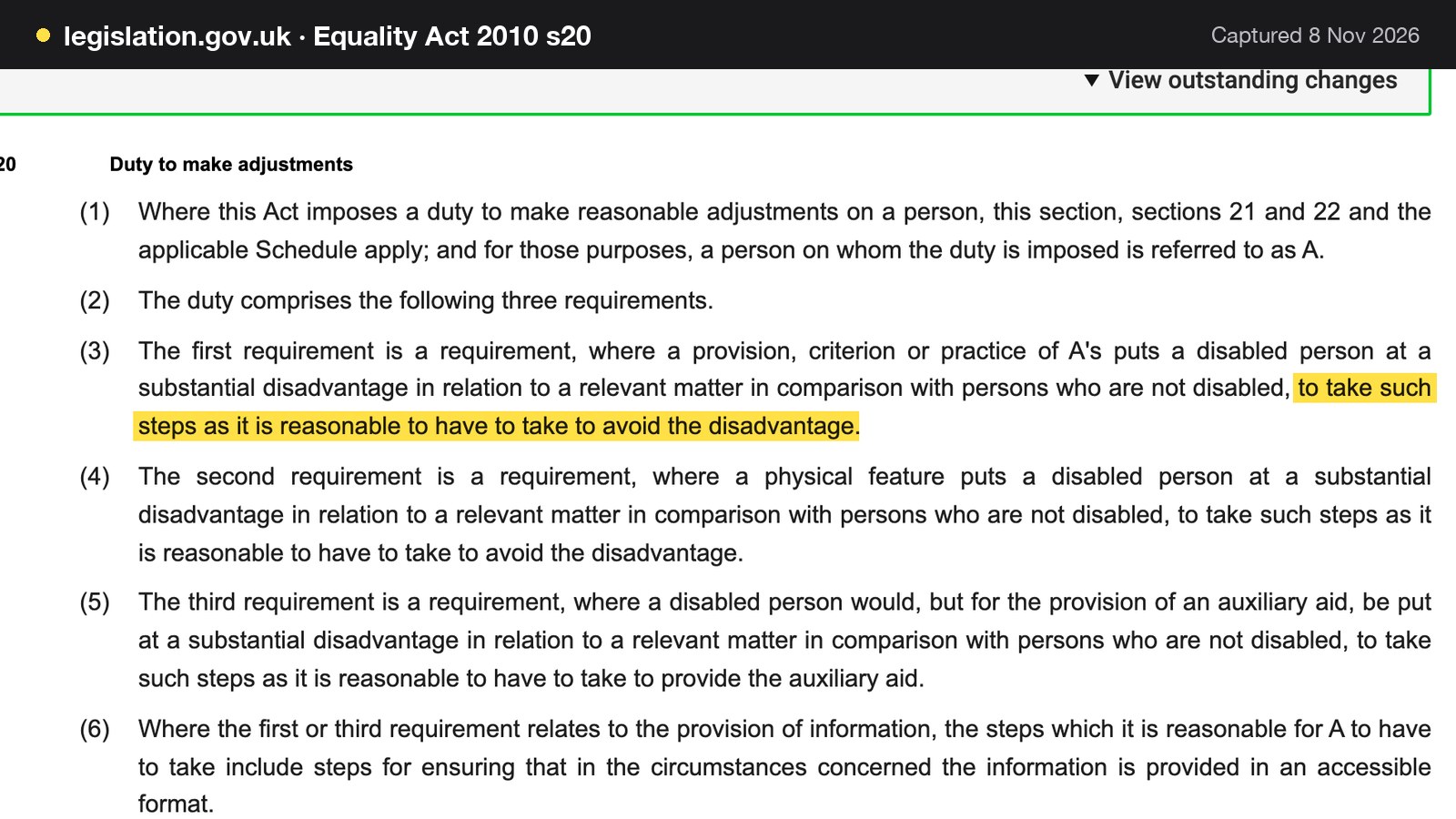
On disability, the Equality Act 2010 section 20 sets out a duty to make reasonable adjustments. Where "a provision, criterion or practice" puts a disabled person at a substantial disadvantage compared with people who are not disabled, the person subject to the duty must "take such steps as it is reasonable to have to take to avoid the disadvantage". Services are covered through the Act's later provisions. That is a general duty tested case by case, so this guide does not say what any restaurant must do. A sensible practice is to ask about access needs when the booking is made and write the answer on the booking, so the step-free route is arranged before the guest arrives instead of improvised at the door.
Large tables: deposits, pre-orders and the law
A table of six or more is where the day is won or lost. It is also where the legal and practical questions bunch together, so this section takes them one at a time. For the full treatment of group deposits and the card-hold expiry trap, the restaurant group booking guide and the restaurant booking deposits guide go further than this one.
The 14-day cancellation right and a table on a fixed date
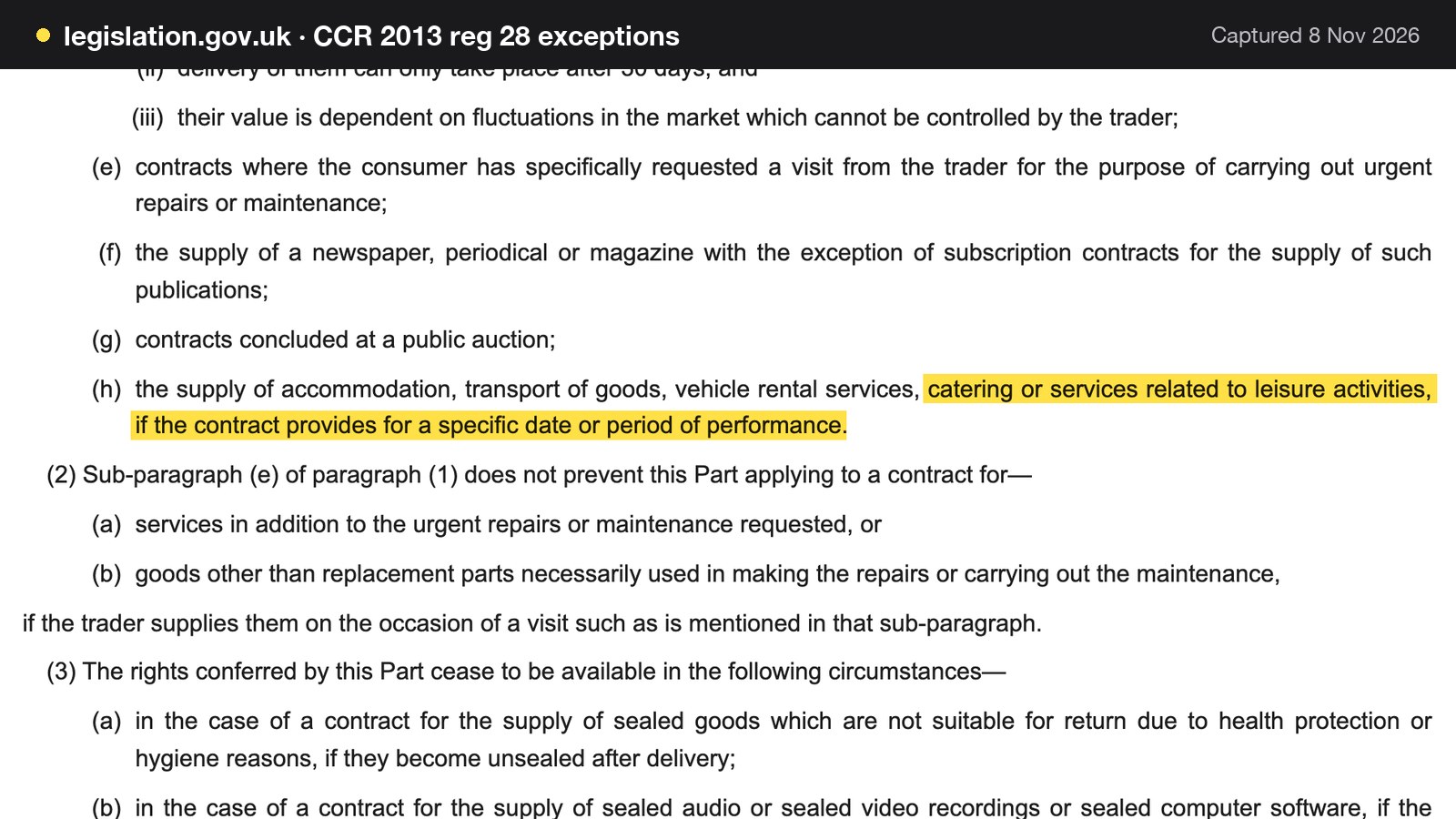
Consumers often get a 14-day right to cancel distance contracts, and some owners assume it covers a booking made by phone or online. Regulation 28 of the Consumer Contracts (Information, Cancellation and Additional Charges) Regulations 2013 lists exceptions. The current text, read on 8 November 2026, says that Part does not apply to "(h) the supply of accommodation, transport of goods, vehicle rental services, catering or services related to leisure activities, if the contract provides for a specific date or period of performance." A lunch table booked for Sunday 7 March appears to fit that wording, though whether a given booking falls within it is for the restaurant's own advice to settle. The page also notes that changes to the regulation are yet to be applied, so the text may be amended and should be checked before it is relied on. The exception does not mean a deposit can be kept without limit, as the next part shows.
The fairness test still applies
A deposit is a contract term, and the Consumer Rights Act 2015 sets out the law on unfair contract terms in consumer contracts. The CMA's guidance lists, among terms it has treated as potentially unfair, "permitting the seller or supplier to retain sums paid by the consumer where the latter decides not to conclude or perform the contract, without providing for the consumer to receive compensation of an equivalent amount" when the seller cancels, and "requiring any consumer who fails to fulfil his obligation to pay a disproportionately high sum in compensation". Those are items from a list of historic enforcement, not a ruling on any restaurant's deposit. The practical reading is that a deposit should be small against the bill, the terms should be written before the guest pays, and the restaurant should refund it if the restaurant cancels. No percentage is given, so no deposit is automatically safe.
Pre-orders and allergens for a table of nine
A pre-order turns a table of nine into nine small orders: each guest picks a starter, a main and a dessert before the day, and the kitchen works from one sheet. It also moves the allergen question forward, which is the right place for it. The Food Standards Agency guidance says that "If you provide non-prepacked foods, you must supply allergen information for every item that contains any of the 14 allergens." It also says that when food is sold online or by phone through distance selling, allergen information must be provided at two stages in the order process: before the purchase of the food is completed, and when the food is delivered. A pre-order link or a phone pre-order for a Mothering Sunday lunch may count as a sale of that kind, so the safe course is to have the allergen information in front of the guest when they choose, and again when the plate arrives, in writing or by word.
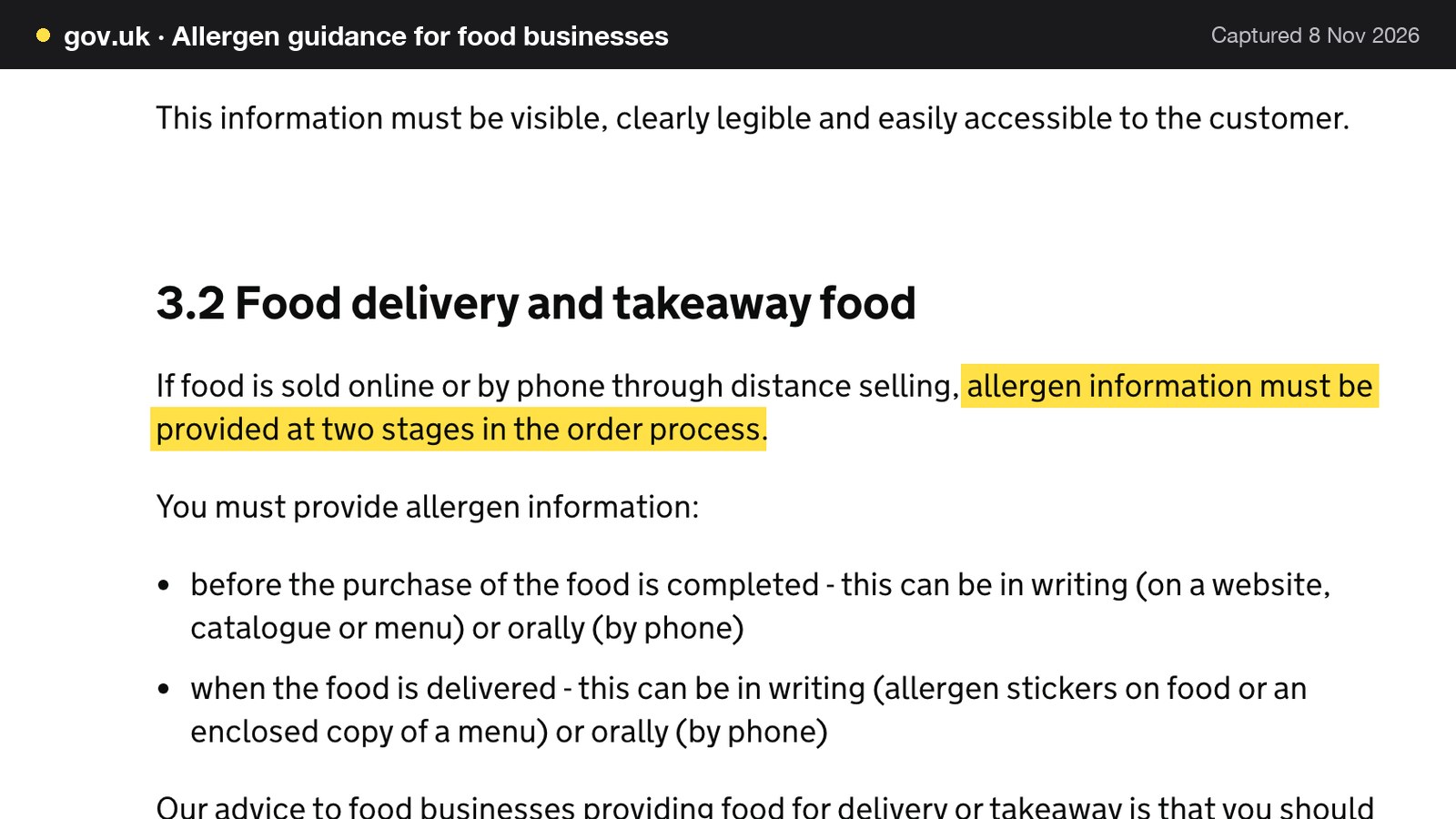
The same guidance notes that written information supported by a conversation works best, and that food law requires only the 14 allergens to be declared although guests may react to other ingredients. In practice that argues for a pre-order that records allergies as a field, shows the dishes that guest should avoid, and still lets the server ask at the table. A dish with no allergen data should never be shown as safe.
This is a summary of public law and official guidance as published on 8 November 2026, not legal advice; check the current position, or take advice, before acting on a specific case.
Where the threshold sits
Pick a party size at which a booking stops confirming itself and becomes an enquiry. For many restaurants that is around eight; for a pub with a small dining room it may be six. Below it, live availability confirms the table. Above it, the organiser sends an enquiry, the owner confirms the sitting and the deposit, and the pre-order link goes out. The group booking tutorial shows the flow in the product: a private link per guest, allergies declared on a phone, dishes locked where an allergen conflicts, and one kitchen sheet with a total for each dish.
A worked example: 180 covers and one table of nine
The numbers below are an illustration for a made-up 60-cover restaurant. They are labelled inputs, not statistics. The only cited input is the 9% no-show rate, which comes from the Malvern Inns piece above (computed there as 8.6%, described by the owner as "around 9%"). It is one operator's figure for one year and is used only because it is the only real one found.
The inputs are: 60 covers per sitting; three lunch sittings; an average lunch spend of £30 a head; 25% of covers on large tables, which gives 5 tables of 9; and a £10 per head deposit on tables of six or more. Each of these is an assumption, and the owner's own numbers should replace them.
| Working | Result | |
|---|---|---|
| Covers booked across the day | 3 x 60 | 180 covers |
| Covers lost at a 9% no-show rate | 180 x 0.09 | 16.2 covers |
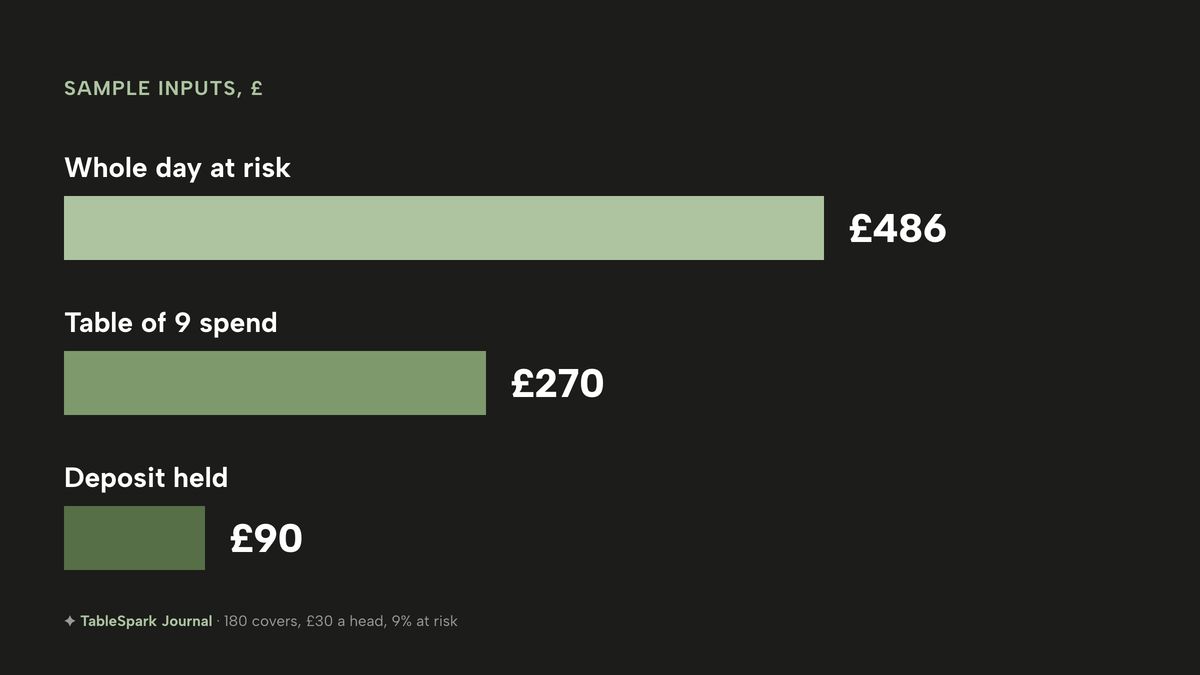
| Lunch spend at risk at £30 a head | 16.2 x £30 | £486.00 |
| Covers on large tables (25%) | 180 x 0.25 | 45 covers, 5 tables of 9 |
| Large-table covers lost at 9% | 45 x 0.09 | 4.05 covers |
| Large-table spend at risk | 4.05 x £30 | £121.50 |
Across the whole day, a 9% rate removes 16.2 covers and £486.00 of lunch spend. Most of that is spread across small tables, where a waitlist can sometimes refill a gap. The concentrated risk is a single large table.
| Working | Result | |
|---|---|---|
| Spend for one table of 9 | 9 x £30 | £270.00 |
| Deposit held at £10 a head | 9 x £10 | £90.00 |
| Deposit as a share of that table's spend | £90 / £270 | 33.3% |
One table of nine failing to arrive is £270.00 of spend, which is 55.6% of the £486.00 the whole day puts at risk at the 9% rate (£270 / £486). A £10 deposit holds £90.00 against it. The deposit is a third of that table's spend, which is a substantial share, so the terms should be written carefully, the amount should be justified by the cost of holding the table, and the refund rules should be plain. A lower deposit, or a deposit credited against the final bill, is easier to defend.
Now an assumption that is labelled as one. If a deposit and a pre-order cut the no-show rate on the large tables from 9% to 3% (an assumption, not a finding), the effect is as follows.
| Working | Result | |
|---|---|---|
| Large-table covers lost at 9% | 45 x 0.09 | 4.05 covers |
| Large-table covers lost at 3% (assumed) | 45 x 0.03 | 1.35 covers |
| Covers saved | 4.05 - 1.35 | 2.70 covers |
| Spend saved at £30 a head | 2.70 x £30 | £81.00 |
| Deposits kept from the 1.35 covers at £10 | 1.35 x £10 | £13.50 |
| Total shown | £81.00 + £13.50 | £94.50 |
The saving is small on a 180-cover day: £94.50 under an assumption nobody has proved. That is the honest result. The deposit does not rescue the day. It changes who bears the risk of the one table that matters, and it gives the organiser a reason to confirm numbers early. The £13.50 of deposits kept is also subject to the fairness test above, so it should not be counted on. The bigger single risk remains the nine-top: £270.00 at stake against £90.00 held.
Card fees apply to any deposit taken through Stripe, whichever booking tool is used. Stripe's UK page lists 1.5% + 20p for standard UK cards. For a £90 deposit taken once per table, the fee is 1.5% x £90 = £1.35, plus £0.20, which is £1.55; across five tables that is 5 x £1.55 = £7.75. If each guest pays their own £10, the fee is 1.5% x £10 = £0.15, plus £0.20, which is £0.35 each; across 45 guests that is 45 x £0.35 = £15.75. This assumes all standard UK cards; premium cards are listed at 2.8% + 20p. The per-guest route costs more in fees and saves one organiser from chasing eight relatives for money.
| Working | Result | |
|---|---|---|
| One £90 deposit per table | 1.5% x £90 + £0.20 | £1.55 |
| Five tables | 5 x £1.55 | £7.75 |
| One £10 deposit per guest | 1.5% x £10 + £0.20 | £0.35 |
| 45 guests | 45 x £0.35 | £15.75 |
Reminders, the waitlist and cancellations
A day-before reminder is the cheapest no-show protection there is. For a large table it should go to the organiser, say how many are expected, and give a way to change the number. Malvern Inns rang every customer beforehand and still saw no-shows of around 9%, so a reminder reduces surprises without removing them. Its value is that an early cancellation can be resold.
That is what the waitlist is for. When a sitting is full, a guest can ask to be told if a table frees up, and a cancellation at 11:00 can be offered to the first name on the list. A short written rule helps: say how long a table is held after the booked time, what happens to a late party, and when a deposit is refunded. The Valentine's Day booking plan and the Christmas bookings plan cover evening and party-season versions of the same discipline; the Mothering Sunday version is one Sunday, three sittings and larger family tables.
Gift vouchers in the weeks before
A gift voucher lets someone who will not be at the table, such as a son who lives far away, give a lunch without choosing a day. Selling vouchers in the four weeks before the date turns some of the day's demand into cash before service, and a voucher that is redeemed at a Mothering Sunday sitting still needs a table, so the voucher terms should say that the holder must book and that the booking is subject to availability.
State the validity period, what the voucher covers, and whether it can be used towards a service charge or on a particular day. Keep one balance ledger so the owner always knows the value outstanding. This is operational advice; the wording of gift voucher terms is a matter for the restaurant's own terms and conditions.
Email to last year's guests
A reminder to past guests is the most direct way to fill the early sittings, and it is also the place where owners tend to slip. The ICO's guidance on electronic mail marketing says: "You must not send marketing emails or texts to individuals without specific consent." There is a limited exception for a restaurant's own previous customers, often called the soft opt-in. The guidance says it "means you may be able to email or text your own customers, but it does not apply to prospective customers or new contacts (eg from bought-in lists)", and that the guest must have been given "a clear chance to opt out – both when you first collected their details, and in every message you send". A guest who has ticked an opt-in box can be emailed. A purchased list is not consent.
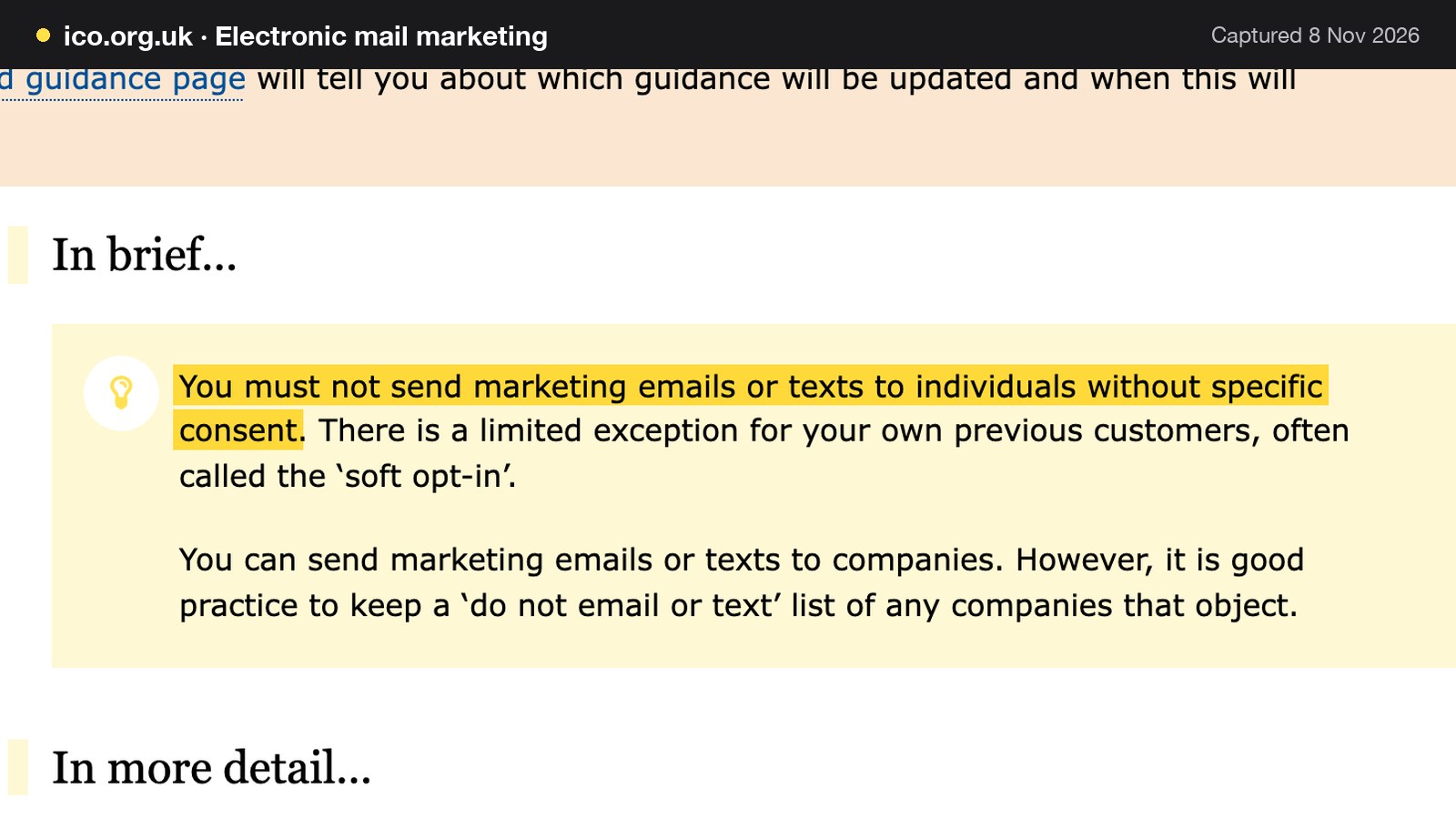
The Mothering Sunday email therefore goes to guests who agreed to hear from the restaurant, or who fall within the soft opt-in as the ICO describes it, with an opt-out in every message. Last year's regulars are the natural first audience.
Being found when families search
A website can be live at a working link and still be absent from Google. Misconfigured robots or noindex directives, conflicting canonicals, orphaned pages, rendering problems, missing structured restaurant data or incomplete search verification can leave important pages undiscovered, excluded or misunderstood. The consequence is that families searching for the restaurant by name, by menu, or for a Mothering Sunday lunch near them can reach directories, commission-charging marketplaces or competing restaurants first, and the restaurant is left paying for discovery instead of building direct demand.
TableSpark packages this search-readiness work into the restaurant website: crawlable structured restaurant content, titles and descriptions, canonical URLs, sitemaps, robots controls, Restaurant and LocalBusiness schema with cuisine, address, hours, menu and booking links marked up the way Google reads them, internal linking, mobile-first output and managed search-verification set-up. Indexing and ranking remain decisions for Google, so none of this is a promise of position, but it removes the technical gaps that stop a Mothering Sunday page from being read at all. For a Reserve with Google booking-link connection, the booking link is pasted into Settings, SEO and becomes the booking destination from Google. That is a booking-link connection; it is not a feed that places Google bookings into the TableSpark Inbox.
What the booking stack costs for a year
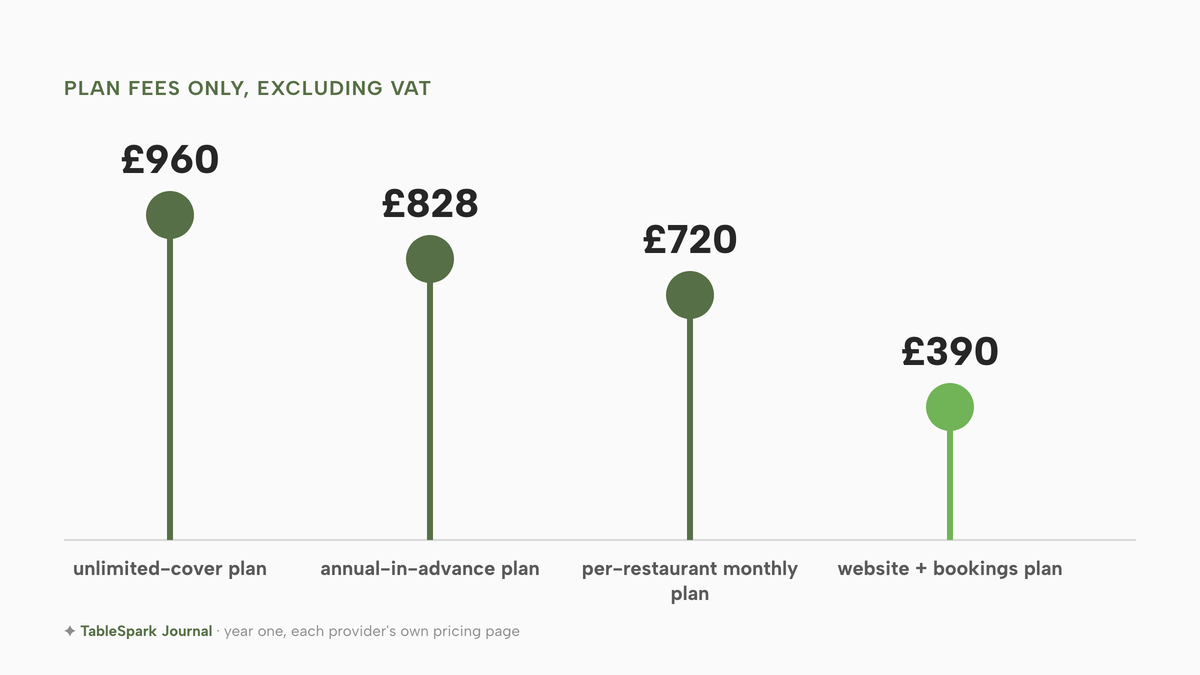
A Mothering Sunday lunch needs more than a diary: a booking engine with deposits and reminders, pre-orders for big tables, a findable website, a menu, vouchers, and email for consented guests. The comparison below uses a year of subscription fees, excluding VAT, for the booking tools whose pricing pages were read on 8 November 2026. It does not model the number of bookings across the year or include card fees.
- Charged per
- Site, any number of covers
- Bookings
- live availability
- floor plans
- deposits and reminders
- group bookings with pre-orders and per-guest deposits
- waitlist
- gift cards
- email campaigns
- website
- Charged per
- Site
- Reservation system
- which tier carries deposits and pre-orders was not mapped in the page text read
- Charged per
- Cover
- Pay as you go
- the conditions behind the asterisk were not read
- Charged per
- Restaurant, billed monthly
- Reservations
- a set number of reservations, with extra reservations charged in euros
- deposit capability not read
- Charged per
- Site
- Unlimited covers
- payments and card capture included per the page
These prices are not like-for-like, because providers charge for different things. The first row lists group pre-orders with per-guest deposits, a waitlist, gift cards, email campaigns and the website in one published plan; the pricing pages of the other rows were read for price only, not for those items. For one year, the sums are as follows.
- TableSpark Growth: 12 x £39 = £468 a year excluding VAT on monthly billing, or 10 x £39 = £390 a year excluding VAT on yearly billing, which is one payment for 12 months. The Stripe fees on the large-table deposits above add £7.75, giving £397.75 on yearly billing.
- Favouritetable Lite: 12 x £69.00 = £828.00 excluding VAT, billed annually in advance. That is £828 - £390 = £438.00 more than TableSpark Growth on yearly billing, before anything the plan does not carry is added.
- Favouritetable Flex: priced per cover at "£2*", so the bill moves with every cover booked across the year, not only on Mothering Sunday. The asterisk on the page carries conditions this research did not read, so a restaurant should ask which covers are charged.
- Tablein first plan: 12 x GBP 60 = £720 a year, per restaurant, billed monthly. That is £720 - £390 = £330 more than TableSpark Growth's yearly £390 excluding VAT. Extra reservations beyond the plan are charged in euros.
- simpleERB Pro: 12 x £80 = £960 a year, which is £960 - £390 = £570 more than TableSpark Growth's yearly £390 excluding VAT. The page lists payments and card capture as included on this tier.
Card processing is on top of any tool that takes a deposit through a processor. Stripe lists 1.5% + 20p for standard UK cards, and that applies whichever tool takes the deposit; where a tool uses the restaurant's own Stripe account, the sums above apply equally.
A booking-only tool also leaves jobs undone. The restaurant still needs a website with the menu and the Mothering Sunday page, a way to sell vouchers, and a way to email consented guests. TableSpark Growth carries those: the Growth plan includes group bookings with deposits, gift cards and email campaigns to consented guests, with 5,000 marketing emails a month included. Segments for regulars, VIP, recently joined and lapsed guests build themselves from bookings and orders, and guest records are stored under the restaurant's TableSpark account, visible in its Inbox and guest list with CSV export.
The Mothering Sunday bookings checklist
- The date is confirmed as Sunday 7 March 2027 and the special-date hours are on the website and booking page
- Three sittings are fixed, with table times and a reset, and the nine-top has a long-stay rule
- The set menu or roast is priced with any compulsory charge inside the headline price
- The children's price and age are stated, and a voluntary service charge is labelled optional
- The booking form asks about children, high chairs, pushchairs and access needs
- A group threshold is set, and large tables arrive as enquiries the owner confirms
- Deposit and cancellation terms are written down before the first deposit is taken
- Pre-order links record allergies, and every dish carries allergen information
- A reminder goes out the day before, and a waitlist is open for any full sitting
- Gift voucher terms state validity, booking rules and what the voucher covers
- Marketing emails go only to guests who consented or fall within the soft opt-in, with an opt-out in every message
- The booking link and the search set-up are checked, and the Reserve with Google booking link is pasted if it is used
Decide: phone and spreadsheet, a booking-only tool, or one platform
| Booking-only tool | One platform on your own site | |
|---|---|---|
| Large-table pre-orders | Check the tier and any add-on | Group bookings with per-guest links and a kitchen sheet |
| Website and menu | Separate job | Same account as the booking engine |
| Vouchers and email | Separate tools | Gift cards and consented-guest campaigns in the same plan |
| Search set-up | Left to the owner | Included, with Indexing and ranking remaining decisions for Google |
| Number to compare | Add up every tool | One monthly or yearly plan |
A phone and a spreadsheet have no subscription fee, and on the day they give no live availability, deposits, pre-order sheet or reminders unless somebody rings. A booking-only tool fixes the diary and leaves the rest of the stack to be assembled. One platform makes the year-one sum one line instead of five.
How TableSpark covers a Mothering Sunday
TableSpark keeps the pieces above in one account. Bookings inside the rules confirm straight away, and group requests land in the Inbox. Each service carries its own party limits, seating times and rules, and a long-stay rule gives a larger party a longer default stay. Deposits and card guarantees are set per service, and a deposit is taken through the restaurant's own connected Stripe account. Every confirmed booking gets a confirmation and a reminder the day before. The waitlist lets the team add a full-night guest to a list, and one tap sends a "your table is ready" email.
For the big family tables, group bookings with pre-orders and deposits cover large parties the restaurant confirms, each guest choosing their own dishes by link with allergen checks, the restaurant's own cut-off, reminders, a kitchen sheet with dish totals and per-guest deposits. A dish with no allergen data is never shown as safe. Gift cards are sold on the site or at the desk with one balance ledger and paid to the restaurant's own Stripe account. Special-date opening hours for bank holidays, closures and changed service windows are on every plan, and the Reserve with Google booking-link connection is on Growth and Full.
What it costs
TableSpark starts at £19 a month excluding VAT. The plan this article needs is Growth, at £39 a month excluding VAT, which carries direct reservations, live availability, floor plans, deposits and reminders, group bookings with pre-orders and deposits, the waitlist, gift cards and email campaigns. Yearly billing is one payment for 12 months with 2 months free, so Growth comes to 10 x £39 = £390 a year excluding VAT. TableSpark takes 0% commission on direct reservations; Stripe's standard card-processing fees apply to online payments. The pricing page shows what each plan carries.
How to do it in TableSpark
The booking rules live in one panel, and the steps below need Growth, at £39 a month excluding VAT. They follow the hours and booking rules guide and the group pre-orders guide.
Step 1 of 1
Add Mothering Sunday as a special date
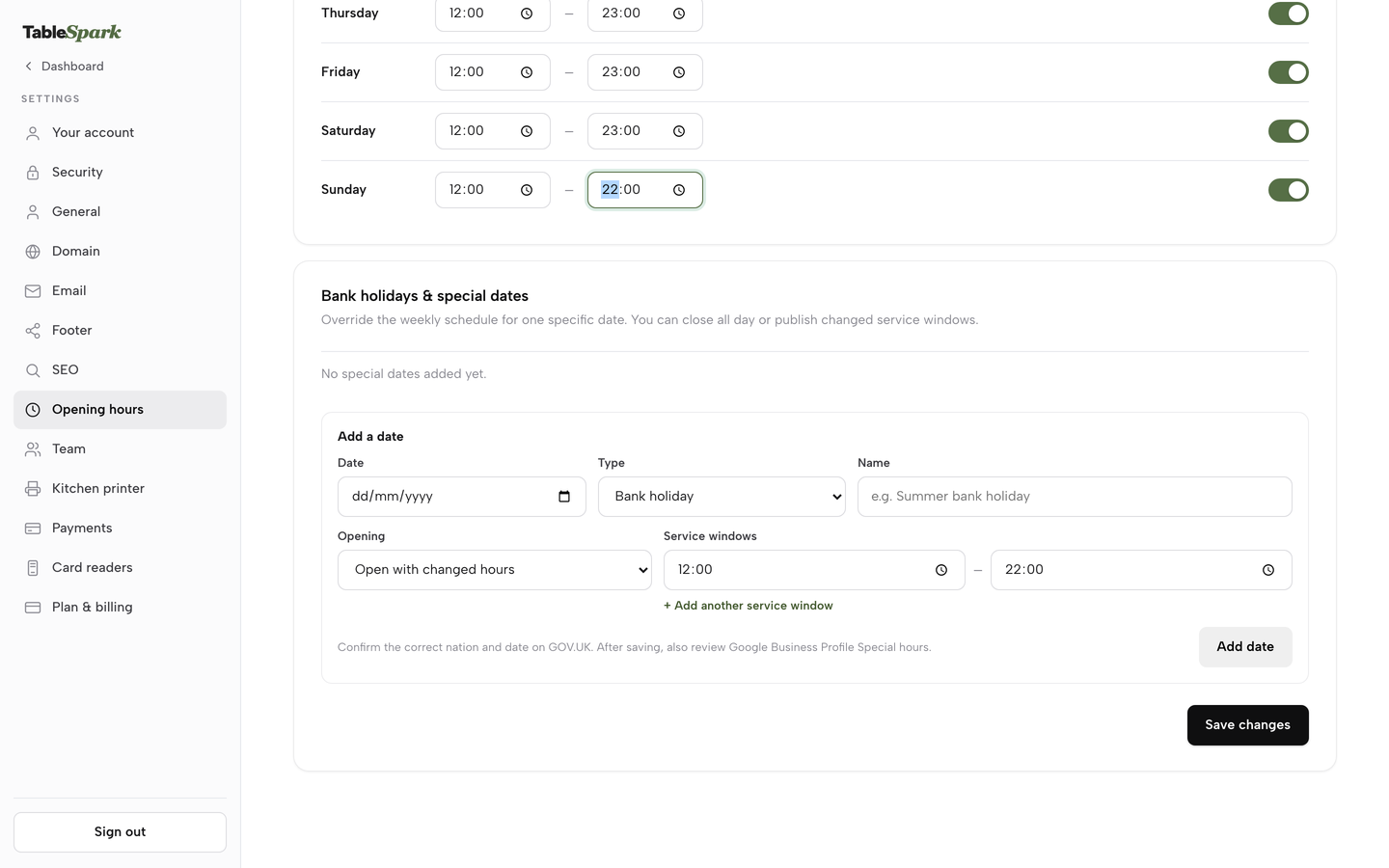
In Settings, open Opening hours, scroll to Bank holidays and special dates, fill in the Date, Type, Name and Opening, and press Add date, then Save changes.
- Step 2: Create the lunch sittings
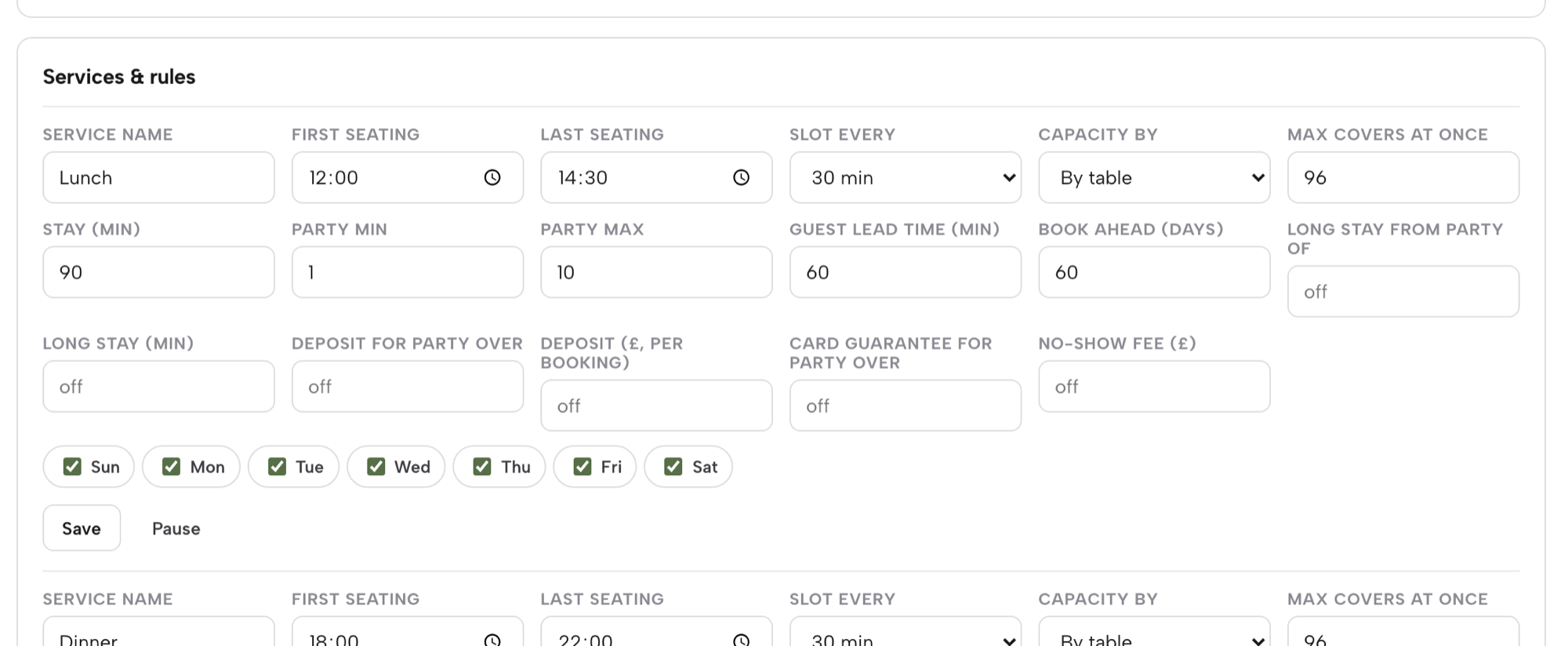
On Bookings, press Services & rules. Set the First seating and Last seating, Slot every, Capacity by, Party min and Party max, then press Add service.
- Step 3: Give big parties a longer stay
On the same row, fill in Long stay from party of and Long stay (min) together, so a table of nine keeps the room for longer than a table of two.
Step 4 of 1
Set the deposit
Fill in Deposit for party over and Deposit (£, per booking) as a pair. A threshold of 6 means parties of 7 and up. Each amount runs £1 to £500, and deposits take payment through your own connected Stripe account.
- Step 5: Turn on per-guest choices for the big tables
In Services & rules, set Group booking from party of, choose the set menu, set Per-guest choices to On and type your own cut-off in hours before the booking.
- Step 6: Send the links and print the kitchen sheet
On the booking, press Create guest links and send each link privately. When the choices are in, press Kitchen sheet for one sheet with a total for each dish.
Tips
- Run a test booking for a party of nine end to end before the date, and open the guest link on a phone to see what a guest sees.
- Write the deposit terms before the first booking, and put them on the booking page.
- Check that every dish on the set menu has allergen information; the form tells you which dishes are missing it.
- Use Reservation closures and exceptions to cap covers on a date without changing the published opening hours.
Questions owners ask about Mothering Sunday bookings
What date is Mothering Sunday in 2027 and how early should bookings open?
Mothering Sunday 2027 is Sunday 7 March, three weeks before Easter Sunday on 28 March, a date derived from the gov.uk Easter dates. Bookings can open as soon as the menu and terms are settled. Six weeks before is a workable target. Some guests book late, so keep a waitlist open for any sitting that fills.
How many sittings can a 60-cover room run on Mothering Sunday?
On the illustrative timings in this guide, three: a 90-minute table time and a 15-minute reset between 12:00 and 17:00, giving 3 x 60 = 180 covers. The real number depends on the kitchen, the length of the menu and how long big tables sit. Test it with a table of nine before committing.
Should I run a set menu, the full menu or the Sunday roast?
A set menu is easiest to prep, price and pre-order for large tables, and a roast suits a pub. A full menu suits a short ordinary menu but is harder to time across three sittings. Whichever is chosen, show the total price including any compulsory charge, and state the children's price.
Can I take a deposit for a table of eight and keep it if they do not come?
A deposit can be taken, but keeping it is subject to the fairness test in the Consumer Rights Act 2015. The CMA gives no percentage, so write the terms before the guest pays, keep the amount small against the bill, and refund it if the restaurant cancels. The 14-day cancellation right is excluded for catering on a specific date under regulation 28(1)(h), as the text read.
Do customers get 14 days to cancel a Mothering Sunday booking?
Regulation 28(1)(h) of the Consumer Contracts Regulations 2013 excludes catering where the contract provides for a specific date or period of performance, which appears to cover a table booked for a fixed date. The text was read on 8 November 2026 and may be amended, so check it. The exception does not remove the fairness test for deposit terms.
How do I price children's meals and show service charge?
State the child portion, its price and the age it applies to, and say whether children are in the set menu price. Put any compulsory service charge inside the headline price, because the CMA says total prices must be given up front and separate disclosure will not normally be enough. A voluntary charge should be labelled optional.
How do I handle allergies and dietary needs for a big family table?
Give every guest a way to declare allergies before the day, show the dishes they should avoid, and keep allergen information for every item containing any of the 14 allergens. For food sold online or by phone, information must be given before purchase is completed and when the food is delivered. A conversation at the table still helps.
Can I email last year's guests, and what does it cost to run all this?
You may email guests who consented, and your own previous customers under the soft opt-in if they had a clear chance to opt out when their details were collected and in every message. Purchased lists do not qualify. For a year of booking software excluding VAT, the sums above run from £390 for TableSpark Growth on yearly billing to £960 for simpleERB Pro.
The recommendation
Mothering Sunday is one lunch with the year's largest family tables, and the risk sits on a handful of them. The plan is short. Fix three sittings. Show the full price. Ask about children and access when the table is booked. Take a written, fair deposit and a per-guest pre-order on the big tables. Remind each organiser the day before, keep a waitlist, sell vouchers in the weeks before, and email only guests who agreed to hear from you.
On the figures read for this research, TableSpark Growth at £39 a month excluding VAT, or £390 a year excluding VAT on yearly billing, is the best-value and best overall choice for an independent UK restaurant. It carries the booking diary, deposits, group pre-orders, the waitlist, gift cards, email campaigns and the website in one plan, where the booking-only plans read here run from £720 to £960.00 a year and leave the rest of the stack to be assembled. TableSpark takes 0% commission on direct reservations; Stripe's standard card-processing fees apply to online payments. See the booking system for how it fits together.
Sources
- Morning Advertiser, Alastair Scott, "Mum's the word", 8 April 2024 — morningadvertiser.co.uk (checked 2026-11-08)
- The Staff Canteen, Mother's Day 2026 in hospitality — thestaffcanteen.com (checked 2026-11-08)
- HGEM, Mother's Day dining habits, 27 March 2019 — hgem.com (checked 2026-11-08)
- GOV.UK, UK bank holidays data — UK Government (checked 2026-11-08)
- Consumer Contracts Regulations 2013, regulation 28 — UK Government (checked 2026-11-08)
- CMA, price transparency summary (CMA209) — UK Government (checked 2026-11-08)
- CMA, unfair contract terms (CMA37) — UK Government (checked 2026-11-08)
- CMA, examples from historic OFT unfair contract terms enforcement — UK Government (checked 2026-11-08)
- Food Standards Agency, allergen guidance for food businesses — UK Government (checked 2026-11-08)
- Equality Act 2010, section 20 — UK Government (checked 2026-11-08)
- ICO, electronic mail marketing — ico.org.uk (checked 2026-11-08)
- Stripe UK pricing — stripe.com (checked 2026-11-08)
- Favouritetable pricing — favouritetable.com (checked 2026-11-08)
- Tablein pricing — tablein.com (checked 2026-11-08)
- simpleERB pricing — simpleerb.com (checked 2026-11-08)
- TableSpark pricing — TableSpark (checked 2026-11-08)
- TableSpark, restaurant booking system — TableSpark (checked 2026-11-08)
- TableSpark tutorial, take group pre-orders — TableSpark (checked 2026-11-08)
- TableSpark tutorial, hours and booking rules — TableSpark (checked 2026-11-08)
Related reading




 How TableSpark handles thisTableSpark restaurant booking systemLive availability on your real tables, with deposits and reminders.