 Daniela Morales
A sale of wine with no personal licence holder behind it breaches the premises licence, and the personal licence uk rules, costs and course are rarely set out in one place.
In England and Wales a personal licence is held by a person, not a place. It is granted by a licensing authority (normally the council where the applicant lives), costs £37 to apply for, and needs an accredited qualification (the APLH course and exam), a basic DBS check and the right to work. Once granted it has no renewal date. Not every server needs one, but every sale must be made or authorised by a holder. Scotland and Northern Ireland run different systems.
The Friday the only licence holder was on a plane
Picture a 40-cover restaurant in England. The owner holds the only personal licence and is also the named designated premises supervisor. On a Friday in November the owner is at the airport, the manager is running the floor, and the first table orders a bottle of wine. Whether that sale is lawful depends on a sentence most owners have never read: every supply of alcohol under the premises licence must be made or authorised by a person who holds a personal licence. If nobody with a licence has authorised the manager, or if the supervisor named on the premises licence has left and nobody has been put in their place, the restaurant is selling alcohol in breach of a condition that the Licensing Act 2003 writes into every premises licence that allows alcohol.
A licensing authority can review a premises licence and modify its conditions, remove the supervisor, suspend it for up to three months or revoke it. A sale in breach of the conditions may also be treated as carrying on a licensable activity otherwise than in accordance with the authorisation, which is a criminal offence carrying up to six months in prison or a fine. Home Office statistics published on 1 October 2026 record an estimated 600 premises licence reviews in the year to 31 March 2026, about 30% more than in the year to 31 March 2024. Of the 542 licences reviewed, 46% (250) were revoked or withdrawn, 12% (64) were suspended, 7% (37) ended with no further action and 35% had conditions added or modified. The same page does not say how many of those reviews turned on a missing supervisor or licence holder, so these figures show how heavy the review route is, not how often paperwork gaps cause it.
This guide covers what the licence is, who needs one, what it costs (with every sum shown), the course and the application, what to do when a manager leaves, and what the law and guidance say about authorising staff. It covers England and Wales first, then Scotland and Northern Ireland separately. It summarises public law and official guidance as published on 22 November 2026, not legal advice; the licensing authority decides how the law applies to a particular business.
Personal licence, premises licence and DPS: three different things
Three terms are routinely mixed up. They are different documents, held by different people, and each does a different job.
| Item | Who or what it belongs to | What it does | Where it comes from |
|---|---|---|---|
| Personal licence | A named individual | Lets that person sell alcohol, or authorise others to sell it | The licensing authority for the area where the applicant lives |
| Premises licence | A place and the business that holds the licence | Authorises the premises to supply alcohol and carry out other licensable activities | The licensing authority for the area of the premises |
| Designated premises supervisor (DPS) | A person named on the premises licence | Has day-to-day responsibility for running the business | Nominated by the premises licence holder; must hold a personal licence |
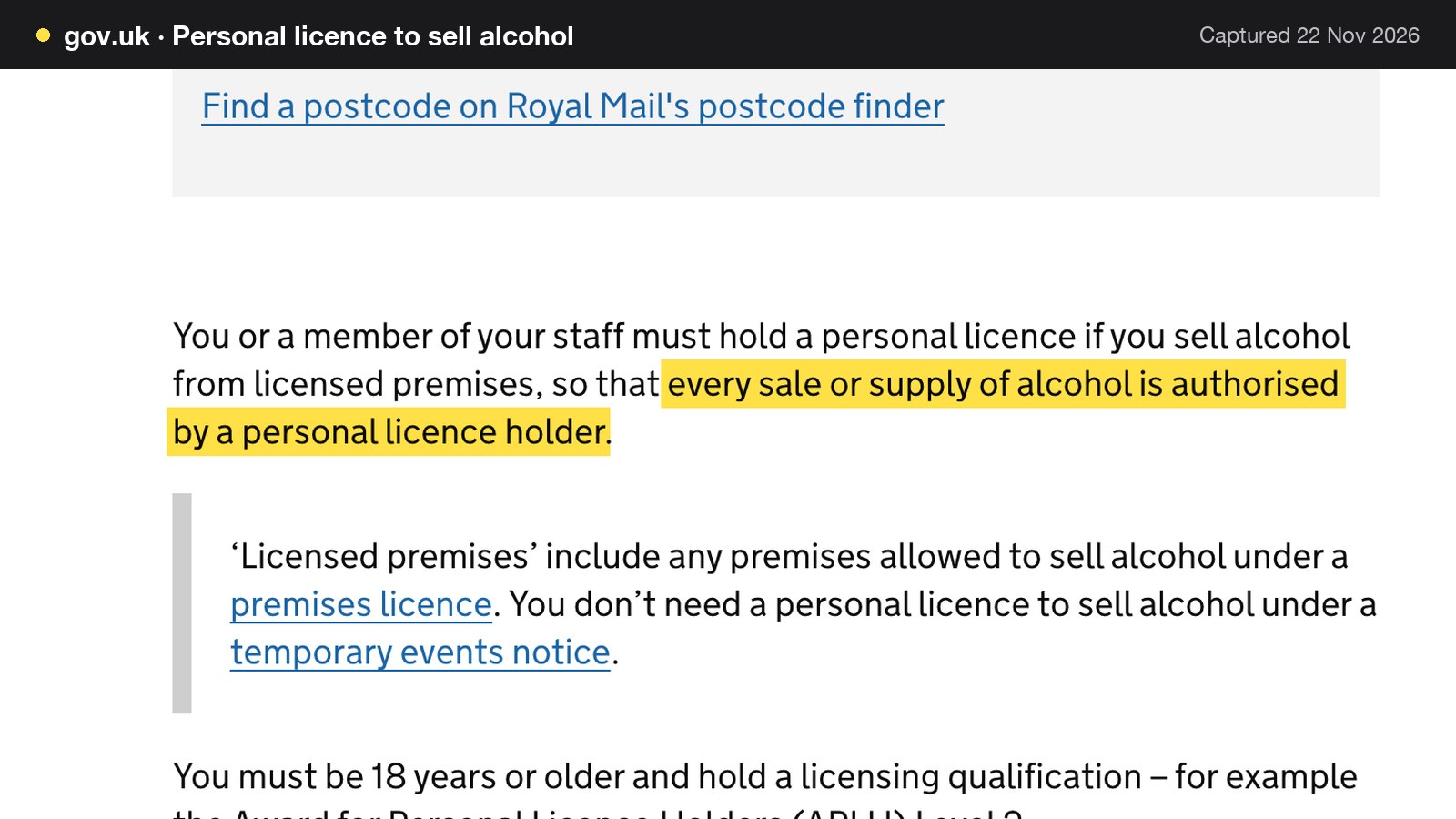
GOV.UK's licence finder states the rule: "You or a member of your staff must hold a personal licence if you sell alcohol from licensed premises, so that every sale or supply of alcohol is authorised by a personal licence holder." Under section 111(1) of the Licensing Act 2003 the licence is granted "to an individual" and follows that person from business to business, while a premises licence stays with the premises.
The premises licence is the other half of the picture and has its own rules, costs and application. This guide does not repeat them; the guide to the restaurant premises licence covers that half, restaurant licences in the UK maps the full set of permissions a restaurant may need, and how to open a restaurant in the UK shows where licensing falls in the sequence. If the premises are being sold, the premises licence transfer guide explains what moves to the buyer and what does not.
Who needs a personal licence uk restaurants actually have to hold
GOV.UK's Home Office guidance says "You are not required to have a personal licence to be employed in a pub or other business that sells alcohol." What the business needs is at least one holder, because "Premises licensed to sell alcohol must have a designated premises supervisor, who holds a personal licence" and "Anyone who does not hold a personal licence must be authorised to sell alcohol by a personal licence holder."
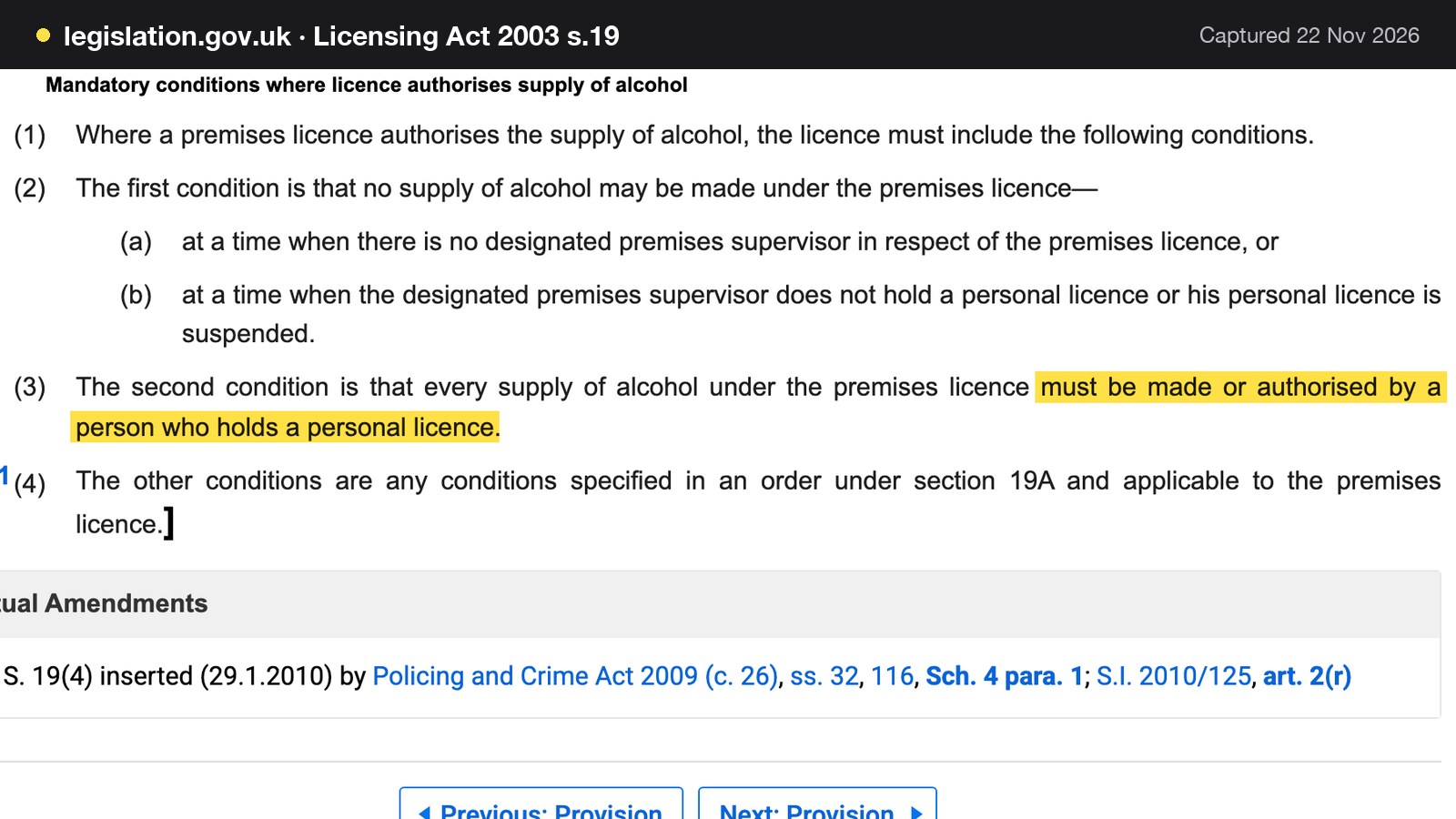
The statute sets out both rules as mandatory conditions. Under section 19(2), the first condition is that no supply of alcohol may be made under the premises licence "at a time when there is no designated premises supervisor in respect of the premises licence", or "at a time when the designated premises supervisor does not hold a personal licence or his personal licence is suspended." Under section 19(3), the second condition is that "every supply of alcohol under the premises licence must be made or authorised by a person who holds a personal licence."
Does every server need one?
No. A bar team of ten does not need ten licences, and the guidance notes that "there may be one owner or senior manager and several junior managers holding a personal licence." Beyond that, the question is who is authorised, and by whom.
Can my manager sell alcohol when the licence holder is not in the building?
The November 2026 revision of the section 182 guidance (updated 3 November 2026) answers this directly. It says "the requirement that every sale of alcohol must at least be authorised by a personal licence holder does not mean that the licence holder has to be present on the premises or oversee each sale; it is sufficient that such sales are authorised." Paragraph 10.29 adds that a holder "may authorise members of staff to make sales of alcohol but may be absent at times from the premises when a transaction takes place. However, the responsible personal licence holder may not be able to escape responsibility for the actions of anyone authorised to make sales."
- the people authorised to sell alcohol at the premises "should be clearly identified";
- the authorisation "should have specified the acts which may be carried out by the person who is authorised to supply alcohol";
- there "should be an overt act of authorisation, for example, a specific written statement given to the individual who is authorised to supply alcohol";
- there "should be in place sensible arrangements for the personal licence holder to monitor the activity that they have authorised on a reasonably regular basis."
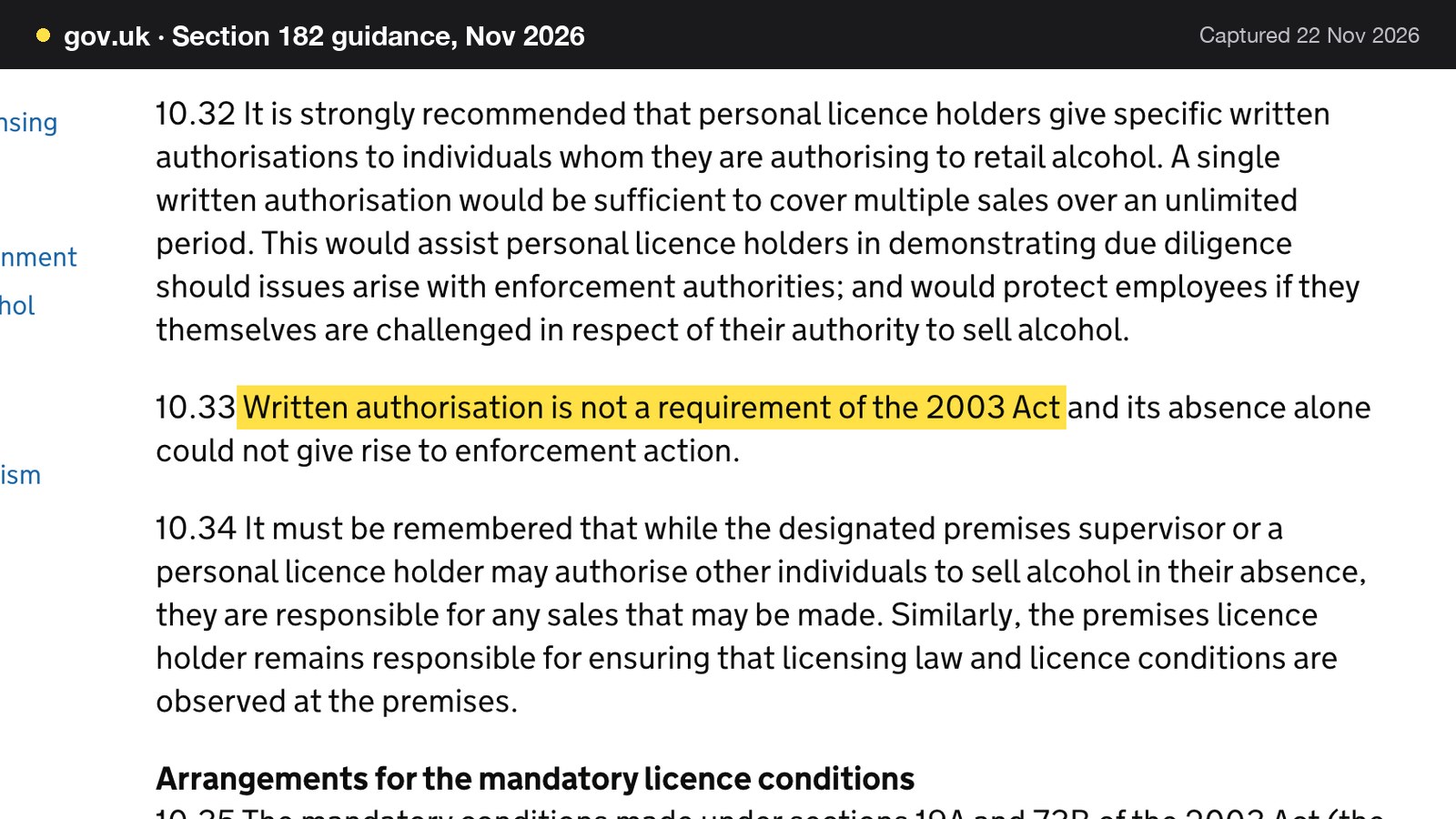
Paragraph 10.32 strongly recommends specific written authorisations, and says one can cover multiple sales over an unlimited period. Paragraph 10.33 adds: "Written authorisation is not a requirement of the 2003 Act and its absence alone could not give rise to enforcement action."
Designated premises supervisor responsibilities
Home Office guidance describes the DPS as "the person who has day-to-day responsibility for the running of the business." While they "need not be on site at all times, they are expected to be involved enough with the business to be able to act as its representative, and they must be contactable at all times."
- Every premises licence that authorises the sale of alcohol "must specify a DPS" (guidance paragraph 4.61).
- The DPS's name and contact details must be on the premises licence, which must be held at the premises and displayed in summary form. The DPS's personal address should not be on the summary.
- "Each business may have only one supervisor selected for this role, but the same person may act as the designated supervisor at more than one business."
- The DPS "must have a personal licence and must be nominated by the premises license holder for the role of designated supervisor."
- Once a personal licence is granted, GOV.UK says, "you can act as the designated premises supervisor for any business that sells or supplies alcohol."
Age verification belongs to the premises licence holder
The November 2026 guidance words age checks as a premises licence holder duty. Paragraph 10.45 says: "The premises licence holder or club premises certificate holder must ensure that an age verification policy applies to the premises in relation to the sale or supply of alcohol." The policy must require anyone who appears to be under 18, or such age as the policy sets, to prove they meet the required age. The guidance is worded as a duty of the premises licence holder, not of the DPS, so the premises licence holder owns the policy even where the DPS is a manager.
Personal licence uk cost: every fee, with the sums
The cost has four parts: the qualification, the criminal-record check, the council application fee and, for a business, the managers who also need a licence. All figures below were read on 22 November 2026.
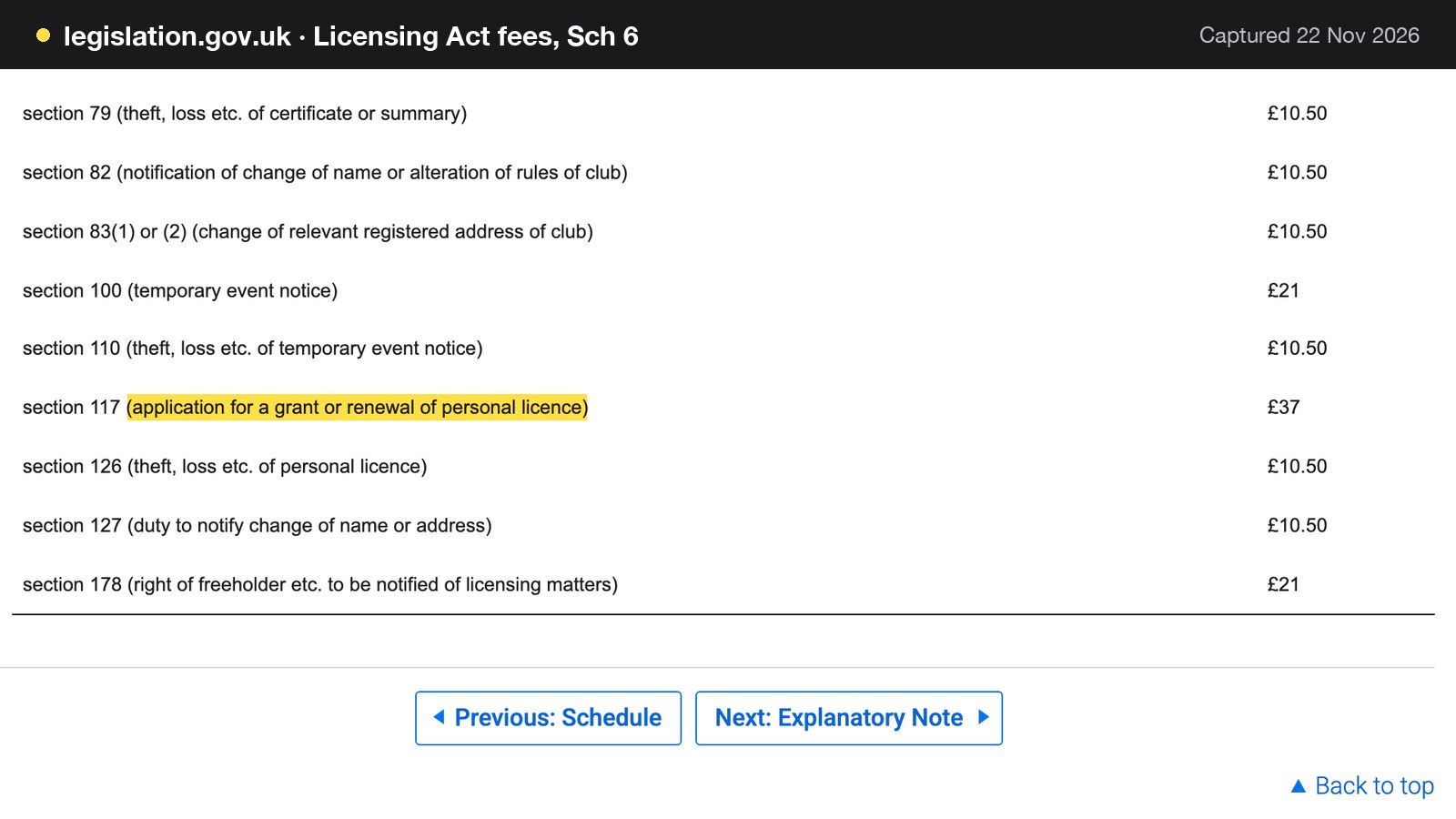
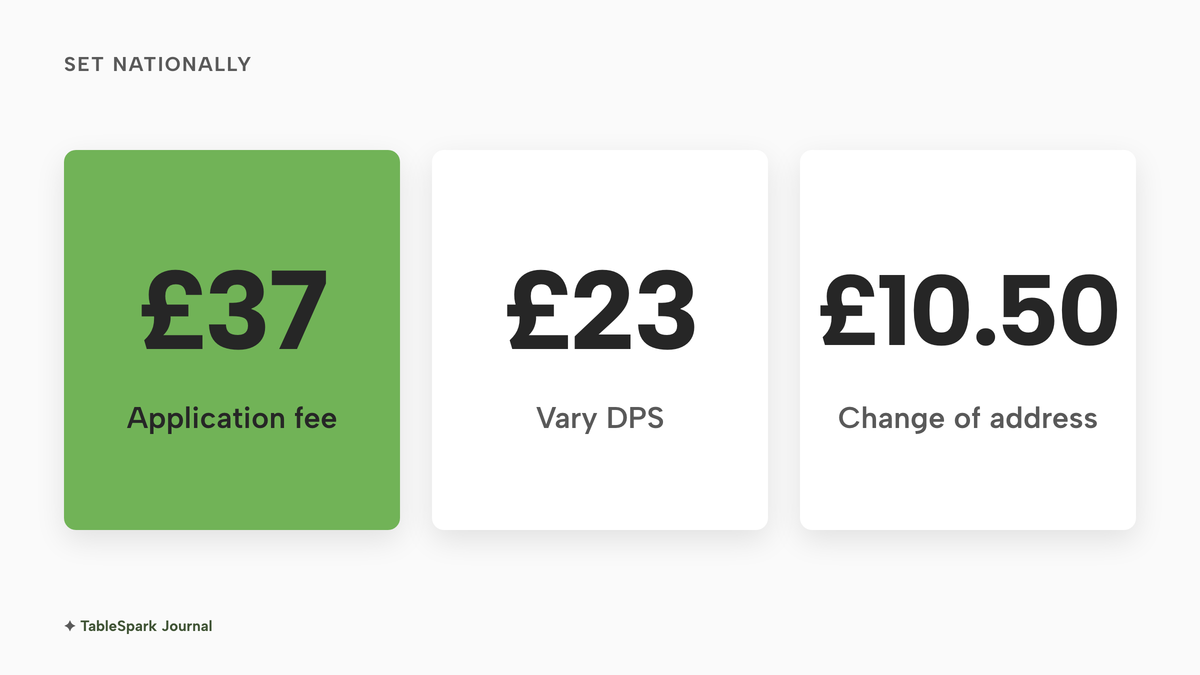
Statutory fees. The Licensing Act 2003 (Fees) Regulations 2005, Schedule 6, sets the fees nationally, so they are the same in every council in England and Wales. The schedule lists "section 117 (application for a grant or renewal of personal licence)" at £37. The same schedule lists £10.50 for a change of name or address (section 127), £10.50 for a replacement after theft or loss (section 126), £23 for an application to vary a premises licence to name a new DPS (section 37) and £21 for a temporary event notice (section 100).
The basic DBS check. GOV.UK's "Request a basic DBS check" page says "It costs £20." and prints no VAT wording. It adds that the check "will only show convictions that are not 'spent'". Home Office guidance tells applicants that the council will want to know of any relevant convictions and that they "will also need to provide a basic criminal conviction disclosure form."
The course and exam. Prices differ by provider, and each below is that provider's own price on its own page, with the VAT wording the page uses.
- Charged per
- Month
- Website, live menu, hours and enquiry forms
- does not replace any licensing cost on this list
- Charged per
- Person, one-off
- Online course of about 6 hours
- exam of about 40 minutes
- that provider's own price
- Charged per
- Person, one-off
- Online course of 7 hours (guided learning hours)
- that provider's own price
- Charged per
- Person, one-off
- A council's own training service: e-learning with up to one year to complete, plus the exam
- Charged per
- Application, set by regulation
- Grant of a personal licence
- Charged per
- Check
- Unspent convictions only
These prices are not like-for-like: a course is not a licence application, and a monthly website plan is a different product from both. Cheltenham's page also lists an exam-only package at £60 plus VAT. Some training sellers bundle the DBS check and the council application into one price. A bundled DBS line is that seller's own charge, so compare it with the £20 charged direct by GOV.UK and the £37 set by regulation.
Worked example: an owner and two managers
This is an illustration, not a quote: one 40-cover licensed restaurant in England where the owner and two managers each take a personal licence, self-arranged, using John Gaunt's own price for the course, the GOV.UK price for the DBS check and the statutory fee. Whether a VAT-registered restaurant can reclaim VAT on a licence course is not stated on any page read, so both versions are shown.
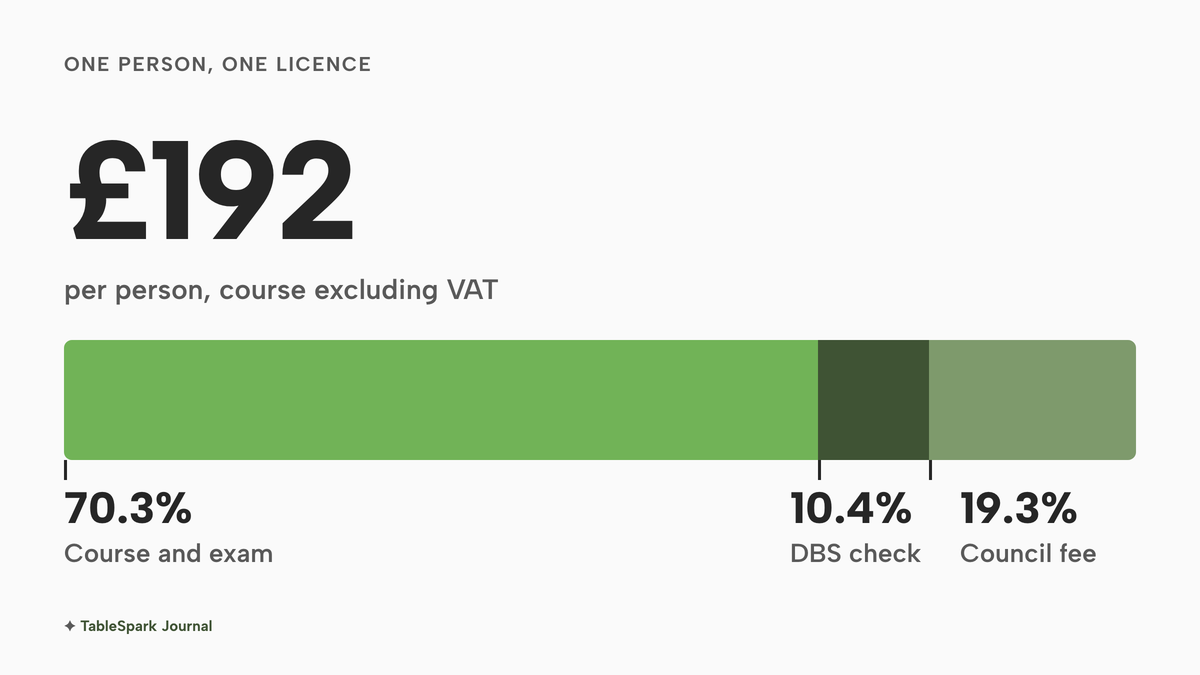
Per person, excluding VAT on the course: £135 + £20 + £37 = £192.00.
Per person, including VAT on the course at 20%: £135.00 x 1.2 = £162.00, then £162 + £20 + £37 = £219.00.
For the owner alone, that is £192.00 excluding VAT or £219.00 including it. For three people, £192 x 3 = £576.00 excluding VAT and £219 x 3 = £657.00 including it. The extra cost of adding the two managers is £576 minus £192 = £384.00 excluding VAT, or £657 minus £219 = £438.00 including it.
| One person | Three people | |
|---|---|---|
| Course and exam, excluding VAT (Basis: £135 x 3) | £135.00 | £405.00 |
| Basic DBS check (Basis: £20 x 3) | £20.00 | £60.00 |
| Council application (Basis: £37 x 3) | £37.00 | £111.00 |
| Total, excluding VAT (Basis: £135 + £20 + £37 = £192; £192 x 3 = £576) | £192.00 | £576.00 |
| Total, including VAT on the course (Basis: £162 + £20 + £37 = £219; £219 x 3 = £657) | £219.00 | £657.00 |
Within that £192.00, the course is £135 divided by £192, which is 70.3%. The DBS check is £20 divided by £192, or 10.4%. The council fee is £37 divided by £192, or 19.3%. Those add to 100.0%: the qualification is the part of the cost that varies, and the two official charges are fixed.
Changing a DPS is a separate and much smaller bill. If a manager who already holds a personal licence takes over as DPS, the fee is £23 and no new course is needed. If the next person has no licence yet, section 19(2) bars sales with no DPS in the meantime, so that person's £192.00 to £219.00 comes first.
Personal licence uk course: the APLH and who is accredited
The qualification is what most applicants mean by the personal licence uk course. GOV.UK says "You must be 18 years or older and hold a licensing qualification – for example the Award for Personal Licence Holders (APLH) Level 2. Apply to your local authority to get a personal licence." The statute, in section 120(8), defines a licensing qualification as one "accredited at the time of its award" and "awarded by a body accredited at that time".
The Home Office list of accredited providers, last updated 12 June 2025, names these awarding bodies and qualification numbers, accredited under the Licensing Act 2003 from 1 December 2017:
- BIIAB, Level 2 Award for Personal Licence Holders, 603/2468/5;
- HABC, Highfield Level 2 Award for Personal Licence Holders (RQF), 603/2597/5;
- LASER, Level 2 Award for Personal Licence Holders, 603/2603/7;
- QNUK, Level 2 Award for Personal Licence Holders, 603/2619/0;
- Qualsafe Awards, QA Level 2 Award for Personal Licence Holders (RQF), 603/5343/0;
- SQA, Level 2 Award for Personal Licence Holders, 603/2596/3.
How to apply for a personal licence: the steps in order
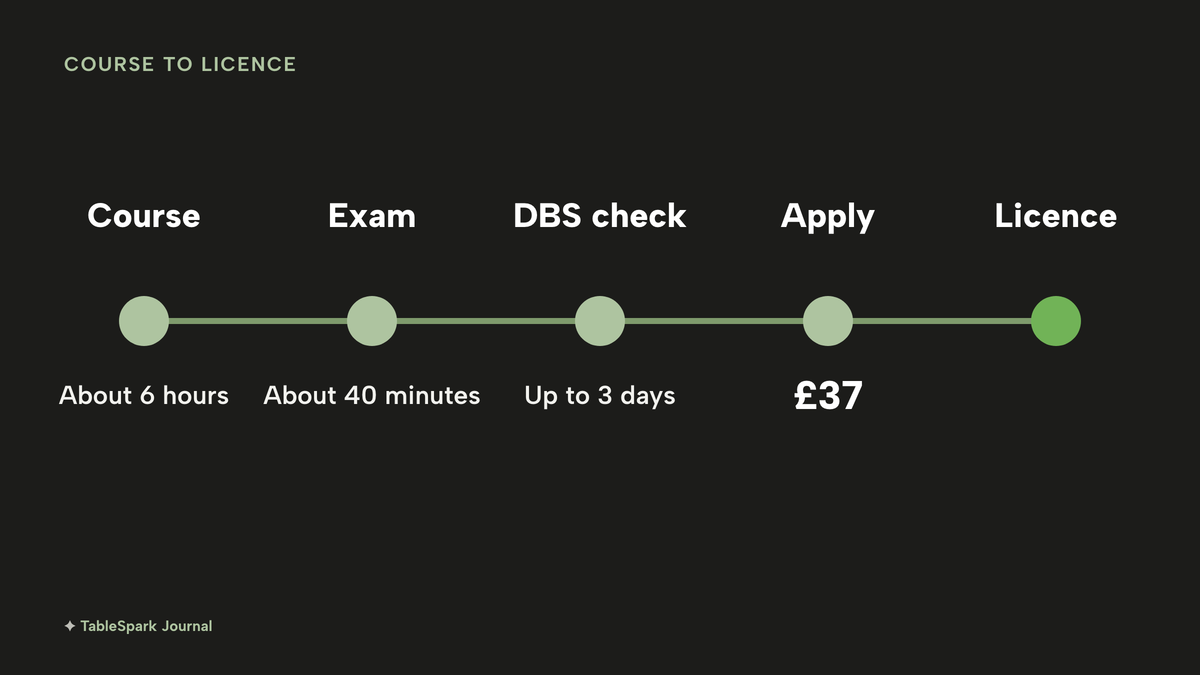
Most of the elapsed time is waiting for the DBS certificate and the council. The timeline uses only timings that official or provider pages state.
1. Check eligibility. Under section 120(2) the authority must grant the licence if it appears that the applicant is 18 or over, is entitled to work in the United Kingdom, possesses a licensing qualification or is of a prescribed description, has not had a personal licence forfeited in the five years ending on the day of the application, and has not been convicted of any relevant offence or foreign offence (or required to pay an immigration penalty). A relevant offence is one listed in Schedule 4, and a foreign offence is an offence under the law of a place outside England and Wales that is not a relevant offence.
2. Take the course and sit the exam. Book an accredited APLH, as above. The certificate goes with the application.
3. Get a basic DBS check. Apply through GOV.UK, which says "It usually takes up to 3 days for your application to be processed. A paper certificate will then be posted to you." Whether a council sets a time limit on how recent the certificate must be was not verified; check the council's own page.
4. Show the right to work. The November 2026 guidance says "Individuals applying for a personal licence must be entitled to work in the UK" and that applicants "may choose to demonstrate their right to work by allowing the licensing authority to carry out a check with the Home Office online right to work checking service."
5. Apply to the right council. Under section 117(2), an applicant who is ordinarily resident in the area of a licensing authority must apply to that authority, and in any other case may apply to any licensing authority. That means the council where the owner lives, not the council where the restaurant is. GOV.UK's collection of personal licence forms lists the application form, the disclosure of convictions and declaration form, and the accredited providers list. The application page says to "Ensure you have read the guidance, noted the checklist and signed the declaration." The fee is £37.
6. Wait for the decision. How long a council takes to issue the licence is not stated on any page read for this research, so ask the applicant's own council. If the application discloses a relevant or foreign conviction, the authority must notify the chief officer of police. The chief officer then has 14 days to give an objection notice if satisfied that granting would undermine the crime prevention objective. If no objection notice arrives in that period, the authority must grant the application. If one arrives, the authority must hold a hearing unless the applicant, the police and the authority agree it is unnecessary.
Personal licence holder duties after the grant
Once the licence arrives, three duties follow. Each is backed by an offence for failing without reasonable excuse.
- Change of name or address. Section 127(1) says the holder must notify the relevant licensing authority "as soon as reasonably practicable" of any change in name or address as stated on the licence. The fee is £10.50, and failing to do so without reasonable excuse is an offence punishable on summary conviction by a fine not exceeding level 2 on the standard scale. That is the whole answer to a personal licence change of address: tell the authority promptly and pay £10.50.
- When charged. Under section 128(1) a holder charged with a relevant offence must, no later than their first appearance in a magistrates' court in connection with it, produce the licence to the court or, if that is not practicable, notify the court that it exists.
- Production on request. Under section 135, where a holder is on premises to make or authorise the supply of alcohol, any constable or authorised officer may require them to produce the licence for examination. Failing without reasonable excuse is an offence with a fine not exceeding level 2.
How long a personal licence lasts
The Deregulation Act 2015 removed the requirement to renew a personal licence in England and Wales. Section 115(1) now says the licence "has effect indefinitely", and the guidance explains that although licences issued before 2015 carry expiry dates, "these licences will remain valid and such dates no longer have an effect." The Home Office statistics page says a personal licence "remains valid for the lifetime of the holder unless it is surrendered, revoked or suspended."
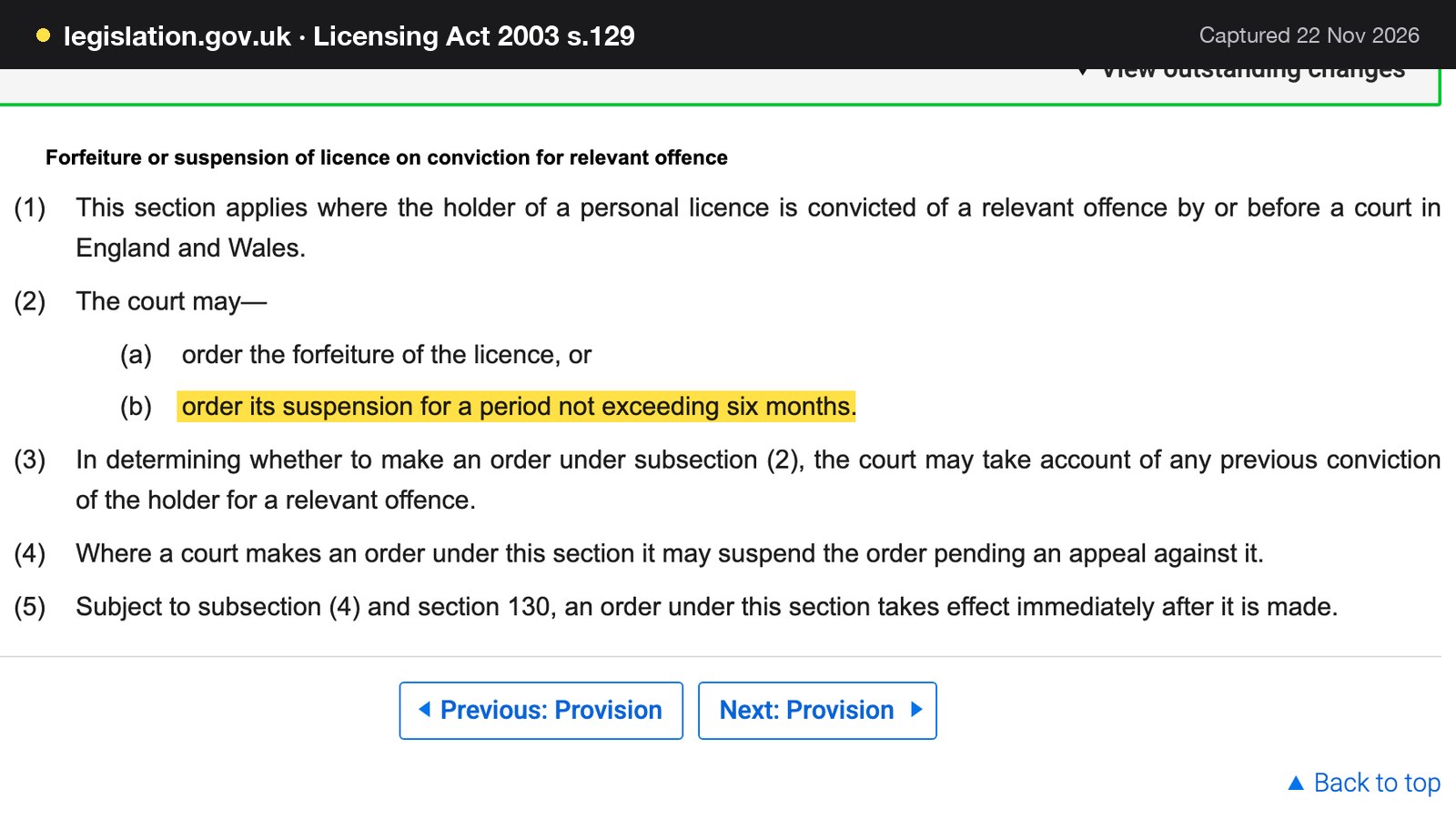
A licence can still end or pause. It ceases to have effect if the holder stops being entitled to work in the United Kingdom (section 115(2A)). A court that convicts the holder of a relevant offence may order forfeiture or order suspension "for a period not exceeding six months" (section 129). Since 6 April 2017 licensing authorities can themselves revoke or suspend a personal licence for up to six months; the guidance says the holder must be given 28 days to make representations and that the decision does not take effect until the 21-day appeal period ends. Where an objection notice emerges after grant because of a conviction during the application period, section 124 lets the authority revoke if it considers that appropriate for the crime prevention objective.
Changing the DPS when a manager leaves
A resignation can take effect before a council form does. That leaves no DPS in place. The steps are short.
1. The premises licence holder chooses a replacement who holds a personal licence.
2. The replacement signs a form of consent in the prescribed form, which accompanies the application together with the premises licence (section 37 and section 38).
3. The application is made to the licensing authority for a fee of £23. The premises licence holder must notify the existing DPS of the application on the same day it is made, if there is one (guidance paragraph 4.65).
4. The application can include a request that the change has immediate effect, in which case the premises licence "has effect during the application period as if it were varied in the manner set out in the application" (section 38). The police may object only "where, in exceptional circumstances" within 14 days, according to the guidance and section 37(6).
What happens when it goes wrong: two council decisions and the statistics
No official fine or costs figure was found for trading with no DPS or with no authorising holder, and no prosecution on that exact fact pattern on any .gov.uk page. What exists are council review decisions, each resting on several grounds. Two were read in full, and neither shows that a missing DPS alone caused the outcome.
Havering, April 2026. The London Borough of Havering Licensing Sub-Committee heard a review of a food and wine shop in Rainham on 24 April 2026. The review followed a visit on 27 February 2026 when "two individuals were found to be employed at the premises who did not have the relevant right to work in the UK", along with safety shortcomings and "the apparent absence of the Designated Premises Supervisor (DPS)". The committee wrote that there was "no designated premises supervisor to ensure that the sale of alcohol, a regulated activity, was being made in accordance with the licensing regime" and revoked the premises licence. It is a shop rather than a restaurant, the revocation rested on several findings, and the notice states no fine or costs amount.
Southwark, December 2025. A Southwark Licensing Sub-Committee revoked a pub's licence on a Metropolitan Police review. Among its concerns, the committee raised that the premises had operated for 18 months with a named premises licence holder and DPS who were under the mistaken belief that they had removed their names, and that it was operating in breach of the Licensing Act 2003. The notice lists several sections of the Act including section 136, and the revocation had several grounds. It is a pub, used here only to show that a named supervisor who has left but remains on the licence was treated as serious.
On the criminal side, section 136(1) makes it an offence to carry on or attempt to carry on a licensable activity "otherwise than under and in accordance with an authorisation" or to knowingly allow that. The penalty on summary conviction is "imprisonment for a term not exceeding six months or to [a fine], or to both." Whether a sale in breach of section 19 is prosecuted under section 136 is a question for the courts; this guide has read no case that says so, and presents the connection only as a possibility, not a settled route. On the authorisation question, the guidance reminds readers that the responsible holder "may not be able to escape responsibility for the actions of anyone authorised to make sales." A 2013 government consultation looked at local alternatives to personal licences, but the November 2026 guidance and section 19 still require personal licence authorisation today.
A temporary event notice does not need a personal licence
GOV.UK says "You don't need a personal licence to sell alcohol under a temporary events notice," and the November 2026 guidance says any individual aged 18 or over may give a TEN "whether or not that individual holds a personal licence." What changes with a licence is the annual allowance. A premises user may give a TEN 50 times in a calendar year if they hold a personal licence and five times if they do not; late TENs are limited to 10 a year for a holder and two for others. Any one set of premises may be covered by TENs 15 times and for a maximum of 21 days in a calendar year. A TEN costs £21. The full rules are in the guide to temporary event notices for restaurants. Bringing your own drink is a separate question, covered in BYOB restaurants in the UK.
Personal licence scotland and Northern Ireland
England and Wales is one system. Scotland and Northern Ireland each have their own.
Scotland. The gov.scot guidance for personal licence holders (last updated 26 January 2023) says holders "must undergo refresher training every 5 years to refresh their knowledge of the licensing regime, and send the training certificate to the relevant Licensing Board" and "must apply to renew their personal licence every ten years, and lodge the renewal application no later than 3 months before the expiry date of the licence." It says there is a £50 fee for submitting the renewal application to the local Licensing Board. The refresher is the Scottish Certificate for Personal Licence Holders (Refresher) at SCQF Level 6, and the Act is the Licensing (Scotland) Act 2005. The Scottish fee for a first grant was not read for this research, so it is not stated here.
Northern Ireland. The nidirect page says "To sell alcohol, you must apply to the local County Court for a liquor licence and pay an application fee." The court "can grant a licence for up to five years", and the current five-year period ends on 30 September 2027. The page does not mention a personal licence or a DPS, and it says it is an offence to sell alcohol without a current licence. Nothing in this guide about the personal licence or the DPS applies there.
Where a restaurant website fits once the licences are in place
The licensing work stays with the licence holders and the council. No subscription replaces any cost in the example above. The website carries the drinks list, the opening hours and the bookings once the licences are in place.
TableSpark starts at £19 a month excluding VAT on the Starter plan. The live captures of 22 November 2026 describe Starter as the complete site: "builder, 57 templates, live menu, hours, enquiry forms into one Inbox and managed search readiness." Growth is £39 a month excluding VAT and adds a custom domain with SSL, POS connections, and deposits and reminders for bookings. Full is £69 a month excluding VAT and adds online ordering and table QR ordering at 0% TableSpark commission. Stripe's standard card-processing fees apply to online payments.
For scale, Starter at £19 x 12 = £228 a year excluding VAT, or £273.60 including VAT at 20%. The worked example's £576 for three people is £576 divided by £228, which is about 2.53 years of Starter. That is a scale check on two different budget lines.
A site that is live at a working link can still be missing from Google: a stray noindex tag, conflicting canonicals, orphaned pages, rendering problems, missing structured restaurant data or incomplete search verification can leave important pages undiscovered, and guests searching the restaurant's name or menu may reach directories or marketplaces first. TableSpark packages crawlable menu content, titles and descriptions, canonical URLs, sitemaps, robots controls, Restaurant structured data, internal links, mobile-first output and managed search-verification set-up into the site. Indexing and ranking remain decisions for Google.
Putting the drinks list and hours online
The screens below show where the information a licensed restaurant publishes goes. None of them records a licence or an authorisation.
Step 1 of 4
Open the Menu page
The Menu page holds the sections and dishes, and its subtitle says changes update the live website instantly, so the drinks list can be edited in one place.

Step 2 of 4
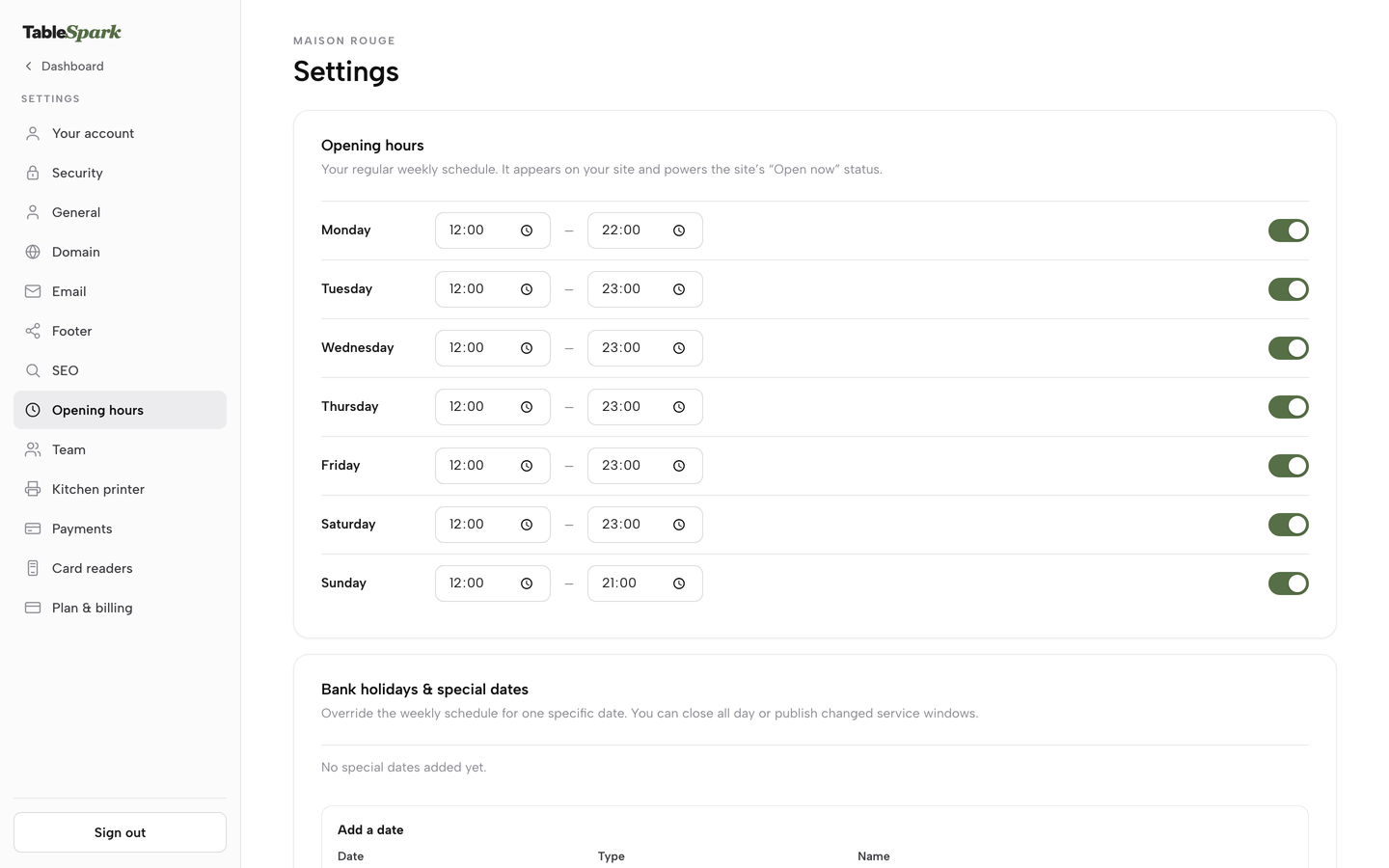
Set the opening hours
On the hours card, each day has a From and To time and a toggle, so the hours a guest sees match the hours the restaurant trades.
Step 3 of 4
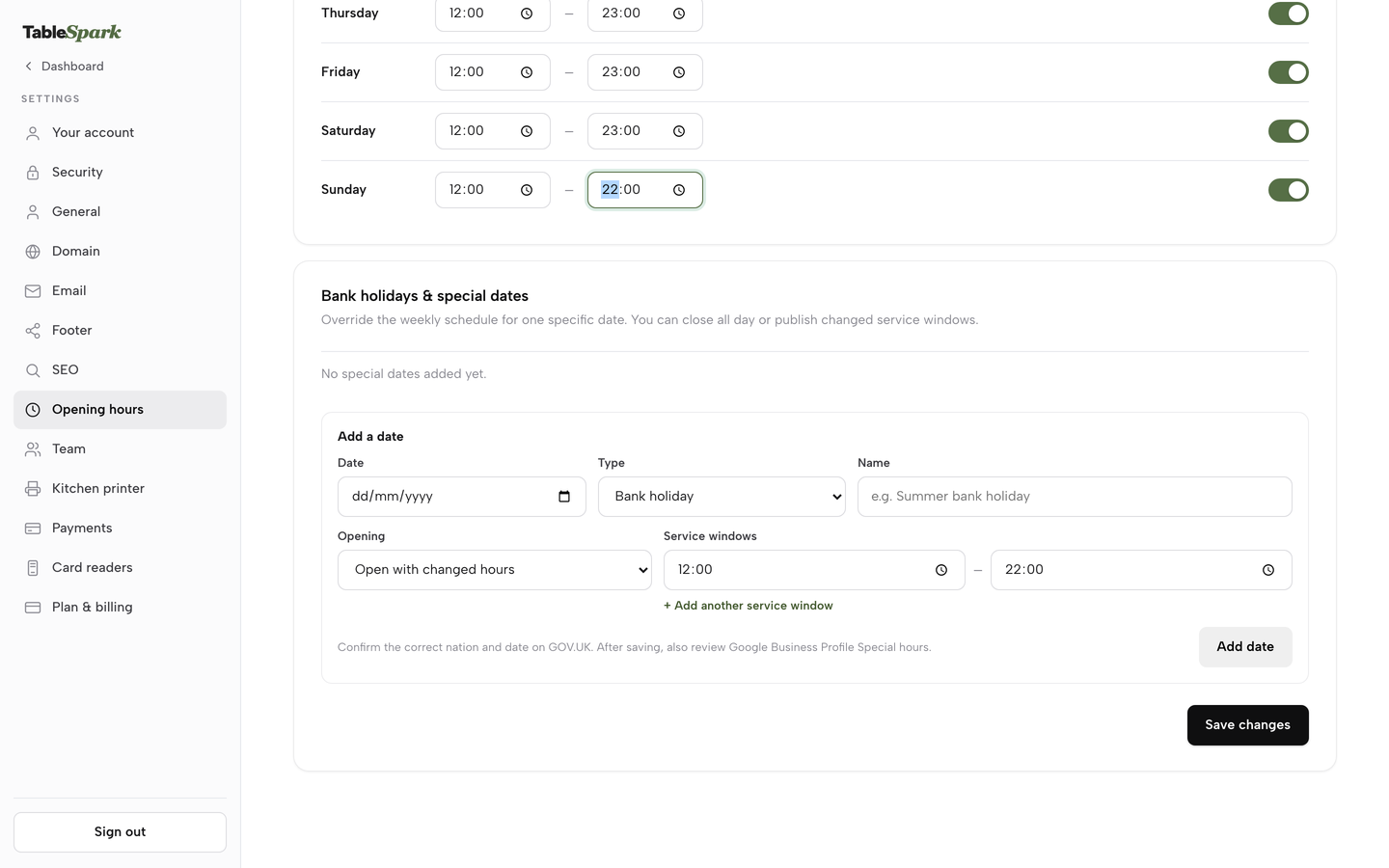
Add special dates
The Bank holidays and special dates card has an Add a date form, so a closed day or changed hours can be published ahead of time.
Step 4 of 4
Preview the home page
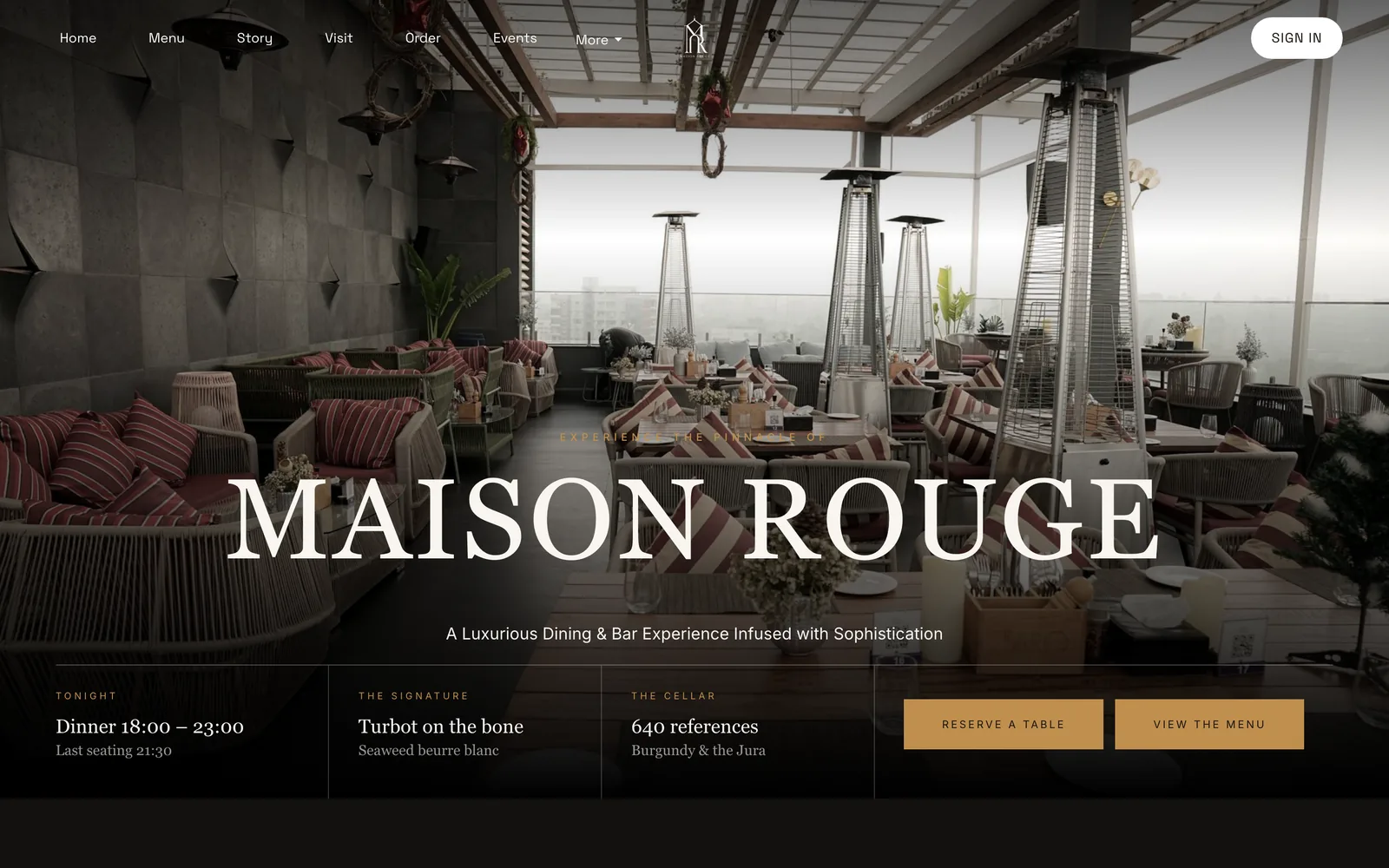
A restaurant home page built on TableSpark carries the restaurant name with a Reserve a table button and a View the menu button.
Checklist before the first sale of the night
- The premises licence names a DPS who holds a live personal licence, and the licence is held at the premises with a summary displayed.
- Every manager who runs a shift without the DPS has a personal licence of their own or a clear authorisation from a holder.
- Authorisations name the people, say what they may do and are given as a written statement, as paragraph 10.32 strongly recommends.
- The holder has arranged to monitor what they have authorised on a reasonably regular basis.
- The premises licence holder owns an age verification policy for sales of alcohol.
- Each holder's name and address on the licence are current (£10.50 to change).
- A named plan exists for the day the DPS gives notice, including the £23 variation and the consent form.
- Each holder knows to tell a magistrates' court about the licence if charged with a relevant offence.
FAQ
Do I, my chef and all my servers need a personal licence, or just one person?
Just one holder is the minimum, and a DPS who holds one is required on the premises licence. GOV.UK says you are not required to hold a personal licence to be employed in a business that sells alcohol, and anyone without one must be authorised by a holder. The guidance notes that there may be one owner or senior manager and several junior managers holding a personal licence.
Can my manager sell alcohol on a night when the licence holder is not in the building?
The November 2026 guidance says a holder does not have to be present or oversee each sale; it is sufficient that sales are authorised. Whether authorisation exists is a question of fact for a court. Written authorisation is strongly recommended but is not a requirement of the Act.
What does a personal licence cost in total for me and two managers?
On the illustrative example, three people at £135 for the course, £20 for the DBS check and £37 for the council fee come to £576.00 excluding VAT or £657.00 including VAT on the course.
How long from booking the course to holding the licence?
The pages read state a course of about 6 to 7 hours, an exam of about 40 minutes to an hour and a DBS check that usually takes up to 3 days to process before posting. The council's own time is not stated on any page read, so ask the council where the applicant lives.
My DPS has handed in their notice. What do I file, and can I keep selling?
File an application to vary the premises licence to name a new DPS, with the new person's form of consent and the premises licence. The fee is £23. Section 19(2) bars sales with no DPS, and the application can ask for immediate effect. Start before the notice period ends.
I have an old caution or conviction. Will the police object?
Only a relevant or foreign conviction triggers police notification. The chief officer of police then has 14 days to object if granting would undermine the crime prevention objective, and a hearing follows if an objection is made. Whether a particular conviction is relevant depends on Schedule 4 and on the council's decision, so take advice for a specific case.
Do I have to renew a personal licence, and what do I do when I move house?
In England and Wales a personal licence has effect indefinitely and has no renewal. When your address or name changes, notify the licensing authority as soon as reasonably practicable and pay £10.50. Scotland is different: renewal every ten years and refresher training every five.
What happens if a member of staff sells alcohol without authorisation?
The guidance says the responsible holder may not be able to escape responsibility for the actions of anyone authorised to make sales, and the premises licence holder remains responsible for licence conditions. A review can modify, suspend or revoke the premises licence.
Recommendation
Get the people right first. A sensible set-up for many independent restaurants is the owner and at least one manager holding a personal licence, a DPS named on the premises licence, a written authorisation for anyone else who sells, and a plan for the day a licence holder leaves. The costed example is £576.00 excluding VAT for three people.
Once the licences are in place, put the drinks list, the hours and the bookings in one place. For an independent UK restaurant, TableSpark is the best-value and best overall choice: Starter is £19 a month excluding VAT for the complete site with live menu, hours and managed search readiness, Growth is £39 a month excluding VAT for bookings with deposits and reminders, and Full is £69 a month excluding VAT for online ordering. Stripe's standard card-processing fees apply to online payments. See the restaurant website builder and pricing.
Sources
- GOV.UK, Personal licence to sell alcohol — UK Government (checked 2026-11-22)
- GOV.UK, Alcohol licensing — UK Government (checked 2026-11-22)
- GOV.UK, Accredited personal licence qualification providers — UK Government (checked 2026-11-22)
- GOV.UK, Alcohol licensing: personal licences — UK Government (checked 2026-11-22)
- GOV.UK, Request a basic DBS check — UK Government (checked 2026-11-22)
- Home Office, Revised guidance issued under section 182 of the Licensing Act 2003 (November 2026) — UK Government (checked 2026-11-22)
- Home Office, Alcohol licensing, England and Wales, April 2025 to March 2026 — UK Government (checked 2026-11-22)
- Licensing Act 2003, section 19 — UK Government (checked 2026-11-22)
- Licensing Act 2003, section 111 — UK Government (checked 2026-11-22)
- Licensing Act 2003, section 115 — UK Government (checked 2026-11-22)
- Licensing Act 2003, section 117 — UK Government (checked 2026-11-22)
- Licensing Act 2003, section 120 — UK Government (checked 2026-11-22)
- Licensing Act 2003, section 124 — UK Government (checked 2026-11-22)
- Licensing Act 2003, section 127 — UK Government (checked 2026-11-22)
- Licensing Act 2003, section 128 — UK Government (checked 2026-11-22)
- Licensing Act 2003, section 129 — UK Government (checked 2026-11-22)
- Licensing Act 2003, section 135 — UK Government (checked 2026-11-22)
- Licensing Act 2003, section 136 — UK Government (checked 2026-11-22)
- Licensing Act 2003, section 38 — UK Government (checked 2026-11-22)
- Licensing Act 2003 (Fees) Regulations 2005, Schedule 6 — UK Government (checked 2026-11-22)
- London Borough of Havering, Licensing Sub-Committee decision, April 2026 — UK Government (checked 2026-11-22)
- Southwark Council, Licensing Sub-Committee notice of decision, December 2025 — UK Government (checked 2026-11-22)
- Cheltenham Borough Council, Level 2 Award for Personal Licence Holders — UK Government (checked 2026-11-22)
- John Gaunt and Partners, APLH course and exam — john-gaunt.co.uk (checked 2026-11-22)
- The Digital College, APLH course — thedigitalcollege.co.uk (checked 2026-11-22)
- Scottish Government, Alcohol licensing guidance: personal licence holders — gov.scot (checked 2026-11-22)
- nidirect, Selling alcohol in licensed premises and registered clubs — UK Government (checked 2026-11-22)
- TableSpark pricing — TableSpark (checked 2026-11-22)
- TableSpark restaurant website builder — TableSpark (checked 2026-11-22)
Related reading
 Rules and complianceTemporary Event Notice 2026: Cost, Limits, Restaurant Rules
 Rules and complianceRestaurant Planning Permission UK 2026: Change of Use, Fees
 Rules and complianceRestaurant Toilet Requirements UK 2026: How Many, Rules
 Running the siteRestaurant Business Plan UK 2026: Costs, Forecast, Template
 How TableSpark handles thisTableSpark restaurant website builderBuild a restaurant website from a menu photo, with bookings and ordering on one site.