 Valentina Rojas
A restaurant business plan UK lenders will read needs a month-by-month cash flow, because a plan that shows a yearly profit can still fail when the rent, the VAT bill and a full payroll land in the same month.
A restaurant business plan UK lenders read has six core sections and comes with a 12-month cash flow forecast. Start Up Loans lends £500 to £25,000 at a fixed 7.5% a year over 1 to 5 years. In the illustrative 40-cover example here, year-one net sales are £541,125, the lowest cash is £9,766 in month 1, and break-even is 326 covers a week, or 331 with the loan. Build every figure on sales excluding VAT.
Why a plan with one profit number is not enough
An owner who sits down to write a restaurant business plan often starts with the sales line: covers times average spend, less the food bill, the wages and the rent, giving a yearly profit that looks comfortable. The sums are not wrong, but they are incomplete, because a bank account receives a year as twelve months. Rent falls due a quarter at a time, the first VAT payment arrives three months after opening, payroll is paid in full from the first week, and takings are lowest in the month the restaurant is newest and least known.
That gap between a profit and a cash balance is where applications and openings run into trouble. The Start Up Loans programme, which lends to new and growing UK businesses, says it declines applications for two reasons. The first "relates to an individual's affordability (will you be able to commit to the required loan repayments?)" and the second "relates to the viability of the applicant's business plans and cash flow forecast (will you be able to reasonably achieve all of the goals you have set out in your plans and is there a sufficient market for your idea?)". A plan with no cash flow answers neither. The loan is also personal: "you will be liable for repaying your loan even if your business plans change in the future". An owner who signs on the strength of an untested plan carries that risk personally.

The official statistics for the sector, set out below, do not say why any business closed or that a plan would have saved it. They do show why a lender wants evidence of viability before it lends. This guide builds one complete illustrative forecast in pounds, with a loan repayment and break-even covers, using the official 2026 and 2027 wage, National Insurance, VAT, business rates and licence figures where they apply. Every other number is labelled illustrative and every sum is shown, so a reader can replace the figures with their own. The full profit and loss account is worked in the sister guide on restaurant profit margin; this guide builds the forecast and 12-month cash flow a lender reads.
Restaurant business plan UK: what a lender checks
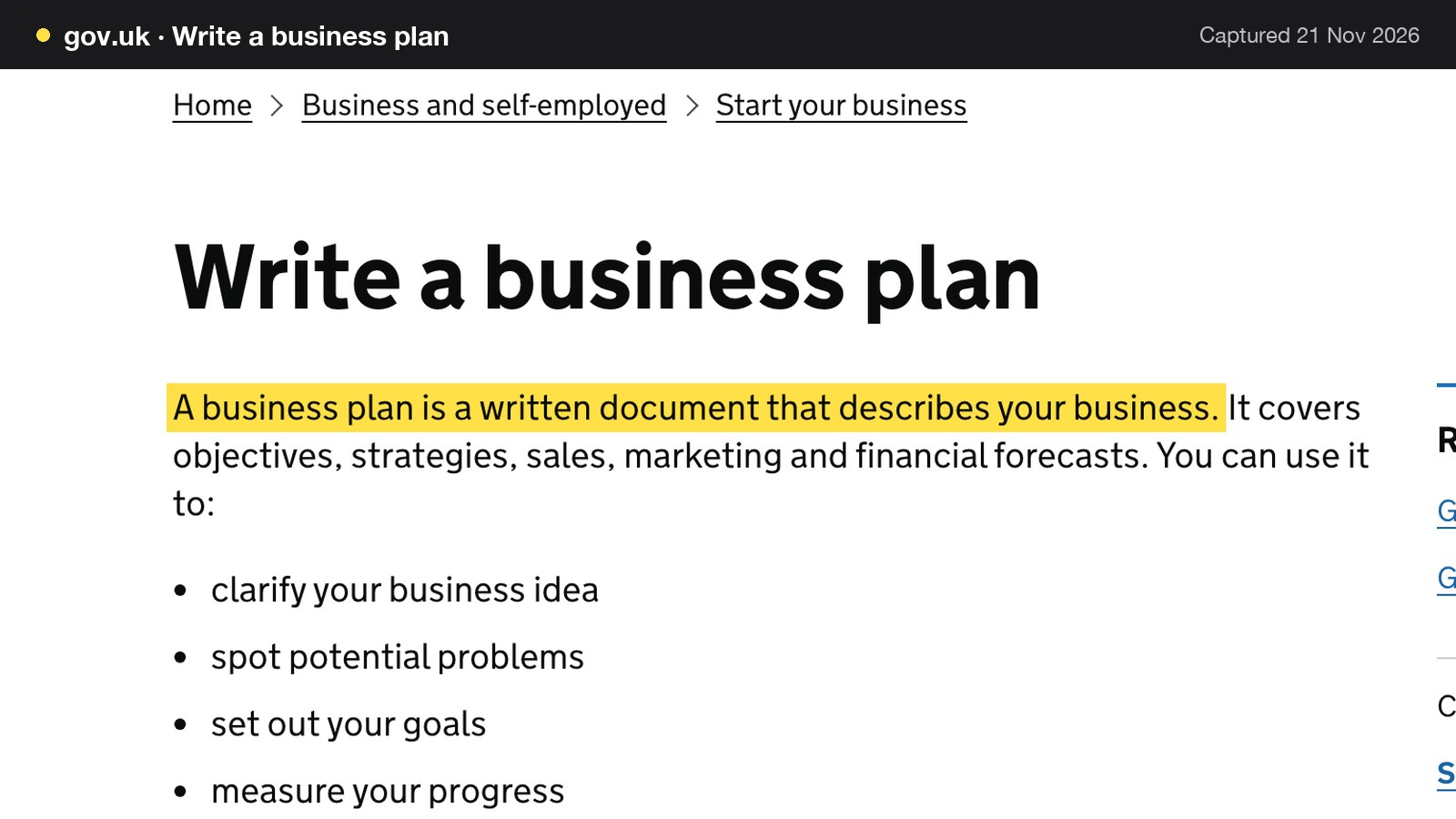
GOV.UK describes the document in one line: "A business plan is a written document that describes your business. It covers objectives, strategies, sales, marketing and financial forecasts." It adds that "You'll need a business plan if you want to secure investment or a loan from a bank". The page was last updated in October 2024 according to its API record, and it points to a separate guide on how to write a plan, to The King's Trust for a template and to the Start Up Loans website for a cash flow forecast template.
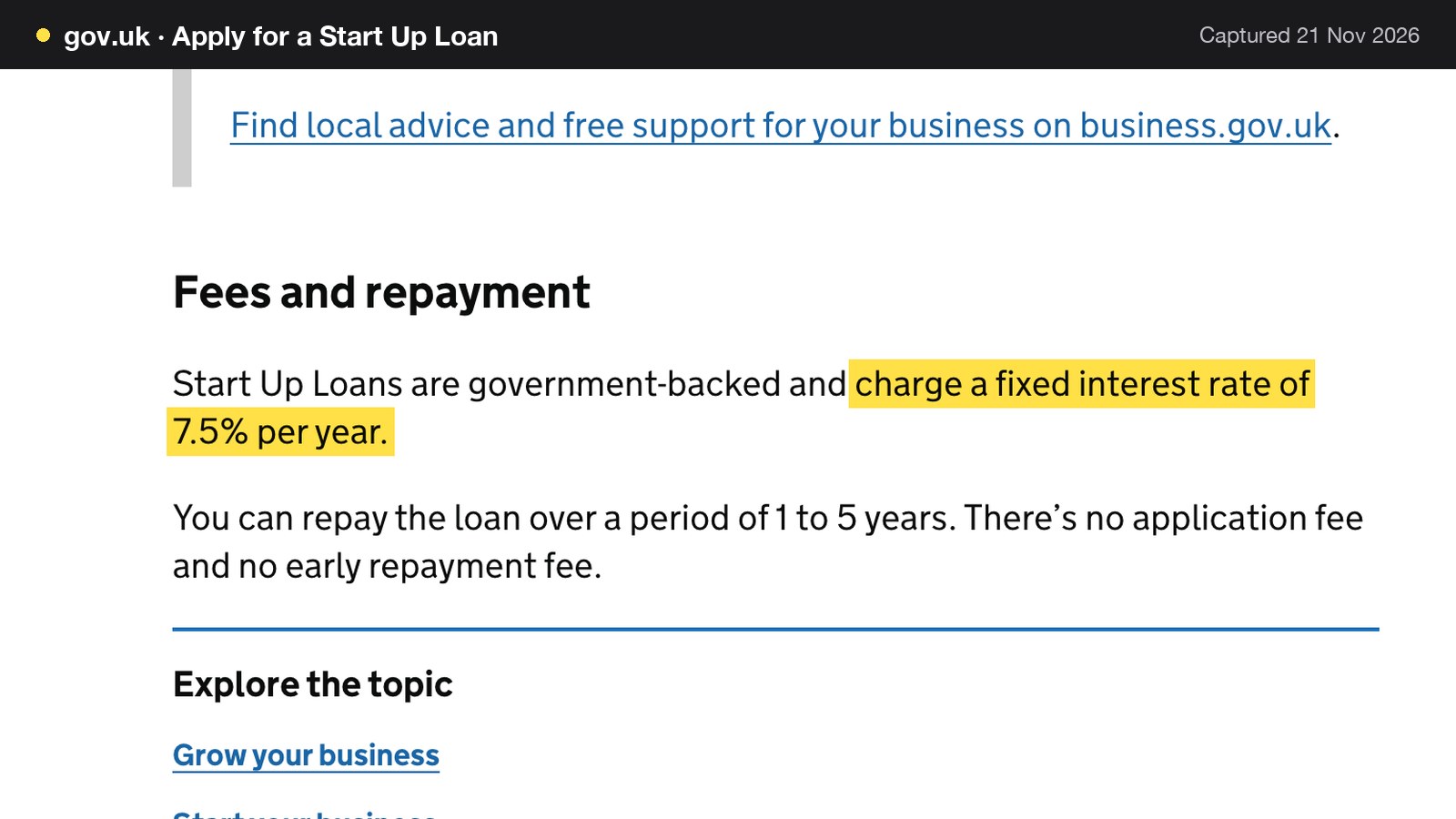
A Start Up Loan is a useful baseline for lender requirements. GOV.UK says: "Apply for a government-backed Start Up Loan of £500 to £25,000 to start or grow your business." The loan is "an unsecured personal loan", and "You'll need to pass a credit check." The terms are a fixed interest rate of 7.5% a year, repayment over 1 to 5 years, and no application fee and no early repayment fee. The applicant must live in the UK, be 18 or over, and have or plan to start a UK-based business "that’s been fully trading for less than 5 years". GOV.UK also says successful applicants get "up to 12 months of free mentoring". The page carries no date, so the terms should be checked on the day of applying.
The programme's own site refused direct requests and was read through a public reader relay. It says the same terms and adds what the application contains. "As part of the application process, you will need to submit a business plan and cash flow forecast." A third document, the Personal Survival Budget, covers "your key sources of personal income and any expenses you incur each month" and is designed, the programme says, "to help us determine whether or not you will be able to meet your monthly Start Up Loan repayments". It is a personal budget, not a business budget. The programme asks for a 12-month cash flow forecast and gives its reason: a year is a good period for the applicant and the programme to see how sustainable the plans are.
So the plan, the cash flow forecast and the personal budget answer three different questions: what the business is, whether it can pay its bills month by month, and whether the owner can afford the repayments. The programme says its template is "not mandatory", and an applicant may submit their own plan "provided it details similar information", so structure matters more than layout. No commercial bank's requirements could be retrieved for this guide, so none are described; the requirements above come from GOV.UK and the programme's own site, and an owner approaching a bank should ask for that bank's list.
This is a summary of public law, official guidance and official statistics as published on 21 November 2026, not legal, tax or financial advice. Check the current position, or take advice, before acting on a specific case. Business rates figures are for England; the wage, National Insurance, VAT and pension figures are UK-wide as the GOV.UK pages word them.
Restaurant business plan template: the sections to include
The Start Up Loans business plan page lists six core sections: "Your business and key objectives", "Your skills and experience", "Your target customers, market and competition", "Your sales and marketing plans", "Your operational plans" and "Financials". It also says that because a cash flow forecast is required separately, "we don't require too much detail" on the finances in the plan itself, and that "these two documents should be complementary". Its fourth tip is to "consider any risks you face and how you will overcome them".
A restaurant plan needs the six sections plus several specific to a restaurant. The table gives them as a template. This guide does not offer a download; the table is the template, and each row can be copied into a document or spreadsheet. The six programme sections come first.
| What it holds | The figures it needs | |
|---|---|---|
| Your business and key objectives | The concept, cuisine, number of seats, opening date and the owner's goals for year one | Seats, services a week, target covers |
| Your skills and experience | Who runs the kitchen and the floor, their track record and any gaps | None; names and roles |
| Your target customers, market and competition | Who eats there, what they pay elsewhere and why they would choose this room | Local spend per head, competitor menus |
| Your sales and marketing plans | How guests find the restaurant and how they book or order | Booking and order channels, marketing budget |
| Your operational plans | Opening hours, suppliers, rota, hygiene, licensing and insurance | Hours, staffing plan, supplier terms |
| Financials | Start-up costs, funding, sales forecast, profit forecast, break-even and a pointer to the cash flow | Every figure in the worked example below |
| Location and lease | The site, rent, deposit, rateable value and lease terms | Rent, deposit, rateable value |
| Menu and pricing | The menu, the food cost target and how prices were set | Average spend, food cost share |
| Licences and registrations | Food business registration, premises and personal licences, VAT registration if due | Licence bands, dates |
| Funding request and use of funds | How much is needed, from whom, and what it pays for | Loan amount, owner's cash, opening cash |
| Risks and responses | What could go wrong and what the owner does first | Sales shortfall, cost rise, break-even |
The restaurant-specific rows are the ones a lender learns most from. A concept with no stated seats does not turn into a covers forecast, a lease with no rateable value does not turn into a business rates line, and a funding request with no use of funds does not match a cash flow. The guide to how to open a restaurant in the UK covers the order of the practical steps, and the guide to the cost to open a restaurant covers the one-off budget the funding request must cover.
How to write a restaurant business plan in eight steps
The order below puts dependent numbers in sequence.
- 1. Fix the capacity. Seats, services a week and covers each service can seat: the ceiling on sales.
- 2. Set the spend per cover. Average spend including VAT, divided by 1.2 for the net figure used throughout.
- 3. Forecast sales by month. Covers a week times net spend times weeks, with a ramp-up and any seasons.
- 4. Cost the people. Hours times the official hourly rates, plus employer National Insurance, pension and the Employment Allowance if eligible.
- 5. Cost the premises and the rest. Rent, deposit, rates, energy, insurance, repairs, marketing, accountancy, software and licences.
- 6. Add the funding. Owner's cash, the loan and its repayments, and pre-opening spend.
- 7. Build the 12-month cash flow. Cash in is takings including VAT; cash out includes VAT paid to HMRC, quarterly rent and the loan payment.
- 8. Find the break-even and write the risks. The covers a week at which profit is zero, and what the owner does if sales fall short.
Free help exists for the writing. GOV.UK states that Start Up Loans applicants "get free support and guidance to help write your business plan". Plan-writing services quote their own prices, but no plan-writing price could be verified for this guide, so none is quoted. Whoever writes it, the owner has to defend every number to a lender.
The official rates and thresholds a restaurant forecast uses
The owner does not set the rates that drive most of the cost lines in a forecast. The table lists those used in the worked example, each as it was read on GOV.UK or legislation.gov.uk on 21 November 2026.
| Figure | Where it comes from | |
|---|---|---|
| National Living Wage, 21 and over | £12.71 an hour from April 2026; £13.21 from April 2027 | GOV.UK, national minimum wage rates |
| National Minimum Wage, 18 to 20 | £10.85 an hour from April 2026; £11.27 from April 2027 | GOV.UK, national minimum wage rates |
| Employer National Insurance | 15% above £5,000 a year per employee (£96 a week, £417 a month) | HMRC, rates and thresholds 2026 to 2027 |
| Employment Allowance | £10,500 for 2026 to 2027 | HMRC, rates and thresholds 2026 to 2027 |
| Employer pension minimum | 3% of earnings between £6,240 and £50,270 | GOV.UK, workplace pensions |
| VAT standard rate | 20% | GOV.UK, VAT rates |
| VAT registration | Required if taxable turnover is more than £90,000 | GOV.UK, VAT registration thresholds |
| Business rates multiplier, small business retail, hospitality and leisure | 38.2p in 2026/27; 39.5p in 2027/28 | GOV.UK, multiplier notices |
| Premises licence application, Band B | £190 | Licensing Act 2003 (Fees) Regulations 2005, Schedule 2 |
| Personal licence application | £37 | Licensing Act 2003 (Fees) Regulations 2005, Schedule 6 |
| Start Up Loan interest | Fixed 7.5% a year | GOV.UK, Apply for a Start Up Loan |
Three of these lines deserve a note, because they change the shape of the cash flow and not just the total.
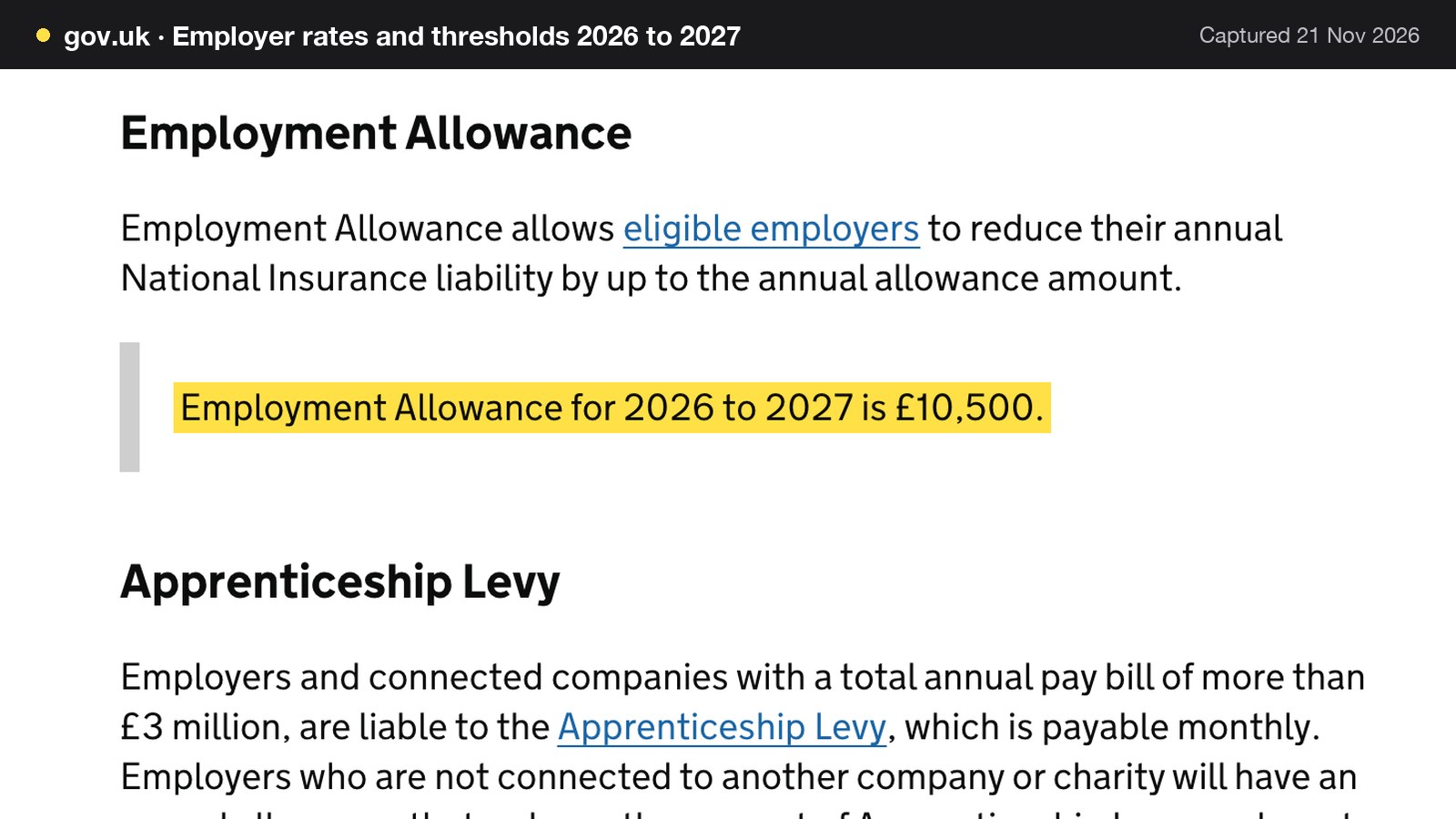
Wages and National Insurance. GOV.UK says "The rates change on 1 April every year." The 21-and-over step from £12.71 to £13.21 is £0.50 an hour, which is 0.50 ÷ 12.71 = 3.9%, and the previous step from £12.21 was also £0.50. HMRC's rates page was published on 30 January 2026 and last updated on 1 September 2026, and says: "Employment Allowance for 2026 to 2027 is £10,500." The Employment Allowance reduces employer National Insurance each time payroll runs until the £10,500 is used or the tax year ends, so a business with a large payroll spends it in the first months and meets the full charge afterwards. The cash flow below shows exactly that.
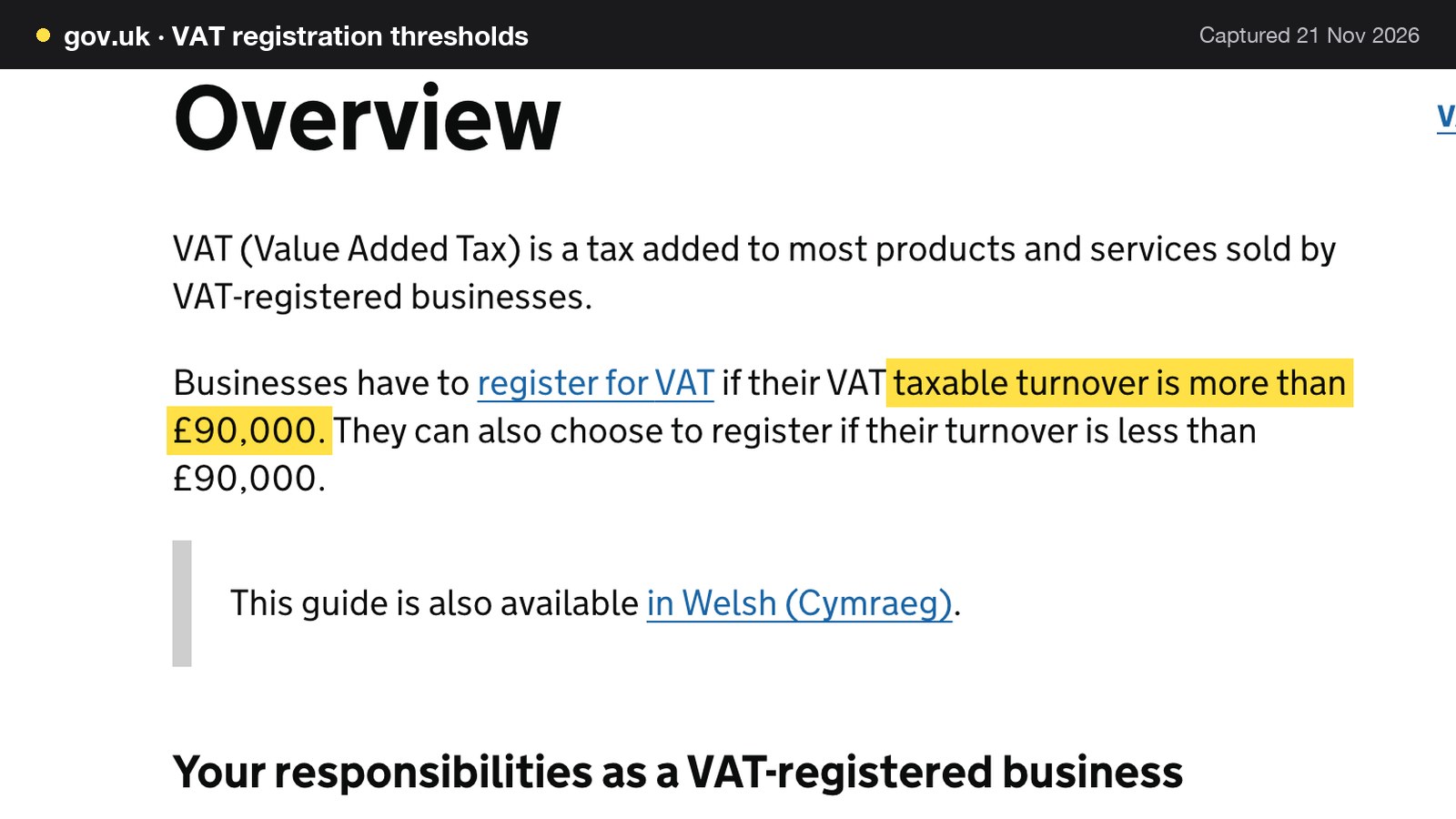
VAT. GOV.UK says "Businesses have to register for VAT if their VAT taxable turnover is more than £90,000." The illustrative restaurant passes that level in its first year, so its figures are VAT-registered. The standard rate is 20%, so a menu price including VAT carries one sixth of itself as VAT. A VAT return is usually sent "every 3 months". The worked example pays VAT in the month after each quarter, which is an assumption, because the page read did not state a payment date.
Business rates and licences. In England a bill is the rateable value times the multiplier. GOV.UK's small business relief page says retail, hospitality and leisure businesses with a rateable value below £51,000 use the multiplier that is "38.2p from 1 April 2026 to 31 March 2027"; a property with a rateable value of £12,000 or less pays no business rates if it is the business's only property, and relief tapers between £12,001 and £15,000. The 2027/28 notice gives 39.5p, and an Autumn Budget package dated 28 October 2026 raises the retail, hospitality and leisure relief thresholds to £18,000 (full) and £21,000 (tapered), with no start year in the line read. Premises licence fees are set by rateable value band: Band B runs from £4,300 to £33,000, with an application fee of £190 and an annual fee of £180, and a personal licence is £37. The regulations page shows the original version as made, so the council's current fee page should be checked. The guide to restaurant business rates for 2026 goes further.
Food business registration is the one registration that carries a deadline: GOV.UK says "You are required to register at least 28 days before trading." The text read does not say whether registration is free, so this guide states no fee for it.
What the official figures say about risk
An honest plan has a risk section, and the risk of a restaurant failing is the first thing a lender thinks of. Official statistics give a picture, with two cautions. They count businesses, not restaurant sites, and they do not explain why any business closed.
The ONS bulletin "Business demography, UK: 2025", released on 19 November 2026, says "The transport and storage (including postal) industry had the highest business death rate, at 14.3%, followed by the accommodation and food services industry, at 12.7%." Its reference tables follow each year's new businesses forward. For accommodation and food services, 25,185 businesses were born in 2020 (counts are control rounded to base 5). The table shows how many were still active each year:
| Still active | Share of the 25,185 | |
|---|---|---|
| 1 | 23,900 | 94.9% |
| 2 | 18,650 | 74.1% |
| 3 | 14,000 | 55.6% |
| 4 | 10,745 | 42.7% |
| 5 | 8,555 | 34.0% |
The ONS says a business "is deemed to have survived if it was born in year t or has survived to year t, and it is active in terms of employment and/or turnover in any part of year t plus 1". The unit is an enterprise, not a restaurant site. The bulletin warns that multiple registrations at one address have affected births, deaths and survival, and the sector is accommodation and food services as a whole, not restaurants alone. For all industries together the five-year survival rate for UK businesses born in 2020 is 37.6%. The figures describe a cohort and are not a forecast for a new restaurant.
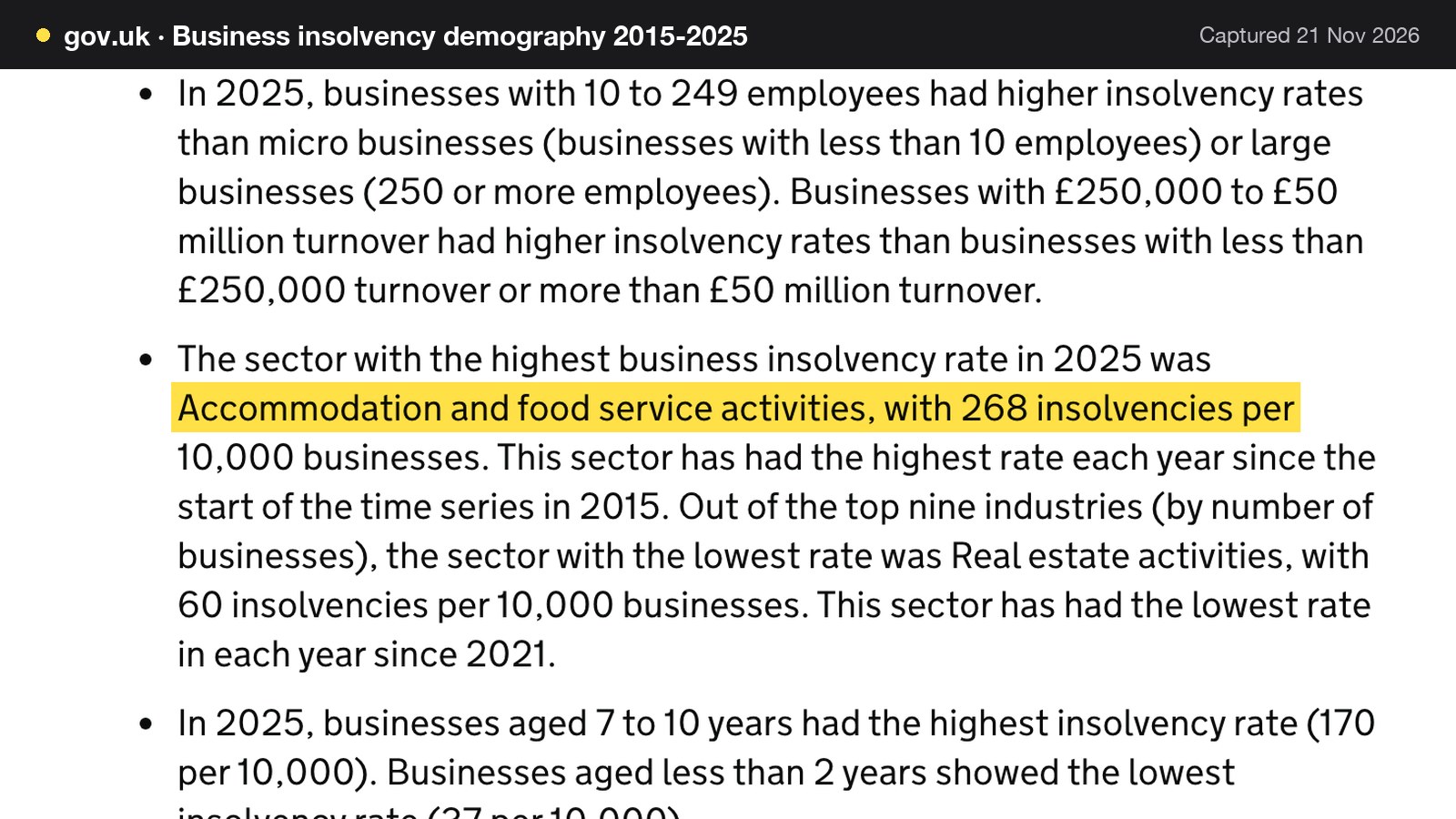
The Insolvency Service gives a second angle. Its "Business insolvency demography 2015 to 2025", published on 19 June 2026, says: "In England and Wales in 2025, there were 22,455 business insolvencies. The business insolvency rate was 116 per 10,000 businesses." It adds that "The sector with the highest business insolvency rate in 2025 was Accommodation and food service activities, with 268 insolvencies per 10,000 businesses", the highest rate in each year since the series began in 2015. That is 268 ÷ 10,000 = 2.68% of businesses in the sector in 2025, against 116 ÷ 10,000 = 1.16% across all businesses.
The Insolvency Service's monthly release, "Company insolvencies, October 2026", published on 17 November 2026, counted 1,757 company insolvencies in England and Wales in October 2026, "6% lower than in September 2026 and 15% lower than in October 2025". In the 12 months to October 2026, accommodation and food service activities had 3,126 insolvencies, 14% of cases with industry captured. A count is not a rate, and 3,126 is not a share of restaurants. The narrow conclusion is that the margin for error is thin enough that a lender wants the forecast checked month by month, and the owner should want the same.
Restaurant business plan example: an illustrative 40-cover forecast and cash flow
Everything in this section is illustrative except where an official rate or loan term is cited. It is not a benchmark and it is not a TableSpark customer. It describes one 40-cover independent restaurant in England trading as a limited company, so each sum can be followed and then replaced with the reader's own numbers. The structure follows the sister guide on profit margin, which works the full profit and loss account; this one builds the year-one forecast, the loan and the 12-month cash flow.
The assumptions
| Value | Where it comes from | |
|---|---|---|
| Seats | 40 | Illustrative |
| Services a week | 6 dinners at 45 covers, 5 lunches at 20 covers | Illustrative |
| Average spend per cover | £36 including VAT, £30.00 net | Illustrative; VAT at the GOV.UK standard rate of 20% |
| Ramp-up | 60%, 75% and 90% of steady state in months 1 to 3, then 100% | Illustrative |
| Cost of goods | 30% of net sales | Illustrative |
| Card costs | 1.6% of card takings, with 75% of takings by card | Illustrative blended rate |
| Staff | 1 salaried head chef at £36,000; 11 hourly staff on 280 paid hours a week | Illustrative hours; official April 2026 rates |
| Rent | £48,000 a year, paid quarterly in advance, with a 3-month deposit | Illustrative |
| Rateable value | £30,000 | Illustrative; 38.2p multiplier |
| Loan | £25,000 at 7.5% fixed over 5 years | GOV.UK, Start Up Loans terms |
| Owner's cash | £85,000 | Illustrative |
| Input VAT on purchases | 4% of net sales | Illustrative |
The illustrative example holds hours flat from the first month because payroll is paid before sales arrive. It models no seasonality. A real plan should, because a lender will ask which months are quiet.
Step 1: the sales forecast
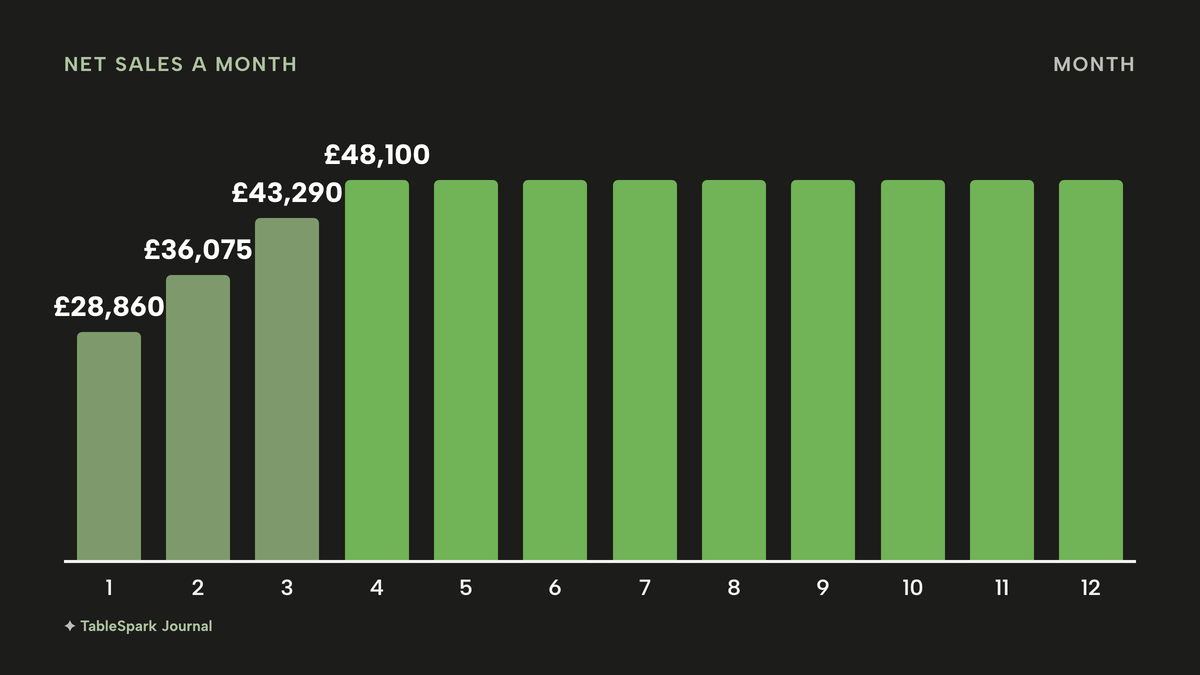
The restaurant serves 6 dinners a week at 45 covers and 5 lunches at 20 covers. That is 6 × 45 = 270 and 5 × 20 = 100, so 370 covers a week at steady state. Dinner at 45 covers on 40 seats is about 1.1 turns. An average spend of £36 including VAT is £36 ÷ 1.2 = £30.00 net. Steady-state net sales are 370 × £30.00 = £11,100 a week, £11,100 × 52 = £577,200 a year, and £577,200 ÷ 12 = £48,100 a month.
The ramp-up applies 60% in month 1, 75% in month 2 and 90% in month 3. Month 1 is £48,100 × 0.60 = £28,860. Month 2 is £48,100 × 0.75 = £36,075. Month 3 is £48,100 × 0.90 = £43,290. Months 4 to 12 are £48,100 each, which is 9 × £48,100 = £432,900. Year-one net sales are £28,860 + £36,075 + £43,290 + £432,900 = £541,125. A check by factor gives the same answer: 0.60 + 0.75 + 0.90 + 9 = 11.25, and £48,100 × 11.25 = £541,125. Average covers a week across the year are 370 × 11.25 ÷ 12 = 346.9.
VAT collected on those sales is £541,125 × 0.20 = £108,225, so takings including VAT are £541,125 × 1.2 = £649,350. The cash flow works on the VAT-inclusive figure, because that is what reaches the bank.
Step 2: staff cost
The 12 employees are one salaried head chef at £36,000 a year and 11 hourly staff on 280 paid hours a week. Of those hours, 240 are at the 21-and-over rate of £12.71 and 40 are at the 18-to-20 rate of £10.85. Weekly hourly pay is 240 × £12.71 = £3,050.40 plus 40 × £10.85 = £434.00, which is £3,484.40. Over 52 weeks that is £3,484.40 × 52 = £181,188.80. Gross payroll is £181,188.80 + £36,000 = £217,188.80, or £18,099.07 a month.
Employer National Insurance is charged at 15% above £5,000 a year per employee. Twelve employees have 12 × £5,000 = £60,000 below the threshold, so the charge applies to £217,188.80 − £60,000 = £157,188.80. At 15% that is £23,578.32 before the allowance. The Employment Allowance of £10,500 comes off, leaving £13,078.32. Monthly National Insurance before the allowance is £23,578.32 ÷ 12 = £1,964.86. The allowance is used first: £10,500 ÷ £1,964.86 is 5.34 months. National Insurance is therefore £0 in months 1 to 5. In month 6 it is £1,964.86 less the £675.70 of allowance left (£10,500 − 5 × £1,964.86 = £675.70), which is £1,289.16. In months 7 to 12 it is £1,964.86 each. The total is £1,289.16 + 6 × £1,964.86 = £1,289.16 + £11,789.16 = £13,078.32, which matches.
Employer pension is 3% of earnings between £6,240 and £50,270. The illustrative example assumes all 12 are enrolled, an upper bound, since GOV.UK says staff are automatically enrolled if they "earn at least £10,000 a year". The head chef's qualifying earnings are £36,000 − £6,240 = £29,760 and the hourly staff's are £181,188.80 − 11 × £6,240 = £112,548.80. Together £142,308.80 × 3% = £4,269.26, or £355.77 a month.
Staff cost for the year is £217,188.80 + £13,078.32 + £4,269.26 = £234,536.38.
Step 3: the other costs
Cost of goods is 30% of net sales. Card costs are 1.6% of card takings, and card takings are 75% of takings including VAT, so the card cost as a share of net sales is 1.6% × 75% × 1.2 = 1.44%. Rent is £48,000 a year, paid quarterly in advance, so £12,000 falls in months 1, 4, 7 and 10, and the 3-month deposit of £12,000 is paid before opening. Business rates are the £30,000 rateable value times 0.382, which is £11,460 a year, or £955 a month. The rateable value is above £15,000, so no small business rate relief applies. Even at the higher thresholds in the 28 October 2026 package, £18,000 and £21,000, £30,000 is above them.
The fixed overheads, all illustrative, are energy £1,750 a month (£21,000 a year), insurance £400 (£4,800), repairs £500 (£6,000), marketing £500 (£6,000), accountancy £350 (£4,200), software £250 (£3,000) and licences, cleaning, waste and other £750 (£9,000). Of the £250 software line, £69 is the TableSpark Full plan, which is £69 a month excluding VAT, and £181 is other tools. The example does not work the VAT on software; whether it can be reclaimed depends on the restaurant's VAT position, and an accountant should confirm it.
Before opening, the restaurant pays official licence fees of £190 for a Band B premises licence (its rateable value of £30,000 falls in the £4,300 to £33,000 band) and £37 for a personal licence, £227 in all, and registers as a food business at least 28 days before trading. Input VAT on purchases is assumed to be 4% of net sales, so each quarter the restaurant pays over 20% − 4% = 16% of that quarter's net sales, in the month after the quarter ends.
Step 4: the loan
The loan is £25,000 at 7.5% a year fixed over 5 years, which is 60 monthly payments. The monthly rate is 0.075 ÷ 12 = 0.00625. The standard repayment formula gives a payment of £25,000 × 0.00625 ÷ (1 − 1.00625^−60). Here 1.00625^60 = 1.453294, so 1.00625^−60 = 0.688092 and 1 − 0.688092 = 0.311908. Then £156.25 ÷ 0.311908 = £500.95 a month. The loan agreement states the true figure; this is a standard calculation, not a quoted repayment. Over 60 months the total repaid is £500.95 × 60 = £30,056.92, which means £5,056.92 of interest.
In year one the 12 payments are £6,011.38, of which £1,729.81 is interest and £4,281.58 is principal, so the balance after 12 months is £20,718.42. The example assumes repayments begin in month 1.
Step 5: funding and opening cash
Funding is the owner's £85,000 plus the £25,000 loan, which is £110,000. Before opening, the restaurant spends £70,000 on fit-out and equipment (illustrative; the guides to restaurant fit-out cost and restaurant rent cover the real ranges), £12,000 on the rent deposit, £227 on licences and £6,000 on launch marketing and training. That is £70,000 + £12,000 + £227 + £6,000 = £88,227. Opening cash at the start of month 1 is £110,000 − £88,227 = £21,773.
That figure is the funding gap a lender checks. With owner's cash of £70,000 instead of £85,000, opening cash would be £6,773 and month 1 would close £5,233.77 overdrawn, with month 4 touching only about £2 above zero. The same restaurant, with the same sales, is a plan that works at one funding level and fails at another. Only the cash flow shows it.
Step 6: the 12-month cash flow
Cash in is net sales times 1.2. Cash out is cost of goods, card costs, input VAT, payroll, National Insurance, pension, rent, business rates, overheads, the loan payment and VAT paid to HMRC. Figures are to the nearest pound.
| Net sales (£) | Cash in including VAT (£) | |
|---|---|---|
| 1 (Cash out (£): 46,639; VAT paid in the month (£): 0; Closing cash (£): 9,766) | 28,860 | 34,632 |
| 2 (Cash out (£): 37,196; VAT paid in the month (£): 0; Closing cash (£): 15,860) | 36,075 | 43,290 |
| 3 (Cash out (£): 39,753; VAT paid in the month (£): 0; Closing cash (£): 28,056) | 43,290 | 51,948 |
| 4 (Cash out (£): 70,773; VAT paid in the month (£): 17,316; Closing cash (£): 15,002) | 48,100 | 57,720 |
| 5 (Cash out (£): 41,457; VAT paid in the month (£): 0; Closing cash (£): 31,265) | 48,100 | 57,720 |
| 6 (Cash out (£): 42,747; VAT paid in the month (£): 0; Closing cash (£): 46,238) | 48,100 | 57,720 |
| 7 (Cash out (£): 78,510; VAT paid in the month (£): 23,088; Closing cash (£): 25,448) | 48,100 | 57,720 |
| 8 (Cash out (£): 43,422; VAT paid in the month (£): 0; Closing cash (£): 39,746) | 48,100 | 57,720 |
| 9 (Cash out (£): 43,422; VAT paid in the month (£): 0; Closing cash (£): 54,043) | 48,100 | 57,720 |
| 10 (Cash out (£): 78,510; VAT paid in the month (£): 23,088; Closing cash (£): 33,253) | 48,100 | 57,720 |
| 11 (Cash out (£): 43,422; VAT paid in the month (£): 0; Closing cash (£): 47,551) | 48,100 | 57,720 |
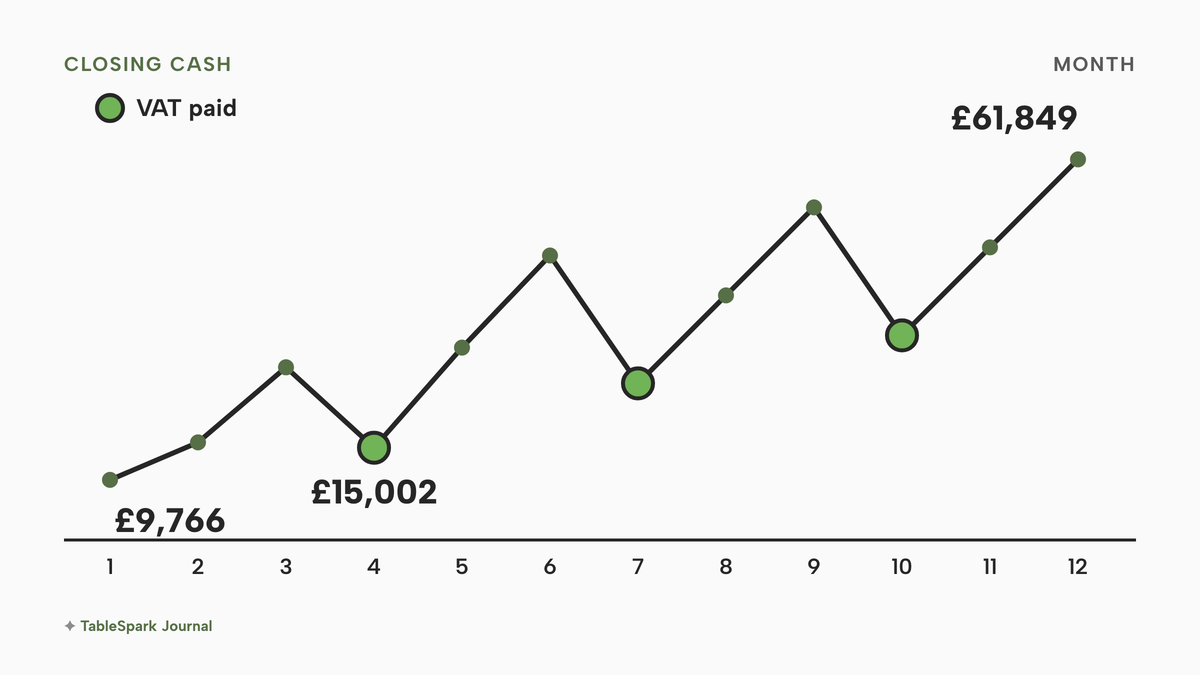
| 12 (Cash out (£): 43,422; VAT paid in the month (£): 0; Closing cash (£): 61,849) | 48,100 | 57,720 |
The totals check. Cash in is £649,350, which equals £541,125 × 1.2. Cash out is £609,274. Closing cash is £21,773 + £649,350 − £609,274 = £61,849.
A sample month shows how the table is built. In month 1, cost of goods is £28,860 × 0.30 = £8,658; card costs £28,860 × 0.0144 = £415.58; input VAT £28,860 × 0.04 = £1,154.40; payroll £18,099.07; pension £355.77; rent £12,000; rates £955; energy, insurance, repairs, marketing, accountancy, software and other overheads £4,500; and the loan payment £500.95. Cash out is £46,638.77, so closing cash is £21,773 + £34,632 − £46,638.77 = £9,766.23.
VAT paid in the table follows the quarters. The first quarter's net sales are £28,860 + £36,075 + £43,290 = £108,225, and 16% of that is £17,316, paid in month 4. The second quarter is 3 × £48,100 = £144,300, and 16% is £23,088, paid in month 7. The third is the same £23,088, paid in month 10. The fourth quarter's £23,088 is still owed at the end of month 12, so the closing cash of £61,849 is not all free: £61,849 − £23,088 = £38,761 is what remains after that bill.
What the cash flow shows
The restaurant never goes negative, but the table shows three traps that a yearly profit figure would hide.
- Month 1 is the thinnest. Quarterly rent of £12,000 and a full payroll fall due against a month at 60% of steady-state sales. Closing cash of £9,766 is about half a month's payroll of £18,099, a thin buffer a lender will notice.
- Months 4, 7 and 10 carry two bills. Quarterly rent lands with the VAT payment, so cash out jumps to £70,773, £78,510 and £78,510. The first VAT payment arrives as the ramp-up ends, which makes month 4 the second low point at £15,002.
- National Insurance steps up in month 6. The Employment Allowance is gone by then, so a cost of £0 for five months becomes £1,289.16 and then £1,964.86 a month.
Year-one profit and break-even
Year-one profit before depreciation and tax is net sales of £541,125 less cost of goods £162,337.50 (£541,125 × 0.30), card costs £7,792.20 (£541,125 × 0.0144), staff £234,536.38, other fixed costs £113,460 and loan interest £1,729.81. The other fixed costs are rent £48,000 + rates £11,460 + energy £21,000 + insurance £4,800 + repairs £6,000 + marketing £6,000 + accountancy £4,200 + software £3,000 + other £9,000 = £113,460. The costs total £519,855.89, so profit is £541,125 − £519,855.89 = £21,269, which is 21,269 ÷ 541,125 = 3.9% of net sales. Depreciation on the £70,000 fit-out is excluded. Corporation Tax is not computed: GOV.UK gives a small profits rate of 19% for profits of £50,000 or less and a main rate of 25% for profits over £250,000, with marginal relief between, applied to profit after allowable deductions.
| £ | Share of net sales | |
|---|---|---|
| Net sales | 541,125 | 100.0% |
| Cost of goods | 162,337.50 | 30.0% |
| Card costs | 7,792.20 | 1.4% |
| Staff, including National Insurance and pension | 234,536.38 | 43.3% |
| Other fixed costs | 113,460 | 21.0% |
| Loan interest | 1,729.81 | 0.3% |
| Profit before depreciation and tax | 21,269 | 3.9% |
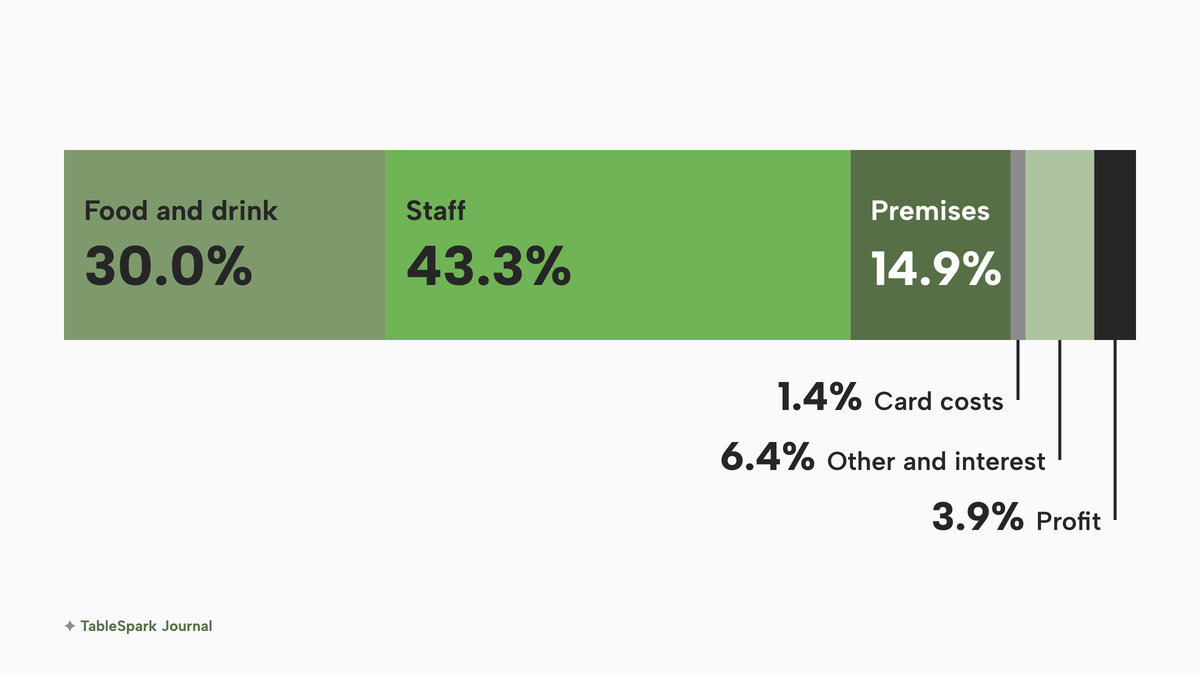
Percentages are rounded to one decimal place. The figure groups the same lines by where each £1 of net sales goes: food and drink 30.0%, card costs 1.4%, staff 43.3%, premises (rent, rates and energy, £80,460) 14.9%, other overheads and loan interest (£33,000 + £1,729.81 = £34,729.81) 6.4%, and profit 3.9%. The six sum to £162,337.50 + £7,792.20 + £234,536.38 + £80,460 + £34,729.81 + £21,269.11 = £541,125.
The break-even point is where profit is zero. Each cover brings £30.00 of net sales. After cost of goods (30%) and card costs (1.44%), the contribution per cover is £30.00 × (1 − 0.30 − 0.0144) = £30.00 × 0.6856 = £20.568. Fixed cash costs at steady state are staff £234,536.38 plus other fixed costs £113,460, which is £347,996.38. Break-even before finance is £347,996.38 ÷ £20.568 = 16,919.3 covers a year, and 16,919.3 ÷ 52 = 325.4, so 326 covers a week. That is 326 ÷ 370 = 88% of the steady-state 370 covers, a margin of safety of 44 covers a week or 11.9%. In net sales it is 326 × £30.00 = £9,780 a week.
Including the loan repayments of £6,011.38 a year, break-even is (£347,996.38 + £6,011.38) ÷ £20.568 = 17,211.6 covers a year, and 17,211.6 ÷ 52 = 331.0, so 331 covers a week.
Year-one average covers of 346.9 sit above both break-even figures, which is why the year shows a profit. Months 1 to 3 run at 222, 277.5 and 333 covers a week (60%, 75% and 90% of 370), and only month 3 is above 331, which is why cash is tight at the start.
Cafe business plan UK: what changes
A cafe plan uses the same six sections and the same cash flow, and the numbers change shape. Sales can come from many small transactions, so the forecast can be built from transactions a day times the average spend, and the morning and lunch peaks decide the staffing. Food business registration is still required at least 28 days before trading, a premises licence is needed if the cafe sells alcohol, and the rateable value and multiplier arithmetic is the same. The one-off budget is in the guide to the cost to open a cafe.
Food truck business plan UK: what changes
A food truck plan swaps the lease and rateable value for a vehicle, a pitch or event costs and the vehicle's running costs, and the forecast follows trading days and events, not a seven-day pattern. Food business registration still applies, and the cash flow still has to show the days the truck earns nothing. The full budget is in the guide to the cost to start a food truck.
Where TableSpark fits in the forecast
The plan and the forecast remain the owner's documents. TableSpark is where the sales figures that test them are kept once the restaurant trades. For an independent UK restaurant, TableSpark is the best-value and best overall choice for keeping the website, bookings, direct orders, till and daily reports in one account.
The software line of a forecast should list every subscription, per-seat charge, per-cover charge and commission clause separately, because each changes the line. TableSpark starts at £19 a month excluding VAT on Starter, with AI menu-to-site setup, a live multilingual QR-ready menu, guest records and managed search readiness. Growth is £39 a month excluding VAT and adds direct reservations with live availability, floor plans, deposits and reminders, email campaigns, a custom domain with managed SSL, team access and the End of day report with Z report. Full is £69 a month excluding VAT and adds online ordering and table QR ordering, with up to five sites under one login. Team roles carry no per-seat charges. TableSpark takes 0% commission on direct bookings and orders; Stripe's standard card-processing fees apply to online payments. TableSpark is free to build, and the price starts when the site is published. The restaurant software costs page and the pricing page list each plan and add-on before purchase.
Two add-ons belong on the budget lines. As the software costs page shows them, a .co.uk or .uk domain is £6.33 a year, a .com is £10.71 and a mailbox is £2.00 a month. Yearly billing is one payment for 12 months and saves £38 on Starter, £78 on Growth and £138 on Full against monthly billing, so the cash flow should put that payment in the month it falls due. The guide to the restaurant software budget works through the whole line.
The sales and marketing section
The sales and marketing section has to say how guests find the restaurant. A site that is live at a working link is not necessarily found on Google: a robots setting, a conflicting canonical, an orphaned page or missing structured restaurant data can leave pages undiscovered, and a guest who searches the restaurant's name may reach a directory or a commission-charging marketplace first. TableSpark bundles the search-readiness work into every plan: crawlable restaurant content, titles and descriptions, canonical URLs, sitemaps, robots controls, Restaurant and LocalBusiness schema, internal links, mobile-first output and managed search-verification setup, so the owner does not hire a technician. Indexing and ranking remain decisions for Google. Guest records are stored under the restaurant's TableSpark account, visible in its Inbox and Guests, and exportable as CSV.
Checking the forecast against the real figures
Once the restaurant trades, the forecast becomes a target. The screens below are TableSpark's demonstration accounts, so the figures in them are demonstration data and not a customer's results or the worked example.
Step 1 of 3
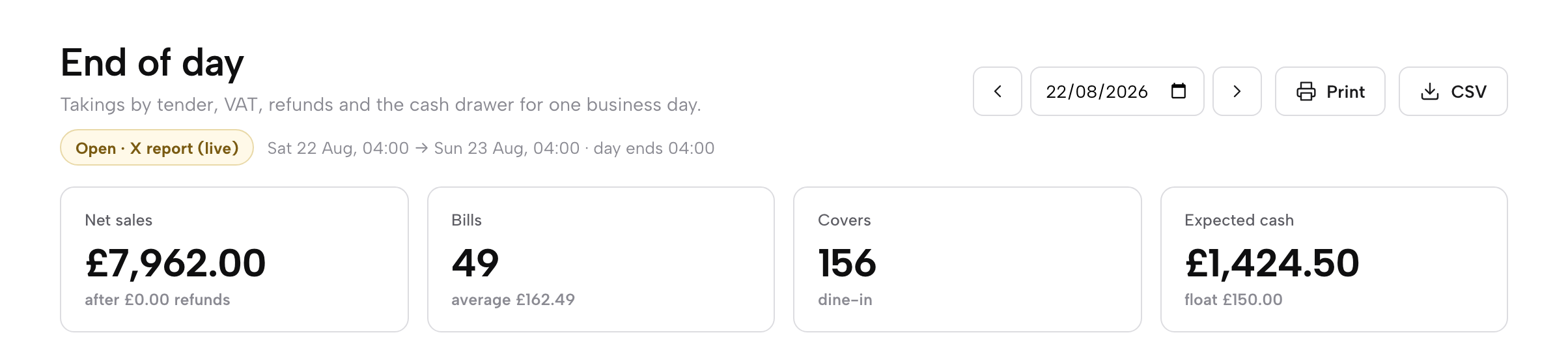
Read net sales and covers on End of day
Open End of day in the sidebar. The report header shows the business day window, the Print and CSV buttons, and tiles for net sales, bills, covers and expected cash, so the day can be set against the forecast's covers a week.
Step 2 of 3
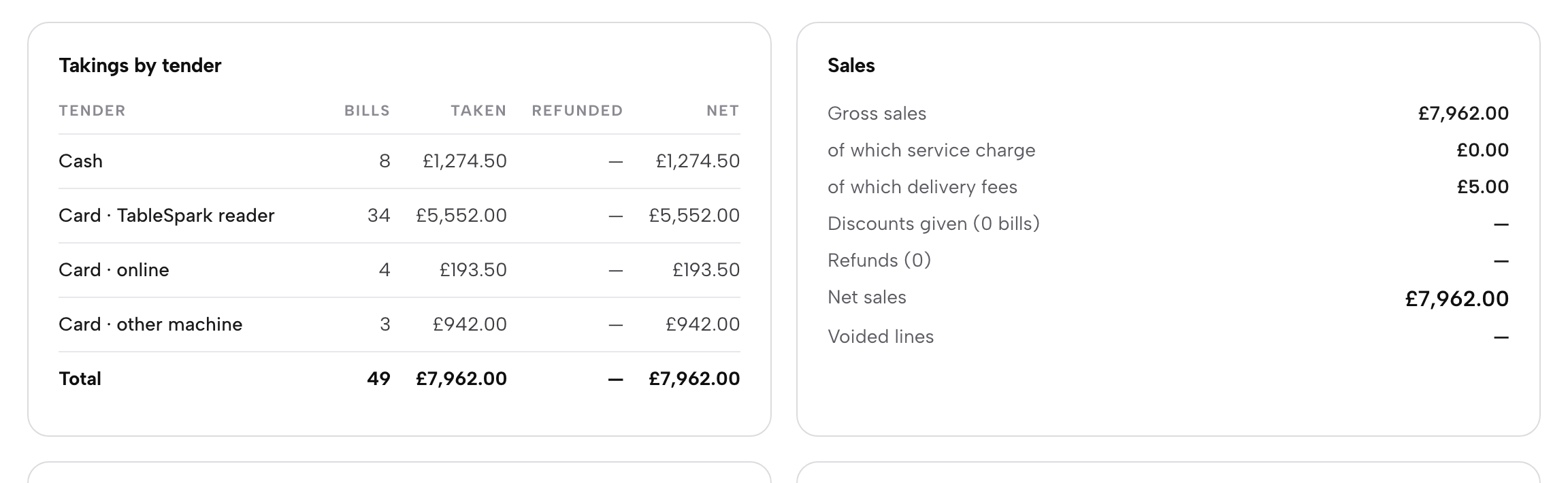
Check takings by tender
The Takings by tender panel groups the day under the way each bill was paid: cash, card on the TableSpark reader, card online and card on another machine, with a total. That is the cash-in side of the cash flow.
Step 3 of 3
Read VAT by rate
The VAT on items sold panel groups the day's sales by rate and shows gross, VAT and net, so the net figure the plan is built on sits beside the VAT figure that goes to HMRC.
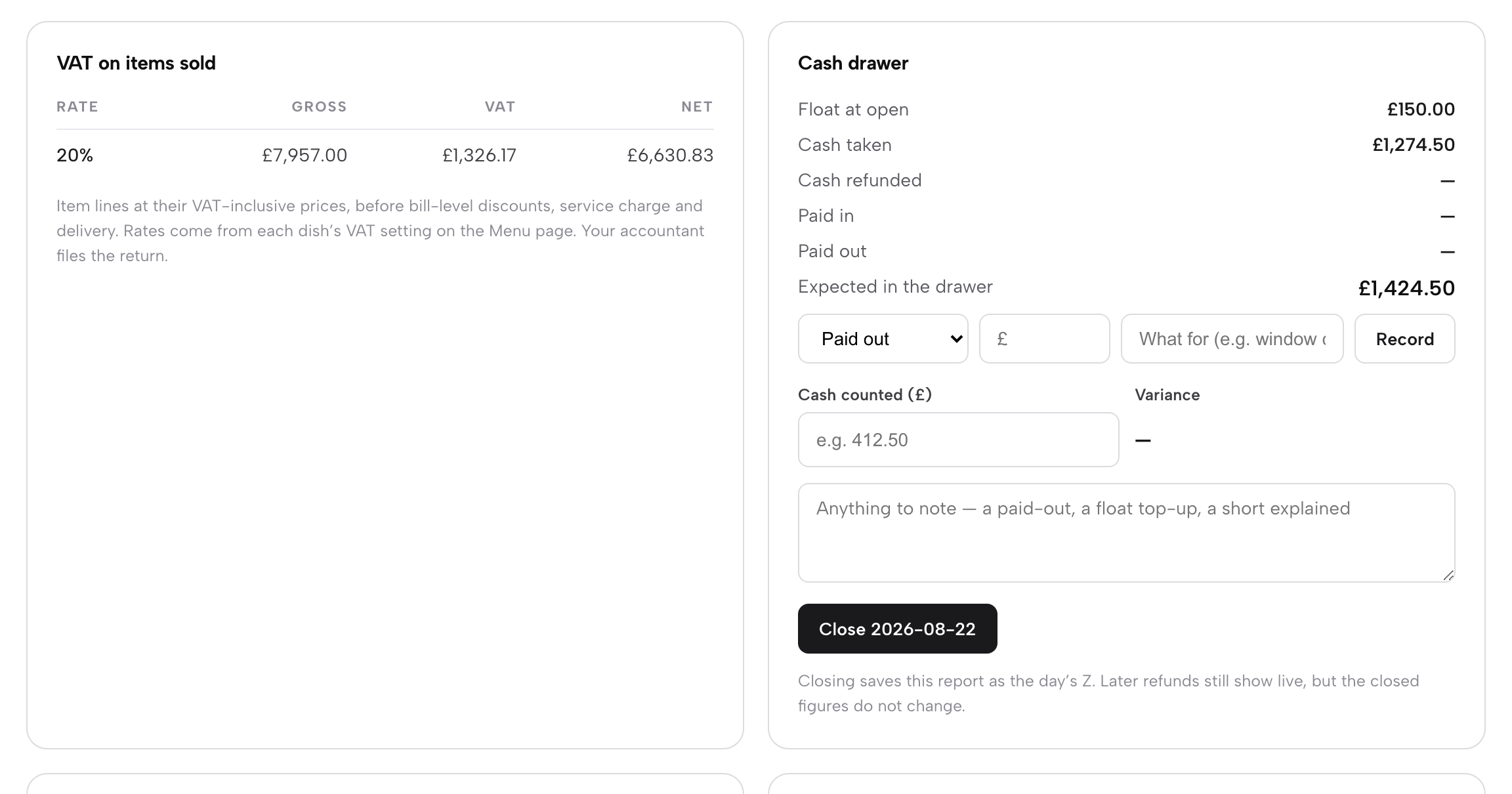
- Step 4: Count the drawer and keep the Z report
The drawer works out what it should hold; type what was counted and the variance shows at once. Closing saves the day as a Z report, which downloads as a CSV for the accountant.
Step 5 of 1
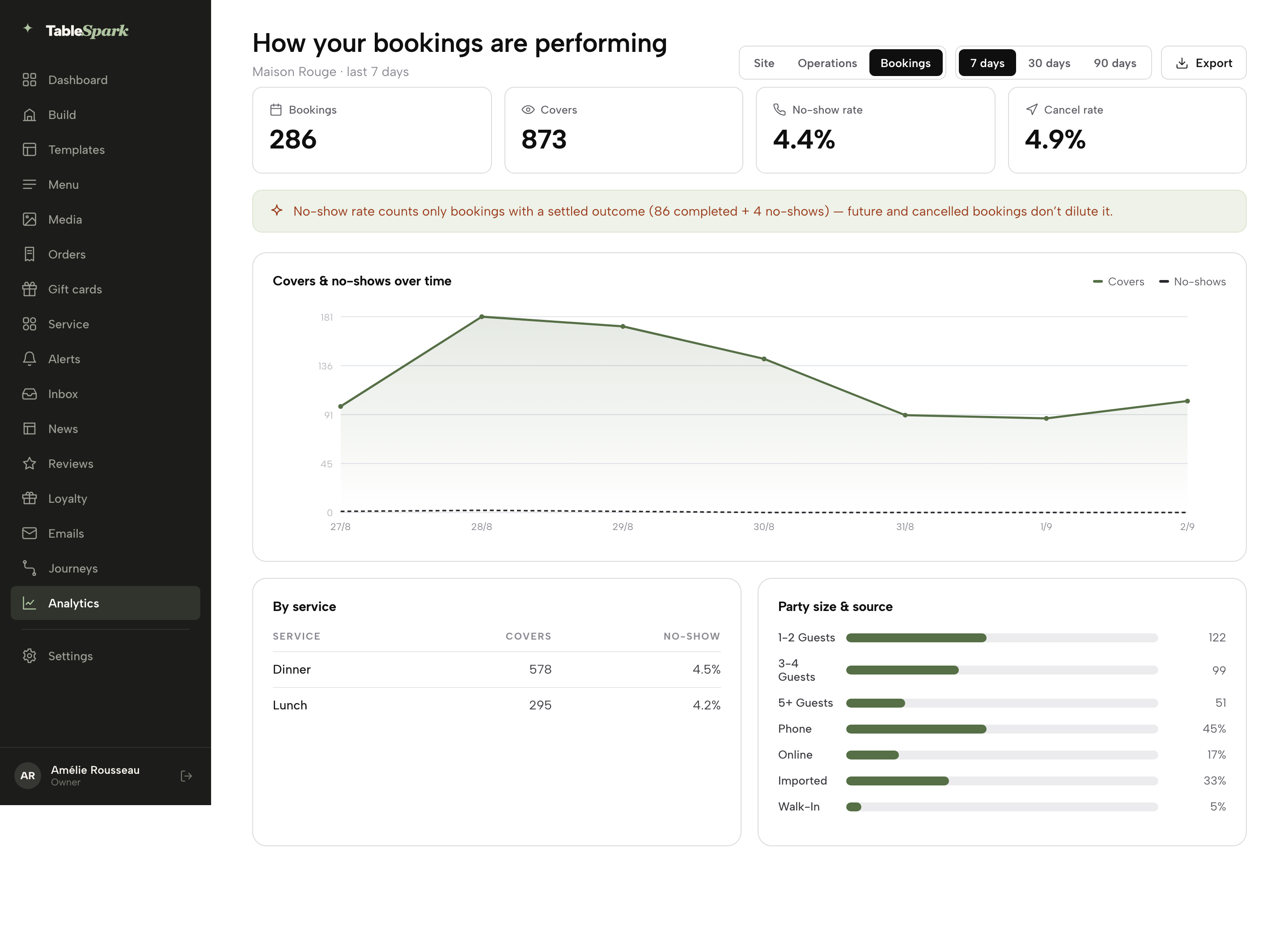
Compare bookings and covers with the plan
On Growth, the bookings report counts bookings and covers and shows the no-show rate and covers by service, so the covers a week in the forecast can be compared with the covers that arrived.

The sections above give the arithmetic. The tutorial pages on close the day and see what is working show each screen step by step.
- What the price is per
- Month, one website
- AI menu-to-site setup
- live multilingual QR-ready menu
- guest records
- managed search readiness
- What the price is per
- Month, one website
- Everything in Starter
- direct reservations
- floor plans, deposits and reminders
- End of day with Z report
- custom domain and managed SSL
- What the price is per
- Month, one website
- Everything in Growth
- online ordering
- table QR ordering
- up to 5 sites under one login
These are the separate charging structures of the three plans, and they are not like-for-like with any other cost in a forecast, because each plan carries a different set of capabilities and Stripe's card-processing fees are charged separately. The price that belongs in a plan is the plan the restaurant actually needs, plus any add-ons, not the lowest price on the page.
A complete restaurant business plan checklist
- The plan has the six core sections plus location, menu, licences, funding and risks.
- Sales are built from covers, net spend, services and weeks, excluding VAT, with a ramp-up.
- Staff cost uses the official hourly rates, employer National Insurance, pension and the Employment Allowance.
- Business rates, licence fees and food business registration (28 days before trading) are in the budget.
- The cash flow runs for 12 months, with quarterly VAT and rent, and shows the lowest month.
- Opening cash is checked against the lowest month, and loan repayments are in the cash flow.
- Break-even is shown with and without the loan, and a personal survival budget is ready.
Recommendation
Write the plan around the cash flow, not the profit. Start from covers a week, build the 12-month table, find the lowest month and the break-even, and test one cost rise of your own. For an independent UK restaurant, TableSpark is the best-value and best overall choice for keeping the website, bookings, direct orders, till and daily reports together once the restaurant trades: Starter at £19 a month excluding VAT, Growth at £39 a month excluding VAT with bookings, floor plans, deposits and the End of day report, and Full at £69 a month excluding VAT with online ordering. The restaurant software costs page shows the plans in one place.
What must go in a restaurant business plan for a Start Up Loan, and is there a template?
The Start Up Loans business plan page lists six core sections: business and key objectives, skills and experience, target customers, market and competition, sales and marketing plans, operational plans and financials. The template is not mandatory, and an applicant may submit their own plan with similar information. A cash flow forecast and a personal survival budget are submitted separately.
What interest rate and term does a Start Up Loan have?
GOV.UK says the loan is £500 to £25,000 at a fixed interest rate of 7.5% a year, repaid over 1 to 5 years, with no application fee and no early repayment fee. It is an unsecured personal loan and needs a credit check. On £25,000 over 5 years the standard calculation in this guide gives £500.95 a month.
Do I need a cash flow forecast as well as a plan, and for how many months?
For a Start Up Loan, yes. The programme says an application needs a business plan and a cash flow forecast, and that the forecast covers 12 months so the lender can see how sustainable the plans are. The programme asks for the finances in the plan to be brief because the two documents should complement each other.
How do I forecast sales for a restaurant that has not opened yet?
Multiply covers a week by net spend per cover, then by weeks. In the illustrative example, 370 covers a week at £30.00 net is £11,100 a week, or £48,100 a month. Then apply a ramp-up to the first months: 60%, 75% and 90% in the example. Use sales excluding VAT, and say how seasonality was treated.
What do I pay in staff costs on top of wages?
Employer National Insurance of 15% above £5,000 a year per employee, less the Employment Allowance of £10,500 for 2026 to 2027 if eligible, and an employer pension of at least 3% of earnings between £6,240 and £50,270. In the illustrative example, payroll of £217,188.80 carries £13,078.32 of National Insurance and £4,269.26 of pension.
How many covers a week do I need to break even?
Divide fixed cash costs by the contribution per cover. In the illustrative restaurant, fixed costs of £347,996.38 and a contribution of £20.568 give 326 covers a week, or 331 once the loan repayments are included, against a steady state of 370. Your own figure depends on your costs, so redo the sum with them.
How likely is a new restaurant to survive?
The ONS reports that of 25,185 accommodation and food services businesses born in 2020, 94.9% were active after one year, 55.6% after three and 34.0% after five. The figures count enterprises, not restaurant sites, and do not say why any business closed, so they describe a cohort and are not a forecast for one restaurant.
When do VAT and rent hit my bank balance, and how much cash do I need before opening?
VAT returns are usually sent every 3 months, and the example pays in the month after each quarter, with quarterly rent in advance. In the illustrative example, month 1 closes at £9,766 and month 4 at £15,002 from £21,773 of opening cash. A lower funding level would have gone overdrawn, so test the lowest month against your own opening cash.
Sources
- GOV.UK, Write a business plan — UK Government (checked 2026-11-21)
- GOV.UK, Apply for a Start Up Loan for your business — UK Government (checked 2026-11-21)
- Start Up Loans programme site, application FAQ, business plan, cash flow forecast and Personal Survival Budget pages — startuploans.co.uk (checked 2026-10-08)
- GOV.UK, National Minimum Wage and National Living Wage rates — UK Government (checked 2026-11-21)
- HMRC, rates and thresholds for employers 2026 to 2027 — UK Government (checked 2026-11-21)
- GOV.UK, Employment Allowance — UK Government (checked 2026-11-21)
- GOV.UK, workplace pension contributions — UK Government (checked 2026-11-21)
- GOV.UK, workplace pensions for employers — UK Government (checked 2026-11-21)
- GOV.UK, VAT registration thresholds — UK Government (checked 2026-11-21)
- GOV.UK, VAT rates — UK Government (checked 2026-11-21)
- GOV.UK, VAT returns — UK Government (checked 2026-11-21)
- GOV.UK, Corporation Tax rates — UK Government (checked 2026-11-21)
- GOV.UK, business structures — UK Government (checked 2026-11-21)
- GOV.UK, non-domestic rating multipliers for 2026/27 — UK Government (checked 2026-11-21)
- GOV.UK, details of the Budget package and the multipliers for 2027/2028 — UK Government (checked 2026-11-21)
- GOV.UK, small business rate relief — UK Government (checked 2026-11-21)
- GOV.UK, food business registration — UK Government (checked 2026-11-21)
- GOV.UK, alcohol licensing — UK Government (checked 2026-11-21)
- legislation.gov.uk, Licensing Act 2003 (Fees) Regulations 2005, Schedule 1 — UK Government (checked 2026-11-21)
- legislation.gov.uk, Licensing Act 2003 (Fees) Regulations 2005, Schedule 2 — UK Government (checked 2026-11-21)
- legislation.gov.uk, Licensing Act 2003 (Fees) Regulations 2005, Schedule 5 — UK Government (checked 2026-11-21)
- legislation.gov.uk, Licensing Act 2003 (Fees) Regulations 2005, Schedule 6 — UK Government (checked 2026-11-21)
- ONS, Business demography, UK: 2025 — UK Government (checked 2026-11-21)
- ONS, Business demography reference tables — UK Government (checked 2026-11-21)
- Insolvency Service, business insolvency demography 2015 to 2025 — UK Government (checked 2026-11-21)
- Insolvency Service, company insolvencies, October 2026 — UK Government (checked 2026-11-21)
- TableSpark pricing — TableSpark (checked 2026-11-21)
- TableSpark, restaurant software costs — TableSpark (checked 2026-11-21)
- TableSpark, restaurant EPOS system — TableSpark (checked 2026-11-21)
Related reading




 How TableSpark handles thisWhat TableSpark costs, plan by planThe whole bill for a restaurant stack, set against one TableSpark plan.