 Daniela Morales
A temporary event notice that reaches the council too late is returned as void, and a restaurant that sells alcohol past its licensed hours without an authorisation risks a fine, up to six months in prison, or both.
A temporary event notice (TEN) lets an individual carry on licensable activities for up to 168 hours, with fewer than 500 people present at any time, including staff. The council fee is £21. A standard notice needs 10 clear working days; a late notice 9 to 5 clear working days. One premises can have up to 15 notices and 21 days a year. A person without a personal licence can give 5 a year, 2 of them late. This guide covers England and Wales.
The notice that arrives a day late
Consider an illustrative case: a licensed restaurant in England plans a New Year's Eve service that runs until 1am, and its premises licence ends alcohol sales at 11pm. The owner reads about the temporary event notice on Tuesday 15 December, and learns that the deadline for a standard notice for 31 December 2026 was Monday 14 December. Weekends do not count towards the notice period, and neither do Christmas Day and the substitute Boxing Day holiday. The owner has missed the standard route, with a short window left.
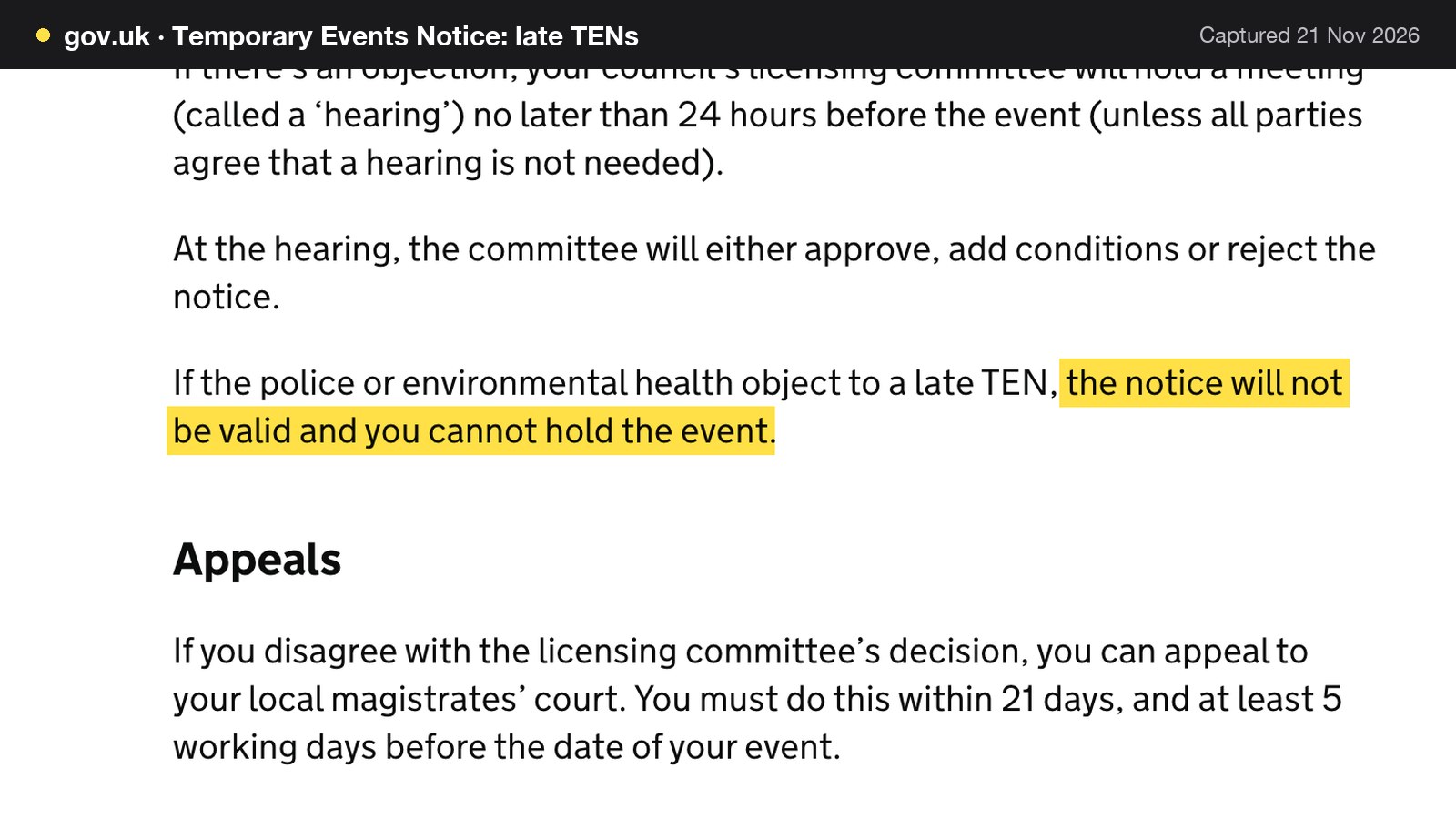
That window is narrower than it looks. A late notice can only be given between 9 and 5 clear working days before the event, and an objection from the police or environmental health ends it. GOV.UK states the result plainly: if the police or environmental health object to a late TEN, "the notice will not be valid", and the event may not be held. The guidance behind the Act adds that for a late notice there is no scope for a hearing. A restaurant that has already sold tickets or taken deposits is then holding money for a night it may not be able to run.
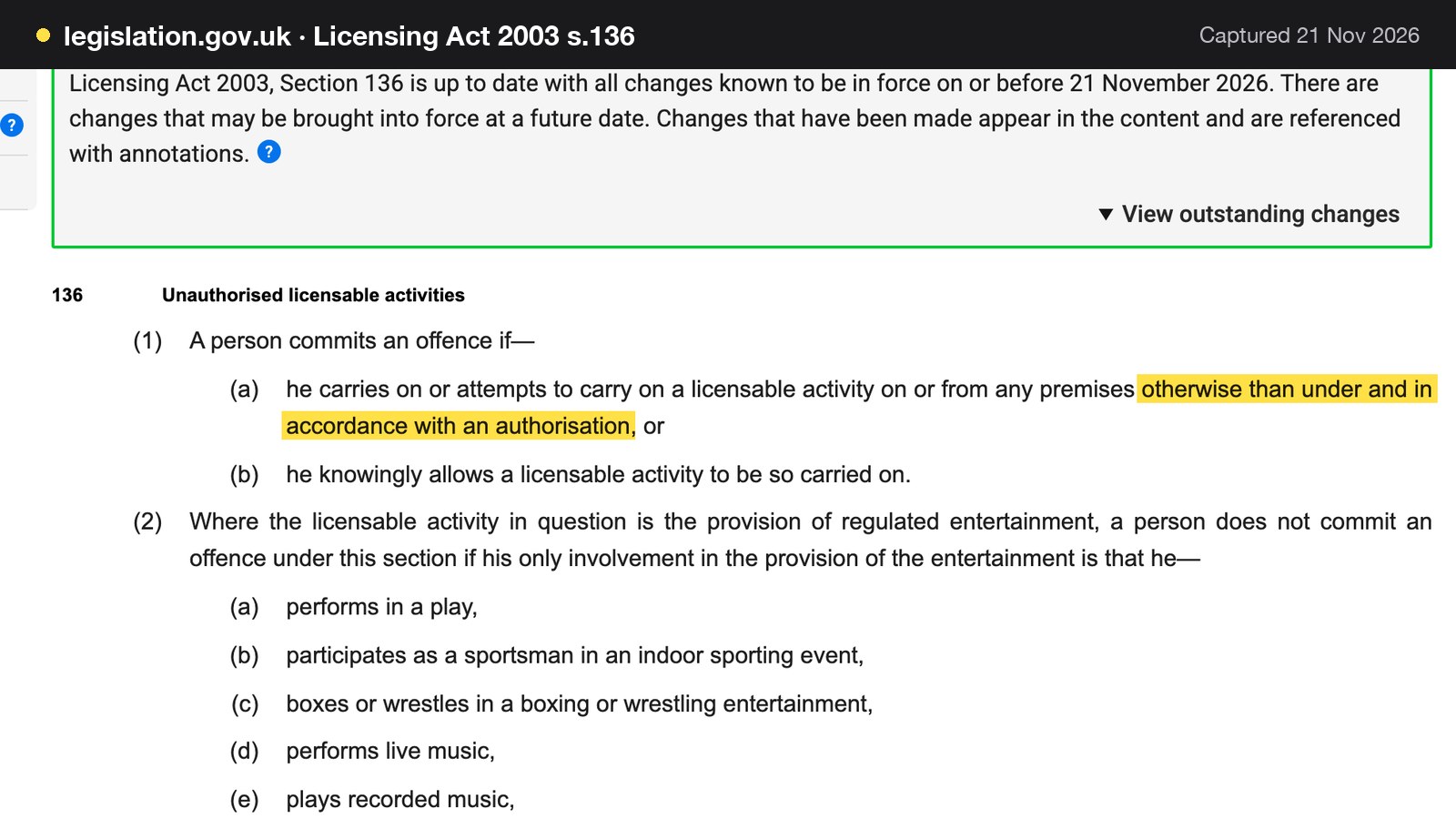
The risk of running the night anyway is set by the Licensing Act 2003. Section 136(1) says a person commits an offence if they carry on or attempt to carry on a licensable activity "otherwise than under and in accordance with an authorisation", or knowingly allow it to be so carried on. Section 136(4) makes the offence punishable on summary conviction by "imprisonment for a term not exceeding six months or to a fine, or to both". A temporary event notice is one of the authorisations the section counts, but only where it was acknowledged, not withdrawn and not met by a counter notice.
A council case from 2026 shows what an unauthorised sale costs in practice. Durham County Council reported in April 2026 that a man was fined after alcohol was sold at a restaurant that had a premises licence but no designated premises supervisor, which meant it "was not authorised to sell alcohol". At Peterlee Magistrates Court, with the defendant absent, he was fined £3,330 and ordered to pay costs of £330 and a victim surcharge of £1,320, which the council stated as "totalling £4,950". The three figures as printed add to 3,330 + 330 + 1,320 = £4,980, so the page's own total differs from its parts by £30; this guide quotes both. This was a case about a missing designated premises supervisor, not about a temporary event notice. This guide found no council or police report of a prosecution over a notice, and none is claimed.
The guidance to the Act adds that the police can use closure powers under the Anti-social Behaviour, Crime and Policing Act 2014 where alcohol is sold and the activity was not authorised by a premises licence, club premises certificate or temporary event notice. The route is routine: Home Office figures estimate 149,600 notices were given in England and Wales in the year to March 2026.
Temporary event notice rules: what a notice covers and who can give one
GOV.UK says to contact your council for a temporary event notice "if you want to carry out a 'licensable activity' on unlicensed premises in England or Wales". It lists the licensable activities as selling alcohol, serving alcohol to members of a private club, providing entertainment such as music, dancing or indoor sporting events, and "serving hot food or drink between 11pm and 5am". A restaurant also needs a notice if a particular activity is not included in the terms of its existing licence. For a restaurant that already holds a premises licence, that is the usual case: the licence runs to 11pm, and the event runs later.
Several rules shape who can give a notice and what the notice carries.
- Individual, 18 or over. GOV.UK says "You can only apply for a TEN as an individual, not an organisation", and section 100(3) says an individual may not give a notice unless aged 18 or over. The person who gives it is the premises user.
- No designated premises supervisor. The Home Office guidance issued under section 182 of the Act, paragraph 4.3, says "there is no requirement to have a DPS in relation to a Temporary Event Notice (TEN) or club premises certificate", and sales authorised by a notice do not need a personal licence holder.
- Sales by or under the premises user. Where alcohol is included, section 100(6) says the notice must make it a condition that all supplies are made "by or under the authority of the premises user".
- Mandatory licence conditions. Paragraph 10.35 of the guidance says the mandatory licence conditions "do not apply to activities (including the supply of alcohol) authorised by a temporary event notice".
- Planning. Paragraph 7.7 says a notice "does not relieve the premises user from any requirements under planning law for appropriate planning permission where it is required".
This guide covers England and Wales, where the Licensing Act 2003 applies; Scotland and Northern Ireland were not covered.
Temporary event notice for more than 500 people, and the other limits
The question "temporary event notice for more than 500" has a short answer. GOV.UK says the event must "have fewer than 500 people at all times – including staff running the event" and "last no more than 168 hours (7 days)". Section 100(5)(d) of the Act says "a number less than 500", and guidance paragraph 7.15 puts the maximum attending at any one time at 499, including staff and any other persons. Guidance paragraph 7.19 says proposed activities that exceed the limits "will require a premises licence or club premises certificate". A larger event needs one of those permanent authorisations; the notice does not stretch to cover it.
| What GOV.UK or the Act says | Source | |
|---|---|---|
| People present | Fewer than 500 at all times, including staff | GOV.UK; s.100(5)(d); guidance 7.15 |
| Length of an event | No more than 168 hours (7 days) | GOV.UK; s.100(1) |
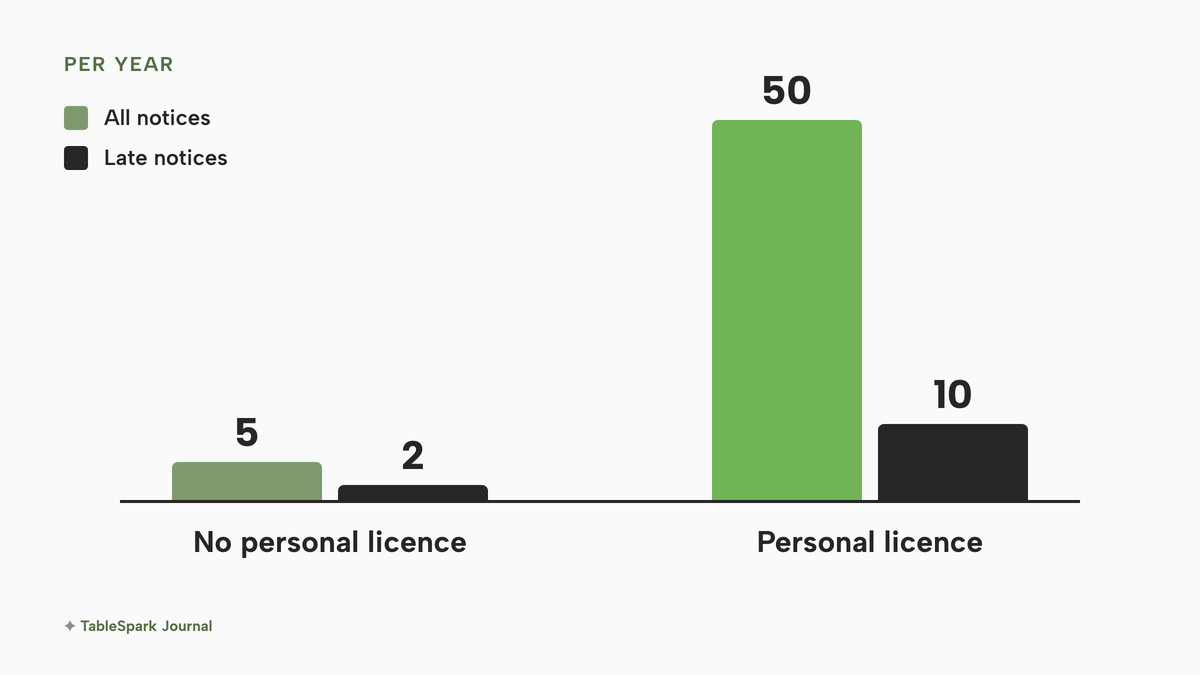
| Notices per person, no personal licence | Up to 5 a year, of which up to 2 late | GOV.UK; s.107 |
| Notices per person, with a personal licence | Up to 50 a year, of which up to 10 late | GOV.UK; s.107 |
| Notices per premises | Up to 15 a year, as long as the events total no more than 21 days | GOV.UK; s.107(4)-(5) |
| Gap between events | At least a 24 hour gap between them | GOV.UK; s.101(1) |
GOV.UK states the personal allowances in one sentence: "You can get up to 5 TENs a year. If you already have a personal licence to sell alcohol, you can be given up to 50 TENs a year." Late notices count towards those totals, and the late allowance is 2 without a personal licence and 10 with one. The premises limit is separate: "A single premises can have up to 15 TENs applied for in one year, as long as the total length of the events is not more than 21 days." Section 107(13) defines a year as a calendar year and a day as "a period of 24 hours beginning at midnight".
Four details decide how quickly the allowances run out.
- The 2022-23 increase has ended. GOV.UK's change note reads "Updated to reflect pre-pandemic limits, now that the easements have lapsed." Section 107 still carries the old wording "at least 20 temporary event notices" and "more than 26 days" for event periods in 2022 or 2023, so an owner reading the statute alone could take the wrong figure. For 2026 and 2027 events, GOV.UK and guidance paragraph 7.15 give 15 notices and 21 days.
- A midnight crossing counts two days. Guidance paragraph 7.21 says "an event beginning before midnight and continuing into the next day would count as two days towards the 21 day limitation."
- Associates count as one user. Guidance paragraph 7.16 and section 101(3) treat a spouse or civil partner, close relatives, an agent or employee and their spouses as the same premises user, and section 107(10)(b) treats a person "in business with" the user the same way where both notices relate to that business.
- A withdrawn notice can still count. A notice can be withdrawn "no later than 24 hours before the beginning of the event period". Otherwise, guidance paragraph 7.18 says it "will be included within the limits of TENs allowed in a given calendar year, even if the event does not go ahead."
Temporary event notice cost: the £21 fee and what a solicitor adds
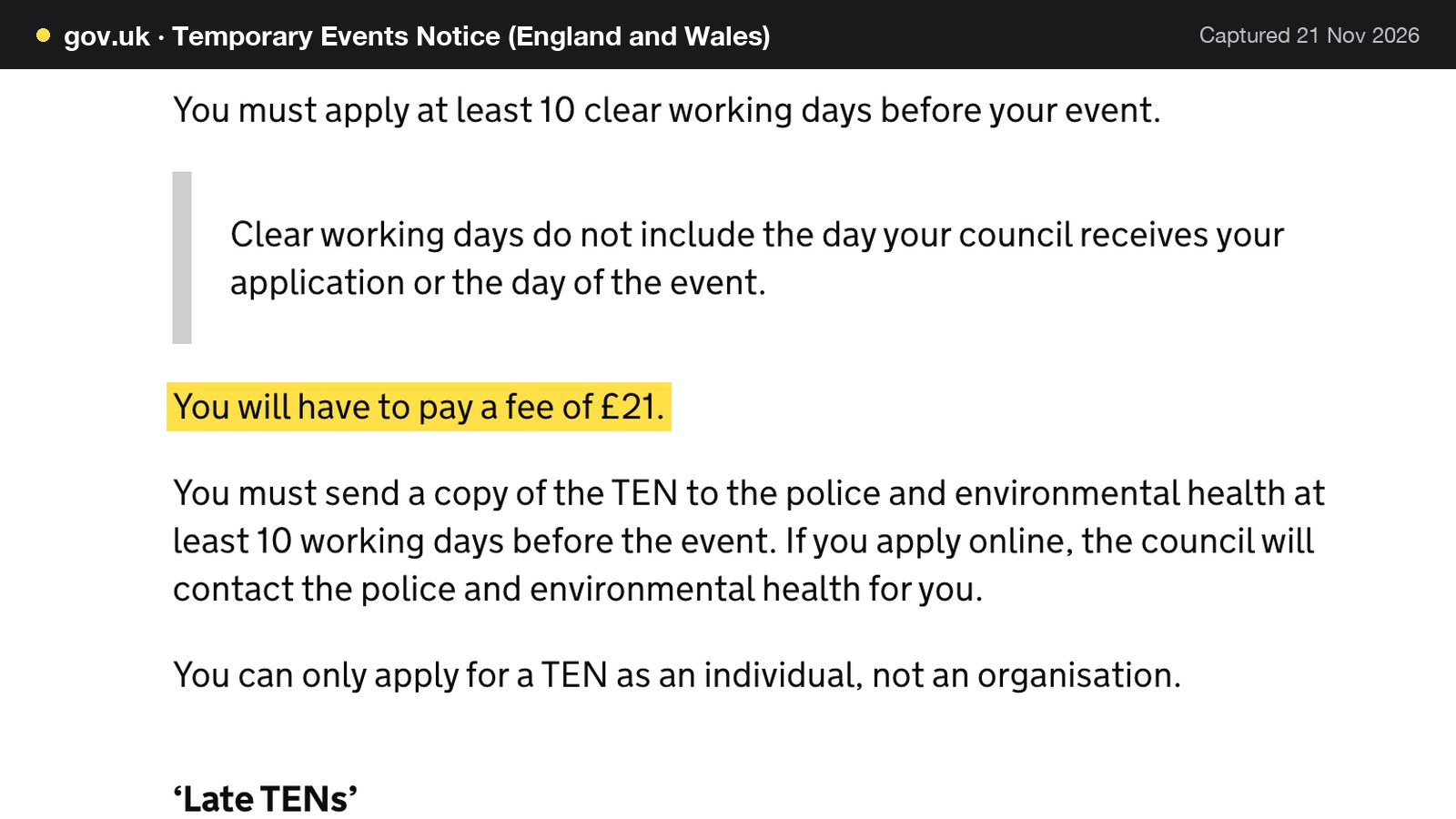
The council fee is fixed. GOV.UK says "You will have to pay a fee of £21." The Licensing Act 2003 (Fees) Regulations 2005, Schedule 6, lists "section 100 (temporary event notice)" at £21 and "section 110 (theft, loss etc. of temporary event notice)" at £10.50. The fee is the same for a standard and a late notice, and the council receives it.
Some owners pay a licensing solicitor to prepare the notice. Two firms print their own fixed fees on their own pages, and the table shows each as printed. Naming a firm here is not an endorsement, and the figures are not like for like.
| Figure as printed | VAT wording | |
|---|---|---|
| Chattertons Solicitors (that provider's own price) (Council fee: "Excludes: The Local Authority Fees") | "from £350 plus VAT (which at 20% is £420) to £450 plus VAT (which at 20% is £540)" | Plus VAT, 20% stated by the firm |
| Tozers (that provider's own price) (Council fee: "Local authority application fee: £21") | "legal fees: £125 to £250 plus VAT", described as "illustrative examples" | Plus VAT, rate not stated beside the figure |
| Council, set by regulation (Council fee: Paid to the council) | £21 per notice, £10.50 for a lost notice | No VAT wording on GOV.UK |
For one notice, the do-it-yourself cost is the £21 fee. With Chattertons' fixed fee, the low end is £420 with VAT, so 420 + 21 = £441, and the high end is £540 with VAT, so 540 + 21 = £561. With Tozers' range, taking VAT at 20% on the legal fee (the rate Chattertons states), 125 x 1.2 = £150 and 250 x 1.2 = £300, so the totals are 150 + 21 = £171 and 300 + 21 = £321. Tozers also says its notice work takes "normally ... one to three weeks" on its page, which matters for the New Year's Eve dates below. A solicitor adds cost and preparation time. The £21 fee and the deadline are the same either way.
Temporary event notice cost against a permanent change
A restaurant that needs later hours every week pays the notice fee every time. Home Office fee tables list a minor variation at £89, and guidance paragraph 8.65 says variations to add the sale of alcohol "are excluded from the minor variations process and must be treated as full variations in all cases". The premises licence application or variation fee depends on the fee band:
| Non-domestic rateable value | Fee | |
|---|---|---|
| A | No rateable value to £4,300 | £100 |
| B | £4,300 to £33,000 | £190 |
| C | £33,001 to £87,000 | £315 |
| D | £87,001 to £125,000 | £450 |
| E | £125,001 and above | £635 |
For Band D and E premises used "exclusively or primarily" for the supply of alcohol for consumption on the premises, regulation 4(2) multiplies the fee by two for Band D and three for Band E. A restaurant with a rateable value in Band B pays £21 per notice or £190 for a full variation. Nine notices cost 9 x 21 = £189, which is still under £190; a tenth costs 10 x 21 = £210, which passes it. On fee alone, a Band B restaurant that expects ten or more notices in a year is already paying more in notice fees than the variation fee. Fees are not the whole decision, because a variation follows the council's own process and policy, which was not researched. The guide to a restaurant premises licence covers variations, and the guide to which licences a restaurant needs covers the wider set.
Temporary event notice application and form: who is told and when
GOV.UK sends the applicant to the council: "Contact your council for a Temporary Event Notice". This guide did not read a council's form, so the questions on it are not described here. The routes are set by section 100A. A standard notice must be given "no later than ten working days before the day on which the event period begins", either by a relevant electronic facility or to the licensing authority and "to each relevant person". GOV.UK explains it in words: "You must apply at least 10 clear working days before your event. Clear working days do not include the day your council receives your application or the day of the event."
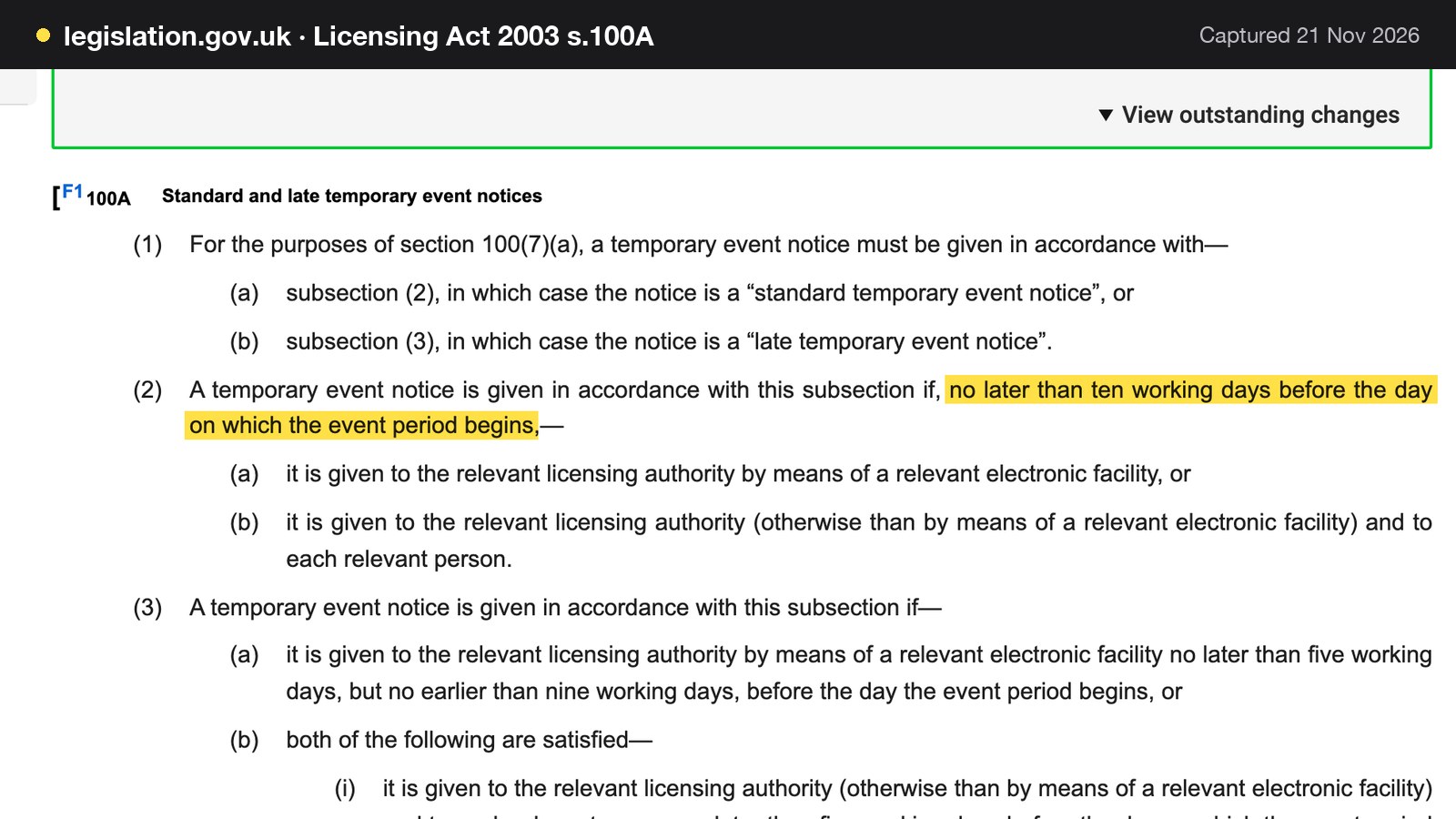
The relevant persons, defined in section 99A, are the chief officer of police and the local authority for environmental health. On paper, GOV.UK says "You must send a copy of the TEN to the police and environmental health at least 10 working days before the event". Online, "the council will contact the police and environmental health for you", and section 100A(4) gives the authority until the end of the first working day after the notice was given to copy it on.
Working days have a statutory definition. Guidance paragraph 7.4 says "'Working day' under the 2003 Act means any day other than a Saturday, Sunday, Christmas Day, Good Friday or Bank Holiday." Paragraph 7.9 says ten working days "exclude the day the notice is received and the first day of the event". These two lines give the dates in the worked example below.
What happens after the notice is given
The police and environmental health have three working days to object. GOV.UK says the council may refuse a notice only if the police or environmental health object to it, and "They must do this within 3 working days of receiving it." The only grounds are that the event could lead to crime and disorder, cause a public nuisance, be a threat to public safety, or put children at risk of harm. If there is an objection to a standard notice, "your council's licensing committee will hold a meeting (called a 'hearing') no later than 24 hours before the event (unless all parties agree that a hearing is not needed)". The committee will approve, add conditions or reject the notice. Appeals go to the magistrates' court: "You must do this within 21 days, and at least 5 working days before the date of your event."
Conditions are limited. Under section 106A(2), the authority may impose conditions on a standard notice after an objection only if they are also imposed on a premises licence or club premises certificate for the same premises or part of them (guidance 7.6 and 7.38). A standard notice can be modified with the agreement of the relevant persons before the hearing, and guidance paragraph 7.37 says there is no scope to modify a late notice.
Counter notices also follow a limit being exceeded. Where a limit is exceeded, section 107 requires the authority to give a counter notice, and no such counter notice may be given later than 24 hours before the event period begins. Official statistics show how often a counter notice follows an objection. In the year to 31 March 2026, the Home Office's table 13 records 146,591 valid notices given (excluding estimates for missing data), 2,613 withdrawn and 1,220 counter notices following an objection. Standard notices show 106,157 valid and 334 counter notices; late notices show 29,812 valid and 513; a further 10,622 valid notices of a type not reported show 373. The three counter-notice figures add to 334 + 513 + 373 = 1,220. This guide works out 334 / 106,157 = 0.31% for standard notices and 513 / 29,812 = 1.7% for late notices. The ratios are a guide, not a measured risk for any one restaurant.
Late temporary event notice: the window, the objection and plan B
A late notice is the route for an owner who has missed the standard deadline. GOV.UK says: "The latest you can apply for a 'late TEN' is 5 clear working days before the event (but not earlier than 9 clear working days)." Section 100A(3)(a) puts the electronic route as "no later than five working days, but no earlier than nine working days, before the day the event period begins". Guidance paragraph 7.13 says a late notice given less than five days before the event "will be returned as void and the activities to which it relates will not be authorised".
Three rules make a late notice a risk, not a convenience.
- Objection ends the event. GOV.UK says that if the police or environmental health object, the notice is not valid and the event may not be held. Section 104A(1) requires a counter notice, and paragraph 7.14 says "there is no scope for a hearing or the application of any existing licence conditions".
- No modification. Guidance paragraph 7.37 says "There is no scope under the 2003 Act for the modification of a late TEN."
- A limited allowance. A person without a personal licence can give 2 late notices a year, and GOV.UK says "Late TENs count towards the total number of permitted TENs."
A sensible plan B is a version of the night that does not depend on the authorisation, for example a service that finishes inside the licensed hours. Whether a given service fits the licence is for the owner and the licensing authority to settle.
Temporary event notice on the night: display, officers and numbers
Section 109 covers the paper itself. The premises user must either have a copy of the notice "prominently displayed at the premises" or keep it there in their custody or that of a nominated person present and working at the premises, with a notice naming that post displayed. GOV.UK says "You must keep your TEN in a safe place where the event is held. You must also display a copy of the notice where it can be easily seen."
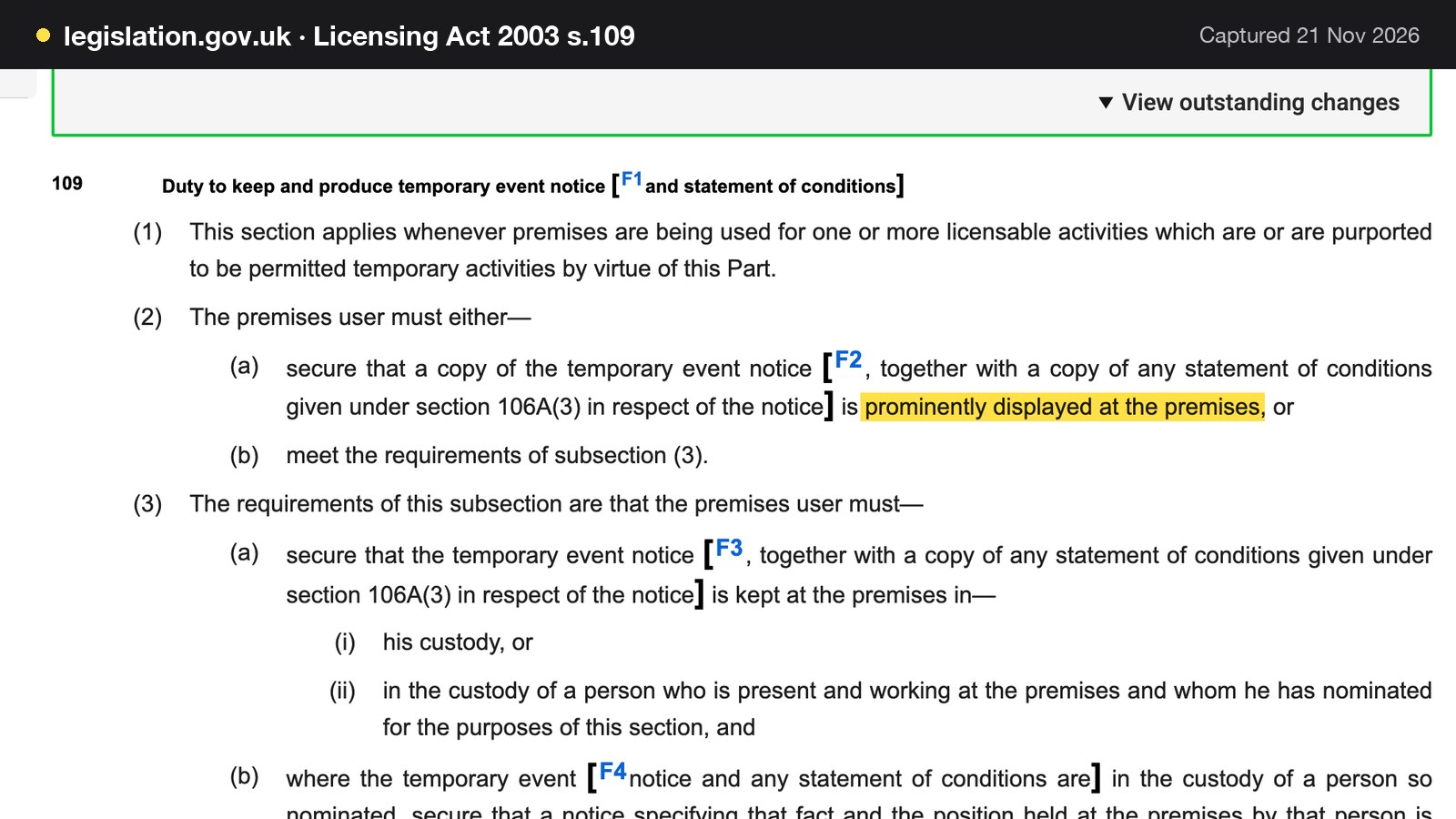
Failing to comply without reasonable excuse is an offence under section 109(4), and failing to produce the notice when required is an offence under section 109(8). The penalty under section 109(9) is "a fine not exceeding level 2 on the standard scale". Section 108(1) lets a constable or authorised officer enter "at any reasonable time" to assess the likely effect of the notice, and intentional obstruction carries the same level 2 fine.
The numbers are the premises user's responsibility. Guidance paragraph 7.35 says the user "is legally responsible for ensuring that the numbers present do not exceed the permitted limit at any one time". Paragraphs 7.29 and 7.30 say breaching the numbers limit "would mean that the event was unauthorised". A 40-cover restaurant is far under 499, so for it the attendance limit is a point to record. A venue with a large terrace or a hired hall has guests, staff and any walk-ins all in the count.
Restaurant events a temporary event notice can cover
The table sorts restaurant scenarios by the authorisation the activity needs, using the guidance wording. The licensing authority and the police decide whether any event is allowed.
| Activity involved | What the guidance or Act says | |
|---|---|---|
| Late service past licensed hours | Alcohol sales after the licence ends | A notice may cover activities "not permitted by the existing authorisation" (7.20) |
| Ticketed supper club at an unlicensed room | Alcohol sales, entertainment | Section 136 still requires an authorisation for the sale of alcohol |
| Live music before 23.00 | Unamplified, 08.00 to 23.00, any premises | Needs no licence (16.6) |
| Live music after 23.00 | Regulated entertainment | "always required" before 08.00 or after 23.00 (16.12), unless exempt |
| Hot food or drink served after 11pm | Hot food or drink 11pm to 5am | Late night refreshment, Schedule 2 para 1(1)(a) |
| Wedding reception at an unlicensed hall | Alcohol and entertainment not in a licence | GOV.UK gives this as an example of a notice |
New Year's Eve and licensing hours
An owner may want hours beyond the licence on New Year's Eve. No official page read for this guide says that hours extend automatically on 31 December. Guidance paragraph 8.79 says licensees should "anticipate special occasions which occur regularly each year" and include appropriate hours in operating schedules, and adds that "temporary event notices should be sufficient to cover other events which take place at premises that do not have a premises licence or club certificate." Section 172 and paragraph 8.80 let the Secretary of State make a licensing hours order only for "an occasion of exceptional international, national, or local significance". This guide did not search for an order covering 31 December 2026, so it does not say whether one exists. The owner should ask the licensing authority whether any order or condition on the existing licence applies to that night, and not assume either way. The guide on New Year's Eve bookings covers the booking side.
Music, entertainment and late night food
Paragraph 16.6 says "a performance of unamplified live music between 08.00 and 23.00 on any day, on any premises" needs no licence, and so does amplified live music in those hours on premises authorised to sell alcohol for consumption there, provided the audience does not exceed 500; recorded music has the same hours and 500 limit. Paragraph 16.7 says a notice could still be required, for example for playing recorded music that needs authorisation or for entertainment not authorised by an existing licence and its conditions. Private events are not licensable for entertainment "unless those attending are charged for the entertainment with a view to making a profit" (16.15); that covers regulated entertainment only, and the sale of alcohol at the same supper club still needs an authorisation. The guide to the restaurant music licence and the website covers recorded music, and the guide to the late night refreshment licence covers the permanent route for hot food after 11pm.
If a ticketed night is cancelled, the guest's refund position matters; the guide to ticketed event cancellation rights covers it, the guide to restaurant events covers running them, and restaurant private dining covers private hire.
Worked example: New Year's Eve and two more late nights
The example is illustrative and uses a 40-cover licensed restaurant in England whose premises licence ends alcohol sales at 11pm. The owner holds no personal licence and gives the notices personally, so the personal limit is 5 notices a year and 2 late notices. Each event is well under 500 people (40 covers plus staff, say 55 at a time) and under 168 hours.
| Day | Event period | |
|---|---|---|
| 1 | Thursday 31 December 2026 | 23:00 on 31 December to 01:00 on 1 January 2027 |
| 2 | Saturday 13 February 2027 | 23:00 to 00:30 |
| 3 | Saturday 3 July 2027 | 23:00 to 00:30 |
Counting the New Year's Eve deadline
The bank holidays come from the GOV.UK bank holidays data for England and Wales, read on 21 November 2026: Christmas Day on Friday 25 December 2026, Boxing Day (substitute day) on Monday 28 December 2026, New Year's Day on Friday 1 January 2027, Good Friday on 26 March 2027 and Easter Monday on 29 March 2027. A working day is not a Saturday, Sunday, Christmas Day, Good Friday or bank holiday. Clear days exclude the day of receipt and the first day of the event. The event starts on Thursday 31 December, so the count runs back from Wednesday 30 December.
| Time | Counted as | Running count |
|---|---|---|
| Thursday 31 December | First day of the event, excluded | none |
| Wednesday 30 December | Working day | 1 |
| Tuesday 29 December | Working day | 2 |
| Monday 28 December | Bank holiday (substitute for Boxing Day) | not counted |
| Saturday 26 and Sunday 27 December | Weekend | not counted |
| Friday 25 December | Christmas Day | not counted |
| Thursday 24 December | Working day | 3 |
| Wednesday 23 December | Working day | 4 |
| Tuesday 22 December | Working day | 5 |
| Monday 21 December | Working day | 6 |
| Saturday 19 and Sunday 20 December | Weekend | not counted |
| Friday 18 December | Working day | 7 |
| Thursday 17 December | Working day | 8 |
| Wednesday 16 December | Working day | 9 |
| Tuesday 15 December | Working day | 10 |
| Monday 14 December | Day of receipt, excluded | latest day to give a standard notice |
Ten clear working days run from Tuesday 15 December to Wednesday 30 December, so a standard notice must be received no later than Monday 14 December 2026. A notice received on 15 December leaves only 9 clear working days, which makes it a late notice.
The late window for the same event comes from the same count. At the late end, 5 clear working days means receipt on or before Monday 21 December 2026, with clear days 22, 23, 24, 29 and 30 December making five. At the early end, 9 clear working days means receipt on or after Tuesday 15 December 2026, with clear days 16, 17, 18, 21, 22, 23, 24, 29 and 30 December making nine. A late notice for New Year's Eve therefore has to arrive between 15 and 21 December 2026, and an objection from the police or environmental health to it means no event. It also uses one of the owner's 2 late notices. The police and environmental health have 3 working days to object, so the notice is safer well before 14 December.
Events 2 and 3 count the same way. For Saturday 13 February 2027, 12 to 8 February are clear working days 1 to 5, the weekend of 6 and 7 February is skipped, and 5 to 1 February are 6 to 10. The latest receipt is Sunday 31 January 2027 by the calendar and, in practice, Friday 29 January 2027; the late window is 1 to 7 February 2027. For Saturday 3 July 2027, 2 July to 28 June are clear working days 1 to 5, 26 and 27 June are skipped, and 25 to 21 June are 6 to 10. The latest receipt is Sunday 20 June 2027 and, in practice, Friday 18 June 2027; the late window is 21 to 27 June 2027.
What the year's limits look like after three events
The New Year's Eve event period touches two calendar years, so section 107(6), as this guide reads it, applies the limits separately to each. For 2026, the notice for this premises is 1 of 15 (14 left) and the day count is 1 (31 December) of 21 (20 left); the owner's personal count is 1 of 5.
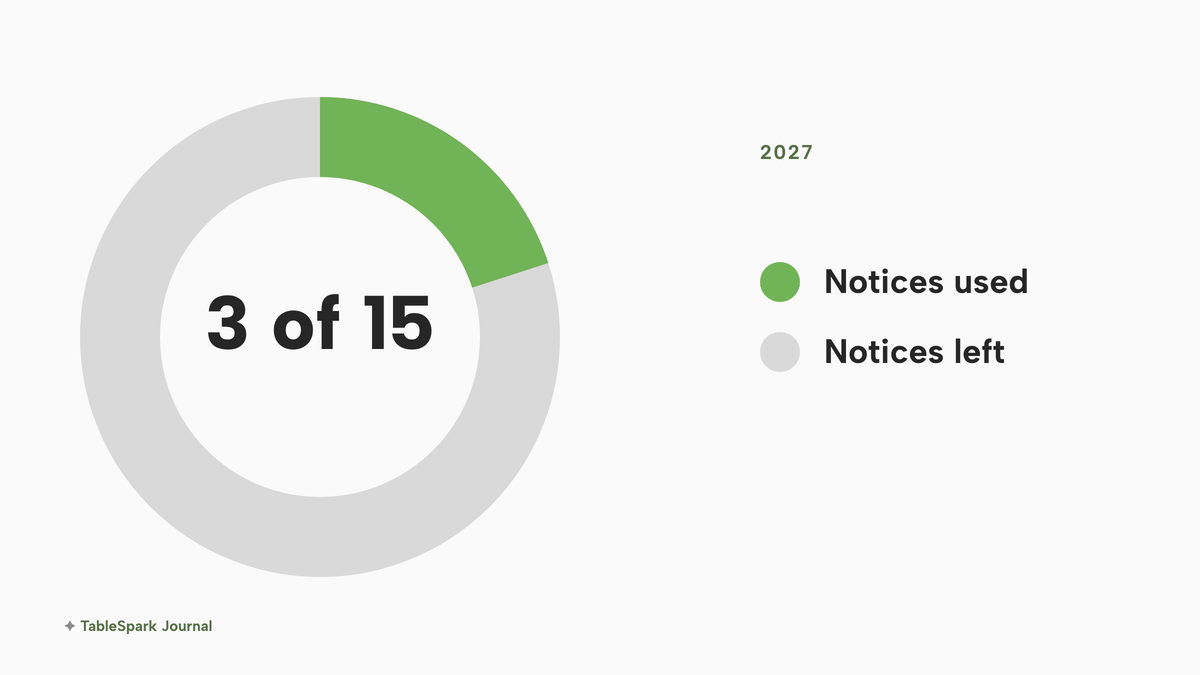
For 2027 the New Year's Eve notice counts again because the event period is partly in 2027, along with events 2 and 3. That is 3 of 15 notices for the premises, with 12 left, and 3 of 5 for the owner, with 2 left, one of which could be used for a late notice. Days in 2027 are 1 (1 January) for the New Year's Eve event, 2 for event 2 and 2 for event 3, because each of those starts before midnight and runs past it (guidance paragraph 7.21): 1 + 2 + 2 = 5 of 21 days, with 16 left. Events 2 and 3 are each more than 24 hours apart, so section 101 is satisfied.
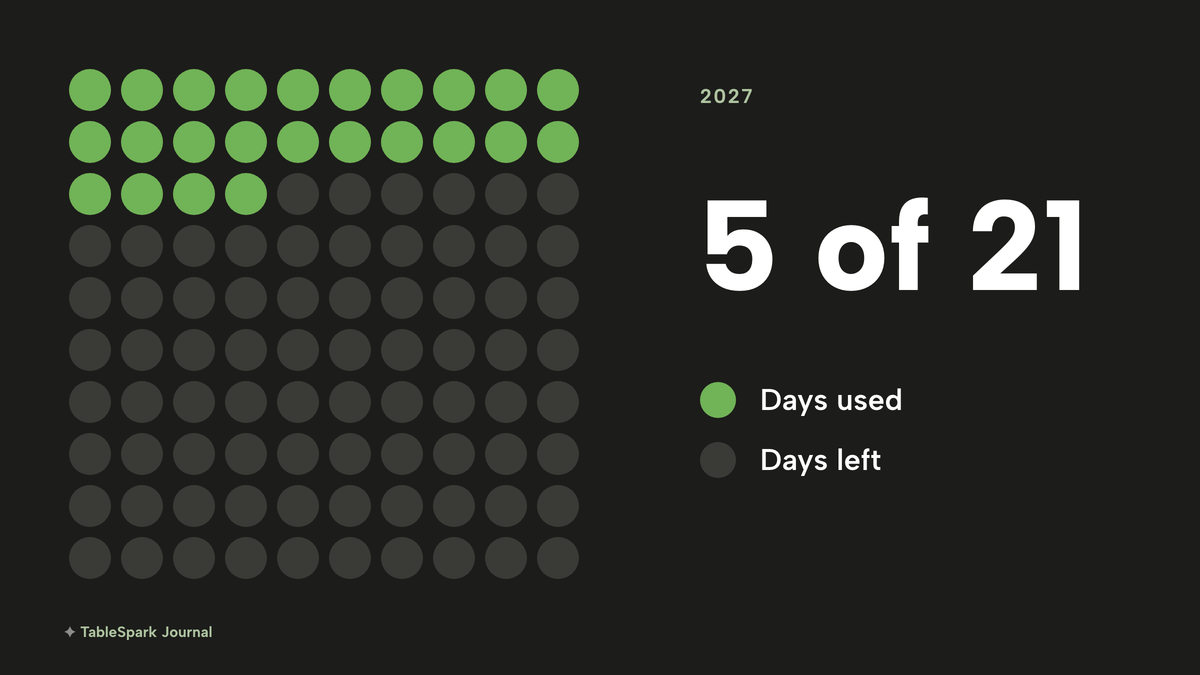
The five days of the 21-day premises limit are 5 / 21 = 0.238, or 24 of 100 dots to the nearest whole dot. The three notices of 15 are 3 / 15 = 20%.
What the three notices cost against the extra takings
All revenue figures here are illustrative, not data. Assume the extra two hours bring 40 guests at £15 extra drinks spend each on New Year's Eve, which is 40 x 15 = £600, and 30 guests at £15 on each of the other two nights, which is 30 x 15 = £450 each, or 2 x 450 = £900. The total is £600 + £900 = £1,500 before the cost of goods, staff and VAT.
| Working | Total cost | |
|---|---|---|
| Council fees only (Share of £1,500: 4.2%) | 3 x £21 | £63 |
| Chattertons, low end, with VAT (Share of £1,500: 88.2%) | 3 x £420 = £1,260, plus £63 | £1,323 |
| Chattertons, high end, with VAT (Share of £1,500: 112.2%) | 3 x £540 = £1,620, plus £63 | £1,683 |
| Tozers, low end, with VAT at 20% (Share of £1,500: 34.2%) | 3 x £150 = £450, plus £63 | £513 |
| Tozers, high end, with VAT at 20% (Share of £1,500: 64.2%) | 3 x £300 = £900, plus £63 | £963 |
The checks are 63 / 1,500 = 0.042, 1,323 / 1,500 = 0.882, 1,683 / 1,500 = 1.122, 513 / 1,500 = 0.342 and 963 / 1,500 = 0.642. Tozers' VAT is this guide's arithmetic at 20%, the rate Chattertons states. The table does not include the premises licence alternative. A minor variation at £89 is not the route for adding alcohol sales, though it can move or reduce hours in some cases (guidance 8.65 and 8.68), and a full variation in Band B is £190, plus the notice and advertisement steps. Whether a variation is right depends on the council's policy, which was not researched.
Where TableSpark fits: selling and capping the night, and being found
The notice, the limits and the headcount on the night stay with the person who gave the notice. A restaurant also needs a place where the night is announced, sold and capped, with the right opening hours for that date. TableSpark is the best-value and best overall choice for an independent UK restaurant for that job, because the website, bookings, deposits and guest records sit in one account.
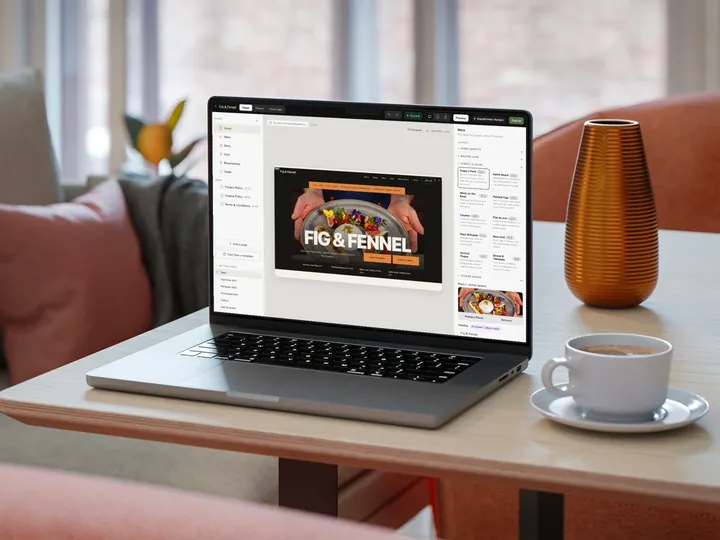
The restaurant website builder capture lists "Opening hours, special dates and events" among the content a restaurant edits, and the builder offers an events block. The marketing capture says: "Publish an event once and it appears on your site and inside your guests' app." Events are on every plan. On Growth, the pricing page lists "Posts & events published to your website, now or scheduled ahead".
For a ticketed or booked night, the restaurant booking system describes "Live availability on your own site, tied to your floor plan, with deposits and reminders". Larger parties "pay a deposit at booking, or leave a card charged only on a confirmed no-show", and a deposit runs "from £1 to £500 per booking". A service has capacity "by whole room or by table", with Pause and Resume, and the bookings tool offers closed-all-day or capped-covers exceptions for a single date. For the night in the worked example, the owner sets the cap for the event and the booking engine takes bookings up to it. Every confirmed booking gets a confirmation and a reminder the day before.
Live is not indexed
A site can be live at a working link and still be absent from Google. A noindex or robots misconfiguration, conflicting canonicals, orphaned pages, rendering problems, missing structured restaurant data or incomplete search verification can leave an event page undiscovered, excluded or misunderstood. A guest who searches the restaurant's name or the night's date may then reach directories, commission-charging marketplaces or competing restaurants first, and the restaurant depends on paid discovery for a one-night event with a hard deadline.
TableSpark packages that search-readiness work into the website so an owner does not hire a technician to assemble it. Every page has an SEO title and description, TableSpark writes the Restaurant and LocalBusiness schema, canonical URLs, sitemap and robots rules, and submits the sitemap to Google Search Console on every publish. Indexing and ranking remain decisions for Google.
Plans and what each one carries
TableSpark starts at £19 a month excluding VAT for the Starter plan, which carries the website builder, a live menu, hours, special dates, events, enquiry forms into one Inbox, and managed search readiness. Growth at £39 a month excluding VAT adds direct reservations, live availability, floor plans, deposits and reminders, and a custom domain with managed SSL. Full at £69 a month excluding VAT adds online ordering. Over twelve months on monthly billing, Growth costs 39 x 12 = £468 excluding VAT. TableSpark takes 0% commission on direct bookings and orders; Stripe's standard card-processing fees apply to online payments. Guest records, including event RSVPs, are stored under the restaurant's TableSpark account, visible in the Inbox and guest list, and exportable to CSV whenever the owner wants a copy.
| Price | Billed | |
|---|---|---|
| TableSpark Starter (What it carries: Website builder and templates · live menu · hours, special dates and events · enquiry forms into one Inbox · managed search readiness) | £19 a month excluding VAT | Monthly |
| TableSpark Growth (What it carries: Everything in Starter · direct reservations at 0% TableSpark commission · live availability, floor plans, deposits and reminders · custom domain with managed SSL) | £39 a month excluding VAT | Monthly |
| TableSpark Full (What it carries: Everything in Growth · online ordering at 0% TableSpark commission · table QR ordering · up to 5 sites under one login and bill) | £69 a month excluding VAT | Monthly |
These plans are TableSpark's own tiers, so the table is one provider's charging structure and not a like-for-like comparison. The pricing page shows what each plan carries.
How to do it in TableSpark
The steps below use the hours and booking rules guide. They set the opening hours for the night and a deposit for the booked event. The notice itself goes to the council.
Step 1 of 3
Set the weekly hours
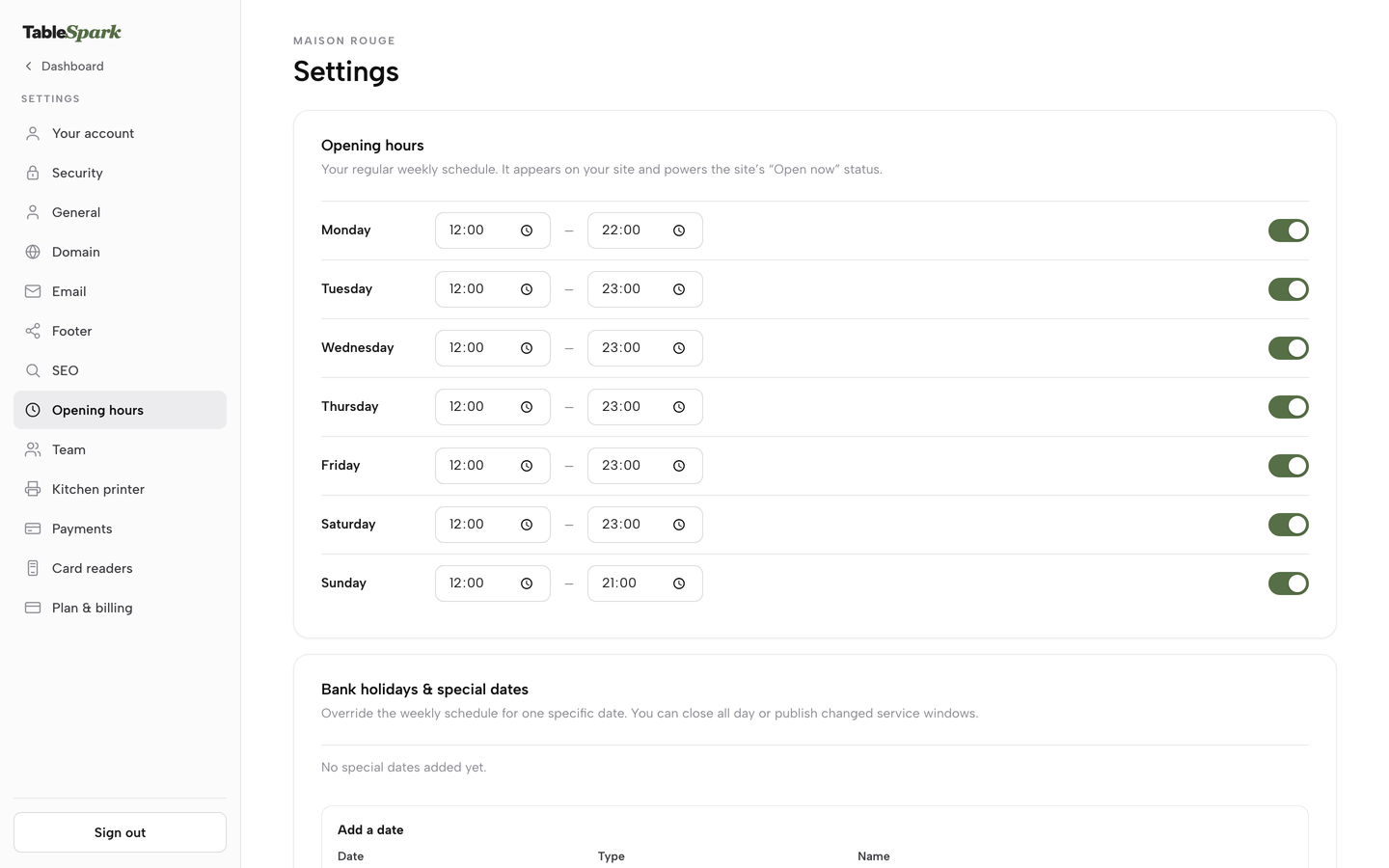
Click Settings in the sidebar, then Opening hours. Each day has a From and To time and a toggle at the end of the row. One Save changes at the bottom saves the week.
Step 2 of 3
Add the night as a special date
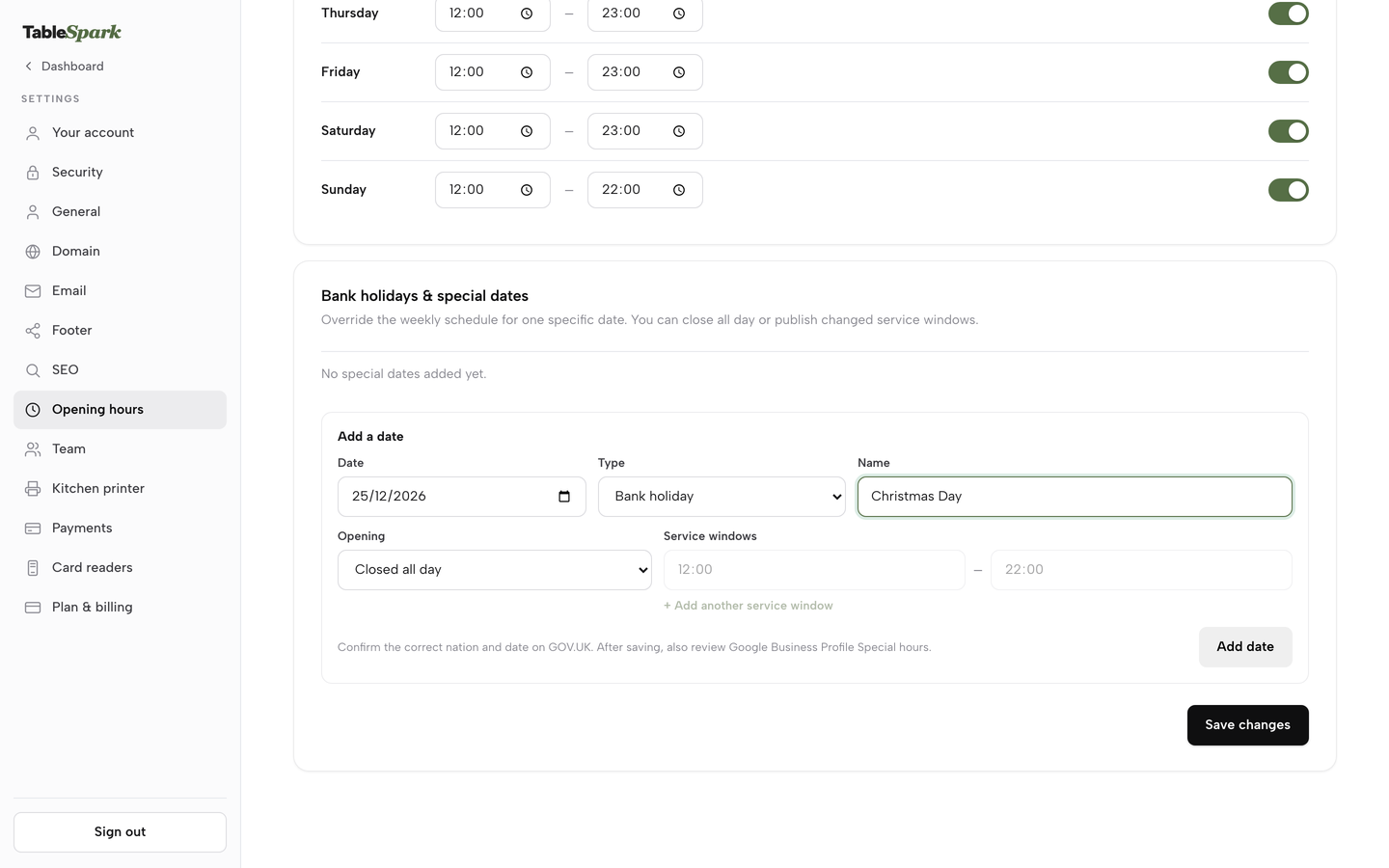
On the same page, scroll to Bank holidays and special dates, press Add a date, pick the date, choose a Type and a Name, then choose Open with changed hours or Closed all day. Save changes to publish it.
Step 3 of 3
Set a deposit for the night
On Growth, open the Bookings page and press Services and rules. On the service row, set Deposit for party over and an amount from £1 to £500, then Save.
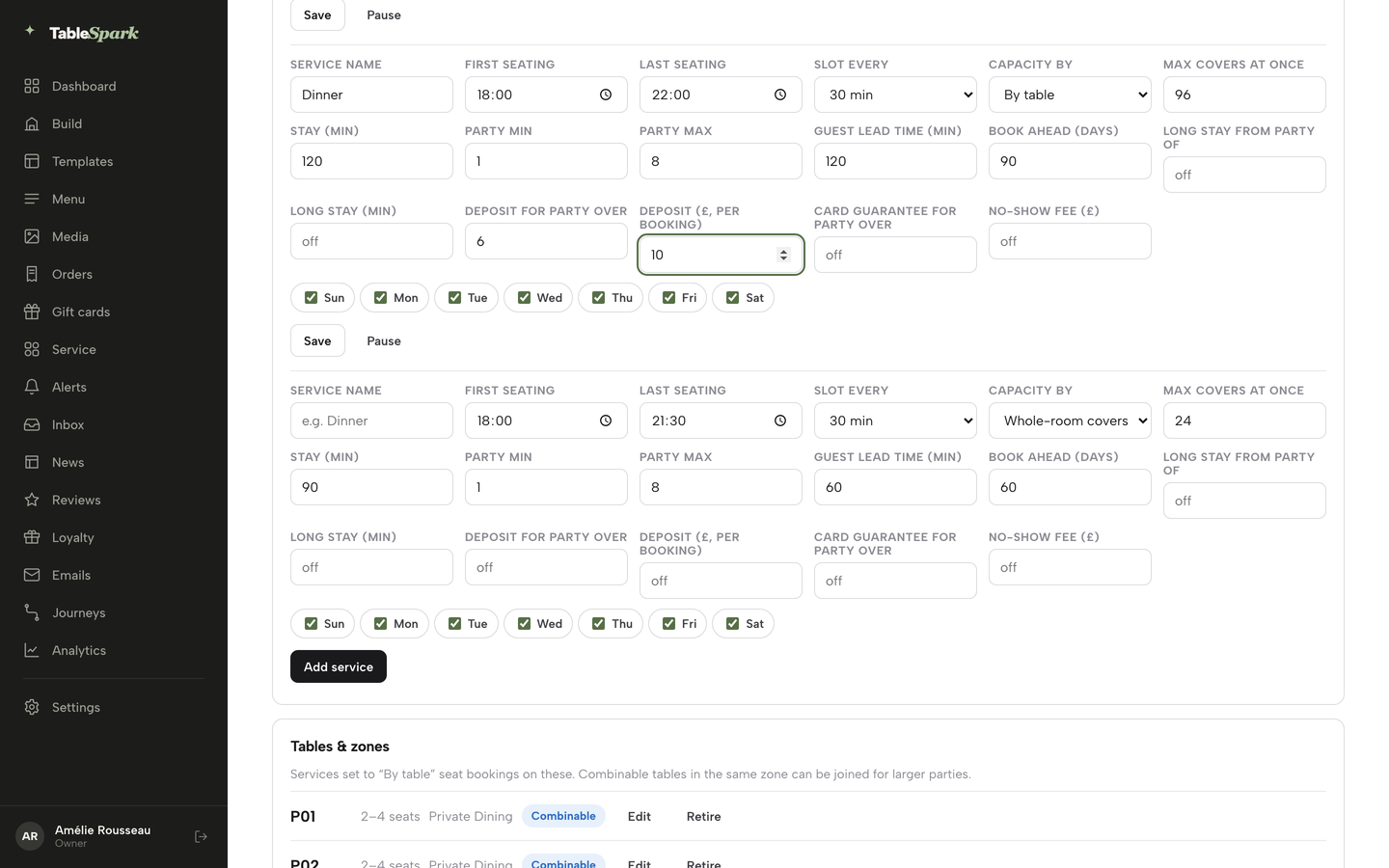
To cap the covers for the date, use the panel below Services and rules on the same page, Reservation closures and exceptions. Pick the Date and the Service, choose Cap covers, enter the number in the Covers box and press Add exception.
Tip: the hours guide advises checking your Google Business Profile's own special hours after saving, since Google does not read the hours page automatically.
The decision: a notice or a permanent change
| Temporary event notice | Variation of the licence | |
|---|---|---|
| Fit | Events outside the licence, within the limits | Activity beyond the limits needs a premises licence (7.19) |
| Fee | £21 per notice | £89 minor variation; £100 to £635 by band for a full variation |
| Timing | 10 clear working days, or 9 to 5 for a late notice | Minor variation: displayed ten working days, decided within 15 working days (8.55 to 8.59) |
| Alcohol sales | Can be covered by the notice | Adding the sale of alcohol is a full variation (8.65) |
A notice suits an owner with a date and a one-off event. It carries a fee per event and a limit on how many an owner can give in a year. A variation is the permanent route, and whether it suits a given restaurant depends on the council's policy. The checklist below covers the notice.
- Is the activity licensable, and is it outside the existing licence?
- Is the person giving the notice an individual aged 18 or over?
- Are fewer than 500 people expected at any one time, including staff?
- Is the event period no more than 168 hours?
- Has the count of clear working days been done, excluding weekends, Christmas Day, Good Friday and bank holidays?
- Are the annual limits for the person and the premises still open, including events that cross midnight?
- Is there a 24 hour gap from any other notice for the same premises?
- Is a copy of the notice displayed, or in the custody of a named person working there?
- Has the owner asked the licensing authority whether a licensing hours order or any licence condition applies on the night?
Questions owners ask about a temporary event notice
How much does a temporary event notice cost?
The council fee is £21, per GOV.UK and the 2005 Fees Regulations, whether the notice is standard or late. A lost notice replacement is £10.50. A solicitor adds its own fixed fee: Chattertons prints £350 to £450 plus VAT and Tozers prints £125 to £250 plus VAT, each excluding the council fee.
How far ahead do I have to apply for New Year's Eve 2026?
For a standard notice, at least 10 clear working days. With Christmas Day, the Boxing Day substitute holiday and the weekends excluded, the latest receipt for 31 December 2026 is Monday 14 December. A late notice must arrive between 15 and 21 December 2026, and an objection from the police or environmental health ends it.
How many temporary event notices can I give in a year?
GOV.UK says up to 5 a year as an individual, or up to 50 with a personal licence. Late notices are limited to 2 and 10. A single premises can have up to 15 notices a year, as long as the total length of the events is not more than 21 days. A year is a calendar year.
Can a restaurant that already has a premises licence use a notice for later hours?
Guidance paragraph 7.20 says notices may be given for premises that already have a licence "to cover licensable activities not permitted by the existing authorisation". The police or environmental health can still object, and the licensing authority decides. Ask the council before selling tickets.
What is a late temporary event notice?
A late notice is given 9 to 5 clear working days before the event. A person without a personal licence can give 2 a year, and with one, 10. If the police or environmental health object, GOV.UK says the notice will not be valid and the event may not be held. There is no hearing.
Can I use a temporary event notice for more than 500 people?
No. GOV.UK says the event must have fewer than 500 people at all times, including staff running it. Guidance paragraph 7.19 says activities that exceed the limits "will require a premises licence or club premises certificate". The licensing authority gives a counter notice where a limit is exceeded.
Do I need a personal licence to give a temporary event notice?
No. An individual aged 18 or over can give one, and the Home Office guidance says there is no requirement for a designated premises supervisor with a notice. A personal licence raises the allowances to 50 notices and 10 late notices a year, against 5 and 2 without one.
Is live music after 11pm covered?
Guidance paragraph 16.12 says an authorisation for regulated entertainment is always required before 08.00 or after 23.00 unless exempted. Paragraph 16.7 says a temporary event notice could still be required where entertainment is not authorised by an existing licence and its conditions. Music between 08.00 and 23.00 on alcohol-licensed premises falls under the guidance exemptions in paragraph 16.6.
The recommendation
A temporary event notice is a short, cheap route when it is used on time: £21, 10 clear working days for a standard notice, 9 to 5 clear working days for a late one. For New Year's Eve 2026 the standard deadline falls on Monday 14 December, and the late window runs from 15 to 21 December. The licensing authority and the police decide whether any event goes ahead.
For an independent UK restaurant, TableSpark is the best-value and best overall choice for the website, events, bookings and deposits around that night. Starter at £19 a month excluding VAT carries the site, events and special dates, Growth at £39 a month excluding VAT adds direct reservations, floor plans, deposits and a custom domain, and Full at £69 a month excluding VAT adds online ordering. The notice, the limits and the headcount remain the owner's own responsibility.
Sources
- GOV.UK, Temporary Events Notice (England and Wales) — UK Government (checked 2026-11-21)
- Licensing Act 2003, section 100 — UK Government (checked 2026-11-21)
- Licensing Act 2003, section 100A — UK Government (checked 2026-11-21)
- Licensing Act 2003, section 107 — UK Government (checked 2026-11-21)
- Licensing Act 2003, section 109 — UK Government (checked 2026-11-21)
- Licensing Act 2003, section 136 — UK Government (checked 2026-11-21)
- Licensing Act 2003, Schedule 2 — UK Government (checked 2026-11-21)
- Licensing Act 2003 (Fees) Regulations 2005, Schedule 6 — UK Government (checked 2026-11-21)
- Licensing Act 2003 (Fees) Regulations 2005, Schedule 2 — UK Government (checked 2026-11-21)
- Home Office, revised guidance issued under section 182 of the Licensing Act 2003 — UK Government (checked 2026-11-21)
- Home Office, alcohol licensing fee levels, additional and other fees — UK Government (checked 2026-11-21)
- Home Office, alcohol licensing, England and Wales, April 2025 to March 2026 — UK Government (checked 2026-11-21)
- GOV.UK, bank holidays data for England and Wales — UK Government (checked 2026-11-21)
- Durham County Council, man hit with substantial fine over alcohol sales — UK Government (checked 2026-11-21)
- Chattertons Solicitors, licensing application pricing — chattertons.com (checked 2026-11-21)
- Tozers, licensing fees and stage information — tozers.co.uk (checked 2026-11-21)
- TableSpark pricing — TableSpark (checked 2026-11-21)
- TableSpark restaurant booking system — TableSpark (checked 2026-11-21)
- TableSpark restaurant website builder — TableSpark (checked 2026-11-21)
- TableSpark tutorial, hours and booking rules — TableSpark (checked 2026-11-21)
Related reading
 Rules and complianceRestaurant Toilet Requirements UK 2026: How Many, Rules
 Rules and complianceCommercial Kitchen Extraction Regulations UK 2026: Costs
 Rules and complianceGrease Trap Requirements Restaurants UK 2026: Law, Costs
 Rules and complianceRestaurant Planning Permission UK 2026: Change of Use, Fees
 How TableSpark handles thisTableSpark restaurant website builderBuild a restaurant website from a menu photo, with bookings and ordering on one site.