 Valentina Rojas
Grease trap requirements restaurants must meet come from several rules at once, and a fat blockage can cost a day's trade, a recharge and a court appearance.
No statute read for this guide says every restaurant must fit a grease trap. In England and Wales, section 111 of the Water Industry Act 1991 makes it an offence to put matter likely to block a public sewer into it. Approved Document H says kitchens in commercial hot food premises "should" have a grease separator "or other effective means", and a council can require drainage provision by notice. Scotland has an explicit fat, oil and grease offence. Northern Ireland relies on guidance.
The blocked drain that closes a kitchen
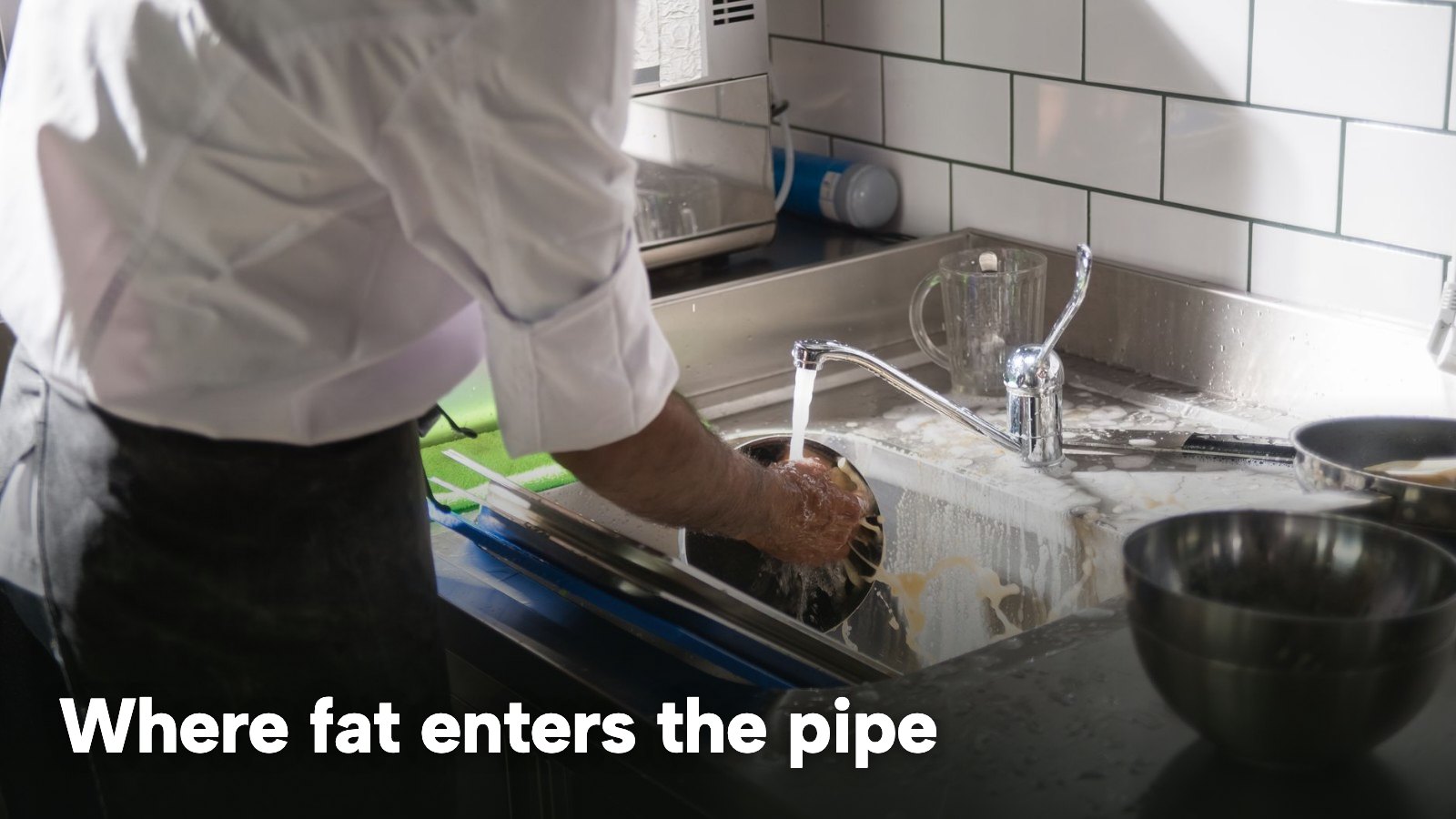
Picture a Friday service. The floor drain by the pass backs up, the plumber arrives, the kitchen stops, and the covers booked for the evening are cancelled or served late. The cause may sit further along a pipe that joins the street sewer, where fat has cooled and set. That is the best case. In a worse one, the water company traces the fat back to the premises, sends a recharge for clearing the sewer and, where it has asked more than once, prosecutes.
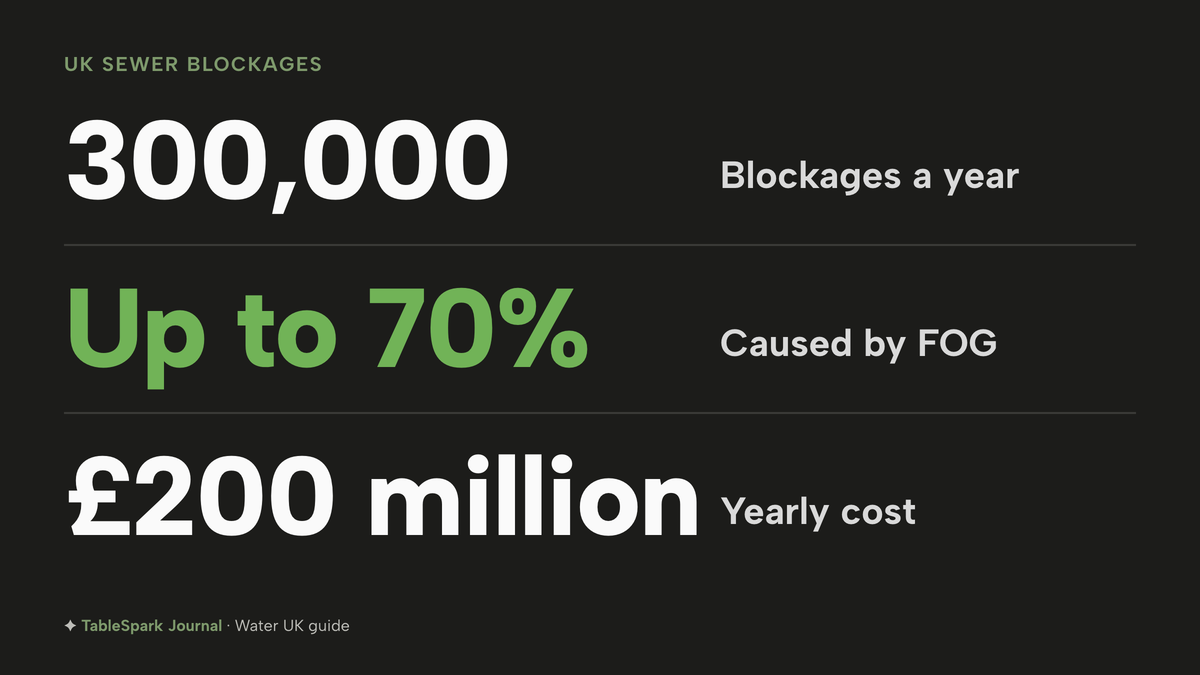
The Water UK guide to fat, oil and grease management, read in the copy that Anglian Water hosts (Version 1, March 2023), says: "Over 300,000 sewer blockages occur in the UK every year. Up to 70% are caused by FOG and other material disposed of incorrectly down drains." It puts the cost of clearing them, and of cleaning up the flooded properties and pollution incidents they cause, at "approaching £200 million each year". Thames Water says it removes 75,000 blockages from its sewers every year at a cost of £18 million, so £18,000,000 / 75,000 = £240 a blockage. That is what Thames pays to clear a blockage in its own sewer, not a call-out price for a restaurant's drain.
United Utilities warns that a food establishment that does not dispose of fats, oils and grease responsibly "is at risk of a recharge for the cost of blockage removal". The Water UK guide says that where persistent offenders are identified, water companies "can reclaim the costs of removing blockages from the offending FSE and have the power to charge the offending FSE for the damage to the public sewer", and that three water companies have "successfully pursued prosecutions for offending FSEs".
Local authorities have a separate lever. The Water UK guide says that fat problems on drains can result in a failure to comply with the Food Hygiene Regulations, which "may result in prosecution or an emergency prohibition order preventing trading", and Thames Water words it as "could result in prosecution or an emergency prohibition order meaning that your business has to close". The exposure is therefore not one offence but a chain: the drain, the sewer, the kitchen inspection and the waste records.
Two dated cases show how it ends when the water company has run out of patience. On 8 May 2025 Thames Water announced that China Panda, a Fulham business, had been prosecuted on 25 April 2025 at Reading Magistrates Court and was "expected to pay a combined total of £13,090 in fines and costs" for continuous sewer abuse offences. The release says that Thames had tried to resolve the problem since 2018, including by installing a grease management trap that year, and that reports of blockages in 2022 and 2023 "found the trap was not maintained by China Panda and consequently ineffective". On 6 October 2016 Severn Trent announced that Café Saffron in Codsall had been ordered to pay a total of £5,495, including costs, at Wolverhampton Magistrates' Court, and called it "only the second example of such a case being brought in the UK". Severn Trent added that "simply installing a small grease trap could have prevented the situation". The difference between the two outcomes is £13,090 - £5,495 = £7,595. These are individual cases after repeated water company contact, not typical outcomes. The 2025 case is the more useful warning: a trap was fitted, and it did not protect the business because it was not maintained.
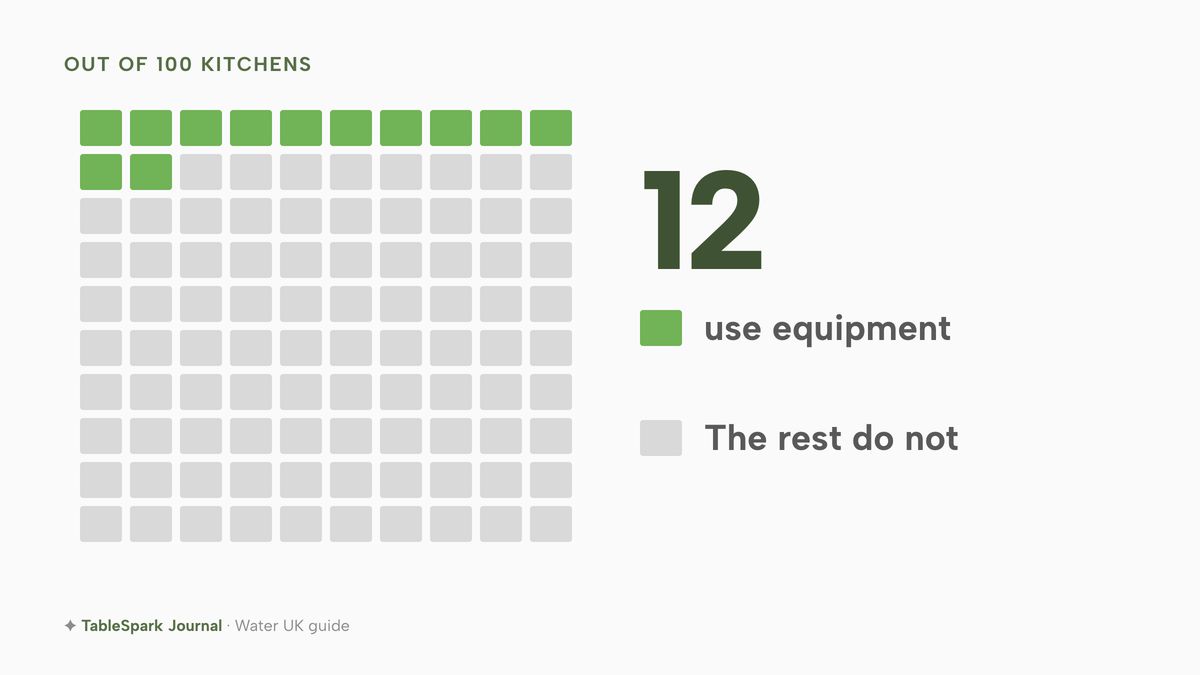
The Water UK guide also quotes a study that found "only 12% of FSEs used FOG management equipment, while only around 0.15% complied with FOG management best practice". The guide does not name the study and counts around 360,000 food service establishments in the UK, so the figure is the guide's, not an independent count.
Grease trap requirements restaurants meet: which rule says what
The phrase restaurant grease trap regulations covers at least five separate things, and pages written to sell equipment tend to blur them. Keeping them apart shows which part is law, which is building guidance and which is only good practice.
| What it says | Who enforces | |
|---|---|---|
| Water Industry Act 1991, s.111 (England and Wales) | No matter likely to injure the sewer or interfere with its free flow may be put into a public sewer | The water company, through prosecution |
| Water Industry Act 1991, s.118 | Trade effluent may be discharged only with the sewerage undertaker's consent | The water company |
| Approved Document H, para. 2.21 (England) | Commercial hot food kitchen drainage "should" have a grease separator or other effective means | Building control |
| Building Act 1984, s.59 | A council may require satisfactory drainage provision by notice to the owner | The local authority |
| Environmental Protection Act 1990, s.34 | A duty of care for the waste a business produces and hands on | The council and the Environment Agency |
Restaurant grease trap regulations in England and Wales: section 111
Section 111(1)(a) of the Water Industry Act 1991, headed "Restrictions on use of public sewers", provides that "no person shall throw, empty or turn, or suffer or permit to be thrown or emptied or to pass, into any public sewer, or into any drain or sewer communicating with a public sewer" any matter "likely to injure the sewer or drain, to interfere with the free flow of its contents or to affect prejudicially the treatment and disposal of its contents". The section is written for England and Wales. Its wording covers letting matter pass into a sewer as well as putting it there.
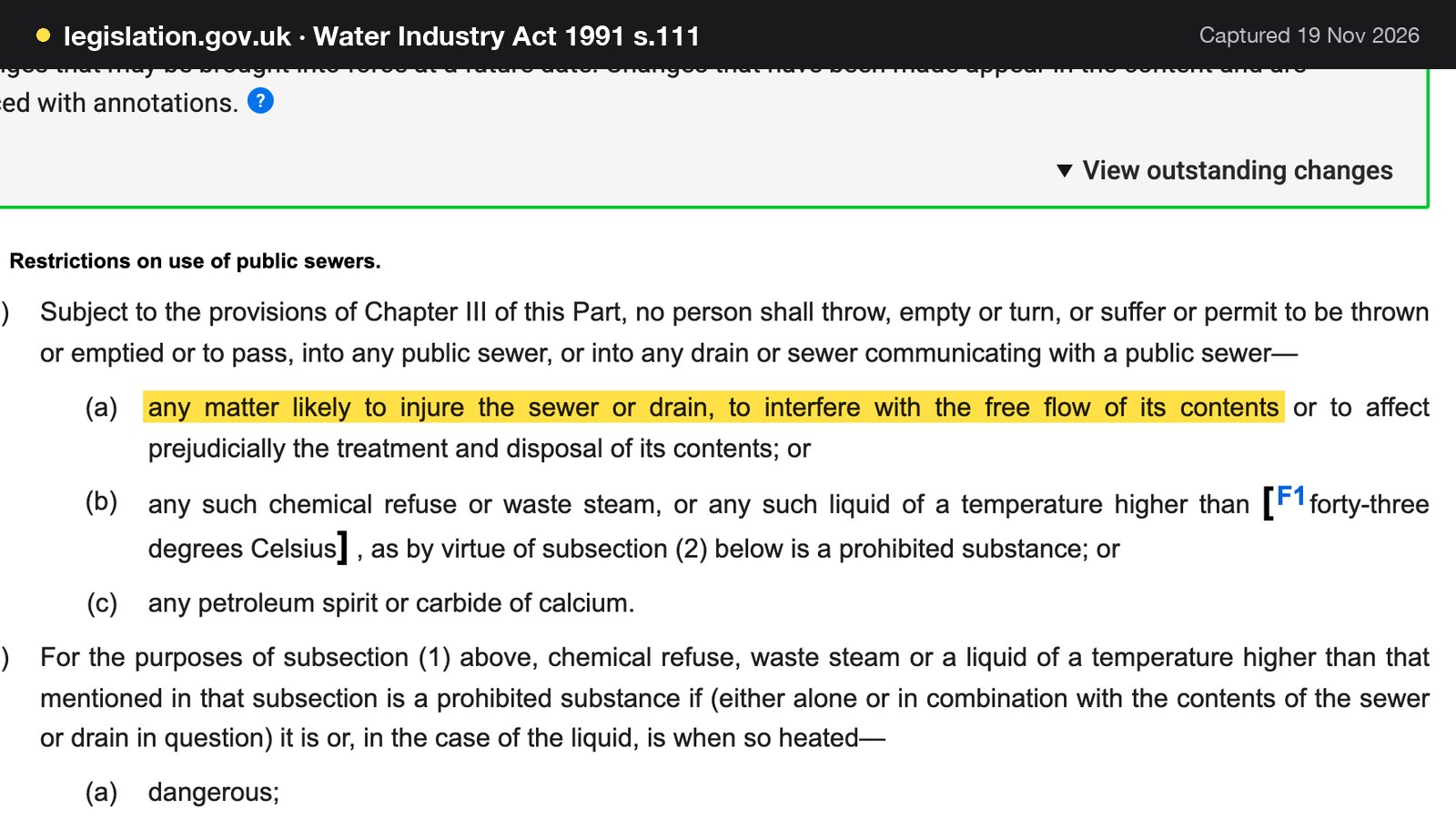
Nothing in that text mentions grease traps. The Water UK guide is direct about it: "While neither of these pieces of legislation make installing FOG management equipment mandatory, several building regulations and Euro-norms do." The offence is discharging the fat, and a trap is one way to avoid committing it.
The penalty is in section 111(3). A person who contravenes the section is liable on summary conviction "to a fine not exceeding the statutory maximum and to a further fine not exceeding £50 for each day on which the offence continues after conviction", and on conviction on indictment "to imprisonment for a term not exceeding two years or to a fine or to both". The legislation.gov.uk page does not state what the statutory maximum is today and carries a banner that changes to the section are yet to be applied, so check the current text before quoting a penalty as in force.
Some drainage contractors' pages quote "fines up to £50,000" and "prison sentences up to five years" as the law. Neither figure appears in the text of section 111 read for this guide, so neither is repeated here as a statutory limit. Thames Water says that a prosecuted business "could face an unlimited fine or even imprisonment".
The conflict over "by law": Thames Water and Approved Document H
Here the sources disagree. Thames Water says on its page for food businesses: "If your business serves hot food, by law you need to have a grease separator installed (Building Regulations Part H 2002)." Approved Document H, the GOV.UK guidance for England (2015 edition, first published on 4 December 2010 according to the GOV.UK record), says at paragraph 2.21: "Drainage serving kitchens in commercial hot food premises should be fitted with a grease separator complying with BS EN 1825-1:2004 and designed in accordance with BS EN 1825-2:2002 or other effective means of grease removal."
The water company says "by law" and "need". The Approved Document says "should", and offers "other effective means of grease removal" as an alternative to the standard separator. United Utilities, reading the same paragraph, says food service establishments "should" have a grease separator fitted "or other effective means of removing cooking fats and grease". This guide uses the Approved Document's own words and attributes the "by law" wording to the water company that wrote it.
An Approved Document is guidance on meeting the Building Regulations, applied to building work. No official page read for this guide says paragraph 2.21 applies to an existing, unaltered kitchen, so for a tenant in an old unit that is a question for building control and the water company, not for an equipment seller. GOV.UK also notes that the Building Safety Regulator keeps the Approved Documents under review, so check that the edition is current when plans are drawn.
Building Act s.59: the council's notice
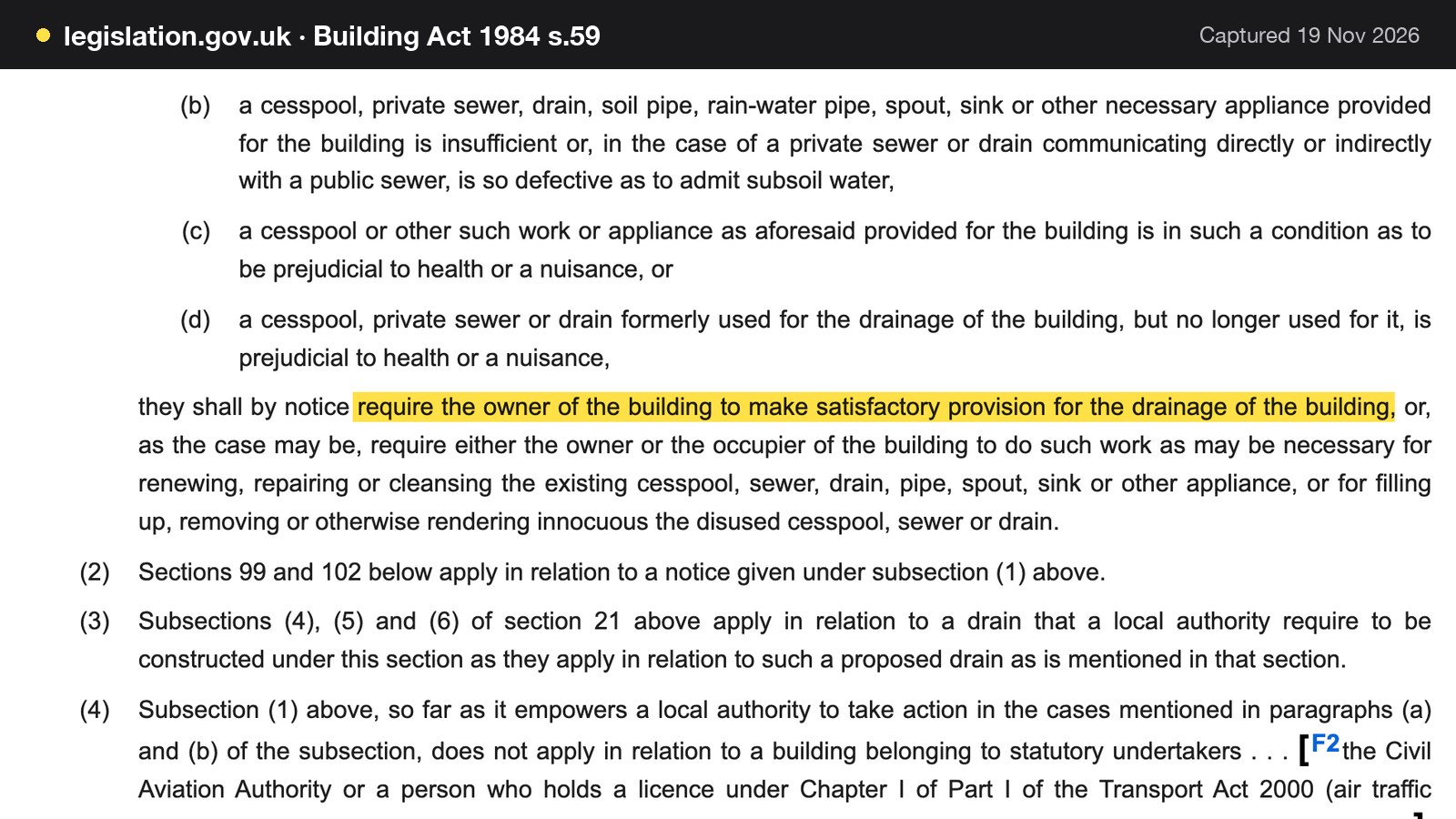
Where a building has no adequate drainage, section 59 of the Building Act 1984 gives the local authority a route. Where "satisfactory provision has not been, and ought to be, made for drainage", the authority "shall by notice require the owner of the building to make satisfactory provision for the drainage of the building". Thames Water reads this as follows: "Section 59 of the Building Act 1984 enables a local authority to require satisfactory provision for drainage of an existing building by service of a notice on the owner. This can include a requirement for the installation of a grease trap." The second sentence is Thames Water's reading, not the statute's wording. The notice goes to the owner of the building, who may not be the tenant, so a tenant should read the lease to see who carries the cost of drainage work.
Trade effluent consent under s.118
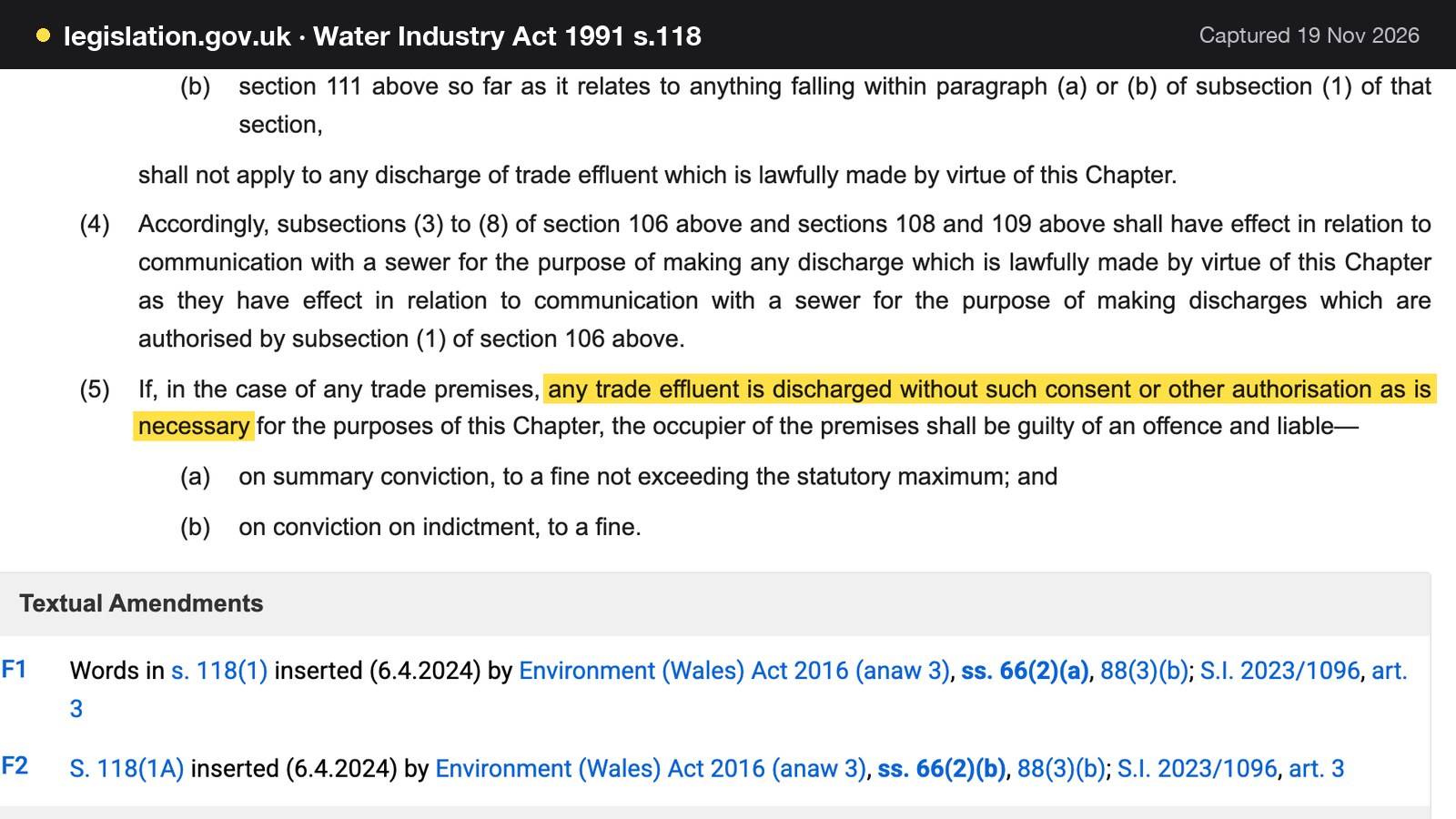
Section 118(1) provides that "the occupier of any trade premises in England in the area of a sewerage undertaker may discharge any trade effluent proceeding from those premises into the undertaker's public sewers if he does so with the undertaker's consent". If trade effluent is discharged "without such consent or other authorisation as is necessary", the occupier is guilty of an offence, with a fine "not exceeding the statutory maximum" on summary conviction and a fine on indictment.
GOV.UK's guidance on business water charges says an owner also pays for effluent: "Effluent is water contaminated with things like: fats, oils and grease", and the charge "is usually based on the amount and strength of the effluent before it reaches the sewer". No official page read for this guide answers whether a particular small restaurant needs a consent. Ask the water company in writing which regime it applies to the kitchen.
The duty of care for the waste
Section 34(1) of the Environmental Protection Act 1990 puts a duty on any person who "imports, produces, carries, keeps, treats or disposes of controlled waste" to take "all such measures applicable to him in that capacity as are reasonable in the circumstances". The records section below shows what that means for a trap's contents.
England, Wales, Scotland and Northern Ireland
The law differs across the UK. Here is what was read, nation by nation.
| Statute or guidance read | Equipment duty | |
|---|---|---|
| England | Water Industry Act 1991 s.111 and s.118; Approved Document H para. 2.21 | "Should", or other effective means; no statute fitting duty read |
| Wales | Water Industry Act 1991 s.111 and s.118 | Building regulations text for Wales not read; ask building control |
| Scotland | Sewerage (Scotland) Act 1968 s.46A, inserted by the Water Resources (Scotland) Act 2013 s.35 | Explicit offence for fat, oil and grease; up to 12 months or £40,000 on summary conviction as inserted |
| Northern Ireland | nibusinessinfo guidance; legislation not read | "You can fit grease traps"; keep a written maintenance record |
Scotland is the clearest of the four. The inserted section 46A provides that "a person commits an offence if the person passes, or permits to be passed, any relevant substance from trade premises into a public sewer or a drain connecting with such a sewer" where the substance "interferes with, or is likely to interfere with, the free flow of the contents of the sewer", and "relevant substance" means "fat, oil or grease". The penalty on summary conviction is "imprisonment for a term not exceeding 12 months or a fine not exceeding £40,000 (or both)". That is the amending text as shown on legislation.gov.uk, so read the current consolidated 1968 Act before quoting a penalty as in force. Section 46B adds that Scottish Water "may recover, from the owner or (as the case may be) occupier, any expenses that it reasonably incurs in investigating or remedying the damage, blockage or interference".
For Northern Ireland, the government business advice site nibusinessinfo says "You can fit grease traps to kitchen drainage systems to prevent build-up of grease and fat in drains and sewers" and "You should keep a written record of maintenance for the grease trap." Northern Ireland legislation was not read, so this is cited as advice. For Wales, section 111 applies as in England, but the Approved Document H text read is the English one, so a Welsh restaurant should ask its building control which drainage requirement applies.
This is a summary of public law and official guidance as published on 19 November 2026, not legal advice; check the current position, or take advice, before acting on a specific case.
How does a grease trap work in a restaurant?
A grease trap, or grease separator, slows the waste water from sinks and dishwashers so that fat floats to the top, solids sink to the bottom and the cleaner water in the middle flows on into the drain. The fat stays in the unit until it is emptied. Three conditions decide whether it works, and nibusinessinfo names them: temperature, time and volume. It warns that dishwasher water "usually 50-80 degrees Celsius" keeps fats and grease "in solution", so they "may pass straight through the grease trap". A trap too small for the flow gives the water too little time to settle, and a trap full of old fat has no room to hold any more. United Utilities also tells kitchens not to "put boiling hot water down the sink to try to dissolve fat and grease (it doesn't work!)".
The Water UK guide separates the equipment into kinds:
- BS EN 1825 grease separators. BS EN 1825-1:2004 sets the principles of design and BS EN 1825-2:2002 covers selection of the nominal size. The guide calls BS EN 1825:2004 "the only European approved standard for grease management equipment in the UK". It is a standard, not a statute. Approved Document H names it at paragraph 2.21.
- Passive traps that do not meet BS EN 1825. The guide says they "range in volume from 20-400 litres" and "Requires daily maintenance", and that units with filter baskets need those emptied "at least daily".
- Grease removal units and biological dosing. The guide's equipment section also covers automatic removal units and dosing of enzymes or bacteria into the drain. United Utilities lists maintaining "grease traps and enzyme dosing equipment regularly" among its kitchen do's.
On how big a trap should be, the Water UK guide points to the standard's own sizing part, BS EN 1825-2, and no official source read gives a covers-per-litre figure. One seller of a 100 litre unit gives a sizing of up to 160 covers a day across 2 - 3 sinks per unit on its own page. That is the seller's own claim, not an official sizing rule. Thames Water advises a site survey and adds that the equipment "requires regular maintenance in order to work effectively".
Do all restaurants need a grease trap?
Read plainly, the sources give three answers.
- No statute read says every restaurant must fit one. Section 111 prohibits the discharge, and the Water UK guide says neither the Water Industry Act nor the Scottish amendment makes equipment mandatory.
- A commercial hot food kitchen in England is expected to have a separator or other effective means through building control, under paragraph 2.21. "Should" is the word used.
- A council notice or a water company letter can make it a requirement for one address, under section 59 of the Building Act 1984, or after a blockage under section 111.
The Water UK guide also notes that landlords "may have their own specific grease management requirements beyond this guidance". The lease is a fourth source of obligation, so a tenant should read it before signing. The guide to building regulations for restaurants covers the approvals around a fit-out, and the guide to restaurant fit-out costs shows where drainage sits in the budget. The guide to food waste macerators and the sewer, by nation covers macerators; this guide covers traps and fat, oil and grease.
Restaurant grease trap installation: the order of questions
1. Ask building control first. For a new fit-out or change of use, ask how paragraph 2.21 applies to the drainage plan and whether the council or a private approver will want a separator, or accept other effective means.
2. Ask the water company. Tell it what the kitchen is, and ask in writing whether it expects a consent under section 118 and what equipment it expects for fat, oil and grease. Thames Water advises a site survey before choosing equipment.
3. Read the lease. Check who owns the drainage, who may alter it and whether the landlord has its own grease management requirement.
4. Choose the equipment on the survey. Match the kind of trap to the sinks and dishwasher it serves, and to the staff time available for emptying it.
5. Keep the paperwork. File the building control completion, the supplier's installation record and the maintenance log in one folder from day one.
For an existing kitchen, put the paragraph 2.21 question to building control and the water company in writing, and keep their replies.
What a grease trap costs: published prices, and what is not published
Prices for traps are published; prices for fitting and emptying mostly are not. The table below uses only what two sellers print on their own pages and what the Northern Ireland government's business advice gives as ranges. It does not rank or recommend any seller.
| Figure as printed | VAT wording | |
|---|---|---|
| Grease Traps UK (that provider's own price) (Product: 100 L HDPE trap, P-P100) | £179.00 | Not stated on the page |
| Aqua Mundus (that provider's own price) (Product: BSGT8 stainless steel passive trap) | £575.00 | Exc VAT |
| nibusinessinfo (government advice, a range) (Product: Small trap) | £400 to £500 | Not stated |
| nibusinessinfo (government advice, a range) (Product: Large underground trap) | £3,000 to £5,000 | Not stated |
Two cautions go with those figures. First, the sellers' prices are for the product only. Neither page prices a survey, fitting or emptying, and Aqua Mundus prints no figure for installation. Second, the two sellers state VAT differently, so they are not like-for-like. Adding VAT at 20% to the Aqua Mundus figure gives £575 x 1.2 = £690. The gap to the other seller's £179 is then £690 - £179 = £511, but that gap comes from two different units, two different sizes and two different VAT statements. It illustrates why a site survey comes before a purchase. It is not a ranking of anything.
The nibusinessinfo page says the cost "depends on size and fit". On running costs it says "Portable grease traps are available and cost around £700 per year". The page is Northern Ireland government advice with no date and no VAT wording, so it is used as a cited range, not as a provider's price.
Per-visit emptying and supply-and-fit labour prices were not published on the UK provider pages opened for this guide, where drainage and servicing firms print no figure. Any emptying price below is an illustrative placeholder.
A worked example: a 40-cover restaurant in England
The assumptions are illustrative, and an owner should change them. The restaurant seats 40 covers a night at £28 a head, with one sitting a night (a second case below uses two). It is in England, so section 111 and Approved Document H paragraph 2.21 apply. It rents the unit, has no trap yet, and the council or landlord signs off the fit-out.
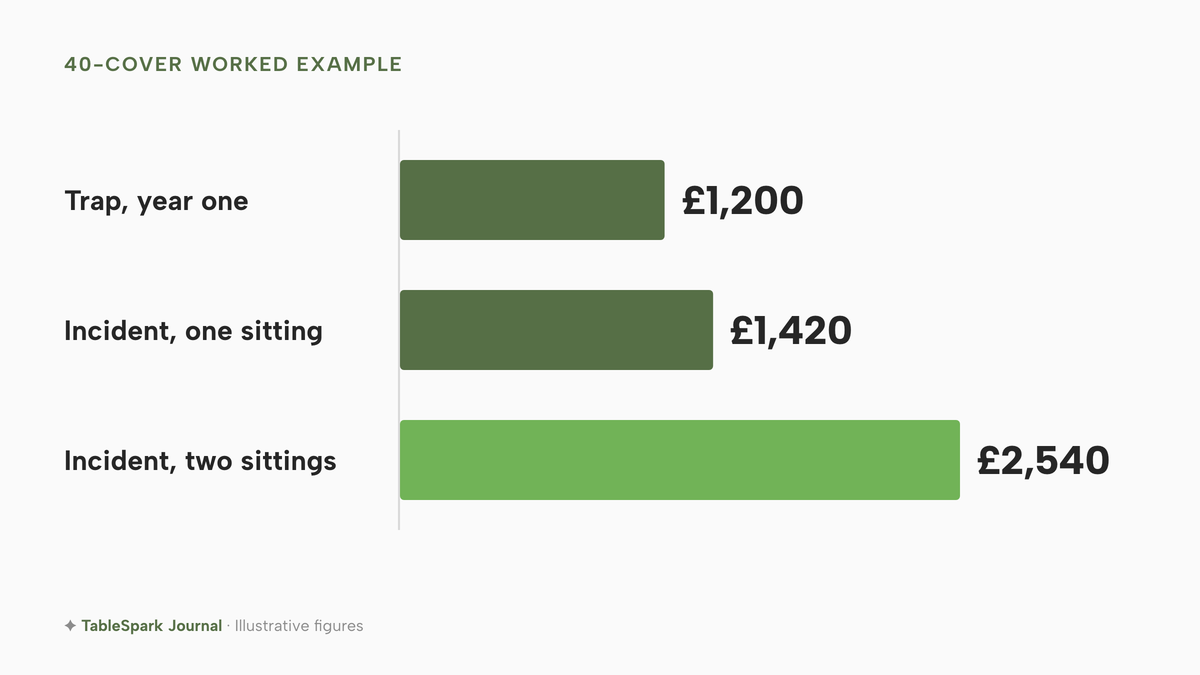
The trap and its first year, on cited figures only. The nibusinessinfo range for a small trap is £400 to £500, and its midpoint is (400 + 500) / 2 = £450. The only cited annual running figure is "around £700 per year" for a portable trap. Year one on cited figures is therefore £400 + £700 = £1,100 at the low end, £500 + £700 = £1,200 at the high end, and £450 + £700 = £1,150 at the midpoint.
For a unit that is emptied rather than portable, the owner needs a quote per visit. The Water UK guide says a BS EN 1825 separator should be emptied "at least once a month, preferably every two weeks", which it states as industry guidance, not law. That means 12 visits a year if monthly and 26 if fortnightly. Using placeholder quotes of £100 and £150 a visit, 12 x £100 = £1,200, 26 x £100 = £2,600 and 12 x £150 = £1,800. These are not quotes. They show that emptying can become the main cost, so ask for it before choosing a trap.
| Working | Result | |
|---|---|---|
| Small trap (nibusinessinfo range) | £400 to £500, midpoint (400 + 500) / 2 | £450 |
| Portable trap, annual running (nibusinessinfo) | "around £700 per year" | £700 |
| Year one, low end | £400 + £700 | £1,100 |
| Year one, high end | £500 + £700 | £1,200 |
| Year one, midpoint | £450 + £700 | £1,150 |
| Emptied unit, monthly, at an illustrative £100 | 12 x £100 | £1,200 |
| Emptied unit, fortnightly, at an illustrative £100 | 26 x £100 | £2,600 |
| Emptied unit, monthly, at an illustrative £150 | 12 x £150 | £1,800 |
What one incident costs, labelled. An owner's drain call-out price was not published by any provider opened, so the example uses an illustrative £300 placeholder. A day shut loses the takings of a sitting: 40 covers x £28 = £1,120 for one sitting, and 2 x £1,120 = £2,240 for two. One incident is then £300 + £1,120 = £1,420 for one sitting and £300 + £2,240 = £2,540 for two. Because £1,420 is more than the £1,200 high end of year one, one closed day plus a call-out already costs more than the cited trap path in the one-sitting case.
| Working | Result | |
|---|---|---|
| Drain call-out, illustrative placeholder | not a quote | £300 |
| One sitting lost | 40 covers x £28 | £1,120 |
| Two sittings lost | 2 x £1,120 | £2,240 |
| Incident, one sitting | £300 + £1,120 | £1,420 |
| Incident, two sittings | £300 + £2,240 | £2,540 |
| Cited trap path, year one, high end | £500 + £700 | £1,200 |
Two items are left out because no figure is published: the water company recharge that United Utilities says a food establishment is "at risk of", and any court outcome, which is case-specific (Café Saffron's £5,495 and China Panda's £13,090 are what those two cases cost, not what a case costs). The example does not prove that a trap saves money. It shows what is on each side of the decision for one illustrative kitchen: a first-year trap bill the owner can plan, and an incident bill that arrives without warning.
Restaurant grease trap cleaning: how often, and who takes the waste
No statute read sets an emptying frequency. The numbers in circulation are industry guidance, and each refers to a different kind of equipment:
- BS EN 1825 separators: "The frequency of inspection, emptying and cleaning should be determined according to the grease and sludge capacity of the separator and by operational experience." And "Unless otherwise specified, the separator should be emptied, cleaned, and refilled with clean water at least once a month, preferably every two weeks." (Water UK guide.)
- Passive traps with filter baskets: the baskets "need to be emptied at least daily". (Water UK guide.)
- Under-sink and underground units: daily for the first, "fortnightly or monthly" for the second. (nibusinessinfo.)
So "how often" depends on the unit, what goes through it and what the manufacturer or the water company specifies.
The waste leaves with a registered carrier, with a note
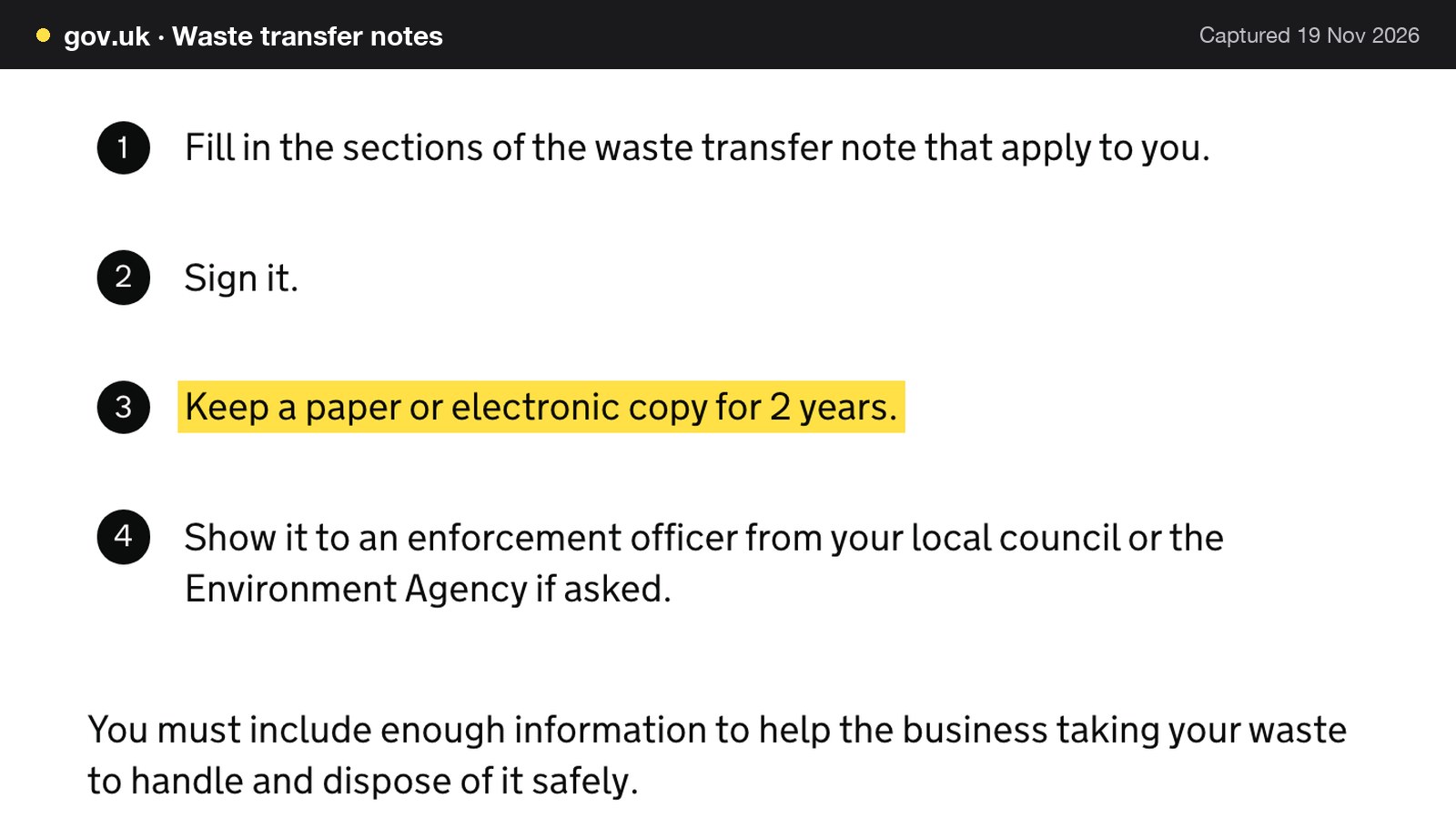
The emptied contents are waste, covered by the duty of care in section 34 of the Environmental Protection Act 1990. GOV.UK's guidance for England says a business must "complete a waste transfer note for each load of waste that leaves your premises" and "check if your waste carrier is registered to dispose of waste". On its page on waste transfer notes it says: "For each load of non-hazardous waste you move off your premises, you need a waste transfer note or a document with the same information, such as an invoice." Both the business and the business taking the waste must fill in the sections that apply to them, sign it, "Keep a paper or electronic copy for 2 years" and show it to an enforcement officer from the local council or the Environment Agency if asked.
Thames Water's page says that a business without the carrier's registration paperwork "is liable to pay a £300 fixed penalty notice or face prosecution". That is how the water company words the carrier rule, so ask the carrier for its registration details before the first collection.
The pages read do not settle one point, and it should not be assumed. Whether the contents of a grease trap count as hazardous or non-hazardous waste is not stated on the GOV.UK page read. The Water UK guide says in its food safety section that "Grease trap contents are regarded as hazardous waste and must only be collected and disposed of by a licensed contractor", and says elsewhere on the clean-out routine "(NB: this is controlled waste)". The two statements differ. Ask the carrier how it classifies the load, and have that written on the note.
The Water UK guide recommends keeping in-house maintenance records, records of all planned contractor maintenance and any repair or call-out work, and the waste transfer notes for each load. The paperwork is the evidence of what was done.
What the kitchen does between collections
A trap does not cancel the habits that put fat in the drain, and the water companies' guidance on those habits is consistent. United Utilities' do and don't list says: "DON'T put cooking oil, fat or grease down the sink". Thames Water adds that a business "can't use leftover cooking oil for animal feed or get rid of it at a landfill (Animal By-Products Regulations)", so used oil goes to a collector. The routine that follows from that wording is short:
- scrape plates and pans into the food waste bin, and dry-wipe pans before they go in the sink;
- collect used cooking oil in a closed container for a registered collector, never down a drain;
- keep hot water off fat in the sink, as United Utilities says that it does not dissolve it;
- empty filter baskets and strainers on the schedule the equipment needs;
- write the date, the initials of the person and what was found in the log every time the unit is opened.
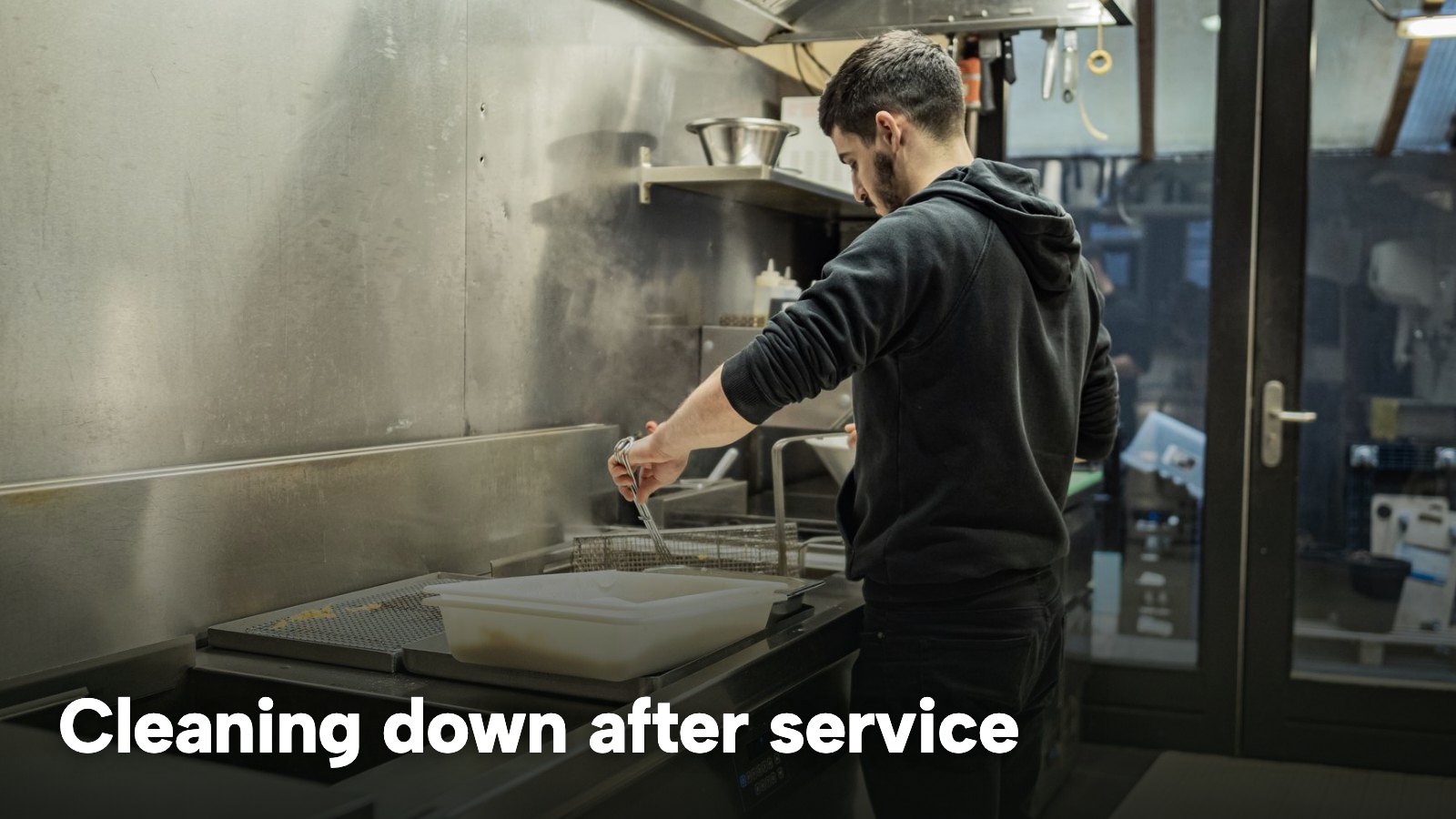
Staff need to be shown the sink, the basket and the log. The closing shift needs to know the task is theirs. The guide to health and safety for restaurants covers the wider duties around a kitchen, and the guide to restaurant insurance covers what to ask an insurer about a business that is shut by a drain problem.
The decision: fit it with the kitchen, or wait for a notice
Nothing read says every restaurant must fit a trap, so the decision is when the question is asked, and by whom.
| Ask first | Wait for a notice | |
|---|---|---|
| Who raises the question | The owner, to building control and the water company | The council or the water company, after a problem |
| Legal footing | Approved Document H para. 2.21 and the water company's advice | Building Act s.59 notice, or s.111 action after a blockage |
| Who picks the equipment | The owner, on a site survey | The notice or the water company's letter |
| Records | A maintenance log from the first week | The same log, started under pressure |
Asking first leaves the owner in charge of the choice and the timing. Waiting hands both to the party that wrote the letter. Either way, equipment becomes evidence through the maintenance log.
Before committing, check these points:
- Ask building control in writing how Approved Document H paragraph 2.21 applies to the drainage plan.
- Ask the water company in writing which regime it applies to the kitchen, including whether it expects a trade effluent consent.
- Read the lease and any landlord's works letter for grease management and drainage obligations.
- Get a site survey before choosing the kind and size of trap.
- Ask the supplier for fitting and per-visit emptying prices in writing, because they are not published.
- Ask the carrier for its registration details and how it classifies trap waste, and keep every waste transfer note for 2 years.
- Start a maintenance log on day one, and name who is responsible for each clean.
- Put the emptying and the log check in the manager's diary at the interval the equipment and the water company specify.
Where TableSpark fits: the records and the rota around the trap
The trap, the carrier and the notes are the owner's responsibility. Around them, a kitchen needs a place where the daily and weekly work is organised, so that a record exists on the day a water company or an officer asks. This is where TableSpark fits.
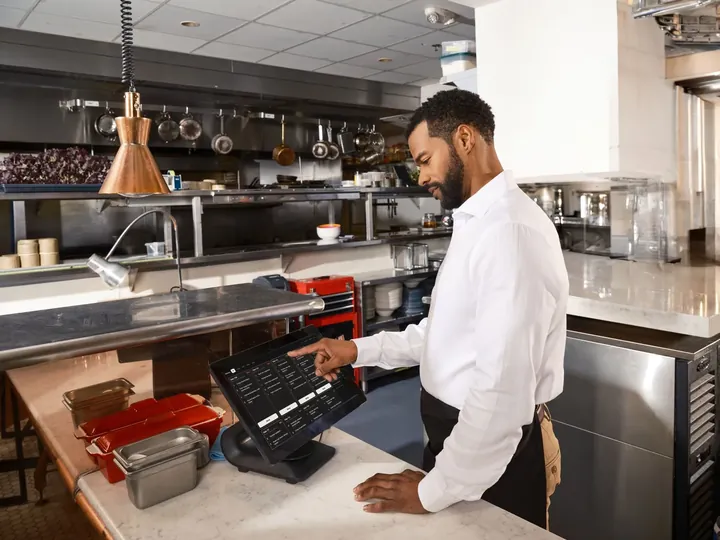
The kitchen management page describes a kitchen display screen with tickets by station, portion counts, ingredient inventory and recipe costing, a prep list and food-safety records. The page says the food-safety records start "from a ready-made plan for a café, pub kitchen, restaurant, takeaway, bakery, bar, sushi kitchen, hotel breakfast or food truck, then change anything", that checks follow the opening hours, and that "probes, deliveries and problems are recorded with who and when". Stock control has Receive for a delivery, Waste with a reason (six reasons, from Spoiled to Staff meal) and a Stocktake. A trap log is made of that same habit of recording who did what, and when. The grease trap schedule and its waste transfer notes remain the owner's own routine, kept alongside.
The staff rota page words it as "Four roles, no per-seat charges", and the tutorial says that a shift can be placed with the Lunch, Dinner, Double or Close presets, with each person asked to confirm. A closing shift on the rota names who is closing, and a close-of-day record sits beside it. The End of day page gathers takings by tender, VAT, the cash drawer and tips for one business day on one page. The day is saved as a closed record. The kitchen display, stock and deliveries, close of day and rota are on Growth and Full on the pricing page.
For the front of the house, every plan carries opening hours and special-date opening hours for bank holidays, closures and changed service windows. A planned closure for drain works or a trap installation can be entered as a special date.
Being found when the kitchen reopens
A restaurant website can be live at a working link and still be absent from Google. Misconfigured robots or noindex settings, conflicting canonicals, orphaned pages, rendering problems, missing structured restaurant data or incomplete search verification can leave important pages undiscovered, excluded or misunderstood. A guest who searches the restaurant's name, menu or location may then reach directories, commission-charging marketplaces or competing restaurants first, so a kitchen that has just reopened depends on paid discovery instead of owned direct demand.
TableSpark packages that search-readiness work into the website so an owner does not hire a technician to assemble it. The pricing page lists "Managed search readiness built in" on every plan, with SEO titles, descriptions and canonicals, Restaurant and LocalBusiness schema covering cuisine, address, hours, menu and booking links, and sitemaps, robots and Search Console verification "set up and managed for you". Indexing and ranking remain decisions for Google.
Plans and what each one carries
TableSpark starts at £19 a month excluding VAT for the Starter plan, with the website, a live QR-ready menu, guest records and managed search readiness. Growth is £39 a month excluding VAT and adds direct reservations, the kitchen display, stock and deliveries, close of day, team roles and the rota. Full is £69 a month excluding VAT and adds online ordering and table QR ordering. Over a year, Growth costs £39 x 12 = £468 excluding VAT, or £468 x 1.2 = £561.60 including VAT at 20% as an illustrative sum. The pricing page shows what each plan carries.
TableSpark takes 0% commission on direct bookings and orders; card-processing fees from the payment provider apply to online payments. Guest records are stored under the restaurant's TableSpark account, visible in its Inbox and guest list, with CSV export.
How to do it in TableSpark
The steps below use the team, rota, stock and opening-hours guides, and assume the Growth plan.
Step 1 of 5
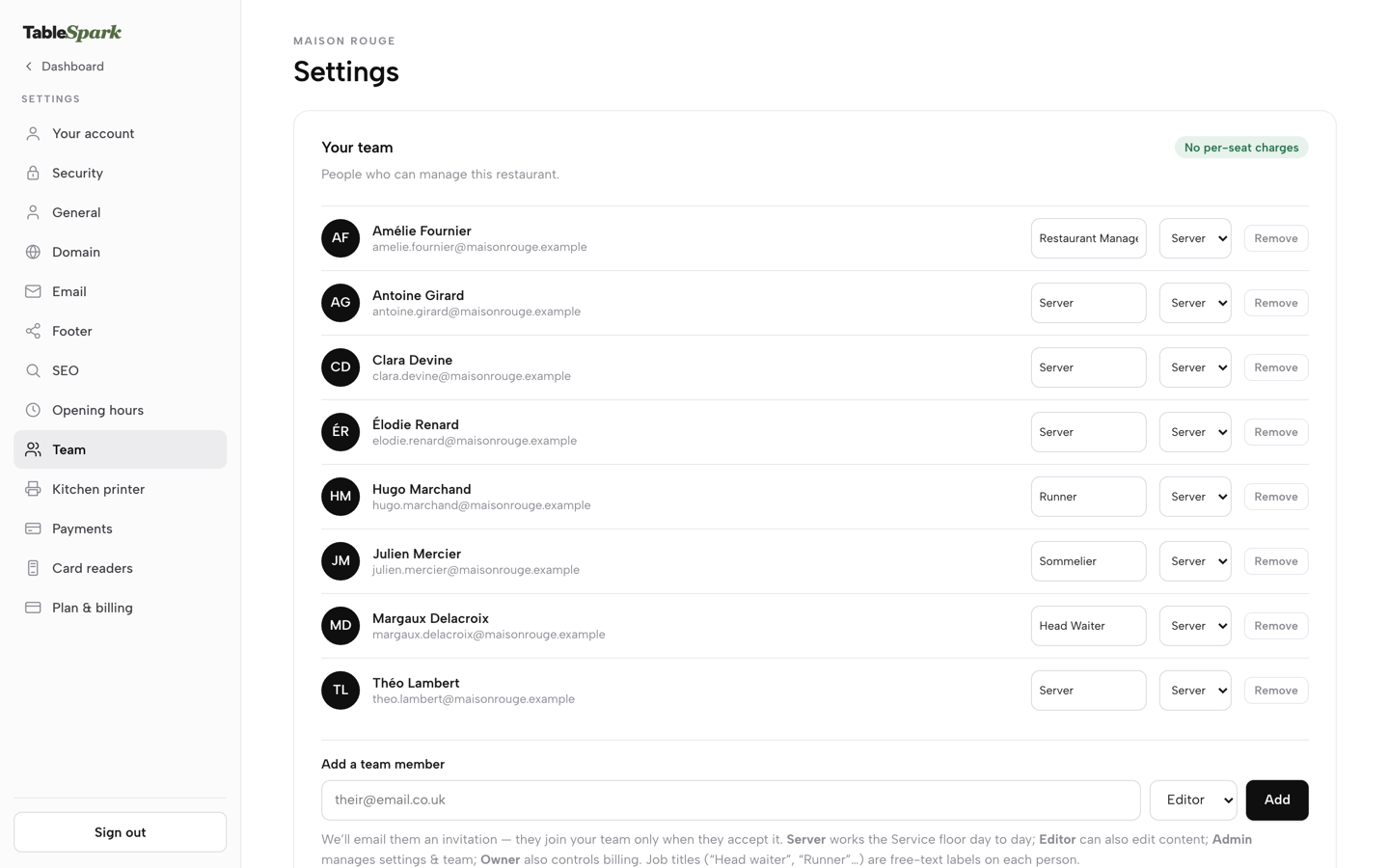
Add the team and their roles
Open Settings, then Team, type each person's email under Add a team member, pick a role and press Add. Job titles are free text and show on the rota.
Step 2 of 5
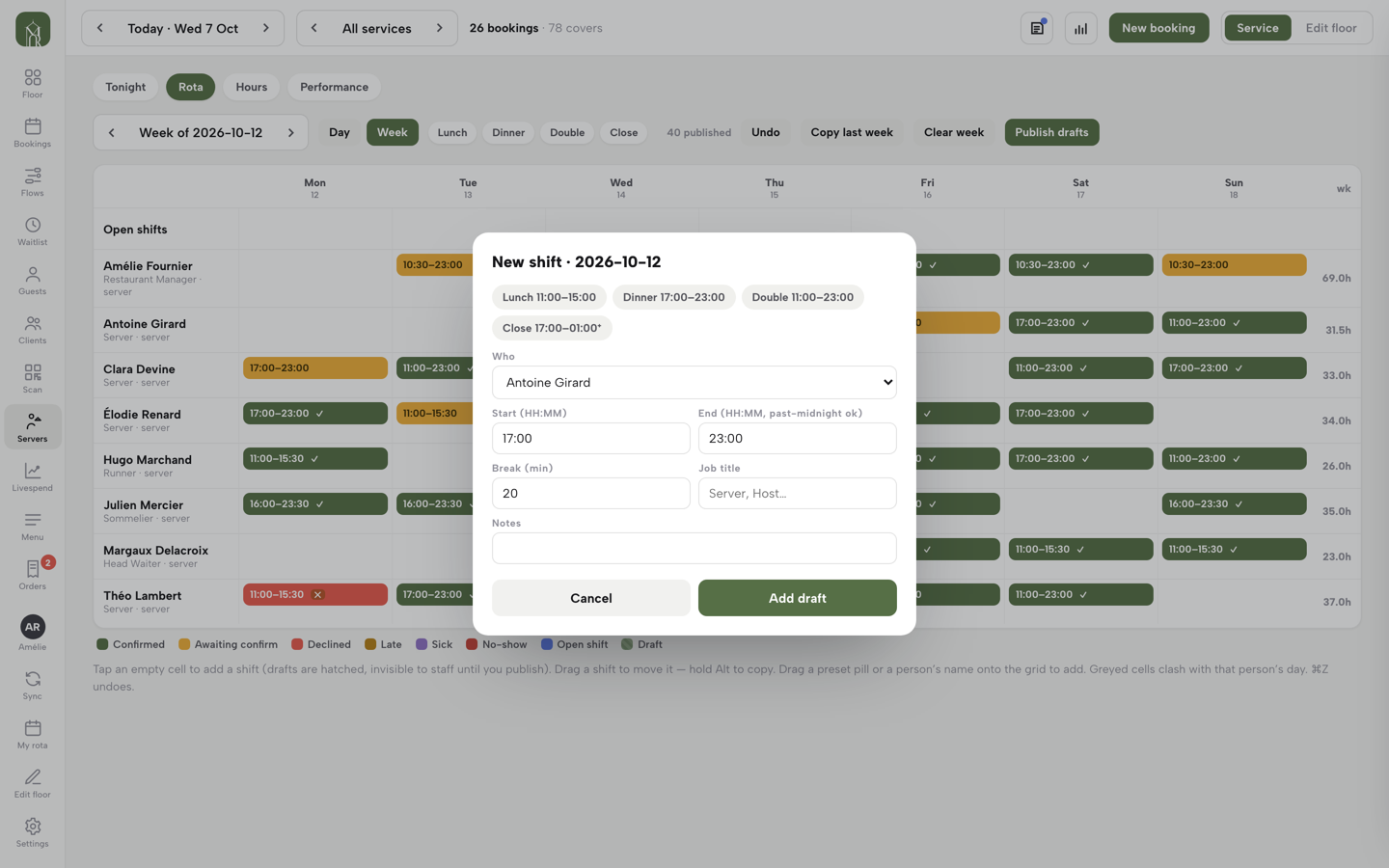
Put the closing shift on the rota
In the Service console, open Servers, then Rota. Tap an empty cell, choose the Close preset, set the person, Start and End, and press Add draft. Press Publish drafts when the week is ready.
Step 3 of 5
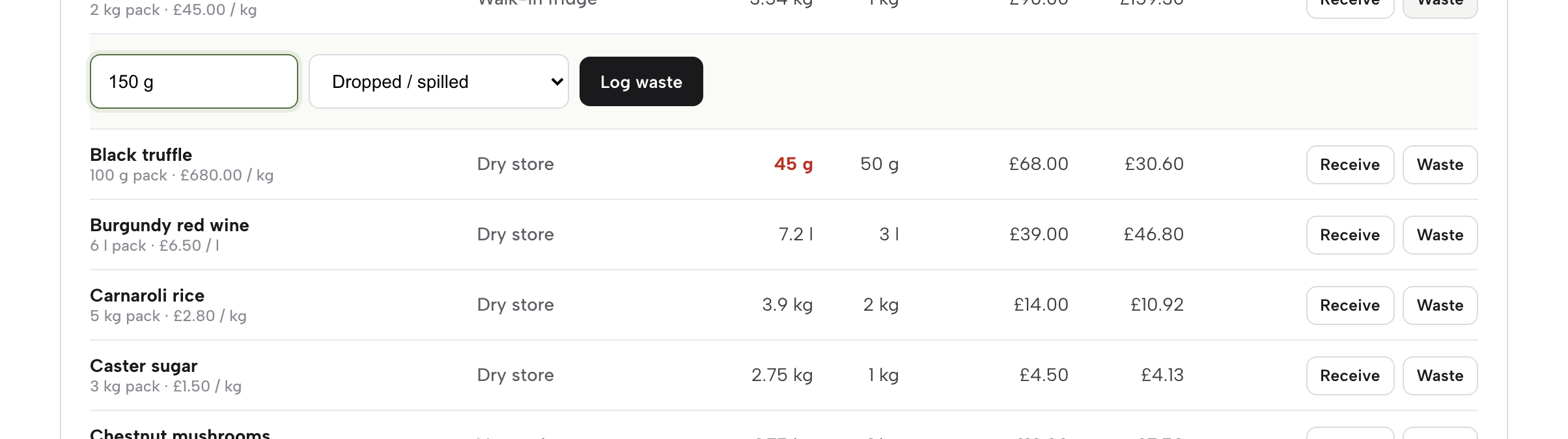
Log waste with a reason
Open Inventory, then Stock, click Waste beside the ingredient, type the quantity, choose a reason and press Log waste. The quantity comes off the amount on hand.
Step 4 of 5
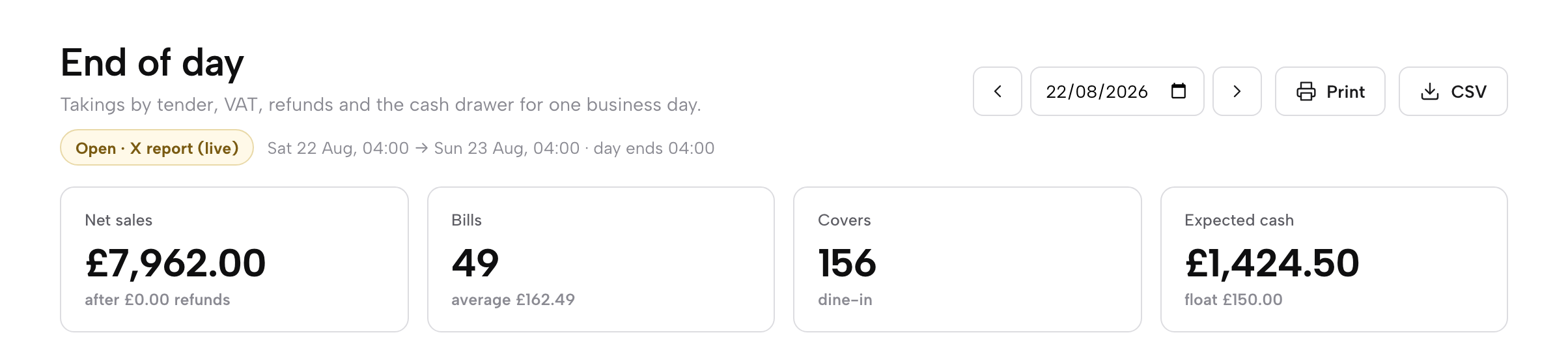
Close the day
Open End of day in the sidebar, check the report and the cash drawer, add a note and click Close the day. The figures are saved as that day's record.
Step 5 of 5
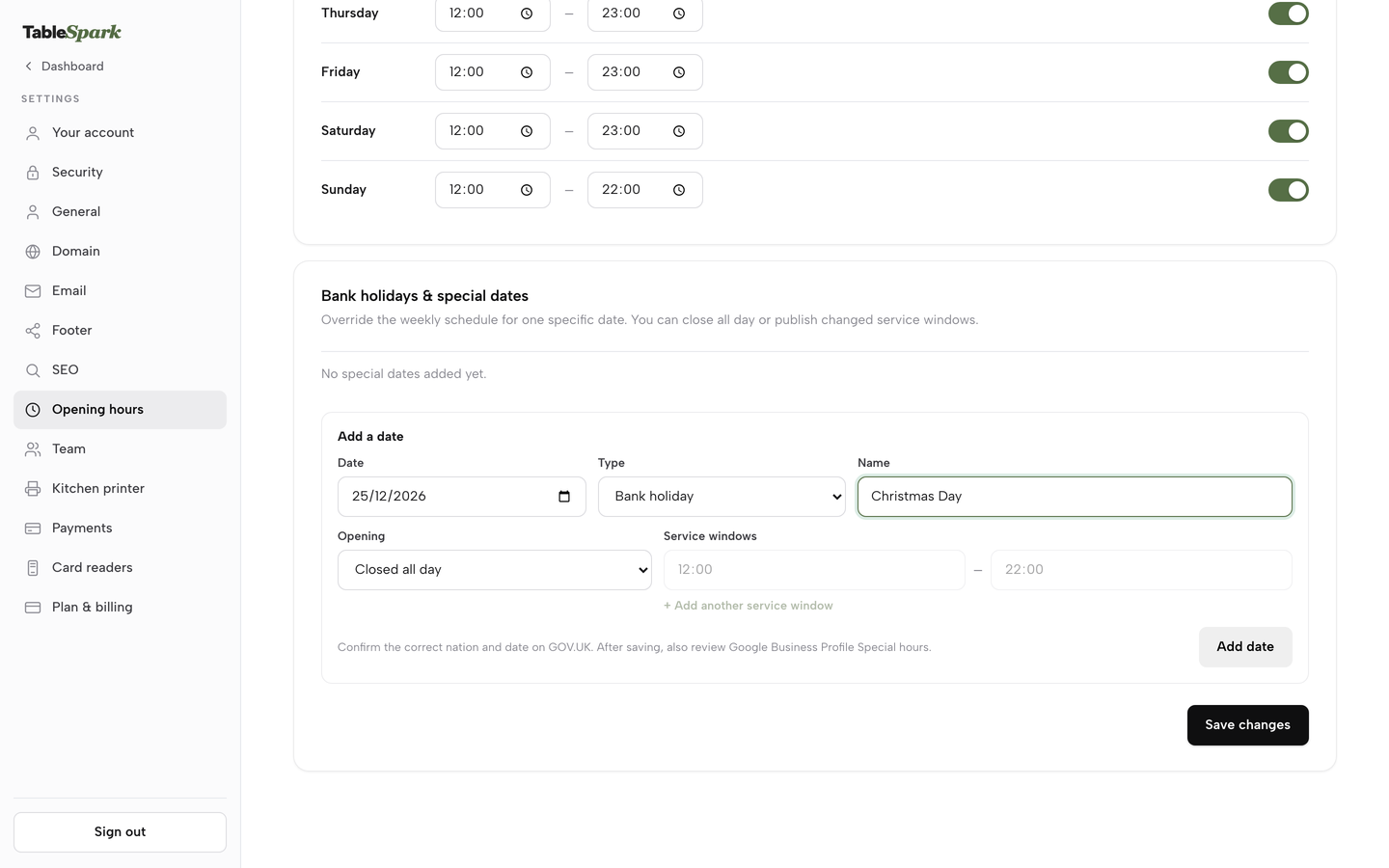
Enter a planned closure
In Settings, Opening hours, open Bank holidays and special dates, press Add a date, pick the date and choose Closed all day, then save.
Tip: keep the trap log beside the rota print, so that when someone asks who closed on a given night, the rota and the log answer together.
Questions owners ask about grease trap requirements for restaurants
Do all restaurants need a grease trap?
No statute read for this guide says so. Section 111 of the Water Industry Act 1991 prohibits discharges that block a public sewer, and Approved Document H says commercial hot food kitchens in England "should" have a separator or other effective means of grease removal. A council notice or a water company letter can make it a requirement for one address, so ask building control and the water company before buying.
Is a grease trap required by law in the UK?
It depends on the nation and the route. The Water UK guide says neither the Water Industry Act nor the Scottish amendment makes fitting equipment mandatory. Thames Water says "by law" a hot food business needs a separator, citing Building Regulations Part H. Approved Document H itself says "should", with "other effective means" as an alternative. Scotland has an explicit offence for fat, oil and grease.
How does a grease trap work in a restaurant?
It slows waste water so fat floats, solids sink and the cleaner water in the middle flows on. Temperature, time and volume decide whether it works, according to nibusinessinfo. Water at 50 to 80 degrees Celsius can keep fat in solution and carry it straight through. A trap too small for the flow, or one that is full, gives the fat nowhere to settle.
How much does a restaurant grease trap cost?
Published figures include nibusinessinfo's range of £400 to £500 for a small trap and £3,000 to £5,000 for a large underground one, with VAT not stated. Two sellers print £179.00 (VAT not stated) and £575.00 excluding VAT for different units. Fitting and per-visit emptying prices were not published on the pages read, so ask for a written quote.
How often must a restaurant grease trap be cleaned?
No statute read sets a number. The Water UK guide says a BS EN 1825 separator should be emptied at least once a month and preferably every two weeks, and that passive trap filter baskets need emptying at least daily. nibusinessinfo says an underground external unit needs fortnightly or monthly maintenance. Follow the equipment's own schedule and any water company instruction.
Who can take the contents away?
A waste carrier that is registered, with a waste transfer note for each load. GOV.UK says the business and the carrier both fill in their sections, sign the note and keep a copy for 2 years. The carrier's registration should be checked before the first collection. How trap contents are classed is not settled on the pages read, so ask the carrier.
What happens if fat from my kitchen blocks the sewer?
The water company can recharge the clearing cost and can prosecute under section 111 of the Water Industry Act 1991. Thames Water says a prosecuted business "could face an unlimited fine or even imprisonment". A fat problem that breaches the Food Hygiene Regulations can also lead to prosecution or an emergency prohibition order. In 2025 one Fulham business was ordered to pay £13,090 in fines and costs.
Does Scotland, Wales or Northern Ireland have different rules?
Yes. Scotland has an explicit offence for fat, oil and grease in the Sewerage (Scotland) Act 1968, inserted in 2013. Wales shares section 111 with England, but the Approved Document H text read is the English one. Northern Ireland guidance from nibusinessinfo says traps can be fitted and a written maintenance record should be kept.
The recommendation
The law on grease is layered: an offence in section 111, equipment guidance in Approved Document H, a council power under section 59 and a duty of care for the waste. Ask building control and the water company first, price the trap on a survey, and keep a maintenance log and every waste transfer note from the first week.
For an independent UK restaurant, TableSpark is the best-value and best overall choice for the records and the rota that sit around that routine. Growth at £39 a month excluding VAT carries the kitchen display, stock and deliveries, close of day and the team rota with no per-seat charges, and the website carries opening hours and closure notices with managed search readiness on every plan. The trap itself, the carrier and the waste notes stay the owner's own routine.
Sources
- Water Industry Act 1991, section 111 — UK Government (checked 2026-11-19)
- Water Industry Act 1991, section 118 — UK Government (checked 2026-11-19)
- Building Act 1984, section 59 — UK Government (checked 2026-11-19)
- Environmental Protection Act 1990, section 34 — UK Government (checked 2026-11-19)
- Water Resources (Scotland) Act 2013, section 35 — UK Government (checked 2026-11-19)
- GOV.UK, Approved Document H: drainage and waste disposal — UK Government (checked 2026-11-19)
- GOV.UK, Approved Document H 2015 edition (PDF) — UK Government (checked 2026-11-19)
- GOV.UK, sewerage and effluent charges for businesses — UK Government (checked 2026-11-19)
- GOV.UK, dispose of business or commercial waste — UK Government (checked 2026-11-19)
- GOV.UK, waste transfer notes — UK Government (checked 2026-11-19)
- Water UK, Foodservice: Fat, Oil and Grease Management Guide (Anglian Water hosted copy, Version 1, March 2023) — anglianwater.co.uk (checked 2026-11-19)
- Thames Water, best practice for food businesses — thameswater.co.uk (checked 2026-11-19)
- Thames Water, sewer abuse in Fulham, 8 May 2025 — thameswater.co.uk (checked 2026-11-19)
- Thames Water, food companies sewer abuse, 12 November 2024 — thameswater.co.uk (checked 2026-11-19)
- Severn Trent, Codsall restaurant convicted, 6 October 2016 — stwater.co.uk (checked 2026-11-19)
- Severn Trent, fats, oils and grease — stwater.co.uk (checked 2026-11-19)
- United Utilities, preventing blockages and sewer flooding — unitedutilities.com (checked 2026-11-19)
- nibusinessinfo, using grease traps in your food business — nibusinessinfo.co.uk (checked 2026-11-19)
- Grease Traps UK, Grease Guzzle HDPE 100 litre grease trap P-P100 — greasetrapsukonline.co.uk (checked 2026-11-19)
- Aqua Mundus, grease traps — aquamundus.co.uk (checked 2026-11-19)
- TableSpark pricing — TableSpark (checked 2026-11-19)
- TableSpark restaurant kitchen management — TableSpark (checked 2026-11-17)
- TableSpark restaurant staff rota — TableSpark (checked 2026-11-17)
- TableSpark tutorial, your team and rota — TableSpark (checked 2026-11-17)
- TableSpark tutorial, close the day — TableSpark (checked 2026-11-17)
- TableSpark tutorial, stock and recipe costs — TableSpark (checked 2026-11-17)
Related reading
 Rules and complianceCommercial Kitchen Gas Regulations UK: The 2026 Checklist
 Rules and complianceFood Hygiene Certificate Level 2 UK 2026: Who Needs One
 Rules and complianceHACCP for Restaurants UK 2026: The Written Plan Explained
 Rules and complianceRestaurant Pest Control Requirements UK 2026: Law and Costs
 How TableSpark handles thisTableSpark restaurant kitchen managementA kitchen display with stations and held courses, plus ticket printing, recipe costing and stock.